Shopping for the best stand mixer for baking cakes can feel strangely high stakes. The machines are big, they sit on your counter for a decade, they cost real money, and every product page claims to be the one serious bakers trust.
Underneath the marketing, though, the decision comes down to a small number of physical facts: how big the bowl is, how the beater moves through it, how much torque the motor can hold under load, and whether the whole machine fits your kitchen and your baking habits. This guide walks through those facts in plain language so you can pick the best stand mixer for baking cakes with confidence instead of guessing from a star rating.
The best stand mixer for baking cakes is the one whose bowl matches your usual batch, whose beater reaches the bottom of that bowl, and whose design suits your counter. For most home bakers making one or two layer cakes at a time, that points to a tilt-head mixer in the 4.5 to 5 quart size class with a flat paddle, a wire whisk and a bowl that scrapes clean.
Bakers who stack tiers, mix large frosting batches or knead heavy dough often do better with a bowl-lift in the 5 to 7 quart range. If you bake a few cakes a year, a good hand mixer may serve you better and cost much less. The rest of this guide shows you how to decide.
- How we wrote this guide
- Do you need a stand mixer for cakes?
- How a stand mixer works
- Bowl size and batch capacity
- Tilt-head vs bowl-lift
- Motor, power and gearing
- Beater-to-bowl clearance
- Attachments that matter for cakes
- Bowl material and extras
- Size, weight, noise and storage
- Warranty, repairs and the used market
- Brand families as examples
- A decision framework
- Checklists to carry to the store
- Using your mixer for cakes
- Care and troubleshooting
- Mistakes to avoid
- FAQ
How we wrote this guide to the best stand mixer for baking cakes
Before anything else, an honest note about what this page is and is not. We have not run a lab comparison of mixers for this article, and we are not going to hand out made-up scores, rankings or “winner” badges. A numbered list of products with a percentage next to each one looks authoritative, but unless somebody has actually measured the same batters in the same kitchen with the same method, those numbers mean very little.
We would rather give you something you can use for years: the criteria that decide whether a mixer will serve a cake baker well, the reasoning behind each one, and a way to check any model on any store shelf against your own needs.
Where we cite specific figures, such as typical bowl sizes or the weight difference between mixer styles, they come from the manufacturer’s own published guidance, and we name the source. Specifications, model names and prices change often, and they differ by country, so please confirm current details on the maker’s page before you buy. We also avoid quoting prices at all. They move too quickly to be useful in an evergreen guide.
If you plan to use this guide alongside our recipe pages, it pairs naturally with our best vanilla cake recipe and our best chocolate cake recipe, both of which give batter weights you can use for the batch math later in this article. For technique, our guide to cake mixing methods explains why creaming, reverse creaming, foaming and one-bowl mixing each ask different things of a machine.
A quick disclosure. This article does not currently contain affiliate links. If we add any in the future, we will say so clearly near the links, and our advice will keep following the same criteria you read here rather than whatever pays best.
What “best” means when you want the best stand mixer for baking cakes
Cake baking asks different things of a mixer than bread baking or cookie baking does. A cake batter is relatively light, but it has to be mixed evenly, and many cakes depend on the machine to build air into butter and sugar or to whip eggs and whites into a stable foam. Frosting adds another job, because a good buttercream often needs several minutes of steady whipping in a bowl big enough to give the mixture room to expand.
Meanwhile the thing you care about most, a fine, even crumb, depends on the beater reaching all of the batter without overworking it.
That is why the best stand mixer for baking cakes is rarely the most powerful or the most expensive. It is the machine that does a handful of everyday jobs reliably: creaming a pound of butter, whipping egg whites without a lot of dead space, mixing a typical two-layer batter without leaving a pocket of dry flour at the bottom, and whipping a generous batch of buttercream without climbing out of the bowl. Everything else is a bonus.
Who this guide to the best stand mixer for baking cakes is for
This guide is written for home bakers in the United States who bake layer cakes, sheet cakes, cupcakes and the frostings that go on them. It will also help if you bake cookies and the occasional loaf of bread, since the same machine usually covers those jobs. If you run a small home business, you will probably outgrow a home mixer sooner than you expect, and the capacity sections here will help you see where that line is.
Do you need a stand mixer for cakes at all?
It is worth asking this honestly, because a mixer that you do not use is a heavy, expensive ornament. A great many excellent cakes are made with nothing but a whisk, a bowl and a spatula. Oil-based cakes and many one-bowl recipes, like the one in our chocolate cake guide, are designed to be stirred by hand. A hand mixer handles creamed batters and whipped frosting well, and it takes a fraction of the storage space. So before you decide on the best stand mixer for baking cakes, think about what you actually bake.
When a whisk and a spoon are enough
If you mostly bake oil cakes, muffins, quick breads and one-bowl cakes, you may not need any mixer at all. These recipes want gentle mixing, and an electric machine mostly gives you more ways to overmix. A big whisk and a sturdy spatula are also easier to clean and cheaper to replace.
When a hand mixer is the smarter buy
A hand mixer is a great fit if you bake cakes occasionally, you have a small kitchen, or you want something that comes out of a drawer in seconds. It can cream butter and sugar, whip egg whites and make buttercream. Its limits are practical rather than magical: you have to hold it, the bowl does not rotate on its own, and long jobs, such as whipping Swiss meringue buttercream or kneading, are tiring.
We cover the details in our guide to the best hand mixers for cake and frosting, including what to look for in speed control and beater design.
When the best stand mixer for baking cakes earns its counter space
The best stand mixer for baking cakes starts to make real sense when you bake regularly, when you want both hands free, and when you do long jobs. Think of a thirteen-minute buttercream, a meringue that needs to whip while you pour hot syrup, a double batch of cupcakes or a cake with several components. Because the machine does the holding, you can weigh the next ingredient, prepare pans or watch the clock. For bakers who also make bread, cookies for a crowd or holiday baking in volume, the case is even stronger.
A simple test. Count how many times you have used a mixer for more than five minutes in the last month. If it was more than once or twice, the hands-free benefit of the best stand mixer for baking cakes will probably feel worth it. If it was zero, a hand mixer or a whisk likely will.
How a stand mixer works, and why it matters for cake
You do not need to be an engineer to buy a good mixer, but a little understanding of how it works helps you read specifications and avoid the traps. The illustration below labels the parts we refer to throughout this guide.

Planetary action in the best stand mixer for baking cakes, explained
Most home stand mixers use what is called planetary action. The beater spins on its own axis, and the whole beater assembly also travels around the inside of the bowl, much like a planet spinning while it orbits the sun. The point is coverage. A beater that only spun in one place would work the middle of the bowl and leave the edges alone.
By orbiting while it spins, the beater passes through every part of the bowl, which is why you can walk away from a mixer in a way you cannot from a handheld one.
Planetary action is why the gap between the beater and the bowl matters so much. If the beater travels in a path that leaves a large gap at the bottom or side, a layer of butter or flour can sit there untouched. If it travels too close, it can scrape. We give that its own section below.
The motor and gearbox of the best stand mixer for baking cakes
The motor spins, but it is the gearing that turns that spin into the slow, strong, steady motion a mixer needs for thick mixtures. In general, a mixer needs torque, which is turning force, more than it needs raw speed. A well-geared machine can hold a slow speed steadily even when you load it with stiff dough or a heavy cookie mixture. A poorly geared one may strain, slow down or overheat.
For cake, you rarely push a machine that hard, but you do ask it to hold a consistent speed while butter and sugar cream, and that consistency shows up in the crumb.
Speeds and why “low” matters most
Most mixers list ten or twelve speeds, and almost nobody uses more than four of them for cake. What matters is how the lowest speeds behave. A good mixer has a true low speed, a gentle stir that folds in flour without flinging it onto the counter, and a smooth step up from there. When you compare models, pay attention to how slowly the slowest setting actually goes and how steadily it holds that pace.
The parts of the best stand mixer for baking cakes you touch most
You will also use the bowl, the beaters, the locking mechanism and the controls dozens of times a year, so ergonomics count. Can you lift the bowl out with one hand? Does the head lock firmly? Can you scrape the bowl without feeling that you are wrestling with the machine? These small things decide whether you reach for the mixer or avoid it.
Bowl size and batch capacity: the first filter for the best stand mixer for baking cakes
If you only learn one thing before you shop, learn this: match the bowl to the batches you actually make. Bowl capacity is the single most useful number on a mixer’s box, and also the one most easily misunderstood. A bowl labeled with a certain number of quarts does not mean you can fill it to the brim. It describes the total volume of the empty bowl, and a working mixer needs a lot of empty space above the batter to avoid splashing, to let air expand and to let the beater move freely.
What the quart numbers mean on the best stand mixer for baking cakes
Manufacturers label home stand mixer bowls in quarts in the United States, and in liters elsewhere. According to KitchenAid’s own guidance, its tilt-head mixers use bowls from roughly 3.5 to 5 quarts, while its bowl-lift mixers come with bowls of about 5 to 7 quarts, and additional bowl sizes are sold separately for many models. Other makers sit in similar ranges, though you should check each one.
We are quoting one brand’s published ranges only to give you a sense of scale, not to say that any single brand has the best stand mixer for baking cakes.
Think of the quart number on the best stand mixer for baking cakes as a size class rather than a promise. A 4.5 or 5 quart bowl is a very common choice for home bakers, large enough for most layer cakes and a double batch of cookies, small enough to fit on a counter. Smaller bowls suit lighter use. Larger ones suit heavy and frequent baking.

The batch math for the best stand mixer for baking cakes, using our own batters
Here is a way to turn the quart number into something concrete. A typical two-layer, 8-inch cake from our recipes, such as the batter in our vanilla cake guide, weighs roughly 1.2 to 1.4 kilograms (about 2.6 to 3 pounds) before baking. Cake batter is close to water in density, so that is somewhere around 1.2 to 1.4 liters, which is about one and a third to one and a half quarts.
Creamed batters gain volume as they whip, because you are beating air into the butter, so the batter takes up a little more room by the time it is ready for the pans.
Now add a cautious rule of thumb. We suggest keeping the batter at or below about 60 percent of the bowl’s stated capacity. That is our own working guideline, not a manufacturer rating, and it leaves room for the beater to move, for whipped mixtures to grow and for you to add ingredients without making a mess. Applying it gives rough batch counts:
- Around 3.5 quarts: about one 8-inch two-layer batch at a time, with limited room for anything else.
- Around 4.5 quarts: one batch comfortably, and sometimes a smaller second one.
- Around 5 to 6 quarts: about two batches, which suits a cake plus a set of cupcakes or two cakes for a party.
- Around 7 quarts: two to three batches, a comfortable size for tiered cakes and baking in volume.
These are estimates, and your batter may be thicker or thinner than ours. Still, they give you a defensible way to decide whether a given bowl suits your usual jobs, and they explain why the best stand mixer for baking cakes for a once-a-month baker is not the same machine as the best one for somebody who bakes a wedding cake every weekend.
Do the math with your own recipe. Weigh the finished batter once. Divide the grams by about 950 to get an approximate quart figure, then divide that by 0.6 to see the smallest bowl that gives you our suggested headroom. A batter that weighs 1,300 grams works out to about 1.4 quarts, which suggests a bowl of roughly 2.3 quarts or larger for comfort. Larger bowls simply add margin and capacity for frosting.
Why frosting sets the limit for the best stand mixer for baking cakes
Batter gets most of the attention, but frosting is usually what pushes a bowl to its limit. Buttercream starts dense and then expands as it whips. Swiss meringue buttercream starts with egg whites that need to grow several times in volume. Whipped cream can double. If you make big frosting batches for a tall layer cake, you will want more headroom than the batter math suggests.
Our buttercream guide compares the main types and their yields, and our Swiss meringue buttercream guide shows why that particular recipe benefits from a roomy bowl and a good whisk.
Small batches can trip up even the best stand mixer for baking cakes
Bigger is not automatically better, and the best stand mixer for baking cakes is rarely the largest one. A large bowl can be a bad match for small jobs. If you whip two egg whites in a 7 quart bowl, the whisk may spin without really touching them, because a small volume of liquid spreads thinly across a wide bowl bottom.
Manufacturers acknowledge this by publishing maximum quantities by bowl size for things like flour and egg whites, and a few sell smaller bowls as accessories. If you regularly whip small amounts, such as a single egg white for a glaze or a half cup of cream, take that into account. It is one reason many bakers keep a hand mixer around even after buying a stand mixer.
Common jobs and the bowl they like
One 8-inch layer cake
Fits easily in most bowls of 4 quarts and up. A smaller bowl can work if you mix the batter and frosting at separate times.
Two cakes or cake plus cupcakes
This is where a 5 to 6 quart bowl becomes useful. You mix once, divide the batter and save time and dishes.
Tiered or celebration cakes
These push toward the 6 to 7 quart class, partly for batter and partly for the large amount of frosting you need.
Sheet cakes
These need more batter per cake than layer cakes. A bowl of 5 quarts or more is more relaxed, though a single sheet cake is workable in smaller sizes.
Foam cakes and meringues
These need volume more than weight. Large whisked whites can expand to several times their starting size, so look at the whisk and the bowl shape, not only the quarts.
Cookies and bread alongside
Dense mixtures stress the machine more than cake does. If you bake them often, include them in your capacity planning.
The widest bowl is not always the best bowl
Two bowls with the same quart label can behave differently. A bowl that is tall and narrow keeps a small amount of batter deeper and helps the whisk reach it. A shallow, wide bowl spreads it out. The shape of the bottom, curved or flat, changes how well the beater follows its contour. This is one more reason to treat the stated capacity as a starting point and to look at how the beater sits in the bowl, which we cover in the clearance section.
A practical way to choose the size of your best stand mixer for baking cakes
Write down the three jobs you do most often and the largest job you do a few times a year. Choose a bowl comfortable for the first group, and make sure the second group is possible, even if it means working in two rounds. It is far easier to mix a second batch than to live with a machine too large to store, too heavy to lift or too clumsy for small jobs. If you often find yourself in the largest category, move up one size class.
Do not buy for the one giant project. The bake you do twice a year should not dictate the machine you use fifty times a year. Plan to split that one big job into two batches, and buy for your normal week.
Tilt-head vs bowl-lift: which design suits the best stand mixer for baking cakes?
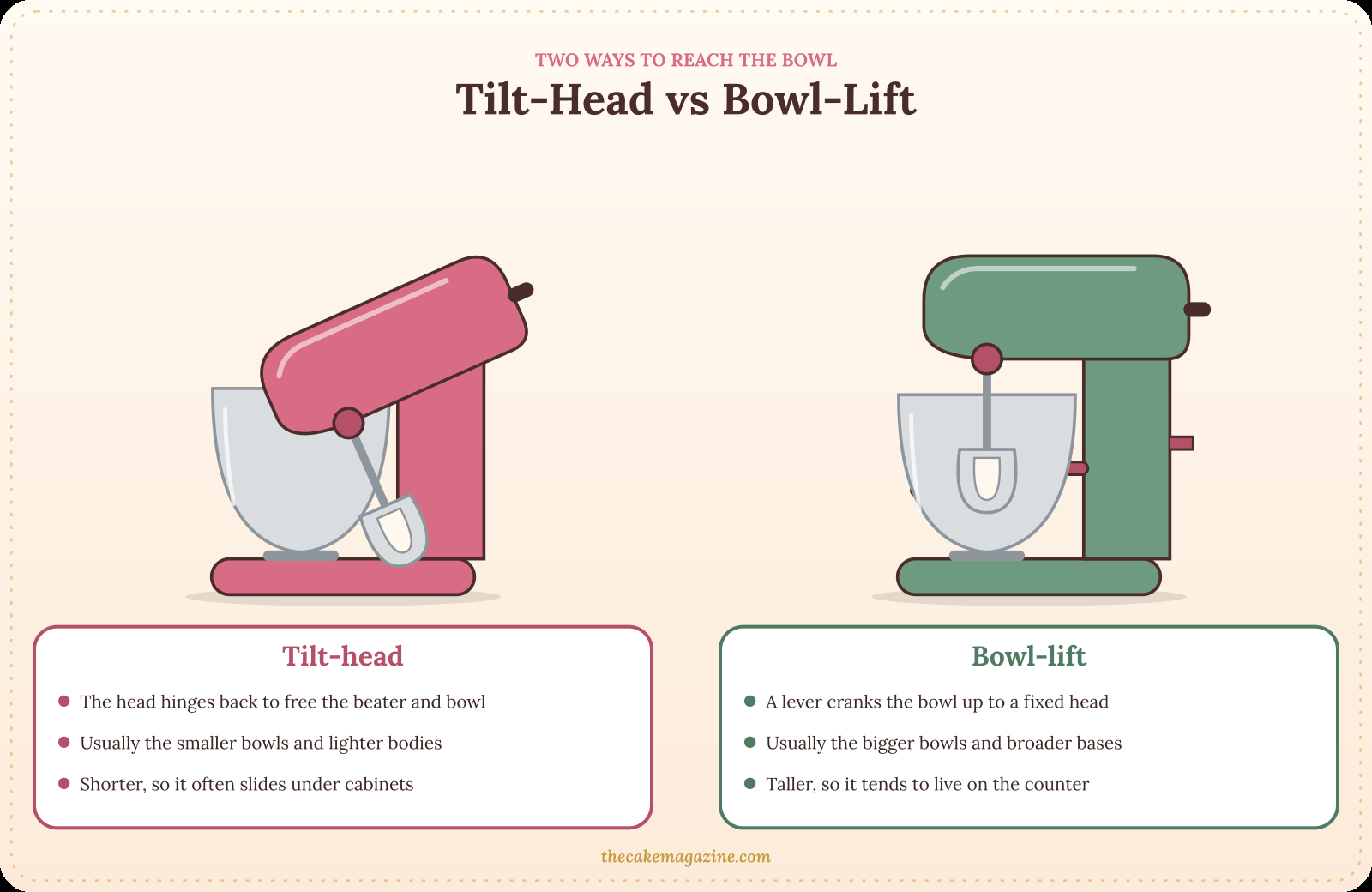
Most home stand mixers fall into one of two families. In a tilt-head mixer, the motor head hinges at the back and tips up so you can attach the beater and lift out the bowl. In a bowl-lift mixer, the head stays fixed, and a lever cranks the bowl upward until the beater is in position. Both are planetary designs, and both can make excellent cakes. The differences show up in size, stability and convenience.
What the manufacturer says about the two designs
KitchenAid, whose two styles are the best known in American kitchens, publishes a helpful comparison. By its account, tilt-head bowls run from about 3.5 to 5 quarts and bowl-lift bowls from about 5 to 7 quarts. It describes bowl-lift mixers as offering more power for thick or heavy mixtures, and it points out that bowl-lift models have broader bases and weigh roughly 29 to 32 pounds, against about 18 to 26 pounds for tilt-head models.
Height differs too: its tilt-head mixers stand about 14 inches tall, so they tuck under most cabinets, while the bowl-lift models are around 16.5 inches and are better left on the counter. We are relaying those figures as one maker’s published numbers. Another brand’s tilt-head or bowl-lift may differ, so compare the details for any model you consider.
Why tilt-head designs often make the best stand mixer for baking cakes at home
For a typical home baker, the tilt-head layout is handy. Tilting the head up gives easy access to the bowl, which matters when you scrape the sides, check how well the butter has creamed or add dry ingredients in stages. The machines are usually lighter, so moving one from a cupboard to the counter is not a workout.
They tend to cost less than bowl-lift counterparts, and their bowls are in the size class that suits one or two layer cakes. If your baking is mostly cakes, cookies and the occasional quick bread, a tilt-head in the 4.5 to 5 quart class is a sensible starting point.
There are trade-offs. Some bakers report that heavy dough makes a tilt-head rock or bounce. The head has to tip up, so you need clear space above the machine, which can matter in kitchens with low cabinets. And the smaller bowls limit very large batches.
Why bowl-lift designs can be the best stand mixer for baking cakes for heavy bakers
A bowl-lift mixer keeps the head fixed and puts the bowl on arms that rise to meet the beater. That construction is generally sturdier, with a lower center of gravity and a broader base. It suits heavy loads, big batches and bakers who push their machines. The bowls are bigger, which gives the headroom that large batches of frosting and tiered-cake batter want. If you bake in volume, make bread regularly or mix thick cookie dough in big quantities, a bowl-lift may be the more comfortable long-term choice.
The downsides are practical. These mixers are heavier and taller, and they take up more room. Lifting the bowl in and out can feel awkward in a tight space, and the arms around the bowl sometimes make it harder to scrape the sides. Some bakers find that the bigger bowls feel oversized for small jobs, like a single batch of whipped cream.
A third option: neither
A few mixers use different designs altogether. Some compact models skip the heavy-duty base and aim at a smaller footprint. Others, such as machines with a rotating bowl and fixed tools, work in a different way from planetary designs, and are usually aimed at bread more than cake.
Cake bakers can use any of them, but most of the advice in this guide assumes a planetary design because it is the most common, and because the way it moves the beater is well suited to creaming and whipping. If you are looking at something unusual, read how its own maker describes the mixing action and ask whether it can cream butter and whip a small number of egg whites.
The honest summary. A tilt-head is usually the more convenient choice for the best stand mixer for baking cakes at home. A bowl-lift is usually the stronger choice if you bake in volume or mix dense doughs. Neither design makes a better cake by itself. Both rely on the beater reaching the bottom of the bowl.
Checking the stability of the best stand mixer for baking cakes in the store
If you can see the machines in person, put your hands on them. Rock the mixer gently from side to side. Check how firmly the head locks, and how much the bowl wobbles when it is seated. Look at the suction feet. A heavy base that grips the counter matters more than any claim about horsepower.
If you cannot test one in person, read the specifications for weight and look for reviewers who describe how the machine behaves with a stiff dough, since a mixer that walks across the counter during bread dough may still be fine for cake, but you will want to know.
Motor, power and gearing in the best stand mixer for baking cakes: what to believe
Power is where marketing gets loud. Boxes proudly state wattage, ads talk about horsepower and some brands describe motors as professional grade. It all sounds precise, but it is the least reliable thing to compare when you search for the best stand mixer for baking cakes.
Why wattage figures can mislead
A wattage number can describe different things. It may be the electrical power the motor draws, not the useful work it delivers at the beater. Efficiency varies, and so does the gearing between the motor and the beater, which means two machines with the same wattage can behave very differently under load. Comparing wattage across brands, or across mixer styles, can send you to the wrong shelf. It is better to treat it as one clue among several.
What actually matters: torque, gearing and sustained speed
For cake, you want a mixer that holds its speed steadily when the load changes. For example, creaming cold butter at the start of a recipe is heavier than whipping a light batter at the end, and a mixer that bogs down is a mixer that will overheat sooner. The qualities that deliver this are better gearing, solid construction and a motor with enough reserve that it is not running flat out. These are hard to see on a spec sheet, but you can find clues:
- Weight and build. Heavier machines usually have more metal in the housing and gears, which helps with stability and longevity. Weight is not proof of quality, but a very light mixer should be examined closely.
- Gear material. Some manufacturers describe all-metal gearing. If a brand tells you what its gears are made of, you can compare. If it will not say, that is a signal too.
- Stated capacity limits. Reputable makers publish maximum flour, egg white or dough quantities by bowl size. A mixer rated for generous maximums is not necessarily better, but a rating that fits your needs is a good sign.
- Warranty length and terms. A manufacturer that is willing to stand behind the machine for years is making a statement about the motor.
How much power does the best stand mixer for baking cakes really need?
Less than the ads suggest. Cake batters are lightweight compared with bread dough or stiff cookie dough. A mixer that handles a double batch of buttercream and a two-layer batter without straining is fully adequate for cake. Extra power is mainly insurance for heavier jobs. If you never make bread, you do not need to pay a premium for a machine designed to knead it, although you may still want the sturdier base and larger bowl that come with those models.
Signs of a mixer that is working too hard
Whatever you buy, learn to notice stress signals: the motor note changing pitch, the head rocking, a warm smell, the machine slowing dramatically when you add flour. The remedy is usually to reduce the batch size, lower the speed or give the motor a rest. A mixer that shows these signs on normal cake batters in a normal-sized bowl is probably the wrong tool for the job.
Speed control and the low end of the best stand mixer for baking cakes
As we said earlier, the slow speeds do most of the work in cake baking. Some machines have a soft start, which begins slowly and ramps up so flour does not fly out of the bowl. Others offer a pulse or a very low “stir” setting. These small details can matter more for cake than an extra horsepower. If you can, check how the machine handles a spoonful of flour at the lowest setting. A clean fold without a cloud of dust is a good sign.
Beater-to-bowl clearance: the quiet detail behind every even batter
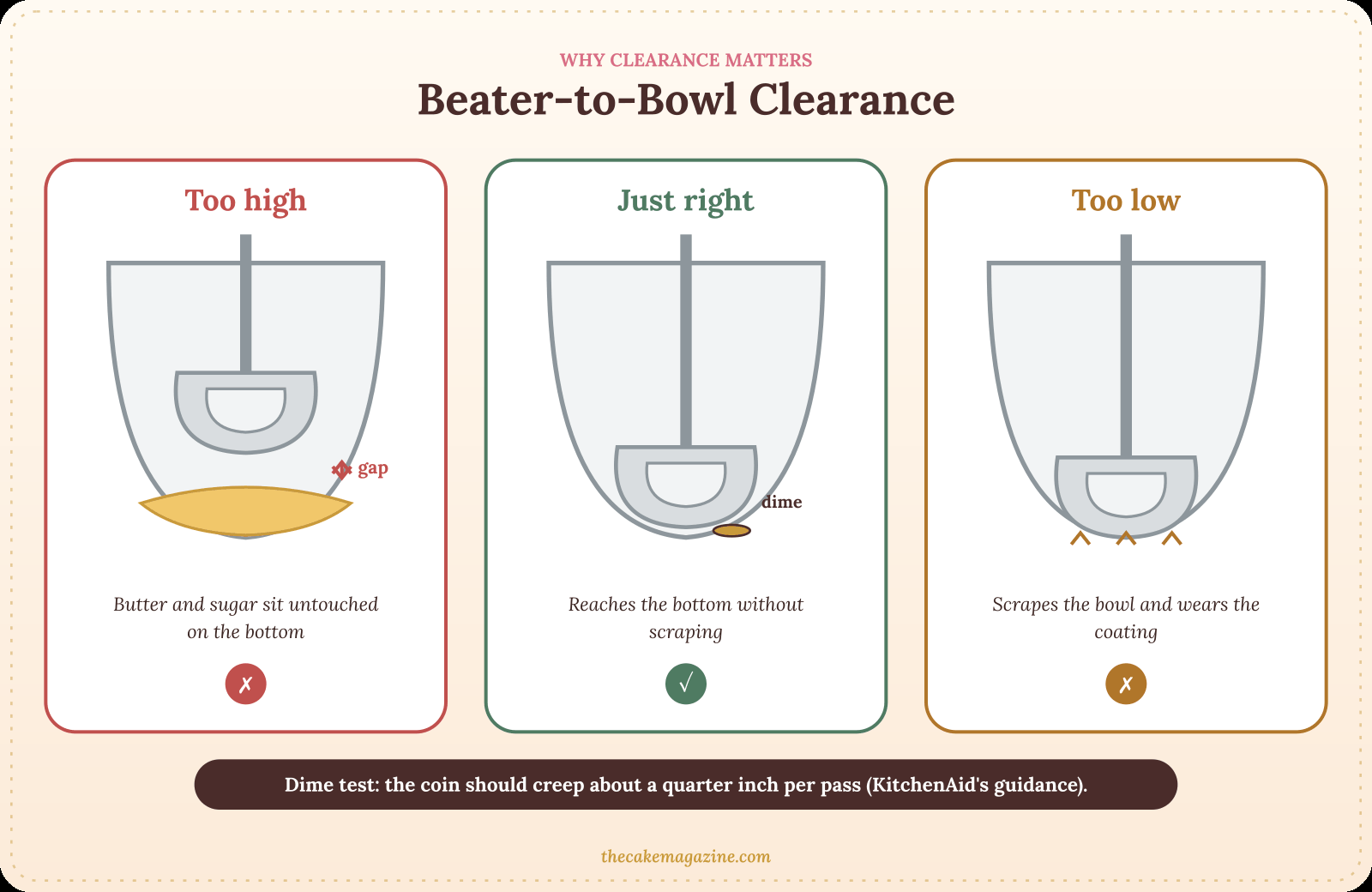
If there is one specification that deserves more attention than it gets when choosing the best stand mixer for baking cakes, it is the clearance between the beater and the bottom of the bowl. Cake batter lives and dies on even mixing, and a gap of the wrong size is the most common reason for streaky, uneven results.
Why the beater gap matters in the best stand mixer for baking cakes
When the beater rides too high, it never touches the layer of ingredients at the bottom. Butter and sugar sit in a patch, flour gathers in a pocket and the rest of the batter spins around it. You may not notice until you pour the batter and find a dense, wet or floury spot. When the beater rides too low, it scrapes the bowl, which wears the coating on a coated beater, can leave marks and makes an unpleasant noise.
The ideal is a beater that comes very close to the bottom and sides without touching.
The dime test
KitchenAid describes a simple check for its mixers that other bakers also use as a rough guide. You attach the flat beater, place a dime in the empty bowl and run the mixer on a low speed. According to the company, the dime should move about a quarter of an inch with each pass of the beater. If the dime does not move, the beater is too high.
If it will not move smoothly around the bowl, the beater is too low. Most mixers have a small adjustment screw that raises or lowers the beater, and the manufacturer says to turn it only a tiny amount at a time, then test again. The location of the screw and the direction of adjustment differ by model, so follow your manual.
What to look for when you shop for the best stand mixer for baking cakes
You cannot run a dime test in a store, but you can learn from the way a machine is described. Look for a mixer that lets you adjust the beater height, ideally with instructions in the manual. Check reviews for comments on whether machines arrived with the beater set correctly, and whether owners had to adjust them. And when your mixer arrives, run the test before you make your first cake.
If your model does not offer adjustment, the first batch of cake batter becomes the test: scrape the bowl bottom thoroughly and see if any dry flour or unmixed butter remains.
Make it a ritual. Do the clearance test when your mixer arrives, after any move or repair, and once a year. A beater that has crept up or down quietly ruins batters, and the fix takes two minutes.
Coated beaters and wear on the best stand mixer for baking cakes
Many flat beaters are coated in a nonstick or enamel-like finish to make cleaning easy. A beater that scrapes the bowl can chip or wear that coating. Some bakers prefer uncoated stainless steel beaters for that reason, and some brands offer both. If you buy a coated beater, take care of it as the maker recommends, and replace it if the coating is peeling. Check whether replacement beaters are available for your model and how much they cost, because they are the part you are most likely to replace.
Attachments that matter for the best stand mixer for baking cakes
A stand mixer is really a motor that drives a set of tools, and for cake the tools matter nearly as much as the motor. Most machines ship with three: a flat paddle, a wire whisk and a dough hook. A few add a fourth that scrapes. The gallery below shows each one and the cake jobs it suits.

The flat paddle: the workhorse of the best stand mixer for baking cakes
The flat paddle, sometimes called the flat beater, is the attachment you will use most when baking cakes. It creams butter and sugar, mixes batters, blends in flour, beats frosting and, in reverse creaming, coats flour with butter before the liquid goes in. Its shape and how closely it follows the bowl are the biggest factors in how evenly your batter mixes. This is why we spent so long on clearance above. A paddle that matches the bowl well is worth more than a whole box of extras.
The wire whisk: the foam tool of the best stand mixer for baking cakes
The wire whisk incorporates air. You will use it for whipped cream, for egg whites and for the foam stage of sponge and chiffon cakes. It is also the tool you want for meringue-based frostings. Whisks vary in how many wires they have and how stiff those wires are, and a very full whisk can be hard to clean. Because whisks need volume to work, the bowl size matters here. A big bowl and a tiny quantity of whites do not get along, as we saw earlier.
If whipped foams are your passion, such as angel food cake or genoise, look for a mixer that can hold a steady speed at its higher settings without vibrating the whole machine. Our guide to mixing methods explains why foaming methods ask more of a mixer than a one-bowl batter does.
The dough hook: optional for cake
The dough hook is designed for kneading yeast dough. For cake, you will rarely touch it. It earns its place if you also bake bread, brioche or cinnamon rolls, or if you make enriched doughs for coffee cakes. If you will never knead, you can ignore the hook when comparing models, and you can safely choose a smaller machine.
The scraper beater: a small luxury
A flex-edge beater is a flat paddle with a soft rubbery edge that wipes the side of the bowl as it turns. That means fewer pauses to scrape, a more evenly mixed batter and less butter stranded on the wall. Many brands offer one in the box or as an accessory. The benefit is real for creamed batters and frostings, but be sure it is designed for your model, and check that it does not touch the bowl at the wrong point. Scraper edges wear over time and can be replaced on some models.
Accessory hubs and add-ons
Many mixers have a power hub on the front of the head for optional add-ons such as pasta rollers or grinders. If you like having one machine that does many jobs, check whether your model has the hub and whether the add-ons are sold separately. For cake baking, this is usually a nice-to-have rather than a deciding factor.
What to check before you buy attachments
- Fit. Attachments are generally specific to a brand and frequently to a model family. Check compatibility before ordering.
- Finish and cleaning. Some finishes are not meant for the dishwasher. Read the manufacturer’s care instructions so you do not damage an attachment on the first wash.
- Replacement availability. Beaters and whisks wear out. Make sure replacements exist and are easy to find.
- What is included. A model that includes a splash guard or a second bowl may cost more but may save you buying them later.
Bowl material and the little extras
The bowl is the part you will touch and wash most often. It makes sense to think about its material, its handle and the extras that come with it when searching for the best stand mixer for baking cakes.
Stainless steel bowls for the best stand mixer for baking cakes
Stainless steel is the most common material. It is light, durable and unlikely to break if you drop it. It is a good conductor of temperature, which can help if you need to warm egg whites over simmering water or chill a bowl for whipped cream, although you should always use a dedicated heatproof bowl for stovetop work rather than putting a mixer bowl on a burner.
You cannot see through steel, so you will need to look from above to check your progress. Some people find steel bowls a little louder when the beater passes close to the bottom.
Glass and ceramic bowls on the best stand mixer for baking cakes
Glass and ceramic bowls look attractive and let you see the batter from the side, which is handy for checking whether butter is fully creamed at the bottom. They are heavier, can chip or crack if knocked, and some are not suited to extreme temperature changes. If you choose one, take care when washing it in hot water straight after chilling it. Many bakers like to keep one of each type so they can choose per recipe.
Handles, pouring shields and lids
A comfortable handle makes it easier to lift a full bowl and to scrape batter out. A pouring shield, which is a splash guard with a chute, keeps flour and sugar from flying when you add ingredients with the mixer running. It also helps when you stream hot syrup into meringue. Lids are useful if you let dough rise or store frosting in the bowl. These extras are small but can improve daily use more than a marginal increase in power.
A second bowl is worth considering
Many bakers find a second bowl one of the best accessories. You can whip egg whites in one bowl and mix batter in another without washing in between. If your model of mixer accepts an extra bowl, check whether the bowl is available separately and how much it costs. It is also a useful way to adjust size, since some makers sell bowls in different capacities that fit the same base.
Size, weight, noise and where it will live
A mixer is a counter appliance, and counters are finite. Part of choosing the best stand mixer for baking cakes is deciding whether it will live out where you can use it daily or in a cabinet where you will have to haul it out.
Footprint and height of the best stand mixer for baking cakes
Measure the space where the mixer will live, including the height above it. A tilt-head needs space above it to tip back, and a bowl-lift is taller overall. As we noted earlier, KitchenAid lists about 14 inches of height for its tilt-head mixers and about 16.5 inches for its bowl-lift mixers, so even a few inches of cabinet clearance can decide which style you can use. Measure your own space rather than trusting memory.
Weight and the storage question
Weight cuts both ways. A heavy mixer sits still on the counter while it works, which is a real benefit. It is also hard to carry, and if you need to put it away after each use, you will use it less. If it will stay on the counter, favor stability. If it will live in a cupboard, favor a machine you can lift comfortably. A mixer you will not take out is not a bargain at any price.
Noise levels in the best stand mixer for baking cakes
Mixers are not quiet, and loudness depends on the motor, the gearing and how hard the machine is working. Published reviews sometimes mention noise, and owners tend to complain about it when it is unusually high. If you have a small home, an apartment with thin walls or a baby who sleeps nearby, ask about noise before you buy. A mixer that growls on low speeds or rattles at higher ones may be signaling a problem rather than merely being loud.
Stability and counter walk
Mixers can creep across the counter, particularly with heavy doughs. Rubber feet help, and so does a clean, dry counter. If your machine moves during cake batters, check that the feet are intact and the surface is clean. If it still moves, it may be too small for the job or the batch may be too large.
Cord, controls and ergonomics
Small details can matter. A cord that is long enough, a speed lever that is easy to move with one hand, a head lock that is easy to release, a bowl that seats firmly with a satisfying click, and a power cord that does not get in the way of the bowl are all signs of thoughtful design. Try the controls with a wet hand if you can, since you will often adjust them mid-recipe.
Warranty, repairs and the used market
A stand mixer is one of the few kitchen appliances people expect to keep for many years. That makes the support behind it part of the product. When you compare candidates for the best stand mixer for baking cakes, give warranty and repairability as much attention as bowl size.
Reading the warranty on the best stand mixer for baking cakes
Do not stop at the number of years. Look at what the warranty covers. Does it include the motor and gears, or only some parts? Is labor included? Do you have to ship the machine at your own expense? Is the warranty reduced if you use the mixer for commercial purposes? What counts as proof of purchase? A short, clear, generous warranty is usually a better sign than a long, hedged one. Always register the product if the maker offers registration, and keep your receipt in a safe place.
Parts and service for the best stand mixer for baking cakes
Ask where the mixer can be serviced and whether replacement parts, such as beaters, bowls, gaskets, gears and feet, are sold to consumers. Machines that can be repaired tend to last longer. Search for the model number and “replacement parts” before you buy. If you cannot find them, treat that as a warning.
Used and refurbished: buying the best stand mixer for baking cakes secondhand
Used and refurbished mixers can be an excellent value, especially for models designed to last for decades. They also carry risk. If you consider one, here is what to check:
- Listen first. Run it at every speed. Grinding, rattling, surging or a burning smell are red flags.
- Check the beater height. Do the dime test. A beater that cannot be adjusted may signal worn parts.
- Look for grease leaks. Dark grease seeping around the head or the hub suggests aging seals.
- Inspect the cord and housing. Frayed insulation or cracks are safety issues. Do not use a mixer with a damaged cord.
- Check the lock and the bowl seat. A head that does not lock firmly or a bowl that wobbles will frustrate you daily.
- Ask about history. Was it used in a home or a business? Has it been repaired? What parts are original?
- Confirm the model. Compare the model number with the maker’s website so you know exactly what attachments fit.
A refurbished unit sold by the manufacturer or a reputable seller often comes with a limited warranty, which can be a reasonable middle path between new and used.
Gifts, registries and hand-me-downs
A mixer is a common wedding or holiday gift. If you are receiving one, you may not get to choose, so use this guide to understand the one you have. If you are giving one, think about the recipient’s baking habits and kitchen space more than the brand name. A smaller mixer they use weekly is a better gift than a giant one they never lift out of its box. And if a family mixer comes to you secondhand, it can be a joy to restore. Check the cord, grease and beater height first.
Brand families as examples of types
It is natural to want names, and we want to be careful here. We are not ranking brands, and we have no hands-on test results to hang a ranking on. What we can do is describe the main types of mixer you will meet and name families that illustrate them. Please verify each maker’s current lineup, specifications and prices on its own website, because models change.
Tilt-head planetary mixers
The most familiar type for American home bakers. KitchenAid’s tilt-head line is the best-known example, and other companies, including Cuisinart and Breville, make planetary mixers as well. Expect bowls in the 3.5 to 5 quart class, manageable weight and a good fit for most cake jobs.
Bowl-lift planetary mixers
Built for bigger batches and heavier loads. KitchenAid’s bowl-lift line illustrates the type, and some other makers offer similar designs. Expect larger bowls, broader bases and more height.
Alternative-architecture mixers
Machines such as Bosch’s universal-style mixers and Ankarsrum’s rotating-bowl design mix differently from planetary models and are often favored by bread bakers. Read each maker’s own description of how it handles creaming and small quantities before you decide it suits cake.
Compact and mini mixers
Smaller bodies and bowls for light use and small kitchens. They can be a good fit for occasional bakers, but check their stated capacity and how they handle small amounts of cream or whites.
Whichever family you consider, use the same questions: how large is the bowl, how does the beater reach the bottom, what do the accessories include and what does the warranty cover? A well-built machine in a family you do not recognize can beat a famous name that does not fit your needs.
A decision framework for the best stand mixer for baking cakes
By now you have a lot of criteria, and criteria alone can paralyze. Here is a way to turn them into a decision. Follow the path in the illustration below, then read the notes that explain each branch.
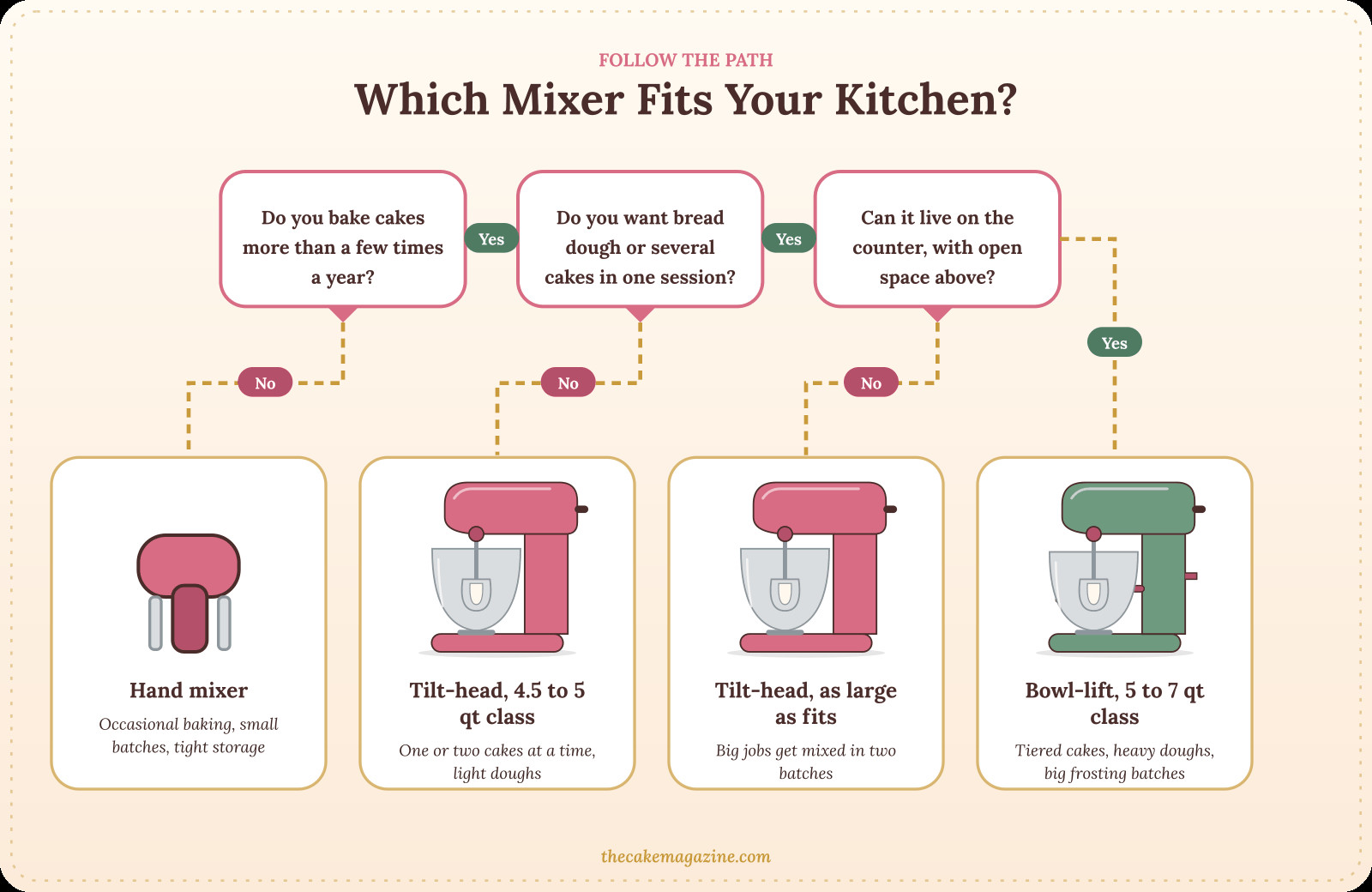
Question one: do you bake cakes more than a few times a year?
If you do not, a stand mixer is probably more machine than you need. A good hand mixer, covered in our hand mixer buying guide, plus a large whisk will take you through birthday cakes and holiday baking. Spend the savings on a scale, good pans and an oven thermometer, which improve cakes more than a mixer does. Our cake pan buying guide covers the pan side of that advice.
Question two: do you want bread dough or several cakes in one session?
If your baking stays with one cake at a time and you rarely knead, a tilt-head in the 4.5 to 5 quart size class is a strong fit. It handles our batters with room to spare, whips buttercream for an 8-inch cake and fits in most kitchens. If you do want bread dough, regular double batches or tiered cakes, keep going.
Question three: can it live on the counter, with open space above?
If so, a bowl-lift in the 5 to 7 quart class gives you the largest bowl, the broadest base and the sturdiest feel. If not, choose the largest tilt-head that fits your space and plan to mix big jobs in two rounds. That is not a failure. Mixing two batches is an ordinary part of baking, and it is much easier than moving a mixer that does not fit.
Tie-breakers when two candidates for the best stand mixer for baking cakes look equal
- Beater adjustability. A model that lets you set the beater height is better than one that does not.
- Warranty and parts. Choose the one with clearer terms and easier replacement parts.
- Included accessories. A scraper beater, a pouring shield or a second bowl can tip the balance.
- Ergonomics. The machine you find easier to lock, lift and clean is the one you will use.
- Noise and weight. If these matter in your home, give them extra weight.
The one-size-fits-most answer. If you want a default and your baking looks like most home bakers’, choose a tilt-head in the 4.5 to 5 quart class with a flat paddle, a whisk, a scraper-style beater if available, and a warranty you understand. It is the most common best stand mixer for baking cakes for ordinary kitchens. Move up in size only if your actual baking asks for it.
Checklists to carry to the store or the checkout page
These short lists condense the guide. Screenshot them, print them or copy them into your phone before you shop.
The capacity checklist for the best stand mixer for baking cakes
- I know the weight of my usual batter, and the bowl gives it at least 40 percent headroom.
- I know the largest batch I make regularly, and I know how I would split it if the bowl is too small.
- I have considered my frosting batches, which need more room than batter.
- I have thought about small jobs, like two egg whites, and whether the bowl suits them.
The design checklist
- I have measured the counter space, including the height above it.
- I know whether I will store the mixer in a cabinet and how heavy it is.
- I understand whether the head tilts or the bowl lifts, and I am comfortable with that action.
- I have checked stability, including the feet and how firmly the head locks.
The performance checklist
- The lowest speed is gentle enough to fold in flour.
- The beater height can be adjusted, and I know how to run the dime test.
- The machine holds a steady speed with butter and sugar, and does not strain.
- The beaters and whisk are the right types for cake, and I know which are coated.
The ownership checklist for the best stand mixer for baking cakes
- The warranty is clear about what it covers and for how long.
- Replacement beaters, bowls and parts are sold to consumers.
- I know the model number and have confirmed what accessories fit.
- If buying used, I have a plan to check the cord, grease, noise and beater height.
Using your mixer for cakes once it is on the counter
Buying the best stand mixer for baking cakes is half the job. The other half is using it well. A good machine in careless hands still makes bad cake, and a modest one used thoughtfully can make very good cake. Here are the habits that help, and they apply to nearly any model.
Match the speed of your best stand mixer for baking cakes to the method
Each mixing method asks for a different rhythm. In the creaming method, you beat butter and sugar at medium speed until they are pale and fluffy, then add eggs gradually and finally fold in the dry and wet ingredients on low. In reverse creaming, you mix the dry ingredients with the butter on low until the mixture looks like damp sand, then add the liquids. Foam cakes call for whipping at higher speed and folding by hand.
We explain all of these in our guide to cake mixing methods, and King Arthur’s cake guide also describes creaming, the paste method and oil-based mixing in a helpful way.
Stop and scrape
Even with a scraper beater, stop the mixer a couple of times to scrape the bottom and sides with a flexible spatula. That is where unmixed butter and flour hide. Scraping takes seconds and improves almost every batter. Turn the machine off first and lift the head or lower the bowl so your hands are never near moving parts.
Mind the temperature
Mixers add friction heat, especially in long jobs. Cold butter may warm faster than you expect, and a warm bowl can melt buttercream. If your kitchen is hot, chill the bowl, or pause and refrigerate the mixture. For recipes that rely on room-temperature butter and eggs, ingredients that are too cold will not cream properly, and ingredients that are too warm will lose structure. Our cake baking science guide explains why temperature has such a big influence on crumb.
Do not overmix
The mixer makes overmixing easy, and the consequences differ by recipe. Once flour meets liquid, gluten starts to develop. Long beating at the stage when flour goes in produces a tough, dense cake with tunnels. Add flour on low speed and stop as soon as the batter is smooth. In a one-bowl recipe, mix until just combined. The mixer is a tool for the stages that need power, not for every stage.
Whipping egg whites and meringue
For whites, start with a very clean, dry bowl and whisk. Fat and traces of yolk prevent whites from whipping properly. Start at a lower speed to break up the whites, then increase to build volume. A mixer that has a bowl too large for your amount of whites may not whip them well, so consider whisking by hand or with a hand mixer for very small amounts.
For safe handling of eggs, consult food-safety guidance such as that from the USDA Food Safety and Inspection Service, especially if you serve raw or lightly cooked egg preparations to children, older adults or anyone with a weakened immune system.
Making buttercream with the best stand mixer for baking cakes
A stand mixer shines at buttercream. American buttercream wants steady paddle work with powdered sugar added in stages and the machine on low to keep sugar from flying. Swiss meringue buttercream wants the whisk to build the meringue, then the paddle to bring everything together once it cools. These frostings can look broken partway through, and patience usually brings them back, as our Swiss meringue buttercream guide shows. For a comparison of the other styles, see our buttercream guide.
Reverse creaming loves the best stand mixer for baking cakes
Reverse creaming is arguably the method where a stand mixer pays for itself. Coating flour with butter takes a few minutes of steady, low-speed paddle work, which is tedious by hand and a poor match for a hand mixer, whose beaters can leave dry flour in the corners of the bowl. If you bake our best vanilla cake recipe often, you will notice the difference.
Care and troubleshooting
A mixer that is looked after keeps working. Most care is common sense, but a few habits are worth stating plainly.
Cleaning your best stand mixer for baking cakes
Unplug the mixer before wiping it. Clean the housing with a damp cloth, never submerge it, and keep liquid out of the vents and the hub. Wash the bowl and beaters according to the maker’s instructions, because some finishes do not belong in the dishwasher. Dry everything thoroughly before storing it.
Periodic checks
- Beater height. Run the dime test once a year or whenever mixing seems uneven.
- Grease around the hub. A little is normal on some designs. A lot or a change in color can mean service is due, and your manual may tell you what to do.
- Cord and plug. Look for fraying. Stop using the mixer if the cord is damaged.
- Feet. Replace worn or missing rubber feet to keep the mixer stable.
Common problems and quick fixes
Unmixed butter or flour at the bottom
This points to a beater set too high or a bowl too large for a small batch. Run the dime test, adjust if your model allows it and scrape the bowl bottom during mixing.
The beater scrapes the bowl
The beater is set too low. Adjust it slightly, retest and replace a damaged beater if the coating is worn. Check that the bowl is seated and locked correctly first.
The mixer slows, hums or gets hot
You may be asking too much of it. Reduce the batch, lower the speed and give it time to rest. Check your manual for duty-cycle guidance. If it happens with ordinary cake batters, contact the maker.
The head rocks or the mixer walks
Check the feet and the counter surface, and make sure the head is locked. Large or stiff mixtures can move any machine, so consider a smaller batch.
Whites will not whip
Look for grease, yolk or a damp bowl, and check that the whisk reaches the whites. Small amounts in a large bowl are a frequent culprit. Our cake troubleshooting guide covers what goes wrong when foams fail.
Ten mistakes to avoid when choosing the best stand mixer for baking cakes
- Buying for the biggest job, not the usual one. Plan around your normal week.
- Trusting wattage as a measure of quality. It is one clue, not a verdict.
- Ignoring the beater-to-bowl gap. It affects every batter you make.
- Skipping the measuring tape. Height and depth have ruined many kitchen plans.
- Overlooking small jobs. A huge bowl may not whip two egg whites.
- Assuming heavier means better. Weight helps stability but can make the machine a chore to move.
- Forgetting parts and service. A repairable mixer outlasts a disposable one.
- Believing rankings with no method. A score without a described test tells you little.
- Paying for features you will not use. A dough hook and a pasta roller do nothing for a sponge cake.
- Skipping the first-use checks. Run the dime test and read the manual before your first cake.
Frequently asked questions about the best stand mixer for baking cakes
What is the best stand mixer for baking cakes if I only have room for one?
For most home kitchens, a tilt-head mixer in the 4.5 to 5 quart size class with a flat paddle, a whisk and a bowl that fits your usual batch is a sensible single choice. It handles layer cakes, cupcakes, cookies and most frostings. If you bake very large batches or knead bread often, step up to a bowl-lift. If you bake rarely, a hand mixer may be all you need.
What size bowl do I need to bake cakes?
Match it to your batch. A typical two-layer 8-inch batter from our recipes weighs about 1.2 to 1.4 kilograms, which is roughly one and a third to one and a half quarts. We suggest keeping batter below about 60 percent of the bowl’s stated capacity, which makes a 4.5 to 5 quart bowl comfortable for one or two batches. Frostings need more headroom than batter.
Is a tilt-head or bowl-lift better for the best stand mixer for baking cakes?
Neither is better in every case. Tilt-head mixers are usually lighter, shorter and easier to access, which suits most home cake baking. Bowl-lift mixers usually have bigger bowls and sturdier bases, which suits large batches and heavy doughs. Choose by the size of your batches and the space in your kitchen.
Does a higher wattage make a better stand mixer for cakes?
Not reliably. Wattage can describe the electrical power a motor draws rather than the work it does at the beater, and gearing and build quality affect real performance. For cake, a steady low speed, good clearance and a sturdy base matter more than a bigger number on the box.
What is beater-to-bowl clearance, and why does it matter?
It is the small gap between the beater and the bowl. If it is too large, ingredients at the bottom go unmixed. If it is too small, the beater scrapes the bowl and can wear its coating. KitchenAid describes a dime test: the coin should move about a quarter of an inch per pass of the beater. Check your own manual for how to adjust your model.
Can I whip a small amount of egg whites in a large stand mixer bowl?
You can try, but small amounts often spread thinly across a wide bowl and the whisk may not reach them well. Manufacturers publish minimum and maximum guidance by bowl size, so check yours. A smaller bowl, a hand mixer or a hand whisk often works better for one or two whites.
Which attachments do I need for the best stand mixer for baking cakes?
The flat paddle and the wire whisk cover almost every cake job. A flex-edge or scraper-style beater is a useful extra because it reduces how often you must stop to scrape. A dough hook matters only if you also knead bread or enriched doughs.
Is a stand mixer worth it if I only bake cakes a few times a year?
Usually not. A hand mixer, a good whisk and a kitchen scale cover occasional baking at a fraction of the cost and storage space. A stand mixer pays off when you bake regularly, make long jobs like meringue-based frostings or want both hands free.
Is a used mixer a good way to get the best stand mixer for baking cakes?
It can be a good value if you inspect it carefully. Run it at every speed, listen for grinding, check for grease leaks, look at the cord and housing, test the head lock and run the dime test. A refurbished unit from the maker or a reputable seller may include a limited warranty.
Do I need the best stand mixer for baking cakes to bake good cakes?
Yes. Many cakes, especially oil-based and one-bowl recipes, are made with a whisk and a spatula. A hand mixer handles creaming and whipping. A stand mixer simply makes long or repeated jobs easier. Our hand mixer guide covers what to look for.
How do I keep the best stand mixer for baking cakes working well for years?
Unplug it before cleaning, keep liquid out of the vents, follow the maker’s washing instructions for bowls and beaters, check the cord and feet, and avoid overloading the bowl. Re-run the clearance test once a year, and register the warranty if one is offered.
Does the best stand mixer for baking cakes also work for bread?
Often, but not always. Dense dough strains a mixer more than cake batter does, and heavier mixtures may favor a bowl-lift or a model rated for kneading. If bread matters to you, check the manufacturer’s stated dough or flour capacity for the bowl size and plan your batches around it.
Final thoughts on choosing the best stand mixer for baking cakes
The best stand mixer for baking cakes is not a trophy. It is a tool that fits your batches, your counter and your habits, and then gets out of your way. Start with the bowl, because the quart number sets the size of the jobs you can do comfortably. Check how the beater meets the bottom of that bowl, because that decides whether your batters mix evenly. Choose between tilt-head and bowl-lift by weighing convenience against capacity.
Read the warranty like a contract, check that parts exist and treat power claims with a healthy dose of skepticism.
If you are still unsure, go back to the decision path and answer the three questions honestly. Most bakers will land on a mid-size tilt-head, a few will need the muscle of a bowl-lift and a fair number will realize that a hand mixer and a scale are all they need. Any of those is a good answer. The mixer that you will actually use, on a counter where it fits, with a bowl that suits your batters, is the best stand mixer for baking cakes for you.
We would love to hear what you decided and why. Tell us your usual batch, your kitchen and what you bake most, and we will keep refining this guide so it stays useful.
Editorial note: this guide is written for home bakers in the United States and uses American measurements. We have not conducted hands-on testing of the products or brands mentioned, and we cite manufacturer information where we give specific figures. Specifications, models and prices change, so confirm current details with the manufacturer before you buy. This article does not currently contain affiliate links. If we add any in the future, we will disclose them clearly near the links.