Most cake failures are not mysteries. A cake that sinks, turns dry, or bakes up dense is almost always telling you something specific about flour, fat, sugar, eggs, liquid or leavening, and once you can read the message, baking stops feeling like luck. That is the whole promise of cake baking science. It is not chemistry class and it does not require a lab coat.
It is a practical way of understanding why a recipe asks for what it asks for, so you can follow it with confidence, repair it when it goes wrong, and change it without crossing your fingers.
A cake is a delicate foam of tiny air bubbles held up by a framework of flour starch and egg protein, softened by fat and sugar, moistened by liquid and lifted by leaveners. Cake baking science is the study of how those six groups of ingredients push and pull against each other. Flour and eggs build structure. Fat, sugar and acid tenderize. Leaveners and steam make the cake rise, and the oven sets everything in place.
When those forces are roughly balanced, you get a tender, moist cake that slices cleanly. When one side wins, you get the classic problems: tough, crumbly, gummy, sunken or dry.
- Why cake baking science matters
- A cake is a foam held by a framework
- Flour: the frame of the cake
- Gluten and mixing
- Fat: the tenderizer
- Sugar does more than sweeten
- Eggs: structure, richness and lift
- Liquids in cake baking science
- Leaveners: how a cake rises
- Salt, acids and bases
- Mixing methods and crumb
- What the oven does
- Ratios and baker’s percentages
- Structure versus tenderness
- Simple kitchen demonstrations
- Changing a recipe safely
- Troubleshooting with cake baking science
- Common mistakes to avoid
- Frequently asked questions
- Final thoughts
Why cake baking science matters
Ask ten home bakers why they follow a recipe exactly, and a lot of them will say some version of “because I’m afraid to change it.” That is a reasonable instinct. Baking is less forgiving than cooking, because the ingredients do not simply combine. They react, and the order and amounts matter. A soup can take another pinch of salt or a splash more broth. A cake batter that has too much liquid or too little flour is already a different cake by the time it reaches the pan.
But fear of changing a recipe is also what keeps people stuck. They bake the same vanilla cake for years, never sure whether they could use buttermilk instead of milk, whether the cake would be better with a little less sugar, or why the layers keep domed in the middle. Understanding cake baking science turns those questions from guesses into decisions. You do not need to memorize equations. You need a mental picture of what each ingredient is doing, and a sense of which jobs are easy to adjust and which are risky.
This guide is built for that. It walks through each ingredient group in plain language, explains what happens during mixing and baking, introduces baker’s percentages so you can compare recipes at a glance, and then gives you a practical way to change recipes one step at a time. It links out to our recipe guides so you can see the ideas in action, including our best vanilla cake recipe and our best chocolate cake recipe, and to our troubleshooting guide for when a bake does not go to plan.
What this cake baking science guide is, and what it is not
This is an explainer, not a lab report. Where a rule of thumb is widely used by bakers, we say so and describe it as a rule of thumb. Where something depends on your oven, your flour, your altitude or your pan, we say that too. We do not quote experiments we did not run, and we do not claim there is one perfect ratio that every cake must follow. Cakes vary wildly, from airy sponges to dense pound cakes, and the right balance for one is wrong for another.
What you will find here is the reasoning that most professional bakers share, explained in a way that a first-time baker can use. If you want a deeper reference alongside this article, the King Arthur Baking cake guide is a good companion, with plenty of recipes and technique notes.
One tool that helps more than any other. A digital kitchen scale. Nearly every principle in this article is easier to apply when you weigh ingredients in grams. A cup of flour can vary by 20 percent or more depending on how you scoop it, and that is enough to change a cake’s texture. If you only make one purchase after reading this, make it a scale.
A cake is a foam held by a framework
Here is the picture that makes everything else easier to understand. Raw cake batter is a thick liquid with a huge number of tiny bubbles suspended in it. Some of those bubbles come from creaming butter and sugar, or whipping eggs. Others form when baking powder and baking soda release gas.
As the batter heats in the oven, the bubbles grow, the whole mixture puffs up, and then something crucial happens: the batter stops being a liquid and becomes a solid. Proteins from the eggs and flour firm up, and starch granules swell and absorb water. The liquid batter turns into a sponge-like structure with the bubbles locked inside it. That is your crumb.
Everything in cake baking science comes back to that transformation. You need enough bubbles to make the cake light. You need a framework strong enough to hold those bubbles while the cake rises, but not so strong that the crumb turns chewy. And you need the timing to work, so the cake sets at the moment the bubbles reach their best size. If the cake sets too early, it stays dense. If it sets too late, the bubbles can burst or escape, and the middle collapses.

The two forces in every cake, in cake baking science terms
It helps to sort the ingredients into two teams. The structure builders are flour, eggs and, in a different way, liquid. They create the framework that holds the cake up. The tenderizers are fat, sugar and acid. They interfere with that framework just enough to keep the crumb soft instead of tough or bready. Leaveners sit in the middle, because they create the bubbles that the structure builders then hold.
Almost every cake problem, seen through cake baking science, comes down to a lopsided balance between these forces. Too much flour or too much mixing, and the structure side wins: the cake is tough and dry. Too much fat, sugar or leavening, and the tenderness side wins: the cake is crumbly, greasy, or falls when it comes out of the oven. The point of a good recipe is to land in the zone between those extremes. The point of cake baking science is to help you recognize which side you landed on.
Why cake baking science differs from bread and cookie science
It helps to compare cakes with their baking cousins. Bread wants lots of gluten, so it is made from high-protein flour, mixed or kneaded to build strength, with very little fat or sugar to get in the way. Cookies are low in liquid and often have no leavener beyond a little baking soda, so they spread and set into something dense and chewy or crisp.
Cake sits at the opposite end from bread: a high proportion of liquid, sugar and fat relative to the flour, a gentle mix to avoid building gluten, and leaveners to create the rise. That is why swapping flours or mixing methods between categories rarely works.
Flour: the frame of the cake
Flour is usually the largest ingredient by weight in a cake, and in cake baking science it is the main source of structure. Two things in flour matter most: starch and protein. Starch makes up the bulk of it. During baking, starch granules absorb water and swell, then firm up as the cake heats. That swelling and setting is a big part of what turns batter into a solid crumb. The protein in flour is less abundant but just as important, because when it meets water and gets agitated, it can form gluten.
What gluten does in cake baking science
Gluten is a network of elastic proteins. In bread, you want a lot of it, because it traps gas and gives the loaf a chewy, stretchy interior. In cake, you want just enough. A small amount of gluten helps the cake hold its shape and keeps the crumb from falling apart. Too much gluten makes the cake tough, rubbery, or full of long vertical holes, called tunnels, where the batter was too elastic for the gas to spread evenly.
The good news is that cake batters are naturally gluten-limited. They have lots of sugar and fat, which compete with the flour for water and coat the proteins so they cannot link up easily. The less good news is that you can still overdo it, especially with heavy mixing, strong flour, or batters that are on the thin side. We cover mixing in the next section and in more depth in our guide to cake mixing methods.
Cake flour, all-purpose flour and the protein spectrum in cake baking science
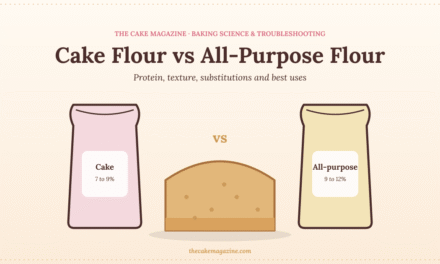
Flours are sold with different protein levels, and the protein level is one of the biggest levers you have over a cake’s texture. As a rough guide, cake flour tends to sit at the low end, around 7 to 9 percent protein. All-purpose flour is usually in the neighborhood of 10 to 12 percent, depending on brand and region. Bread flour is higher still. These are general ranges, not exact guarantees, and brands differ, so check the label or the manufacturer’s website for the flour you actually use.

Lower protein means less gluten potential, which is why cake flour makes a soft, fine, tender crumb. Cake flour is also usually bleached or chlorinated, and that treatment changes how the starch behaves. Many bakers find it lets a batter hold more sugar and liquid without collapsing, which is part of why it is the standard for high-sugar, high-moisture layer cakes.
If you cannot find cake flour or prefer not to buy it, you can often use all-purpose flour with a modest adjustment, though results depend on the recipe. Our guide to red velvet cake shows how a cake with cocoa and buttermilk can still be soft with the right balance.
A note on swapping. You will see advice online to replace a certain amount of all-purpose flour with cornstarch to mimic cake flour. It is a popular shortcut, and plenty of bakers use it happily. Treat it as a workable approximation, not an exact match. The cake may be a little different in crumb, and it works better in some recipes than others.
Measuring flour for cake baking science: why weight beats volume
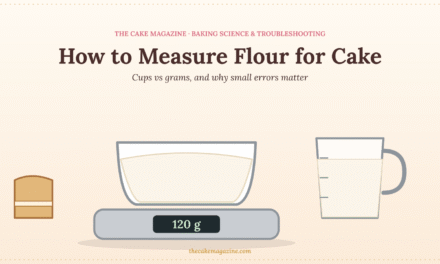
Flour is one of the easiest ingredients to mismeasure. If you scoop a measuring cup straight into the bag, you pack the flour down and can end up with noticeably more than the recipe intended. If you spoon it lightly and level it, you get less. The difference can be large enough to move a cake from tender to dry. Weighing flour removes the guesswork, and it is why professional recipes list ingredients in grams. When a cake keeps coming out drier than expected, check how you measure flour before you blame anything else.
Here is a good habit: pick one reliable weight for a cup of flour and stick with it. Many American baking resources use about 120 grams for a cup of all-purpose flour, and your own scale will tell you what your technique actually gives. Whatever number you choose, use the same one every time so your results are consistent and comparable from one bake to the next.
Sifting, aerating and why it is not always needed
Sifting flour separates clumps and adds air, and some recipes call for it, especially delicate sponge cakes. For most butter and oil cakes, whisking the dry ingredients together does the job of blending leaveners and salt evenly through the flour. Sifting matters most when you are folding flour into a fragile foam, such as beaten egg whites, where lumps are hard to break up without deflating the batter.
When a recipe gives flour in grams, sifting does not change the amount, so you can weigh first and sift afterward. When it gives cups, the wording matters: “1 cup sifted flour” and “1 cup flour, sifted” are different amounts, which is one more reason to prefer weights.
Gluten and mixing in cake baking science: how much is enough
In cake baking science, gluten does not exist in dry flour. It forms when the proteins glutenin and gliadin absorb water and are then moved around, whether by kneading, stirring or beating. More water contact and more agitation mean more gluten. That is the simple version of the story, and it is the reason batter mixing instructions always sound a little fussy: “mix until just combined,” “do not overmix,” “stop when no dry streaks remain.”
The key idea is that the first moments after flour meets liquid are when gluten begins to build fastest. Anything that slows that process, like fat coating the flour or sugar competing for water, helps keep a cake tender. Anything that speeds it up, like adding all the liquid at once to plain flour and then beating hard, pushes toward toughness. This is why many recipes add the flour in stages, alternating with the liquid, and why some methods mix the flour with the butter first.
Overmixing, undermixing and the cake baking science sweet spot
Overmixing is the textbook cause of tough cakes, but it is worth remembering that undermixing is a problem too. If the batter is not mixed enough, the leaveners and salt are not evenly spread, and you can get pockets of flour, streaks, or an uneven rise. The sweet spot is a smooth batter where the ingredients are fully combined and no more.
For most butter cakes, that means mixing on low or medium-low speed once the flour goes in and stopping as soon as the batter looks uniform. Using a spatula to scrape the bottom and sides of the bowl at the end catches any leftover dry patches without overworking the batter.
Batters differ in how much mixing they tolerate. A thin oil-based batter, like the one in our chocolate cake, is quite forgiving because the oil coats the flour. A thick pound cake batter with a lot of butter can handle more beating in the early creaming stage because the fat is already insulating the proteins. A delicate foam cake, on the other hand, can be ruined by a few extra folds.
The method matters as much as the ingredients, and we dig into it later in this article and in our guide to cake mixing methods.
Rest, temperature and gluten in cake baking science
Two small factors affect gluten that bakers do not always think about. The first is temperature: warm batter hydrates flour faster and can build gluten a little more readily than cold batter. The second is time: some batters, left to sit for a while before baking, begin to hydrate the flour more fully, and the starch absorbs water, which can thicken the batter.
Most cake recipes are written for batters that go into the oven promptly, so that is a good default. If your oven is not ready, it is usually better to wait to finish mixing than to let a finished batter sit, especially if it contains baking powder that has already started to react.
Fat: the tenderizer in cake baking science
Fat does several jobs in cake baking science, and the shorthand for them is “shortening,” an old baker’s word that tells you something. Fat shortens gluten strands by coating flour proteins so they cannot link into long, elastic chains. That is the primary reason fat makes cakes tender. Fat also carries flavor, adds richness, gives a cake a smooth feel in the mouth, and helps a cake stay soft by slowing moisture loss. Depending on the type of fat and the mixing method, it can also trap air.
Butter, oil and shortening in cake baking science
Butter is the classic cake fat, loved for flavor. In American butter, the fat content is typically about 80 percent, with the rest mostly water and a little milk solids. That water matters: it turns to steam in the oven, contributing a bit of lift, and it makes butter cakes slightly different in feel from cakes made with pure fat. Butter is solid at cool room temperature and softens as it warms, which is why creaming methods depend on butter being at the right temperature.
Oil is 100 percent fat and stays liquid at room temperature. Oil cakes are famously moist, and they stay soft even after refrigeration because the fat does not harden the way butter does. The trade-off is that oil does not carry the same buttery flavor, and it does not hold air when beaten the way creamed butter does, so oil cakes rely more on chemical leaveners for their rise. Our chocolate cake recipe is a good example of an oil-based cake, and the vanilla cake in our best vanilla cake recipe shows a butter-based approach.
Shortening, the solid vegetable fat sold in tubs, is 100 percent fat and holds air well, which is why some bakery-style cakes and frostings use it. It can make very tender, very stable cakes, but it has no butter flavor, and many bakers prefer to use it in combination with butter rather than alone.
Why creaming works: the cake baking science of air
When you beat softened butter with sugar, the sharp-edged sugar crystals cut tiny pockets into the fat, and the beating action traps air in those pockets. This is the creaming method, and it is one of the main ways a butter cake gets its fine, even crumb. Those air cells do not make bubbles by themselves, but they act as seeds. When baking powder or soda releases gas, the gas flows into the existing air cells and expands them.
A batter with few air cells to start with ends up with a coarser or denser texture, because the gas has fewer places to go.
The butter’s temperature matters here. If it is too cold, it will not hold much air and the sugar will not cut into it smoothly. If it is too warm, it turns greasy and cannot hold air, and the creamed mixture looks shiny and slack. Most bakers aim for butter that is cool to the touch and gives slightly when pressed, not melted and not hard. Many recipes say “room temperature,” and a cool room is often closer to the right feel than a warm kitchen on a summer day.
Too little fat, too much fat
With too little fat, a cake tends toward dry, firm, and a bit bready, because there is less fat to coat the proteins and soften the crumb. With too much, a cake can turn greasy, heavy or crumbly, and it may sink in the center because the structure cannot support the weight. Cakes with lots of fat rely on other ingredients, such as eggs and flour with the right protein, to supply enough framework.
This is one of the reasons it is risky to cut or add fat in a recipe without making any other change, and why we place it near the middle of the risk ladder later in this guide.
Sugar does more than sweeten in cake baking science
Ask what sugar does in a cake and most people say it adds sweetness. That is true, but sweetness is only the beginning. In cake baking science, sugar is a structural ingredient with several jobs, and understanding them explains why cutting sugar by a lot rarely works.
Sugar holds moisture and tenderizes in cake baking science
Sugar is hygroscopic, which is a fancy way of saying it attracts and holds water. In a batter, that means sugar competes with flour proteins and starch for available water. With less water available to flour, less gluten forms, which keeps the cake tender. Sugar also holds on to moisture in the finished cake, which is why a cake with plenty of sugar often stays soft longer than a low-sugar one.
Sugar delays setting
Sugar raises the temperature at which egg proteins and starch set. In practice, that gives the cake more time to rise before the structure firms up. This is a big part of why a high-sugar cake can be tall and light, and why a low-sugar cake can set early and bake up short and dense. When you reduce sugar, the batter sets sooner and the crumb can become coarser or drier. Small reductions often go unnoticed, but a large cut changes the cake more than most people expect.
Sugar helps with browning and flavor
When a cake’s surface gets hot and dry, sugars brown and develop caramelized flavor, and they react with proteins in a process called the Maillard reaction. That is where the golden color and toasty notes on the crust come from. A cake with less sugar tends to brown less. A cake with much more sugar, or with honey, brown sugar or syrup, tends to brown faster, and may need a slightly lower oven temperature or a foil tent to avoid a dark crust.
Granulated, brown, powdered and liquid sugars in cake baking science
Granulated sugar is the default in most cakes, and its crystals are good for creaming. Brown sugar contains molasses, which adds moisture, a slight acidity and a caramel-like flavor, and it makes cakes a bit denser and moister. Powdered sugar is used more in frostings than in cakes, though some recipes use it for a very fine texture, and it usually includes a little cornstarch.
Liquid sweeteners such as honey or maple syrup add flavor but also add water and can brown quickly, so substituting them for granulated sugar is not a one-to-one swap. If you are planning a swap, make the change once, bake a small test, and take notes.
Cutting sugar: go slowly. Reducing sugar by a small amount is usually fine. Cutting it by a third or more can change the rise, the crumb, the moisture and the browning all at once. If you want a less sweet cake, it is often easier to reduce the sweetness of the frosting or choose a flavor, like lemon or coffee, that balances sweetness, rather than rewriting the cake’s sugar.
Eggs in cake baking science: structure, richness and lift
In cake baking science, eggs are the ingredient that does the most different jobs at once. They provide structure, moisture, richness, color, emulsification and a little lift. Understanding eggs is one of the quickest ways to improve your grasp of cake baking science, because so many recipe decisions, like using whole eggs, extra yolks or whipped whites, come down to which of these jobs the cake needs most.
Egg whites in cake baking science: protein, foam and structure
Egg whites are mostly water and protein. When you whip them, the proteins unfold and form a network around tiny air bubbles, which is how a foam gets its volume. When egg whites are heated, those proteins coagulate, meaning they firm up and turn from clear and runny into white and solid. In a cake, that setting is a major part of the structure.
Sponge and chiffon cakes lean on whipped egg whites for much of their lift, which is why they are so light and why they can collapse if the foam is handled roughly.
Egg yolks in cake baking science: fat, flavor and emulsifiers
Yolks bring fat and flavor, and they contain natural emulsifiers, including lecithin, that help water and fat mix into a smooth batter instead of separating. Yolks also coagulate with heat, though at a slightly higher temperature range than whites. A cake made with extra yolks tends to be richer and more tender, with a slightly denser, silkier crumb, while a cake made mostly with whites tends to be lighter and whiter. Many white cakes are built around this idea, and many yellow cakes around the opposite.
Whole eggs and the role of temperature
Most layer cake recipes use whole eggs, which give a balance of structure, richness and emulsification. Egg temperature matters because cold eggs can cause creamed butter to seize and look curdled, since the cold liquid hardens the fat. Room-temperature eggs blend more smoothly. If you forgot to take eggs out ahead of time, you can set whole eggs in a bowl of warm tap water for about ten minutes, and they usually warm enough to use.
For safety, do not leave eggs sitting at room temperature for long stretches. The USDA’s Food Safety and Inspection Service offers general guidance on handling eggs and other foods at fsis.usda.gov.
Too many eggs, too few eggs
Too many eggs can make a cake dense, rubbery or eggy tasting, because the extra protein firms the structure and the flavor can dominate. Too few can make a cake crumbly, pale and short, because there is not enough protein to hold the bubbles and bind the crumb together. Egg size also matters. A recipe written for large eggs can behave differently with medium or extra-large ones, which is one more reason to weigh eggs when you want consistent results.
As a rough guide, many American recipes assume a large egg, without the shell, weighs about 50 grams, though your carton may vary. Weighing the beaten egg is the easiest way to be precise.
Liquids in cake baking science
Liquid is the quiet partner in every cake. It dissolves sugar and salt, hydrates flour so starch can swell and gluten can form, carries flavor, activates baking powder and baking soda, and turns to steam in the oven, which contributes to lift. The type of liquid you use changes the cake in ways that are easy to overlook.
Milk, buttermilk, yogurt and sour cream in cake baking science
Whole milk adds moisture, a little fat and a mild richness. Buttermilk, yogurt and sour cream are acidic, and that acidity does two helpful things. It tenderizes by weakening gluten, and it reacts with baking soda to make carbon dioxide. Cakes made with these ingredients often have a soft, tender crumb and a faint tang. Because they are thicker than milk, they also change the batter’s consistency, so swapping them one-for-one can alter the texture.
If you want to try it, start with a similar-thickness substitute, such as thinned yogurt in place of buttermilk, and watch how the batter looks.
Water, coffee and other thin liquids in cake baking science
Plain water is entirely neutral. It hydrates the flour without adding flavor or fat, which is why some chocolate and spice cakes use water or hot coffee so the other flavors can come through cleanly. Hot liquids can also “bloom” cocoa, helping it dissolve and develop richer flavor, which is the idea behind the method in our best chocolate cake recipe. Thin liquids create thin batters, and thin batters tend to bake into moist, tender cakes with a fine crumb, as long as the rest of the formula is balanced for it.
Juice, purees and other wet ingredients
Fruit juices and purees add water, sugar and acid, and sometimes pectin or fiber, which can make a cake dense or gummy if the proportions are off. Applesauce, mashed banana, pumpkin puree and similar ingredients also act as moisture holders and partial fat replacers in some recipes. When adding purees, think of them as both liquid and body. If a recipe is not designed for them, they can overload the cake with moisture and weaken the structure.
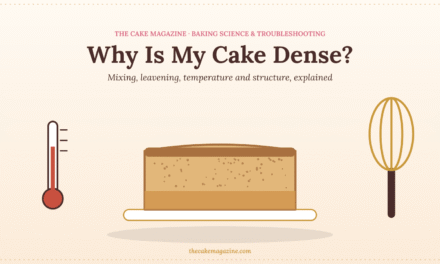
This is a typical cause of the gummy layer in the middle of a cake, which we discuss in our cake troubleshooting guide.
Steam as a leavener in cake baking science
Water in the batter turns to steam as the oven heats the cake, and steam expands to many times its liquid volume. In thin, wet batters, steam provides a surprising share of the rise. This is one reason cakes that are baked in a hot, preheated oven rise well: the water in the outer layers flashes to steam quickly, pushing the batter up before the structure sets. The trade-off is that a very hot oven can set the outside too fast and leave the center to catch up, which can produce domes and cracks.
Leaveners in cake baking science: how a cake rises
A cake rises because bubbles form and expand. There are three main sources of bubbles, and most recipes combine at least two. The first is mechanical: air beaten into fat or eggs. The second is chemical: gas released by baking soda or baking powder. The third is physical: steam from water in the batter. A cake’s texture, whether airy and springy or tight and tender, depends heavily on how a recipe balances them.

Baking soda in cake baking science
Baking soda is sodium bicarbonate, a base. When it meets an acid and moisture, it reacts and releases carbon dioxide gas. Acids in cakes include buttermilk, yogurt, sour cream, lemon juice, vinegar, brown sugar, honey, natural cocoa and some fruits. Soda also raises the batter’s pH, which affects browning and flavor. If a recipe has more soda than the acid can neutralize, the leftover soda can leave a soapy or metallic taste and a coarse, yellowish crumb.
Soda starts working as soon as it is wet, so batters with baking soda should usually go into the oven without a long wait.
Baking powder in cake baking science
Baking powder is baking soda plus one or more dry acids and a bit of starch to keep it stable and absorb moisture. Because it carries its own acid, it can leaven a batter that has no other acidic ingredient. Most modern baking powder is double-acting, meaning it releases some gas when it gets wet and more when it gets hot.
That gives a bit of insurance: some lift in the bowl, and more in the oven, as the batter is setting. Baking powder is more forgiving than soda, which is why it is the main leavener in many simple cakes.
Why recipes often use both
You will often see a recipe call for both baking powder and baking soda. That is usually because the batter has an acidic ingredient, such as buttermilk, that needs some soda to neutralize it and add lift, but the cake also needs additional rise that the soda alone cannot supply without too much leftover alkalinity. The combination lets the recipe develop both flavor and lift without pushing the batter’s chemistry too far in one direction. We cover this pairing in more detail in our guide to baking powder versus baking soda in cake.
Freshness and measuring
Leaveners lose strength over time, especially once the container is open and humid air gets in. If a cake that normally rises well suddenly bakes up flat, old baking powder is a common suspect. A quick test is to stir a small amount into hot water: fresh baking powder fizzes right away, and weak powder fizzes little or not at all. For baking soda, add a little vinegar or lemon juice and watch for fizzing. Always level leaveners carefully.
A small excess can make a cake rise fast and then collapse, and a small shortfall can leave it dense.
Whipped eggs, creamed butter and the mechanical rise in cake baking science
Some cakes use little or no chemical leavener at all. Classic sponge and angel food cakes depend on air whipped into eggs. Pound cakes, in their original form, relied on creamed butter and eggs. The upside of mechanical leavening is a fine, even crumb and great flavor from the eggs and butter. The downside is that these cakes are less forgiving. Over-whipping or under-whipping the eggs, or deflating the foam while folding, changes the result in a big way. A touch of baking powder is often added to modern versions as a safety net.
A quick sanity check for leavening. Many American layer cake recipes use roughly one teaspoon of baking powder per cup of flour, sometimes a little more, but this varies by recipe, so treat that as a loose reference point rather than a rule. If your recipe has far more than that, double-check the measurement, and consider whether the recipe is built to include extra acid, extra liquid or a lot of sugar.
Salt, acids and bases in cake baking science
These are the small-quantity ingredients that people skip or fudge, and they punch well above their weight. A cake without salt tastes flat and strangely sweet. A cake with the wrong balance of acid and base can taste soapy, bake up pale or dark, or rise too little or too much.
What salt does in cake baking science
Salt sharpens flavor and rounds off sweetness, so the cake tastes more like itself. It also strengthens gluten slightly and can slow the activity of some leaveners a little, which is part of why recipes give it an exact amount. In cake baking science, salt is a flavor tool first. If you are using butter, check whether it is salted or unsalted, because the recipe’s salt amount usually assumes unsalted butter.
Using salted butter in a recipe that also calls for salt can make the cake too salty, and the amount of salt in salted butter varies by brand.
Acids in the batter and cake baking science
Acid has three roles in a cake. It reacts with baking soda to produce gas. It weakens gluten, which makes the crumb softer and more tender. And it affects color. Acidic batters, such as those with buttermilk or natural cocoa, tend to bake up lighter or more reddish in tone, while alkaline batters brown faster and can deepen the color. If you have ever noticed that a chocolate cake with natural cocoa is a different color from one made with Dutch-process cocoa, this is a big part of why.
Natural versus Dutch-process cocoa: a cake baking science note
Natural cocoa is acidic and reacts with baking soda. Dutch-process cocoa has been treated with an alkali to reduce acidity, so it does not react with baking soda in the same way and usually pairs better with baking powder. Swapping one for the other without adjusting the leaveners can change the rise, color and flavor.
If a recipe calls for one and you only have the other, check whether the cake has other acidic ingredients, and if you are unsure, bake a small test. Our red velvet cake recipe explains how cocoa, vinegar and buttermilk work together in a cake that relies on that balance.
Bases and why too much baking soda tastes bad
Baking soda is the main base in cake batters. Used in the right amount alongside acid, it disappears into carbon dioxide and a neutral salt. Used in excess, there is not enough acid to react with it, and the unreacted soda gives a soapy, chemical taste and a coarse, dark, uneven crumb. Because it is so powerful, soda is typically used in small amounts, often less than a teaspoon in a whole cake.
When you scale a recipe, scale soda and baking powder carefully rather than just multiplying everything, because tiny measurement errors have larger effects.
Mixing methods and crumb in cake baking science
Different cakes are made in different ways because the method decides how air, fat and flour come together, and that shapes the crumb. Here is a quick look at the main approaches, with the science behind them. Our guide to cake mixing methods explained covers each in more detail.
Creaming method
Beat soft butter with sugar to trap air, then add eggs, then alternate dry and wet ingredients. This produces a medium-fine crumb with a buttery flavor. Its success depends on butter temperature and not overbeating after the flour goes in.
Reverse creaming
Mix the dry ingredients with the butter first so the fat coats the flour, then add liquids. Because the flour is coated in fat before it meets water, less gluten forms, and the crumb tends to be very fine and tender. It is a favorite for wedding-style layer cakes.
Foaming methods
Whip eggs or egg whites, sometimes with sugar, into a foam, then fold in the flour gently. Sponge, genoise, chiffon and angel food cakes work this way. The structure comes from the foam, so gentle folding is crucial.
One-bowl and oil methods
Whisk dry and wet ingredients separately, then combine. Oil-based batters are thin, and the fat is already liquid, so they are forgiving and quick. They rely on chemical leaveners instead of creamed air.
How method changes the crumb in cake baking science
A creamed butter cake has a crumb that is typically soft and slightly open, with a firm-but-tender bite. A reverse-creamed cake is usually finer and plusher, with a velvety feel. A foam cake is airy and springy, with a more elastic, sponge-like crumb. An oil cake is moist and soft, with a slightly looser crumb that stays tender in the fridge. None of these is better than the others. They are different textures for different jobs, and cake baking science helps you choose the one that fits what you are making.
Scraping, speed and timing
Small habits in the mixing bowl add up. Scraping the bowl keeps ingredients evenly blended. Mixing at the speed the recipe suggests keeps you from beating too much air in, or too little. And adding ingredients at the point the recipe says, rather than all at once, controls how the batter forms.
If a recipe tells you to add eggs one at a time and beat after each, it is because the emulsion of fat, water and egg is easier to hold together in stages. Rushing that step is a common reason batters look curdled and cakes bake up dense.
What the oven does: cake baking science in the heat
The oven is where all the ingredients finally commit. Understanding what happens as heat moves through the batter explains why oven temperature, pan type and bake time matter so much, and why a cake that looks done on the outside can still be raw in the middle.

Heat moves from the outside in during a bake
Heat travels from the pan and the surrounding air into the batter, so the edges and bottom of the cake heat first and the center heats last. In the early minutes, the batter near the pan warms up, fat softens or melts, and the leaveners release more gas. The warm batter becomes thinner for a moment, bubbles expand, and the cake rises.
As the temperature climbs further, the egg proteins and starch in the outer batter begin to set, forming a skin and a wall. The setting front moves inward until the whole cake has become a solid.
The setting window in cake baking science
For cakes, the important window is the stretch of time between “bubbles are expanding” and “structure has set.” Egg proteins generally begin to coagulate somewhere in the range of the 140s to 160s degrees Fahrenheit, and starch swells and gels over a broad range that overlaps with that. Sugar and fat push those temperatures higher, which is part of the reason a rich, sweet cake sets later and gets taller.
If the center sets before the gas has done its work, the cake is dense. If the structure is too weak when the gas is still expanding, the bubbles can merge, escape or collapse.
Doming, cracking and the oven’s hot edge
Layers that dome in the middle are a common sight. The edges of the batter touch the hot pan and set first, while the center is still fluid and keeps rising, pushing up in a dome. A cooler oven, a lighter-colored pan, or insulated cake strips slow the edges down and tend to produce flatter tops. Cracks happen when the surface sets and then the center keeps expanding underneath.
These are shape issues more than flavor issues, and they respond well to small oven and pan adjustments. Our cake troubleshooting guide has a closer look at fixing them.
Browning and the crust in cake baking science
As the surface dries and heats past the boiling point of water, sugars and proteins on the outside begin to brown. That is where baked flavor comes from. The browning is limited to the surface because the interior stays near the boiling point of water as long as there is moisture to evaporate.
This is also why the internal temperature of a done cake is typically around 205 to 210 degrees Fahrenheit for butter and oil cakes, near, but not far past, the boiling point of water at sea level. Higher altitudes change this, because water boils at a lower temperature when air pressure is lower.
Why cakes can be done outside and raw inside
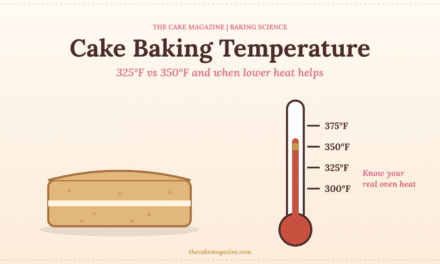
If the oven is too hot, the outside sets and browns before the center has had time to heat through. The crust then acts as insulation, and the center lags behind. You end up with a dark, firm outside and a wet or gummy middle. The fix is usually a lower temperature and a longer bake, so the heat has time to travel inward. An oven thermometer is worth the small cost, because many home ovens run hotter or cooler than their dial says, and that single factor can explain a lot of baking mysteries.
Cooling is part of baking
Cooling is not just waiting. As a cake cools, the starch continues to firm up, steam leaves the crumb, and the structure becomes sturdy enough to handle. Cutting or frosting a warm cake can tear it and smear the frosting. A short rest in the pan helps the cake release without breaking, and a complete cool on a rack lets steam escape from the bottom instead of making it damp.
If you wrap a still-warm cake, trapped steam can make the crust sticky. Patience at this step often makes the difference between a neat cake and a messy one.
Ratios and baker’s percentages in cake baking science
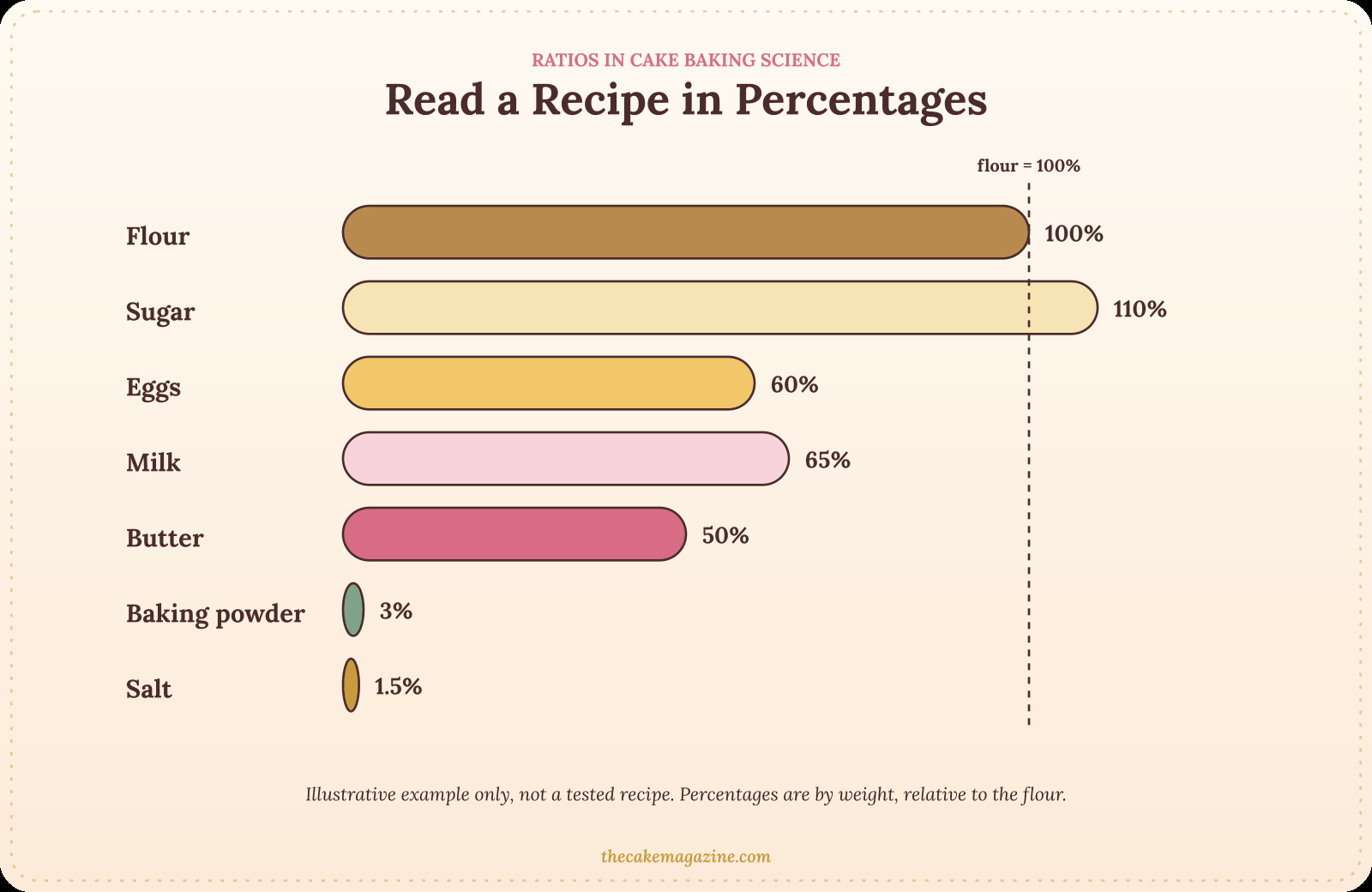
Once you know what each ingredient does in cake baking science, the next step is learning to see a recipe as a set of proportions. Professional bakers do this with baker’s percentages. The idea is simple: pick the flour as the reference and call its weight 100 percent. Every other ingredient is then expressed as a percentage of the flour weight. A cake with 300 grams of flour and 330 grams of sugar has sugar at 110 percent. A cake with 150 grams of butter has butter at 50 percent.
The reason this is useful is that it lets you compare recipes at a glance, spot unusual formulas, and scale a recipe up or down without losing the balance. A recipe that looks different on paper because it uses different amounts may turn out to have very similar proportions once you convert it. And a recipe that looks ordinary may reveal an odd number, like an unusually low amount of liquid, that explains why it bakes dry.
How to calculate baker’s percentages for cake baking science
Weigh each ingredient in grams. Divide each ingredient’s weight by the flour weight, then multiply by 100. That is all. For example, in the illustrative formula above, if the flour is 300 grams, then 330 grams of sugar is 110 percent, 180 grams of eggs is 60 percent, 195 grams of milk is 65 percent and 150 grams of butter is 50 percent. This is an illustration of how to read a formula, not a tested recipe, and real cakes vary a lot.
Try it with a recipe you already trust. Convert your favorite cake into percentages and write them down. Next time you try a new recipe, convert that one too, and compare. You will start to see patterns quickly. Sugar above or near 100 percent of the flour is common in layer cakes. A butter cake often has fat somewhere around half the flour weight or more.
Liquids, including eggs and milk together, usually add up to a decent proportion of the flour weight. When a number lands far from what you have seen before, it is worth asking why.
The classic pound cake ratio in cake baking science
Traditional pound cake was built on a memorable ratio: a pound each of flour, butter, sugar and eggs. In baker’s percentages, that is 100 percent for each. It is a perfect teaching example, because it shows how the old recipes relied on eggs and creamed butter alone for lift, and why they bake up dense, rich and fine crumbed. Modern versions often adjust the ratios and add a touch of baking powder or a little liquid for a lighter result.
Looking at pound cake as a ratio also helps explain why changing one ingredient has such a visible effect: every part is carrying a lot of weight.
High-ratio cakes
You may hear bakers mention “high-ratio” cakes. In general, this describes cakes where the weight of sugar is at least equal to the weight of flour and the liquids are relatively generous. Those cakes are tender, moist and soft, and they usually lean on high-ratio shortening or reverse creaming, along with chlorinated cake flour, to carry the extra sugar and liquid. It is a useful concept if you want to understand why some bakery cakes feel so plush, and why swapping ingredients in a high-ratio formula can be riskier than in a standard one.
Scaling without losing the balance
When you scale a recipe up or down, working in percentages helps you keep proportions intact. Multiply every ingredient by the same factor, using weights. For tiny amounts, like salt, baking powder or baking soda, check your scale’s precision. If your scale reads in whole grams, a half teaspoon of baking soda, around two or three grams, can easily be off by a significant percentage. That is one reason scaling leaveners can cause more problems than scaling flour.
Pan size and bake time need adjusting too, because batter depth changes how fast the center heats. Keep notes so you can improve with each bake.
Structure versus tenderness in cake baking science: finding the balance
We started with the idea of two teams, structure builders and tenderizers. Now that you have met every ingredient, it is easier to see how to use that idea as a practical tool. Think of every recipe change as moving a dial. Changing one ingredient shifts the dial toward structure or toward tenderness, and sometimes it moves other settings too.
Moves that add structure
More flour, higher-protein flour, more eggs, less sugar, less fat, less liquid, and more mixing all push a cake toward structure. A cake that is too soft, too crumbly or collapsing can often be helped by moves in this direction, such as a slight increase in egg or flour, or a switch to a stronger flour. Gentle bakers often make small changes first, like adding an extra egg yolk’s worth of richness rather than a whole egg, to see how the crumb responds.
Moves that add tenderness
More fat, more sugar, more acid, lower-protein flour, more liquid and less mixing push a cake toward tenderness. A cake that is tough, dry, bready or rubbery can often be improved this way, for example by switching to a softer flour, reducing mixing, or using buttermilk in place of milk. The risk is overshooting: too much tenderness gives you a cake that crumbles when sliced or sinks in the center, which is why the changes should be small and one at a time.
Reading your own cake with cake baking science
You can often tell which side your cake landed on by looking and feeling. Cut a slice and look at the crumb. A tight, shiny, slightly rubbery crumb with a few large holes suggests too much structure or gluten. A crumb that falls apart when you cut it, or feels greasy or sugary, suggests too much tenderness.
A gummy, damp band near the bottom points to underbaking or too much moisture, and a dry, sandy texture often means too much flour, too much baking, or too little fat. Over time, you will build a library of these signs, and cake baking science gives you the vocabulary to describe them.
Simple kitchen demonstrations of cake baking science
You do not need a lab to see these principles for yourself. The following small demonstrations use ordinary ingredients, take a few minutes, and help the ideas stick. We are not reporting results from tests we ran; each one describes what to look for. What you observe may vary with your ingredients, so treat them as invitations to experiment, and take notes or photos for comparison.
Watch baking soda meet acid
Put a small spoonful of baking soda in one cup and a spoonful of baking powder in another. Add a little warm water to each and watch. Then add a few drops of vinegar or lemon juice to the soda. This shows the difference between a leavener that needs an acid partner and one that carries its own.
You should see the soda react strongly when acid arrives, and the powder react on contact with moisture and, if you warm it, a bit more. It is also a handy way to test whether your leaveners are still fresh.
Feel the gluten difference
Mix a few tablespoons of all-purpose flour with just enough water to make a ball of dough, and knead it for a couple of minutes. Rest it, then rinse it under cold water, working it gently in your hands, until the starch washes away. What is left is a stretchy, elastic mass, which is gluten. Try the same with cake flour, if you have it, and compare how much remains and how stretchy it feels. It is a hands-on way to understand why cakes use gentler flour and gentler mixing than bread does.
Whip an egg white and a whole egg
Whisk one egg white in a clean glass or metal bowl until it forms soft peaks. Then try a whole egg in a separate bowl. The white should build volume and form a foam, and the whole egg will foam much less because of the yolk’s fat. You can see for yourself why foam cakes separate eggs and why a speck of yolk or grease can interfere with a meringue. Keep all your tools clean and dry for this one.
Cream butter with and without sugar
Beat a small amount of cool, soft butter by itself, then beat another portion with sugar. Look at how the color and texture change. With sugar, the mixture usually becomes paler and fluffier as air gets trapped. This is a small look at why the creaming step matters, and why butter that is too warm or too cold does not cream as well. If you have a scale, weigh the same volume of each and see how the creamed mixture weighs less per cup, a sign of the air you have beaten in.
Bake two tiny cakes with one change
If you are curious and have time, bake two mini cakes or two muffins from the same batter, changing one thing, such as the amount of sugar or the oven rack position. Bake them side by side, label them, and compare height, color and crumb. This is the best way to learn how your own oven and ingredients behave. Resist changing more than one thing at a time, or you will not know which change caused which result.
Keep a baking notebook. Write down the recipe, any changes, your oven temperature, the pan, the bake time and how the cake turned out. After a handful of bakes, patterns appear that no article can show you, because they are specific to your kitchen. That record is the most valuable tool in cake baking science for home bakers.
Changing a recipe safely with cake baking science
This is where the cake baking science background pays off. Once you understand the roles of each ingredient, you can adapt recipes for taste, diet, ingredient availability or texture, with a better sense of what is likely to happen. The key rule is to change one thing at a time, weigh everything, and write down what you did. Not every change carries the same risk, so here is a ladder from the safest to the riskiest.

Rung one: flavorings and zest
Extracts, spices, citrus zest, a splash of coffee or a pinch of espresso powder add flavor without disturbing the structure much. They are the safest place to start. Be mindful of liquid flavorings. A tablespoon of extra liquid is not a disaster, but a large amount can thin the batter. Dry add-ins like zest, spices and cocoa can slightly change absorption, so make small changes first.
Rung two: swapping similar dairy
Milk, buttermilk, yogurt and sour cream are close relatives. You can often swap them if you keep the thickness and acidity in mind. Replacing milk with buttermilk adds acid, which can make the cake more tender and may change how much soda is ideal. Replacing buttermilk with milk removes acid, so a recipe built on soda may rise less and taste flatter. A thinned yogurt is a common stand-in for buttermilk, but it is not identical.
Rung three: trimming sugar a little
A small reduction in sugar, often in the range of a spoonful or two per cup, is generally tolerable in many recipes. Larger cuts affect moisture, browning, rise and shelf life. If you are making a significant cut, expect a different texture, and consider a test bake. For a cake that tastes less sweet without a big structural change, you can also adjust the frosting, add a pinch more salt or add an acidic flavor like lemon to balance the sweetness.
Rung four: swapping the fat
Swapping butter and oil is possible, but they behave differently. Butter has water and milk solids, and oil is pure fat. If you replace butter with oil, you usually use a little less oil than butter by weight, since butter is not 100 percent fat, but how much depends on the recipe. A butter cake also relies on creaming for air, and an oil cake relies on chemical leaveners, so changing fat can mean changing the method too. Treat this as a project, not a quick tweak.
Rung five: swapping the flour
Changing flour type affects protein, absorbency and structure. Moving from cake flour to all-purpose can make a cake a little firmer and chewier. Moving to whole wheat, gluten-free blends or nut flours changes the formula significantly, since they absorb water differently and carry different amounts of fiber and protein. Recipes built for those flours are a better starting point than adjusting a standard recipe.
Rung six: changing leaveners or eggs
These two do many jobs at once, which makes them the riskiest to change. Removing or reducing eggs removes structure, richness, emulsification and lift. Changing the leaveners can alter rise, flavor and color. If you need an egg-free or allergy-friendly cake, start from a recipe designed for that purpose instead of trying to patch a standard recipe. The balance is different at the core.
A simple process for any change
- Pick one change and write down the old and new amounts in grams.
- Think through what that ingredient does, and what else might need to move with it.
- Bake a small test, such as a half batch or a few cupcakes, if you can.
- Note height, color, crumb, moisture and flavor, with photos if you like.
- Decide what to tweak next, and change only one thing again.
Troubleshooting with cake baking science
When a cake goes wrong, the cake baking science in this guide help you narrow down the suspects. Here is a quick map from symptom to likely causes. These are patterns, not diagnoses, and a single symptom can have several explanations. Our full cake troubleshooting guide goes much deeper with step-by-step checks.
The cake is dry or sandy
Likely causes: too much flour from scooping, overbaking, too little fat or liquid, or an oven that runs hot.
How to check: weigh your flour next time, use an oven thermometer, and test for doneness a few minutes early.
Fix it next time: measure by weight, check the oven, and look for doneness cues such as a springy top and moist crumbs on a skewer.
The cake is tough or rubbery
Likely causes: overmixing after adding flour, flour with higher protein than the recipe intended, or too many eggs for the formula.
How to check: look at the crumb for tunnels and a tight, shiny texture. Recall how long you mixed after the flour went in.
Fix it next time: mix just until combined, consider a lower-protein flour, and follow the recipe’s egg count or weight.
The cake sank in the middle
Likely causes: underbaking, opening the oven door too early, too much leavening, too much sugar or fat for the structure, or too much moisture.
How to check: a gummy, wet band near the bottom points to underbaking. A coarse, open crumb points to too much leavening.
Fix it next time: bake until the center reaches the doneness zone, avoid opening the oven early, measure leaveners carefully and verify your oven temperature.
The cake is dense and heavy
Likely causes: stale leaveners, cold ingredients that did not blend, under-creamed butter, or a batter that sat too long before baking.
How to check: test your baking powder and soda for freshness, and think about butter and egg temperature.
Fix it next time: replace old leaveners, cream butter to the right texture, and get the batter into the oven promptly.
The cake domed or cracked
Likely causes: an oven that is too hot, a dark or thin pan, or a batter that is too deep for the pan.
How to check: compare the oven’s real temperature with the dial using a thermometer.
Fix it next time: bake a little cooler, try a light-colored aluminum pan or cake strips, and use the pan size the recipe specifies.
If you want more help with specific mixing methods that tie into these problems, see cake mixing methods explained. And if you are looking to put the ideas into practice on a full recipe, start with the best vanilla cake recipe, which is a good baseline for experimenting.
Common mistakes to avoid
These are the habits that quietly cause the most trouble. Most of them have nothing to do with skill and everything to do with small details.
- Measuring flour by scooping. It packs the flour. Weigh it, or spoon and level.
- Skipping the oven thermometer. Many ovens are off by a surprising amount, and it affects every bake.
- Using cold ingredients straight from the fridge. Cold eggs and dairy can make batter curdle and cakes dense.
- Overmixing after the flour goes in. It builds gluten and toughens the crumb.
- Using old leaveners. They lose strength with time and humidity.
- Changing several things at once. You will never know which change mattered.
- Opening the oven door early. It can drop the temperature and cause a sunken center before the structure has set.
- Using the wrong pan size. It changes batter depth and bake time.
- Frosting a warm cake. It melts the frosting and can tear the cake.
- Not taking notes. Without records, you cannot learn from your own bakes.
Frequently asked questions about cake baking science
What is cake baking science in simple terms?
It is the study of how cake ingredients interact and change with heat. Flour and eggs build the structure, fat, sugar and acid tenderize, leaveners and steam make the cake rise, and the oven sets the crumb. Understanding those roles helps you follow recipes more successfully and adjust them with confidence.
Why does cake baking science need both structure and tenderness?
Without enough structure, a cake collapses, crumbles or sinks. Without enough tenderness, it turns tough, dry or bready. Good cake baking science is about keeping those two forces in balance, so the cake rises, holds its shape and still feels soft to eat.
Does the type of flour really matter in cake baking science?
Yes, because protein level affects how much gluten can form. Cake flour is lower in protein and gives a softer, finer crumb, while all-purpose flour is a bit sturdier. Protein content varies by brand, so check the label, and know that swapping flours may change the texture.
Why does sugar matter so much in a cake?
Sugar sweetens, but it also holds moisture, tenderizes, delays the setting of eggs and starch, and helps browning. Cutting it a lot can change the rise, crumb and moisture. Small reductions are usually fine, but large cuts deserve a test bake.
What is the difference between baking soda and baking powder in cake baking science?
Baking soda is a base that needs an acid to react and make gas. Baking powder contains its own acid, so it works on its own once wet and heated. Many recipes use both when the batter has acidic ingredients like buttermilk or natural cocoa.
Why does cake baking science recommend room-temperature ingredients?
Ingredients at similar temperatures blend more evenly into a smooth emulsion. Cold eggs can cause creamed butter to look curdled, and butter that is too cold will not cream well. Cool room temperature is usually the goal, not warm or melted.
How do I know if my cake baking science is off when the cake fails?
Look at the symptoms. A dry crumb suggests too much flour or overbaking. A tough crumb suggests overmixing. A sunken center suggests underbaking or too much leavener. Use our cake troubleshooting guide to match the symptom with likely causes.
Can I replace butter with oil according to cake baking science?
Sometimes, but not as a simple swap. Butter contains water and milk solids and helps trap air when creamed, while oil is pure fat. Swapping may require adjusting the amount, the method and the leaveners. Start with a recipe designed for oil if you can.
What are baker’s percentages in cake baking science, and why do bakers use them?
Baker’s percentages express each ingredient as a percentage of the flour weight, with flour set at 100 percent. They make it easier to compare recipes, spot unusual formulas and scale a recipe while keeping the balance intact.
Why did my cake sink in the middle?
Common reasons are underbaking, opening the oven too early, too much leavening, or too much moisture or fat for the structure. Check the center with a thermometer or skewer, and verify your oven temperature. Our troubleshooting guide explains how to tell the causes apart.
How can I learn cake baking science faster?
Weigh your ingredients, change one thing at a time, and keep notes. Try the small demonstrations in this guide, then bake the same recipe twice with a single change to see the effect. Reading recipes as baker’s percentages also speeds up your understanding.
What temperature should a finished cake reach inside?
For many butter and oil cakes, a center temperature of roughly 205 to 210 degrees Fahrenheit is a common doneness zone. Foam cakes and special recipes can differ, so follow the recipe’s own cues, and use a skewer and visual signs as a second check.
Final thoughts
Cake baking science sounds intimidating until you see how few ideas it really rests on. Flour and eggs build a frame. Fat, sugar and acid soften it. Leaveners and steam lift it, and the oven locks it in. Every recipe you read is a particular balance of those forces, and every problem you meet is a clue about which one got out of balance.
You do not need to memorize any of this. Come back to the infographics, the ladder of safe changes and the troubleshooting map when you need them. The most important habits are simple: weigh your ingredients, check your oven, change one thing at a time and write down what happens. Those habits turn every cake into a small experiment, and every experiment makes the next cake better.
If this guide helped, tell us what you are baking and what you would like explained next. We will keep refining it, and building out guides on mixing, troubleshooting, frostings and decorating so the whole cake, from batter to final swirl, makes sense.
Editorial note: this guide is written for home bakers in the United States, using American measurements and ingredients. Temperatures and ranges are general rules of thumb, not guarantees, and results vary with your oven, altitude, pans and ingredients. We have not presented any tests of our own here. Where we link to products or tools in the future, we will disclose affiliate relationships near the links.