Most people remember their first slice of confetti cake with a little fondness and a little suspicion. The sprinkles looked cheerful, but the crumb tasted faintly of a box, and by the time the cake was cut the colors had melted into a gray-pink haze. A good funfetti cake recipe fixes both problems. It starts with a genuinely delicious vanilla cake, then adds sprinkles in a way that keeps every dot sharp. This guide gives you that cake, plus the reasoning behind each choice.
A dependable funfetti cake recipe is a tender vanilla butter cake with jimmy-style (rod-shaped) sprinkles folded in at the very end, in as few strokes as possible. Weigh your ingredients, use reverse creaming for a soft, fine crumb, and skip nonpareils inside the batter, because those tiny round beads bleed. Bake two 8-inch layers at 350°F until a skewer shows a few moist crumbs, cool fully, then frost.
- Why this funfetti cake recipe works
- The ingredients, explained
- Choosing sprinkles that hold their color
- The recipe card
- Step-by-step method
- How to keep the colors clean
- Doneness, pans and yield
- Frosting and filling choices
- Decorating with sprinkles
- Make ahead and storage
- Troubleshooting
- Variations
- Scaling and planning a party
- Ten mistakes to avoid
- FAQ
Why this funfetti cake recipe works
Confetti cake is a vanilla cake wearing a party hat, so the cake underneath has to be good. Sprinkles cannot rescue a dry or bland crumb, and they make a weak cake worse by adding sugar and a slightly waxy chew. This recipe borrows its base from our best vanilla cake recipe, a formula already built for soft layers that stack well. Then it adjusts the handling so the sprinkles survive.
If you want the full back story on why that base behaves so nicely, the vanilla guide goes deep. Here, we focus on what changes when you invite sprinkles into the bowl. Four decisions do most of the work, and each one is worth understanding before you measure anything.
A funfetti cake recipe needs a vanilla base that stands on its own
The bakery-style flavor most people chase is simple: sweet cream, butter, vanilla, and a faint almond note. The cake in this guide delivers that with real butter, sour cream for tenderness and a splash of vanilla. An optional drop of almond extract nudges the flavor toward the nostalgic birthday cake you remember without tasting like marzipan. Get the base right and the sprinkles become a bonus instead of a disguise.
Reverse creaming makes this funfetti cake recipe tender and sturdy
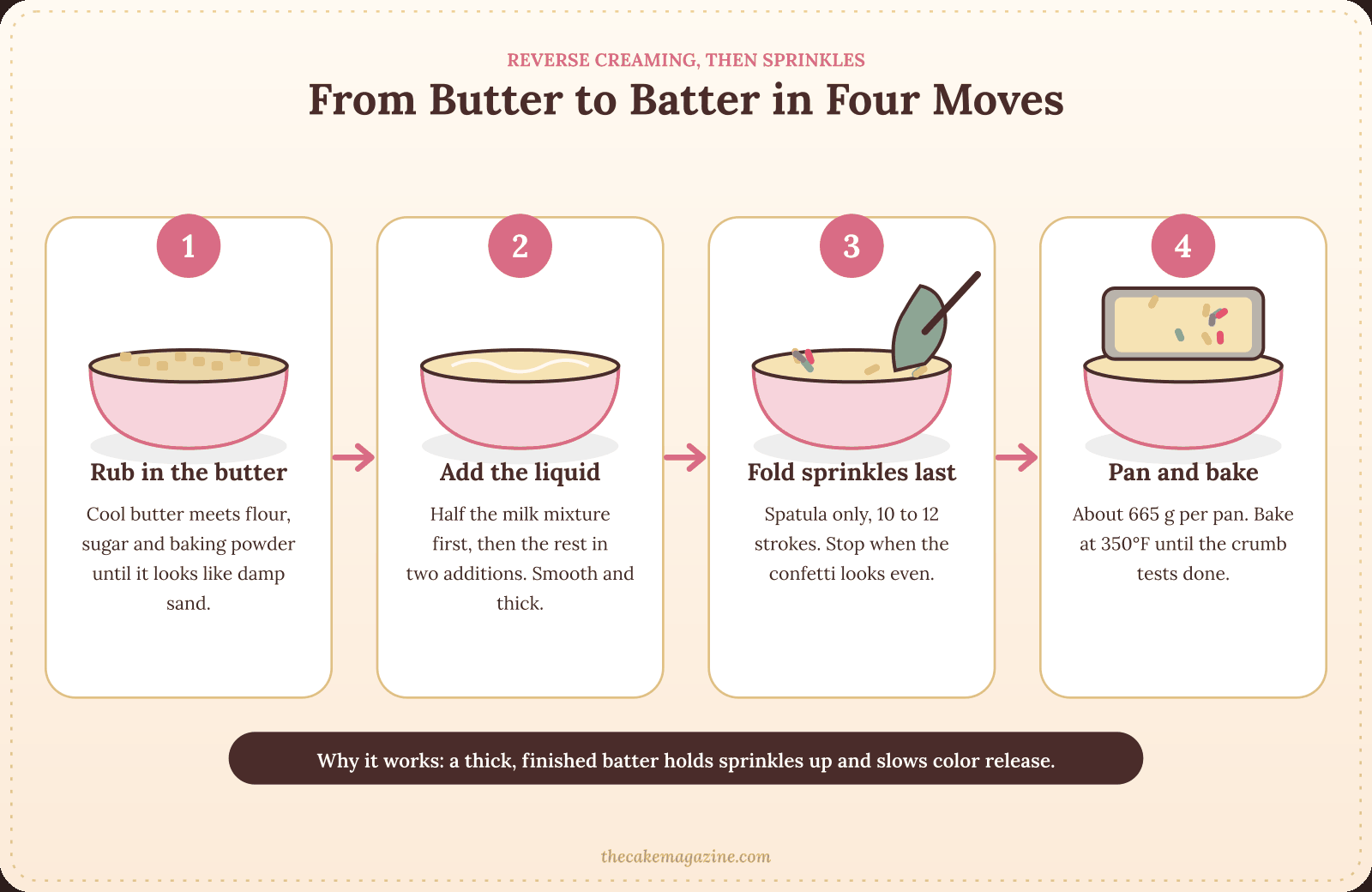
In reverse creaming, you rub the butter into the dry ingredients first, then add the liquid. The flour gets coated in fat, which limits gluten development, so the crumb turns out fine, velvety and tender. It also gives you a thick, stable batter. That matters for sprinkles, because a thick batter holds the little rods in suspension instead of letting them sink into a dense layer on the bottom of the pan.
The method has another quiet benefit. There is no long creaming stage that whips in lots of air, so the batter is less likely to dome and crack. If you would like to compare it with other approaches, our guide to cake mixing methods lays the options side by side.
A funfetti cake recipe adds the sprinkles last, and gently
This is the big idea behind a clean confetti cake. Color migrates from sprinkles into wet batter, and the longer and harder the batter is stirred with them in it, the more the color spreads. So we mix the batter completely first, then fold in the sprinkles at the end with a spatula, using the fewest strokes that spread them evenly. You will see the effect in the next sections.
A weight-based funfetti cake recipe gives you repeatable results
Every ingredient in the recipe card is listed in grams, with cup measures for convenience. Flour is the usual culprit when a cake turns out dry, because a scooped cup can weigh noticeably more than a spooned one. Sprinkles are worse. A cup of sprinkles can vary a lot depending on shape and size. Weighing them takes ten seconds and removes a major source of surprise. Our cake baking science guide explains why small errors in flour and fat show up so clearly in the crumb.
A note on the name. “Funfetti” began as a brand name for a boxed cake mix and has since become shorthand for any white or yellow cake studded with rainbow sprinkles. You will also see it called confetti cake, sprinkle cake or birthday cake. They all mean roughly the same thing, and this guide uses the terms interchangeably.
The ingredients, explained
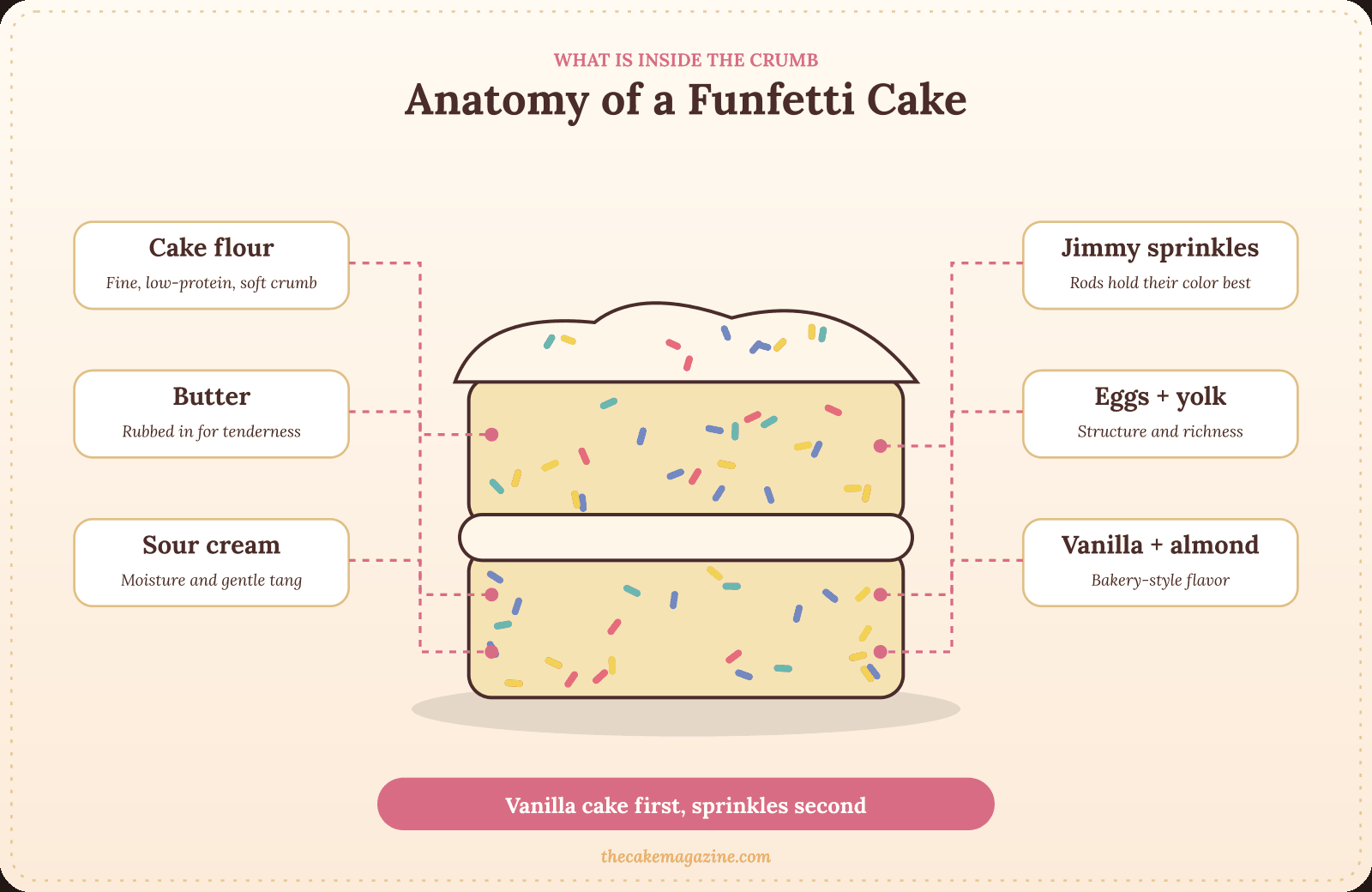
It helps to know what every ingredient contributes before you measure it. That knowledge is what lets you substitute sensibly, or rescue a batch that looks a little off. The illustration below shows the cross-section of the finished cake, and the sections after it explain each component in plain language.
Cake flour and the soft crumb of a funfetti cake recipe
Cake flour is milled finer and has less protein than all-purpose flour, which means less gluten and a softer crumb. For a confetti cake, softness matters because sprinkles add chew, and a slightly tough crumb makes that chew more obvious. If you cannot find cake flour, a mix of 262 g all-purpose flour and 38 g cornstarch, sifted together twice, gets you close. Measure by weight and sift, because cornstarch clumps.
Butter, sour cream and milk in a funfetti cake recipe
Unsalted butter provides the flavor. Keep it cool, around 65°F, so it can be rubbed into the flour without melting. Sour cream adds fat, moisture and a gentle tang that keeps a very sweet cake from tasting flat. Whole milk lightens everything and carries the vanilla. Use full-fat dairy here. Low-fat versions contain more water and less richness, and the cake feels it.
Eggs and the extra yolk in this funfetti cake recipe
Three whole eggs and one extra yolk give structure and richness. The yolk is also why the crumb has a faint buttery yellow. If you want a whiter cake so that colors pop against a pale background, the variations section shows how to use egg whites instead. Take eggs out of the fridge about thirty minutes ahead so they blend smoothly into the batter and do not chill the butter.
Leavening and salt
Baking powder does the lifting. We use a measured amount rather than a heaping spoon, because too much creates a coarse crumb and a cake that rises high and then drops in the center. Fine salt is not optional. Cakes with a lot of sugar, and sprinkles are mostly sugar, taste dull without it. Weigh the salt, since a teaspoon of coarse kosher salt and a teaspoon of fine table salt are very different amounts.
Vanilla, and a hint of almond
Use pure vanilla extract, or vanilla bean paste if you like the tiny dark flecks. Imitation vanilla works, but the flavor is thinner. A quarter teaspoon of almond extract is the classic bakery trick, and it is entirely optional. Almond extract is strong, so measure it carefully. Anyone with a nut allergy should check the label, because some extracts are made with different bases and manufacturing practices.
The sprinkles themselves
Here is where a funfetti cake recipe differs from any other vanilla cake. The type of sprinkle matters more than the brand, and it matters more than almost any other choice you will make. The next section walks through every common type and how it behaves in warm, wet batter.
Choosing sprinkles for a funfetti cake recipe that keeps its color
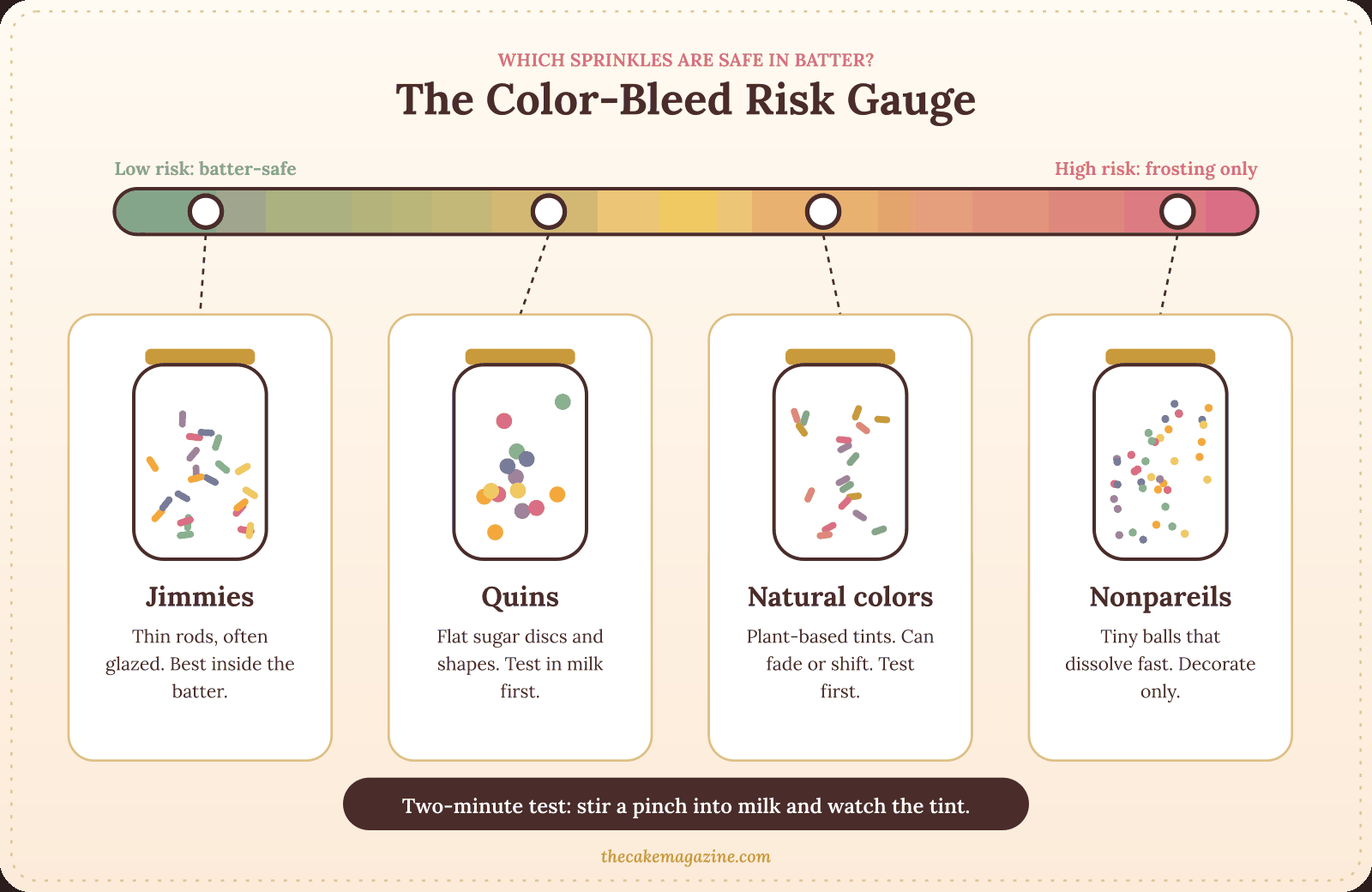
Walk down a baking aisle and you will find a dozen kinds of sprinkles, and they do not all behave the same way in a batter. Some stay crisp and bright. Others dissolve into streaks. Knowing the difference before you buy saves a cake. The gauge below ranks the most common types by how likely they are to bleed.
Jimmies: the best choice inside the batter
Jimmies are the thin, rod-shaped sprinkles, and they are the best bet for the inside of a confetti cake. Their shape means a relatively small surface area touches the batter, and many are coated with a waxy or glazed finish that slows color release. Look for products labeled for baking, and avoid very cheap bulk mixes that look chalky or have a dull, matte finish. Those tend to bleed faster.
Nonpareils: pretty on top, risky inside
Nonpareils are the tiny round balls. They look wonderful pressed onto frosting, but they are small, thin-coated and sugary, so they dissolve quickly in wet batter and leave colored halos. If you love their look, save them for the outside of the cake. Our guide to dot cakes shows how much sprinkle-covered frosting can do without ever touching the batter.
Quins, sequins and shaped sprinkles
Flat discs, stars, hearts and other shapes are often called quins or sequins in the baking world. Their performance depends on how they are made. Many are pressed from sugar paste and have a dry, firm finish that holds up reasonably well, while others are softer. The reliable test is simple: drop a pinch into a small cup of milk and watch for a few minutes. If the milk turns tinted quickly, keep that sprinkle on top of the cake.
Natural-color sprinkles
Sprinkles colored with plant-based ingredients are increasingly common, and they appeal to bakers who prefer them. They can behave differently from conventional ones. Some fade in the oven, and some release color or shift hue in the batter. If you want to use them, test a small amount first, and expect muted tones rather than neon brights. Always read the ingredient list if you or a guest has an allergy or dietary restriction.
A simple bleed test before you commit
Here is a thirty-second check that tells you almost everything. Stir a teaspoon of your sprinkles into a spoonful of room-temperature milk. Wait two minutes. If the milk stays almost clear and the sprinkles still look bright, they are a good candidate for the batter. If the milk turns pink or blue, use that product only for decoration. Our cake troubleshooting guide includes a similar habit: test the doubtful ingredient before blaming the recipe.
How many sprinkles belong in a funfetti cake recipe?
The recipe card uses 90 grams of jimmies for two 8-inch layers, which gives a lively confetti look without overwhelming the crumb. Going much beyond 120 grams starts to weigh down the batter, and the cake can turn crumbly and overly sweet. If you want a more dramatic look, add extra sprinkles to the frosting and the surface, not the batter.
- Light confetti: 60 to 70 g, with a mostly vanilla look.
- Classic: 90 g, the amount in the card below.
- Maximum party: up to 120 g, with a slightly more fragile crumb.
The funfetti cake recipe: full recipe card
Funfetti Layer Cake
A reverse-creamed vanilla butter cake with jimmy sprinkles folded in at the end. This is a starting formula to adapt, built on conservative, well-known baking ratios. We have not oven-tested it, so check doneness early and take notes on your own oven.
Ingredients
- Cake flour300 g (about 2 ½ cups, spooned and leveled)
- Granulated sugar300 g (1 ½ cups)
- Baking powder10 g (2 ½ teaspoons)
- Fine salt4 g (¾ teaspoon)
- Unsalted butter, cool (65°F), cut in ½-inch cubes170 g (12 tablespoons)
- Whole milk, cool room temperature220 g (a scant 1 cup)
- Full-fat sour cream, cool room temperature60 g (¼ cup)
- Large eggs, cool room temperature150 g (3 whole eggs)
- Egg yolk18 g (1 large yolk)
- Pure vanilla extract12 g (1 tablespoon)
- Almond extract, optional1 g (¼ teaspoon)
- Jimmy-style rainbow sprinkles (baking quality)90 g (about ⅔ cup), plus extra for decorating
Instructions
- Prep. Set a rack in the center of the oven and heat to 350°F (175°C). Grease two 8-inch by 2-inch round pans, line the bottoms with parchment, grease the parchment and dust the sides with flour.
- Mix the liquids. In a medium bowl or large measuring cup, whisk the milk, sour cream, eggs, yolk, vanilla and almond extract (if using) until smooth. Set aside.
- Whisk the dry ingredients. In the bowl of a stand mixer fitted with the paddle, whisk the flour, sugar, baking powder and salt on low for 30 seconds.
- Rub in the butter. With the mixer on low, add the cubed butter a few pieces at a time. Mix 1 to 2 minutes, until the mixture looks like damp, fine crumbs with no large butter lumps.
- Add the first half of the liquid. Pour in about half of the milk mixture. Raise the speed to medium and mix for 1 minute. The batter will look thick and smooth.
- Add the rest. Scrape the bowl well. On low speed, add the remaining liquid in two additions, mixing just until combined. Finish with a few folds by hand to catch any flour at the bottom.
- Fold in the sprinkles. Remove the bowl from the mixer. Add the 90 g of sprinkles and fold with a flexible spatula, about 10 to 12 strokes, just until the sprinkles are evenly scattered. Stop there.
- Pan the batter. Divide evenly by weight (about 665 g per pan). Smooth the tops and tap each pan firmly on the counter two or three times to release large air bubbles.
- Bake. Bake 28 to 34 minutes. The cakes are done when the tops spring back lightly, the edges just begin to pull away from the pan and a skewer in the center shows a few moist crumbs (about 205°F to 210°F inside).
- Cool. Cool in the pans on a rack for 10 minutes. Run a thin knife around the edges, turn the layers out, peel off the parchment and cool completely, at least 1 to 2 hours, before filling or frosting.
Notes
- Storage: Wrap cooled layers tightly and keep at room temperature for up to 1 day, or freeze for up to 2 months.
- No cake flour? Use 262 g all-purpose flour plus 38 g cornstarch, sifted together twice.
- Sprinkle type: Use jimmies inside the batter. Save nonpareils for the outside of the cake.
- Other pans: See the doneness and pans section for starting times in other pans. Treat them as estimates and check early.
- Frosting: Pair it with American buttercream or a lightly sweet Swiss meringue buttercream.
Step-by-step: how to make this funfetti cake recipe
The card gives you the sequence. This section gives you the reasoning, which is what saves you on the day something behaves a little differently. If you have never made a layer cake before, read it once through before you pull out the butter.
Step 1: Set yourself up for the funfetti cake recipe
Take the butter, eggs, milk and sour cream out about an hour before you bake. Butter is the one that cannot be rushed. Aim for about 65°F: cool to the touch, slightly flexible, not greasy. Heat the oven fully, and prepare the pans before you mix, because this batter should not sit around waiting. Weigh the sprinkles into a small bowl now so they are ready the moment the batter is.
Weigh everything into its own bowl or cup first. Cooks call this mise en place, and it makes a quiet difference. When you are not hunting for the baking powder with butter on your hands, you make fewer mistakes.
Step 2: Whisk the dry ingredients for the funfetti cake recipe
Whisk the flour, sugar, baking powder and salt in the mixer bowl for about 30 seconds. This spreads the leavening evenly, which is the only way to get an even rise. Cake flour can clump after sitting in the bag, so if you see tiny lumps, sift it first. A smooth dry mix means a smooth batter later.
Step 3: Rub in the butter
Add the cool butter in pieces with the paddle turning on low. After a minute or two, the mixture should look like wet sand, with no obvious butter chunks. This coating step is the heart of reverse creaming. It shields the flour from the liquid, so the crumb stays soft. If the butter feels warm or greasy, chill the bowl for ten minutes and try again.
Step 4: Add the liquid in stages
Pour in half the milk mixture and beat on medium for a full minute. That minute builds body and lets the batter become thick, smooth and creamy. Then stream in the rest in two additions on low and stop as soon as it looks combined. The two-stage approach reduces curdling and gives the batter enough structure to carry sprinkles evenly.
Scrape the bottom and sides carefully. Flour hides in the corner of a mixer bowl, and a streak of dry flour in a baked layer looks like a pale, bitter pocket. A few folds by hand at the end catch whatever the paddle missed.
Step 5: Fold the sprinkles into the funfetti cake recipe last
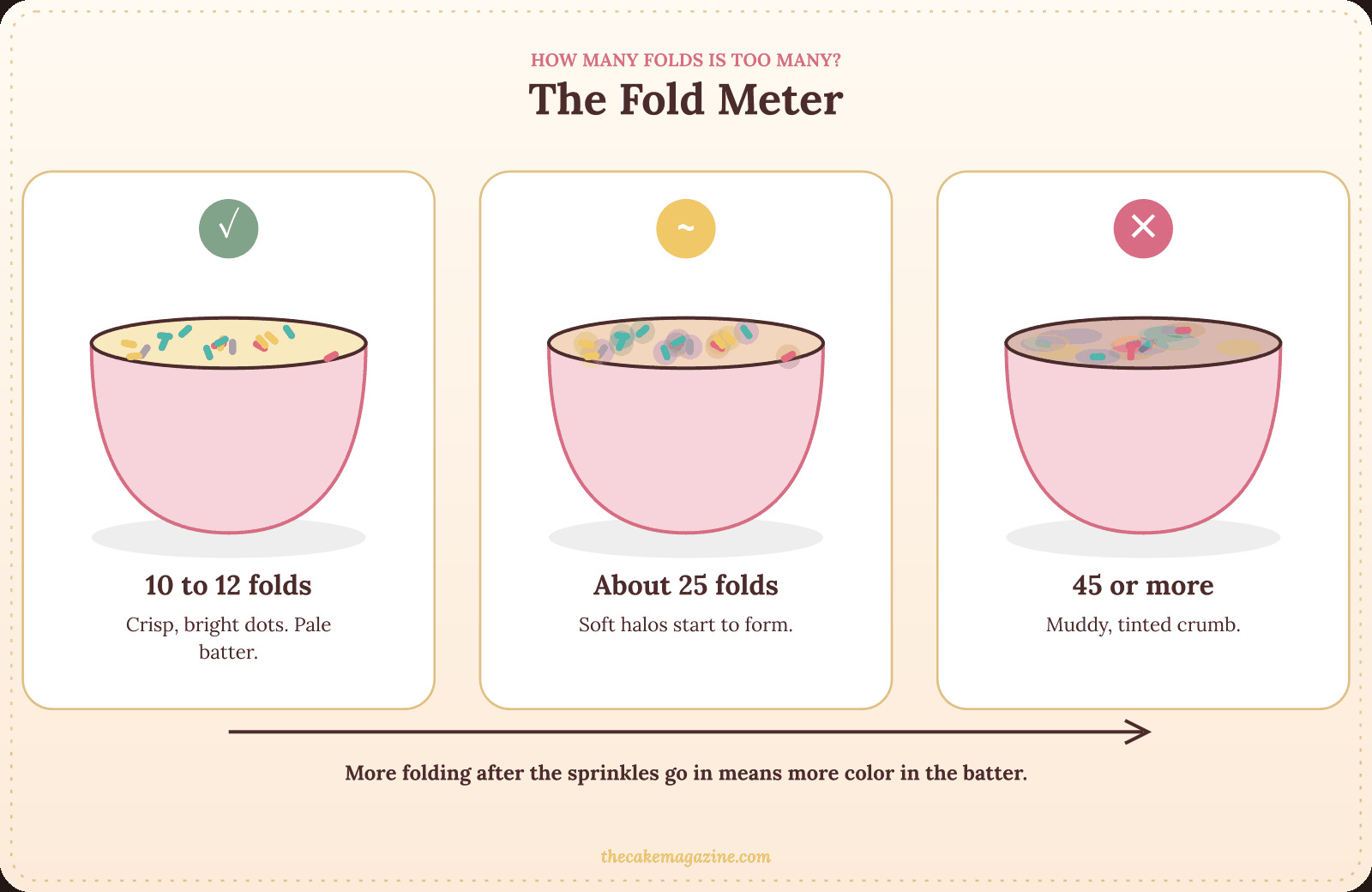
Take the bowl off the mixer. Add the sprinkles all at once and fold with a flexible spatula, scraping down the side and bringing batter up through the middle, rotating the bowl as you go. Ten to twelve strokes is usually enough. The sprinkles do not need to be perfectly distributed. They will keep spreading slightly as you scrape the batter into the pans.
Resist the urge to keep folding. Every extra stroke pushes more color into the batter and makes the crumb a little more tinted. Slightly uneven confetti looks charming. Muddy batter does not.
Step 6: Pan and bake the funfetti cake recipe
Divide the batter by weight, about 665 grams per pan. Smooth the surface and tap each pan on the counter to release large bubbles. Bake on the center rack and keep the oven door closed for the first 20 minutes or so. A gentle, steady heat gives you a level top and a delicate crumb. Rotate the pans only if you know your oven bakes unevenly, and only late in the bake.
If you are working in a different pan, or you want to convert the formula, our cake pan buying guide explains how pan material and color change browning and bake times.
How to keep the colors clean in a funfetti cake recipe
Clean colors are the whole reason people search for tips on a funfetti cake recipe. Nearly every complaint, from muddy crumb to rainbow streaks, comes from one of five causes. The illustration below shows what happens to the batter as you fold, and the checklist after it turns that into habits.
Mix the batter completely before the sprinkles arrive
Any mixing you do after adding sprinkles is mixing that can smear color. So do all the real work first: rubbing in the butter, building body, adding the liquid and scraping. The sprinkles join a finished batter and get only the gentlest handling. This single habit prevents most of the muddiness bakers complain about.
Choose a thick batter
Thin, watery batter lets sprinkles sink and lets color travel faster. The reverse-creamed batter in this recipe is on the thicker side, which keeps the rods suspended and slows migration. If you substitute a very thin batter, such as an oil-based one, expect more sinking. Our best chocolate cake recipe is deliberately thin and is a good example of a batter that does not suit sprinkles.
Use a spatula, not the mixer
A stand mixer paddle will happily grind sprinkles against the bowl and chop the rods into powder. A spatula moves them gently. Fold, do not stir. Cut down through the center, sweep along the bottom and bring batter up and over the top. Turn the bowl a quarter turn after every couple of strokes.
Keep everything cool
Heat speeds up color release. Cool butter, cool milk and cool batter all slow it down. Do not let the finished batter sit on the counter while the oven preheats. Pan it and bake it right away. If your kitchen is hot, consider chilling the sprinkles for a few minutes before folding them in.
Do not overbake, and do not open the door early
Overbaking dries the crumb and dulls colors. Opening the door early can make a cake collapse, which compresses the crumb and makes the sprinkles look crowded. Bake until the cues in the next section tell you it is done, not a minute longer.
Quick color-clean checklist. Run the bleed test on your sprinkles. Use jimmies inside, nonpareils outside. Mix the batter completely first. Fold 10 to 12 strokes with a spatula. Pan immediately. Bake until just done. If you do those six things, your funfetti cake recipe will look bright in the crumb.
What to expect from the colors
Even with a careful hand, some sprinkles will leave a small halo of color around themselves, especially the reds and purples. A little of that is normal and even charming. You are aiming for sharp dots and a pale crumb with a few soft edges, not a laboratory-perfect result. If you notice heavy streaking, the culprit is almost always the sprinkle type or too many folds.
Doneness, pans and yield for a funfetti cake recipe
Sprinkles make a cake look done before it is. The tops brown, the edges set, and the colors can hide the wet center. So rely on several cues together instead of the timer alone. Because we have not oven-tested this formula, treat the times here as a starting range and begin checking at the early end.
Four doneness cues
- Edges: they just begin to pull away from the pan, leaving a hairline gap.
- Top: it springs back when pressed lightly in the center and leaves no dent.
- Skewer: a few moist crumbs cling to it. Wet batter means more time, and a perfectly clean skewer can mean slightly overbaked.
- Temperature: an instant-read thermometer in the center reads about 205°F to 210°F for most butter cakes.
A sprinkle can melt slightly and stain a skewer, which looks like wet batter. Probe in a spot without a visible sprinkle, or judge by the crumb texture on the tester, not just color.
Pan sizes, bake times and batter weight for the funfetti cake recipe
The batter total is about 1,330 grams with the sprinkles. Fill pans about halfway, and never beyond two-thirds, so the cake has room to rise. The estimates below are starting points. Deeper or darker pans and different ovens can shift times by several minutes.
Two 8-inch rounds
The default in the recipe card. About 665 g of batter per pan, baking 28 to 34 minutes. Gives a tidy two-layer cake with 12 to 14 slices.
Two 9-inch rounds
Thinner layers that bake a little faster, roughly 24 to 30 minutes. Start checking early. About 665 g per pan, and the layers will be a touch shorter.
Three 6-inch rounds
Tall, dramatic layers. Around 440 g per pan, roughly 25 to 32 minutes. A lovely choice for a small birthday cake.
9 by 13-inch pan
A single sheet layer for a crowd. Use all the batter, bake roughly 32 to 38 minutes. See our sheet cake guide for pan sizes and servings.
Cupcakes
Fill liners about two-thirds full, which yields about 20 to 24 cupcakes. Bake roughly 18 to 22 minutes at 350°F, checking early.
Mini and bento cakes
Small molds bake fast, often 15 to 22 minutes. Our mini cakes guide covers portions and scaling.
If you are cutting a cake for a party and want to know how many people it feeds, remember that an 8-inch two-layer cake yields roughly a dozen modest slices. For larger events, our cake serving guide for tiered cakes shows how portions scale up.
Cooling the layers of a funfetti cake recipe
Leave the layers in their pans for ten minutes. That gives the structure time to firm so the cake does not tear when you turn it out. Run a thin knife around the edge, flip each layer onto a rack, peel off the parchment and let them cool completely. A warm layer will melt buttercream and smear the sprinkles into the frosting, which is the opposite of what you want.
Frosting and filling choices for a funfetti cake recipe
The frosting you choose changes how the whole cake reads. Sprinkles are sweet, so a very sugary frosting can tip the cake into cloying territory. White or pale frostings make the confetti glow. Dark frostings like chocolate are fun but hide the pattern when sliced. Here are the options that work best, with the reasoning for each.
American buttercream
Quick, sturdy and the nostalgic partner for a birthday cake. It is very sweet, so use a pinch of salt and consider a splash of cream. Our American buttercream recipe shows how to adjust sweetness and texture.
Swiss meringue buttercream
Silky, less sweet and very stable, which balances a sprinkle-heavy cake nicely. Our Swiss meringue buttercream guide covers the temperature and emulsion steps.
Cream cheese frosting
Tangy and soft, a good contrast to sugary sprinkles. It needs refrigeration and has limits for decorating. See our cream cheese frosting guide for the details.
Stabilized whipped cream
Light and not too sweet, with a fresh dairy flavor. It must stay cold, so it suits cakes served the same day. Learn more in our stabilized whipped cream guide.
Which frosting suits a funfetti cake recipe best?
If you are making a child’s birthday cake and want the familiar taste, go with American buttercream. If the guests are adults who will notice sweetness, choose Swiss meringue buttercream or cream cheese frosting. If the cake will sit at a warm outdoor party, avoid whipped cream and cream cheese. Our overview of types of buttercream helps you compare them side by side.
Filling ideas for a funfetti cake recipe
A plain layer of buttercream between the cakes is perfectly good. For something more playful, try a ring of buttercream with a little pile of sprinkles in the center, which shows up as a confetti band when the cake is cut. You can also add a thin layer of raspberry or strawberry jam inside a buttercream dam. Our guide to jam cake fillings shows how to use preserves without making layers slide.
Keep fillings simple. A funfetti cake already has a lot happening, between the sprinkles and the sweetness. Soft, fruity or tangy fillings give contrast, while heavy chocolate or caramel layers compete for attention.
How much frosting do you need?
For a two-layer 8-inch cake, plan on roughly 700 to 900 grams of finished frosting if you want a generous fill and coat plus some piping. A thin, rustic coat takes less. Always make a little more than you think you need, because it is much easier to throw away extra frosting than to remake a batch at the last minute.
Decorating a funfetti cake recipe with sprinkles
The inside of the cake carries the party, and the outside can carry more. Because you are using jimmies in the batter, you have an opportunity to use other sprinkle types, like nonpareils and quins, on the surface. The illustration below shows three classic looks, and each of them is within reach of a beginner.
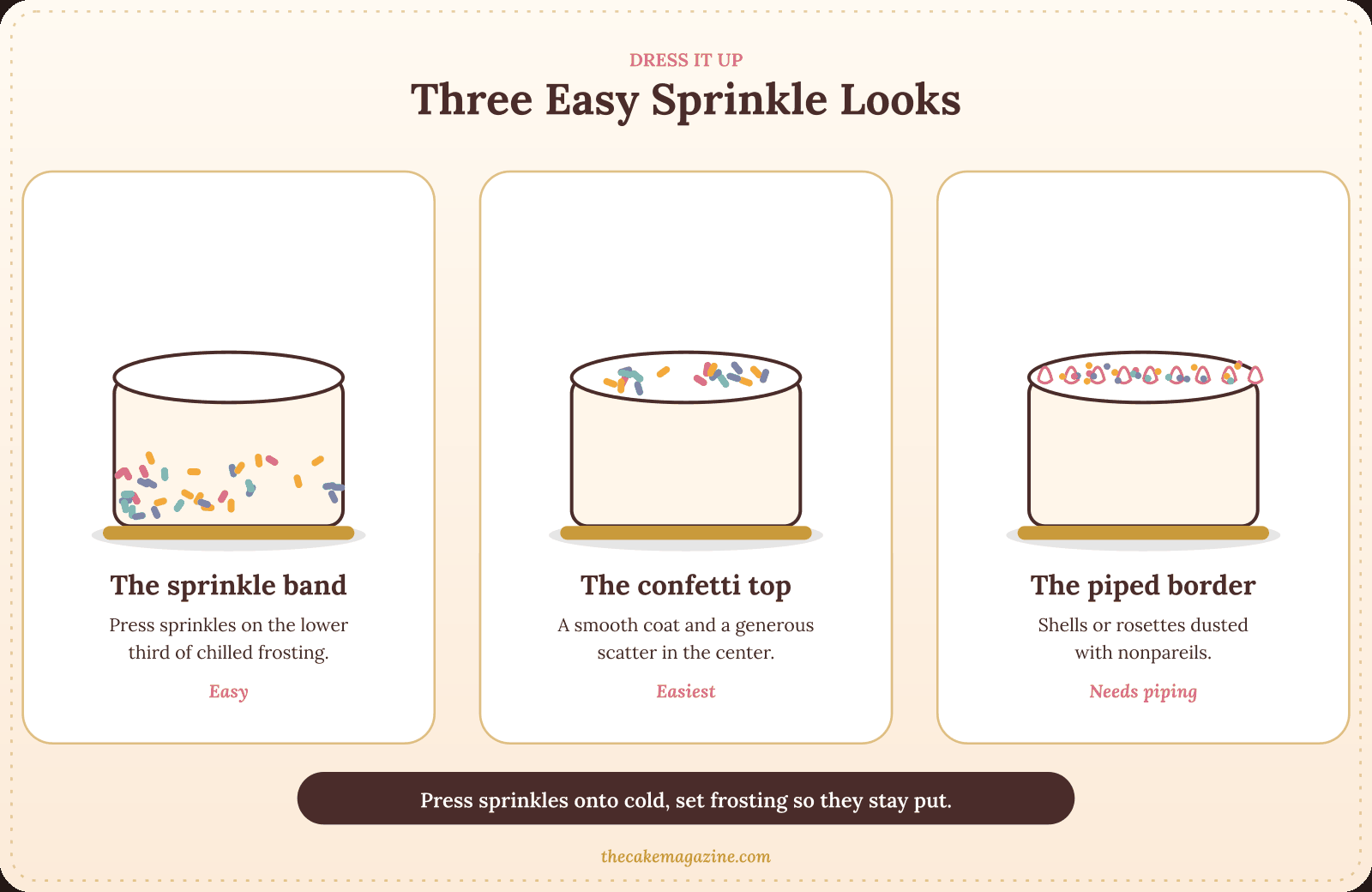
The sprinkle band
Frost the cake and chill it until the buttercream is firm to the touch. Then hold the cake over a tray, scoop sprinkles into your palm and gently press them onto the lower third of the sides. The tray catches the extras, and you can pour them back into the jar. This look is easy and tidy, and it frames the cake nicely.
The confetti top
A smooth top with a generous scatter of sprinkles in the center feels festive without much work. For a smoother finish, check our guide to getting smooth buttercream sides and sharp edges. A clean base coat makes every sprinkle pop.
The piped border
A simple shell or rosette border in white frosting, dusted with nonpareils, adds a bakery touch. If you are new to piping, start with the techniques in our cake piping guide, and practice on parchment first. Our cake decorating for beginners guide lists the tools worth buying first.
Sprinkle tips that save frustration
- Press sprinkles onto cold, set frosting, not soft frosting that will smear.
- Decorate over a baking sheet to catch the mess.
- Add nonpareils to a chilled cake shortly before serving if you want them at their brightest.
- Keep a small paintbrush to nudge stray sprinkles back into place.
- Store open sprinkle jars away from heat and sunlight, because they fade.
Making it a showpiece
Sprinkle cakes are having a moment, from tall dramatic birthday cakes to little single-serving rounds. Our cake trends guide looks at where small formats and playful decoration are heading. Whatever the trend, a well-baked cake in a tidy coat of frosting always looks better than an over-decorated one with a dry crumb.
Make ahead and storage for a funfetti cake recipe
Confetti cake is a friendly make-ahead cake. The layers can be baked early, wrapped and frozen, which takes pressure off the day of the party. A few simple rules keep the crumb soft and the colors bright, and one safety rule matters if your frosting contains dairy.
Baking the layers ahead
Cool the layers completely, then wrap each one tightly in plastic wrap. At cool room temperature, they will keep well for about a day. For longer storage, wrap them again in foil or place them in a freezer bag and freeze for up to two months. Wrapping while still warm traps steam and makes the tops sticky, so be patient.
Thawing and frosting frozen layers
Move the wrapped layers to the fridge the night before, or leave them wrapped on the counter for a couple of hours. Keep the plastic on while they thaw so condensation forms on the wrap instead of the cake. Slightly cold layers are also easier to level, fill and frost, with fewer crumbs in the buttercream.
Storing a frosted cake
A cake frosted with American or Swiss meringue buttercream and no perishable filling holds well at cool room temperature for a day or two under a cake dome or in a covered box. A cake with cream cheese frosting, whipped cream, pastry cream or fresh fruit belongs in the refrigerator. Bring slices or the whole cake to cool room temperature before serving, because cold butter-based cake tastes firmer and less flavorful.
Food-safety reminder. Perishable foods, including cakes with dairy-based frostings or fillings, should not sit at room temperature for long periods. The USDA Food Safety and Inspection Service publishes current guidance on safe handling and temperatures. When in doubt about a particular filling, refrigerate it and follow official advice.
Why sprinkles fade when you store a funfetti cake recipe
Sprinkles on a refrigerated cake can weep a little. Moisture from the frosting and from the cold, humid air of a fridge pulls color out of the sprinkles, and you may see small bleeding streaks. If you plan to refrigerate a decorated cake, consider adding nonpareils and quins just before serving, and use jimmies, which tend to hold up better, on the sides.
Serving and slicing
Use a long, sharp knife, dip it in hot water and wipe it dry between cuts. The clean slice shows off the confetti in the crumb. Serve at cool room temperature, when the butter in both cake and frosting is soft. If your cake spent the day in the fridge, give it 30 to 60 minutes on the counter before slicing.
Troubleshooting your funfetti cake recipe
Even a careful baker meets a few surprises. Below are the most common problems with sprinkle cakes, with a diagnosis and a fix for each. For problems that are not specific to sprinkles, our cake troubleshooting guide covers sinking, dryness, density and cracking in far more depth.
The colors bled and the crumb looks muddy
What it looks like: pink, blue or gray streaks run through the crumb, and the cake looks dingy instead of bright.
How to test: drop a pinch of your sprinkles into a spoonful of milk and wait two minutes. A tinted liquid tells you the sprinkles are the culprit. If the milk stays clear, too much stirring is the likelier cause.
Fix it next time: switch to jimmies sold for baking, fold only 10 to 12 strokes and pan immediately. Keep nonpareils for the frosting.
The sprinkles sank to the bottom
What it looks like: a dense line of sprinkles sits at the base of each layer, with a pale, plain top.
How to test: check the thickness of your batter. If it poured like heavy cream, it was too thin to hold the sprinkles up.
Fix it next time: use a thicker batter such as the reverse-creamed one in this recipe, do not overfill with sprinkles, and avoid extra milk. A tablespoon of flour tossed with the sprinkles can help a little, though it is not a cure for a thin batter.
The cake is dry or crumbly
What it looks like: the slice falls apart, tastes dusty and the crumb looks coarse.
How to test: weigh your flour next time. A scooped cup can add 20 percent or more flour. Also check that the cake did not bake past 210°F inside.
Fix it next time: weigh the flour, cut the sprinkles back to 70 g and begin checking doneness five minutes early. Sprinkles add dry sugar, so too many make a cake crumbly.
The layers sank in the middle
What it looks like: a dip or crater forms as the cake cools, often with a gummy ring around it.
How to test: if the center was wet when you pulled it, it was underbaked. If it was cooked but still sank, look at the leavening and oven door habits.
Fix it next time: level the baking powder, keep the oven door closed for the first 20 minutes and verify the oven temperature with a separate thermometer.
The tops domed and cracked
What it looks like: a high peak with a split down the middle.
How to test: check your oven temperature. A hot oven sets the edges while the middle keeps rising.
Fix it next time: lower the oven by 15 to 25°F, use light-colored pans and consider baking strips. Level any dome with a serrated knife before frosting.
There are tunnels or large holes inside
What it looks like: long, narrow holes run through the crumb, often slanting upward.
How to test: think about whether you overmixed after adding the sprinkles or the liquid.
Fix it next time: stop mixing as soon as the batter comes together and fold gently. Our guide on cake tunnels and large holes goes through every cause.
The edges are dark but the middle is raw
What it looks like: brown, firm edges and a wobbly center.
How to test: use an oven thermometer. Many home ovens run hot or cold by 25°F or more.
Fix it next time: lower the temperature by 25°F and bake longer. Use light-colored aluminum pans, which brown more gently than dark ones.
Variations on the funfetti cake recipe
Once you have made the base cake and watched how it behaves in your oven, there is plenty of room to play. These variations on the funfetti cake recipe stay close to the original formula, and each one is a starting point to test rather than a promise. Change one thing at a time so you know what caused any difference.
White confetti cake
For the palest crumb, replace the 3 whole eggs and the yolk with about 170 g of egg whites and keep everything else the same. Expect a whiter, slightly less rich cake. This is a starting idea to test, not a verified swap.
Cake-batter flavor
Replace 30 g of the cake flour with 30 g of dry milk powder and add a little extra vanilla. It gives a creamy, malted bakery taste. Keep the total flour weight the same.
Brown-butter confetti
Brown the butter, chill it until solid again and use it in the reverse-creaming step. You get a nutty, toasty flavor, but the cake loses its pure vanilla look and sprinkles show less.
Lemon confetti
Rub the zest of one lemon into the sugar before mixing, and swap the almond extract for a pinch more vanilla. Pair it with a light cream cheese frosting.
Funfetti cupcakes
Fill liners two-thirds full and bake about 18 to 22 minutes, checking early. A swirl of vanilla buttercream and a pinch of nonpareils finishes them.
Confetti mini cakes
Bake in a sheet pan, cut out rounds and stack them with frosting for tiny layer cakes. See the mini and one-bite cakes guide for ideas.
Making it a rainbow layer cake
You can divide the batter into parts and tint each with gel food color for a striped cake. It is a fun project but a different one from sprinkle cake, so skip the sprinkles and use less color than you think. Gel colors are strong and a tiny dab goes a long way. Tinting the batter does not affect the baking, though very dark colors may brown unevenly.
A simple dairy-free or gluten-free adaptation?
We would not promise a perfect swap for either. A dairy-free version would need a plant-based butter that behaves like real butter in reverse creaming, and a gluten-free one needs a flour blend designed for cakes. Both change the structure, so start with a recipe written for those needs and apply the sprinkle technique from this guide to it.
Scaling and planning a funfetti cake recipe for a party
Sooner or later someone asks for a bigger cake, a smaller cake or a cake for a crowd of thirty. The base formula scales sensibly, but sprinkles and pan size need a little thought. Here is how to plan the funfetti cake recipe around the size of your event, without guessing and without wasting butter.
Scaling the funfetti cake recipe up or down
For a single 8-inch layer, halve everything, including the sprinkles (45 g). For three 8-inch layers, multiply by one and a half and use a large mixer bowl, because reverse creaming needs room. Round awkward numbers, such as half an egg, by whisking a whole egg and weighing out the amount you need. Leavening does not always scale perfectly, so treat the first scaled bake as a test and take notes.
Tall cakes bake slower in the center. When you use deeper pans, drop the oven temperature by 25°F and extend the time, and use baking strips if your cakes dome. The reasoning behind those adjustments is in our guide to cake baking science.
A realistic party timeline
Two days ahead, bake and freeze the layers. The day before, make the frosting and cover it, and gather sprinkles for decorating. On the day, thaw the layers in their wrapping, level and fill them, apply a crumb coat, chill, then finish the outside. Add nonpareils last. If anything goes wrong, a plain layer with a thick coat of buttercream and a scatter of sprinkles still looks festive.
Matching the cake to the guest list
- Six to eight people: a single 8-inch layer, or a split of one layer for a small, lower cake.
- Ten to fourteen people: the full two-layer 8-inch cake from the card.
- Fifteen to twenty-four people: a 9 by 13-inch sheet cake, cut in small squares, or two 8-inch cakes.
- A crowd: cupcakes are easier to serve and avoid cutting entirely.
These counts assume modest party-size portions, so go up a size if your guests are hungry or the cake is the only dessert. The best funfetti cake recipe in the world cannot stretch past its pan, and a hungry crowd at a children’s party disappears a cake faster than you expect.
Flavors that pair well with a funfetti cake recipe
Sprinkle cakes taste of vanilla, so pair them with simple, bright companions. Strawberry and raspberry jam bring a welcome tartness. Lemon curd, in a thin layer, cuts the sweetness. Cream cheese frosting adds tang, and a little whipped cream lightens the whole plate. Skip dark chocolate and heavy caramel, which overpower the delicate cake flavor and hide the confetti.
When to choose another cake instead
If you are serving someone who dislikes very sweet desserts, a funfetti cake recipe may not be the right fit, since sprinkles add pure sugar. A lemon or almond cake may suit them better. For a richer, darker alternative, our red velvet cake recipe uses cocoa and buttermilk to deliver a different kind of celebration.
Ten mistakes to avoid with a funfetti cake recipe
Most failed attempts at a funfetti cake recipe trace back to a short list of habits. Read through these before you bake, and you will dodge the majority of problems. Each one is easy to fix once you know to look for it.
- Using nonpareils inside the batter. They dissolve and tint the crumb. Keep them for the outside.
- Folding the sprinkles in too early. Add them after the batter is fully mixed.
- Folding too long. Ten to twelve strokes is plenty. More only adds color to the batter.
- Using a mixer to add the sprinkles. The paddle crushes them. Use a spatula.
- Measuring flour by scoop. Weigh it, or you risk a dry, crumbly cake.
- Adding too many sprinkles. Beyond about 120 g, the batter gets heavy and sweet.
- Letting the batter sit. Pan it right away so the colors do not spread.
- Skipping the pan prep. Sugar from the sprinkles can stick. Grease, line and flour the pans.
- Frosting warm layers. Heat melts buttercream and smears the decoration.
- Overbaking. Check early, use a thermometer and remember that the cake keeps cooking in the pan for a few minutes.
A simple plan for a party day
Timing is the secret to a calm birthday. Bake the layers one or two days ahead and freeze them. Make the buttercream the day before and keep it covered. On the day, thaw, level, fill and frost, then decorate. That order leaves you time to enjoy the party. If you are baking and selling cakes, our guide to calculating the cost of a cake helps you price the sprinkles, butter and labor fairly.
Frequently asked questions about the funfetti cake recipe
What is the best sprinkle type for a funfetti cake recipe?
Jimmies, the thin rod-shaped sprinkles sold for baking, are the safest choice inside the batter because they hold their color better than most. Save nonpareils, the tiny round beads, for decorating the frosting, where they cannot bleed into the crumb.
Why do the colors bleed in my funfetti cake recipe?
Color bleeds when sprinkles dissolve in wet batter, which happens faster with nonpareils, cheap sprinkles, heat and extra stirring. Fold in the sprinkles last with 10 to 12 gentle strokes, pan the batter right away and test your sprinkles in milk first.
How many sprinkles should I put in a funfetti cake recipe?
For two 8-inch layers, about 90 grams works well. You can go down to 60 grams for a subtle look or up to about 120 grams for a bolder one. Beyond that, the batter gets heavy and the cake can turn crumbly.
Can I make this funfetti cake recipe with all-purpose flour?
Yes. Replace the 300 grams of cake flour with 262 grams of all-purpose flour and 38 grams of cornstarch, sifted together twice. The crumb will be a little less delicate, but it still works well for layers.
Why did my sprinkles sink to the bottom of the cake?
A thin batter cannot hold sprinkles in suspension, and heavy handling makes them sink faster. Use a thick, reverse-creamed batter, avoid adding extra liquid and fold the sprinkles in gently at the end.
Can I use a box mix instead of a homemade funfetti cake recipe?
You can, and plenty of people do. Follow the package directions and still fold gently, because the same color-bleed rules apply. Homemade gives you a richer butter flavor and a sturdier crumb for stacking, but a mix is a perfectly fine shortcut.
Can I bake this funfetti cake recipe as cupcakes?
Yes. Fill liners about two-thirds full and bake at 350°F, checking around 18 minutes. The batter makes roughly 20 to 24 cupcakes, though times vary by pan and oven, so test one batch and note the results.
How far ahead can I make a funfetti cake recipe?
Bake the layers up to two months ahead and freeze them tightly wrapped. Frosted cakes keep a day or two at cool room temperature when the frosting has no perishable dairy. Refrigerate cakes with cream cheese, whipped cream or custard fillings.
Does a funfetti cake recipe need almond extract?
No. It is optional. A quarter teaspoon gives the classic bakery flavor, but vanilla alone is lovely. If you cook for someone with a nut allergy, check the extract label and consider leaving it out.
Can I freeze a frosted funfetti cake recipe?
You can freeze a fully frosted buttercream cake if you chill it solid first and wrap it very well. Thaw it slowly in the fridge, still wrapped. Sprinkles may weep a little, so add nonpareils after thawing for the brightest look.
What frosting goes best with a funfetti cake recipe?
Vanilla buttercream is the classic partner. Swiss meringue buttercream or cream cheese frosting are less sweet and balance the sugary sprinkles well. Avoid dark frostings if you want the confetti to show when you cut the cake.
Why is my funfetti cake recipe too sweet?
Sprinkles are mostly sugar, and American buttercream is very sweet too. Cut the sprinkles to 70 grams, add a pinch of salt to the frosting and try a tangy cream cheese or Swiss meringue buttercream to bring things into balance.
Can I swap the butter for oil in a funfetti cake recipe?
You can, but the method changes. Oil makes a thinner batter that lets sprinkles sink and bleed, so the result is moister but harder to keep clean. If you try it, use a recipe built for oil and fold in the sprinkles very gently.
Final thoughts
A good funfetti cake recipe is a good vanilla cake with a few smart habits layered on top. Weigh the ingredients, reverse-cream the batter for a soft and sturdy crumb, pick jimmies for the inside and nonpareils for the outside, and fold the sprinkles in last with a light hand. Do those things and the colors stay clean, the crumb stays tender and the cake tastes as cheerful as it looks.
Make it once as written so you know how it behaves in your oven, and keep notes on bake time, sprinkle brand and anything you would change. After a bake or two, you will know exactly how to adjust it for your pans, your party and your taste. For more background on technique and ingredients, the King Arthur Baking cake guide is a respected reference.
If you try this funfetti cake recipe, tell us how it went. Share your pan size, your oven and which sprinkles you used, and we will keep refining the guide.
Editorial note: reviewed and updated November 2026. This guide is written for home bakers in the United States, using American measurements and ingredients. The recipe is a starting formula built on conservative, well-known baking ratios and has not been oven-tested by The Cake Magazine, so bake times and amounts may vary with your oven, pans, altitude and ingredients. Always check allergen labels on sprinkles and extracts. Where we link to products or tools in the future, we will disclose affiliate relationships near the links.