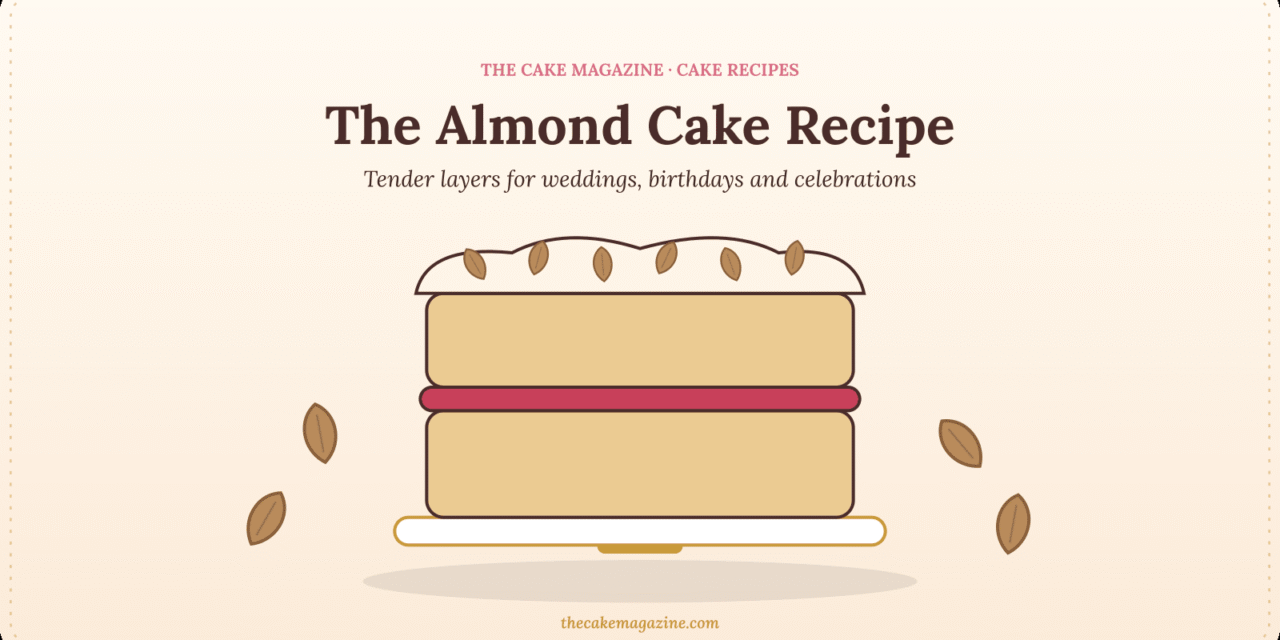
Almond cake has a quiet kind of glamour. It does not shout the way a chocolate cake does, and it does not hide behind sprinkles. It tastes like marzipan and warm vanilla, it slices cleanly for a wedding table, and it is the flavor guests keep asking about long after the plates are cleared. This almond cake recipe gives you a soft, tender, stackable layer cake with real almond flavor, plus the reasoning behind every step, so you can adapt it to birthdays, showers and celebration cakes with confidence.
A dependable almond cake recipe for layers combines soft cake flour, a little almond flour, butter, sour cream and eggs, then gets its flavor from pure almond extract used with restraint, about one teaspoon for two layers. Mix it by the reverse creaming method, weigh the batter into two 8-inch pans, bake at 350°F until a skewer shows a few moist crumbs, and cool completely before filling. Everything is in grams, and the full reasoning follows below.
- Why this almond cake recipe works
- The ingredients, explained
- How to get real almond flavor
- Equipment, pans and yield
- The almond cake recipe card
- Step-by-step method
- How to tell it is done
- Fillings and frostings that suit almond
- Storage, make ahead and nut allergies
- Troubleshooting
- Variations
- Ten mistakes to avoid
- Using it for weddings, birthdays and celebrations
- FAQ
Why this almond cake recipe works
Search for almond cake and you will find three very different things sharing one name. Some are dense, flourless cakes made almost entirely of ground nuts. Some are plain vanilla cakes with a splash of extract. Others are almond-flavored sponges soaked in syrup. They are all lovely, but they behave differently, and most of them are not built to carry frosting and fillings. This almond cake recipe is designed for a specific job: a soft, even, sturdy layer that tastes unmistakably of almond and still stacks well.
This almond cake recipe starts from a proven vanilla base
Rather than invent a new structure, the formula borrows the reverse creaming method and the balance of fat, sugar and liquid from a classic butter cake. If you have already made our best vanilla cake recipe, the process will feel familiar. The difference is a handful of deliberate swaps: a portion of the flour becomes almond flour, the vanilla is trimmed to make room for almond extract, and the leavening is kept steady so the added nut meal does not weigh the crumb down.
The crumb is tender because the butter goes in first
In reverse creaming, you rub cold butter into the dry ingredients before any liquid arrives. The flour particles get a thin coat of fat, which limits gluten development and produces a fine, velvety crumb. It also forgives small mistakes. A cake mixed this way is harder to overwork, which is a relief when you are juggling pans, frosting and a birthday party.
Almond flavor in this almond cake recipe comes from two directions
Almond flour brings a gentle, toasty, buttery nuttiness and a little extra moisture. Almond extract brings the sharper, perfumed, marzipan note most people recognize as almond. Used together they taste rounder and more natural than either one alone. Using only extract can read as candy. Using only almond flour can read as faint. The pairing is the quiet secret here.
Weighing keeps your almond cake recipe repeatable
Almond flour packs differently from wheat flour, and a scooped cup can vary by many grams. That is exactly the kind of drift that turns a moist cake into an oily one, or a tender one into a dry one. Every ingredient below is listed in grams, with cup equivalents for convenience. A basic digital scale is the best investment a layer-cake baker can make, and the reasons are explained in our guide to cake baking science.
A note on testing. The Cake Magazine has not oven-tested this formula. It is built from conservative, widely used butter-cake ratios and adapted for almond, and it is offered as a starting formula to adapt. Ovens, pans and ingredients vary, so bake one test cake before a big event and adjust the time to what you see.
The ingredients, explained
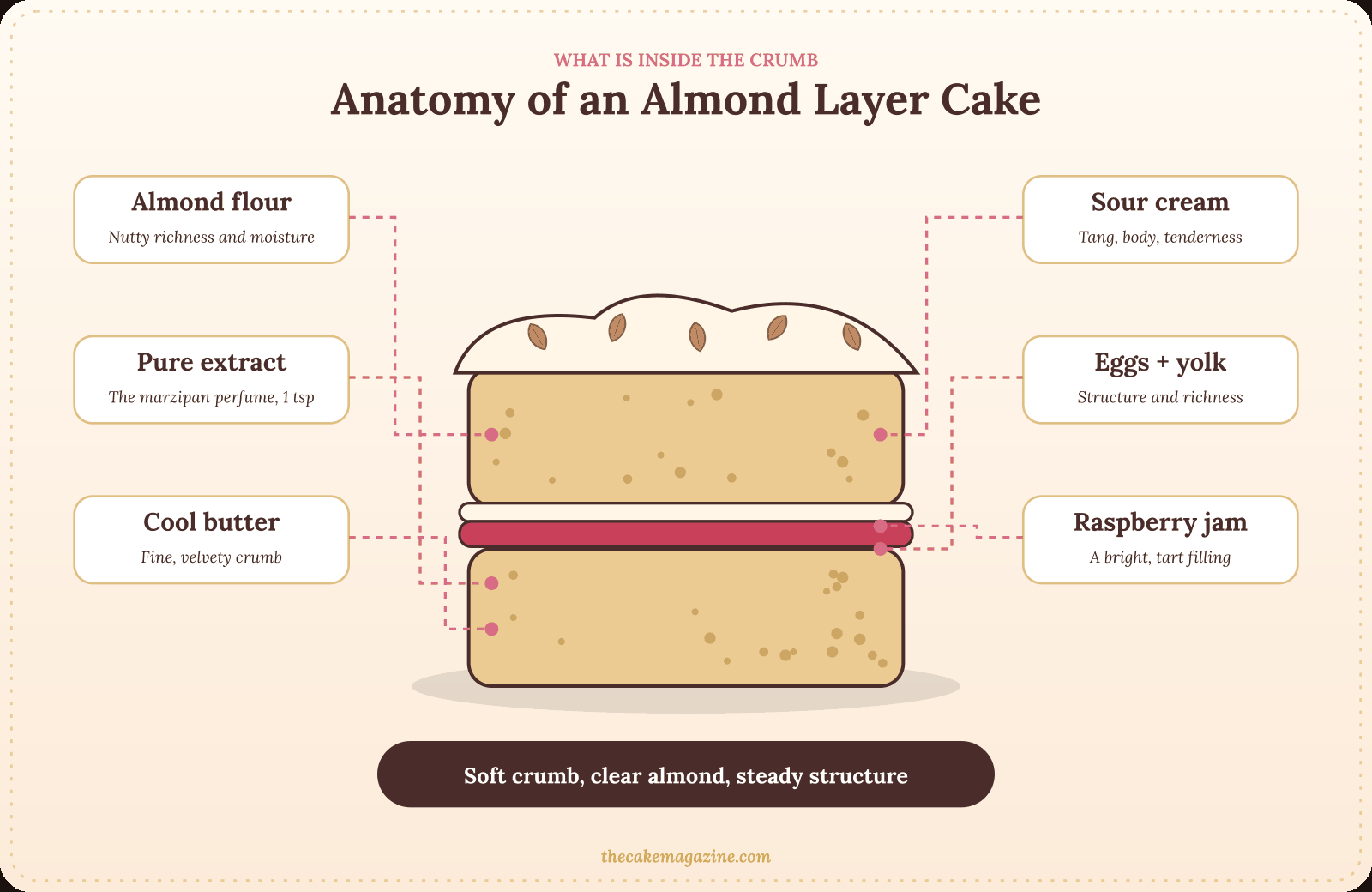
Understanding what each ingredient does is the difference between following an almond cake recipe and owning one. The illustration below shows a cross-section of the finished cake, and the sections after it walk through each part.
Cake flour: the soft foundation of an almond cake recipe
Cake flour has less protein than all-purpose flour, so it forms less gluten and bakes into a softer, more delicate crumb. That matters here because almond flour contributes no gluten at all. If your structure comes mostly from a low-protein flour, you want to keep the batter gentle. If you only have all-purpose flour, you can still bake the cake, and the substitution note in the recipe card explains how to adjust.
Almond flour in an almond cake recipe: moisture, richness and tenderness
Almond flour is simply finely ground almonds. Blanched almond flour, made from peeled almonds, is pale and smooth, which gives a clean crumb. Almond meal, often made with the skins on, is coarser and speckled, which adds a rustic look and a slightly heavier texture. For a layer cake, blanched almond flour is the better choice. It contributes natural oils, which keep the cake moist, and because it replaces some of the wheat flour, it softens the structure.
Do not go overboard. Almond flour has no gluten, so a cake made with too much of it turns fragile, oily and hard to stack. In this almond cake recipe, it makes up about fifteen percent of the dry flour weight, enough to taste and feel the difference without compromising the layers.
Butter: flavor and a fine crumb
Unsalted butter gives the cake its richness and its familiar bakery flavor. Use it cool, around 65°F, so it feels pliable but not greasy. Butter that is too warm will smear instead of rubbing into the flour, and the crumb will turn heavy. Cut the butter into small cubes so it disperses quickly. Salted butter works in a pinch, but reduce the added salt, since brands vary.
Sugar: sweetness, moisture and softness
Granulated sugar does more than sweeten. It attracts and holds moisture, slows the setting of the batter and helps create that soft, plush texture. Almond is a mild flavor that benefits from balance, so keep the sugar as written. Cutting it too far produces a drier, paler, tougher cake. If you want a less sweet result, choose a lighter filling or frosting instead.
Milk and sour cream: moisture with a little tang
Whole milk supplies the liquid, and sour cream adds fat, a little acidity and body. The acid tenderizes the crumb and gives the leavening a gentle assist. Full-fat plain yogurt can stand in for the sour cream, and buttermilk can replace the milk. Keep both at cool room temperature so they blend smoothly into the butter-and-flour mixture rather than shocking it.
Eggs and an extra yolk: structure and richness
Three whole eggs build the structure, and one extra yolk adds richness and a softer bite. Weigh the eggs if you can. A large egg is about 50 grams out of the shell, according to the King Arthur Baking guide to cake, and weighing helps when your eggs run a little small or large.
Choosing and storing almond flour for an almond cake recipe
Look for finely ground, blanched almond flour that smells sweet and fresh, not stale or paint-like. Because it is rich in natural oils, it can turn rancid faster than wheat flour. Keep an opened bag sealed in the fridge for a few months, or in the freezer for longer, and bring the weighed amount to room temperature before mixing. Cold flour chills the butter and can slow the batter down.
Why ingredient temperature matters here
Reverse creaming relies on butter that is cool but pliable. The liquids should be cool room temperature, around 68°F to 70°F, so they blend without melting the butter or setting it hard. If the kitchen is hot, chill the milk and sour cream for ten minutes. If it is cold, set the eggs in a bowl of warm tap water for five minutes. These small steps keep the emulsion smooth.
Baking powder and salt: lift and balance
Baking powder gives this cake a steady, even rise. Measure it exactly, because too much creates a coarse, domed layer that sinks as it cools. Salt does not make the cake salty. It sharpens the flavors, and in an almond cake it keeps the sweetness from tasting flat. Use fine salt so it distributes evenly.
How to get real almond flavor in an almond cake recipe
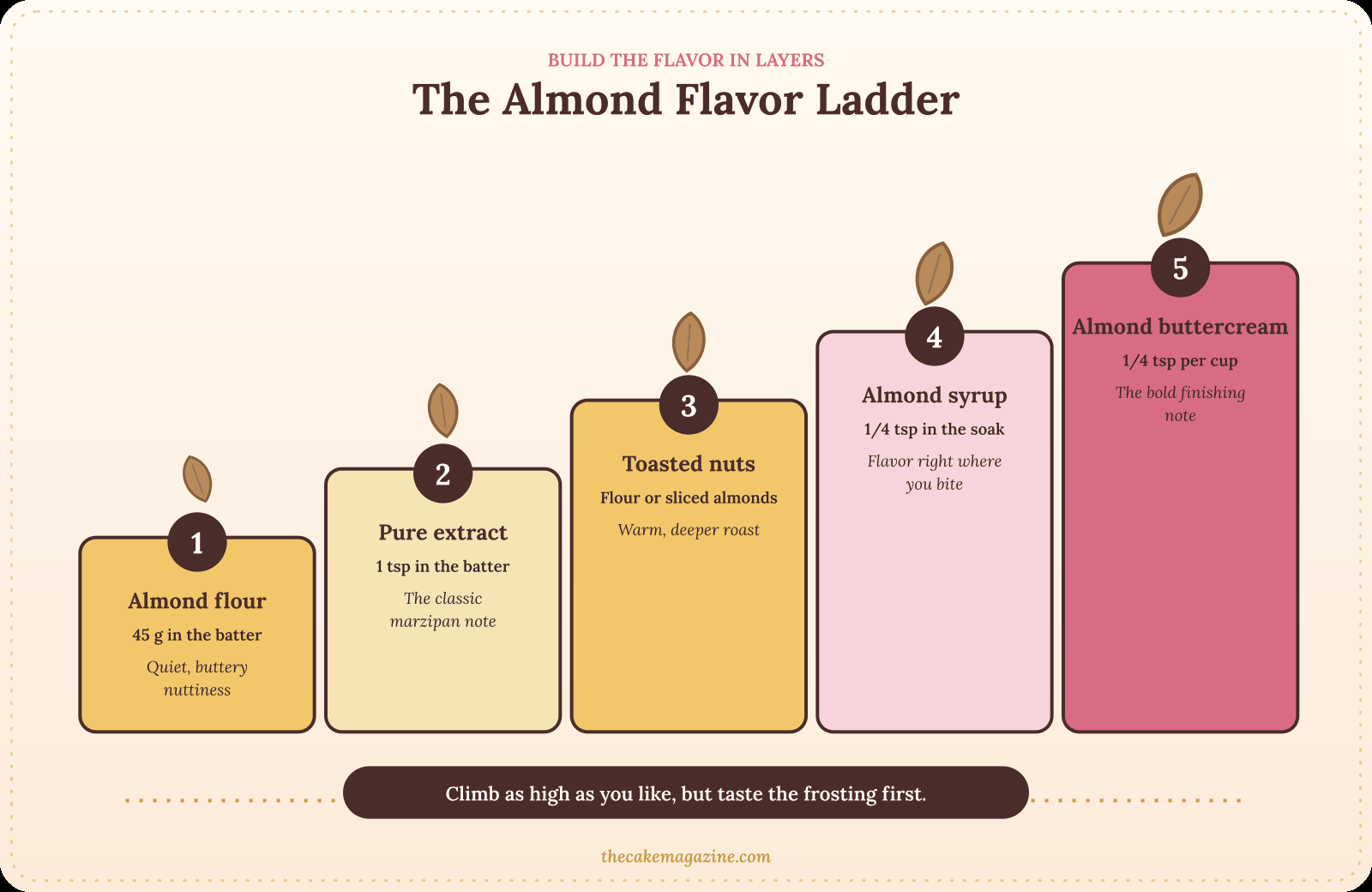
Almond is a flavor people either love or find soapy, and the difference often comes down to dose and source. A good almond cake recipe treats flavor as a layered build rather than a single splash from a bottle. The staircase below shows the main ways to add it, from the quiet foundation to the bold finish.
Pure almond extract in an almond cake recipe: measure carefully
Almond extract is highly concentrated, and a small amount goes a long way. A single teaspoon in a two-layer batter gives a clear almond note. Two teaspoons often tips into medicinal or perfumey territory, especially after a day, when the flavor seems to intensify. If you are unsure, start at half a teaspoon, taste a spoonful of the finished frosting, and keep notes on what you liked.
Check the label. Pure almond extract and imitation almond flavoring taste different, and brands vary in strength. Because concentration varies, treat the amounts in this guide as a starting point rather than a rule.
Vanilla still belongs in the bowl
It may seem strange to add vanilla to an almond cake, but a small amount of it rounds the edges. Vanilla supports almond without competing with it, and it keeps the cake from tasting one-note. That is why the formula uses a teaspoon of almond extract and a smaller measure of vanilla. Think of vanilla as the harmony and almond as the melody.
Toasted almonds add depth you cannot get from extract
Toasting almond flour or chopped almonds in a dry skillet or low oven brings out a deeper, nuttier flavor. If you want a more rustic cake, toast the almond flour lightly, cool it completely and then weigh it. It should smell warm and sweet, never scorched. Toasted flour looks slightly darker, so the crumb will have a faint golden tone.
Almond paste and marzipan: bold but different
Almond paste is a mixture of ground almonds and sugar, and marzipan is typically a sweeter, smoother version. Both are dense and flavorful, but they change the moisture and sweetness of a batter. They shine more as fillings or in specialty cakes than in a basic layer. We mention them in the variations section, with cautions about sweetness and texture.
Soak and fill for a second layer of almond
Brushing the layers with a light syrup flavored with a few drops of almond extract is a bakery habit that deserves to be more widely known. It adds moisture and almond flavor right where you taste it first. A thin spread of almond buttercream or a smear of raspberry jam finishes the idea. The next sections show how to build the pairing wheel around the cake.
The dose rule. Add almond extract in the cake and the frosting in small amounts, then taste and adjust the frosting only. The cake bakes in once and cannot be changed. The frosting can be nudged in either direction right up until you use it.
A quick taste test before you bake
Not sure how much almond you like? Stir a tiny pinch of powdered sugar and a drop of extract into a spoonful of softened butter and taste it. That small experiment shows how the flavor reads in a fat-based setting, which is close to how it behaves in cake and frosting. If a drop already feels loud, use less. If it feels shy, a full teaspoon in the cake will be a pleasure.
One more point on flavor: a successful almond cake recipe tastes almost the same on day two as on day one, only rounder. If your first test tastes a little shy, resist the urge to double the extract. Give it a night, wrap it well and taste again before changing anything.
Equipment, pans and yield for this almond cake recipe
You do not need specialty tools to bake a good cake. A few basics, used well, make the difference between a layer that rises evenly and one that domes, tilts or sticks.
- A digital kitchen scale. It measures grams and makes the formula repeatable.
- Two 8-inch by 2-inch round pans. Light-colored aluminum pans bake more gently than very dark ones, as the King Arthur guide notes.
- Parchment paper. Cut rounds for the bottoms so the layers release cleanly.
- A stand mixer with a paddle, or a hand mixer. The paddle attachment is ideal for reverse creaming. Our guide to cake mixing methods explains how each technique shapes a crumb.
- An oven thermometer. Home ovens are often off by 15 to 25 degrees, and a thermometer takes the guessing out.
- A fine-mesh sieve. Almond flour can clump, so sifting it with the dry ingredients keeps the batter smooth.
- An instant-read thermometer. Handy for checking doneness at the center of the cake.
Measure your pans to confirm that they really are 8 inches wide and 2 inches deep. Many pans labeled as 8-inch measure a little differently, and shallower pans can overflow. The same King Arthur guide recommends measuring, and it takes ten seconds.
One almond cake recipe, several pan sizes
The formula makes about 1,240 grams of batter. These are starting points rather than promises, so check for doneness early.
Two 8-inch rounds (the standard)
About 620 g per pan. Bake 28 to 34 minutes. Serves 12 to 14 slices of a tall, filled cake.
Two 9-inch rounds
Same weight per pan, so the layers are thinner. Start checking at 24 minutes and expect 24 to 30. A wide, low cake that suits generous filling.
Three 6-inch rounds
About 410 g per pan. Expect 26 to 32 minutes. A tall, narrow cake that serves 10 to 12.
9 by 13-inch pan
All of the batter in one pan. Expect 30 to 38 minutes. A simple sheet cake that is easy to cut and carry.
Cupcakes
Fill liners about two-thirds full, roughly 24 cupcakes. Expect 18 to 22 minutes at 350°F.
For larger events, our wedding cake servings guide explains how many slices different tiers yield, which helps you decide how many batches to bake.
The almond cake recipe card
Tender Almond Layer Cake
A two-layer 8-inch butter cake made by reverse creaming, with blanched almond flour and pure almond extract for a soft crumb that tastes clearly of almond. A starting formula to adapt, not yet oven-tested by this site.
Ingredients
- Cake flour255 g (about 2 cups, spooned and leveled)
- Blanched almond flour45 g (about ½ cup, lightly spooned)
- Granulated sugar300 g (1 ½ cups)
- Baking powder10 g (2 ½ teaspoons)
- Fine salt4 g (¾ teaspoon)
- Unsalted butter, cool (65°F), cut in ½-inch cubes170 g (12 tablespoons)
- Whole milk, cool room temperature220 g (a scant 1 cup)
- Full-fat sour cream, cool room temperature60 g (¼ cup)
- Large eggs, cool room temperature150 g (3 whole eggs)
- Egg yolk18 g (1 large yolk)
- Pure almond extract4 g (1 teaspoon)
- Pure vanilla extract4 g (1 teaspoon)
Instructions
- Prep. Set a rack in the center of the oven and heat to 350°F (175°C). Grease two 8-inch by 2-inch round pans, line the bottoms with parchment, grease the parchment and dust the sides with flour.
- Mix the liquids. In a medium bowl or large measuring cup, whisk the milk, sour cream, eggs, egg yolk, almond extract and vanilla until smooth. Set aside.
- Whisk the dry ingredients. In the bowl of a stand mixer fitted with the paddle, whisk the cake flour, almond flour, sugar, baking powder and salt on low for 30 seconds. Press any almond flour clumps through a sieve first.
- Rub in the butter. With the mixer on low, add the cubed butter a few pieces at a time. Mix for 1 to 2 minutes until the mixture looks like damp, fine crumbs with no large butter lumps.
- Add the first half of the liquid. With the mixer on low, pour in about half of the milk mixture. Raise the speed to medium and mix for 1 minute. The batter will look thick and smooth.
- Add the rest. Scrape the bowl and paddle well. On low speed, stream in the remaining liquid in two additions, mixing just until combined. Scrape once more and fold a few times by hand to catch flour at the bottom.
- Pan the batter. Divide evenly by weight (about 620 g per pan). Smooth the tops and tap each pan firmly on the counter two or three times to release large air bubbles.
- Bake. Bake 28 to 34 minutes, until the tops spring back lightly, the edges just begin to pull from the pan and a skewer in the center shows a few moist crumbs (roughly 205°F to 210°F inside). Begin checking at 26 minutes.
- Cool. Cool in the pans on a rack for 10 minutes. Run a thin knife around the edges, turn the layers out, peel off the parchment and cool completely, at least 1 to 2 hours, before filling or frosting.
Notes
- Allergen alert: this cake contains tree nuts (almonds), milk, eggs and wheat. Label it clearly for guests.
- No cake flour? Use 235 g all-purpose flour plus 20 g cornstarch in place of the 255 g of cake flour, and sift them together twice.
- No almond flour? Use 300 g of cake flour in total and raise the almond extract to no more than 1 ¼ teaspoons. The cake will taste lighter and a little less rich.
- Storage: wrap cooled layers tightly and keep at room temperature for up to 1 day, or freeze for up to 2 months.
- Frosting: pair it with a silky Swiss meringue buttercream, a classic American buttercream or a jam filling.
- Untested: amounts and times are starting points. Bake a test cake before a big event.
Step-by-step: how to make this almond cake recipe
The recipe card gives you the sequence. This section gives you the reasoning, which is what saves you on the day something behaves differently than you expected. If you are new to layer cakes, read it once before you start.

Step 1: Set up for your almond cake recipe
Take the milk, sour cream and eggs out about 30 minutes before baking, and let the oven heat fully. A preheat light can come on before the oven walls are truly hot, so give it ten extra minutes if you can. Weigh every ingredient into its own bowl or cup before you begin. This habit, called mise en place, turns a stressful bake into a calm one.
Prepare the pans before mixing, not while the batter waits. The classic method is to grease the pan, line it with parchment and grease again, then dust with flour, which is the same approach the King Arthur cake guide describes.
Step 2: Whisk the dry ingredients for your almond cake recipe
Almond flour is oily and forms tiny clumps, especially if the bag has been open for a while. Press it through a sieve with the cake flour, or whisk firmly for a full 30 seconds. Lumps of nut flour do not disappear in the oven. They show up as little pockets in the crumb. The same goes for baking powder, which should be whisked in thoroughly so the rise is even.
Step 3: Rub in the cool butter
Start the mixer on low and add the cubes gradually. The goal is a texture like damp sand or fine breadcrumbs. If the butter is too warm, the mixture turns pasty and clumps on the paddle. If it is too cold, you will see large chunks that stay stubborn. Fifteen to twenty minutes on the counter in a cool kitchen usually brings butter to about 65°F.
If you are curious why this order matters, our explanation of cake mixing methods compares reverse creaming with traditional creaming and the all-in-one method.
Step 4: Add the liquid in stages to the almond cake recipe batter
Pour in roughly half the liquid and beat on medium for a full minute. This is where the batter builds body and holds air. Then scrape the bowl, drop the speed and add the remaining liquid in two additions. Stop as soon as everything looks smooth. The batter should be thick, glossy and pourable, with no lingering streaks of flour or butter.
Scrape the bottom of the bowl, because almond flour likes to settle there. A few folds by hand with a flexible spatula finishes the job.
Step 5: Pan, tap and bake
Divide the batter by weight. Put the bowl on the scale, record the total and split it evenly. Even layers bake evenly, and they stack evenly too. Smooth the tops and tap each pan firmly on the counter to knock out large air pockets. Bake on the center rack, and avoid opening the door in the first twenty minutes.
Why the batter looks thick. Reverse-creamed batters with almond flour are denser than oil-based ones. That is normal. If it looks closer to cookie dough than pancake batter, though, check the weights of the flour and milk.
Step 6: Plan the baking day
A calm bake is a good bake. Work in a sensible order: heat the oven, prepare the pans, weigh everything, mix, pan and bake. While the layers bake, make the frosting or syrup. If you are doing several things at once, set a timer for the first doneness check at 26 minutes, since that is the moment people most often get distracted and overbake.
Wipe up as you go and keep a damp towel under your mixing bowl or cooling rack so nothing slides. Little habits like these keep the process pleasant, and they matter more than any single ingredient.
How to tell your almond cake is done
Timers are estimates. Your oven, your pans and even the temperature of your batter can move the finish line by several minutes. Use the senses and a thermometer together, and trust them over the clock. The illustration below shows the cues for this almond cake recipe and how long the finished cake keeps.

Three signs your almond cake recipe is done
- The edges pull away slightly. You should see a thin gap between the cake and the pan wall.
- The top springs back. Press lightly in the center. A done cake returns to shape. An underbaked one leaves a dent.
- A skewer comes out with a few moist crumbs. Wet batter means more time. A clean, dry skewer means the cake may be slightly overbaked, which is especially noticeable in a nut cake.
An instant-read thermometer in the center should read about 205°F to 210°F. Almond flour browns faster than wheat flour, so the top may look golden before the center sets. If the edges are darkening too fast, tent the pans loosely with foil for the last ten minutes.
Cooling matters as much as baking for any almond cake recipe
Leave the layers in the pans for about ten minutes, then turn them out onto a rack. Cooling in the pan too long steams the sides and can make them gummy. Turning out too early risks cracking. Let the layers cool completely, then wait a little more. The King Arthur cake guide advises waiting at least 30 to 60 minutes after a cake seems cool before frosting, and butter cakes taste best at room temperature.
Trimming and leveling the layers
Almond layers often bake with a gentle dome. If you want sharp, flat tiers, trim the tops with a long serrated knife while the cake is cool. Save the scraps. Toast them lightly and crumble them over ice cream, or use them in a trifle. Wrapped and chilled for 30 minutes, the layers are firmer and easier to level.
Before you move on, a quick word on timing. Every almond cake recipe benefits from a rest between baking and frosting, because a cooled layer is firmer, cleaner to cut and kinder to buttercream. Plan the bake early in the day, or the day before, and you will frost with a clear head instead of a rush.
Fillings and frostings that suit your almond cake recipe
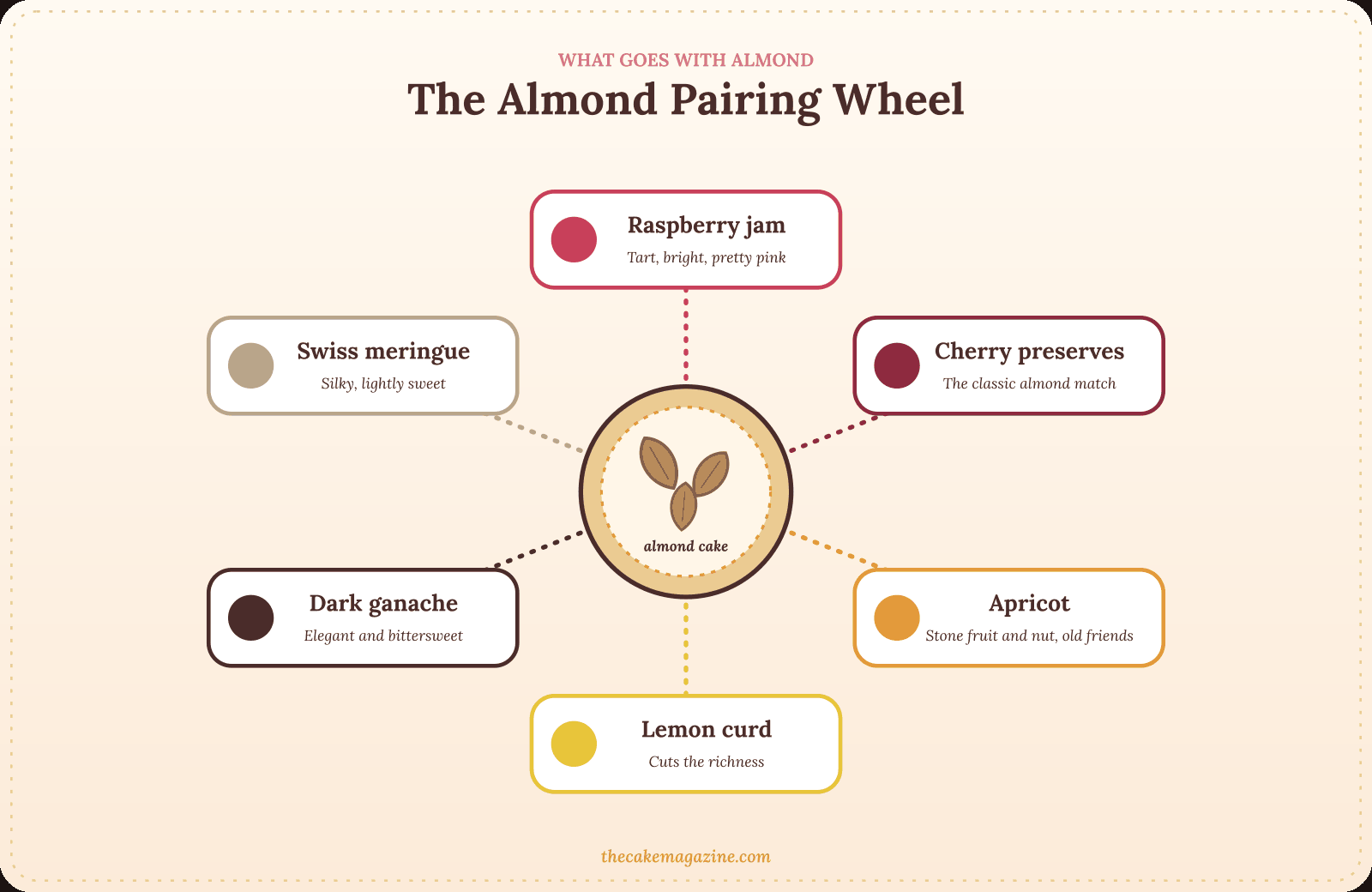
Almond is friendly. It pairs with fruit, with cream, with chocolate and with florals, which is why it appears so often at weddings. The wheel below maps out the classic partners, and the cards that follow explain how to use each one.
Swiss meringue buttercream
Silky, balanced and less sweet. A drop of almond extract in the buttercream echoes the cake. Our Swiss meringue buttercream guide explains the temperatures and emulsion steps.
American buttercream
Quick, sturdy and sweet. Use a pinch of salt and a splash of cream to tame it. See our American buttercream recipe for texture fixes.
Raspberry or cherry jam
A thin layer of seedless jam adds brightness and a pretty color. Pipe a dam of buttercream around the edge so the jam stays inside.
Apricot or peach preserves
Stone fruit and almond are old friends. Warm the preserves slightly and strain them for a smooth, glossy spread.
Lemon curd
A tart layer cuts the richness. Chill the curd until thick, and use a buttercream dam. If lemon is your goal, see our lemon cake recipe.
Chocolate ganache
Dark chocolate and almond make an elegant pairing. Our chocolate ganache guide gives ratios for drips, fillings and whipped versions.
Building a wedding-style cake from this almond cake recipe
For a classic wedding look, fill with raspberry jam and almond Swiss meringue buttercream, then finish with a smooth coat of vanilla buttercream and fresh flowers that are food safe. Plan flavors around your guests as well as your taste. Our best wedding cake flavors guide shows how almond sits among the other popular choices.
A light almond syrup
Heat 100 g of water with 100 g of sugar until the sugar dissolves, cool it and stir in a quarter teaspoon of almond extract. Brush a thin coat on each layer after leveling. The syrup adds moisture, and it helps layers hold their texture across a long event day. Use a light hand, because too much syrup makes a cake soggy and hard to stack.
Making almond buttercream
You do not need a separate recipe. Take your favorite vanilla buttercream and replace half of the vanilla with pure almond extract, starting with a quarter teaspoon per cup of frosting. Beat it in, rest it for ten minutes and taste again, since the flavor develops as it sits. If you want a more natural note, fold in a spoonful of finely ground toasted almonds, which adds texture and a deeper, nuttier taste.
Keep the frosting a little less sweet than the cake. A pinch of salt and a spoonful of cream will sharpen the almond and keep each slice from tasting flat.
Crumb coat, chill and finish
Fill and stack the layers, spread a thin crumb coat, and chill the cake for 20 to 30 minutes. Then apply the final coat. If you want crisp edges, our guide to smooth buttercream sides and sharp cake edges walks through the method in detail.
Storage, make ahead and nut allergies
Almond cake is a good candidate for planning ahead. The natural oils in the almond flour keep the crumb soft, and the flavor often settles and rounds out after a night. A little scheduling takes a lot of stress out of a party day.
Keeping unfrosted almond cake recipe layers
Wrap cooled layers tightly in plastic wrap, then in foil or a zip bag. At cool room temperature they keep well for a day. For longer, freeze them for up to two months. Thaw in the wrapping, on the counter, so condensation collects on the plastic rather than the cake. Frozen layers are also easier to level and carve, which many decorators prefer.
Keeping a frosted cake
Storage depends on what is inside. A cake finished with buttercream and a jam filling holds comfortably at cool room temperature for a day or two under a cake dome. Cakes with dairy-heavy or custard fillings need the fridge. The USDA food safety site at fsis.usda.gov/food-safety gives general guidance on keeping perishable foods out of the danger zone, and it is worth a read before you serve a cake that sits out at an event.
If you refrigerate the cake, bring slices to cool room temperature before serving. Cold butter makes any cake feel firmer than it is. Thirty to sixty minutes on the counter restores the soft, tender bite.
A sensible make-ahead timeline
- Up to 2 months ahead: bake and freeze the layers, wrapped well.
- 2 days ahead: make the frosting and any jam or curd filling. Refrigerate in airtight containers.
- 1 day ahead: thaw, level, fill and crumb coat the cake. Chill overnight.
- Party day: apply the final coat, decorate and let the cake come to a cool room temperature before serving.
Freezing slices for later
Leftover slices freeze well. Chill the cut cake until the frosting is firm, wrap each slice tightly in plastic and place it in an airtight container. Thaw in the fridge overnight, then let it sit at room temperature for about an hour. It will not look quite as sharp as a fresh slice, but the crumb stays moist and the almond flavor holds nicely.
Nut allergies and your almond cake recipe: the part that really matters
Almonds are a tree nut, and tree nuts are one of the nine major food allergens recognized in the United States, according to the FDA food allergy page. An almond cake recipe should never be served to guests without telling them what is in it. Allergic reactions can be serious, and even small traces matter.
If you are baking for others, keep these habits in mind:
- Tell guests plainly that the cake contains almonds, milk, eggs and wheat.
- Label cakes at parties and potlucks, and keep the ingredient list handy.
- Wash bowls, pans, spatulas and surfaces thoroughly if the same tools will later touch an allergen-free bake.
- Do not promise that a cake is safe for someone with a nut allergy unless you control every ingredient and every surface.
If you sell cakes, labeling and allergen rules apply and vary by location. This guide offers general information only. Check with your state or local food authority for requirements that apply to you.
Troubleshooting your almond cake recipe
Every baker meets a few of these. Most have a quick cause and a quick fix. If your problem is not here, our complete cake troubleshooting guide covers many more.
The cake is dry or crumbly
Likely cause: too much almond flour, too much flour overall from scooping, or overbaking. Nut meal that is packed into a cup can weigh far more than expected.
Fix: weigh the ingredients, check the oven with a thermometer and begin testing at 26 minutes. Our guide to why cake turns dry goes deeper on the causes. A light syrup can rescue a layer that has already baked.
The crumb is oily or greasy
Likely cause: too much almond flour or butter that was too warm and broke down during mixing.
Fix: keep almond flour at the stated weight, use butter that is about 65°F and stop mixing once the batter is smooth.
The almond flavor is too weak
Likely cause: old or imitation extract, too little almond flour or a very sweet frosting that drowns it out.
Fix: use pure extract that is within its date, toast the almond flour lightly, and add a drop or two of extract to the frosting and syrup. Taste the frosting before you commit.
The almond flavor tastes harsh or medicinal
Likely cause: too much extract, or a strong imitation flavoring.
Fix: cut the extract to half a teaspoon next time and let vanilla fill the gap. Balance a sharp frosting with a little extra butter or cream.
The cake sank in the middle
Likely cause: underbaking, opening the oven too early, too much baking powder or an oven that runs cooler than the dial says.
Fix: measure the baking powder by weight, check the center temperature and keep the oven door closed for the first 20 minutes. Our article on why cakes sink in the middle lays out the full list of suspects.
The top is domed or cracked
Likely cause: an oven that is too hot, which sets the edges before the center rises.
Fix: lower the temperature by 25°F and bake a few minutes longer, or use bake-even strips. Trim the dome flat once cool.
The layers stuck to the pan
Likely cause: skipped parchment or pans that were not greased well.
Fix: run a thin knife around the edge, warm the bottom of the pan briefly on a hot towel and tap firmly. Next time, grease, line with parchment and grease again.
The edges are dark and the center is pale
Likely cause: dark pans, a hot oven or a rack placed too low. Almond flour also browns faster than wheat flour.
Fix: use light aluminum pans, bake on the center rack and tent the cake with foil when the color is where you want it.
The layers are uneven or lopsided
Likely cause: an oven with hot spots, pans that were not level or batter that was unevenly divided.
Fix: weigh the batter into each pan, rotate the pans once if the oven is uneven, and keep the rack in the center. Level the tops with a serrated knife before stacking.
There is a dense, gummy band at the bottom
Likely cause: unmixed pockets of butter or flour, underbaking or a batter that was too wet.
Fix: scrape the bowl thoroughly, bake until the center reads at least 205°F, and measure the milk by weight. Cool layers fully before wrapping them so steam does not collect.
If a problem keeps returning, change only one thing at a time. Weigh again, check the oven, and keep a short note beside your almond cake recipe so the fix is there for next time.
Variations on the almond cake recipe
Once you have made the base almond cake recipe a couple of times, small changes create new cakes. Change one thing at a time and write it down, so you know what caused what.
Raspberry almond cake recipe variation
Keep the batter the same. Spread seedless raspberry jam between the layers and finish with almond buttercream. The tart fruit gives the sweet nut flavor a sharper edge, and the pink filling looks lovely when sliced.
Cherry almond cake
Cherry and almond share a flavor compound family, which is why they feel so natural together. Use a cherry preserve or a cooked cherry filling thickened with a little cornstarch, and keep it well contained with a buttercream dam. Do not stir fresh cherries directly into the batter, since their juices can make the crumb wet.
Almond and vanilla bean
Swap the vanilla extract for vanilla bean paste and keep the almond extract. You will see tiny specks in the crumb, and the flavor reads richer and more bakery-like.
Toasted almond cake recipe variation
Toast the 45 g of almond flour in a dry skillet over medium-low heat, stirring until fragrant, then cool completely before whisking it in. The cake takes on a deeper, caramelized nuttiness. Press toasted sliced almonds onto the sides of the finished cake for a rustic finish.
Almond paste cake
Almond paste adds intense flavor but also sugar and moisture. If you want to try it, crumble 60 g of paste into the butter-and-flour step, reduce the almond extract to half a teaspoon and cut the sugar by about 30 g. Treat this as an experiment and bake a test cake first, since pastes vary a great deal by brand.
Almond and orange
Add the finely grated zest of one orange to the sugar and rub it in with your fingers before adding it to the dry ingredients. The oils in the zest scent the whole cake. This pairs beautifully with a light orange syrup.
Almond and pistachio or coconut combinations
Nut cakes get along. A pistachio filling or a toasted coconut finish creates a layered flavor profile that feels special without being complicated. Keep each filling simple and let the almond remain the lead voice.
Almond streusel or crunchy top
For a casual cake, skip the frosting. Mix 40 g of flour, 40 g of sliced almonds, 30 g of sugar and 30 g of cold butter into rough crumbs, scatter them over the batter and bake in a 9 by 13-inch pan. The topping turns golden and crisp, and the cake needs only a dusting of powdered sugar. Check for doneness a few minutes early, since the crumbs add weight.
Almond cupcakes
Fill liners about two-thirds full and bake at 350°F for roughly 18 to 22 minutes. Top with a swirl of almond buttercream and a toasted sliced almond. They are an easy choice for showers and school events, though you must label them for nut allergies.
Almond sheet cake for a crowd
Bake all of the batter in a greased and lined 9 by 13-inch pan for about 30 to 38 minutes. Spread with buttercream, score the top for neat portions and decorate simply. It is easy to transport and cut.
None of these variations changes the core structure. Each one is a small, safe adjustment around the same dependable almond cake recipe, so you can experiment without losing the soft crumb that made you choose it.
Ten mistakes to avoid with an almond cake recipe
- Using too much almond extract. More is not better. Past a teaspoon, the flavor gets medicinal.
- Scooping almond flour. Cup measurements vary too widely. Weigh it.
- Skipping the sieve. Nut flour clumps do not bake out.
- Using butter that is too warm. The crumb turns heavy and oily.
- Overmixing after the liquid goes in. It toughens the cake. Mix until combined, then stop.
- Replacing all the flour with almond flour. It becomes a different kind of cake, one that is fragile and dense.
- Ignoring the oven’s real temperature. A cheap thermometer solves this.
- Frosting a warm cake. The buttercream melts and slides.
- Forgetting to label nuts. This is a safety matter, not a courtesy.
- Judging by the timer. Trust the cues and a thermometer.
Using this almond cake recipe for weddings, birthdays and celebrations
Almond is one of those flavors that feels appropriate almost anywhere. It is festive enough for a wedding, mild enough for a children’s party and familiar enough that adults rarely say no to a second slice. Here is how to think about using it for each occasion.
Wedding and shower cakes with an almond cake recipe
Couples often choose almond because it feels traditional and elegant, and because it pairs well with fruit fillings, florals and white or ivory designs. Because tiers need strong structure, stick to the formula as written instead of adding extra almond flour. If you are planning an event cake, start with our complete wedding cake guide, which covers design, budget, delivery and cutting.
Almond also does well at tastings. It is a flavor that people remember. Offer it alongside one fruit filling and one buttercream, so guests can compare combinations and choose the one that feels like theirs.
Birthday cakes
Almond cake feels grown-up and friendly at once, which is a tricky balance for a birthday table.
For a birthday, the almond cake recipe works as a classic two-layer round with a bright jam filling and a swirl of buttercream. Adults tend to love it with raspberry or apricot. For younger guests who may be wary of strong almond flavor, cut the extract to half a teaspoon and keep the vanilla at a full teaspoon. The cake will still taste soft and buttery, with just a hint of nut.
Anniversaries and holiday tables
Almond cake feels right at winter gatherings, spring celebrations and quiet anniversary dinners. Dust the top lightly with powdered sugar, add a few toasted sliced almonds and serve with fresh berries. A simple finish suits the cake. It has enough character that it does not need heavy decoration.
Scaling an almond cake recipe for a crowd
The formula scales linearly. Double all weights for four 8-inch layers, or multiply by one and a half for a 10-inch pair. Mix large batches in separate bowls rather than overloading one mixer, and always divide the batter by weight. Bigger pans need longer, gentler baking, so lower the oven to 325°F and test early. Because the formula has not been oven-tested here, bake a trial cake in your largest pan before an event.
Decorating ideas that match almond
Almond suits soft, natural decoration. Think fresh berries, edible flowers, a scattering of toasted sliced almonds or a dusting of powdered sugar through a doily. For a more formal look, a smooth buttercream finish with a ring of piped pearls reads as quietly elegant. If you want to build your skills, our beginner-friendly cake decorating guide explains tools, techniques and practice routines.
Choose decoration that matches the occasion. A shower cake might use pale pink buttercream and tiny blossoms. A birthday cake might get colorful berries. An anniversary cake might need nothing more than a few almonds and a candle.
Transport and serving tips
- Chill the finished cake for 30 minutes before transport so the frosting firms up.
- Use a non-slip mat under the cake box, and keep the car cool.
- Carry a small repair kit with extra buttercream, a spatula and a few toothpicks.
- Let the cake sit for an hour at room temperature before cutting so the crumb softens.
- Offer a card that lists the ingredients, including almonds, milk, eggs and wheat.
Almond cake recipe FAQ
What makes an almond cake recipe taste like almond?
Almond flavor comes mostly from pure almond extract, with almond flour adding a nutty richness. A teaspoon of extract in a two-layer cake is a good starting point. Extra almond flavor can come from toasted almonds, a light syrup and an almond-scented buttercream.
How much almond extract should I use in an almond cake recipe?
For two 8-inch layers, about one teaspoon of pure almond extract is a balanced start. Half a teaspoon is gentler. Two teaspoons often tastes medicinal. Extract strength varies by brand, so taste your frosting and take notes for next time.
Can I use almond meal instead of almond flour?
You can, but the cake will be slightly coarser and speckled. Almond meal usually has the skins on and a heavier grind. Blanched almond flour gives a smoother, paler crumb that suits a layer cake better. Weigh either one and sift out clumps.
Is almond cake gluten free?
Not this one. The formula uses cake flour alongside almond flour, so it contains wheat. Flourless almond cakes exist, but they have a denser, fudgier structure and are not designed for tall stacked layers, so this almond cake recipe should not be swapped into them.
Can I make this almond cake recipe without almond flour?
Yes. Use 300 g of cake flour in total and keep the extract at one teaspoon or slightly more. The cake will taste lighter and a little less rich, but it will still carry a clear almond note and bake into a tender layer.
What can I use if I do not have cake flour?
Replace the 255 g of cake flour with 235 g of all-purpose flour and 20 g of cornstarch, then sift the two together twice. The crumb will be close to the original. Whisk the almond flour in separately.
Why is my almond cake dry?
The usual suspects are overbaking, too much flour from scooping and too much almond meal. Weigh everything, check your oven temperature and start testing early. A light almond syrup brushed on the layers also helps restore moisture.
Can I bake the almond cake recipe in advance?
Yes. Wrap cooled layers tightly and keep them at room temperature for a day, or freeze them for up to two months. Thaw in the wrapping before filling. Frost the cake on the day before serving, or on the day itself, for the freshest look.
What frosting goes best with almond cake?
Swiss meringue buttercream is a favorite because it is silky and not overly sweet. American buttercream, cream cheese frosting and whipped ganache also work. Raspberry, cherry and apricot fillings add a bright contrast to the soft nut flavor.
How long does a frosted almond cake last?
With buttercream and a jam filling, it keeps for a day or two at cool room temperature under a cover. Anything with fresh cream or custard should be refrigerated. Bring slices to cool room temperature before serving for the best texture.
Can I use this almond cake recipe for cupcakes or a sheet cake?
Yes. Fill liners two-thirds full and bake for about 18 to 22 minutes, or bake all of the batter in a 9 by 13-inch pan for roughly 30 to 38 minutes. Treat these times as starting points, and check early because ovens differ.
Is this almond cake recipe safe for people with nut allergies?
No. Almonds are a tree nut and a major allergen. Always tell guests that the cake contains almonds, and never assume that a small amount is harmless. When in doubt, bake a separate, clearly labeled cake without nuts.
Final thoughts
A good almond cake recipe is mostly about restraint. A little almond flour for tenderness, a measured teaspoon of extract for flavor, a steady butter-cake structure and a gentle hand at the mixer. Do those things, weigh your ingredients and bake until the cake tells you it is ready, and you get a soft, fragrant layer that feels more special than its short ingredient list suggests.
Make it once as written so you know how it behaves in your oven. Then start playing: toast the almond flour, add orange zest, try a cherry filling. Keep notes on every change. After a few bakes you will have an almond cake recipe that is truly yours, and the confidence to scale it for the next wedding shower, birthday or quiet Sunday dinner.
If you try this almond cake recipe, we would love to hear how it went. Tell us your pan size, your oven and what you filled it with, and we will keep refining this guide.
Editorial note: reviewed and updated November 2026. This guide is written for home bakers in the United States, using American measurements. The Cake Magazine has not oven-tested the formula, so treat the amounts and times as a starting point and bake a trial cake before an important event. Allergen and food-safety information here is general, not medical advice. Where we link to products or tools in the future, we will disclose affiliate relationships near the links.