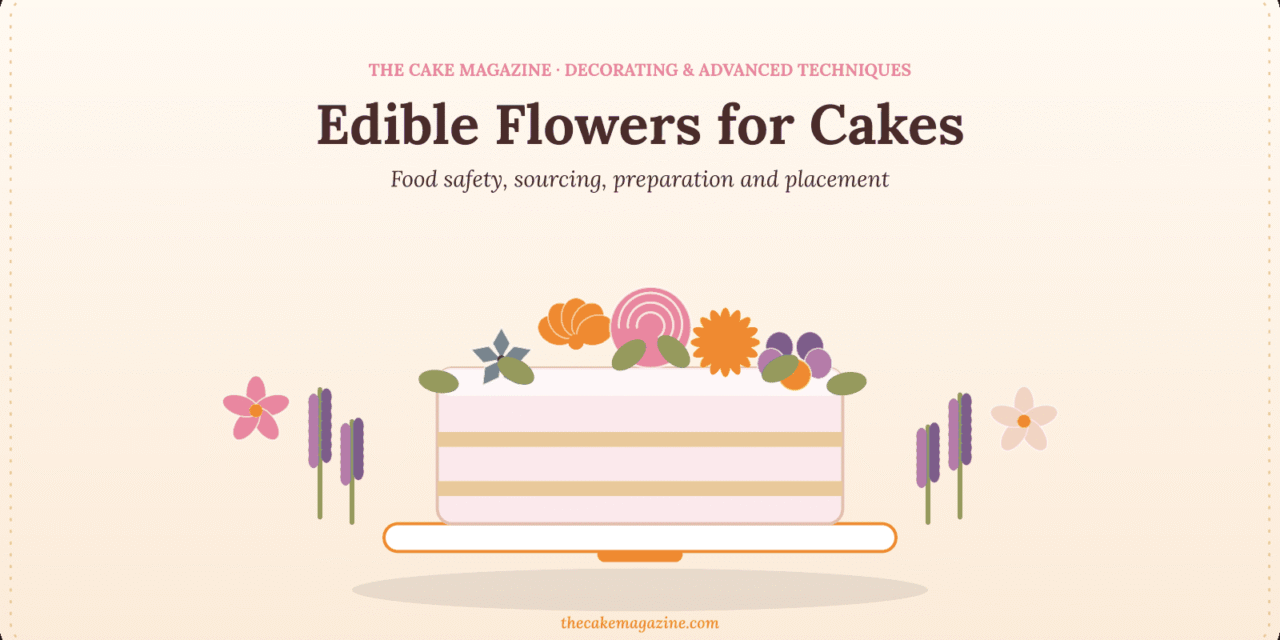
A handful of pansies on a frosted cake can do what an hour of piping cannot: make it look like it was gathered, not built. But edible flowers for cakes come with a catch that sugar roses and sprinkles do not. A flower is a plant that grew somewhere, was touched by something, and may or may not be safe to put in front of a guest.
This guide covers the whole path, from deciding which blooms are safe to eat, to where to find them, how to clean and trim them, and how to place them so the cake still looks fresh at the party.
Safe edible flowers for cakes are blooms that were grown for eating, identified by their exact plant name, and never treated with pesticides you cannot account for. Skip florist bouquets, garden-center plants and roadside flowers. Rinse gently, dry well, remove stamens and bitter petal bases, and keep stems out of the cake itself. Place the flowers on frosting shortly before serving, and tell guests which blooms are meant to be eaten and which are only decoration.
- What edible flowers for cakes actually are
- Food safety rules for edible flowers for cakes
- Where to buy edible flowers for cakes
- The best edible flowers for cakes by flavor and color
- Herb, vegetable and garden blooms worth a look
- Flowers to keep off your cake
- Allergies, guests and honest labeling
- Washing, drying and trimming blooms
- Storing flowers and timing the decorating
- Placing flowers on the cake
- Design ideas by cake style
- Candied, pressed and infused flowers
- Weddings, transport and serving day
- Common mistakes and quick fixes
- FAQ
What edible flowers for cakes actually are
People use the phrase loosely, so it helps to pin it down. Edible flowers for cakes are blooms from plants that are known to be safe to eat, that were grown without chemicals that do not belong in food, and that are handled like any other fresh produce. “Edible” describes the plant and the growing method together. A rose from a supermarket bouquet and a rose grown for the kitchen are the same species, but only one of them is a food.
That distinction is the heart of this whole topic. Colorado State University Extension, in its edible flower fact sheet, tells readers to confirm a plant’s identity before eating it and to use the scientific name, because common names can point to more than one plant. Its advice for anything uncertain is blunt: if you are unsure, do not eat it. A cake is a good place to follow that rule, because the person who bites into the flower is often not the person who picked it.
Why bakers reach for flowers
Edible flowers for cakes solve a few problems at once. They add color that does not need dye, height that does not need structure, and a hand-gathered look that pairs well with simple frosting. A smooth cake with a loose spray of blooms looks finished in ten minutes. That is a real advantage when you are learning, and it is why many bakers start here before they attempt piped flowers or sugar work.
If you are still building basic skills, our beginner’s guide to cake decorating covers the frosting and smoothing steps that make a flower-topped cake look polished.
There is also a flavor argument for edible flowers for cakes, though it is smaller than people expect. Most flowers taste mild, grassy or faintly bitter. A few are peppery or perfumed. They are decoration first and seasoning second, and the section on flavors below will help you pick blooms that will not surprise anyone with the first bite.
The three jobs a flower can do on a cake
It is useful to decide, before you shop for edible flowers for cakes, what role each flower plays. A bloom can be meant to be eaten, like a pansy petal scattered over a lemon cake. It can be safe if eaten but mostly for looks, like calendula petals that add gold color with little taste.
Or it can be pure decoration that should never be eaten, like a bouquet flower held away from the frosting in a barrier. Keeping those three categories in mind makes every later decision simpler, from sourcing to labeling.
Rule of thumb for the whole guide. If you cannot name the plant, cannot say where it was grown, or cannot say what it was sprayed with, it stays off the cake. A bare cake looks fine. A cake that makes someone sick does not.
What the research bodies agree on
Extension services from several universities publish guidance on edible flowers for cakes and other dishes, and the core advice is remarkably consistent. The University of Minnesota Extension says to use only pesticide-free flowers and to avoid cut flowers and roadside flowers. Colorado State says florist, garden center and nursery flowers are not grown for consumption and may carry unsafe chemicals. The North Carolina Department of Agriculture warns that not all flowers are edible and points growers toward university plant references.
We are not agricultural scientists, and nothing here replaces a plant reference. What this guide adds is the cake-specific layer: how to prep flowers so they hold up under frosting, how to place them so no stems touch the crumb, and how to plan a decorating day around a short-lived ingredient. For the wider food-handling picture, including refrigeration and display times for the cake itself, see our cake food safety guide.
Food safety rules for edible flowers for cakes
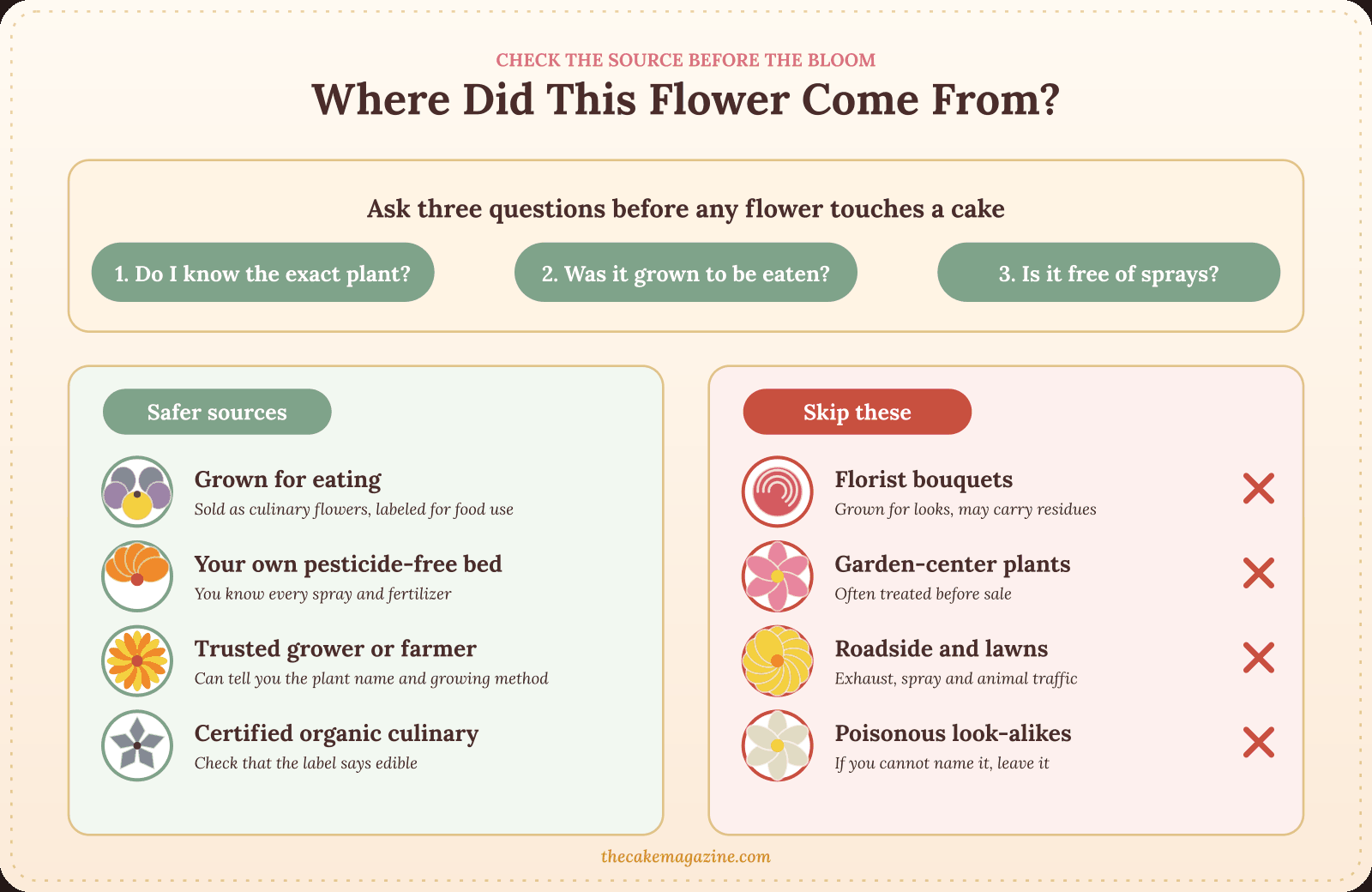
Food safety with edible flowers for cakes is mostly about three things: what the plant is, what has been put on it, and what has touched it since. Each one has a simple rule, and together they take about a minute to run through before any flower goes near a cake.
Rule one for edible flowers for cakes: know the exact plant
Common names are slippery. “Lily” covers dozens of plants, some of them harmful. “Marigold” can mean calendula, which bakers use, or other plants that are not for eating. “Daisy” is a loose label that gets stuck on very different species. Write down the Latin name from the seed packet, the grower’s tag or the supplier’s label, and match it to a trusted extension list.
When you buy from a grower, ask for the plant name and ask whether it was grown for eating. A good grower will answer without hesitation, .
Rule two: no sprays you cannot account for
Pesticide residue is the main reason florist flowers do not belong on food. Commercial cut flowers are grown for appearance and shelf life, not for the kitchen, and the sprays used are chosen with that in mind. The University of Minnesota Extension notes that garden center plants can carry chemicals too, and suggests flushing the soil, transplanting carefully or growing from seed if you want to use them.
For a bakery or a special-order cake, the simpler route is to buy flowers sold for eating or grow your own from seed.
Fertilizer counts as well. Colorado State advises avoiding flowers from plants fertilized with fresh or uncomposted manure. That matters most if you pick from a neighbor’s garden, where you may not know what went into the soil.
Rule three: treat flowers like produce
Once the flower is picked, it is a raw, ready-to-eat plant product that will never be cooked. The North Carolina Department of Agriculture’s edible flowers fact sheet describes growers keeping flowers off soil, cleaning and sanitizing tools and containers, using clean water and avoiding flowers that animal waste may have touched. As a baker, you carry the same habits forward: clean hands, a clean board, clean scissors, and a container that has not held anything else.
Because the flowers go on a cake uncooked, the general produce guidance from the USDA Food Safety and Inspection Service is a sensible background reference for handwashing, clean surfaces and keeping perishable foods out of the temperature danger zone.
A quick pre-flight checklist
- I know the plant’s Latin name and it is on a trusted edible list.
- It was grown for eating, or I grew it myself without sprays.
- It was not bought from a florist, nursery or garden center.
- It is free of insects, mold, bruising and dirt.
- I have a clean container, board and scissors ready.
- I can tell the guests or the customer what is edible on the cake.
Selling cakes? Rules about flowers, labeling and what a home or licensed kitchen may sell differ by state and county. This guide is general information, not legal advice. Check with your state or local food regulator before you add flowers to a product you sell.
Where to buy edible flowers for cakes
The good news is that sourcing has gotten easier. A few years ago, bakers either grew their own or called around. Today there are several reliable routes, and each has trade-offs in cost, variety and freshness. The best choice depends on how many cakes you decorate and how much lead time you have.
Grow them yourself
Cheapest per bloom and the most control. Pansies, violas, nasturtiums, calendula and borage grow readily from seed, and you decide what goes on or near the plants. Plan for a season of growing and expect to pick on the day you need them.
Local growers and farmers markets
Ask for flowers grown for eating, and ask about sprays. Many small farms sell edible flower boxes to restaurants and will take a bakery order with a few days of notice. You also get the plant name straight from the person who grew it.
Specialty culinary suppliers
Online and regional suppliers sell flowers packed for kitchens, often in small clamshells. Check the label for the plant name and the intended use, and ask about shipping time. Flowers that sit in a hot truck will wilt before they reach you.
Grocery produce sections
Some stores stock small packs of flowers beside the fresh herbs. These are sold as food, which is the point. Selection is limited, but the packaging usually names the flower and the shelf life.
What to ask a supplier
Before you place an order, send a short message with four questions. What are the plant names? Were they grown for eating? What, if anything, was applied to them? When were they picked, and how will they travel? A supplier who sells to food businesses will have clear answers. A vague answer to the second or third question is your cue to look elsewhere.
Why the florist counter is the wrong place
It is tempting to grab roses or ranunculus from a flower shop because the quality is so good. The problem is not the look, it is the purpose. Colorado State says directly not to eat flowers from florists, garden centers or nurseries, because they are not grown for consumption and may have been treated with unsafe chemicals. If a design truly needs those blooms, treat them as decoration with a barrier, which we cover in the placement section, and never as food.
How many edible flowers for cakes you will need
Planning numbers for edible flowers for cakes vary a lot with the design, so treat these as rough starting points rather than rules. A small cluster on a 6-inch cake might use a dozen small blooms plus a few leaves. A cascade or crescent on an 8-inch cake can take 20 to 30 small flowers or fewer large ones.
A full wreath around a 9-inch cake can take 40 or more. Always order about a quarter extra, because some blooms will be bruised, insect-nibbled or simply not photogenic.
- Order for the day before the event, so you can inspect and rinse in a calm moment.
- Ask for a mix of sizes: a few focal blooms, several mid-size ones and a handful of tiny fillers.
- Request leaves or edible herbs if you want greenery, so you are not tempted to borrow it from a bouquet.
The best edible flowers for cakes by flavor and color
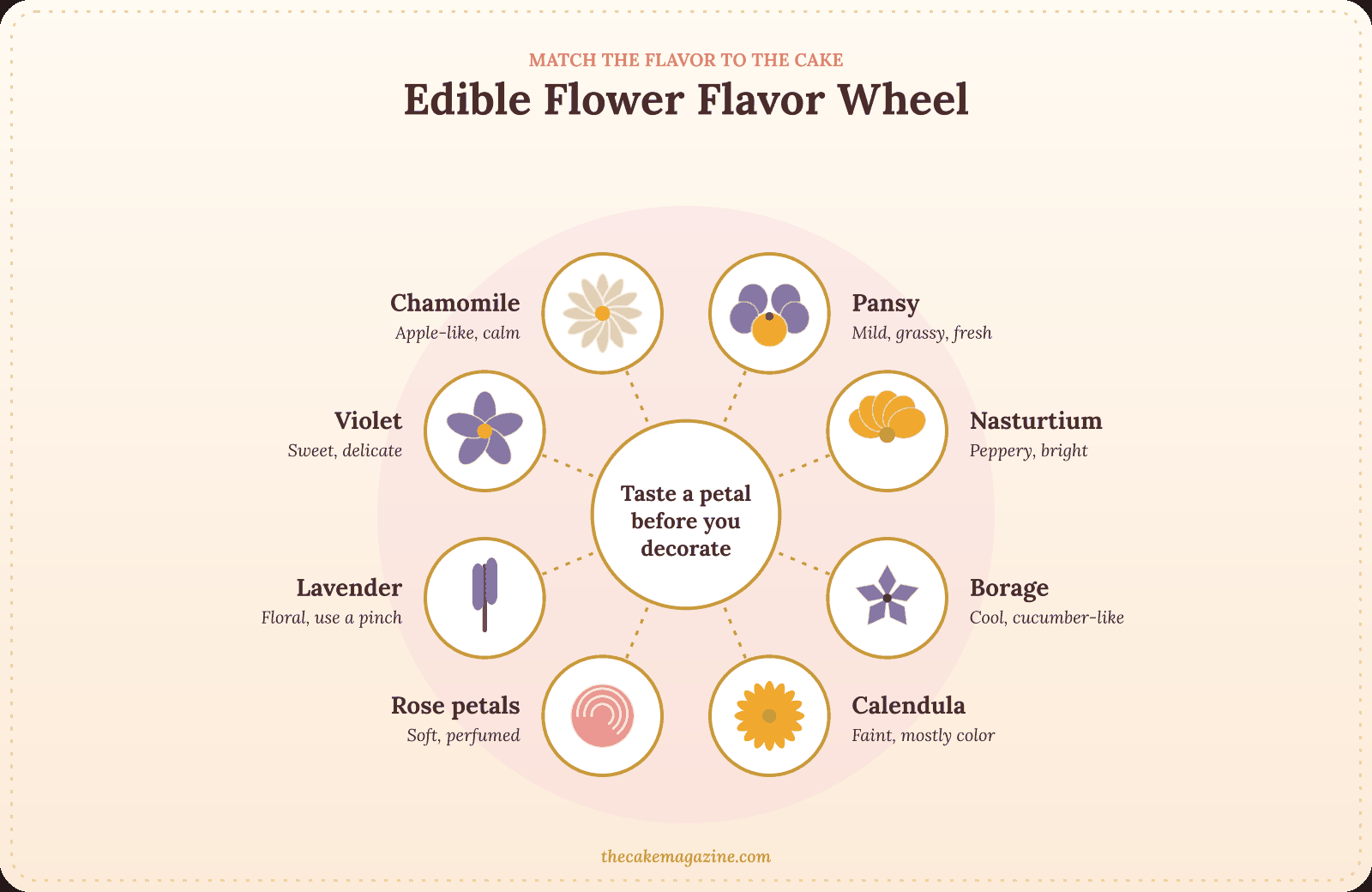
Not every edible bloom suits a cake, and a long list of edible flowers for cakes is only useful if you know how each one behaves. The best edible flowers for cakes are sturdy enough to sit on frosting for a few hours, pretty from every angle, and mild or pleasant in flavor.
Some flowers are safe to eat but wilt in minutes. Others look fine but taste bitter, which is awkward when a guest picks one off and eats it. The notes below group the most useful flowers by how they behave on a finished cake.
Pansies and violas
If you only try one of the edible flowers for cakes, make it a pansy or its smaller cousin, the viola. They come in purple, yellow, white, blue, apricot and nearly black, the faces are charming, and the petals are thicker than most. The University of Minnesota Extension describes the flavor as grassy, which matches experience: mild and fresh, nothing that fights with vanilla or lemon. The same source notes that dark-colored pansies may temporarily darken your tongue, a fun detail to mention to children.
Violas are the better choice for small cakes and cupcakes because the blooms are about the size of a quarter. Pansies work as small focal flowers. Both press flat easily, which makes them useful for the pressed-flower technique later in this guide.
Nasturtiums
Nasturtiums bring warm orange, red and yellow, and they are one of the few flowers with real flavor. The University of Minnesota lists nasturtium among the peppery flowers, . On a cake, that peppery note works best with citrus, carrot or spice cakes, and it can feel out of place on a delicate vanilla cake. The round leaves are also edible and make a lovely natural base under the blooms, though they are peppery too.
Nasturtiums are fragile, so add them last. They bruise if you press on them and will droop quickly in a warm room.
Borage
Borage blooms are small, star-shaped and a true sky blue, a color that is almost impossible to get from natural food dye. The University of Minnesota describes the flavor as cucumber-like and notes that borage has a diuretic effect in large quantities, which is no concern for a few flowers on a slice of cake. Borage stems and leaves are bristly, so trim the bloom close and use only the flower.
Calendula
Calendula, sometimes called pot marigold, supplies yellow and orange petals that read as gold on a cake. Its flavor is faint and slightly bitter, and the University of Minnesota notes it is mostly used for color. Pull the petals off the head and scatter them rather than placing the whole flower, which looks heavy. A pinch of petals over a pale frosting looks like confetti.
Roses
Roses are the classic cake flower, and among edible flowers for cakes they are a favorite when grown for eating. The petals have a soft, perfumed flavor, and the white base of each petal is bitter, so snip it off. Colorado State also advises removing the sour petal base of roses.
Fresh rose petals are thin and delicate, so they work best as loose petals tucked into a cluster rather than as a whole open bloom. For a whole rose look, many bakers use tight buds or buttercream roses instead, which you can learn in our buttercream flowers guide.
Lavender
Lavender looks wonderful on a cake and tastes strongly of soap if you overdo it. The University of Minnesota warns it can taste bitter or astringent and recommends using it sparingly. A few buds scattered over the cake or a tiny sprig tucked beside a rose is plenty. Culinary lavender is the type to buy, and it pairs well with lemon, honey and berry cakes.
Violets, pinks and chamomile
Violets (Viola odorata) are tiny, sweet and old-fashioned, and they are beautiful on a pale cake. They are also hard to find in quantity. Pinks, or dianthus, have a clove-like flavor according to the University of Minnesota, with a bitter white base that should be trimmed. Chamomile has small white daisy-like flowers with a calm apple-like scent. Colorado State notes that people with ragweed allergies may react to English chamomile, which is a good reason to ask guests before using it.
Best for sturdiness
Pansies, violas, calendula petals and dianthus hold their shape longest on frosting. They are the safest picks for cakes that will sit out for a few hours.
Best for flavor
Nasturtiums for pepper, borage for a cool cucumber note, lavender for a floral pinch and rose petals for a soft perfume. Taste one before you commit.
Best for color
Borage for true blue, calendula for gold, nasturtium for orange and red, violas for purple. Many of these colors are hard to get from food dye.
Most delicate
Rose petals, violets and nasturtiums wilt or bruise fastest. Add them last and keep the cake cool.
Match edible flowers for cakes to the cake
A little pairing logic goes a long way with edible flowers for cakes. Mild, grassy blooms like pansies and violas suit almost any flavor. Peppery nasturtium suits lemon, carrot, ginger and olive oil cakes. Perfumed rose and lavender suit vanilla, honey, almond, pistachio and berry cakes. Calendula and borage are nearly flavorless, so they can go on chocolate or coffee cakes without clashing. If a flower has strong flavor and the cake does too, they compete, and the flower usually loses.
Herb, vegetable and garden blooms worth a look
Some of the prettiest edible flowers for cakes are not in the flower bed at all. Herb and vegetable plants flower too, and those blooms are often easy to grow, small and tidy. They add a garden look without needing a special order.
- Chive blossoms: purple pom-poms with an onion flavor, best on savory bakes or a cheese-forward cake, not a sweet vanilla layer.
- Squash blossoms: large and orange, mostly used stuffed or fried, and too soft to hold a shape on frosting.
- Thyme, mint and oregano flowers: tiny and delicate, they add a herbal note and a fine, lacy texture. The University of Minnesota lists mint, lemon balm and oregano blooms among edible flowers.
- Bachelor’s buttons (cornflowers): a vivid blue with a spicy-sweet flavor, according to the University of Minnesota. The petals scatter beautifully.
- Anise hyssop and bee balm: minty, licorice or citrus notes, and pretty spikes of color.
- Hibiscus: deep red petals with a cranberry-citrus tang, often used dried or candied.
- Tuberous begonias: citrusy and juicy, but Colorado State says only hybrid tuberous begonias are edible, which is a great example of why the exact plant name matters.
Flowers with special instructions
A few blooms are edible only with conditions. Colorado State says dandelion flowers should be eaten cooked and warns not to cook rosemary flowers. The University of Minnesota says elderflower and elderberry need to be cooked, with all stems and leaves removed. Those are not flowers to sprinkle raw on a cake. If you see a flower in a design photo and are not sure about its status, look it up in an extension reference before you buy it.
Greenery that is safe
Real leaves make a cake look like a garden. Safe options include mint, lemon balm, basil, nasturtium leaves and small sprigs of thyme. Skip leaves from decorative plants that are not on a recommended food list, even if the florist includes them in a bouquet. Eucalyptus, ferns and boxwood are common bouquet fillers, but they are not food plants for cakes.
Flowers to keep off your cake: what is not one of the edible flowers for cakes
This is the section to read twice. A cake topped with the wrong bloom is more than a mistake, it can make people ill. The list below is not complete, because no list of poisonous plants ever is, but it names the flowers that come up most often in wedding and bouquet work.
Poisonous flowers named by extension sources
Colorado State’s fact sheet lists examples of toxic plants, and several are common in flower arrangements and gardens:
- Lily of the valley
- Foxglove
- Daffodil and jonquil
- Hyacinth
- Larkspur and delphinium
- Monkshood
- Oleander
- Azalea and rhododendron
- Calla lily and amaryllis
- Autumn crocus
The source also points out that its table is not a complete list. It adds that many lilies contain alkaloids and are not edible, and that opium poppy and castor bean are on the toxic list. If a flower is not named as safe on a reliable edible list, treat it as unsafe for food.
Even touching the cake is a problem. Some of these plants can contaminate frosting through sap or pollen. If you use any non-edible bloom for looks, keep it fully separated from the cake by a barrier, and tell the person receiving the cake not to eat it or let a child pick it up.
Safe-sounding flowers that are not on edible lists
Some flowers are not on the poisonous lists but are also not recommended for eating. Baby’s breath, hydrangea, ranunculus and many bouquet fillers fall in this gray area. Their absence from an edible list means you have no basis for calling them safe. Treat them as decoration only, with a barrier, or leave them out.
The same goes for wild flowers. Foraging can be rewarding, but beginners mistake plants constantly, and roadsides collect exhaust and spray. For a cake, a purchased or home-grown flower with a known name is the dependable choice.
The two-list check
When in doubt, check two sources. First, confirm the plant appears on a university extension edible list. Second, check that it does not appear on a poisonous plant list. A flower that passes both is a reasonable candidate. A flower that appears on neither list is an unknown, and unknowns do not go on cakes.
Allergies, guests and honest labeling
Even safe edible flowers for cakes can cause trouble for a few people. Pollen is the main culprit, and the stamens that carry it are exactly the part you will trim away. The North Carolina Department of Agriculture’s fact sheet notes that pollen can affect flavor and cause allergic reactions, which is one more reason to remove stamens before decorating.
Colorado State recommends trying unfamiliar flowers in small amounts first, and the University of Minnesota says some people react to plants considered safe to eat. That advice is simple to follow in your own kitchen, but it is harder at a party, where you cannot test every guest. The practical solution is communication.
Tell people which edible flowers for cakes they are looking at
A short note solves most problems. If you are a home baker, a sentence in the invitation or on the cake table is enough: “The flowers on this cake are edible pansies and nasturtiums. Please let us know if you have flower or pollen allergies.” If you sell cakes, add the same information to the order confirmation and the label. Name the specific flowers. “Edible flowers” alone is not very helpful to someone with a ragweed or pollen allergy.
Offer a flower-free slice
For allergy-conscious events, offer to cut slices from the side of the cake without flowers, or remove all flowers before serving and then slice. Take care to use a clean knife and clean hands after touching the blooms. That small step protects guests who are sensitive to pollen, and it costs nothing.
Special notes for children and pets
Children will pick flowers off a cake. That is fine if every flower is edible and clean, and a problem if some are decorative. For a party with young guests, keep to all-edible blooms and skip the barrier-and-pick method. If you have pets, remember that some safe-for-people flowers are not safe for animals, so keep the cake out of reach and clear leftover flowers right after the party.
Washing, drying and trimming edible flowers for cakes
Prep is where good edible flowers for cakes either get a little better or get ruined. The goal with edible flowers for cakes is simple: remove dirt and tiny insects, keep the petals crisp, and cut away anything bitter or gritty. You do not need special equipment. You need clean hands, a clean bowl, soft paper towels and a few quiet minutes.
Rinse gently, never scrub
Colorado State recommends rinsing flowers gently with cool running water. In practice, many bakers fill a wide bowl with cool water, swish the flowers once or twice, and lift them out instead of holding them under a strong tap, which can bruise the petals. Hold each flower by the stem or the base. Do not soak them. Thin petals like violets and nasturtiums can take on water and go limp or translucent.
Some flowers hide small insects in the center. Tilt each bloom and look inside. A gentle shake, or a soft brush, usually sends them on their way. If a flower is heavily infested, put it aside and use another.
Dry carefully
Lay the rinsed flowers face-up on a clean, dry paper towel or kitchen towel and let them air-dry for 10 to 20 minutes. Then pat the undersides lightly. Excess water causes spotting on frosting, makes buttercream slide, and speeds up wilting. A salad spinner is too rough for most blooms, but it can be used on very sturdy small flowers with a towel inside, on a gentle setting.
Trim the bitter parts
The University of Minnesota Extension advises eating only the petals of most flowers and removing the stamens and pistils. It also says to trim the white base of petals in flowers such as pinks and roses, which can be bitter. Colorado State agrees that anthers and pistils may be bitter and says to remove stems. For a cake, that gives you a clear routine.
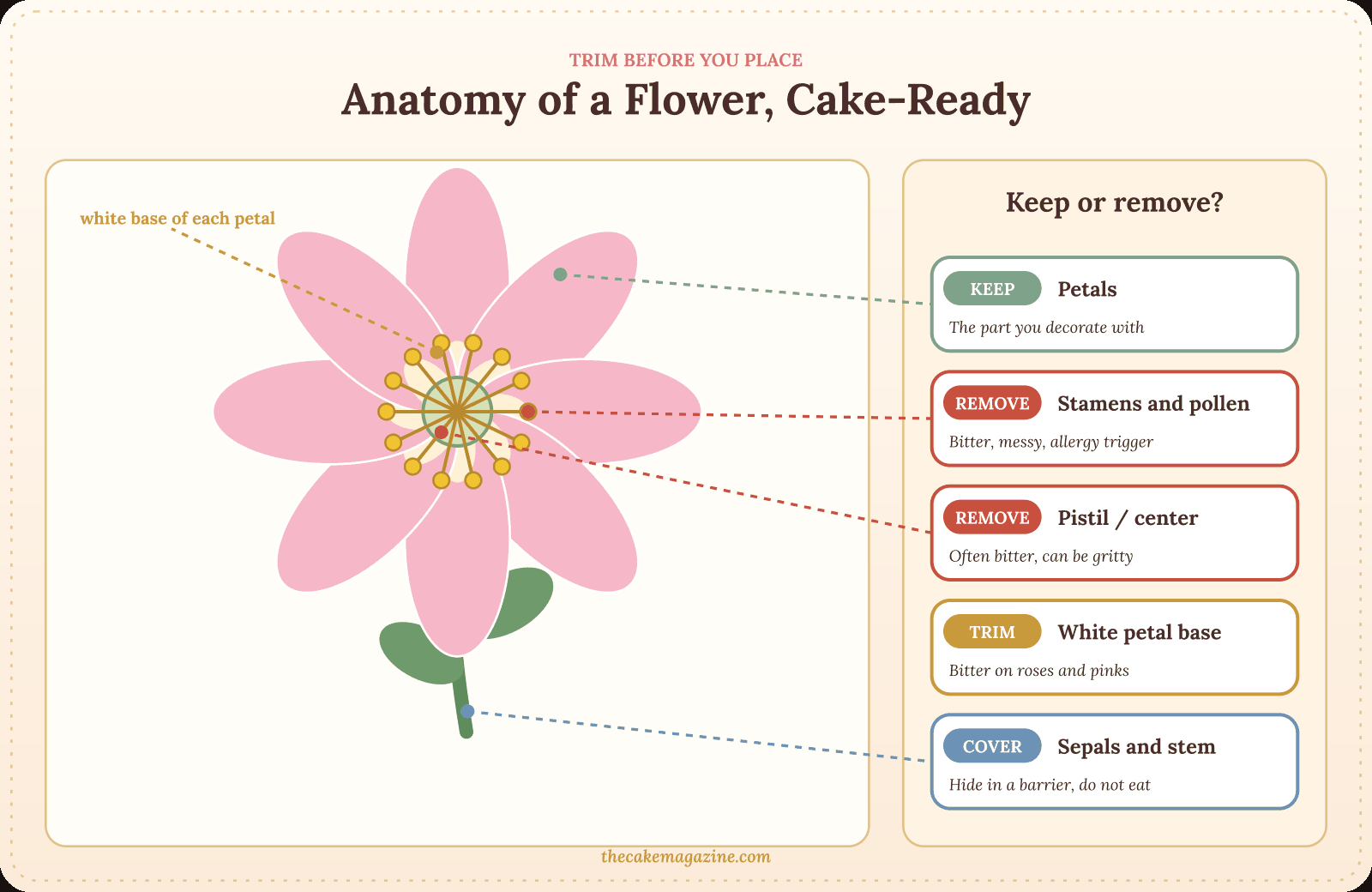
- Hold the flower by the base and look at it from the side.
- Snip the stem close to the bloom, leaving a small stub if you plan to use a barrier method.
- For flowers like roses, pull petals off and snip the pale base from each one.
- For flowers with visible stamens, such as squash blossoms, remove the center with tweezers or small scissors.
- For pansies and violas, you can usually leave the whole face intact, since the center is tiny.
- Set each prepared flower on a tray lined with a barely damp paper towel.
A small tool kit that earns its place
- Sharp, clean scissors: for stems and petal bases.
- Fine tweezers: for placing small blooms and lifting stamens.
- A soft, clean paintbrush: for nudging insects and dust off petals.
- Paper towels and a shallow tray: for drying and staging.
- A lidded container: for chilling the prepped flowers.
Keep these tools for food use only. A pair of scissors that has cut florist wire or garden stems should be washed and sanitized before it touches an edible flower, and it is better still to keep a dedicated pair in the kitchen drawer.
Clean hands matter more than clean flowers. Wash your hands with soap and warm water before handling the blooms, and again if you touch raw eggs, your phone or the trash. Flowers go on the cake uncooked, so nothing later will make up for a mistake here.
Storing flowers and timing the decorating
Edible flowers for cakes are the shortest-lived ingredient on your cake. A buttercream can sit in the refrigerator for days. A pansy has a window of a few hours at its best. Planning around that window is the difference between a cake that looks fresh and one that looks tired in the photos.
How to store prepped edible flowers for cakes
Colorado State suggests placing washed flowers between damp paper towels and refrigerating them until use, and notes that some flowers last longer if you wash them just before use. The University of Minnesota suggests refrigerating harvested flowers in plastic bags. Both ideas share the same logic: keep them cool and keep them moist, but not wet. A shallow, lidded container with a lightly damp paper towel on the bottom and another gently over the top works well.
Do not pile the flowers on top of each other. Arrange them in a single layer, or separate layers with paper towels, so the weight does not crush the petals.
A realistic timeline for edible flowers for cakes
The timeline below is a planning example that you can adjust. It assumes you are decorating a buttercream cake that will be served the same day.
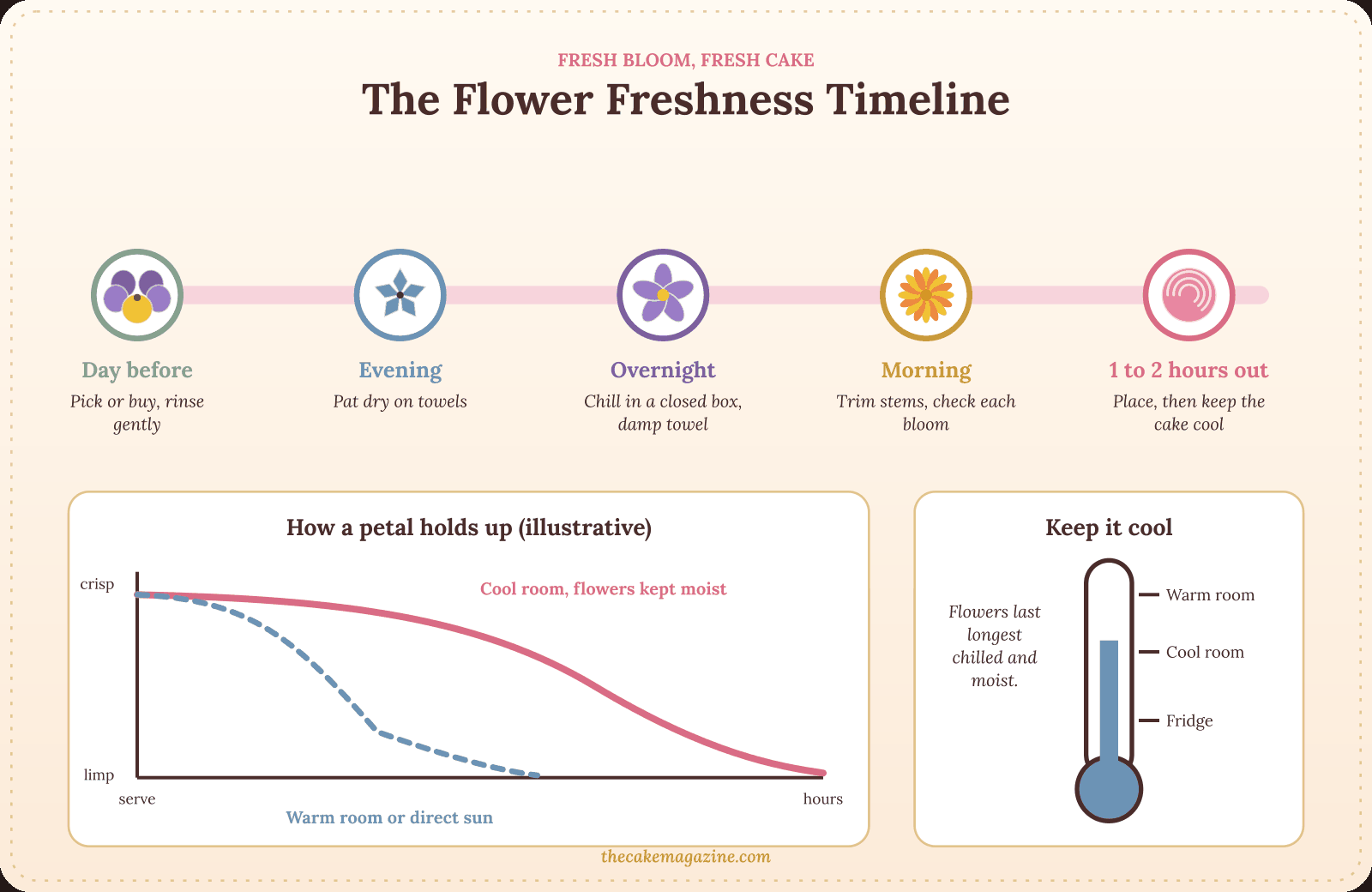
The day before
Buy or pick the flowers, inspect them, and rinse gently. Discard any that are bruised or have insects you cannot remove. This is also the day to taste a petal or two of each variety, so you know what you are putting on the cake.
The evening before
Pat the flowers dry, trim bitter bases and stamens, and layer them in a lidded container with damp paper towels. Refrigerate overnight. The cake itself should be frosted and chilled by now.
The morning of
Check the flowers. Remove any that look limp. Let the container sit out for a few minutes if the flowers are very cold, so condensation does not form on the frosting.
One to two hours before serving
Place the flowers, step back, adjust, and keep the cake cool until it is served. Wedding and event cakes may need placement at the venue.
Can you decorate the day before?
You can, but you take a risk. Flowers placed on frosting and refrigerated overnight can wilt, weep moisture into the frosting or pick up odors from the refrigerator. Sturdy blooms like pansies, violas and calendula petals handle it better than delicate ones. If you must decorate early, keep the cake in a closed cake box in the refrigerator and place the most fragile flowers at the last moment.
Condensation and cold cakes
A chilled cake taken from the refrigerator into a warm room will collect moisture on the surface. That water can make flowers slide and can spot the petals. Let the cake sit for 20 to 30 minutes before you place the flowers. It should be firm enough to hold a dab of frosting, but not so cold that it is beaded with moisture. If your kitchen is humid, work near the air conditioner or a dehumidifier when possible.
When flowers wilt on the cake
A wilted flower is not unsafe, only unattractive. If it happens, lift off the limp blooms with tweezers and replace them with fresh ones from your chilled reserve. This is another reason to buy a quarter more than you think you need. A tray of spare flowers in the refrigerator can rescue a cake in under five minutes.
Placing edible flowers for cakes on the frosting
Placement of edible flowers for cakes is partly design and partly food safety. The design question is where the flowers look best. The food safety question is what the stems and bases touch. Good placement answers both.
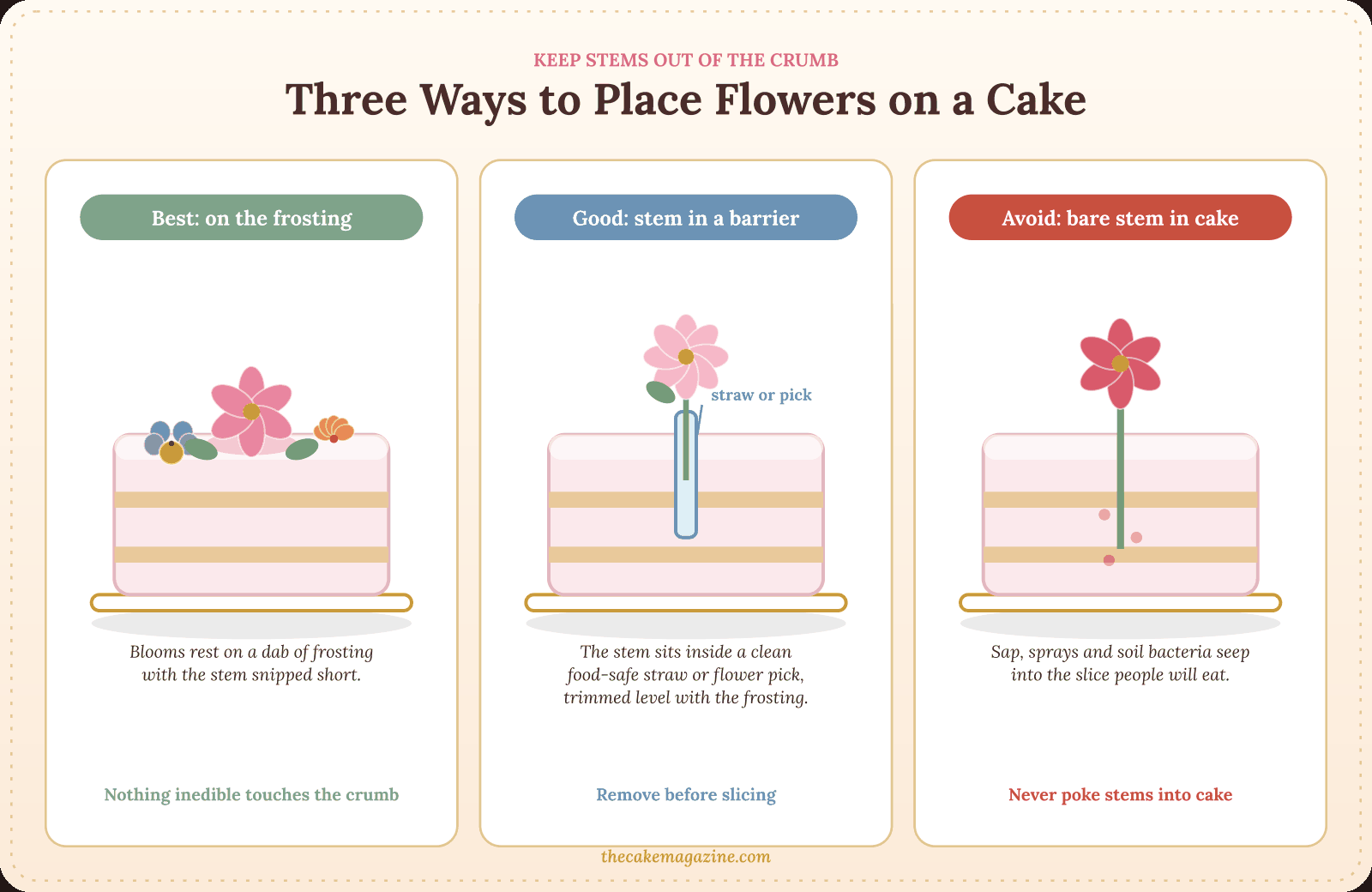
The best method for edible flowers for cakes: resting on frosting
For edible flowers for cakes that are truly edible, the cleanest approach is to rest each bloom on the frosting with the stem trimmed short or removed. Put a small dab of buttercream, about the size of a dime, where you want each flower, press the base gently into the dab, and angle the petals so they catch the light. The frosting acts as glue. Nothing needs to go into the cake.
This works well on American buttercream, which crusts slightly and holds blooms firmly, and on a chilled Swiss meringue buttercream, which is silkier and may need a larger dab. If you are choosing frosting, our guides to American buttercream and Swiss meringue buttercream compare how each one behaves at room temperature.
When you need a barrier
Sometimes a design calls for flowers that are not edible, or for a tall cascade that needs stems. In that case, the stems must not touch the cake. A common practice is to slide a clean food-safe straw or a food-grade flower pick into the cake, then insert the stem into that tube.
Another is to wrap the stem in floral tape or plastic wrap, then in parchment, and nest the bundle in the frosting. Whichever method you use, the principle is the same: no stem, sap or dirt ever touches the crumb or the frosting a guest will eat.
Step-by-step: a simple floral crescent
- Chill the frosted cake until the surface is firm, then let it sit for a few minutes.
- Choose your focal flowers, mid-size flowers, fillers and greenery, and set them on a tray in a loose crescent shape.
- Place the largest flower first, near the middle of the crescent, on a dab of frosting.
- Add one or two more focal blooms at slightly different heights, tilting them in different directions.
- Tuck in mid-size flowers to fill gaps between the large ones.
- Add fillers and leaves last, letting some hang slightly over the cake edge.
- Step back, check the shape from all sides, and make small adjustments with tweezers.
Design principles that always help
- Odd numbers: groups of three or five blooms look more natural than pairs.
- Vary the size: a few large flowers, several medium and a handful of tiny ones give depth.
- Repeat colors: two or three shades repeated across the cake look intentional. Too many colors look scattered.
- Leave some cake showing: negative space makes the flowers feel placed, not piled.
- Mind the direction: flowers should look like they are growing out of the cake, not lying flat.
Keeping flowers from sliding
Warm frosting is the main reason blooms slip. Keep the cake firm, use a slightly thicker dab, and avoid placing heavy blooms on the sides unless they are fully supported by a ledge of frosting. If you are building a vertical cascade, anchor the heaviest flowers near the top and use a short, clean toothpick tucked inside a bloom only if you know the toothpick will be removed before serving, and tell the people serving the cake.
Design ideas for edible flowers for cakes by cake style
The same edible flowers for cakes look completely different depending on what is underneath them. A pansy on smooth white buttercream feels fresh and modern. The same pansy on a textured, rustic cake feels like a meadow. Here are the styles where flowers shine, and what to watch for on each one.
Smooth buttercream cakes
A clean, smooth finish is the perfect backdrop, because the flowers are the only decoration. The challenge is that every fingerprint and smear shows. Finish the sides first, chill the cake well, and add flowers last. If your sides are not quite smooth yet, our guide to smooth buttercream sides and sharp cake edges walks through the scraper and chilling steps.
Naked and semi-naked cakes with edible flowers for cakes
Naked cakes, with exposed layers and a thin coat of frosting, pair naturally with flowers, because both look organic. The risk is moisture. Exposed crumb dries quickly, and wet flowers can leave dark spots on it. Keep flowers dry and place them on frosting, not directly on bare sponge. For more on the technique itself, see our guide to naked and semi-naked cakes.
Fondant-covered cakes
Fondant is a stable surface, but it does not like water. A damp flower can leave a spot or soften the fondant underneath, so dry the blooms well and place them on a small dab of buttercream or a thin smear of piping gel.
Ganache and chocolate cakes
Dark ganache makes light flowers glow. Pale pansies, white chamomile, pink rose petals and blue borage all stand out beautifully. Ganache is firm when chilled, so you may need a drop of warm ganache or a bit of frosting to anchor each bloom. Keep flowers away from the warm drip areas, where they can wilt.
Semi-wild, rustic cakes
Loose, asymmetrical cascades suit textured frosting, a slightly imperfect finish and mixed herb sprigs. Combine pansies, nasturtium, calendula petals, thyme flowers and a few mint leaves. This style is forgiving, which makes it a good first project.
Pairing edible flowers for cakes with other techniques
Flowers combine well with other finishes. A thin gold edge, applied with food-safe products, looks elegant beside soft petals, and our guide to metallic cake decorating explains which finishes are safe to use on food. And if you want flowers that last for days, wafer paper blooms from our wafer paper decorating guide are a good companion to a few fresh ones.
Spring garden
Pansies, violas, violets and chive blossoms on pale buttercream. Add mint leaves for a fresh green and keep the cake lightly lemon or vanilla flavored.
Summer meadow
Calendula petals, borage, cornflowers and nasturtium on a naked cake with berries. Colors are bright, and the cake should stay cool.
Autumn warmth
Deep orange nasturtium and calendula with rosemary sprigs and sugared cranberries on a spice cake. Keep rosemary as a leaf garnish only.
Winter romance
White chamomile, dried rose petals and a dusting of sugar on a dark chocolate cake. Subtle and dramatic.
Choosing a color palette
A limited palette looks more sophisticated than a rainbow. Pick one dominant color, one supporting color and one accent. For example, purple violas with yellow centers, a few white chamomile flowers and green leaves. Or orange nasturtiums with golden calendula and blue borage as a pop of contrast. Hold a few flowers against the cake in daylight before you commit, because colors look different under kitchen lights.
Scale and proportion
Flowers should feel in proportion to the cake. On a 6-inch cake, a single large rose can overwhelm, while tiny violas look sweet. On a 10-inch cake or a tall tiered cake, tiny flowers can disappear. Match flower size to cake size, and add a few larger blooms for focus. The planning numbers earlier in this guide are a starting point, not a rule.
Candied, pressed and infused flowers
Fresh edible flowers for cakes are not the only way to bring flowers to a cake. Some techniques make flowers last longer, taste sweeter or travel better. Each one comes with its own food safety notes.
Candied or sugar-preserved flowers
Candying coats petals or small flowers in a thin layer of sugar, which makes them keep their shape and add a delicate crunch. The classic method paints each petal with egg white and dusts it with fine sugar. Colorado State’s fact sheet specifically says to use pasteurized dehydrated egg whites for sugar-preserved flowers to avoid foodborne illness.
Raw egg is a known risk, and the USDA’s food safety resources explain why pasteurized products are safer for uncooked uses. Meringue powder mixed according to its label is a common stand-in.
- Start with small, dry, trimmed flowers or single petals, such as violas, violets or rose petals.
- Mix pasteurized egg white product or meringue powder according to its package directions.
- Paint a thin, even layer on both sides of each petal with a clean, soft brush.
- Dust with superfine sugar while the coating is still wet, then shake off the extra.
- Dry on parchment or a wire rack in a dry, cool room until crisp. The time varies with humidity, so test one before you plan around it.
- Store in an airtight container in a cool, dark place, as Colorado State suggests for dried or sugar-preserved flowers.
Treat this as a starting method, not a tested recipe. Drying time and crispness depend on humidity and petal thickness, so make a small test batch well before the cake date. Candied flowers soften in humid air and when placed on moist frosting, so add them just before serving.
Pressed flowers
Pressed edible flowers are thin, flat and almost translucent. They stick to a smooth buttercream or fondant surface like a decal, which is a lovely way to decorate the sides of a cake. Pansies, violas, small herb flowers and tiny leaves press best. Press them between parchment sheets inside a heavy book or a flower press for a week or two, and make sure the flowers are fully dry before they touch the cake.
Moisture left behind can promote mold, so only use flowers that are completely papery.
Dried flowers and petals
Dried culinary rose petals, lavender buds, chamomile and hibiscus are sold for tea and baking. They are shelf-stable and good for sprinkling, but they are not the same as fresh flowers. Check the label to confirm they are sold for food use. Many craft and potpourri flowers are dried for decoration and may have been treated. If you are not sure, do not use them on a cake.
Flower-infused sugar, syrup and buttercream
Infusing gives flavor without any visible petals. Steep culinary lavender or rose petals in warm milk or simple syrup, strain, and use the liquid in a soak or buttercream. Keep flavors light, because floral flavors turn soapy fast. Colorado State notes that homemade flavored vinegars and oils have a limited shelf life and need refrigeration, and the same caution applies to flower infusions made with moisture. Keep infused syrups in the refrigerator and use them within a few days.
Flower-shaped and flower-colored alternatives
Sometimes a flower is not the right choice, whether due to allergies, season or safety. Alternatives include piped buttercream blooms, fondant or gum paste flowers, wafer paper flowers and edible-flower-printed sugar sheets. A mix of one or two real blooms and a handful of piped or paper ones can give the same look at lower risk. Our guide to cake toppers and food-safe placement covers other toppers that can sit beside flowers.
Weddings, transport and serving day
Edible flowers for cakes get more complicated when a cake leaves your kitchen. Heat, vibration, long waits and many guests are all factors. The decisions you make at home can save you from panic at the venue.
Coordinate edible flowers for cakes with the florist
Wedding florists often offer to supply cake flowers, and they usually mean bouquet flowers. If the flowers are not edible, they are decoration, and they must be kept away from the cake with a barrier. Ask the florist exactly which flowers and greenery they will provide, what they were treated with and how the stems will be wrapped.
Ask them to deliver them clean and dry, so you do not have to carry buckets of wet stems into a food area. Our wedding cake design guide shows how flowers fit with style, venue and scale,.
Decorate at the venue when you can
For tall tiers and long drives, the best plan is to transport the cake plain and add the flowers on site. Pack the flowers in a lidded container with damp paper towels and carry them in a cooler bag. Bring tweezers, scissors, a small offset spatula, extra frosting in a piping bag, spare flowers and a clean towel. Plan 20 to 30 minutes for placement, longer for a large cascade.
Heat and sun
Flowers and buttercream both suffer in heat. If the cake will be outdoors, keep it in shade and away from direct sun. Place it at the last possible moment, and cover or refrigerate when you can. The cake food safety principles in our food safety guide also apply to how long a decorated cake can sit out.
Cutting and serving
Before the first slice, someone should remove any non-edible flowers, barrier tubes, picks and tape. Say it out loud to whoever is cutting: “Take out the straws and any wired flowers first.” Then slice and serve. For edible blooms, let guests choose whether to eat them. Some people will, and others will set them aside on the plate. Both are fine.
What to do with leftovers
Flowers that have sat on a cake for several hours are not worth saving. Remove them and store the cake in the refrigerator, covered, following the storage times for the frosting and filling. If you saved unused flowers in a chilled container, they can go on a salad or a drink the next day, assuming they were grown for eating and have stayed cool and clean.
Common mistakes and quick fixes
Almost every problem with edible flowers for cakes comes from the same short list of avoidable choices. Here are the ones we would watch for first.
Using florist or garden-center flowers
What it looks like: a beautiful rose or ranunculus that was grown for the vase, not the plate.
Why it matters: Colorado State says flowers from florists, garden centers and nurseries are not grown for consumption and may carry unsafe chemicals.
The fix: buy flowers sold for eating, grow your own from seed, or use the florist’s flowers as decoration only, with a barrier, and tell guests not to eat them.
Sticking bare stems into the cake
What it looks like: a pretty cascade with stems pushed straight into the sponge.
Why it matters: sap, soil residue and any surface treatment can transfer to the slice someone eats.
The fix: rest flowers on frosting, or use a clean straw or pick as a sleeve and remove it before serving.
Leaving stamens and bitter bases on
What it looks like: pollen dusting the frosting, or a guest grimacing at a rose petal.
The fix: trim stamens and pistils, and snip off the white base of petals before decorating.
Decorating too early
What it looks like: drooping blooms, wet spots and tired petals by serving time.
The fix: keep flowers chilled and place them one to two hours before serving, or at the venue, using the timeline above.
Using flowers with strong flavors on delicate cakes
What it looks like: peppery nasturtium on a mild vanilla cake, or too much lavender making a slice taste soapy.
The fix: taste a petal first, use strong flowers sparingly and match them to cakes that can handle them.
Forgetting to tell guests
What it looks like: a guest with a pollen allergy, or a child eating a decorative bloom.
The fix: name the flowers on a card or in the order, separate edible from decorative, and offer a flower-free slice.
Wet flowers on frosting
What it looks like: dark spots, slipping blooms or tinted frosting where petals touched.
The fix: dry flowers thoroughly, use a firm chilled cake and a thick dab of frosting, and swap any damp bloom for a fresh one.
A final check for edible flowers for cakes before the cake goes out
- Every flower on the cake is edible, or has a barrier and a note.
- No stems touch the cake or frosting.
- Stamens and bitter bases are trimmed from the edible blooms.
- The flowers are fresh, dry and placed no earlier than needed.
- Guests know which flowers are edible and what the flowers are.
- Someone knows to remove non-edible flowers and picks before slicing.
Frequently asked questions about edible flowers for cakes
Are all edible flowers for cakes safe for everyone?
No. Even flowers that are safe for most people can bother someone with pollen or plant allergies. Colorado State and the University of Minnesota both suggest trying unfamiliar flowers in small amounts. When you serve a cake, name the flowers, trim the stamens and offer a flower-free slice to anyone who is unsure.
Can I use flowers from a florist as edible flowers for cakes?
It is best not to. Colorado State says florist, garden center and nursery flowers are not grown for consumption and may have been treated with unsafe chemicals. Use them only as decoration with a barrier between stems and cake, and tell guests not to eat them.
Which edible flowers for cakes are the easiest for beginners?
Pansies and violas are the easiest. They are sturdy, mild in flavor, widely sold and forgiving to place. Calendula petals and borage are good next steps. Roses and nasturtiums are lovely, but they bruise easily and need a lighter touch.
Do I need to wash edible flowers before putting them on a cake?
Yes, a gentle rinse is wise. Colorado State recommends rinsing flowers with cool running water. Swish them lightly, check inside the blooms for insects, and let them dry fully on paper towels. Wet petals spot frosting and wilt faster, so dry time matters as much as rinsing.
How far ahead can I decorate with edible flowers for cakes?
For the best look, place flowers one to two hours before serving. Sturdy blooms like pansies and calendula can handle being placed the evening before if the cake stays in a closed box in the refrigerator. Delicate flowers like nasturtiums and rose petals should go on last.
Should I remove the stamens and petal bases from edible flowers for cakes?
For most flowers, yes. The University of Minnesota Extension advises eating only the petals of most flowers and removing stamens and pistils, and trimming the white base from petals such as roses and pinks. Pansies and violas are small enough that many bakers leave them whole.
What is the best way to attach edible flowers for cakes to frosting?
Use a small dab of buttercream under each bloom, on a cake that is chilled but not wet with condensation. Trim stems short and angle the petals as you press. For tall cascades, sleeve any stem in a clean food-safe straw or pick, and remove it before slicing.
Can edible flowers for cakes go on fondant?
Yes, but dry them thoroughly first and place them on a dab of buttercream or a thin smear of piping gel. Moisture can leave spots on fondant and soften it, so avoid wet petals and avoid leaving flowers on fondant longer than the event requires.
Do edible flowers for cakes taste good?
Most taste mild, grassy or faintly floral. Some have real flavor: nasturtiums are peppery, borage is cucumber-like, and pinks taste a little like clove, according to the University of Minnesota. Lavender can be bitter or astringent, so use only a pinch. Taste a petal first.
Are lilies, hydrangeas or baby’s breath safe as edible flowers for cakes?
Treat them as decoration only. Colorado State notes that many lilies contain alkaloids and are not edible, and bouquet fillers like hydrangea and baby’s breath are not on recommended edible lists. If a flower is not clearly listed as edible by a trusted source, keep it off the cake or behind a barrier.
How do I store leftover edible flowers for cakes?
Layer them between damp paper towels in a lidded container and refrigerate, as Colorado State suggests for washed flowers. They are best used within a day or two. Dried or sugar-preserved flowers keep longer in an airtight container in a cool, dark place.
Can I sell cakes decorated with edible flowers for cakes?
Possibly, but rules differ by state and county, and some home-baking programs limit what you may use. Check with your state or local food regulator, name the flowers in your labeling and buy flowers sold for eating. This guide is general information, not legal advice.
What can I use instead of fresh edible flowers for cakes?
Piped buttercream flowers, fondant or gum paste blooms, wafer paper flowers and pressed or candied petals all give a floral look. They avoid pollen and shorten your decorating-day timeline. Many bakers mix a few fresh blooms with these to get the best of both.
Final thoughts on edible flowers for cakes
The charm of edible flowers for cakes is that they look effortless, and the work that makes them safe is mostly invisible. You choose blooms that were grown for eating, name them correctly, rinse and trim them, keep them cool and place them at the last sensible moment. After that, the cake does the talking.
If you are new to this, start small. Buy a pack of pansies or violas from a supplier that sells flowers for eating, taste a petal, and decorate one simple cake with a handful of blooms. Notice how long they stay fresh in your kitchen and how they behave on your frosting. That one experiment will teach you more than any list, and you can add nasturtium, borage and herb flowers as your confidence grows.
Above all, remember the rule that runs through every section: if you do not know the plant, where it came from and what touched it, it does not go on the cake. Everything else is design, and design is the fun part.
Editorial note: reviewed and updated November 2026. This guide is general food-handling and decorating information for home and small-batch bakers in the United States, drawing on university extension and state agriculture sources named in the text. It is not medical, allergy or legal advice. Plant identification, allergies and local food rules vary, so confirm any flower against a trusted edible-plant reference and check with your local food regulator before selling decorated cakes. We have not hands-on tested the flowers or techniques described here.