Most couples can picture the wedding cake they want in about four seconds, and then spend four months finding out why it is harder than it looks. Wedding cake design is a set of connected decisions about size, style, venue, color, flowers, texture and proportion, and each one changes the others. A cake photographed in a bright studio can look lost in a barn, or wilt on a patio in July. This guide walks through the choices in a sensible order, so the cake fits your guests, your room and your baker’s real skills.
Good wedding cake design starts with the practical facts and ends with the decoration. First settle your guest count and budget, then look at the venue’s space, temperature and lighting. Choose a style that suits the day, pick one base color with one accent, decide whether flowers will be real, sugar or absent, and choose a texture your baker can execute cleanly. Check that the tiers look balanced for the table, and bring three reference photos rather than thirty.
- What wedding cake design really covers
- The order that makes wedding cake design easier
- Guest count and the shape of the cake
- Choosing a wedding cake design style
- Wedding cake design for your venue
- Flowers and wedding cake design
- Color choices that photograph well
- Texture and finish
- Scale and proportion
- Tiers, shapes and the structure behind the look
- Flavor, filling and design working together
- Working with your baker on the design
- Common wedding cake design mistakes
- Wedding cake design FAQ
- Final thoughts
What wedding cake design really covers
When people search for wedding cake design ideas, they usually mean the surface: ruffles, florals, gold leaf. That is the part you see in photos. But the surface sits on top of a stack of decisions that decide whether the cake can be built, delivered and served at all. A designer who only thinks about the look will hand you something fragile. A baker who only thinks about structure may hand you something plain.
Real wedding cake design lives between those two. It covers the number and size of tiers, the shape, the frosting type, the color story, the texture, any flowers or toppers, the cake stand and the table it sits on. It also covers things nobody photographs, such as how the cake travels and how it holds up under warm lights.
The six levers you can pull
It helps to name the levers, because naming them makes conversations with a baker much shorter. You can change the size (how many people it serves and how tall it stands), the style (the overall mood), the color, the flowers or decorations, the texture of the frosting and the structure underneath. Everything else is a combination of those six.
Each lever in wedding cake design has a cost in time, skill and money. A smooth, sharp-edged cake with painted detail is more work than a softly textured one, and a tall five-tier cake needs more support than a short two-tier cake. Our wedding cake cost guide explains how those choices show up in the price, so you can match your wishes to your budget before you fall in love with a picture.
Where this guide fits
This is one chapter of a larger planning picture. If you are still deciding the basics, start with the full wedding cake guide, which covers servings, budget, delivery and cutting alongside design. Here we go deeper on the visual side: how to choose a look that suits your venue and then make it work in real life.
We have not baked or photographed any of the cakes described here, and the illustrations are drawn for explanation, not as promises about how a particular baker works. Treat the advice as a framework for the conversation you will have with a professional, who knows their own methods and your local conditions.
The order that makes wedding cake design easier
The most common source of stress is deciding in the wrong order. Couples often start with a Pinterest photo, then discover that it needs a cake twice as big as their guest list requires, or that it uses a frosting that melts in an outdoor reception. Reversing the order saves a great deal of disappointment.
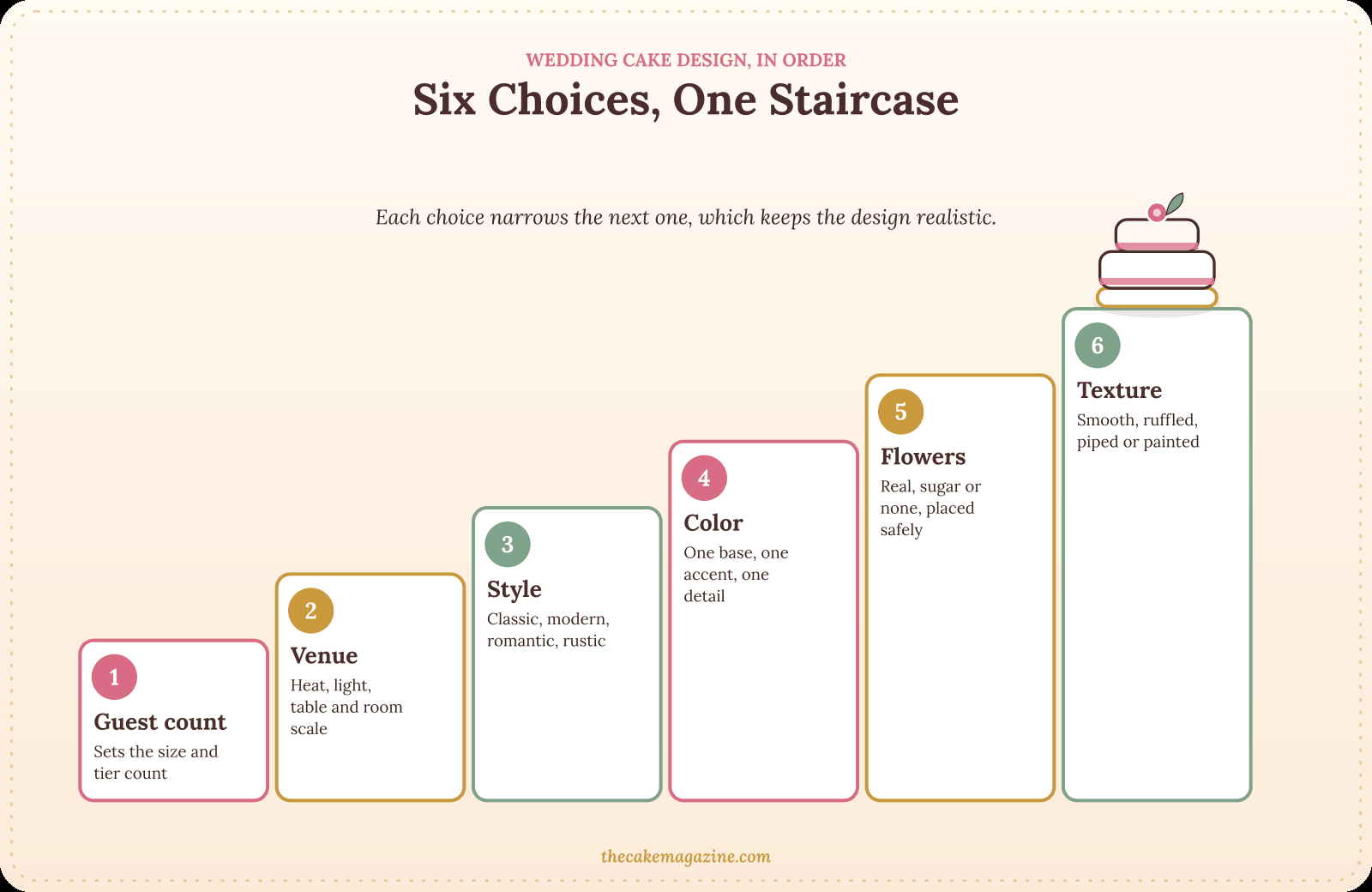
The staircase in the figure above shows the sequence we recommend. Each step is a decision that narrows the next one.
Step by step
- Guest count and budget. These two numbers set the size and the number of tiers. Everything else has to fit inside them.
- Venue. Indoor or outdoor, air-conditioned or not, a long banquet table or a small round one. The room tells you how tall and how delicate the cake can be.
- Style. Classic, modern, romantic, rustic or something personal. Choose one main mood, not four.
- Color. One base, one accent, and perhaps a small detail color.
- Flowers and decoration. Fresh, sugar, painted or none, with a plan for keeping blooms away from the frosting.
- Texture and finish. The tactile surface that makes the cake feel like yours.
Notice that flavor is not on this list. That is deliberate, because flavor and design affect each other in ways we cover later, and most couples choose flavors at a tasting after the visual direction is set. See our guide to the best wedding cake flavors when you reach that step.
A useful rule of thumb. Write your answers to steps one and two on a card before you open any inspiration board. When a photo catches your eye, check it against the card. If the cake in the picture serves 200 and you have 60 guests, you already know what to adjust.
When to start
Design conversations go better when you are not rushed. Many bakers book up well ahead for popular dates, so it is worth reading our wedding cake ordering timeline before you start collecting ideas. A baker who has time can sketch, test a color and adjust. One who has two weeks can only repeat what they already make well.
Guest count and the shape of the cake
The practical heart of wedding cake design is the number of people you need to feed. A tall, dramatic cake for 40 guests means either a lot of leftover cake or a lot of dummy tiers. A small, tidy cake for 180 guests means a kitchen cake to supplement it. Neither is wrong, but you should choose on purpose.
For the detailed math, our wedding cake serving guide lays out tier sizes, portions and backup cakes. Here we only need the design consequences, because serving needs and visual needs pull in different directions.
Three common ways to balance size and look
One cake does everything
A tiered cake sized to serve most guests. It makes the strongest centerpiece and the cutting moment feels real. It also costs the most per slice for decoration and needs good structure.
Display cake plus kitchen cake
A smaller, beautifully decorated cake sits on the table, while plain sheet cake in the same flavors is cut in the kitchen. You get the look without paying to decorate every portion. See our comparison of sheet cake and tiered cake.
Dummy tiers for height
Decorated foam tiers add height and presence at a lower cost, with a real cutting tier on top or in the middle. Our guide to dummy wedding cakes explains the trade-offs.
Round, square or something else
Round tiers are the traditional choice and the easiest to cut and to decorate evenly. Square and hexagonal tiers give a more architectural, modern look and tend to make portion cutting neater, but their sharp corners ask more of a baker’s skill with smooth frosting or fondant. Offset or asymmetrical stacks, where tiers sit off-center, look striking in photos but need extra internal support and a careful delivery plan.
A good question to ask a baker is how many portions each shape yields at your chosen slice size, because a square tier generally serves more than a round tier of the same width. They can tell you exactly, using their own portion standard.
Choosing the tier count
Two tiers read as simple and intimate. Three tiers are the classic proportion and balance easily. Four or more begin to feel grand, and they need a big room and a table that can take the weight. If your venue has high ceilings or you want presence in photos, taller can make sense. In a small restaurant or a backyard, a tall cake can look top-heavy and make people nervous.
Whatever you choose, keep the design simple enough that the baker can focus effort where people will look, which is usually the top two-thirds of the cake and the front-facing side.
Choosing a wedding cake design style
Style is the overall mood. Most couples are drawn to one of a handful of looks, and naming yours helps a baker propose something coherent. The categories below are loose, and plenty of cakes sit between them, but they give you a useful vocabulary.
Classic and timeless
Think white or ivory, smooth sides, tidy borders, perhaps a ribbon or a few sugar flowers. This is the safest wedding cake design for a formal venue, and it ages well in photos. Because it is clean, it exposes flaws. Smooth buttercream or fondant has nowhere to hide, so it rewards an experienced decorator. If you want to understand what is involved, our guide to smooth buttercream sides and sharp edges shows why this look takes practice.
Modern and minimal
Clean geometry, matte surfaces, a single bold color or an abstract painted wash. Modern wedding cake design often uses fewer decorations and relies on shape, contrast and negative space. The look suits galleries, lofts and contemporary restaurants. It can feel cold in a rustic setting unless you add warmth through natural flowers or a textured finish.
Romantic and soft
Ruffles, piped lace, pastel tints and loose blooms. This style is generous with detail and gentle with color. It photographs beautifully but takes more hours, so expect it to cost more than a simple finish. Soft piping work benefits from a baker who is confident with a bag, and our cake piping guide gives a sense of how much skill the borders and lace patterns require.
Rustic and organic
Semi-naked cakes with sponge showing through a thin coat of frosting, fresh greenery, berries and fruit, or bark-like textured buttercream. These cakes feel relaxed and suit barns, gardens and farm venues. They are forgiving of minor imperfections, which is part of their charm, but they leave more cake exposed to air, so they should not sit out in heat for long.
Personal and playful
Hand-painted details, a motif from your story, a cake that matches your invitation suite or a nod to your cultural traditions. This is where wedding cake design stops being a template and becomes yours. The challenge is restraint. One meaningful detail, such as a pattern borrowed from a family quilt or a flower from a grandmother’s garden, usually reads better than five competing ideas.
Bring three pictures, not thirty. Choose three cakes you love and write one line on what you like about each: the shape, the color, the texture. Bakers can combine those details into something original, and original designs are easier to price and defend than copies of someone else’s work.
Wedding cake design for your venue
A cake does not exist in a studio. It lives on a particular table, under particular lights, at a particular temperature, for several hours. Good wedding cake design starts by asking what the venue will do to the cake, and the answers shape almost every other choice.
Questions to ask the venue first
- Is the cake table indoors or outdoors, and is it in sun or shade?
- Is the room air-conditioned, and does the system run during the whole reception?
- How big is the cake table, and is it sturdy and level?
- Is there a refrigerator or cool room where the cake can wait before it is displayed?
- Who sets up the table, and who cuts and serves the cake?
- What are the lights like: warm candles, spotlights, or a bright dance floor wash?
Our wedding cake setup checklist goes through table, lighting, temperature and cutting tools in detail. For design purposes, the answers tell you how much detail the cake can carry and how long it can safely sit out.
Heat is the first design constraint
Warm rooms and outdoor receptions change the whole plan. Butter-heavy frostings soften as the room warms, and sculpted decoration droops sooner than you expect. A cake that would be fine in a cool ballroom may need a sturdier frosting, a shorter display window or a simpler profile in a summer garden.
Different frostings behave differently, which is worth understanding before you choose one. Our overview of the types of buttercream explains how American, Swiss, Italian and other styles handle temperature. Fondant-covered cakes tolerate a wider range of conditions on the outside, though the filling inside still needs care.
Do not guess about food safety. Cakes with perishable fillings, such as fresh cream or custard, should not sit in a hot room for long. The USDA publishes general guidance on how long perishable food can stay out and how that limit shortens in hot weather. Read the USDA Food Safety and Inspection Service pages and ask your baker for their own timing advice.
Match the cake to the room
Ballroom or hotel
Formal and controlled, with long banquet lighting. Clean lines, elegant piping and tall proportions work well here, and the large room can handle a bigger cake.
Garden or backyard
Soft and natural. Think greenery, delicate color and a lower profile. Plan shade, a cool holding spot and a shorter display time.
Barn or farm
Textured finishes, semi-naked layers and wildflowers fit the mood. Check the floor and table, because rustic spaces are not always level.
Beach or waterfront
Wind, humidity and heat all matter. Choose a sturdy, simple design, secure the stand and keep the cake sheltered until the cutting.
Modern gallery or loft
Bold geometry, matte color and statement flowers stand up to the architecture. Keep the cake proportions strong so it does not vanish into the space.
Restaurant or small room
Scale matters more than style. A modest two-tier cake looks generous in a small room, while a tall one may overpower it.
Lighting changes color
Warm tungsten bulbs push whites toward cream and pastels toward peach. Cool lights can flatten gold and turn blush into gray. Candlelit tables look romantic, but they make fine piping nearly invisible. If your wedding cake design depends on a particular shade or a delicate detail, ask to see a sample in light similar to the venue’s. Bakers can often tint a test batch, and a quick phone photo in the room can save you from surprises.
The table matters as much as the cake
A cake on a bare folding table looks smaller than the same cake on a styled one. A tablecloth that reaches the floor, a stand with some height and a little space around the cake give it presence. The cake should not compete with a tall floral arrangement next to it, and the table should be strong enough for the full weight of the cake, which can be considerable. If you are unsure, ask the venue or your baker about the weight and the table’s capacity.
If the cake has a long trip to the venue, read our guide to transporting a wedding cake. A design that survives the drive is part of a good plan, and some designs are better at it than others. Delicate sugar work and tall piped borders ride poorly, while smooth, sturdy surfaces travel well.
Flowers and wedding cake design
Flowers are the decoration most people picture first, and they can make a simple cake look luxurious. They also raise questions that a cake with no flowers never has to answer: what kind, where, who places them, and whether they belong near food at all.
Your three options
You can use fresh flowers, sugar flowers or no flowers at all. Fresh blooms look natural and can match your bouquets and table arrangements. Sugar flowers are made from edible paste, take many hours to craft and cost more, but they last, can be made in advance and are safe to place directly on the cake. A cake with no flowers relies on texture and color, which suits a modern look.
Some couples mix the two: a few sugar blooms the baker controls and fresh greenery from the florist. That gives a natural feel while keeping the most delicate work under the baker’s roof.
Placement ideas
Where the flowers sit changes the whole feel of the cake. Five common placements appear in the illustration below, each with a different mood and a different amount of work.
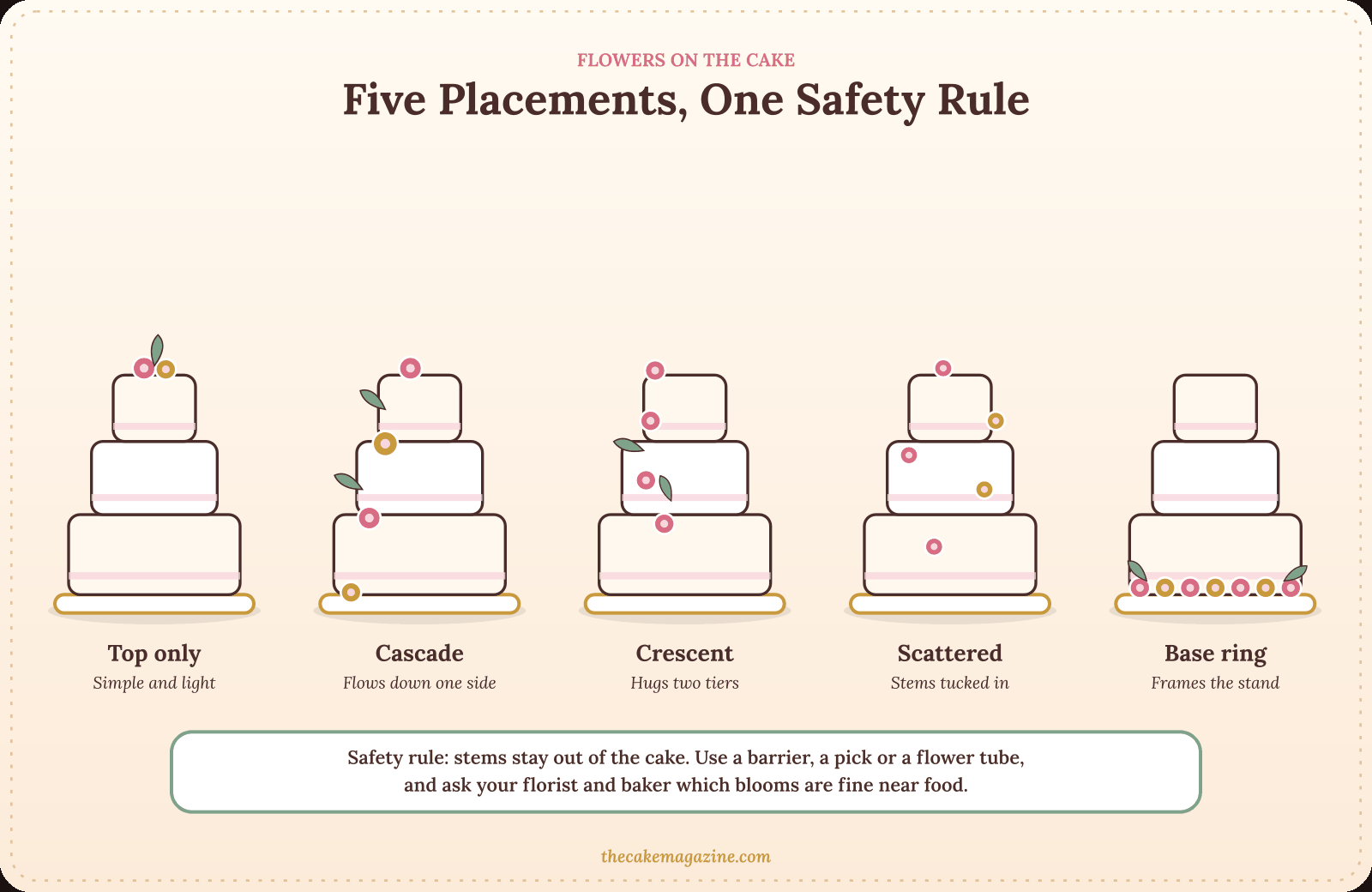
- Top only. A small cluster or a single bloom crowns the cake. It is easy, light and works for nearly every style.
- Cascade. Flowers flow down one side, which draws the eye along the height of the cake. It is dramatic and needs careful balance so it does not look lopsided.
- Crescent. A curved line of blooms wraps two or three tiers. Many people find it feels graceful and intentional.
- Scattered. Individual blooms and leaves are tucked between tiers or on the sides for a loose, garden look.
- Base ring. Flowers around the bottom of the cake or on the stand frame it without touching the frosting at all.
Keeping flowers food-safe
This is where wedding cake design meets common sense. Flowers can carry pesticides, and some varieties are not meant to be eaten. Even a flower that is perfectly fine to look at should not push its stems into a cake that people will eat. Responsible bakers and florists handle this with a barrier, such as floral tape, a plastic flower pick or a small tube, so that stems never touch the cake.
Tell your florist the flowers are going on a cake, and ask for blooms grown without pesticides on the parts that touch the cake’s area. Ask your baker which flowers they are happy to use and how they prefer them delivered. Guests should also be able to tell that decorative flowers are not for eating, which a baker may handle at the cutting by removing them first.
A simple rule. Treat fresh flowers as decoration, not ingredients. Keep stems out of the cake, remove blooms before serving, and let the baker and florist agree on the list of flowers in advance. If anyone in your family has allergies, mention it, since pollen and plants can matter even when the flowers are not eaten.
Who places the flowers?
Settle this before the wedding, not on the morning of it. Some bakers decorate with the flowers at the kitchen, which gives them control, while others prefer to deliver the cake plain and have the florist or a designated person add blooms at the venue. The second route lets the flowers stay fresher, but it needs clear timing and someone who knows where each stem goes. A short written note with a photo of the final arrangement prevents confusion.
For the full picture of what the baker and venue are responsible for on the day, see the setup checklist, which includes who handles florals at the table.
Color choices that photograph well
In wedding cake design, color is the fastest way to make a cake feel like part of your wedding. It is also the easiest place to go wrong, because the color you imagine and the color that appears in a room under lights are not always the same. A little discipline in your wedding cake design helps.
Use a simple palette formula
A palette that works on almost any cake is the 60-30-10 idea borrowed from interior design. About 60 percent of the visible cake is a base color, 30 percent is a supporting accent and 10 percent is a small detail. White or ivory makes a reliable base. The accent might be a soft blush on a top tier or a wash of sage. The detail could be gold leaf, a bold flower or a thin piped line.
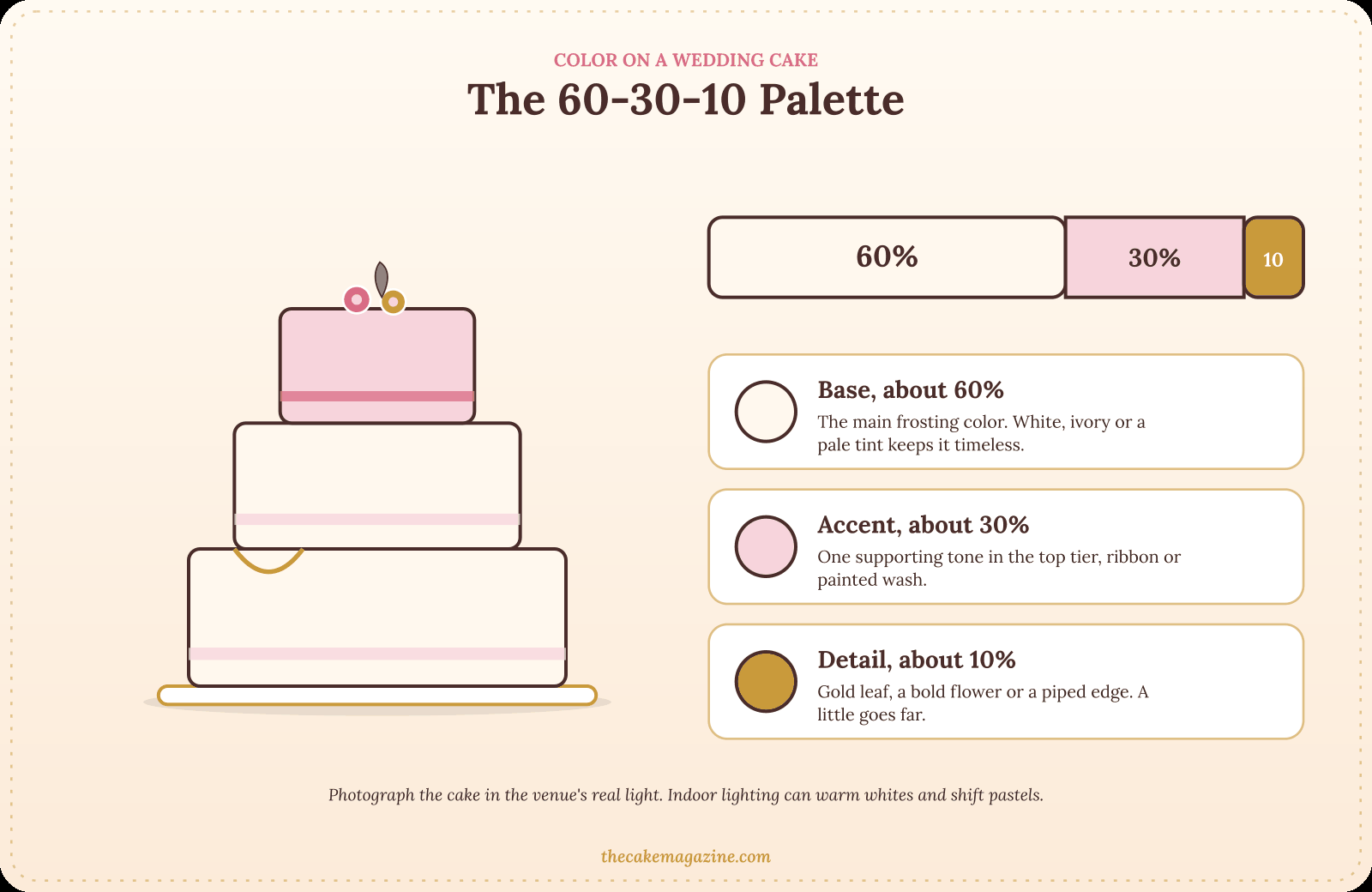
The percentages are a guide, not a measurement. What matters is that one color clearly leads and that the others support it. Cakes that try to give equal weight to four colors tend to look busy, and the eye does not know where to rest.
Match, but do not clone
Your cake does not have to match your bridesmaid dresses exactly. Echoing one or two colors from the flowers, the stationery or the table linens is enough to tie everything together. Trying to match a color perfectly in frosting can be difficult, because food coloring behaves differently from fabric or paper, and results vary between buttercream and fondant.
Bring a fabric swatch or a color chip to your tasting and ask the baker to show you what is realistic. Many bakers keep sample boards to demonstrate how their colors look in real life.
Which colors are harder to make
Deep, saturated colors such as navy, black, burgundy and bright red take a lot of coloring, which can affect taste and can stain teeth and mouths. Some bakers prefer to achieve depth through painting or a thin glaze rather than tinting a whole batch. Very pale pastels can be tricky in a different way, because slight differences in lighting change how they appear. If you love a bold shade, ask your baker how they achieve it and what the trade-offs are.
Metallics and shine
Gold, silver and copper accents bring a formal glow. Edible gold leaf, painted details and metallic dust each have different looks and different price points, and not every product labeled as metallic is edible. If you want metallic accents, ask your baker to confirm that everything used on the cake is food-safe, and that any decorative elements that are not edible are marked or removed before serving.
Seasonal color ideas
Seasons offer an easy shortcut. Spring leans toward blush, lilac and fresh green. Summer favors bright citrus tones, soft blues and sun-washed whites. Fall suggests terracotta, burgundy and warm gold. Winter works with crisp white, deep evergreen and silver. These are starting points rather than rules, and a well-chosen unexpected color can feel fresh. For current ideas across weddings and celebrations, our cake trends guide follows what bakers and couples are choosing.
Texture and finish
Texture is what makes a cake feel like a particular kind of wedding. Two cakes in the same white and the same size can look entirely different depending on whether the surface is glassy and smooth or full of soft ridges. It is also the lever that most affects how many hours of work the baker has to put into your cake, so it connects design directly to price.
The swatches below show six finishes drawn side by side. Each has a different personality, and each asks something different of the person making it.
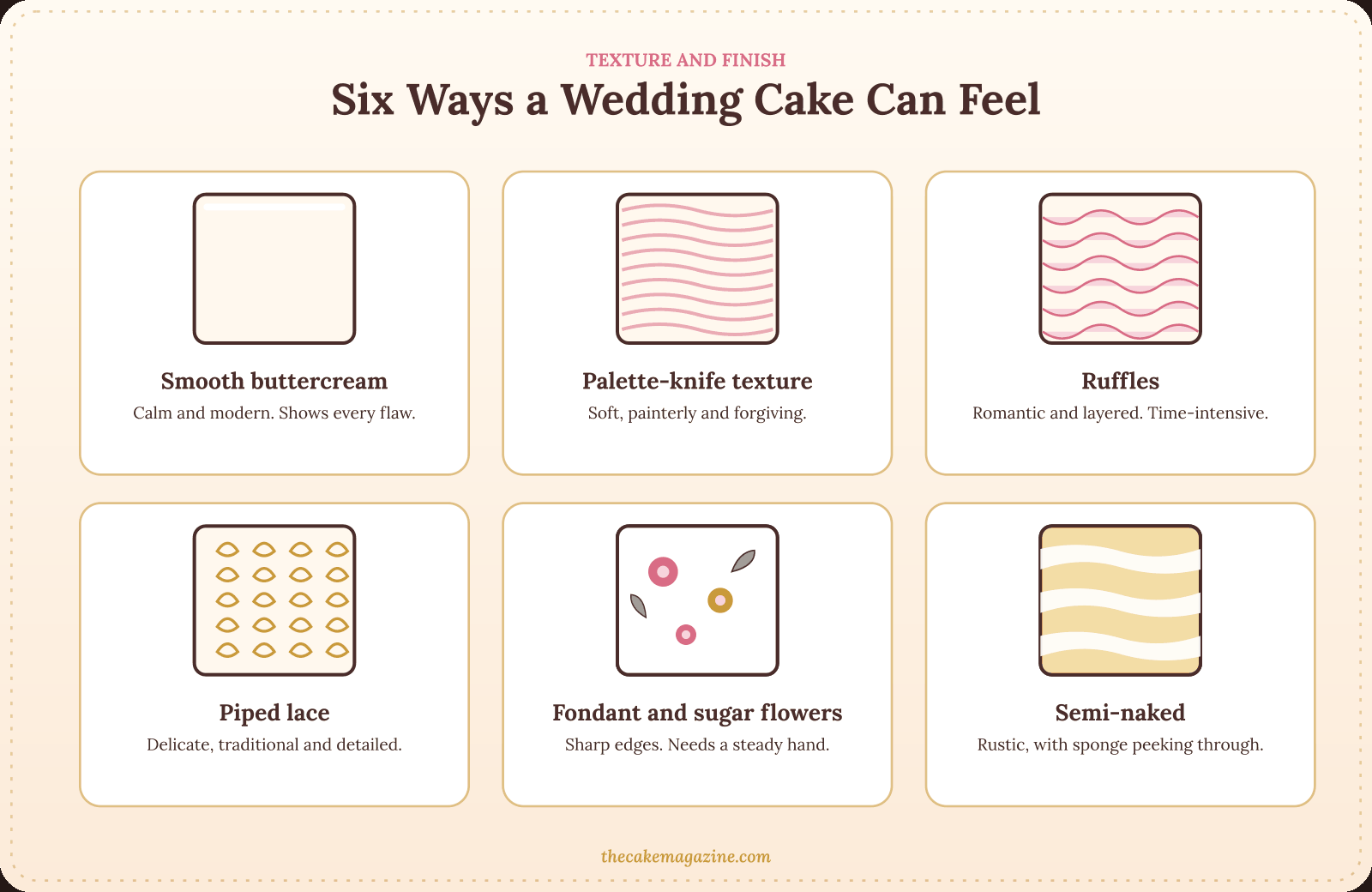
Smooth buttercream
A smooth finish is calm and modern. It needs level layers, a well-made frosting and a steady hand with the scraper, and it shows every bump and crumb. It tends to be forgiving of heat only up to a point, because buttercream softens and can pick up fingerprints. Our American buttercream guide and the one on Swiss meringue buttercream explain two of the frostings commonly used for smooth finishes and how each behaves.
Palette-knife and painterly texture
Bakers drag a small spatula through the frosting to create soft, brushed ridges, sometimes in two or three tones that blend. The effect is artistic and relaxed, and because the surface is intentionally uneven, small flaws vanish into it. It is a good choice for couples who love a handmade look and want to keep the budget under control.
Ruffles and piped petals
Rows of ruffled frosting create a romantic, layered look that suits soft colors. They are time-intensive, since each row is piped by hand, and they are very much affected by temperature. If you love the style, ask whether your baker has made it in warm weather and what they would change for your venue.
Piped lace and borders
Fine piped patterns recall classic wedding cakes. They suit formal, vintage and romantic styles, and they can be matched to the lace on a gown or a sleeve. Piping at this level takes patience and a baker with a steady touch, which is why the work is often priced by the hour. If you are curious how bags, tips and pressure produce borders, see the piping guide.
Fondant and sugar work
Fondant gives a perfectly smooth, matte surface and sharp edges, and it is a stable base for sugar flowers, ribbons and sculpted details. It is also a matter of taste: some people love its clean look, while others dislike the texture. Many bakers cover the cake in fondant for looks and use a tasty filling inside, and some will layer a thin coat of buttercream underneath. If you are unsure, ask for a sample at the tasting.
Semi-naked and naked styles
A thin scrape of frosting lets the sponge show through. The style feels homey and generous, and it pairs well with fruit, herbs and wildflowers. It dries out faster than a fully covered cake, so these cakes tend to be assembled close to the event and kept out of long sun exposure.
Let one texture lead. A cake with ruffles on one tier, palette-knife strokes on another and piped lace on the third can look confused. Choose one hero texture, then use a calmer one on the other tiers. Contrast is good, as long as it is intentional.
Painted and sculpted details
Hand-painted florals, watercolor washes, gold brushwork and sculpted sugar elements add personality. They are some of the most artistic details a baker can offer, and they are priced accordingly. Ask to see a portfolio of similar work, because painted cakes depend on one person’s hand more than most other styles.
Mixing finishes sensibly
It is perfectly fine to combine two textures, and some of the best wedding cake design does exactly that. A smooth bottom tier with a textured top tier creates a sense of rhythm. A fondant base with a piped border adds detail without chaos. The rule of thumb is that the finish should feel connected to the style you chose earlier, so a rustic cake gets organic textures and a formal cake gets clean ones.
Scale and proportion
Scale is where wedding cake design either looks professional or slightly off, and it is the reason many photos of “almost right” cakes feel disappointing. Proportion is how tier sizes, heights and decorations relate to each other and to the space around them.
How tiers should relate
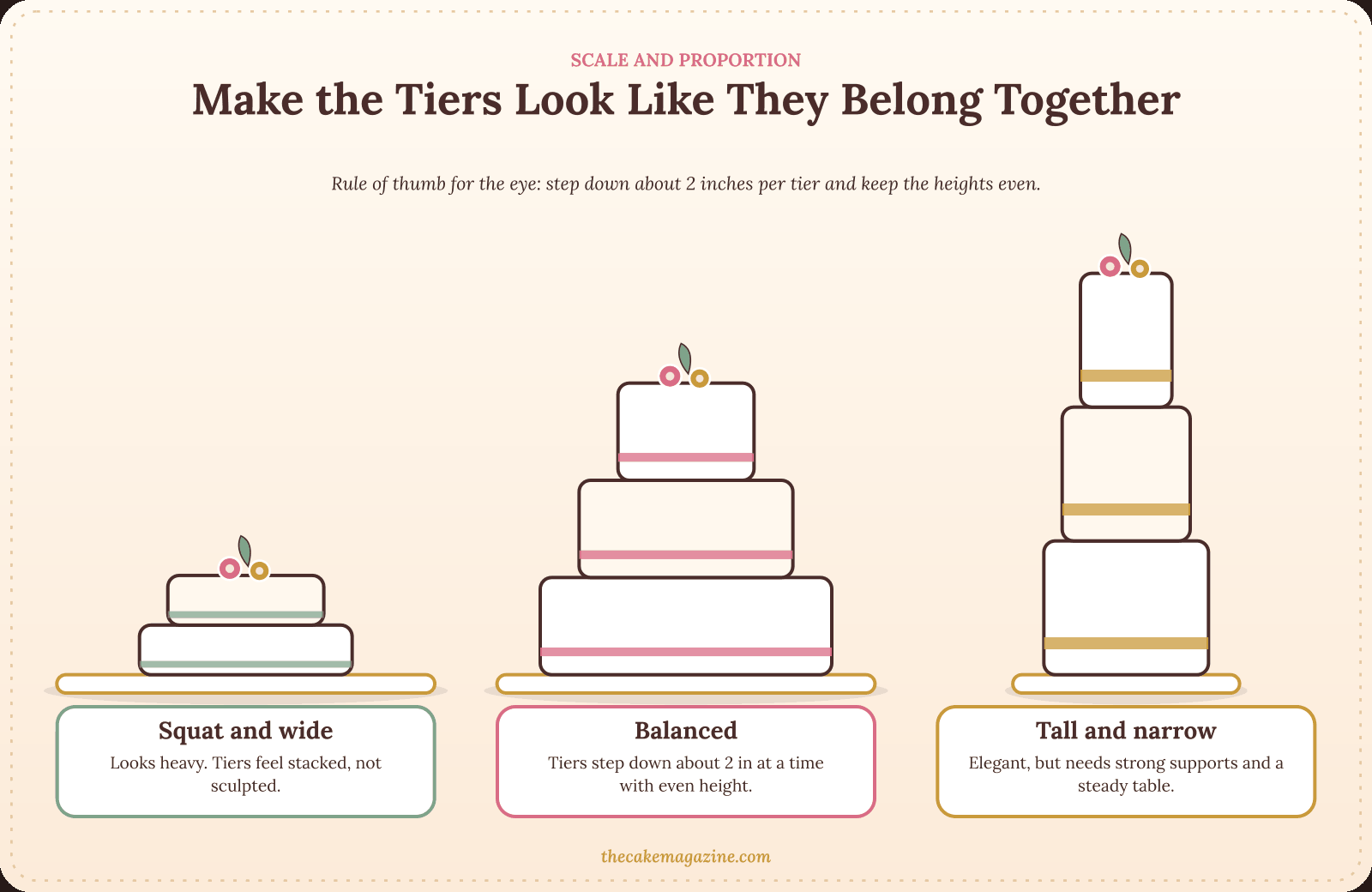
A common approach is to step down the diameter by about two inches per tier, for example 10, 8 and 6 inches. Even steps look orderly and give the cake a comfortable, stable silhouette. Larger jumps, such as a 12-inch tier under a 6-inch tier, create a dramatic taper that can look top-light or tower-like.
Height matters as much as width. Tiers of equal height tend to look balanced. A very tall bottom tier with thin upper tiers makes the cake look narrow, while squat tiers can make it feel heavy. The figure below compares three silhouettes.
Match the cake to the table
A cake looks big or small only in relation to what surrounds it. A 14-inch base on a small round table can crowd the plates, flowers and signage. A narrow two-tier on a six-foot banquet table can disappear. Measure the table, or ask the venue for its dimensions, and tell your baker. They can then suggest a footprint that leaves breathing room.
The stand or base board matters too. A wide board or a pedestal adds visual weight and height, while a thin base keeps the cake low and understated. If you plan to surround the cake with flowers, candles or a small sign, allow extra space on the table.
Photo proportions versus real-life proportions
Inspiration photos are often cropped and shot at a flattering angle, so they can hide how big or small a cake actually is. Before you fall for a picture, ask yourself how many people it served, how tall it was and what it sat on. Ask your baker to give you the real dimensions of a similar cake, in inches, and compare them to your venue.
Decoration scale
The same rule applies to decoration. A large flower on a small cake overwhelms it, while tiny sugar blossoms on a tall cake can look lost from across the room. As a general guide, details should be big enough to read from a few feet away, since most guests see the cake from a distance. Fine detail is wonderful in close-up photographs, but it only matters if people can see it.
- Large rooms and tall cakes can carry bolder, bigger elements.
- Small rooms and short cakes look better with finer, smaller details.
- When in doubt, add less. Baker and photographer both prefer a clean silhouette.
Tiers, shapes and the structure behind the look
A pretty cake that cannot stand up is not good wedding cake design. Behind every tiered cake is a quiet structure, and it limits what the design can do. You do not need to understand the engineering, but knowing its basics helps you ask sensible questions.
What holds the cake up
Tiered cakes are usually stacked with internal supports such as dowels or straws and thin boards under each tier, so that the weight of the upper tiers rests on the supports rather than the soft cake below. A tall or heavy design needs more of this, and a cake with offset or leaning tiers needs extra thought. Ask your baker how the cake will be supported and whether it will arrive stacked or be assembled at the venue.
Our wedding cake guide includes an overview of how a tiered cake is built, including boards and supports, which is a helpful companion to this section.
Designs that ask more of the structure
- Very tall cakes. More tiers mean more weight and more risk during delivery.
- Offset or asymmetrical stacks. Tiers that do not sit centered need careful balancing.
- Heavy decorations. Large sugar sculptures, tiered toppers and fruit add weight at the top of the cake.
- Cantilevered or floating effects. These rely on hidden supports and are best left to experienced bakers.
- Soft fillings. Very soft fillings can bulge under weight, so the baker may adjust the filling or the design.
Shapes beyond round
Square, hexagonal, petal and heart-shaped tiers all work, and each affects portions, decoration and cost. Square tiers serve more per tier and cut easily, but their corners are demanding to finish. Hexagons feel modern and slightly unusual. Mixed shapes, such as a round tier on a square one, can be striking. As always, a cake that looks good in a photo must still be cut and served, so look at our guide to cutting a wedding cake to see how different shapes are portioned.
The cake stand and board
The cake sits on something, and that something is part of the design. A plain board covered in foil or fabric is functional. A stand with a pedestal base adds height and elegance. Acrylic stands feel modern, wooden slabs suit rustic weddings, and a mirror or marble round suits glam. Ask whether the baker supplies the stand, whether it must be returned and who is responsible for getting it back.
Flavor, filling and design working together
Wedding cake design and flavor are often planned separately, but they affect each other more than most couples expect. A filling that is delicious may be too soft to support a tall cake. A frosting that is gorgeous may be too sweet for the lemon cake inside. Bringing the two decisions together early prevents compromises later.
Fillings that change what you can build
Sturdy fillings, such as buttercream, ganache and thick fruit preserves, support tall tiers and travel well. Soft or perishable fillings, such as fresh whipped cream, mousse and custard, create wonderful flavors but need cold storage and shorter display times. If your design is tall, outdoors or warm, tell your baker so they can choose a filling that fits. The discussion on the best fillings and pairings in our wedding cake flavor guide shows how flavors and structure fit together.
Design affects flavor choices
If you want a very thin layer of frosting, as in a semi-naked cake, the sponge itself is more visible and more important. If you choose thick fondant, the flavors inside carry more of the taste. Dark colors may need heavily pigmented frosting, which some bakers manage with a thin glaze instead. If you want several flavors in different tiers, think about whether the colors of the fillings might show through at the cut edge, which can be a lovely detail or an unwelcome surprise.
Use the tasting to test the design
A tasting is the ideal moment to talk about design, because the baker can show you real frostings, real colors and sample textures. Our wedding cake tasting guide lists what to try and what to ask. Take photos of the samples in the light of the room where you are, and take notes on how each frosting held its shape during the session.
Ask for a visual sample. Some bakers can show a small decorated sample of your color and texture alongside the flavor samples. Seeing the real surface and tasting the real frosting together takes the guesswork out of your final decision.
Working with your baker on the design
The best wedding cake design is a collaboration. You bring the story, the venue and the budget, and the baker brings the technique and the experience of what holds up in real rooms. Clear communication makes the second half of the process much smoother.
What to bring to the first conversation
- Your wedding date, venue name and whether the cake will be indoors or outdoors.
- Your estimated guest count and whether you plan a dessert table, as covered in our guide to the wedding cake versus a dessert table.
- Your budget range, stated honestly. Bakers cannot design well in the dark.
- Three reference photos, each with a note about what you like.
- Your color palette, with a swatch or a photo of your invitations or flowers.
- Any dietary needs or allergens among your guests.
A short design brief you can copy
Writing a brief makes you sharper and gives the baker something to refer to later. It does not have to be fancy. A few lines in an email is enough, as in this example you can adapt.
Sample brief. “Outdoor garden wedding, late afternoon, about 90 guests. We would like a three-tier, softly textured cake in ivory with one blush accent and a loose crescent of greenery and a few roses. We love the texture in photo two and the proportions in photo one. Budget is flexible up to a point and we would prefer to save on decoration rather than flavor.”
Be honest about what you love and what you do not
Tell the baker what you dislike as well as what you like. If you hate fondant, or you do not want sugar flowers, or you are nervous about a certain color, say so. It narrows the options and speeds up the conversation. Bakers would rather hear a preference early than redo a design late.
It is also fair to ask about the baker’s own style. Every baker has strengths. Some are known for clean modern work, others for lace and romance, others for painted details. A baker who tells you what they do best is usually giving you good advice, and the cake you receive will probably be better for it.
Respect the baker’s craft
Sending a photo of another baker’s cake and asking for an exact copy is awkward at best, and in some cases a baker will decline to copy someone else’s original design. A better request is “this mood, with our colors and our flowers.” You get something that feels personal, and the baker gets room to do work they are proud of.
Changes and deadlines
Ask when your final design needs to be locked, when the final guest count is due and what happens if you change your mind afterward. Typically, small changes are easy early on and harder close to the date, because ingredients and decorations are ordered and prepared in advance. Our ordering timeline explains the usual order of events from consultation to delivery.
Get the design in writing
Ask for a written summary of the final design, including size, flavors, colors, decorations, delivery time and setup. A sketch or digital mock-up is a nice addition, though not all bakers provide one. If something is unclear, such as who is responsible for the flowers, resolve it in writing. A clear contract and design summary protects both of you and makes the wedding day calmer.
Design choices that save money without losing style
Many of the most beautiful cakes are not the most expensive ones, and smart wedding cake design is often about where you spend. Because design effort and labor drive cost, a few thoughtful choices can reduce the price while keeping the look. For how pricing works in general, read our wedding cake cost guide.
- Choose a texture, not a pattern. Palette-knife strokes or a soft, brushed finish take less time than hand-piped lace.
- Use fewer, bolder details. One striking element, such as a flower cluster or a painted panel, beats many small ones.
- Add a display-and-kitchen split. A smaller decorated cake plus plain sheet cake keeps servings affordable.
- Use fresh greenery and seasonal flowers. A florist can supply them, and they usually cost less than a large set of handmade sugar flowers.
- Pick a classic color. White, ivory and soft pastels need less pigment and less fuss than deep, saturated shades.
- Skip the extra tier. Height adds structure and labor, so a lower cake with a strong design can look just as polished.
Common wedding cake design mistakes
Most wedding cake design problems are predictable. Knowing them in advance lets you avoid the ones that have a way of appearing on wedding day.
Falling for a design before checking the size
What happens: a photo shows a gorgeous four-tier cake, but the guest list is 50, so the real version is either vastly oversized or must be rebuilt with foam tiers.
How to avoid it: decide your guest count and serving plan first, then look for designs at that scale.
Ignoring the venue’s temperature
What happens: a delicate, buttercream-heavy cake sits outside on a warm afternoon and starts to droop before the cutting.
How to avoid it: tell your baker where the cake will be displayed and for how long, and choose a frosting and design suited to the conditions.
Choosing too many ideas at once
What happens: ruffles, gold leaf, fresh flowers, a painted panel and a monogram all compete on a single cake, and nothing stands out.
How to avoid it: pick one hero element and let the rest support it. Restraint reads as confidence.
Forgetting about lighting
What happens: a soft blush looks gray in dim light, or gold disappears under warm bulbs.
How to avoid it: look at your colors in light similar to the venue’s and ask the baker for a swatch or test.
Leaving flowers to the last minute
What happens: nobody is sure who adds the blooms, and the cake sits plain while someone searches for a florist or tape.
How to avoid it: agree in writing who places the flowers, when and how stems are kept off the cake.
Skipping the structure conversation
What happens: a tall or offset design arrives with no clear plan for support, and the baker is nervous about the drive.
How to avoid it: ask how the cake will be built, delivered and assembled, and choose a design your baker is comfortable carrying out.
Underestimating the table
What happens: the cake fits, barely, and there is no room for the knife, flowers or plates.
How to avoid it: measure the table and plan for the cake, the cutting tools and decorative extras together.
A quick design checklist
- Guest count and serving plan decided
- Venue conditions confirmed: temperature, lighting, table size
- One style chosen and described in a sentence
- Palette set: base, accent and detail
- Flower plan agreed: fresh, sugar or none, with food-safe placement
- One hero texture chosen
- Tier sizes and heights checked against the table
- Flavors and fillings compatible with the structure
- Delivery and setup plan confirmed
- Final design summary received in writing
Three worked examples of wedding cake design
Abstract advice only goes so far, so here are three imaginary couples and how the process might work for each. They are illustrations, not real clients, and the numbers are round figures for explanation.
A summer garden wedding for 80
This couple loves a romantic look. Following the order in this wedding cake design guide, they begin with the guest count, which suggests a three-tier cake or a smaller display cake with a kitchen cake behind it. The venue is an outdoor garden in July, so the baker proposes a sturdy Swiss meringue buttercream, a shorter display window and a shaded table.
The style is soft and romantic, the palette is ivory with a blush accent, and a small crescent of roses and greenery sits on a plastic-barrier pick. The texture is gentle palette-knife strokes rather than ruffles, because ruffles would suffer in the heat.
A winter ballroom wedding for 150
Here the room is climate controlled, formal and large. Wedding cake design can afford to be ambitious, so the couple chooses four tiers with a smooth finish, a deep green accent and a thin gold painted line. Because the room is big and the table is long, the proportions can be tall and the cake can stand alone without florals. The baker plans a dummy tier for height and real cake in the lower tiers, with kitchen portions as backup. The result looks grand without a vast bill.
A small modern restaurant wedding for 30
This couple wants something minimal. A two-tier cake in a matte white finish, with one dramatic sugar flower, fills the table without crowding it. Their wedding cake design is built on negative space and one strong detail, and the proportions suit the small room. Because the cake is small, the budget goes into excellent flavors and a hand-painted accent rather than height. They keep the top tier for their first anniversary, a plan our guide to saving the top tier explains safely.
Wedding cake design FAQ
Where should I start with wedding cake design?
Start with the practical facts: your guest count, budget and venue. Wedding cake design works best when those three numbers come first, because they set the size and the number of tiers and tell you how much heat, light and space the cake has to deal with. Once you know them, choose a style and a color palette, then decide on flowers and texture. Starting with a photo and reverse engineering it often leads to a cake that does not fit your room.
How many tiers should my wedding cake have?
It depends on how many people you need to serve and the look you want. Two tiers feel simple and intimate, three tiers are the classic proportion, and four or more feel grand and need a large room and a strong table. A good wedding cake design also considers cost, because each tier adds structure and decoration. Many couples choose a smaller display cake plus kitchen cake. Our serving guide explains portions in detail.
What is the most popular wedding cake design style?
Classic white or ivory cakes with soft textures and a few flowers remain a common choice, but styles shift with seasons and trends. Rather than chasing the most popular wedding cake design, pick the style that fits your venue and your own taste. Our trends guide describes what bakers and couples are choosing now, and your baker can tell you what they see most often in their own orders.
Can I use fresh flowers on my wedding cake?
Yes, many couples do, as long as the flowers are handled safely. A florist and baker should agree on which blooms are used, and stems should never be pushed into the cake. A barrier such as floral tape, a plastic pick or a small tube keeps the flowers separate from the cake. Some flowers are not meant for eating, so treat them as decoration and remove them before serving. Sugar flowers are another option.
How do I choose colors for my wedding cake design?
Pick one base color, one accent and, if you like, one small detail color, roughly in a 60-30-10 balance. Echo one or two colors from your flowers or stationery instead of matching everything. Check shades in the venue’s lighting, because warm bulbs can shift whites and pastels. Deep colors such as navy or black take more coloring, so ask your baker how they achieve them and what trade-offs to expect.
Does wedding cake design affect the price?
Yes, a lot. Labor, skill and materials drive cost, so intricate piping, handmade sugar flowers, painted details and tall structures cost more than simple textured finishes. Wedding cake design choices such as the number of tiers, the frosting type and the amount of decoration all change the quote. Our cost guide explains the main factors, and your baker can show you where small adjustments save money without losing the look you love.
What wedding cake design works best for an outdoor wedding?
A sturdy, simple design with a heat-tolerant frosting and a short display time works best. Think about shade, wind and a cool place to hold the cake until it is needed. Wedding cake design for the outdoors often avoids delicate ruffles and fragile sugar work in favor of smooth or lightly textured surfaces. Ask your baker what they recommend for your date and location, and follow USDA food safety guidance for perishable fillings.
Is fondant or buttercream better for a wedding cake?
Neither is better in every case. Fondant gives a smooth, sharp look and holds up well to handling and some temperature swings, while buttercream tastes creamier to many people and suits textured, romantic or rustic styles. The right wedding cake design choice depends on your venue, your taste and your baker’s strengths. Tasting samples of both is the best way to decide, and many bakers combine the two.
How do I make sure the cake fits my table?
Measure the cake table, or ask the venue for its dimensions, and share them with your baker. Leave space around the cake for the knife, plates, flowers or a sign. Good wedding cake design considers the stand as well as the cake, since a wide base can crowd a small table. Also confirm that the table is sturdy and level, because a tiered cake can be heavy.
Can I copy a cake I saw online?
You can use it as inspiration, but many bakers prefer not to reproduce another baker’s original design exactly. A better approach is to show the photo and explain what you like about it, such as the color or texture, so the baker can create something similar with your own details. This kind of wedding cake design conversation often gives a more personal result and respects everyone’s craft.
How far ahead should I finalize my wedding cake design?
Many couples book a baker several months in advance and finalize the details a few weeks before the wedding, but each baker has their own schedule. Ask when the design must be locked and when your final guest count is due. Our ordering timeline guide describes the usual stages. A calm, early wedding cake design process gives your baker time to source ingredients and prepare decorations.
What if my wedding cake design needs to change at the last minute?
Contact your baker as soon as you know. Small changes, such as a different flower color, may be possible, while big ones, such as extra tiers, may not be. Your written wedding cake design summary and contract should explain what is flexible and what is not. Having a simple backup, like a kitchen cake or sheet cake, can ease the pressure if circumstances shift unexpectedly.
Final thoughts
Good wedding cake design is less about finding the most spectacular photo and more about making a series of sensible choices in the right order. Start with the number of guests and the room, choose a style that feels like you, keep the palette simple, plan flowers that are safe, and pick a texture your baker can do beautifully. Check the proportions against the table, and talk through structure and delivery before you commit.
If you take only one thing from this guide, let it be restraint. One strong idea, carried out well, almost always beats five ideas carried out hastily. A baker who understands your wedding cake design goals can turn a few photos and a handful of notes into something that looks like it belongs at your wedding, tastes wonderful and arrives in one piece.
Keep the practical side close. For the wider picture of servings, budget and delivery, return to our complete wedding cake guide, and for the cutting and the top tier, see the guides linked above. For safe handling of perishable cakes, the USDA Food Safety and Inspection Service is a reliable general reference, and the King Arthur cake guides are a good place to learn the baking basics behind the tiers.
Editorial note: reviewed and updated November 2026. This guide is general information for couples and bakers in the United States, and the illustrations are drawn to explain ideas, not to show any specific baker’s work. We have not baked or photographed the cakes described here. Prices, lead times, venue rules and food safety requirements vary, so confirm details with your baker, your venue and your local health authority.