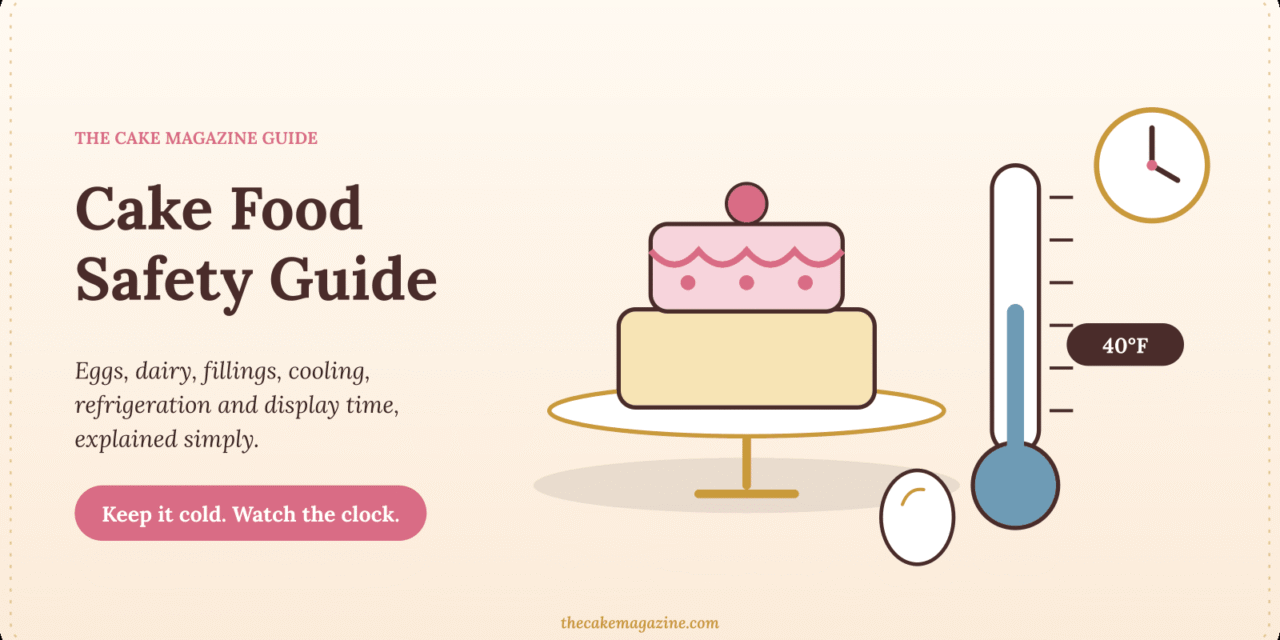
Cake food safety is the part of baking nobody photographs, and it decides whether your beautiful cake is a gift or a problem. Cakes look harmless, yet many of them carry eggs, butter, cream, custard or fruit, and those ingredients behave like any other perishable food once they warm up. This guide covers cake food safety from the egg carton to the display table: what needs the fridge, how to cool fillings, how long a cake can sit out and how to keep your kitchen habits boringly reliable.
Good cake food safety comes down to temperature and time. Keep perishable ingredients and finished cakes at 40°F or below, do not leave them between 40°F and 140°F for more than two hours (one hour above 90°F), cook egg-based fillings to 160°F, cool them quickly in shallow containers, keep raw flour and raw eggs away from ready-to-eat food, and label what needs refrigeration. Rules for selling cakes vary by state, so check with your local health department.
- Why cake food safety matters more than you think
- The danger zone: the core of cake food safety
- Which cakes need the fridge and which do not
- Eggs and cake food safety
- Dairy and cake food safety: butter, milk, cream and cream cheese
- Cake food safety for fillings: custard, curd, fruit and cream
- Frostings and cake food safety
- Cooling cakes and fillings the safe way
- Refrigeration: setting up the cold chain
- Cake food safety on display: how long a cake can sit out
- Cake food safety in transport and delivery
- Hygiene, raw flour and cross-contact in cake food safety
- Common cake food safety mistakes
- A daily cake food safety checklist
- Cake food safety in real situations
- Safer swaps and smart variations
- Records, labels and learning more
- FAQ
Why cake food safety matters more than you think
Most people think of cake as a shelf-stable treat, something you can leave on the counter through an entire party. Sometimes that is true. A plain oil-based loaf with a dusting of sugar is a very different thing from a four-layer cake with lemon curd, fresh strawberries and whipped cream. Cake food safety is really about knowing which of those two cakes you are holding and treating each one accordingly.
The trouble is that unsafe food does not announce itself. The U.S. Food and Drug Administration points out that bacteria which cause illness are different from the ones that make food spoil, so a cake can look, smell and taste fine and still make someone sick. That is why cake food safety relies on habits and thermometers rather than on a quick sniff test.
There is also a very human reason to care. People eat cake at their happiest moments: weddings, graduations, a child’s birthday. Nobody forgets the party where the cake made a guest ill. Even if you bake only for family, the same habits protect grandparents, small children, pregnant guests and anyone with a weaker immune system, who are more vulnerable to foodborne illness.
A note on scope. This article gives general food-handling information drawn from U.S. government guidance. It is not medical or legal advice. If you sell cakes, your state and local health department decides what is required of you, including permits, labels and which cakes you may sell. When the guidance here and your local rules differ, follow your local rules.
What this guide covers and what it leaves to others
We stick to the foods and moments where cake food safety is won or lost: ingredients, fillings, frostings, cooling, storage, display and delivery. Allergens are a separate and equally serious subject, covered in our guide to cake allergen management. Licensing, pricing and the legal side of selling are in how to start a home cake business.
You do not need a food science degree for any of this. You need a reliable thermometer, a clock you actually look at and a few rules that you follow every single time, including the rushed Friday evening before a wedding.
The danger zone: the core of cake food safety
If you remember only one idea from this guide, make it this one. The U.S. Department of Agriculture’s Food Safety and Inspection Service describes the danger zone as the range between 40°F and 140°F, where bacteria grow fastest. Cold food belongs below that range, hot food above it, and anything perishable should spend as little time in the middle as possible.
The same agency gives the clock that goes with the thermometer. Perishable food should not stay in the danger zone for more than two hours, and that window shrinks to one hour when the air is above 90°F. Under the right conditions, bacteria can double in as little as 20 minutes. Those are the numbers behind nearly every cake food safety decision you will make.

Notice how generous the cold side of the thermometer is and how narrow the safe window is on the warm side. A kitchen at 72°F is well inside the danger zone. A summer porch at 95°F is much worse. So when a recipe says “let the filling cool,” the real question is how quickly it passes through the middle of that thermometer, not simply whether it has cooled by morning.
What the two-hour rule actually counts
The clock adds up. Two hours is the total time perishable food spends in the danger zone, from the moment it leaves the fridge until it goes back. It is not two hours per trip. If a cream-filled cake sits on the counter for 40 minutes during decorating, then 50 minutes in a warm car, then 30 minutes on a party table, the clock is already past two hours.
For a baker, this is the most useful way to think about it: a running tab. Write the time a perishable cake comes out of the fridge on a sticky note or in your phone. When the tab hits the limit, the cake goes back into the cold or, if it cannot, it is not served.
- Below 90°F: a two-hour total limit for perishable foods in the danger zone.
- Above 90°F: a one-hour total limit, which matters for outdoor weddings and summer picnics.
- Fridge target: 40°F or below, checked with an appliance thermometer rather than the dial.
- Freezer target: 0°F or below, according to the FDA.
Why a thermometer beats your instincts in cake food safety
Food that has been warm for too long usually looks perfect, which is the unnerving part of cake food safety. You cannot judge a custard by its smell, and you cannot judge a fridge by how cold it feels on your hand. The FDA notes that many refrigerator dials do not show the real temperature, which is why it recommends a separate appliance thermometer in both the refrigerator and the freezer.
A digital probe thermometer is the other tool worth owning. It tells you when a custard has reached a safe temperature and whether a cooling filling is dropping fast enough. Many are inexpensive, and you can check one against ice water, which should read close to 32°F, before trusting it.
Which cakes need the fridge and which do not
Not every cake is equally perishable, and treating them all the same either wastes space in your fridge or puts guests at risk. A helpful way to sort your own menu is to think in terms of moisture, dairy and egg content. The more of those a cake and its filling contain, and the less sugar or fat sits between the bacteria and the food, the more carefully the cake needs to be handled.

The ladder above is a conservative working guide, not a regulation. It is based on the general principle from federal guidance that perishable food should be kept cold, and it deliberately errs on the side of caution. State rules for sold cakes may be stricter or may treat specific products differently, so verify the details with your health department before you sell anything.
Lower-risk cakes: dry, sugary and baked through
Plain butter cakes, oil cakes, pound cakes and sheet cakes dusted with powdered sugar, or covered only with a firm glaze, sit at the bottom of the ladder. They are fully baked and have little free moisture on the surface. Many bakers keep these covered at room temperature for a day or two, and they stay tender that way.
Even here, the baked cake is not the whole picture. The moment you add a fresh-fruit topping, a cream cheese frosting or a custard drizzle, the cake takes on the risk profile of whatever you added. Cake food safety follows the most perishable component, not the average of all of them.
Higher-risk cakes: dairy, eggs and fresh toppings
At the top of the ladder are cakes with whipped cream, pastry cream, cream cheese frosting, mousse, cheesecake layers and fresh-fruit fillings. They are perishable, so they should live in the fridge until shortly before serving, and they carry the shortest display time. Treat them like a bowl of potato salad: lovely, and not to be left out all afternoon.
Room-temperature friendly
Baked oil and butter cakes with a glaze or dusting of sugar. Cover to keep them from drying out.
Handle with care
Cakes with butter-based frostings, jam fillings or ganache. Follow local rules and keep them out of heat and sun.
Keep cold
Anything with whipped cream, custard, mousse, cream cheese frosting, fresh dairy fillings or cut fresh fruit.
If you are unsure which group a cake belongs to, put it in the third one. The cost of a cake that spent a few extra hours in a cool fridge is a slightly firmer frosting. The cost of the opposite mistake is far higher. For a closer look at the flavors and structures that sit in each group, our overview of the best vanilla cake recipe is a good example of a sturdy, lower-risk base you can pair with either kind of filling.
Eggs and cake food safety
Eggs are in almost every cake, and for cake food safety the good news is that a fully baked cake is a safe place for them. The concern is raw or lightly cooked egg: in batter you might taste, in meringue, in mousse, in custard that has not been heated enough, or in a frosting that is never cooked at all. This is where cake food safety gets specific.
Buying and storing eggs
The USDA’s Food Safety and Inspection Service advises keeping eggs at 40°F or below, in their carton, in the coldest part of the refrigerator rather than in the door. It also says not to buy or use cracked eggs, since bacteria can enter through cracks in the shell. Raw eggs in the shell keep for about three to five weeks in the fridge and should not be frozen in the shell.
Refrigerated eggs should not sit out for more than two hours. This matters in a busy bakery, where a tray of eggs can sit warming beside the mixer while you scale flour. Bring them to room temperature only as long as the recipe needs, and for most cakes that means a short soak in warm water rather than a long wait on the counter.
- Check every carton for cracks before you buy and again before you bake.
- Store eggs in the carton on a middle or lower shelf, away from the door.
- Wash your hands after cracking eggs and before touching anything else.
- Throw out a cracked egg rather than hoping the bake will fix it.
Raw and undercooked egg in frostings and fillings
Traditional Italian and Swiss meringue buttercreams, royal icing made with raw egg whites, mousses and some custards rely on eggs that are not baked. The FSIS recommends using pasteurized eggs or egg products for recipes that call for raw or undercooked eggs. Alternatively, you can heat the eggs in liquid form to 160°F before combining them with other ingredients.
Swiss meringue buttercream is a useful case. The classic method whisks egg whites and sugar over simmering water, and you can use a thermometer to confirm the mixture reaches 160°F before whipping. If you want the full method, our Swiss meringue buttercream guide walks through it in detail, and the overview of the types of buttercream explains which versions use raw egg and which do not.
The 160°F habit. Cook egg dishes and egg-based fillings to a safe minimum of 160°F, checked with a food thermometer, as the USDA recommends. Do not judge it by color or thickness alone. A custard can look set and still be under temperature, and a thermometer takes five seconds.
Tasting raw batter
Cake bakers love to lick the spoon, and it is worth being a little strict about this one. The FDA says never to eat or taste raw flour, dough or batter, because flour is a raw food that can carry bacteria such as Salmonella and pathogenic E. coli, and milling does not kill them. The agency also says cooking is the only reliable way to make foods containing flour and raw eggs safe.
If you need to taste-test, bake a small cupcake or a spoonful of batter in a mini pan. For more on why batter behaves the way it does once it goes in the oven, see our guide to the science of cake baking.
Dairy and cake food safety: butter, milk, cream and cream cheese
Dairy is the second big player in cake food safety. Milk, buttermilk, cream and cream cheese are all perishable, and the USDA’s cold-food limit applies to them the same way it applies to eggs: 40°F or below, and no more than two hours in the danger zone. Butter is more forgiving in the short term, but it still belongs in the fridge or freezer for storage.
Ingredients on the counter
Many recipes call for room-temperature butter, eggs and milk so they blend smoothly. That instruction is about texture, not about leaving food out all day. Soften butter for the time the recipe needs, then get the rest back into the cold. A stick of butter that sits near the oven all morning is not a safety emergency, but a carton of cream that does is a different story.
Pull out only what you will use in the next stretch of baking. If you are scaling up for several cakes, work in rounds: take a batch of dairy out, use it, put the rest back. This simple rhythm keeps the whole day inside the two-hour rule and makes cake food safety feel routine.
Cream cheese and whipped cream
Cream cheese frosting and whipped cream are two of the most requested toppings and two of the most perishable. Both are soft, moist and rich in dairy, which is the profile that cake food safety guidance asks you to keep cold. Cream cheese frosting also tends to soften quickly, so a cake that slumps in a warm room is giving you a hint about its temperature as well as its looks.
A practical approach is to treat both like fresh dairy. Chill the finished cake, bring it out for decorating or serving, and return it to the fridge as soon as you can. If you want a sturdier look on a warm day, ask whether a stabilized or different frosting would work, rather than counting on the filling to behave outdoors. Our American buttercream guide compares the options.
Sniff tests do not count. The FDA reminds us that illness-causing bacteria are not the same as spoilage bacteria. A cake with a dairy filling can smell and taste normal and still have spent too long warm. When the clock says it is past the limit, discard it.
Cake food safety for fillings: custard, curd, fruit and cream
Fillings are where cakes become genuinely perishable. A pastry cream or lemon curd contains eggs, sugar and often milk, cooked to thicken. A fresh-fruit filling contains cut fruit and liquid. A mousse contains whipped cream or whipped eggs. Each is delicious, and each needs a different kind of care.
Pastry cream and custard
Egg-based custards are the clearest case. Cook them until they reach 160°F, per the USDA’s guidance for egg dishes, and confirm with a thermometer rather than guessing. Then comes the part that surprises many bakers: the cooling stage is where problems tend to start. A thick custard holds heat in the middle for a long time, which means it spends a long time in the danger zone as it cools.
The fix is to cool it fast. Spread the hot custard in a shallow, wide pan, press plastic wrap against the surface so a skin cannot form, and chill it in the fridge or over an ice bath. The USDA advises dividing large batches into smaller, shallow containers so they cool quickly, and that advice works for custard just as well as for soup.

Once chilled, a custard filling goes into the cake cold, and the finished cake goes straight back to the fridge. Plan your assembly so the filling is not sitting out while you level layers or fuss with a crumb coat. If a filling must wait, keep it in the fridge in a covered container, and take out only what you can use quickly.
Lemon curd, jam and fruit fillings
Lemon curd contains eggs and butter, so it is cooked and cooled like a custard. Many bakers cook it gently and then strain and chill it. Jam and cooked fruit fillings are a different category. They are high in sugar and have been cooked, and they tend to be more stable, but they are still moist foods that should follow your local rules and be kept clean and covered.
Fresh, uncooked fruit is the touchy one. Cut berries and sliced fruit are juicy and perishable, and they bring natural moisture into the cake. If you use them, add them as late as you can, keep the cake cold and do not leave fruit-topped cakes on a warm table. Wash fruit under running water before cutting, and wash your hands and boards as you go.
Whipped cream and mousse
Whipped cream and mousse are best made cold, filled cold and served cold. Chill the bowl and whisk, start with cold cream and work in a cool kitchen. A stabilized whipped cream holds its shape better, but stabilizer does not change the temperature rules. It simply helps the texture survive the fridge. Treat these cakes as the shortest-display items on your menu.
- Cook it: egg-based fillings reach 160°F before cooling.
- Cool it: shallow pans, surface wrap, fridge or ice bath.
- Fill it cold: never into a warm cake and never into warm layers.
- Chill it again: finished cakes go back into the fridge until close to serving.
Frostings and cake food safety
Frosting choice changes your cake food safety profile as much as filling does. Some frostings are mostly sugar and fat. Others are mostly dairy or egg. Knowing which is which helps you decide how long a cake can sit and whether it belongs in the fridge. Our guide to the types of buttercream is a good companion to this section.
Sugar-heavy buttercreams
American buttercream, made from butter and a large amount of powdered sugar, is the lowest-moisture of the common frostings. Many bakers find it stands up to a day at cool room temperature better than dairy-heavy options. Even so, whether a cake with this frosting can be sold without refrigeration depends on your state’s rules, and the answer is not the same everywhere. Check, and keep the cake out of heat and direct sun.
Buttercream also absorbs odors and picks up dust, so covered storage helps both flavor and cleanliness. If your cake has a filling inside the buttercream dam, the filling governs the storage rules. A cake with a lemon curd center behaves like a curd cake, not like a plain buttercream one.
Meringue-based and cooked frostings
Swiss and Italian meringue buttercreams are silky and less sweet, which is why many bakers love them. They also involve egg whites, so the method matters. Heating egg whites with sugar to 160°F, as in the USDA’s liquid-egg guidance, or using pasteurized whites, is the standard safety step. Once made, they contain a lot of butter and moisture, so keep them cool and covered.
Italian meringue pours hot sugar syrup into whipped whites, which cooks them as it goes, while Swiss meringue cooks them over heat first. Either way, use a thermometer rather than a timer. For step-by-step instructions, see our Swiss meringue buttercream guide.
Cream cheese, ganache and glazes
Cream cheese frosting is a dairy product with sugar added, so we keep it cold, as discussed above. Ganache, made from chocolate and cream, is less sweet and quite rich, and a ganache-covered cake should still be treated as a dairy-containing cake until your local rules say otherwise. Simple sugar glazes and fondant are low in moisture, but the cake beneath them still sets the rules.
Fondant deserves one extra note. It seals the surface and looks sturdy, but a chilled cake under fondant can sweat when it comes out of the fridge. Let it warm in its box, loosely covered, so condensation forms on the box and not on the fondant. That is a texture issue rather than a safety one, but it shapes how you plan fridge time.
Cooling cakes and fillings the safe way
Cooling gets less attention than baking, yet it is where a lot of cake food safety goes wrong. Plain baked layers are not a big risk, but they need to be fully cool before frosting, partly so the frosting does not melt and partly so steam does not get trapped. Fillings and cooked components are a different matter, because they sit in the danger zone while they cool.
Cooling baked layers
Let layers rest in the pan for the time your recipe gives, then turn them out onto a rack so air circulates underneath. A rack matters because a cake left on a flat plate holds moisture against its base. Once the layers feel cool to the touch all the way through, you can wrap and chill or freeze them, or frost them right away.
Wrapping layers while still warm traps steam, which can make the crust gummy and gives moisture a place to hang around. Wait until they are cool. If you plan to freeze layers, wrap them well and keep the freezer at 0°F or below, as the FDA recommends. For help with layers that turn out dense, wet or sunken, see our cake troubleshooting guide.
Cooling cooked fillings quickly
The rule from the USDA is to refrigerate within two hours, and the shallow-container tip is how you meet it. A deep pot of pastry cream can take far longer to cool in the center than you would guess. A wide shallow pan, with the filling spread no more than an inch or two deep, cools much faster. Stirring now and then helps, and so does an ice bath beneath the pan.
A probe thermometer shows you the truth. If the middle of the filling is still warm after an hour, spread it thinner or move it to the fridge. Do not stack warm containers on top of each other, because that traps heat. A single layer in the fridge with a little air between pans is better than a tower.
Never fill a warm cake. Warm layers can melt a dairy filling, push it past the danger-zone clock and make the cake slide. Chill layers and fillings separately, and assemble when both are cool.
Refrigeration: setting up the cold chain
Your refrigerator is the center of cake food safety. A cake can only be as safe as the fridge it lives in. That means a fridge that actually holds 40°F or below, with enough room for air to move, and a layout that keeps raw ingredients away from finished cakes.

Check the temperature, not the dial
The FDA says to keep the refrigerator at 40°F or below and the freezer at 0°F or below, and to use appliance thermometers to verify it. Place one in the fridge where your cakes will sit, not in a spot near the door, and check it often. Home fridges swing in temperature when doors open, when the fridge is overstuffed and when a new warm item goes in.
A fridge that is jammed full can have warm pockets, which quietly undermines cake food safety. If you are making several cakes for a weekend, plan the space ahead and, when needed, free a shelf by moving other food elsewhere. Cakes also pick up smells, so wrap or box them and keep them away from strong foods like onions and fish.
Shelf order and separation
The simplest layout puts ready-to-eat items, like finished cakes and fillings, above raw items. Raw eggs, dairy cartons and anything that could drip belong lower. Flour and raw eggs should be stored away from ready-to-eat foods, because flour spreads easily as a powder, according to the FDA. Keep a dedicated shelf or bin for baking projects if you can.
- Top shelves: finished cakes and chilled fillings in covered boxes.
- Middle shelves: eggs in their cartons, butter, cream cheese and cream.
- Bottom: anything raw that might leak, such as raw meat if it shares the fridge.
- Door: condiments, not eggs or dairy.
How long cakes keep
The USDA’s leftover guidance gives a general window of three to four days for refrigerated leftovers. That is a reasonable ceiling for cut or perishable cakes at home. If you sell cakes, give customers a clear use-by guideline on the label, and keep your claims modest. Do not promise shelf life that you have not confirmed with your local health department.
When freezing, the USDA says frozen food stays safe longer but can lose moisture and flavor, and it lists three to four months as a general window for leftovers. For cakes, plan on better texture by freezing unfilled, well-wrapped layers rather than fully assembled dairy cakes. If you sell or ship cakes, see our guides on cake packaging for businesses and cake delivery workflow for keeping cold cakes cold in transit.
Cake food safety on display: how long a cake can sit out
Display time is the question everyone asks and the one where cake food safety advice gets vague. The honest answer is that it depends on the cake and the room. The federal rule gives you the frame: perishable food, two hours in total in the danger zone, one hour if the air is above 90°F. A cake with whipped cream or custard filling should follow that clock closely.
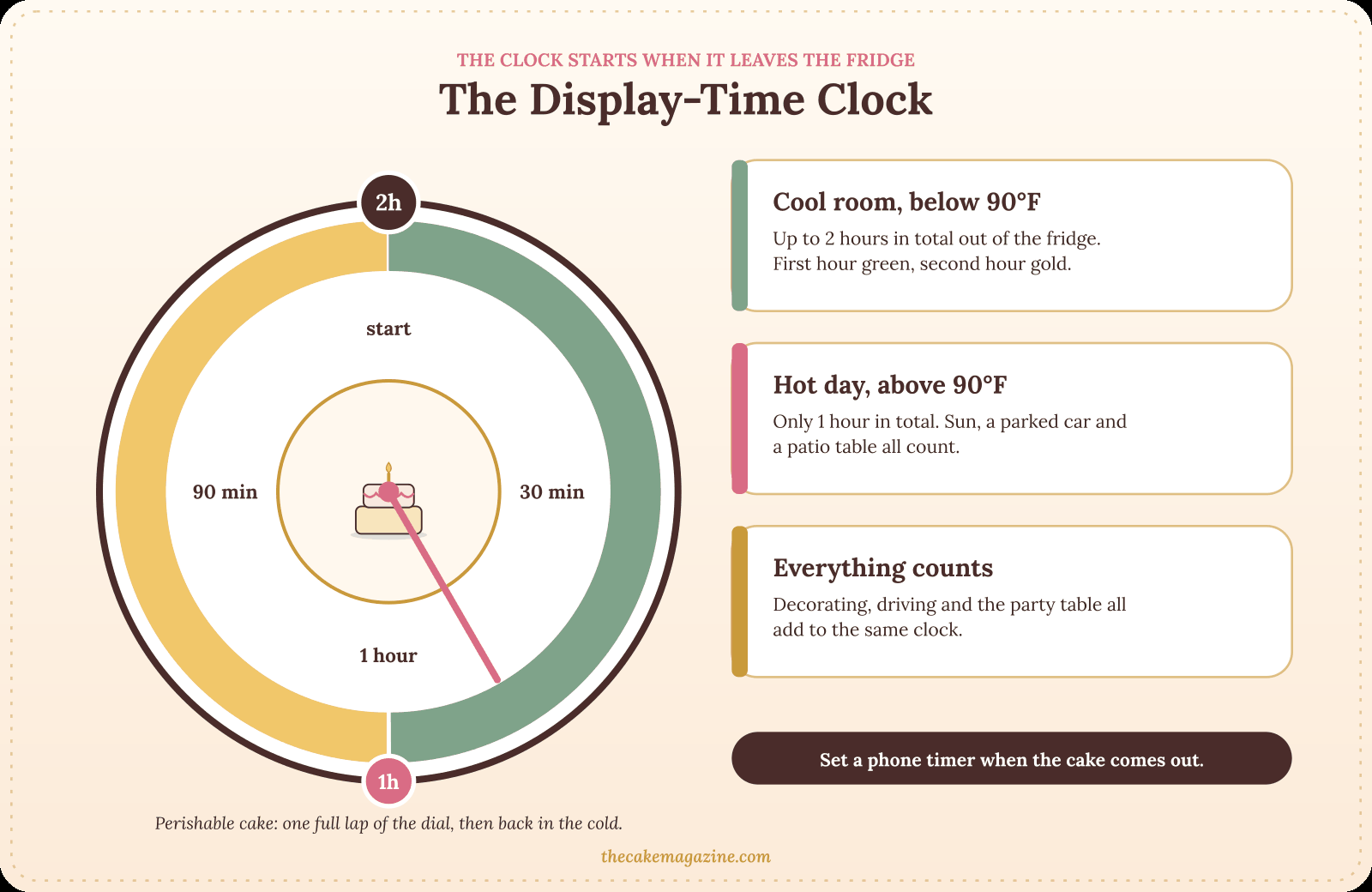
Reading the clock in real rooms
A cool indoor room, say 70°F, gives you the full two hours for a perishable cake. A hot kitchen, a sunny window or a crowded party room can warm a cake much faster than you expect. An outdoor reception on a summer afternoon is a one-hour situation, and in direct sun even that is optimistic. The clock starts when the cake leaves the fridge, so include the time spent decorating and driving.
For a typical birthday party, this works out well with a little planning. Keep the cake in the fridge until the candles are about to be lit, cut it, serve it and put the rest back in the cold. For a long event, such as a wedding reception, consider keeping the cake in a cooled room and bringing out just the portion being served.
Practical ways to extend a safe display
You cannot stretch the rule, but you can design around it. Choose cakes and fillings that suit the setting. A buttercream cake with a jam filling, treated per your local rules, is far more suitable for a long outdoor table than a fresh cream cake. Better still, serve a dairy-rich dessert in small portions straight from the cooler.
- Keep display cakes in a cool, shaded spot, away from sunlight, ovens and windows.
- Set a phone timer when a perishable cake comes out of the fridge.
- Serve cut slices from a chilled back-up cake rather than displaying everything at once.
- Use a clean knife and serving utensil, and wipe the blade between cuts.
- Discard perishable cake that has exceeded the clock, even if it looks fine.
Cake tables, dessert bars and buffets
Dessert tables are lovely and, for cake food safety, unforgiving. Platters of cut cake, mini cakes and cream-filled treats sit out together, often in a warm room. If you serve many small items, split them into batches and keep the reserve chilled. For mini and bite-size cakes, which are especially popular this year, our guide to mini and one-bite cakes covers sizing and packaging.
A good rule at a buffet is to replace rather than top up. When a platter runs low, swap in a fresh, chilled one instead of adding new pieces to the old plate. That keeps each plate inside its own two-hour window.
The cake-cutting trick. For weddings and events, ask whether the cake can stay in a cooler room or fridge until the cutting. Even a short time chilled before serving gives you a lot more of the safe window for the guests who want a second slice. Our wedding cake guide covers timing around the cake cutting.
Cake food safety in transport and delivery
The drive from your kitchen to the party is where many cakes quietly use up their safe time. A car in summer can climb well above 90°F in minutes, which cuts the window to one hour and can turn a cream cake soft before it even arrives. Cake food safety on the road is about keeping cold things cold and keeping the trip short.
Before you leave
Chill the cake thoroughly, since a cold cake starts the trip with more safe time. Use a sturdy box, and pre-cool the car with the air conditioning running. Do not stack boxes and never leave a cake in a parked car, even for a quick stop. Plan your route to avoid long stops, and tell the recipient when to refrigerate the cake on arrival.
Pack insulated carriers or coolers with ice packs for perishable cakes, and keep ice packs from touching the cake directly, which can cause condensation. Test your cooler setup with a thermometer before a big delivery, so you know how long it really keeps things at or below 40°F.
At hand-off
When you deliver a cake, say aloud what the customer needs to know: that it contains dairy, that it should go into the fridge right away and when it should be served. A short printed card in the box does this work for you. It also reduces the chance that a beautiful cake sits in a hot hallway for three hours while the party gets going.
- Label it: ingredients, a keep-refrigerated note and the date baked.
- Tell them: put the cake in the fridge on arrival and take it out shortly before serving.
- Record it: note the delivery time and temperature conditions in your order log.
- Stay local: for perishable cakes, keep delivery distance short or use a cooler.
For a full routine for routes, vehicle setup and handoff, our cake delivery workflow is a good next read.
Hygiene, raw flour and cross-contact in cake food safety
Good cake food safety does not stop at temperatures. A clean kitchen and tidy habits keep unwanted bacteria off the cake in the first place. The FDA lists a clear set of steps for handling raw flour that apply equally to any baker: wash hands with soap and running water, and wash utensils, bowls, pans, cutting boards and countertops with warm, soapy water after contact with raw ingredients.
Flour is a raw food
It is easy to forget that flour is raw. The FDA says flour can carry bacteria from the field, that milling does not kill them and that home heat-treating methods may not kill all of them. Cooking is what makes flour-based foods safe, which is why you never eat uncooked batter. The agency reported 168 known illnesses and 20 hospitalizations from outbreaks linked to raw flour and flour-based products since 2009.
Practically, that means keeping flour contained. Scoop gently, store it in a closed container and wipe up spills. Keep it away from fillings, frostings and finished cakes, because flour spreads easily as a powder. A baker who scoops flour right next to an open bowl of buttercream has made an avoidable mistake.
Hands, tools and surfaces
Wash your hands when you start, after you handle raw eggs, after touching your phone and any time you step away. Use clean towels, and keep a separate towel for hands and for wiping the counter. Replace sponges and dishcloths regularly, since damp cloths hold bacteria. Wash tools between tasks, especially spatulas and bowls that touched raw egg.
If you sell cakes, your health department may require specific handwashing, sanitizing and kitchen setup steps. Our guide to starting a home cake business explains how to find those rules, and it includes a kitchen zone plan for separating raw and finished work.
Cross-contact and allergens
Cross-contamination means bacteria move from one food to another. Cross-contact is the allergen version of the same problem. They have similar fixes: separate tools, clean surfaces and careful storage. We cover allergen details in the guide to cake allergen management, including labels and how to talk with customers.
Quick fixes for a safer kitchen
- Problem: Taste-testing batter. Fix: bake a small test cupcake instead.
- Problem: Eggs left on the counter. Fix: keep them cold and take out only what you need.
- Problem: Flour dust near frosting. Fix: store flour in a closed bin and frost in a clean zone.
- Problem: The same spoon for raw and cooked. Fix: use separate, labeled tools.
Common cake food safety mistakes
Most cake food safety problems are not exotic. They are small, understandable lapses that happen when a baker is tired, rushed or confident. Knowing the common ones helps you spot them in your own routine before a customer does. Here are the mistakes bakers make most often, and how to fix them without drama.
Leaving the cake out too long
The classic one. A cream cake sits on a counter through a long afternoon, or a guest says “just leave it out, we’ll have it later.” Later is exactly the problem. Put perishable cakes back in the fridge as soon as serving is done, and use the timer approach to keep track. If a cake has been out longer than the limit, discard it, and do not feel guilty about it.
Filling a warm cake
Warm layers plus a dairy or custard filling is a recipe for trouble, both for texture and for safety. The filling warms into the danger zone, and the cake may then spend a long time getting back to cold. Cool each part completely before assembling, and chill the finished cake promptly.
Trusting the fridge dial
Many bakers have never checked their fridge temperature, a gap in cake food safety that is easy to close. If the number is 45°F instead of 40°F, every cake in there is spending its life in the danger zone. An inexpensive appliance thermometer corrects that, as the FDA recommends. Check it weekly, and more often in summer or after a big grocery trip.
Cooling cooked fillings in a deep pot
Pastry cream cooled in a tall pot on the counter is a very common error. Its center stays warm for hours. Use shallow pans, an ice bath and surface wrap, as described above. This one habit protects more cakes than almost anything else in the guide.
Skipping the thermometer
Judging a custard by feel or a meringue by timing feels confident right up to the moment it is wrong. A thermometer is cheap and fast. Make it part of the routine for every egg-based filling and every meringue frosting, and calibrate it occasionally with ice water.
Promising shelf life you have not verified
For sellers, a printed claim like “keeps three days at room temperature” can be a problem if it is untrue for the cake in the box. Use conservative guidance, match your label to your local rules and when in doubt, say “keep refrigerated.” Our cake business insurance guide covers the risks and coverage questions that come with selling food.
Cake food safety in real situations
Rules are easier to follow when you can picture them. Here are five common scenarios and how the same principles apply. They are general illustrations, not local requirements, so adjust them to your own cakes and your own health department.
A backyard birthday in July
A whipped-cream strawberry cake and a hot afternoon is the hardest combination in the guide. With air above 90°F, the limit is one hour for a perishable cake. Keep the cake in the fridge until just before singing, serve it in the shade, and put what is left back in the cold within the hour. If the party runs long, offer a sturdier dessert for the rest of the afternoon.
A cake for an elderly relative or a pregnant guest
Vulnerable guests deserve extra care. Skip raw-egg frostings and uncooked fillings, use pasteurized eggs or fully cooked meringue, and keep dairy cakes cold. The goal is not a boring cake. It is a cake whose risk you have already removed in the kitchen, so nobody has to think about it at the table.
A cake you made three days ahead
Planning ahead is smart, and the cake food safety approach is to separate stages. Bake and freeze the layers, make shelf-stable components early, and assemble perishable fillings and frostings as late as practical. If you must assemble early, keep the finished cake cold and mind the three- to four-day general window for refrigerated leftovers from the USDA.
A cake for sale from a home kitchen
Selling changes the rules. Many states have cottage food laws that restrict which cakes a home baker may sell, often limiting products to those that do not need refrigeration. Because these laws vary, check with your state agency before you take an order for a cream-filled or custard cake. Our guide to starting a home cake business shows how to look up the rules that apply to you.
A wedding cake with a long timeline
Wedding cakes combine tiers, travel, tables and speeches, which makes cake food safety a scheduling problem. Plan the schedule backward from the cutting. Our wedding cake guide and the breakdown of wedding cake servings help you plan how much to cut and when, so the cake spends less time on display.
A daily cake food safety checklist
Checklists feel basic until the day a busy bake nearly slips through. Print this one, tape it inside a cabinet and run through it on every baking day. It takes two minutes and covers the points that matter most for cake food safety, from the first egg to the last box.
The start-of-day check. Look at the fridge thermometer and confirm 40°F or below. Check egg cartons for cracks. Wash your hands, clean your surfaces and set out only the ingredients you need for the first batch.
While you bake and assemble
- Keep eggs, dairy and fillings in the fridge until needed.
- Cook egg-based fillings to 160°F and confirm with a thermometer.
- Cool fillings in shallow containers, covered, and chill promptly.
- Cool cake layers completely before filling or frosting.
- Do not taste raw batter or raw dough.
- Wash tools and surfaces after touching raw egg or flour.
- Return perishable cakes to the fridge as soon as you finish decorating.
Before you hand a cake over
- Check that the cake is cold and the box is clean and sturdy.
- Label ingredients, allergens and storage instructions.
- Note the time the cake left the fridge and the plan for delivery.
- Tell the customer to refrigerate the cake and when to take it out.
- Keep records of orders, dates and any temperature checks.
Weekly and seasonal checks
Once a week, wipe down the fridge, check the date on every open container and throw out what is past its time. Check your thermometer against a glass of ice water. In summer, tighten the routine: shorter display times, more coolers and a harder look at what you offer for outdoor events. In winter, remember that a cold porch is not a fridge, because temperatures swing.
Safer swaps and smart variations
You do not have to give up your favorite cakes to practice good cake food safety. Small swaps keep the flavor and lower the risk, and some actually make a cake easier to transport. Think of these as options to try, not a rulebook, and adapt them to your recipes.
Use pasteurized eggs
For mousse, tiramisu-style fillings and royal icing, pasteurized eggs or egg products remove a main concern, as the USDA recommends for raw-egg recipes.
Cook the base first
Heat egg whites and sugar to 160°F for meringue buttercream before whipping, and confirm with a thermometer.
Choose sturdier fillings
Jam, cooked fruit compote or ganache can replace fresh cream for warm-weather events, subject to your local rules.
Serve in small batches
Keep a reserve cake cold and bring out portions as needed to keep every plate inside the clock.
Making a cake that travels better
A cake that will be moved or displayed for hours benefits from a sturdier structure and a less perishable filling. A well-chilled buttercream cake, a firm ganache layer or a simple fruit compote all handle bumps and heat better than soft cream. If you are building your first tiered cake, our cake decorating for beginners guide covers crumb coating and chilling that help here too.
When to say no to a request
Sometimes the best cake food safety answer is a kind refusal. A customer who wants a whipped cream cake for an outdoor event in 95°F heat, or a raw-egg mousse for an event with young children and no refrigeration, is asking for a cake that cannot be made safely in those conditions. Offer an alternative instead. Customers usually appreciate a baker who protects their guests.
Write it into your policy. If you take orders, put a line on your form about refrigeration needs and display time. It sets expectations before the cake exists and makes the hard conversations easier later.
Records, labels and learning more
Habits are easier to keep when they leave a trail, and cake food safety records are no exception. A simple notebook or spreadsheet for fridge temperatures, bake dates and delivery times helps you see patterns, like a fridge that runs warm every Friday. If a customer ever has a concern, written records also help you respond clearly and calmly.
For official guidance, the USDA Food Safety and Inspection Service publishes plain-language pages on temperatures, eggs and leftovers at fsis.usda.gov/food-safety. The FDA’s consumer pages cover refrigerator temperatures and raw flour. For baking technique, King Arthur Baking’s cake guide is a dependable reference, and the sources above are the ones we drew on for the numbers in this article.
If you sell cakes, your state or local health department is the final authority on permits, labels and which products you may sell. Call or visit their website, ask your questions plainly and write down the answers. Cake food safety is a habit, and so is asking for the rules.
Frequently asked questions about cake food safety
What is the most important rule of cake food safety?
Control temperature and time. Keep perishable ingredients and finished cakes at 40°F or below, and do not let them sit between 40°F and 140°F for more than two hours in total, or one hour when the air is above 90°F. Everything else, from cooling fillings to timing the display, is a way of staying inside that rule.
Does every cake need refrigeration for cake food safety?
No. Fully baked oil, butter and pound cakes with a dry glaze or dusting of sugar are generally treated as lower risk, though your local rules decide what you may sell. Cakes with whipped cream, custard, cream cheese frosting, mousse or fresh fruit are perishable and belong in the fridge. When in doubt, refrigerate.
How long can a cake sit out at a party?
For a perishable cake, the USDA’s general limit is two hours in total, or one hour when the temperature is above 90°F. Count all the time out of the fridge, including decorating and transport. Lower-risk cakes can last longer, but the filling and frosting set the rule, so follow whichever component is most perishable.
Is it safe to taste cake batter?
The FDA says never to eat or taste raw flour, dough or batter, because flour can carry bacteria such as Salmonella and E. coli and raw eggs add another risk. Cooking is what makes it safe. If you want to check flavor, bake a small test cupcake or a spoonful in a mini pan.
Can I use raw eggs in frosting or mousse?
The USDA recommends pasteurized eggs or egg products for recipes that call for raw or undercooked eggs. Another option is to heat the eggs in liquid form to 160°F before combining them with other ingredients. Vulnerable guests, such as young children, older adults and pregnant people, are good reasons to avoid raw egg entirely.
How do I cool pastry cream safely for cake food safety?
Spread it in a shallow pan, press plastic wrap against the surface and chill it quickly in the fridge or over an ice bath. The USDA advises dividing large batches into smaller shallow containers so they cool fast. Check the center with a thermometer, and avoid cooling it slowly in a deep pot on the counter.
How long does a refrigerated cake last?
The USDA gives a general window of three to four days for refrigerated leftovers. That is a sensible ceiling for cut cakes or cakes with perishable fillings at home. Cakes you sell may need a specific use-by statement, and your local health department can tell you what is acceptable for your products.
What temperature should my refrigerator be?
The FDA says to keep the refrigerator at 40°F or below and the freezer at 0°F or below. Because many fridge dials do not show the real temperature, use a separate appliance thermometer and check it regularly. If it reads warmer than 40°F, adjust the setting and recheck before storing perishable cakes.
Is buttercream safe at room temperature?
It depends on the buttercream and on your rules. American buttercream is mostly butter and sugar and holds up better than dairy-heavy frostings, while meringue and cream cheese versions need more care. If the cake has a perishable filling, the filling governs storage. For sold cakes, check your state’s rules before assuming it can stay out.
Can I make a cake ahead and still follow cake food safety?
Yes, and it is a smart way to spread out the work. Cool layers completely, wrap them well and freeze at 0°F or below. The USDA notes that frozen food stays safe longer but can lose moisture and flavor. Add perishable fillings and frostings closer to serving time, and keep the finished cake cold.
How do I keep cake food safety intact during delivery?
Start with a thoroughly chilled cake, pre-cool the vehicle, use a sturdy box and a cooler with ice packs for perishable cakes, and keep the trip short. Never leave a cake in a parked car. Tell the recipient to refrigerate it on arrival. Remember that the clock is one hour when the air is above 90°F.
Do I need a permit to sell cakes from home?
Often yes, or at least you must follow state cottage food rules, which differ widely and may limit cream-filled cakes. We do not state specific requirements because they vary and change. Contact your state or local health department and read our guide to starting a home cake business for how to look them up.
What should I do if someone gets sick after eating my cake?
Take it seriously and stay calm, because cake food safety also covers what you do after a problem. Listen to what the person reports, avoid giving medical advice and encourage them to contact a healthcare provider. Keep your order records, stop serving the same product until you understand what happened and ask your local health department how to proceed. Clear records make all of this easier.
Final thoughts
Cake food safety is not about fear. It is about a handful of habits that let you bake generously and serve with a clear conscience. Know which cakes are perishable. Keep cold things cold and watch the clock. Cook egg-based fillings to 160°F, cool them fast and fill cold. Check your fridge with a real thermometer. Keep flour and raw egg away from finished food.
None of this makes cake less beautiful. If anything, a baker who handles cake food safety well has more freedom to try ambitious fillings and frostings, because the safety is already built into the routine. Pick one change to make this week, whether that is buying a fridge thermometer or switching to shallow pans for custard, and build from there.
If you have a safety question about a specific cake, tell us what you are making and what worries you, and we will keep improving this guide. And if you sell, remember that your local health department is the final word. Ask early, write down the answers and keep your cakes cold.
Editorial note: reviewed and updated in November 2026. This guide offers general food-handling information based on U.S. government sources, including the USDA Food Safety and Inspection Service and the FDA, and is not medical, legal or professional food safety advice. Rules for selling cakes vary by state and locality and change over time, so confirm current requirements with your health department. We have not oven-tested any recipe in this article, and temperatures and times in examples are general guidance to adapt to your own kitchen.