Almost everyone who gets married ends up in the same position about three months before the wedding. The venue is booked, the dress fits, the guest list has finally stopped changing, and then someone asks about the cake. Suddenly you are comparing bakers, reading about fondant versus buttercream, wondering whether a three-tier cake is too much for eighty people, and trying to figure out why the quotes you have seen are all so different.
This wedding cake guide is written for that moment. It walks through designs, flavors, servings, budget, delivery and cutting in plain language, from both sides of the table: what the couple needs to decide and what the baker needs to know to say yes with confidence.
A good wedding cake comes down to six decisions made in a sensible order: how many people it needs to serve, what it should look like, how it should taste, who will make it, what it will cost and how it will get to the table safely. Start with your guest count and your venue, book your baker early, hold a tasting before you commit and give the baker accurate numbers and allergen notes a week out.
Everything in this wedding cake guide expands on those steps, and the planning timeline below shows when each one tends to happen.
- What a wedding cake is actually for
- How a wedding cake is built
- Wedding cake designs and style
- Current wedding cake trends
- Flavors and fillings that work
- Frosting and finish: buttercream, fondant, ganache
- The wedding cake tasting
- Allergens and dietary needs
- Wedding cake servings and size
- Wedding cake budget
- Choosing a baker
- The planning timeline
- Delivery, setup and the venue
- Food safety on the day
- How to cut a wedding cake
- What to do with the top tier
- Cake, dessert table or both
- Making a wedding cake yourself
- Notes for bakers
- Three sample plans
- Common mistakes
- FAQ
- Final thoughts
What a wedding cake is actually for
Before getting into the details, it helps to be honest about what the cake does at a wedding. It is a photograph, a centerpiece, a dessert, a small ceremony and, for a lot of families, a tradition that matters more than the flavor does. The best way to use a wedding cake guide is to decide early which of those jobs matters most to you, because that answer settles a surprising number of other choices.
If the cake is mostly a visual centerpiece, you may spend more of your budget on design and less on a wide menu of flavors. If it is mostly dessert, you may care more about the tasting, the filling and the way slices hold up on a plate than about how many sugar flowers sit on the top tier.
If the cutting moment matters, because family is gathered and someone will film it, then the cake needs to look finished from the angle where you will stand, and it needs to cut cleanly. And if the cake is a nod to a tradition, such as saving the top tier or serving a family recipe, the plan should protect that.
Couples often disagree here without realizing it. One partner pictures a tall, dramatic cake. The other pictures a simple cake that tastes like their grandmother’s kitchen. Neither is wrong, and a good baker can usually find a design that respects both. Having that conversation before the first baker consultation saves time, and it makes the consultation more useful, because you arrive with a clear brief rather than a screenshot folder with forty conflicting cakes in it.
The couple’s view: what you need to decide
From the couple’s side, a wedding cake is a bundle of decisions. You need to settle the number of guests who will eat cake, the style, the flavors, the budget, the baker, the delivery plan and who will cut and serve it. None of these is hard on its own. The trouble is that they depend on each other. A tall tiered cake that suits a ballroom does not suit a backyard tent in July.
A cake with fresh cream fillings and fruit is not what you want sitting outside for hours. A tiny guest list changes how many tiers you need, which changes the price, which changes what you can afford to decorate. This wedding cake guide keeps pointing back to those dependencies on purpose.
A practical habit is to write down four facts in one place before you contact anyone: your date, your venue and its address, your approximate guest count and a rough budget range for the cake. Every good wedding cake guide recommends starting with those four things, because a baker can answer most questions with them, and many will tell you quickly whether they are free that day.
If you add one sentence about the feeling you want, such as “romantic and soft” or “simple, modern and not too sweet,” you will get better suggestions than you would from a pile of photos.
The baker’s view: what they need from you
From the baker’s side, a wedding cake is a production job with a hard deadline. They are buying ingredients and boards, scheduling oven time, building structure that has to survive a car ride and setting up in a space they may never have seen. A baker who has done this many times is not trying to be difficult when they ask for your venue name, your delivery time window or whether the reception is indoors. Those answers decide how they build.
If you are a baker reading this wedding cake guide, the same logic applies in reverse. The better this wedding cake guide helps you understand what the couple is trying to do, the better you can quote it, build it and avoid surprises. If you are thinking about taking on wedding work, our guides on starting a home cake business and pricing cakes properly cover the business side that this guide only touches on.
A useful rule of thumb. Use this wedding cake guide in this order: decide guest count, venue conditions, style, flavors, then decoration details. Each choice narrows the next one, which is the logic behind this whole wedding cake guide, and the order keeps you from falling in love with a design that does not fit the room, the heat or the budget.
How a wedding cake is built
It is much easier to make decisions once you can picture what is inside the cake, so the wedding cake guide starts with the build. A tiered wedding cake looks like a single sculpture, but it is really a stack of separate cakes, each built on its own board, with internal supports that carry the weight of the tiers above.
Knowing the structure explains why any wedding cake guide has to talk about weight and support, and why wedding cakes cost what they do, why bakers ask for firm delivery times and why a stack of three tiers is not just a taller version of a birthday cake.
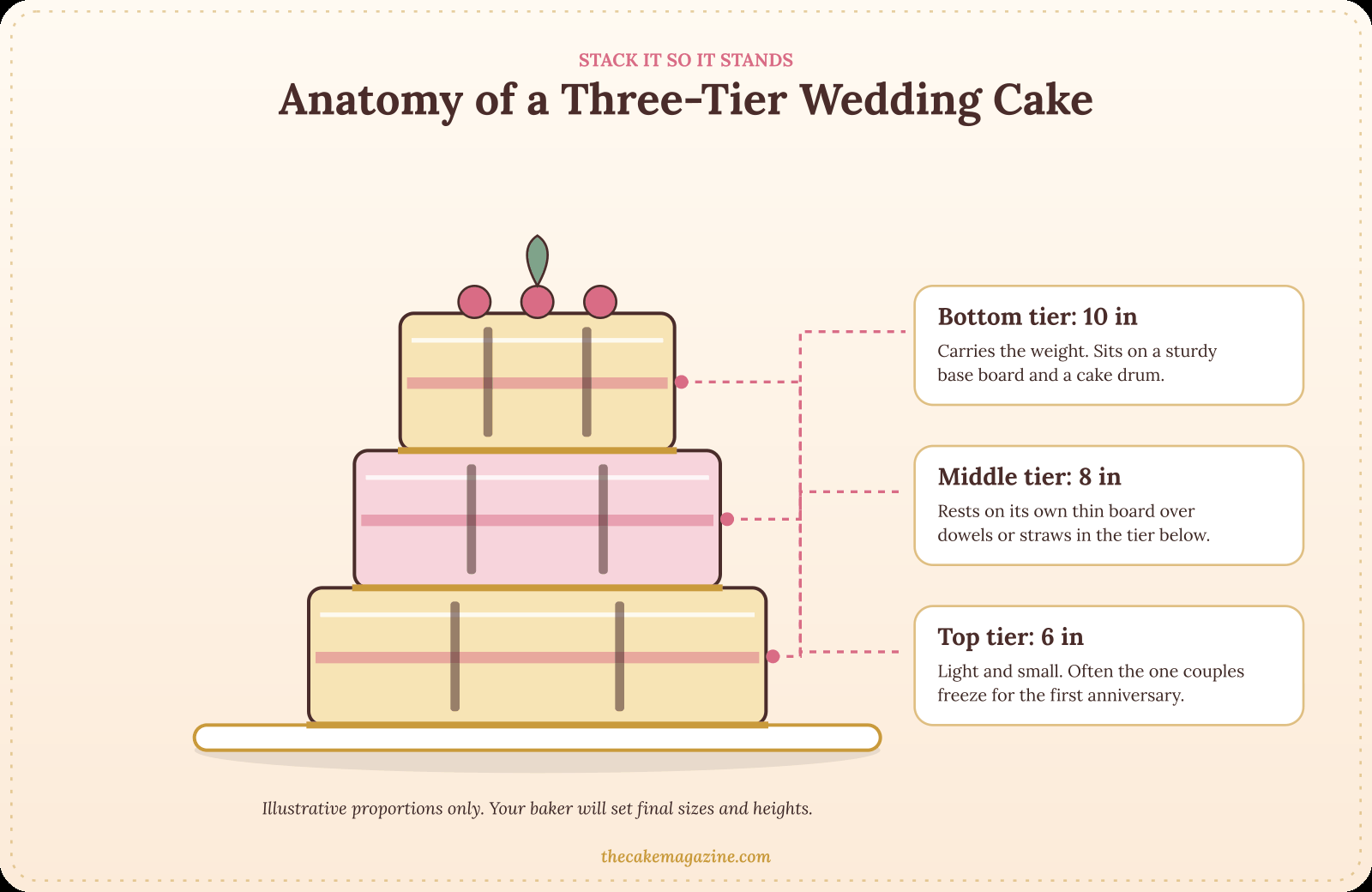
The infographic below shows a typical three-tier stack with its tiers, boards and supports. Think of it as the skeleton under the frosting. Few wedding cake guide articles show the structure, yet it explains most of the price and most of the logistics.
Tiers, boards and supports
Each tier is usually made of two or more layers of cake with filling between them, wrapped in frosting and sitting on a thin cardboard round the same size as the cake. That board is what lets the baker lift and move the tier without touching the cake. Under the whole stack sits a thicker base, often called a cake drum or a board, wide enough to leave a border of space around the bottom tier.
Between tiers, bakers push dowels, straws or other supports down through the lower cake so the tier above rests on the supports instead of squashing the crumb underneath. Many bakers also run a single central rod through the stack for extra stability, especially for tall cakes that will be transported already assembled.
You do not need to supervise any of this, but you should know that those internal supports are why you should never cut into a tier without first taking apart what is above it, and why the baker or venue staff may tell you not to lean on or lift a wedding cake by the top. If someone offers to move your assembled cake for you across the room, the answer is almost always “please do not.”
Tier sizes and how they relate
Common round tier sizes step down by about two inches in diameter as they go up, which is why you often see combinations such as 6, 8 and 10 inches in a wedding cake guide like this one. Bakers choose the steps to keep the cake looking balanced and to leave enough room on each lower tier for the one above. Height matters too.
A standard tier is often around four to five inches tall once filled and frosted, but many bakers build taller or shorter ones to suit the design. A taller tier gives more servings from the same width, though it also raises the cake’s center of gravity, which is one reason delivery planning matters so much.
There are plenty of other shapes. Square and hexagonal tiers, oval tiers and stacked sheet cakes all appear at weddings. Round tiers remain the most common and, for many bakers, the easiest to stack neatly. If you have a shape in mind, say so early, because pans, boards and supports for unusual shapes can be harder to source, and the number of servings per tier changes with the shape. Our wedding cake serving guide explains how tier size and shape translate into portions.
Why wedding cake layers are baked differently
Most wedding cakes are not made with a delicate, barely-held-together birthday cake crumb. They need a crumb that carries weight, holds a filling, can be torn down and sliced into rectangular pieces and still tastes good after sitting out for a stretch. Bakers often adjust a recipe for that purpose, using a slightly sturdier structure while keeping the texture soft.
If you want to understand why, our explainer on cake baking science covers what flour, fat, sugar, eggs and leaveners do inside a crumb, and our guide to cake mixing methods shows how technique changes the finished texture.
For a sense of what a dependable base cake looks like before a baker customizes it, you can look at our best vanilla cake recipe and our best chocolate cake recipe, which are good examples of the soft, stackable layers that wedding bakers build on. A professional wedding cake will have its own tested formulas, but the principles are the same.
Filling, crumb coat and the final finish
Once the layers are baked and cooled, the baker adds filling, stacks the layers, trims the sides if needed and applies a thin crumb coat of frosting to trap loose crumbs. The tier then rests, usually chilled, so the coat firms up before the final finish goes on. That final finish might be smooth buttercream, a textured scrape, fondant or ganache with a covering of fondant on top.
The finish is where much of the labor and price sits, which is part of why two cakes of the same size can cost very different amounts. We look at the choices in the frosting section below.
A finished wedding cake is mostly cake, frosting and filling, plus some structure you cannot eat. The flowers, ribbons and toppers that sit on it are a separate decision. Fresh flowers need to be safe for contact with food, and some are not, so confirm with your baker which blooms are fine and who will place them. Sugar flowers and edible pearls are made by the baker and are a bigger time investment than they look.
Ask about the structure. A short question to your baker, such as “how will this be supported and will it arrive assembled?”, tells you whether the plan has been thought through. A confident answer usually mentions dowels or supports, boards, chilling and a repair kit.
With the build in mind, the next part of the wedding cake guide covers the question most people jump to first: what should the cake look like?
Wedding cake designs and style
Design is the part of a wedding cake guide that gets the most attention, and it deserves some, but it is easier when you treat style as a spectrum instead of a menu of unrelated options. At one end you have a relaxed, barely frosted cake with fruit or flowers on top. At the other end sits a satin-smooth fondant cake with hand-made sugar flowers and fine detail. Most couples land somewhere in the middle. The picture below, the first design tool in this wedding cake guide, shows five common points on that spectrum.

Naked and semi-naked cakes
A naked cake shows its layers with little or no frosting on the outside, and a semi-naked cake gets a thin scrape of frosting that lets the cake peek through. These cakes suit relaxed weddings, gardens, barns and informal receptions. They are usually decorated with fresh fruit, herbs or flowers, which gives them a seasonal, natural feel.
The trade-off is that the exposed sides dry out faster than a fully frosted cake, so they are best made close to the wedding date and kept covered until the last moment. They also do not hold up well in heat, since there is less frosting to protect the crumb. If your reception is outdoors in summer, ask your baker honestly whether a naked cake makes sense.
Smooth buttercream
Clean, smooth buttercream with crisp edges is the classic modern look. It reads as elegant without being fussy, and it works as a blank canvas for flowers, fresh or sugar, a simple ribbon or a monogram. Getting those smooth sides and sharp corners takes skill and patience, which is why the technique has its own guide: how to get smooth buttercream sides and sharp cake edges. The choice of buttercream matters too.
Swiss meringue buttercream tends to be silky and less sweet, which many wedding bakers prefer. Our Swiss meringue buttercream guide explains the method and the temperature behavior, and our buttercream comparison sets the main types side by side.
Textured and piped finishes
Textured finishes include ruffles, swoops, a stucco look, pleats and combed lines. They hide small imperfections better than a perfectly smooth finish, which can make them more forgiving in warm rooms and during transport. They also photograph well in soft light. Piped designs, such as borders, rosettes, shells, lace work and lettering, add more detail. If you like the idea of piping, our cake piping guide shows what is involved, and it will help you appreciate how much time those details take.
Fondant and sugar art
Fondant, which every wedding cake guide has to cover, is a rolled sugar covering that gives an ultra-smooth, matte or satin surface. It is the traditional choice for formal designs, sharp geometric cakes, painted details and elaborate sugar flowers. Fondant also seals the cake somewhat, which helps in some conditions. Some guests find it too sweet or chewy, so many bakers put it over a layer of buttercream or ganache and tell guests they can peel it off.
If you love the look but not the taste, ask about a thin application or a hybrid design that mixes fondant accents with buttercream.
Flowers, fruit and other decoration
Decoration is where a cake becomes yours. Fresh flowers are the most common choice, and they can be spectacular, but you should confirm with the baker which varieties are food safe, how they will be wired or wrapped so stems do not touch the cake, and who is responsible for placing them. Sugar flowers, made by hand from gum paste, are fully edible-looking and last far longer, though they are labor-intensive. Fresh fruit, dried fruit slices, herbs, edible gold leaf, piped details and hand-painted accents all appear, and each one affects timing and cost.
Toppers are a separate topic in any wedding cake guide. A classic figurine, a monogram or a simple flower can all work. If a topper is something you or a family member will bring, tell the baker in advance so the top tier is built to carry its weight and so there is a plan for placing it. Keep in mind that a heavy topper on a soft tier can sink or lean over a long reception.
Matching the design to the venue and season
The venue should shape the design more than Pinterest does. An outdoor summer reception under direct sun is a hard environment for any buttercream, and especially for a delicate or naked cake. A ballroom with air conditioning gives you almost any option. A rustic barn may suit a textured, natural cake, but check whether the table will be level and where it sits relative to windows and doors.
In winter, cold rooms are kinder to cakes, but long drives in freezing conditions can cause condensation when a cold cake meets warm air, so ask your baker how they handle that.
A simple way to think about it is to match the formality of the cake to the formality of the room. A black-tie event usually calls for a precise finish. A backyard party can carry something softer and looser. In wedding cake guide terms, a mismatch is not a disaster, but it often feels slightly off in photos, and it is worth considering before you commit to a design.
Current wedding cake trends
Trends shift, and a wedding cake guide that pretends otherwise would be out of date quickly. The Knot’s wedding cake trends roundup is a useful reference here, and its list of wedding cake trends mentions a few themes worth knowing about. They include 1980s-inspired details such as buttercream swags and floating tiers, oval cakes, pleated and textured finishes, classical motifs such as columns and scallop shells, and vintage-inspired designs in the Lambeth style, which are decorated in a maximalist way.
It also points to sugared and candied fruit, metallic and pearlescent finishes, and floral, herbal and less-sweet flavors. There is also an interactive trend, where the cutting moment turns into a small performance with candles or a cake wheeled to the dance floor.
Some of this overlaps with what we cover in our look at 2026 cake trends, which includes mini formats, texture, tangy flavors, vintage piping and statement cakes. The small formats are especially relevant to weddings, because some couples pair a smaller cake for the ceremonial cutting with sheet cake or individual desserts for guests. Our pieces on dot cakes and mini and one-bite cakes explain why those formats are growing.
How to use trends without regretting them
A few honest thoughts on trends. First, a trend is a starting point, not a requirement. The most dated wedding photos tend to show the most trend-heavy details, so it is worth asking whether you will still like the cake in ten years.
Second, tell your baker which trend you love and why, and bring this wedding cake guide’s three-picture rule with you. “I like the vintage piping and the dusty colors” gives a baker more to work with than “make it look like this photo.” Third, if a design includes unusual techniques, such as complex piping or sugar art, confirm that your baker actually does that work regularly rather than learning it on your cake.
If a trend sounds like it would melt, lean or sink in your climate, say so. A good baker will tell you what is realistic. Many will gladly adapt a look: the swags and pleats of a vintage cake, for example, can be done in stable buttercream, and sugared fruit can be applied just before serving.
Bring three pictures, not thirty. Choose three cakes you love and write one line on what you like about each: the shape, the color, the texture. Bakers can combine those details into something original, and original designs are easier to price and defend than copies of someone else’s work.
Flavors and fillings that work
A wedding cake has to please a crowd. That does not mean it has to be boring, but it does mean the flavor should appeal to most guests, from kids to grandparents, and it should hold up for several hours without the structure or filling failing. Most wedding cake guide advice on flavor can be boiled down to a handful of principles: keep the cake itself broadly appealing, pick a filling that adds interest, balance sweetness and make sure everything survives a day at room temperature.
The wheel below shows pairings that tend to work. It is a starting point, not a rule, and the best way to decide is at your tasting.

Classic flavors that rarely fail
Vanilla and chocolate are the two flavors people expect, and for good reason: nearly everyone likes one of them. A well-made vanilla cake, like the one in our vanilla cake recipe, is a very good base, and it pairs with almost any filling. A deep chocolate cake, like our chocolate cake recipe, appeals to a different crowd and holds up well to rich fillings.
Lemon cake is a popular third choice because it is bright, which cuts through a long meal. Red velvet and carrot cake are also common wedding choices, and our red velvet cake guide covers what makes that cake distinctive.
Fillings: where flavor gets interesting
Fillings add contrast. A tart fruit filling next to vanilla, a salted caramel next to chocolate, a lemon curd between layers of white cake: these are classic pairings because the sharp or rich element balances the sweetness of the frosting. When you pick a filling, remember that it has to stay put. Soft, runny fillings can ooze out the sides of tall tiers or make the layers slide, so most bakers pair them with a ring of firm buttercream, known as a dam, to hold the filling in place.
Cream cheese fillings and fresh cream fillings need special attention because they are perishable. They are delicious, but they are also the fillings most likely to cause food safety issues if the cake sits out for hours. If you love one, ask your baker how they handle it and what the plan is for keeping the cake cool, and read the food safety section of this guide.
Mixing flavors across tiers
Many couples choose a different flavor for each tier, so guests have options, and a wedding cake guide should mention the trade-offs. It is a nice solution if you and your partner disagree, and it can give you a more interesting tasting. It also affects servings, because you now have to guess how many guests will want each flavor, and it can affect price.
A simple approach is to make the biggest tier the safest flavor, such as vanilla or chocolate, and let the smaller tiers carry the more adventurous choices. That way most guests have something familiar and a few have something unusual.
One more wedding cake guide tip: if you are choosing two flavors in a single tier, such as marbled or layered flavors, make sure the combination is one you tasted at the tasting rather than imagined. Flavors that sound lovely in a description can taste muddy together.
Balancing sweetness
Weddings are long, and guests eat cake after dinner and sometimes after drinks. A cake that is intensely sweet can feel heavy. This is one reason Swiss meringue and other less-sweet buttercreams are popular for weddings. If you prefer a less-sweet cake, say so at the tasting, and ask whether the baker can adjust the sweetness in the frosting.
Our American buttercream guide explains how sweetness and texture can be adjusted, which is useful background even if your baker uses a different style. Treat sweetness as one of the main dials in any wedding cake guide discussion of flavor.
The flavor choices The Knot lists, such as lavender, rose, elderflower and Earl Grey, are lovely when they are subtle. They can also be polarizing. If you want something floral or herbal, it is usually safest to put it in a filling or a single tier, and keep the rest of the cake familiar.
Frosting and finish: buttercream, fondant, ganache
The exterior of a wedding cake is a decision about taste, looks and logistics all at once. Every finish behaves differently in heat, in transport and under a knife. This part of the wedding cake guide compares the main options so you can ask better questions.
Buttercream
Buttercream is the most common finish for modern wedding cakes. American buttercream, made from butter and powdered sugar, is sweet, quick and sturdy. Swiss, Italian and French meringue buttercreams are smoother and less sweet, and they take more skill. Ermine and German styles are different again. Our buttercream comparison guide covers all of them. For weddings, the practical questions are how the buttercream handles heat, how it holds a smooth finish and how it tastes after a long afternoon at room temperature.
Butter-based frostings soften as the temperature rises. That is not a flaw, it is just how butter works, but it is why outdoor summer weddings need a plan. Some bakers add a portion of shortening for stability, which can help in heat but changes the mouthfeel. Others use stabilized recipes or build the design to need less structure from the frosting. Whatever the choice, ask the baker how the cake will behave at the temperature of your venue, not at the temperature of their kitchen.
Fondant
Fondant gives the smoothest look and the sharpest corners, and it resists some of the softening that buttercream suffers in warm rooms. It is also the foundation for sugar flowers and fine detail. On the other side, some guests do not enjoy the taste or texture, and fondant can hide a lovely cake behind a layer of sugar. If your baker uses fondant, ask what is underneath it. A good buttercream or ganache layer under the fondant is part of what makes the cake taste good.
Ganache and chocolate finishes
Ganache, a mix of chocolate and cream, gives a sleek, firm finish and a rich flavor. It can be left as the finish or used as a base under fondant. It is excellent for sharp edges and for tiers that need to be robust in transport, though it sets firm in the fridge and can be a little heavy if the layer is thick. Drips of ganache are a popular decorative effect, but they need cool conditions to hold their shape.
Choosing what suits you
In short, and this is the wedding cake guide summary: buttercream is the all-rounder, fondant is the formal and heat-tolerant option for detailed designs, and ganache is the rich, firm option. Pick the finish that matches the design you want, the temperature of your venue and the flavor your guests will actually enjoy. A wedding cake guide can only point you toward the right finish.
Then confirm at the tasting that the finish you choose tastes good with your cake and filling, since a beautiful finish you do not want to eat is a poor trade.
The wedding cake tasting
A tasting is the best use of an afternoon in the whole wedding cake process. Most wedding cake guide checklists put it near the top of the list. It tells you whether the baker’s taste matches yours, it lets you pick flavors and fillings with real information and it gives you a chance to ask questions face to face. Many bakers charge for tastings, sometimes with the fee credited to your order if you book, so ask about the policy when you inquire.
What to bring and what to ask
Bring this wedding cake guide’s basics with you: your date, venue, guest count and a rough budget, plus your three inspiration pictures and any dietary concerns. Ask what flavors and fillings the baker offers, how many tiers you can mix, how they handle delivery and what is included in the price. Ask to see photos of recent wedding cakes in a similar style to the one you want.
If a baker offers a sample box rather than a sit-down tasting, ask which flavors are in it and how closely the samples match the cake you would order.
Do not feel pressured to decide on the spot. Take notes on what you liked, ideally in the same notebook as the rest of your wedding cake guide planning, take photos of the samples and sleep on it. If you are tasting with someone else, say, a partner or a parent, taste first and discuss afterward, so no one’s opinion drowns out your own.
How to taste like you mean it
Taste each cake plain, then with the filling and then with the frosting. Pay attention to sweetness, moisture and texture. Cakes that are good fresh may be dry after sitting, so ask whether the sample is a day old or fresh. Consider how the cake will taste at room temperature, which is how guests will eat it. A cold sample from a fridge can taste more muted than it will when served.
Tell the truth at the tasting. It is tempting to say you love everything to be polite. A baker would much rather hear “this is a bit sweet for us” at the tasting than learn it from a bad review after the wedding. Specific feedback gets you a better cake.
Allergens and dietary needs
Allergens deserve their own section in any serious wedding cake guide, because the consequences are not just a bad meal. Common allergens in cakes include wheat, eggs, milk, tree nuts, peanuts and soy. Even a cake that does not contain nuts may be made in a kitchen that handles them. If any guest has an allergy, tell your baker well in advance and be specific about whether the concern is a mild intolerance or a serious allergy.
What to tell your baker
Share the allergens involved, how many guests are affected and how severe the reaction is. Ask how the baker handles cross-contact, meaning the transfer of allergen traces from shared tools, surfaces or ingredients. Some bakers work in kitchens that are set up for particular allergens, and others cannot guarantee an allergen-free product. If a baker says they cannot do what you need, that is useful information, not a failure, and it is much better to hear it early.
Plan how the cake will be labeled at the reception. Many couples ask the baker or the caterer to provide a small card with ingredients or major allergens, particularly if there are multiple flavors. If someone with a serious allergy is attending, it is safest to ask them directly what they are comfortable with, and have a separate dessert for them, rather than relying on a modified recipe. For official background on allergens and handling, the USDA Food Safety and Inspection Service is a good place to start for general food safety guidance.
Dietary preferences beyond allergies
Vegan, gluten-free, dairy-free and lower-sugar cakes are all possible, but they are a specialty. If you need one, find a baker who makes that style regularly and test their cake at the tasting. A common approach is to make the main cake in a classic style and provide a smaller separate cake or dessert for guests with specific needs. That keeps the wedding cake itself simple and gives those guests something made to suit them.
Wedding cake servings and size
Getting the size right is one of the most practical parts of this wedding cake guide. A cake that is too small leaves guests without dessert. A cake that is too large wastes money. The right size depends on your guest count, how the cake will be served and whether there is other dessert.
The wedding slice versus the party slice
Wedding cake slices are generally smaller than a slice of birthday cake. A common description of the wedding slice is about one inch wide by two inches deep, cut to the height of the tier, though bakers and caterers sometimes use slightly different measurements. A party slice is larger. Which one your baker uses to calculate servings changes the number dramatically, so ask which they are quoting. Our detailed wedding cake serving guide covers tier sizes, portions, guest count and backup cake, with the reasoning behind each recommendation.
Counting guests who will actually eat cake
One thing a wedding cake guide must admit: not every guest will take a slice. Some are full, some are not eating sweets, and some are small children. But many people take a slice for the tradition or the photo, and some come back for seconds. A common approach is to plan for most of your guests, then add a small cushion. If you are serving other desserts, such as a dessert table or plated sweets, you can plan the cake for fewer servings. If the cake is the only dessert, plan for nearly everyone.
Using a sheet cake or kitchen cake as backup
One way to keep the display cake smaller and the budget under control is to pair it with a kitchen cake, which is a sheet cake or extra tiers kept in the kitchen and cut for guests. The display cake is used for the ceremonial cutting and the photos, while the kitchen cake supplies most of the slices.
This is a very common arrangement, and it also solves a practical problem: it is easier to cut a flat sheet cake into neat rectangular portions quickly. Ask your baker about it, and read the serving guide for the numbers.
Whatever you decide, do not guess. A wedding cake guide can give you the method, but only your RSVPs give you the number. Give the baker an accurate count once your RSVPs are in, and ask them to confirm how many servings their quote includes.
Wedding cake budget
Money is the topic most people want covered in a wedding cake guide, and also the one where it is easiest to give misleading numbers. Prices vary widely by region, baker, design and season, and any single figure quoted online is likely to be wrong for your market. So rather than give you dollar amounts, this section of the wedding cake guide explains how bakers build a price and where you can save. For a deeper look, see our guide to wedding cake pricing, which explains the factors bakers and couples should understand.
How bakers usually price
Many bakers price a wedding cake per serving, which is the first thing a wedding cake guide should explain, with a base rate that rises with design complexity. A simple buttercream cake sits at the lower end of a baker’s range, and a heavily detailed fondant cake with sugar flowers sits at the higher end.
In rough terms, the price is the number of servings multiplied by a per-serving rate, plus add-ons such as delivery, setup, a cake stand rental or a separate fee for special decorations. These numbers are not universal, so treat the formula as a way to compare quotes and not as a prediction.
Bakers who price properly are covering ingredients, labor, overhead and a margin, not just the cost of flour and butter. If you are curious how that works from the baker’s side, our guides on how to price cakes and the cake cost calculator break it down, and they will help you understand why a quote that looks high may be reasonable.
What moves the price
- Servings. More servings mean more ingredients and more labor.
- Design complexity. Smooth buttercream costs less time than detailed piping, and fondant with sugar flowers costs more still.
- Tiers and height. More tiers mean more structure and more handling.
- Flavors and fillings. Specialty ingredients and multiple flavors can raise the cost.
- Delivery and setup. Distance, venue access and setup time all matter.
- Date and season. Peak wedding dates are busier, and some bakers price accordingly.
- Rentals and extras. Stands, toppers, flowers and a cutting fee, if there is one.
These figures are illustrative categories, not quotes. Always confirm the full price with local bakers in writing.
Where couples can save without losing the look
The best wedding cake guide advice on cost is that you do not have to give up the look you want to control it. A smaller display cake paired with a kitchen sheet cake is one of the most effective approaches. A simpler finish, with one or two striking details instead of many, can look more elegant and cost less. Fresh flowers from your florist can replace sugar flowers. Fewer flavors reduce the complexity.
And booking early and on a less in-demand date sometimes opens up better options. Ask your baker where they would trim without changing the feel of the cake. They usually have good ideas.
Questions to ask before you pay a deposit
Ask what the quote includes, what the deposit is, what the cancellation policy is, whether the baker charges a cutting fee when the cake is served by the venue and what happens if you change your guest count. Ask what happens if the baker is ill or there is an emergency. No wedding cake guide can replace a clear written contract. A written contract is standard for wedding cakes, and it protects both of you.
Choosing a baker
Your baker matters more than any trend or flavor, which is why a wedding cake guide should spend time on how to choose one. A skilled, organized baker can adapt a design to your venue and weather, answer questions clearly and show up on time with a cake that is stable. This part of the wedding cake guide covers how to find and vet one.
Where to look
Start with word of mouth: your venue, your caterer, your planner and recently married friends. Venues often know which bakers deliver reliably and are comfortable with their space. Local bakeries, independent cake designers and home bakers who are legally licensed to sell in your state are all possibilities. Look at a baker’s portfolio and check that it contains wedding cakes in a style like yours, and not just birthday cakes or photos from a different kind of event.
What to check
Ask about licensing and insurance. Rules for home bakers differ by state, and a baker who works from home should be able to tell you how they operate legally. If you are curious about what that involves, our guide to starting a home cake business explains the legal basics from the baker’s side. Read recent reviews with an eye to reliability, communication and delivery, not just taste. Ask how many weddings the baker takes on each weekend, since overbooking is a real risk, and ask what the backup plan is.
Red flags and green flags
In wedding cake guide terms, a good sign is a baker who asks questions about your venue, timing and guests, gives you a written quote and contract and talks openly about what can go wrong. Warning signs include very vague pricing, no contract, reluctance to describe delivery, no answer on food safety and pressure to pay in full immediately with no paperwork. It is fine for a baker to be firm about policies. It is not fine for them to be unclear about them.
The planning timeline
Timing is where a lot of wedding cake plans succeed or stumble. Popular bakers book months ahead, as any wedding cake guide will tell you, especially for peak season, so starting early gives you more choices. The infographic below shows a typical order of events, from first budget conversation to the day itself. Treat the time frames in this wedding cake guide as general patterns, not rules, because different bakers have different lead times.
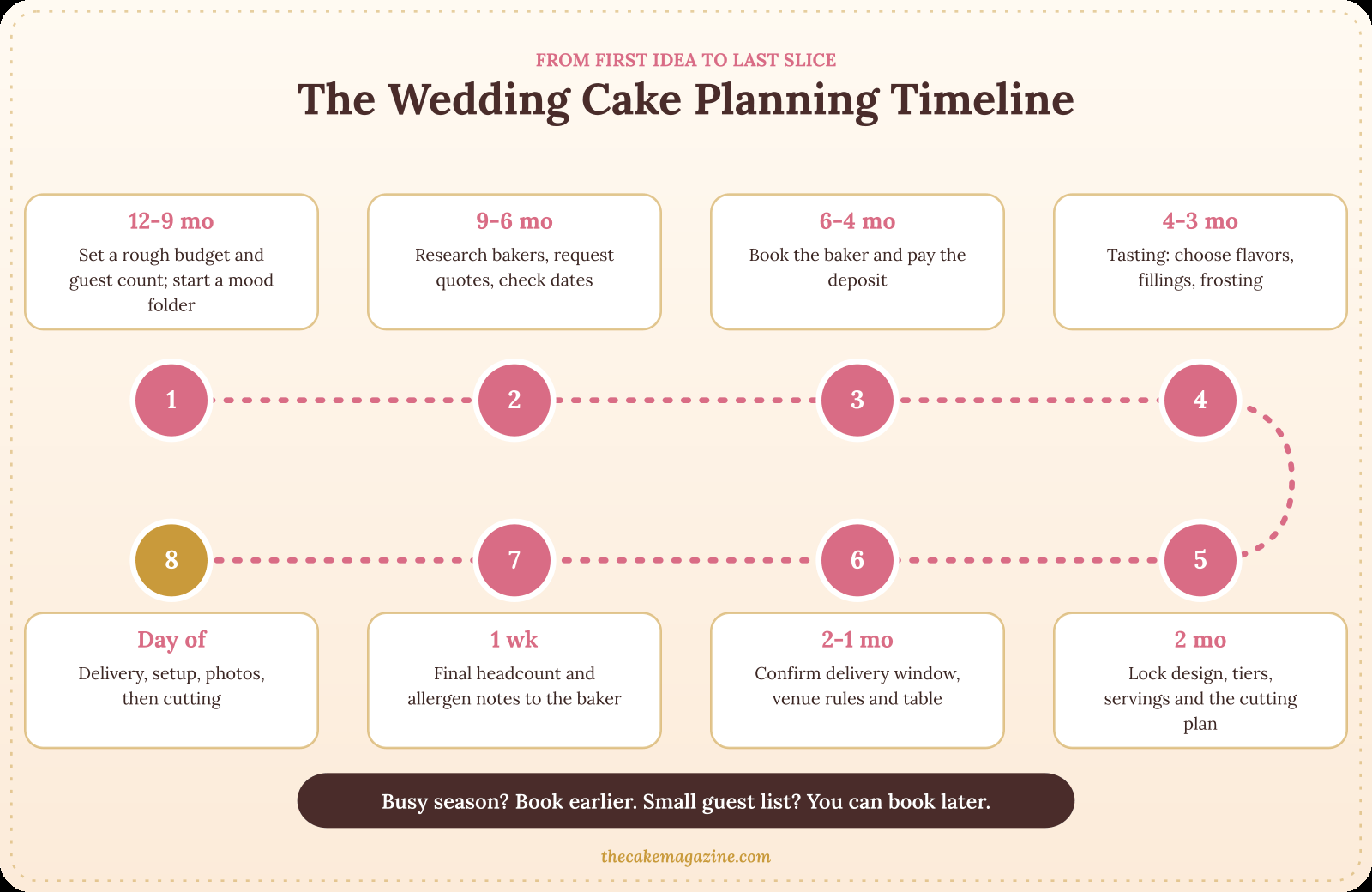
Twelve to six months out
At this stage you are gathering information, and a wedding cake guide like this one is a good place to start. Set a rough budget, estimate your guest count and think about style. Start a folder of cakes you like. Research bakers and send inquiries with your date, venue and guest count. Many bakers will tell you immediately whether they are available. If your date is in a busy season, aim to contact bakers on the earlier side of this window. Smaller or off-season weddings often have more flexibility.
Six to three months out
This is when most couples book. After you have chosen a baker, you will usually sign a contract and pay a deposit. Schedule your tasting for a time when you are not rushed. Use the tasting to decide on flavors, fillings and frosting, and begin to shape the design. Ask when the baker needs final decisions on each detail, and write the dates next to this wedding cake guide’s timeline, since some details, such as sugar flowers, take longer to prepare.
Two months to one month out
Finalize the design, tier sizes and servings. Confirm the delivery window with your venue, and share the venue contact details with your baker. Ask about the table: its size, its position and whether the venue provides a cake table or you do. Many bakers need to know the table dimensions so the stand and the cake fit. Confirm who is placing flowers, who is providing a cake knife and server and what the plan is for cutting.
The last week
Send your final headcount and any allergen notes in writing. Confirm the delivery time again. Make sure someone on your side, such as a planner, a family member or a venue manager, knows the plan and has the baker’s phone number. If you are doing a cake cutting with a photographer, share the schedule so the cake is ready when you need it. Final payment is usually due around this time, and your contract will say when.
The wedding day
On the day, the baker delivers, sets up and checks the cake, and your wedding cake guide checklist is done. You should not have to do anything except enjoy it. Plan when the cake will be cut, and let your venue or caterer know so they can prepare plates, forks and serving tools. After the cutting, someone should slice and serve the rest while you are still at the table.
Delivery, setup and the venue
The journey from the baker’s kitchen to your reception is where cakes are most at risk, and it is why this wedding cake guide spends real time on logistics. A cake that looked perfect at the bakery can arrive damaged if the vehicle is hot, the road is bumpy or the table is uneven. Most issues are preventable with a plan.

Delivery versus pickup
For a large tiered cake, professional delivery and setup is almost always the better option. Delivery means the baker or their team transports the cake and assembles it on-site, which keeps it safe and lets them make last-minute repairs. If you are picking up a smaller cake yourself, ask how to transport it, and use the flattest part of the car, such as the floor of the back seat or the trunk, with the air conditioner on.
Never put a cake on a car seat that slopes, and never carry it on your lap if you can avoid it.
Cold cake, flat floor, slow driving
Three habits protect a cake in transit. First, a cold cake is a firmer cake. Chilling the tiers before loading makes frosting and fillings more stable, and it reduces the risk of smearing. Second, the cake must sit on a flat, level surface, with nothing that can slide into it. Third, the driver must go slowly, with gentle turns and soft braking. Bakers who deliver regularly carry a repair kit with extra frosting, a small spatula and tools for fixing small marks. Ask whether yours does.
Questions about the venue
The venue shapes the plan. Find out where the cake will be set up, whether the room is air-conditioned or heated, whether there is a level table and how long the cake will sit before it is cut. Ask about loading access, stairs, elevators and parking. Some venues require vendors to deliver at certain times. Share these details with your baker. A wedding cake guide that skips the venue skips half the story. If the cake will be outdoors, check where the shade is and plan to keep the cake out of direct sun.
Setup details people forget
- A sturdy table that does not wobble when someone walks by.
- A tablecloth that matches the cake stand and does not drag.
- Enough space around the cake for flowers and for the couple to stand together for the cutting.
- A cake knife, a server, plates, forks and napkins ready to go.
- A named person at the venue who will answer the baker’s call.
- A plan for storing leftovers or boxing the top tier.
If you are working with a planner or a coordinator, share this wedding cake guide checklist with them. If you are not, give it to a trusted friend or family member who can handle questions on the day.
Food safety on the day
Cake is generally a low-risk food, a point every wedding cake guide should make honestly, but a wedding cake can sit out for hours, and some fillings and frostings are perishable. A responsible wedding cake guide should say clearly what matters here. The USDA Food Safety and Inspection Service publishes guidance on keeping perishable foods safe, including the general advice that perishable food should not sit out at room temperature for more than two hours, or one hour when it is very hot outside. Check their pages for the current details.
Which cakes need extra care
Cakes filled or frosted with fresh cream, custard, whipped cream, cream cheese or fresh fruit are the most perishable. Buttercream made with butter and sugar is more stable, though it still softens in heat. Meringue-based buttercreams use cooked egg whites and should be made carefully, a topic covered in our Swiss meringue buttercream guide. If you want a perishable filling at an outdoor summer wedding, ask your baker how they keep the cake safe, and consider placing the cake in a cool room until just before the cutting.
Practical safety habits
The safety rules in this wedding cake guide are short. Keep the cake out of the sun. Keep it away from heat sources such as kitchen equipment, lights and open flames. Do not leave leftover cake out all night. If you want to save slices, box them and refrigerate them or freeze them soon after the cake is served. Use clean tools to cut and serve, and have a person with clean hands do the serving. If you have questions about a specific filling or ingredient, ask the baker for guidance instead of guessing.
A quick safety script for your baker. Ask, “Which parts of this cake are perishable, how long can it safely sit at room temperature and what is the plan if the room is warm?” A thoughtful baker will have a clear answer.
How to cut a wedding cake
The cake cutting is a small piece of theater, and it is also a practical job. Someone has to cut a stacked, supported cake into tidy slices for a lot of guests, usually in a crowded room, usually while a photographer is watching. Knowing the method makes the difference between neat slices and a pile of crumbs, so the cutting belongs in any complete wedding cake guide. Here is how the standard approach works for round tiers.

The ceremonial first cut
The first cut is mostly for photos. The couple makes one slice together from the bottom tier, usually a modest piece, and may feed each other a bite. Ask your baker or your photographer where the best spot to cut is, since the cake may have a decorated front. After the photos, the cake is taken to the kitchen or a service area for cutting, or cut right at the table by staff.
Cutting a round tier in rings
The usual method is to start from the outside. Make a circular cut about two inches in from the edge of the tier, then slice that outer ring into pieces about one inch wide. Once the ring is gone, you are left with a smaller circle in the center, and you can repeat the process, or cut the remaining core into similar pieces. Each tier is cut in turn, starting with the top tier and working down.
The reason you work top-down is that the upper tiers rest on supports in the lower ones, so you should lift off or take apart the upper tier before cutting the one below.
Tools and technique
A long, sharp, thin knife works best. Wipe the blade clean between cuts, and dip it in hot water and dry it if the frosting drags. Cutting straight down in one smooth motion, without sawing, gives cleaner edges. Use a flat server to lift each slice. If the cake has dowels or straws inside, remove them as you go and put them aside, so no guest bites into one.
This is also the moment to tell the person serving that the cake contains supports. A good baker will mention it, and may offer to cut the cake themselves or to show the serving staff how.
Who cuts the cake
Ask your venue or caterer whether they cut the cake and whether they charge a cutting fee. Some venues include it, and others charge per slice, which is worth asking about before you finalize your wedding cake guide budget. If a friend or family member is doing it, give them clear instructions and the right tools. A tired, well-meaning relative with a dull knife is not the ideal plan, and no wedding cake guide would suggest it.
If you are hiring a baker for delivery and setup, ask whether they provide cutting instructions or a diagram for the serving team.
Sheet cakes, kitchen cakes and rectangular slices
If you have a kitchen cake, it is usually cut into rectangular portions that match the planned servings. Flat cakes are faster to portion and more predictable. Serve the kitchen cake alongside slices from the display cake, so guests receive a consistent portion regardless of where it came from. Ask your baker how many servings each cake provides, so the catering staff can plan how to divide them.
What to do with the top tier
A long-standing tradition, and a favorite wedding cake guide question, is to save the top tier of the wedding cake and eat it on the first anniversary. It is a sweet idea, and the wedding cake guide advice here is simple: it works well enough if you take a few precautions. It is also fine to skip it, and many couples do.
If you want to save it
Plan ahead. Tell your baker you intend to freeze the top tier, so they can make it with that in mind, for example by using a stable filling. After the wedding, someone should remove any decorations, flowers and supports, then freeze the tier uncovered for a short time until firm, and wrap it very well in plastic wrap and then foil, or place it in a sturdy airtight container. Freezers can leave odors on cake, so tight wrapping matters. Label it with the date and flavor.
Be realistic about taste. A cake frozen for a year may not taste like it did on the wedding day. Many couples find the experience is more about the ritual than the flavor, and some prefer to order a fresh small cake from the same baker for the anniversary. That is a perfectly good solution, and some bakers offer a first-anniversary cake as part of a package. Cakes with fresh fruit or cream cheese fillings are poor candidates for long freezing.
Other ways to use the top tier
You can also eat it the day after the wedding, share it with the wedding party at a brunch, or send slices home with guests. If you want to avoid the stress of managing leftovers on the night of the wedding, assign someone, such as a planner or a trusted family member, to box up the top tier or any leftover slices for you.
Cake, dessert table or both
The traditional tiered cake is not the only way, as this wedding cake guide has said, to serve dessert at a wedding. Some couples prefer a dessert table, a small cake for cutting plus individual treats, or a different dessert entirely. It is worth deciding on purpose and not by default, and this wedding cake guide recommends doing it before you book a baker.
Why couples choose a traditional tiered cake
A tiered cake has a clear role: it is the centerpiece, it provides the cutting moment, and it feeds a lot of people. It is also familiar, and families often expect it. For many, the photo and the ceremony are the point.
Why some choose a dessert table or small cake
A small cake for the ceremonial cut, paired with a dessert table or individual treats, can be a good way to give guests a choice and to reduce the cost of a large cake. It can also suit couples who do not care for traditional wedding cake flavors. Mini and one-bite cakes are a growing format, and our pieces on small-format celebration cakes and dot cakes explain why. The downside is more variety to organize, more labor for the baker or the caterer and more elements to place and label.
Doing both
A modest tiered cake and a few extras is a flexible approach. The tiered cake is the focal point and the cutting moment, and the extras cover guests with different tastes and dietary needs. If you do both, tell the baker, since the servings from the main cake can be reduced.
Making a wedding cake yourself
Some people choose to make their own wedding cake, or to ask a talented friend or relative to do it. It can be wonderful. It can also be stressful, and any honest wedding cake guide will say so, and it deserves a frank look. If you are going to try, the points below from this wedding cake guide will help.
Who this works for
Making a tiered wedding cake works best for people with real baking experience who have already made stacked cakes, have the equipment and are not going to be the one carrying it into the reception in a wedding dress. A simpler design, such as a two-tier buttercream cake or a naked cake, is far more realistic than a complicated sculpted one.
If you are a beginner who wants to build the skills, our cake decorating for beginners guide and the guide to smooth buttercream sides are good places to start, and you should practice well before the wedding.
Equipment you will need
A sturdy mixer and enough pans are the foundation. If you are shopping, our guides to stand mixers for cake baking, hand mixers and cake pans cover the choices. You also need cake boards, a turntable, a long serrated knife, dowels or supports, an offset spatula, a bench scraper, a large enough fridge and a vehicle that can carry the cake safely. Space for chilling tiers is often the limiting factor. Many home refrigerators cannot hold a full set of tiers at once.
A realistic plan
Bake layers ahead and freeze them, wrapped well. Make frosting a day or two before. Assemble the tiers the day before and chill them. Stack and decorate on-site if you can, since it is much safer than moving an assembled stack. Test the full recipe at least once at the size you will serve. Our cake troubleshooting guide is worth reading in advance, since the problems it covers, such as sinking, dryness and cracks, are far easier to fix at a practice bake than on the morning of the wedding.
When to hire a professional instead
If you are short on time, have a large guest list, need a complex design or do not have the space to chill and transport the cake, hiring a baker is the safer choice. It is also worth hiring a professional if you want to be able to enjoy the day instead of worrying about the cake. A middle path, and one many a wedding cake guide recommends, is to buy a simple professional cake and add your own decorations, or to have a baker make the structure and let a friend add flowers.
For another respected perspective on cake technique, the King Arthur Baking cake guide is a useful reference for the basics of cake baking.
Notes for bakers
If you are a baker, or thinking of becoming one, a wedding cake guide like this one doubles as a checklist of what couples worry about. The more of these questions you answer before you are asked, the more confident people feel when they book you.
What to put in your wedding consultation
Ask about the date, the venue, the guest count and the style, and confirm what else will be served. Explain your lead time, your tasting policy, your pricing method and your delivery process. Share a clear contract with a deposit, a payment schedule and a cancellation policy. Describe how your cakes are made, what they are supported by and how you handle allergens. Say plainly what you can and cannot do. A couple who knows your limits will trust you more than one who hears “sure” to everything.
Protecting yourself and the couple
Know your state’s rules on selling baked goods. Carry a repair kit. Take photos of the cake before you leave it, and get a signature or a message confirming delivery. Plan your timeline with buffer, and have a backup plan if you are ill. If you are building a business around this kind of work, our guides on starting a home cake business and pricing cakes cover the business foundations, and our cake cost calculator guide shows how to check that a quote covers your costs.
Three sample plans from this wedding cake guide
Advice is easier to use when you can see it applied. These three made-up couples are not real weddings, and the details are illustrative, but they show how the pieces of this wedding cake guide fit together under different conditions.
The small backyard wedding
Imagine thirty guests, a summer afternoon and a tent in a garden. The sensible plan from this wedding cake guide is a modest two-tier cake in a stable finish, perhaps smooth or lightly textured buttercream, with fresh flowers from a florist placed at the last minute. The couple skips a perishable filling, picks lemon and vanilla, asks for delivery close to the cutting time and puts the cake table in the shade, away from the grill.
Because the guest count is small, they save the extra expense of a kitchen cake, and they keep one tier for slices to take home.
The ballroom wedding with a big guest list
Now picture two hundred guests, an air-conditioned ballroom and a formal evening. Here a wedding cake guide would point toward a tall display cake for the photographs and a kitchen cake for most of the servings. A fondant finish with sugar flowers suits the formality, and delivery with on-site assembly is non-negotiable. The couple holds a tasting early, chooses a different flavor for each tier, gives the baker the table measurements and confirms the venue’s cutting policy and any fee.
They send an allergen list a week out and make sure the planner has the baker’s number.
The couple with a tight budget
Finally, imagine a couple who love dessert but want to control costs. The wedding cake guide approach is to shrink the display cake to the smallest size that still looks right, keep the finish simple, use florist flowers, choose one or two flavors and serve most guests from a sheet cake cut in the kitchen. They book on the earlier side to have more choices, ask each baker for a written quote on the same specifications and compare what is included. The cake still looks lovely and tastes good, and the budget stays intact.
Your own plan will look different, but the order of decisions in this wedding cake guide stays the same: guests, venue, style, flavor, baker, details.
Common mistakes
After all of the above, here are the mistakes that come up most often in the wedding cake guide questions we hear. Avoiding them will save you stress, and it is the quickest way to put this wedding cake guide to work.
- Waiting too long to book. Popular bakers fill up, and your date may be gone.
- Choosing a design that does not suit the venue. Heat, wind and uneven tables are real.
- Skipping the tasting. A cake that looks perfect may not taste the way you hoped.
- Guessing at servings. Ask for the number the quote includes, and give an accurate count.
- Forgetting allergens. Tell your baker early and be specific.
- Ignoring the table. A wobbly or small table is a common source of problems.
- Not having a delivery contact. The baker needs a person to call on the day.
- Letting the cake sit in the sun. Heat and direct sun do real damage.
- Forgetting who will cut it. Plan the knife, the plates and the person.
- Not reading the contract. Know what is included, and what is not.
Wedding cake guide FAQ
How far in advance should I order a wedding cake?
Many couples following a wedding cake guide timeline book a baker somewhere between six and twelve months before the wedding, and earlier for popular dates and peak season. If your date is in spring, summer or fall on a weekend, contact bakers as early as you reasonably can. If your wedding is small or on a quieter day, you may have more flexibility. Ask each baker about their lead time and when they stop taking orders for your date.
Once you book, the baker will usually tell you when final decisions are due. The planning timeline in this wedding cake guide gives a general order of events, but your baker’s own schedule is the one that counts.
How many tiers does a wedding cake need?
It depends on your guest count, your budget and the look you want, and a wedding cake guide can only give a starting point. A single large tier can serve a small wedding. Two or three tiers are more traditional and give more height, and they also allow different flavors. More tiers usually mean more structure, more labor and a higher price.
Many couples order a smaller display cake for the cutting and use a kitchen cake for most of the servings. Our wedding cake serving guide explains tier sizes and portions in more detail, and your baker can recommend a combination that fits your guest list and venue.
What flavors are best for a wedding cake?
Vanilla, chocolate and lemon are popular because they appeal to most guests, and they pair well with many fillings such as raspberry, salted caramel, lemon curd and cream cheese. Red velvet, carrot and almond are also common. The best flavor is the one you enjoyed at your tasting and that holds up well for several hours at room temperature.
If you want something more unusual, such as lavender, rose or Earl Grey, consider using it in a filling or a single tier, and keep the rest of the cake familiar for guests who like to stay traditional.
Is fondant or buttercream better for a wedding cake?
Neither is better in every case. Buttercream is the most common modern choice, it tastes good to most people and it can look smooth or textured. Fondant gives a very smooth, formal finish, handles some warm conditions better and supports sugar decoration, though some guests do not like the taste or texture. Ganache is a rich, firm option. The right choice depends on the design you want, the venue’s temperature and what your guests prefer. Ask your baker what is under any fondant, because a good buttercream or ganache layer improves the flavor.
How much does a wedding cake cost?
Prices vary by region, baker, design, season and number of servings, so there is no single number that fits everyone. Many bakers price per serving, with a rate that rises with design complexity, and then add delivery, setup and rentals. A simple buttercream cake generally costs less than a detailed fondant cake with sugar flowers. The best approach is to request written quotes from several local bakers using the same details, and compare what each includes.
Our wedding cake cost guide explains the pricing factors in more depth, and you can reduce cost with a smaller display cake and a kitchen cake.
How many people does a wedding cake serve?
That depends on the tier sizes, the shape and the slice size. Wedding slices are usually smaller than party slices, and a common description is about one inch by two inches, though bakers differ. Ask your baker to tell you how many servings the quote includes and what slice size they are using. If you have other desserts, you may need fewer servings from the cake. Our wedding cake serving guide covers tier sizes, portions and backup cake, so you can check the baker’s numbers against your own guest count.
Do I need a tasting before ordering a wedding cake?
It is strongly recommended. A tasting lets you try flavors, fillings and frostings, and see whether the baker’s style fits yours. Some bakers charge a fee that may be credited if you book, and some offer sample boxes instead of a sit-down session. If you cannot attend in person, ask about a sample box. Bring your date, venue, guest count and inspiration photos, and be honest about what you like.
A tasting is also the right moment to ask about delivery, setup and allergens, so your wedding cake guide questions are answered before you pay a deposit.
How should a wedding cake be transported?
For a large tiered cake, professional delivery and setup is the safest option. The cake should be chilled, placed on a flat, level surface in a cool vehicle and driven slowly with gentle turns and braking. Bakers who deliver regularly bring a repair kit with extra frosting and tools. If you are collecting a smaller cake yourself, use the flattest part of the car, turn on the air conditioning and avoid placing the cake on a sloping seat. Never lift or move an assembled tiered cake by the top, since it may have internal supports.
How long can a wedding cake sit out?
It depends on the cake and the temperature. Cakes with perishable fillings or frostings, such as fresh cream, custard, cream cheese or fresh fruit, are the most sensitive. The USDA Food Safety and Inspection Service gives general guidance that perishable food should not be left at room temperature for more than two hours, or one hour in very hot weather. Buttercream cakes are more forgiving but soften in heat. Ask your baker how long your specific cake can safely stay out, and keep it away from direct sun and heat sources.
How do you cut a tiered wedding cake?
Start with the top tier and work downward. For each round tier, cut a circle about two inches in from the outer edge, slice that ring into pieces about one inch wide, then cut the center in similar portions. Use a long, sharp knife, wipe it clean between cuts and lift slices with a flat server. Remove any dowels or supports as you go. If you have a kitchen cake, it is usually cut into rectangular portions. Ask your baker for a cutting diagram, or ask them to show the serving staff.
Can you freeze the top tier of a wedding cake?
Yes, many couples do. Remove decorations and supports, freeze the tier briefly until firm, then wrap it very well in plastic wrap and foil or place it in an airtight container. Freezers can pass odors to cake, so tight wrapping matters. A cake frozen for a year may not taste like it did at the wedding, and cakes with fresh fruit or cream cheese fillings freeze poorly. Many couples treat it as a tradition and order a small fresh cake for the anniversary instead. Tell your baker in advance if you plan to freeze it.
What should I tell my baker about allergies?
Tell them early and be specific. Share which allergens are involved, how many guests are affected and how serious the reaction is. Ask how the baker handles cross-contact, which is when traces of an allergen transfer through shared tools, surfaces or ingredients. Some bakers can make allergen-friendly cakes and others cannot guarantee it. Plan how the cake will be labeled at the reception, and consider a separate dessert for guests with serious allergies. Honest communication at the start of the wedding cake guide process prevents difficult surprises later.
Final thoughts
A wedding cake is a small project with a lot of moving parts, and most of the stress comes from facing every decision at once. This wedding cake guide is meant to break it into a sensible order: decide how many people it must serve and what the room is like, choose a style that fits both, taste before you commit, pick a baker you trust and give them clear information. After that, the rest is logistics, and a good baker handles most of it.
Remember that the cake is one part of a very full day, and this wedding cake guide is only meant to make that part easier. It does not have to be perfect to be memorable. What people tend to recall is that it tasted good, that it looked like you and that the cutting moment felt joyful. If you protect those three things, the details will fall into place.
Finally, give yourself permission to keep it simple. A modest cake, well made and well served, beats an ambitious one that arrives stressed. If you use this wedding cake guide as a checklist, you will be well prepared for the conversations ahead. If something here did not match your experience, or if you have a question we have not covered, tell us. We keep these guides updated, and your questions help us make them better.
Editorial note: this guide is written for couples and bakers in the United States. Cake prices, lead times, licensing rules and food safety requirements vary by location, so confirm details with local bakers, your venue and your state or local authorities. Trend references are summarized from the sources named in the text. Where we link to products or tools in the future, we will disclose affiliate relationships near the links.