You have the recipe open, the butter softening on the counter, and a drawer full of pans that all look about right. Then the recipe says “two 9-inch rounds” and you own two 8-inch rounds and a 9 by 13. Do you improvise, or buy another pan? The answer depends on a few numbers most bakers never learn: diameter, depth, area and volume. This guide to cake pan sizes explains them in plain language, shows you how to measure what you own, and gives you the arithmetic for swapping pans without a ruined layer.
Most American layer-cake recipes assume 8-inch or 9-inch rounds, 2 inches deep. An 8-inch square and a 9-inch round have almost the same baking area, about 64 square inches, so they swap well. A 9 by 13 pan has about 117 square inches and roughly matches two 9-inch rounds in batter volume, though it bakes as one thicker slab. When you are unsure of any pan, measure it: inside edge to edge for width, floor to rim for depth, and water for capacity. That is the whole secret behind reliable cake pan sizes.
- Why cake pan sizes matter more than the recipe admits
- How pans are measured, and where labels mislead
- Round pans: 4, 6, 8, 9, 10 and 12 inches
- Pan depth: 2-inch, 3-inch and what it does to batter
- Square and rectangular pans
- Sheet pans and jelly roll pans
- Loaf pans
- Bundt and tube pans
- Specialty pans: springform, cupcake, mini and shaped
- Cake pan sizes by area and volume: the easy math
- Swapping pans without ruining the recipe
- Bake time and temperature in a different pan
- Cake pan sizes for tiered cakes
- Which pan sizes to own first
- Common mistakes and quick fixes
- A quick list of safe pan swaps
- Fitting pans in your oven and your kitchen
- Cake pan sizes FAQ
Why cake pan sizes matter more than the recipe admits
Every cake recipe is written around a container. The developer picked a pan, poured in a certain amount of batter, and then tuned the oven temperature and the bake time to suit the depth that batter reached. Change the pan and you change the depth. Change the depth and you change how fast heat reaches the center, how far the cake can climb before it spills, and whether the edges set before the middle has finished rising.
That is why a cake that is perfect in two 8-inch rounds can turn out dense in a 9 by 13, or why muffin-sized portions of the same batter finish in a fraction of the time. Nothing is wrong with the batter. The geometry is different. Once you see cake pan sizes as a question of batter depth rather than a question of inches, most substitution problems stop being mysterious.
There is also a practical, money-saving side. Pans are bulky, and most home kitchens do not have room for every size. If you understand which pans are close cousins, you can own fewer of them and still say yes to nearly any recipe. You will also know when a swap is a bad idea, such as using a cheesecake springform in place of a regular cake pan, so you avoid the sort of failure that wastes a pound of butter.
How we wrote this guide. The area and volume figures here are calculated from standard pan dimensions, so they are approximate. Where we cite capacities or substitution advice, they come from published guidance from King Arthur Baking, linked in the text. We have not oven-tested pans for this article, and real pans vary by brand, so treat every number as a starting point and confirm it against your own pan.
If you are new to the topic, a good companion is our cake pan buying guide, which covers materials such as aluminum, nonstick and glass. This article is its partner: that one is about what the pan is made of, this one is about how big it really is. When a bake goes sideways and you suspect the pan, the cake troubleshooting guide helps you match the symptom to the cause.
How pans are measured, and where labels mislead
A pan labeled “9-inch” does not always measure 9 inches, and two pans with the same label can behave differently, which is why published cake pan sizes are only a starting point. The industry habit is to name a pan by its nominal size, which is a rounded number printed on the packaging. Some makers measure across the top of the rim, some measure inside the wall, and some simply use the closest round number. The only reliable figure is the one you measure yourself.
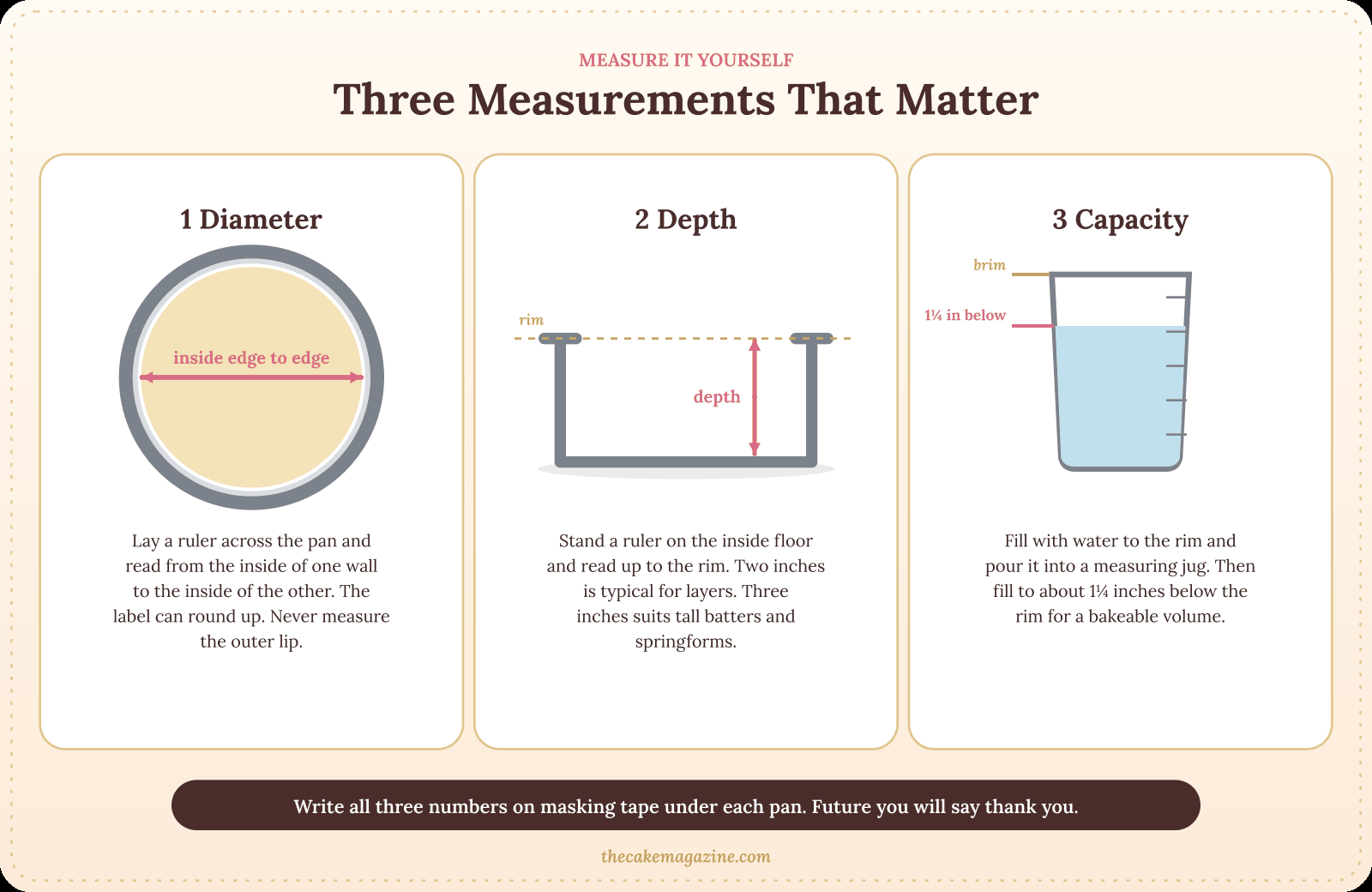
Measure cake pan sizes from the inside
Lay a rigid ruler across the pan and read from the inside of one wall to the inside of the opposite wall. Ignore the outer lip or rolled rim, because batter never touches it. For a round pan, take two readings at right angles in case the pan is slightly out of true. For a square or rectangular pan, measure length and width separately. It takes ten seconds and settles most of the confusion around cake pan sizes.
Measure the depth separately
Stand the ruler on the inside floor and read up to the rim. Many layer-cake pans are 2 inches deep, and many “tall” pans are 3 inches, but plenty of budget pans sit at 1.5 inches. That half inch matters. A shallow pan overflows with a batter that fits easily in a 2-inch pan, and a deep pan shades the top of a cake, which slows browning.
Measure capacity with water
For shaped pans such as Bundts, hearts and stars, the ruler is not enough, because the interior curves and ridges steal space. King Arthur Baking recommends a simple water test: fill the pan to the rim and pour the water into a measuring pitcher to find the capacity, then repeat with the water filled to about 1¼ to 1½ inches below the rim to find the volume you can actually bake in it. We will use that idea throughout this guide.
A habit worth stealing. Measure each pan once, then write the inside width, depth and water capacity on a strip of masking tape stuck under the pan or on the inside of a cabinet door. Next time a recipe calls for something unfamiliar, you can answer in seconds instead of hunting for a ruler.
Round cake pan sizes: 4, 6, 8, 9, 10 and 12 inches
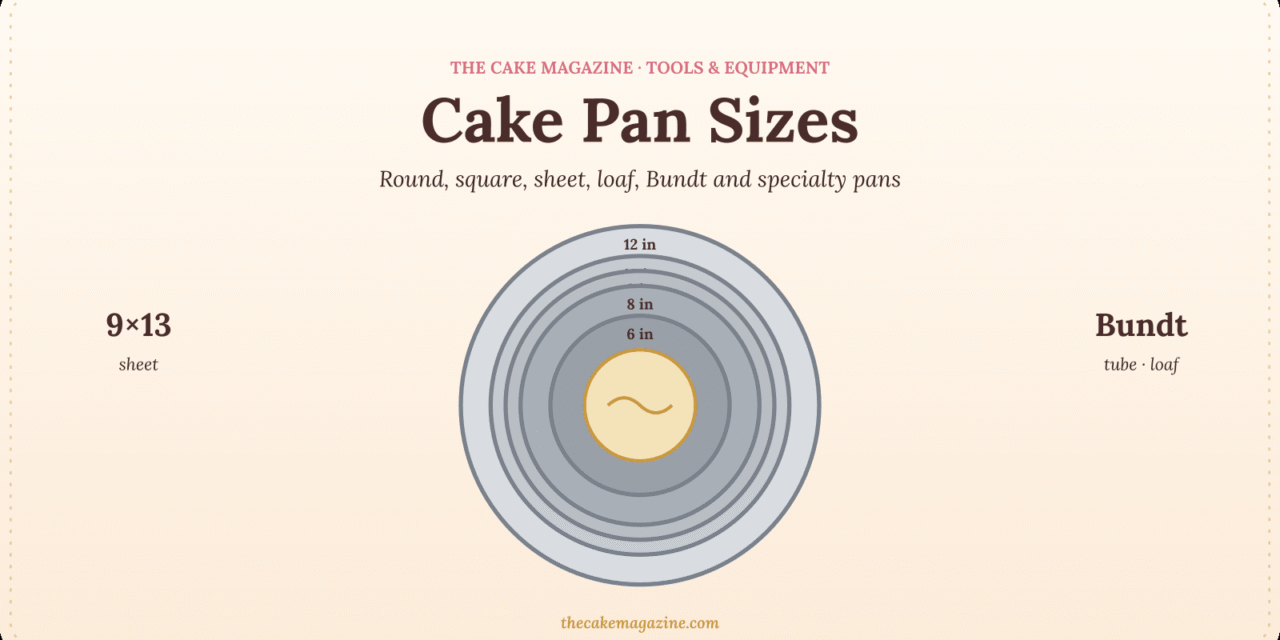
Round pans are the backbone of American layer cakes, and the 8-inch and 9-inch cake pan sizes cover most of what you will meet in recipe books and blogs. Because area grows with the square of the radius, the gaps between neighboring cake pan sizes are bigger than they look. A 9-inch round is only one inch wider than an 8-inch, yet its surface is about 27 percent larger. Here is how the common sizes line up, drawn to the same scale.

4-inch round
About 13 square inches. Used for tiny celebration cakes, test bakes and the top tier of a very small tiered cake. Some bakers love them for single-serving desserts. See our guide to mini cakes for more ideas.
6-inch round
About 28 square inches. A favorite for small celebrations and for the top tier of a wedding or birthday cake. It bakes quickly, so start checking early.
8-inch round
About 50 square inches. The classic home-baker layer pan. Two or three of them make a tall, tidy cake that suits most family gatherings.
9-inch round
About 64 square inches. The other standard. It is the size many American recipes assume when they say “two round pans” without further detail.
10-inch round
About 79 square inches. Handy for larger gatherings and for the middle or bottom tier of a stacked cake. It needs a roomy oven rack.
12-inch round
About 113 square inches. A big-event pan, often used as a base tier. Check that your oven and your cooling rack can hold it before you buy.
What the geometry says about batter
Multiply area by depth and you get the brim volume. A 2-inch-deep 8-inch round holds roughly 7 cups to the brim, a 9-inch about 8.8 cups, and a 10-inch about 10.9 cups. Those figures are theoretical maximums, not batter amounts. You never fill a pan to the brim, and each recipe leaves its own headroom depending on how much the batter rises.
For a feel for real numbers, King Arthur Baking notes that a typical 9 by 13 cake, or two 9-inch rounds, takes around 6 cups of batter. That is about three cups per 9-inch layer, well under the brim volume. It shows how much room a typical butter cake leaves for rising. A sponge that climbs high needs more headroom, and a dense pound cake can run closer to the top.
Which of the round cake pan sizes should you start with?
If you can only buy one pair, an 8-inch pair gives tall, elegant layers and uses less batter, which is kind to your budget. A 9-inch pair gives a wider, lower cake, bakes a little faster in the center, and matches more published recipes. Many bakers eventually own both. If you want a first cake that will look impressive with modest effort, try our vanilla cake recipe in whichever pair you own, and scale with the steps later in this guide.
A last thing about round pans: look for straight, vertical sides. Some inexpensive pans flare outward or have rolled bottom corners, which makes layers that are awkward to stack and frost. Straight sides also help when you want to build a tall cake with sharp edges. If frosting a neat cake is the goal, our guide to smooth buttercream sides shows why a clean layer matters from the first step.
Pan depth: 2-inch, 3-inch and what it does to batter
Width gets all the attention in discussions of cake pan sizes, but depth is the quieter variable that changes more bakes. A 2-inch pan is the everyday standard for layer cakes. A 3-inch pan holds about half again as much batter at the same width, and it gives you a taller single layer. Both can produce a lovely cake, but these two cake pan sizes do not behave the same way in the oven, and a recipe written for one will not always transfer cleanly to the other.
What a deeper pan changes
Taller sides shade the batter. The edges are insulated a little, the surface is farther from the oven’s top element, and the center takes longer to come up to temperature. In practice that often means a longer bake and a paler top. It also means the cake has more room to rise, so you can pour in more batter without overflow. A pan that is 3 inches deep at 8 inches wide holds roughly 10.5 cups to the brim, against about 7 for the 2-inch version.
What a shallow pan changes
A pan that is only 1.5 inches deep, which you will find in some budget lines, leaves little headroom. Batter that fits fine in a 2-inch pan can spill over the rim, make a mess of the oven floor and leave an undercooked, sunken center. King Arthur Baking advises using pans that are 2 inches deep for cakes, noting that shallower pans can suit bars. If you only own shallow pans, bake with a little less batter and set a rimmed sheet on the rack below to catch drips.
Do not trust the pan name for depth. Two pans both sold as “8-inch round” can differ by half an inch or more in height. When you buy pans for a layer cake, check the listed depth, and measure when they arrive. Matching depth matters as much as matching width if you want layers that bake at the same pace.
If you tend to bake tall cakes, you will likely want a few 3-inch pans, and you will want to read about heat and material in our cake pan buying guide, because deeper pans in dark finishes can brown the outside well before the inside is set. Lowering the oven temperature a little and baking longer is a common remedy, but check an oven thermometer first, as described in our oven thermometer guide.
Square and rectangular cake pan sizes: 8×8, 9×9, 9×13 and 11×7
Square and rectangular pans are where many family favorites live: sheet cakes, snack cakes, poke cakes, brownie-style bakes and anything served straight from the pan. They are also the pans people most often substitute for rounds, so it is worth knowing how their areas compare.
8×8 inch square
64 square inches. This matches a 9-inch round almost exactly. King Arthur Baking notes the two are interchangeable in most recipes.
9×9 inch square
81 square inches. Owned by fewer home bakers, but common in older recipes. An 8-inch square holds roughly 20 percent less.
9×13 inch rectangle
117 square inches. The workhorse for sheet cakes, crowd-pleasing desserts and casseroles. It is only a bit larger than two 8-inch rounds.
11×7 inch rectangle
77 square inches. A close match to a 9-inch square and a common substitute for it.
The corner effect
Square pans have corners, and corners bake faster because heat reaches them from two sides. If you like soft edges, lower the temperature slightly or pull the pan a few minutes early. If you like a crisp corner piece, enjoy the bonus. Rounded corners behave a little differently from sharp ones, too, so pans from different makers are not perfect twins even when the labels match.
How square pans turn into layers
You can bake a layer cake in square pans, and square layers are great for stacked cakes with clean corners. Remember that a 9-inch square has about 27 percent more area than a 9-inch round. If you are following a recipe written for round layers and you switch to square, scale the batter by the ratio of areas, which we work out in the swapping section below. For plain snack cakes, a single square pan is a simple, forgiving choice.
Cakes baked in a 9 by 13 pan also travel well. They are easy to frost in the pan, easy to slice into tidy portions and easy to cover for a potluck. If you are thinking about selling or sharing slices at scale, our wedding cake serving guide explains how portion size changes the math, and the same idea applies to sheet cakes.
Sheet pans and jelly roll pans: the shallow cake pan sizes
A sheet pan is a rimmed, shallow pan, usually about 1 inch deep. Bakers and restaurants use the term “full sheet” for the largest size, “half sheet” for half of that and “quarter sheet” for a quarter. Home ovens rarely fit a full sheet, so the half sheet and the quarter sheet are the ones to know.
Quarter sheet and half sheet
A half sheet pan commonly measures about 18 by 13 inches on the outside, which leaves a little less inside once the rim is subtracted. A quarter sheet is about 13 by 9 inches outside. Brands differ, and the rim size changes the usable area, so measure the inside if you plan to scale a recipe. Because these pans are shallow, they are meant for thin sponges, cake rolls, sheet cakes baked in a single layer and trays of bars.
Jelly roll pans
The jelly roll pan is the cake-roll specialist, usually 10 by 15 inches or 11 by 17 inches, with a rim of about an inch. King Arthur Baking lists the 10 by 15 version at roughly 150 square inches and says it is mainly for sponge cakes. A flexible, thin sponge needs that shallow depth to bake fast without drying out, so a deep pan is a poor stand-in.
Shallow pans bake fast. A thin sponge in a jelly roll pan may be done in a handful of minutes, which is why recipes for rolled cakes tell you to stay by the oven. Line the pan with parchment, since a thin cake with no release layer is almost guaranteed to stick. And whenever you take a cake from a sheet pan to a cooling rack, be gentle: thin layers tear easily.
A sheet pan is not a cake layer pan. The shallow rim that makes a sheet pan useful for sponges makes it a poor substitute for a 2-inch layer pan. If a recipe wants deep layers, a rimmed baking sheet will not hold the batter. Pair your sheet pans with a good rack; our cooling rack guide explains why size and strength matter.
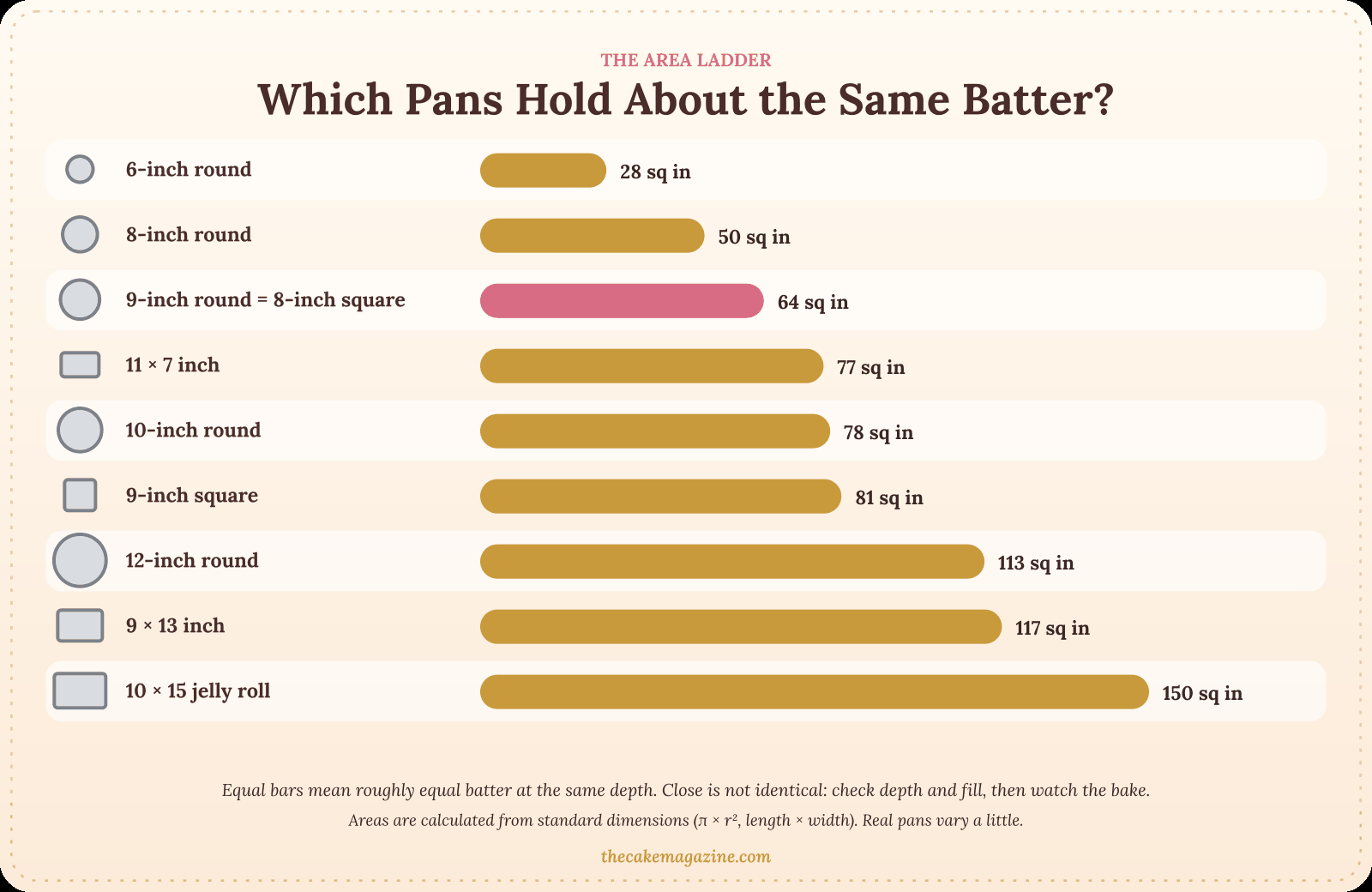
The ladder above puts the common cake pan sizes side by side. Notice the pairs. A 9-inch round and an 8-inch square sit together at 64 square inches. A 10-inch round and an 11 by 7 pan are close at 79 and 77. A 12-inch round and a 9 by 13 are nearly equal at 113 and 117. Pairs like these are your substitution shortcuts when you shop for cake pan sizes.
Loaf pans: two standard cake pan sizes and a mini
Loaf pans are mostly for pound cakes, banana bread, quick breads and tea cakes. They are narrow and deep, so the batter has to cook through a thick center. That makes loaves slower to bake than their volume suggests, and it makes the outside prone to browning before the middle is ready.
The two common sizes
You will see two standard loaf pans in American kitchens, and both belong on any list of cake pan sizes. The larger is sold as 9 by 5 inches, and the smaller as 8½ by 4½ inches. These are usually outside measurements, and the interior is a little smaller. Makers often list capacity in cups: the larger often lands around 8 cups to the brim and the smaller around 6. Those are label figures that vary by brand, so run the water test if a recipe depends on exact capacity.
Why loaf recipes are touchy about pan size
A loaf recipe written for the 9 by 5 pan can overflow in the 8½ by 4½ pan, because the smaller pan holds noticeably less. If you must swap, fill the smaller pan no more than about two thirds and bake the extra batter as a few muffins. Bake times shift too, since a narrower pan heats through faster. Use a toothpick or a thermometer rather than the clock.
Loaf pans also come in mini sizes, often sold in sets of four or six. Those are fun for gifting and for tasting-menu desserts. Divide the batter by weight so each mini loaf bakes evenly, and expect a much shorter bake. A digital scale makes that easy; our guide to kitchen scales for baking covers what to look for.
Bundt and tube pans: capacity is not batter volume
Bundt pans are the exception to every rule about cake pan sizes above. Their interior is ridged, swirled or sculpted, with a center tube that takes up space. That means the “capacity” printed on the pan, such as 10 cups or 12 cups, is a measure of how much water fits to the rim, not how much batter belongs inside.

The headroom rule
King Arthur Baking explains that a 10-cup Bundt pan has a bakeable capacity of about 6 cups, and a 12-cup pan about 7¼ cups. Batter should stay at least 1¼ inches below the rim, and the same source found that 6¼ cups was the upper limit for a 10-cup pan. If you fill to the brim, the cake will rise over the edge or bake into a heavy, uneven crown.
Swapping a Bundt for a flat pan
The good news is that a Bundt pan is a flexible substitute. A recipe made for a 9 by 13 pan or two 9-inch rounds yields about 6 cups of batter and can usually go into a 10-cup Bundt or a 12-cup Bundt. King Arthur suggests adding roughly 30 percent to the bake time for the 10-cup pan, a little less for the 12-cup pan, and checking for doneness once you reach the recipe’s maximum time.
Not every cake belongs in a Bundt. Delicate sponge and angel food batters want a different pan, since they need an ungreased surface to climb. Butter cakes, oil cakes and sour cream cakes do beautifully, because they have enough structure and fat to release cleanly. Grease every ridge, using shortening, a pastry brush and a thin dusting of flour or cocoa, or use a baking spray that contains flour.
Tube pans
Tube pans, with a straight, tall wall and a hollow center, are the home of angel food and chiffon cakes. Some have removable bottoms and little feet for cooling upside down. They come in several diameters, so check the capacity against the recipe. As with a Bundt pan, fill a tube pan by its volume, not by matching width. If you are unsure which pan to use for a specific cake, our cake baking science guide explains how structure and leavening decide what a batter can support.
Specialty cake pan sizes: springform, cupcake, mini and shaped
Beyond the standards sits a long list of pans that do one job well. Most of these cake pan sizes can be understood the same way as the round and square pans: find the capacity, note the depth, and think about how fast heat will reach the center. A few of them deserve their own advice.
Springform pans
A springform pan has a removable ring that latches around a flat base, so you can lift the sides away without flipping the cake. It is built for cheesecakes and other fragile desserts. Common diameters are 8, 9 and 10 inches, and the sides are usually taller than a layer pan. King Arthur Baking says plainly not to substitute for a springform when a recipe calls for one, because the extra depth and the removable wall are part of the design.
The flip side is that a springform is a poor choice for a thin, pourable batter that might leak through the seam. If you bake a regular cake in one, set it on a rimmed baking sheet to catch drips. Wrap the outside with foil if you plan a water bath, though note that many bakers prefer a water-free method.
Cupcake and muffin pans
A standard muffin pan has 12 cups, and a mini muffin pan has 24 or more. A jumbo pan has 6. Cup sizes vary by brand, so the amount of batter per cup changes. King Arthur Baking notes that a batch yielding about 6 cups of batter makes roughly two dozen cupcakes, which works out to about a quarter cup each. Fill liners about two thirds full for most recipes, and weigh the batter if you want even cupcakes.
Cupcakes bake fast, often in about 20 minutes for a standard size, though you should rely on a toothpick and on your own oven rather than on any number printed here. When you convert a layer recipe to cupcakes, keep the oven temperature the same or slightly higher and shorten the time substantially. See the troubleshooting section later for how to avoid dry, domed cupcakes.
Mini cake pans and dot cake pans
Mini round pans, often 3 to 4 inches across, are popular for individual cakes. They are the same shape as a layer pan with a smaller footprint, so the usual rules apply. Our guides to mini cakes and dot cakes show how bakers use these small formats, and they explain why a tidy, even bake matters when the cake is only a few bites.
Heart, hexagon, half-sphere and other shapes
Shaped pans have a wide range of capacities, so their cake pan sizes are hard to compare, and the printed label rarely tells you how much batter they take. Use the water test. Pour in water to the rim, then to about an inch below, and measure each. Fill with batter to the lower volume, since cake pan sizes on the label are rim measures. Because shaped pans often have narrow corners and thin edges, those parts bake fastest, so keep an eye on them and consider lowering the oven temperature.
Know your pan’s limits. Some specialty pans, such as silicone molds and nonstick novelty shapes, come with maker-set temperature limits or care instructions. Follow what the manufacturer prints for your specific pan, and do not assume that a pan safe for one oven setting is safe for another.
Cake pan sizes by area and volume: the easy math
You do not need to be a math person to work with cake pan sizes. You need two formulas and a calculator. The first gives you the area of a pan’s floor. The second turns area into a rough volume. Everything else about cake pan sizes follows from them.
Area: the number that matters most
For a round pan, area equals 3.14 times the radius times the radius, and the radius is half the width. For a square or rectangular pan, area is simply length times width. A 9-inch round has a radius of 4.5, so its area is 3.14 × 4.5 × 4.5, which is about 63.6 square inches. An 8-inch square is 8 × 8, or 64 square inches. That near-tie is why the two are such good partners.
When two pans have the same depth, comparing area is the same as comparing volume. That is the heart of the whole swap method. If your recipe was written for a pan of 100 square inches and you want to use a pan of 117, the new pan is about 17 percent larger, and you should scale the batter by roughly that amount.
Volume: area times depth
Multiply the area by the depth in inches to get cubic inches, then divide by 14.4 to get cups, because a cup is about 14.4 cubic inches. A 9 by 13 pan at 2 inches deep is 117 × 2 = 234 cubic inches, or about 16 cups to the brim. Remember that the result is a ceiling. A cake batter fills only part of that space.
What fraction should the batter fill?
You will often read that cake pans should be filled halfway to two thirds. That is a handy ceiling for batters that rise a lot. The real figure depends on the recipe. As noted earlier, a typical 9 by 13 cake uses about 6 cups of batter in a pan with a 16-cup brim, which is closer to 37 percent. Dense batters such as pound cake can sit higher, and airy sponges lower. Follow the recipe’s volume when you can, and scale it by area when you cannot.
The quick area cheat sheet. 6-inch round: 28. 8-inch round: 50. 9-inch round: 64. 8-inch square: 64. 9-inch square: 81. 10-inch round: 79. 11 by 7: 77. 12-inch round: 113. 9 by 13: 117. All in square inches. Keep this list near the oven and you can do most pan swaps in your head.
Swapping cake pan sizes without ruining the recipe
Now we put the numbers to use on real cake pan sizes. The method has four steps: find the area of the pan the recipe wants, find the area of the pan you have, divide the second by the first, and scale the batter by the result. Then check the depth and watch the bake. The picture below shows three common swaps on a balance, which is a fair way to think about it: you are trying to keep the batter and the pan in proportion.

Worked example: two 9-inch rounds into a 9 by 13
Two 9-inch rounds give 127 square inches in total, and a 9 by 13 gives 117. The pan is slightly smaller than the two rounds, so the batter will be a little deeper. King Arthur Baking says that a 9 by 13 pan is easily replaced by two 9-inch rounds, and that the substitution also works with one 9-inch and one 8-inch round. Expect a thicker slab, and begin checking for doneness a few minutes before the original time.
Worked example: two 8-inch rounds into a 9 by 13
Two 8-inch rounds total 100.5 square inches, about 14 percent less than 117. The batter will sit higher, and King Arthur Baking warns of an overflow risk with high-rising batters. If you try it, fill each round no higher than about two thirds, bake any leftover batter as cupcakes, and place a baking sheet on the rack below to catch spills.
Worked example: converting between 8-inch and 9-inch cake pan sizes
The 9-inch pan has about 27 percent more area, so multiply the recipe by about 1.25 if you want the layers to bake to the same depth. Scale by weight, not volume, and round eggs to the nearest half, using a beaten egg to split one. If you leave the recipe unchanged, the layers will be thinner and will finish sooner, so shorten the bake and check early.
Worked example: a 9-inch recipe in an 8-inch pan
The reverse needs more caution. Using an 8-inch pan for a 9-inch recipe puts about 27 percent more batter into a smaller space. Bake only about four fifths of the batter in the 8-inch pans, and use the rest for cupcakes. The extra height raises the chance of a sunken or gummy center, which our cake troubleshooting guide explains in detail.
Worked example: layers to a Bundt
A cake that makes about 6 cups of batter, such as a 9 by 13 or two 9-inch rounds, suits a 10-cup Bundt. Pour in about 6 cups and no more than 6¼. Bake longer, and use the toothpick test. If a recipe makes far more than 6 cups, do not push the extra into the Bundt. Bake it in a second pan or as cupcakes.
The recipe is a different volume than your pan
Likely causes: a swap that changed both area and depth, or a pan with a rounder, narrower interior than its label suggests.
Fix: measure the pan with water, divide your pan’s bakeable volume by the volume the recipe was written for, and scale the batter. Bake the surplus as cupcakes. Keep notes for next time.
Bake time and temperature when cake pan sizes change
Once the batter is scaled to the new cake pan sizes, the clock is the next question. There is no universal conversion, but there are patterns that hold across ovens and recipes. Larger and deeper means slower. Smaller and shallower means faster. Dark metal and glass shift things again, as covered in our cake pan buying guide.
Depth drives the clock
A thin layer reaches the center quickly. A thick slab takes longer, because heat has to travel farther and the outer edge sets while the center is still wet. That is why cupcakes finish quickly, a 9 by 13 takes about as long as two layers or a touch longer, and a deep Bundt can take roughly 30 percent longer than the flat version, according to King Arthur Baking’s Bundt guidance.
Use cues, not just minutes
Start checking earlier than the recipe says whenever the pan is smaller, shallower or a different material. Look for edges that pull slightly from the pan, a top that springs back when pressed lightly, and a toothpick that comes out with a few moist crumbs but no wet batter. For a more precise reading, many bakers use a thermometer; it removes the guesswork and keeps you from overbaking.
When to change the oven temperature
If you move a recipe from a light pan to a dark one, or from a shallow pan to a deep one, a small drop in temperature can help the edges and center finish together. If you bake a big flat cake in a large pan, a slightly lower temperature also reduces the risk of dry edges. Many ovens run hot or cold, so verify yours with an oven thermometer. Our oven thermometer guide shows how to check calibration and hot spots.
A swap routine to follow. Find the area of both pans. Scale the batter by weight. Check that the batter will fill the new pan no more than about half to two thirds. Lower the temperature slightly for dark or deep pans. Begin testing early. Cool as the recipe directs, and write down what worked so you can repeat it.
If you want a recipe that you can use to practice swaps, our chocolate cake recipe and red velvet cake recipe are both written to scale, and our carrot cake recipe is a useful test of how a heavier batter behaves in a different pan.
Cake pan sizes for tiered cakes
Tiered cakes depend on cake pan sizes in a way single cakes do not. The tiers have to stack, so each one needs to be smaller than the one beneath it by enough margin to look intentional, and each one needs to bake to a matching height. The usual approach is to step down by 2 inches in diameter from tier to tier, as in 6, 8 and 10 inches, or 8, 10 and 12 inches for a larger cake.
Why a 2-inch step works for tier cake pan sizes
A 2-inch difference leaves a 1-inch ledge on each side of a tier, which is enough to look graceful and to hold decorations or piping. A smaller step looks cramped, and a larger one can look top-heavy or thin. Many bakers also bake each tier as two or three layers of the same size, so that every tier ends up equally tall.
Matching depth and pairs
For a stacked cake, plan on a pair of each size so that you can bake two layers per tier at once. Use pans of the same depth and the same finish, or the tiers will brown differently and need leveling. Weigh the batter into each pan to keep layers even, a habit we recommend in the cake pan buying guide as well.
Support, boards and servings
A tier larger than 6 inches usually needs internal support, and every tier needs a cake board of the right size. Our guide to cake support supplies covers dowels, straws and boards, and cake boards versus drums explains how to choose them. For portion planning, see the wedding cake serving guide, and for planning the whole event, the wedding cake guide gives the broader picture. We do not publish serving counts here, because they depend on how the cake is cut and who is eating it.
Think in finished size, not pan size. After trimming, filling and frosting, a tier is typically wider and taller than the pan it was baked in. Allow for that when you choose boxes, boards and cake stands, and measure the finished cake before you buy anything it has to fit.
Which cake pan sizes to own first
You do not need every one of the cake pan sizes in this guide. A short, well-chosen list handles a surprising range of recipes. Think about what you actually bake, and add pans only when a specific recipe asks for one you lack. Here is a sensible way to build up, by baker type.
The occasional baker
Two 9-inch rounds, 2 inches deep, and one 9 by 13 pan. That covers layer cakes, sheet cakes and most snack cakes. An 8-inch square is a smart third addition, because it doubles as a 9-inch round in many recipes.
The regular layer-cake baker
Three 8-inch rounds and three 9-inch rounds. Three layers of one size make a tall cake with room to spare. Add a quarter sheet pan for cake rolls and thin layers.
The tier baker
Two each of 6, 8 and 10 inches, all the same depth. Add a pair of 12-inch rounds if you bake for larger events, and a few 3-inch pans for tall tiers.
The bread and pound-cake fan
One 9 by 5 loaf pan and one 8½ by 4½. Add a 10-cup Bundt pan if you love sculptural cakes, since it can stand in for a 9 by 13.
Before you buy anything, compare the pan against the one you already have. If a recipe asks for a size within about one inch of a pan you own, you can often use the pan you have with a little batter scaling. Spending your budget on better, matching pans in a few cake pan sizes is smarter than buying a large mixed set of unmatched ones. For the tools that sit next to pans on the counter, our guides to stand mixers and hand mixers are good next reads.
A note on parchment, strips and prep
Pan size affects prep too. Parchment rounds are sold by diameter, so buy sizes that match your pans or cut your own by tracing the base. Cake strips come in lengths that fit certain pan circumferences. For tall pans and large rounds, check that the strip is long enough to wrap the whole pan. Greasing and lining is quick work in a standard pan and fussier in a Bundt, where every ridge needs attention.
Common mistakes and quick fixes
Most problems with cake pan sizes come from a handful of repeated errors. Here are the ones we see most often, with fixes that cost nothing.
The batter overflowed the pan
Likely causes: a pan smaller or shallower than the recipe assumed, filling too high, or a Bundt filled by its printed capacity rather than its bakeable capacity.
Fix: measure the pan with water, leave at least an inch of headroom, and bake the surplus separately. Put a baking sheet on the lower rack next time.
The center sank or stayed gummy
Likely causes: too much batter for the pan, an oven that is too cool or too hot, or opening the oven door too early.
Fix: scale the batter to the pan, confirm the oven temperature with a thermometer, and keep the door closed until the cake has set. The cake troubleshooting guide goes through each cause.
The edges were dry and dark
Likely causes: a dark pan, a pan bigger than the recipe expected, or a bake that ran long.
Fix: lower the oven temperature slightly, check earlier, and consider cake strips for a gentler edge. A thinner layer in a bigger pan finishes sooner than the recipe’s time.
The layers came out different heights
Likely causes: pans with different true widths or depths, or batter divided by eye.
Fix: weigh the batter into each pan, use matching pans, and level the oven rack. Trim the dome of each layer for tidy stacking.
The cake stuck to the pan
Likely causes: skipped parchment, thin greasing in a detailed pan, or waiting until the cake was fully cold.
Fix: run a thin knife around the edge, warm the pan bottom briefly with a damp towel and try again. Next time, line the base with parchment.
Most of these come down to measuring before you bake. It is a small habit that pays off every time you use cake pan sizes that do not match the recipe, and it keeps you from blaming the recipe for something the pan did.
A quick list of safe swaps between cake pan sizes
Here is a short reference you can scan when a recipe names a pan you do not own. Each swap between cake pan sizes is based on the area figures above and on the King Arthur Baking substitution advice we have cited. Treat them as starting points: check depth, scale by weight when the area changes, and test for doneness early.
- 9-inch round to 8-inch square. Nearly equal area at about 64 square inches. Swap directly, and expect the corners to brown a little faster.
- Two 9-inch rounds to a 9 by 13. Close in volume. Expect one thicker layer and a slightly longer bake for the slab.
- 9 by 13 to a 10-cup Bundt. Works when the recipe makes about 6 cups of batter. Add roughly 30 percent to the bake time, and leave 1¼ inches of headroom.
- 9-inch square to an 11 by 7 pan. Close at 81 and 77 square inches. Layers are a little thicker in the smaller pan.
- 8-inch round to a 6-inch round. The 6-inch holds about 56 percent of the batter. Scale down and bake early.
- Layers to cupcakes. A 9 by 13 batch of about 6 cups makes roughly two dozen cupcakes. Cut the time sharply and use a toothpick.
- Loaf pan size to size. Going from 9 by 5 to 8½ by 4½, fill no more than about two thirds and bake the extra separately.
Swaps we would avoid
A few substitutions create more trouble than they solve. Do not swap a springform for a regular pan, or the reverse, when the recipe depends on a removable wall. Do not bake delicate sponge or angel food cakes in a Bundt. Do not stand in a shallow sheet pan for a 2-inch layer pan. And do not put batter into a glass or ceramic dish without checking the maker’s instructions for the oven temperature, since those materials heat differently from metal.
When in doubt, bake a small test. If you are about to commit an expensive batch of batter, such as a wedding cake or a cake for a client, bake a trial in the pans you plan to use. It is the fastest way to find out whether your swap works before it matters.
Fitting pans in your oven and your kitchen
Cake pan sizes are not only a recipe question. It is also a question of what fits. A 12-inch round and a half sheet pan need real space, and home ovens vary. Before you buy large pans, measure the inside of your oven, check the rack positions and leave room for air to circulate. Pans that touch each other or the oven walls bake unevenly.
Rack positions and spacing
For two layers, the middle rack usually works best. If you need to bake four layers at once, use two racks and swap them halfway through, or bake in two rounds. Stagger pans so that one does not sit directly above another, which blocks heat. Leave about an inch between pans and walls. Cooling matters too: a cooling rack large enough to hold a hot layer saves you from cracks and soggy bottoms.
Storage and handling
Nested round pans stack neatly when they are different sizes, though stacking pans of the same size scratches them. Store loaf and square pans on edge in a cabinet organizer. Keep springform pans in two pieces or latched, depending on your space, and take care of the base so the seam stays flat. Wash and dry every pan thoroughly before storing it, and follow the maker’s care instructions to protect any coating.
Safety basics when you bake
Baking is a low-risk activity, but a couple of habits help. Use dry oven mitts, since steam burns can happen through a wet cloth. Let hot pans cool on a rack, not on a cold, wet counter. And if your cake contains perishable fillings or frostings, such as cream cheese or custard, follow safe handling and storage guidance from the USDA; the USDA Food Safety and Inspection Service publishes clear, general advice on keeping food at safe temperatures.
Cake pan sizes FAQ
What are the most common cake pan sizes?
The most common cake pan sizes in American kitchens are 8-inch and 9-inch rounds, an 8-inch or 9-inch square, a 9 by 13 rectangle, and 9 by 5 loaf pans. Most layer cake recipes assume rounds that are 2 inches deep.
Can I use an 8-inch square pan instead of a 9-inch round?
Yes, in most recipes. Both have an area of about 64 square inches, and King Arthur Baking lists them as interchangeable. The square’s corners may brown faster, so check a little early and trim crisp edges if you prefer soft ones.
How many cups of batter do the larger cake pan sizes hold, such as a 9 by 13?
To the brim, a 2-inch-deep 9 by 13 pan holds roughly 16 cups by simple geometry, but you should not fill it that far. A typical 9 by 13 cake uses about 6 cups of batter, according to King Arthur Baking, so follow the recipe’s amount.
What is the difference between a 2-inch and a 3-inch cake pan?
A 3-inch pan holds about half again as much as a 2-inch pan of the same width, so it makes a taller layer and often bakes longer. Both are common, but check the depth of the pan a recipe expects before you swap them.
How do I measure cake pan sizes correctly?
Measure the width from the inside of one wall to the inside of the other, and the depth from the inside floor to the rim. For shaped pans, use water: fill to the rim and measure, then fill to about 1¼ inches below the rim for the bakeable volume.
How much batter goes in a 10-cup Bundt pan?
About 6 cups, with an upper limit near 6¼ cups, according to King Arthur Baking. The 10-cup label measures the pan filled to the rim with water, and batter needs at least 1¼ inches of headroom to rise.
How do I convert a recipe between cake pan sizes, such as 9-inch to 8-inch?
Divide the area of the 8-inch pan by the area of the 9-inch pan, about 50 divided by 64, which is roughly 0.8. Multiply the recipe by that amount by weight, bake any extra batter as cupcakes and check for doneness early.
Can I bake a layer cake recipe in a 9 by 13 pan?
Usually yes. A recipe for two 9-inch rounds fits a 9 by 13 well, and one for two 8-inch rounds is a little tight. Fill no higher than about two thirds, expect a thicker slab, and bake a bit longer, checking for doneness early.
Do cake pan sizes affect baking time?
Yes. Deeper and wider pans generally need longer, while shallow pans and small cupcakes finish faster. Depth matters most, because heat has to reach the center. Start checking earlier than the recipe says and rely on visual cues and a toothpick.
Which cake pan sizes do I need for a three-tier cake?
A common choice is 6, 8 and 10 inches, stepping down 2 inches per tier, with a pair of each size for two layers. Use the same depth throughout and add boards and supports. See our wedding cake guides for planning.
Can I use a loaf pan for cake batter meant for a round pan?
You can, but the narrow, deep shape bakes differently. Fill it no more than about two thirds, expect a longer bake and cover the top with foil if it browns too fast. Check with a toothpick rather than the clock.
Why do my cake layers come out different sizes?
Mismatched pan widths or depths, and batter divided by eye, are the usual culprits. Weigh the batter into each pan, use matching pans and level the oven rack. Differences in cake pan sizes that look small on paper can show up clearly in the baked layers.
Final thoughts
Pan size is one of those topics that feels fussy until the day it saves a cake. Once you know that a 9-inch round and an 8-inch square are twins, that a 10-cup Bundt really takes about 6 cups of batter, and that depth changes the bake as much as width, most substitutions become easy. The whole subject of cake pan sizes comes down to three measurements and one bit of arithmetic.
Measure your pans once and write the numbers down. Keep a short list of safe swaps near the oven. Buy a few matching pans in the sizes you bake most, rather than a drawer of near-misses. And when a recipe goes oddly, check the pan before you blame the batter. If you want a place to practice, our vanilla cake recipe is a forgiving starting point, and King Arthur Baking’s cake guide is a trusted companion for technique.
Tell us which pan you own and which recipe you want to bake, and we will keep improving this guide with the swaps readers ask about most. A good grasp of cake pan sizes is a lasting skill, and it will keep paying off whatever you bake next.
Editorial note: reviewed and updated November 2026. This guide is written for home bakers in the United States, using American inches and cups. Area and volume figures are calculated from standard dimensions and are approximate, and pan makers differ in dimensions and care instructions. Capacity and substitution guidance is paraphrased from King Arthur Baking’s published pan-size and Bundt pan articles. We did not conduct product tests for this article. Always follow the manufacturer’s instructions for your own pans.