A good carrot cake is supposed to be the easiest cake in the neighborhood to love: soft, spiced, a little crunchy from nuts, and finished with a tangy blanket of cream cheese frosting. A bad one is oily and weirdly wet in the middle. This carrot cake recipe is built on a handful of sensible choices, such as fine shreds, oil instead of butter, brown sugar, toasted nuts, and a frosting that is kept cold. Below you get one starting formula and the reasons behind each step.
A dependable carrot cake recipe uses finely grated carrots, a neutral oil, a mix of white and brown sugar, warm spices and toasted nuts, stirred together in one bowl without any creaming. Bake two 8-inch layers at 350°F until a skewer comes out with a few moist crumbs, cool them completely, then fill and frost with a cream cheese frosting made from cold block cream cheese. Weigh everything, and treat our timings as a starting point to test in your own oven.
- Why this carrot cake recipe works
- The ingredients, explained
- Grating the carrots
- Choosing and balancing the spices
- Nuts, raisins and other mix-ins
- Equipment and pans
- The carrot cake recipe card
- Step-by-step method
- How to tell it is done
- Cream cheese frosting
- Filling, stacking and frosting
- Pan sizes and yield
- Make ahead and storage
- Troubleshooting
- Carrot cake styles and variations
- Ten mistakes to avoid
- FAQ
Why this carrot cake recipe works
People who go looking for a carrot cake recipe usually want the same few things. They want a cake that stays moist for days, spices that taste warm rather than dusty, and layers sturdy enough to carry a thick frosting. A few deliberate decisions in this formula answer each of those wishes. Once you understand them, you can adapt the carrot cake recipe: swap nuts, change the spice blend or move to a different pan without wondering what will break.
This carrot cake recipe uses oil, so the crumb stays soft
Butter tastes lovely, but it is firm when cold and it contains water and milk solids. A cake made with liquid oil stays plush straight from the refrigerator, and carrot cake spends a good part of its life in the refrigerator because of its cream cheese frosting. Carrots, cinnamon and brown sugar already bring plenty of flavor, so you lose very little by skipping butter in the batter. Save the butter for the frosting, where it earns its place.
Carrots bring moisture to a carrot cake recipe, not just color
Carrots are mostly water, along with natural sugars and a little fiber. As the cake bakes, the shreds soften and release that moisture into the crumb, which is why a carrot cake feels damp without tasting wet. The fiber also gives the crumb a tender, slightly rustic bite. This is also the reason that carrots need to be measured by weight. A loosely packed cup and a pressed cup of shreds can differ by a third, and that changes how wet the batter turns out.
Brown sugar deepens the flavor of the carrot cake recipe
Plain granulated sugar sweetens. Brown sugar does that and adds molasses, which brings a caramel note, a little acidity and extra moisture-holding power. Using both keeps the cake tasting rounded rather than flat. It also helps the crust develop a gentle, golden-brown color. If you only have white sugar, you can still make the cake, and we cover the substitution later.
One bowl, no creaming: a carrot cake recipe with fewer ways to go wrong
There is no creaming of butter and sugar here and no whipping of egg whites. You whisk the eggs, sugars and oil together, stir in the dry ingredients, and fold in the carrots and nuts. That makes it one of the most forgiving layer cakes you can bake, and a good first project if you are moving beyond boxed mixes, and a friendly carrot cake recipe for beginners. If you would like to see how this style compares with creaming and foaming, read our guide to cake mixing methods.
This carrot cake recipe is built to hold a heavy frosting
Cream cheese frosting is soft by nature, and carrot cake layers are chunky with shreds and nuts. A cake that is too delicate will tear when you try to frost it. This formula is structured with enough flour and eggs to hold together, yet it stays tender thanks to the oil. Chilling the layers before you frost makes the job much easier, as you will see in the assembly section.
A note on how we present recipes. The Cake Magazine has not oven-tested this formula. It is built from conservative, widely used carrot cake ratios and checked against general baking principles, so treat it as a starting point to adapt. Bake times and amounts vary with your oven, pans and carrots. Make this carrot cake recipe once as written, take notes, and adjust from there.
The ingredients, explained
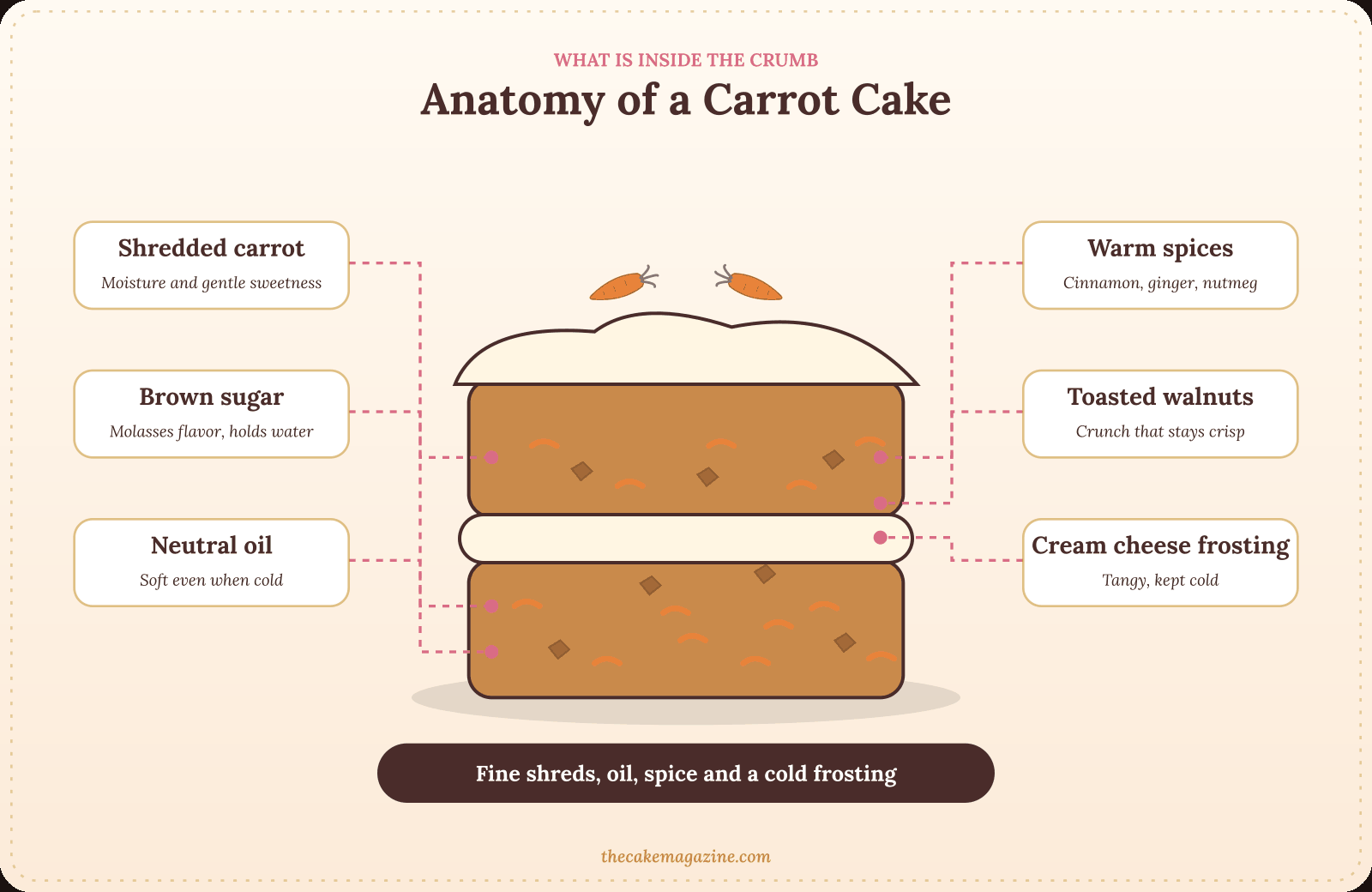
Before you start weighing, it helps to know what each ingredient is doing. The cross-section below shows where the main players sit in the finished crumb, and the notes after it explain the choices in plain language.
Carrots: the heart of any carrot cake recipe
Use fresh, firm carrots, peeled and grated yourself. Pre-shredded bagged carrots are usually cut thick and dry out at the edges, so they bake up as chewy strands instead of melting into the crumb. Fresh carrots with a bright orange color and a snappy texture have the most sugar and moisture. Avoid carrots that feel rubbery, since they have already lost water. We give the grating details in the next section.
All-purpose flour: structure without toughness
Plain all-purpose flour is perfect here. The carrots, nuts and oil soften the crumb, so you do not need cake flour. Spoon the flour into the bowl on a scale rather than scooping with the cup, because scooped flour packs down and can add a surprising extra ounce. If measuring flour is something you want to get right, our guide on how to measure flour for cake shows why grams win every time.
Granulated and light brown sugar
Granulated sugar gives clean sweetness and a fine, even texture. Light brown sugar adds molasses flavor and moisture. Pack the brown sugar only if you are using cups, and weigh it if you can. Dark brown sugar works too, though it will push the flavor toward gingerbread and darken the crumb.
Neutral oil: moisture that lasts
Canola, vegetable or sunflower oil keeps the flavor clean so the spices stay in front. Avoid a robust extra virgin olive oil unless you want that taste in the cake. Weigh the oil, because the recipe depends on a consistent ratio of fat to flour. A cake with too little oil bakes up dry, and one with too much can feel greasy and may sink.
Eggs: structure and lift
Four large eggs give the cake enough protein to hold a heavy load of carrots and nuts without becoming rubbery. Use them at cool room temperature so they blend smoothly with the oil and sugar. If you forgot to take them out, place them in a bowl of warm tap water for five to ten minutes. You can read more about when temperature matters in our guide to room-temperature ingredients for cake.
Baking soda, baking powder and salt
Brown sugar and any buttermilk or pineapple add a little acidity, which baking soda needs in order to work. Baking powder supplies steady, reliable lift. Together they give the heavy batter enough rise to avoid a dense, damp layer. Check the dates on both, because they lose strength over time. Salt is not optional: a pinch sharpens the spices and keeps the cake from tasting merely sweet. To see how the two leaveners differ, read baking powder vs baking soda in cake.
Vanilla in a carrot cake recipe
A teaspoon or two of pure vanilla extract rounds out the spices. You will not taste vanilla on its own. You will notice that the cinnamon and nutmeg taste smoother and more complete.
Optional extras: pineapple, coconut and raisins
Many classic American versions add crushed pineapple, shredded coconut or raisins. These are optional in our formula, and we treat them in the mix-ins section. If you add wet ingredients such as pineapple, remember that they change the moisture balance, so drain them well and bake a little longer.
Three habits that matter most. Weigh the carrots, flour and sugar. Grate the carrots finely and squeeze nothing. Keep the cream cheese frosting cold. These three habits do more for a carrot cake than any exotic ingredient.
Grating the carrots for a carrot cake recipe
This is the step where a carrot cake recipe is won or lost. The size and the dryness of your shreds change the texture of every bite, so it is worth a few minutes of care.

Fine shreds make the best carrot cake recipe crumb
Use the small holes of a box grater, or the fine shredding disc on a food processor. Fine shreds soften quickly in the oven, spread their moisture evenly and give a cake that feels uniformly tender. They also look better in a slice, with flecks of orange that never stand out as stringy pieces. This is the texture most people picture when they think of a classic carrot cake.
Medium shreds give a rustic bite
The medium holes of a box grater leave a slightly chewier cake with visible ribbons of carrot. Some bakers love that. If you choose this size, weigh the carrots and consider cooking the cake a few minutes longer, since larger shreds hold more water and the center can stay damp. Pairing medium shreds with chopped walnuts gives a pleasing contrast of soft and crunchy.
Coarse shreds are the risky choice
Large shreds can leave pockets of moisture and strands that do not fully soften. They also tend to sink toward the bottom of the pan as the cake bakes, which can leave a heavy, wet band at the base. If all you have is a coarse grater, give the shreds a few quick chops with a knife before you weigh them.
Should you squeeze or drain the carrots?
No. Freshly grated carrots do not need squeezing, and doing so strips away moisture and natural sugar the recipe relies on. The one exception is carrots that have sat out and are visibly wet from the grating, or a batch that looks watery on the cutting board. In that case, blot them gently with a clean towel. Do not wring them out.
Food processor or box grater?
A food processor with the fine shredding disc is quick and gives a consistent result. Cut the peeled carrots into pieces that fit the feed tube and shred them in small batches. A box grater takes longer but gives you more control over the size. Whichever you use, weigh the shreds after grating rather than before, since the weight of whole carrots includes tops, tips and peelings you will not use.
How many carrots is 350 grams? It depends on size, but three to four medium peeled carrots usually get you there. Buy one extra so you are never short. Leftover grated carrot keeps well in a covered container for a day and is lovely in a salad or slaw.
Choosing and balancing the spices
A carrot cake recipe is really a spice cake in disguise. Without the spices, you have a sweet, vaguely vegetal yellow cake. With them, you get the warm, cozy flavor people crave. The trick is balance: enough to taste clearly, not so much that the cake turns gritty or medicinal.

Cinnamon leads the carrot cake recipe spice blend
Cinnamon is the backbone, and in our formula it makes up most of the spice blend. Fresh ground cinnamon tastes sweet and warm, while an old jar tastes like sawdust. If yours has sat in the cupboard for years, replace it. Cassia, the common supermarket kind, is bolder and spicier. Ceylon cinnamon is milder and more floral. Either works, so choose the flavor you prefer.
Ginger adds brightness
A small amount of ground ginger lifts the whole blend and keeps it from tasting heavy. It also complements the sweetness of carrots. Too much, and the cake starts to taste like gingerbread, so measure it with care.
Nutmeg, allspice and cloves are the supporting cast
Nutmeg adds an aromatic, slightly woody warmth. Allspice brings notes of clove, cinnamon and pepper in one jar. Cloves are powerful, and a tiny pinch is plenty. Freshly grated nutmeg tastes noticeably better than the pre-ground kind, and a whole nutmeg lasts a long time. Our starting formula uses cinnamon, ginger and nutmeg only, and the wheel above shows how to nudge the blend toward spicier or milder versions.
How much spice is too much?
Our carrot cake recipe uses about 12 grams of total spice for 300 grams of flour. That is generous enough to taste clearly after the frosting is on, because cold cream cheese frosting mutes flavors. If you serve the cake at room temperature, you may find the spices more pronounced. Taste the batter before baking, but remember that raw batter tastes stronger than the finished cake.
Stir the spices into the flour, not the wet mixture
Whisk the spices through the dry ingredients so they disperse evenly. Clumps of cinnamon or nutmeg in the batter lead to bitter pockets and uneven flavor. If your ground ginger or nutmeg is lumpy, break up the lumps with a fork or sift the dry ingredients.
Toasting spices: worth it or not?
Toasting whole spices wakes up their oils, but ground spices burn quickly and rarely benefit from the extra step in a cake. Instead, rely on fresh spices and good proportions. If you want an extra layer of flavor, replace a little of the sugar with brown sugar or add a spoonful of freshly grated ginger to the wet ingredients.
Nuts, raisins and other mix-ins
Mix-ins are where a carrot cake becomes yours. Some bakers want nothing but carrots and spice. Others want walnuts, pecans, coconut, pineapple and raisins all in the same bowl. Know the effect of each before you start tossing handfuls in.
Walnuts and pecans for a carrot cake recipe: toast them first
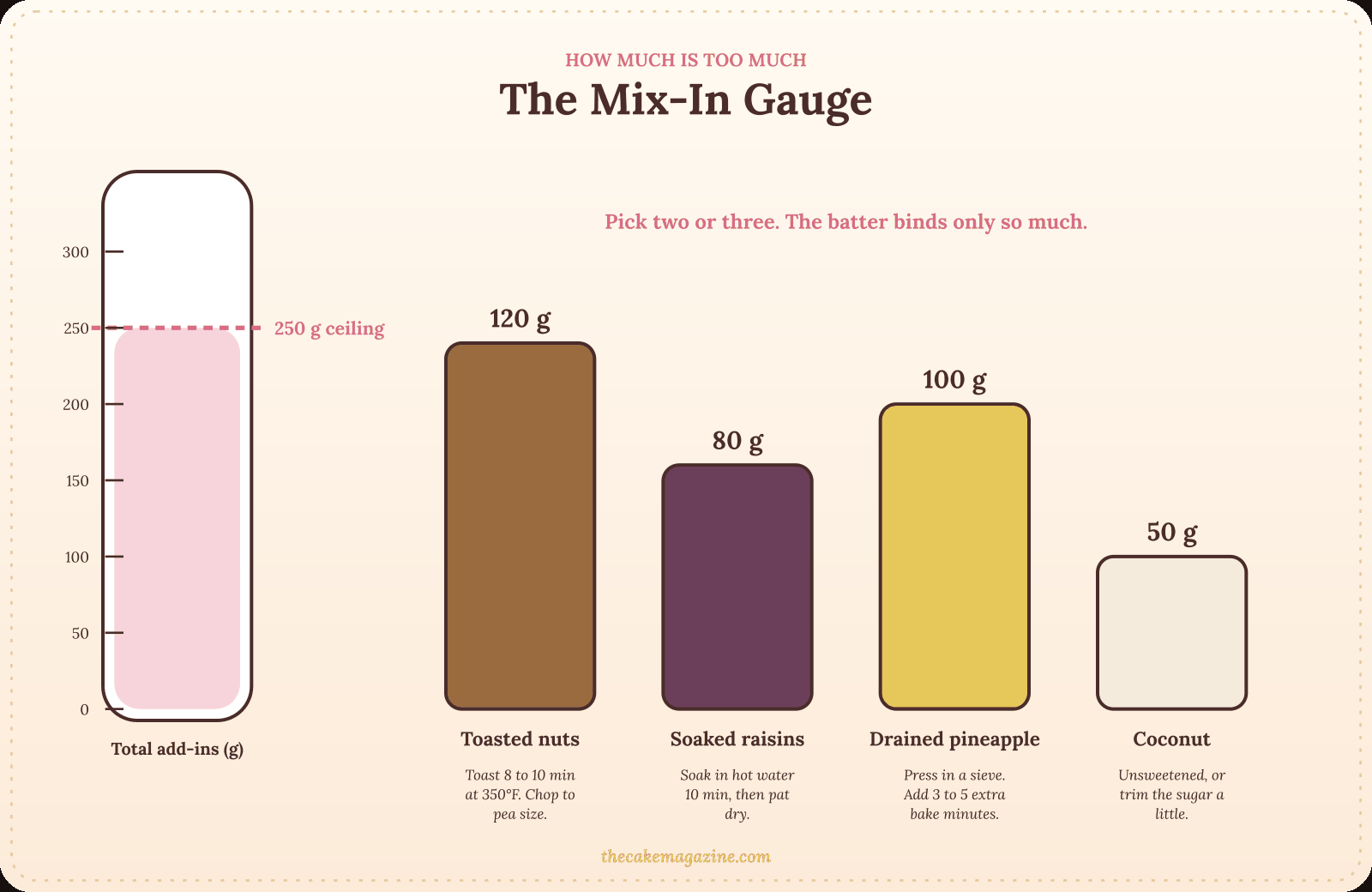
Walnuts are the classic choice, with a slightly bitter edge that balances the sweetness. Pecans are sweeter and more buttery. Either way, toast them. Spread chopped nuts on a baking sheet and bake at 350°F for about 8 to 10 minutes, shaking the pan once, until they smell fragrant and nutty. Cool them completely before adding them to the batter. Toasting keeps them crunchy even after a day in a moist crumb.
How many nuts is enough?
Our formula uses 120 grams of toasted, chopped nuts, which gives noticeable crunch without crowding out the carrots. Chop them to about the size of a pea, since large pieces sink and make slicing awkward. A coarse chop also keeps the pieces from turning into a mealy paste. For nut-free versions, see the variations section.
Raisins and currants
Raisins give pops of sweetness and chewiness. If you use them, soak them in hot water or hot tea for ten minutes, then drain and pat them dry. Otherwise they draw moisture from the crumb and can taste leathery. Golden raisins look prettier against orange carrot, and currants are a smaller, tangier option for people who feel strongly about the size of dried fruit.
Pineapple in a carrot cake recipe: moisture with a catch
Crushed pineapple adds moisture, a hint of acidity and a subtle tropical sweetness. It also adds a lot of water, so drain it thoroughly in a sieve, pressing gently, before measuring. About 100 grams of well-drained crushed pineapple is a sensible addition to this formula. Because it adds moisture, add a few extra minutes of bake time, and check the center carefully.
Shredded coconut
Unsweetened shredded coconut adds chew and a mellow sweetness. Use about 50 grams. Sweetened flaked coconut works as well, though it will make the cake sweeter and more moist, so you may want to trim the granulated sugar slightly. Toasting coconut deepens its flavor, and it is lovely pressed onto the sides of the frosted cake.
How many mix-ins can one cake carry?
Plan for a total of about 200 to 250 grams of mix-ins in this formula. The batter is thick, but it is not unlimited. Too many additions make the cake crumbly, because there is not enough batter to bind everything together, and they sink toward the bottom of the pan. If you want it all, pick two or three and skip the rest.
Equipment and pans
You do not need anything exotic to follow a good carrot cake recipe. A few reliable tools make the job easier and the result more consistent. Our pan buying guide goes into depth if you are shopping for new ones.
- Two 8-inch by 2-inch round cake pans. Light-colored aluminum pans bake evenly and brown gently. Dark pans can brown the edges before the center sets.
- A digital kitchen scale. The easiest way to make this carrot cake recipe repeatable.
- A box grater or food processor with a fine shredding disc.
- Parchment paper. Line the bottoms so the heavy, sticky cake releases cleanly.
- Two large bowls and a whisk. One for dry ingredients, one for wet.
- A flexible spatula for folding in the carrots and nuts.
- A wire rack for cooling.
- An oven thermometer. Many home ovens run hotter or cooler than the dial says, which can make a cake dry or underbaked.
- An offset spatula and a bench scraper for frosting.
Preparing the pans
Grease the pans with soft butter or baking spray, line the bottoms with a circle of parchment, then grease the parchment. Dust the sides lightly with flour, and tap out the excess. Carrot cake is sugary and sticky, and the sugars love to cling to bare metal. Thorough preparation prevents the frustrating moment when half a layer stays behind. Our guide on why cakes stick to the pan covers release problems in more detail.
A note about weighing the batter
Place the pans on the scale and divide the batter evenly by weight. Carrot cake batter is thick and chunky, so it is easy to give one pan a little more than the other. Equal layers bake at the same speed and stack neatly. You will need about 800 grams per pan with this formula, though your total may vary slightly.
The carrot cake recipe card
Here is the full carrot cake recipe formula. It is a starting point, so treat the bake times as a range to check against your own oven. We have listed grams first, with cup measures in parentheses for convenience.
Carrot Layer Cake with Cream Cheese Frosting
A one-bowl, oil-based, two-layer 8-inch carrot cake with fine carrot shreds, warm spices and toasted walnuts, finished with a tangy cream cheese frosting. This is an untested starting formula, built from conservative ratios.
Cake ingredients
- All-purpose flour300 g (about 2 1/2 cups, spooned and leveled)
- Baking soda5 g (1 teaspoon)
- Baking powder4 g (1 teaspoon)
- Fine salt5 g (1 teaspoon)
- Ground cinnamon8 g (1 tablespoon)
- Ground ginger2 g (1 teaspoon)
- Ground nutmeg1 g (1/2 teaspoon)
- Large eggs, cool room temperature200 g (4 eggs)
- Granulated sugar200 g (1 cup)
- Light brown sugar150 g (3/4 cup, packed)
- Neutral oil220 g (1 cup)
- Pure vanilla extract8 g (2 teaspoons)
- Finely grated carrots, loosely packed350 g (about 3 1/2 cups)
- Toasted walnuts or pecans, chopped120 g (1 cup)
Cream cheese frosting
- Full-fat block cream cheese, cold340 g (12 ounces)
- Unsalted butter, softened but still cool170 g (3/4 cup)
- Powdered sugar, sifted360 g (3 cups)
- Pure vanilla extract8 g (2 teaspoons)
- Fine salt2 g (1/4 teaspoon)
Instructions
- Prep. Set a rack in the center of the oven and heat to 350°F (175°C). Grease two 8-inch by 2-inch round pans, line the bottoms with parchment, grease the parchment and dust the sides with flour.
- Toast the nuts. Bake the chopped nuts on a sheet pan for 8 to 10 minutes until fragrant. Cool completely, then set aside.
- Whisk the dry ingredients. In a medium bowl, whisk the flour, baking soda, baking powder, salt, cinnamon, ginger and nutmeg until evenly combined.
- Whisk the wet ingredients. In a large bowl, whisk the eggs, granulated sugar and brown sugar for about one minute until smooth. Whisk in the oil and vanilla until glossy.
- Combine. Add the dry ingredients to the wet. Stir with a spatula until just no flour streaks remain.
- Fold in the carrots and nuts. Fold gently until evenly distributed. The batter will be thick and chunky.
- Pan the batter. Divide by weight (about 800 g per pan). Level the tops and tap each pan firmly on the counter two or three times to release large air pockets.
- Bake. Bake 30 to 38 minutes. Start checking at 30 minutes. The cakes are done when the tops spring back lightly, the edges just pull from the pan and a skewer shows a few moist crumbs (about 205°F to 210°F inside).
- Cool. Cool in the pans on a rack for 15 minutes. Run a thin knife around the edge, turn out the layers, peel off the parchment and cool completely, at least 1 to 2 hours.
- Make the frosting. Beat the butter on medium until smooth, about 1 minute. Add the cold cream cheese in pieces and beat just until combined. Add the vanilla, salt and sifted powdered sugar, and mix on low, then briefly on medium until smooth. Do not overbeat.
- Assemble. Chill the layers for 20 to 30 minutes, then fill and frost. Refrigerate the finished cake and serve at cool room temperature.
Notes
- Untested formula: The Cake Magazine has not oven-tested this recipe. Bake times and amounts vary by oven, pan and carrots. Check early and adjust.
- Storage: Because of the cream cheese frosting, refrigerate the frosted cake. Unfrosted layers wrapped tightly keep at room temperature for 1 day or freeze for up to 2 months.
- Nut-free: Replace the nuts with toasted pepitas or an extra 50 g of carrots, and tell your guests.
- Frosting options: If you want something sturdier than cream cheese frosting, try a Swiss meringue buttercream.
Step-by-step: how to make this carrot cake recipe
The carrot cake recipe card above gives you the sequence. This section gives you the reasoning, which is what saves you on the day something behaves a little differently than expected. If you are new to layer cakes, read it once before you start the carrot cake recipe.
Step 1: Set up before you mix
Take the eggs out about 30 minutes ahead and heat the oven fully before the cakes go in. A preheat light can switch on before the oven walls and rack are truly hot, so give it ten extra minutes if you can. Toast the nuts while the oven heats, and grate the carrots while the nuts cool. Prepare the pans before you mix, not while the batter waits.
Weigh every ingredient into its own bowl or cup before you begin. Cooks call this mise en place, and with a one-bowl cake it keeps you from the moment of panic when you cannot remember whether the second cup of sugar went in.
Step 2: Whisk the dry ingredients
Whisk the flour, leaveners, salt and spices in a bowl for about 30 seconds. You are not just combining them. You are spreading the baking soda and the spices evenly through the flour, which prevents bitter pockets and uneven rise. If any spice looks clumpy, press it out with a fork or sift everything together.
Step 3: Whisk the eggs, sugars and oil
In a large bowl, whisk the eggs with both sugars for about a minute until the mixture is smooth and slightly thickened. Stream in the oil while whisking, then add the vanilla. The mixture should look glossy, like thin caramel. Whisking the eggs and sugar first helps dissolve the granulated sugar and builds a light emulsion with the oil.
If your brown sugar has lumps, rub them out between your fingers or press them through a sieve. Hard lumps will not dissolve in this thick batter and will bake into small sweet pebbles.
Step 4: Combine the carrot cake recipe batter without overmixing
Add the dry ingredients to the wet and fold with a spatula until you no longer see dry flour. Stop there. Overmixing after the flour goes in develops gluten, and the result is a tougher, more rubbery crumb with tunnels running through it. Because the batter is heavy, it is tempting to keep stirring to make it look smooth. Resist. It should look thick and slightly lumpy at this stage.
Step 5: Fold in the carrots and nuts
Add the carrots and toasted nuts, plus any raisins or coconut, and fold gently. The carrots will loosen the batter slightly as they release moisture. Mix just until the shreds are evenly spread. A few streaks of flour at this stage are fine, since they will disappear as the cake bakes. Fold in a figure-eight motion, scraping the bottom of the bowl, where heavy ingredients like to collect.
Step 6: Divide and pan
Scrape the batter onto your scale, dividing it as evenly as you can. Smooth the tops with an offset spatula, pushing the batter slightly toward the edges so the center does not dome too much. Tap each pan on the counter a few times. Do not skip the tap, since it releases the biggest air pockets that can form tunnels or holes in a dense batter.
Step 7: Bake and rotate
Bake in the center of the oven. Resist opening the door for the first 25 minutes, since a sudden drop in heat can cause the center to sink. If your oven has hot spots, rotate the pans front to back near the end of baking, but only after the cakes have set. Our guide to why cakes bake unevenly explains how to find and work around hot spots.
The batter looks like too much stuff and not enough batter. That is normal. A carrot cake batter is thick, studded and a little wild-looking. Resist the urge to thin it with milk. The carrots release moisture as they heat, and the finished cake will be tender. If you add extra liquid, you will end up with a gummy layer.
Step 8: Cool properly
Let the cakes rest in their pans for about 15 minutes. This gives the structure time to firm up so the layers do not break when you turn them out. Run a thin knife around the edge, flip each cake onto a rack, peel off the parchment and let the layers cool fully. A warm carrot cake is fragile and will melt cream cheese frosting into a sad puddle. Be patient.
How to tell your carrot cake is done
A carrot cake recipe makes a heavy, moist cake, so it is easier than most to take out too early. The center can look set while the inside is still gummy. Rely on several cues together rather than a single one. For a deeper look at timing, see our guide to how to tell when a cake is done without overbaking it.
Cue 1: The edges pull away
Look for a hairline gap between the cake and the pan wall. It is a gentle sign, not a dramatic one. If the cake still clings to the sides, give it a few more minutes.
Cue 2: The top springs back
Press the center lightly with a fingertip. A baked cake rebounds and does not leave a dent. A wet center feels soft and holds the print of your finger.
Cue 3: The skewer test for a carrot cake recipe
Insert a wooden skewer into the center. You want a few moist crumbs, not wet batter. Because this cake contains carrots and nuts, the skewer may sometimes hit a shred, so try two spots. If it is coming out clean and dry, you are probably a little past ideal.
Cue 4: The thermometer
An instant-read thermometer takes the guesswork out. A reading of about 205°F to 210°F in the center suggests the crumb is set. This is a general guideline for a moist cake like this one, so use it alongside the other cues. If you are under about 200°F, bake on.
If the top is browning too fast
Tent the pans loosely with foil. Because of the brown sugar, carrot cake can brown quickly, and the edges may darken before the center is done. Dropping the oven temperature by 25 degrees and baking a little longer is another option, particularly in a dark pan. See our baking temperature guide for when lower heat helps.
Cream cheese frosting for your carrot cake recipe
The frosting is half the identity of carrot cake. It also causes more tears than the cake itself, because cream cheese frosting is notoriously soft and slippery. The good news is that most of the trouble comes from a few predictable mistakes. For a deeper dive, read our complete cream cheese frosting guide.
Use block cream cheese, not the tub
Spreadable cream cheese in a tub contains extra water and stabilizers designed for bagels, and it makes a loose, runny frosting. Use full-fat block cream cheese. Low-fat and whipped versions also tend to be too wet for frosting a layer cake.
Keep the cream cheese cold, the butter cool
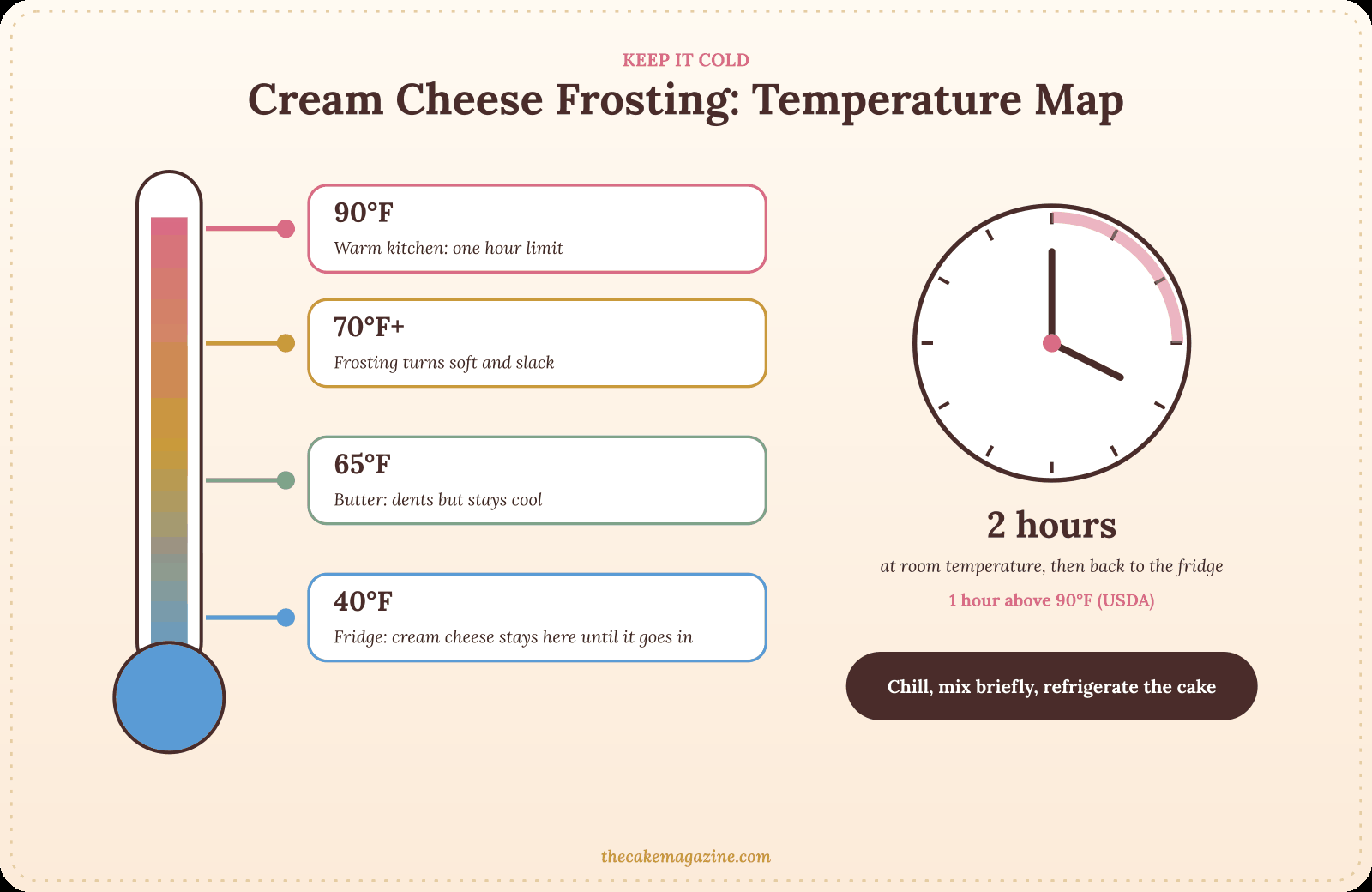
Most soft frostings fail because the ingredients are too warm. Let the butter soften until it dents when pressed, but is still cool to the touch, around 65°F. Add the cream cheese straight from the refrigerator, in pieces. The cold cream cheese keeps the mixture firm enough to hold a shape.
Beat the butter first, then add the cream cheese
Beat the butter alone until smooth, then add the cream cheese and mix only until combined. Adding the sugar last avoids a lumpy texture. Overbeating after the cream cheese goes in warms and loosens the mixture. Think of it as a quick blend, not a whipping session.
Sift the powdered sugar
Sifting removes the tiny lumps that never dissolve into a cream cheese base. It takes thirty seconds and saves you from a gritty frosting.
How sweet should it be?
Our formula uses 360 grams of powdered sugar for 340 grams of cream cheese and 170 grams of butter. That gives a frosting that is tangy and only moderately sweet. Add more sugar a spoonful at a time for a firmer, sweeter frosting, but know that you will lose the pleasant tang. A pinch of salt balances sweetness and sharpens the cream cheese flavor.
When the frosting is too soft
Chill it. Twenty minutes in the refrigerator often firms a loose frosting enough to spread. If it is still soft, beat in a tablespoon or two of powdered sugar, or swap part of the cream cheese frosting for a more stable base. Never add extra butter to fix softness, since that only makes things greasier once it warms up.
When the frosting is curdled or grainy
This often means the butter and cream cheese were at very different temperatures. Let the bowl sit at room temperature for ten minutes, then beat on low until smooth. Briefly warming the outside of the bowl with your hands, or a damp warm towel, can also help smooth things out.
Food safety: do not leave cream cheese frosting out
Cream cheese frosting is a dairy product and needs refrigeration. The USDA defines the "danger zone" as 40°F to 140°F and advises that perishable food should not sit out for more than two hours, or one hour when temperatures are above 90°F, according to a USDA Food Safety and Inspection Service news release. For general guidance, see the USDA food safety page. This is general information and not a substitute for official guidance.
Filling, stacking and frosting the carrot cake
Assembly is where a lovely cake becomes a great-looking one. Because cream cheese frosting is soft, the work goes better when everything is cold and you move without hurry. If you want a polished finish, our guide to smooth buttercream sides and sharp edges covers technique that carries over to cream cheese frosting, within limits.
Chill the carrot cake recipe layers first
Wrap the cooled layers loosely and chill for 20 to 30 minutes, or freeze for 15. A cold, firm layer gives you cleaner crumbs and far less tearing. Carrot cake can be crumbly at the surface, so this step is not optional if you want a clean finish.
Level and trim if needed
If the layers have domed, trim the tops flat with a long serrated knife. Save the scraps for snacking or for cake crumbs on the side of the finished cake. A flat layer stacks stably and helps avoid a leaning tower. Place the bottom layer on a cake board with a dab of frosting underneath to keep it from sliding.
Fill generously, but not too thickly
Spread a layer of frosting roughly a half-inch thick over the bottom cake, all the way to the edge. Because cream cheese frosting is soft, a very thick filling can squeeze out the sides. Place the second layer upside down, so the flat bottom becomes a smooth top.
Apply a crumb coat
For this carrot cake recipe, spread a thin layer of frosting over the top and sides to trap loose crumbs, then chill for 20 minutes. The crumb coat is especially useful for carrot cake because the surface sheds shreds and nuts. After it chills, apply the final layer of frosting. Use an offset spatula and long, steady strokes.
A rustic finish suits this cake
Carrot cake looks best with a casual finish. Swirl the frosting with the back of a spoon, leave the sides lightly "naked," or press toasted chopped nuts around the base. Fussy piping is not needed, though a ring of small piped dots adds a touch of polish. If you want to pipe more, our cake piping guide shows the tips and techniques, and keep the frosting cold while you work.
Decorating ideas that fit the flavor
- A sprinkle of toasted walnut or pecan pieces on top.
- A dusting of cinnamon through a small sieve.
- Marzipan or fondant carrots for a nostalgic look.
- Thin ribbons of carrot, quick-candied or fresh, in a little nest on top.
- Toasted coconut pressed around the base.
If you plan to use fondant or marzipan decorations, add them just before serving, since moisture from the frosting can soften and stain them. For more ideas, our cake decorating for beginners guide covers the basics.
Pan sizes and yield
The formula makes roughly 1,600 grams of batter, which is enough for two 8-inch layers. If you need another shape, the table of numbers below is a starting point only. Pans differ in depth, material and color, so check early and trust the doneness cues over the clock. For the general rules, see our cake pan conversion guide.
- Two 9-inch rounds: thinner layers, so start checking around 28 to 33 minutes.
- Three 6-inch rounds: tall, narrow layers for a small celebration cake, usually 32 to 40 minutes. Fill each pan only about halfway.
- One 9 by 13-inch pan: a single, easy layer for a crowd. Expect roughly 35 to 45 minutes, and frost directly in the pan if you are traveling. Our sheet cake guide covers servings and transport.
- Cupcakes: fill liners about two-thirds full. They often bake in 18 to 24 minutes. The formula makes about two dozen standard cupcakes.
- A 10-cup bundt pan: grease it thoroughly, bake around 50 to 60 minutes and finish with a glaze instead of a thick frosting. See the bundt cake guide for release tips.
How many people does this carrot cake recipe serve?
Two 8-inch layers, frosted and filled, typically give 12 to 14 modest slices. A 9 by 13-inch sheet gives 15 to 24 pieces depending on how you cut. If you are cooking for a crowd or a party, bake extra layers or choose a sheet pan, since carrot cake is rich and people tend to take small slices.
Scaling a carrot cake recipe up or down
Halve the formula for a single 8-inch layer, or for a small loaf. Weighing the ingredients makes scaling a carrot cake recipe easy, and eggs can be halved by whisking one and using half by weight. If you plan to scale for several cakes at once, our guide on how to scale a cake recipe up or down by weight walks through the arithmetic. Bake times shift with volume, so check early and often.
Make ahead and storage
One of the best qualities of this carrot cake recipe is that it improves with a little rest. The spices bloom, the crumb settles and the flavors blend. That makes it ideal for planning ahead.
Baking the layers ahead
Bake the layers a day ahead, cool them fully and wrap them tightly in plastic. Keep them at cool room temperature overnight. For longer storage, freeze the wrapped layers for up to two months and thaw them, still wrapped, on the counter or in the fridge. Wrapping while still warm traps steam and makes the surface gummy, so wait until they are cool.
Making the frosting ahead
The cream cheese frosting for this carrot cake recipe can be made one to two days ahead and kept in the refrigerator in a covered container. Before using, let it sit for 15 to 20 minutes until it is spreadable but still cool, then stir with a spatula. Beating it again with a mixer will warm and loosen it, so stir by hand if you can.
Storing the frosted cake
Because the frosting contains cream cheese, store the finished cake in the refrigerator, covered, so it does not absorb fridge smells. A cake box or a tall cake dome works well. For the best flavor and texture, let slices sit at room temperature for 20 to 30 minutes before serving. The USDA two-hour guideline on perishable foods applies, as mentioned earlier, so do not leave the cake out all afternoon.
How long does a carrot cake recipe keep?
As a general guideline, frosted carrot cake keeps for about three to four days in the refrigerator, and the crumb often tastes even better on the second day. Look for changes in smell, texture or mold, and discard it if anything seems off. If you are unsure about a specific storage scenario, check official guidance such as the USDA site.
Freezing slices and whole cakes
Freeze an unfrosted layer wrapped well, or a frosted cake after chilling it until the frosting is firm. Flash-freeze slices on a tray for an hour, wrap each one and keep them in a freezer bag. Thaw overnight in the refrigerator. Texture is usually best within a month or two.
Troubleshooting your carrot cake recipe
Even careful bakers have the occasional miss. Treat it as information. Each failure leaves clues, and many problems have more than one possible cause, so use the notes below to narrow things down. For a wider diagnostic approach, see our cake troubleshooting guide.
The carrot cake sank in the middle
Likely causes: underbaking, opening the oven too early, old leaveners or too much moisture from wet add-ins like pineapple.
How to check: a damp, dense band near the bottom points to underbaking or too much moisture.
Fix it next time: bake until the center is at least 205°F, keep the oven door closed for the first 25 minutes, drain pineapple thoroughly and verify your oven temperature with a thermometer. Our sinking cake guide has more.
The carrot cake is greasy or oily
Likely causes: too much oil from measuring by volume incorrectly, underbaking or an oil that was not well emulsified with the eggs and sugar.
Fix it next time: weigh the oil, whisk the eggs and sugar well before adding it, and bake until the crumb is set. See why cakes turn greasy.
The carrot cake is dry
Likely causes: overbaking, too much flour from scooping, very dry carrots or an oven that runs hot.
Fix it next time: weigh the flour, use fresh carrots, pull the cakes at the first sign of doneness and check the oven with a thermometer. A light brush of simple syrup can rescue baked layers. Our dry cake guide covers more causes.
The carrot cake recipe is gummy or heavy at the bottom
Likely causes: underbaking, carrots grated too coarsely, too many wet add-ins or heavy mix-ins sinking in a thin batter.
Fix it next time: grate finer, toss mix-ins in a spoonful of the flour mixture, drain wet ingredients and bake a few minutes longer. See gummy layers explained.
The nuts and raisins all sank
Likely causes: a loose batter, large pieces or too many mix-ins.
Fix it next time: chop nuts to pea size, use fewer mix-ins and toss them with a spoonful of the dry ingredients before folding in.
The cake tastes bland
Likely causes: old spices, not enough salt or skipping the brown sugar.
Fix it next time: replace spices that are more than a year old, weigh the salt and serve the cake closer to room temperature, since cold mutes flavor.
The frosting is runny and slides off
Likely causes: cream cheese from a tub, warm butter, overbeating or a warm cake.
Fix it next time: use cold block cream cheese, cool butter and fully cooled layers. Chill the frosting before using it.
The cake cracked or domed
Likely causes: an oven that is too hot, which sets the edges before the center rises.
Fix it next time: lower the oven by 25 degrees, use cake strips if you own them, or level the layers after baking. Read why cakes dome for more.
Carrot cake styles and variations
Carrot cake is a flexible canvas. Before you start changing the formula, it helps to see what styles exist and which dials produce each one.
Classic American carrot cake
The style in this guide. Oil-based, brown sugar, warm spices, toasted nuts and cream cheese frosting. Moist, sturdy and very forgiving.
Pineapple and coconut carrot cake
Adds crushed pineapple and shredded coconut. Extra moist with a tropical edge. Needs a little longer in the oven and a careful drain on the pineapple.
Carrot sheet cake
Baked in a 9 by 13-inch pan and frosted in the pan. Easy for crowds, bake sales and potlucks.
Carrot cupcakes
The same batter in liners with a swirl of frosting. Great for parties, and they bake in about 20 minutes.
Making a nut-free carrot cake recipe
For a nut-free carrot cake recipe, leave the nuts out and add toasted pumpkin seeds for crunch, or simply skip them and add 50 grams more carrot. If you serve guests with allergies, check labels on every ingredient, including spices and cream cheese, and keep nut-containing tools separate.
Using whole wheat flour
In a whole grain carrot cake recipe, swap up to 25 percent of the all-purpose flour with whole wheat or white whole wheat for a nuttier flavor. The crumb will be a little denser and thirstier, so a spoonful of milk or extra drained pineapple helps.
Cutting some of the sugar
You can trim the sugar a little, but sugar is also a tenderizer and a moisture holder, so cutting more than 10 percent changes the texture. A better way to reduce sweetness in a carrot cake recipe is a less sweet frosting. Our cake flavor pairing guide suggests other filling and frosting matches.
Swapping the oil in a carrot cake recipe
Melted, cooled butter can replace the oil in the same weight for a richer flavor, though the cake will be firmer when cold. Part of the oil can be replaced with unsweetened applesauce, but the crumb will be a little less rich.
Adding buttermilk or yogurt
Replace 60 grams of the oil with the same weight of buttermilk for a slightly tangier, softer cake. The formula holds up well to this change, but test it before a special occasion.
Gluten-free adaptation
A one-to-one gluten-free baking blend can stand in for the flour. Results vary by brand, and gluten-free batters often need extra rest and a little more time. Because this site has not tested the formula, treat any substitution as an experiment and bake a trial cake before an event.
Alternatives to cream cheese frosting
If you need a frosting that can sit out longer or hold a sharper edge, try a buttercream. A tangy cream cheese filling with a buttercream outer coat gives you both flavors and better stability. Our buttercream guide compares the main types, and the American buttercream recipe is the simplest to make.
Ten mistakes to avoid
- Using pre-shredded carrots. They are dry and thick. Grate your own.
- Measuring by cups. Carrots, flour and brown sugar vary wildly by volume. Weigh them.
- Skipping the nut toast. Raw nuts turn soft and bitter in a moist crumb.
- Overmixing after the flour goes in. It makes the cake tough and tunneled.
- Adding wet ingredients without adjusting. Undrained pineapple leads to gummy layers.
- Underbaking. Dense carrot cake hides wet centers. Use a thermometer.
- Frosting a warm cake. The frosting melts and slides. Cool completely.
- Using tub cream cheese. It is too wet. Buy blocks.
- Leaving the finished cake out. Refrigerate it and watch the two-hour guideline.
- Serving it ice cold. Flavor and texture are best after 20 to 30 minutes at room temperature.
Frequently asked questions about this carrot cake recipe
What makes a carrot cake recipe moist?
Oil, brown sugar and the water in the carrots do most of the work. Oil stays liquid at every temperature, brown sugar holds moisture and the grated carrots release water as they bake. Weighing the flour and avoiding overbaking are the habits that matter most.
Should I use oil or butter in a carrot cake recipe?
Oil is the usual choice because it keeps the cake soft even when chilled. Melted butter gives more flavor but a firmer crumb when cold. If you want both, use oil in the cake and plenty of butter in the frosting.
Do I have to peel the carrots for a carrot cake recipe?
Peeling is recommended. The skin can taste slightly bitter and leaves darker flecks in the crumb. If your carrots are very fresh and well scrubbed, you can skip it, though the flavor may be a little earthier.
How finely should I grate the carrots?
Use the small holes of a box grater or a fine shredding disc for a tender, even crumb. Medium shreds give a rustic cake, and coarse shreds can leave wet pockets. Weigh them after grating instead of counting carrots.
Can I use pre-shredded carrots from a bag?
You can in a pinch, but they are usually cut thick and are drier. Give them a few chops with a knife to make the pieces smaller, and consider a spoonful of milk or drained pineapple to restore moisture.
Do I need to toast the nuts?
It is not required, but it is worth it. Toasting boosts flavor and helps the nuts stay crisp in a moist crumb. Eight to ten minutes in a 350°F oven is usually enough. Cool them fully before folding them in.
Can I make the carrot cake recipe without nuts?
Yes. Leave them out, or replace them with toasted pumpkin seeds or extra carrot. The cake will be slightly softer, but still tender and flavorful. Check ingredient labels if you are serving someone with allergies.
Why is my cream cheese frosting runny?
Most often the cream cheese was from a tub, the butter was too warm or the frosting was overbeaten. Use cold block cream cheese, cool butter and mix briefly. Chilling the bowl for 20 minutes usually firms it up.
Does carrot cake need to be refrigerated?
If it is covered in cream cheese frosting, yes. The USDA advises that perishable foods should not sit out for more than two hours, or one hour above 90°F. Serve slices at room temperature after a short rest, then return the cake to the fridge.
Can I freeze this carrot cake recipe?
Yes. Wrap cooled, unfrosted layers tightly and freeze for up to two months. You can also freeze a frosted cake once the frosting is firm. Thaw in the refrigerator overnight, still wrapped, to prevent condensation.
Can I bake carrot cake as cupcakes or in a 9 by 13 pan?
Yes. Cupcakes usually bake in 18 to 24 minutes and a 9 by 13-inch pan in about 35 to 45. These are starting points, so start checking early and use the doneness cues rather than the clock.
Why did my carrot cake sink in the middle?
Underbaking, an early oven door opening, old leaveners or too much moisture from wet add-ins are the usual suspects. Bake until the center reaches roughly 205°F to 210°F, drain pineapple well and check your oven with a thermometer.
Final thoughts
The carrot cake recipe above is not about tricks. It is a handful of good habits: grate the carrots finely, weigh everything, toast the nuts, whisk instead of overmixing, bake until the cake tells you it is done and keep the cream cheese frosting cold. Do those things and a humble vegetable cake becomes the one people ask you to bring again.
Make the carrot cake recipe once as written so you know how it behaves in your oven. Then start tweaking: a different spice blend, a little pineapple, pecans instead of walnuts. Keep notes. After a few bakes, you will have a carrot cake recipe that is truly yours, and you will know enough to fix it when something goes sideways.
Editorial note: reviewed and updated November 2026. This guide is written for home bakers in the United States, using American measurements and ingredients. The recipe formula has not been oven-tested by The Cake Magazine and is offered as a starting point to adapt. Baking results vary by oven, altitude and ingredients. Food safety information is general and not a substitute for official guidance. Where we link to products or tools in the future, we will disclose affiliate relationships near the links.