There is a moment, right after you cut the first slice, when a layer cake either wins the table or doesn’t. If the filling is lemon curd, that moment is a bright yellow stripe between pale layers, glossy and tart, and the whole cake suddenly tastes alive. Good lemon curd cake filling does that, but it is fussier than jam or buttercream. It can run, weep, taste metallic or turn to rubber if you rush it.
This guide covers how to cook lemon curd cake filling to the right thickness, balance its flavor, keep it safely and build layers that stay put.
Lemon curd cake filling is a cooked mixture of lemon juice, sugar, eggs and butter, thickened gently over low heat to about 170°F, strained and chilled until spoonable. For cake layers, use it cold, about a quarter inch thick, held in by a ring of stiff buttercream so it cannot squeeze out. If it is too soft, cook it a little longer or add a small amount of starch. Keep any filled cake in the refrigerator.
- What lemon curd cake filling is, and why it works between layers
- Ingredients and equipment that shape lemon curd cake filling
- How to control thickness in lemon curd cake filling
- A starting formula for lemon curd cake filling
- Balancing the flavor of lemon curd cake filling
- Firmer and fluffier versions of lemon curd cake filling
- Assembling a layer cake with lemon curd cake filling
- Cakes and frostings that suit lemon curd cake filling
- Storage and food safety for lemon curd cake filling
- How much lemon curd cake filling you need
- A make-ahead timeline for a lemon curd cake filling cake
- Troubleshooting lemon curd cake filling
- Citrus and flavor variations
- FAQ
- Final thoughts
What lemon curd cake filling is, and why it works between layers
Lemon curd is a stovetop custard with a lot of personality. You whisk lemon juice, sugar, whole eggs or yolks and butter together over gentle heat until the egg proteins tighten and the mixture turns thick, glossy and spreadable. There is no flour and no cream, which is why the flavor is so direct. It tastes like lemon first and sweetness second, with a smooth richness from the butter that softens the acid.
As a cake filling, that intensity is exactly the point. Vanilla sponge, buttercream and even a sweet glaze are all gentle, and a thin layer of curd cuts through them like a squeeze of fresh juice over a rich dinner. A quarter inch of lemon curd cake filling is enough to flavor an entire slice, which makes it economical as well as pretty.
Why curd works where jam and fruit often struggle
Fruit fillings bring water, seeds and pieces that fight with the crumb. Curd is smooth, fairly dense and already cooked, so it sits between layers without releasing much liquid. It also firms up as it chills, because the egg proteins and butter set. That makes lemon curd cake filling one of the more dependable options when you want real fruit flavor without a soggy cake. If you are weighing alternatives, our guide to jam cake fillings and how to stop layers sliding explains where preserves fit.
What lemon curd cake filling is not
People sometimes confuse curd with lemon pie filling, lemon pastry cream or lemon mousse. They are cousins, not twins. Pie filling usually leans on cornstarch, so it is firmer and cloudier. Pastry cream is made with milk and flour or starch, so it is mellow and creamy. Mousse folds in whipped cream or whipped egg whites. Plain curd is the leanest of the group, and that clean flavor is what you are paying for. Our pastry cream guide for cakes covers the milk-based relative.
When lemon curd cake filling is the right choice
Reach for it when the cake itself is mild: vanilla, white, almond, coconut, poppy seed or a simple butter cake. It shines in spring and summer desserts, at bridal and baby showers, and in any cake that needs a bright note against sweet frosting. It is less suited to hot outdoor events, because it contains eggs and butter and has to stay cold. We will come back to that in the food-safety section.
If the cake can live in a refrigerator until about thirty to sixty minutes before serving, lemon curd cake filling is a great fit. If it has to sit on a warm buffet for hours, choose a shelf-stable filling instead, or keep the curd as a spoonable topping served cold at the table.
Ingredients and equipment that shape lemon curd cake filling
Curd has only a handful of ingredients, so each one shows up in the finished taste. Spending your effort here is more useful than hunting for a secret trick later. Below is what each ingredient does and what to look for at the store.
Fresh lemon juice
This is the main flavor, so use juice squeezed from real lemons rather than the bottled kind, which often tastes flat or slightly cooked. Strain out the seeds and most of the pulp. Four to five medium lemons usually give about a cup of juice, though size and juiciness vary a lot.
Lemon zest
The zest carries the fragrant oils that juice lacks. Rub it into the sugar before cooking and the sugar crystals will pull the oils out and turn damp and fragrant. Take only the yellow layer, because the white pith underneath is bitter.
Eggs and yolks
Whole eggs make a lighter, more delicate curd. Extra yolks make it richer, deeper in color and a bit thicker. Using yolks only gives the most luxurious texture, and also leaves you with whites for meringue or a batch of cake.
Sugar
Plain granulated sugar sweetens, thickens and helps the curd keep. Too little and the curd turns harsh and thin. A ratio close to equal weights of sugar and lemon juice is a familiar starting point.
Butter
Cold unsalted butter whisked in at the end gives sheen and a smooth, rounded mouthfeel. Unsalted lets you control the salt. Adding it off the heat keeps the curd glossy rather than greasy.
Salt and vanilla
A small pinch of salt sharpens the lemon and rounds off the sweetness. A little vanilla softens the edge without making the curd taste like vanilla. Neither is required, but both are cheap insurance.
Equipment that prevents most curd problems
The pan matters more than most people expect. Use stainless steel, enamel-lined or glass over a gentle heat. Lemon juice is acidic and can react with bare aluminum, cast iron or unlined copper, giving the curd a gray tint and a metallic taste. You also need a whisk that reaches the corners, a heatproof spatula, a fine-mesh sieve and a digital instant-read thermometer.
The thermometer is the quiet hero. Judging curd by sight alone works for experienced cooks, but a number removes the guessing, which is helpful when the curd is headed into a cake that will sit in a refrigerator for days. For a broader look at the physics of eggs, fat and sugar in baking, our cake baking science guide is a good companion.
Weigh it if you can
Volume measures of lemon juice and sugar are close enough for a casual jar of curd. For a filling that has to behave under a cake, weighing is better, because small differences in the juice-to-egg ratio change how firmly the curd sets. A kitchen scale costs little and the grams in this guide are written to be used with one. Cup amounts are provided for convenience.
How to control thickness in lemon curd cake filling
Thickness is the single biggest difference between a curd that is lovely on toast and one that works inside a cake. A spreadable curd that oozes at the edges of a layer is a mess waiting to happen. Fortunately, thickness is controllable, and it comes down to four levers: egg content, cooking temperature, starch and chilling.
Temperature and the spoon test
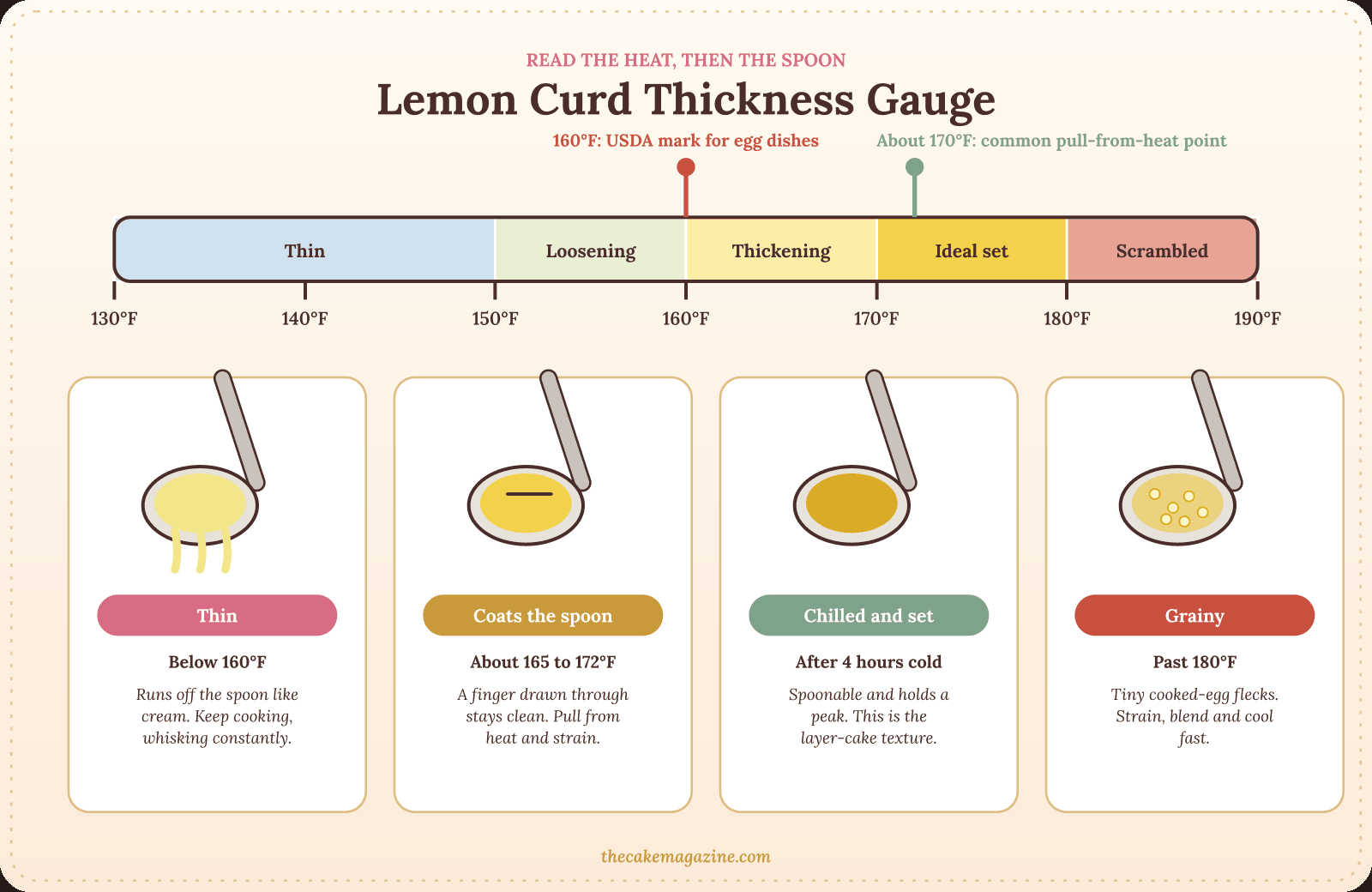
Egg proteins begin to tighten as the curd warms, and they keep thickening as the temperature climbs. Many published recipes, including King Arthur Baking’s lemon curd recipe, aim for about 170°F, which usually takes several minutes of constant whisking over medium to medium-low heat. At that point the curd should coat the back of a spoon, and a finger drawn through it should leave a clean line that does not flood back.
Go well past that, toward 180°F and above, and the proteins clump. The curd looks lumpy or grainy, and the flavor turns eggy. Pull the pan off the heat as soon as the spoon test and the thermometer agree, then strain immediately into a cool bowl so residual heat does not keep cooking the bottom.
Why the curd thickens more as it cools
Hot curd always looks thinner than the finished product. Butter solidifies as it chills, and the egg proteins tighten into a firmer network. A curd that barely coats a spoon at the stove will be soft and spoonable after about four hours in a refrigerator. If you judge doneness only while hot, you may overcook it chasing a thickness that would have arrived on its own.
A good habit is to spoon a teaspoon onto a cold saucer and put it in the freezer for two minutes. That shows you the chilled texture almost immediately, and it is a better predictor than the hot pan.
Egg content: whole eggs, yolks and the in-between
More yolk means a thicker, richer, more custard-like curd. A formula with equal numbers of whole eggs and extra yolks, like the one below, sits comfortably in the middle: soft enough to melt on the tongue and thick enough for a layer. If you need a firmer result, increase the yolks and reduce the whole eggs. If you want a lighter, brighter curd for a topping, go the other way.
Starch and gelatin for extra insurance
When a cake has to travel, sit at a party or be sliced into neat wedges, many bakers add a little cornstarch to the curd. A small amount, around ten grams for a batch like ours, keeps the filling from creeping when the layers press down. It must be cooked until bubbles break the surface, or it can taste raw and may thin out again. We will show the method in the variations section.
Even careful whisking leaves tiny bits of cooked egg and zest. Straining through a fine sieve is what turns good curd into silky curd. It also catches any small chalazae. Press the curd through with a spatula, scrape the underside of the sieve, and you will lose almost nothing.
Chilling: the final thickness lever
Press plastic wrap or parchment directly onto the surface of the warm curd so no skin forms, then refrigerate for at least four hours, or overnight. Before assembling a cake, give the cold curd a quick stir with a spatula to loosen it into a smooth, spreadable consistency. Do not whisk it hard, which can thin it. For most layer cakes, cold, gently stirred curd is the ideal consistency.
A starting formula for lemon curd cake filling
The formula below is a starting point to adapt, built from the same well-known ratios you will find in many trusted recipes, including the King Arthur Baking page linked earlier. It makes roughly 700 to 750 g, about two and a half cups, which is enough to fill a three-layer 8-inch cake with some left over for serving. We have not kitchen-tested this exact version, so make it once as a trial before you commit to a special-occasion cake.
Classic Lemon Curd Cake Filling
A bright, silky curd cooked to about 170°F, strained and chilled until it holds a gentle shape between cake layers.
Ingredients
- Granulated sugar250 g (1 1/4 cups)
- Zest of lemons, finely grated2 lemons (about 8 g)
- Fresh lemon juice, strained225 g (about 1 cup)
- Large eggs200 g (4 eggs)
- Large egg yolks37 g (2 yolks)
- Cold unsalted butter, cubed113 g (8 tablespoons)
- Fine salta generous pinch (about 1 g)
- Pure vanilla extract2 g (1/2 teaspoon), optional
Instructions
- Perfume the sugar. In a medium bowl, rub the zest into the sugar with your fingertips for about 30 seconds, until it looks damp and smells strongly of lemon.
- Warm the juice. Heat the lemon juice in a stainless steel or enamel saucepan over low heat until hot but not boiling. Set up a fine-mesh sieve over a clean bowl.
- Whisk the eggs. In another bowl, whisk the eggs and yolks until smooth, then whisk in the zested sugar in three additions.
- Temper. Slowly pour the hot juice into the eggs in a thin stream, whisking constantly so the eggs warm without scrambling.
- Cook. Pour the mixture back into the saucepan and cook over medium-low heat, whisking constantly and scraping the corners, until it reaches 170°F and coats the back of a spoon, roughly 6 to 10 minutes.
- Strain. Immediately pour the curd through the sieve, pressing with a spatula.
- Finish. Whisk in the cold butter a few cubes at a time until melted and glossy, then add the salt and vanilla.
- Chill. Press plastic wrap onto the surface and refrigerate at least 4 hours or overnight before using as a cake filling.
Notes
- Pull the pan from the heat the moment the thermometer and the spoon test agree. Curd keeps cooking in the hot pan.
- Oven, stove and pan all change cooking time, so treat the minutes as guidance and trust the thermometer.
- The curd will look thin when hot. It thickens a great deal as it chills.
- For a richer, less sharp curd, swap 2 tablespoons of the butter for 28 g of heavy cream.
- Keep refrigerated and use within about a week, or freeze for longer storage.
Method notes that make the difference
Tempering is the step most likely to go wrong, so go slowly. Hot juice poured all at once can cook the eggs on contact and leave tiny white flecks. A thin stream and a steady whisk let the temperature rise gradually. If you are nervous, cool the juice for a minute before pouring, or try the one-pan method: whisk everything except the butter in a cold saucepan, then heat gently while whisking nonstop.
The whisk should touch every part of the pan floor, especially the corners where the curd catches. If you see tiny set bits forming, lift the pan off the burner for a few seconds while you keep whisking, then return it. Moving the pan on and off the heat is a perfectly good technique, and it is much safer than trying to rescue overcooked curd.
Making a smaller or larger batch
Curd scales cleanly, but pan size matters. Half the formula in a large saucepan will cook faster and may catch more easily because the shallow layer heats quickly. Double it and the curd takes longer to climb, so keep whisking. Whenever you change the batch size, rely on temperature and the spoon test instead of the clock.
Balancing the flavor of lemon curd cake filling
Taste is where lemon curd cake filling either charms or disappoints. A curd that is too sweet tastes like lemon candy, and one that is too tart puckers the mouth against a mild cake. The goal is a clear lemon flavor that is bright but rounded, because the sweet cake and frosting around it will soften the edge.
Think in terms of a seesaw
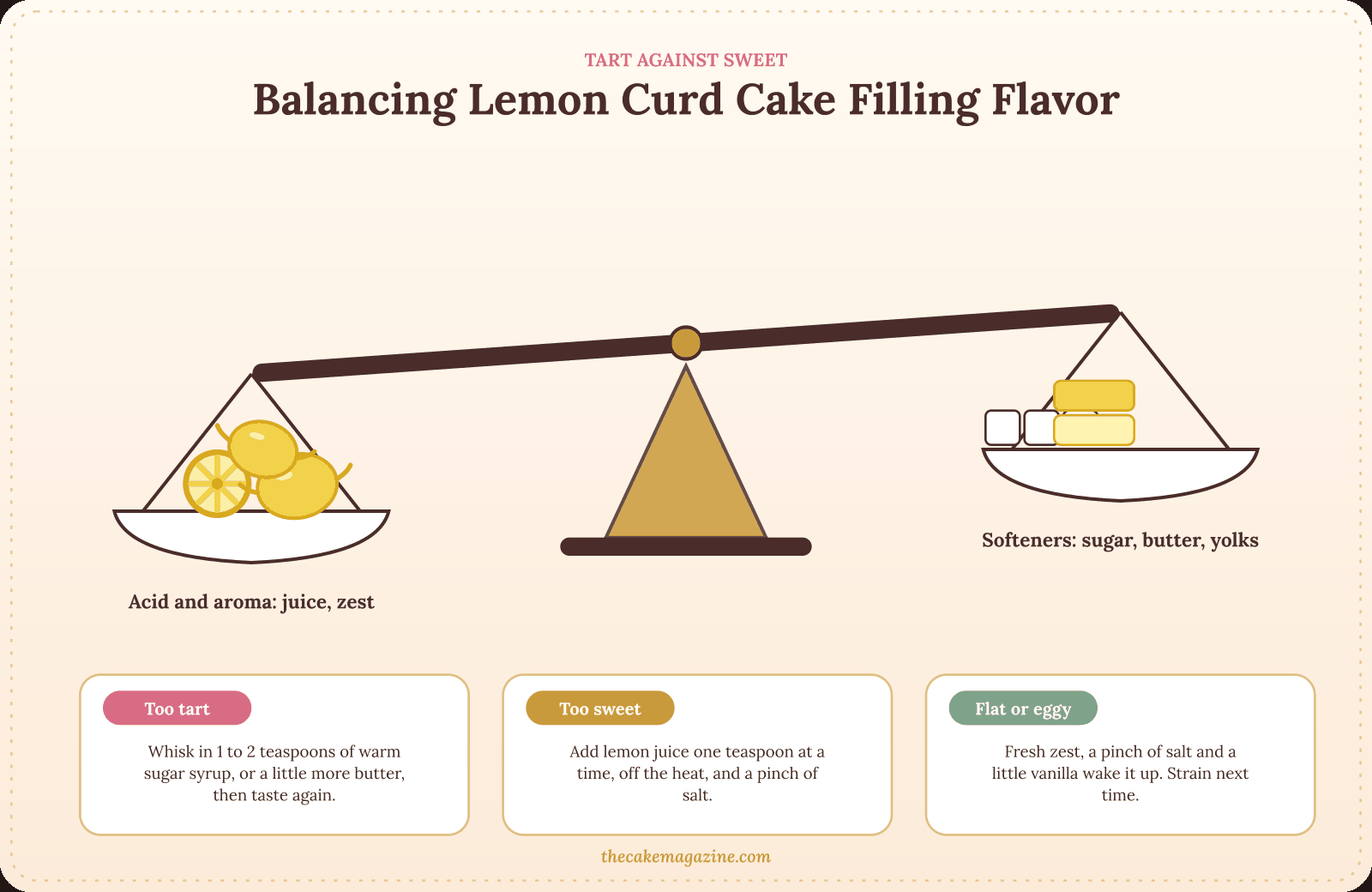
On one side sit acid and aroma: lemon juice and zest. On the other sit the softeners: sugar, butter and yolks. Change one and the other has to answer. If you add more juice, add more sugar or butter. If you cut the sugar, expect a sharper curd that suits a very sweet cake, such as a heavily frosted vanilla layer cake, and may be too much for a plain sponge.
The cake and frosting change what tastes balanced
Taste the curd by itself, then taste it with a bite of the cake and frosting you plan to use. A cake wrapped in sweet American buttercream can handle a very tangy curd. A cake finished with a lightly sweetened whipped cream or a mellow cream cheese frosting may need a slightly softer curd. If you are using meringue-based frosting, the combination is naturally lovely, and our Swiss meringue buttercream guide shows a frosting that complements curd without extra sugar.
Quick flavor fixes
- Too tart: whisk in a spoonful of warm simple syrup, or a few more cubes of butter, and taste again.
- Too sweet: stir in lemon juice a teaspoon at a time, off the heat, with a pinch of salt.
- Flat: add fresh zest, a pinch of salt or a few drops of vanilla.
- Eggy: it was probably cooked too hot. Strain well and add a little zest. Next time, lower the heat.
- Bitter: pith got in the zest, or the juice was squeezed too hard. Start over with lighter pressure.
Do not change the formula after the curd has cooled
Adjust the flavor when the curd is warm and fully mixed, because cold curd resists blending. If you must fix it when cold, warm a spoonful of the curd with the extra ingredient in a small bowl, then stir it back in a little at a time. Large changes at the last minute can thin the curd or create streaks.
Firmer and fluffier versions of lemon curd cake filling
The classic version is a wonderful filling, but sometimes a recipe needs something more cooperative. A tall wedding-style cake, a warm kitchen or a cake that will be driven across town all call for extra support. Here are four ways to change the texture of lemon curd cake filling without losing flavor.
Starch-stabilized curd
Whisk about 10 g of cornstarch into the sugar before mixing with the eggs, then cook until the mixture just reaches a gentle bubble and keep whisking for a full minute. It gives a sliceable, stable filling that holds under weight. Taste for a floury note and cook a little longer if you notice one.
Gelatin-set curd
Bloom about 2 g of powdered gelatin in 10 g of cold water, then stir it into the strained warm curd until it dissolves. This sets firmer for cutting but can feel bouncy if overused, so start with the small amount, chill and test.
Curd and buttercream blend
Beat a few tablespoons of cold curd into a cooled, stiff buttercream. The result is creamy, soft yellow and very stable. It tastes milder than straight curd, which is useful for a cake that will sit out longer, within food-safety limits.
Lemon curd mousse
Fold about 240 g of cream whipped to medium peaks into roughly 300 g of cold curd. It is light, mellow and pillowy, though it needs refrigeration and is best for same-day or next-day cakes. Chill it well and use a sturdy dam.
How to add cornstarch without lumps
Mix the starch thoroughly with the sugar, not with the liquid. The dry mix disperses evenly, and the starch granules swell smoothly as they heat. Add the juice slowly, whisk and cook. Because acid can weaken starch, the curd may need to bubble gently for a minute or two before it thickens fully. Always chill a spoonful on a cold saucer to see what the finished texture will be.
When to stay with the classic version
Do not reach for starch or gelatin out of habit. A plain, well-cooked curd gives the cleanest flavor and the most luxurious mouthfeel. If your cake is a simple two-layer birthday cake with a good buttercream dam, classic curd will behave perfectly. Save the stabilized versions for taller cakes, travel and warm weather.
A firmer curd does not replace the ring of buttercream. The dam is what keeps filling from bulging at the sides when the weight of the upper layers settles. Treat the two as a team: the dam holds the curd in, and the curd stays out of the frosting.
Assembling a layer cake with lemon curd cake filling
Perfectly cooked curd can still ruin a cake if the assembly is sloppy. The usual disasters are filling that squeezes out of the sides, layers that slide and a frosted cake that bulges one week after you thought you were finished. Every one of those is preventable with a little structure and some patience.
Start with cold, level layers
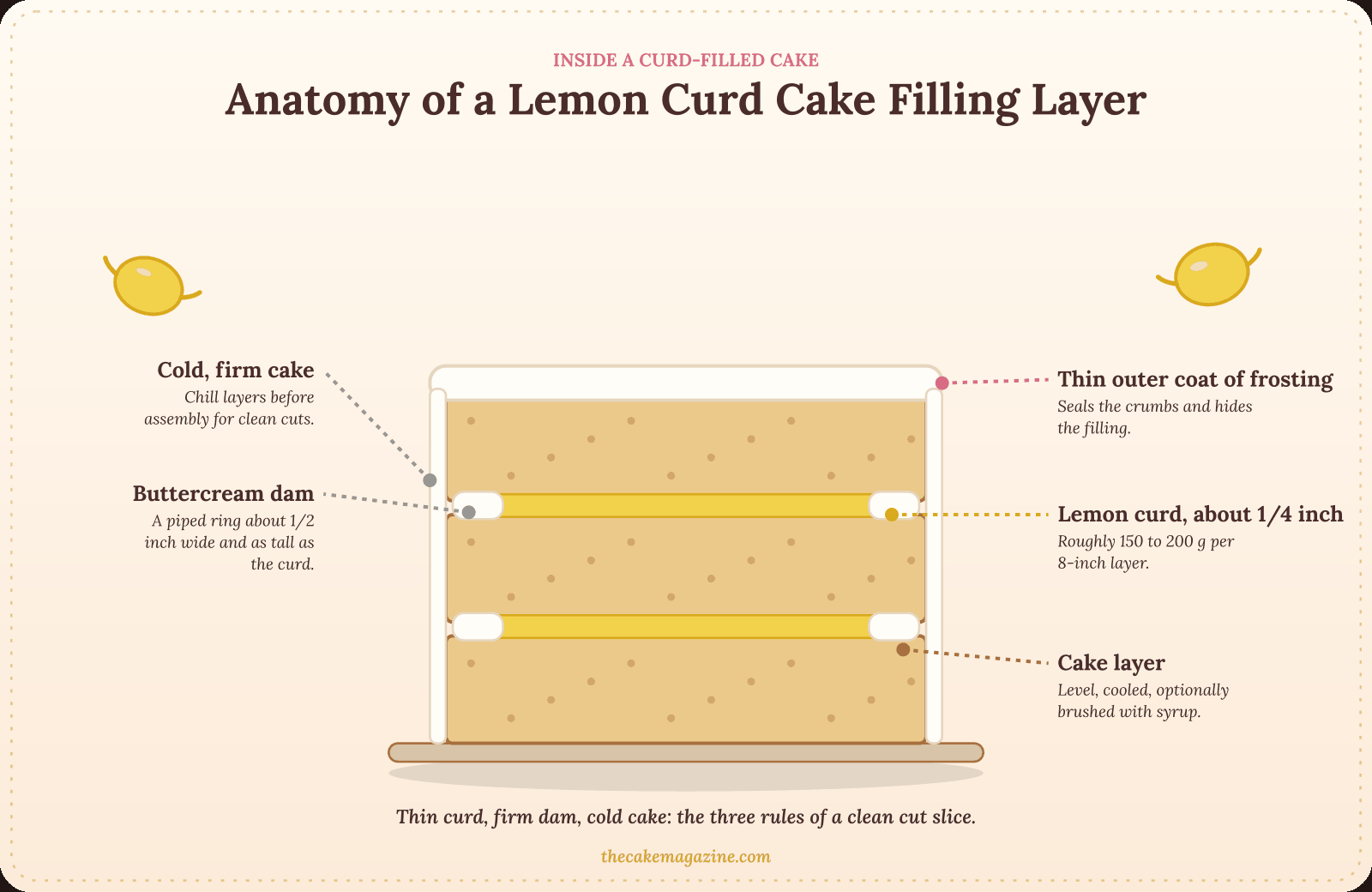
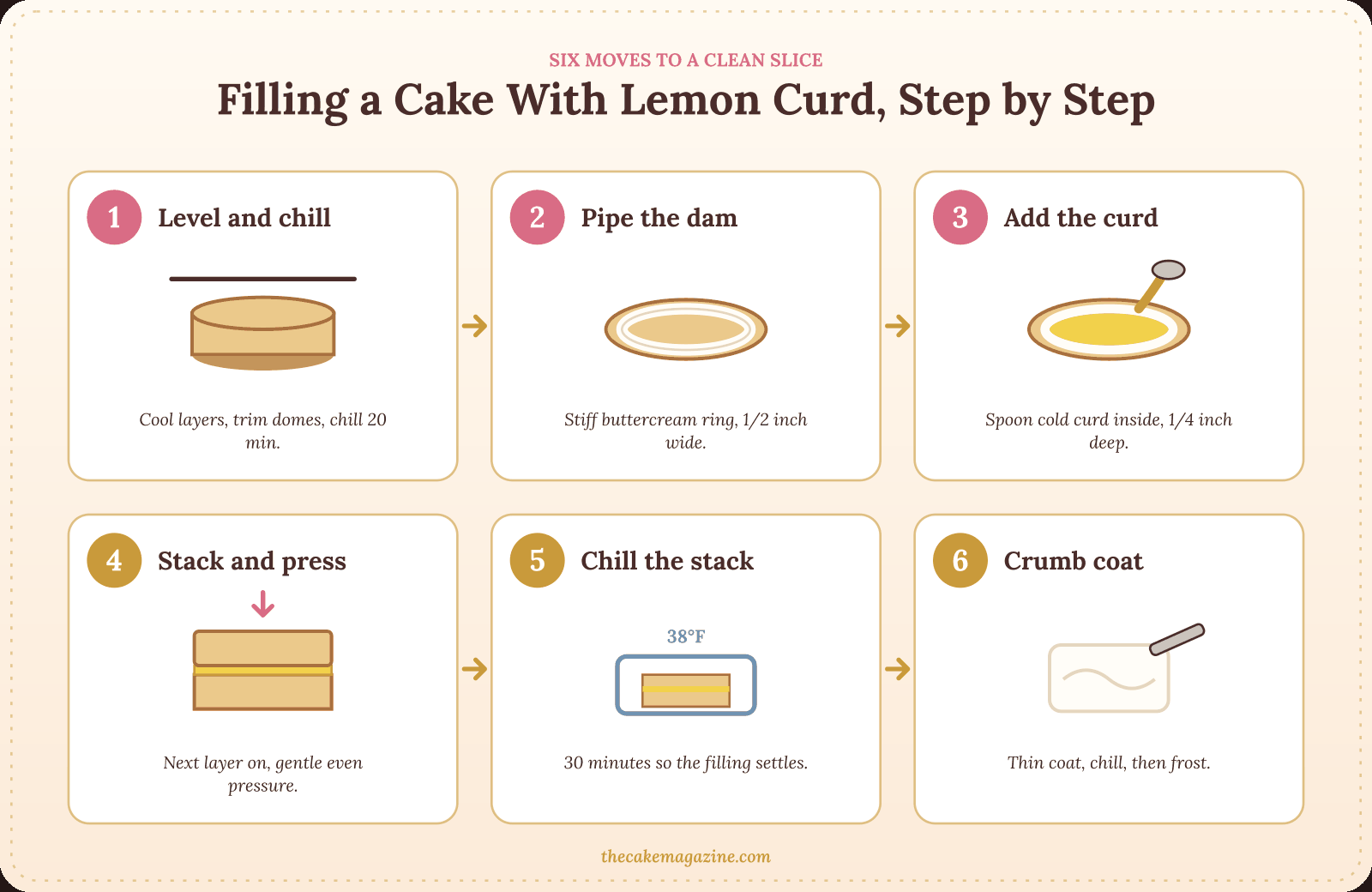
Bake and cool your cake completely, then wrap the layers and chill them for at least twenty minutes. Cold crumb is firmer, so it is easier to level, less likely to tear and less likely to compress under the filling. Trim any dome with a serrated knife so the layers sit flat. If you need a refresher on splitting and leveling, our guide on how to torte a cake walks through each step.
Pipe a buttercream dam
A dam is a ring of stiff frosting piped around the outer edge of each layer. It acts like the wall of a tiny reservoir. Use a sturdy buttercream, not a soft whipped one, and pipe a ring about half an inch wide and as tall as the filling will be. Keep it about a quarter inch in from the edge so it does not peek out of the finished cake.
American buttercream is the easiest for this job because it crusts and holds firm. Our buttercream guide comparing American, Swiss, Italian, French, German and ermine styles helps you choose one that suits your cake and your climate.
Fill gently and keep it thin
Spoon the cold, lightly stirred curd inside the dam and spread it with a small offset spatula, stopping just short of the ring. Aim for about a quarter inch, which is roughly 150 to 200 g for an 8-inch layer. It is tempting to pile on more, because the flavor is so good, but extra curd is what makes layers slip and the dam burst.
If you love a stronger lemon flavor, build it a different way. Brush the cake layers with a lemon-scented syrup, or spoon a small amount of curd onto each plated slice at serving. Our simple syrup for cake guide shows how to add moisture and flavor without making the crumb soggy.
Stack, press and rest
Place the next layer on top with its flat bottom facing up. A flat bottom makes the most level surface, and it keeps crumbs out of the frosting. Press gently and evenly with the flat of your hand, and check from the side that the layers are straight. Then chill the whole stack for thirty minutes so the filling settles and the dam firms.
Crumb coat, chill and finish
Apply a thin crumb coat, which traps stray crumbs and seals the dam. Chill again until the surface feels firm, then add the final coat of frosting. If you want to understand how thin that first layer should be, read our crumb coat guide. After frosting, return the cake to the refrigerator so the curd stays safely cold and the frosting sets.
If a stack starts to lean, stop and chill it for fifteen minutes, then check that the curd layer is no thicker than a quarter inch. Slide a few dowels or sturdy straws through tall cakes and add a cake board between tiers. A thick curd layer is the usual cause of sliding, not the cake itself.
Assembly checklist
- Cake layers are fully cool, level and chilled for at least 20 minutes.
- Curd has been chilled for 4 hours or longer and stirred smooth.
- Buttercream for the dam is stiff enough to hold its shape.
- Each filling layer is about 1/4 inch, no more.
- Stack is chilled for 30 minutes before the crumb coat.
- Finished cake goes back into the refrigerator promptly.
Cakes and frostings that suit lemon curd cake filling
Lemon curd cake filling is a team player, but it prefers certain partners. The best matches are cakes with a tender crumb and a calm flavor, so the curd can be the star. A few pairings are classics for a reason, and a few surprises are worth trying once you understand the logic.
Cakes that welcome curd
Vanilla, white, almond and butter cakes are natural choices because their sweetness and mild flavor leave room for tartness. Lemon cake with a lemon filling is a double dose of citrus that some people adore and others find overwhelming, so think about who is eating. If you are baking one, our lemon cake recipe with lemon filling options shows how to keep the layers tender and balanced.
Coconut cake and curd are a lovely pair, as are poppy seed cakes, blueberry cakes and raspberry cakes. Chocolate is trickier. A dark chocolate cake can overpower lemon, but a light chocolate layer with raspberry and a little curd can work if you keep the curd thin.
Frostings that hold it up
Sturdy American buttercream is the easiest dam and exterior for a classic birthday cake. Swiss meringue buttercream is silkier and less sweet, which lets the lemon shine. Cream cheese frosting adds tang that can make the cake taste too sharp, so go gently on the zest if you use it. Whipped cream frostings are lovely, but they need refrigeration and a sturdier dam.
Flavor additions that play well
Fresh berries, toasted coconut, almond extract, lavender, thyme and a little cardamom all echo or soften lemon. Keep additions subtle, because curd is powerful already. For a systematic approach to matching cake, filling and frosting, our cake flavor pairing guide gives you a framework you can use for any combination.
Classic spring cake
Vanilla sponge, lemon curd cake filling, a buttercream dam and a whipped vanilla or Swiss meringue exterior. Decorate with fresh berries or edible flowers.
Coconut and lemon
Coconut layers, thin curd, buttercream dam and toasted coconut on the outside. A lovely bridal shower or Easter cake.
Berry and curd
White or almond cake with curd and a thin line of raspberry jam. Keep the layers thin and the dam sturdy, because two fillings are doubly wet.
Lemon poppy seed
Poppy seed cake layered with curd and cream cheese frosting. Reduce the curd’s sweetness slightly so the cream cheese does not make it too sharp.
Storage and food safety for lemon curd cake filling
Curd contains eggs, butter and sugar, so treat it as a perishable dairy and egg dessert. The good news is that cooking it to a safe temperature and keeping it cold makes it easy to manage. The bad news is that a filled cake can sit out for only a short time, and that matters at parties.
Cook it to a safe temperature
The USDA Food Safety and Inspection Service says egg dishes and egg-containing products should be cooked until a food thermometer reads 160°F. Curd that reaches the common 170°F target is above that mark, which is one more reason a thermometer is worth using. For general rules on handling perishable foods, see the USDA Food Safety and Inspection Service food safety pages.
Storing the curd itself
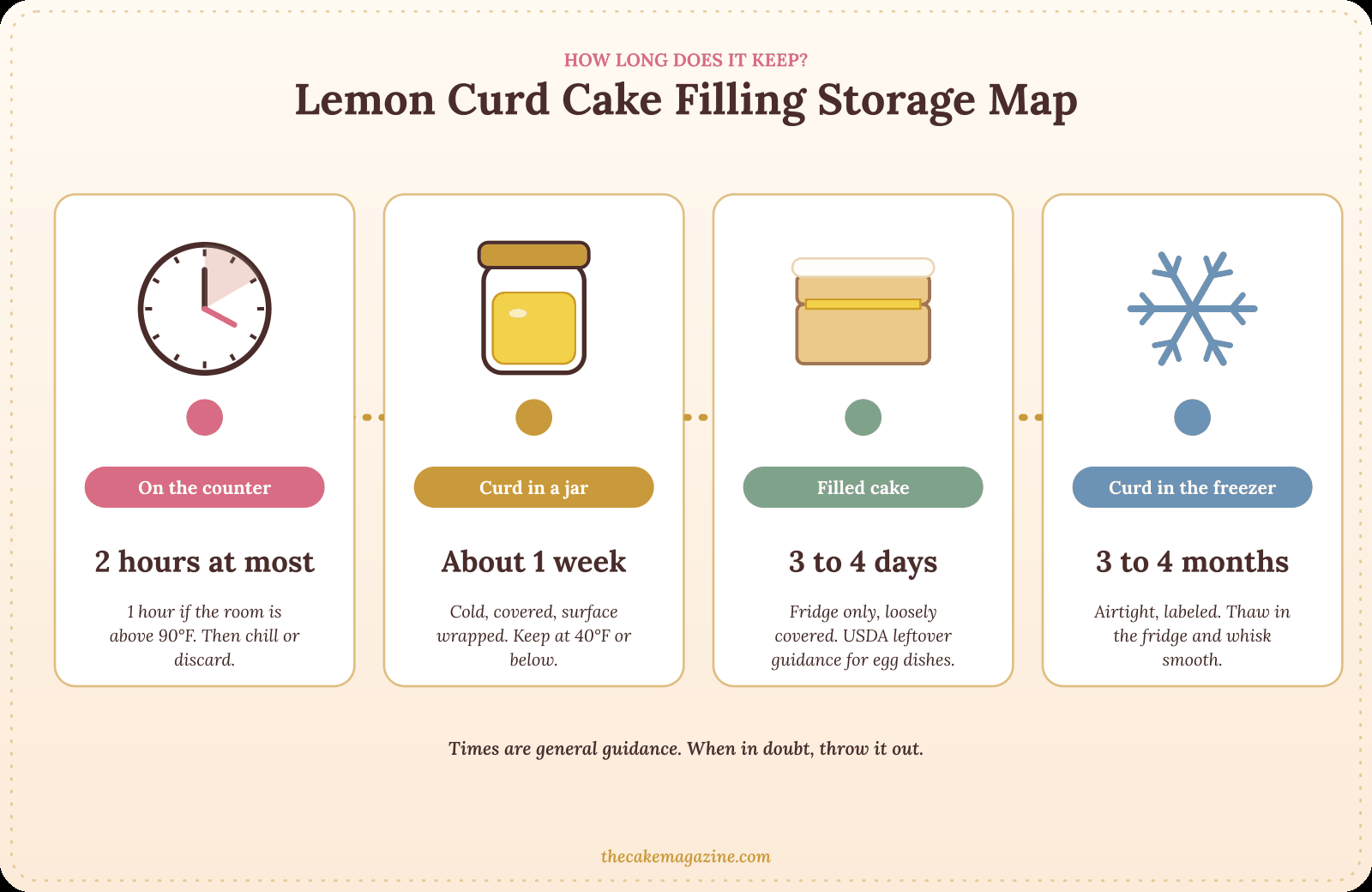
Put chilled curd in a clean, airtight container with plastic pressed to the surface. King Arthur Baking says homemade curd keeps for about a week in the refrigerator, and that you can freeze it for longer storage. Label the container with the date. The USDA’s general leftovers guidance, published on the Food Safety and Inspection Service leftovers page, gives three to four days in the refrigerator for typical leftovers and three to four months in the freezer for best quality.
When those numbers differ from a recipe, choose the shorter, more conservative time, especially if you are serving children, older adults, pregnant guests or anyone with a weakened immune system.
The counter rule
Perishable foods should not sit out for more than two hours, or one hour when the room is above 90°F, according to the same USDA guidance. A curd-filled cake on a dessert table counts. If you are serving at a long party, keep the cake in the refrigerator until shortly before cutting and put out only what you need. For more on which fillings can sit out and which need the refrigerator, see our cake filling stability guide.
Freezing curd
Curd freezes well. Pour it into a freezer-safe container, leaving a little room for expansion, and press wrap on the surface. Thaw it overnight in the refrigerator, then whisk gently to smooth it. It may look slightly separated after thawing, but a few strokes with a whisk or spatula usually bring it back. Freezing fully assembled cakes with curd is possible, but texture can suffer, so freeze the curd and the cake layers separately when you can.
Because curd is made with eggs and butter, it is not a casual candidate for water-bath canning. This site does not cover canning. If you want shelf-stable curd, look for a recipe tested by a recognized food-preservation authority. Otherwise, refrigerate or freeze.
Serving a curd-filled cake safely
Plan the timeline backward from the party. Assemble the cake the day before, frost it and refrigerate it overnight. Take it out thirty to sixty minutes before serving so the frosting softens a little and the flavors open up. Then slice, serve and put the remaining cake back in the refrigerator. That rhythm keeps the cake both safe and delicious.
How much lemon curd cake filling you need
Running out of curd halfway through assembly is miserable, and so is a refrigerator full of leftovers. A few simple estimates help. They are rules of thumb, not exact measures, because layer thickness, pan size and personal preference all change the numbers.
Rough amounts by cake size
- 6-inch layer: about 80 to 110 g of curd per filling layer.
- 8-inch layer: about 150 to 200 g per filling layer, or roughly 1/2 to 2/3 cup.
- 9-inch layer: about 190 to 250 g per filling layer.
- Cupcakes: about 1 to 2 teaspoons of curd per cupcake, spooned into a core.
- Sheet cake (9 by 13 inches): about 300 to 500 g for one filling layer.
A three-layer 8-inch cake has two filling layers, so you need between 300 and 400 g. The classic formula above makes about 730 g, which leaves enough for tasting, garnish and dessert plates. If you plan a taller cake with four layers, make a double batch or use the curd and buttercream blend to stretch it.
Filling cupcakes and small cakes
Use a small paring knife or cupcake corer to remove a cone of cake from each cupcake, then fill with a teaspoon of cold curd and top with frosting. The cored piece can be trimmed and replaced, or eaten by the baker. For larger plans, such as a dessert table with several flavors, our buttercream comparison helps you choose frostings that match multiple fillings.
Planning ahead
Curd is best made one or two days before assembly. That gives it time to chill thoroughly and lets you fix any problems without panic. Cake layers can be baked and frozen ahead as well, so on assembly day you are mostly piping, filling and frosting rather than cooking.
A make-ahead timeline for a lemon curd cake filling cake
Spreading the work over three days is the calmest way to build a cake with lemon curd cake filling. Each stage needs a rest, and rushing any of them is how curd ends up warm, thin and sliding out of a layer. This schedule is a suggestion, so shift it to fit your kitchen and your party.
Two or three days before
Cook and strain the curd, then chill it in a covered container. This is also the time to bake the cake layers, cool them fully, wrap them tightly and refrigerate or freeze them. Baking early actually helps, because slightly chilled cake is firmer and cleaner to level. If you plan a stabilized version, make that now too and test a spoonful on a cold saucer.
The day before
Make or soften your buttercream and bring it to a stiff piping consistency. Level the layers, pipe the dams, fill, stack and chill. Apply the crumb coat, chill again and finish the outer coat. Put the finished cake in the refrigerator uncovered for the first hour, so the surface firms, then cover it loosely or place it in a box. Everything that needs a long rest gets it overnight.
The day of the party
Take the cake out thirty to sixty minutes before serving, so the buttercream loses its chill and the curd softens slightly. Decorate with fresh berries, lemon slices or herbs just before it goes out. After the cake is cut, serve the slices promptly and return the remainder to the refrigerator. Keep to the two-hour limit, and one hour in a hot room.
Cutting clean slices
A tall knife dipped in hot water and wiped dry between cuts glides through frosting and curd without dragging. A cold cake cuts best, so slice before it warms too much. If the curd smears, chill the cake again for fifteen minutes. Neat slices show off the yellow stripe, which is half the reason to bake the cake in the first place.
Using up leftover lemon curd
You will probably have curd left after filling a cake. Spoon it over yogurt or pancakes, swirl it into cheesecake batter, sandwich it between shortbread cookies or fold it into whipped cream for a quick parfait. Use it within the storage times above, and always return it to the refrigerator promptly. A small jar of homemade lemon curd cake filling also makes a thoughtful gift, as long as you tell the recipient to keep it cold and eat it within a few days.
A note on timing and equipment
Stovetop curd cooks the same way in most kitchens, but gas flames, electric coils and induction hobs behave differently, and thin pans heat unevenly. Use a heavy-bottomed saucepan and plan to adjust. If your lemons are unusually juicy or dry, weigh the juice instead of counting lemons, and the result will be much more consistent from batch to batch.
Troubleshooting lemon curd cake filling
Most curd problems come from heat, timing or a reactive pan, and almost all of them have a fix. Here are the issues bakers meet most often, written as quick diagnoses. For problems in the cake layers themselves, see our cake troubleshooting guide.
The curd is runny after chilling
What it looks like: it pours off the spoon even after a night in the refrigerator.
Likely causes: it was pulled from the heat too early, the eggs were too few for the juice, or the juice was extra watery.
Fix it: return it to a clean pan and cook gently to 170°F while whisking, then strain and chill again. For a quick save, bring it back up with a small starch slurry. Next time, check the temperature, not just the clock.
The curd is grainy or lumpy
What it looks like: tiny cooked-egg flecks that feel sandy on the tongue.
Likely causes: the heat was too high, whisking paused, or hot juice hit the eggs too quickly.
Fix it: strain firmly. If it is still gritty, blend it with an immersion blender for a few seconds while it is still warm, then strain again. It will not be perfect, but it will be usable. Next time, lower the heat and whisk constantly.
The curd tastes metallic
What it looks like: a faint tinny or sharp aftertaste, sometimes with a gray tint.
Likely cause: a reactive pan, such as bare aluminum or cast iron, reacted with the acid in the juice.
Fix it: there is no clean fix, so stir in a little extra butter and vanilla to mask it, or begin again. Use stainless steel, enamel or glass in future, and a nonmetal bowl for chilling if you are worried.
The curd tastes eggy
What it looks like: a savory, sulfurous note under the lemon.
Likely causes: overcooking, or a pan that was too hot at the bottom.
Fix it: add fresh zest and a little more juice or vanilla to disguise it. Cook more gently next time, and pull the pan off the heat sooner.
A skin forms on top
What it looks like: a rubbery film that forms as the curd cools.
Likely cause: air touched the surface.
Fix it: strain out the skin, and press plastic wrap directly on the surface of the curd next time.
The filling squeezes out of the cake
What it looks like: yellow bulges at the sides of the layers, or leaks into the crumb coat.
Likely causes: the dam was too low or too soft, the curd layer was too thick, or the cake was warm.
Fix it: chill the cake, scrape away the bulge with a clean spatula and patch the side with a little buttercream. Next time, pipe a taller dam and cut the curd layer to a quarter inch.
The curd soaks into the cake
What it looks like: damp, darker crumb under the filling, or a yellow stain in the cake.
Likely causes: warm or thin curd, a very open crumb or a long wait before serving.
Fix it: brush the layer with a thin coat of buttercream before the curd, use colder and thicker curd, and assemble closer to serving time.
Common mistakes at a glance
- Using bottled juice and wondering why the curd tastes flat.
- Cooking in an aluminum pan.
- Stopping the whisk, even for a moment, over direct heat.
- Skipping the strainer.
- Spreading warm curd on a cake.
- Piling the curd too thick and skipping the dam.
- Leaving a filled cake out for hours.
Citrus and flavor variations for lemon curd cake filling
Once the classic is comfortable, small changes give you a whole family of fillings. Each of these follows the same method, but the juice, sugar and flavorings change, so taste as you go and adjust.
Meyer lemon curd
Meyer lemons are sweeter, softer and more floral than standard lemons. Use the same weight of juice, but reduce the sugar by roughly 20 to 30 g and taste before adding more. The flavor is gentler, so use extra zest if you want a clear lemon punch.
Lime, orange and grapefruit curd
Lime is sharper and slightly bitter, so a small increase in sugar helps. Orange is mild, so mix it with a spoonful of lemon juice to give it brightness. Grapefruit works well with a touch of honey to soften its bitterness. In each case, keep the total weight of juice the same as the classic formula and adjust sweetness by taste.
Passion fruit and berry curds
Strained passion fruit pulp makes a tropical, vivid curd, and raspberry or blackberry purées create colorful ones. Strain out the seeds, reduce the sugar if the fruit is sweet and expect a softer set, because purée has more water. A small amount of starch can help if the cake needs a firmer filling. Fruit purée brings extra moisture, so keep the filling layer thin.
Lemon-lavender, lemon-ginger and lemon-herb
Steep a few lavender buds, a slice of ginger or a sprig of thyme in the warm juice for ten minutes, then strain before using. Keep infusions light because they intensify as the curd chills. Taste the warm curd carefully, because cold dulls flavors and may fool you into adding too much.
Egg-yolk-only curd and white-chocolate curd
Using only yolks gives a golden, very silky curd that sets firmly. Replace the whole eggs with about 100 g of yolks, which is roughly six yolks, and use the whites elsewhere. For white chocolate lemon curd, stir a few ounces of finely chopped white chocolate into the hot strained curd until melted. It becomes sweeter and creamier, so reduce the sugar slightly.
Lemon curd with cream and cream cheese
Folding cold curd into whipped cream or softened cream cheese gives a pale, mellow filling that is easy to spread and very forgiving. These versions are perishable and need the refrigerator at all times. They are especially lovely in cupcakes, trifles and cake roll fillings.
Adapting for dietary needs
Curd is naturally gluten free, as long as you leave out flour and check labels on any added ingredients. For dairy-free cooks, plant-based butter blocks can replace the butter, though the flavor and texture will change. Vegan curd uses a different structure altogether and falls outside this guide. If a guest has an allergy, read every ingredient label and confirm with them.
Frequently asked questions about lemon curd cake filling
What is lemon curd cake filling?
It is a cooked mixture of lemon juice, sugar, eggs and butter that is thickened over gentle heat, strained and chilled. Bakers spoon it between cake layers for a bright, tart contrast to sweet cake and frosting. It is thick, glossy and smooth, and it is firmer than a sauce but softer than jam.
How thick should lemon curd cake filling be?
It should coat the back of a spoon when hot and become soft but spoonable after chilling for about four hours. In the cake, spread it about a quarter inch thick. If it runs when you tilt the bowl, cook it a bit longer next time, or add a small amount of cornstarch for stability.
Can I use store-bought lemon curd as a cake filling?
Yes, with care. Jarred curd is often softer and sweeter, and it may be thinner than homemade. Chill it well, give it a taste, and use a sturdy buttercream dam. If it is runny, cook it gently with a small starch slurry or fold it into buttercream or whipped cream for more body.
How long does homemade lemon curd cake filling last in the refrigerator?
King Arthur Baking says homemade curd keeps about a week in an airtight container in the refrigerator. For a cake that has been filled, the USDA’s general leftovers guidance of three to four days is a useful and conservative limit. If anything smells off or looks moldy, discard it.
Can I freeze lemon curd cake filling?
Yes. Freeze it in an airtight container for roughly three to four months for best quality, thaw it overnight in the refrigerator, and whisk it smooth. It may look slightly separated at first, but it usually comes back together. Freeze the cake layers separately for the best texture.
Does a cake with lemon curd filling need to be refrigerated?
Yes, because curd contains eggs and butter. Keep it in the refrigerator, and take it out only thirty to sixty minutes before serving. Perishable foods should not sit out for more than two hours, or one hour when it is above 90°F, according to USDA guidance.
Why does my lemon curd taste metallic?
The most common cause is cooking it in a reactive pan, such as bare aluminum or cast iron, which reacts with the lemon’s acid. Use stainless steel, enamel-lined or glass cookware, plus a nonreactive whisk and bowl. If the taste is mild, extra butter and vanilla may soften it.
How do I keep lemon curd cake filling from leaking out of the layers?
Pipe a ring of stiff buttercream around the edge of each layer, keep the curd to about a quarter inch and use it cold. Chill the stack for thirty minutes before the crumb coat. These three habits prevent most bulges and slipping layers.
Can I add cornstarch or gelatin to lemon curd cake filling?
You can. Roughly 10 g of cornstarch, cooked until bubbling, or about 2 g of bloomed gelatin stirred into warm curd will give a firmer filling for tall or travel cakes. Both are starting amounts, so test a small batch and adjust, because too much makes the filling rubbery.
Is lemon curd cake filling safe for pregnant guests?
Properly cooked curd reaches temperatures that the USDA recommends for egg dishes, so it is generally considered a better choice than raw-egg fillings. Still, check with your guest’s healthcare provider, keep the cake cold and discard it after the recommended time. This is general information, not medical advice.
What cake flavors go best with lemon curd cake filling?
Vanilla, white, almond, coconut, poppy seed and berry cakes are classic partners because they are mild enough to let the curd shine. Lemon cake works for lemon lovers, and a light chocolate cake can pair with raspberry and a thin layer of curd. Our flavor pairing guide offers more ideas.
Can I make lemon curd cake filling without butter?
Yes. A butter-free curd cooks the same way and tastes sharper and slightly lighter, with a looser set. Some bakers replace part of the butter with heavy cream for richness. Expect a different texture, and chill well before using it between layers.
Final thoughts on lemon curd cake filling
Lemon curd cake filling rewards a little care. Weigh the ingredients, cook gently to about 170°F, strain every batch and chill it long enough to set. Then give it a firm buttercream dam, keep the layer to a quarter inch and put the cake back in the refrigerator quickly. Those habits matter far more than any single secret ingredient, and they work for beginners and experienced bakers alike.
Make a small batch before your big cake. Taste it with your cake and frosting, notice how it behaves after a night in the cold and adjust the sweetness or thickness to suit your oven and your guests. Once you trust your version of lemon curd cake filling, you can turn almost any plain layer cake into something that tastes bright, fresh and special. If you want to explore frostings next, our buttercream guide is a good place to start.
Editorial note: reviewed and updated November 2026. This guide is written for home bakers in the United States, using American measurements and ingredients. The curd formula and the firming amounts here are starting points built from common baking ratios and published King Arthur Baking recipe notes.
We have not tested them ourselves, so make a small batch and adjust for your lemons, pan, stove and kitchen. Food-safety times come from USDA Food Safety and Inspection Service guidance and are general information, not medical advice. If you sell baked goods, check your state and local food rules. Where we link to products or tools in the future, we will disclose affiliate relationships near the links.