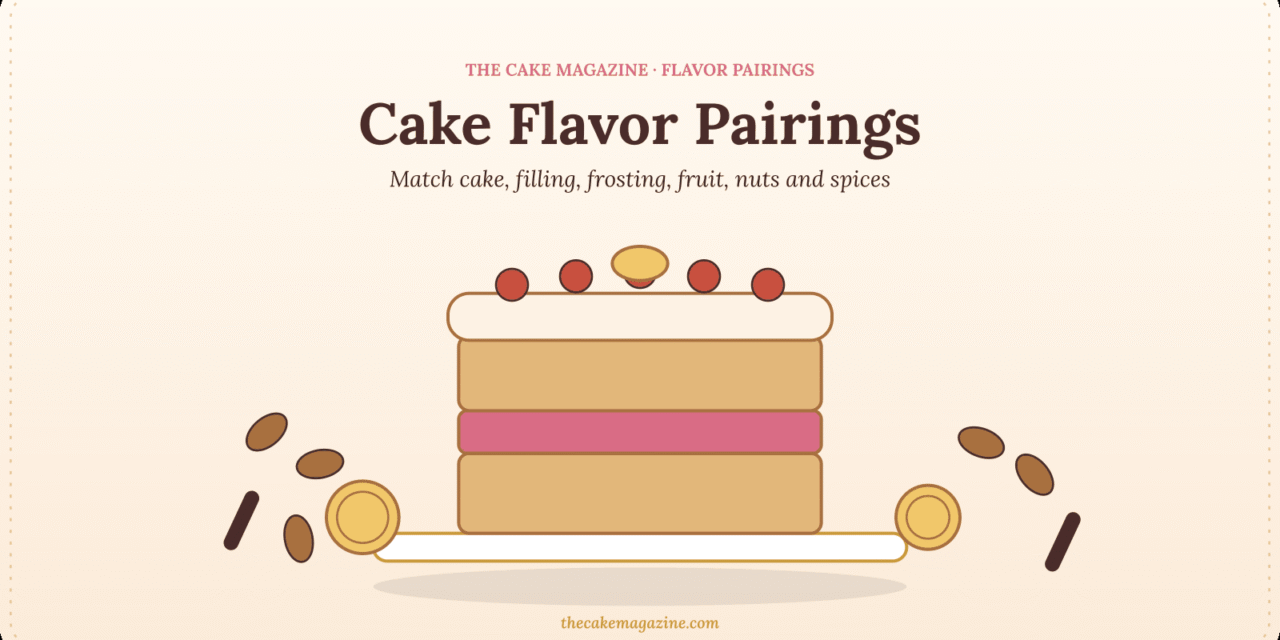
The best cake you ever ate probably did not taste like one thing. It tasted like a tender vanilla crumb with a spoonful of tart raspberry in the middle and a frosting that was just sweet enough to hold it all together. That is the quiet skill behind good cake flavor pairings: choosing partners that make each other taste better, instead of stacking flavors that merely sit in the same slice. This guide shows how to match cake, filling, frosting, fruit, nuts and spices with a few simple rules.
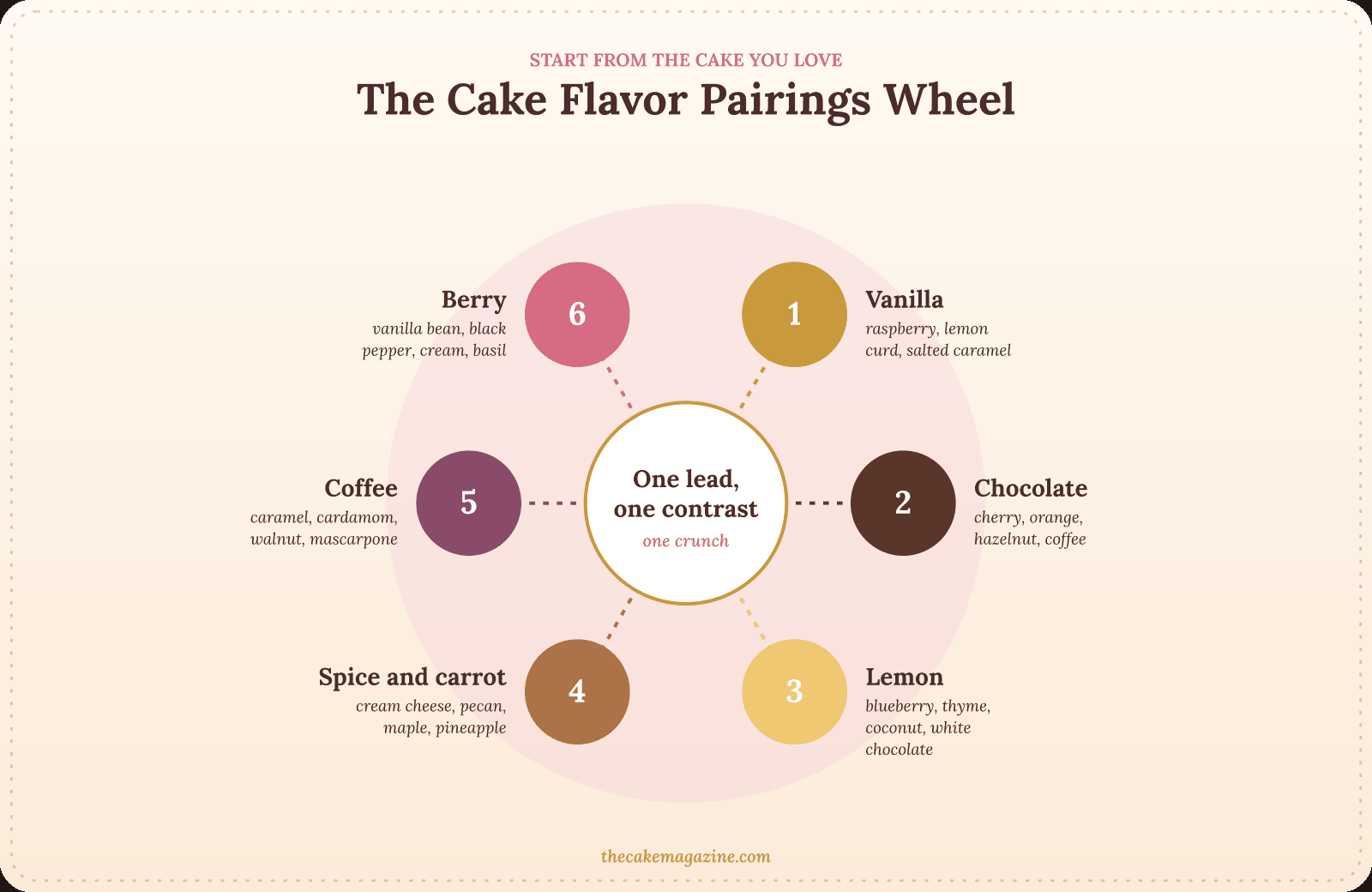
Good cake flavor pairings follow three habits. Let one flavor lead and give the others supporting roles. Balance sweet with something tart, salty, bitter or toasty. Vary the texture from layer to layer, so every bite has a soft part and a contrasting part. Start with a cake you love, add a filling that is brighter or tangier than the frosting, and finish with a frosting that matches the cake’s weight. Then taste a small test slice before committing.
- Why cake flavor pairings work
- A simple framework for cake flavor pairings
- Classic cake flavor pairings, cake by cake
- Matching frosting to the cake
- Choosing a filling that earns its place
- Fruit: fresh, cooked and zesty
- Nuts: flavor, crunch and toasting
- Spices and warm flavors
- Chocolate, coffee, caramel and other deep flavors
- Balancing sweetness, texture and moisture in cake flavor pairings
- Food safety for cake flavor pairings with perishable fillings
- Adapting cake flavor pairings to cupcakes, sheet cakes and tiers
- Six complete cake flavor pairings to borrow
- Common mistakes and how to test a pairing
- FAQ
- Final thoughts
Why cake flavor pairings work
Taste is only part of what you notice when you eat a slice of cake. Smell does a lot of the work, and so do temperature, texture and even how moist the crumb feels against your tongue. A pairing succeeds when these signals support each other. A cold, creamy filling next to a warm, spiced crumb feels interesting. A sticky caramel on a sticky cake feels like too much of the same thing.
Most pairings that people call “classic” share a quiet logic. Lemon and blueberry work because tart fruit cuts through a buttery crumb. Chocolate and raspberry work because the berry’s sharpness wakes up chocolate that might otherwise taste heavy. Carrot cake and cream cheese frosting work because the frosting’s tang offsets the sweetness of the cake and the warmth of the spices. None of this is magic, which means you can borrow the logic and apply it to flavors that have never been on a cake menu.
It also helps to remember that a cake is not a single flavor. It is a stack: crumb, soak, filling, frosting and sometimes a crunchy or fresh topping. Each layer is a chance to add a different note. Good cake flavor pairings treat the stack like a short piece of music, with a melody, a harmony and the occasional unexpected high note.
Three kinds of cake flavor pairings
Nearly every combination you will meet falls into one of three families. Knowing which family you are building makes the rest of the decisions easier.
- Echo pairings repeat the same flavor in different forms: a lemon cake with lemon curd and a lemon-scented buttercream. They are clear and easy to love, but they can feel flat if every layer has the same texture.
- Contrast pairings set opposites side by side: sweet cake with tart fruit, rich chocolate with bright citrus, mild vanilla with salty caramel. These are the combinations people remember.
- Bridge pairings use one ingredient to connect two flavors that would not otherwise meet, like orange zest linking chocolate and cardamom, or brown butter linking pecans and maple.
Most of the best cakes mix two of these. A chocolate cake with raspberry filling and chocolate buttercream is partly an echo and partly a contrast. That balance of familiar and surprising is a good target for almost any celebration cake.
A simple framework for cake flavor pairings
When a client or a family member asks for “something with strawberries and maybe chocolate,” it helps to have a way to turn that into a plan. This framework for cake flavor pairings is not a rulebook. It is a set of questions that makes the decision feel less like a coin flip.
Step one: pick the lead flavor
Every cake needs one flavor that the slice is about. It might be the cake itself, as in a deep chocolate cake, or it might be the filling, as in a plain vanilla cake that exists to carry a bright passion fruit curd. Decide this first. Without a lead, a cake with five flavors tastes like none of them. If you cannot name the lead in a single word, simplify.
Step two: choose a supporting partner
A supporting flavor should be easy to taste next to the lead without covering it. Fruit, nuts, spices and a pinch of salt are the usual helpers. A good test is to ask whether the partner makes the lead taste more like itself. Raspberry makes chocolate taste more chocolatey. Almond makes cherry taste more like cherry. Cinnamon makes apple taste more like a warm apple, not just a sweet one.
Step three: add a contrast
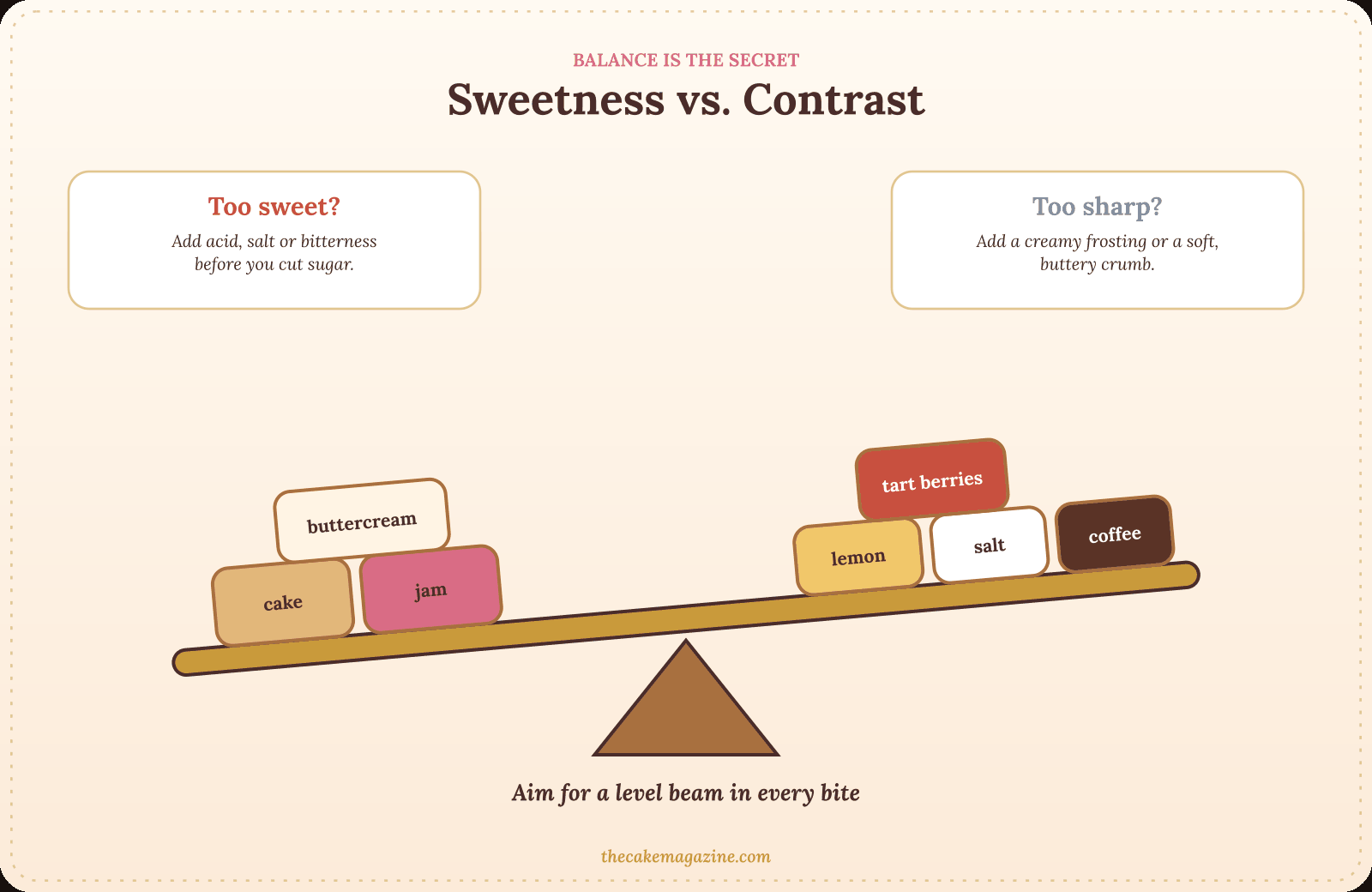
Sweet cakes need something that pushes back. Acid, salt, bitterness and a toasty note are all ways to do it. Tart jam, a squeeze of lemon, flaky salt in caramel, espresso in chocolate frosting, and toasted nuts folded into a filling each give the tongue a reason to keep going after the first bite. When a cake tastes “fine, but boring,” the missing ingredient is almost always contrast.
Step four: match texture and weight
Cake flavor pairings fail as often from texture as from taste. A fluffy chiffon cake collapses under a heavy ganache. A dense, buttery pound cake can feel dull with a thin glaze alone. Keep the weight of the layers in a conversation: delicate cakes get light, airy frostings and fillings, while sturdy cakes can handle richer ones. The related guide to types of buttercream shows how much the weight changes from one style to the next.
Step five: check the practical limits
Last, ask whether the idea will survive real life. Will the filling hold its shape between layers? Does it need refrigeration? Will the cake sit out at a party for three hours? This is where many beautiful pairings go wrong, and it is covered in detail in the food safety section below. A filling that tastes wonderful but slides out of the side of the cake is not a good pairing, however clever the flavors.
The five-question pairing check
- What is the one lead flavor?
- What partner makes it taste more like itself?
- What provides contrast: acid, salt, bitterness or toast?
- Do the textures and weights of the layers match?
- Will it hold up, and does it need the fridge?
A worked example
Say you want a spring birthday cake. The lead is lemon, because the guest of honor loves it. A tender vanilla-lemon cake gives you the crumb. For a partner, blueberry is a classic choice, so you cook a quick blueberry compote with a little zest. The contrast is already built in, because the berries are tart and the cake is sweet. For frosting, an American buttercream would be very sweet next to that, so you choose Swiss meringue buttercream or a lemony cream cheese frosting.
For crunch, you scatter a few crushed freeze-dried berries on top, or add a thin ring of toasted white chocolate crumbs near the base. Notice that the cake now has four layers of interest and only one theme. That is what a confident pairing looks like.
If you would like to go deeper on the cake side, our vanilla cake recipe is a good neutral canvas for almost any filling, and the lemon cake recipe shows how to build lemon flavor into the crumb itself.
Classic cake flavor pairings, cake by cake
The easiest way to learn cake flavor pairings is to start from the cake you are baking and work outward. Below are the cakes bakers ask about most, with partners that tend to work and a short reason why. Treat these as starting points. Your own taste, your guests and your recipe will decide what is right.
Vanilla and white cakes
Vanilla is the most flexible partner in the cake world, because it is gentle and does not compete. That makes it a good carrier for strong fillings. Try it with raspberry, strawberry, lemon curd, passion fruit, salted caramel, chocolate ganache, cookies and cream crumbs or a coffee buttercream. Because the crumb is mild, the filling carries the personality. If you want the cake itself to feel special, brown a little of the butter or use a vanilla bean paste in the batter.
Chocolate cake
Chocolate wants brightness or bitterness to stand next to. Raspberry, cherry, orange, coffee, peanut butter, hazelnut, mint, caramel, salted pretzel and cream cheese all work. Deep chocolate can also take a slightly tangy filling, like sour cherry preserves, because the sourness keeps each bite from feeling heavy. For a closer look at building that base, see our guide to a chocolate cake with a reliable crumb.
Red velvet
Red velvet is a mild cocoa and buttermilk cake, and tang is its natural partner. Cream cheese frosting is the traditional match, and a thin layer of raspberry or cherry jam adds a bright note without hiding the delicate flavor. Pecans, white chocolate and a pinch of salt also fit. If you want to understand why it tastes the way it does, read our red velvet cake guide.
Lemon, orange and other citrus cakes
Citrus cakes pair with berries, stone fruit, herbs and florals: blueberry, raspberry, strawberry, thyme, lavender, elderflower, basil, poppy seeds, coconut and white chocolate. The trick is to match intensity. A fully lemony cake wants a filling with its own backbone, like lemon curd or a berry compote, rather than a gentle cream. Orange loves chocolate, cardamom, almond, cranberry and ginger. See the orange cake guide for ways to build the citrus flavor without bitterness.
Strawberry and other berry cakes
Berry cakes can be delicate, since fresh fruit is wet and its flavor fades in the oven. Pair them with something that restores the intensity: a cooked berry filling, vanilla bean frosting, a little lemon, black pepper or balsamic vinegar in the compote, and a creamy but not too sweet frosting such as whipped cream or cream cheese. White chocolate, basil and rose are lovely, quieter partners. Our strawberry cake guide explains how to keep the crumb from going wet.
Carrot, banana, pumpkin and apple
These moist, spiced cakes all sit comfortably next to cream cheese frosting, brown butter frosting and maple. Walnuts and pecans add crunch to the crumb. Carrot likes pineapple, coconut, raisins and orange. Banana loves peanut butter, chocolate, caramel and rum. Pumpkin and apple belong with cinnamon, ginger, nutmeg, cloves, caramel and toasted pecans. If you have been wondering how to dress them, our guides to pumpkin cake, apple cake and banana cake go deeper into each one.
Coffee, coconut and pistachio
Coffee cake loves chocolate, hazelnut, caramel, cardamom, vanilla and mascarpone. Coconut loves lime, passion fruit, mango, pineapple, white chocolate and rum. Pistachio likes rose, cardamom, raspberry, cherry, lemon and white chocolate. Each of these has a strong personality, so choose partners that complement rather than compete. For details, see the coffee layer cake, coconut cake and pistachio cake guides.
Vanilla
Raspberry, lemon curd, passion fruit, salted caramel, ganache, coffee buttercream. A neutral canvas for a bold filling.
Chocolate
Raspberry, cherry, orange, coffee, peanut butter, hazelnut, mint, caramel. Needs brightness or bitterness to stay interesting.
Lemon
Blueberry, raspberry, thyme, lavender, poppy seed, coconut, white chocolate. Match its brightness with a filling that has backbone.
Carrot and spice
Cream cheese, pecans, pineapple, orange, maple, brown butter. Tang offsets the sweetness of the crumb.
One more tip. When you are not sure, look at what ingredients already live in the cake. If the batter has buttermilk, a tangy filling will feel natural. If it has brown sugar, caramel and toasted nuts will fit. If it has oil and cocoa, coffee and berries will brighten it. The recipe often tells you what it wants.
Matching frosting to the cake
In cake flavor pairings, frosting does more than cover the cake. It is usually the single largest portion of flavor and fat in each bite, so choosing the wrong one can drown a good cake. Think of frosting as the volume knob: some frostings are loud, some are quiet, and your cake needs the right one.

Which frosting for which job
A short orientation helps. American buttercream is sweet, sturdy and forgiving. Swiss and Italian meringue buttercreams are silky and less sweet. Cream cheese frosting is tangy and soft. Whipped cream is light and fresh but needs refrigeration. Ganache is deep and dense. Ermine frosting is cooked, fluffy and gently sweet. Our full guide to buttercream types compares them in detail, and you can read more about American buttercream, Swiss meringue buttercream and cream cheese frosting separately.
- American buttercream suits sturdy, lightly sweet cakes and anything that must travel. Add a pinch of salt, a splash of lemon or a spoonful of cocoa to tame the sweetness. Pairs well with tart fillings.
- Swiss or Italian meringue buttercream suits fruit cakes, wedding cakes and anything where you want the filling to be the star. It is smooth and mild, and it takes flavors like raspberry puree, lemon, coffee and caramel without turning sugary.
- Cream cheese frosting suits carrot, red velvet, pumpkin, banana, hummingbird and chocolate cakes. Keep it cold and stay realistic about how much it can hold up.
- Whipped cream frosting suits chiffon cakes, strawberry shortcake-style cakes and tropical flavors. It needs a stabilizer for any piping and must stay chilled. See stabilized whipped cream.
- Ganache suits vanilla, coffee, peanut butter and raspberry cakes. It is rich, so keep the layer thin. See chocolate ganache ratios.
- Ermine frosting suits red velvet, chocolate and lighter spice cakes, and is a good answer for people who find buttercream too sweet. See ermine frosting.
Flavoring frosting without breaking it
Adding flavor to frosting is where many bakers get into trouble. Extra liquid makes buttercream soupy and can curdle it. Better options include freeze-dried fruit powder, which adds intense flavor and no water; reduced fruit puree cooled completely; instant espresso powder dissolved in a teaspoon of warm vanilla; cocoa sifted in; nut butters; and citrus zest rubbed into the sugar first. Add flavor a little at a time, tasting as you go, because the sweetness of the frosting will dull any addition.
Be careful with strong extracts too. Almond, peppermint and rum extracts are potent. A quarter teaspoon can change the whole cake, and many people find too much of any of them tastes artificial. If you are not sure, start with less than you think you need and chill the frosting for a few minutes before tasting again, since cold dulls flavor and warm brightens it.
Weight matters as much as flavor in cake flavor pairings
A heavy frosting on a delicate cake is one of the most common errors in cake flavor pairings. A light sponge or chiffon can be squashed flat by a thick layer of dense buttercream, and its fine flavor will vanish. Match a light crumb to a light frosting, and reserve ganache and cream cheese for sturdier cakes. If you must use a heavy frosting on a delicate cake, apply a thinner layer and add a bright filling to lift it.
Choosing a filling that earns its place
The filling is where cake flavor pairings give you the most freedom. It is hidden, so it can be bolder than the outside. It is also the layer most likely to be wrong, because it must taste good, hold its shape and stay safe. A useful rule is that the filling should be brighter, tangier or fruitier than the frosting. If the frosting is sweet and creamy, the filling should push back.
Common filling styles
- Jam and preserves are the easiest filling. A thin layer adds fruit flavor and acid. Warm the jam slightly to loosen it, and pipe a frosting dam so it cannot slide. Our guide to jam cake fillings covers this in detail.
- Fruit compote offers a fresher flavor and more texture, and is made by cooking fruit with sugar and a thickener. Cool it fully before using. See fruit compote for cake filling.
- Lemon curd and other curds are intensely tart, silky and set. They work as a thin layer inside a frosting dam. See lemon curd for cakes.
- Pastry cream is soft, vanilla-rich and ideal for Boston-cream-style cakes. It is perishable, so it needs careful storage. See pastry cream for cakes.
- Mousse is airy and elegant, but needs refrigeration and a firm outer structure. See cake mousse fillings.
- Caramel and dulce de leche add a deep, toasty sweetness that loves salt. Keep the layer thin or it will squeeze out. See caramel cake filling.
- Ganache and nut spreads give a dense, chocolatey or nutty middle. A thin layer goes a long way.
The contrast rule for cake flavor pairings
Here is a trick that works with almost any combination. Look at the cake and the frosting, and ask what they are missing. A sweet vanilla cake with buttercream is missing acid, so use lemon curd or raspberry. A chocolate cake with chocolate frosting is missing brightness or texture, so use cherry compote or a crunchy hazelnut praline. A tangy lemon cake with cream cheese frosting is missing depth, so use a thin layer of blueberry jam cooked down with a little vanilla.
That question turns filling selection from a guess into a puzzle with a short list of right answers. It also helps you avoid doubling up: caramel between caramel layers rarely works, and neither does a sweet jam in a sweet cake with sweet frosting.
Moisture and a filling’s job
Remember that a filling will also move moisture into the crumb over time. A wet filling can make the cake soggy on its second day, especially if it contains fruit juice. A thicker filling or a cake soak that matches it lets you control this. If the cake has been brushed with a flavored syrup, the filling can be lighter. Our guides to simple syrup for cake and cake soaks explain how to match them.
Fruit: fresh, cooked and zesty
Fruit is the great balancer of cake flavor pairings, because it brings acid, aroma and color. But fruit behaves very differently depending on how you use it, and the form you choose affects both taste and stability.
Choose the right form
Fresh fruit tastes bright but weeps juice, so it belongs on top or in a thin layer with a barrier of frosting. Cooked fruit, like compote or jam, has a deeper, jammier flavor and holds its shape better. Freeze-dried fruit adds concentrated flavor and crunch with no moisture. Zest and juice add aroma and sharpness. A well-built cake often uses two forms of the same fruit: cooked raspberries in the filling and fresh ones on top, for example.
Our guide to fresh fruit cake fillings explains how to handle moisture, and the tangy cake flavors guide looks at brighter fruits like passion fruit, yuzu and raspberry in more depth.
Cake flavor pairings by fruit
Strawberry
Vanilla, lemon, white chocolate, chocolate, basil, balsamic, black pepper, rhubarb. Cook it down to concentrate flavor.
Raspberry
Chocolate, vanilla, lemon, pistachio, almond, rose, white chocolate. Its sharpness cuts rich frostings.
Blueberry
Lemon, lavender, almond, cinnamon, vanilla, cream cheese. Cooking brings out its sweetness and deep color.
Lemon and lime
Berries, coconut, ginger, thyme, white chocolate, poppy seed. Zest in the sugar spreads flavor evenly.
Peach and apricot
Vanilla, almond, brown butter, cardamom, ginger, bourbon. Roast or cook to concentrate.
Cherry
Chocolate, almond, vanilla, pistachio, orange. Tart cherries keep rich cakes lively.
Passion fruit and mango
Coconut, vanilla, lime, white chocolate, ginger. Both are intensely tangy and need a mild cake.
Apple and pear
Cinnamon, caramel, brown butter, walnut, ginger, maple. Cook until just tender, not mushy.
Matching intensity
The most useful habit in cake flavor pairings is to match the intensity of the fruit to the cake. A delicate sponge disappears under a strong passion fruit curd, while a sturdy chocolate cake can handle it just fine. Berries and stone fruit are medium, and citrus curds are strong. If the fruit is strong, go lighter with the amount, or choose a mild frosting that lets it shine.
Seasonal thinking
Cake flavor pairings with fruit change with the season. In summer, ripe berries and stone fruit need little help. In winter, you may do better with citrus, pears, cranberries or good-quality frozen fruit, which is picked ripe and can taste better than out-of-season fresh fruit. Frozen berries cooked into a compote are often the most reliable choice for a filling at any time of year, because the cooking concentrates flavor and you control the sweetness.
Nuts: flavor, crunch and toasting
Nuts bring fat, aroma and texture, which are exactly the things a soft cake lacks. Used well, they are among the most dependable ingredients in cake flavor pairings. Used carelessly, they turn bitter, soggy or stale.
Toast them
Raw nuts taste mild and a little waxy. Toasting changes that: the flavor deepens and the crunch improves. Spread nuts on a rimmed sheet in a moderate oven, stir once, and pull them as soon as you can smell them, since they go from golden to bitter quickly. Cool them completely before chopping or folding them into a frosting. Because ovens vary, watch the nuts rather than the timer.
Cake flavor pairings by nut
- Almond loves cherry, apricot, raspberry, orange, vanilla, chocolate and coffee. Almond extract is strong, so use it sparingly.
- Hazelnut is chocolate’s closest friend. It also suits coffee, pear, caramel and orange.
- Pecan pairs with caramel, maple, brown sugar, bourbon, apple, pumpkin, banana and chocolate.
- Walnut is slightly bitter and earthy. Use it with carrot, banana, coffee, honey, maple and dark chocolate.
- Pistachio loves rose, cardamom, lemon, raspberry, cherry, white chocolate and orange blossom.
- Peanut goes with chocolate, banana, jelly, caramel and salt. See the notes on allergens below.
- Coconut is not a true nut in everyday baking terms, but it behaves like one: it loves lime, mango, passion fruit, white chocolate and rum.
Keep nuts crisp
Crunch fades when nuts sit in moist frosting or filling. To keep them crisp, add them to the cake as late as you can, or coat them in a thin layer of melted chocolate or caramel. Praline, which is nuts cooked with caramelized sugar, holds its crunch well and makes a lovely thin layer between cake and filling. Otherwise, use nuts as a topping, pressed into the sides just before serving, or sprinkled between layers of a cake that will be eaten the same day.
Allergen note. Tree nuts and peanuts are common allergens, and traces can travel on spoons, bowls and cutting boards. If you bake for others, tell guests which nuts are in the cake and keep nut-free cakes prepared separately. Never assume a guest can tolerate a small amount.
Ground nuts can also replace some of the flour in a cake for a tender, flavorful crumb, as in an almond or hazelnut cake. They also work as a sweetening, flavorful layer: a thin spread of hazelnut praline paste between layers of chocolate cake is one of the simplest ways to make a cake taste professional.
Spices and warm flavors
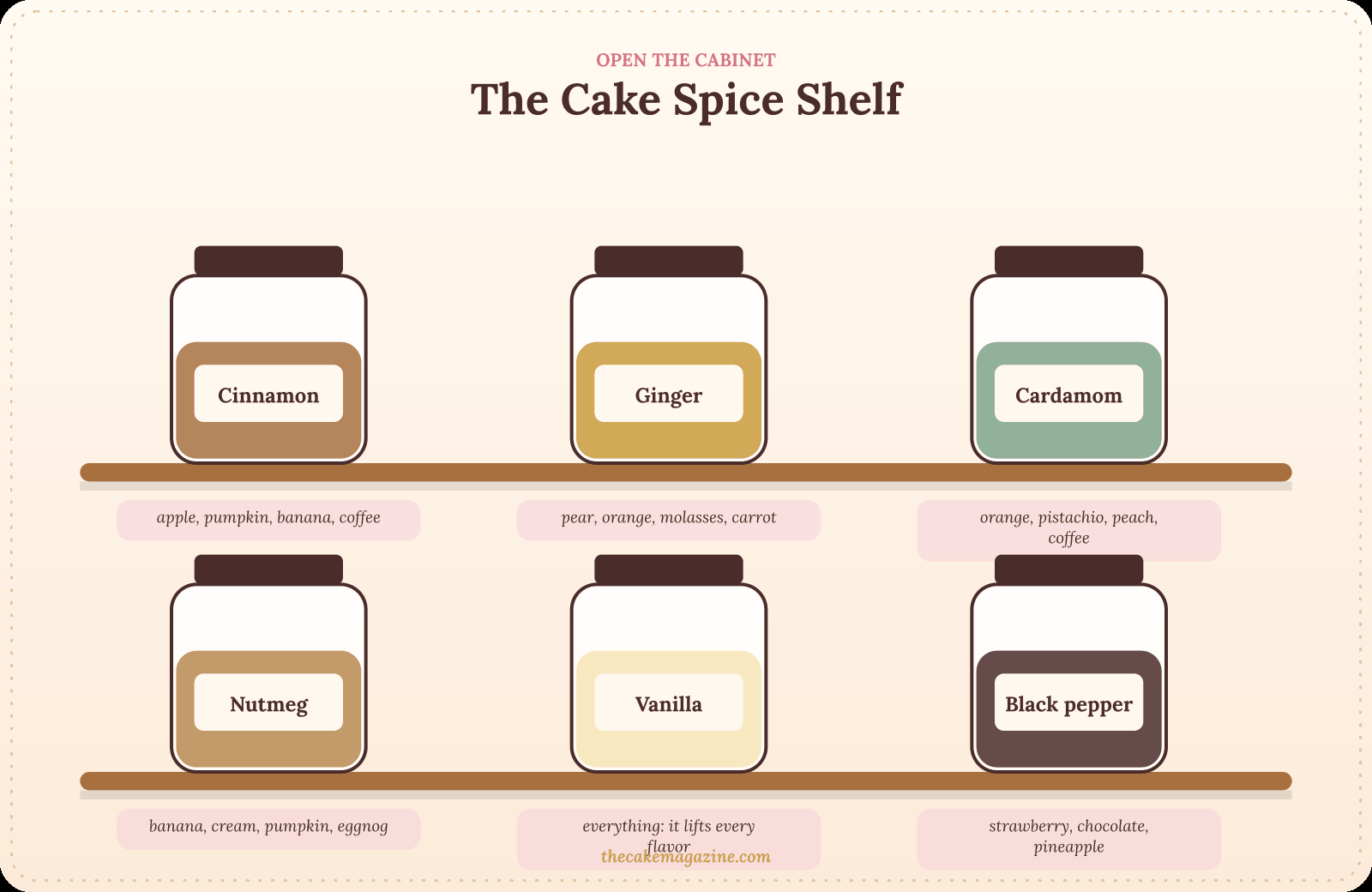
Spices are the quiet workhorses of cake flavor pairings. A little cinnamon can make a plain cake feel cozy. A pinch of cardamom can make orange taste more like orange. But spices are also the easiest way to make a cake taste dusty or medicinal, so a light hand and fresh jars matter.
Buy fresh and bloom them
Ground spices lose their punch over time. If a jar has been in the cabinet for years, the aroma will be faint, and you will be tempted to use too much. Buy small amounts and label the date. To get the most from them, warm the spices briefly in the melted butter or oil from the recipe before mixing them into the batter, which helps release their aroma. Whole spices ground just before use are even more fragrant.
Cake flavor pairings by spice
- Cinnamon suits apple, pumpkin, banana, carrot, coffee, chocolate, pecan and brown sugar. It also brings a lovely warmth to a plain vanilla cake.
- Ginger suits pear, molasses, orange, lemon, pumpkin, banana and dark chocolate. Fresh grated ginger is brighter, while ground is warmer.
- Nutmeg is sweetly woody and belongs in banana, pumpkin, eggnog-style cakes and anything with cream. A little goes a long way.
- Cardamom is floral and a bit citrusy. Try it with orange, pistachio, coffee, pear, rose, peach and white chocolate.
- Cloves and allspice are strong. A pinch in pumpkin, spice or gingerbread-style cakes is plenty.
- Black pepper is a surprise partner for strawberry, chocolate and pineapple. A few grinds are enough.
- Vanilla is technically a spice and the most useful of all. Real vanilla beans, vanilla paste and a good extract all deepen every other flavor around them.
- Saffron, lavender and rose are delicate florals. Use them sparingly with lemon, pistachio, honey, apricot or white chocolate, and taste often.
Warm spice blends worth knowing
Some blends work as shortcuts. Pumpkin pie spice typically combines cinnamon, ginger, nutmeg and cloves, and it makes a good base for pumpkin, apple, banana and carrot cakes. Chai spice often adds cardamom and black pepper, which makes it a nice twist on a vanilla or coffee cake. Because blends vary by brand, taste a pinch in a spoonful of frosting first, and adjust to your preference.
Spice the whole stack
One easy way to make a spiced cake feel considered is to carry the spice through more than one layer, at different strengths. Put the cinnamon in the cake, a pinch in the brown butter frosting, and a dusting on top. The cake will taste unified without being heavy. Contrast this with doubling the spice in the batter, which only makes it harsh.
Chocolate, coffee, caramel and other deep flavors
In cake flavor pairings, deep flavors are the ones that bring roast, bitterness or caramelization. They are rich and satisfying, but they also tire the palate fast, so they need an airy counterpart.
Chocolate
Chocolate is a lead flavor in many cakes and a supporting one in many more. Dark chocolate has bitterness that pairs well with sweet, creamy partners like vanilla, caramel and peanut butter. Milk chocolate is gentler and pairs well with hazelnut, banana and coffee. White chocolate is sweet and buttery, and it likes tart fruit, citrus, pistachio and coconut. The type of cocoa also matters: our guide to natural versus Dutch-process cocoa explains how each one tastes and behaves.
Coffee
Coffee works as both a flavor and an enhancer. A teaspoon of instant espresso powder in a chocolate batter will deepen the chocolate without making it taste like coffee. A stronger dose makes a real mocha cake. Coffee loves chocolate, caramel, hazelnut, cinnamon, cardamom, vanilla, walnut, banana and mascarpone. It can also be used in a soak. See our guide to coffee-flavored layer cakes for fillings and frostings that work.
Caramel and brown sugar
Caramel brings toasty, buttery sweetness, and salt makes it far more interesting. It works with apples, pears, bananas, pecans, chocolate, coffee, vanilla and bourbon. Because it is already very sweet, avoid combining it with a very sweet frosting. Pair it with tart fruit, cream cheese or a lightly sweetened whipped cream instead.
Brown butter, honey, maple and molasses
Browning butter turns its milk solids toasty and nutty, a small step that gives vanilla, pumpkin and apple cakes real depth. Honey and maple bring their own floral or woody character and pair well with nuts, spice and citrus. Molasses is dark and slightly bitter, perfect with ginger and brown sugar. All of them add moisture, so they change the crumb a little. Replace them in small amounts rather than all at once.
Savory notes
A touch of salt is the simplest savory addition, and it makes nearly every sweet flavor taste more vivid. Beyond salt, some bakers use miso, tahini, olive oil, rosemary or thyme. These are fun but easy to overdo. If you want to experiment, start with a small test cake or a single cupcake, and keep the other flavors simple.
Balancing sweetness, texture and moisture in cake flavor pairings
Perfectly good flavors can still add up to a disappointing slice if the balance is off. Three kinds of balance matter most.
Sweetness against acid and salt
Sugar is a flavor and also a volume knob. When a cake, filling and frosting are all sweet, the slice feels flat and sticky. Add acid from fruit, citrus, cream cheese, buttermilk or sour cream. Add salt, which suppresses the perception of cloying sweetness. Add bitterness from dark chocolate, coffee or toasted nuts. If a finished cake tastes too sweet, the fix is rarely less sugar everywhere. It is usually more contrast.
Texture contrast
Strong cake flavor pairings give each slice something soft, something creamy and something with a little bite. A tender crumb, a silky filling and a thin line of praline is a common structure. Without any crunch, a soft cake with a soft filling and soft frosting can feel monotonous, even if the flavor is wonderful. Add texture with toasted nuts, crumbs, cookie bits, a crisp sugar layer or a fresh fruit garnish.
Moisture and structure
Moisture moves from one layer to another. Wet fillings soften the crumb, dry cakes absorb moisture from the filling, and fruit juices travel along cut edges. Use a frosting dam to hold the filling in, choose thicker fillings for tall or long-held cakes, and let a very juicy filling cool and thicken before using. Because structure also depends on frosting and layer count, see our guide to torting a cake for how to build neat, even layers.
A quick balance fix. If a cake tastes too sweet, add a pinch of salt to the frosting, a teaspoon of lemon juice to the filling, or serve it with unsweetened whipped cream or fresh berries. If it tastes flat, add acid. If it tastes heavy, add something crisp and bright.
Food safety for cake flavor pairings with perishable fillings
A cake that tastes wonderful is no good if it makes someone ill. Many of the most appealing cake flavor pairings rely on perishable fillings, including pastry cream, mousse, fresh cream, curds made with eggs, and cream cheese frostings. These need careful handling.
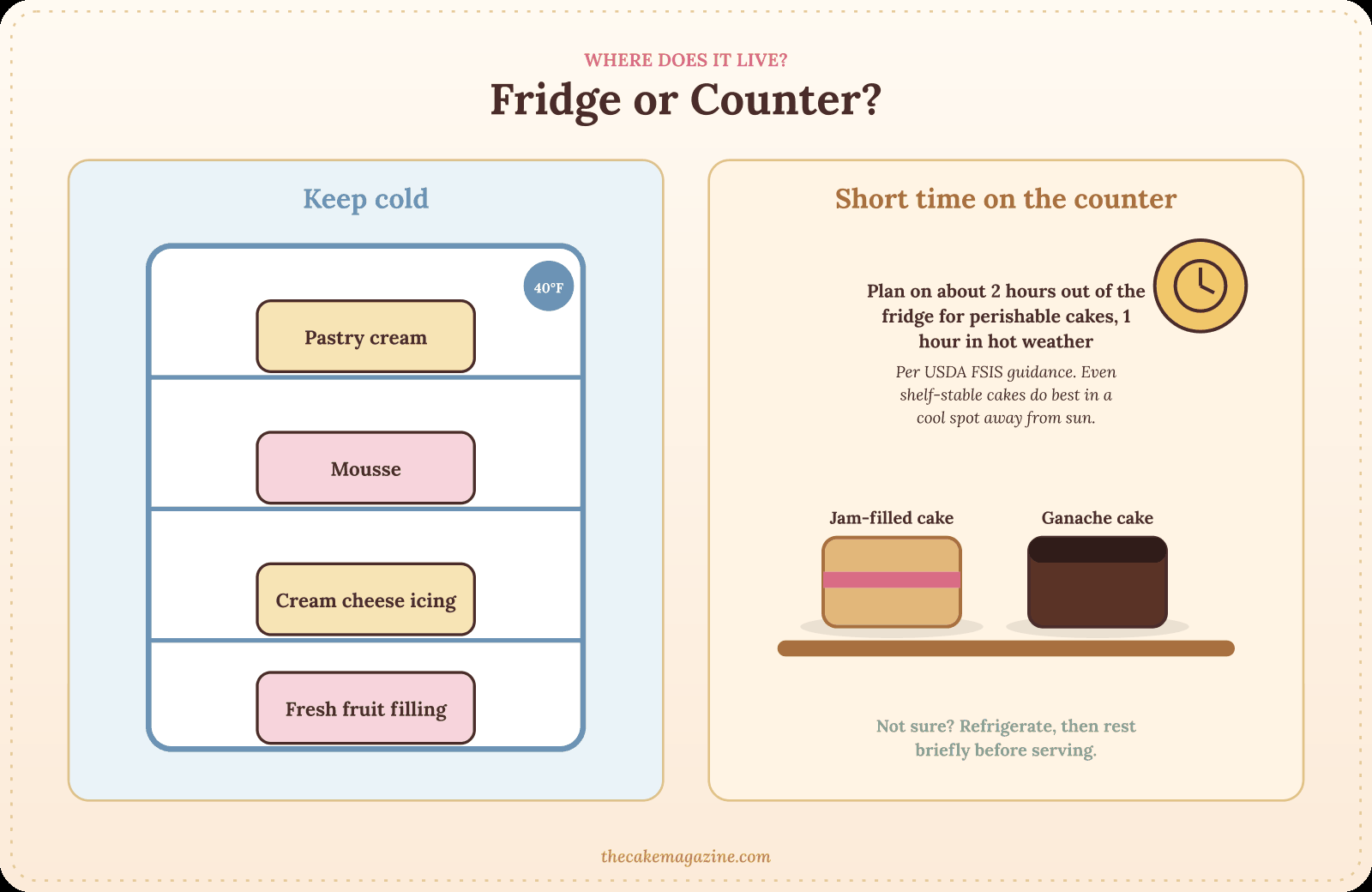
The United States Department of Agriculture’s Food Safety and Inspection Service explains that bacteria grow fastest between 40 and 140 degrees Fahrenheit, and that perishable food should not be left out for more than two hours, or one hour when the temperature is above 90 degrees Fahrenheit. You can read the agency’s danger zone guidance and its general food safety resources for more.
What generally stays at room temperature, and what does not
- Usually fine for a short time on the counter: a cake with American buttercream made with butter and powdered sugar, jam-filled cakes, and cakes with fully baked, shelf-stable ingredients. Even these do better in a cool spot, away from sun and heat.
- Needs refrigeration: pastry cream, mousse, whipped cream, custards, cream cheese frosting, fresh fruit fillings and egg-based curds.
- Depends on the recipe and handling: meringue buttercreams, ganache and caramel. When you are unsure, refrigerate and bring the cake to a cool room temperature before serving.
Our guide to cake filling stability goes into more detail on what can sit out and what cannot, and it is worth reading before you plan a menu around perishable fillings.
A practical habit. Chill cakes with perishable fillings until you are ready to serve, and keep them out for no longer than the two-hour guideline. This is general information, not medical or regulatory advice. If you sell cakes, check your state or local rules for requirements about perishable ingredients and labeling.
Cold changes flavor, too. A chilled cake can taste muted, because cold dulls aroma and firms the fat in the crumb and frosting. Let a refrigerated cake sit out briefly before serving, within the safe time limit, so the flavors come forward. Slicing with a warm, wiped knife gives clean layers and avoids smearing the filling.
Adapting cake flavor pairings to cupcakes, sheet cakes and tiers
Cake flavor pairings that sing in a six-inch layer cake can fall apart in a different format. Cupcakes, sheet cakes and tiered cakes each change how much filling you can use, how the cake is cut and how long it sits out. Thinking about format early saves you from a lovely idea that does not survive the trip.
Cupcakes and mini cakes
A cupcake has very little room for a filling, so the flavor needs to be concentrated. A teaspoon of jam, curd or ganache pressed into the center is plenty. Because frosting makes up a large share of each bite, choose one you enjoy eating in quantity, which usually means something less sweet. Nut crunch and fresh fruit work well on top. For small formats, our guide to mini cakes covers how portions and filling amounts change when the cake shrinks.
Sheet cakes and crowd cakes
Sheet cakes are cut into rectangles, so the filling is exposed on the sides and gets handled more. Choose fillings that hold a clean edge, like jam, curd, firm buttercream or ganache. Skip loose fruit and soft mousse unless the cake will be served chilled and eaten right away. Flavors for a crowd should be widely liked, so lean on classics and keep any adventurous element, like an unusual spice, subtle.
Tiered cakes
Each tier can have its own flavor, which is a chance to offer variety. The tiers should still feel related. A lemon tier, a vanilla and raspberry tier and a chocolate tier can sit together comfortably because the frosting is shared. Heavy or tall cakes need firm fillings, since weight pushes soft layers outward. Ask whether each filling will travel and survive hours at a venue. For planning help, see the wedding cake servings guide.
How much filling is enough?
As a general habit, keep the filling layer thinner than the cake layer, often about a quarter to a third of an inch, and keep it inside a ring of frosting. More filling is not more flavor. Past a certain point the layers slip, the cake leans and the filling dominates every bite. If you want a stronger flavor, make the filling more intense rather than thicker. Reduce fruit until it is jammy, add a little zest, or stir in a pinch of salt.
Make-ahead thinking
Fillings and frostings often taste better when they have a day to settle, but cakes assembled too early can soften. A common approach is to bake and wrap the layers first, make jams, curds and ganache ahead, assemble a day before and frost closer to serving. Always return perishable cakes to the refrigerator between steps. Be honest about your own timeline, too, because a simpler pairing made calmly beats an ambitious one made in a panic.
Six complete cake flavor pairings to borrow
Sometimes the best way to understand cake flavor pairings is to see a few finished combinations laid out layer by layer. These are ideas to adapt rather than tested recipes. Each one gives a cake, an optional soak, a filling, a frosting and a finishing touch, along with the reason it works.
Lemon and blueberry spring cake
Vanilla-lemon cake, blueberry compote, lemon cream cheese frosting or Swiss meringue buttercream, fresh berries and lemon zest on top. The tart fruit keeps the buttery crumb lively.
Chocolate, raspberry and hazelnut
Chocolate cake, raspberry jam inside a buttercream dam, thin hazelnut praline layer, chocolate buttercream. Bright fruit, nutty crunch and rich cake in one bite.
Brown butter apple and pecan
Spiced apple cake, a thin salted caramel layer, brown butter frosting, toasted pecans. Warm spice, toasty fat and a little salt give it an autumn feel.
Coconut, lime and passion fruit
Coconut cake, passion fruit curd, coconut whipped cream or a light meringue buttercream, toasted coconut. Tangy and tropical, best served chilled.
Orange, cardamom and pistachio
Orange cake with a pinch of cardamom, orange syrup soak, pistachio cream or white chocolate frosting, chopped pistachios. Floral, citrusy and a little unexpected.
Mocha and salted caramel
Chocolate cake with espresso powder, thin salted caramel, coffee buttercream, shaved dark chocolate. Deep and grown-up, softened with a pinch of salt.
Why these work
Look at the pattern in these cake flavor pairings. Each build has one lead, one bright or tangy element, one rich or creamy element and one point of crunch or fresh texture. They also keep the layers manageable: a thin line of filling, a dam to hold it in, and a frosting that suits the weight of the cake. You can swap parts in and out. Replace blueberry with raspberry in the first build, or hazelnut with almond in the second, and the logic still holds.
For celebrations, this is also a good place to think about guests. A cake for a mixed crowd can lean on familiar partners like vanilla and berry or chocolate and caramel. For a smaller group of adventurous eaters, orange with cardamom or lime with coconut is a fun surprise. Our guide to best wedding cake flavors goes further into choosing combinations that please a large and varied group, and the wedding cake guide shows how those flavors fit into a bigger plan.
Pairing ideas by season
Seasons offer a natural shortcut for cake flavor pairings. Spring leans toward lemon, strawberry, rhubarb, lavender and elderflower. Summer favors berries, peaches, coconut, lime and mango. Autumn suits apple, pear, pumpkin, pecan, caramel and warm spice. Winter is the time for chocolate, orange, cranberry, ginger, coffee and peppermint. None of this is a rule, but cakes served in season often feel more at home, and the ingredients tend to taste better.
Common mistakes and how to test a pairing
Even experienced bakers trip over the same few problems when planning cake flavor pairings. Here is what to watch for, followed by a simple way to try a new idea before it lands on a party table.
Mistakes that spoil cake flavor pairings
- Too many leads. Chocolate, caramel, peanut butter, coffee, banana and cookies in one cake is a sampler, not a pairing. Choose one lead and two supporters.
- All sweet, no contrast. Sweet cake, sweet filling and sweet frosting taste flat. Add acid, salt or bitterness.
- A heavy frosting on a light cake. Delicate crumbs need delicate frostings.
- Wet fillings without a dam. They leak, slide and soak the crumb. Pipe a dam and thicken the filling.
- Too much extract or spice. Strong flavors taste artificial or harsh when overdone. Start low.
- Forgetting temperature. Serving a cold cake straight from the fridge mutes everything.
- Ignoring the guest list. Check for allergies, dietary needs and strong preferences before you commit.
- Skipping a test. Untried combinations are where most surprises come from.
Test cake flavor pairings with a tasting plate
A tasting plate is the fastest way to evaluate cake flavor pairings. Bake a small amount of cake, such as a few cupcakes or a quarter-sheet pan. Make small portions of two or three fillings and frostings. Then assemble mini bites with different combinations and taste them side by side. Take notes on each one: sweetness, tang, texture and how it feels after the third bite. The best combination is not always the most exciting on the first bite. It is the one you still want to finish.
If you are working with a client, a tasting box lets them react to real flavors instead of descriptions. Our guide to cake business menu strategy covers how to limit and organize flavor options so that tastings stay manageable and profitable, and the home cake business guide shows where tastings fit into the larger workflow.
A fast cheat sheet for cake flavor pairings
When you need an answer quickly, these cake flavor pairings are dependable starting points. Each pairs a cake with a partner that adds the contrast it needs, and each can be adapted with the framework above.
- Vanilla cake with raspberry jam and lightly sweet buttercream.
- Chocolate cake with cherry compote and whipped ganache.
- Lemon cake with blueberry filling and cream cheese frosting.
- Carrot cake with cream cheese frosting, pineapple and toasted pecans.
- Coffee cake with hazelnut praline and mascarpone frosting.
- Coconut cake with lime curd and a light meringue frosting.
- Banana cake with peanut butter frosting and a ribbon of caramel.
- Red velvet with cream cheese frosting and a thin layer of raspberry jam.
Use the list as a map, not a menu. Once you see why each pair works, you can swap parts freely and still land on something balanced.
Write it down
Keep a simple flavor notebook. Record the cake, the filling, the frosting, the quantities, what you would change and who enjoyed it. After a few months, you will have your own pairing library, built from your tastes and your kitchen. That is more useful than any list, including this one. When you are ready to build a cake that is also beautiful, our cake decorating for beginners guide is a good next step, and our cake troubleshooting guide helps when the crumb or layers do not cooperate.
For more background on how cakes are built, the King Arthur Baking cake guide offers a useful overview of ingredients and techniques, and our own cake baking science guide explains why fat, sugar, eggs and leaveners shape the crumb that your fillings and frostings have to match.
FAQ
What are the best cake flavor pairings for beginners?
The easiest cake flavor pairings rely on contrast and familiar flavors: vanilla cake with raspberry jam and buttercream, chocolate cake with peanut butter or cherry, lemon cake with blueberry, and carrot cake with cream cheese frosting. Each has a sweet base and a tangy or rich partner, which makes it forgiving.
How do I choose a filling for cake flavor pairings with chocolate?
Look for brightness or crunch. Raspberry, cherry, orange, coffee, peanut butter, hazelnut praline and salted caramel all work well. Avoid adding another very sweet, heavy filling, because chocolate cake with chocolate frosting already carries plenty of richness.
Which frosting works best in cake flavor pairings?
Pair light cakes with light frostings, such as whipped cream or meringue buttercream. Pair sturdier cakes with American buttercream, cream cheese frosting or ganache. Tangy cakes like red velvet and carrot suit cream cheese, while very sweet cakes suit less sweet frostings.
Which fruit makes the best cake flavor pairings with vanilla cake?
Raspberry, strawberry, blueberry, lemon, peach, passion fruit and cherry all pair well with vanilla cake. Because vanilla is mild, the fruit can lead. Cooking the fruit into a compote or jam keeps the filling stable and concentrates flavor.
How do I keep cake flavor pairings from being too sweet?
Add contrast instead of simply cutting sugar. Use tart fruit, a pinch of salt, lemon juice, cream cheese, espresso or toasted nuts. Choose a less sweet frosting such as meringue buttercream or whipped cream, and keep fillings thin so the sweet layers do not stack up.
Can cake flavor pairings include more than one filling?
Yes, if the fillings share a story and one leads. For example, a thin layer of raspberry jam and a layer of vanilla buttercream is common. Avoid three or four competing fillings, which make the cake taste muddled, and make sure the layers are firm enough to stack.
Which spices make good cake flavor pairings with chocolate?
Cinnamon, a pinch of cayenne, cardamom, ginger and black pepper all work, as does espresso powder as a flavor enhancer. Use a small amount so the chocolate still leads. A teaspoon of cinnamon in a typical two-layer batter is a gentle starting point to adjust.
Which nuts are best for cake flavor pairings?
Hazelnut pairs with chocolate and coffee, pecan with caramel, apple and banana, walnut with carrot and coffee, almond with cherry and apricot, and pistachio with rose, cardamom and lemon. Toast the nuts first for deeper flavor and a crunchier bite.
Which cake fillings need refrigeration?
Pastry cream, mousse, whipped cream, custards, egg-based curds, cream cheese frosting and fresh fruit fillings should be refrigerated. The USDA advises not leaving perishable food out longer than two hours, or one hour in hot weather. Check local rules if you sell your cakes.
How do I test new cake flavor pairings before a party?
Bake a few cupcakes or a small sheet of cake, make small portions of the fillings and frostings, and assemble tasting bites. Compare them side by side and take notes. Test at the serving temperature you plan to use, since cold can mute flavor.
What is the best frosting for a fruit-filled cake?
A less sweet, stable frosting is usually best, such as Swiss or Italian meringue buttercream, cream cheese frosting or stabilized whipped cream. They let the fruit stand out and offer a creamy contrast. Pipe a frosting dam so juicy fruit stays inside the layers.
Can I use extracts instead of real fruit or spices?
Extracts are handy for flavors that are hard to get from the real ingredient, like almond or peppermint, but they are strong and can taste artificial. Real zest, purees, vanilla bean and fresh ground spices usually give a more natural result. Use extracts in small amounts and taste as you go.
How do I choose cake flavor pairings for a wedding or a large crowd?
Lean on familiar, widely liked combinations such as vanilla with raspberry, lemon with berries, chocolate with caramel or hazelnut, and carrot with cream cheese. Offer one or two options per tier, check for allergens, and plan a tasting so the couple can try them together.
Final thoughts
Good cake flavor pairings are less about secret combinations and more about habits. Choose one lead flavor. Give it a partner that makes it taste more like itself. Add something tart, salty or bitter to push back against the sugar. Match the weight of the frosting to the crumb, and give each bite a little texture. Then check that the filling will hold and stay safe.
Once those habits feel natural, the possibilities open up. You can borrow a classic like lemon and blueberry, shift it with cardamom or lavender, and know exactly why it works. You can also rescue a cake that tastes flat by adding the contrast it needs. Most of all, taste as you go, take notes, and trust your own palate. The best cake flavor pairings are the ones that make your people ask for a second slice.
Editorial note: reviewed and updated November 2026 for home bakers in the United States. The pairings and build ideas in this guide are suggestions based on common baking practice and have not been oven-tested by The Cake Magazine; amounts, bake times and results vary with your recipe, oven and ingredients. Food-safety information is general and not medical or regulatory advice, so follow USDA guidance and your local rules, especially if you sell cakes.