You slide a beautiful batter into the oven, watch it rise through the little window, and pull out a cake with a canyon running straight down the middle. The good news is that why cake cracks on top is one of the most predictable questions in baking. Heat, pan size and batter depth explain nearly every case, and each one has a simple fix. This guide shows you how to read the crack, find the cause and bake a smoother top next time.
Why cake cracks on top comes down to timing. The crust sets before the middle has finished rising, so the still-expanding center has nowhere to go but up, and it splits the crust to escape. The usual triggers are an oven running hotter than its dial, a pan that is too small or too deep for the amount of batter, and batter piled too high in the pan. Check your real oven temperature, fill pans only half to two-thirds full and bake a little lower and slower.
- Why cake cracks on top: what is happening in the oven
- Is a cracked top actually a problem?
- Reading the crack: four kinds and what they mean
- Oven temperature: the number one reason why cake cracks on top
- Pan size and depth: why cake cracks on top in the wrong pan
- Batter depth: how much is too much?
- Mixing, leavening and flour
- Other reasons why cake cracks on top
- A quick diagnosis path for why cake cracks on top
- How to bake a flat top and fix why cake cracks on top
- Cake types that crack on purpose, and ones that should not
- Fixing a cracked cake you already baked
- Prevention checklist
- FAQ
Why cake cracks on top: what is happening in the oven
Think of a cake in the oven as a race between two things. One is the batter climbing as gas bubbles expand and steam builds. The other is the outside of the batter drying and setting into a crust. If the climb finishes first, the top stays smooth. If the crust wins, the batter underneath is still pushing upward, and the only place for that pressure to go is through the weakest point in the lid. That weak point becomes the crack.
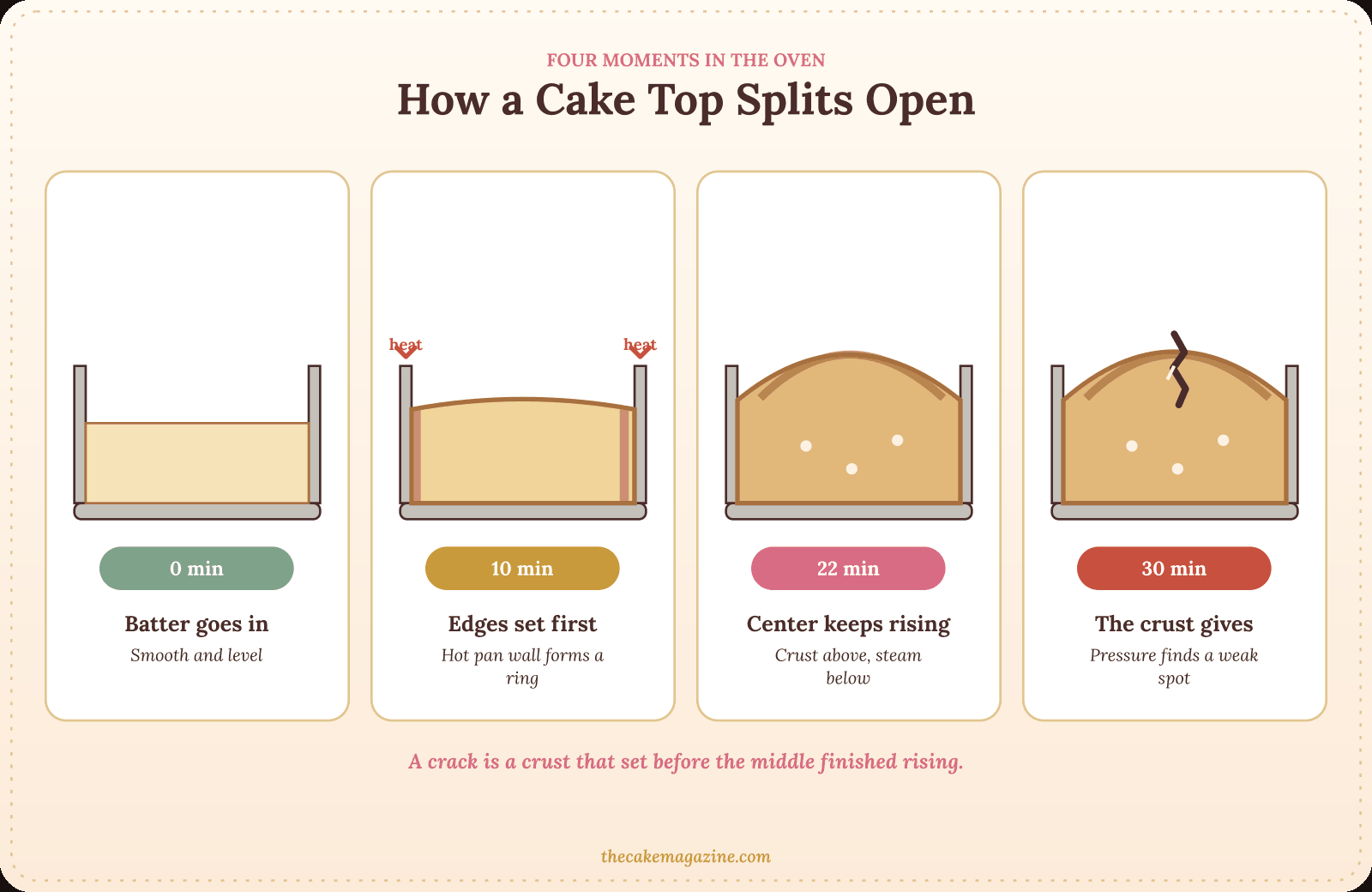
This explains why cake cracks on top far more often with a hot oven. High heat sets the surface fast and the edges even faster, because the pan wall is hot metal touching the batter. The outer ring of the cake sets while the center is still liquid and rising. The center then lifts into a peak, stretches the crust above it and splits it. A lower, gentler oven lets edge and center set closer together.
The same logic explains the other two headline causes. A pan that is too small or too narrow forces the batter to climb instead of spread, so it rises into a taller, steeper dome with a more stretched crust. Batter that is too deep in the pan has the same problem plus a slow center, because heat takes longer to reach the middle of a thick cake. The surface dries out well before the center is done.
A few other ingredients in the story are worth knowing. Sugar on the surface, a lot of flour, or a batter that has dried a little before baking all make a crust that sets earlier and more stiffly. A stiff crust cracks more readily than a stretchy one. Meanwhile a strongly leavened batter rises more vigorously and creates more pressure underneath. For a deeper look at those building blocks, our guide to cake baking science and how flour, fat, sugar, eggs, liquid and leaveners work together covers the foundations.
A cake cracks when its crust sets too early or too hard for the pressure building underneath. Everything in this guide is a way to slow down the crust, speed up the center, or both.
If you came here for a quick fix for why cake cracks on top, jump to the diagnosis path or the prevention checklist. If you want to understand your own oven and pans well enough to stop guessing, read on. We also keep a broader cake troubleshooting guide for every other symptom, from sunken centers to gummy layers, and this article goes deep on the cracked top specifically.
Is a cracked top actually a problem?
Before changing anything, ask whether the crack matters, because knowing why cake cracks on top also tells you how much to worry. Often it does not. A cracked top on a cake you plan to level and frost is an invisible flaw, because the top gets sliced off or hidden under buttercream. A split down the middle of a loaf or pound cake is traditional and usually admired. The crack only becomes a problem when it signals something deeper, or when the cake will be served unfrosted.
When why cake cracks on top does not matter
A crack is generally cosmetic when the cake is fully baked, the crumb is even and tender, and the crack is shallow. You can tell by inserting a skewer in the middle. If it comes out with a few moist crumbs and the center springs back gently, the cake is fine. Level it with a serrated knife, save the trimmings for a snack, and move on.
Layer cakes are the most forgiving case. Bakers routinely cut off the dome and the cracked crust anyway to get flat layers that stack evenly. If you are planning a tall frosted cake, you were going to lose that top layer of crust no matter what, so a crack costs you nothing.
When a crack is a warning sign about your bake
Treat the crack as a message when it comes with other symptoms. A deep gash that exposes raw batter means the cake needed more time or less heat. A cracked top plus a dry, crumbly edge points to a hot oven or too much flour. A cracked top plus a huge peak plus tunnels in the crumb suggests too much mixing or leavening. Then the crack is the visible tip of a bigger issue, and it is worth fixing at the source.
It also matters for presentation bakes. Wedding bakers, hobbyists who sell cakes and anyone making a naked or semi-naked cake cannot hide the top. If you are in that group, learning why cake cracks on top gives you real control over the finished look. Our guide on why cakes dome and how cake strips and pan size affect shape pairs well with this one, since doming and cracking usually share the same causes.
Reading the crack: four kinds and what they mean
Not every answer to why cake cracks on top is the same, because not every crack tells the same story. Where it sits, how deep it goes and what the crumb looks like underneath narrow the suspects quickly. Look at the cake while it is fresh from the oven, ideally before you frost or slice it, and match it to one of the four patterns below.
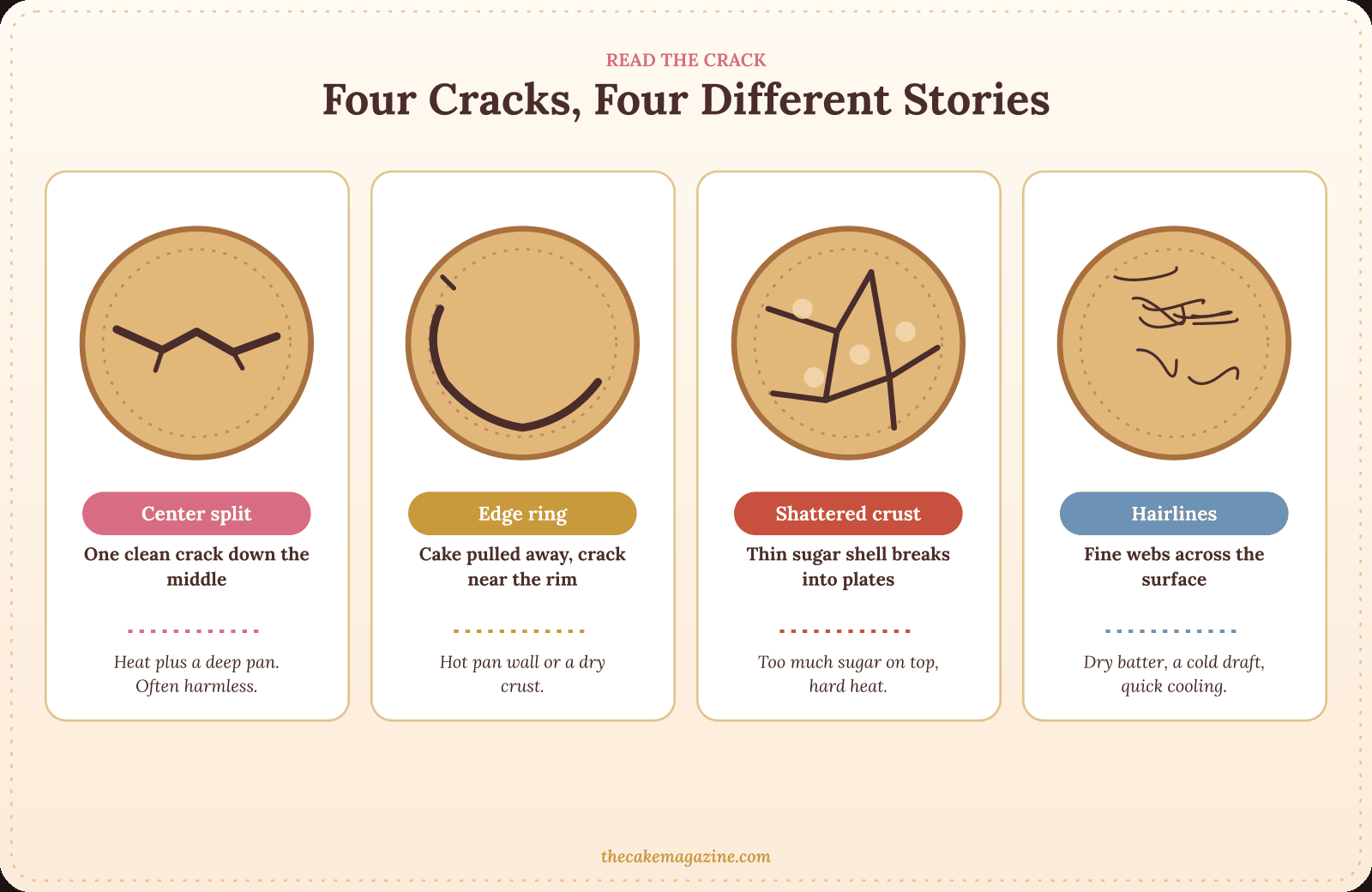
The center split
What it looks like: one long crack, or a jagged line, running down the middle of a domed top. The sides of the cake are level and golden.
Most likely cause: the classic reason why cake cracks on top. The edges set while the center was still rising, and the dome split under its own pressure. Usually heat is a little high or the batter is deep.
Fix it next time: lower the oven by 25°F, bake a bit longer and check that the batter is no more than two-thirds up the pan.
The edge ring
What it looks like: a crack that curves around the outer part of the top, often with the cake pulling away from the pan wall. The center may look flat or even slightly sunk.
Most likely cause: a dry, overbaked edge. The crust at the rim shrank as it dried and tore, or the pan wall ran very hot (dark metal and glass both do this).
Fix it next time: bake lighter-colored pans at the center rack, shorten the bake, or wrap the pan in a damp cake strip so the sides cook gently.
The shattered crust
What it looks like: a thin, shiny, brittle skin that breaks into plates, a little like a crackled meringue or a brownie top.
Most likely cause: a sugar-rich surface. High sugar, hard heat and sometimes a batter that was whisked until foamy produce a crisp, glassy crust that cracks as the cake settles.
Fix it next time: bake at a lower temperature, fold the batter instead of beating it hard at the end and let the cake cool in the pan for a few minutes before moving it.
The hairline web
What it looks like: many fine cracks across the surface, usually shallow, sometimes appearing after the cake comes out of the oven as it cools.
Most likely cause: a surface that dried or cooled too fast. Overbaking, a cold draft, a hot cake set on a cold surface or a long bake in a very dry oven can all do it.
Fix it next time: pull the cake as soon as the skewer is clean, cool it on a rack away from drafts and brush the top with a little simple syrup if it looks dry.
When you are working out why cake cracks on top in your own kitchen, keep in mind that real cakes sometimes mix two types. A hot oven and a deep pan together can give you a center split plus a ring crack. When that happens, start with the biggest, most likely cause and change one thing at a time, so you know which change worked.
Oven temperature: the number one reason why cake cracks on top
If you only change one thing, fix this, because oven heat is the biggest reason why cake cracks on top. Home ovens are famously unreliable, and the gap between the number on the dial and the heat inside the box is where most cracked tops are born. King Arthur Baking, in its cake guide, recommends checking the oven with a separate thermometer because built-in readings are often inaccurate. That one piece of advice solves more cracked cakes than any fancy technique.

Why cake cracks on top in a hot oven
Heat reaches a cake from the outside in. The pan wall and the top surface get the most heat, so they set first. In a properly moderate oven, the gap between edge-set and center-set is small and the cake rises almost evenly. In a hot oven the gap widens. The edge locks in place and the surface crisps over while the center is still loose, steaming and climbing.
That climbing center needs somewhere to go. With the sides locked and the lid hardening, it pushes up through the middle and splits the top. This is why a cake from a too-hot oven often looks like a volcano: tall in the center, crusty at the edges, with a crack along the ridge. It is also why that same cake may be damp or slightly raw below the crack.
Check what your oven really does
Buy an inexpensive oven thermometer and hang it from the center rack. Preheat for a full 20 to 30 minutes, since the dial light often goes off long before the walls and racks have soaked up heat. Then read the thermometer, not the dial. If it says 375°F when you asked for 350°F, you have found your culprit, and you can simply set the dial 25 degrees lower.
Ovens also cycle. The heating element turns on and off to hold an average, so the heat swings above and below your target. A thermometer reading taken at one moment can mislead. Look at it a few times over 15 minutes and note the range. A swing of 10 to 15 degrees is normal. A swing of 30 or 40 is a sign the oven needs servicing, or at least that you should bake at the lower end.
Preheat to 350°F for 30 minutes with the thermometer on the middle rack. Write down the reading every five minutes for 20 minutes. If the average is more than 15 degrees above or below the dial, adjust the dial for every cake you bake until the oven is repaired or replaced.
Is 325°F better than 350°F for cakes?
For anyone chasing why cake cracks on top, a lower setting often helps. Most American cake recipes call for 350°F, and plenty of ovens handle that fine. But in many home ovens, dropping to 325°F gives the center more time to catch up with the edges, which lowers the dome and reduces the chance of a split. The trade is a longer bake, usually five to ten minutes more for a layer.
Lower is not always better. A cake baked too cool can come out pale, a little gummy or slightly dense, because the structure sets so slowly that bubbles have time to coarsen. Our full cake baking temperature guide on 325°F versus 350°F walks through when each temperature makes sense. For crack-prone batters, 325°F to 340°F is a good starting range to test.
325°F: flatter, slower
Best for deep pans, dense batters like pound cake, and ovens that run hot. Expect a gentler dome, a lighter crust and a longer bake.
350°F: the standard
Works well for shallow layers in an accurate oven. Gives more color and quicker bake times, but a higher crack risk with deep batter.
375°F and up: cupcakes, not cakes
Small cakes bake through before the crust can run away. A big cake at this heat almost always peaks and splits.
Preheating and the cold-oven mistake
Putting batter into an oven that has not finished preheating is a quiet cause of trouble. The oven may signal that it has reached 350°F while the element is still working to heat the walls. In the first few minutes the cake gets blasts of element heat followed by lulls, which can make the top set unevenly. Give the oven a full half hour when you can.
The opposite problem exists too. Opening the door repeatedly drops the temperature, and the oven then overshoots to recover, delivering a burst of strong heat right on top of your cake. Leave the door shut for the first 25 to 30 minutes and use the oven light instead. When you do open it, do so quickly and gently.
Convection settings and fans
Convection ovens blow hot air across the surface, which dries and sets the top faster. That is helpful for cookies and roasting, but it is a frequent reason why cake cracks on top for people who switch to a fan oven without adjusting. If your oven has a convection option, try bake mode without the fan first. If you do use the fan, reduce the temperature by 25°F and expect to check for doneness a few minutes sooner.
Some ovens have a gentler fan-assist setting that circulates air only slowly, which is better for cakes. Check your manual. And remember that any fan-driven airflow can create uneven browning if pans touch each other or the oven walls. Leave about an inch of space around each pan, as covered in our piece on why cakes bake unevenly, including hot spots and rack position.
Pan size and depth: why cake cracks on top in the wrong pan
The pan shapes the cake as much as the oven does. A pan sets how deep the batter sits, how fast heat gets in from the sides and how far the batter can spread before it has to climb. When you ask why cake cracks on top, the answer is often a perfectly good recipe poured into the wrong pan.
Why cake cracks on top in a too-small pan
Suppose a recipe was written for a 9-inch round and you use an 8-inch pan. The 8-inch round has roughly 50 square inches of floor space against about 64 for the 9-inch. The same batter has to pile about a quarter higher. That means a deeper batter, a slower center and a steeper climb, which is the exact setup for a peaked, cracked top.
Measure pans across the inside from rim to rim, not the outside edge, and check their depth. King Arthur notes that standard cake pans are usually about 2 inches deep. A shallow pan with a thick batter can overflow, which is its own disaster, and our guide to why a cake overflows and how pan capacity and batter depth interact covers that side of the problem.
Converting a recipe to a different pan
Pan conversion is a common hidden reason why cake cracks on top. When you change pan size, change the amount of batter, or accept that the bake will behave differently. The easiest method is to compare volumes. Fill each pan with water, measure it and compare. A 9 by 13-inch pan holds roughly 14 to 15 cups to the brim, an 8-inch round about 6 cups and a 9-inch round about 8 cups. Aim for the batter to fill any pan about half to two-thirds.
Our cake pan conversion guide on changing pan sizes without ruining the bake gives full worked examples. For now, remember the principle: a bigger pan means thinner layers, which bake faster and rarely crack; a smaller pan means deeper batter, which bakes slower and cracks more. Adjust the oven temperature and time to match.
Pan color and material in why cake cracks on top
Dark, nonstick and glass pans absorb and hold more heat than shiny aluminum. They brown the outer ring of the cake faster, which hardens the edge early and raises the crack risk. Shiny light aluminum reflects heat and bakes gently, which is why many professional cake bakers favor it. Silicone, on the other hand, conducts heat slowly and can leave tops pale, wet or domed in odd ways.
If your pans are dark or glass, reduce the oven temperature by 25°F as a starting point, a rule many recipes and manufacturers share. If you are not sure what is best for your kitchen, see our cake pan buying guide covering aluminum, anodized, nonstick, steel, silicone and glass for the trade-offs of each.
Light aluminum
Even, gentle heat and a soft edge. The easiest material for flat, crack-free tops, and the one most test kitchens reach for.
Dark or nonstick metal
Browns faster. Reduce the oven by 25°F and watch the edges. A higher chance of a ring crack and dry rim.
Glass or ceramic
Holds heat a long time, so the cake keeps cooking after it leaves the oven. Lower the oven and pull the cake a little early.
Silicone
Slow, gentle conduction. Often needs a metal tray underneath for support, and tops can look pale and uneven.
Bake-even strips and why they work
Cake strips are fabric bands you soak in cold water, wring out and wrap around the outside of the pan. The wet fabric cools the metal wall, so the outer ring of batter sets later and the center can catch up. The result is a flatter top, a more level cake and often fewer cracks. They are inexpensive and reusable, and many bakers consider them the best fix for a persistent dome and for why cake cracks on top in deep pans.
You can make your own from an old towel cut into strips and pinned around the pan, though purpose-made strips are easier. Never let the fabric hang below the pan base where it could touch the oven element, and keep it away from open flames. Strips slow the bake slightly, so add five to ten minutes and check with a skewer.
Batter depth: how much is too much?
Batter depth is the quiet partner of oven heat and pan size. It is the thing you control with a measuring scale and a spatula, and it has a big effect on the top. Many readers who ask why cake cracks on top never think to measure it. The deeper the batter, the longer heat takes to reach the center, the longer the crust has to dry and harden, and the more room the center has to rise against that stiffening lid.

The half to two-thirds rule
A reliable rule for most cakes is to fill the pan between one half and two-thirds full. That leaves headroom for the batter to rise without spilling and gives heat a reasonable path to the middle. Below about one-third, the cake bakes quickly and can dry out. Above three-quarters, you invite doming, splitting, overflow or a sunken center from a slow, weak set.
Different batters rise by different amounts. A sturdy butter or pound cake rises modestly, so it can sit a little fuller. A light sponge or a cake with plenty of baking powder rises a lot and needs more room. If you are unsure, aim for the low end of the range and test, rather than risking a volcano.
Weigh the batter between pans
Layer cakes crack unevenly when one pan holds more batter than another. Use a kitchen scale to divide the batter into equal portions. Weigh the empty bowl or pan first, then pour in the batter in stages. A 10 to 20 gram difference between pans is no problem, but a 100 gram gap means one layer will be deeper, slower and more likely to dome.
If you are scaling a recipe up for a bigger cake, depth is easy to overlook. Doubling a recipe and pouring it into one pan makes a very deep cake, which cracks and sinks. Split it across pans or use a larger one. Our walkthrough on how to scale a cake recipe up or down by weight explains how to keep proportions and depth in check.
Tall pans and tube pans are different
Bundt and tube pans hold batter in a ring, so heat reaches it from both sides, from the center tube and from the outside wall. That is why a bundt can be a deep cake and still bake through. These pans also crack in a different way. The flat bottom of the baked cake, which you see when you turn it out, often has a split along the surface where the batter rose. Nobody sees it, so most bakers ignore this quiet version of why cake cracks on top.
For loaf pans, the depth is similar but the narrow width means the center is surrounded by heat on two sides. This is part of why pound cakes baked in loaf pans form a long, tidy crack down the center. We cover that in the section on cake types below.
After pouring the batter, hold a ruler against the inside of the pan. For a standard 2-inch-deep layer pan, about 1 to 1.25 inches of batter is a good target. If the batter is higher than about 1.5 inches, move some to a second pan or a few cupcake liners.
Mixing, leavening and flour
Heat and pans get most of the attention, but the batter itself shapes how fast the crust forms and how hard the center pushes. If you have checked the oven, pan and depth and still cannot explain why cake cracks on top, look at the recipe and your handling of it.
Too much leavening
Baking powder and baking soda make gas, and gas makes pressure. Too much leavening creates a vigorous rise that overshoots the crust, forming a tall dome that splits. It also tends to produce a coarse, open crumb and sometimes a soapy or bitter taste. If your cake cracks and also tastes a little metallic, measure your leavener again.
Level the spoon, do not heap it, and use a scale if you have a precise one. When you scale a recipe, do not simply multiply the leavener; larger batters often need proportionally less. If you want to understand how these two ingredients differ, our guide on baking powder versus baking soda in cake explains when each one is the right choice.
Overmixing: another reason why cake cracks on top
Flour contains proteins that form gluten when stirred with liquid. A little gluten gives a cake its structure. Too much makes the batter tough and elastic, so the crust sets into a rubbery lid that peaks and cracks while the crumb comes out chewy rather than tender. Mix until the flour is just combined, then stop. Fold in the last streaks by hand if you need to.
Different mixing methods have different risk levels. Creaming butter and sugar adds air for a tender rise, while the reverse creaming method coats flour in fat first, which limits gluten and often gives a flatter top. Our cake mixing methods guide covering creaming, reverse creaming, foaming and one-bowl cakes compares them in detail. If you struggle with domes, reverse creaming is worth a try.
Too much flour
Excess flour is a quiet reason why cake cracks on top. Scooping flour straight from the bag packs it into the cup, and you can easily end up with noticeably more than the recipe intended. A dry, stiff batter forms a thick crust that cracks, and the finished cake is often crumbly and dry. Spoon flour lightly into the cup and level it, or better, weigh it. Our guide to measuring flour for cake in cups and grams shows how small errors add up.
Flour type matters too. Cake flour has less protein than all-purpose, so it forms less gluten and bakes up with a more tender, level top. If you substitute all-purpose without adjusting, the structure is stronger and the crust stiffer. Neither is wrong, but if your cake cracks, switching to cake flour or replacing a few tablespoons per cup with cornstarch can calm it down.
Sugar, eggs and the crust
Sugar helps cakes brown and keeps them moist, but a sugar-heavy batter forms a harder, glassier surface that cracks more readily. If a recipe is very sweet and cracks every time, cutting the sugar slightly or lowering the oven can help. Eggs, which provide structure through protein, can also contribute: a batter with many whole eggs and not much fat sets quickly and firmly.
Whipped egg foams, as in sponge cakes, bring their own pattern. The foam is very airy and sets into a delicate crust that can crack if the cake is overbaked or cooled too fast. Fold gently, bake until just set and cool the sponge as the recipe directs, often upside down for chiffon-style cakes.
Altitude and dry climates
At high elevation, lower air pressure makes batters rise faster and dry out sooner, which pushes cakes toward doming and cracking. Recipes written for sea level often need less leavening, less sugar and a hotter or cooler oven depending on the case. See our guide to high-altitude cake baking with flour, liquid, sugar, leavening and oven adjustments for a structured way to adjust.
Very dry indoor air, such as in winter, can also dry the surface of a batter before it goes into the oven, especially if it sat on the counter while you prepared pans. Bake promptly and avoid leaving filled pans uncovered for long stretches.
Other reasons why cake cracks on top: rack position, door opening and cooling
Some cracked tops come from habits rather than recipes. Each of the following is easy to correct once you spot it, and several are easy to overlook.
Rack position
A cake baked too near the top element has its surface blasted with heat and sets early, which is a classic recipe for a split. A cake on a low rack gets more bottom heat and may brown underneath. For most cakes, the center rack is best. Place pans in the middle of the rack, away from the walls, and avoid stacking racks closely so air can move around them.
Opening the door early
Cracks and sunken middles are often linked. A cold blast from an early peek can make a still-liquid center shrink, while the crust has already begun to set, which tears. Keep the door shut for at least the first half of baking, then check with a skewer. If you need to rotate pans, wait until the structure has set, usually after about 25 minutes for a layer cake.
Cooling too fast, or in a draft
A hot cake that goes straight onto a cold stone counter or into a drafty window can develop hairline cracks on top as the surface contracts faster than the interior. Let the cake rest in its pan on a wire rack for 10 to 15 minutes, as most recipes direct, then turn it out. The steady rest lets the crumb firm up while the surface relaxes.
Overbaking
An overbaked cake is a dry cake, and a dry cake cracks, which makes overbaking a sneaky reason why cake cracks on top. As moisture leaves the crust and crumb, they shrink, pull away from the pan and split. Test early with a skewer and an instant-read thermometer, which should read about 205°F to 210°F in the center for most butter and oil cakes. Our guide to how to tell when a cake is done without overbaking it goes deeper on the cues.
Pan prep and a stuck rim
When batter clings to the sides of an ungreased or poorly greased pan, the rim cannot slide upward as the cake rises, so it tugs the surface sideways and tears it. A thin, even coat of fat and flour (or a parchment-lined bottom with a greased side) lets the cake climb freely. Lining the pan sides with a collar of parchment can also help in a pinch.
A quick diagnosis path for why cake cracks on top
When you are tracing why cake cracks on top, resist the urge to change five things at once. Work through the clues in order, starting with the most common cause. The flow below walks from where the crack sits to the likeliest explanation. Use it as a starting point, then confirm with the sections above.

Why cake cracks on top: symptom, cause and first fix
Here is the same logic in a checklist form that you can pin on the fridge. Each card gives the symptom you can see, the cause behind it and the first thing to change. These pair up with the cracked top, and with any other symptom that appears alongside it.
Tall peak, center split
Cause: oven too hot or batter too deep. First fix: hang a thermometer, drop the oven 25°F and keep batter under two-thirds of the pan.
Edge crack, dry rim
Cause: dark pan, overbaking or a hot pan wall. First fix: switch to a lighter pan or use cake strips, and shorten the bake by a few minutes.
Crust shatters like glass
Cause: high sugar on top, strong heat. First fix: lower the heat to 325°F and avoid overwhipping the batter at the end.
Hairlines after cooling
Cause: a dry surface or fast cooling. First fix: pull the cake at the first clean skewer and cool on a rack out of drafts.
Crack plus tunnels
Cause: overmixing or too much leavener. First fix: stir just until combined and measure baking powder level or by weight.
Crack plus raw center
Cause: deep batter, hot oven. First fix: divide into more pans, lower the temperature and bake longer.
If you keep wondering why cake cracks on top across several recipes, the cause lives in your kitchen: the oven, the pans, or how you measure and fill them. If it shows up with just one recipe, look at the formula. A cake that has too much leavening, flour or sugar for its pan will crack in anybody’s oven.
How to bake a flat top and fix why cake cracks on top
You do not need special skills to fix why cake cracks on top, only a short routine that you repeat every time. These steps address the causes above in the order they happen at the counter. Try the whole sequence on your next cake, then relax steps individually once you know which ones your kitchen needs.
Step by step
- Verify the oven. Hang a thermometer at the center rack, preheat 30 minutes and set the dial so the thermometer reads your target.
- Pick the right pan. Use light-colored metal pans at least 2 inches deep. Check the inside diameter against the recipe.
- Prepare the pan. Grease the sides lightly, line the bottom with parchment and flour or cocoa the sides so the cake can climb.
- Measure by weight. A scale takes the guesswork out of flour, sugar and leavening, which are the three biggest levers on the crust.
- Mix gently. Stop when the last streak of flour disappears. Scrape the bowl once, then fold by hand.
- Fill to the guide. Divide the batter by weight. Aim for one half to two-thirds of the pan height.
- Tap and level. Smooth the surface and give the pan one firm tap on the counter to release the largest air pockets.
- Bake lower and slower. Try 325°F to 340°F on the center rack, and consider cake strips for deep or large pans.
- Do not open the door. Wait at least 25 minutes before you peek or rotate.
- Test and cool. Pull the cake at the first clean skewer, rest it in the pan on a rack and turn it out after 10 to 15 minutes.
The cake-strip method for why cake cracks on top
If your cakes keep doming despite a good oven, cake strips are the best single addition. Soak the strips in cold water for a minute, squeeze out the dripping excess so they are damp rather than soaking, and wrap one around the outside of each pan. Pin or fasten the ends. Place the pans on a baking sheet if they are heavy or if you are concerned about spills.
Expect to add roughly five to ten minutes to the bake. Because the edges are cooler, they may look paler than usual, which is fine. Rely on a skewer and your thermometer instead of color. Rinse and air-dry the strips after each use so they do not mildew, and replace them if they fray.
Trimming and flipping as a backup
Even a careful baker sometimes ends up with a slight dome. That is no cause for alarm. Let the layers cool fully, then level them with a long serrated knife while the cake sits on a flat surface. A cake leveler or a taut piece of thread can help. Flipping the cake so the flat bottom becomes the top gives you an even surface for frosting.
If you plan to stack and smooth buttercream, a perfectly level layer helps all the way down the line. Our guide on how to get smooth buttercream sides and sharp cake edges shows how level layers make that finishing stage far easier.
Cake types that crack on purpose, and ones that should not
Some cakes are meant to crack. Others are meant to be smooth, and a split top is a clear sign something is off. Knowing which is which keeps you from fixing a problem that is not there.
Pound cakes and loaves
In loaf pans, why cake cracks on top is part of the charm. A split down the center of a pound cake is a traditional signature. The batter is dense and heavy, the pan is narrow and the crust sets while the middle keeps rising, so the center opens along the ridge. Many bakers even score the top with a wet knife before baking to guide the crack into a neat line. If you prefer a smooth top, bake at 325°F and consider a wider pan.
Butter and oil layer cakes
These cakes are intended to bake with a gentle dome. A shallow dome is normal and trims off easily. A split peak is a signal to look at why cake cracks on top: check the oven, pan size and batter depth, as above. Layer cakes recipes that rely on a high amount of baking powder or that call for extra-deep batters may crack more, and tweaking the pans solves most of that.
For a reference formula to practice on, our best vanilla cake recipe uses moderate depth and a standard oven temperature, which makes it a handy cake for testing your oven and pans before you bake something special. Remember that every oven is different, so treat any recipe as a starting point.
Sheet cakes
Sheet cakes are wide and shallow, so they usually bake flat. When a sheet cake cracks, it is often because the batter is deeper than usual (a smaller pan than the recipe called for) or because the edges are baking much faster than the center in a dark pan. Use a light pan, line it with parchment and bake at 325°F to 350°F.
Chocolate cakes
Cocoa is a dry ingredient that absorbs liquid, so chocolate batters can set a little drier and firmer at the surface than vanilla ones. Dark crusts also hide cracks well, which makes them look different than they are. If a chocolate cake cracks, check for overbaking, because a dry chocolate cake is a sad one. Our best chocolate cake recipe includes pan-size and doneness cues worth borrowing.
Cheesecakes and custard cakes
Why cake cracks on top has a cousin in cheesecake, which splits for related reasons: too much heat, too much mixing air and cooling too fast. King Arthur’s cake guide specifically calls out the “unsightly cracked top” of cheesecake and suggests checking the temperature near the edge and turning the oven off at 175°F. A water bath, a slow cool in the oven with the door ajar and gentle mixing all help.
Cupcakes and mini cakes
Small cakes cook quickly, so they cope with higher heat and rarely have time to develop a deep crack. If cupcakes crack, the cause is nearly always overfilled liners or a very hot oven. Fill liners about two-thirds full and bake at 350°F in the center of the oven. For trendy little formats, see our overview of mini cakes and how they bake.
Fixing a cracked cake you already baked
Suppose the cake is already out of the oven and the crack is already there. You have several good options, and none of them require starting over.
Cover it with frosting or ganache
The easiest repair is to use the crack as a feature. Cool the cake completely, then fill the crack with a thin layer of buttercream or ganache and smooth it flat with an offset spatula. For frosted cakes, a crumb coat of icing glues loose bits down and gives you a clean base for the final coat. A dusting of powdered sugar or a glaze disguises a crack on a bundt or loaf.
Level it off
Trim the cracked dome with a serrated knife so the layer is flat, and flip it so the cut side faces down for stability. The scraps make excellent cake crumbs for parfaits, trifles or cake pops. If you are building a stacked cake, the trimmed layer works exactly like one baked flat.
Brush it with simple syrup
When the crack comes with a dry edge, brush the cut surface with simple syrup, made by simmering equal parts sugar and water until the sugar dissolves and cooling it. A thin brush of syrup restores some moisture. Flavor it with vanilla, citrus zest or a splash of liqueur for a little extra interest.
Turn it into something else
A badly cracked cake can become cake-truffle filling, a trifle with fruit and cream, or a crumbled topping for ice cream. None of these hide a failure, they simply make good use of a cake that tastes perfectly fine. If the cake is underbaked in the center, however, slice it, check the middle and cut away or discard any wet batter.
If a deeply cracked cake is raw in the center, bake it longer rather than serving it. Raw flour and eggs can carry bacteria, and the U.S. Department of Agriculture advises against eating raw batter. Find official guidance at USDA Food Safety and Inspection Service. Keep cakes with cream, custard or cream cheese frosting refrigerated.
Prevention checklist: stop why cake cracks on top before it starts
Most bakers do not need to memorize any chemistry. A short checklist, run through before each bake, catches almost every reason why cake cracks on top. Print it, tape it inside a cabinet door, or copy it into your phone notes. The more often you run it, the faster it becomes habit.
- Oven thermometer hanging at the center rack, and the oven preheated for a full 20 to 30 minutes.
- Dial adjusted so the thermometer reads the temperature you want.
- Light-colored metal pans, at least 2 inches deep, measured across the inside.
- Pans greased, parchment-lined and floured or cocoa-dusted, with cake strips soaked and ready for deep pans.
- Rack set to the center position, with an inch of air around every pan.
- Flour, sugar and leaveners weighed or carefully leveled.
- Batter mixed only until just combined, not whipped.
- Batter divided by weight between pans.
- Each pan filled between one half and two-thirds full.
- Surface smoothed, pan tapped once and baked right away.
- Oven door kept closed for the first 25 to 30 minutes.
- Skewer and thermometer test at the early end of the time window.
- Cake pulled when the skewer shows a few moist crumbs and the center reads about 205°F to 210°F.
- Cooling in the pan on a rack for 10 to 15 minutes, away from drafts.
- Notes written down: what you changed, what happened.
Keep a simple baking log
A notebook next to the oven is the cheapest tool for solving why cake cracks on top again and again. Write the date, recipe, pan size, oven setting, thermometer reading, bake time and a one-line result. After three or four bakes the pattern jumps out. You might find that every cake baked in your dark 9-inch pan cracks, or that the problem disappears at 325°F. Nothing replaces your own kitchen data.
Common mistakes behind why cake cracks on top
Even experienced bakers repeat a handful of habits that quietly invite cracks. See how many of these sound familiar. Fixing just one or two usually changes the whole result.
Trusting the oven dial, the top reason why cake cracks on top
The most common slip by far. A dial is an approximation, and many home ovens run 15 to 25 degrees off. If you take one thing from this guide, make it a cheap thermometer.
Using a smaller pan than the recipe
An 8-inch pan swapped for a 9-inch one changes depth enough to alter the bake. Either scale the batter down or adjust the temperature and time. Never assume the recipe will handle it.
Filling pans to the top
A heaped pan feels generous, but a cake needs space. Overfilling raises the dome, slows the center and risks spills on the oven floor. Stay under two-thirds and use the leftover batter for a few cupcakes.
Beating the batter hard at the end
A final burst of mixing feels thorough, but it builds gluten and traps extra air. Both give a tougher, peakier top. Stop as soon as the batter looks smooth, and fold the last bits with a spatula.
Baking too long to be safe
Fear of a raw center pushes many bakers to leave cakes in the oven an extra ten minutes. That dries the edges and causes cracks. A thermometer reading around 205°F to 210°F and a skewer with a few moist crumbs are better signals than a long clock.
Moving the cake while it is fragile
Turning out a hot cake or lifting it from the pan too soon tears the structure, which can crack the top as it falls. Let the cake firm up on the rack, then release it with a thin knife run around the edge.
Changing too many things at once
If you lower the oven, switch pans, swap flours and change the mixing method together, you will never know which change worked. Alter one thing per bake and record it.
Frequently asked questions
Why does my cake crack on top even when I follow the recipe exactly?
Because the recipe cannot see your oven. The most common reason is that the oven runs hotter than the dial says, so the crust sets before the center finishes rising. Other usual suspects are a pan that is smaller or darker than the one the recipe was written for, and batter that fills more than two-thirds of the pan. Check these three before blaming the recipe.
Is a cracked cake still safe to eat?
Yes, as long as it is fully baked. A crack is a surface feature and does not affect safety by itself. The concern is an underbaked center, because raw flour and eggs can carry bacteria. Test the middle with a skewer and a thermometer, and bake longer if it is wet. Follow the USDA’s food safety guidance for storing cakes with perishable fillings.
Why does cake crack on top in the oven but not in my friend’s oven?
Ovens differ in how accurately they hold temperature, how strongly the elements cycle and how hot the walls and top run. Two ovens set to 350°F can behave like a 325°F and a 375°F oven. Pans, racks and even the cake recipe differ as well. Use an oven thermometer and compare actual readings, not dial settings.
Does lowering the oven temperature change why cake cracks on top?
Often, yes, though it is not a magic switch. A lower temperature slows the crust, so the center has more time to catch up, which reduces both the dome and the split. The trade-off is a longer bake and a slightly paler crust. Try 325°F to 340°F for deep batters, and use a skewer to confirm doneness.
Do cake strips fix why cake cracks on top?
For many bakers they do. A damp strip around the pan cools the metal wall, so the outer edge of the cake sets later and the center keeps pace. The result is usually a flatter top and fewer splits. They work best on large or deep pans. Add five to ten minutes to the bake time and test with a skewer.
Which pan size solves why cake cracks on top?
Use the size the recipe specifies, and fill it half to two-thirds full. If you switch pans, compare their volumes by filling them with water. A larger pan gives thinner, flatter layers that rarely crack, while a smaller one makes deeper batter that does. Use light-colored metal pans at least 2 inches deep when you can.
Why did my cake crack after it came out of the oven?
That is usually a dry or fast-cooling surface. If the cake is overbaked, the crust loses moisture and shrinks as it cools. A cold draft, or a hot cake placed on a very cold counter, can add stress. Pull the cake sooner, cool it on a wire rack in a draft-free spot, and brush the top with simple syrup if it looks dry.
Can too much baking powder explain why cake cracks on top?
Yes. Extra leavener makes extra gas, which pushes the center up faster than the crust can stretch. You often see a tall peak, a crack and a coarse, open crumb, sometimes with a bitter or soapy taste. Level the spoon, weigh if you can, and do not scale leavener up in proportion when you enlarge a recipe.
Why do pound cakes crack down the middle?
It is nearly a tradition. A pound cake batter is thick and baked in a narrow loaf pan, so the crust sets while the middle is still rising, and the center ridge opens along a neat line. It does not mean anything went wrong. If you want a smoother top, try 325°F, a wider pan or cake strips on the pan.
Does opening the oven door explain why cake cracks on top?
It can. A burst of cool air early in the bake can disturb the rise, and the oven may then overshoot its temperature to recover. Either one can lead to a split or a sunken center. Keep the door shut for the first 25 to 30 minutes, and use the oven light to watch the cake.
Does convection change why cake cracks on top?
Use it cautiously. The moving air dries and sets the surface faster, which raises the chance of a crack. If you use convection, lower the temperature by about 25°F and check for doneness sooner. Many bakers simply turn the fan off for cakes and keep it for cookies and roasting. Your oven manual may include a gentler cake setting.
How can I hide a crack on a frosted cake?
Level the top with a serrated knife, flip the layer so the flat bottom faces up and add a crumb coat of buttercream before the final coat. A thin layer of frosting or ganache fills shallow cracks well. For stacked cakes, a level layer matters more than a perfect crust, because the top crust is usually trimmed away anyway.
How do I know when my cake is done so I do not overbake it?
Combine three signs: the edges just begin to pull away from the pan, the top springs back when pressed gently and a skewer in the center comes out with a few moist crumbs. An instant-read thermometer should read about 205°F to 210°F for most butter and oil cakes. Start checking a few minutes before the recipe’s earliest time.
Final thoughts
Why cake cracks on top is no great mystery once you picture the race between a rising center and a setting crust. Slow the crust and the center catches up. You do that with an accurate oven, a pan sized to the batter, a sensible fill depth and a gentle mixing hand. None of that needs expensive gear, only a thermometer, a scale and a little patience.
To solve why cake cracks on top in your kitchen, start with the oven, because it is the cheapest and most powerful change. Then check the pan and the depth. If the top still splits, look at the mixing and the leavening. Keep notes, change one thing at a time and remember that a cracked cake still tastes like cake. A serrated knife and a bit of frosting forgive plenty.
Understanding why cake cracks on top also makes you a steadier baker overall, because the same habits (verified heat, accurate measuring, moderate depth) prevent sunken centers, dry edges and gummy layers too. Bake the next cake with the checklist in hand, and enjoy the smooth, level top you earned.
Editorial note: reviewed and updated November 2026. This guide is written for home bakers in the United States, with American measurements and ingredients. The explanations reflect widely taught baking principles and cited public sources; the temperatures, depths and times given are starting points, not oven-tested results, and they will vary by oven, pan, altitude and recipe. For food safety questions, consult the USDA Food Safety and Inspection Service.