You pull two beautiful layers out of the oven, let them cool, turn them over, and find a hill. The edges are low and the center is peaked like a tiny volcano, and you have to decide whether to saw it off or start over. If you have ever wondered why does cake dome so stubbornly, the answer is almost always about timing: the outside of the batter sets before the inside is finished rising. This guide explains that process, then shows how heat, pan size and cake strips change the shape.
Why does cake dome? The sides of the pan heat up faster than the middle, so the outer batter sets into a firm ring while the center is still liquid and still rising. The soft middle has nowhere to go but up. The usual fixes are a slightly lower oven temperature, the right pan size and batter depth, insulating the pan with damp cake strips, and a batter that is not over-leavened or overmixed.
- What a cake dome is, and when it is normal
- Why does cake dome? The edges-first story
- Why does cake dome more in a hot oven? How heat shapes the top
- Why does cake dome in deep pans? Pan size and batter depth
- Pan color, metal and glass
- Cake strips and why does cake dome less when you use them
- When the batter is the culprit
- Symptom, cause and fix cards
- Flat-top tricks without cake strips
- Leveling and using a domed cake
- Domes in cupcakes, sheet cakes, loaves and bundts
- Why does cake dome more with some recipes than others?
- A prevention checklist and a test plan
- Reading the dome: what the shape tells you
- When a dome is useful
- Final thoughts on why does cake dome
- FAQ: why does cake dome and how to stop it
What a cake dome is, and when it is normal
A dome is simply a cake whose center rose higher than its edges. Some doming is a natural result of how batter bakes, and almost every butter or oil cake baked in a metal pan shows a little of it. A gentle rise of a quarter inch or so is nothing to worry about. A hill an inch tall, with a split or a darker ridge on top, is the kind of cake that makes people search for why does cake dome in the first place.
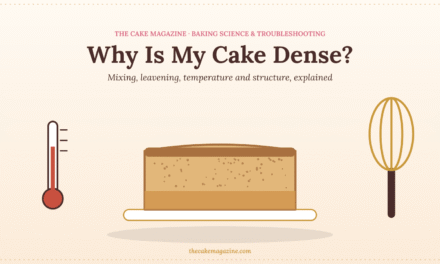
It helps to separate three different shapes that bakers often lump together. A gentle crown is fine and easy to trim. A steep peak with a crack down the middle is a dome plus a split, and it points to heat that was too strong. A dome that rises and then collapses into a crater is a different problem altogether, covered in our guide on why a cake sinks in the middle.
Shape matters mostly when you plan to stack and frost. A flat layer sits securely on the one beneath it and needs very little frosting to look neat. A domed layer rocks, squeezes frosting out at the seams and forces you to cut away cake you spent time and money making. For a plain loaf or a rustic snacking cake, a dome is part of the charm, and you can leave it alone.
The quick way to measure your dome
Instead of eyeballing it, lay the cooled layer on a board and rest a long ruler or the flat of a serrated knife across the top. Slide a thin stack of coins or a second ruler under the gap at the center edge. If you can see daylight less than a quarter inch tall, treat the cake as flat. Between a quarter and a half inch, a light trim fixes it. Anything taller is worth changing next time.
Take that number down in a notebook, because it is the first clue to why does cake dome in your kitchen, along with the pan, the oven setting and the bake time. A recorded dome height turns a vague feeling into something you can compare from one bake to the next, which is how you find out whether a change actually helped.
If the dome is mild and the crumb is tender and even, leave your recipe alone and just level the layers. If the dome comes with a crack, dark edges or a dense crumb, something else needs adjusting, and the sections below show you where to look first.
Why does cake dome? The edges-first story
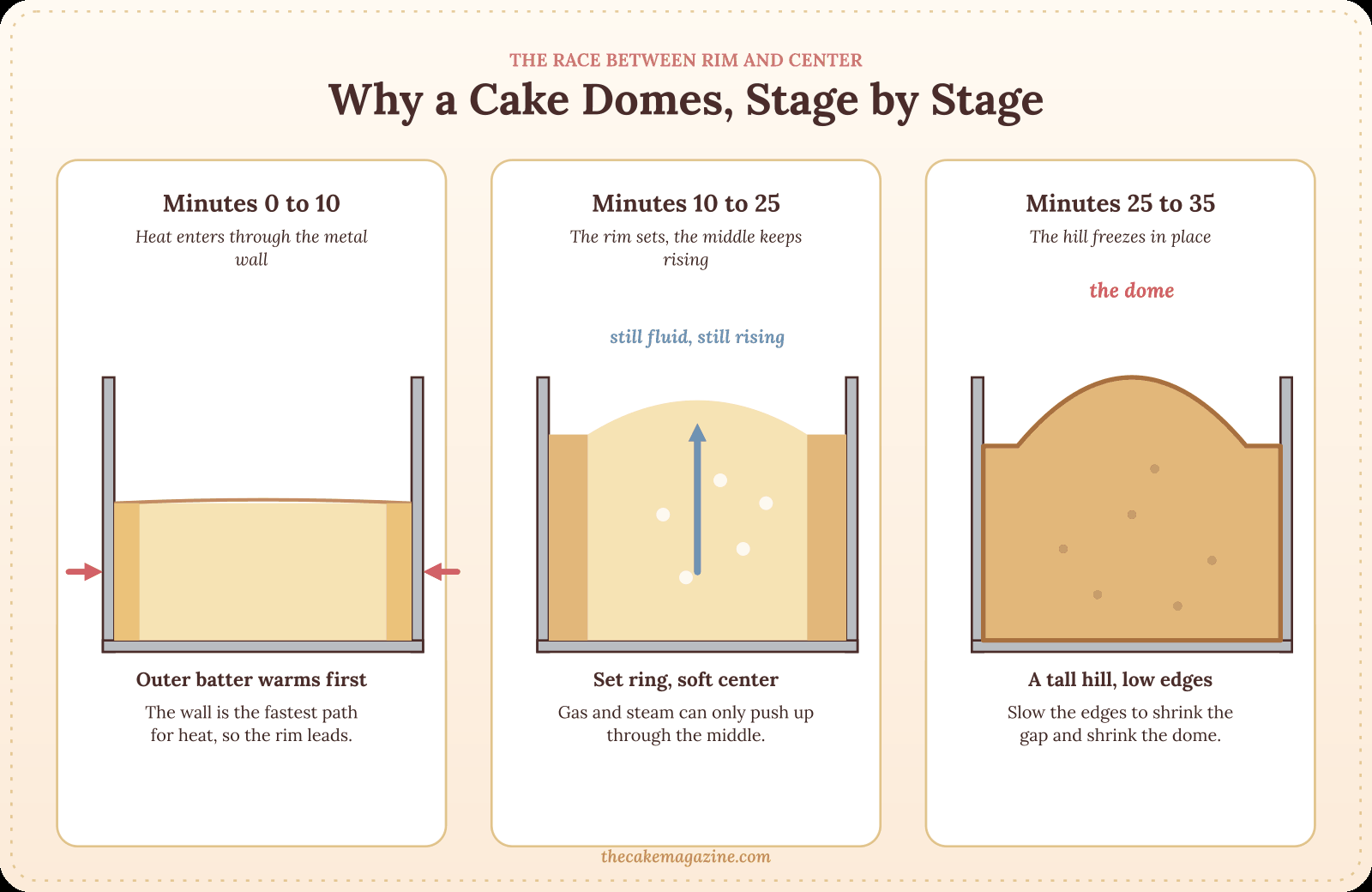
To understand why does cake dome, picture a cake pan as a small metal bucket of batter sitting in a hot box. Heat arrives from the oven air, and the metal conducts it quickly into the batter that touches the walls and base. That outer shell of batter warms up first. The batter in the very middle sits insulated by everything around it, so it stays cooler and more fluid for several more minutes.
As the outer batter heats, three things happen close together. The leaveners release gas. Steam builds from the liquid. The proteins in the flour and eggs firm up and the starches swell and gel. Once the edge batter has set, it cannot stretch anymore. It becomes a stiff wall, and it also grips the pan, so it holds on while the middle keeps expanding.
The center is still fluid and still full of gas. It keeps rising, but it can only go in one direction, which is up. The batter in the middle is pushed upward and forms a hill. When that hill finally sets, it freezes in place, and you are left with the dome you see on the cooling rack. This single explanation covers most of what bakers mean when they ask why does cake dome in the center.
Why the timing gap is the whole story
Notice that the gas and steam are not the villains. Every cake needs them. What matters is the gap between the time the edges set and the time the center sets. In a perfectly flat cake that gap is small, so the whole surface rises together and sets together. In a domed cake the gap is large, so the middle keeps climbing alone.
Everything else in this guide is really a way of shrinking that gap. A cooler oven slows the edge heat. Cake strips insulate the edges. A shallower batter heats through faster. A thinner, more lightly leavened batter delays the point at which the edges lock up. Once you think of it as a race between the rim and the center, the fixes make intuitive sense instead of feeling like random advice.
A short note on the starch and protein
Flour proteins and egg proteins stiffen as they heat, and starch granules absorb water and swell into a gel in the same temperature range. Together they turn a runny batter into an elastic foam and then into a crumb. A batter with plenty of structure builders, such as extra flour or strong flour, sets earlier and grips harder, which can exaggerate a dome. If you want the full picture of how each ingredient contributes, our cake baking science guide is the best companion to this page.
Why does cake dome more in a hot oven? How heat shapes the top
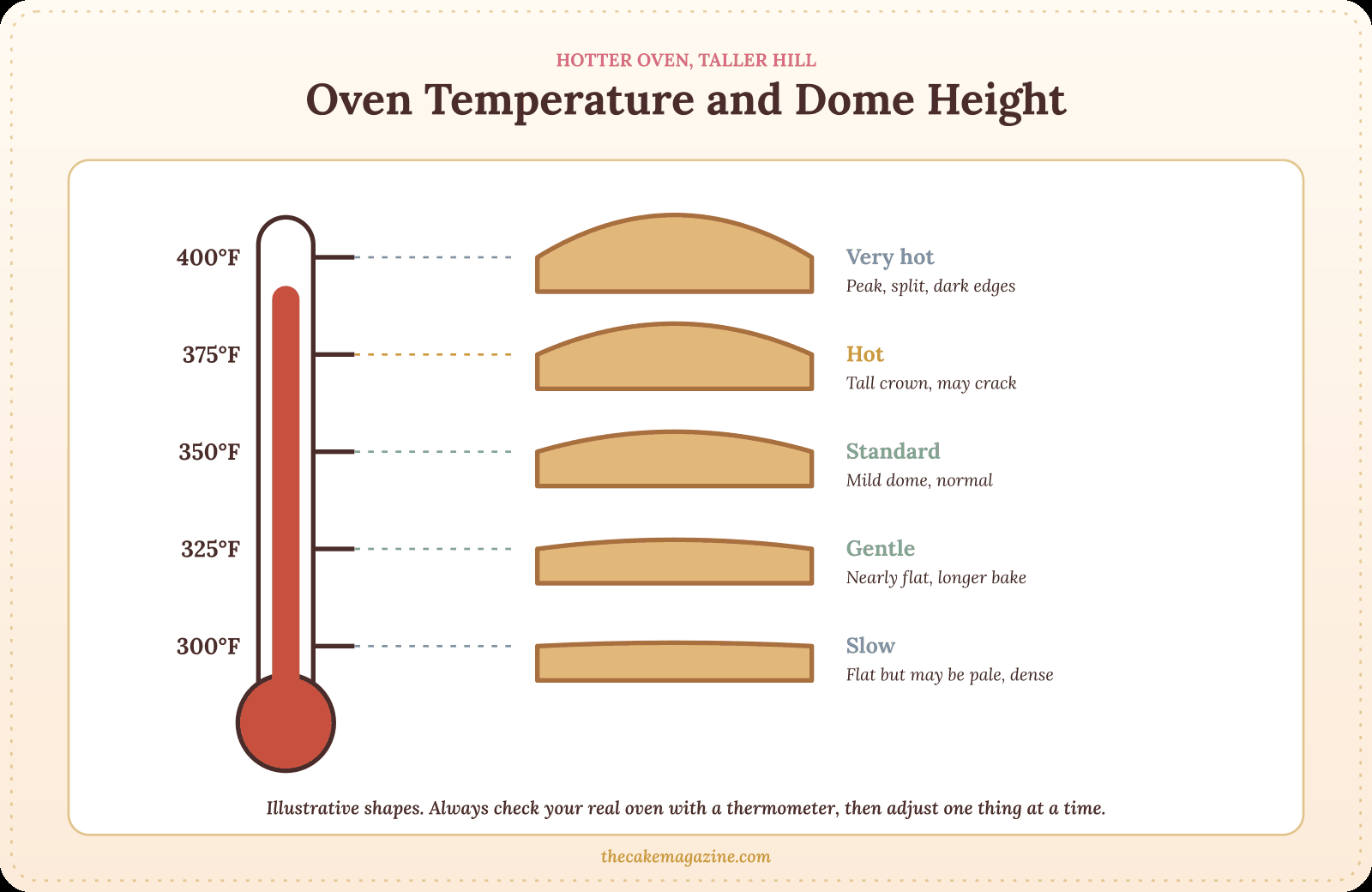
Oven temperature is the biggest lever you have, and also the one most often misjudged. A hotter oven widens the timing gap, because the rim cooks quickly while the heat is still working its way inward. A gentler oven narrows it. This is why a recipe that bakes flat at 325°F may peak at 375°F, even with the same batter in the same pan.
Many home ovens do not match their dials. Some run 15 or 25 degrees hot, and some cycle widely between the high and low points of their thermostat. If you have never checked yours, hang an inexpensive oven thermometer on the center rack and look at it once the oven has been preheating for a good 20 minutes. What you read there, not the number on the knob, is the temperature your cake is actually experiencing.
What lowering the temperature really does
Dropping from 350°F to 325°F gives the center more time to catch up with the edges. The trade is a longer bake, often by five to ten minutes for a layer cake, so you will want to test for doneness a little later than the recipe says. Our cake baking temperature guide walks through when 325°F makes sense and when it leaves a cake pale or dense.
If your oven is hot and you are unsure, change only the temperature first, by 25°F, and leave every other variable alone. Then compare the dome height to your earlier notes. A single clean test teaches more than three changes at once, and it tells you whether heat is the main reason for your own answer to why does cake dome in your kitchen.
Rack position and preheating
Bake layer cakes on the center rack, where air circulates evenly around the pans. A rack set too high exposes the tops to the upper heating element, which dries and sets the surface early and encourages a peak. A rack set too low can scorch the bottoms. Leave an inch or two of space between pans and between the pans and the oven walls, so hot air can move freely.
Preheat fully, not just until the oven beeps. The beep often arrives before the walls of the oven have absorbed heat, so the temperature swings up and down for several minutes afterward. If you are also seeing lopsided or unevenly browned layers, see our guide on why a cake bakes unevenly for hot spot and rotation advice.
A fan moves hot air over the surface and speeds up crust formation, so convection cakes often dome more than conventional ones. Many bakers switch the fan off for layer cakes, or lower the set temperature by about 25°F if they keep it on. Check your oven manual, because fan behavior varies from model to model.
Why does cake dome in deep pans? Pan size and batter depth
The pan sets the distance between the hot wall and the middle of the batter. In a wide, shallow pan, the center is only a few inches from a wall, so heat reaches it quickly and the cake rises flat. In a narrow, deep pan the center is buried, and the timing gap grows. This geometry explains why a narrow six-inch pan so often produces a taller hill than a nine-inch round with the same amount of batter.
Batter depth works in the same direction. A thick layer of batter has more mass to heat, and the heat has farther to travel. Most home recipes for layer cakes aim for batter that sits roughly one third to one half of the way up the pan, which leaves room to rise without spilling and keeps the depth reasonable. Overfilling is a common reason answers to why does cake dome include the word “too much.”

Match the batter to the pan
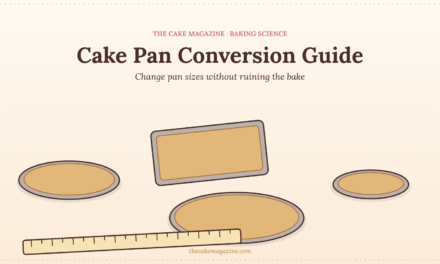
When you adapt a recipe to a new pan, work out how much the volume changes before you pour. A batter written for two 9-inch rounds will fill two 8-inch rounds noticeably deeper, which pushes the cake toward a dome and makes it take longer to bake. Our cake pan conversion guide shows how to scale volumes and bake times so you do not have to guess.
If you only have a deep pan, consider splitting the batter across three pans for thinner layers, or baking cupcakes with the extra. Weigh the batter into each pan so the layers match. Equal weight gives equal height, and it is the simplest way to stop one layer from peaking while the other sits flat. If you are shopping for pans, our cake pan buying guide explains the sizes and depths that suit layer cakes best.
The cake domes in a deep, narrow pan
Likely cause: the center is far from the hot wall and sets last.
How to test: bake the same batter in a wider pan at the same temperature and compare the tops.
Fix it next time: use a wider pan or divide the batter across more pans, and wrap the sides with damp strips.
Pan color, metal and glass
The material of the pan changes how fast heat reaches the batter. Dark, matte metal absorbs heat and passes it quickly into the cake, so the edges set early. Shiny, light aluminum reflects some of the heat and bakes more gently. Glass and ceramic heat slowly but hold heat for a long time, which can leave the rim overbaked while the middle catches up. Each one shifts the timing gap in its own way, so the pan is a big part of why does cake dome for some bakers and not others.
For layer cakes, most bakers settle on light-colored aluminum pans with straight sides, because they heat evenly and release well. Dark nonstick pans are fine, but they often need the oven turned down by about 25°F, or a check for doneness a few minutes early. Thin pans warp and heat unevenly, and heavier gauge pans moderate the swing. That is one more reason the question of why does cake dome has a different answer from kitchen to kitchen.
Light aluminum
Reflects some heat, bakes gently and evenly. A solid default for layer cakes and the least likely to produce a sharp peak.
Dark or nonstick metal
Absorbs heat and browns edges fast. Lower the oven about 25°F or bake a little shorter, and use strips if the top still peaks.
Glass or ceramic
Slow to heat, slow to cool. Many recipes suggest reducing the temperature by 25°F, and the edges can overbake while the center lags.
Silicone molds
Insulate the batter and often give a flatter rise, but the pan needs a baking sheet underneath for stability and bakes slower.
Pan height and straight sides
Straight, tall sides give the batter something to climb and keep the cake even. Pans with a sloped or flared wall change how the batter sets, because the thin edge heats quickly while the thick center lags. If you use a 2-inch deep pan, you have room for most layer batters. A 1.5-inch pan fills faster and can overflow or dome, so give it a lighter fill.
Whatever pan you choose, grease and line it properly. A cake that clings to the sides can drag the rim upward and make a dome look more dramatic. A thin film of fat or a parchment round lets the batter rise evenly. Our article on why a cake sticks to the pan covers greasing and release in detail.
Cake strips and why does cake dome less when you use them
Cake strips, sometimes called bake-even strips, are fabric bands that you soak in water and wrap around the outside of a cake pan before baking. They are one of the most direct answers to why does cake dome, because they attack the cause itself: the rim heating faster than the center. The wet fabric absorbs and slows the heat that would otherwise pour through the pan wall.
With the edge heating more slowly, the outer batter stays fluid longer and keeps rising along with the middle. The whole surface lifts together and sets nearly together, so the top bakes flatter and the crust on the sides stays pale and tender instead of dark and firm. You trade a slightly longer bake for a much more level layer.

How to use cake strips, step by step
- Soak the strips in cool water until they are fully wet, then squeeze out the extra so they are damp and not dripping.
- Wrap each strip snugly around the outside of the pan, with the seam flush to the metal, and secure it with the pin or fastener it came with.
- Fill the pan with the batter, weighing for even layers, and place it on the center rack.
- Expect a longer bake, often by about 10 to 25 percent, and test for doneness with a toothpick or a thermometer near the center.
- When the cake is done, take the pans out, remove the strips with a mitt and let the cake rest a few minutes before turning it out.
Strips are reusable. Rinse and air dry them after use, and keep them away from direct flame. Follow the manufacturer’s directions about using them in a conventional oven and not in a microwave. Because designs and fabrics vary, read the label for your own set rather than relying on a general rule.
Make your own wraps from household materials
If you do not own strips, many bakers make a version from strips of old cotton towel or folded kitchen towels, soaked in water and wrapped in aluminum foil to hold them against the pan. The foil keeps moisture from dripping and keeps the towel snug. Be careful with hot, wet fabric and never let loose threads hang toward the oven element. Commercial strips are made for this job and are generally easier to handle.
Water takes a lot of energy to heat, so a damp band soaks up heat before it reaches the pan wall. A dry towel mostly adds a thin layer of air. If you want the effect, the fabric has to be wet, and it should be wrung out so it is not dripping into the oven.
What strips do not fix
Strips slow the edges, which is half of why does cake dome in the first place, but they cannot rescue a batter with too much leavening, a pan that is far too deep or an oven that runs 50°F over. They also will not stop a cake from sinking if the center is underbaked. Think of them as one tool among several. If your dome stays tall even with strips, work back through oven temperature, fill depth and batter before buying anything else.
Strips also change timing, so the usual cues matter. A toothpick with a few moist crumbs, a springy top and edges that barely pull from the pan are better guides than the clock. For more on judging a finished bake, see our guide on how to tell when a cake is done.
When the batter is the culprit
Sometimes the pan and the oven are fine, and the recipe is why does cake dome in your kitchen. Several batter factors push the center to rise too hard or the rim to set too early. They are worth checking after you have ruled out heat and pan size, because they usually require a change to the recipe or the method, not just to the equipment.
Too much leavening
Baking powder and baking soda make the gas that lifts the cake. Too much of either produces a burst of bubbles that rise quickly, expand the center and then may collapse. A measuring spoon that was heaped instead of leveled, or a recipe that has been scaled up without adjusting the leaveners properly, can cause this. Level every spoon, and consider weighing small amounts on a scale that reads to a tenth of a gram.
If you want to understand what each leavener does and how they work together, our guide to baking powder vs baking soda in cake explains it clearly, and it ties directly to the question of why does cake dome in recipes with a lot of lift.
Too much flour or too strong a flour
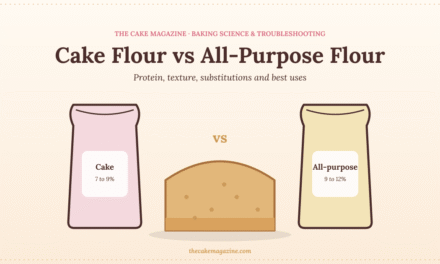
Extra flour makes a thicker batter with more structure, and a stiffer batter does not flow out to the edges as the cake rises. The result is a tall center and a heavy crumb. Flour scooped straight from the bag can weigh up to a fifth more than flour that is spooned and leveled, which is why a scale is the most reliable fix. The difference between flours matters as well, and our guide to cake flour vs all-purpose flour shows how protein affects tenderness and shape.
Overmixing
Once flour meets liquid, mixing develops gluten, the stretchy network that makes bread chewy. A little is needed for structure. Too much gives a cake that peaks, tunnels and turns tough. Mix on low speed until the flour just disappears, then stop. If you are not sure which method suits your recipe, our overview of cake mixing methods explains how creaming, reverse creaming and one-bowl batters each behave.
Cold or stiff batter
Batter that is very cold heats slowly in the middle and sets early at the edges, which exaggerates the timing gap. Ingredients at roughly the same cool room temperature blend into an even emulsion and bake more predictably. Cold eggs and cold milk are the usual offenders, and our guide to room-temperature ingredients for cake explains which ones really matter.
Low moisture or low fat
A batter that is dry and thick holds its shape in the pan and gets pushed up in the middle. A thinner, wetter batter, such as many oil-based chocolate cakes, spreads to the edges as it bakes and tends to rise flat. This is one reason a cake mix often bakes flatter than a scratch cake with the same pan, and it is a recipe-level fact you can use when choosing a formula.
The dome comes with a dense, tough crumb
Likely causes: too much flour, overmixing, or a stiff batter.
How to test: weigh your flour, then bake again with the mixer on low just until combined.
Fix it next time: measure by weight, mix gently and bring the cold ingredients up to cool room temperature.
Symptom, cause and fix cards
Here is a fast reference you can scan in the kitchen. Find the symptom that matches your cake, check the most likely cause and try the single fix listed. Remember to change one thing at a time. If a fix does not shrink the dome after one or two bakes, move to the next suspect. This is the practical way to settle why does cake dome in your own oven.
A tall peak with a crack down the middle
Likely causes: an oven that is too hot, a rack that is too high, or a deep fill.
Fix it next time: lower the temperature by 25°F, move to the center rack and use damp cake strips. If cracks are your bigger concern, see our guide on why a cake cracks on top.
A gentle dome and dark, crisp edges
Likely causes: a dark or thin pan, or a glass dish at full temperature.
Fix it next time: switch to light aluminum, reduce the heat by 25°F, or wrap the pan in strips.
One layer domes and the other is flat
Likely causes: uneven batter weight, a hot spot or an oven rack that is crowded.
Fix it next time: weigh the batter into each pan, bake the pans side by side with space between them and rotate once near the end.
The dome rises tall, then sinks into a crater
Likely causes: too much leavening, an underbaked center or opening the door early.
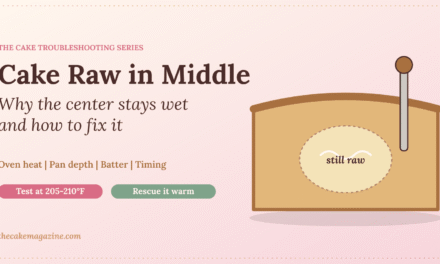
Fix it next time: level your leaveners, keep the door closed for at least the first half of the bake and confirm that the center reads about 205°F to 210°F. Our sunken-cake guide covers this in depth.
A tall dome and a wet, gummy band at the bottom
Likely causes: too much batter in the pan, a pan that is too deep or underbaking.
Fix it next time: reduce the fill, bake longer at a lower temperature, and read our guide on why a cake has a gummy layer.
Flat-top tricks without cake strips
Strips are handy, but they are not the only answer to why does cake dome, and they are not the only route to a flat layer. Bakers have used a handful of other methods for generations, and several of them cost nothing. Each one works by the same principle: slow the edges, or help the center catch up. If you are still asking why does cake dome even after adjusting your oven, try one or two of these.
Lower the temperature and extend the time
This is the simplest swap. Drop the oven by 25°F and add five to ten minutes. The slower heat gives the middle time to set before the rim locks. Many reliable layer-cake formulas already use 325°F or 340°F for this reason. Always confirm with a thermometer, since an oven that runs cool will turn this into a pale, dense cake.
Use a heating core, often called a baking nail
A baking nail, also sold as a flower nail or heating core, is a small metal rod set in the center of a wide pan. Metal conducts heat well, so the rod carries warmth into the middle of the batter and brings the center up to the same pace as the edges. Many professional bakers use them for tall or wide cakes. Grease the nail, stand it point-up in the pan and fill the batter around it.
After baking, slide the nail out and fill the small hole with frosting or a spare crumb. A nail is especially useful for large pans, where the center is far from any wall and the timing gap is greatest.
Bake in more, thinner layers
Three 6-inch layers or four 8-inch layers heat through much faster than two thick ones, and thin layers dome far less. Weighing the batter into each pan makes the layers match. The cake is a little more work to assemble, but it stacks tall and even, and you can level any small crown with a gentle trim.
Tap, rest and bake on a sheet pan
Rap the filled pan on the counter a few times to release large air bubbles, because trapped air can push the center up. Letting the filled pans sit for ten minutes before baking is sometimes suggested to let the batter settle, but results vary by recipe, so treat it as an experiment. A heavy sheet pan under the cake pans can soften bottom heat if your bases darken.
Some bakers press the dome down with a towel the moment the cake leaves the oven. It can work on a very soft butter cake, but it also squeezes out air, compacts the crumb and risks burns. Reaching for a serrated knife after the cake has cooled is gentler and gives you more control.
Check your leaveners before you blame the pan
Fresh baking powder is lively, and old baking powder is flat and can leave you chasing the wrong cause. Stir half a teaspoon of baking powder into hot water and it should fizz energetically. For baking soda, add a splash of vinegar and look for a rapid foam. Test them once a season and replace them if they are weak. Reliable leaveners help your results stay consistent.
Leveling and using a domed cake
Even bakers who know exactly why does cake dome end up with a hill now and then. The fix is easy and quick: level the cake, and save the deeper question of why does cake dome for the next bake. Cool the layers completely first, because warm cake crumbles and smears. If the cake is very tender, a short time in the fridge or freezer firms it up and makes cutting cleaner.

How to level a layer cleanly
- Put the layer on a turntable or a flat board at eye level.
- Hold a long serrated knife flat, with the blade parallel to the board, just below the highest point of the dome.
- Rotate the turntable slowly while you saw gently, letting the blade follow a level line all the way around.
- Lift the removed dome off in one piece and set it aside.
- Flip the layer so the flat bottom faces up. The bottom is the flattest, firmest side and makes the best top for frosting.
A cake leveler with a wire guide is another option, and it makes layers consistent in height. Whichever you choose, aim to trim as little as possible. If the dome is small, you may only need to flip the layer and let the flat bottom face upward. Our guide to smooth buttercream sides and sharp cake edges shows how a level layer sets up a clean finish.
Do not waste the trimmings
The trimmed dome is perfectly good cake. Bakers use the scraps in several ways. Cube them for a trifle. Crumble them over ice cream or yogurt. Mix them with a spoonful of frosting to form cake truffles or cake pops. Freeze them in an airtight bag for later. Snacking on a few pieces while you decorate is also entirely reasonable.
If you are building a layer cake for a party, bake a little extra batter into one more small pan or a few cupcakes. The extras give you a sample to taste and cover the occasional layer that does not come out the way you hoped. Beginners will find more gentle practice ideas in our cake decorating for beginners guide.
Storing cooled layers before leveling
Wrap cooled layers in plastic and chill them if you are working ahead, which firms the crumb and makes leveling cleaner. Cakes with perishable fillings or frostings, such as cream cheese, whipped cream or custard, need refrigeration, and food-safety agencies advise keeping perishable foods out of the temperature danger zone. The USDA Food Safety and Inspection Service publishes general guidance on safe handling and storage.
Domes in cupcakes, sheet cakes, loaves and bundts
The same physics applies to every shape, but the practical result differs. Knowing how each one behaves helps you decide when a dome is a problem and when it is part of the charm.
Cupcakes and muffins
A small crown on a cupcake is normal and even desirable, since it holds frosting nicely. A very high peak usually means an oven that is too hot or liners filled too full. Fill cupcake liners about two thirds of the way, and if the tops split, drop the oven by 25°F. A bakery-style tall dome is a different goal that deliberately uses a hot start, so match the method to the result you want.
Sheet cakes and 9×13 pans
A large, shallow pan is a gentle environment, so sheet cakes usually bake flat. When they dome, the culprit is often a crowded oven or a thick batter in a pan that is too small. Check that the batter is spread evenly to the corners before baking, and bake on the center rack with space on all sides.
Loaf cakes and pound cakes
A loaf pan is narrow and deep, so the center is far from the sides and a dome and even a lengthwise crack are expected. Many pound cake fans love that split. If you prefer a smoother top, lower the temperature slightly, bake a little longer or place a pan of water on a lower rack to add steam. Check for doneness early, since loaves vary widely in size.
Bundt and tube pans
The central tube heats the batter from the inside, which brings the center and the edges into step. That is one reason bundt cakes tend to rise evenly. The dome forms on the base, which becomes the bottom after you turn the cake out, so a small hill is easy to trim. Level the underside with a serrated knife if the cake rocks.
Cake mixes
Boxed mixes are formulated to bake level in standard pans, but they can still dome with a hot oven or an overfilled pan. Follow the pan size on the box, bake on the center rack and test early. Because the batter is thin and the structure is balanced, cake strips tend to work well with mixes.
Layer cake
Aim for flat. Use strips, a center rack and a moderate oven. Trim any small crown before filling.
Cupcake
A gentle crown is lovely. Fill liners two thirds full and keep the oven at the recipe temperature.
Loaf or pound cake
A dome and a crack are traditional. Embrace them, or lower the heat for a smoother top.
Sheet cake
Usually flat. Spread the batter to the corners and keep the oven uncrowded.
Why does cake dome more with some recipes than others?
Two cakes can sit side by side in the same oven and come out with different shapes. When bakers compare notes on why does cake dome in one recipe and not another, the answer is usually the batter itself. Fat, sugar, liquid and mixing method all change how quickly a batter sets and how far it flows toward the edges while it bakes.
Why does cake dome in butter cakes?
Creamed butter cakes hold a lot of air and have a fairly thick batter. Thick batter does not slide toward the rim as it rises, so the center climbs. Butter also firms as the cake cools, which locks in the shape. This is why a classic yellow cake is one of the more dome-prone recipes, and why the strips and a gentler oven help so much with it.
Why does cake dome less in oil-based cakes?
Oil cakes, including many chocolate and carrot recipes, start with a thinner, more pourable batter. It flows out to the edges as it bakes and tends to set flatter. If you are comparing recipes and wondering why does cake dome in one and not the other, check the fat first. Our chocolate cake recipe uses an oil-based, one-bowl method, and the notes there show how that shapes the crumb.
Why does cake dome in high-ratio and pound cakes?
Dense batters with a lot of butter and eggs, such as pound cake, bake slowly and set from the outside in. A tall crown is expected, often with a split down the middle. If you want a gentler top, bake at a slightly lower temperature, use a wider pan or accept the split as a feature. For sponge and foam cakes, the structure comes from whipped eggs, and the shape depends mostly on how gently you fold.
Recipes are written for the writer’s oven, pan and flour. If a formula reliably domes for you, it is rarely your fault. Adjust the temperature, the pan or the fill, and keep notes. A recipe that has been tuned to your kitchen is worth more than the original.
Why does cake dome when I double the recipe?
Doubling a batter often means pouring it into a deeper pan or a heavier fill, and both widen the timing gap. If you scale a recipe, scale the pan as well, or divide the batter across more pans. Our guide to scaling a cake recipe by weight explains how to change the amounts and bake times together.
Why does cake dome in a 9-inch pan but not an 8-inch?
It can go either way, which is why the pan and batter need to be matched. A wider pan spreads the same batter thinner, so it usually bakes flatter, but if you pour a 9-inch batter into an 8-inch pan, the layer gets deeper and the dome grows. Always weigh the batter and check the depth, not just the diameter.
Why does cake dome in the oven and sink after?
A tall rise followed by a collapse usually points to an over-leavened batter, an underbaked center or a door opened too early. The dome formed as the batter ballooned, but the structure was not strong enough to hold it. Bake a bit longer, level your leaveners and test the center with a thermometer before you pull the cake. Fixing the sink often fixes the dome.
A prevention checklist and a test plan
Rather than hoping for the best, treat your next cake as a small experiment. Settle the cause once, write it down and then you can stop asking why does cake dome every time you bake. A clear routine takes only a few minutes of extra attention, and it pays back in layers that stack neatly.
- Hang an oven thermometer on the center rack and preheat for at least 20 minutes.
- Weigh the flour and other main ingredients instead of scooping.
- Check that the baking powder and baking soda are fresh.
- Bring cold ingredients up to cool room temperature.
- Choose the pan size the recipe was written for, and use light aluminum if you can.
- Weigh the batter into each pan so the layers match.
- Fill the pan no more than about halfway.
- Wrap the pans in damp cake strips if your layers always peak.
- Keep the oven door closed for the first half of the bake.
- Rotate once near the end if your oven has hot spots.
- Cool for about ten minutes in the pan, then turn out onto a rack.
- Measure the dome with a ruler and record it.
- Level with a serrated knife once the layers are cool.
- Save the trimmings for trifle, truffles or snacking.
A simple three-bake test plan
If your cakes dome every time, run a controlled test. Bake one: make no change, and record the dome height, pan, temperature and time. Bake two: drop the oven by 25°F and add a few minutes. Bake three: keep the lower temperature and add damp strips. Compare the three heights. You will usually see one change that does most of the work, and that is your answer for your oven.
Keep the notes with the recipe. If you also run into sinking or density in later bakes, the broader reference in our cake troubleshooting guide and its sibling articles on dry cake and dense cake will help you connect the symptoms.
Reading the dome: what the shape tells you
Because a dome is a clue and not just a flaw, the exact shape can point to the cause. Cut a domed layer in half from edge to edge and look at the cross-section. Where the crumb is tight, where it opens up and where the color changes all say something about how the heat moved through the batter. Here is how to read what you find, and how each shape answers why does cake dome in that particular case.
A smooth, rounded crown with an even crumb
This is the mild, healthy dome. The batter rose steadily and set in one go, and the crumb is fine and even from edge to center. It tells you the leavening is right and the oven is basically sound. A small trim is all that is needed, and you can bake the recipe exactly the same way next time.
A pointed peak with a crack and a darker top
A sharp peak with a split means the surface set early and then burst open as the center kept pushing up. This is the classic sign of an oven that is too hot, a rack that is too high or a deep batter. The crumb underneath may look tunneled, with long holes running upward. Start by cutting the temperature and moving to the center rack.
A tall dome and a gummy stripe along the base
When the base shows a dense, wet-looking stripe, the cake probably had too much batter for its pan or was cut and cooled before it finished baking. The extra depth meant the middle needed more time than you gave it. Reduce the fill, bake longer at a lower temperature and confirm doneness with a thermometer reading around 205°F to 210°F for most butter cakes.
A dome that is paler than the edges
If the center peak is pale while the sides are dark, the pan is probably a dark metal or the cake is sitting too close to the lower heat. The edges absorbed more heat than the middle, which is the textbook cause of why does cake dome in dark pans. Light aluminum pans, damp strips or a lower rack move heat more evenly.
A worked example you can follow
Here is a made-up scenario to show how the method works, not a record of a real test. Imagine a baker whose vanilla layers rise to about three quarters of an inch and split at the top. The oven thermometer reads 375°F while the dial says 350°F, so the oven is running 25 degrees hot. The baker drops the dial to 325°F so the real temperature is near 350°F and bakes one layer in a dark pan and one in a light pan, noting the result.
The light-pan layer comes out flatter, which suggests pan color was also contributing. On the next bake, the baker wraps the dark pans with damp strips and finds the two layers now match in height. The notes are then saved with the recipe: dial at 325°F, light aluminum pans or strips on dark pans, and weigh the batter. That tiny experiment answers the question of why does cake dome for that baker’s own kitchen.
How a dome differs from a crack or a sink
These three problems often show up together, and it is easy to mix them up. A dome is a shape issue: a higher middle. A crack is a split in the crust and usually follows a sharp dome. A sink is a collapse after the cake has risen. Each has overlapping causes, but the fixes differ. If your cake peaks and then falls, start with our guides to cracks on top and sunken centers.
At higher elevations, batters rise faster because air pressure is lower, which can encourage a taller dome and later a collapse. Recipes often adjust leavening, sugar, liquid and temperature there. Our high-altitude cake baking guide covers the adjustments, and the King Arthur cake guide is a useful general reference for tested technique.
When a dome is useful
Not every dome needs fixing. A rounded top is lovely on a rustic loaf, a coffee cake or a Bundt cake, where the shape signals a tender, well-risen crumb. Bakery-style cupcakes aim for a generous crown on purpose so there is room for a big swirl of frosting. A snack cake served plain is better with a little height in the middle than with a pale, flat top.
If you would rather keep the dome and make it prettier, a light brush of melted butter or a dusting of coarse sugar just before baking creates a crisp, golden crust. A thin glaze or a scattering of nuts or fruit can hide a small crack. For layer cakes meant to be stacked and decorated, though, flat layers save time and frosting, and that is where the techniques above pay off.
Final thoughts on why does cake dome
The question of why does cake dome has a satisfying answer once you see the race between the rim and the center. The rim sets first, the middle keeps rising and the hill is the leftover. Slow the edges with a gentler oven, damp strips or a light pan, shorten the distance to the center with a shallower fill, and keep the batter balanced. Then level what remains with a serrated knife and enjoy the trimmings.
Change one thing per bake, write the result down and you will have a flat-layer routine in a couple of tries. For the wider picture, start with our cake baking science guide and the full cake troubleshooting guide. Every kitchen is different, and the best fix is the one you can confirm with your own oven.
FAQ: why does cake dome and how to stop it
Why does cake dome in the middle?
The outer batter touches the hot pan and sets first, forming a firm ring. The center stays fluid and keeps rising because trapped gas and steam have nowhere to go but up. The longer the gap between the edges setting and the middle setting, the taller the hill. A cooler oven, a shallower fill and damp cake strips all shrink that gap.
Why does cake dome more in a dark pan?
Dark metal absorbs more heat than shiny aluminum, so the rim cooks faster and the timing gap widens. Many recipes suggest lowering the oven by about 25°F for dark or nonstick pans. You can also wrap the pan in damp strips or switch to a light-colored, heavier gauge aluminum pan, which heats more evenly.
Why does cake dome even when I use cake strips?
They help a lot with the common edge-first dome, because the wet fabric slows the heat reaching the pan wall. The cake rises more evenly and the top bakes flatter, though not always perfectly flat. Strips cannot fix a hot oven, too much leavening or an overfilled pan, so use them alongside the other adjustments.
Why does cake dome at 350°F but not at 325°F?
Many layer cake recipes bake well at 325°F to 350°F, and the lower end gives a flatter top because the center has more time to catch up. Verify your oven with a thermometer first, since many ovens run hot or cool. If you lower the heat, add a few minutes and check doneness with a toothpick or a thermometer.
Can I fix a domed cake after baking?
Yes. Let it cool completely, then slice off the dome with a long serrated knife, holding the blade level while you rotate the cake on a turntable. You can also flip the layer so the flat bottom faces up. Save the trimmings for trifle, cake pops or snacking, since they are perfectly good cake.
Why does cake dome, and does it mean the cake is underbaked?
Not necessarily. A mild dome is a normal result of how batter bakes and does not mean the cake is underbaked. Check the center for doneness with a toothpick or an instant-read thermometer. Many butter and oil cakes are done at about 205°F to 210°F. A dome that cracks, sinks or comes with a wet band may signal other problems.
Why does cake dome when I add extra baking powder?
It can. Too much leavening creates a rush of gas that lifts the center quickly, and the cake may rise high and then collapse. Level every spoon, weigh small amounts if you can, and check that your baking powder is fresh. Our guide on baking powder and baking soda explains how much lift a typical cake needs.
Why does cake dome when I use a box mix?
Mixes are made to bake level, but a hot oven, an overfilled pan or a dark pan can still produce a peak. Follow the pan size on the box, bake on the center rack and check a few minutes early. Damp cake strips work well with mixes, and lowering the oven slightly is a safe first step.
Why does cake dome more in a narrow pan?
Yes. A narrow, deep pan buries the center far from the hot wall, so the middle sets late and rises into a hill. A wider, shallower pan lets heat reach the center sooner. Matching the batter volume to the pan, and using more pans for thinner layers, are the most reliable ways to keep a layer flat.
Why does cake dome and crack on top?
When the surface sets early, the center keeps pushing upward and the crust splits open. The usual causes are an oven that is too hot, a rack that is too high or a deep batter. Drop the temperature by 25°F, use the center rack and consider strips. Small cracks in pound cakes and loaves are traditional and harmless.
Why does cake dome more with a convection fan?
Many bakers do, or they lower the set temperature by about 25°F, because moving air sets the crust faster and can encourage a peak. Oven designs differ, so check your manual and compare a bake with and without the fan. Record the dome height so you can see which setting your oven likes.
Do I need a baking nail or heating core?
You do not need one for ordinary 8-inch layers, but it can help on large or tall pans where the center is far from the sides. The metal rod carries heat into the middle so it sets at nearly the same pace as the edges. Grease it well and fill the small hole with frosting afterward.
Why does cake dome every time, and how can I stop it?
Combine three small changes. Check your oven with a thermometer and drop it by 25°F if needed, weigh the batter into pans filled no more than halfway, and wrap the pans in damp strips. Keep notes so you can see which change made the biggest difference, then keep that one in your recipe.
Editorial note: reviewed and updated November 2026. This guide shares general baking principles for home bakers in the United States and uses American measurements. Results vary by oven, pan, altitude and ingredients, and the temperatures and times here are starting points to confirm with your own thermometer and notes. The worked example above is an illustration, not a recorded test.