Open almost any cake recipe and you will find a small line in the ingredient list: a teaspoon of baking powder, or a half teaspoon of baking soda, or sometimes both. Those few grams decide whether the layers rise tall or bake flat, gummy or faintly soapy. The baking powder vs baking soda cake question confuses many home bakers, because the two white powders look identical. This guide explains what each does, why a recipe might need both, and how to measure and fix them.
In the baking powder vs baking soda cake debate, the difference is acid. Baking soda is a pure base, so it only makes gas when the batter contains an acid such as buttermilk, yogurt, brown sugar, natural cocoa or lemon juice. Baking powder is baking soda with its own dry acid already mixed in, so it works in a plain batter. Cakes need both when a recipe is acidic enough to want soda for browning, flavor and balance, but not acidic enough to lift the whole cake without help from baking powder.
- Baking powder vs baking soda cake: the basics
- What is actually in each jar
- Acid decides which one you need
- Double-acting powder and the timing of the rise
- Why some cakes need both
- How much to use: rules of thumb and grams
- Which leavener for which cake
- Too much, too little: reading the crumb
- Swapping one for the other
- Freshness, storage and the fizz test
- Mixing and baking habits that protect your leavening
- Altitude, humidity and other variables
- Four real baking dilemmas, solved
- Myths worth retiring
- A quick decision checklist
- FAQ
Baking powder vs baking soda cake: the basics
A cake rises because tiny bubbles of gas get trapped in the batter and then expand in the oven’s heat. Some of that gas is steam, and some is air beaten in during mixing. But in most American-style cakes, the bubbles that matter most come from a chemical leavener, a powder that releases carbon dioxide when it gets wet and warm. The baking powder vs baking soda cake choice is really a choice about how that gas gets made.
Here is the one idea that makes everything else easier. Carbon dioxide from baking soda needs a partner. Soda is a base, and a base only produces gas when it meets an acid. If the batter has no acid, the soda just sits there, then turns bitter and soapy in the oven. Baking powder solves that problem by carrying its own acid in the same jar, which is why it works in a simple batter of butter, sugar, eggs, flour and milk.
That is the whole story at its core. Everything else in this guide, from buttermilk cakes to red velvet to why your carrot cake needs two leaveners, is a variation on how much acid is in the batter and how much lift the cake needs.

Why baking powder vs baking soda cake choices matter more than in cookies
Cookies can forgive a lot. A cookie that spreads a little more or rises a little less is still a cookie. A layer cake is different, because its entire structure depends on bubbles being small, numerous and evenly spread. If the leavener is off, the crumb shows it right away: a sunken center, coarse holes, a tight rubbery texture, or a flavor that tastes like a cleaning product.
Cake batters are also thin compared to dough, so they cannot hold on to oversized bubbles. Gas that forms too early or too violently simply escapes or lifts the batter too far and then lets it fall. That is why the baking powder vs baking soda cake decision deserves a little attention even if you follow recipes closely. A recipe that works is balanced chemistry, and swapping one powder for the other quietly breaks that balance.
The three-sentence summary to remember
Baking soda needs acid and is strong, so you use small amounts. Baking powder carries its own acid and is milder, so you use larger amounts. Recipes that contain both are usually acidic enough to want soda, but still need powder for most of the lift.
If you only take one thing from this baking powder vs baking soda cake guide, take that. The rest of the baking powder vs baking soda cake story fills in the details and helps you fix cakes that went wrong. For the bigger picture of how leaveners sit alongside flour, fat, sugar and eggs, our cake baking science guide is a good companion read.
What is actually in each jar: baking powder vs baking soda cake ingredients
It helps to look at the two ingredients side by side before getting into the chemistry of a baking powder vs baking soda cake batter. They share a common ancestor, which is why bakers mix them up, but they behave very differently in a mixing bowl.
Baking soda: one ingredient, one job
Baking soda is sodium bicarbonate, a fine white crystalline powder. On its own it is a mild alkaline, or base. When it meets something acidic and moisture, it reacts quickly and releases carbon dioxide gas, along with water and a neutral salt. According to the King Arthur Baking explanation of soda and powder, that reaction starts right away, which is why batters made with soda should go into the oven promptly.
Because soda is a base, it does a second job that people often forget. A less acidic batter browns more readily and deeply, so soda helps cakes take on a darker crust and a deeper color. It also softens the sharpness of an acidic ingredient, which can make buttermilk or natural cocoa cakes taste rounder. But if there is more soda than acid in the batter, the leftover soda tastes metallic and soapy.
Baking powder: soda plus a dry acid
Baking powder is a complete leavening system in one jar. It contains baking soda, one or more dry acids, and a bit of starch, usually cornstarch, to keep the mixture dry and to buffer the ingredients from each other. The dry acids stay inactive until moisture arrives, so you can store it on a shelf without it fizzing away.
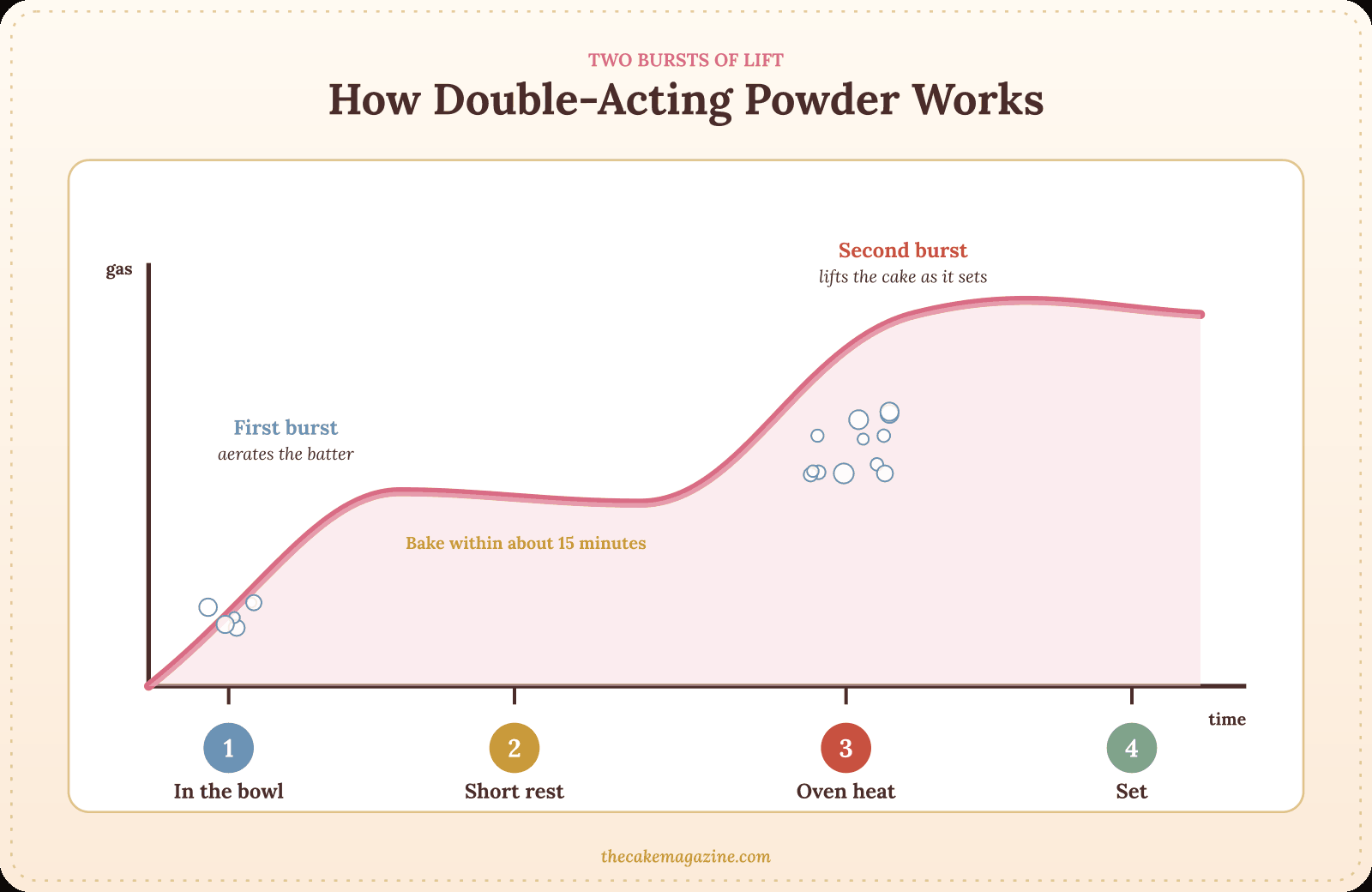
Most baking powder sold in American grocery stores is labeled double-acting. That means two kinds of acid are included: one that dissolves and reacts at room temperature when the powder gets wet, and another that waits for oven heat. The result is a first burst of bubbles in the bowl and a second burst in the oven, which is very useful for a thin cake batter that might sit for a few minutes while you fill the pans.
Baking soda is one ingredient that needs a partner. Baking powder is a pre-made partnership. When a recipe lists only baking powder, the batter does not need to supply any acid. When a recipe lists baking soda, an acidic ingredient has been chosen on purpose, and that ingredient is part of the formula.
Strength: why you use less soda
Baking soda is considerably stronger than baking powder, because baking powder is partly diluted with its acid and starch. King Arthur’s guidance puts the swap at three teaspoons of baking powder to replace one teaspoon of baking soda, which gives you a feel for the difference in strength. That ratio is a rough guide to potency, and it does not mean you can substitute one for the other without changing anything else in the recipe, as the swapping section later in this guide explains.
In practice, this is why a cake recipe might call for one and a half teaspoons of baking powder but only a quarter teaspoon of baking soda. The numbers are not random. They reflect how much gas each ingredient can make and how much acid is available in the bowl.
Baking powder vs baking soda cake: acid decides which one you need
When you wonder which leavener a batter needs, the best question to ask is simple: how much acid is already in this recipe? Many ingredients that taste nothing like sour are mildly acidic, and a good cake recipe counts them. Once you learn where the acid hides, baking powder vs baking soda cake decisions get much easier to predict.

The usual acidic ingredients in cake
Some of the acids in cake batter are obvious, such as lemon juice or vinegar. Others are easy to overlook. Buttermilk, sour cream, yogurt and crème fraîche carry lactic acid. Brown sugar and molasses are acidic because of how they are made. Honey and maple syrup are mildly acidic. Natural cocoa powder is acidic enough to react with soda, and applesauce, ripe bananas, pineapple and other fruit add mild acid too.
By contrast, plain milk, butter, white sugar, eggs, flour and water are close to neutral. They do not give soda much to work with. A batter made only from those ingredients needs baking powder, and cannot rely on soda alone.
The cocoa difference
Cocoa deserves its own note, because it trips up a lot of chocolate cake bakers. Natural cocoa powder is acidic, so it can partner with baking soda. Dutch-process cocoa has been treated with an alkali, which lowers its acidity, so it does not give soda enough acid to react with. King Arthur’s notes say Dutch-process cocoa lacks enough acidity to do the job.
If a chocolate cake recipe calls for Dutch-process cocoa and soda, it is probably relying on another acid, such as buttermilk or coffee, to do the work. If you swap one cocoa for the other without adjusting the leavener, you can end up with a cake that is either dense or bitter. Our chocolate cake recipe goes into this balance in more detail.
What happens when the acid and the soda do not match
Think of the acid and the soda as two weights on a scale. If the soda outweighs the acid, the leftover soda gives the cake a bitter, soapy taste, a yellowish, coarse crumb and a crust that browns too fast. If the acid outweighs the soda, the cake still works, but the flavor can taste sharp, and the batter loses some of the lift that soda would have added.
This is also why recipes that contain a lot of acid, such as buttermilk cakes, often include a little baking powder and a little soda together. The soda neutralizes some of the acid and gives browning and tenderness, and the powder fills in the lift that soda alone cannot supply.
Double-acting powder and the timing of a baking powder vs baking soda cake rise
Timing is the part of leavening that home bakers rarely think about, and it matters as much as the amount. The two leaveners behave very differently over the first hour of a cake’s life, and that difference explains a lot of puzzling results.
Soda reacts fast, so batter should not wait
When baking soda meets an acid in a wet batter, the reaction begins at once. Bubbles start forming as soon as you stir. If the batter then sits on the counter for half an hour while you wash dishes or frost something else, much of that gas leaves before the cake ever sees the oven. The cake that comes out will be flatter, denser and sometimes a little gummy, a classic baking powder vs baking soda cake mistake.
This is why recipes that rely heavily on soda, such as buttermilk or red velvet cakes, usually tell you to bake right away. Prepare your pans, preheat the oven and have everything lined up before you combine the wet and dry ingredients. When the batter is mixed, pour it, level it and get it in the oven.
Powder gives you a head start and a second wind
Double-acting baking powder is more forgiving. A first, smaller release of gas happens as soon as the powder is wet, which helps aerate the batter. A second, larger release happens when the batter heats up in the oven, which is the moment the cake needs lift most, because that is when the structure is setting around the expanding bubbles.
The practical benefit is a larger window. A cake leavened mostly with double-acting powder can wait a few minutes while you scrape bowls and fill pans, which is helpful if you are baking several layers or working with a stand mixer and a single bowl. Still, do not push it. Bake soon after mixing, within about 15 minutes, and your cakes will be taller and more even.
Single-acting powder exists, but you will rarely see it
Some baking powders are single-acting and release most of their gas when they get wet. These are uncommon in regular grocery stores today. If your jar does not say double-acting, check the label, and if it is single-acting, work fast and bake right after mixing. Whichever type you own, the habit that protects every cake is the same: mix, pan and bake without long breaks.
The second release of double-acting powder depends on the batter heating up. An oven that runs cool, or a cold pan straight from the fridge, delays that second lift, and the structure can set before the bubbles have finished expanding. A cake that comes out dense despite fresh leavener is often an oven or timing problem. Our guide to cake baking temperature explains why.
Baking powder vs baking soda cake: why some recipes need both
The most common baking powder vs baking soda cake puzzle is the recipe that lists both. It looks redundant. If baking powder already contains soda, why add more? The answer is that the two ingredients are doing different jobs in the same batter, and a good recipe assigns each job on purpose.
Job one in a baking powder vs baking soda cake: neutralize the acid
Imagine a buttermilk cake. Buttermilk brings a lot of acid. If you leave that acid alone, the cake tastes tangy, the crumb turns slightly tight, and the crust stays pale. A small amount of baking soda neutralizes some of it, which softens the flavor and loosens the crumb. That is soda’s first job, and it needs only a little, because there is only so much acid to neutralize.
The gas released during that neutralization does help the cake rise, but it is rarely enough. Neutralizing acid and lifting an entire cake are separate quantities, and a recipe can easily have enough acid for a quarter teaspoon of soda while needing the lift of two teaspoons of powder.
Job two in a baking powder vs baking soda cake: the remaining lift
Baking powder is the fill-in. It supplies the rest of the carbon dioxide without needing any extra acid from the recipe, and its second release in the oven helps the cake keep rising while it sets. This is why chocolate cakes made with natural cocoa and buttermilk, banana cakes, spice cakes, carrot cakes and red velvet cakes so often list both.
There is a third, subtler benefit. Because powder carries its own acid, using it keeps the batter from depending on a single acidic ingredient to do all the work. If your buttermilk is a bit thinner than usual, or your cocoa a bit milder, a cake with both leaveners tolerates the difference better than a cake leavened by soda alone.
A simple way to picture the baking powder vs baking soda cake balance
Picture two buckets. One bucket is the acid in the batter, and baking soda can only empty that bucket. The other bucket is the lift the cake needs. If the acid bucket is small compared with the lift bucket, soda alone cannot fill the gap, so baking powder tops it up. If the acid bucket is huge, you might need soda to avoid a sour cake, plus powder for lift, which brings us right back to a recipe with both.
Not every cake belongs in that group. Butter cakes made with plain milk and white sugar have almost no acid, so baking powder does everything. Some cakes, such as certain old-fashioned buttermilk or vinegar cakes, have so much acid that soda alone does the lifting, and they bake best right after mixing. Our vanilla cake recipe shows the first type: a simple, neutral batter that depends on baking powder alone.
Baking powder vs baking soda cake amounts: rules of thumb and grams
Recipe developers talk about leavening in ratios, and once you know the common baking powder vs baking soda cake ratios, you can spot a recipe that looks off before you waste butter on it. The numbers below are common starting ranges used in home baking, not strict laws, and they vary with the recipe, the other ingredients and your kitchen. Treat them as guardrails for any baking powder vs baking soda cake recipe, and test any change in your own oven.
Baking powder amounts in a cake
For a typical American butter or oil cake, a common range is about 1 to 1 1/4 teaspoons of baking powder per cup of all-purpose flour. A cup of flour weighs roughly 120 to 125 grams when measured carefully, and a teaspoon of baking powder weighs about 4 grams, though brands and scoops differ. That puts a working range near 3 to 3.5 grams of powder per 100 grams of flour.
Light, delicate cakes that are mostly egg foam sometimes use less or none, since whipped eggs do much of the lifting. Heavier or denser cakes, such as those loaded with fruit, nuts or mashed bananas, may use a little more. If a recipe calls for far more than that range, it may be poorly balanced, and the cake may taste bitter, metallic or collapse.
Baking soda amounts
A common rule is about 1/4 teaspoon of baking soda per cup of flour, as long as the batter contains enough acid. A teaspoon of baking soda weighs roughly 5 grams, so a quarter teaspoon is about 1 to 1.5 grams. Another way bakers check the balance is by the acid itself: roughly 1/2 teaspoon of soda for each cup of acidic liquid such as buttermilk or yogurt is a widely used rule of thumb.
These two guidelines will not always agree, and that is fine. They are rough sanity checks. If a recipe has far more soda than either guideline suggests, look for a lot of acid, such as vinegar, lemon juice or natural cocoa, that explains it. Without that, the cake will probably taste harsh.
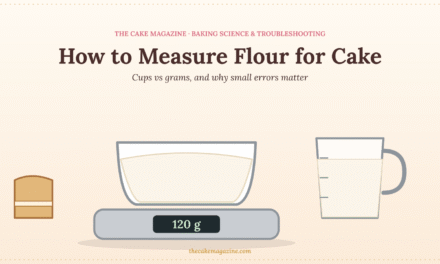
A heaping measuring spoon can hold a third more than a level one, and with baking soda that is enough to ruin a cake. Fill the spoon, then level it with the straight edge of a knife. Better yet, use a scale that reads to a tenth of a gram. Our guide on how to measure flour for cake explains why weighing beats scooping for every ingredient.
Worked examples (starting points, not tested formulas)
These examples show how baking powder vs baking soda cake ratios play out in a recipe. They are illustrations built from common ratios, and this site has not oven-tested them. Use them to sanity-check your own recipes and expect to adjust.
Neutral butter cake, 250 g flour
Plain milk, white sugar, no acid. Baking powder only, roughly 2 to 2 1/2 teaspoons (8 to 10 g), with no soda. The powder carries all the lift, and the batter has no acid for soda to work with.
Buttermilk cake, 250 g flour
About 240 g (1 cup) of buttermilk. Roughly 1/2 teaspoon baking soda (about 2.5 g) to balance the acid, plus about 1 to 1 1/2 teaspoons baking powder (4 to 6 g) for lift. Both, doing separate jobs.
Natural cocoa devil’s food, 200 g flour
Natural cocoa, brown sugar and buttermilk or coffee. A teaspoon or so of soda (4 to 5 g), sometimes with a little powder. The soda is the main leavener because the acid is plentiful.
Dutch-process cocoa cake
Cocoa is nearly neutral, so soda needs help from buttermilk or another acid. Many recipes rely mainly on baking powder here, with a little soda if there is other acid in the batter.
Notice that none of these recipes is identical. The baking powder vs baking soda cake pattern is what matters: the more acid the batter carries, the more the recipe leans on soda, and the less acid it carries, the more it leans on powder. When your recipe breaks that pattern, ask why before you bake.
Baking powder vs baking soda cake by cake type
It is easier to learn the logic by looking at specific cakes. Here is how the leaveners usually line up across the cakes most bakers make. Individual recipes differ, so use this as a map rather than a rulebook.
Vanilla and white cakes
Mostly baking powder. The batter is close to neutral, with plain milk and white sugar, and sometimes a little soda only if a tangy ingredient is present.
Yellow butter cake
Baking powder only in most classic recipes. A pinch of soda may appear when buttermilk replaces milk, which is a common upgrade.
Buttermilk and sour cream cakes
Soda plus powder. The acid is built in, so soda neutralizes it, and powder provides the rest of the lift.
Chocolate cake with natural cocoa
Often soda-forward, because natural cocoa is acidic. Powder may be added for extra lift in layer cakes.
Chocolate cake with Dutch-process cocoa
Usually more powder, since the cocoa has little acid. Soda appears only when buttermilk, coffee or another acid is in the recipe.
Red velvet
Both, with buttermilk and a splash of vinegar. The soda and vinegar reaction gives lift and a tender crumb, as covered in our red velvet cake recipe.
Banana, carrot, spice and apple cakes
Usually both. Fruit, brown sugar and spices bring mild acid, and the batter is heavy, so it needs both browning and lift.
Lemon and citrus cakes
Often both. Citrus juice adds acid, but the juice amount is small, so powder still does most of the work.
Pound cake
Often little or none. Pound cakes may rely on creamed butter, sugar and eggs for lift, with just a small amount of powder or soda in some modern versions.
Sponge, chiffon and angel food
Mostly whipped eggs or whites. Chiffon often adds baking powder, while angel food usually relies on the foam and cream of tartar for stability, not a chemical leavener.
Why mixing method changes the baking powder vs baking soda cake answer
How you mix also shifts how much chemical leavener a cake needs. Creaming butter and sugar traps air, so creamed cakes may need a little less help. Oil-based cakes and one-bowl cakes have no creamed air, so they lean harder on powder or soda. Foaming methods get most of their lift from beaten eggs. If you want to understand how those methods change the crumb, read our guide to cake mixing methods.
The takeaway for the baking powder vs baking soda cake decision: look at the acid first, then the mixing method, then the weight of the batter. Those three clues explain almost every recipe you will meet.
Baking powder vs baking soda cake problems: reading the crumb
When a cake goes wrong, the leavener is a frequent suspect, but it is rarely the only one. A baking powder vs baking soda cake problem usually leaves recognizable signs, and learning them helps you decide whether to adjust the leavener or look elsewhere. Our cake troubleshooting guide covers the full list of suspects, and this section focuses on the leavening clues.
Too much baking powder in a cake
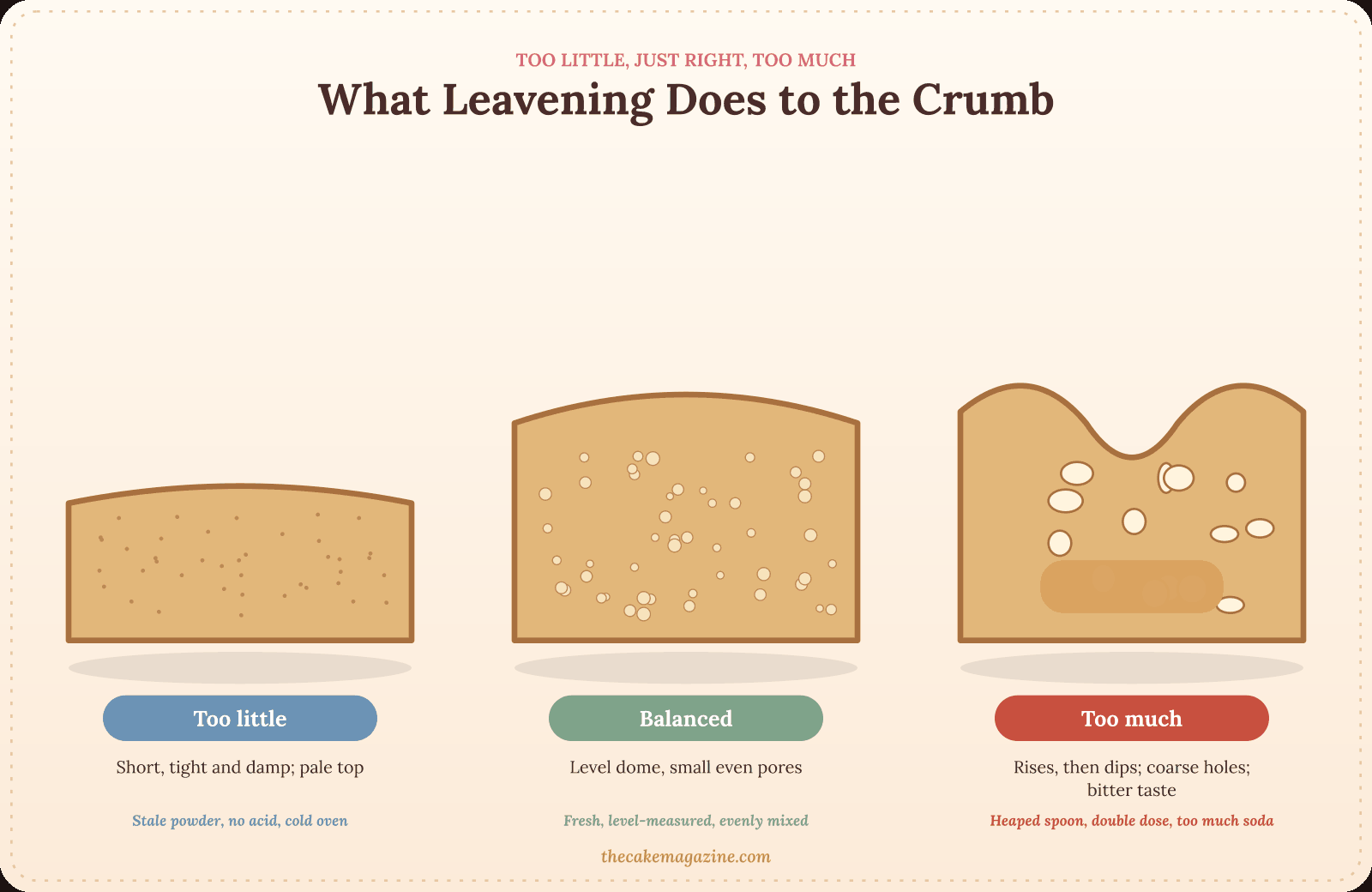
What it looks like: the cake rises quickly, then falls in the center. The crumb is coarse and open, with large holes, and the edges look dry or crumbly. A bitter, chemical or faintly metallic aftertaste is common.
Why it happens: the batter makes more gas than its structure can hold. The bubbles grow large, burst and leave a weak crumb that cannot support itself as it cools.
Fix it next time: reduce the powder by about a quarter, level your measuring spoon, and check that you did not add powder twice, for instance by using self-rising flour in a recipe that also lists baking powder.
Too little baking powder
What it looks like: the cake is short, tight, heavy and sometimes damp. The crumb has tiny pores, a rubbery bite, and may look pale on top.
Why it happens: not enough gas formed to expand the batter before it set. Old, damp or expired powder causes the same result even when you measure correctly.
Fix it next time: test your powder for freshness, which is covered below, and measure with a level spoon. Then check the usual suspects of oven temperature, overmixing and flour measurement before adding more powder.
Too much baking soda
What it looks like: a soapy or metallic taste, a yellowish or overly dark crumb, a coarse texture and a crust that browns faster than the center cooks. In chocolate cakes the crumb can look reddish-brown and taste harsh.
Why it happens: there was more soda than acid in the batter, so some soda never reacted and stayed behind as a bitter-tasting base.
Fix it next time: cut the soda by a quarter to a third, or add a little more acid, such as a spoonful of buttermilk or yogurt, if the recipe allows. Check which cocoa you used, because Dutch-process cocoa supplies less acid than natural.
Too little baking soda, or not enough acid
What it looks like: a pale crust, a tight, slightly sour crumb and less rise than the recipe promised. Flavor can taste flat or sharp, depending on the acid.
Why it happens: the acid in the batter was not fully neutralized, so the cake lost both lift and flavor balance. This often happens when someone swaps buttermilk for plain milk, or natural cocoa for Dutch-process cocoa, without changing the leavener.
Fix it next time: keep the original acidic ingredient, or add acid to milk (see the swap section). Stir dry ingredients well so soda spreads evenly.
Clumps and speckles
Sometimes the problem is not the amount but the distribution. If soda or powder clumps in the dry mix, tiny pockets of bitterness or brown specks appear in the finished cake, because a clump never dissolved or reacted. Sifting or whisking the leavener with the flour and salt for 20 to 30 seconds spreads it evenly. This is a cheap step that fixes a surprising number of off-tasting cakes.
When the leavener is not the culprit
A sunken center is not always a leavener problem. Underbaking, an oven door opened too early, overmixing and a batter that is too wet cause it too. Our sibling guide, why did my cake sink in the middle, walks through those, and why is my cake dense does the same for heavy crumb. Before blaming the powder, rule out the simpler suspects.
Baking powder vs baking soda cake swaps: using one for the other
Sooner or later every baker finds themselves mid-recipe with the wrong white powder in the cupboard. The honest answer for a baking powder vs baking soda cake swap is that it can be done, but only with adjustments, and it is never perfectly equal. Here are the common cases, all based on commonly published guidance such as King Arthur Baking’s substitution notes.
Baking powder vs baking soda cake swap one: powder in place of soda
This swap is easier than the reverse, but it needs a larger amount of powder. King Arthur’s guidance suggests an equivalent of roughly three teaspoons of baking powder for each teaspoon of baking soda called for. Remember that baking powder is weaker, and it will not neutralize the recipe’s acid the same way.
The result is usually a cake that rises, but with a slightly different flavor, paler color and a bit more tang if the recipe contains buttermilk or sour cream. If a recipe calls for a small amount of soda, such as 1/4 teaspoon, the swap is small enough that many cakes survive it. A recipe built around a large amount of soda, like a vinegar cake, will change more.
Baking powder vs baking soda cake swap two: soda in place of powder
A baking powder vs baking soda cake swap in this direction needs an acid. A common approach is to use about one-third as much baking soda as the baking powder called for, and add an acidic ingredient to give it something to react with. Lemon juice or white vinegar both work in small amounts, roughly 1/2 teaspoon of acid for each 1/4 teaspoon of soda, based on the King Arthur guidance.
Use this swap carefully in cakes. Too much acid or soda changes flavor, and the extra liquid slightly changes the batter. If there is any way to buy a small tin of baking powder, it is a better solution than improvising when the cake matters, such as for a birthday or an order.
Making a quick baking powder at home
If you have baking soda and cream of tartar, you can mix a stand-in. King Arthur’s published substitution is 1/4 teaspoon baking soda plus 1/2 teaspoon cream of tartar plus 1/4 teaspoon cornstarch to replace 1 teaspoon of baking powder. Mix it fresh and use it right away, since homemade powder, unlike store-bought double-acting powder, releases most of its gas as soon as it gets wet.
Do not substitute baking soda for baking powder one-for-one. The cake will taste soapy and brown unevenly. Do not use self-rising flour and add more baking powder, since self-rising flour already contains powder and salt. And do not use Dutch-process cocoa in a soda-only recipe without checking for another acid.
Swapping the acid
Buttermilk is the most common acid people want to replace. A widely used stand-in is plain milk with a tablespoon of lemon juice or white vinegar per cup, left for five to ten minutes until it thickens slightly. Plain yogurt or sour cream thinned with milk works too. These substitutes keep the acid in the recipe so the baking soda still has something to react with.
What you should not do is swap buttermilk for plain milk and keep the soda, because there is no longer enough acid for the soda to work. If you must swap, adjust the leavener or restore the acid.
Freshness, storage and the fizz test for baking powder and soda
Leaveners lose strength over time, and a jar open for two years may not be doing much, which can quietly ruin a baking powder vs baking soda cake that was measured perfectly. Old powder absorbs moisture from the air, which triggers its reaction slowly in the jar instead of in your batter. By the time you scoop it out, some of the lift is already gone. That is a hidden cause of flat cakes that look fine on paper.
Test baking powder
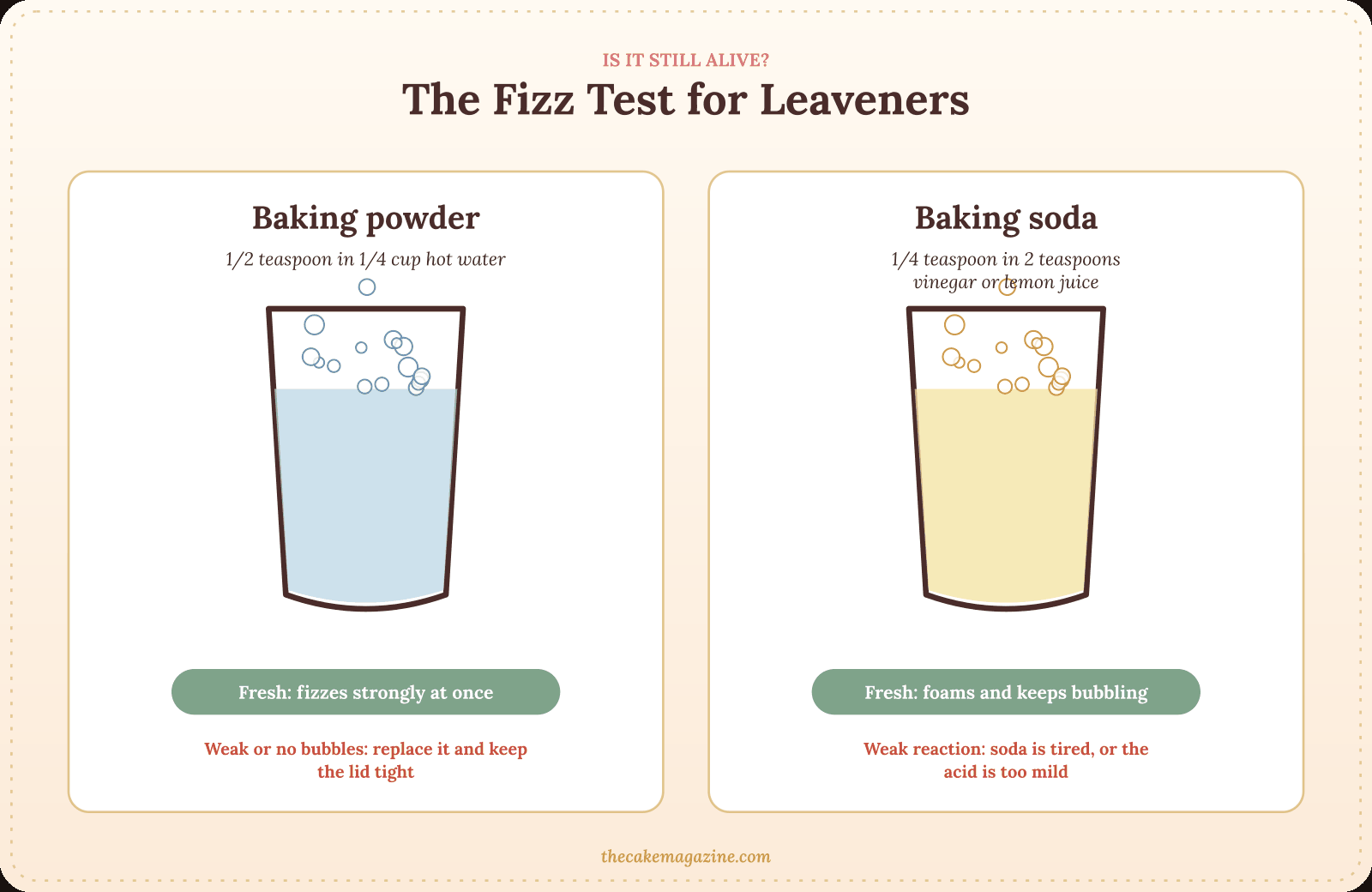
A widely used home test is to stir about 1/2 teaspoon of baking powder into 1/4 cup of hot water. If it fizzes up energetically within a few seconds, it is still active. If it barely bubbles, replace it. This is a quick test and worth doing before baking a cake for a special event.
Test baking soda
For baking soda, stir about 1/4 teaspoon into a couple of teaspoons of vinegar or lemon juice. A fresh batch fizzes at once and keeps bubbling for a moment. If the reaction is weak, the soda has lost potency or the acid is too mild. Baking soda keeps longer than powder, because it is a single stable ingredient, but it still absorbs odors and moisture over time.
Identify an unlabeled powder
If you have a white powder with no label, King Arthur’s identification trick is to mix one teaspoon with a tablespoon of water. Fizzing means baking powder, and no fizzing means baking soda. It is a good reminder of why you should label containers when you move powders into jars.
Storage that actually helps
- Keep both in tightly sealed containers, away from the stove, the dishwasher and any steamy spot.
- Scoop with a dry spoon every time. Even a little moisture shortens the life of baking powder.
- Write the date you opened each container on the lid.
- Check the expiration date, and replace baking powder about every six months to a year if you bake only occasionally. Replace it sooner if the test is weak.
- Keep baking soda away from strong smells, or store it in a lidded jar. Boxed soda can absorb fridge odors, so do not reuse that box in a cake pantry.
Note that expiration guidance varies by brand, so follow the date on your package and use the fizz test whenever you are in doubt. The USDA Food Safety and Inspection Service offers general food safety guidance that is worth bookmarking for pantry and storage questions, though it does not set leavener shelf-life rules.
Baking powder vs baking soda cake habits that protect your leavening
Even a perfectly measured, perfectly fresh leavener can be wasted by a few careless steps. These are the habits that matter most with any baking powder vs baking soda cake recipe, and they cost nothing to adopt.
Whisk the leavener into the dry ingredients
Combine the flour, leavener, salt and any cocoa in a bowl and whisk for half a minute, or sift them together. This spreads small amounts of baking soda and powder through a large amount of flour, so they react evenly instead of in pockets. It also breaks up lumps in cocoa, which tend to hide stubborn bits of soda.
Keep wet and dry apart until you are ready
Soda starts reacting the moment it meets acid in liquid, and powder begins its first release when it gets wet. Do not combine the wet and dry mixtures until the pans are prepared, the oven is hot and the rack is in place. Many collapsed cakes were mixed too early, then left on the counter.
Mix until just combined
Overmixing does two harmful things. It develops gluten, which makes a tougher crumb, and it knocks out bubbles that the leavener worked to create. Once the flour disappears into the batter, stop. A few small lumps will bake out. If you are unsure how much mixing a particular style of cake needs, our guide to cake mixing methods explains the differences between creaming, reverse creaming and one-bowl batters.
Bake right away
Fill the pans, level the batter gently, tap each pan once on the counter to bring up the biggest air pockets, and place them in the oven within a few minutes. This matters most for baking soda cakes, since their gas starts forming immediately, but it helps every cake, because a batter that waits is a batter that quietly loses lift.
Use a reliable oven temperature
An oven thermometer is one of the best investments a baker can make. If the oven runs 25 degrees cool, the second release of double-acting powder comes late and the cake sets before it finishes rising. If it runs hot, the crust sets early, and the center keeps rising until it cracks. Both look like leavening problems, but they are heat problems. See our guide to cake baking temperature for how heat changes the crumb.
Do not open the oven door early
While a cake is still setting, the bubbles inside it are fragile. A rush of cool air from an opened door can make them shrink and the cake sink. Wait until the cake has had at least half its baking time, then check quickly. The oven light is your friend.
Altitude, humidity and other baking powder vs baking soda cake variables
The same leavener behaves differently in different conditions, which is one reason a recipe that works for a friend may disappoint you. A few of the variables are worth knowing about.
High altitude
Above roughly 3,000 feet, lower air pressure lets gas bubbles expand more easily, so cakes rise fast and then often collapse or dry out. Common advice is to cut the leavener slightly, but the right amount depends on your elevation and recipe. Instead of guessing, work from a tested source. Our guide to high-altitude cake baking explains the typical adjustments and how to test them one at a time.
Humidity and storage
In a humid kitchen, baking powder absorbs moisture more quickly, which shortens its life. Keep the container closed tightly and do not store it above the stove or kettle. If you live somewhere humid, test the powder more often than the label suggests.
Ingredient temperature
Cold ingredients slow the reactions that make gas, and they also keep the batter from emulsifying properly. A cold buttermilk straight from the fridge, for example, will slow the soda reaction in a baking powder vs baking soda cake a bit, while a room-temperature batter makes bubbles more evenly. Our guide to room-temperature ingredients for cake explains which ones matter most.
Flour type
Cake flour is lower in protein and milled finer than all-purpose flour, so it needs less structure from the leavener, and it carries bubbles differently. If you swap one flour for the other, expect to need small adjustments. We explain the differences in our guide to cake flour vs all-purpose flour.
Four baking powder vs baking soda cake dilemmas, solved
Rules are easier to remember when you see them applied. These are common kitchen situations that put the baking powder vs baking soda cake question to work. Each answer is reasoning you can adapt, not a tested formula.
The recipe lists baking soda but the cake tastes soapy
In this baking powder vs baking soda cake problem, there was most likely too little acid for the soda. Check what you swapped. Did you use Dutch-process cocoa instead of natural? Plain milk instead of buttermilk? Reduce the soda by a quarter next time, or restore the acid. Also check that you did not scoop a heaped spoon, which can add a third more than intended.
You only have baking powder and the recipe calls for soda and buttermilk
Use the buttermilk as written, and replace the soda with about three times as much baking powder, as the King Arthur ratio suggests. Expect a slightly paler, tangier cake. If the recipe has a small amount of soda, the difference will be subtle. Bake it right away, and take note of how it turns out, so you can compare next time.
Your cake rose high, then dropped in the middle
Look for too much powder, an oven that was opened early, or a batter that waited. Measure the powder with a level spoon, weigh it if you can and bake at once. If the cake still sinks, look at oven temperature and underbaking, because those two cause more dips than leavener does.
Your cake is short, tight and dense
Test the powder for freshness first, because stale leavener is a quiet culprit. Then check that you did not overmix, and that the batter is not too wet or too cold. Confirm the oven temperature with a thermometer. If all of those check out, add a quarter teaspoon more powder in the next test and change nothing else.
When you adjust leavening, do not change the oven temperature, flour amount and mixing time in the same bake. Move one variable, write it down and compare. Keeping a short baking log is the fastest way to learn how a baking powder vs baking soda cake behaves in your own kitchen.
Myths worth retiring
Baking advice gets passed along for decades, and some of it does not hold up. Here are the myths that cause the most trouble in any baking powder vs baking soda cake conversation.
Myth: more leavener means a taller baking powder vs baking soda cake
It is tempting to add extra powder when you want height. But past a certain point, bubbles grow too large, the structure cannot hold them, and the cake collapses. A tall cake needs the right amount, a strong enough batter and a well-set crumb. More powder usually makes a worse cake, not a taller one.
Myth: baking powder vs baking soda cake leaveners are interchangeable
They are not. They differ in strength and in whether they need acid. A one-for-one swap will leave you with a cake that tastes soapy or does not rise. If you must swap, use the adjusted amounts and expect a small change in flavor and color.
Myth: if a recipe has both, someone made a mistake
Recipes with both are common, and intentional. Soda tunes the acid and the browning, while powder supplies the remaining lift. Removing one of them without adjusting the other will change the cake, often not for the better.
Myth: baking powder never goes bad
It does lose strength, especially once the container has been opened and exposed to humidity. A quick fizz test takes less than a minute and can save a cake. Replace old powder instead of adding extra to compensate.
Myth: you can fix a flat cake by adding baking soda to the batter
Adding soda late usually makes things worse. Without enough acid, it leaves a bitter taste and uneven browning. If a cake is flat, work out why before you change the recipe. Often the cause is old leavener, a cool oven, overmixing or a batter that waited too long.
A baking powder vs baking soda cake decision checklist
When you are not sure which leavener a recipe or a new idea needs, run through these questions in order. The right choice usually becomes clear by the third one.
- Is there acid in the batter? Look for buttermilk, yogurt, sour cream, brown sugar, molasses, honey, natural cocoa, citrus juice, vinegar or fruit.
- How much acid is there? A lot of acid means soda has plenty to work with. A little means powder will do most of the lift.
- Is the cocoa natural or Dutch-process? Natural cocoa is acidic enough to pair with soda. Dutch-process cocoa is not.
- How heavy is the batter? Fruit, nuts and mashed bananas weigh the batter down, so these cakes often need both leaveners.
- What is the mixing method? Creamed butter, whipped eggs and foam add air, so they may need less chemical leavening.
- Will the batter wait? If there will be a delay, rely more on double-acting powder.
- Is your leavener fresh? Run the fizz test, then measure with a level spoon or a scale.
- Are you changing the recipe? If you swap an acid, a cocoa or a leavener, adjust the amounts and test one change at a time.
A well-developed recipe has already balanced acid, leavener and structure. If you are following one, use the leaveners as written, use the ingredients the recipe names and weigh whenever you can. Make changes only when you have a reason, and only one at a time.
Frequently asked questions about baking powder vs baking soda cake
What is the main difference in the baking powder vs baking soda cake debate?
Baking soda is a pure base that needs an acid to make gas, while baking powder already contains soda and a dry acid. That is why powder works in a plain batter and soda needs an acidic ingredient such as buttermilk, yogurt, brown sugar or natural cocoa.
In a baking powder vs baking soda cake swap, can I use powder instead of soda?
Yes, with adjustments. King Arthur Baking suggests about three teaspoons of baking powder for each teaspoon of baking soda. The cake may rise a little less, taste milder and look paler, because powder does not neutralize the recipe’s acid the same way soda does.
Can baking soda replace baking powder in a cake?
Only if the batter has acid or you add some. A common approach is about one-third as much soda as the powder called for, plus a little lemon juice or vinegar. Without acid, the cake rises poorly and tastes bitter and soapy, so it is not a one-to-one swap.
Why does a baking powder vs baking soda cake recipe sometimes use both?
The two do different jobs. Soda neutralizes the acid in ingredients like buttermilk and natural cocoa and helps with browning and tenderness, while baking powder supplies most of the lift. This pairing is common in chocolate, buttermilk, banana, carrot and red velvet cakes.
How much leavener belongs in a baking powder vs baking soda cake per cup of flour?
A common range for butter and oil cakes is about 1 to 1 1/4 teaspoons per cup of all-purpose flour, which is roughly 3 to 3.5 grams per 100 grams of flour. Treat it as a guideline, since recipes vary, and test any change in your own oven.
How much baking soda is too much for a cake?
Roughly 1/4 teaspoon per cup of flour is a common rule, provided the batter has enough acid. Much more than that, without a clear acid source like vinegar, buttermilk or natural cocoa, tends to cause a soapy taste, coarse crumb and fast browning.
Does a baking powder vs baking soda cake taste different?
It can. Properly balanced, soda softens acidic flavors and helps browning, giving a rounder taste. When there is too much for the acid in the batter, the unreacted soda leaves a metallic, soapy or bitter aftertaste that most people notice quickly.
How do I know if my baking powder is still good?
Stir about 1/2 teaspoon into 1/4 cup of hot water. Strong, immediate fizzing means it is active. Weak or no bubbles means it is time to replace it. Also check the date on the container and keep it tightly closed and away from steam.
Does Dutch-process cocoa work with baking soda?
Not by itself. Dutch-process cocoa has been treated to reduce acidity, so it does not give soda much to react with. Recipes using it usually lean on baking powder or include another acid, such as buttermilk or coffee, to work with a little soda.
Can I leave the batter sitting before baking?
Short waits are fine for cakes leavened with double-acting baking powder, but try to bake within about 15 minutes. Baking soda reacts as soon as it meets acid, so batters that rely on it should go into the oven promptly or they lose lift.
Is self-rising flour the same as using baking powder?
Self-rising flour already contains baking powder and salt, so it replaces both the flour and the leavener in a recipe. Do not add more baking powder on top of it unless the recipe says so, or the cake can rise and then collapse.
Why did my cake taste soapy or metallic?
The most likely cause is too much baking soda for the acid in the batter, or soda that was not evenly mixed. Measure with a level spoon, whisk the dry ingredients well and check that you used the acidic ingredient the recipe called for.
Do I need baking powder in a sponge or chiffon cake?
It depends on the style. Foam cakes get most of their lift from whipped eggs or whites, and angel food usually has no chemical leavener at all. Chiffon cakes often add a little baking powder for insurance, so follow the recipe you trust.
Final thoughts on baking powder vs baking soda cake
The baking powder vs baking soda cake question sounds technical, but it comes down to one practical idea: look for the acid. Where the batter has plenty, soda has a job, and a little powder tops up the lift. Where it has almost none, powder does everything. Add fresh leaveners, level measures, even mixing and a prompt trip to a properly heated oven, and the majority of leavening problems disappear.
Next time a cake rises short, tastes soapy or sinks in the middle, the baking powder vs baking soda cake checklist gives you a place to start. Check the freshness of your powder, count the acids in the bowl, weigh the amounts and change one thing at a time. Cake baking rewards patient, curious bakers, and a baking powder vs baking soda cake is one of the best places to learn.
If you have a baking powder vs baking soda cake puzzle this guide did not answer, tell us the recipe, the pan, your oven and what the crumb looked like, and we will use your questions to keep improving this page.
Editorial note: this baking powder vs baking soda cake guide was reviewed and updated in November 2026 for home bakers in the United States, using American measurements. The amounts and ratios here are common rules of thumb and worked illustrations, not oven-tested recipes from this site, and results vary with your oven, altitude, ingredients and brands. Substitution ratios follow published guidance from King Arthur Baking. For general food safety questions, consult the USDA Food Safety and Inspection Service.