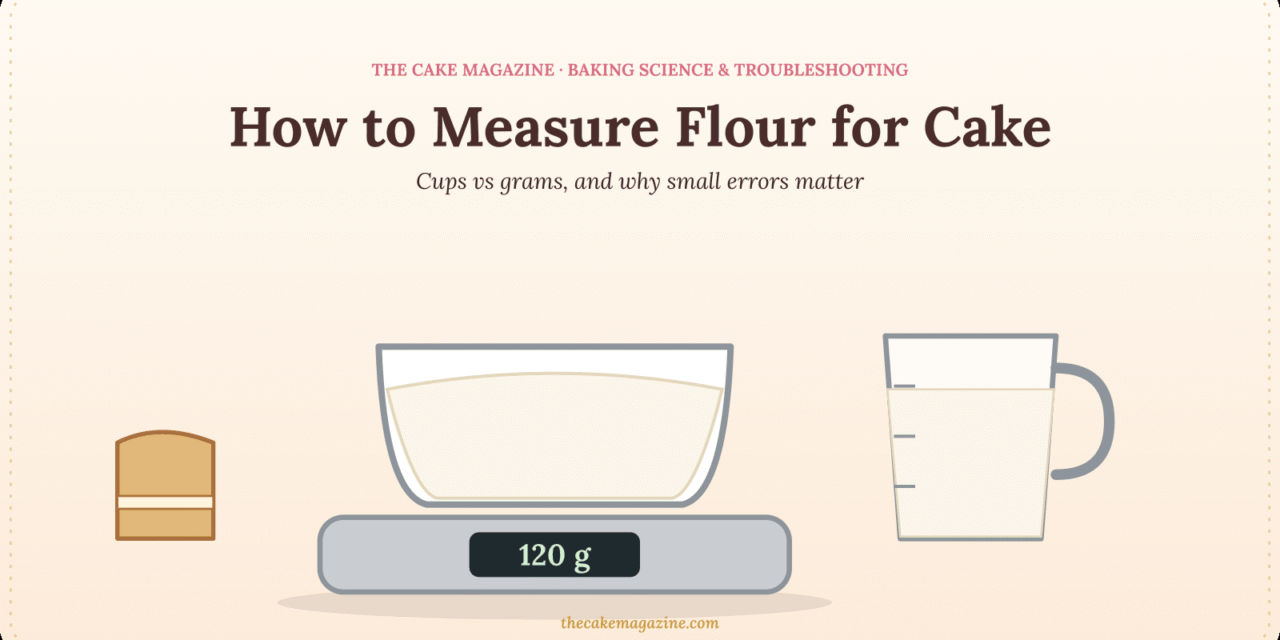
Two bakers can follow the same recipe, use the same pans and the same oven, and still bake two very different cakes. A cup can weigh 120 grams in one kitchen and 150 or more in another, and the cake feels every gram. Learning how to measure flour for cake is the quietest upgrade you can make, because it costs almost nothing and solves problems that look like mysteries.
The most reliable way to do it is to weigh the flour. Put a bowl on a digital scale, press tare, and add flour until you reach the recipe weight. With cups only, fluff the flour, spoon it lightly into the cup and level it with a knife, never scooping from the bag. King Arthur Baking treats a cup of all-purpose flour as 120 grams, and a packed cup can run about 40 grams heavier. That gap can turn a tender cake dry.
- Why learning how to measure flour for cake matters
- Cups vs grams: how to measure flour for cake by weight
- Why one cup of flour is never exactly one cup
- How to measure flour for cake with a scale
- How to measure flour for cake with measuring cups
- Sifting and how to measure flour for cake
- How to measure flour for cake in different cake types
- Why small errors matter in how to measure flour for cake
- What happens when there is too little flour
- Comparing the methods: how to measure flour for cake
- Cake flour, all-purpose flour and other types
- Converting a cup recipe into grams
- What to look for in a baking scale
- Diagnosing a flour measuring error from the cake
- Common mistakes in how to measure flour for cake
- Weighing the rest of the batter
- Measuring flour when you bake for customers
- A calm routine for baking day
- FAQ
Why learning how to measure flour for cake matters
Flour is the skeleton of a cake. When the batter hits the oven, the proteins in flour link up into a loose network, and the starches swell and set as they take up water. Together they form the walls that hold air bubbles in place and turn a liquid batter into a soft, sliceable crumb.
Fat, sugar and eggs make that structure tender and moist. Flour is the part that holds it up, which is why even a modest mistake in the flour shows up in the finished cake.
Most other ingredients are forgiving. A few extra drops of vanilla will not hurt. Flour is different because the ratio matters so much. A cake that calls for two cups of flour is built around the other ingredients being balanced against that amount. If the flour is off by a fifth, the balance of moisture to structure shifts, and the crumb moves with it.
The broader reasons are laid out in our guide to cake baking science and how flour, fat, sugar, eggs, liquid and leaveners work together.
The good news is that how to measure flour for cake is a skill, not a talent, and an easy variable to control. You cannot do much about humidity or the quirks of a rented oven. You can control how you measure flour, and once you do, many of the problems people blame on recipes simply stop happening.
If a trusted recipe worked beautifully one week and came out dry the next, the answer is often in the flour bin. Thinking about how to measure flour for cake is the first step to fixing that.
The measuring problem in plain terms
American recipes have traditionally been written in cups, a volume measure. Volume works well for liquids, because milk fills a cup the same way every time. It works badly for powders, because a powder can be loose, settled, packed or sifted, and each of those states puts a different amount into the same cup. Flour is among the worst offenders, which is why how to measure flour for cake gets so much attention from careful bakers.
Weight does not have that problem. A hundred and twenty grams of flour is a hundred and twenty grams whether it is fluffy or compacted, fresh from the bag or settled at the bottom of a canister. This is why professional bakers, and most recipe writers who care about repeatable results, work in grams. It is also why this article leans on weight while still explaining how to measure flour for cake with cups for readers who do not own a scale yet.
Who benefits most from learning how to measure flour for cake
Anyone who bakes cakes benefits, but a few situations make accurate flour measuring especially valuable.
- Layer cakes for an occasion. When a cake has to be tall, level and tender for a birthday or wedding, you cannot afford a dry or dense result.
- Delicate sponge and chiffon cakes. These have less fat and fewer ingredients holding things together, so flour errors show quickly.
- Anyone selling cakes. Consistency is what lets a baker repeat a recipe a hundred times, a point we cover in starting a cake business.
- Bakers troubleshooting. If a cake keeps coming out dry, dense or sunken, flour is one of the first things to rule out.
Cups vs grams: how to measure flour for cake by weight
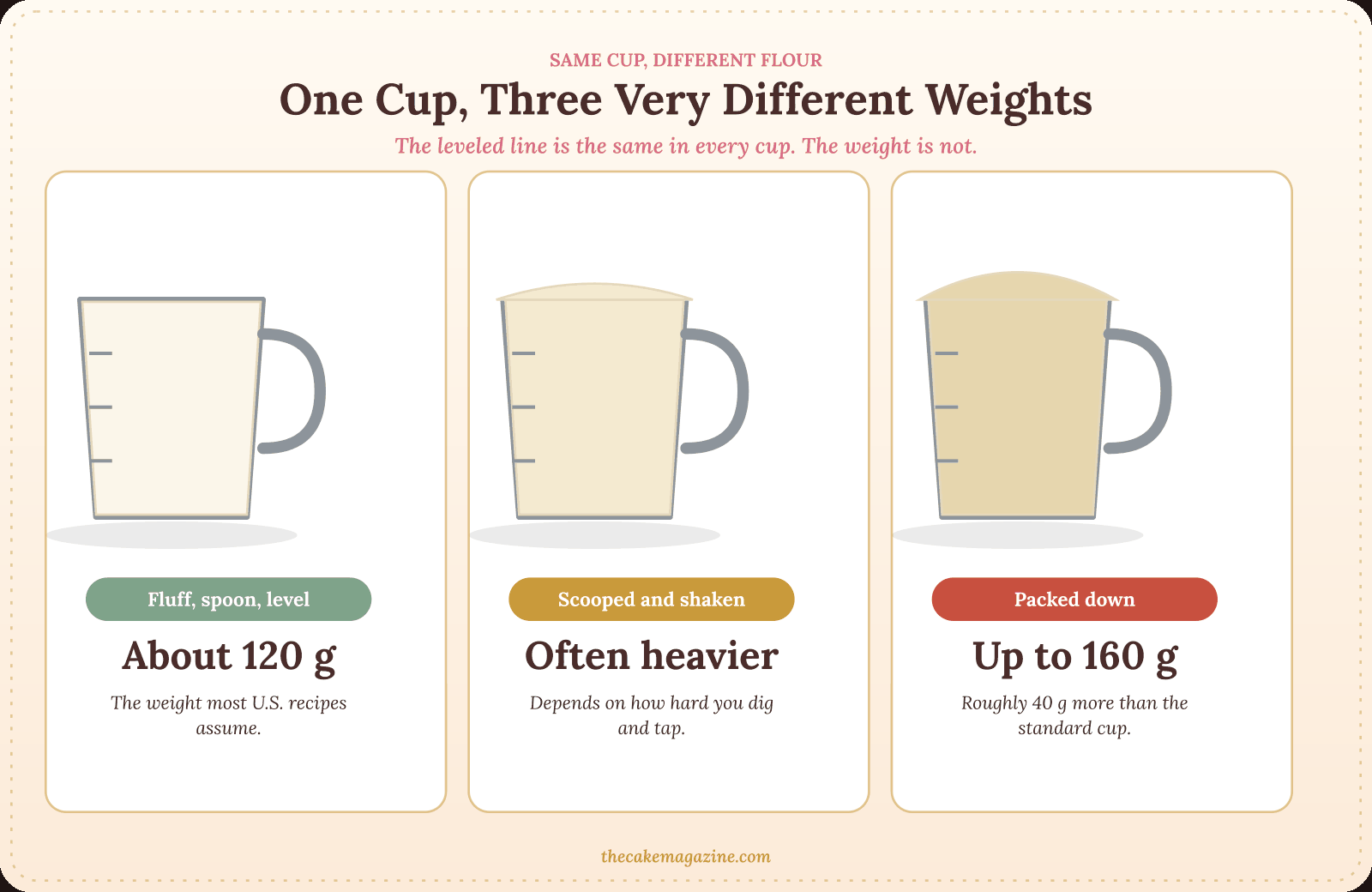
Here is the number that anchors everything else. King Arthur Baking, one of the best-known flour brands and recipe sources in the United States, lists one cup of all-purpose flour as 120 grams in its ingredient weight chart. Its article on measuring flour repeats that figure and explains that scooping a cup directly from the bag can pack in far more. A densely packed cup, the site notes, can reach about 160 grams, roughly 40 grams above the standard.
Forty grams does not sound like much. It is about three tablespoons of flour. But put it in context: a cake made with two cups of flour, which is 240 grams on King Arthur’s scale, would receive 280 grams if both cups were packed. That is about 17 percent more flour than the recipe was written for. A cake recipe that has been balanced carefully has very little room for a 17 percent swing in its main structural ingredient.
Why different sources give different numbers
If you have ever searched for the weight of a cup of flour, you will have seen several answers. Some recipe sites use 120 grams, others use slightly higher figures, and older cookbooks sometimes assume a heavier, scooped cup. Neither side is lying. They are simply measuring different things, since the weight depends on the technique and on the flour itself.
For cake baking, the practical rule is this: use the weight the recipe writer gives you. When a recipe lists both cups and grams, trust the grams, whatever your habit for how to measure flour for cake.
If a recipe gives only cups and does not say which flour measuring method it assumes, 120 grams per cup is a sensible starting point for all-purpose flour, because it matches a major U.S. brand’s published figure. Later we show how to calibrate your own cup, so your approach to how to measure flour for cake does not depend on anyone else’s numbers.
A useful rule of thumb. Think of 120 grams as the target weight of a level cup of all-purpose flour, not as a law. A few grams either way will not ruin a cake. King Arthur says a variance of about five grams over or under will not affect a recipe. Thirty or forty grams will.
Cups and grams for other common cake ingredients
Flour is not the only ingredient that changes weight with technique, but it is the one that changes the most. For reference, the same King Arthur chart lists granulated sugar at about 198 grams per cup, unsifted confectioners’ sugar at 113 grams, butter at 226 grams per cup (two sticks), and unsweetened cocoa powder at roughly 84 grams per cup.
Sugar and butter are fairly consistent from one measuring to the next. Powdery ingredients like cocoa and confectioners’ sugar can vary the way flour does, so weigh them too if you can.
- Flour (all-purpose): about 120 g per cup, variable by method
- Granulated sugar: about 198 g per cup, fairly consistent
- Unsifted confectioners’ sugar: about 113 g per cup
- Cocoa powder: about 84 g per cup, loose and easily packed
- Butter: about 226 g per cup, which is two sticks
Why one cup of flour is never exactly one cup
It helps to understand where the variation comes from, because once you can see it, you can avoid it. Flour is a fine powder made of tiny particles of starch and protein with a great deal of air between them. How much of that air is squeezed out when you fill the cup decides the weight. Several things push the number up or down, and each one matters when you decide how to measure flour for cake.
Settling in the container
Flour stored in a canister or bag settles under its own weight, and the bottom layers get denser. When you plunge a cup into settled flour, you collect compressed powder. Stirring the flour first, with a whisk or fork, loosens it and lets air back in. That one step is why recipe writers say to fluff the flour before measuring. If you refill your canister from a big bag, the flour will be especially compacted right after pouring, and it will need a good stir.
The scoop itself
Dipping the measuring cup into the flour and lifting it out pushes flour into the cup under pressure. The cup fills, you level it, and you have measured far more than the cup can hold when the flour is loose. Tapping or shaking the cup to level it compacts it further. Spooning flour gently into the cup avoids that pressure, which is why the spoon method gives lighter and more consistent results.
The flour and the weather
Flour is dry, but it still holds a small amount of moisture and responds to its surroundings. Different brands, milling methods and flour types vary a little in density and in how finely they are ground. Very humid kitchens can make flour a touch clumpier and heavier. These effects are smaller than the scooping effect, but they are another reason weighing wins: grams measure what is actually there.
The cup itself
Not every cup is the same size. Dry measuring cups come in metal and plastic sets from many manufacturers, and the true volume of a “one cup” measure can vary a little between sets. A liquid measuring cup, the clear kind with a spout, is not meant for flour at all, because it is almost impossible to level accurately. Use nested dry cups for flour, and if you have more than one set, notice whether they give the same weight.
- Stored flour settles and becomes denser at the bottom of the container.
- Scooping and tapping both compress the flour inside the cup.
- Brand, flour type and humidity nudge the weight a little.
- Cups differ slightly between sets, and liquid cups are the wrong tool.
How to measure flour for cake with a scale
If you want the single best answer to how to measure flour for cake, this is it. A digital kitchen scale removes the guesswork, saves dishes and makes it easy to scale a recipe up or down. King Arthur’s own advice is to weigh ingredients with a digital scale for best results.
It takes about the same time as filling cups, and once the habit forms, it is faster. Weighing is the method we recommend for how to measure flour for cake whenever a scale is available.
The step-by-step method for how to measure flour for cake by weight
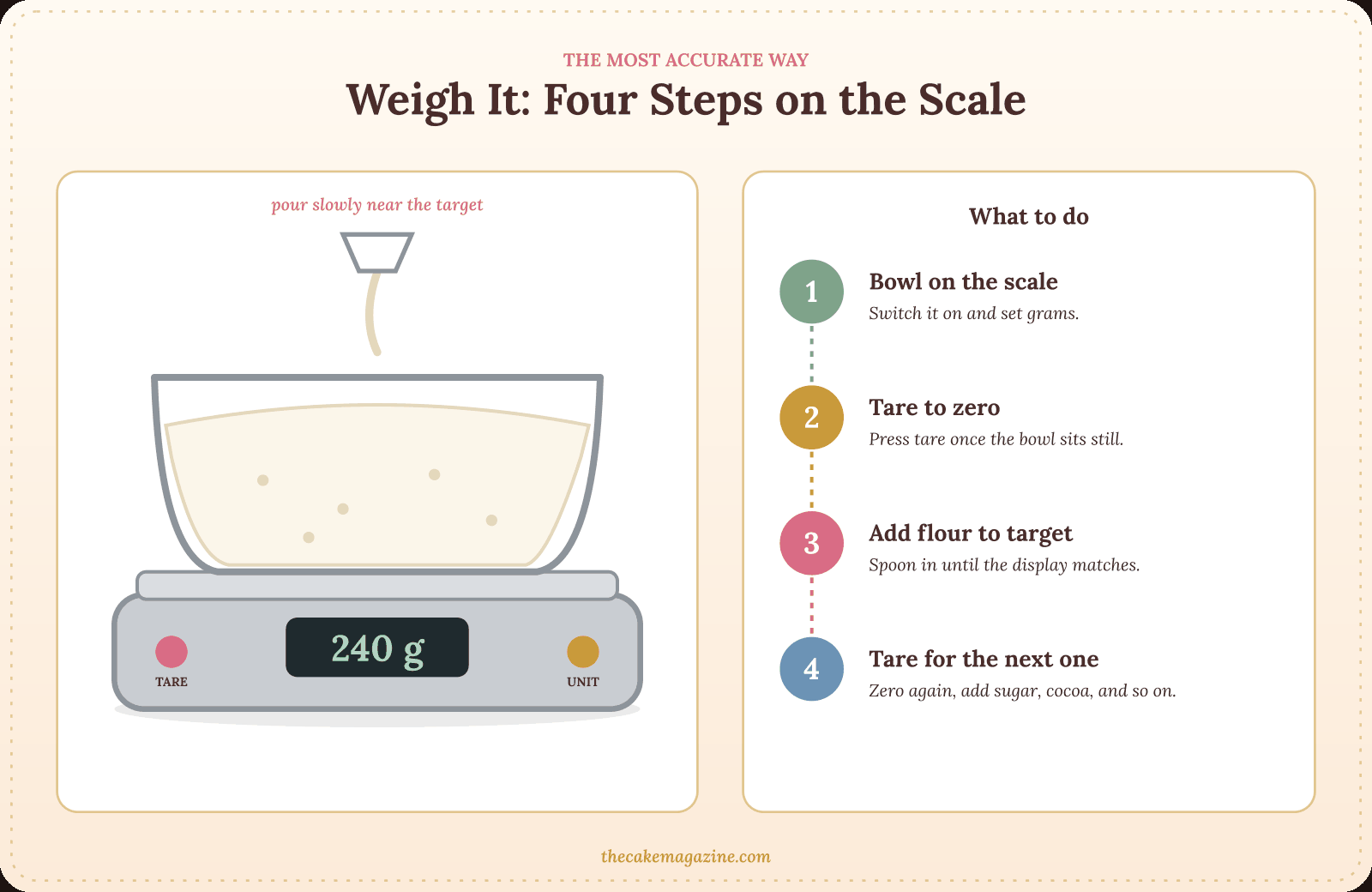
- Set the scale on a hard, level surface. A wobbly counter or a surface with a tablecloth underneath can throw the reading off.
- Switch to grams. Most scales let you flip between grams and ounces. Grams are finer, and almost every cake formula written for accuracy uses them.
- Place your empty bowl on the scale. Wait for the number to settle, then press the tare or zero button so the display reads 0.
- Add flour gradually. Spoon or pour it in, slowing down as you near the target. It is far easier to add a little than to take flour out.
- Stop on the number. If you overshoot by a gram or two, leave it. If you overshoot by more, spoon a little back into the container.
- Tare again for the next ingredient. Press zero and add the sugar, cocoa or leavening in the same bowl, if the recipe allows.
That last step is a quiet advantage of weighing: you can build a whole dry mix in one bowl, taring between ingredients, and never dirty a single measuring cup. If the recipe calls for sifted dry ingredients, weigh them into the bowl first and sift or whisk afterward.
How precise do you need to be?
Precision matters, but perfection does not. King Arthur says that being off by up to five grams, either way, will not affect a recipe, although it still recommends staying as exact as you can. For a typical layer cake, that means aiming for the number, accepting a gram or two of drift, and not stressing over the last half gram. Many home scales jump in whole-gram steps, which is perfectly fine for flour.
What you should avoid is a casual pour that lands twenty or thirty grams off the target. If you are rushing, the display is your safety net. Look at it before you stop pouring, and again before you walk away from the bowl.
Scale tips for better accuracy
- Tare the empty bowl every time, even if you used the same bowl yesterday.
- Keep your hand off the counter and the bowl while the number settles.
- Use fresh batteries or a charged scale, since a low battery can make readings drift.
- Weigh straight into the mixing bowl when you can, so no flour is lost to a transfer.
- Do not lean on the scale or press the platform when you add ingredients.
- If the scale shuts off while you work, you will need to tare again, so check the display after any restart.
If you do not yet own a scale, you will find a plain-language guide in our look at kitchen scales for baking, including gram precision, capacity, tare and bowl size. Later in this article we also list what to look for in a scale, without recommending any one model.
How to measure flour for cake with measuring cups
Many home bakers still use cups, and plenty of lovely cakes come from cup recipes. This section covers how to measure flour for cake when no scale is in the picture. The goal when using cups is not perfection, it is consistency: the same motion, the same flour treatment, every time. If you can fill a cup the same way on every bake, your results will be repeatable even if your cup holds a few grams more or less than someone else’s.
The fluff, spoon and level method for how to measure flour for cake
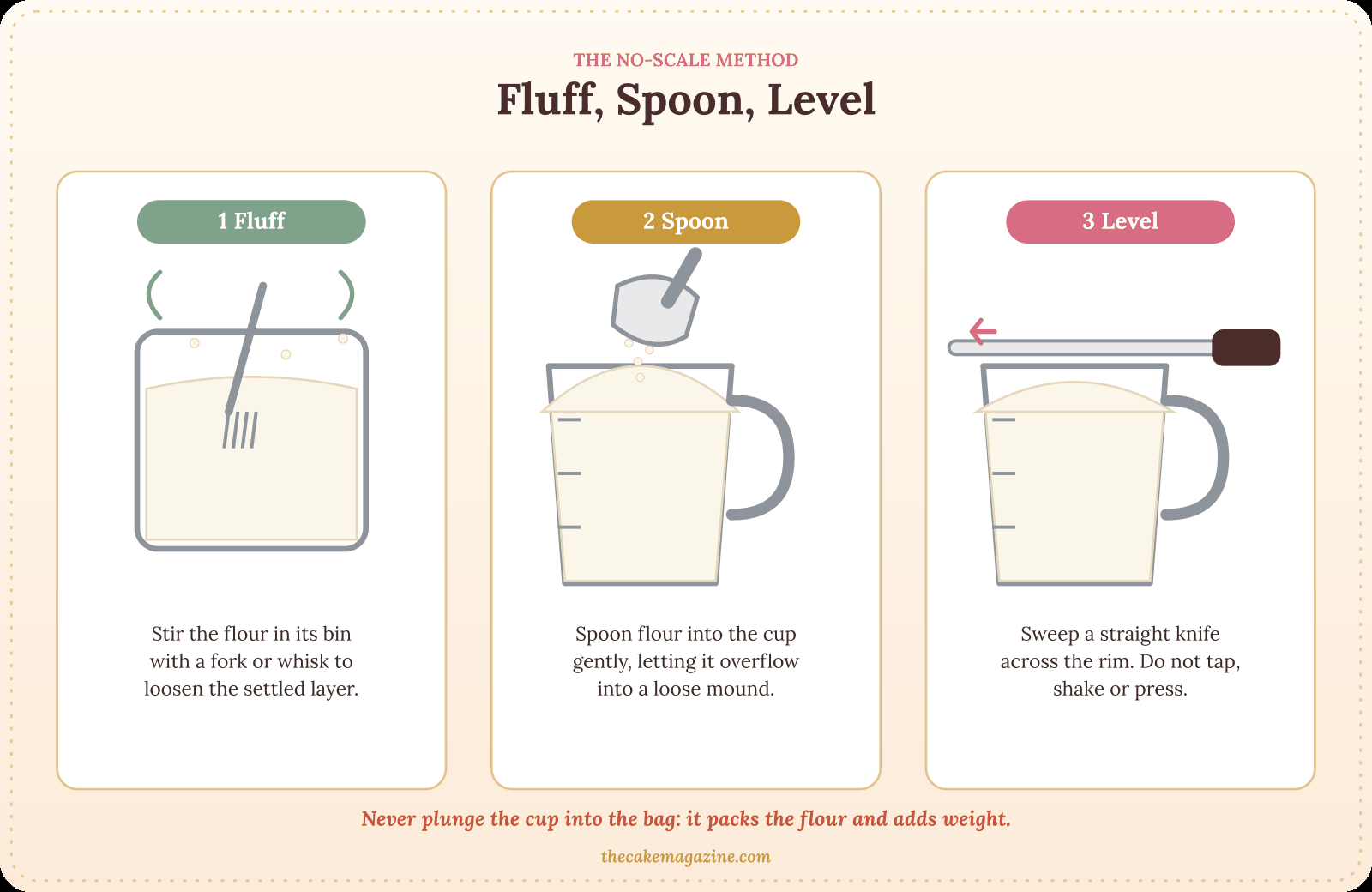
This is the technique most recipe writers have in mind when they publish a cup measure, and King Arthur describes a version of it as fluff, sprinkle and scrape. Here is how it goes.
- Fluff. Stir the flour in its container with a fork or whisk to loosen it and break up any compacted layers.
- Spoon. Use a regular spoon to lightly drop flour into a dry measuring cup. Do not press it down. Let it pile above the rim.
- Level. Drag the straight edge of a knife or an offset spatula across the top of the cup, letting the extra fall back into the container.
Done this way, a cup of all-purpose flour lands near that familiar 120 grams. Done by scooping straight from the bag, it can land much higher. The difference between those two motions is the biggest reason how to measure flour for cake with cups goes wrong, and the biggest source of dry, dense cakes.
The scoop-and-sweep method and why it runs heavy
Scooping means dipping the cup into the flour and sweeping off the top. It is quick and many people learned it from a parent or grandparent. The trouble is that dipping compresses the flour, and the amount you take depends on how deep and how forcefully you scoop. Two people using the same cup can end up with weights that differ by 20 grams or more. For bread, a slightly heavy cup may be tolerable. For a cake, it often is not.
Do not tap or shake the cup. It feels like a way of making the cup “exact,” but tapping packs the flour down and lets you add still more. Fill gently, level once and move on.
Choosing and using measuring cups
Choose a set of nested dry measuring cups with flat, straight rims so you can sweep across the top. Metal cups tend to hold their shape better than thin plastic. Keep them for dry ingredients, and use a separate clear cup with a pour spout for liquids. If a recipe calls for a half cup or a third cup of flour, use that exact measure rather than building it up from smaller ones, since each extra fill adds a small error.
For amounts smaller than a quarter cup, tablespoons and teaspoons work, but they are better for leaveners, salt and spices than for flour. If a cake needs a tablespoon or two of flour, spoon it in lightly and level it the same way. If you already own a scale, weigh even small flour amounts, since a gram of flour is only a little more than a teaspoon.
Sifting and how to measure flour for cake
Sifting causes more confusion than almost any other part of how to measure flour for cake, mostly because of two small words in a recipe: “1 cup sifted flour” and “1 cup flour, sifted.” They sound alike but mean different things. The first tells you to sift the flour and then measure it, which gives a lighter cup. The second tells you to measure the flour and then sift it, which does not change the amount at all.
If you weigh your flour, the order does not matter
This is another reason to choose weight when you decide how to measure flour for cake. A recipe that lists flour in grams already tells you how much flour to use. Whether you sift before or after weighing, 240 grams is 240 grams. Sifting after weighing is the easiest approach: weigh the flour, then sift or whisk it together with the leaveners and salt so everything blends evenly and any lumps are broken up.
If you use cups, follow the recipe wording
With cups, the order does change the amount. Sifting first aerates the flour, so a cup of sifted flour weighs less than a cup of unsifted flour measured with the spoon method. If a cup recipe says “sifted,” sift first. If it simply lists flour without mentioning sifting, you are expected to use fluff, spoon and level. Some older recipes were written for sifted flour and not updated, which is one more reason a recipe from a family card can be tricky to reproduce.
When sifting still helps
- Cocoa powder, confectioners’ sugar and cake flour are fine powders that clump, so sifting or whisking breaks up lumps before they ruin a batter.
- Delicate sponge and chiffon cakes benefit from light, airy dry ingredients that fold in without deflating whipped eggs.
- Mixing in leaveners and salt is easier and more even if you sift or whisk them with the flour.
For a sturdy butter or oil cake, a thorough whisk is usually enough and saves a dish. The mixing method you choose also matters, and we explain how each approach handles dry ingredients in our guide to cake mixing methods.
Why small errors matter in how to measure flour for cake
It is easy to wave off a few extra grams. After all, who can taste the difference between 240 and 260 grams of flour? The answer is that most people cannot taste it directly, but they can feel it in the crumb, and the effect compounds with the other small drifts that happen in any kitchen. To understand why, it helps to look at what flour does in the batter.
Flour soaks up liquid. The starch granules take on water as the batter heats, and the proteins form a network. More flour means more thirsty starch and more network competing for the same milk, eggs and fat. The batter turns stiffer, the finished crumb turns drier and tighter, and the cake is less able to rise as high before it sets. The effect grows with each additional gram.
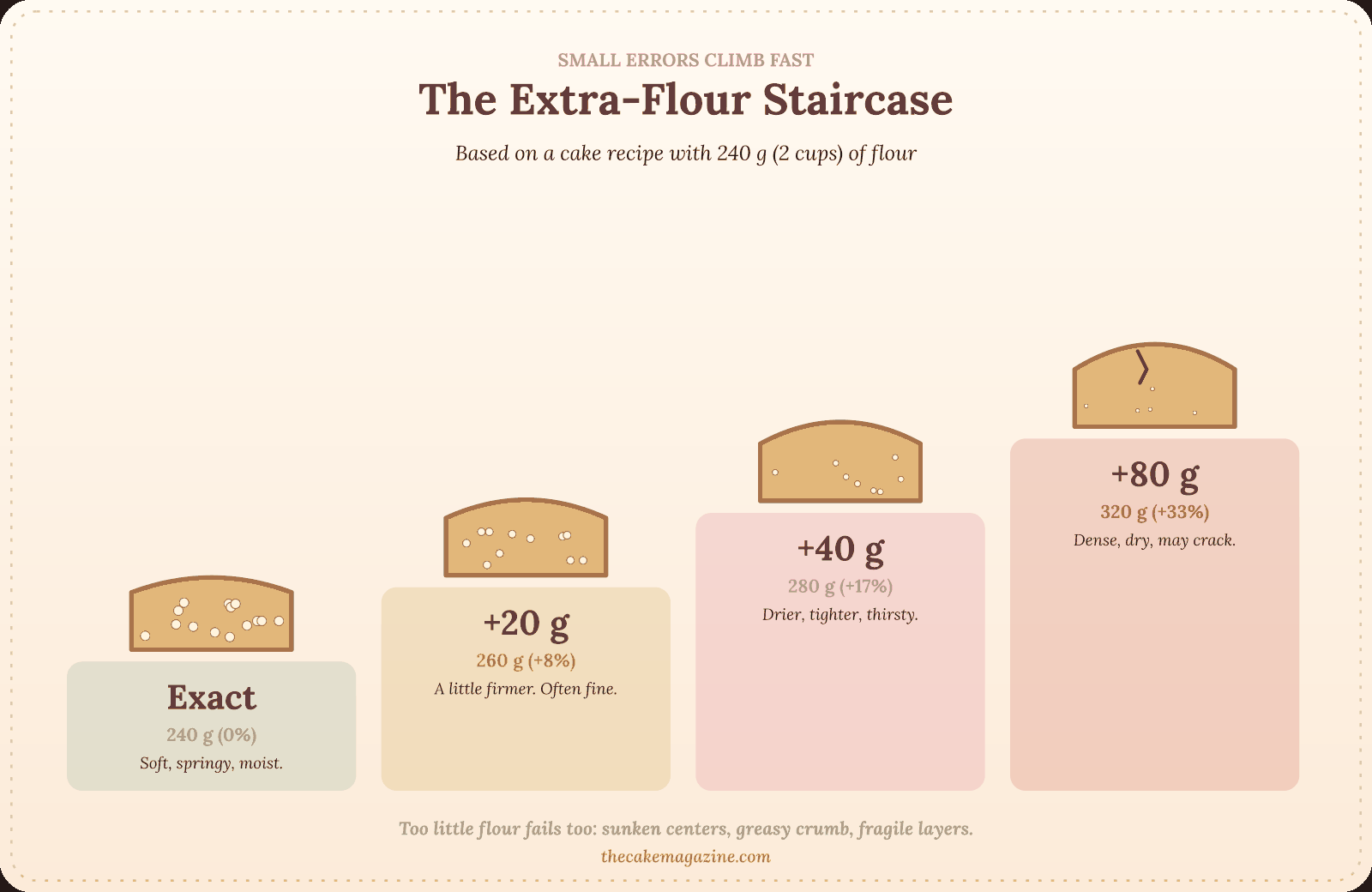
The staircase of extra flour in a cake
Take a recipe that calls for two cups, or 240 grams, of all-purpose flour. Here is how the extra flour stacks up, using simple arithmetic.
- +20 grams (about 8 percent more). Close to the point where a baker might not notice. The cake can be a little firmer and a little less moist, and many cakes are still perfectly good.
- +40 grams (about 17 percent more). This is the gap between a fluffed cup and a packed cup, repeated across two cups. Expect a drier, tighter crumb that needs more frosting or syrup to taste moist.
- +80 grams (about 33 percent more). A cake this far off is likely to be dense, dry and possibly cracked on top. It may also taste floury.
These descriptions are general expectations based on how flour behaves in a batter, not measured results from a test kitchen, and individual recipes respond differently. A rich, high-fat butter cake will tolerate extra flour better than a lean sponge. But the direction is always the same: more flour, drier cake.
Errors multiply across a recipe
Flour is rarely the only thing that drifts. An oven that runs a little hot dries a cake faster. A heavy hand with the cocoa adds more dryness. Packing flour on top of that can push a borderline recipe over the edge. When several small drifts line up, the result looks like a disaster, even though no single mistake seems large.
Choosing the right way to measure flour for cake removes one of the biggest drifts, which makes it easier to find the others, the idea behind our cake troubleshooting guide.
Consistency matters more than the exact number. If your cup always lands at 135 grams and you bake that way every time, you can adjust and learn. If it lands at 120 one day and 155 the next, you can never tell what went wrong.
Why scaled recipes make errors worse
An error that is harmless in a small cake can be large in a big one, and vice versa. If you double a recipe by cups and each scoop runs 20 grams heavy, you are now 40 grams over. If you halve a recipe, a half cup that is a few grams heavy represents a bigger share of the total. Weighing the ingredients and scaling by grams keeps the ratios intact, as we explain in how to scale a cake recipe up or down by weight.
What happens when there is too little flour
Extra flour gets most of the attention, but too little flour causes its own set of problems, and it happens more often than you would expect. Spooning flour very lightly, sifting before measuring in a recipe that did not intend it, or heaping the batter with other ingredients can all leave a cake short on structure.
When flour runs low, the batter is looser and wetter. The crumb can be delicate to the point of fragile, with a wet or gummy feel. The cake may rise early and then collapse as the structure fails to hold its own weight. Fat may seep out, leaving a greasy crumb. The sides can pull inward, and the top can sink in the center. These problems overlap with a long list of other causes, so flour is one clue among many, not a confirmed diagnosis.
Signs your cake may be short on flour
- The center sinks after the cake leaves the oven, even when it was baked fully.
- The crumb is wet, sticky or gummy, especially near the bottom.
- The cake tears or crumbles when you turn it out of the pan.
- The texture feels oily or greasy, with a slick film on the surface.
- The layers are thin and spread wide, with little rise.
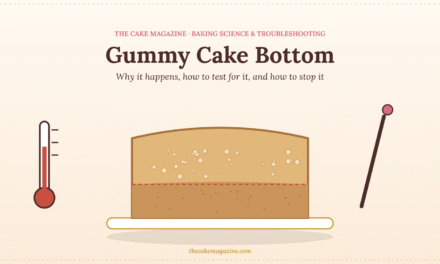
If this sounds like your cake, check the other usual suspects at the same time, including leavening amounts, oven temperature and underbaking. Our guides to why a cake sinks in the middle and why a cake has a gummy layer walk through those possibilities in order.
The sweet spot in how to measure flour for cake is narrow, but reachable
The encouraging part is that you do not need laboratory precision to land in the sweet spot. A typical cake recipe tolerates a small range around its target, and hitting the target within a handful of grams is easy with a scale. With cups and the spoon method, you can usually stay within the range if you are consistent. The aim of this whole guide on how to measure flour for cake is to move you from a wide, unpredictable spread to a narrow, repeatable one.
Comparing the methods: how to measure flour for cake
There is no single correct method for every baker. Each approach to how to measure flour for cake has tradeoffs in accuracy, cost, speed and convenience. Rather than a grid of numbers, here is a plain-language comparison that you can match to your own kitchen.
Weighing in grams
Accuracy: the best of the three, repeatable every time. Cost: a small one-time purchase if you do not own a scale. Speed: fast once practiced, with fewer dishes. Best for: layer cakes, sponge cakes, special occasions and anyone who sells or scales recipes.
Fluff, spoon and level
Accuracy: good if you do it the same way every time. Cost: free, using cups you already own. Speed: a little slower than scooping. Best for: casual bakers, cup-only recipes and kitchens without a scale.
Scoop and sweep
Accuracy: unpredictable, with a tendency to run heavy. Cost: free. Speed: the fastest. Best for: forgiving recipes like some quick breads, rather than delicate cakes.
Calibrated cup
Accuracy: good once you know your own cup weight. Cost: needs a scale once, not every time. Speed: moderate. Best for: bakers who follow cup-only recipes and want to fix repeated failures.
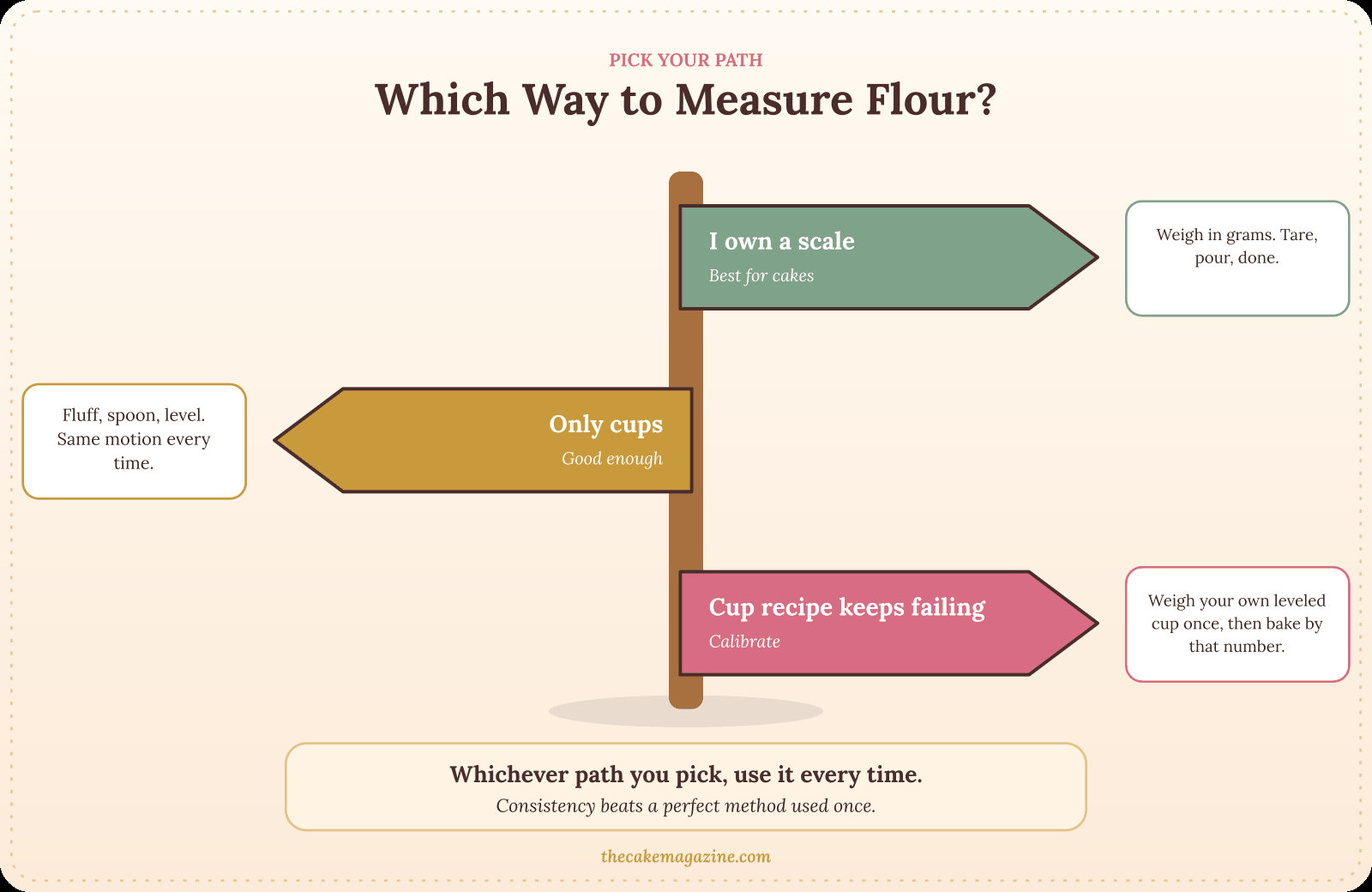
A decision checklist for how to measure flour for cake
Walk through these questions to decide how to measure flour for cake next time you bake.
- Do you own a digital scale? If yes, weigh your flour in grams. If not, consider buying one before your next important cake.
- Does the recipe list grams? Use the grams. If it lists only cups, use fluff, spoon and level.
- Is this a delicate or special-occasion cake? Weigh it, or calibrate your cup first.
- Has this recipe failed before? Weigh your flour next time and compare it with the cup weight you were using.
- Are you scaling the recipe? Work in grams, always.
The same logic applies when you move between recipes: the more delicate the cake, the stronger the case for weighing. Knowing how to measure flour for cake pays off most there. If you want a recipe to practice on, our vanilla cake recipe and chocolate cake recipe both work well when the dry ingredients are weighed carefully.
Cake flour, all-purpose flour and other types
Once you know how to measure flour for cake, the next question is which flour to measure. Cake flour, all-purpose flour, bread flour and pastry flour differ mainly in protein content and in how finely they are milled. Lower-protein flours build a softer, more tender crumb, while higher-protein flours build chewier structure. That difference is the subject of our full comparison of cake flour vs all-purpose flour, so here we focus on what changes at the measuring stage.
Do different flours weigh different amounts per cup?
You might expect fine cake flour to weigh much less than bread flour. On King Arthur’s ingredient chart, however, unbleached cake flour, all-purpose flour and bread flour are all listed at 120 grams per cup. Other sources may list slightly different figures, and cake flour that has been sifted in the bag can feel airier in the cup.
The takeaway is that you cannot safely guess a flour’s weight from how it looks or feels. Check the recipe, check your brand’s own information if it provides any, and weigh.
Whole wheat flour and some specialty flours are a different matter. Whole grain flours contain bran and germ, which change the density and the way the flour absorbs liquid. If a recipe calls for a particular flour, use that flour at the weight listed. Do not swap one type for another by volume alone and assume the cake will behave the same way.
Swapping flours without changing how to measure flour for cake
If a recipe asks for cake flour and you only have all-purpose, a straight swap by weight can work but changes the crumb, making it a little sturdier and less delicate. The reverse swap, cake flour in an all-purpose recipe, can make a cake that is too soft to stack. The detailed substitutions and when each one makes sense belong in the flour comparison guide, but the rule for how to measure flour for cake stays constant: swap by weight, never by feel.
- Check the recipe’s gram weight for the flour and stick to it.
- If you swap flour types, expect a change in tenderness and structure, not only in weight.
- Write the swap down so you can repeat it or reverse it next time.
- Do not add or remove flour just to fix the look of the batter before you have checked the weight.
Self-rising flour and flour blends
Self-rising flour already contains baking powder and salt, so it should only be used when a recipe calls for it. If you accidentally use it in place of all-purpose flour, the cake can rise too fast and then fall, with a bitter or salty edge.
Gluten-free flour blends vary widely in weight and in how they hydrate, so follow the blend maker’s own weight guidance and the recipe’s grams rather than assuming a cup-for-cup match. When using unfamiliar flour, weigh it. That one habit protects you from most surprises.
Leaveners are the other half of the chemistry, and a miscounted flour amount can make them look guilty when they are not. For how baking powder and baking soda work in the batter, read our guide to baking powder vs baking soda in cake.
Converting a cup recipe into grams
Many beloved recipes exist only in cups. If you want to apply how to measure flour for cake by weight to them, you do not need to give them up. You need a conversion plan that turns your cups into a weight you can repeat. There are two approaches: use a standard figure, or calibrate your own.
Option one: use a standard figure
The easy approach is to apply a published weight, such as 120 grams per cup of all-purpose flour. Multiply the number of cups by 120. Two cups becomes 240 grams, a cup and a half becomes 180 grams, and a quarter cup becomes 30 grams. This works well when the recipe came from a source that uses the fluff and level approach. It works less well with older family recipes, which may have been written for heavier, scooped cups.
- 1 cup all-purpose flour is about 120 g
- 3/4 cup is about 90 g
- 2/3 cup is about 80 g
- 1/2 cup is about 60 g
- 1/3 cup is about 40 g
- 1/4 cup is about 30 g
Option two: calibrate your own cup
If you have an old recipe that has always worked for you, the best conversion is the one that matches how you bake. Next time you make that cake, weigh the flour as you normally measure it. Here is how to do it.
- Place your bowl on the scale and tare it.
- Measure flour exactly the way you always do for that recipe, scooping or spooning as usual.
- Look at the number and write it on the recipe card in pencil, beside the cup measure.
- Do this three times and average the results to smooth out small differences.
- Bake the cake. If it turns out the way you love, that weight is your recipe’s true flour amount.
This approach to how to measure flour for cake respects the recipe as it was meant to be baked in your hands. It also gives you a number you can scale, share and repeat. If the cake comes out drier than you remember, compare your weight with 120 grams per cup. A big gap is a hint that your usual scoop is packing the flour.
When a cup recipe keeps failing
If you try a recipe from a blog or a cookbook in cups and the cake is dry, dense or crumbly, weigh your flour on the next attempt and compare it with 120 grams per cup. If the recipe included a gram weight in the notes, compare with that too.
Many times, you will find that your cups ran 20 to 40 grams heavy. Reduce to the weighed amount and bake again. Keep every other variable the same for that second attempt so you know what changed.
Keep a flour note in your baking log. Write down the flour brand, how you measured it and the weight you ended up with. Over a few bakes, you will see patterns that explain a lot about your cakes.
What to look for in a baking scale
A scale does not have to be expensive to transform how to measure flour for cake. What matters is a short list of features. We are not testing or ranking specific models here, so treat this as a checklist rather than a recommendation, and see our full guide to kitchen scales for baking for more detail.
Gram readout
Look for a scale that displays in whole grams at minimum. Some read in tenths of a gram, which is helpful for small amounts of leavening but not necessary for flour.
A tare button
Taring is the feature that makes weighing easy. Make sure it zeroes quickly and reliably with a bowl on top.
Enough capacity
A big mixing bowl full of dry ingredients can be heavy. Check the maximum capacity and make sure it covers your largest bowl plus ingredients.
A platform that fits your bowl
A very small platform can be hidden by a large bowl, hiding the display. Look for a readout you can still see with your biggest bowl on top.
Stable, easy to clean
A flat surface that wipes clean, rubber feet that grip and a case that resists spilled flour will last longer in a baking kitchen.
Reasonable auto-off
A scale that shuts off too quickly is annoying in the middle of a recipe. A timeout of a few minutes or longer is more practical.
A quick check once you own a scale
You can check whether a scale is behaving by placing a few familiar items on it. A stick of butter is marked with its weight on many U.S. packages, and a sealed bag of sugar or flour usually lists its net weight in grams. Compare the display with the label, allowing for the small margin of packaging. If your scale is wildly off, or if the numbers jump around when nothing is touching it, replace the batteries and try again before concluding that it is faulty.
Taking the time to weigh also gives you a handy way to portion batter evenly between pans, a subject we explore in the guide to choosing cake pans. Equal weights of batter mean layers that bake at the same speed and stack evenly.
Diagnosing a flour measuring error from the cake
Suppose you have baked a cake and something is off. Was it the way you measured the flour? You can look for clues, although none of them is conclusive on its own. Treat the cake as a witness: the crumb, the top and the sides all have something to say about how the cake was measured.
The cake is dry and tight
Possible flour cause: too much flour, usually from a packed or scooped cup.
What to check: weigh a cup of flour the way you normally measure it and compare it with about 120 grams. Also check oven temperature and bake time, which are the other common causes. Our guide to why a cake is dry covers them.
Next time: weigh the flour, or switch to fluff, spoon and level.
The cake is dense and heavy
Possible flour cause: extra flour, or a mixing step that built too much gluten once the flour went in.
What to check: the flour weight, the mixing time after the flour is added and the age of your leavening. The article on why a cake is dense goes deeper into those causes.
Next time: weigh the flour, add it in the order the recipe says and stop mixing as soon as the batter is smooth.
The center sinks or the crumb is gummy
Possible flour cause: too little flour, perhaps from lightly spooned cups, or too much liquid for the amount of flour.
What to check: the flour weight, then the oven temperature, bake time and leavening amounts, since all of them can cause the same symptom.
Next time: weigh the flour to the recipe’s gram amount and confirm the cake is done before pulling it out.
The cake is crumbly and breaks when sliced
Possible flour cause: a dry cake from extra flour, or a structure that is too weak from too little.
What to check: compare the weight, then look at fat, sugar and baking time. See why a cake crumbles for a fuller list.
Next time: make the flour amount the one thing you control exactly, then adjust other variables one at a time.
A simple experiment on how to measure flour for cake
If you are skeptical, and many bakers are, you can see the effect for yourself with a free test. Take your usual measuring cup and fill it three ways, weighing the flour each time: first with fluff, spoon and level, then with a gentle scoop and sweep, and finally with a hard scoop and a tap. Write down the three numbers. Most people are surprised by the spread, and the numbers are the best argument for changing how to measure flour for cake in your kitchen.
If you want to go further, bake the same cake twice, once with flour weighed to the gram and once with your usual scooped cups, and compare the slices side by side. We have not run this comparison for this article, so we cannot give you results. But your own kitchen is the best laboratory you have, and the differences, if any, are easy to see and feel.
Common mistakes in how to measure flour for cake
Most flour measuring problems come from a short list of habits. These are the ones to watch for when learning how to measure flour for cake, with a quick fix for each.
- Scooping straight from the bag. This packs the flour. Fluff and spoon instead, or weigh.
- Tapping the cup on the counter. Tapping compresses the flour and lets you add more. Level once and stop.
- Using a liquid measuring cup for flour. You cannot level it, so the amount is a guess. Use a dry cup or the scale.
- Forgetting to tare the bowl. If you put flour in a bowl without zeroing, you will measure the bowl too. Check for 0 before every addition.
- Not fluffing stored flour. Flour that has settled in a canister weighs more per cup. Stir it first.
- Sifting when the recipe did not call for it. In a cup recipe, sifting first can leave you short on flour.
- Trusting a cup figure from the wrong source. Some recipes assume scooped cups. If a recipe keeps failing, weigh your own cup.
- Adding extra flour to rescue the batter. A looser batter can be right for the recipe. Check the weight before you correct by eye.
- Measuring over the mixing bowl. Flour that falls from the cup or the spoon can overshoot. Measure over the flour bin or a sheet of parchment.
- Switching methods between bakes. If you weigh once and scoop the next time, you will never learn what your results mean.
Habits that make how to measure flour for cake easier
A few small routines make how to measure flour for cake second nature. Keep flour in an airtight container with a wide mouth so you can stir it easily. Store a small spoon and a flat knife with the canister. Leave your scale out on the counter, because a scale in a cabinet rarely gets used. Place a sticky note on your oven or fridge that says “weigh flour” until it feels natural.
Storing flour so it stays consistent
How you store flour affects how it measures. An airtight container keeps out moisture, odors and pests, and it protects the flour from absorbing humidity that could clump it. Store flour in a cool, dry spot. Storage is the quiet half of how to measure flour for cake consistently. Whole grain flours contain natural oils and keep best in a cool place, and a refrigerator or freezer is often suggested for them.
For flour safety, the U.S. Department of Agriculture’s Food Safety and Inspection Service notes that raw flour is not a ready-to-eat food, so do not taste raw batter; see its food safety resources for general guidance.
A calm routine for how to measure flour for cake on baking day
Knowing how to measure flour for cake is one thing, and doing it calmly on a busy day is another. A short routine keeps you from skipping steps when you are hurrying. Think of it as the mise en place habit that professional kitchens use: get everything ready before you mix anything.
- Read the recipe first. Note the flour weight and whether the flour is sifted or not.
- Clear the counter and set up the scale. Make sure it is level, switched to grams and has power.
- Weigh the dry ingredients together. Tare after each one, so the bowl holds flour, leaveners, salt and cocoa if the recipe uses it.
- Whisk or sift them. This blends the leaveners evenly and breaks up lumps.
- Set the bowl aside. Weigh and mix the wet ingredients separately, according to the method in the recipe.
- Write down anything you changed. A note takes ten seconds and saves a lot of guessing later.
Many bakers also like to weigh the finished batter and divide it equally among their pans. Matching layers bake at the same pace, so they come out the same height. If you like precise cakes, this is a natural next step once your flour measuring is steady.
How to measure flour for cake in different cake types
The principles stay the same from cake to cake, but some styles lean on flour more heavily than others. Knowing where your cake sits helps you decide how careful to be about how to measure flour for cake.
Sponge, chiffon and angel food cakes
Foam-based cakes depend on whipped eggs for lift and use very little fat. Flour here is folded in gently at the end, and too much of it can weigh down the foam and make a rubbery, dry crumb. Because there is so little else to hide a mistake, these are the cakes where weighing pays off the most. Sifting also matters, since a light dusting of fine flour folds into whipped eggs without deflating them.
Butter cakes and pound cakes
Rich butter and pound cakes contain plenty of fat and eggs, which makes them a little more forgiving of flour mistakes. They can still turn heavy or dry if the flour runs 15 to 20 percent over. The creaming step also traps air, and extra flour makes it harder for that air to expand. Weigh the flour, and follow the mixing method in the recipe closely.
Oil cakes, carrot cake and chocolate cake
Oil-based cakes are known for staying moist, which can make bakers relaxed about measuring. But an oil cake with too much flour still turns dense, and one with too little can sag. If you are baking a chocolate cake, remember that cocoa powder acts like a flour in the batter, because it absorbs liquid. Weigh the cocoa, too, since a loosely packed or heavily packed cup of cocoa can differ by several grams.
Cupcakes, sheet cakes and loaf cakes
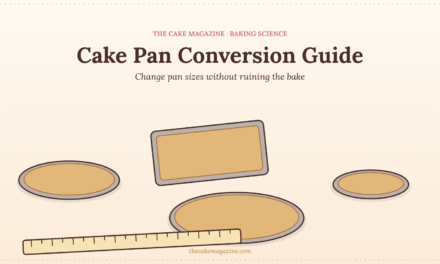
Smaller and shallower cakes bake quickly and dry out quickly, so a heavy hand with flour shows up fast. That is why how to measure flour for cake matters most for thin layers. Weighing the flour also makes it simple to scale a layer recipe to a sheet pan or a dozen cupcakes without losing the balance of the batter. When changing pan sizes, pair careful flour measuring with the right batter depth; our cake pan conversion guide explains how.
Gluten-free and alternative flour cakes
Gluten-free cakes rely on blends of rice, tapioca, potato or other flours, and many include starches and gums that behave very differently from wheat. Cup weights of these blends vary widely. Use the weights in the recipe, and weigh the blend, since a gluten-free batter can go from soft to gummy or from tender to gritty with a small change in flour.
Weighing the rest of the batter: why flour is only the start
Once you have settled how to measure flour for cake, it is natural to weigh the rest. Sugar, cocoa, butter and even eggs and milk can all be measured in grams, and doing so means you never need to guess at a cup again. Many bakers find that weighing liquids is easier than pouring them, since you can add milk or oil straight into the bowl and watch the number climb.
Eggs and liquids
Large eggs vary in size, and so does the amount of white and yolk in each. A recipe that lists eggs by weight, such as 100 grams of beaten egg for two large eggs, is easier to reproduce than one that says “2 eggs.” If a recipe lists eggs only by count, large eggs are the usual default in American recipes.
Milk and buttermilk weigh close to a gram per milliliter, but weighing them still removes the worry about reading a curved liquid surface at eye level.
Leaveners and salt
Baking powder, baking soda and salt are used in tiny amounts, so a small error has a large effect. A scale that reads to a tenth of a gram helps, though level measuring spoons are fine if used carefully. Fill the spoon, level it and avoid tapping. If a cake tastes bitter, metallic or oddly salty, a heavy hand with the leaveners or salt may be the cause.
Why how to measure flour for cake by weight builds trust in recipes
A recipe written in grams is a clear instruction, not a suggestion. When you bake by weight, you are following the writer’s formula exactly, and if it fails, you can say with confidence that the formula or the oven is at fault, not your measuring. That clarity is worth far more than the few minutes it takes to learn the habit, and it is the reason recipe developers prefer grams.
A practical middle path. You do not have to weigh everything on day one. Start with flour, which has the most variation, then add cocoa and confectioners’ sugar. Everything else can follow as you get comfortable.
Measuring flour when you bake for customers
If you sell cakes, the stakes for measuring flour rise, and how to measure flour for cake becomes a business question. A cake that is dry or dense is not just a disappointment. It is a refund, a bad review or a lost client. Professional bakers weigh their ingredients for the same reason a chemist does: the same input produces the same output. Weighing also makes it far easier to cost a recipe, because you know exactly how many grams of flour each cake uses.
That connection between measuring and money is covered in our guides to how to price cakes and the cake cost calculator. Both depend on knowing the weight of every ingredient. A baker who measures by the cup will always have a fuzzy cost, whereas a baker who measures by the gram can price a cake with confidence.
Keeping a master formula for how to measure flour for cake
Write every recipe you sell as a formula in grams, with the flour amount at the top. For a baker who sells cakes, how to measure flour for cake is a business habit too. Keep a note of the flour brand and type. If you ever change brands, bake a test cake and compare it with the old one before selling it. That kind of discipline is what turns a baking hobby into a repeatable product.
FAQ: how to measure flour for cake
What is the best way to measure flour for a cake?
Weighing is the best way, because it gives the same amount every time. Put a bowl on a digital scale, tare it and add flour until you hit the gram weight in the recipe. If you only have cups, fluff the flour, spoon it lightly into a dry measuring cup and level it with a knife without packing or tapping.
How many grams is one cup of flour?
For most American recipes, how to measure flour for cake starts with this number: King Arthur Baking lists one cup of all-purpose flour as 120 grams when measured by weight or with the fluff, spoon and level method. Other sources use slightly different numbers, and a scooped cup can run much heavier, up to about 160 grams if packed. Use the gram weight in your recipe when it gives one.
Does it really matter how I measure flour for cake?
Yes, because flour supplies the structure of a cake, so how to measure flour for cake affects the crumb directly. Too much makes a dry, tight, dense cake, and too little can leave it gummy, sunken or fragile. Many cake recipes tolerate small differences, but a 20 to 40 gram swing per two cups is often enough to change the crumb you get.
Should I sift flour before or after measuring?
It depends on the recipe wording. “1 cup sifted flour” means sift first, then measure. “1 cup flour, sifted” means measure first, then sift. If the recipe gives grams, the order does not matter, so weigh the flour and sift it afterward if you want to remove lumps and blend in the leaveners.
Is it okay to scoop flour with the measuring cup?
It works for forgiving recipes, but it is not the best way to measure flour for cake. Scooping compresses the flour and often adds 20 grams or more per cup, which can make a cake dry or dense. If you only use cups, spoon the flour into the cup and level it for results that are closer to what the recipe developer intended.
Can I use a liquid measuring cup to measure flour?
It is better not to. Liquid cups have a spout and extra headroom above the measuring lines, so you cannot level flour accurately. Dry measuring cups with flat rims let you sweep across the top. A scale avoids the problem altogether, which is one more reason to use one.
How do I know the right way to measure flour for cake if the recipe only lists cups?
Start with fluff, spoon and level, and treat 120 grams as a reasonable weight for each cup of all-purpose flour. If the cake turns out dry or dense, weigh your own cup and compare it. You can also calibrate by weighing the flour you normally use in a recipe that has always worked, then recording that number.
Do cake flour and all-purpose flour weigh the same per cup?
King Arthur’s chart lists both at 120 grams per cup, but other brands and sources may differ, and sifted cake flour can feel lighter. Because the flours behave differently in the batter, always use the flour the recipe names and the weight it gives rather than assuming they can be swapped by the cup.
How accurate does my scale need to be for flour?
A scale that reads in whole grams is fine for flour. King Arthur says being about five grams over or under will not affect a recipe, though it still recommends staying as close as you can. A tenth-of-a-gram scale is handy for small amounts of leavening but not necessary for most cake flour measuring.
What happens if I add too much flour to a cake?
The crumb turns drier, tighter and denser, and the cake may rise less and taste floury. Extra flour absorbs more of the liquid in the batter, so the cake can feel thirsty even if it was baked correctly. A few grams will not matter, but 40 grams or more over two cups usually will.
What happens if I use too little flour in a cake?
The batter is looser, and the cake may sink in the center, feel gummy or greasy, or fall apart when you turn it out. Several other problems cause the same symptoms, including underbaking and too much leavening, so weigh your flour and also check your oven and bake time.
Is how to measure flour for cake different at high altitude?
The measuring technique is the same, but high-altitude recipes often change the amounts of flour, liquid, sugar and leavening, so weighing matters even more. Start with a recipe written for your elevation, weigh the ingredients and change one variable at a time while keeping notes on each bake.
Do I need to weigh flour for every cake?
You do not have to, but it is the surest way to repeat a good result. If you are baking a simple, forgiving cake for family, careful fluff, spoon and level measuring is usually enough. For special-occasion cakes, delicate sponges or cakes you sell, weighing is worth the small extra step.
Final thoughts
Learning how to measure flour for cake is not glamorous, and nobody posts a photo of a level cup. But it quietly decides whether your cake is tender or tough, tall or squat, moist or dry. The whole lesson fits in a couple of sentences: weigh flour whenever you can, and when you cannot, fluff, spoon and level the same way every time.
If you take one step after reading this guide, make it a simple one. Weigh your usual cup of flour tonight and write the number inside your recipe box. That small piece of information may explain a cake that has puzzled you for years. Once you know how to measure flour for cake with confidence, every other part of baking, from oven temperature to frosting, becomes easier to read and easier to fix.
For a deeper look at why the ingredients in your batter behave the way they do, start with our guide to cake baking science, and read the King Arthur cake guide for additional baking reference. Happy baking, and may every one of your cakes rise level.
Editorial note: reviewed and updated November 2026. This guide is general baking information for home bakers in the United States, using American measurements. The gram weights come from King Arthur Baking’s published ingredient chart and measuring guidance, and the effects of extra or missing flour describe general baking principles, not results from our own test kitchen. Results vary by flour brand, oven, pan and kitchen conditions, so test and adjust for your own setup. Food safety information is general and not a substitute for guidance from official agencies.