Most home bakers learn how to price cakes the hard way. A friend asks for a birthday cake, you quote what the ingredients cost plus a little for your trouble, and three days and one very long Saturday later you realize you earned less than you would have at a part-time job, if you count the cleanup and the grocery run. Nothing was wrong with the cake. The problem was the number you said out loud at the start.
This guide walks through how to price cakes so that your ingredients, your time, your overhead and a real profit are all covered, in plain arithmetic you can run on a calculator or a notebook page.
To work out how to price cakes, add up what it truly costs you: ingredients (with a little waste), packaging, your labor at a rate you choose, and your share of overhead. Then divide that total by one minus your target margin to get the price, and add delivery, rush or custom fees separately. Divide the final price by the number of servings to check that it makes sense per slice. Every number in this guide is an example.
Replace each one with your own costs, and compare the result with what bakers in your area charge before you publish a price list.
- Why cakes get underpriced
- The big picture: five blocks of cost
- Step one: ingredient costs
- Step two: your labor
- Step three: overhead
- Margin vs markup
- A full worked example
- Pricing by complexity
- Delivery, setup, rush and custom fees
- Price per slice and per serving
- Checking your price against the market
- Quotes, deposits and policies
- Building a price list
- Discounts and other traps
- Raising your prices
- Common mistakes
- FAQ
Why cakes get underpriced, and why it matters
Before the formulas, it helps to understand why so many cakes are priced too low in the first place. Nearly everyone who bakes for other people goes through the same stages, and knowing them makes the math feel less personal. Learning how to price cakes is mostly a matter of getting honest about things you used to treat as free.
Ingredients are the only cost you can see
When you push a cart through the grocery store, the receipt shows butter, flour, sugar and eggs, and you can see exactly what they cost. Your time does not appear on a receipt. Neither does the electricity for a four-hour oven day, the parchment, the boxes, the new offset spatula you bought last month or the sixth trip to the store because you ran out of cream.
Because only ingredients show up in black and white, they become the whole price in many new bakers’ minds. A cake that costs $12 to ingredient-cost feels like it should sell for $25 or $30, and everyone is happy until the baker counts the hours.
Friends and family set the first price
Most home bakers start with people they know. Those first orders come with a hidden discount, because nobody wants to name a number that sounds greedy to a cousin or a coworker. That first price tends to stick. By the time a stranger asks for a quote, the baker already thinks of that price as normal, and the stranger gets the cousin rate even though the cake is the same size, the same design and the same stress to deliver. If you recognize this, you are in good company, and it is fixable.
Grocery store cakes are the wrong comparison
A sheet cake from a big store looks cheap next to a custom cake from a home baker. That comparison does not hold up. The store buys ingredients in enormous quantities, runs production lines, pays staff in shifts and often treats cakes as a way to bring people into the building. A home baker or small shop buys at retail, makes one cake at a time and designs it for one customer.
Knowing how to price cakes well means you are not competing on price with a mass producer, and you can stop trying. What you can offer is a cake made for that person, and the price should reflect the work behind that.
What underpricing costs, and why how to price cakes well matters
Underpricing does more than shrink your profit. It sets up a quiet spiral. You work long hours for little money, you start to resent the orders, you rush the details to claw back time, the cakes get a bit worse, and eventually you stop baking or burn out. Customers do not benefit from this either. A baker who is paid fairly can afford better ingredients, better tools, insurance and the rest time that makes the next cake good. Learning how to price cakes sustainably is a service to the customer as much as to you.
A note about the numbers in this guide on how to price cakes. Every dollar figure here is an example chosen to make the arithmetic easy to follow. None of it is market data, and your costs will differ from ours depending on where you live, where you shop and how you work. Treat the figures as placeholders, put your own numbers in the same formulas, and check the result against real prices from bakers near you. Nothing here is legal, tax or accounting advice.
Who this guide on how to price cakes is for
If you bake a few cakes a month for friends and neighbors, this guide on how to price cakes will help you set a fair price and say it without flinching. If you are building a cake business, it gives you the cost-plus method that most small food businesses use as a starting point. If you already sell cakes, it may help you test your current prices against your real costs.
For the bigger picture of starting out, see our guide on how to start a home cake business, and when you are ready to plug your own costs into a worksheet, the cake cost calculator walks through each input.
The big picture: how to price cakes in five blocks
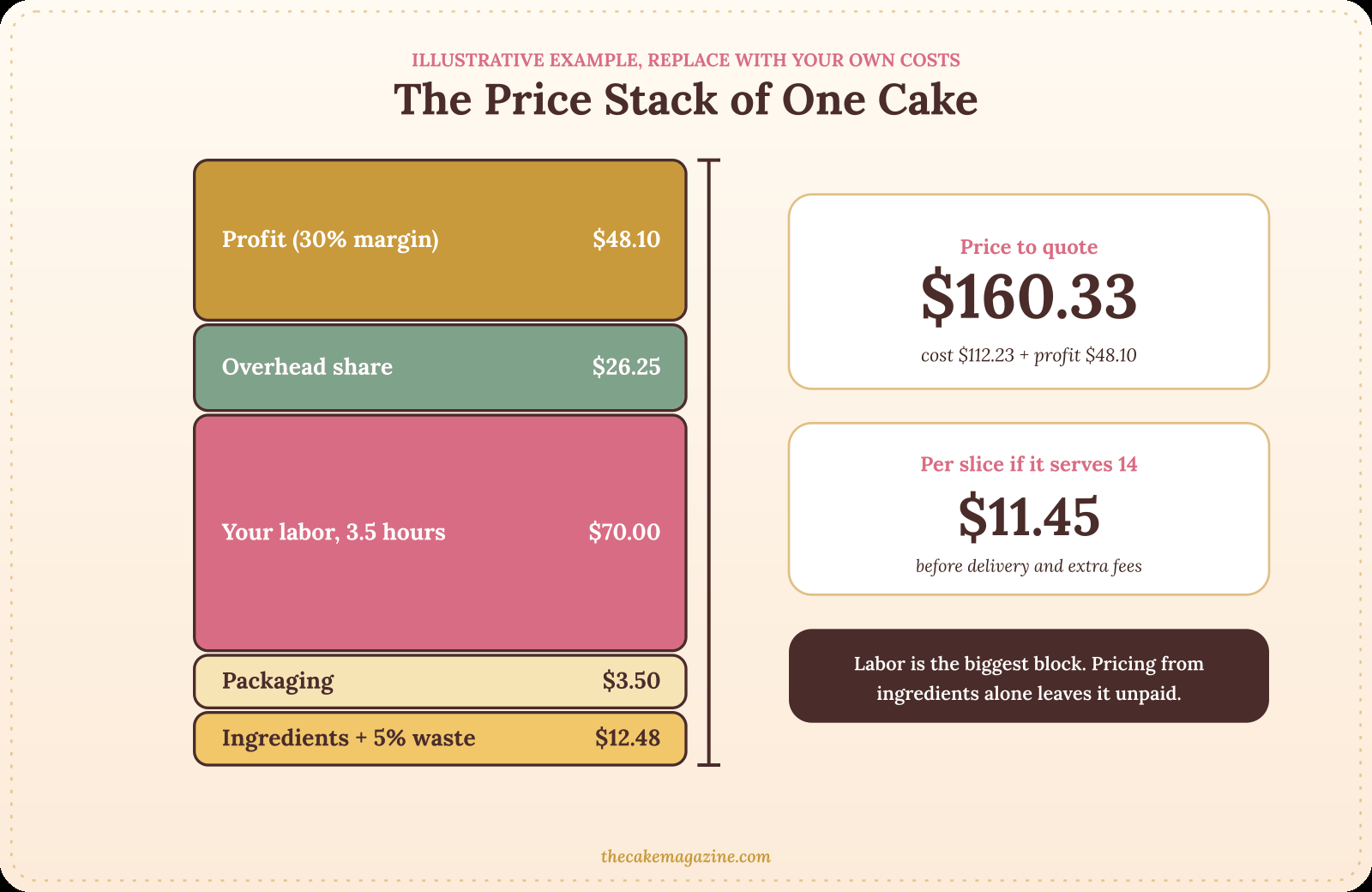
Here is the whole method for how to price cakes in one paragraph. A cake price is built from five blocks stacked on top of each other: ingredients, packaging, labor, overhead and profit. The first four blocks are your cost. You add the fifth on purpose, because profit is what lets a business grow, replace a broken mixer or pay you a raise.
Once the four cost blocks are known, the price is the total cost divided by one minus your profit margin. Delivery, rush work and custom extras are added as separate lines, so they never get hidden inside the base price.
Why a stack beats a gut feeling when you decide how to price cakes
Gut-feeling prices usually come from comparing yourself with someone else, and that is a reasonable thing to do later, as a check. Starting from a stack of costs, which is how to price cakes on solid ground, gives you a floor. Any price under the floor loses you money on that order, and you know it before you say yes. It also gives you a way to explain a price calmly, because each block is something real.
When a customer asks why the cake costs what it does, you can answer in terms of time and ingredients without apologizing.
The five blocks in plain words
Ingredients
Everything that goes into the cake and the frosting, priced by weight, with a few percent added for waste, spills and trimmings.
Packaging
The cake board, the box, the ribbon, the parchment and the dowels. Small items, but they add up quickly.
Labor
Every hour you spend on the order, at an hourly rate you choose, including shopping, baking, decorating, cleanup and talking to the customer.
Overhead
The costs of keeping the kitchen running that do not belong to any one order: utilities, insurance, licenses, equipment, software and marketing.
Profit
The amount left after all costs are paid. It is the cushion that keeps the business healthy and pays for growth.
The two numbers that drive how to price cakes
Two numbers drive everything else, and both are your decisions rather than facts you look up. The first is your hourly labor rate. The second is your target profit margin. Choosing them is uncomfortable, because they feel like statements about what you are worth. A better way to think about them is as inputs to a machine. The machine does not judge you; it just tells you what price makes those inputs true.
If the result feels too high for your market, that is useful information, and you can adjust the design, the size or the menu rather than quietly working for less.
A word on honesty with yourself
The most common mistake in learning how to price cakes is leaving out costs because they feel small or embarrassing. The cleaning time is real. The twenty minutes spent answering messages is real. The drive to buy fondant is real. Write everything down for a few orders, even if it feels like overkill. The goal is a price that matches reality. If you decide to give a discount later, you can do it knowingly rather than accidentally.
Step one in how to price cakes: know your ingredient costs
The ingredient block is the easiest part of how to price cakes to calculate, which is why it is the best place to start. It also trains the habit you will use for everything else: write the number down instead of estimating it. A cake is not priced per cake in your head. It is priced per gram of butter, per egg and per teaspoon of vanilla, and then those small prices add up.
How to price cakes starts with weight, not cups
Recipes in this magazine are written in grams because weight is the only measure that works equally well for baking and for costing. A cup of flour can vary by 20 percent depending on how you scoop it, but 300 grams is 300 grams. To cost an ingredient, divide the price you paid by the weight in the package. A 5-pound bag of flour that cost $4.50 holds about 2,268 grams, so each gram costs about two-tenths of a cent.
Multiply by the grams in the recipe and you have the cost of that ingredient in that cake. This is the foundation of how to price cakes accurately.
Do this once for every ingredient you use regularly and keep the results in a notebook or a simple spreadsheet. Update the list every few months, because butter, eggs and chocolate change in price more often than you expect. A spreadsheet row per ingredient with the pack price, the pack weight and the cost per gram is all you need. The cake cost calculator guide has a ready-made structure for this, if you would like one to copy.
Include every ingredient, even the tiny ones
A teaspoon of vanilla, a pinch of salt and a quarter teaspoon of baking soda each cost almost nothing, but vanilla extract in particular can be one of the pricier items per gram in your pantry. Add everything, including the dusting of flour for the pan and the parchment for the base. Leaving out the small items makes your cost look lower than it is, and the habit of skipping them becomes a problem when you move to ingredients that matter, like a real vanilla bean or a block of good chocolate.
Cost the cake and the frosting separately, then add them
To make how to price cakes manageable, pick the recipes you sell most and work them out in full. For a two-layer 8-inch vanilla cake, such as our best vanilla cake recipe, price the batter, then price the frosting, then add the filling and any decoration. Keeping the parts separate lets you swap one component without redoing the rest. If you offer chocolate or strawberry as an option, you can see right away how much each flavor changes the cost.
An illustrative ingredient list
Here is an example for a 2-layer vanilla cake with American buttercream, serving about 14 people. The prices are placeholders, not market figures. They are chosen to show the method.
- All-purpose flour0.35 kg at $2.00 per kg = $0.70
- Granulated sugar0.55 kg at $2.20 per kg = $1.21
- Unsalted butter0.60 kg at $9.00 per kg = $5.40
- Eggs5 large at $0.40 each = $2.00
- Buttermilk and milk0.25 kg at $2.50 per kg = $0.62
- Powdered sugar0.50 kg at $2.60 per kg = $1.30
- Vanilla extract$0.50
- Salt and leaveners$0.15
Added up, the ingredients come to $11.88. That is the number most people stop at when they are guessing how to price cakes. It is also less than 8 percent of the final price in our example, which is the first thing most new bakers find surprising. The rest of the price pays for everything else.
Add a waste factor to your how to price cakes math
Real kitchens lose a little food on every batch. Batter stays in the bowl, a layer gets trimmed flat, a bit of frosting sticks to the scraper, an egg cracks wrong. A waste factor of 3 to 8 percent is a reasonable starting range for many home kitchens, but yours depends on how you work, so track a few cakes before you settle on a number. In the example, we use 5 percent: $11.88 times 1.05 is $12.48.
If you also throw out a failed layer once in a while, add a little more, or add it to the overhead block as a “mistakes” allowance.
Cost what you actually buy, not what you wish you paid
You might look at a warehouse club price and decide to use it because it is lower. If you really buy there and really use the whole pack before it goes off, use it. If you buy small amounts at a regular store, use that price. Costing at the cheapest price you have ever seen gives you a flattering number that you cannot rely on. Cost the way you shop on a normal week.
Specialty ingredients and seasonal swings
Some cakes call for high-priced ingredients: good chocolate, pistachios, fresh berries out of season, edible gold, liqueurs. Price these per order rather than relying on your standard cost, and decide whether to build them into the base or list them as an add-on. Seasonal fruit is a good example. A strawberry cake in June and the same cake in January may differ a lot in cost, and a menu that says “market price” for fresh fruit is not unusual.
You can also offer a seasonal flavor list so that the main menu stays stable while the specials change.
Use the same recipes every time. Knowing how to price cakes depends on baking from recipes you know well. A tested recipe with known weights gives a known cost. If you adapt a recipe for every order, your cost estimates drift and you are guessing again. Choose a short list of reliable cakes, such as the vanilla and a chocolate cake, cost them carefully and build your menu around them.
Packaging is part of the cost of a cake
A cake that leaves your kitchen needs a board, a box and often more. A sturdy base board, a grease-resistant liner, a box that fits, and a sticker or label with the ingredients are the basic set. If you deliver tiers you also need dowels or supports and non-slip matting for the car. Add up what you spend on these per cake. In our example the packaging is $3.50. For a tall or tiered cake it will be more, and a charge for the board itself is normal if the customer keeps it.
The food safety side of ingredients and cost
Cost is not the only reason to track ingredients carefully. Storing dairy and eggs properly, labeling allergens and keeping fillings cold are part of running a food business, and mistakes there are expensive in a different way. The USDA Food Safety and Inspection Service publishes general food safety guidance that is a good starting point for the basics of keeping perishable food safe. Local rules for selling food vary, so check with your own state and county as well. Our guide on starting a home cake business covers the rules landscape at a high level.
What to do with leftovers and scraps
Cake scraps are an old trick for recovering cost. Trimmings can become cake pops, parfaits or snack boxes sold at a small price, and extra frosting can go on cupcakes. This works best when you plan for it, not when you pretend it will make up for a low price. Treat any scrap sales as a small bonus. Your base price should stand on its own without them.
Step two in how to price cakes: put a price on your labor
Labor is the block of how to price cakes that most often goes missing from a home baker’s price, and it is usually the largest. Counting it properly is what separates a hobby price from a business price. If that distinction feels uncomfortable, remember that you do not have to decide to run a business to give your time a value. You only have to decide what an hour of your work is worth, and then keep that number steady.
Track every minute of a real order before you set how to price cakes
The first time you cost labor, do not guess. Set a timer or write down start and stop times for a few real orders. Include everything: planning the design, shopping, weighing and mixing, baking, cooling, leveling, making frosting, filling, crumb coating, chilling, decorating, boxing, cleaning, delivering and answering the customer’s messages. Most bakers are surprised. A cake they thought took two hours turns out to take five once the shopping, the cleanup and the delivery are counted.
Here is a typical shape for a standard two-layer cake, in hours, as an example only:
- Planning, messages and shopping: 0.5
- Baking and cooling layers: 0.75 of hands-on time, with the rest waiting
- Making frosting and filling: 0.5
- Assembling, crumb coating, final coat and decorating: 1.0
- Boxing, cleanup and handoff: 0.75
That adds up to 3.5 hours of your time, which is the number we use in the worked example. Your own numbers will differ. Faster is not always better; a baker who is slower but charges for the hours will earn more than a faster baker who undercharges. As you practice, your times will fall, and when they do the price can fall too, or the extra can become profit.
Waiting time is not free time, but it is not full-price time either
Layers need to cool for an hour or two. Frosting needs to chill. During that time you are not standing next to the cake, but you often cannot do anything else that matters. Most bakers count the hands-on time at full rate and some of the waiting time at a reduced rate, or they count only the time they are actively working and build the waiting into the hourly rate itself. The important part is to be consistent and to include it somewhere. If you pretend waiting is free, you are donating those hours.
Choosing an hourly rate for how to price cakes
There is no single right hourly rate, but there are reasonable ways to arrive at one. One approach is to start with the annual income you would like from baking, divide it by the number of hours you realistically work on orders in a year, and add a share for taxes and benefits you now pay for yourself.
Another is to start from what you would earn in a skilled job in your area and adjust for the extra risk and responsibility of running your own operation. A third is to look at the going rates for skilled food workers locally and treat that as the floor.
The key word in the first method is “realistically.” Nobody bakes 40 billable hours a week. Between admin, shopping, cleaning, answering messages and slow weeks, many small bakers spend only a portion of their working hours on paid baking. Your hourly rate has to carry the unpaid hours too, which is why a number that looks high compared to a regular job can still be fair. In our example we use $20 per hour as a simple placeholder. Replace it with a rate that makes sense where you live, for the experience you have.
Do not use minimum wage as your target. Minimum wage is a legal floor for employees, and it was never meant to pay for training, risk, equipment or the work of running a business. If you reach for it because it feels modest, you may end up with a price that looks affordable and leaves you worse off than a regular job. Choose your hourly rate on purpose, and review it once a year.
Your labor in the stack
At $20 per hour, a 3.5-hour cake has $70 of labor. In our price stack, that single block is bigger than ingredients, packaging and overhead combined. This is the reason a cake that costs $12 in ingredients sells for far more than $12 plus a bit. If someone suggests that a baker is overcharging because the ingredients are cheap, the stack is the answer: ingredients are the small part.
What your effective hourly pay really is
One way to test any price is to work backwards to the hourly pay you would earn after costs. Take the price, subtract ingredients, packaging and overhead, and divide what is left by the hours you worked. The gauge below shows the same 3.5-hour cake at three prices. At $60 you earn about $5 an hour, at $85 about $12, and at $160.33 about $34 an hour, which includes the profit. Most new bakers who have never studied how to price cakes have priced somewhere near the left end of this gauge without knowing it.

Use the gauge to test how to price cakes for any quote
Before you send a quote, run the formula once. It takes under a minute. If the effective hourly figure falls below your target rate, you have a choice: raise the price, shrink the design, shorten the work or decline the order. Each of those is a legitimate way to handle a low-paying request, and all of them are better than saying yes and finding out later.
Paying yourself versus paying the business
Some bakers prefer to think of two separate amounts: a wage for their labor and profit for the business. Others fold everything into one margin. Both work. Separating them can be clearer, because it lets you see whether the business is earning something beyond your wage, and that extra is what covers surprises. If you run the business as a sole proprietor, the line between the two can blur, so write down your own convention and use it every time.
A tax professional can explain how your income is treated for tax purposes in your area. We cannot give tax advice here.
Step three in how to price cakes: spread your overhead
Overhead is the part of how to price cakes that hides, the set of costs you pay whether or not you bake a particular cake. They keep the kitchen legal, working and findable. They are easy to forget because no single order triggers them. The trick is to estimate them for a month or a year and then spread them across the hours or the orders over that period.
What counts as overhead
- Utilities: the extra electricity, gas and water from baking and washing.
- Insurance and licenses: any business insurance, permits, registrations and renewals you pay for. Rules differ by place, so check your local requirements.
- Equipment and tools: mixers, pans, turntables, scrapers, piping bags and tips. Spread the cost of larger items across the years you expect to use them.
- Software and website: a booking tool, an order form, a domain, accounting software, a photo editing app.
- Marketing: business cards, a tasting event, a few boosted posts, photography props.
- Kitchen costs: if you rent a commissary kitchen or a share of one, that rent belongs here.
- Cleaning and consumables: sanitizer, towels, gloves, parchment and foil that are not part of any single cake.
- Training and fees: courses, books and payment processing fees.
Turning monthly overhead into an hourly number
Add up the overhead you expect in a typical month, then divide it by the number of hours you spend on paid orders in that month. If your monthly overhead is $600 and you work 80 paid hours, your overhead rate is $7.50 for every hour of work. A 3.5-hour cake carries $26.25. This approach is easy to repeat and it rewards you for spending your time on larger, more profitable orders, since each hour carries the same share.
Another method is to divide overhead by the number of orders instead of the number of hours. That is simple, but it can make small orders look overpriced and large ones look underpriced. An hourly overhead rate is usually the fairer way to share the cost, because a 10-hour sculpted cake uses more of your kitchen than a 2-hour simple one.
A percentage method for simple menus
If you sell a small, steady range of cakes, you can also add overhead as a percentage of the direct costs. A baker with $600 of monthly overhead and $1,800 of monthly direct costs, for example, could add about one-third on top of the direct costs. That is easy to apply, but it ties overhead to direct cost, which is not always how it behaves. Use whichever method of how to price cakes you can keep up with, and check it against the other once in a while.
If you bake in a home kitchen
Home bakers sometimes assume they have no overhead because they are not paying rent. In truth, the oven wear, the water, the freezer space and the equipment all count. Some places have rules about the kitchen you can use, and some require licensing or inspection; look into this early. If you are unsure where to start, our overview on how to start a home cake business collects the questions to ask your local authorities. Do not assume anything about what is allowed in your state or county without checking with the official source.
Equipment is overhead too
A stand mixer, a set of good pans and a scale are the kind of costs that feel like one-time purchases, but they wear out. A simple way to count them is to divide the price by the number of years you expect to use the item, then divide that by the number of months. A $400 mixer expected to last five years costs roughly $80 per year, or $6.67 per month.
If you are choosing equipment, our buying guides on stand mixers and cake pans explain what to look for, so you do not pay for features you will not use.
Margin vs markup: the math behind how to price cakes
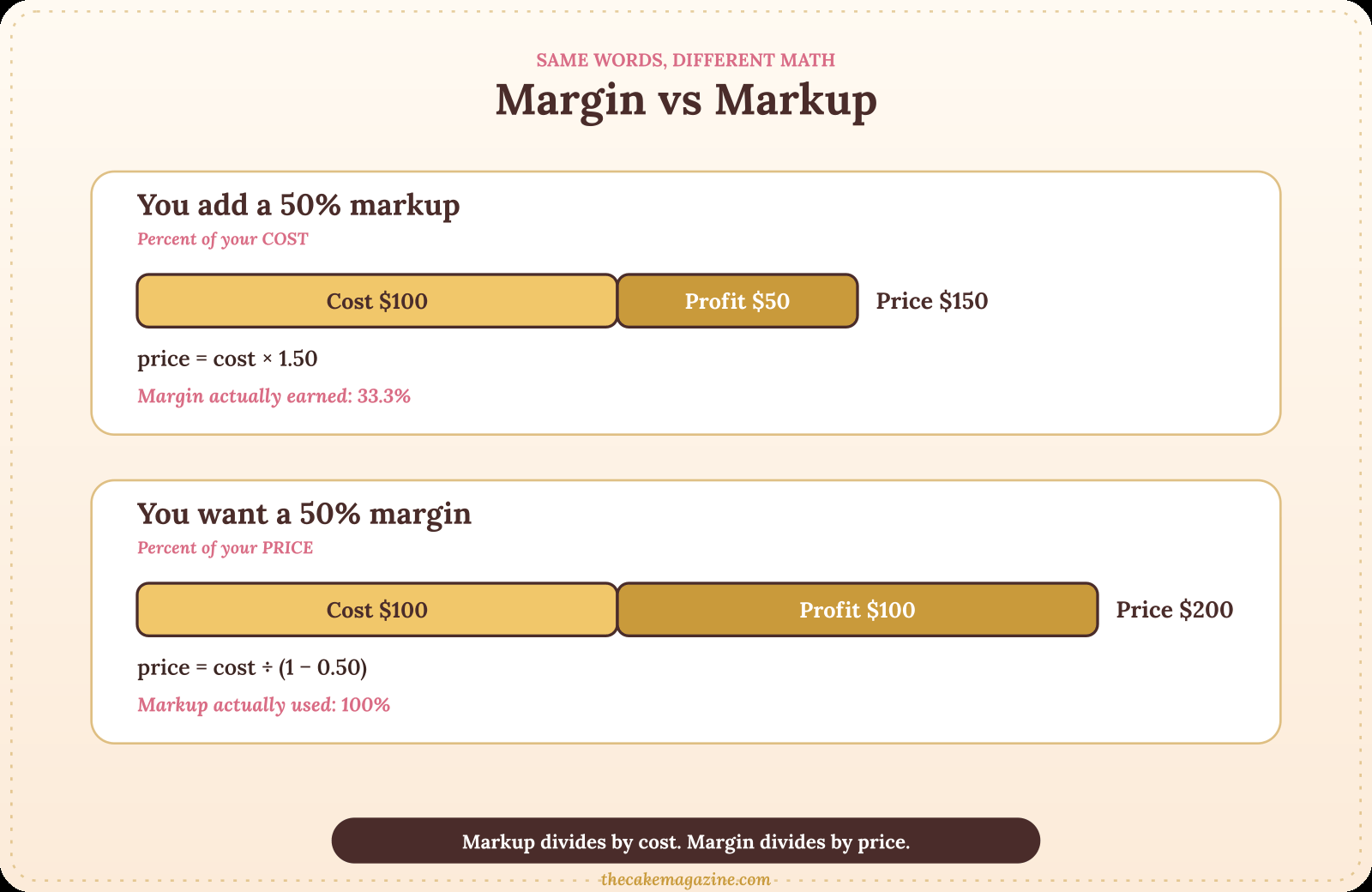
You now have a total cost for a cake. The next step is deciding how much profit to add, and this is where two similar-sounding words cause a lot of trouble. Markup and margin both describe profit as a percentage, but they divide by different things. Mixing them up is one of the most common arithmetic mistakes in how to price cakes, and it nearly always costs the baker money.
Markup is a percentage of cost
Markup answers the question: how much did I add on top of what it cost me? If a cake costs you $100 and you sell it for $150, you added $50, which is 50 percent of $100. The formula is simple. Markup percentage equals profit divided by cost. To go the other way, price equals cost times one plus the markup. A 50 percent markup on $100 is $100 times 1.50, or $150.
Penn State Extension’s guide to product pricing describes this cost-plus approach for small food producers, adding a standard percentage to the cost of making the product.
Margin is a percentage of price
Margin answers a different question: how much of every dollar the customer pays do I keep? On that same $150 sale, you keep $50, which is one-third, or 33.3 percent. The formula is profit divided by price. To find the price you need for a target margin, divide your cost by one minus the margin. For a 50 percent margin on a $100 cost, price equals $100 divided by 0.50, or $200.
Why the margin and markup difference matters when you decide how to price cakes
If you decide you want a 30 percent profit, and you multiply your cost by 1.30, you do not get a 30 percent margin. You get about 23 percent. The gap grows as the percentage rises. A baker who aims for a “50 percent profit” and applies a 50 percent markup ends up with a 33 percent margin, and may be confused about why the money does not stretch as far as planned.
The fix is to choose one language and use it consistently. For the rest of this guide on how to price cakes we use margin, because it connects directly to what you keep from each sale.
A quick conversion guide
These pairs show the same price expressed both ways. They are exact arithmetic, not market data.
- A 25 percent markup is a 20 percent margin.
- A 33 percent markup is a 25 percent margin.
- A 50 percent markup is a 33 percent margin.
- A 100 percent markup is a 50 percent margin.
Going the other way, a 20 percent margin is a 25 percent markup, a 30 percent margin is about a 43 percent markup, a 40 percent margin is about a 67 percent markup and a 50 percent margin is a 100 percent markup. If someone tells you a number and does not say which one they mean, ask. Two bakers can say “I add 30 percent” and mean completely different prices.
The two formulas to remember. Price from a margin: price equals cost divided by (1 minus margin). Price from a markup: price equals cost times (1 plus markup). Write both on a sticky note and put it where you keep your calculator.
Choosing a target margin for how to price cakes
The right margin depends on your business. A baker who is paying herself an hourly wage through the labor block can reasonably aim for a lower profit margin than one who has not counted labor at all, since the profit is what is left after she is already paid.
Many bakers pick a margin in the range of 20 to 40 percent as a starting point, then adjust based on how many orders they get and what they want from the business. This is a planning choice rather than a rule. If you can book every date at your current price and have a waiting list, your margin is probably too low.
If you hear no from every customer, test a smaller increase or add a lower-priced option instead of giving up on the margin entirely.
Break-even: the price below which you lose money
Penn State Extension also points to break-even thinking: add up your total costs and divide by the amount you expect to produce to find the minimum price that covers expenses. For a single cake, your break-even price is simply the total cost, $112.23 in our example. Any price under it loses money on that order. When a customer asks for a discount, the break-even figure tells you how much room you actually have, which is a lot less than it looks if you think only about ingredients.
A full worked example of how to price cakes
Now let us put the blocks of how to price cakes together. This example uses the illustrative figures from earlier steps. Every number is a placeholder that you will replace with your own. We arrive at the final price in six short steps, and they are the same steps you will repeat for every cake you sell.
Pricing one 2-layer, 8-inch vanilla cake (14 servings)
The steps
- Step 1: ingredient cost$11.88 for the recipe
- Step 2: add 5 percent waste$11.88 × 1.05 = $12.48
- Step 3: add packaging$12.48 + $3.50 = $15.98
- Step 4: add labor3.5 hours × $20 = $70.00
- Step 5: add overhead3.5 hours × $7.50 = $26.25
- Step 6: total cost$15.98 + $70.00 + $26.25 = $112.23
From cost to price at three margins
With a total cost of $112.23, here is the price at three example margins, using price equals cost divided by one minus margin.
20 percent margin
$112.23 ÷ 0.80 = $140.29. Profit is $28.06. That works out to a 25 percent markup and $10.02 per slice at 14 servings.
30 percent margin
$112.23 ÷ 0.70 = $160.33. Profit is $48.10, a 42.9 percent markup, and $11.45 per slice at 14 servings.
40 percent margin
$112.23 ÷ 0.60 = $187.05. Profit is $74.82, a 66.7 percent markup, and $13.36 per slice at 14 servings.
For the rest of this guide on how to price cakes, we use the 30 percent margin price of $160.33. That includes your pay for 3.5 hours, your share of overhead and $48.10 of profit. Most customers will see a round number, so you might quote $160, or $165, rather than $160.33. Rounding to a clean figure is fine as long as you round up consistently or at least know the effect.
What happens if you skip labor
To see why labor matters, suppose you left it out and used only ingredients, packaging and overhead: $12.48 + $3.50 + $26.25 = $42.23. At the same 30 percent margin the price would be $60.33, which is the $60 pin on the gauge earlier. You would be working 3.5 hours for roughly $5 an hour after costs. That price feels plausible to a new baker, because it is a lot more than the ingredients, and it is not enough to be sustainable.
Always round in your favor, not the customer’s
When your result is $160.33, rounding to $160 loses 33 cents. It sounds trivial, but small rounding losses across hundreds of orders become real money. A rule of thumb that is easy to use is to round up to the nearest $5 for cakes and the nearest $0.50 for small items. This keeps prices tidy and never undercuts the formula.
Test the price from the other direction
Once you have a number from how to price cakes, check it against two other measures. First, calculate the effective hourly pay, as in the gauge. Second, calculate the price per serving. If both look reasonable for your market and your skill, the price is ready. If either feels off, go back to the blocks and see which one is driving the result. Often it is labor hours, which suggests a design that takes too long for what it brings in.
Pricing by complexity: the part of how to price cakes that surprises people
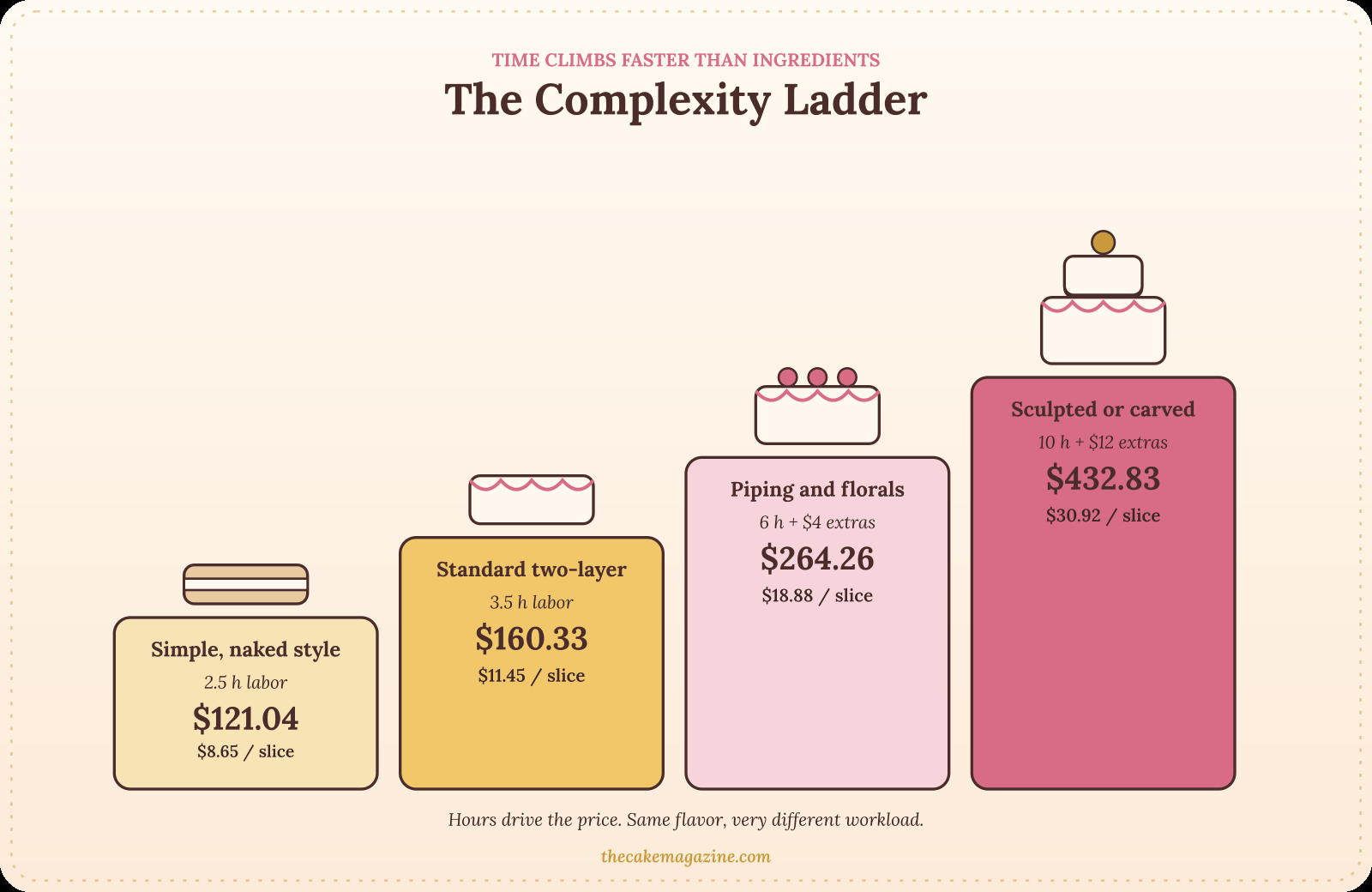
Two cakes can serve the same number of people and still take very different amounts of work. A simple naked-style cake with a swipe of frosting and a few berries is quick to finish. A cake with piped florals, painted details or a carved shape can easily take three times as long, even though the ingredients are close to the same. If you price by size alone, the harder designs quietly cost you money. If you price by time, which is how to price cakes honestly, they pay for themselves.
Think in tiers of work, not decoration styles
Most bakers find it easier to sort cakes into a handful of complexity tiers than to price every request from scratch. The ladder above shows four. These are examples, and your tiers should match the work you offer.
Simple, naked or lightly frosted
Minimal decoration, quick finish. In our example this takes about 2.5 hours and prices near $121 at a 30 percent margin for 14 servings.
Standard two-layer
A smooth or textured finish and simple piped details. About 3.5 hours, about $160 for 14 servings.
Piping and florals
Detailed piping, buttercream flowers or hand work. In the example, 6 hours of labor plus $4 of extras, near $264.
Sculpted or carved
A shaped cake, structure, supports, fondant or airbrushing. Ten hours plus $12 of extras gives about $433 in this example.
How to price cakes by estimating the hours for a design
To get better at how to price cakes, keep a log of how long your own designs take, and build a simple chart from your results. Over time you will know that a standard buttercream cake takes you about so many hours, and a floral cake about so many more. Until you have that data, ask yourself for each new request: how many separate decorative tasks are there, and how long does each one really take me?
Add a cushion for the unexpected, because custom work nearly always takes longer than the plan. Then multiply by your rate and your overhead rate, as before.
Do not charge for the decoration alone
It is tempting to price decoration as a flat “extra” and leave the base alone. That is fine for small add-ons, like a sparkler topper or a cluster of macarons from a supplier. For labor-heavy decoration, use hours. A buttercream floral cascade is not a $20 add-on if it takes you ninety minutes to pipe. When in doubt, test with a real timer on your next order, and remember to include practice and the time to fix mistakes.
How to price cakes by servings first, then adjust for the work
Many bakers start with a base price per serving, which covers the cake, filling and a simple finish, and then add complexity charges. This is a good approach for menus, because it is easy to explain to customers. A rough structure is a per-serving price for the base cake, plus a line for each additional element. Our earlier guide to wedding cake servings shows how to work out how many slices a cake of a given size will give you, which is the input you need to make per-serving prices fair.
Tiered cakes and structure
Tiered cakes add cost beyond the size of the cake itself. They need internal supports, a stable base, extra boards, more careful transport and a longer setup. They can also involve more waste and more risk. Price stacked cakes with their own labor time and their own supplies, and add setup time at the venue if you go there. If you are pricing wedding work specifically, the wedding cake cost guide explains the factors from the couple’s side, which is useful to know when a client brings a quote from another baker.
Minimums protect you from tiny orders
A small cake is not always a small amount of work. Shopping, setup and cleanup take about the same time for a 6-inch cake as for an 8-inch one. Many bakers set a minimum order amount so that very small requests still cover the fixed part of the work. The minimum is usually based on the fixed time you need for any order, plus the cost of the smallest cake. This is a normal business practice and, if you explain it clearly, customers tend to understand.
Specialty diets and allergen requests
Cakes made without gluten, dairy, eggs or nuts often need separate ingredients, separate tools and extra cleaning. If you offer them, cost them as their own menu items, and do not simply add a small fee to a standard recipe. Be honest about what your kitchen can safely do. Cross-contact is a real concern, and if you cannot control it, it is better to refer the customer elsewhere than to promise something you cannot deliver. Ingredient lists and allergen labeling rules vary, so check requirements where you sell.
Delivery, setup, rush and custom fees
The base price from how to price cakes covers the cake. Several other costs belong on separate lines, because they do not apply to every order and because customers should see what they are paying for. A clear fee schedule also makes it easy to say yes to special requests without losing money.
Delivery fees and how to price cakes that travel
Delivering a cake takes time, fuel, vehicle wear and a certain amount of worry. For a local run, a simple approach is to charge by distance: choose a per-mile figure, multiply it by the round-trip distance and add the time cost for the drive. If your per-mile figure is $0.70 and the delivery is 15 miles each way, that is 30 miles, or $21, before any charge for your time.
Add your hourly rate for the drive time and any waiting at the venue. For tall or tiered cakes, a second person may be needed, and that can be included in the fee.
Some bakers set delivery zones with flat fees, such as one price within a short radius and another beyond it. This is simpler to quote. Offering pickup as an option at no charge is common, and customers often choose it. Whichever method you use, put the delivery policy in writing: who is responsible once the cake is handed over, what happens if the venue is not ready and how you handle parking, stairs and waiting time.
Setup at an event
If you are placing a cake at a venue, add setup time to the order. For a simple cake it may be fifteen minutes. For a tiered cake with flowers and a display it can be an hour or more, and the risk is higher. Charge for the time, and charge for travel back if you have to return to collect your stand or board. If someone else will assemble or display the cake, say so in the agreement.
Rush orders: how to price cakes on short notice
A rush order disrupts your schedule, so how to price cakes for rush work includes a surcharge. The reasoning is simple. You may need to turn down other work, change your plans or work longer hours. Many bakers set a rush fee as a percentage of the cake price when the order is placed within a certain window before the date.
In our example, a rush fee of 25 percent on the $160.33 cake adds $40.08 and brings the price to $200.41. Pick a percentage that makes you comfortable to take the order, and decide in advance when you will decline instead.
Custom design and consultation fees
Designing a one-of-a-kind cake takes planning, sketching, shopping and sometimes testing a new technique. A custom design fee covers the thinking before the baking. You can charge it as a flat amount, as an hourly consultation or as part of the base price for complex orders. Some bakers credit the fee toward the final order if the customer books; others keep it separate. Either way, write down what it covers. If a customer wants three revisions of a sketch, you need to know in advance who pays for the time.
Tastings and samples
Tastings are marketing, and marketing is a cost. If you offer them, include their cost in your overhead or charge a modest fee that is credited toward an order. Free tastings for every inquiry can quietly become a big expense, especially for wedding work, where couples often compare several bakers. A small sample box with a few flavors and a fixed price is an easy way to handle it.
Cake stands, boards and rentals
If you lend a cake stand, dome or display piece, treat it as an asset with a deposit. Write down what is being lent, what it is worth and when it must be returned. A refundable deposit protects you from losing equipment. A charge for a decorative board that the customer keeps is a normal line item.
Extras that deserve their own line
- Fresh flowers, with a note about food-safe placement
- Specialty toppers, figurines or printed edible images
- Extra tiers or a second small cake for the family
- Additional cutting or serving guidance for events
- Late-night or weekend delivery
- Custom cake boxes or labels
Putting extras on separate lines lets customers choose what they want, and it keeps your base prices clean.
Price per slice: a second check on how to price cakes
Customers often think in servings, not cakes, so how to price cakes should include a per-slice check. “How much per slice?” is one of the first questions people ask, and it is also a useful test for your own pricing. Once you have a price for the whole cake, divide it by the number of servings it provides. In our example, $160.33 divided by 14 slices is $11.45 per slice.

How to price cakes when the same cake is cut differently
The chart shows what happens to the per-slice figure if the same cake is cut into 12, 14, 20 or 24 portions. The total price stays the same, and only the division changes. This is why you should quote by servings you intend to provide and not by how large the cake looks. A cake cut into party slices gives fewer portions than the same cake cut into small wedding-style pieces.
If a customer expects 24 servings, they need a larger cake, not a smaller slice from the same one. Our guide on wedding cake servings explains the portion sizes that are commonly used and how to estimate them from the pan size.
Use per-slice prices in your menu, if you like them
Some bakers publish a price per serving, such as a base rate for a simple cake and a higher rate for more detailed work. This lets customers do the math themselves and builds in the larger cake sizes. If you do this, state the portion you are using. A “serving” can mean a slice about an inch wide for an event or a larger slice for a family dessert.
Per-slice pricing and mini cakes
Small cakes are priced a little differently. The cost of each portion is higher because the fixed work, like shopping, setup and packaging, is spread over fewer slices. If you sell one-bite cakes, cupcakes or four-inch cakes, price each unit on its own and sell them in sets. Our overview of the mini cake trend explains why small formats are popular and how to think about their pricing and packaging.
Do not let a low per-slice price pull you down
A customer might compare your $11.45 slice with a grocery store sheet cake at a fraction of the price per serving. Do not respond by cutting your price. Explain what is different: made to order, made with real butter and fresh ingredients, designed for the occasion. If the customer’s budget is below your price, offer a smaller cake or a simpler design, which is a better answer than a smaller profit.
Checking your price against the market
The cost-plus method of how to price cakes tells you the lowest sensible price. The market tells you what your customers may be willing to pay. You need both. Penn State Extension’s guidance on product pricing suggests comparing your price with competitors to confirm that it is reasonable, and then checking that it still covers your costs. That two-way check is a good model for cake pricing too.
How to look at local prices before you decide how to price cakes
Look at the published prices of bakers in your area who offer something similar. Notice their sizes, flavors, serving counts and what the price includes. A $70 cake that serves 8 is a different product from a $70 cake that serves 14. Look at how they describe their work, their delivery policy and their minimums. You are not copying them. You are learning where your price sits in the range and whether the difference can be explained by your design, your ingredients or your experience.
What to do if your price is higher than the market
If your cost-plus price is above what you see in the market, do not assume you are wrong. Check your numbers first. Are your labor hours reasonable? Is your overhead share too large because you bake too few hours? Then look for ways to reduce effort: a smaller menu, fewer custom elements, batch preparation of frosting or a faster finishing technique. Raise your skill with practice, and lower the time. Only after that should you consider adjusting the margin. A price below your cost is not a competitive price. It is a loss.
What to do if your price is lower than the market
Maybe your numbers produce a price below what other bakers charge. That can happen if you are fast, if your overhead is low or if you have not counted everything. Double check, then think about whether you want to price at the market level anyway. A lower price may fill your calendar, and that is a choice. A price close to the market, with a better product, builds a business that can survive a slow month.
Differentiate by value, not just by price
Customers pay for more than cake. They pay for responsiveness, reliability, beautiful photos, a smooth ordering process and a baker who shows up on time. If you offer these, your price can sit above the cheapest option. Describing what you do differently, in plain words, is more effective than apologizing for the price.
Quotes, deposits and policies
Knowing how to price cakes is only half the job, since a price is only useful if you can communicate it clearly and protect it. That means a quote that spells out what the customer gets, a deposit that locks the date and policies that explain what happens if plans change. This is general business practice and not legal advice; if you are drawing up contracts, a local professional can help you make them fit the rules where you live.

Build the quote in order
The flow above puts the steps in the order that keeps you out of trouble. Gather the facts first: the date, the number of servings, the venue, the budget range, any allergies. Then pin down the design. Only then cost the recipe, add labor and overhead and layer on the fees. The last step is the written quote with the deposit and the deadline. Notice that the money talk comes late.
When a request comes in, resist the pressure to name a number in the first message. A quick reply like “I can give you an exact price once I know the date, the servings and the design” gives you time to do the math.
What a good quote includes
- The date, time and place of pickup or delivery
- The number of servings and the cake size
- The flavors, fillings and frosting
- A short description of the design, with a sketch or reference photo if there is one
- The base price and each extra on its own line
- The delivery or setup fee
- The deposit amount and the due date
- The balance and when it is due
- The deadline for changes and the cancellation policy
- Allergen notes and storage instructions
Deposits
A deposit does two jobs. It reserves your time, which you cannot sell twice, and it covers your first costs if the customer cancels. Many bakers ask for a deposit when the order is booked and the balance before the cake is handed over.
The deposit can be a flat amount or a percentage of the price; for example, half of the cake price is a common structure in many small businesses, though the right amount for you depends on the order size and your costs. In our example, a 50 percent deposit would be $80.16 of the $160.33. Larger or more custom orders often need a bigger deposit because the supplies and the design time come early.
Cancellation and change policies
Write down what happens if the customer cancels, reschedules or changes the order. Typical policies include a window before the date in which the deposit is not refundable, a limit on the number of design changes and a lower guest count that is locked a few days before. These policies should be simple and fair. They protect you from the loss of a booked date and help the customer understand what is flexible. Always put them in writing before the deposit is paid.
Quote scripts that sound like you
Many bakers who know how to price cakes still freeze when it is time to say a price out loud. Having a few sentences ready helps. Here are some examples. Change the wording to suit your voice.
The first reply. “Thanks for thinking of me for the party. To give you an exact price, I need the date, how many people you are expecting and a bit about the design you have in mind. Once I have that I will send you a written quote within two days.”
Sending the price. “For a two-layer cake that serves 14 with the design we talked about, the price is $165. That includes the cake, the filling, the buttercream and the box. Delivery to your venue is an additional $25. To reserve the date I ask for a 50 percent deposit, and the balance is due three days before the event.”
When the budget is lower. “I understand that is a bit over what you had in mind. If it helps, I could make a smaller cake with a simpler finish, which would bring the price to about $120. A cake with that much hand-piped detail takes me around six hours, which is why it costs what it does.”
A rush request. “I can fit that in, since you need it in four days. There is a rush charge of 25 percent for orders under a week, which I use to cover the schedule changes. Would you like me to send the updated quote?”
Notice what these have in common. They state the price plainly, give a reason when it helps, and offer a way forward without apologizing. You do not have to justify your time at length. A calm, clear answer is usually more convincing than a long defense.
Building a price list that works
Once you know how to price cakes one at a time, you will want to organize your prices into a menu so you do not have to start from scratch with every request. A good price list is clear enough that customers can estimate their own cost, and flexible enough that you can still quote custom work.
Start with a small menu so how to price cakes stays simple
Offer a handful of sizes, flavors and finishes. A limited menu is faster to price, easier to bake and simpler to explain. It also protects you from the trap of one-off recipes, which are the hardest to cost. Pick two or three base cakes, such as the vanilla cake and a chocolate cake, and offer a few fillings and frostings. Add seasonal items as specials.
A simple structure
- Cake sizes with servings: for example a 6-inch, 8-inch and 10-inch round, each with a stated serving count and a starting price.
- Base flavors: the flavors included in the starting price, and any that cost extra.
- Fillings and frostings: list the ones included and the premium options.
- Finish levels: simple, standard and detailed, with a description of each and a price or a surcharge.
- Extras: toppers, flowers, printed images and extra boards.
- Fees: delivery, setup, rush and minimum order.
- Policies: deposit, cancellation and lead time.
Starting-at prices
Prices that say “starting at” are honest for custom work. They tell customers where the range begins, and they leave room for the details. Make sure your starting price is not so low that it attracts the wrong inquiries. It should represent the simplest cake you would be happy to make at that price.
Keep an internal sheet
Your public price list is not the same as your internal costing sheet. Keep a private spreadsheet with your ingredient costs, labor times and overhead rate, so you can update prices when your costs change. The cake cost calculator guide shows a way to organize it. Once a quarter, compare your costs against your list, because it is easy for a price list to drift out of date.
Seasonal and holiday pricing
Holiday weekends, wedding season and the days before big events are crowded. Some bakers add a holiday surcharge or limit the menu on peak days. You can also set a different lead time for busy periods. These policies protect your schedule and help you avoid the situation in which you work twice as hard for the same price. As with everything else, publish the rule in advance.
Discounts and other traps when you price cakes
Everyone asks for a discount sooner or later, and how to price cakes includes knowing how to answer. Sometimes it is a friend, sometimes a repeat customer, sometimes a stranger who saw a lower price somewhere. Having a plan before the question arrives is the only way to answer without regret.
What a small discount really does to your profit
Here is the math that surprises people. In our example the price is $160.33 and the profit is $48.10. A 10 percent discount lowers the price to $144.29. The cost does not change, so the profit drops to $32.07. A 10 percent discount on the price took away one-third of the profit. Your margin fell from 30 percent to about 22 percent.
To make the same total profit at the discounted price, you would need to sell about one and a half cakes for every one sold at the full price. A discount is not a small gesture. It is a big move on the part of the price that is yours to keep.
Better ways to say yes
If you want to be generous, there are ways that protect your margin:
- Offer a smaller cake or simpler design at a lower price instead of cutting the price of the same cake.
- Include a small extra at no cost, like a few cookies or a custom label, which costs you little and feels like a gift.
- Give a returning-customer credit toward a future order instead of money off now.
- Keep a fixed number of discounted slots per year for causes you care about, and say no to others without guilt.
Free cakes for exposure
Offers of exposure in exchange for cakes are common. Sometimes they make sense, such as a small event where you can meet the right customers. Most of the time they do not pay the bills. If you want to donate a cake, treat it as a gift to a cause or a marketing expense that you have budgeted. Do not do it because someone promised that the audience will be large.
Price matching and how to price cakes next to a competitor
You do not have to match a competitor’s price. Their costs, their skills and their business are different from yours. If a customer shows you a lower quote, thank them and explain what is included in yours. If they choose the cheaper option, that is fine. A customer who chooses only on price is rarely the one who refers friends.
Friends and family
Cakes for people you love are the hardest to price. Some bakers give a flat discount for close family and charge full price for everyone else. Others charge only for ingredients. Others refuse to work for family at all. There is no single right answer. Decide what you are comfortable with, state it kindly and repeat it consistently. Gifts are wonderful when they are chosen freely, and resentment is not a good ingredient.
Payment terms and late payments
Ask for payment before the cake is handed over. If you accept payment methods that charge you a fee, count that fee in your overhead or add a small charge. Keep records of every order and payment. If you ever have to remind a customer about a balance, a calm, written note usually works. Local rules about collecting payments and issuing receipts vary, so check what applies to you.
Raising your prices without losing your customers
Part of how to price cakes is accepting that at some point your costs will rise, your skills will improve or your calendar will fill up, and your price should rise with them. The thought of raising prices makes many bakers anxious, so it helps to treat it as routine maintenance and not as a drama.
Signs it is time
- You are booked weeks ahead and turning people away.
- Your ingredient or supply costs have gone up.
- You are taking less time per cake and your quality has improved.
- Your effective hourly pay, using the gauge formula, is below your target.
- Customers rarely hesitate when they see your price.
How to do it
Give notice. Tell regular customers that prices will change on a particular date, and honor the old price for orders already booked. Explain the change in a sentence or two, without apologizing. Update your price list and your website at the same time. Raise prices in steps small enough to be comfortable but large enough to matter. Check the effect after a month or two, and adjust if needed.
A sample notice
“Hello, and thank you for supporting my little bakery. Starting on the first of next month, my cake prices are going up a bit to reflect the rising cost of ingredients and supplies. Anything you have already booked stays at the price we agreed. If you have an event coming up, now is a great time to reserve your date.”
Expect a few to leave
Some customers will not follow you at a higher price, and that is okay. Often the people who leave are the ones who asked for the most discounts and the most revisions. A higher price tends to attract customers who value your work and respect your time. If you lose a few and your income rises because every remaining order pays better, that is a good trade.
Review prices on a schedule
Pick a regular date, such as every January and every July, to review your costs and your prices. Update the ingredient list, check your labor times and look at your results. Regular small changes are easier than a big adjustment after years of standing still.
Common mistakes when learning how to price cakes
Here are the errors we see most often, with a short fix for each. If you recognize one, you are not alone, and you can correct it with your next quote.
Pricing from ingredients alone
Likely cause: ingredients are the only cost on the receipt, so they feel like the whole cost.
Fix: use the five-block stack. Add packaging, labor, overhead and profit every time.
Confusing markup with margin
Likely cause: the two words sound alike and both use a percentage.
Fix: choose one, preferably margin, and use the formula price equals cost divided by (1 minus margin).
Forgetting unpaid hours
Likely cause: shopping, cleanup and messages feel like background tasks.
Fix: time a few real orders from first message to final cleanup, and use that total.
Using a single price for every design
Likely cause: pricing by size only.
Fix: add complexity tiers or hours-based charges so detailed work pays for its time.
Quoting too fast
Likely cause: pressure to answer right away.
Fix: reply with a short holding message, and send an exact written quote after you gather the details.
Skipping the deposit
Likely cause: fear of seeming pushy.
Fix: make the deposit part of every booking, and state it as a normal step in your process.
Never updating costs
Likely cause: prices get set once and forgotten.
Fix: review ingredient costs and your price list on a schedule.
Discounting out of guilt
Likely cause: a price feels high compared with a grocery store or with your own spending habits.
Fix: offer a smaller or simpler cake rather than cutting the price, and remember that 10 percent off can remove a third of your profit.
Frequently asked questions about how to price cakes
What is the simplest formula for how to price cakes?
Add up ingredients (with a small waste allowance), packaging, your labor and your share of overhead to get a total cost. Divide the total cost by one minus your target margin to get the price. For example, a $112.23 cost at a 30 percent margin gives $160.33. Then add delivery or other fees as separate lines.
How much should I charge per hour when I learn how to price cakes?
There is no universal number for how to price cakes by the hour. Base it on the income you want, the number of paid hours you can realistically work and the rates for skilled work in your area. Remember that your rate has to cover unpaid time, such as shopping and admin. Choose a figure on purpose, and review it once a year.
How to price cakes: by the slice or by the whole cake?
Do both when you decide how to price cakes. Work out the whole-cake price from your costs, then divide by the servings to see the price per slice and check that it makes sense. Many bakers publish a price per serving for menus, because it is easy for customers to understand. State the portion size you use.
What is the difference between margin and markup when pricing cakes?
Markup is profit as a percentage of cost, and margin is profit as a percentage of price. A $100 cost sold for $150 is a 50 percent markup but only a 33.3 percent margin. Using one when you mean the other can leave you with less profit than you planned.
How to price cakes that are custom or decorated?
Estimate the hours the design will take, add any special supplies and use the same blocks as for any cake. Complex work is a matter of time more than ingredients. Many bakers use complexity tiers, such as simple, standard, detailed and sculpted, each with its own labor estimate.
Does how to price cakes include a minimum order amount?
Many bakers find it helpful. Shopping, setup and cleanup take roughly the same time for a small cake as a large one, so a minimum makes sure very small orders still cover the fixed work. Set it based on your own time and costs, and put it in your policies.
How much deposit should I ask for?
It depends on the order. A common approach is to take part of the price, often around half for many small bakeries, to reserve the date and cover early costs. Bigger or more custom orders may need more. Put the deposit amount, the due date and the refund terms in writing before the customer pays.
How can I tell if my how to price cakes result is fair for my area?
For how to price cakes against the market, calculate your cost-based price first, then compare it with the published prices of local bakers who offer similar cakes, paying attention to servings and what is included. Extension programs and small business advisers also publish pricing guidance for food businesses. The market check is a second opinion, not a replacement for your own costs.
When you work out how to price cakes, should delivery cost extra?
Yes, in most cases. Delivery uses time, fuel and vehicle wear, and it carries risk. Charge by distance or by zone, and add the time you spend, including setup at a venue. Offering pickup at no charge is a common alternative.
How do I handle someone who says my cakes are too expensive?
Stay calm, thank them and explain what the price includes. If it helps, offer a smaller or simpler cake at a lower price. Avoid cutting the price on the same cake, because a small discount can remove a large share of your profit.
How often should I revisit how to price cakes in my business?
Review them at least twice a year, and whenever ingredient costs or your time per cake change noticeably. Give regular customers notice before a change, and honor the old price on orders already booked.
Do I need a license or insurance before I start to price cakes and sell them?
Rules about selling food vary by state and by county, and they change. Some places allow limited home-based sales under cottage food rules, while others require a licensed kitchen. Check with your state department of agriculture or health and your local government before you sell. Our guide on starting a home cake business explains what to ask, and this article is not legal advice.
Final thoughts on how to price cakes
How to price cakes is a skill, and like most skills it improves with practice. The first few times, the math feels strange and the numbers feel large. After a handful of orders, it becomes routine: weigh, time, add, divide, check. You will find that your confidence grows alongside your prices, and the customers who value your work will be easy to recognize.
Start small. Cost your two best-selling cakes this week. Time your next order from the first message to the last wipe of the counter. Pick an hourly rate and a margin and write them at the top of your notebook. Then run the formula and compare the answer with what you charged last month. If there is a gap, you have just found the most useful number in your business.
A fair price is not only about money. It is what lets you keep baking, keep learning and keep making cakes that people remember. If you want a deeper walk through the inputs, the cake cost calculator guide builds the worksheet step by step, and the home cake business guide puts pricing in the context of the whole operation. For general cake knowledge to pair with it, King Arthur Baking’s cake guide is a good reference for technique, and Penn State Extension’s page on product pricing explains the cost-plus approach for small food producers.
Editorial note: this guide is written for home bakers and small cake businesses in the United States and uses American units and examples. All dollar figures are illustrative examples chosen to show the arithmetic and are not market data or a recommendation of what to charge. This article is general information and is not legal, tax or accounting advice. Rules for selling food vary by state and locality, so check with your own authorities. Where we link to products or tools in the future, we will disclose affiliate relationships near the links.