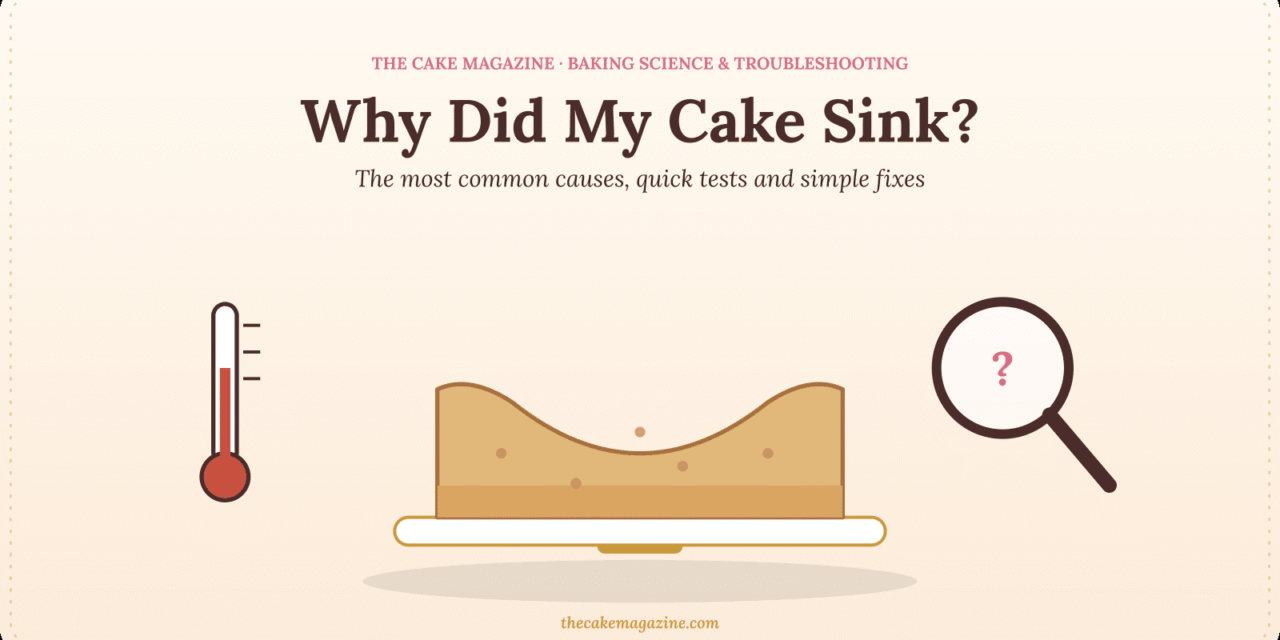
You pull the pans out of the oven, the cake looks gorgeous for about ninety seconds, and then the center slowly slumps into a dimple. If you are standing at the counter asking why did my cake sink, you are in very good company, because a sunken middle is one of the most common problems in home baking. A cake that falls leaves clues in its crumb, its crust and its timing, and this guide shows you how to read each one and fix it on the next bake.
Why did my cake sink? Almost always because the center had not finished setting when something shook its structure. The usual triggers are pulling the cake too early, opening the oven door during the first two thirds of the bake, an oven that runs hotter or cooler than its dial, too much leavening, or a batter with too much sugar, fat or liquid for the flour. Check your oven with a thermometer, weigh your ingredients, leave the door shut and test for doneness before you trust the timer.
- Why did my cake sink? What happens inside the pan
- Quick diagnosis: why did my cake sink? Match it to its clues
- Why did my cake sink? Underbaking and the early peek
- Why did my cake sink? Oven temperature, too cool or too hot
- Why did my cake sink? Too much, too little or tired leavening
- Why did my cake sink? Batter balance of sugar, fat, liquid and flour
- Why did my cake sink? Mixing mistakes that make a cake fall
- Why did my cake sink? Pan size, batter depth and heavy mix-ins
- Why did my cake sink if it is a sponge, chiffon or angel food?
- Why did my cake sink after the bake? Cooling, drafts and gummy bands
- Altitude, box mixes and other special cases
- Rescuing a sunken cake
- Prevention checklist: seven steps to a level cake
- FAQ
Why did my cake sink? What happens inside the pan
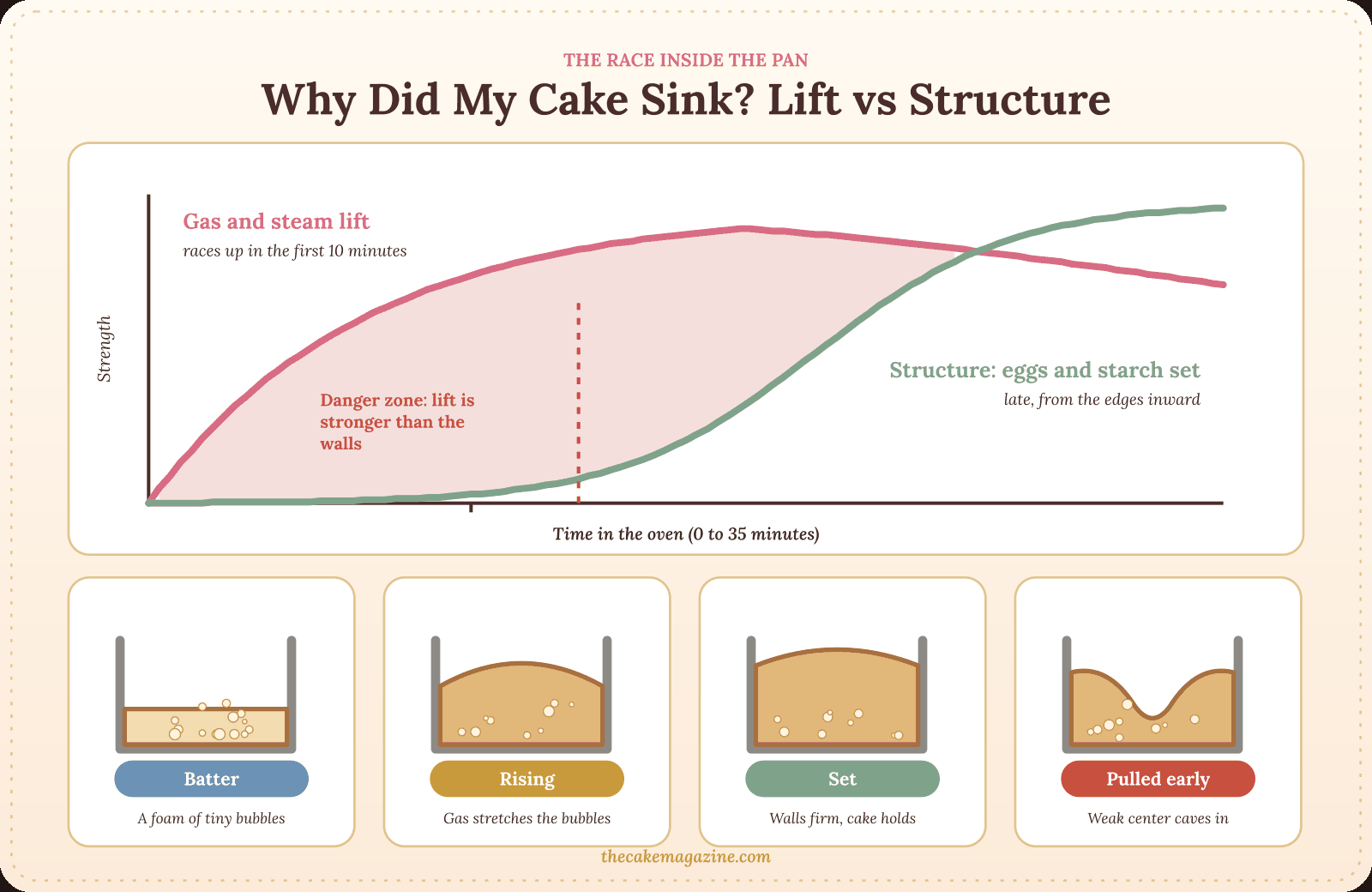
To understand why a cake falls, it helps to picture what the batter is doing in the oven. Raw cake batter is a foam made of tiny air bubbles, water, fat, sugar and flour. When heat reaches it, three things happen at roughly the same time. The gas in the bubbles expands, steam builds up, and the leavener (baking powder, baking soda or whipped eggs) keeps producing lift. If you want the full ingredient-by-ingredient picture, our guide to cake baking science covers it in depth.
The batter needs to rise, then set, in that order. Rising is the easy part. Setting is what matters. Starch granules in the flour swell and gel, and the proteins in the eggs and flour firm up into a network that holds the bubbles in place.
Once that network is strong enough to carry its own weight, the cake can leave the oven and survive the trip to the rack. If the cake is pulled before that point, or if something weakens the network, the walls of the bubbles cannot hold, and the middle drops.
The center is always the last part to finish. The edges touch hot metal and set first, which is why they stand up so confidently. The middle is insulated by all that batter around it, so it lags.
That is the key idea behind every cause in this article. A sunken cake is a cake whose center rose on gas, then ran out of structure before the gas ran out of steam. So the honest answer to why did my cake sink is nearly always about timing and strength, not bad luck.
Why did my cake sink in the oven vs on the rack?
When you ask yourself why did my cake sink, the first useful detail is when it fell. A cake that collapses while it is still in the oven, or the moment you open the door, usually has a structural or timing problem: too much lift, too little flour, a cool oven or a door opened too soon.
A cake that looks perfect in the oven and then settles over the next ten minutes on the rack is usually underbaked, which means the center was still wet and soft when it came out.
Both versions show up differently inside. A fully collapsed cake from the oven often has a coarse, open crumb with large holes where the bubbles grew and popped. An underbaked cake that slumped on the rack tends to have a damp, dense, slightly rubbery band across the bottom and a smooth, shiny dip on top. Cut the cake in half before you decide on a cause, because the crumb will tell you which story you are in.
A little sinking is normal
Not every dip is a failure. Many cakes, especially tender butter cakes baked at a moderate temperature, settle a few millimeters as they cool, and the top ends up slightly flatter than it looked in the oven. A shallow, even settling that leaves a soft, uniformly crumbed slice is perfectly fine.
The cause for concern is a deep crater with a wet or gummy center, a cake that is visibly shrunken from the sides of the pan, or a slice with a dense stripe that looks like uncooked batter. A shallow, even settle rarely needs the question why did my cake sink at all.
Before you blame the recipe. Recipes are written for one kitchen. If a recipe that works for thousands of other bakers sinks for you, suspect your oven, your measurements or your timing before you suspect the formula. Fixing those three things usually fixes the cake.
Quick diagnosis: why did my cake sink? Match it to its clues
Rather than guessing why did my cake sink, match what you see to the most likely cause. Use the flow chart below first, then read the matching section. If more than one clue applies, work through the causes in the order listed in this article, because they run roughly from most common to least common.
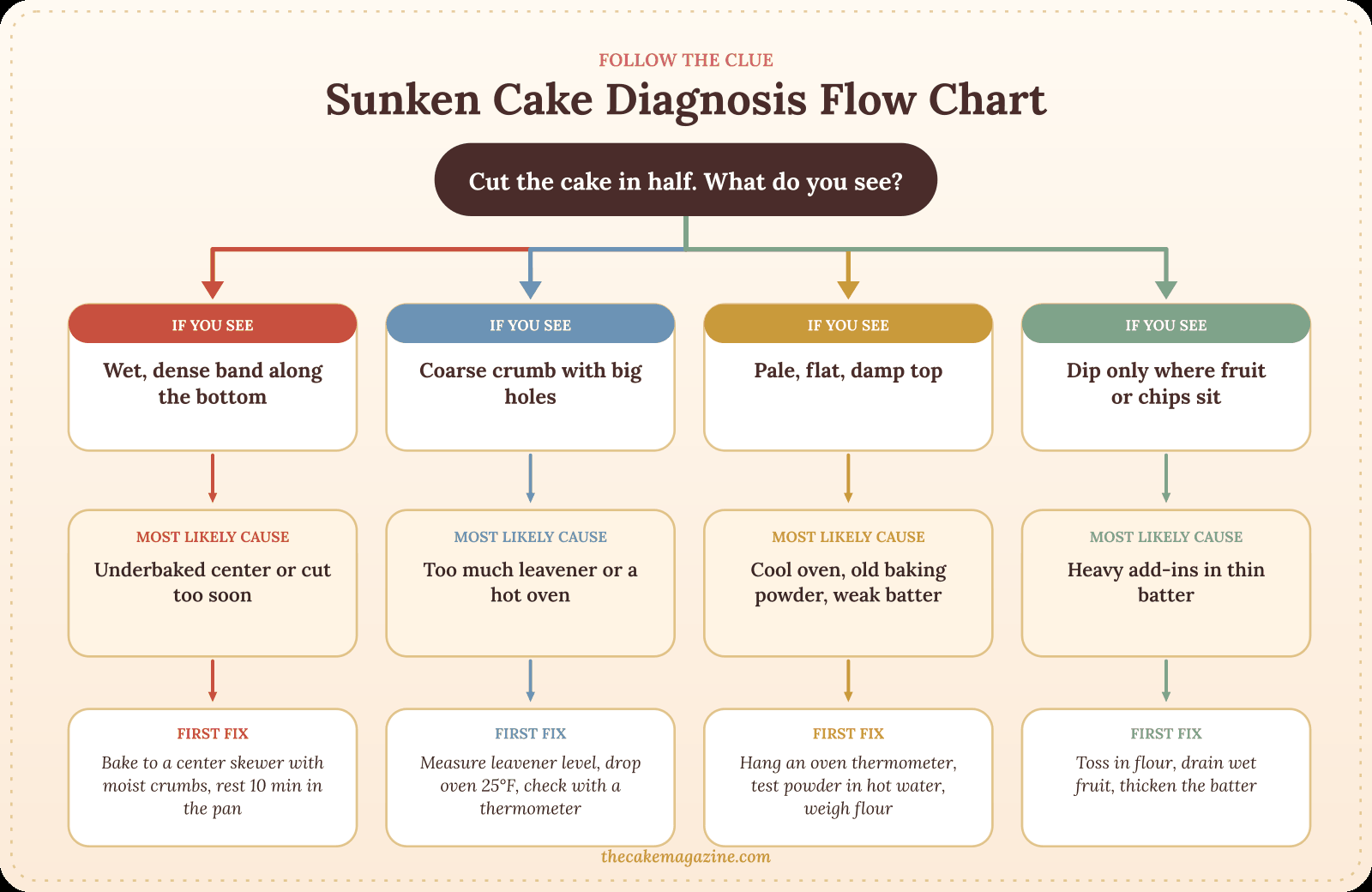
Wet, dense band along the bottom
This is the classic sign of an underbaked center or a cake that was moved or cut too early. Read the section on underbaking and the one on cooling and gummy bands.
Coarse, open crumb with big holes
The batter rose too fast and the bubbles burst. Look at too much leavening, an overly hot oven or too much air from overmixing.
Pale, flat, damp-looking top
Think about a cool oven, old leavener or too much sugar, fat or liquid. The batter never gained enough strength to hold itself up.
Cracked peak that falls after it cools
An oven that is too hot sets the crust early, the middle keeps pushing up and then drops. Check your thermometer first.
Sunk only around heavy fruit or chips
That is not a structural failure so much as heavy add-ins dragging through thin batter. Toss them in a little flour and use a thicker batter.
Sponge or chiffon that shrank in the pan
The whipped eggs deflated, or the cake was not cooled the way foam cakes need to be. See the section on foam cakes.
Questions to ask when you wonder why did my cake sink
If the flow chart leaves you with two suspects, a few direct questions can separate them. Did the top look wet or shiny when you took it out? That points to underbaking. Did it smell faintly metallic or taste soapy?
That points to too much baking soda or powder. Did the cake rise like a mountain and then crack before it sank? That points to heat. Did the edges brown fast while the center stayed pale? That also points to heat, or to a pan that was too large for the batter.
Write the answers down alongside the pan size, the oven temperature and the bake time. Two or three bakes of notes will show you a pattern that guessing never will. When bakers ask why did my cake sink again after fixing it once, the answer is usually a second problem that was hiding behind the first, and notes make that visible.
Why did my cake sink? Underbaking and the early peek
If I had to bet on a single answer to why did my cake sink, I would bet on underbaking, with an early peek as the runner-up. They are close cousins, and together they account for a large share of sunken centers.
Why did my cake sink when it looked done?
The surface of a cake browns and firms up long before the center reaches its set point. A golden top and pulled-in edges are encouraging but they are not proof. The batter in the middle has to climb to a temperature where the egg proteins firm and the starch gels. Until it does, the center is wet batter held up by hot steam, and when the steam cools and condenses, the middle falls.
This is why a toothpick or thin skewer is more trustworthy than a timer. Insert it into the center, not near the edge, and pull it out. A few moist crumbs clinging to it are fine. Wet, glossy batter means the cake needs more time. A skewer that comes out completely clean and dry usually means the cake is a minute or two past ideal, which is better than underbaked but still worth noticing.
Four doneness checks that work together
No single test is perfect, so use two or three together. Each one answers the question a little differently, and agreement between them is what you can trust.
- The skewer test. Insert it in the center. Moist crumbs mean done. Wet batter means keep baking.
- The spring-back test. Press the top lightly with a fingertip. It should bounce back, not hold a dent.
- The edge test. The cake should have just begun to pull away from the pan wall, with a faint gap at the sides.
- The thermometer test. Many bakers use an instant-read thermometer in the center and look for a range around 205 to 210°F for butter cakes. Treat that as a rough guide, because recipes vary, and compare it against your own good cakes.
For a closer look at these cues, including what each one looks like in practice, see our guide on how to tell when a cake is done without overbaking it. If your cake keeps coming out set at the edges but soft in the middle, our article on cakes that are done outside but raw in the middle walks through that exact pattern.
Why did my cake sink after I opened the oven door?
Opening the door lets a rush of cooler air into the oven, and the temperature can drop by a surprising amount in seconds. A cake that is still rising and has not yet set is delicate at that stage. The cooler air makes the gas in the bubbles contract, the rising stalls and the weak center can drop before it gets a chance to firm. This is the reason most cake recipes quietly say not to open the door for the first twenty minutes or so.
You can still check on a cake without wrecking it. Switch on the oven light and look through the glass instead. Wait until the cake has been in for at least two thirds of the shortest time in the recipe. When you do open the door, do it quickly and gently, and do not slam it shut, because the shock of a banged door can nudge a nearly set center.
Cake sinks right after you open the door
Likely causes: the door was opened too early, too often or for too long, or the cake was close to done but not quite set.
How to test: note the minute you first opened the door and whether the cake fell within the next few minutes.
Fix it next time: use the oven light, wait until at least two thirds of the baking time has passed, and rotate pans only once if you must.
Do not trust the timer alone
Recipe times are an estimate for an average kitchen. A dark pan, a hot oven, a fan-assisted setting, a crowded rack or a different batter depth can each move the finish line by five minutes or more. Set a timer for about five minutes before the earliest time in the recipe, run your tests, and then continue in short intervals until the cake passes them. This habit alone prevents a great many sunken cakes, and it answers why did my cake sink for many first-time bakers.
Why did my cake sink? Oven temperature, too cool or too hot
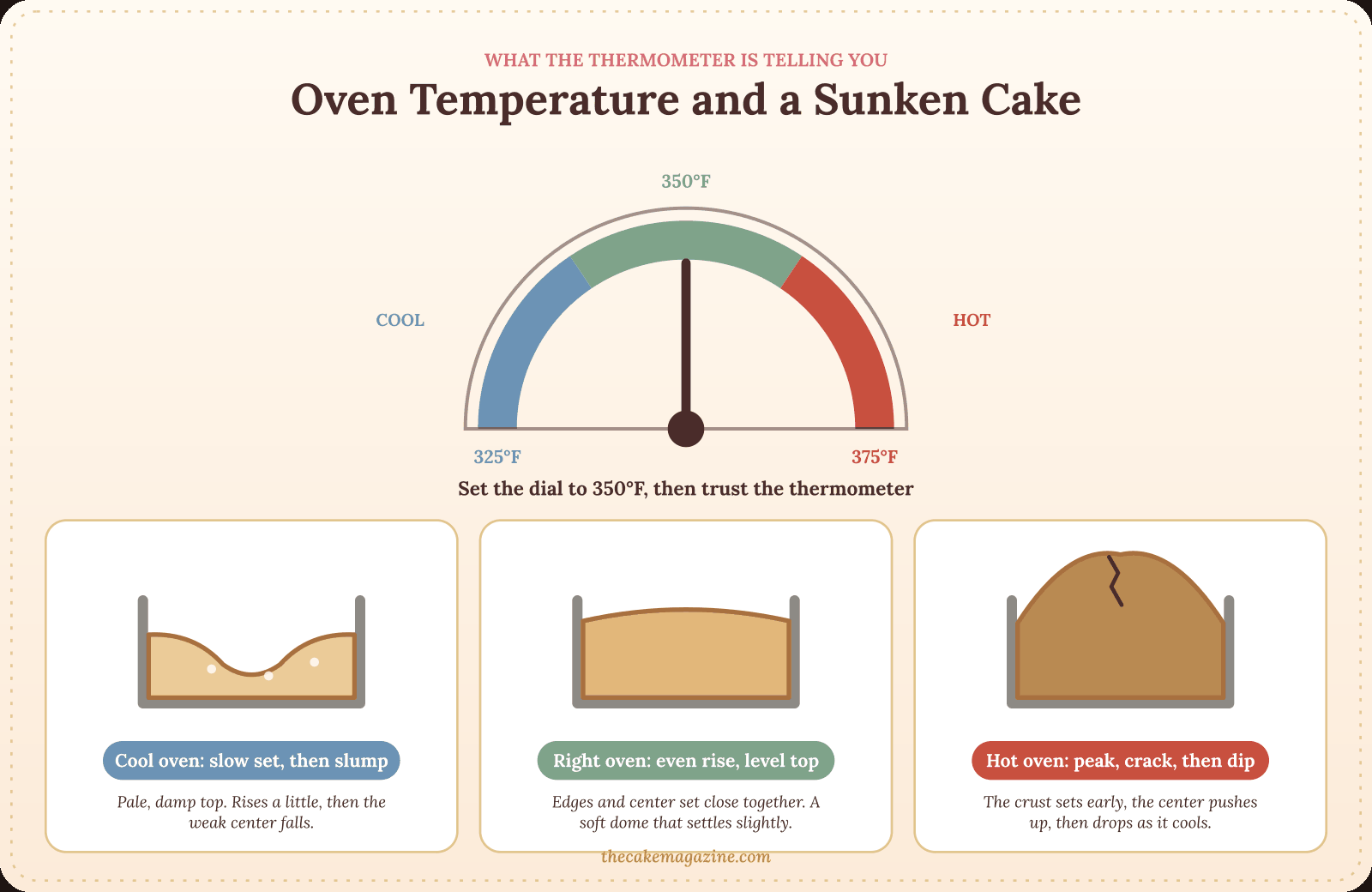
The second big answer to why did my cake sink is the oven itself. A home oven is less precise than the dial suggests. It heats and cools in cycles, and the number you set is an average at best. Some ovens run 25°F off, and a few are worse. King Arthur Baking, in its cake baking guide, advises preheating thoroughly and using an independent oven thermometer, since built-in readouts are often inaccurate.
Why did my cake sink in a cool oven?
A cool oven is the sneaky cause of a sunken center. The leavener starts working on schedule, so the batter rises, but the proteins and starch take far longer to set because the heat is weak. The bubbles keep growing, stretch thin and eventually give up. The result is a cake that rose a little, never quite firmed up and then slumped, often with a pale top and a damp, pasty center.
If your cakes are pale, take longer than the recipe says and sink in the middle, a thermometer reading well under your dial setting is your answer. Raise the dial by the difference, and the same recipe often behaves like a new one.
An oven that runs too hot
Heat that is too high tells a different story. The outside sets quickly, locking the edges in place, while the center is still liquid and keeps pushing upward. The cake rises into a high peak, often cracking along the top. Then, as the center finally sets or as the cake cools, the dome falls and leaves a crater or a dip beside the crack. The crumb is dense and sometimes dry at the edges and wet in the middle.
If you see a tall, cracked mountain that later falls, drop the oven temperature by 25°F and bake a little longer, or move to a lower rack position. Our guide to cake baking temperature, 325°F vs 350°F explains when a gentler oven is the better call.
Pale, damp cake that sinks and takes forever to bake
Likely causes: an oven that runs cool, a short preheat, or an oven door that was opened often.
How to test: hang an oven thermometer on the middle rack, preheat for 20 to 30 minutes and compare the reading to the dial.
Fix it next time: adjust the dial to match the real temperature and write the offset somewhere you will see it.
Tall, cracked dome that later falls
Likely causes: an oven that runs hot, a dark metal pan, or a rack set too low.
How to test: use the thermometer and check whether the bottom and edges brown much faster than the top.
Fix it next time: lower the temperature 25°F, use the center rack and consider cake strips around the pans for gentler, more even heat.
Preheating, so you stop asking why did my cake sink
An oven that beeps has told you only that the air near its sensor reached the target. The walls, the rack and the stone or steel inside are still catching up. Give the oven a full 20 to 30 minutes, and keep the thermometer visible while it does. Putting a cake into an oven that has not truly come up to temperature is the same as baking in a cool oven for the first part of the bake, which is exactly when the structure is most vulnerable.
Rack position and crowded ovens
Heat is not distributed evenly. A cake on a low rack gets a hot bottom and a pale top. A cake on a high rack browns quickly and sets a crust before the center rises. Bake layers on the center rack when you can.
If you must use two racks, stagger the pans so one does not sit directly over the other, and expect a few extra minutes. A crowded oven with pans touching the walls or each other blocks airflow and produces uneven rising, which can leave one side sunk and the other fine. If that sounds familiar, read our article on why cakes bake unevenly.
Convection and fan ovens
A fan moves hot air faster across the batter, which speeds setting on the surface and can dry the top. Many recipes assume a conventional oven. If you bake with a fan, many bakers lower the temperature by about 25°F, or turn the fan off for cakes, then watch the cake earlier than the recipe suggests. A fan that is too strong can also ripple the top of a delicate batter and set it unevenly, which produces a lopsided sink.
Why did my cake sink? Too much, too little or tired leavening
Leaveners create the gas that lifts a cake, and both extremes of using them can explain why did my cake sink. The balance between lift and structure is delicate, which is why bakers who change one measurement by eye often end up with a flop.
Too much baking powder or baking soda
When a batter has too much leavener, it produces more gas than the structure can carry. The cake shoots up fast, the bubbles stretch thin and the walls tear. The gas escapes, the structure collapses and the middle falls. Telltale signs are a coarse, open crumb with big holes, a slightly bitter or soapy aftertaste, and a cake that rose dramatically and then fell within minutes of leaving the oven.
A heaping teaspoon is not the same as a level teaspoon. Many butter cake recipes land in the range of roughly 1 to 1½ teaspoons of baking powder per cup (about 120 grams) of flour, but your recipe’s own number is the one to follow. Measure with proper spoons, level the top with a knife and whisk the leavener into the dry ingredients so it is evenly spread rather than sitting in a pocket.
Too little leavening, or a leavener that has gone stale
Old leavener is quieter and more common than a heavy hand. Baking powder loses strength over time, particularly if it has been exposed to humidity. The batter then rises weakly, never builds the tall, stretched structure it should have and sets dense and low, sometimes with a small sunken center. This is also why a cake can fail in the same way every time with one tin of baking powder and then behave after you buy a fresh one.
Test your baking powder in 30 seconds. Stir half a teaspoon into a little hot water. It should fizz vigorously right away. For baking soda, stir a pinch into a spoonful of vinegar or lemon juice and watch for strong bubbling. If either is weak, replace it, and write the date you opened the tin on the lid.
Baking soda needs an acid partner
Baking soda only produces gas when it meets an acid, such as buttermilk, yogurt, natural cocoa, brown sugar or lemon juice. If a recipe uses soda and you swap the acid for something neutral, the soda has little to react with, leaving an off flavor and weak rise.
The opposite also happens: too much acid with too little soda leaves the cake flat and heavy. When you substitute an ingredient, check whether it changes the acid balance. Our guide to baking powder vs baking soda in cake explains how the two work, when a cake needs both, and how to adjust.
Why did my cake sink even with perfect leavening?
Leavening is only half the equation. Even the right amount of baking powder will not save a batter that is too weak to hold its bubbles. The two sides, lift and structure, have to match. If a cake keeps sinking after you have checked the oven and the leavener, the problem is more likely in how the batter is balanced, which is the next piece of the puzzle.
Why did my cake sink? Batter balance of sugar, fat, liquid and flour
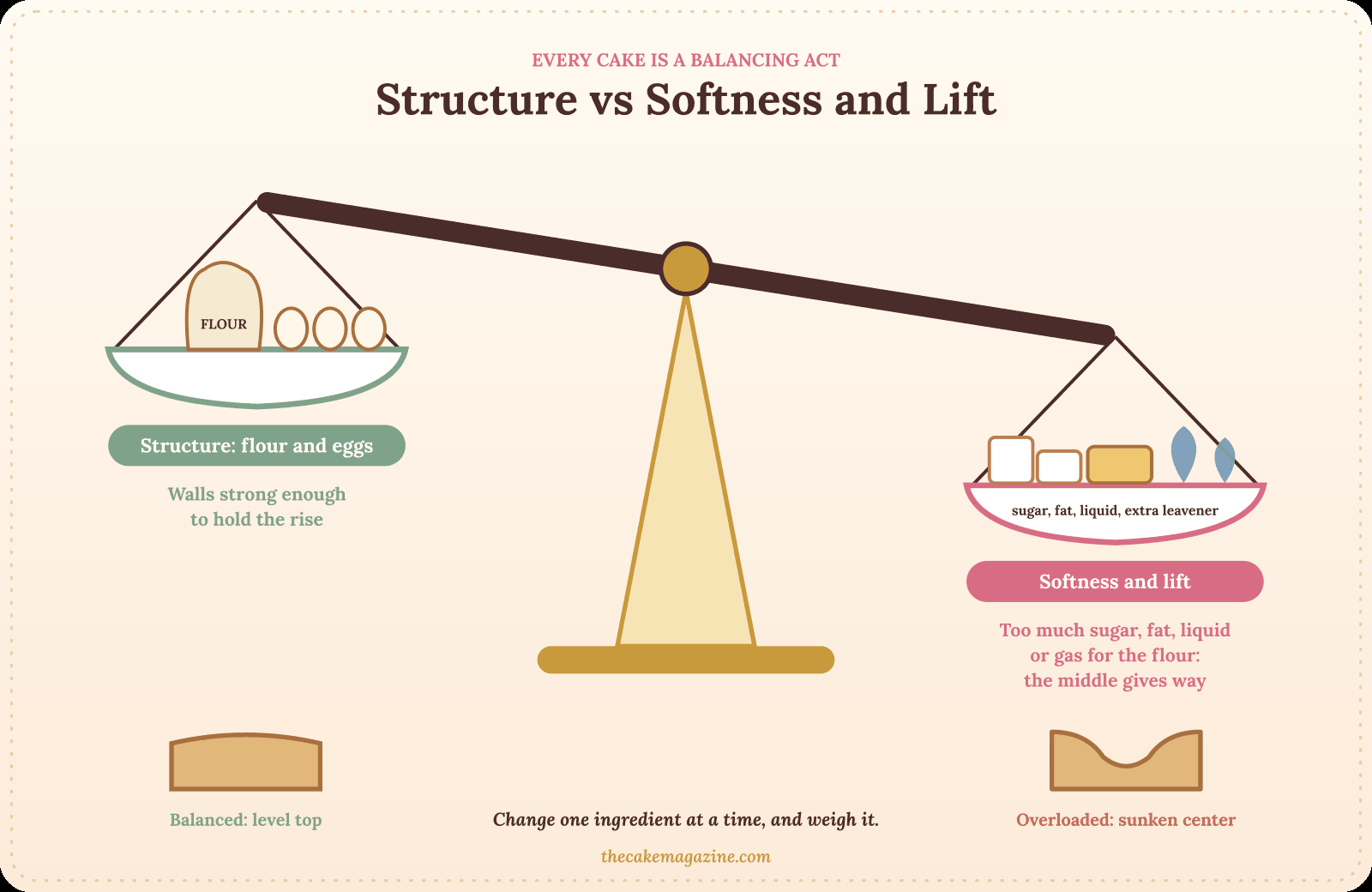
Flour and eggs build the walls of a cake. Sugar, fat and liquid make those walls tender, moist and flavorful, but if there is too much of any of them, the walls become too soft to hold up. That is why a recipe that looks only a little off on paper can produce a cake that falls. This is the part of the puzzle that most bakers overlook when they ask why did my cake sink.
Too much sugar: a hidden answer to why did my cake sink
Sugar does far more than sweeten. It attracts water, softens the crumb and delays the point at which the egg proteins and starch set. A modest amount produces a lovely tender cake. Too much holds the structure in a soft, unset state for too long, so the cake may rise and then fall before it firms. Cakes with excess sugar also brown quickly, and the top can look done while the center is still wet.
If you are reducing or increasing sugar for taste, change it slowly, in steps of 10 percent at a time, and note the result. Cutting sugar by a lot can make a cake tough and dry, and adding a lot can make it collapse. The balance in a tested recipe is deliberate.
Too much fat, liquid or egg
A batter that is too wet has less flour doing the structural work for each bubble. Fat interferes with gluten and starch in much the same way sugar does, so an extra splash of oil or melted butter can turn a springy cake into a delicate one that cannot support its center. Extra liquid, such as a generous pour of milk, extra egg or a very juicy fruit puree, spreads the structure thin in the same way.
This often happens when you adapt a recipe. Swapping applesauce, mashed banana, pumpkin or yogurt for part of the fat looks harmless, but each one adds water. Moist add-ins are best swapped one ingredient at a time and by weight, then judged with a skewer instead of a timer.
Too little flour and why did my cake sink after a swap
Flour is the main source of structure, and an error here is invisible until the cake falls. A cup of flour scooped straight from the bag can weigh noticeably more than a cup that was spooned and leveled, and the opposite mistake, using a loosely spooned cup in a recipe that was written for scooping, leaves the batter short on structure.
Weighing is the fix. Our guide on how to measure flour for cake, cups vs grams shows how small differences add up and gives reliable weights to work from.
Flour type matters too. Cake flour has lower protein and produces a more tender but also more delicate cake, and substituting it one-for-one in a recipe designed for all-purpose flour can leave you with a weaker structure. Read more about the trade-offs in cake flour vs all-purpose flour.
Eggs, temperature and the emulsion
Eggs supply protein for structure and help bind the fat and water into a smooth batter. Cold eggs or cold butter can cause the batter to curdle or split, which leaves pockets of fat and water that bake unevenly and weaken the crumb. A curdled-looking batter will usually still bake, but it can produce a heavy, sunken or greasy cake.
If the batter looked split, that may be why did my cake sink. Bring eggs, dairy and butter to a cool room temperature, around 65 to 68°F for the butter, and the batter will emulsify smoothly. Our piece on room-temperature ingredients for cake covers which ones matter most.
Cake with a tender, almost wet crumb that sinks after cooling
Likely causes: too much sugar, fat or liquid for the amount of flour, or flour that was under-measured.
How to test: weigh your ingredients and compare them to a trusted formula for the same size pan.
Fix it next time: use weights, change only one ingredient at a time and add a tablespoon or two (about 8 to 16 grams) of flour only if the recipe is clearly under-structured.
Why did my cake sink? Mixing mistakes that make a cake fall
Mixing builds the air bubbles the leavener will later inflate, and it develops the gluten that supports them. Too little or too much of either and the structure wobbles. If you have ruled out the oven and the measurements and still wonder why did my cake sink, look at how you mixed.
Overmixing: why did my cake sink after the flour went in?
Once flour meets liquid, gluten begins to form. A little gluten is useful, because it gives the cake some strength. Too much makes the batter tight and elastic, and as it bakes the cake rises hard, tunnels and then contracts as it cools. You get a tough, rubbery crumb with long holes and often a sunken center. The cure is simple. Mix the last additions of flour only until no dry streaks remain, then stop.
A stand mixer makes overmixing easy, because it does the work so quickly. Finish by hand with a spatula for the last few folds. If you are choosing between mixers, our stand mixer buying guide and the guide to hand mixers can help you pick one that gives you good control.
Undermixing and underbeating the butter
Creaming butter and sugar traps tiny air pockets in the fat. Those pockets are the seeds that the leavener’s gas later fills. If you cream for only thirty seconds, the batter has few seeds, so the cake rises poorly and can set dense, with a small dip. Cream butter and sugar until pale and fluffy, usually three to five minutes with a mixer, scraping the bowl twice. The butter should be cool and pliable, not greasy or melting.
Different recipes use different methods, from creaming to reverse creaming to one-bowl mixing, and each one fails in its own way. Our overview of cake mixing methods explains what each method is designed to do, so you can match your technique to your recipe.
Too much air
It may sound odd, but a batter beaten with too much air can sink. Large air bubbles rise through the batter quickly, burst at the surface and leave a coarse crumb with weak walls. Beating on high speed after you add the eggs, or whipping a batter for a long time after adding the flour, can create exactly this. Slow down, and keep to a medium-low speed once the dry ingredients go in.
Slow assembly and standing batter
Baking powder starts reacting as soon as it touches liquid, and many double-acting powders release a first burst of gas at that point. A batter that sits on the counter while you prepare pans or wait for an oven to heat loses some of that early lift. Get the pans greased and the oven hot before you start mixing. Once the batter is mixed, pour it, level it and bake it without a long wait.
Banging the pan
Tapping the filled pan on the counter once or twice helps release large bubbles and level the batter, and that is a good thing. Dropping it hard, or repeating the tap several times, knocks out too much air and can compress a delicate batter. One or two gentle taps is enough.
Why did my cake sink? Pan size, batter depth and heavy mix-ins
The pan is part of the recipe. If you change it without adjusting anything else, you change how the cake heats, rises and sets, and that can answer a surprising number of questions about why did my cake sink.
A pan that is too large or too small
Swapping a 9-inch pan for an 8-inch pan packs more batter into less space. The cake becomes deeper, the edges set long before the center and the middle can sink or stay raw. A pan that is much larger than the recipe expects gives a thin layer that bakes quickly and may dry out or pull away from the sides. Use the pan size the recipe names, and if you must change it, use our cake pan conversion guide to adjust batter and time.
Filling pans too full and why did my cake sink
Most cake recipes call for filling a pan about halfway to two thirds. A cake needs room to rise, and a pan filled to the brim will either overflow or rise so high that the center cannot set before the edges do. Overfull pans are a classic reason for a volcano that collapses into a crater. If you have extra batter, bake it as cupcakes in a separate tin rather than squeezing it in.
Dark, glass and insulated pans
A dark metal pan absorbs more heat than a shiny aluminum one, so the edges and bottom set faster and the dome rises higher. Glass and ceramic are slow to heat and hold heat for a long time, so the outer batter keeps cooking after it leaves the oven.
Air-gap pans insulate and slow the bake. Each one changes how the center behaves. If you use glass or dark metal, many bakers drop the temperature by about 25°F and watch the clock. Our cake pan buying guide explains how pan material and color influence results.
Heavy fruit, chips and nuts
Blueberries, chocolate chips and chopped nuts can sink to the bottom of a thin batter, leaving a dense, wet layer and a hollow top. This is not quite the same as a collapsed center, but it looks similar when you cut the cake.
Toss the add-ins in a spoonful of the recipe’s flour, fold them in at the end and make sure the batter is thick enough to hold them. Very wet fruit, such as fresh strawberries or canned pineapple, releases juice as it bakes, so drain it well and pat it dry before folding it in.
Fruit or chips sunk to the bottom, leaving a damp layer
Likely causes: thin batter, heavy or wet add-ins, or overmixing after the add-ins went in.
How to test: lift a spoonful of batter. It should hang from the spoon for a second rather than run off.
Fix it next time: coat the add-ins in flour, drain wet fruit, fold gently and spread the batter evenly.
Cake strips and even heat
Cake strips are damp fabric bands wrapped around the pan that slow the heat reaching the sides. The edges bake at nearly the same pace as the center, so the cake stays flatter and rises more evenly. They are helpful for tall layers and for ovens that run hot, but they also lengthen the baking time, so keep testing for doneness. Our guide on why cakes dome goes further on that subject.
Why did my cake sink if it is a sponge, chiffon or angel food?
Foam cakes depend on whipped eggs or egg whites for most of their lift. They have little or no chemical leavener, so they are more sensitive to technique, and many bakers ask why did my cake sink after a sponge or chiffon flops.
Deflated egg foam: why did my cake sink
Whipped egg whites are fragile. Any trace of fat, including a speck of yolk, grease on the bowl or oil on the beaters, keeps the whites from reaching full volume. Underwhipped whites cannot carry the batter, and overwhipped ones turn dry and clumpy, so they do not fold in smoothly. Use a clean, dry bowl, whip to soft or stiff peaks as the recipe says and fold the whites in with a wide spatula in a few confident strokes.
Folding too roughly
Folding is a gentle cut-and-turn motion that keeps as much air as possible. Stirring or beating at that stage knocks out the bubbles that were meant to lift the cake. Add the whites in two or three parts, folding the first portion in more briskly to lighten the batter and the rest gently. Stop as soon as no streaks remain.
Cooling the way foam cakes need
Angel food and some chiffon cakes are cooled upside down in their tube pans, which holds the structure stretched while it sets. If you cool one right side up, it often shrinks and sinks. Hang the pan on its feet or over a bottle neck, as the recipe says, and do not unmold until the cake is completely cool.
Do not grease a tube pan for angel food or chiffon. These batters need to cling to the pan walls as they climb. A greased pan lets them slip, and the cake can collapse. Follow your recipe’s pan instructions exactly.
Why did my cake sink after the bake? Cooling, drafts and gummy bands
Sometimes the cake is baked properly and then something happens afterward. This is a less frequent answer to why did my cake sink, but it is worth knowing.
Turning out the cake too soon
A cake needs a few minutes in the pan after baking so the structure can firm up under its own weight. Most layer cakes rest in the pan for about 10 minutes before they are flipped onto a rack. Take a cake out too early and it can crack, stick or sink. Wait longer and it can steam and turn gummy at the edges. Ten minutes is a reliable starting point for 8- and 9-inch rounds, then run a thin knife around the edge and invert.
Cutting into a warm cake
A warm cake is still setting. Starch continues to firm up as the cake cools, and cutting too early gives you a damp, gummy slice, with a band that looks underbaked even if the cake was actually done. If you suspect the cake is gummy, wait until it is fully cool before judging. Our guide on gummy layers in a cake goes into that band in more detail.
Temperature shock and drafts
Moving a hot cake from the oven straight into a very cold or drafty spot can cause the surface to contract faster than the center. Set cakes on a wire rack in a draft-free corner of the kitchen. Do not put a hot cake into the refrigerator, and do not cover it while warm, which traps steam and turns the top sticky.
Bumping and jarring
A cake in the oven is at its most delicate in the last stage before setting. Slamming a cabinet beside the oven, stomping across a floor or sliding a rack in and out can shake a nearly set cake. It is a small effect, but with a cake already on the edge, it can be enough.
Altitude, box mixes and other special cases
Some situations change the rules a little. If you have worked through the causes above and are still asking why did my cake sink, one of these may apply.
High altitude
At higher elevations, air pressure is lower. Gas expands more easily, liquids evaporate faster and batters rise quickly before the structure is ready. At around 3,000 feet and above, many cakes puff up and then collapse. Bakers commonly respond by using a little less leavener and sugar, a little more flour or liquid and sometimes a slightly hotter oven, but the right numbers depend on your elevation and recipe. Make changes in small steps, and read our full guide on high-altitude cake baking for a methodical approach.
Box cake mixes
Box mixes are designed to be forgiving, but they sink too, usually for the same reasons: an inaccurate oven, overmixing, opening the door or a pan that does not match the directions. Another common cause is adding extra ingredients, such as additional eggs, oil, sour cream or pudding mix, that the mix was not formulated for. Follow the package directions first, and change one thing at a time when you want a richer cake.
Humidity and kitchen conditions
On a very humid day, flour absorbs moisture and sugar draws it in, so a batter can behave a bit wetter than usual. If your cakes sink only in the summer, a slightly longer bake or a touch more flour (a tablespoon or two) can help, though the first thing to check is still the oven. Store flour in a sealed container so that it does not take on moisture.
Very rich, dense or heavily flavored cakes
Cakes loaded with chocolate, nut butter, fruit puree, cream cheese or cooked custards are heavier and wetter than a standard layer cake. Many of them are designed to be soft in the center, and a small dip is part of the recipe. Flourless chocolate cakes, for example, often settle by design. Check the recipe’s own description before you decide the cake failed. Our chocolate cake recipe shows a layer cake that is rich but built to stay level.
Substitutions that quietly change the structure
Gluten-free flour blends, egg replacers, sugar substitutes and plant-based milks all behave differently from their traditional counterparts. They can absorb more or less water, set at a different pace and release gas differently. If you are baking with substitutions, start with a recipe designed for them rather than converting a standard recipe, and expect to experiment.
Rescuing a sunken cake
Once the cake has fallen, the question changes from why did my cake sink to what can I do with it now. The answer depends on how bad the dip is and whether the center is cooked. A sunken cake is almost always still delicious, and there are several ways to make it look intentional.
First, check that the center is cooked
Cut a small wedge from the center before you decide what to do. If the crumb is set and just a little damp, you can use the cake. If the middle is raw, wet batter, it is not ready, and a cake containing raw egg and flour should not be eaten as is.
The USDA Food Safety and Inspection Service has general guidance on cooking and handling food safely at fsis.usda.gov, including its Clean, Separate, Cook and Chill basics, and it reminds cooks to wash their hands after handling uncooked eggs.
If the cake is clearly raw in the center but is still in the oven, you may be able to save it. Lower the temperature a little, tent the top with foil if it is browning and bake for another 10 to 15 minutes. Check again with a skewer. A cake already out of the oven and cooled generally cannot be returned for more baking without drying the edges, although a low oven for a short time can sometimes firm a slightly damp center.
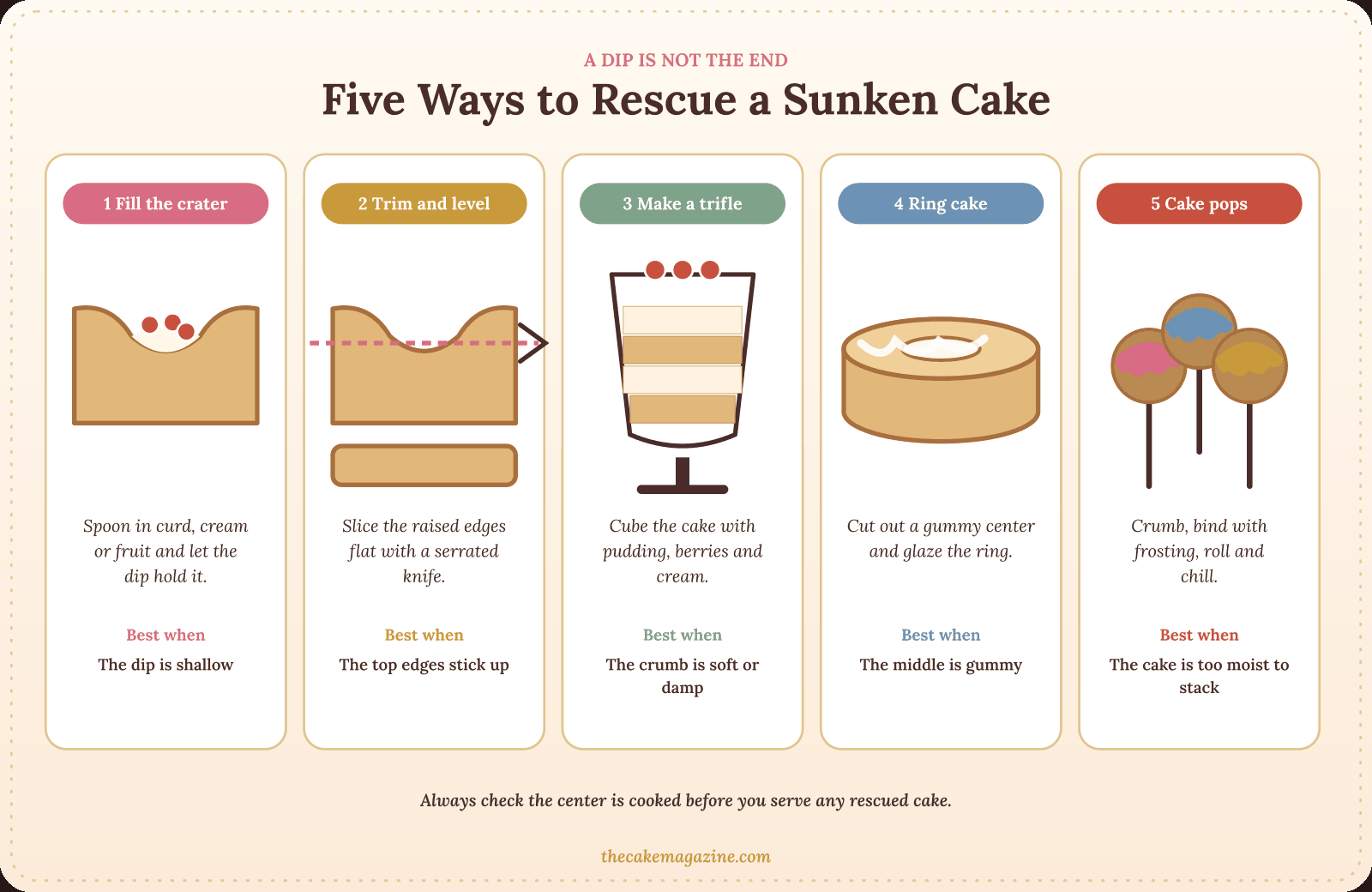
Five ways to turn a dip into a feature
- Fill the crater. Spoon in whipped cream, pastry cream, lemon curd, ganache or fresh fruit. A shallow dip becomes a built-in well for the filling.
- Trim and level. For a layer cake, slice off the raised edges with a serrated knife so the top is flat, and use the trimmed layer as the bottom tier. The frosting hides the rest.
- Make a trifle. Cube the cake and layer it with pudding, berries and whipped cream in a glass bowl. A soft or slightly damp crumb works beautifully here.
- Cut out the center. If only the middle is gummy, cut it away with a round cutter and use the ring as a crown for a cake bowl or a ring cake with a glaze.
- Crumb it. Dry the cake pieces in a low oven, then use them for cake pops, parfaits or ice cream toppings.
For decorated cakes, you can level a dip with a thin layer of frosting, a crumb coat and a short chill. Our guides to smooth buttercream sides and sharp edges and to cake decorating for beginners show how to fill gaps and finish a cake so a small flaw disappears.
What not to do
Do not press down on a sunken center to flatten it, because that packs the crumb and makes it gummier. Do not try to hide a wet center under a thick layer of frosting without cooking it further, since the moisture can make the frosting slide. And do not throw the cake away until you have tasted it, since most fallen cakes taste exactly like the ones that stood tall.
Prevention checklist: seven steps to a level cake
Everything above comes down to a small routine. Go through it each time you bake, and you will almost never need to ask why did my cake sink again.
1. Check the oven
Hang a thermometer on the center rack, preheat 20 to 30 minutes and adjust the dial to the real temperature.
2. Weigh everything
Use a scale for flour, sugar and liquids. Level the small spoons for leavener and salt.
3. Refresh the leavener
Test the baking powder in hot water. Replace it if the fizz is weak, and write the date on the tin.
4. Mix with intent
Cream until fluffy, then stop mixing as soon as the flour is incorporated. Fold the last bit by hand.
5. Use the right pan
Match the size the recipe names, fill it no more than two thirds and tap once to settle the batter.
6. Leave the door shut
Look through the glass. Test for doneness only after two thirds of the shortest time has passed.
7. Cool before judging
Rest 10 minutes in the pan, then cool fully on a rack in a draft-free spot before you cut.
A simple baking log
A notebook next to the oven pays for itself. After each bake, jot down the recipe, pan, oven temperature (dial and thermometer), bake time, ingredients you changed and how the cake turned out. After a few entries, you will see which variable lines up with your best cakes. If you want to dig deeper into the chemistry and cause-and-effect behind each of these steps, our big picture cake troubleshooting guide covers dryness, density, cracks and more in one place.
Which cakes are the most forgiving?
If you are building confidence after a few failures, begin with a sturdy oil-based or butter-based cake with a moderate amount of sugar and no delicate folding. A simple vanilla layer, such as the best vanilla cake recipe on this site, gives you a baseline to learn your oven with. Once you can bake that cake reliably, you will have a reference point for every other recipe.
Common mistakes at a glance
- Trusting the dial instead of a thermometer.
- Measuring flour by scooping a cup into the bag.
- Opening the door early, or more than once.
- Using stale baking powder.
- Overmixing after the flour goes in.
- Filling the pan past two thirds.
- Pulling the cake because the top looks done.
- Changing several variables in the same bake.
FAQ: why did my cake sink and what to do next
Why did my cake sink in the middle after it came out of the oven?
The most likely reason is that the center was not fully set. The edges firm up first, so the cake looks done, but the middle is still held up by steam. As it cools, the steam condenses and the center drops. Bake until a skewer in the center comes out with moist crumbs, not wet batter, and check your oven with a thermometer.
Why did my cake sink after I opened the oven door?
Cooler air rushed in, the gas in the bubbles contracted and the weak, unset center dropped. Cakes are most fragile before they have set. Keep the door shut for at least the first two thirds of the shortest baking time, use the oven light to look, and open and close the door quickly and gently when you do need to test.
Can too much baking powder make a cake sink?
Yes. Too much leavener makes a cake rise very fast and then collapse, because the bubbles stretch beyond what the batter can hold. You may see a coarse, holey crumb and taste a bitter or soapy edge. Measure with level spoons, follow the recipe’s amount and whisk the leavener thoroughly into the flour.
Can old baking powder cause a cake to sink?
It can. Stale baking powder produces too little gas, so the cake rises weakly and sets dense, sometimes with a small dip in the center. Test it by stirring half a teaspoon into hot water. It should fizz strongly. If it barely bubbles, replace it and write the date you opened the new tin on the lid.
Why did my cake sink even though it passed the toothpick test?
A toothpick only samples one spot. It may have missed a wet pocket, or the cake may have been close to done but not quite set. Try a longer skewer in the center, press the top for spring-back and check for a slight pull from the pan. A thermometer reading in the 205 to 210°F range is a useful extra check for many butter cakes.
Is a slightly sunken cake safe to eat?
If the cake is cooked through, yes. Cut a small wedge from the center and check that it is set, not raw and wet. A cake with raw batter in the middle should not be eaten as it is. For general guidance on cooking and handling food safely, see the USDA Food Safety and Inspection Service at fsis.usda.gov.
Why did my cake sink only in the center and not at the edges?
That is the typical pattern because the center sets last. The batter along the edges touches hot metal and firms up early, while the middle lags. If the center sinks, either it was not baked long enough, the oven was too hot or too cool, or the batter was too weak to carry the rise. Work through those three checks in order.
Why did my cake sink when I used a different pan?
A different size, depth, color or material changes how the batter heats. A smaller pan makes a deeper cake whose center can stay raw, and a dark or glass pan can set the edges too soon. Match the pan to the recipe, or adjust the batter and bake time with a conversion guide, and test for doneness instead of trusting the original timer.
Why did my cake sink after I reduced the sugar or fat?
Sugar and fat affect more than sweetness and richness. They change how the crumb sets, how much air the batter holds and how tender the cake is. Cutting them by a large amount can unbalance the recipe either way. Change one ingredient at a time, by small amounts, and weigh everything so you can compare results from bake to bake.
Why did my chiffon or sponge cake sink?
Foam cakes rely on whipped eggs, so the most common culprits are underwhipped or overwhipped whites, traces of fat in the bowl, rough folding and cooling the cake the wrong way up. Whip in a clean, dry bowl, fold gently and follow the recipe’s instructions about cooling a tube pan upside down.
Can I fix a sunken cake that is already baked?
You can usually make it work. Fill the dip with cream, curd or fruit, trim and level the layer, or turn the cake into a trifle or cake pops. If the center is raw, it needs more baking and cannot be rescued once cooled. Always check the center before you decide which route to take.
How do I stop asking why did my cake sink every time I bake?
Build a routine: confirm your oven temperature with a thermometer, weigh the ingredients, test your leavener, mix only until combined, use the right pan and leave the door shut. Keep a short baking log so patterns show up. After a few bakes, you will know your oven well enough to predict problems before they happen.
Final thoughts
When a cake sinks, it feels personal, but it is really a message. The center told you it was not ready, or that the oven was off, or that the batter was too light on structure for its lift. Once you know how to read that message, why did my cake sink becomes a question with a short, practical list of answers instead of a mystery.
Start with the three easiest wins: an oven thermometer, a kitchen scale and a closed oven door. Then check your leavener, mix gently and test for doneness with a skewer before you trust the timer. Change one thing at a time, write down what happened and be patient with yourself. A sunken cake is still cake, and every one makes the next one better.
If you are still stuck, note your pan size, oven type, recipe and what the crumb looked like when you cut it, then compare those details with the sections above. The pattern is usually there once you look for it.
Editorial note: reviewed and updated November 2026. This guide is general baking education for home bakers using American measurements, drawn from common baking principles. Results vary by oven, altitude and ingredients, and nothing here has been tested in a laboratory. Food safety information is general, so refer to official sources such as the USDA Food Safety and Inspection Service for guidance on handling eggs and raw batter.