You pull a stick of butter out of the fridge, glance at the recipe, and see the same line you have seen a hundred times: everything should be at room temperature, the kind of room temperature ingredients cake recipes always seem to want. It sounds like fussy advice until you skip it and the batter turns into a curdled, greasy puddle.
Room temperature ingredients cake recipes depend on are not a matter of tradition. They change how air gets into the batter, how fat and water mix, and how evenly the cake rises. This guide explains which ingredients really need the wait, which ones do not, and how to get there fast and safely.
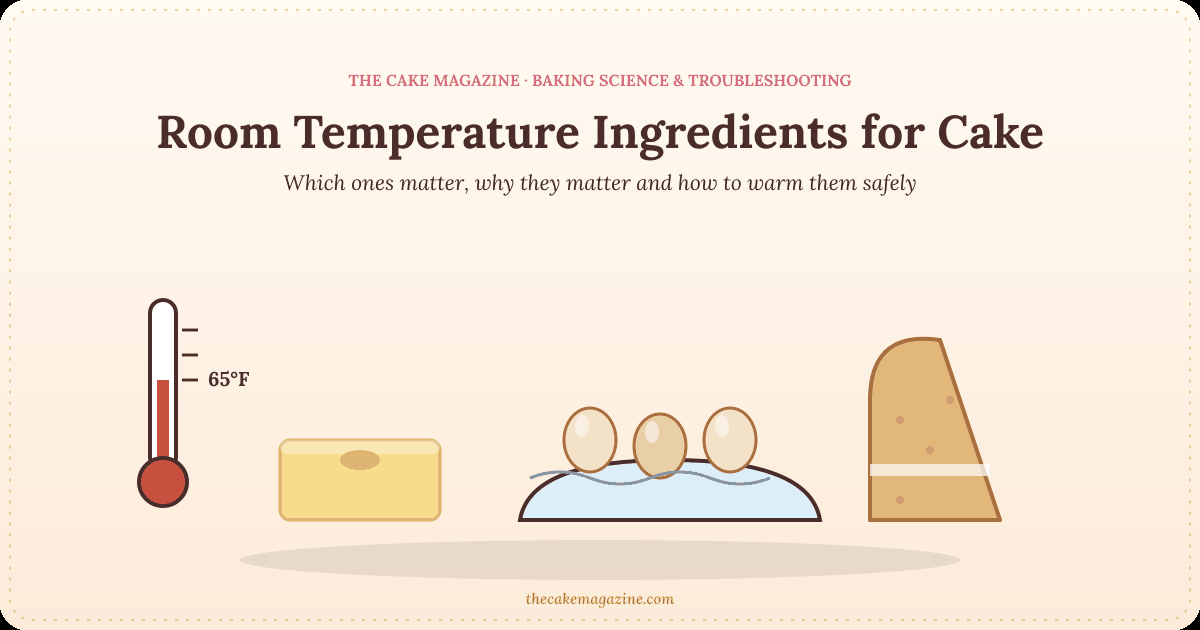
For most butter cakes, the room temperature ingredients cake batter needs are the butter, the eggs and any milk, buttermilk or sour cream. Butter should be cool and pliable, around 65°F, not warm and shiny. Eggs and dairy should simply be taken off the chill, around 68 to 72°F. Flour, sugar and oil do not need to match. When ingredients are at similar temperatures, they blend into a smooth emulsion that traps air, bakes evenly and gives you a fine, tender crumb.
- What “room temperature” actually means in a cake recipe
- Why temperature changes the batter
- Butter: the ingredient that matters most
- Eggs: why cold ones break a batter
- Milk, buttermilk, sour cream and cream cheese
- Room temperature ingredients cake bakers can skip
- How the mixing method changes the rules
- Safe ways to warm ingredients quickly
- Hot kitchens, cold kitchens and batter temperature
- Curdled, greasy or heavy batter: what to do
- Room temperature ingredients cake types need, one by one
- A closer look at fat, air and water
- Myths about room temperature ingredients cake advice
- A baking day timeline
- Common mistakes with room temperature ingredients cake recipes
- FAQ
What “room temperature” actually means in a cake recipe
When a recipe asks for room temperature ingredients, cake bakers often picture whatever is sitting on the counter. That is not quite the idea. A summer kitchen can sit near 80°F, and a winter one can dip into the low 60s. The target the recipe is really describing is a narrow, cool-to-the-touch range, usually somewhere between 65 and 72°F, depending on the ingredient.
Butter is the clearest example among the room temperature ingredients cake recipes rely on. Sally’s Baking Addiction describes properly softened butter as about 65°F, cool to the touch, and says a finger press should leave a dent without the stick sliding or looking greasy. That is cooler than many kitchens, which surprises people. It is also why butter left out all day in July is often too soft to cream well, even though it technically sat at room temperature.
Eggs and dairy are the less touchy room temperature ingredients cake batters call for. They only need to lose the sharp chill of the refrigerator, which sits at 40°F or below according to the USDA Food Safety and Inspection Service. A cold egg and a 70°F egg behave very differently in a batter, but a 68°F egg and a 74°F egg behave almost the same.

A working temperature chart
Use this room temperature ingredients cake chart as a starting guide rather than a rule. Bakers’ kitchens, thermometers and butter brands all vary, so treat these numbers as ranges and learn what each one feels like in your hands.
- Butter for creaming: about 65°F, firm but able to take a thumb dent without squishing out.
- Whole eggs: roughly 68 to 72°F, which feels neutral or barely cool in your palm.
- Milk and buttermilk: roughly 68 to 72°F, no longer cold on your lip or fingertip.
- Sour cream and yogurt: roughly 68 to 72°F, loosened enough to stir smooth.
- Cream cheese: about 65 to 70°F, soft enough to whip without lumps.
- Flour, sugar, cocoa: whatever your pantry is, because these are dry ingredients.
Using room temperature ingredients cake recipes ask for does not mean chasing a thermometer around the kitchen for every bake. Learn the touch test for butter and eggs, take a few readings so your hands know what 65°F feels like, and then relax. The goal is “even and cool”, not “exactly 68.4 degrees”.
Why temperature changes the batter
A cake batter is an emulsion, which means it holds two things that normally refuse to mix: fat and water. Butter is mostly fat, with a little water and milk solids. Eggs and milk are mostly water. Getting them to hold together in tiny, stable droplets is what makes a batter smooth and what lets it bake into a tender, even crumb. Temperature decides how willing each ingredient is to cooperate, which is the whole case for room temperature ingredients cake bakers keep hearing about.
That is the heart of why room temperature ingredients cake batter relies on matter. Cold fat is stiff and breaks into hard bits when it meets other ingredients. Warm fat is soft and blends easily, but if it gets too warm it melts and can no longer hold air. Somewhere in the middle, butter is plastic, meaning it is flexible, workable and able to wrap around air bubbles. That window is narrow, and the rest of the ingredients should be brought close to it.
Butter and the air it holds
When you cream butter and sugar, the sugar crystals cut tiny pockets into the butter and the pockets fill with air. Those air cells are the seeds of your cake’s crumb. Baking powder and soda release gas that expands the cells, and steam from the liquid does the same in the oven. Without air in the batter, leaveners have nothing to inflate, and the cake bakes up dense.
Butter that is too cold cannot hold much air, because the crystals in the fat are too rigid to be reshaped around bubbles. Butter that is too warm holds air for a minute and then loses it as the fat turns oily and the bubbles drain out. This is why “room temperature” for butter means cool and pliable rather than soft and shiny. The cake baking science guide covers how this air feeds the rest of the structure, and why room temperature ingredients cake layers depend on stay level.
The emulsion and what cold liquid does to it
Once the creamed butter is airy, you add eggs and liquid. If those are cold, they chill the butter on contact and the fat firms up into small, hard flecks. The water has nowhere to go, so the batter separates and looks curdled or broken, with a grainy surface and little pools of liquid.
A curdled batter is not always ruined, as the troubleshooting section below shows, but room temperature ingredients cake batters need make it far less likely. But it often bakes into a coarser cake with a tighter, more uneven crumb, because the emulsion that was supposed to hold air in place has failed. Room temperature ingredients cake batters keep together tend to rise higher and slice more cleanly.

What the evidence says, and what it does not
It is worth being honest here about room temperature ingredients cake claims. The mechanism behind room temperature advice is well established in food science, and sources like King Arthur Baking and America’s Test Kitchen teach it the same way. But how large the effect is varies by recipe, and the specific temperature numbers in circulation are practical guidelines, not laws. This site has not run a lab trial on them, so treat the figures in this guide as sensible starting points.
If you want a fuller picture of how fat, sugar, eggs, flour and leaveners interact, the King Arthur Baking cake guide is a dependable place to continue reading.
Butter: the ingredient that matters most
If you only have time to get one thing right in any room temperature ingredients cake recipe, make it the butter. In a creamed cake, butter is the engine. It carries the air, it carries the flavor, and its temperature decides how well everything else blends in. The room temperature ingredients cake recipes list first, whether it is a vanilla layer, a pound cake or a spice cake, almost always starts with butter.
What properly softened butter looks and feels like
Press the stick lightly with a finger. It should leave a clear dent without the butter feeling squishy, and the surface should look matte rather than glossy. If you bend a stick, it should bow without snapping and without folding in on itself. When you cut through it with a knife, the knife should glide with a little resistance, not slide through like warm clay.
Another trick for judging butter is to look at its sheen. Glossy, wet-looking butter has started to melt at the edges and is already past ideal. Butter that is truly cold feels hard and waxy and will crack if you flex it. Learn the in-between feeling and you will rarely need a thermometer.
You can nudge cold butter along with a few more minutes of mixing. Once butter has softened into a greasy paste, the crystal structure that holds air is gone for good. If it happens, put the bowl in the fridge for 10 to 15 minutes, then try creaming again.
How long butter takes to soften
On a normal day, a whole stick of cold butter usually needs about an hour to reach a good creaming temperature, and sometimes two in a chilly kitchen. Sally’s Baking Addiction suggests roughly one to two hours depending on weather. Cut the butter into tablespoon-sized pieces and it can be ready in about 20 to 30 minutes, because more surface area warms faster.
Pieces also make room temperature ingredients cake butter easier to judge. You can press a cube and see exactly how it behaves. If some pieces are warmer than others, rearrange them so the cooler ones sit on the outside.
Why you should not microwave butter
The microwave heats unevenly, so you end up with a melted pool next to a frozen core. Even a few seconds can ruin the texture, and melted-then-chilled butter does not return to its original structure. If you are in a hurry, use the grating, pounding or pieces method in the quick methods section below.
Unsalted butter and the cake’s flavor
Most room temperature ingredients cake recipes, including those on this site, are written for unsalted butter so you can control the salt. Salted butter works in a pinch, but brands vary a lot in how much salt they contain, so you may want to reduce the added salt slightly. Temperature rules do not change between the two. Both should be cool and pliable.
For more on how butter’s structure shapes cake texture, see the creaming approach used in our vanilla cake recipe, where butter temperature decides how fluffy the layers turn out.
Eggs: why cold ones break a batter
After butter, eggs are the next place a cake batter goes wrong. An egg straight from the refrigerator is around 40°F. When you pour it into a bowl of 65°F creamed butter, the butter instantly stiffens around it. The egg stays liquid, the butter clots, and the mixture breaks into a curdled mess that looks like cottage cheese. Room temperature ingredients cake batters bake from stay smooth because the eggs slip in without shocking the fat.
Eggs also whip better when they are not cold
Temperature does a second job for eggs in foam cakes, where room temperature ingredients cake sponges need are mostly the eggs. Warm yolks and whites loosen up, so they trap more air when beaten. A sponge cake whipped from cold eggs takes longer to build volume and is more likely to come out smaller and denser. Many sponge recipes take it one step further and warm the whole eggs gently with sugar over a pan of hot water before whipping.
If you want to try that method, the cake mixing methods guide explains when foam and warm-sponge techniques apply and how they differ from creaming.
How to warm eggs safely
The simplest approach to room temperature ingredients cake eggs is to set the eggs in a bowl of warm tap water for about ten minutes. Sally’s Baking Addiction recommends this window, and it works because the shell is thin and the water carries heat quickly. Use warm water you can comfortably hold your hand in, not hot, because hot water can start to cook the white near the shell.
Another option is to crack the cold eggs into a small bowl and let them sit on the counter while you measure the rest of your ingredients. Cracked eggs warm in 10 to 15 minutes. Either way, do not let the eggs sit out for long. The USDA Food Safety and Inspection Service says refrigerated shell eggs should not be left out for more than two hours.
Treat eggs as a perishable ingredient, even when a recipe wants room temperature ingredients cake style. The “room temperature” step is a brief warm-up before baking, not a reason to leave eggs on the counter all morning. For official guidance on storing and handling eggs, see the USDA Food Safety and Inspection Service. This is general information, not medical advice.
Eggs and the order you add them
Even with warm eggs, add them one at a time, mixing on low or medium speed until each disappears into the batter before adding the next. Dumping them in together overloads the emulsion. If the batter starts to look slightly grainy anyway, add a spoonful of the measured flour and keep mixing. The flour soaks up extra water and pulls the batter back together.
Size matters too. A recipe written for large eggs expects about 50 grams per egg out of the shell. If you only have medium or jumbo eggs, weigh them. Weighing is the single most useful habit for consistent cakes, a point the flour measuring guide makes about dry ingredients as well.

Milk, buttermilk, sour cream and cream cheese
Liquid dairy is the third piece of the room temperature ingredients cake puzzle. Milk, buttermilk, sour cream and yogurt all enter the batter after the eggs, usually alternating with the flour. If they are cold, they do the same thing cold eggs do: they chill the fat and cause tiny curdles. The effect is a little milder because liquids spread more easily, but it is real. Room temperature ingredients cake recipes list for dairy are there for the same reason as the butter.
Milk and buttermilk
For room temperature ingredients cake milk, measure what you need and let it stand on the counter for 20 to 30 minutes while you prepare pans and weigh the dry ingredients. In a pinch, microwave a measuring cup in 10-second bursts, stirring between each one. Aim for just-barely-cool, never warm. Sally’s Baking Addiction notes that cold dairy other than butter can be microwaved about 10 seconds to take off the chill.
Buttermilk has a second job. Its acidity reacts with baking soda to produce gas and to tenderize the crumb. Warming it does not weaken that acid. If you do not have buttermilk, a common substitute is milk with a spoonful of lemon juice or vinegar stirred in and rested for a few minutes, but flavor and thickness will differ slightly.
Sour cream and yogurt
Thick dairy is trickier because it is hard to warm evenly. Scoop out the amount you need into a bowl and leave it for 30 minutes, then stir until smooth. If it is still stiff, give it a few seconds in the microwave on low power, stirring well. Sour cream cakes have a famously tender crumb, and keeping the sour cream at a similar temperature to the batter is part of why.
Cream cheese
Cream cheese turns up in the batter of some cakes and in the frosting of many more. Cold cream cheese stays in lumps no matter how long you beat it, and those lumps show up as little pale specks in the finished cake or as a gritty frosting. Soften the block, still wrapped, on the counter for 30 to 60 minutes, then beat it alone until smooth before adding sugar or butter.
The same rule applies when you move to frosting. Butter that is cool and pliable is what makes a clean, fluffy American buttercream. If the butter is too warm, the frosting looks soupy; too cold, and it looks curdled and lumpy.
Cream and sweetened condensed milk
Heavy cream added to a batter follows the same logic as milk. Cream whipped for a filling is the opposite: it whips best when it is cold. Always read the recipe’s wording. “Room temperature” appears when the dairy is part of a batter. “Cold” appears when you need to whip it.
Room temperature ingredients cake bakers can skip
Not every ingredient on a room temperature ingredients cake list needs to be at the same temperature. If you treat every item on the list as equally urgent, you will waste time and stress yourself out before you start. Here is where you can relax.
Flour, sugar, cocoa and salt
Dry ingredients are not part of the emulsion, so room temperature ingredients cake rules skip them, so they do not shock the fat. They are almost always at pantry temperature already. The one exception is flour stored in the freezer for pest control or long-term storage. Let it come to room temperature in a closed container first, because cold flour can chill the batter and clump as condensation forms.
Oil
Oil cakes do not ask for creamed butter, and vegetable oil stays liquid at any normal kitchen temperature. You can use it straight from the cupboard. The eggs and dairy in an oil cake still benefit from being off the chill, because they blend more easily and the batter stays uniform. But the stakes are lower than in a butter cake.
Melted butter
When a recipe calls for melted butter, the melting is the point. Let it cool until it is warm rather than hot, so it does not cook the eggs or deflate the batter. It does not need to return to 65°F.
Leaveners
Baking powder and baking soda are dry and shelf stable. Their temperature does not matter, but their freshness does. The baking powder versus baking soda guide shows how to test them, because a stale leavener causes flat cakes that bakers sometimes blame on ingredient temperature.
Ingredients that should stay cold
Some recipes want the opposite. Pie crusts, biscuits and scones rely on cold butter that stays in flakes. Whipped cream and some mousse fillings whip best when chilled. The rule “bring everything to room temperature” belongs to cake batters and some enriched doughs, not to all baking.
Must be room temperature
Butter for creaming, eggs, milk, buttermilk, sour cream, cream cheese in batter.
Helps, but forgiving
Eggs and dairy in oil cakes, melted butter cooled slightly, frozen flour thawed.
Does not matter
Sugar, cocoa, salt, baking powder, baking soda, oil, vanilla extract.
Keep cold
Butter in pastry, whipping cream for filling, chilled custards.
How the mixing method changes the rules
Whether room temperature ingredients cake rules matter depends on how the cake is mixed. Cake recipes fall into a handful of families, and each treats temperature a little differently. Knowing which family you are baking tells you where to spend your effort. The cake mixing methods guide goes deeper into each technique; this section covers only the temperature side.
Creaming method: temperature matters most
Classic butter cakes, like a vanilla layer or a pound cake, start by beating butter and sugar until pale and fluffy. This is the method where room temperature ingredients cake batters need are strictest. Butter has to be at that cool, pliable 65°F, and the eggs and milk should be close behind. A mistake early on is hard to repair later, because the air you build in the first few minutes is the air the cake will have.
Cream for about three to five minutes at medium speed, scraping the bowl once or twice. The mixture should look lighter in color and noticeably fluffier. If it looks greasy and slick instead, the butter was too warm.
Reverse creaming: more forgiving
In reverse creaming, you mix the dry ingredients with soft butter first, so the flour coats the fat, and then add the liquids. The flour coating protects the batter from some of the temperature shocks, and the crumb comes out fine and velvety. Butter still should be cool and pliable, but cold eggs and milk are less likely to cause a break because the fat is already dispersed.
That makes it a decent choice on a day when you are short on time or the kitchen runs cold, though you should still take the chill off the liquids.
Oil and one-bowl cakes: the easiest
Oil cakes, such as the chocolate cake in our chocolate cake recipe, are mixed with a whisk and do not rely on creamed air. The temperature of the butter is irrelevant because there is no butter. Eggs and dairy still blend better when they are not icy, and very cold buttermilk can make the batter feel stiff, but the margin for error is generous. If you are nervous about temperature, this is the place to start.
Foam cakes: eggs matter, butter does not
Sponge and chiffon cakes get their lift from whipped eggs. Here, warm eggs whip faster and higher. If a genoise recipe asks you to warm the eggs and sugar over simmering water, follow it. Any melted butter folded in at the end should be warm and liquid, not hot, or it will knock the foam flat.
Whipped egg whites for angel food and chiffon work a bit differently: whites separate more easily when cold, but they whip to a better volume once they have warmed slightly. Separate the eggs straight from the refrigerator, then let the whites stand for 20 to 30 minutes.
Quick reference by method
Creaming
Butter at about 65°F, eggs and milk near 70°F. Strictest of all the methods.
Reverse creaming
Butter cool and pliable, liquids lightly warmed. More forgiving of small mistakes.
Oil or one-bowl
No butter temperature to worry about. Take the chill off eggs and dairy so the batter stays smooth.
Foam or sponge
Warm eggs whip higher. Fold in melted butter only when it is warm, not hot.
Safe ways to warm ingredients quickly
Everyone forgets to take out the butter sometimes, and room temperature ingredients cake recipes still need it. The good news is that most of the wait can be shortened, as long as you aim for even, gentle warming and avoid anything that melts the fat. These are the methods bakers use most, ordered from the ones that work best to the ones that need care.

Butter: cube it, flatten it or grate it
Cut the cold stick into half-inch cubes and spread them on a plate. In 15 to 30 minutes they will be pliable. For something even faster, place the butter between two sheets of parchment and roll it flat with a rolling pin to about a quarter inch. The thin sheet loses its chill in about ten minutes.
You can also grate cold butter on a box grater straight into the mixing bowl. The shreds soften in just a few minutes. Another option is to pound the butter with the pin until it bends, which warms it by friction without melting. In every case, check the butter by pressing, not by guessing.
The warm glass trick
Fill a glass with hot tap water, let it sit for a minute, pour out the water and dry the glass. Place it upside down over a stick of butter for five to ten minutes. The trapped warmth softens the outside gently. Replace the glass if the butter begins to shine.
Eggs: warm water bath
Put the eggs, still in their shells, into a bowl of warm tap water for about ten minutes. Swap the water once if it cools down. This is the safest, easiest method and works for any number of eggs. Dry the shells before cracking so water does not drip into the bowl.
Milk and buttermilk: short microwave bursts
Warm the measured liquid in 10-second bursts, stirring in between. You are not trying to heat it, only to bring it up to roughly 70°F. If it feels warm on your finger, it has gone too far, and you should let it cool for a few minutes. Hot liquid scrambles eggs and melts butter in the batter.
Cream cheese and sour cream
Cut cream cheese into cubes and leave them on the counter, or set the foil-wrapped block in a bowl of warm water for 10 to 15 minutes. For sour cream, scoop it into a bowl and stir every few minutes as it warms. Do not microwave cream cheese for more than a few seconds at low power or it can turn grainy.
Do not melt the butter and call it softened, do not leave eggs out overnight and do not warm dairy until it is hot. Shortcuts should bring ingredients to a cool, even temperature, never to a warm or melted one. When a shortcut fails, it is better to wait 15 more minutes than to bake a cake with a broken batter.
Planning ahead is still easier than any shortcut
The most reliable way to get room temperature ingredients cake recipes want is also the least exciting: set out butter and measure your cold ingredients before you do anything else. By the time pans are prepped and the oven is hot, the butter and dairy are ready. If you bake often, take out butter for tomorrow’s cake at night and cut it into cubes on a plate in the morning. Just remember the two-hour guideline for eggs and perishable dairy.
Hot kitchens, cold kitchens and batter temperature
The recipe says “room temperature”, but your room is not the recipe writer’s room. A bakery with the ovens running can feel like summer all year, and a drafty winter kitchen can keep butter hard for hours. Understanding how your own kitchen behaves is part of getting room temperature ingredients cake bakers rely on to cooperate.
If your kitchen is warm
In hot weather, butter softens quickly and may go from perfect to greasy while you are not looking. Take it out later, not earlier, and check it every ten minutes. Chill your mixing bowl for 10 minutes in the refrigerator before creaming. If the batter starts to look glossy and loose, stop, chill the whole bowl for 15 minutes and resume.
Dairy and eggs can be handled the same way. Keep them in the refrigerator until just before you need them, and take off only the sharpest chill. A 75°F egg is not a better egg than a 68°F one when the butter is at its limit.
If your kitchen is cold
In a cold kitchen, butter takes longer than an hour and may never get past the firm stage. Use the cube method, work in a slightly warmer part of the house or set a bowl near, not on, a warm stove. A small amount of extra creaming time also helps, since mixing generates its own warmth. Warm your mixing bowl with hot tap water, then dry it thoroughly.
Batter temperature as a clue
When ingredients are properly tempered, batter often ends up in the low 70s Fahrenheit, and some professional bakers check it as a quality check on their process.
A home baker does not need to do this, but an instant-read thermometer in the batter once or twice can teach you a lot. If your batter is far cooler than expected, it will take longer to rise and bake. If it is much warmer, leaveners may start working before the pans reach the oven.
Batter temperature also connects to oven behavior. A cold batter in a hot oven sets differently from a room temperature batter, which is one reason the cake troubleshooting guide recommends checking ingredient temperature when layers come out dense.
Humidity and altitude
High humidity does not change how butter softens much, but it can make cooled cakes feel sticky. At high altitude, the main concerns are moisture and leavening, not ingredient temperature. Those issues belong to a separate discussion, covered in our high-altitude cake baking guide.

Curdled, greasy or heavy batter: what to do
Even careful bakers end up with a batter that looks wrong. When it happens, do not panic and do not throw it out yet. Most problems tied to ingredient temperature can be improved, and some cakes bake perfectly well from a batter that looked terrible in the bowl.
The batter looks curdled
A curdled batter has a grainy, cottage-cheese look, with liquid pooling around small lumps of butter. It usually means cold eggs or milk hit the creamed butter. Add a tablespoon of the measured flour, and mix on low. The flour absorbs free water and helps the fat and liquid come back together.
If that does not work, set the bowl in a larger bowl of warm water for 30 seconds while stirring with a spatula, then mix again. Do not leave it long. A few degrees is all you are after. Once the batter smooths out, finish the recipe as usual.
The batter looks greasy or soupy
If your batter is glossy and slack, the butter was probably too warm to hold air. Chill the bowl in the refrigerator for 15 to 20 minutes, then mix on low speed to see if it tightens. It will not be perfect, but it often gets close enough to bake. The cake may be a little denser, which is a reminder to cool the butter earlier next time.
The cake came out dense or heavy
If the cake is already baked and dense, ingredient temperature may be one cause among several. Overmixing, old baking powder, too much flour and an underheated oven can all cause the same result. The dense cake guide walks through the whole list so you can find the real culprit instead of guessing.
The cake has oily patches or tunnels
Greasy streaks and shiny spots can happen when butter was too warm or the emulsion broke and the fat separated. Our guide to greasy cakes covers this in detail. Long tunnels and large holes usually point to overmixing or too much leavener, though poorly mixed batter pockets can contribute. See cake tunnels and large holes for the diagnosis.
Quick fix card: broken batter
Likely cause: cold eggs or milk added to creamed butter, or butter that was too warm to begin with.
Test: look at the batter after the last egg. Is it grainy, separated or glossy and loose?
Fix now: add one tablespoon of the recipe’s flour and mix low. Warm a curdled batter briefly with a warm water bath, or chill a soupy batter for 15 minutes.
Prevent next time: bring eggs and milk off the chill, keep butter near 65°F, and add eggs one at a time.
Room temperature ingredients cake types need, one by one
The general rules hold across the board, but each style of cake leans on temperature in its own way. A pound cake is nearly all emulsion, while a cheesecake is mostly about avoiding lumps. Here is how room temperature ingredients cake types of every kind put the idea to work, so you can adjust without hunting for a separate rule each time.
Layer cakes and sheet cakes
Classic butter layers are the main reason this advice exists. They have a lot of butter, a moderate amount of liquid and a leavener that needs air cells to inflate. Cool butter, warm-ish eggs and dairy near 70°F give the batter its smooth look and the cake its even, fine crumb. A sheet cake is the same batter in a wider pan, so the rules do not change.
If layers come out domed or uneven despite good temperatures, look at the oven and the pan before blaming the butter. Our guide to why cakes dome explains how heat and pan size shape the top.
Pound cakes
Pound cake leans heavily on creaming, so room temperature ingredients cake rules bite hardest here, and a good one may have little or no chemical leavener at all. Because the air in the batter does most of the lifting, the butter temperature matters even more than in a layer cake. Cream longer, add the eggs slowly and keep everything near 68 to 70°F. The payoff is a close, buttery crumb with a fine, even texture.
Cupcakes and muffin-style cakes
Cupcakes use the same batters as layer cakes, so the same room temperature ingredients cake rules apply. Small cups bake fast, which means mistakes show up quickly: a dense, greasy or sunken cupcake is often a clue that the butter was too warm or the batter broke. Fill the liners evenly and bake right away, because a batter that sits loses air.
Cheesecake
Cheesecake is the one place where room temperature ingredients cake bakers think of as optional are actually a hard requirement. Cold cream cheese leaves tiny lumps that never smooth out, and cold eggs can cause the filling to curdle. Soften the cream cheese, beat it alone until creamy, then add the sugar and warm eggs one at a time on low speed. Mixing slowly keeps air out, which helps prevent cracks.
Chiffon, angel food and sponge cakes
These cakes get nearly all their lift from beaten eggs, so room temperature ingredients cake sponges need are mostly about eggs, so egg temperature rules the show. Warm whites and yolks whip to a larger volume than cold ones. Chiffon cakes add oil and egg yolks to the mix, and angel food uses only whites. Separate eggs cold, because yolks are less likely to break, and let the whites stand about 20 to 30 minutes before whipping.
Carrot, banana and other fruit cakes
Many of these cakes are oil based and use grated or mashed fruit, which adds moisture and tolerance. Temperature still helps the eggs and dairy blend, but the batter is thick and forgiving. If a recipe calls for butter instead, follow the creaming rules. Overly cold mashed banana or buttermilk can chill the batter, so take the chill off before mixing.
Boxed mixes
Cake mixes contain emulsifiers and dried ingredients designed to tolerate real-world kitchens, so cold eggs and water usually work. Follow the package directions. If you are doctoring a mix with melted butter or sour cream, the same advice about not using hot ingredients applies.
A closer look at fat, air and water
If you like knowing why room temperature ingredients cake advice works, this section goes a little deeper. You do not need any of it to bake a good cake, but it explains why the advice has stayed consistent across so many cookbooks and why it shows up on practically every recipe card for butter cakes.
Butter is a solid and a liquid at the same time
Butter is a mixture of different fats that melt at different temperatures. Some are solid at fridge temperature and others stay soft, which gives butter its unusual range of textures. At around 65°F, a good share of the fat is solid but the crystals are small and slide past each other, so the butter bends without breaking. That is the plastic state bakers want.
At refrigerator temperature, the crystals lock together and the butter turns brittle. At warm kitchen temperatures, more of the fat has melted, and the structure loses its grip on air. This is a general description of how butter behaves, and the exact temperatures shift with the brand, the season of the milk and the butterfat content.
Sugar crystals as tiny shovels
During creaming, sugar crystals scrape across the butter and carve out air pockets. That job needs butter that is firm enough to resist, but soft enough to give. Cold butter shatters, warm butter smears, and neither makes the neat pockets the batter needs. Granulated sugar is the traditional choice because its sharp crystals do the work well.
Eggs as emulsifiers
Egg yolks contain lecithin, a natural emulsifier that helps fat and water stay together. When the eggs are close in temperature to the butter, the lecithin can do its job as the mixture blends. Cold eggs lock the butter into hard clusters before the emulsifier can spread out. That is the physical reason behind curdling when you add cold eggs to creamed butter.
Leaveners need somewhere to go
Baking powder releases gas when it gets wet and again when it heats up. That gas has to go into existing bubbles, because it rarely creates new ones. A batter with plenty of small, stable air cells gives the gas a place to land, and the cake rises evenly. A batter with few cells forces the gas into a few large holes, which is how tunnels and a coarse crumb happen.
Temperature and the speed of baking
A cooler batter takes longer to heat through, which affects doming and bake time. A batter that is much warmer than expected begins to set sooner at the edges. This is one reason ingredients that match each other produce more predictable results from bake to bake. You can read more about how heat, structure and timing interact in our cake baking temperature guide.
Myths and half-truths about room temperature ingredients cake advice
Room temperature ingredients cake advice gets passed around with little context, and some of it is more confident than it should be. Sorting the useful parts from the folklore can save you time and keep you from fussing over things that do not matter.
“Room temperature means 72 degrees or higher”
Not for butter. A kitchen that warm will make butter too soft for creaming if it sits long enough. For butter, the target is cooler, around 65°F, and it is the texture that counts. For eggs and dairy, a few degrees either way barely matters.
“If the butter is cold, just beat it longer”
Longer beating does not fix cold butter. It tends to produce a lumpy mixture that eventually warms through friction, but by then the structure is uneven. A short wait is better than extra beating.
“Cold ingredients always ruin cakes”
They do not. Many oil cakes and boxed mixes turn out fine with cold ingredients, and some bakers deliberately use cold buttermilk. The rule is about particular batters and methods. Room temperature ingredients cake recipes depend on most are the creamed butter ones.
“You must measure the temperature with a thermometer”
A thermometer is a handy learning tool, but your fingers are enough once you have practiced. Press the butter, feel the egg shell and trust what you see in the bowl. If the batter looks smooth and fluffy, the temperatures were fine.
“Warm milk is better than cool milk”
Warm milk is not the goal. Lukewarm is acceptable, but warm or hot liquid can melt the butter in the bowl or cook the eggs. Aim for just off the chill.
“Room temperature rules apply to every dessert”
Pie dough, biscuits, scones and puff pastry all rely on cold fat to stay flaky. Whipped cream, meringue stabilizers and some custards also work best cold. Only apply the room temperature rule where the recipe calls for it, usually in cake batters, cookies and some quick breads.
Bakers disagree about how much any of this matters in practice, and the effect depends on the recipe. If your favorite cake turns out well with slightly cold milk, you do not have to change it. Use the advice here when you are chasing a better crumb or fixing a problem, not as a rule that must never be broken.
A baking day timeline
The easiest way to make sure room temperature ingredients cake recipes need are ready is to treat temperature as part of the schedule. A simple timeline turns “plan ahead” into a short list of actions you can follow even on a busy day. The times below are guidelines for a typical kitchen around 68 to 72°F, so shorten or lengthen them to fit yours.
About an hour before mixing
Take the butter out of the refrigerator and cut it into cubes on a plate. Measure the milk, buttermilk or sour cream into a small bowl and leave it on the counter. If your recipe uses cream cheese, set it out too. This is also a good moment to read the recipe once more and confirm whether it is a creaming, reverse creaming, oil or foam method.
Thirty minutes before mixing
Place the eggs in a bowl of warm water. Heat the oven so it reaches temperature in time. Prepare the pans, line them with parchment and weigh your dry ingredients. Sift if the recipe asks. Press a cube of butter: if it dents without feeling greasy, you are on track.
Ten minutes before mixing
Check the butter again, swap the water around the eggs, and stir the sour cream or buttermilk smooth. Make sure your oven is actually at temperature with an oven thermometer. If you are baking on a hot day, chill the mixing bowl.
During mixing
Cream the butter and sugar until pale. Add the eggs one at a time. Alternate the dry ingredients and the liquids, beginning and ending with the dry. Stop as soon as the batter looks smooth. The cake baking science guide explains why overmixing at this stage ruins the tender crumb you worked to build.
Before you bake
Divide the batter evenly, preferably by weight, tap the pans on the counter to release large bubbles and get them into the oven promptly. Batter sitting around lets the leaveners work in the bowl instead of the oven. If your oven is not ready, wait to mix, not to bake.
A printable checklist
- Butter out and cubed about an hour ahead, pressed to check it is cool and pliable.
- Eggs in a warm water bath for about ten minutes, then dried.
- Milk, buttermilk and sour cream measured and sitting at room temperature.
- Cream cheese, if used, softened and beaten smooth on its own.
- Bowl chilled on hot days, warmed on cold days.
- Oven thermometer checked and pans prepared.
- Eggs added one at a time, with a spoonful of flour ready in case the batter curdles.
Common mistakes with room temperature ingredients cake recipes call for
Most room temperature ingredients cake problems fall into a few patterns. Spotting your own pattern is the fastest way to a better cake. Here are the mistakes bakers make most often, with the reason each one hurts and what to do instead.
Leaving butter out for too long
A stick of butter that sat on the counter all afternoon in a warm kitchen is often too soft to cream properly. It looks fine and spreads like paste, which feels like good news but is not. Soft, greasy butter cannot hold air, which defeats the point of room temperature ingredients cake recipes. Use butter that is cool and takes a dent, and if it overshoots, chill it for ten minutes.
Softening butter in the microwave
Even a short blast can melt parts of the stick while other parts stay hard. Melted-and-rechilled butter loses much of its ability to trap air. If you must use the microwave, use 5-second bursts at low power and rotate the stick each time, though cubing and waiting is better.
Adding cold eggs one after another without pause
Even warm eggs need time to blend. Pouring them in quickly can overload the emulsion. Add one, mix until it vanishes, then add the next. Scraping the bowl between eggs makes sure no pockets of butter stay hidden at the bottom.
Warming ingredients too far
Hot milk, melted butter that is not cooled and eggs left in hot water can all do harm. Warm means barely cool to the touch. Hot liquid can cook eggs on contact and start the leaveners working early. If an ingredient feels warm, wait a few minutes.
Ignoring the kitchen’s own temperature
Following “one hour on the counter” blindly in a hot or cold kitchen leads to either greasy or stubborn butter. Use the press test instead of the clock. Over time you will learn how long your own kitchen takes in each season.
Treating every ingredient the same
Some bakers spend ten minutes warming sugar or cocoa, which makes no difference to room temperature ingredients cake results. Spend your effort on butter, eggs and dairy. That is where room temperature ingredients cake batters need make a real impact, and everything else can go straight into the bowl.
Skipping the food safety side
Bringing eggs and dairy to room temperature does not mean leaving them out for hours. Warm them briefly, bake the cake soon after, and put leftovers away promptly. Cakes with cream cheese frosting, custards or whipped cream should be refrigerated. For general rules about leaving perishable foods out, see the USDA food safety resources.
Assuming temperature is the only problem
A dense or sunken cake has many possible causes. Ingredient temperature is a common one, but it is not always the one. If you have the temperatures right and the cake still disappoints, widen your search. Check the oven, the measurements and the mixing time, using the cake troubleshooting guide as your map.
Frequently asked questions about room temperature ingredients cake
What does room temperature ingredients cake recipes require, exactly?
It means butter, eggs and dairy that have lost the chill of the refrigerator. Butter should be around 65°F, cool and able to take a thumb dent. Eggs, milk, buttermilk and sour cream should be roughly 68 to 72°F. Dry ingredients and oil do not need special treatment.
Do room temperature ingredients cake batters need really make a difference?
In creamed butter cakes, yes. Even temperatures help the batter form a stable emulsion that holds air, which supports an even rise and a fine crumb. The size of the effect varies by recipe, and oil-based cakes are far more forgiving than butter cakes.
How long should I leave butter out for a cake?
A whole stick usually takes one to two hours on a normal day. Cut into small cubes, it can be ready in 20 to 30 minutes. Use the press test rather than the clock, because kitchen temperature changes the timing a lot.
Can I use cold butter if I cream it longer?
Longer creaming will not fix butter that is too cold, because the fat crystals are too rigid to hold air. You will get lumpy batter and a denser cake. Cube the butter and give it 20 minutes instead.
What is the fastest way to bring eggs to room temperature?
Place whole eggs in a bowl of warm tap water for about ten minutes, swapping the water once if it cools. Alternatively, crack them into a small bowl and let them sit while you prepare the other ingredients. Do not leave them out more than two hours in total.
Is it safe to leave eggs on the counter overnight for baking?
No. The USDA Food Safety and Inspection Service says refrigerated eggs should not be left out for more than two hours. Warm eggs briefly just before baking instead of leaving them out for hours.
Do room temperature ingredients cake recipes with oil still need?
They help, but they matter less. Eggs and dairy blend more smoothly when they are not icy, so it is still worth taking the chill off. Oil itself needs no warming, and there is no creamed butter to protect.
What if my batter curdles after adding the eggs?
Add a spoonful of the recipe’s flour and mix on low until smooth. If it is still grainy, set the bowl briefly over warm water while stirring. Most curdled batters bake into acceptable cakes, though the crumb may be a little coarser.
Should milk and buttermilk be at room temperature too?
Yes, for creamed cakes. Cold liquid can chill the butter and break the emulsion. Let the measured milk stand for 20 to 30 minutes or microwave it in 10-second bursts until the chill is gone, not until it is warm.
Does flour need to be at room temperature?
Normally no, since flour is stored in the pantry. If you keep flour in the freezer, let it come to room temperature in a closed container first, because cold flour can clump and chill the batter.
Does room temperature matter for cake frosting too?
Yes, especially for buttercream and cream cheese frosting. Butter that is cool and pliable whips into a smooth, fluffy frosting. Too warm and it turns soupy, too cold and it looks curdled. See our American buttercream guide for adjustments.
Do boxed mixes need room temperature ingredients cake recipes from scratch do?
Boxed mixes are formulated to be forgiving, so cold eggs and water usually work, though the package directions rule. For scratch recipes, follow the temperatures the recipe lists, and always weigh ingredients for consistency.
Final thoughts
The idea behind room temperature ingredients cake recipes ask for is simple, and it bears repeating: ingredients that are close in temperature blend into a smooth batter, and a smooth batter bakes into a better cake. Butter deserves most of your attention, followed by eggs and dairy. Everything else can stay in the pantry.
You do not need special equipment for room temperature ingredients cake baking, only a little planning and a fingertip. Press the butter, warm the eggs for ten minutes, take the chill off the milk and add the eggs slowly. When something goes wrong, check temperature first, then widen the search with the guides linked above.
Cake baking rewards small habits more than big tricks. Making room temperature ingredients cake day a routine rather than a scramble is one of the cheapest ways to bake with more confidence and fewer surprises.
Editorial note: reviewed and updated November 2026. This guide is written for home bakers in the United States and gives general baking and food safety information, not medical advice. Temperature figures are practical guidelines drawn from published baking sources such as King Arthur Baking, Sally’s Baking Addiction and USDA food safety pages, and have not been laboratory tested by this site. Results vary with your oven, kitchen and ingredients.