A good bundt cake recipe does something a layer cake never has to do: it has to climb out of a heavy, deeply carved pan in one piece and still look like a celebration. The batter has to be sturdy enough to hold every ridge, moist enough to eat without frosting, and gentle enough on the pan that it lets go when you flip it.
This guide gives you a starting formula for a vanilla sour cream bundt, then walks through pan choice, pan prep, filling, baking, release and glaze, so you understand why each step is there. If you want a cake that works more than once, this is the place to start.
A dependable bundt cake recipe uses a fairly dense, butter-rich batter with sour cream or buttermilk, baked at a moderate 325°F in a pan filled only half to two-thirds full. The pan is greased in every ridge, the cake rests 10 to 15 minutes after baking, and then it is flipped onto a plate while still warm. Glaze goes on once the cake is cool. The formula below is a starting point, so test it in your own oven.
- What a bundt cake recipe has to do
- Choosing your bundt pan
- The batter ingredients, explained
- The bundt cake recipe card
- Pan prep that actually works
- Mixing and filling the pan
- Baking, testing and doneness
- Getting the cake out in one piece
- Glaze, drizzle and finishing touches
- Flavor variations on the base formula
- Adapting any cake to a bundt pan
- Troubleshooting a bundt cake
- Storing, freezing and serving
- Ten mistakes to avoid
- FAQ
What a bundt cake recipe has to do
Most cake recipes are written for a smooth, shallow pan and a forgiving release. A bundt cake recipe works under tougher rules. The batter fills a tall, narrow channel with a metal tube down the middle, which changes how heat reaches it. The surface is covered in ridges, and every ridge is a place for crumbs to cling. And the top of the finished cake is actually the bottom of the pan, so any sticking shows up right where everyone looks first.
That is why the batter in a bundt cake is usually closer to a pound cake than to a light sponge. It is rich in fat, sturdy in structure and slightly heavy, so it holds the carved shape instead of slumping. If you want to understand where that sturdiness comes from, our guide to classic pound cake explains the butter, sugar and egg balance in detail, and the bundt cake recipe below borrows its logic.
A short history of the pan
The pan has a traceable story. According to the Minnesota Historical Society, H. David Dalquist of Northland Aluminum Products, later called Nordic Ware, made the first Bundt pan in 1950. Members of a local Hadassah chapter had asked him to reproduce the heavy, fluted pans used for traditional German-style Gugelhupf cakes. The name was trademarked, which is why you will sometimes see lowercase “bundt” used for the general shape.
The same source notes that a Tunnel of Fudge cake baked in the pan took second place at the 1966 Pillsbury Bake-Off, and that the publicity sent a wave of letters to the company asking where to buy one. You do not need the history to bake a good cake, but it explains why the shape feels so American even though its roots are European.
Three things a bundt cake recipe must get right
Strip away the decoration and three jobs remain. First, the batter must be dense enough to hold a sharp edge but not so dense that it turns dry. Second, the cake must be baked all the way through, including the part hugging the center tube. Third, the pan must be prepared so thoroughly that the cake lets go. Everything in this guide serves one of those three jobs, and when a bundt cake fails, it is nearly always one of them.
Read this before you start. The formula in this guide is a starting point built from conservative, widely used cake ratios. It has not been oven-tested here, and ovens, pans and ingredients differ. Treat the bake time as a range, check doneness with a thermometer, and write down what happens in your kitchen so the second bake is better than the first.
Choosing your bundt pan
The pan is half of any bundt cake recipe, and two pans can behave very differently with the same batter. Before you mix anything, look at what you own and decide how it will change the bake. The infographic below shows the parts of a typical pan and why each one matters to the finished cake.

Pan size and capacity for a bundt cake recipe: measure it
Many classic pans are sold as 10 or 12 cups, but shapes vary and some labels refer to the capacity of the pan filled to the brim. The simplest check is to set the pan on the counter and pour in water one measuring cup at a time until it is full. Write the number on a piece of tape on the bottom. A cake that is meant for 12 cups will overflow a 6-cup pan, and in a 15-cup pan it will bake up short and wide.
This bundt cake recipe makes about 1,500 grams of batter, which suits a pan of roughly 10 to 12 cups filled about halfway to two-thirds. If your pan is smaller, bake the extra batter as a few cupcakes. If it is larger, scale up by weight rather than guessing, and keep the fill rule in mind.
Pan material and color: how they change the bundt cake recipe
Heavy cast aluminum conducts heat evenly and tends to give a golden, well-defined crust. Thin, dark nonstick pans heat fast and can brown the outside before the middle is done, so many bakers drop the oven temperature by about 25°F or watch the cake earlier. Light-colored pans bake gently. Silicone pans do not brown and are floppy, which can make the batter harder to level. Our cake pan buying guide compares the common materials in more detail.
Detail level: intricate pans are not always better
A pan with deep, sharp, narrow flutes looks stunning, and it is also the hardest to release. Wide, rounded ridges are far more forgiving. If you are baking your first bundt cake, choose a simpler pattern. Save the lacy, architectural pans for when your pan prep is automatic. A beautiful pan that traps half your cake is not a bargain.
Check the pan before you bake
Run a finger around the inside. Old baked-on residue, scratches or a sticky film from past cooking spray all increase sticking. Wash the pan by hand with warm soapy water and a soft brush, and dry it completely. A pan that looks clean can still carry an invisible layer of polymerized oil, and a gentle scrub with a nylon brush usually clears it. Avoid steel wool, which scratches nonstick coatings.
The batter ingredients, explained
You do not need exotic ingredients for a reliable bundt cake, only the right ones. You need the right ones, in the right state, in the right amounts. This is the same logic described in our guide to cake baking science, applied to a dense, ridged cake.
Butter: flavor and fine crumb
Unsalted butter at cool room temperature, around 65°F, should dent under a finger without feeling greasy. Butter that is too warm will not hold air when you cream it, and the cake can bake up heavy. Butter that is too cold will not blend smoothly and may leave streaks. The formula uses 227 grams, which is two standard sticks or one cup.
Sugar: sweetness, moisture and browning
Granulated sugar does more than sweeten. It holds on to water, which keeps the crumb moist, and it helps the crust brown into those appealing dark ridges. Reducing it too far shortens the shelf life and makes the cake pale and dry. If you want a less sweet result, keep the sugar in the cake and choose a thinner, tangier glaze instead.
Eggs: structure that holds the flutes
Five large eggs give the batter body and richness. Use them at cool room temperature so they blend smoothly into the creamed butter. Crack each egg into a small cup first so a stray shell never lands in the bowl, and add them one at a time, mixing just until each disappears. Rushing the eggs is a common reason batters look curdled.
Flour for a bundt cake recipe: measure by weight
All-purpose flour supplies enough structure for a heavy batter. A cup of flour can weigh anywhere from about 120 to 150 grams depending on how you scoop it, which is a swing of up to 25 percent. In a dense cake, that matters. A scale removes the guesswork, and 360 grams is 360 grams every time. If you must use cups, spoon the flour into the cup and level it with a knife.
Sour cream and milk: moisture with a tender tang
Sour cream adds fat, moisture and a mild acidity that tenderizes the crumb and balances sugar. Full-fat plain yogurt can stand in at the same weight. The small amount of milk loosens the batter just enough to pour into the pan without it becoming wet. Keep both at cool room temperature so they blend easily and do not seize the creamed butter.
Baking powder, a little salt and vanilla
Baking powder gives gentle lift. Because a bundt cake is dense, too much leavening can make it rise fast and collapse. Fine salt sharpens flavor, and good vanilla extract fills in the background. Stir the dry ingredients together well so the powder is evenly distributed, since a pocket of powder can leave a tunnel or hole in the crumb.
The bundt cake recipe card: a vanilla sour cream starting formula
Here is the base bundt cake recipe. It is a plain, buttery vanilla cake, which makes it a good teaching recipe because you can see exactly how the crumb behaves before you add flavors. The amounts come from conservative ratios commonly used for sour cream bundts and pound-style cakes. This site has not oven-tested it, so use the times as a guide and trust your thermometer.
Vanilla Sour Cream Bundt Cake
A buttery, tender, pound-style bundt with a fine crumb and a mild tang. It holds sharp ridges and takes a glaze beautifully. Formulated for a 10 to 12 cup pan.
Ingredients
- All-purpose flour360 g (about 3 cups, spooned and leveled)
- Baking powder6 g (1 1/2 teaspoons)
- Fine salt6 g (1 teaspoon)
- Unsalted butter, cool room temperature227 g (1 cup, 2 sticks)
- Granulated sugar350 g (1 3/4 cups)
- Large eggs, cool room temperature250 g (5 eggs)
- Pure vanilla extract10 g (2 1/2 teaspoons)
- Full-fat sour cream, cool room temperature240 g (1 cup)
- Whole milk, cool room temperature60 g (1/4 cup)
- For the pan: grease-and-flour paste (see pan prep)about 2 to 3 tablespoons
Instructions
- Prep the pan. Heat the oven to 325°F (165°C) with a rack in the lower third. Brush a thin, even coat of grease-and-flour paste into every ridge of a clean 10 to 12 cup bundt pan, including the center tube. Set the pan on a baking sheet.
- Whisk the dry ingredients. In a medium bowl, whisk the flour, baking powder and salt until evenly combined.
- Cream. Beat the butter on medium speed for 1 to 2 minutes until smooth, then add the sugar and beat 3 to 4 minutes until pale and fluffy, scraping the bowl once or twice.
- Add the eggs. Beat in the eggs one at a time, waiting until each disappears before adding the next. Beat in the vanilla.
- Alternate. Stir the sour cream and milk together. On low speed, add the flour mixture in three parts and the sour cream mixture in two, beginning and ending with flour. Mix only until no dry streaks remain.
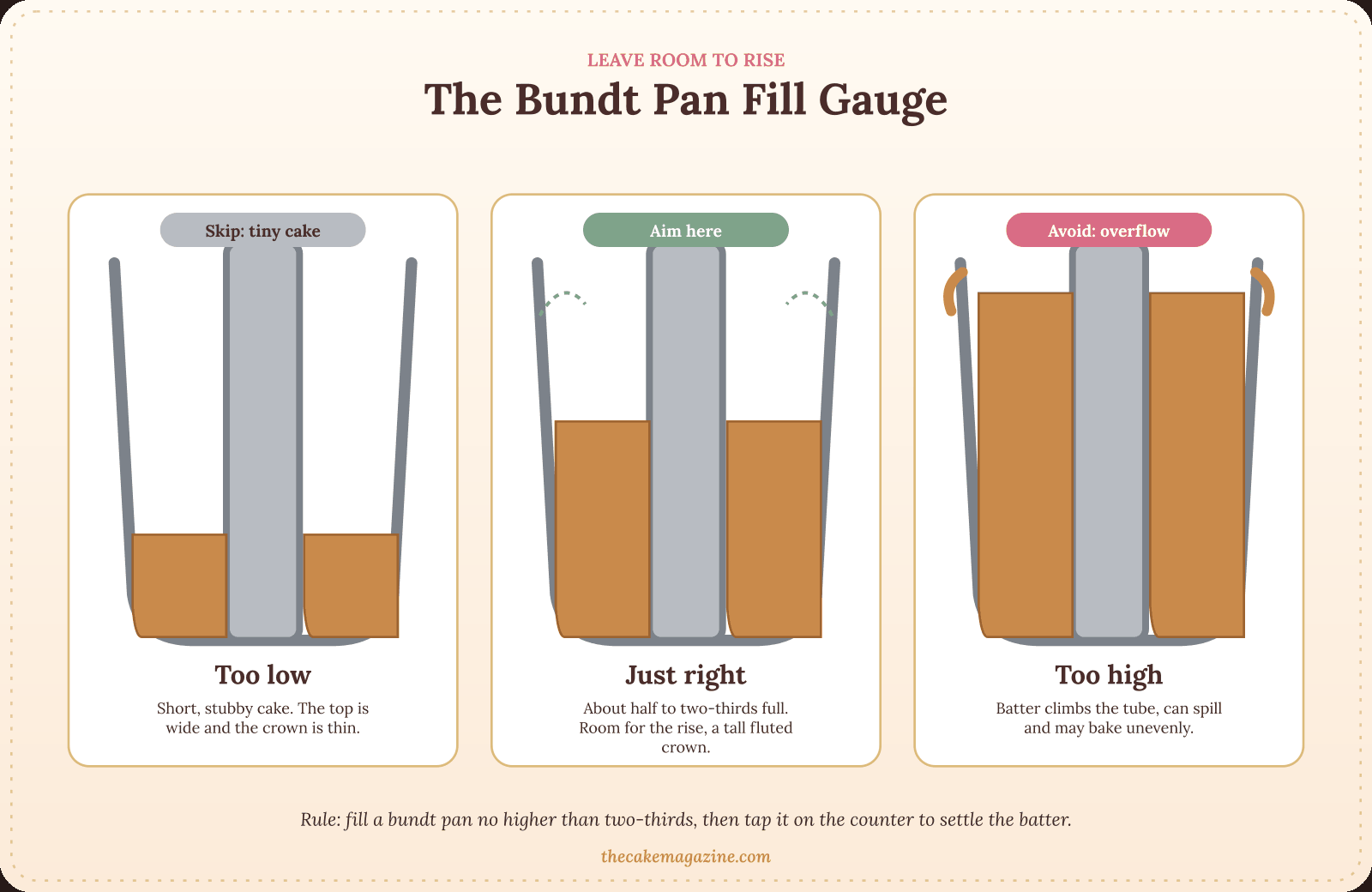
- Fill the pan. Scrape the batter into the pan in spoonfuls, working around the ring. Level it lightly with a spatula and tap the pan firmly on the counter three or four times to settle the batter into the ridges. It should fill the pan no more than about two-thirds.
- Bake. Bake 55 to 65 minutes. Begin checking at 50 minutes. The cake is done when a skewer comes out with a few dry crumbs and an instant-read thermometer in the thickest part reads about 205°F to 210°F.
- Rest, then release. Cool in the pan on a rack for 10 to 15 minutes. Set a plate or rack over the pan, hold both firmly and flip. Lift the pan gently away. Cool completely before glazing.
Notes
- Weigh the ingredients. Volume measures for butter and flour are less precise.
- A dark nonstick pan may bake faster. Check 10 minutes early and consider lowering the oven by 25°F.
- Bake times vary by oven, pan material and pan size. This formula is untested in our kitchen, so keep notes on your first bake.
- Store the cooled, unglazed cake wrapped at room temperature for up to two days, or freeze it as described below.
Bundt cake recipe pan prep that actually works
If you take one lesson from this guide, make it this one. Pan prep is the step that separates a gorgeous bundt cake from a heartbreaking pile of crumbs. It is not glamorous and it takes three minutes. It is also the single most common reason a perfectly good batter fails, so give it your full attention.

Why a quick spritz is not enough for a bundt cake recipe
Cooking spray is convenient, but the thin mist skips the narrow valleys of an ornate pan and can pool in others. Pooled oil can fry the crust and leave a gummy spot. Some sprays with flour built in work well for many bakers, especially in simpler pans. For a pan with deep detail, though, nothing beats physically brushing a paste into every crevice.
The grease-and-flour paste
This homemade paste is a long-standing baker’s habit, sometimes sold under names like pan release paste. Stir together equal parts by volume of vegetable shortening, neutral oil and all-purpose flour until smooth. A tablespoon of each makes a small cup, which is plenty for one pan. The fat forms a barrier, and the flour keeps the fat from pooling. Store the rest in a covered jar in the refrigerator.
- Use a soft pastry brush, not a paper towel, so you can push paste into the narrowest flutes.
- Coat the center tube and the top rim as well as the carved walls.
- Look for any bare silvery patches. A bare patch is where the cake will stick.
- Aim for a thin, even film, not a thick layer. Excess paste leaves greasy streaks and pale blotches on the crust.
The butter-and-flour method
If you prefer the traditional route, brush softened butter into every ridge, then add a spoonful of flour, tilt and tap the pan until the flour coats everything, and knock out the excess over the sink. The milk solids in butter can brown and stick, which is why some bakers prefer shortening for the base. It works when you are thorough, and it is a good choice when you want a cake with a slightly buttery crust.
When the batter is chocolate or dark
For a cocoa batter, dust the buttered pan with cocoa powder instead of flour. This avoids pale, floury streaks on a dark crust. The same idea works for a spiced batter, where a little granulated sugar or fine breadcrumbs can serve in place of flour. Either way, the surface needs a complete coat of fat underneath for the dusting to cling to.
Bakers’ shortcut. Prep the pan first, before you start the batter, and put it on the counter where you can see it. Chilling a well-prepped pan for 10 minutes while you cream the butter helps the coating stay put as you fill it.
Mixing and filling a bundt cake recipe the right way
A bundt batter wants to be smooth, aerated and well emulsified, with the gluten left alone. There is nothing complicated about it, but the order and the pace matter. If you have not yet seen how different mixing styles shape a crumb, read cake mixing methods explained. This bundt cake recipe uses classic creaming, the method that builds fine, even air cells in a butter-heavy batter.
Cream the butter and sugar until pale
Beat the butter alone first, until it looks smooth and a touch lighter. Add the sugar and keep going for three to four minutes, scraping down the bowl. The mixture should look pale and fluffy, almost like frosting, with the sugar granules still visible if you look closely. Those sugar crystals cut tiny air pockets into the fat, and those pockets expand in the oven. Skipping this step is a quiet way to bake a dense cake.
Add the eggs without breaking the emulsion
Add the eggs one by one. If the mixture starts to look curdled, it is usually because the eggs were too cold. Do not panic, because it will come together once the flour goes in. Better still, let the eggs sit in a bowl of warm tap water for five minutes before you start. They will blend smoothly, and the batter will hold more air.
Alternate the dry and wet, then stop
Switch to low speed. Add about a third of the flour mixture, mix briefly, then add half of the sour cream and milk, and repeat, finishing with flour. Alternating prevents the batter from separating and keeps the flour from forming too much gluten. As soon as the last streak of flour disappears, stop. Finish folding by hand with a spatula, scraping the bottom of the bowl to catch any buried butter.
What the batter for this bundt cake recipe should look like
The batter should be thick, glossy and spoonable, somewhere between a thick pancake batter and a soft cookie dough. It should hold a ridge when you drag a spatula through it, but slowly relax. If it looks greasy or separated, the butter was probably too warm. If it is very stiff and dry, the flour may have been overmeasured. Fix it with a tablespoon of milk and a gentle fold.
Fill the pan carefully
Drop the batter in spoonfuls around the ring rather than pouring it all in one place. This helps keep it from trapping large air pockets against the walls, which show up later as holes in the ridges. Press the batter gently into the base with the back of a spoon, then level the top. Use the gauge below as a reminder of how high to go.
Tap, then bake without delay
Lift the pan a few inches and drop it flat onto the counter three or four times. You will see small bubbles rise and the batter settle into the fluted walls. Do not skip this step. Then get the pan into the oven promptly, because the leavening starts working as soon as it meets liquid. Place the pan on a sheet pan to catch any drips and to shield the bottom from direct heat.
If you have extra batter
Never overfill to use up every spoonful. Pour the leftover into a muffin liner or a small ramekin and bake it separately for roughly 20 to 25 minutes. This also gives you a free test cake: a small cake bakes faster, so you can taste the flavor and check the crumb before slicing the big one. Plenty of bakers do this on purpose when trying a new recipe.
Baking, testing and doneness for a bundt cake recipe
A bundt cake spends a long time in the oven, roughly an hour for the formula above, and the center tube makes that time more even than you might expect. But the same shape makes it easy to misread doneness. The outside of a tall, dense cake can look finished long before the batter near the base has set. The timeline below gives you the overall rhythm, from heating the oven to glazing.

Oven temperature and rack position for a bundt cake recipe
Dense batters do best at a moderate temperature. A hot oven sets the outside quickly, forms a thick dark crust and leaves the center raw, while a gentle 325°F lets heat travel inward. Put the rack in the lower third so the pan sits near the middle of the oven, away from the top element. Because home ovens often run off by 10 to 25 degrees, an inexpensive oven thermometer is one of the best investments a baker can make.
Do not open the door early
Keep the door closed for the first 40 minutes or so. Opening it lets heat escape and can cause a cake that has not yet set to sink or crack. Use the oven light to check on the color instead. If you must rotate the pan for uneven heat, wait until the structure has firmed and then do it quickly and gently.
The three doneness checks
- The skewer. Insert a long wooden skewer into the thickest part of the cake, close to the center tube. A few dry crumbs are fine. Wet batter means the cake needs more time.
- The thermometer. An instant-read thermometer should read about 205°F to 210°F in the thickest part. Be sure the tip is not touching the metal pan or tube, which will read hotter.
- The surface. The top, which is the cake’s future bottom, should feel set and spring back lightly. The sides should start to pull away from the pan.
If the surface is browning faster than the middle is cooking, tent the pan loosely with a sheet of foil and keep baking. The foil slows browning while the center catches up. The thermometer is more reliable than the clock, so trust the number over the timer.
Why bundt cake recipe bake times vary so much
You will see bundt cake recipe times online that run from 45 minutes to well over an hour. That is not a contradiction. Pan material, capacity, how far you filled the pan, oven accuracy and even whether the batter started cold all change the result. A heavy cast aluminum pan, a thin dark nonstick pan and a silicone pan can bake the same batter at three different speeds. Start checking early and keep notes.
Getting the cake out in one piece
The moment of truth is the flip. Everything before it has been preparation, and nothing after it can repair a cake that is stuck in the pan. The good news is that release is mostly a matter of timing and patience. Done right, a well-prepared bundt cake slides out with a soft sigh.
Let it rest, but not too long
Straight from the oven, the cake is fragile and steamy. Cool it in the pan on a wire rack for 10 to 15 minutes. During that rest, the structure firms up enough to hold together and the cake begins to shrink slightly away from the walls. Wait too long, though, and the sugars cool and set like glue. If you are unsure, err toward the shorter end of the window and test a corner.
The flip
Set a plate or a wire rack over the pan. Hold both together with oven mitts, with your hands on opposite sides, and turn them over in one smooth motion. Set the whole thing on the counter and wait a full minute, because gravity needs time to do the work. Lift the pan straight up. If it does not budge, resist the urge to shake it violently.
If it does not come out
Try these in order. Tap the sides of the pan firmly with a wooden spoon, working around the ring, to break the bond. Gently wiggle the pan from side to side. If the cake still holds on, set the inverted pan on the counter and drape a warm, damp towel over it for 10 minutes. The steam loosens the crust. As a last resort, slide a thin silicone spatula between cake and pan and carefully release one ridge at a time.
Repairing a stuck cake
If part of the cake stays behind, do not throw it out. Pry the stuck piece loose, press it back into the cake like a puzzle piece, and fill any gaps with a little extra glaze. A thick glaze or a frosting made from American buttercream can hide a lot of damage. A generous drizzle covers sins nicely, and most guests will only notice the flavor.
Do not rush the cooling. Glazing a warm cake makes the glaze melt away and soak in instead of setting. Wait until the cake is cool to the touch, which can take one to two hours depending on its size.
Glaze, drizzle and finishing touches for a bundt cake recipe
The glaze is where a bundt cake recipe gets its personality. It also happens to be forgiving, since it is nothing more than powdered sugar and liquid. What matters is consistency, and that is entirely in your control. The infographic below shows what to look for.

A basic vanilla glaze for your bundt cake recipe
Whisk 240 grams of powdered sugar (about 2 cups) with 45 grams of whole milk (3 tablespoons), a teaspoon of vanilla extract and a pinch of salt until perfectly smooth. Add more milk a half teaspoon at a time to loosen it, or more sugar to thicken it. Sift the sugar if it is lumpy. Like the cake formula, this ratio is a starting point rather than a tested promise, because humidity and brands vary.
The ribbon test
Lift your whisk or spoon and let the glaze fall back into the bowl. A glaze that is ready forms a thick ribbon that sits on the surface for a few seconds before melting back in. That consistency clings to the ridges and drips slowly over the edges in nice, long tongues. Too thick, and it sits in clumps. Too thin, and it runs straight to the plate and leaves the cake looking bare.
How to apply it
- Cool the cake completely, and set it on a rack over a sheet pan to catch drips.
- Pour the glaze slowly around the top of the cake in a circle, starting at the center of the crown.
- Use the back of a spoon to nudge the glaze toward any bare spots.
- Let it set for 20 to 30 minutes before moving the cake to a serving plate.
Glaze variations
Swap the milk for lemon or orange juice for a bright, tart finish, which pairs especially well with the citrus ideas in our lemon cake recipe. Use brown butter for a nutty depth, strong coffee for a mocha note, or heavy cream for a richer drip. A cream cheese glaze needs refrigeration if it will sit for long. For a deeper chocolate finish, melt equal weights of chopped dark chocolate and warm cream, stir until smooth, and cool slightly before pouring.
Dusting, toppings and presentation
A shower of powdered sugar is the simplest finish, and it highlights every ridge. For a more festive look, press chopped toasted nuts, flaked coconut or crushed freeze-dried berries into the wet glaze, or scatter fresh berries and citrus zest on the plate. Wait until just before serving for toppings that soften. A cake with a sharp silhouette often needs no more than a dusting and a sprig of mint.
Flavor variations on the base bundt cake recipe
Once the base bundt cake recipe works in your oven, you can change it in small, careful steps. Change one thing at a time, so that if the texture shifts, you know why. Here are reliable ways to branch out without upsetting the balance.
Lemon or orange
Rub the zest of two lemons or oranges into the sugar before creaming. Replace two teaspoons of the vanilla with citrus extract if you like, and glaze with juice.
Chocolate swirl
Mix about a quarter of the batter with cooled melted chocolate or cocoa, layer it with the plain batter, and swirl once with a knife. Overmixing blurs the pattern.
Cinnamon sugar ribbon
Layer half the batter, sprinkle on cinnamon sugar and nuts, add the remaining batter and swirl lightly. Keep the filling away from the pan walls so it does not stick.
Warm spice
Add cinnamon, ginger and nutmeg to the flour. Our spice cake recipe has a full guide to balancing them.
Fruit and vegetable cakes
Apples and pumpkin bring moisture and need adjustments, so see our apple cake recipe before adding fruit to a bundt batter.
Poppy seed or almond
Fold in two tablespoons of poppy seeds, or replace the vanilla with a half teaspoon of almond extract and add sliced almonds to the glaze.
Adding mix-ins without sinking them
Nuts, chocolate chips and dried fruit drop to the bottom of a thin batter, but this batter is thick enough to hold them. Toss about 150 grams of mix-ins with a tablespoon of the flour mixture first, then fold them in at the end. Because the bottom of the pan becomes the top of the cake, a few chips at the base will show up as a crown of chocolate, which most people consider a bonus.
Using a different pan for the bundt cake recipe
The same bundt cake recipe can bake in other pans with a few adjustments. Smaller bundtlette pans take roughly 20 to 30 minutes. A loaf pan bakes a denser slice and takes closer to an hour. For a flat cake for a crowd, see our sheet cake guide for pan sizes and servings, and for individual portions our mini cakes guide explains scaling. Always fill any pan only half to two-thirds, and check for doneness early.
Making a bundt cake recipe from a mix
Plenty of people start with a boxed cake mix, and a bundt pan handles that well. Mixes are lighter and more delicate than the formula above, so prepare the pan with extra care and rest the cake the full 15 minutes before flipping. Add a cup of sour cream or an extra egg if you want a sturdier, richer crumb. Follow the package for the baking temperature and time, and use the thermometer to confirm doneness.
Adapting any cake to a bundt pan
Sooner or later you will want to bake a favorite recipe in a bundt pan. It can work well, but not every batter suits the shape. Light, airy foam cakes and delicate layer-cake batters are less sturdy than the formula above, while dense, butter-rich or oil-rich batters tend to do beautifully. Here is how to decide, and how to adjust when you do.
Match the volume of your bundt cake recipe to the pan
A recipe written for two 8-inch round layers makes roughly 1,300 to 1,500 grams of batter, which is similar to this formula and suits a 10 to 12 cup pan. A recipe for a 9 by 13-inch cake is often a similar amount. A recipe for three layers is closer to a full pan. When in doubt, weigh the finished batter, and divide by the pan’s volume in cups, remembering you want it about half to two-thirds full.
Lower the temperature and lengthen the time
Layer cakes bake in 30 to 35 minutes at 350°F because the batter is shallow. In a bundt pan the batter is deep, so the heat takes longer to reach the middle. Drop the oven to about 325°F and expect the bake to take close to double the layer time. Begin checking at the lower end and keep your thermometer handy. Recipes with a lot of moisture, like fruit cakes, may need even longer.
Check the structure
A sturdy bundt needs a batter that can support its own weight. If the original is very light and tender, such as a chiffon or a sponge, the carved shape can crush or tear when released. Cakes made with fruit purée, such as banana or pumpkin, often work because they are dense and moist, and our pumpkin cake recipe is a good example of a batter whose moisture and spice suit the pan.
Consider a trial run
If you are adapting a favorite for a special event, bake it once ahead of time. It is far less stressful to discover a sticking problem on a Tuesday than on the morning of the party. Take notes on bake time, pan and oven, and write down what you would change. That practice bake also tells you how the cake tastes at day two, which is when most hosts will be serving it.
Scaling the formula up or down
To scale this bundt cake recipe to a half batch for a 6-cup pan, halve every ingredient by weight and use two and a half eggs, which means beating a fifth egg and using half of it by weight (about 25 grams short of three eggs, or roughly 125 grams in total). Bake a bit shorter, starting around 40 minutes. To make a double batch for two pans, bake both at the same time on separate racks and rotate once the cakes have set, because crowded ovens bake unevenly.
Why a bundt cake recipe keeps better than a layer cake
A dense, butter-rich crumb with a sealed crust loses moisture slowly. A bundt cake also has a smaller surface area relative to its volume than a stack of thin layers, and it is rarely cut until serving. That is why bakers often make them a day ahead. The flavor improves as the sugar and fat settle into the crumb, and the cake slices more cleanly once it is fully cool and a little firm.
Troubleshooting a bundt cake recipe
When a bundt cake goes wrong, the pan usually leaves clues. Look at the crumb, the crust and the way the cake came out, and match the symptom to the cause. For problems that apply to any cake, our cake troubleshooting guide goes deeper. The cards below cover the failures that are most specific to bundts.
The cake stuck to the pan
What it looks like: chunks of crust or crumb stay in the ridges, and the top of the cake is torn or ragged.
Likely causes: a thin or missed spot in the pan prep, flipping too soon or too late, or a pan with old residue. Sugary batters stick more as they cool.
Fix it next time: brush a full coat of paste into every ridge, rest the cake 10 to 15 minutes, and flip while it is still warm. Wash the pan by hand and check for bare patches before filling it.
The cake is raw or gummy near the center tube
What it looks like: a damp, dense ring near the base or around the tube, even though the outside looks done.
Likely causes: an oven that runs hot, a dark pan, too much batter, or pulling the cake before the center set.
Fix it next time: bake at 325°F, check with a thermometer near the tube, and tent with foil if the surface browns early. Fill the pan only to about two-thirds.
The cake is dry and crumbly
What it looks like: a sandy texture that falls apart when sliced, with a thick, hard crust.
Likely causes: overbaking, too much flour from scooping with a cup, or too little fat and liquid.
Fix it next time: weigh the flour, pull the cake at about 205°F to 210°F, and brush any dry slices with a little simple syrup or serve them with fruit and cream.
A big crack across the top
What it looks like: a split along the crown, which becomes the base of the cake.
Likely causes: an oven that is too hot, which sets the crust before the center rises.
Fix it next time: lower the heat by 25°F. Because the crack ends up on the bottom, it is usually invisible once the cake is on the plate.
The cake is flat on the bottom or uneven
What it looks like: a rocking cake that will not sit flat on the plate.
Likely causes: an uneven oven, batter that was not leveled, or a dome that rose in the center.
Fix it next time: level the batter before baking, bake on a flat rack, and trim any dome with a serrated knife before serving. A thin slice off the base fixes the wobble.
Holes, tunnels or air pockets in the ridges
What it looks like: pockmarks on the surface or hollows inside the cake.
Likely causes: trapped air from dumping the batter in one spot, or a failure to tap the pan.
Fix it next time: spoon the batter around the ring, press it into the corners, and tap the pan firmly before baking. Overmixing after the flour goes in can also create tunnels.
The bundt cake recipe sank or came out dense
What it looks like: a compact, heavy crumb or a collapsed section.
Likely causes: butter that was too warm, undermixing, expired baking powder, or opening the oven door too early.
Fix it next time: cream longer, use fresh baking powder and keep the oven closed through the first 40 minutes.
Storing, freezing and serving a bundt cake recipe
The structure that makes a bundt cake sturdy also makes it easy to keep. A butter-rich, glazed cake with no perishable filling is one of the most forgiving desserts to make ahead. A few simple habits keep it moist for days.
Room temperature
Once the cake is completely cool, cover it with a cake dome or wrap it loosely in plastic. An unglazed cake keeps well at cool room temperature for about two days. Glazed, it holds up for one to two days before the glaze becomes sticky. Cut slices from the center of the cake rather than the ends, then press the cut sides together to keep the interior from drying out.
Refrigerating and food safety
Cakes with plain powdered sugar glazes are fine at room temperature, but dairy-based toppings, cream cheese frostings and fresh fruit fillings need refrigeration. For general guidance on how long perishable foods can sit out, see the USDA Food Safety and Inspection Service. Bring a chilled cake back to cool room temperature before serving, since cold butter cakes taste firmer and less flavorful.
Freezing
Freeze the cake unglazed for the best results. Wrap the cooled cake tightly in two layers of plastic wrap and one of foil, label it with the date and freeze for up to about two months. Thaw it in its wrapping on the counter for several hours or overnight so condensation collects on the wrapper and not on the crust. Glaze it after thawing. Slices can be frozen separately.
Transporting a bundt cake
Bundt cakes travel better than layer cakes because there is no delicate frosting to smear. Set the cooled cake on a sturdy board or plate, add the glaze, let it set fully and cover it with a tall container or a large inverted bowl. Slide a non-slip mat under the plate in the car. If you are taking a cake to a party, glaze it at the destination for the freshest look.
Serving suggestions
A plain vanilla bundt is a blank canvas. Serve slices with whipped cream and macerated berries, a spoonful of lemon curd, vanilla ice cream or a pour of warm caramel. For a tea-time cake, a simple dusting of powdered sugar is enough. Cut with a serrated knife using a gentle sawing motion, wiping the blade between slices to keep the ridges clean.
Ten mistakes to avoid with a bundt cake recipe
- Skipping or rushing pan prep. Brush every ridge, including the tube. This is the single biggest cause of stuck cakes.
- Overfilling the pan. Past two-thirds, the batter overflows or bakes unevenly.
- Using cold ingredients. Cold eggs and dairy break the emulsion. Let them sit out for 30 minutes first.
- Scooping flour with the cup. It packs the flour and produces a dry cake. Weigh it.
- Overmixing after the flour goes in. It toughens the crumb and creates tunnels.
- Trusting the clock instead of a thermometer. Times are estimates, and a thermometer tells the truth.
- Opening the oven early. A sudden drop in temperature can collapse an unset cake.
- Flipping too soon or too late. Stay inside the 10 to 15 minute window and watch the cake.
- Glazing a warm cake. The glaze melts and soaks in. Wait until the cake is cool.
- Not writing things down. A line or two in a notebook after each bake is the quickest way to learn your oven and your pan.
A simple bundt cake recipe checklist for bake day
- Pan washed, dried and checked for residue
- Pan fully brushed with paste, then set aside
- Ingredients weighed, at cool room temperature
- Oven at 325°F, rack in the lower third, thermometer inside
- Pan filled to no more than two-thirds, leveled and tapped
- Thermometer, skewer and a timer set for 50 minutes
- Rack, plate and oven mitts waiting for the flip
Frequently asked questions about the bundt cake recipe
What makes a good bundt cake recipe different from a regular cake recipe?
A good bundt cake recipe has a sturdier, butter-rich batter that can hold carved ridges, and it is baked lower and longer so the center cooks through. It also relies on careful pan prep, because every flute is a place for the cake to stick.
How full should I fill the pan for a bundt cake recipe?
For this bundt cake recipe, fill it about halfway to two-thirds. That leaves room for the rise without overflowing the center tube. Level the batter, tap the pan on the counter to settle it and bake any extra batter in a ramekin or muffin liner.
What is the best way to keep a bundt cake recipe from sticking?
Brush a thin, complete coat of grease-and-flour paste into every ridge, including the tube. Many bakers use equal parts shortening, oil and flour. Rest the cake 10 to 15 minutes, then flip it while it is still warm.
How long should a bundt cake recipe cool in the pan before I flip it?
Ten to fifteen minutes is a common window. Shorter, and the cake can break because it is still fragile. Longer, and the sugars set and glue the cake to the pan. If it sticks, a warm damp towel over the inverted pan helps.
What temperature should a bundt cake recipe bake at?
Most dense bundt batters do well around 325°F, which lets the heat reach the center before the crust darkens. This bundt cake recipe uses 325°F for roughly 55 to 65 minutes, but ovens vary, so check early and use a thermometer reading about 205°F to 210°F.
How do I know when a bundt cake recipe is done?
Use three checks together: a skewer near the center tube with a few dry crumbs, an instant-read thermometer around 205°F to 210°F, and a set top that springs back lightly. Do not rely on the timer alone, because pans and ovens differ.
Can I use cooking spray instead of the paste?
You can, especially with a simple pan, and sprays with flour in them often work well. For an ornate pan, spray can miss narrow flutes. Brushing paste or butter and flour into every ridge is more reliable.
Why did my bundt cake recipe sink in the middle or come out dense?
Common reasons are butter that was too warm, too little creaming, old baking powder, or opening the oven door before the cake set. Underbaking is another cause. Check the center with a thermometer and keep the door closed for the first 40 minutes.
Can I make a bundt cake recipe ahead of time?
Yes. The cake often tastes better after a day. Wrap it when fully cool and keep it at room temperature for up to two days, or freeze it unglazed for about two months. Glaze on the day you plan to serve it.
Do I have to glaze a bundt cake recipe?
No. A dusting of powdered sugar is enough, and some cakes are lovely plain with whipped cream and fruit. A glaze adds sweetness and shine, and it hides small flaws, but it is optional.
Can I bake this bundt cake recipe in a different pan?
Yes. It works in a loaf pan, mini bundt pans or a 9 by 13-inch pan with shorter bake times. Fill the pan half to two-thirds, expect different timings and check early. Treat the first bake as a test.
How do I fix a bundt cake recipe that broke when I flipped it?
Press the broken pieces back into place like a puzzle, then cover the seams with a thick glaze or a simple frosting. Chilling the cake for 20 minutes first helps it hold together. Next time, check the pan prep and the resting time.
Can I use butter instead of sour cream in this bundt cake recipe?
They do different jobs, so they are not interchangeable. Butter is already in the cake. The sour cream adds moisture and a gentle tang. If you need a substitute for the sour cream, plain full-fat yogurt at the same weight is the closest match.
Final thoughts on your first bundt cake recipe
A bundt cake rewards care more than skill. If you prepare the pan thoroughly, fill it modestly, bake at a gentle temperature and wait out the rest before flipping, the cake will almost always come out beautiful. This bundt cake recipe is a plain, buttery foundation that you can flavor a dozen ways once you trust it.
Start with one bake, take notes, and adjust from there. For more reading on cake technique, the King Arthur Baking cake guide is a respected companion. When you are ready for another challenge, a plain bundt cake pairs well with the ideas in our guides above, and the best next step is simply to bake again.
Editorial note: reviewed and updated November 2026. This guide is general baking information for home bakers in the United States, using American measurements. The formulas here have not been oven-tested by us, so treat amounts and times as starting points and expect results to vary by oven, pan and ingredients. Historical details come from the Minnesota Historical Society’s MNopedia entry on the Bundt pan.