A good pound cake recipe asks very little of you and gives a lot back: four plain ingredients, a bowl, and a little patience at the mixer. What you get is a golden loaf with a thin, slightly crisp crust and a tight, buttery crumb that slices cleanly and keeps for days. It is also one of the easiest cakes to get wrong without noticing, because there is no baking powder to hide behind. This guide gives you a starting formula in grams and, more usefully, the reasons behind every step.
A dependable pound cake recipe uses roughly equal weights of butter, sugar, eggs and flour, plus a little salt, vanilla and a spoonful of sour cream for tenderness. Cream cool butter with sugar until pale, add the eggs slowly, fold in the flour gently, and bake low and slow at 325°F until the center reads about 205°F to 210°F. Weigh everything, and let the loaf cool completely before slicing.
- Why this pound cake recipe works
- The ratio behind the name
- The ingredients, explained
- Creaming, temperature and the science of a fine crumb
- Equipment and pans
- The pound cake recipe card
- Step-by-step method
- Baking and doneness
- Flavor variations
- Glazes, toppings and serving
- Pound cake styles compared
- Troubleshooting your loaf
- Storage and make-ahead
- Ten mistakes to avoid
- Scaling, pan sizes and yield
- A first-bake checklist
- FAQ
Why this pound cake recipe works
Most people who search for a pound cake recipe want the same few things. They want a crumb that is fine and moist rather than coarse and dry. They want real butter flavor. They want a loaf that does not sink in the middle or leave a greasy ring around the pan. Those goals sound modest, yet they depend on a handful of small decisions made in the first ten minutes, long before the oven gets involved.
This formula makes those decisions for you and explains them. It is a starting point, built from conservative, well-known baking ratios and not from a long run of test bakes in our kitchen, so treat the numbers as a foundation you adapt. Ovens, pans and butters differ. Watch your own loaf and take notes.
A pound cake recipe has no chemical shortcut
Most cakes get help from baking powder or soda. A traditional pound cake recipe had none. Its rise came from air beaten into butter and sugar and from steam and egg proteins doing their work in the heat. That is why technique matters so much here. If the butter is too cold or too warm, or the creaming is rushed, there is no leavener to rescue the loaf.
Our formula includes a tiny pinch of baking powder as insurance, which is common in modern home versions. It is not meant to do the lifting. It just keeps a slightly under-creamed loaf from turning out dense. If you want the purist version, leave it out and cream a little longer.
The crumb is the point of any pound cake recipe
A great pound cake crumb is fine, tender and a bit velvety. Cut a slice and the knife should glide, leaving a clean face with small, evenly spaced air cells and no big tunnels. That structure comes from tiny air bubbles trapped in the butter, from an egg emulsion that stays smooth, and from flour that is mixed in just until it disappears. Each of those gets its own section below.
Before you start. This pound cake recipe is the plain, classic style. If you would rather have a cake that is lighter and sponge-like, our guide to genoise sponge cake covers the whipped-egg approach, and the best vanilla cake recipe shows how a layer cake differs from a loaf.
The ratio behind the name
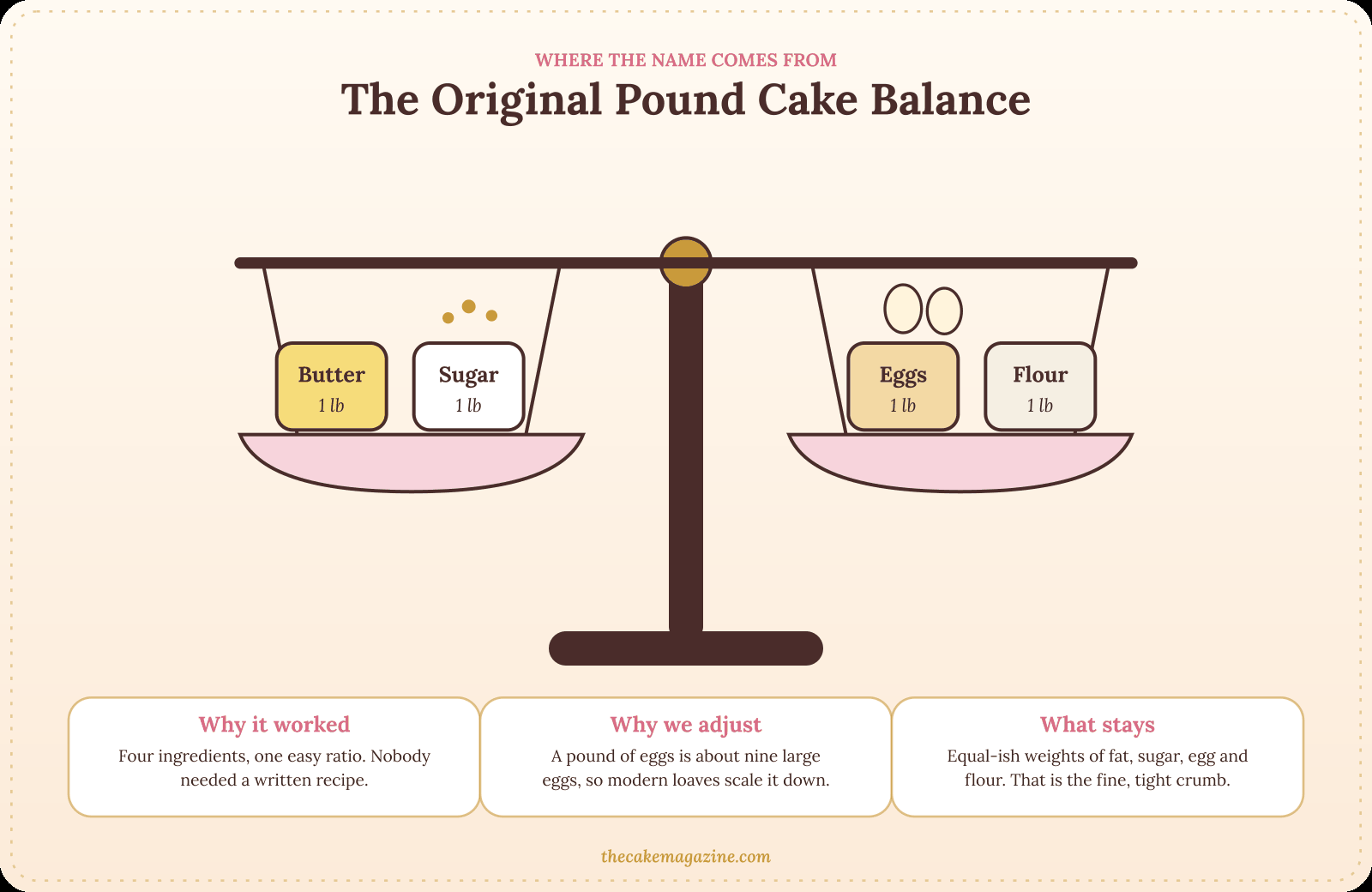
The name is literal. Early recipes called for a pound each of butter, sugar, eggs and flour, which made an enormous cake and was easy to remember when many home cooks worked from memory rather than a printed page. Food historians generally trace this style to Britain and note that it arrived in American kitchens in the eighteenth century. We will not pretend to a precise origin date, because the sources differ, but the one-pound ratio is a well-documented part of the story.
Nobody needs a pound of everything today. A modern home loaf scales that idea down, usually to about a cup of butter, and then nudges the numbers. The idea survives: fat, sugar, egg and flour in near-equal weights. That balance is what produces a dense yet tender cake, rich in fat and eggs, with enough flour to hold it together.
Why weight matters in a pound cake recipe
Equal weights do not mean equal cups, and a pound cake recipe is unusually sensitive to that. A cup of flour weighs about 120 to 130 grams, a cup of sugar about 200 grams, and a cup of butter about 227 grams. Measuring by volume throws the ratio off in ways you cannot see, and a pound cake has little room for error. A flour scoop packed an extra ten percent heavy is enough to make the crumb dry.
For that reason every ingredient in the recipe card is given in grams first, with cup amounts as a convenience. A digital scale costs less than a good loaf pan and will improve every cake you make. If flour measuring is new to you, read our guide on how to measure flour for cake before you bake.
How this formula adjusts the classic ratio
Our starting numbers for this pound cake recipe are 227 grams of butter, 250 grams of sugar, 200 grams of eggs and 250 grams of flour. That is close to the old one-to-one-to-one-to-one balance, with a little extra sugar for moisture and tenderness and slightly less egg than butter. Then we add a small amount of sour cream, which brings acidity, moisture and a softer bite without upsetting the structure.
You can scale the whole pound cake recipe up or down. If you want to bake two loaves or a bundt, our guide to the bundt cake recipe shows how pan volume changes batter amounts and bake times.
The ingredients, explained
With only a few ingredients, each one has to earn its place. Here is what each does in this pound cake recipe, and what happens if you swap it.
Butter: the heart of a pound cake recipe
Butter is the star. It carries flavor, it tenderizes by coating flour proteins, and when creamed with sugar it holds the tiny air pockets that become the crumb. Use unsalted butter so you control the salt. Choose a fresh, good-tasting brand, since there is nothing to hide it. Higher-fat European-style butter gives a richer loaf, but ordinary American butter works well.
Butter temperature is critical. We spend a full section on it below, but the short version is cool and pliable, about 65°F, never soft and shiny. Margarine and spreads contain more water and less fat, and they change the texture, so skip them in this recipe.
Sugar: sweetness, tenderness and a crust
Granulated sugar does more than sweeten. Its sharp crystals cut air pockets into the butter. It attracts water, which keeps the crumb moist for days. It slows protein setting so the cake bakes tender, and it caramelizes on the outside to form the thin golden crust. Cutting the sugar sharply gives you a pale, tougher, drier loaf.
Superfine sugar dissolves faster and can make a smoother crumb. It is optional. If you only have regular granulated sugar, simply cream a minute longer, until the mixture feels creamy rather than gritty between your fingers.
Eggs in a pound cake recipe: structure and emulsion
Eggs bind the batter, add richness through the yolks and set the structure through the whites. They also supply most of the moisture. Large eggs weigh about 50 grams each without the shell, so four equal about 200 grams. Crack them into a measuring cup and weigh them. If you are a few grams short, whisk in a little extra egg to make up the weight.
Eggs should be cool room temperature. Cold eggs firm up the butter and make the batter look curdled. Very warm eggs melt it. To take the chill off quickly, place whole eggs in a bowl of warm tap water for five to ten minutes.
Flour: just enough structure
All-purpose flour works well and gives a classic, slightly sturdier crumb. Cake flour gives a softer, finer, more delicate result. If you want to learn more about how the two behave, read our comparison of cake flour versus all-purpose flour. For this formula we use all-purpose, because a loaf needs a bit more backbone than a layer.
Whisk the flour with the salt and baking powder before adding it, so the small amounts distribute evenly. If you swap in cake flour, keep the same weight and expect a slightly softer, more fragile slice.
Sour cream, vanilla and salt: the supporting cast
Sour cream adds moisture and gentle acidity, which tenderizes the crumb and gives it a faint tang that makes the butter taste more interesting. Full-fat plain yogurt or whole milk will work in a pinch, but sour cream gives the plushest result. Keep it at room temperature as well.
Pure vanilla extract is worth the money here, since a loaf this plain showcases it. Salt is non-negotiable. Half a teaspoon of fine salt brings out the butter and balances the sweetness. Without it, the cake tastes flat even when everything else is perfect.
Butter
Unsalted, cool and pliable at about 65°F. It brings flavor and holds the air that lifts the loaf.
Sugar
Granulated. Cuts air into the butter, keeps the crumb moist and builds the golden crust.
Eggs
Four large, cool room temperature. They bind, enrich and set the structure.
Flour
All-purpose, weighed. Added last and mixed only until it disappears.
Creaming, temperature and the science of a fine crumb
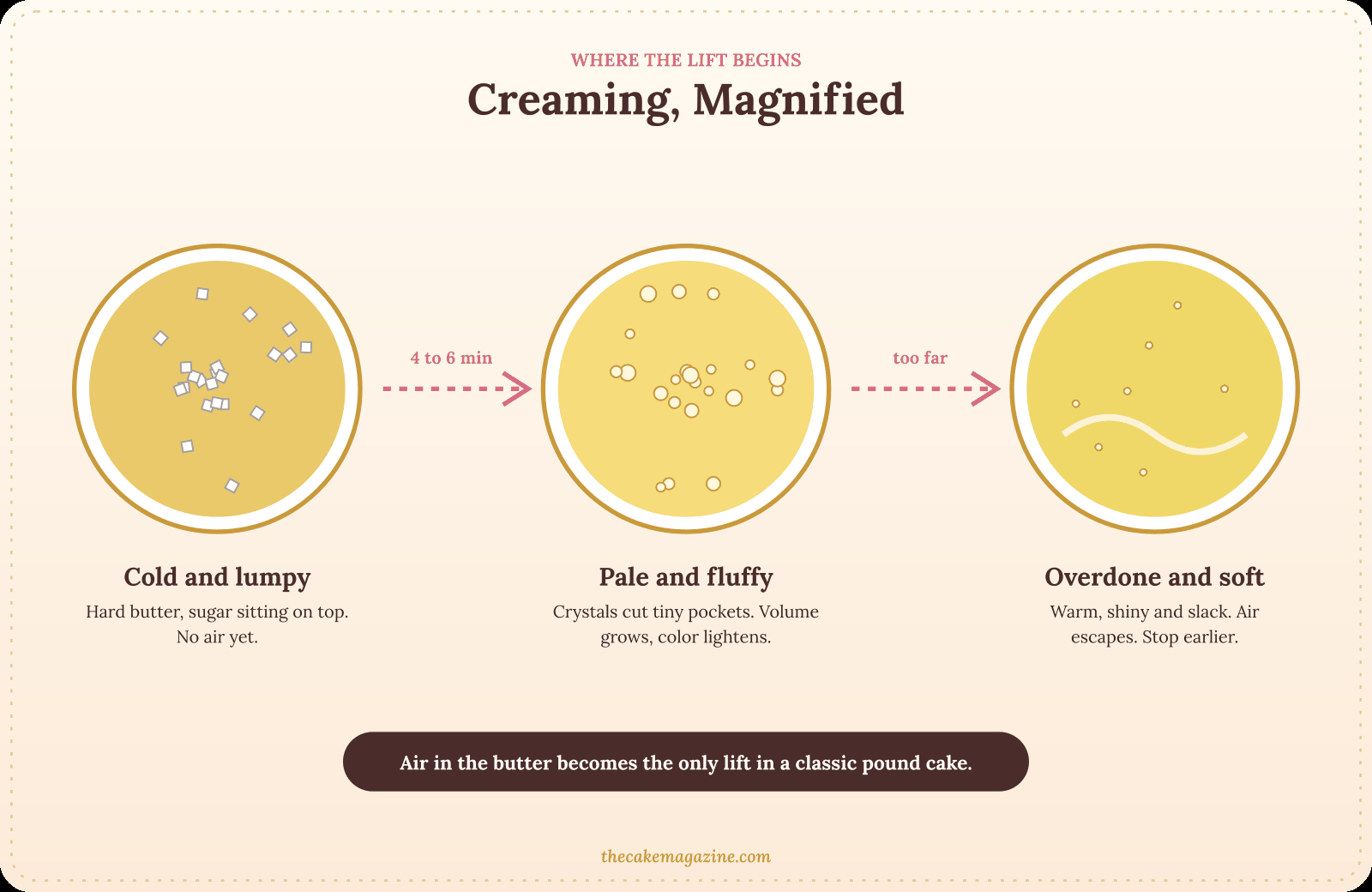
If you take one idea away from this guide, make it this one: a pound cake recipe is a butter-and-air recipe. Everything else supports that. When you cream butter and sugar, the sugar crystals scrape tiny pockets into the fat. Those pockets fill with air. Later, in the oven, the air expands, steam joins in, and the egg and flour proteins set around the bubbles to lock the structure in place.
The finer and more evenly spread those bubbles are, the finer the crumb. This is the connection between the technique and the “science of a fine crumb” that people talk about. For a wider look at how fat, sugar, eggs and flour interact, our guide to cake baking science goes deeper.
The butter temperature that makes a pound cake recipe work
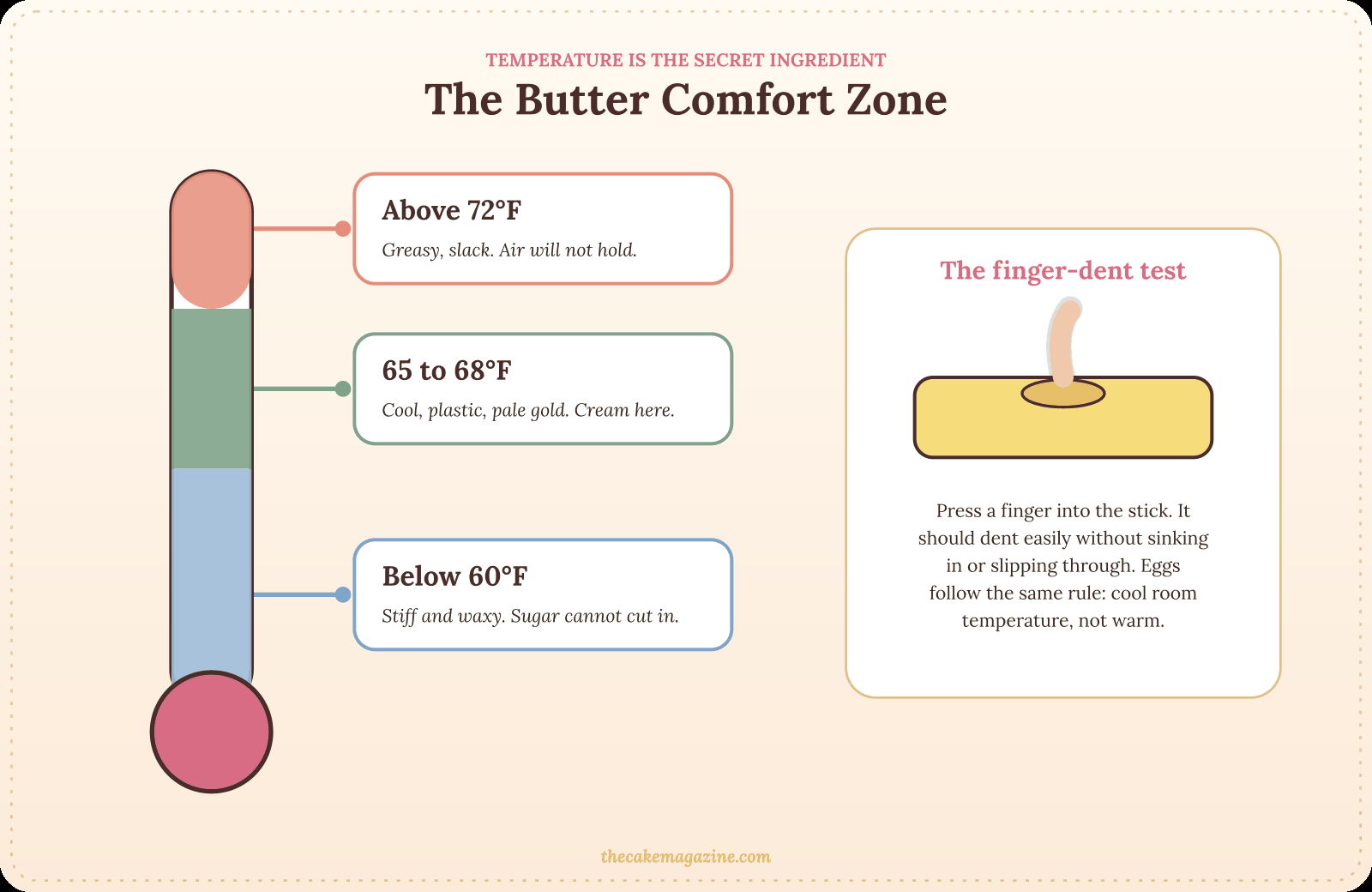
Butter is a plastic fat. At around 65°F it is soft enough to hold air and firm enough to keep it. Colder, and the sugar cannot cut in, so you get a lumpy, under-aerated mixture. Warmer, and the butter turns shiny and slack, and air escapes as fast as you beat it in. That leaves a heavy loaf with a greasy edge.
The easiest check is the finger test shown below. Press a finger into the stick. It should dent easily but not sink deeply, and it should still feel cool to the touch. In a typical kitchen, that usually means about 30 to 45 minutes out of the fridge, though warm rooms shorten it. Cut the butter into tablespoon-sized pieces to speed things up.
Do not microwave the butter. Even a few seconds of microwaving can melt the outside while the center stays hard. Melted-then-recooled butter does not cream the same way. If you are short on time, cube it and let it sit, or pound a cold stick between parchment with a rolling pin until it is flat and pliable.
Our article on room temperature ingredients for cake explains why this advice shows up in so many recipes, and how to hurry it along safely.
How long to cream for a pound cake recipe
Most home mixers need about four to six minutes of creaming on medium speed. Stop and scrape the bowl once or twice, because butter and sugar love to hide on the bottom and sides. You are looking for a pale, fluffy mixture that has visibly increased in volume and looks closer to whipped frosting than to paste.
A good sign is that the sugar no longer feels sharp. Pinch a little between your fingers. It should feel smooth and creamy, not gritty. Stop before the mixture turns glossy and loose, which means the butter is warming up too much. If that happens, chill the bowl for ten minutes and start over from a cool footing.
Adding the eggs without breaking the emulsion
Once the butter and sugar are fluffy, the eggs go in one at a time, or in small splashes if you whisk them first. Each addition should be fully absorbed before the next. The butter is a fat, the eggs are mostly water, and your job is to coax them into a stable emulsion. Add them too fast and the batter looks curdled or soupy.
A curdled-looking batter is not ruined. It means the emulsion broke. A spoonful of the measured flour stirred in can help bring it back. Cold eggs are the usual culprit, which is why warming them first is worth the minute it takes.
Folding in the flour without toughening the loaf
Flour goes in last, in two or three additions, mixed on low speed or folded by hand just until you no longer see dry streaks. Once flour meets liquid, gluten begins to form. A little gives structure. Too much makes the loaf tough and rubbery, with a tight, chewy crumb and sometimes a steamed, gummy layer near the bottom.
This is why a pound cake recipe asks for gentle handling at the end after all that vigorous creaming. Beat hard for air, then switch to a light touch to protect it. For more on how different mixing styles change a cake, see our guide to cake mixing methods.
Equipment and pans
You do not need much, but a few pieces make this pound cake recipe more reliable. Here is the list, with the reasoning for each.
- Digital kitchen scale. For all the reasons above. Everything in the formula is weighed.
- Stand mixer or hand mixer. You can cream by hand, but it takes strong arms and about twice as long. A hand mixer does the job beautifully. If you are shopping, see our guides to stand mixers and hand mixers.
- 9 by 5-inch loaf pan. Light-colored metal bakes more evenly than dark metal, which browns the crust faster.
- Oven thermometer. A low and slow bake depends on an accurate temperature, and many home ovens run hot or cold by 15 to 25 degrees.
- Instant-read thermometer. The most reliable way to know the loaf is done.
- Parchment paper. A sling of parchment makes lifting the cake out easy and prevents sticking.
- Rubber spatula and wire rack. For folding, scraping and cooling.
Choosing and preparing the pan
A standard 9 by 5-inch loaf pan, holding roughly eight cups, suits the batter in this pound cake recipe, which weighs about 1,000 grams. Fill it no higher than about two-thirds. If your pan is smaller, such as 8.5 by 4.5 inches, bake the extra batter in a mini loaf pan or muffin cups, and check those early.
To prepare the pan, grease it generously with softened butter or baking spray, line the bottom and the two long sides with a strip of parchment, and grease the parchment. Pound cake sticks easily because of its sugar and butter. If sticking is a recurring problem, our troubleshooting piece on cake stuck to the pan has a full fix list.
Other pans for the same pound cake recipe
The same batter can be baked in other shapes, though the bake time changes. A 10-cup bundt pan holds about this much batter and may need 50 to 60 minutes at the same temperature, and a tube pan behaves similarly. Two smaller 8 by 4-inch loaves bake in roughly 45 to 55 minutes. These are starting windows, not promises. Begin checking about ten minutes before the earliest time.
Pan material matters, too. Dark pans and glass absorb more heat, so reduce the oven temperature by 25°F or watch the crust closely. Light aluminum pans are the safest choice for an even, golden color. Our cake pan buying guide explains the differences in detail.
The pound cake recipe card
Here is the full formula. Please remember that this is a starting formula to adapt: we have built it from conservative, well-known ratios and have not oven-tested it in our own kitchen. Bake times, loaf height and browning will vary with your oven, pan and ingredients, so test it once as written before you change anything.
Classic Butter Pound Cake
A dense yet tender loaf with a golden crust, a fine buttery crumb and a faint tang from sour cream. Plain enough to eat on its own, sturdy enough to glaze, toast or serve with fruit.
Ingredients
- Unsalted butter, cool but pliable, about 65°F227 g (1 cup, 2 sticks)
- Granulated sugar250 g (1 ¼ cups)
- Large eggs, cool room temperature, out of the shell200 g (4 eggs)
- Pure vanilla extract8 g (2 teaspoons)
- All-purpose flour250 g (about 2 cups, spooned and leveled)
- Baking powder (optional insurance)2 g (½ teaspoon)
- Fine salt3 g (½ teaspoon)
- Sour cream, room temperature60 g (¼ cup)
Instructions
- Prep. Set a rack in the center of the oven and heat to 325°F (165°C). Grease a 9 by 5-inch loaf pan, line the bottom and long sides with parchment, and grease the parchment.
- Whisk the dry ingredients. In a medium bowl, whisk the flour, baking powder and salt. Set aside.
- Cream. In a stand mixer or large bowl, beat the butter and sugar on medium speed for 4 to 6 minutes, scraping the bowl twice, until pale and fluffy.
- Add the eggs. Whisk the eggs with the vanilla. With the mixer on medium-low, add them a tablespoon or two at a time, letting each addition absorb before adding more.
- Add the flour. On low speed, add one third of the flour, then half the sour cream, another third of the flour, the rest of the sour cream and the final flour. Stop as soon as no dry streaks remain.
- Pan. Scrape the batter into the pan, smooth the top and tap the pan firmly on the counter twice to release large air bubbles.
- Bake. Bake 60 to 75 minutes. Begin checking at 55 minutes. The loaf is done when it is deep golden, the edges pull in slightly and an instant-read thermometer in the center reads about 205°F to 210°F.
- Cool. Cool in the pan on a rack for 15 minutes. Lift out with the parchment and cool completely, at least 1 to 2 hours, before slicing.
Notes
- If your loaf browns too quickly, tent it loosely with foil after about 40 minutes.
- For a purist version, omit the baking powder and cream for an extra minute.
- Whole milk can replace the sour cream, though the crumb will be a touch less tender.
- Always weigh the ingredients. Cup measures are approximate.
Step-by-step method for this pound cake recipe
The card above lists the steps. Here is the reasoning and what to watch for at each stage, so that you can recognize good and bad signs as they happen.
Step 1: Prepare everything before you start
Set out the butter, eggs and sour cream about 30 to 45 minutes ahead. Weigh the flour, salt and baking powder into a bowl and whisk. Weigh the eggs in a measuring cup. Prepare the pan. It feels fussy, but a pound cake recipe moves quickly once the mixer is running, and fumbling for the vanilla while the butter warms up is how batters go wrong.
Check the oven temperature while you work. If you own an oven thermometer, trust it more than the dial. If you are curious why dial settings drift appears in our guide to cake baking temperature.
Step 2: Cream until pale and fluffy
Start the mixer on low for the first 30 seconds so sugar does not fly out of the bowl, then increase to medium. Scrape the bowl after two minutes and again near the end. The butter should lighten from yellow to a pale, creamy ivory and look noticeably fluffier. In any pound cake recipe, this stage is where most of the loaf’s structure begins, so give it the time.
If you are using a hand mixer, expect to hold it steady for about six minutes. Move the beaters around the bowl so nothing escapes the action.
Step 3: Add the eggs slowly
Whisk the eggs and vanilla together in a measuring cup with a spout. Pour a thin stream or add a tablespoon at a time with the mixer on medium-low. Wait until the batter looks smooth again before adding more. This takes patience, and it is the single most important thing you can do to avoid a curdled batter.
If the batter does look grainy, keep going. Add a spoonful of the flour and mix briefly, and it usually smooths out. A slightly curdled batter still bakes into an acceptable cake, but it will have a coarser texture.
Step 4: Fold in the flour and sour cream gently
Switch to low speed, or put down the mixer and use a spatula. Add the dry ingredients in three parts, alternating with the sour cream. Alternating keeps the batter smooth and prevents flour pockets. When the last bit of flour disappears, stop. A few streaks can be folded in by hand with four or five strokes of the spatula.
The finished batter should be thick, smooth and glossy, similar to soft frosting. It should fall slowly from a spoon in a ribbon rather than pour.
Step 5: Pan, tap and smooth
Scrape every bit of batter from the bowl, then spread it into the pan with the spatula, pushing it into the corners. Leave a very slight dip in the middle, since the loaf will rise higher there. Tap the pan on the counter two times to release trapped air. Do not bang it hard enough to deflate the batter.
Put the pan in the center of the oven and set a timer for 55 minutes. Resist opening the door before then. The early minutes are when the structure is most fragile.
Baking and doneness
Pound cake bakes low and slow. At 325°F, the outside sets gently while the heat travels to the dense center. A hotter oven browns the crust before the middle finishes, giving you a dark, sometimes dry exterior and a gummy core. If you have ever pulled a pound cake with a beautiful top and a wet streak in the middle, heat was the likely cause.
What happens inside the oven
In the first fifteen minutes or so, the edges warm, the butter softens and the batter relaxes. Then the structure begins to rise. The crust forms on the surface while the center is still expanding, so it splits along the top. That crack, or ridge, is a hallmark of a pound cake recipe done well. Finally, the proteins set, the crust deepens to gold, and the loaf shrinks very slightly from the pan.
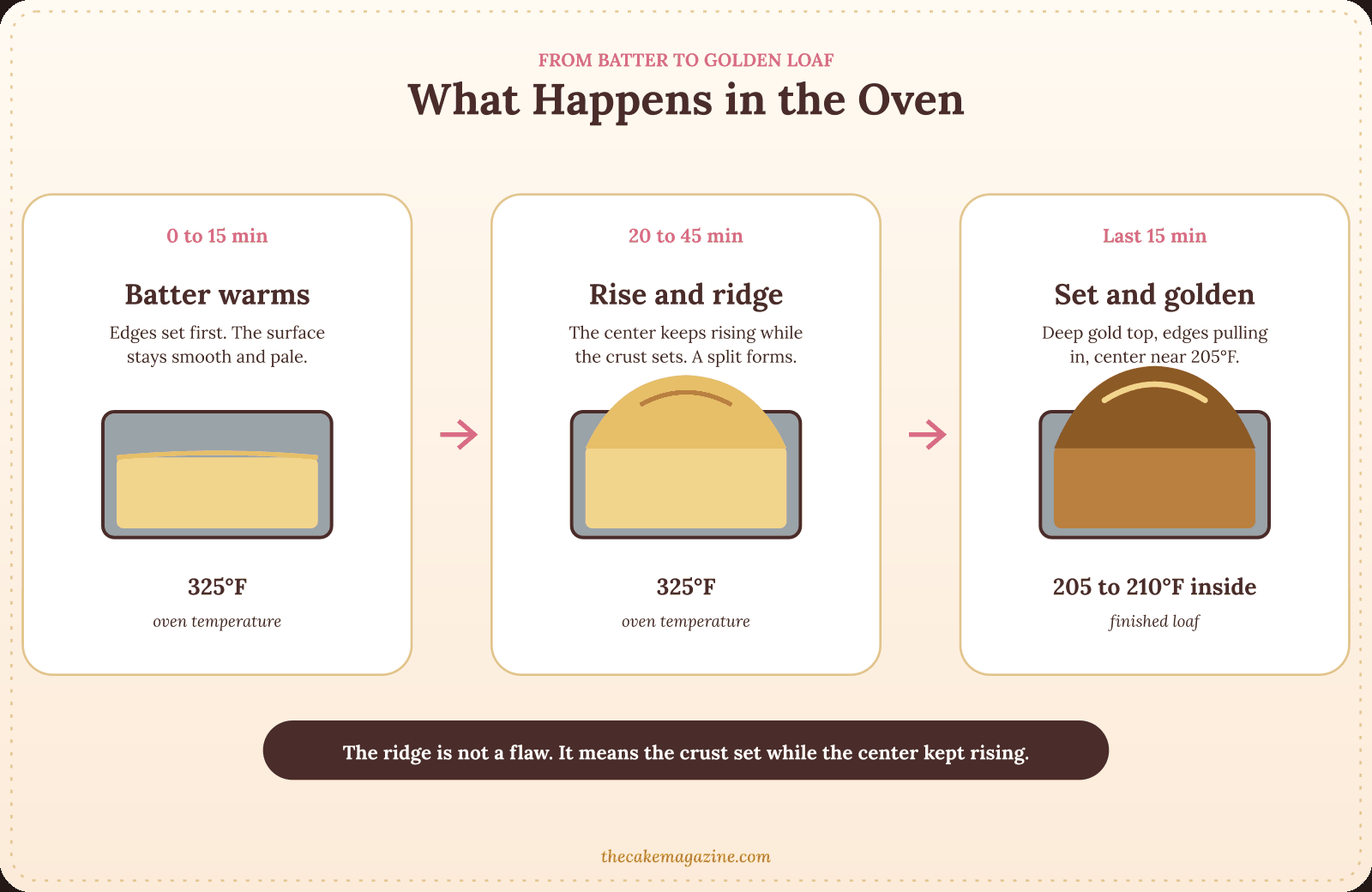
Three signs your pound cake recipe is done
Use more than one cue, because each can mislead on its own.
- Temperature. An instant-read thermometer in the center should read about 205°F to 210°F. Below 200°F, the middle is probably still setting.
- Skewer. A wooden skewer pushed through the crack should come out clean or with a few dry crumbs. Wet batter means more time.
- Look and touch. The top is deep golden, the sides begin to pull from the pan, and the center springs back lightly when pressed.
Because the deep center of a loaf lags behind the edges, check there. Our article on how to tell when a cake is done has a fuller set of cues, including what to do when your oven runs unevenly.
If the top browns too fast
Loosely tent the pan with foil once the crust reaches a color you like, usually around the 40 to 45 minute mark. Do not seal the foil tightly, which traps steam and softens the crust. Lowering the rack one position can also help in ovens with strong top heat. Make a note of what you did so that you can repeat it next time.
Cooling the right way
Let the loaf rest in its pan for about 15 minutes. That gives the crumb time to firm up so it will not tear on release. Then lift it out by the parchment, set it on a wire rack and cool completely, ideally two hours. Slicing a hot pound cake smears the crumb and releases steam that would otherwise redistribute and keep the loaf moist.
Many bakers say pound cake tastes better the next day, because moisture spreads evenly and flavors settle. Wrap it well once cool and judge for yourself.
Flavor variations for your pound cake recipe
The plain version is lovely, and it is also a flexible canvas. These changes keep the structure intact. Make one change at a time so you can tell what worked.
Lemon pound cake
Rub the zest of two lemons into the sugar with your fingertips before creaming. Replace the sour cream with lemon-flavored yogurt or keep it and brush the warm loaf with a little lemon syrup. See our lemon cake recipe for more citrus ideas.
Almond pound cake
Replace half the vanilla with almond extract, about 2 grams, and top the batter with sliced almonds. Go lightly, since almond extract is strong. Our almond cake recipe explores nut flavors further.
Orange cardamom
Add orange zest and a quarter teaspoon of ground cardamom to the sugar. Brush with an orange glaze. A grown-up flavor that keeps well.
Brown sugar pound cake
Replace up to half the white sugar by weight with light brown sugar for a caramel note and a slightly moister crumb.
Chocolate chip
Fold in 120 grams of mini chocolate chips, tossed in a spoonful of the flour so they do not sink.
Vanilla bean
Scrape one vanilla bean into the sugar and rub it in, or use vanilla bean paste in place of extract for visible flecks.
Rules for changing a pound cake recipe safely
Keep wet additions small. Adding more than a tablespoon or two of juice, liquor or extra milk shifts the balance and can sink the loaf. Instead, use zest, extracts, spices and dry mix-ins, and bring moisture in afterward with a glaze or syrup. Whenever you add mix-ins such as nuts or fruit, toss them in flour so they stay suspended.
Spices work well in small amounts. A quarter teaspoon of cinnamon, nutmeg or cardamom is plenty. If you enjoy warm spice, our spice cake recipe goes further.
Glazes, toppings and serving
A pound cake recipe is wonderful plain, but a finishing touch makes it feel special. Because the crumb is dense, it holds up to sauces and toppings better than most cakes.
Simple glaze for a pound cake recipe
Whisk 120 grams of powdered sugar with 20 to 30 grams of milk or lemon juice, a teaspoon at a time, until it falls from a spoon in a thick ribbon. Glaze the loaf once it has cooled, or while slightly warm for a thinner, shinier coat. Too thin a glaze soaks in and disappears, so add liquid gradually.
Syrups and soaks
A simple syrup made from equal weights of sugar and water, flavored with citrus, vanilla or liqueur, can be brushed onto the loaf while it is still warm. A few spoonfuls add moisture and extend shelf life by a day or so, though the cake should not feel wet.
Ways to serve it
- With fruit. Macerated strawberries, roasted peaches or a spoonful of berry compote.
- Toasted. Slice, butter lightly and toast in a skillet until the edges crisp. Day-old pound cake shines here.
- With cream. Softly whipped cream or crème fraîche adds a cool, tangy contrast.
- As a base. Cube it for trifles, grill it for dessert or layer it with pudding and berries.
If you plan to turn the loaf into a layered or frosted cake, our guide to cream cheese frosting pairs well with a denser crumb. You can find more ideas for frosting a sturdy cake in the American buttercream recipe.
Pound cake styles compared
“Pound cake” covers more ground than most people realize. Different families, regions and bakeries have their own versions, and knowing the differences helps you pick the one you actually want.
Classic butter pound cake
The style in this guide. Creamed butter and sugar, eggs, flour. Fine crumb, buttery flavor, a crisp thin crust.
Sour cream pound cake
Adds more sour cream, usually with a little baking soda or powder. Moister, softer and tangier, with a more tender slice.
Cream cheese pound cake
Swaps part of the butter for cream cheese. Denser and richer, with a subtle tang and a tight, velvety texture.
Whipped or sponge-style
Some old recipes whip eggs separately for lift. The result is lighter and more airy but less buttery. Related to genoise.
Chiffon-adjacent
Oil-based and lightened with whipped whites, it is a different animal. See our chiffon cake recipe if you want that airy texture.
Bundt and tube versions
Same batter, different pan. A bundt gives a decorative shape and more crust per slice. See our bundt cake guide.
If you cannot decide, begin with the classic style in this pound cake recipe, then try the sour cream-heavy version as your second bake. Comparing the two side by side teaches you more than any article can.
Troubleshooting your pound cake recipe
Pound cake is simple, which means problems are usually easy to trace. Use the wheel below to spot your symptom, then read the detail that follows. If your trouble is not here, our cake troubleshooting guide covers a much wider range of problems.
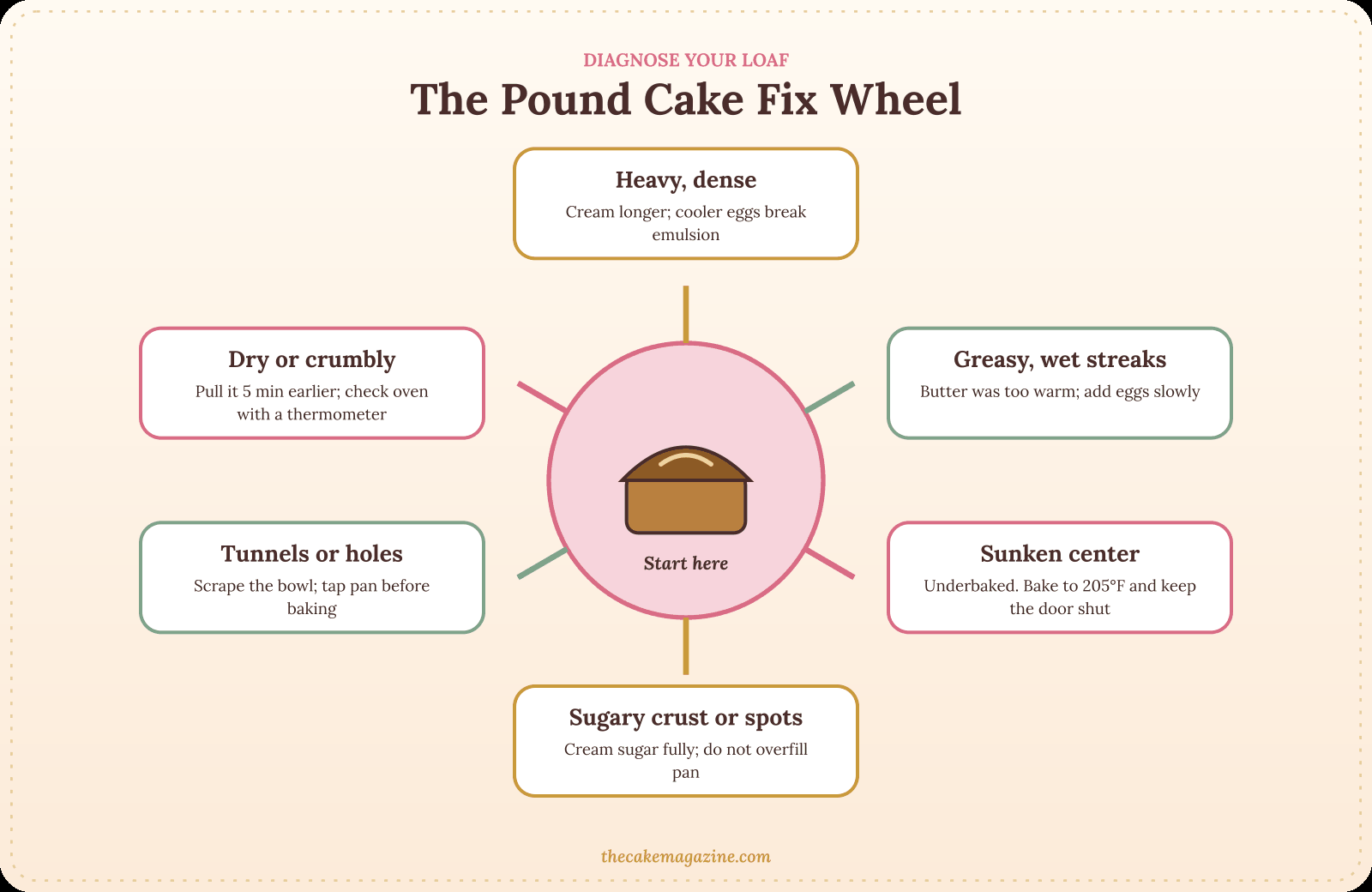
The pound cake recipe turned out dry or crumbly
Likely cause: overbaking, too much flour from scooping, or an oven running hotter than the dial says.
Fix: weigh the flour, check the oven with a thermometer, and pull the loaf as soon as the center hits about 205°F. A syrup brushed on while warm can rescue a loaf that is already baked. See also our guide to why a cake is dry.
The loaf is heavy and dense
Likely cause: butter that was too cold or too warm, not enough creaming, or flour overmixed after it was added.
Fix: cream longer at the right butter temperature, add the eggs slowly, and stop mixing when the flour disappears. Pound cake is naturally dense, but it should never feel leaden. Learn more in why a cake is dense.
There are greasy streaks or a wet ring at the edge
Likely cause: butter that was too warm, a broken emulsion or over-creaming that melted the fat.
Fix: keep the butter cool, chill the bowl if the mixture turns shiny, and add the eggs gradually. Do not use melted butter in place of creamed.
The pound cake recipe sank in the center
Likely cause: underbaking, opening the oven early, a too-full pan or an oven that was too hot.
Fix: bake to 205°F in the center, leave the door shut until at least the last third of baking, and fill the pan no more than two-thirds. If the outside is browning, tent with foil and keep baking.
The crust is pale, spotty or sugary
Likely cause: sugar that was not fully creamed in, or a pan that was too heavily greased with sugar-adhering residue.
Fix: cream until the sugar no longer feels gritty. A light-colored pan can give a paler crust, so brush with a little milk before baking if you want more color.
There are tunnels or large holes
Likely cause: unscraped pockets of butter, over-folded batter trapping big air bubbles, or a batter that was not tapped.
Fix: scrape the bowl well, fold gently but thoroughly, and tap the pan before baking. Our guide to why cakes crack on top explains why a ridge is fine but a crater is not.
The loaf has a gummy stripe near the bottom
Likely cause: too much liquid, underbaking or a batter that was overmixed after the flour went in.
Fix: weigh the sour cream, bake a few minutes longer and use gentle folding. A lower rack can also help the base set.
The loaf stuck to the pan
Likely cause: insufficient greasing, no parchment or turning out too early or too late.
Fix: use a parchment sling, grease thoroughly and release after about 15 minutes of resting. Run a thin knife along the short ends before lifting. For more, see cake stuck to the pan.
Storage and make-ahead
One of the best things about a pound cake recipe is how well it keeps. The high fat content and dense structure help it stay moist. Cool it completely before wrapping, or condensation will turn the crust sticky.
Storing a pound cake recipe at room temperature
Wrap the cooled loaf tightly in plastic wrap or foil, or place it in an airtight container. Plain pound cake usually stays pleasant for two to three days at cool room temperature. Slice only what you need, since cut surfaces dry out first. If the loaf has a glaze, keep it covered but not squashed.
Refrigerating
Plain butter pound cake does not need the fridge in most kitchens, and cold air tends to dry it. The exception is a loaf with perishable toppings such as whipped cream, cream cheese frosting or fresh fruit, which should be kept chilled. Food-safety guidance on holding perishable foods, including the two-hour rule, is available from the USDA Food Safety and Inspection Service. Bring chilled cake back to room temperature before serving for the best texture.
Freezing
Pound cake freezes very well. Wrap the whole loaf, or individual slices, in two layers: plastic wrap first, then foil or a freezer bag. Frozen cake is generally best used within two to three months. Thaw it in its wrapping at room temperature, so that moisture collects on the wrapper and not on the cake.
Slices can be toasted straight from the freezer, which makes them a handy emergency dessert. Label the package with the date so you remember what you have.
A simple make-ahead plan
- Two days ahead. Bake the loaf, cool completely, wrap and keep at room temperature.
- The day before. Make the glaze or syrup and store separately. Prepare any fruit compote and refrigerate.
- The day of. Glaze an hour before serving, slice with a serrated knife and serve with cream or fruit.
For more on keeping bakes fresh, and on safe handling of eggs, dairy and perishable fillings, check the general information from official sources rather than relying on rules of thumb alone.
Ten mistakes to avoid
Almost every failed loaf traces back to one of these. Read through the list before you bake, and again if something goes wrong.
- Using butter that is too cold or too warm. Aim for about 65°F and a gentle dent.
- Measuring flour by scooping. Weigh it, or spoon and level.
- Skipping the scraping. Unmixed butter at the bottom of the bowl causes streaks and holes.
- Adding eggs too fast. This breaks the emulsion and curdles the batter.
- Overmixing after the flour. Tough, gummy and tunneled results follow.
- Trusting the oven dial. Use an oven thermometer to check the real temperature.
- Opening the door early. A rush of cool air can collapse a fragile loaf.
- Baking too hot to save time. You will get a dark crust and a raw center.
- Slicing while warm. The crumb tears and the loaf dries out faster.
- Leaving out the salt. The cake tastes flat even when it looks perfect.
Keep a baking log. Write down your oven temperature, pan, bake time, final internal temperature and anything you changed. Two or three entries will show you the pattern behind your oven, and it is the fastest way to turn any pound cake recipe into one that works every time in your kitchen.
For another respected perspective on technique, you may like the King Arthur Baking cake guide, which covers many cake basics that apply to loaves as well.
Scaling, pan sizes and yield
Once you have made the loaf, you will want to bake it in other shapes: for gifts, for a crowd, for a brunch table. The batter in this pound cake recipe is flexible, but the pan and the clock both change. Here are sensible starting points. Treat each time as a window to check inside, not a promise.
One 9 by 5-inch loaf (the standard)
All of the batter, about 1,000 g. Bake 60 to 75 minutes at 325°F. Serves 10 to 12 slices about three-quarters of an inch thick.
Two 8 by 4-inch loaves
About 500 g per pan. Start checking at 45 minutes and expect 45 to 55. Good for gifting one and keeping one.
Mini loaves
About 130 to 150 g per pan. Start checking at 25 minutes and expect 25 to 35. Fill each pan about two-thirds.
10-cup bundt or tube pan
All the batter. Grease and flour thoroughly. Check at 50 minutes and expect 50 to 65. Cool 15 minutes before turning out.
Muffin tin
About 70 g per cup, filled two-thirds. Bake at 350°F for roughly 20 to 25 minutes. A quick way to try the flavor.
Doubling or halving the formula
Because the recipe is built from weights, scaling is arithmetic rather than guesswork. Multiply every weight by the same number. Eggs are the one place where it gets awkward, since half of four is two but a one and a half batch calls for six eggs. For odd amounts, whisk the egg and weigh out the portion you need. Our guide on how to scale a cake recipe covers that in more detail.
Doubling the batter does not mean doubling the pan. A larger batch bakes slower, so lower the oven temperature by 10 to 15 degrees and extend the time. For converting between pan shapes, see cake pan conversion.
High altitude
At higher elevations, liquids evaporate faster and air pressure is lower, which makes cakes rise quickly and then collapse. Small adjustments to sugar, leavening and oven temperature usually help. Since this recipe uses very little leavener, the main fixes tend to be a slightly hotter oven and a touch more liquid. Read our high altitude cake baking guide before adjusting, and change only one variable at a time.
How many people does a pound cake recipe serve?
A 9 by 5-inch loaf yields about ten to twelve slices cut a bit under an inch thick, which is generous for such a rich cake. For a dessert plate with fruit and cream, slices around half an inch thick stretch it to fourteen. For a party, bake two loaves. If you are planning cakes for events or sales, the numbers in our wedding cake servings guide show how portion size changes the math.
A first-bake checklist for your pound cake recipe
Before the oven goes on, run through this short list. Each item prevents a problem we have discussed above.
Out 30 to 45 minutes ahead
Butter at about 65°F, eggs and sour cream at cool room temperature.
Weighed, not scooped
Flour, sugar, eggs and sour cream measured on a scale and written in your log.
Oven verified
An oven thermometer in place and the rack in the center position.
Pan prepared
Greased, lined with a parchment sling and greased again.
Thermometer ready
An instant-read thermometer on the counter so you check the center, not the clock.
Cooling space
A wire rack cleared and a plan to leave the loaf alone for at least an hour.
What to taste for in your first pound cake recipe loaf
When you cut the first slice, look and taste on purpose. The crumb should be fine and even, with no large tunnels or a gummy stripe. The flavor should lead with butter and vanilla, with enough salt that the sweetness feels balanced. The crust should be thin and slightly crisp, not thick and bitter. Write down what you notice. That feedback is how you improve the next loaf.
If something is off, go back to the troubleshooting section above and change one thing. A second bake, with a single change, teaches more than three bakes where you adjust everything at once.
Pound cake recipe FAQ
What is the basic pound cake recipe ratio?
The classic pound cake recipe uses equal weights of butter, sugar, eggs and flour, which is where the name comes from. Modern versions usually scale that down to about one cup of butter and nudge the ratio slightly. Weigh the ingredients rather than measuring by cups, because a few grams either way changes the crumb.
Why is my pound cake recipe dry?
Dry pound cake usually comes from overbaking, too much flour or an oven that runs hotter than its dial. Weigh the flour, check your oven with a thermometer and pull the loaf when the center reaches about 205°F to 210°F. A little sour cream or a brush of simple syrup helps keep the crumb moist.
Why did my pound cake crack on top?
A crack down the center is normal and even desirable. The crust sets while the center keeps rising, so it splits along the top. A wide, deep, wet-looking crack usually means the oven was too hot or the loaf was underbaked inside, so lower the temperature and bake longer.
Should the butter be softened or cold for a pound cake recipe?
Neither extreme. Aim for cool and pliable, about 65°F, so a finger leaves a dent without sinking in. Very cold butter cannot trap air, and very soft or melted butter loses it. If the butter is too warm and shiny, chill the bowl for ten minutes before continuing.
Can I make this pound cake recipe without baking powder?
Yes. Traditional pound cake had no chemical leavener, and the rise came from air beaten into the butter and sugar. If you omit the baking powder, cream for an extra minute and be careful not to overmix after adding the flour. The crumb will be a little denser and more traditional.
Can I use cake flour instead of all-purpose flour?
You can use the same weight of cake flour for a softer, more delicate crumb. The slice will be a bit more fragile, and the loaf may brown slightly differently. All-purpose flour gives the sturdier, more classic texture many people expect from a pound cake recipe.
How do I know my pound cake is done?
Use several cues together. The center should read about 205°F to 210°F on an instant-read thermometer, a skewer should come out clean or with dry crumbs, and the top should be deep golden with the sides starting to pull away. Wet batter on the skewer means it needs more time.
Why is my pound cake heavy and dense?
Heaviness usually traces back to under-creaming, butter at the wrong temperature, eggs added too quickly or flour mixed too long. Cream butter and sugar until pale and fluffy, add the eggs slowly and stop mixing when no dry streaks remain. Some density is natural, but it should still slice cleanly and feel tender.
How long does pound cake keep?
Wrapped well, a plain loaf usually keeps for two to three days at cool room temperature and for two to three months in the freezer. Cakes with perishable toppings such as cream cheese frosting or whipped cream should be refrigerated. Wrap the cake after it has cooled completely to avoid sticky condensation.
Can I bake this pound cake recipe in a bundt pan?
Yes. A 10-cup bundt or tube pan holds about this much batter, and bake time usually runs from 50 to 65 minutes at 325°F. Grease and flour the pan thoroughly, check early and cool for about 15 minutes before turning it out. See the bundt guide for more detail.
What can I use instead of sour cream?
Full-fat plain yogurt works the same way and gives a similar tang. Whole milk also works, although the crumb will be slightly less tender and a little less rich. Keep whichever you use at room temperature so it blends smoothly into the batter without chilling the butter.
Why did my pound cake sink in the middle?
A sunken center usually means the loaf was underbaked, the oven door was opened early, the pan was overfilled or the oven was too hot. Bake until the center reads about 205°F, keep the door closed for the first hour, and fill the pan no higher than two-thirds. Tent with foil if the top browns too soon.
Can I freeze a pound cake recipe before baking?
It is better to freeze the baked loaf than the raw batter, because the air you worked into the butter can deflate during freezing and thawing. Wrap the cooled cake in plastic and foil, freeze it, and thaw at room temperature in its wrapping. Slices can be toasted from frozen.
Final thoughts
A pound cake recipe is humble on paper and surprisingly demanding in practice, which is exactly why it is so satisfying to get right. Weigh the ingredients, bring the butter to about 65°F, cream it until pale, add the eggs slowly, fold in the flour gently and bake low and slow until the center reads about 205°F to 210°F. Then, the hardest step: wait until it cools.
Make the loaf once as written, so you know how it behaves in your oven and pan. Then play. Add lemon zest, swap in brown sugar, glaze it, toast it, serve it with berries. Keep notes as you go. Within a few bakes you will have a pound cake recipe that is truly yours, along with the know-how to fix it when a batch goes sideways.
If you try it, we would love to hear how it went. Tell us your pan, your oven and what you changed, and we will keep refining this guide.
Editorial note: reviewed and updated November 2026, written for home bakers in the United States using American measurements. The formula in this article is a starting recipe built from conservative, widely used baking ratios. It has not been oven-tested by our team, so test it once before baking for guests or for sale. Results vary by oven, pan, altitude and ingredients. Where we link to products or tools in the future, we will disclose affiliate relationships near the links.