A good pumpkin cake should taste like autumn without tasting like a candle. It should be moist from the first slice to the last, warmly spiced rather than harshly so, and sturdy enough to carry a thick swirl of frosting. Too many versions turn out gummy in the center or pale in flavor. This pumpkin cake recipe is built to avoid that. You get a reliable two-layer formula in grams, the reasoning behind each choice and a plan for frosting, storing and fixing it.
A dependable pumpkin cake recipe uses canned pumpkin puree, oil, a mix of white and brown sugar, three eggs and a measured blend of cinnamon, ginger, nutmeg, cloves and allspice. Whisk the dry ingredients, whisk the wet, combine gently and bake two 8-inch layers at 350°F until a skewer comes out with a few moist crumbs. Cool the layers fully, then frost with a tangy cream cheese frosting. The formula below is a starting point to test in your own oven.
- Why this pumpkin cake recipe works
- The ingredients, explained
- Choosing and preparing pumpkin puree
- The warm spice blend
- Equipment and pans
- The recipe card
- Step-by-step method
- Fall frosting pairings
- Filling, stacking and decorating
- Pan sizes and yield
- Make ahead and storage
- Troubleshooting
- Variations
- Common mistakes to avoid
- FAQ
Why this pumpkin cake recipe works
People who search for a pumpkin cake recipe usually want a short list of things that sound easy and are not. They want real pumpkin flavor, a crumb that stays moist for days and spices that taste rounded instead of dusty. They want layers that hold a frosting without crumbling. A handful of deliberate choices in this formula answer each of those wishes, and once you know what they are, you can adjust the cake with confidence.
This pumpkin cake recipe uses oil, so the crumb stays soft
Butter tastes wonderful, but it turns firm in the fridge, and a cake that spends time under cream cheese frosting spends a lot of time in the fridge. Oil stays liquid at every temperature, so a cake made with it feels plush whether it is warm, cool or cold. Pumpkin and spice have plenty of flavor of their own, so you give up very little by skipping butter in the batter. The butter shows up where it shines, in the frosting.
If you want a butter-based cake for comparison, our best vanilla cake recipe uses reverse creaming and makes a good contrast to this whisk-and-pour method.
In this pumpkin cake recipe, puree is a moisture ingredient first
Most people think of pumpkin as a flavor, but in a cake it is also structure. Puree is mostly water with some starch and fiber, so it adds moisture and body together, much like applesauce or mashed banana. That is why a pumpkin cake recipe can be so tender with relatively little fat. The flavor of the puree itself is mild and earthy. Most of the “pumpkin” taste you recognize comes from the spices and brown sugar, which is worth knowing before you add a second can.
Two sugars give the pumpkin cake recipe depth without heaviness
Granulated sugar gives clean sweetness and a lightly crisp edge. Light brown sugar brings a little molasses, which makes the cake taste richer and keeps it moister for longer. Using both is a small step that makes a noticeable difference, and it costs nothing extra. If you only have one kind, the variations section explains how to swap.
The pumpkin cake recipe measures its spices instead of guessing
Plenty of pumpkin cake recipes say “1 tablespoon pumpkin pie spice” and leave it there. That works, but the blend can taste flat if the jar is old or overpowering if it is fresh and strong. This formula weighs out each spice so you can taste, adjust and repeat the result. We cover how to tune the blend in the spice section below.
Weigh, do not scoop
A cup of flour can weigh anywhere from 120 to 160 grams depending on how you scoop it, and that gap is the difference between a tender pumpkin cake recipe and a dry one. Every ingredient in the recipe card is in grams, with cups listed as a convenience. A digital scale is the cheapest way to make your results repeatable. Our guide to cake baking science explains why the ratios matter so much.
A note on testing. The Cake Magazine has not oven-tested this formula. It is built from conservative, widely used ratios for oil-based pumpkin layer cakes, and every number is a starting point. Ovens, pans and canned pumpkin all vary, so bake one cake as written, take notes and adjust from there.
The ingredients, explained
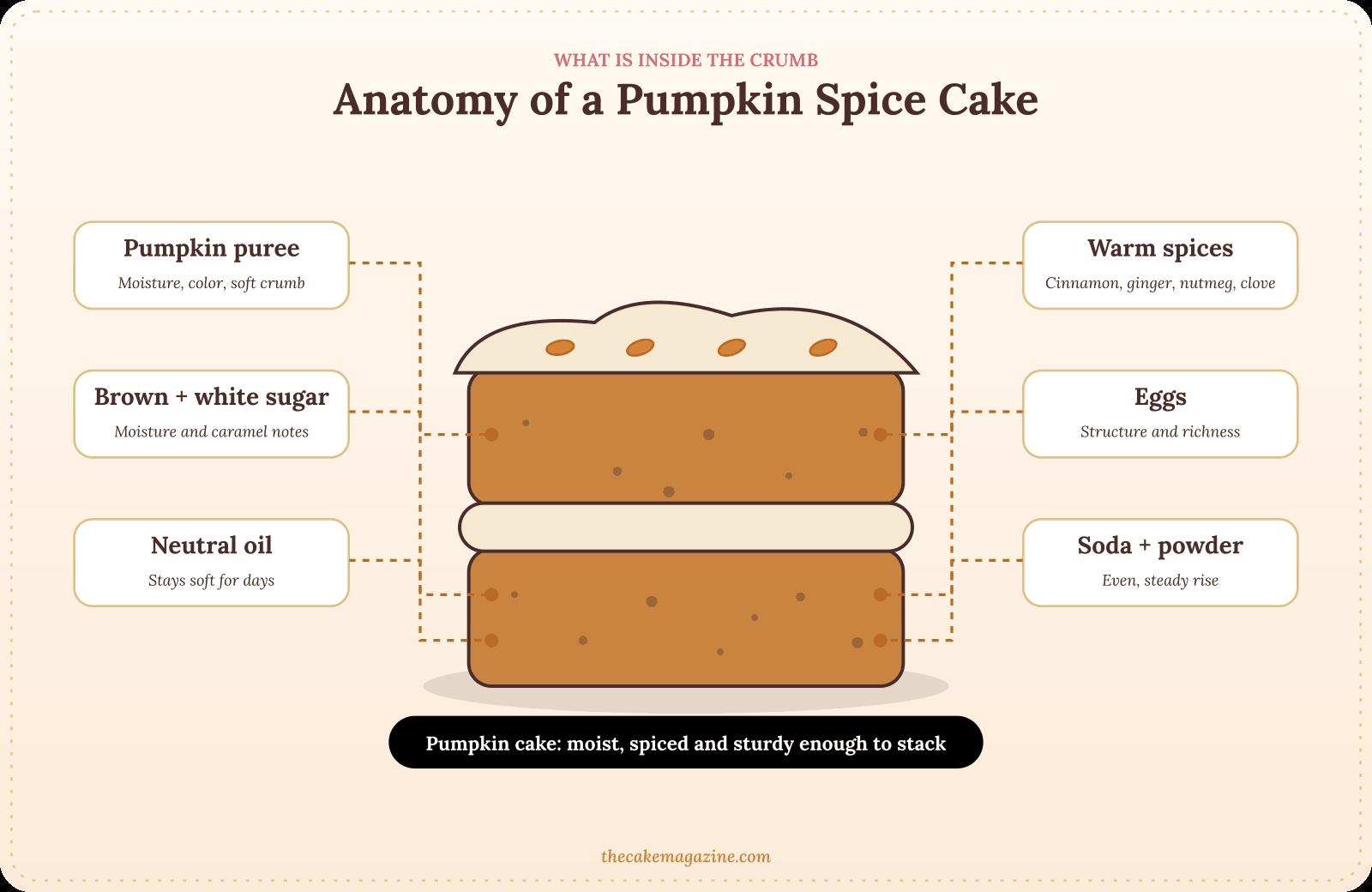
Before you start measuring, it helps to know what each ingredient does in the bowl. This is the difference between following a recipe and understanding one. The infographic gives you the quick version, and the sections after it fill in the detail.
All-purpose flour
Plain all-purpose flour is all this cake needs. The puree and oil already soften the crumb, so cake flour is not necessary. Spoon the flour into your measuring cup and level it if you are not using a scale, and whisk it with the leaveners and spices so the spices spread evenly. Clumped cinnamon in one bite and none in the next is a common problem in a rushed batter.
Granulated and brown sugar
Sugar sweetens the cake, but it also holds water and slows gluten formation, which keeps the crumb tender. This formula uses 200 grams of granulated sugar and 150 grams of light brown sugar. Press the brown sugar through your fingers to break up lumps, since a hard knot of sugar will not dissolve in a batter this quick. Dark brown sugar works too and gives a stronger molasses note.
Neutral oil
Canola, vegetable or sunflower oil keeps the flavor clean. Avoid strongly flavored oils such as extra virgin olive oil unless you want them in the cake. Measure by weight, 200 grams, since oil is easy to over-pour by volume. Melted and cooled coconut oil or melted butter can stand in, but both change the texture slightly once cold.
Eggs
Three large eggs, about 150 grams without shells, give structure and richness. Use them at cool room temperature so they blend smoothly into the oil and sugar. If you forgot to take them out, set them in a bowl of warm tap water for five to ten minutes. Cold eggs can leave the oil looking slightly separated, which is not a disaster but is easy to avoid.
Baking powder, baking soda and salt
This cake uses both leaveners. Baking soda needs a little acid to work, and pumpkin puree supplies some, along with the brown sugar. Baking powder provides steady lift on top of that. Check the dates on both, since either can lose strength after six months to a year in the cupboard. Salt matters more than you might think: a full teaspoon of fine salt keeps the sugar and spice from tasting flat or cloying.
Vanilla
Eight grams of pure vanilla extract, about two teaspoons, rounds out the spices. You will not taste vanilla on its own. You will notice that the cake tastes smoother and a little more bakery-like.
Pumpkin puree
The heart of this pumpkin cake recipe is 425 grams of plain pumpkin puree, which is the weight of a standard 15-ounce can. It deserves its own section, because the wrong product or a watery batch of homemade puree can sink a cake.
Three things to remember. For any pumpkin cake recipe, use plain puree, not pie filling. Weigh the flour and puree. Salt the batter. These habits do more for a pumpkin cake than any exotic ingredient.
Choosing and preparing pumpkin puree for a pumpkin cake recipe
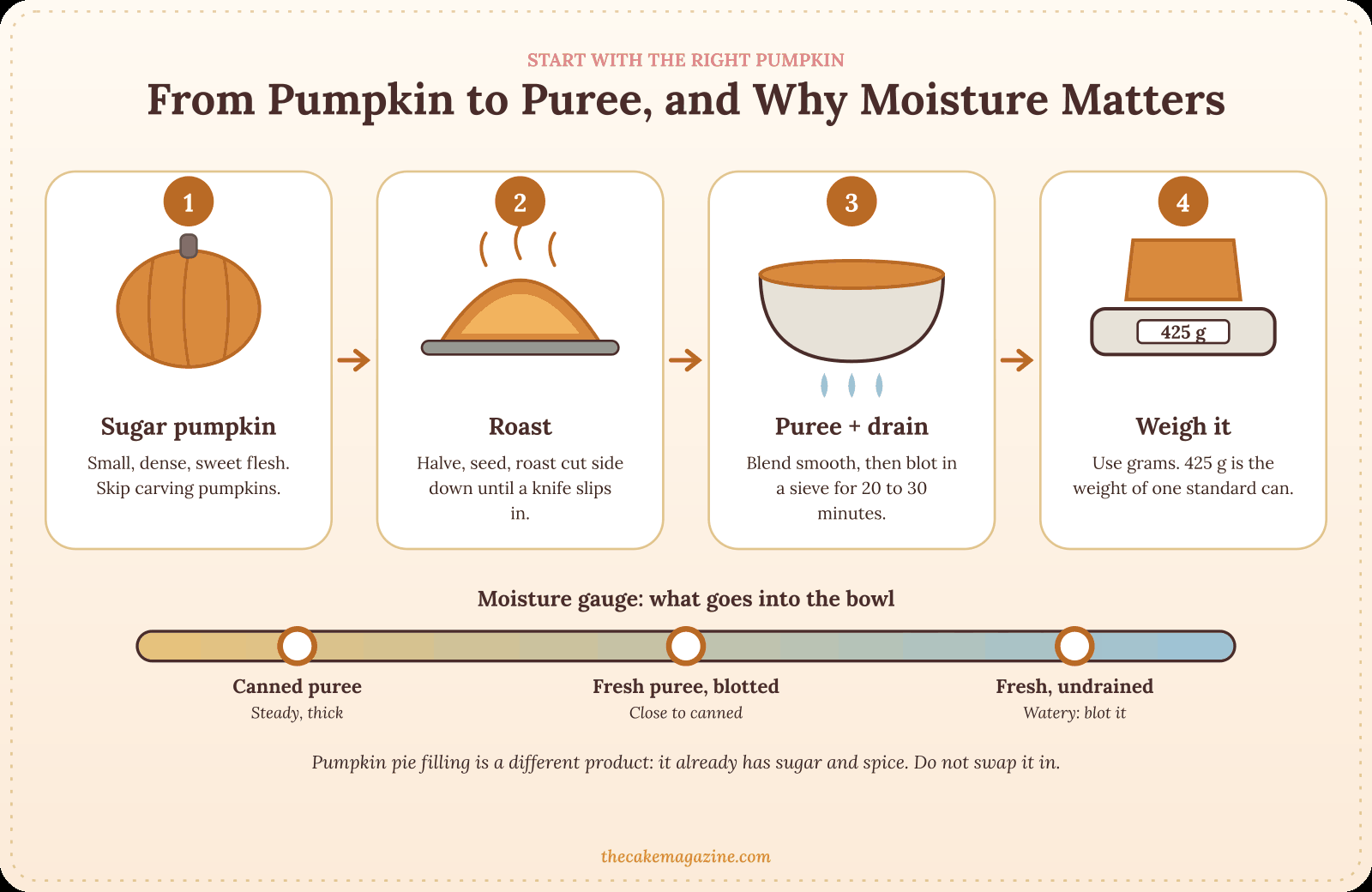
Pumpkin puree is the one ingredient that changes from can to can and pumpkin to pumpkin, so it is worth getting to know. Some bakers swear by roasting their own, and others use cans all year without a second thought. Both work. The trick is knowing what each one brings to the bowl, and controlling its moisture before it goes in.
Canned pumpkin: the steady choice
Plain canned pumpkin is cooked, blended and thick, and one can contains the same weight every time. That consistency is the main reason a canned-pumpkin pumpkin cake recipe is so repeatable. Look for a label that lists only pumpkin, or pumpkin and a little water. The ingredient list should not include sugar, spices or thickeners.
Some canned “pumpkin” is actually made from other winter squash varieties. That is not a problem for baking, as the flavor and color are very close, but it is a good reason to judge by texture and not by the name on the label. Good puree is thick and smooth and holds a spoon upright for a moment.
Do not swap in pumpkin pie filling
Pumpkin pie filling looks nearly identical on the shelf, but it is a different product. It already contains sugar and spices, and sometimes other ingredients, so using it in this formula would throw off both the sweetness and the spice balance. Read the label before you buy. If you end up with the wrong can, save it for a pie and pick up plain puree for the cake.
Fresh puree for a pumpkin cake recipe: worth it if you drain it
Homemade puree can taste lovely, but it is wetter and more variable than canned. Use a small, dense variety sold as a sugar or pie pumpkin, not a big carving pumpkin, which tends to be stringy and watery. Halve it, scoop out the seeds, and roast the halves cut side down at 400°F until a knife slides in easily. Scrape out the flesh and blend it until smooth.
Then comes the step most recipes skip. Spoon the puree into a fine sieve set over a bowl and let it drain for 20 to 30 minutes, pressing gently. Weigh out 425 grams of the drained puree. If it still looks loose and glossy rather than thick, let it drain longer or cook it in a pan for a few minutes to evaporate some water.
Preserving puree safely. If you make a big batch of fresh puree, freeze it. Penn State Extension advises that mashed or pureed pumpkin should not be home-canned, by pressure or boiling water bath, because no tested method shows heat reaches the center safely. Their guidance is to freeze puree in rigid containers or bags. You can read more on the Penn State Extension page on preserving pumpkin puree.
A quick moisture test for your pumpkin cake recipe
Here is an easy check you can do with a spoon. Scoop up some puree and tip the spoon. Good puree slides slowly and leaves a thick trail. If a watery halo appears around it on a plate after a minute, it needs blotting. For canned pumpkin that looks unusually loose, you can blot it with a paper towel, though most cans do not need it. In a pumpkin cake recipe, a little extra water in the puree is the most common cause of a gummy middle.
What about other squash?
Butternut squash puree makes a perfectly good substitute, with a sweeter, slightly nuttier flavor and a deeper orange color. Treat it the same way: roast, puree, drain and weigh. Kabocha is drier and starchier and often needs no draining at all. Sweet potato puree also works in a pinch, though the flavor shifts away from pumpkin and toward something closer to a sweet potato cake.
The warm spice blend in a pumpkin cake recipe
The spices are what make a pumpkin cake taste like a pumpkin cake. They are also the most common place for a recipe to go wrong, because spices vary so much from brand to brand and from jar to jar. A spice that has sat open for two years can be a shadow of what it was. A freshly opened jar of ground cloves can bully every other flavor in the bowl.
The spice blend in this pumpkin cake recipe
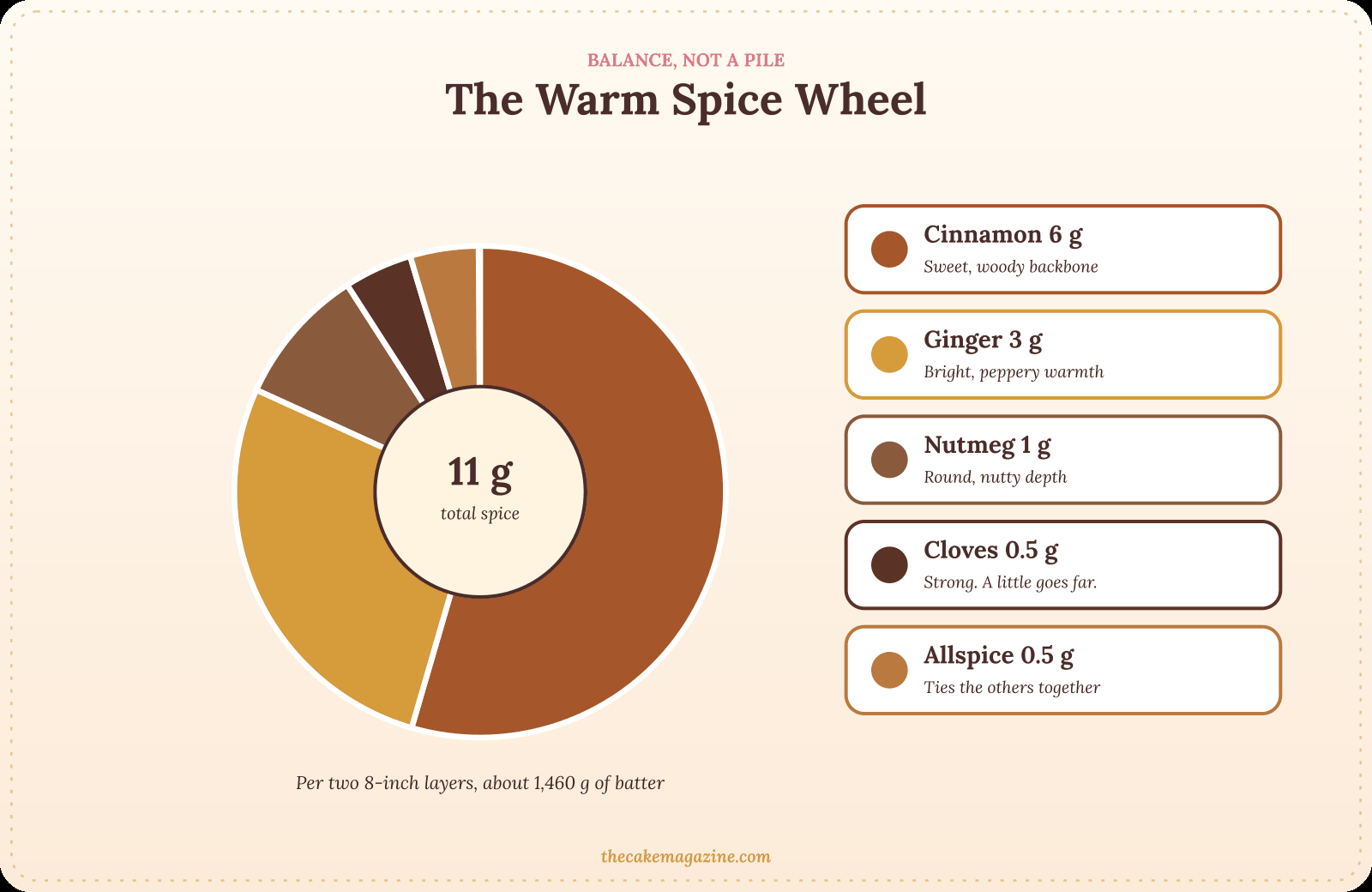
This pumpkin cake recipe uses 11 grams of spice in total: 6 grams of cinnamon, 3 grams of ground ginger, 1 gram of nutmeg, half a gram of cloves and half a gram of allspice. In spoons, that is roughly 2½ teaspoons, 1½ teaspoons, ½ teaspoon, and two small ¼ teaspoons. The result is cinnamon-forward with a peppery lift from ginger and a quiet background of the others.
If you would rather use a store-bought pumpkin pie spice blend, you can replace the five spices with about 10 to 12 grams, roughly a tablespoon, and taste the result. Blends differ in strength, so treat the first bake as a test.
Freshness matters more than quantity
A simple test: rub a pinch between your fingers and smell it. It should be fragrant right away. If you have to hunt for the aroma, the spice is tired and the cake will taste dull no matter how much you add. Ground spices are best used within about a year of opening. Whole nutmeg, grated fresh on a fine grater, gives a brighter flavor than the pre-ground kind and lasts for years.
Tuning the blend to your taste
Everyone’s idea of a “spiced” cake is a little different. Here are a few adjustments that are easy to make once you have baked the base formula once.
- Warmer and rounder: add another half gram of nutmeg and swap the light brown sugar for dark.
- Brighter and sharper: raise the ginger to 4 grams, and add a teaspoon of finely grated fresh ginger to the wet ingredients.
- Gentle for kids: cut the cloves entirely and reduce the ginger to 2 grams.
- Bakery-style: add a small pinch of black pepper and a pinch of ground cardamom for a faint complexity that people notice but cannot name.
If you love spice as a theme, our spice cake recipe goes deeper into balancing cinnamon, ginger and nutmeg without pumpkin in the batter.
Toast the spices for a deeper pumpkin cake recipe
An optional step gives the spices a boost. Warm the dry spices in a small, dry skillet over low heat for 30 to 60 seconds until fragrant, then cool them before whisking them in. This is not necessary, but it can make a good pumpkin cake recipe taste a little more like a bakery loaf. Do not let them scorch, or they turn bitter.
Equipment and pans for the pumpkin cake recipe
You do not need anything fancy to make this pumpkin cake recipe. A few tools make it more consistent, though, and the list is short.
- A digital kitchen scale. The most useful upgrade, especially for flour, puree and sugar.
- Two 8-inch round cake pans, 2 inches deep. Light-colored aluminum bakes most evenly. Dark nonstick pans brown faster, so check early. Our cake pan buying guide compares the options.
- Parchment paper. Pumpkin batter is sticky and sugary, and parchment rounds in the bottom make release almost foolproof.
- A large whisk and two bowls. This is a whisk-and-fold method, so a mixer is not required for the cake. It is helpful for the frosting.
- A rubber spatula. For folding and scraping the bowl clean.
- An oven thermometer. Many ovens run 10 to 25 degrees off. King Arthur Baking notes in its cake guide that built-in oven thermometers are often inaccurate, so an independent one is worth having.
- An instant-read thermometer. Optional, but handy for checking doneness.
- A wire rack. For cooling the layers evenly.
Prepare the pans
Grease the sides and bottoms of the pans with softened butter or baking spray, press a parchment circle into the bottom and grease the parchment. Dust the sides lightly with flour, and tap out the excess. Because this batter is sticky from brown sugar and puree, do not skip the parchment. A cake that tears on release is a frustrating way to end an hour of work.
If you bake layer cakes often, damp fabric baking strips wrapped around the pan help the cakes bake evenly and keep the tops flatter. They are optional, but they help with a dense batter like this one.
Rack position and oven prep
Set a rack in the center of the oven and heat it to 350°F (175°C). A preheat light can come on before the oven walls and rack are truly hot, so give it another ten minutes if you can. Place the pans side by side with a little space between them and away from the oven walls, so air can move around each pan.
The pumpkin cake recipe card
Here is the full pumpkin cake recipe in one place. It is a starting point built from conservative, commonly used ratios, and it has not been oven-tested by this site. Bake times and amounts can shift with your oven, pans and puree, so treat the first bake as a trial run and keep notes.
Pumpkin Spice Layer Cake
A moist, oil-based, two-layer 8-inch pumpkin cake with brown sugar and a measured blend of warm spices. Designed to stack and frost well, and to stay soft under cream cheese frosting.
Ingredients
- All-purpose flour300 g (about 2½ cups, spooned and leveled)
- Granulated sugar200 g (1 cup)
- Light brown sugar150 g (¾ cup, packed)
- Baking powder6 g (1½ teaspoons)
- Baking soda5 g (1 teaspoon)
- Fine salt5 g (1 teaspoon)
- Ground cinnamon6 g (about 2½ teaspoons)
- Ground ginger3 g (about 1½ teaspoons)
- Ground nutmeg1 g (½ teaspoon)
- Ground cloves and ground allspice0.5 g each (¼ teaspoon each)
- Plain pumpkin puree (not pie filling)425 g (one 15-ounce can, about 1¾ cups)
- Large eggs, cool room temperature150 g (3 eggs)
- Neutral oil (canola, vegetable or sunflower)200 g (1 cup)
- Pure vanilla extract8 g (2 teaspoons)
Instructions
- Prep. Set a rack in the center of the oven and heat to 350°F (175°C). Grease two 8-inch by 2-inch round pans, line the bottoms with parchment, grease the parchment and flour the sides.
- Whisk the dry ingredients. In a large bowl, whisk the flour, baking powder, baking soda, salt and all the spices for 30 seconds until evenly mixed.
- Whisk the wet ingredients. In a second large bowl, whisk both sugars with the eggs for about a minute until slightly thick. Whisk in the oil, then the pumpkin puree and vanilla until smooth.
- Combine. Add the dry mixture to the wet in two additions. Fold with a spatula just until no dry streaks remain. The batter will be thick but pourable.
- Pan the batter. Divide evenly by weight (about 730 g per pan). Smooth the tops and tap each pan firmly on the counter two or three times to release air bubbles.
- Bake. Bake 32 to 38 minutes, checking at 30. The cakes are done when the tops spring back lightly, the edges just begin to pull from the pan and a skewer in the center shows a few moist crumbs (about 205°F to 210°F inside).
- Cool. Cool in the pans on a rack for 15 minutes. Run a thin knife around the edge, turn the layers out onto the rack, peel off the parchment and cool completely, at least 1 to 2 hours, before frosting.
- Frost. Fill and frost with cream cheese frosting (see the notes) or one of the pairings below. Refrigerate if the frosting contains cream cheese.
Notes
- Cream cheese frosting starting point: beat 170 g (3/4 cup) soft unsalted butter until smooth, add 340 g (12 oz) cool, full-fat block cream cheese and beat just until combined, then mix in 480 g (4 cups) sifted powdered sugar, 10 g vanilla and 2 g salt. Chill 20 minutes if too soft.
- Storage: Wrap cooled, unfrosted layers tightly and keep at room temperature for up to 1 day, or freeze for up to 2 months. Refrigerate frosted cake.
- Add-ins: Fold in 100 g of toasted, chopped pecans or walnuts if you like. Dust them with a spoonful of the flour first.
- Other pans: See the pan size section for starting points in 9-inch, 9×13, bundt and cupcake formats. Treat them as estimates and check early.
- Frosting pairings: Try it with cream cheese frosting, American buttercream or a chocolate ganache.
Step-by-step: how to make this pumpkin cake recipe
The recipe card gives you the sequence. This section gives you the reasoning, which is what saves you the day something behaves differently than expected. If you are new to layer cakes, read it once before you begin.
Step 1: Set up for the pumpkin cake recipe
Take the eggs out about 30 minutes ahead and heat the oven fully before the cakes go in. Prepare the pans before you mix, not while the batter waits. Weigh every ingredient into its own bowl or cup first, which cooks call mise en place. It feels fussy for about two minutes and then saves you ten, because the batter comes together quickly and you can keep your hands moving.
Check the puree before you start. Open the can, give it a stir and make sure it is thick and smooth. If it looks watery on top, stir it back in, or blot it lightly. Homemade puree should already be drained and weighed.
Step 2: Whisk the dry ingredients for the pumpkin cake recipe
Whisk the flour, leaveners, salt and spices for a full 30 seconds. This is not just stirring for the sake of it. Leaveners and spices are used in small amounts, and unless they are evenly dispersed you can get a bitter bite of baking soda or a pocket of strong clove. If any of your spices have lumps, press them out with the back of a spoon or sift everything together.
Step 3: Whisk the wet ingredients
In a separate bowl, whisk the sugars and eggs for about a minute. You are not trying to whip air into them like a sponge cake. You just want the sugar to start dissolving and the mixture to look slightly thick and pale. Whisk in the oil in a steady stream, then the puree and vanilla. The mixture should look smooth and uniform, a warm orange-brown with no streaks of oil.
Step 4: Fold the pumpkin cake batter together
Add the dry mixture in two additions and fold with a spatula, scraping the bottom and sides of the bowl. Stop as soon as the last streak of flour disappears. Overmixing develops gluten, which makes the cake tough, chewy and prone to tunnels. A few tiny lumps are fine and will disappear in the oven. The batter will be thick, but you should be able to spoon and spread it into the pans.
Why not a mixer? You can use one on its lowest speed for the final combine, but a spatula gives you more control. For more on how mixing affects crumb, see our guide to cake mixing methods.
Step 5: Divide, level and tap
Weigh the filled bowl, subtract the weight of the bowl and divide the batter evenly. Aim for about 730 grams in each pan. Smooth the surface with the back of a spoon, pushing slightly more batter toward the edges, since the center of a cake tends to dome. Tap each pan firmly on the counter two or three times. This knocks out large air pockets that could leave holes or tunnels in the finished layer.
Step 6: Bake the pumpkin cake recipe with patience
Place the pans on the center rack and bake at 350°F. Keep the oven door closed for at least the first 25 minutes. Opening it early lets in cool air, and the unset structure of a moist cake can sink as a result. If your oven is known for hot spots, rotate the pans once near the end, after the structure has set. Start checking at 30 minutes. This pumpkin cake recipe usually needs a few minutes longer than a lighter butter cake, because the puree makes the batter dense.
How to tell a pumpkin cake is done
Do not rely on the timer alone. Use all of these cues together:
- The edges pull away. A hairline gap appears between cake and pan wall.
- The top springs back. Press the center lightly with a fingertip. It should rebound without leaving a dent.
- The skewer tells the story. A skewer in the center should come out with a few moist crumbs. Wet batter means more time. A completely clean, dry skewer often means the cake is a touch overbaked.
- The temperature reads 205°F to 210°F. An instant-read thermometer in the center confirms what the skewer suggests.
Because pumpkin batter is so moist, a skewer is more reliable than the top alone. A cake can look done and still be gummy near the base. If the top is browning too fast while the center is still wet, tent the pans loosely with foil and keep baking.
Step 7: Cool the pumpkin cake before you frost
Let the layers rest in their pans on a wire rack for about 15 minutes so the structure firms up. Run a thin knife around the edge, flip each pan onto the rack, peel off the parchment and let the layers cool completely, which takes at least an hour or two. Frosting a warm cake melts the frosting and makes the layers slide. King Arthur Baking suggests waiting 30 to 60 minutes after a cake seems cool before frosting, which is good advice here.
If your schedule is tight, wrap the cooled layers and chill them for 30 minutes. Cold layers are firmer and easier to frost, especially under a soft cream cheese frosting.
Fall frosting pairings for your pumpkin cake recipe
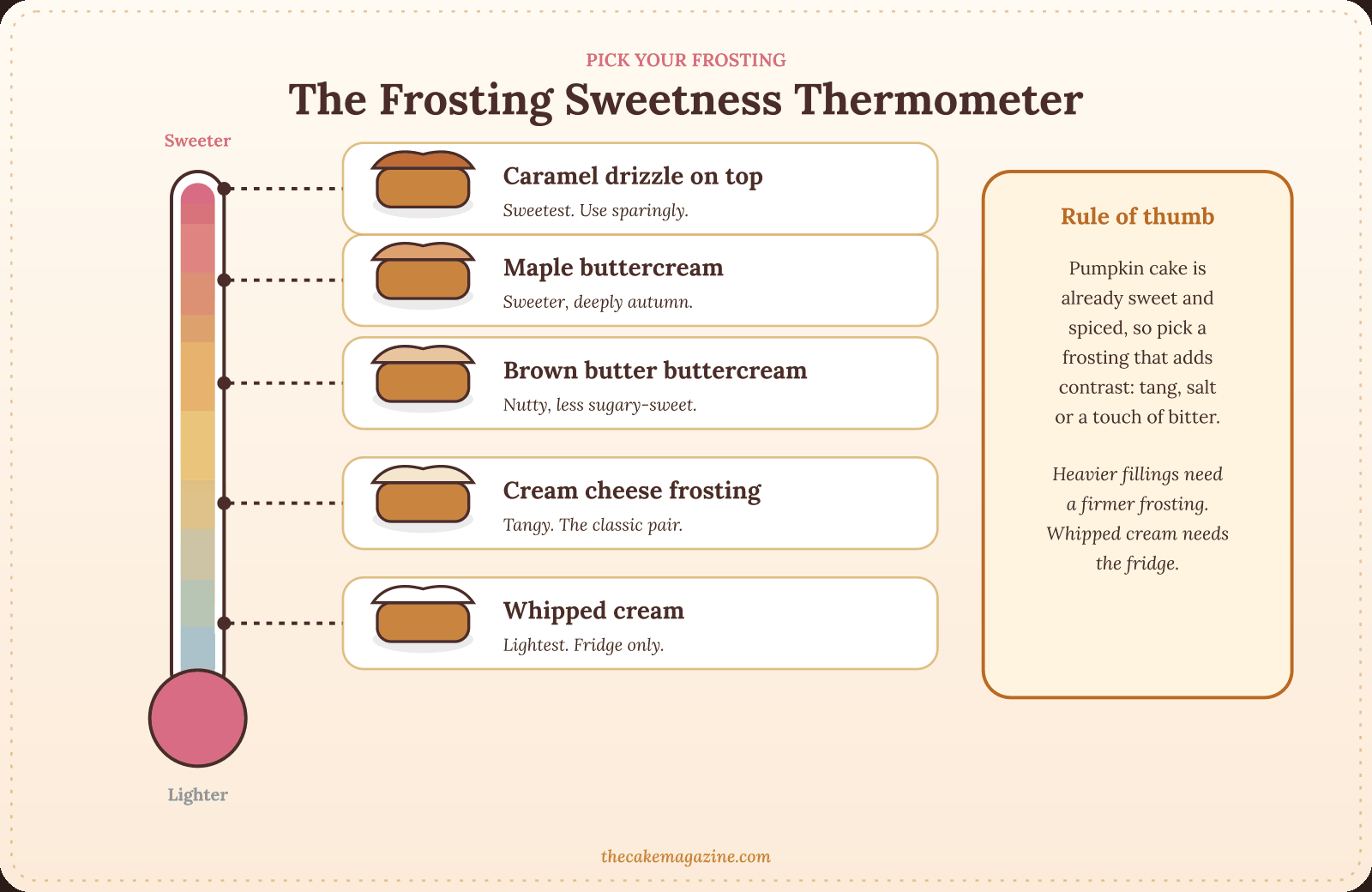
Pumpkin cake is already sweet and spiced, so the best frostings add contrast. That usually means tang, a little salt, a touch of bitterness or a creamy, cooling texture. Pick the frosting before you bake, because it decides how you store, stack and serve the cake. The thermometer below ranks five popular choices from lightest to sweetest.
Cream cheese frosting: the classic pumpkin cake recipe partner
There is a reason this pairing is on nearly every table in the fall. The tang of cream cheese cuts through the brown sugar and spice, and the creamy texture is a good match for a moist, dense crumb. Our full guide to cream cheese frosting covers structure, sweetness and why it can turn soft or runny.
Use full-fat block cream cheese, not the whipped tub variety, which contains extra water and air. Keep the cream cheese cool, beat the butter first and add the cheese last, mixing only until just combined. Overbeating warms and loosens it. If it gets soft, chill it for 20 minutes before using.
Brown butter buttercream for a pumpkin cake recipe
Browning the butter before you beat it adds a toasty, nutty depth that is lovely with pumpkin. Cook the butter in a light-colored pan over medium heat until it foams, smells like toasted nuts and shows golden-brown specks, then pour it into a bowl, scraping in the browned bits. Chill until it is solid but soft, like regular room-temperature butter, before beating with powdered sugar. This is a variation of our American buttercream, with a more grown-up flavor.
Maple buttercream
Maple syrup and pumpkin go together naturally. Replace a few tablespoons of the cream or milk in a basic buttercream with real maple syrup, and add a pinch of salt. Use pure maple syrup rather than pancake syrup, which has a different flavor and a thinner body. Be aware that maple buttercream is on the sweet side, so it is best paired with a cake that is not overly sugary. Use a lighter hand with the powdered sugar and let the syrup do the work.
Whipped cream and mascarpone
If you like a lighter finish, a stabilized whipped cream or a whipped mascarpone frosting lets the spice of the cake shine. These are softer and need refrigeration. They are a good fit for an everyday cake you plan to eat within a few days, and a poor fit for a tall celebration cake that has to sit on a buffet.
Chocolate ganache
Pumpkin and chocolate are a quiet pairing that deserves more attention. A dark chocolate ganache drizzled over a cream cheese frosting looks striking and tastes balanced. For more on ratios and textures, see our chocolate ganache guide. A semisweet ganache also keeps well at room temperature, unlike cream cheese.
Caramel as a finishing touch
A little salted caramel sauce drizzled on top adds shine and a deeper sweetness. Because it adds sugar, use it sparingly on cakes that already wear a sweet frosting, and let it cool before you pour so it does not slide off. It also works as a thin layer between the cake layers, though a runny caramel can leak out, so thicken it first.
How to choose
- Everyday family cake: cream cheese frosting, refrigerated, served cool.
- Holiday dessert table: brown butter or maple buttercream, which handles a few hours at room temperature better.
- Make-ahead gift or potluck: ganache or buttercream over a cooled, wrapped cake.
- Lighter finish: stabilized whipped cream, kept cold until just before serving.
If you are curious about how flavors combine more broadly, our cake flavor pairing guide explores matching cakes, fillings and frostings, and our guide to how much frosting you need helps you make the right amount.
Food safety note. Frostings and fillings made with cream cheese, mascarpone or whipped cream are perishable. The USDA’s Food Safety and Inspection Service advises keeping perishable food out of the 40°F to 140°F danger zone, and not leaving it out for more than two hours, or one hour in hot weather. See the USDA FSIS food safety pages for details. This is general information, not a substitute for guidance from your local health department.
Filling, stacking and decorating a pumpkin cake
Once the layers are cool, a few simple habits turn a homey cake into a polished one. You do not need advanced skills. You need level layers, a thin first coat and patience with the fridge.
Level and torte if you like
Pumpkin cakes tend to bake with a gentle dome. Trim the tops with a serrated knife, holding it level and sawing gently. The trimmings are a baker’s snack, or save them for crumbs to press on the sides. If you want four thin layers instead of two thick ones, our guide to how to torte a cake shows how to split layers cleanly.
Add a filling with care
A thin layer of cream cheese frosting between layers is classic. For extra interest, add a spoonful of salted caramel, a layer of toasted chopped pecans or a thin spread of cranberry sauce or apple butter. Pipe a ring of frosting around the edge first, a dam, so softer fillings stay put. Keep fillings thin, since a thick wet filling in a moist cake is a recipe for sliding layers.
Crumb coat, chill, finish
Spread a thin layer of frosting over the whole cake to trap crumbs, then chill for 20 to 30 minutes until firm. Pumpkin crumb is dark and shows through light frosting, so the crumb coat matters more here than on a vanilla cake. Our crumb coat guide explains how thin the first layer should be. Add the final coat and smooth it with a bench scraper or an offset spatula.
Decorating ideas that suit the season
- Rustic swirls. Skip the smooth sides and use the back of a spoon to make loose, generous swoops of cream cheese frosting.
- Toasted nuts. Press chopped pecans or walnuts around the bottom edge for texture.
- Pepitas. Toasted pumpkin seeds on top look the part and add a salty crunch.
- Cinnamon dust. A light sieve of cinnamon over white frosting reads instantly as fall.
- Caramel drip. A cooled caramel or a ganache drip around the top edge, finished with a few candied pecans.
- Sugared leaves. Real or fondant leaves in muted orange, rust and gold. If you use real leaves, make sure they are food-safe and do not touch the cake.
If you want to practice before a big occasion, our cake decorating for beginners guide covers the basic tools and techniques, and our smooth buttercream sides guide goes into sharp edges.
Pan sizes and yield for the pumpkin cake recipe
This formula makes about 1,460 grams of batter. That is enough for two 8-inch layers, but it can be adapted to other pans. Remember that these are estimates only, since this site has not oven-tested them, so start checking earlier than the time given and trust the skewer over the clock.
A guide to other pans
- Two 9-inch rounds: thinner layers, about 730 grams each. Start checking around 28 to 34 minutes.
- Three 6-inch rounds: tall, narrow layers, about 485 grams each. Start checking around 28 to 34 minutes. Good for a petite, tall cake.
- One 9×13-inch pan: a single thick sheet. Use all the batter and start checking around 35 to 42 minutes.
- A 10- to 12-cup bundt pan: grease and flour thoroughly. Expect roughly 50 to 60 minutes, and cool in the pan 15 minutes before turning out.
- Cupcakes: fill liners about two-thirds full. Expect about 24 cupcakes, baking roughly 20 to 24 minutes.
- Two 9×5-inch loaf pans: half the batter in each. Start checking around 45 to 55 minutes.
The fill-level rule for any pumpkin cake recipe
Fill any pan about halfway, and never more than two-thirds, so the batter has room to rise. A pan filled to the brim will overflow or bake into a heavy dome. If you are not sure whether your pans are the right size, measure them across the top, inside edge to inside edge, and check the depth. Our pan buying guide explains how pan size and depth work.
Scaling the pumpkin cake recipe up or down
Doubling is simple since this is a whisk-and-fold cake. Use a bowl large enough for the batter, and weigh everything. Leaveners do not always scale perfectly, so for big batches, keep the baking powder and soda close to the original ratio by weight and watch the first bake closely. For halving, use one 8-inch pan, and note that half of 3 eggs is awkward. Whisk one egg and use about 75 grams of it.
Make ahead and storage for a pumpkin cake
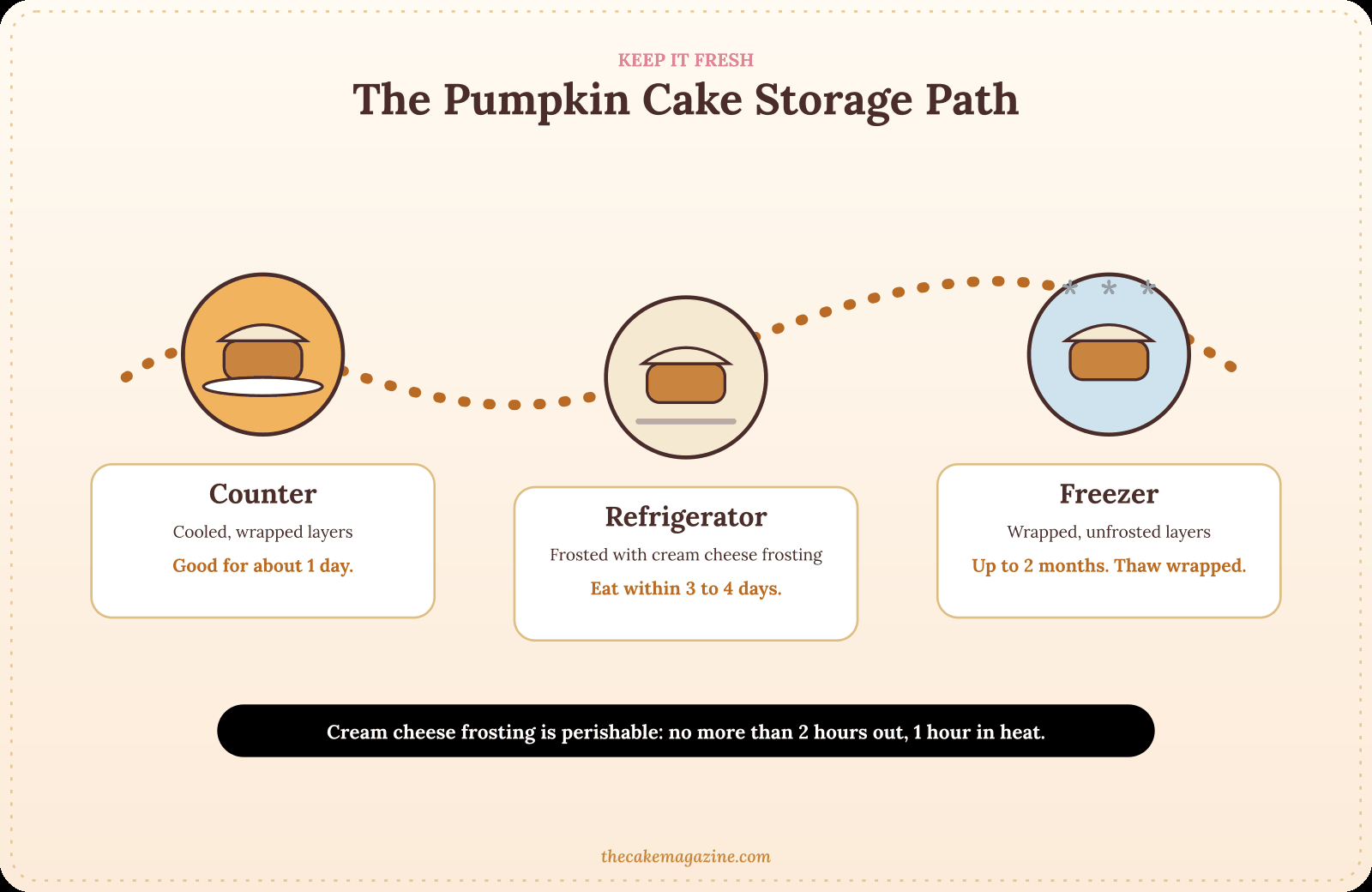
One of the best things about a pumpkin cake recipe is that it gets better with a little time. The spices mellow and the crumb settles, so a cake baked the day before often tastes better than one served hot from the cooling rack. The infographic shows the basic path, and the sections below explain the details.
Unfrosted layers
Once the layers are completely cool, wrap each one tightly in plastic wrap. At cool room temperature they keep well for about a day. For longer storage, freeze them. Wrap in plastic, then in foil or a freezer bag, and freeze for up to two months. Thaw the layers still wrapped, on the counter, so condensation collects on the wrapping and not on the cake. Cold layers are also easier to level and frost.
Frosted cake from the pumpkin cake recipe
Because most pumpkin cake pairings use cream cheese frosting, plan on refrigerating a frosted cake. Keep it in a covered container or a cake carrier, and eat it within three to four days. Cream cheese frosting is a perishable food, and the USDA recommends not leaving perishable food out for more than two hours, or one hour in hot weather. Take the cake out 30 to 60 minutes before serving so the crumb softens, but serve it soon after.
A cake with ganache or a butter-only buttercream is more forgiving. It can sit at cool room temperature in a covered container for a day or two, as long as there is no perishable filling.
Freezing a frosted cake
You can freeze a frosted cake, but it takes some care. Chill the frosted cake until the frosting is firm, wrap it very well and freeze it. Thaw it in the refrigerator, still wrapped, overnight. Frosting can weep a little as it thaws, and the texture of cream cheese frosting may change slightly. For best results, freeze the layers and make the frosting fresh.
Freezing slices
Individual slices freeze well on a tray until firm, then wrapped in plastic and stored in a freezer bag. They thaw in an hour or two at room temperature, which makes them handy for lunchboxes and unexpected guests.
A simple make-ahead schedule
- Two days ahead: bake the layers, cool completely, wrap and refrigerate or freeze. Make the frosting and keep it covered in the fridge.
- One day ahead: fill and frost the cake. Chill it in a covered container.
- Serving day: let it stand 30 to 60 minutes at room temperature, add any garnish and slice with a warm, clean knife.
Troubleshooting your pumpkin cake
Even a careful baker sometimes pulls out a cake that is not quite right. Most pumpkin cake problems come back to moisture, leavening or oven temperature. For a broader look at cake problems, see our cake troubleshooting guide. Here are the issues most common with this pumpkin cake recipe.
The center is gummy or sunken
What it looks like: a dip in the middle, a dense, wet-looking band near the bottom and a skewer that comes out with sticky batter.
Likely causes: underbaking, too much moisture from watery puree, opening the oven too early or too much leavening.
Fix it next time: drain homemade puree, bake a few minutes longer, confirm your oven temperature with a thermometer and keep the door shut for the first 25 minutes. Aim for 205°F to 210°F in the center.
The cake is dense or heavy
What it looks like: a tight, rubbery crumb that feels more like bread than cake.
Likely causes: overmixing after the flour goes in, too much flour from scooping, or old leaveners.
Fix it next time: weigh the flour, fold only until the streaks vanish and test your baking powder by stirring a little into hot water. It should fizz vigorously. Our cake science guide explains how gluten and leavening interact.
The cake is dry
What it looks like: a crumbly, sandy texture that soaks up frosting like a sponge.
Likely causes: overbaking, too much flour, too little puree or a hot oven.
Fix it next time: pull the cake when the skewer shows a few moist crumbs, not a clean stick. To rescue a dry cake, brush the layers with a light simple syrup before frosting.
The layers are too domed or cracked
What it looks like: a high peak in the middle and a split down the top.
Likely causes: an oven that runs hot, which sets the edges before the center has risen, or too much batter in the pan.
Fix it next time: lower the oven by 25°F and bake a little longer, use baking strips and fill the pans to no more than two-thirds. A domed layer is easily leveled with a serrated knife.
The spices taste weak or harsh
What it looks like: a cake that tastes bland, dusty or has a bitter bite.
Likely causes: stale spices, spices not distributed evenly, or too much clove.
Fix it next time: replace spices that are more than a year old, whisk the dry mix thoroughly and measure the clove carefully. Taste your spice by the pinch before you bake.
The cake stuck to the pan
What it looks like: the bottom stays in the pan, or the layer tears when you flip it.
Likely causes: missing parchment, not enough grease or turning the cake out too soon or too late.
Fix it next time: use parchment rounds and grease the sides well, and release after 15 minutes. If a layer breaks, patch it with frosting. Nobody will know once it is stacked.
The frosting slides or weeps
What it looks like: frosting that droops, slides off the sides or leaves a wet ring.
Likely causes: frosting on warm layers, soft or whipped cream cheese, or too little powdered sugar.
Fix it next time: cool the layers completely, use block cream cheese and chill the frosting briefly if it is soft. Do not add so much sugar that the frosting turns cloying. Chill the cake between coats.
Nuts or add-ins sank
What it looks like: all the pecans in a layer at the bottom.
Likely causes: large, heavy pieces in a thin batter.
Fix it next time: chop them small, toss in a spoonful of the measured flour and fold them in at the end. Or scatter them on top before baking.
Rescue ideas for a cake that went wrong
A dry cake
Brush the layers with simple syrup, add a moist filling and use a generous frosting. Or cube it for a trifle with whipped cream, caramel and toasted pecans, where the layers happily soak up cream.
A sunken center
Fill the dip with frosting or caramel. Or trim the raised edge and cut out the gummy middle, then use the ring as a smaller cake.
A cracked top
Level it with a serrated knife and use the trimmings for cake crumbs, a trifle or truffle-style cake bites rolled in cinnamon sugar.
Variations on the pumpkin cake recipe
Once you have baked the base pumpkin cake recipe, small changes can give you a different cake for a different mood. Change one thing at a time so you know what caused what, and keep notes.
Swaps for common ingredients in the pumpkin cake recipe
- No brown sugar: use 350 grams of granulated sugar, and add a teaspoon of molasses if you have it. The cake will be slightly paler and less rich.
- No cinnamon-heavy blend: reduce the cinnamon to 4 grams and raise the ginger to 4 grams for a brighter, gingerbread-style flavor.
- Butter in place of oil: use 200 grams of melted, cooled butter. The flavor is richer, though the cake can firm up in the fridge.
- Adding buttermilk: replace 60 grams of the oil with 60 grams of buttermilk for a slightly tangier, tenderer crumb. This lowers the fat a little.
- Whole wheat: replace up to 25 percent of the flour with whole wheat. Expect a nuttier, denser cake.
- Gluten free: use a one-to-one gluten-free baking blend by weight, and let the batter rest 15 minutes before baking. Results vary by blend.
- Dairy free: the cake itself is already dairy-free as written. Use a plant-based butter and cream cheese for the frosting, and expect a softer result.
Flavor ideas for the pumpkin cake recipe
- Chocolate chip pumpkin cake: fold in 150 grams of mini chocolate chips, tossed in a spoonful of flour.
- Pecan streusel: top the batter in a 9×13 pan with a mix of brown sugar, flour, butter and chopped pecans before baking.
- Maple pumpkin cake: replace 50 grams of the granulated sugar with maple syrup and cut a little of the oil, then frost with maple buttercream.
- Pumpkin chai: add a little cardamom and black pepper, and brush with a chai-spiced simple syrup.
- Pumpkin and apple: fold in 150 grams of finely diced, patted-dry apple. Our apple cake guide explains how to manage the extra moisture.
- Carrot-pumpkin: replace 100 grams of the puree with finely grated carrot. For a related classic, see our carrot cake recipe.
Other pumpkin cake styles
The same flavors work in other formats. A pumpkin sheet cake feeds a crowd with minimal effort. A pumpkin bundt looks impressive with a simple glaze of powdered sugar and milk or maple syrup. Pumpkin cupcakes are easy to pack for parties. Pumpkin loaf cakes are good for gifting, since they need no frosting. Each of these can use the same batter, adjusted for the pan.
Making it a showpiece for the holidays
For a fall dinner or Thanksgiving table, bake the layers two days ahead, freeze them and frost the day before. Add toasted pecans, a caramel drizzle and a sprinkle of cinnamon. If you want other seasonal ideas, our cake trends guide shows what bakers are making this year, and our chocolate cake recipe makes a good second cake for a dessert table.
Common mistakes to avoid with a pumpkin cake recipe
Most failed pumpkin cakes come down to a short list of avoidable mistakes. Here they are in one place, so you can scan them before you bake.
- Using pumpkin pie filling. It already has sugar and spice. Use plain puree.
- Skipping the draining step for fresh puree. Extra water makes a gummy cake.
- Measuring flour by scooping. You can pack in 30 grams too much. Weigh it.
- Overmixing. Fold until the flour disappears, then stop.
- Using old spices. If they do not smell strong, they will not taste strong.
- Adding too much clove. A quarter teaspoon is enough.
- Opening the oven early. Wait at least 25 minutes.
- Trusting the timer alone. Use the skewer and the thermometer.
- Frosting a warm cake. Cool completely.
- Leaving cream cheese frosting out. Refrigerate, and keep the time at room temperature short.
Pumpkin cake recipe FAQ
What is the best pumpkin cake recipe for beginners?
An oil-based, whisk-and-fold cake is the easiest place to start, because there is no creaming and little risk of overmixing. Use plain canned pumpkin puree, weigh the flour, bake two 8-inch layers and frost with cream cheese frosting. The formula in this guide follows that approach.
Can I use pumpkin pie filling in a pumpkin cake recipe?
It is not a good idea. Pie filling already contains sugar and spices, and sometimes other ingredients, so it changes the sweetness and spice balance of the cake. Use plain pumpkin puree and add your own spices, so you control the flavor.
Can I use fresh pumpkin instead of canned in a pumpkin cake recipe?
Yes. Roast a small sugar pumpkin, blend the flesh and drain it in a sieve for 20 to 30 minutes, then weigh out 425 grams. Fresh puree is wetter than canned, so skipping the draining step is the most common cause of a gummy center.
Why is my pumpkin cake gummy in the middle?
The usual causes are watery puree, underbaking, opening the oven too soon or overmixing. Drain fresh puree, keep the oven door closed for the first 25 minutes and bake until the center reads about 205°F to 210°F or a skewer shows only a few moist crumbs.
How do I make a pumpkin cake recipe more moist?
Weigh the flour so it is not packed in, use oil instead of all butter, include brown sugar and avoid overbaking. Pull the cake when a skewer shows a few moist crumbs. Wrap the cooled layers tightly, and a light simple syrup brush can rescue a dry layer.
What frosting goes best with a pumpkin cake recipe?
Cream cheese frosting is the classic choice because its tang balances the sweet spice. Brown butter or maple buttercream, chocolate ganache and stabilized whipped cream are good alternatives. Choose based on how long the cake will sit out, since cream cheese and whipped cream need refrigeration.
How long does a frosted pumpkin cake last?
A cake with cream cheese frosting should be refrigerated and eaten within three to four days. Perishable food should not sit out for more than two hours, or one hour in hot weather. A cake with ganache or butter-only buttercream may keep a day or two at cool room temperature.
Can I freeze a pumpkin cake recipe?
Yes. Wrap cooled, unfrosted layers tightly in plastic and foil and freeze for up to two months, then thaw them still wrapped. You can freeze a frosted cake, but the frosting texture may change a little. Freezing layers and frosting fresh gives the best result.
Can I bake this pumpkin cake recipe in a 9×13 pan or as cupcakes?
Yes. A 9 by 13-inch pan takes all of the batter and needs roughly 35 to 42 minutes, and cupcakes take about 20 to 24 minutes. Those times are estimates, since ovens differ, so start checking early and rely on a skewer and the crumb.
Can I make a pumpkin cake recipe without eggs or dairy?
The cake already has no dairy as written, as it uses oil and no milk. Egg-free versions are possible with replacers such as flax or applesauce, but the structure changes and this formula has not been tested that way. Treat any egg-free attempt as an experiment.
Why does my pumpkin cake taste bland?
Blandness usually comes from stale spices, too little salt or too little spice. Replace ground spices that are over a year old, use a full teaspoon of fine salt and taste your blend. Letting the cake rest overnight also lets the flavors deepen.
How much puree is in a can for a pumpkin cake recipe?
A standard 15-ounce can holds about 425 grams of puree, or roughly 1¾ cups, which is exactly what this formula uses. Weigh it if you can, since labels and fills vary slightly. If you open a larger can, measure out the grams you need and save the rest.
Final thoughts
A great pumpkin cake recipe is not about a secret ingredient. It is a handful of good habits: use plain puree and drain it if it is homemade, weigh the flour, measure the spices instead of guessing, fold gently and bake until a skewer tells you it is done rather than when the timer does. Do those things and a simple orange-brown cake becomes the one people request each October.
Bake it once as written so you know how it behaves in your oven. Then start making it yours: a little more ginger, a brown butter frosting, a handful of toasted pecans. Keep notes on what you change. After a few bakes you will understand this pumpkin cake recipe well enough to fix it when something goes sideways.
If you try it, we would love to hear how it went. Tell us your pan size, your oven and what you frosted it with, and we will keep refining this guide.
Editorial note: reviewed and updated November 2026. This guide is written for home bakers in the United States, using American measurements and ingredients. The formula has not been oven-tested by The Cake Magazine and is offered as a starting point to adapt; baking results vary by oven, altitude and ingredients. Food safety information is general and is not a substitute for guidance from your local health authority. Where we link to products or tools in the future, we will disclose affiliate relationships near the links.