Some frostings ask you to love sugar. Ermine frosting asks you to love cream. This old-fashioned, cooked-flour topping starts as a spoonful of flour and sugar whisked into milk, turns into a thick pudding on the stove, and ends up as a pale, cloud-soft frosting that tastes like sweetened butter and vanilla instead of a sugar bomb. This ermine frosting recipe gives you a formula in grams, a method for first-time roux cooks, and the temperature know-how that keeps it silky.
An ermine frosting recipe is a cooked flour frosting: you whisk flour, sugar and milk over heat until it thickens like pudding, cool that paste completely, then whip it into softened butter and vanilla. It is also called boiled milk frosting or flour buttercream. It is lighter and far less sweet than American buttercream, needs no powdered sugar and no raw egg whites, and it behaves best when the paste and the butter are both at cool room temperature, roughly 65 to 70°F, before you combine them.
- What ermine frosting is, and where it came from
- Why this ermine frosting recipe works
- The ingredients, explained
- Equipment that makes it easier
- The ermine frosting recipe card
- Step-by-step method
- Temperature is the whole game
- Troubleshooting your ermine frosting
- Flavors and variations
- Using ermine frosting on cakes
- Ermine frosting vs other frostings
- Scaling and planning a batch
- Tuning texture and sweetness
- A pre-flight checklist
- Reading the frosting by sight and touch
- Leftovers and ideas
- Storage and food safety
- Common mistakes to avoid
- FAQ
What an ermine frosting recipe actually makes
Ermine frosting is a cooked-flour frosting. You cook a small amount of flour with sugar and milk until the mixture becomes a smooth, thick paste, much like the base of a pastry cream without the eggs. Once that paste is completely cool, you beat it into soft butter. The starch holds the milk in place, the butter supplies richness and structure, and the whipping adds air. The result looks like whipped cream and spreads like a very smooth buttercream.
You will see the same frosting under several names. Bakers call it ermine icing, boiled milk frosting, flour frosting, cooked flour buttercream and, in some Southern kitchens, simply “the white frosting.” It is the traditional partner of red velvet cake, which is why plenty of bakers first meet it in a recipe for that cake. Our own red velvet cake guide covers the cake itself, and this guide covers the frosting that many people feel it was made for.
The origin story is a little fuzzy, and we would rather say so than invent a tidy one. Food writers often trace the style to the era before powdered sugar was common and cheap, when cooks thickened milk with flour and sugar to make a stable base for butter. The recipe lasted because it works, it is inexpensive, and it tastes lovely. Beyond that, treat any precise date or inventor you read about with caution.

The ermine frosting recipe in one sentence
Cook flour, sugar and milk to a pudding, cool it fully, then whip it into soft butter. Every problem people run into with an ermine frosting recipe traces back to one of those clauses: undercooked paste that tastes starchy, paste that was still warm and melted the butter, or butter that was too cold to blend.
What a good ermine frosting recipe tastes and feels like
Expect a mellow, milky, buttery flavor with a clean finish. Because the sugar is dissolved into the paste rather than piled in as powder, the texture has no grit at all. Because there is less sugar overall, you taste the butter and vanilla first and the sweetness second. If American buttercream feels heavy to you, this is the frosting to try. If you want a bright candy-sweet pop, it may taste too restrained, and that is a fair preference.
Why this ermine frosting recipe works
A good ermine frosting recipe is really a small lesson in starch. Understanding the lesson is what lets you fix the frosting when it misbehaves, so it is worth a minute before you reach for a saucepan.
Starch does the thickening, and heat is what activates it
Flour is mostly starch. Raw starch granules are tiny, hard and insoluble, which is why flour stirred into cold milk just sinks. When the milk reaches a gentle boil, the granules swell with water and burst open, releasing starch that traps the liquid and thickens it. That swelling is called gelatinization, and it only completes when the mixture actually reaches a bubble. Pull the pot off the heat too early and you get a thin, floury paste that tastes of raw flour.
Cooling stops the butter from melting
Butter melts at body temperature or just a little above it, so a warm paste turns butter into soup. Cooling the paste fully before you add butter is the single most important rule in this ermine frosting recipe. The paste should feel cool or neutral on your wrist, and ideally measure below about 80°F. King Arthur Baking gives a similar target, cooling the cooked mixture below 80°F before the butter goes in, in its own ermine frosting recipe.
Whipping turns paste and butter into one emulsion
Butter is a water-in-fat emulsion, and the cooked paste is mostly water held by starch. Beating the two together creates a new, stable structure where tiny droplets of paste are suspended in butterfat with air bubbles folded through. That structure is only stable in a narrow temperature range, which is why this frosting can look curdled and then smooth out after a few more minutes of whipping or a gentle temperature adjustment.
It needs no raw eggs and no powdered sugar
Meringue-based buttercreams use cooked egg whites, and American buttercream relies on a lot of powdered sugar. An ermine frosting recipe uses neither, which makes it handy for bakers who avoid eggs or who simply do not want a very sweet topping. It does use dairy, so it is not dairy-free by default. The cooked milk paste also means the finished frosting is perishable in a way that sugar-heavy buttercream is not, and we cover that in the storage section.
A note on testing. The formula below is built from conservative, widely published ratios, including the proportions on the King Arthur page linked above. The Cake Magazine has not oven-tested or whip-tested it, so treat it as a starting formula to adapt. Your pan, stove, mixer and kitchen temperature will change times and texture.
The ingredients in an ermine frosting recipe, explained
There are only five ingredients, plus salt, so each one matters in an ermine frosting recipe. Here is what every item does and how to choose it.
All-purpose flour
Plain all-purpose flour works. Its protein content is moderate, so the paste is smooth rather than gluey. Weigh it carefully. A scoop-and-sweep cup can vary by 20 percent or more, and the flour is what sets the thickness of the whole recipe. Too little and the paste stays loose, which gives a soft frosting. Too much and it turns pasty and can taste starchy.
Because flour is a raw agricultural product, the FDA reminds home cooks that it can carry bacteria and that cooking is what makes it safe. See the FDA guidance on flour as a raw food. In this recipe the flour is cooked to a boil, so do not skip the bubbling step, and do not taste the paste before it has fully boiled.
Granulated sugar
Regular granulated sugar dissolves into the hot milk, which is why the finished frosting has no grit. Superfine sugar dissolves slightly faster but it is not required. Do not swap in powdered sugar for the cooking step. Powdered sugar contains cornstarch, and it will change how the paste thickens.
Whole milk
Whole milk gives the best flavor and body, and its fat helps the paste turn glossy. Two percent milk works, though the frosting will taste a touch thinner. Skim milk is not ideal. Plant milks can work in principle, since the starch does the thickening, but flavor and texture will change, and we have not tried to give a formula for them.
Unsalted butter
Butter is the star. Use a good unsalted butter, since it is the main flavor, and use plenty of it, because the butter provides the structure once it sets. Cultured or European-style butter gives a deeper, tangier taste. Whatever you use, it must be softened properly, which means pliable but still cool, about 65 to 68°F. If you press a finger into it, it should leave a dent without sliding around.
Vanilla and salt
With so little sugar to compete, vanilla stands out, so use pure extract or vanilla bean paste. A small pinch of fine salt sharpens the dairy flavor and keeps the frosting from tasting flat. Add the salt to the pot with the flour and sugar so it disperses evenly.
What to weigh
Flour, sugar, milk and butter, all in grams. A digital scale takes the guesswork out of every one of them, and the paste thickness depends heavily on the flour-to-milk ratio.
What to choose
Whole milk, unsalted butter and pure vanilla. These three decide the flavor, so spend a little more here than on the flour or sugar.
What to skip
Powdered sugar in the paste, instant pudding mix, and cornstarch shortcuts. They change the texture and can leave an artificial taste.
Equipment that makes an ermine frosting recipe easier
You do not need anything exotic. A few well-chosen tools make the process calmer, and one or two of them make a real difference.
- A medium, heavy-bottomed saucepan. Thick metal spreads heat evenly, so the paste is less likely to scorch on the bottom.
- A flat-edged whisk or silicone spatula. The paste sticks in the corners of a pot, and a flat edge reaches them.
- A fine-mesh strainer. Optional, but it catches any lumps if you rushed the whisking.
- A stand mixer or a sturdy hand mixer. Beating takes several minutes, and a stand mixer lets you walk away from the bowl while it cools and whips.
- A digital scale and an instant-read thermometer. Temperature decides success, so a thermometer is worth more than any fancy attachment.
- Plastic wrap or a shallow dish. Pressing film on the surface of the paste prevents a skin, and spreading it in a shallow dish cools it faster.
If you are deciding what to buy, the stand mixer buying guide and the hand mixer guide explain what matters for creamed and whipped frostings. Either type can make this frosting. A hand mixer simply asks you to stay with it.
The ermine frosting recipe card
This is a double-size batch, enough to fill and frost a two-layer 8-inch cake with a modest amount left for piping. Halve it for a dozen cupcakes or a small sheet cake. Weights are in grams, with cup guides for convenience.
Classic Ermine Frosting (Cooked Flour Frosting)
A silky, lightly sweet cooked-flour frosting with a whipped-cream lightness and real butter flavor. Starting formula to adapt: not oven-tested by us, so judge texture by feel and temperature.
Ingredients
- All-purpose flour60 g (about 1/2 cup, spooned and leveled)
- Granulated sugar300 g (1 1/2 cups)
- Fine salt2 g (about 1/3 teaspoon)
- Whole milk454 g (about 2 cups)
- Unsalted butter, softened340 g (3 sticks, 1 1/2 cups)
- Pure vanilla extract8 to 10 g (2 teaspoons)
Method
- Whisk the flour, sugar and salt together in a medium saucepan so no flour lumps remain.
- Pour in the milk gradually, whisking to a smooth, thin slurry before you turn on the heat.
- Cook over medium heat, whisking constantly and scraping the corners, until the mixture thickens and large bubbles pop on the surface, about 5 to 8 minutes. Keep cooking and whisking for 1 minute more after the first bubbles.
- Scrape the paste into a clean bowl. Press plastic wrap directly onto the surface and cool until it measures below 80°F. Spread it in a shallow dish to speed this up.
- Beat the cooled paste briefly in a mixer bowl until smooth, then add the butter a few tablespoons at a time on low to medium speed.
- Add the vanilla, scrape the bowl and whip on medium-high for 3 to 6 minutes until pale, fluffy and smooth.
- Use right away, or see the storage notes before chilling.
Notes: Times are estimates. Stoves and pots vary, so rely on the visual cues. If the frosting looks curdled or soupy, it is a temperature issue, not a failure, and the troubleshooting section shows how to fix it.
Step-by-step ermine frosting recipe method
Here is the same ermine frosting recipe again, slowed down, with the reasons and the cues you should watch for at each stage.
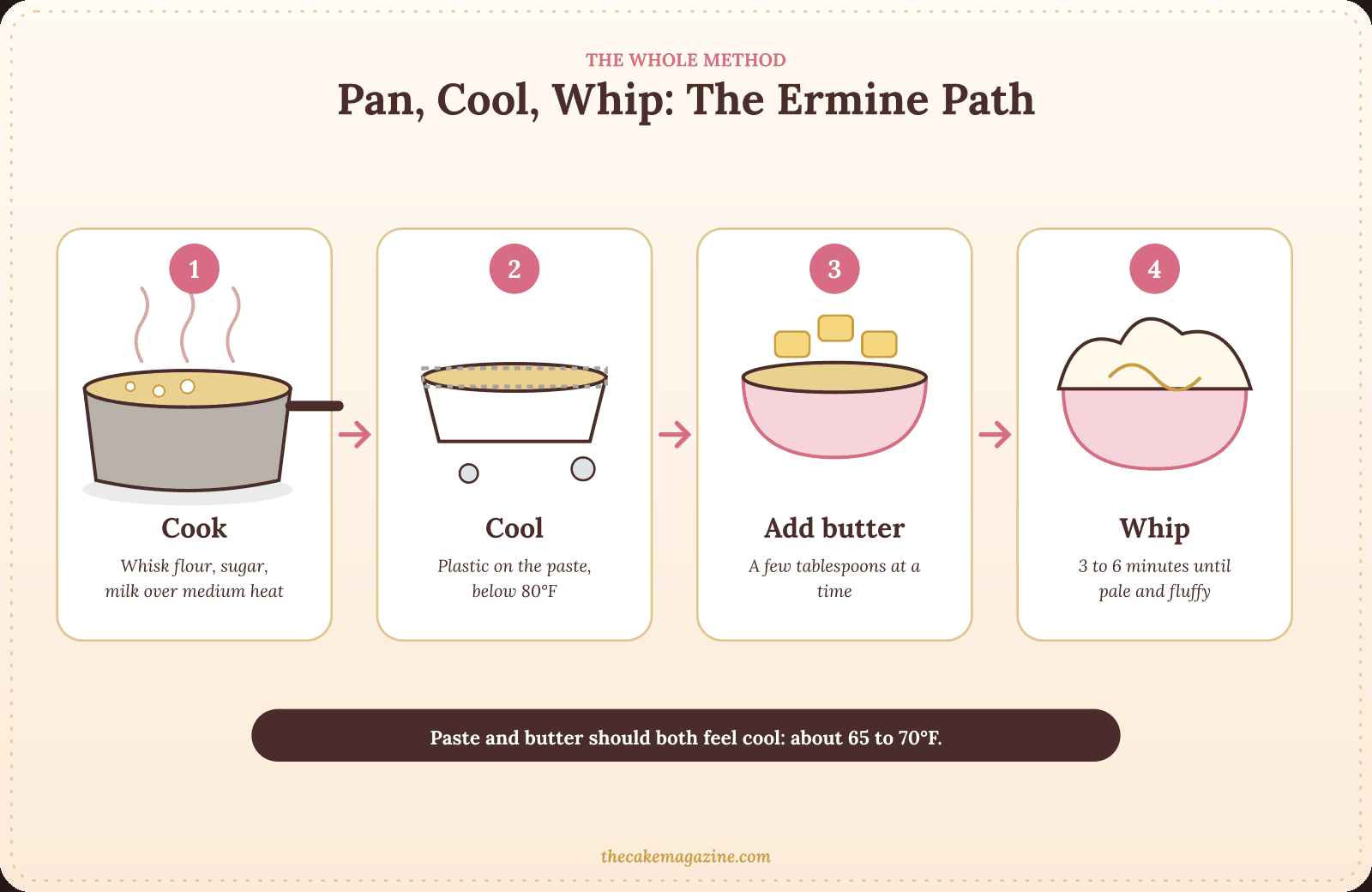
Step 1: Whisk the dry ingredients first
Put the flour, sugar and salt in the cold saucepan and whisk them together. Sugar crystals separate the flour particles so they disperse in milk instead of clumping. This tiny habit prevents most lumps. Whisk for about 20 seconds and then move on.
Step 2: Add the milk slowly
Pour in a splash of milk and whisk to a smooth paste, then add the rest. Doing it this way means you never face a stubborn dry pocket. Set the pan on the stove only once the slurry is smooth and thin. If you see any flour specks, whisk longer.
Step 3: Cook the ermine frosting recipe paste to a pudding
Use medium heat, not high. Whisk steadily and watch the corners and the bottom, because starch thickens first where the pan is hottest. After several minutes you will feel the whisk drag. The mixture goes from watery to thick and then, sometimes quite suddenly, to something like a soft pudding that holds a trail from the whisk.
The clue to watch is bubbling. When thick bubbles break slowly through the surface, the starch is cooking. Keep whisking for a full minute after that so the flour tastes cooked and the paste reaches its maximum thickness. Take it off the heat. If you see brown flecks or smell scorched milk, pour the paste through a strainer into a clean bowl and carry on. Do not scrape the burnt bottom in.
Step 4: Cool the paste completely
Transfer the hot paste to a shallow bowl and press plastic wrap directly onto it. Air contact forms a skin, and skin leaves chewy lumps in the finished frosting. Cool at room temperature, or speed it up by setting the bowl in a larger bowl of ice water and stirring every few minutes. In the refrigerator, check it often, because cold paste is as problematic as warm paste.
The paste is ready when it measures below 80°F and feels neutral or just cool against your wrist. If it is cold and stiff from the fridge, let it sit out until it loosens to around 65 to 70°F before you continue.
Step 5: Add the butter gradually
Beat the cooled paste for a few seconds so it is smooth, then add the soft butter a few tablespoons at a time on low to medium speed. Wait for each addition to disappear before adding more. This slow approach helps the emulsion form. Scrape the bottom and sides of the bowl often, since paste hides there.
Step 6: Whip until light
After the butter and vanilla are in, turn the speed up to medium-high and let the mixer work for several minutes. The frosting will lose its dense, yellowish look and turn pale and fluffy. At some point it may look split or lumpy. Keep whipping for another minute or two, because that often resolves itself as the temperature evens out. If it does not, the troubleshooting section tells you which way to nudge the temperature.
Taste before you use it. If it tastes starchy or pasty, the flour was probably not cooked long enough. If it tastes flat, add a tiny pinch of salt and a few more drops of vanilla and whip again. Unlike sugar-heavy buttercream, ermine frosting rewards small seasoning adjustments.
Making the ermine frosting recipe paste ahead of time
You can cook the paste a day ahead. Cover it with plastic pressed on the surface and refrigerate it. The next day, take it out and let it come to cool room temperature, so it is pliable, then beat it smooth before you add the butter. Planning this way spreads the work out and removes the waiting from the day you want to frost. Chilled paste and chilled butter will not blend, so give both time to warm.
Temperature is the whole game in an ermine frosting recipe
If you take only one idea away from this guide, make it this one. Almost every complaint about ermine frosting, from greasy to curdled to soupy, is really a story about two temperatures: the temperature of the paste and the temperature of the butter. When both sit near 65 to 70°F, the frosting comes together in minutes. When they differ by more than a few degrees, it will fight you.
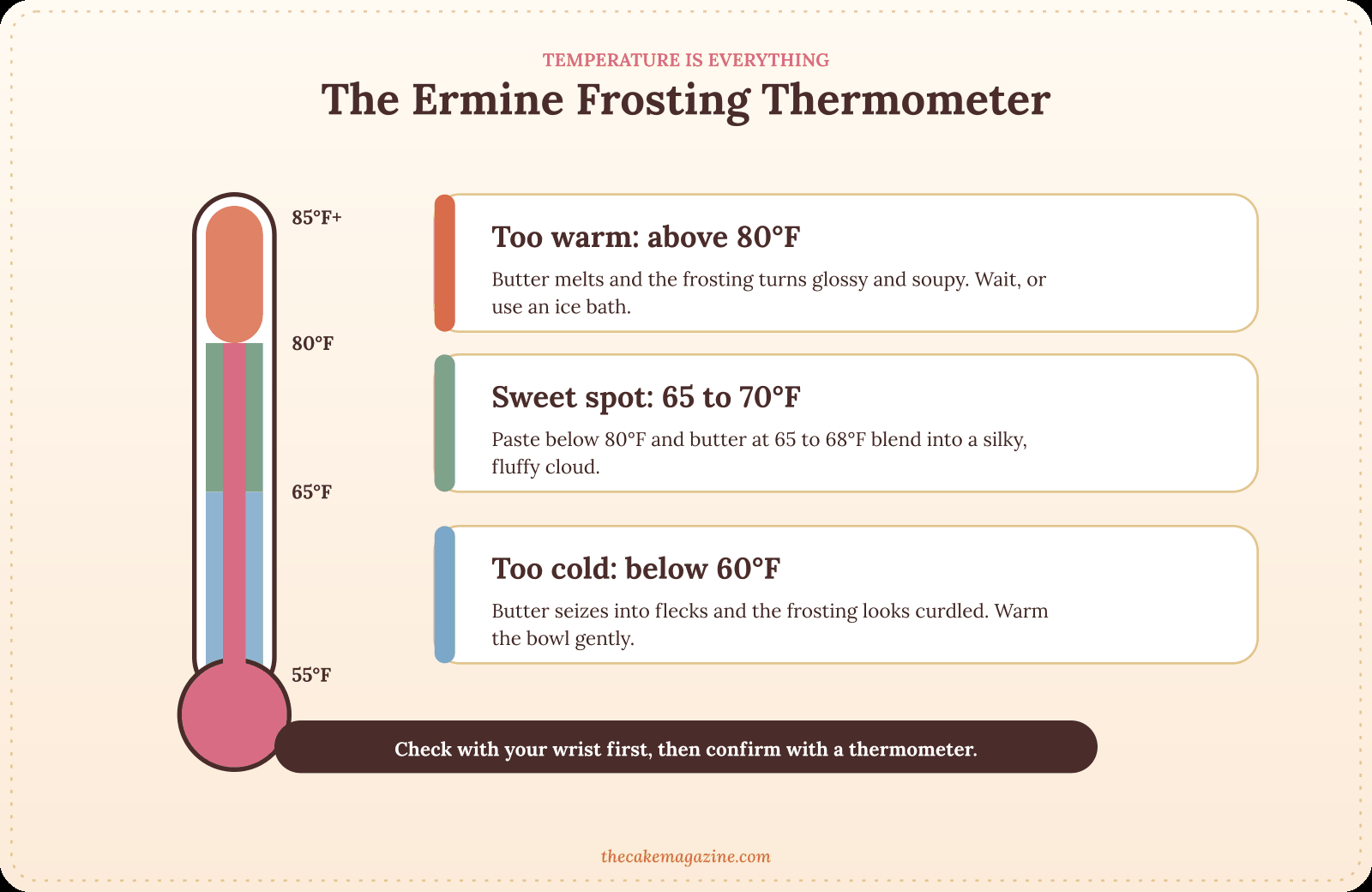
Why the two temperatures in an ermine frosting recipe must match
Butter holds its shape when it is cool and becomes creamy around 65 to 68°F. Above roughly 75°F it begins to melt and lose the ability to trap air. A hot paste melts the butter outright, and the frosting turns to glossy soup. Very cold paste, on the other hand, makes the butter seize into little cold crumbs, and the mixture looks curdled. The paste and butter should feel as if they belong in the same room.
Your kitchen counts too
A hot kitchen pushes the bowl warm as you whip, since the motor and friction add heat. In summer, pause and chill the bowl for ten minutes if the frosting starts to look glossy and loose. In a cold kitchen, the opposite problem appears, and the butter stays firm. A hair dryer on low heat around the outside of a metal bowl, or a few seconds over a pot of steaming water, will warm it just enough. These adjustments are small, and gentle is better than strong.
A quick reference for what to do
- Paste warmer than 80°F: wait. Do not add butter. Stir the paste over an ice bath if you are in a hurry.
- Paste cold from the fridge: leave it on the counter until it loosens, then beat it smooth.
- Butter greasy or shiny: chill it for ten minutes and try again.
- Butter hard from the fridge: cut it into small pieces and let it soften for 20 to 30 minutes. Avoid the microwave if you can, since it melts butter unevenly.
Troubleshooting your ermine frosting recipe
Most problems are fixable, and the fix is usually patience or a small shift in temperature. If you want the bigger picture of why batters and frostings fail, our cake troubleshooting guide works through the logic for cakes, and the same cause-and-effect habit applies here.
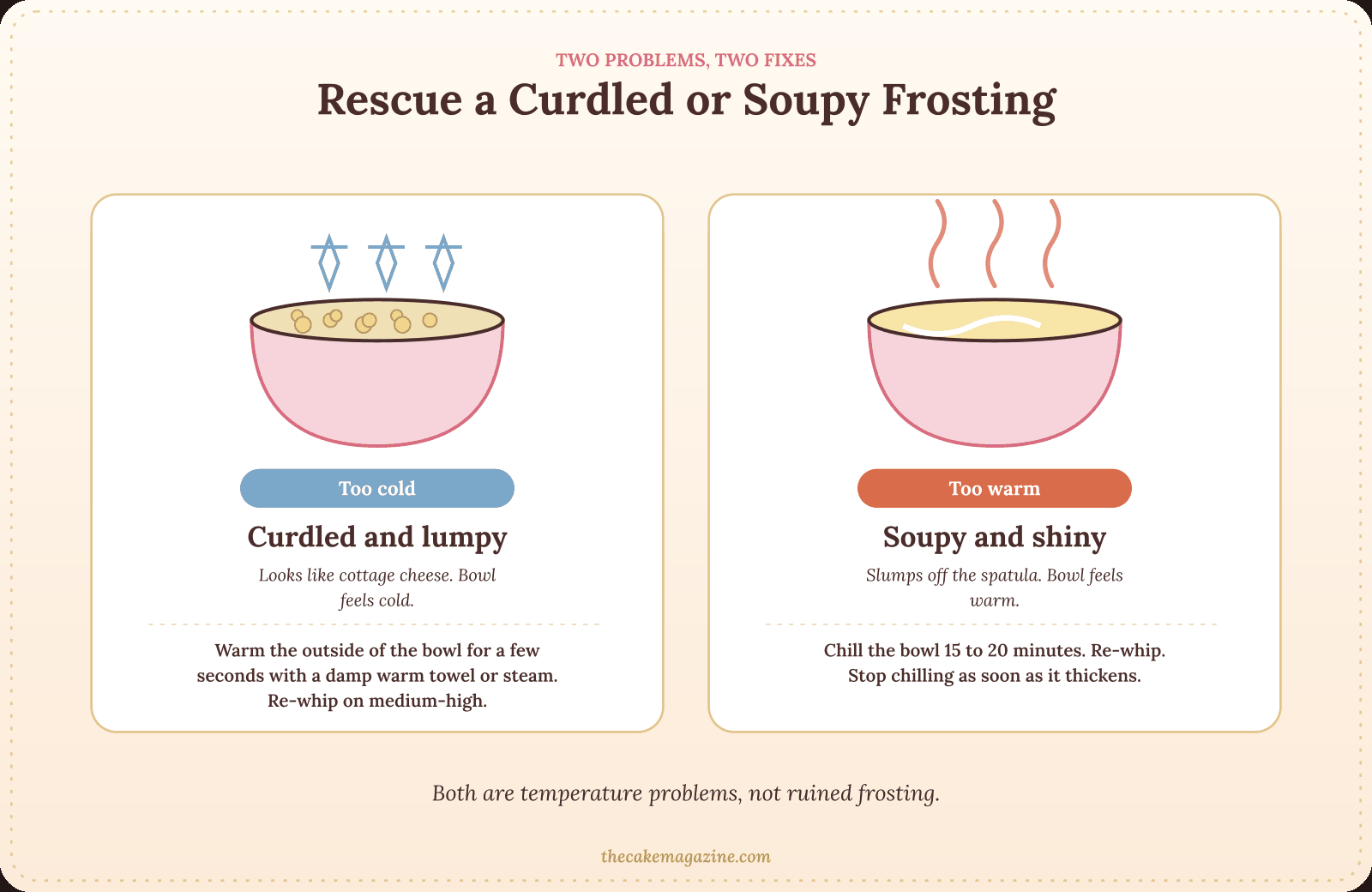
The ermine frosting looks curdled or lumpy
Likely causes: the paste or butter was too cold, the butter went in too fast, or the bowl is simply cool.
How to check: touch the outside of the bowl. If it feels cold, and the frosting looks dense, cottage cheese-like or has tiny butter flecks, cold is the culprit.
Fix it: warm the outside of the bowl briefly with a warm towel or a few seconds over steaming water, until the edges barely soften, then whip again on medium-high. It should smooth out within a couple of minutes.
The ermine frosting is soupy or greasy
Likely causes: the paste was still warm, the butter was too soft, or the kitchen is hot.
How to check: the frosting looks shiny and slumps off the spatula. The bowl feels warm.
Fix it: refrigerate the bowl for 15 to 20 minutes, then whip again. Repeat once if needed. Stop chilling the moment it thickens, since overchilling creates the curdled problem above.
It tastes starchy or like raw flour
Likely causes: the paste did not cook long enough after it began to bubble.
Fix it next time: cook until thick bubbles break the surface, then keep whisking for a full minute. For a batch that has already been whipped, there is no perfect rescue. Add a bit more vanilla and a pinch of salt, and use it on something rich, like a cocoa cake, where the flavor is easier to mask.
There are little lumps in the frosting
Likely causes: flour clumps that never dissolved, or bits of skin from the paste.
Fix it next time: whisk the dry ingredients first, add milk gradually, press plastic wrap on the paste while it cools, and strain it if you see lumps. For a finished batch, you can sometimes beat it longer on medium, but stubborn lumps rarely disappear completely.
It is too thin to hold piped shapes
Likely causes: a warm room, too little flour, too much milk, or paste that was too warm when the butter went in.
Fix it: chill the frosting, then re-whip. If it is persistently soft, the paste was probably too thin to start. Next time, weigh the flour and milk precisely and cook the paste until it is properly thick. For piping, lean on firmer techniques from our cake piping guide, and keep the frosting cool while you work.
It tastes too buttery or not sweet enough
Likely causes: that is the nature of this frosting. It is lightly sweet by design.
Fix it: add a tablespoon or two of sugar to the paste next time, or pair it with a sweeter cake or a jam filling. Do not stir in powdered sugar to the finished frosting in large amounts, since it changes the texture and moves it toward American buttercream.
It separated in the fridge
Likely causes: it was chilled and used while cold, so the butter set hard around the paste.
Fix it: bring it to cool room temperature, then re-whip for a few minutes. That step restores the emulsion and the fluffy texture.
When to start over
Start over if the paste scorched and tastes burnt, if the milk paste has turned sour, or if it smells off. Spoiled dairy cannot be rescued, and a few dollars of ingredients is cheap insurance. Everything else on the list above is fixable with time and temperature.
Flavors and variations on the ermine frosting recipe
Once the base ermine frosting recipe feels familiar, it takes flavor beautifully, because it is mild and not very sweet. Add flavorings at the end, after the butter is in, and whip them through. Taste as you go. These ideas use small amounts so they do not upset the structure.
Chocolate ermine frosting
Cool 100 to 120 g of melted dark chocolate until it is just barely warm, then whip it in at the end. Or whisk 20 to 25 g of cocoa into the flour and sugar at the start, which gives a milder, deeper flavor. Cocoa thickens the paste a little, so add a splash more milk if it feels stiff.
Brown sugar or caramel notes
Swap some of the granulated sugar for light brown sugar, up to about half. The flavor turns toffee-like and goes well with spice cake, apple cake and pecan layers.
Coffee ermine frosting
Dissolve a teaspoon or two of instant espresso powder in the warm milk before cooking. It gives a mocha-leaning, grown-up flavor that works on chocolate cake.
Lemon or orange
Whip in finely grated zest and a teaspoon or two of juice at the end. Keep the liquid small, since extra juice can loosen the frosting. A spoonful of thick lemon curd is another option. See our lemon curd for cakes guide.
Almond, coconut or maple
Replace half the vanilla with almond extract, or use a few drops of coconut or maple flavoring. Extracts are strong, so begin with a quarter teaspoon and taste.
Berry swirl
Fold a few tablespoons of thick jam or reduced fruit compote through the finished frosting just before piping, for a marbled effect. Keep the fruit thick so it does not weep.
Coloring the frosting
Ermine frosting is a creamy off-white because of the butter, so pastel colors come out warmer than they do on a stark white buttercream. Gel colors work best, in small amounts, since liquid food coloring thins the frosting. A tiny dot of violet gel cancels the yellow cast if you want it whiter. Our guide to coloring buttercream covers gel colors and deep shades in more detail.
A lighter or richer version
For a lighter frosting, use a little less butter, around 285 g in this batch, and expect a softer set. For a richer, firmer one, add the full amount and let it chill briefly before you pipe. Both are valid choices. They simply trade softness against structure.
Dairy-free adjustments
You can experiment with a plant-based milk and a firm plant-based baking butter in the same weights. Expect a different flavor and a frosting that may be softer. We have not developed a dairy-free formula, so make a small test batch before you rely on it for an event.
Using your ermine frosting recipe on cakes and cupcakes
This frosting is soft and silky, which makes it lovely for spreading, swirling and filling, and a little less at home in tall, ornate piping or warm rooms. Here is where it shines and where to be careful.
Cakes that love an ermine frosting recipe
Red velvet is the classic partner. The cake is mildly tangy and cocoa-tinted, and the plain, milky frosting calms and finishes it. Our red velvet cake recipe is a natural companion. It also loves chocolate cake, spice cake, carrot cake, a simple vanilla layer and anything with fruit or nuts. For a simple vanilla pairing, see the best vanilla cake recipe.
How much you need
As a rough guide, this batch covers a two-layer 8-inch cake with a modest fill and a smooth, thin coat, plus a few piped details. For a tall three-layer cake or heavy piping, make one and a half batches. Our frosting quantity guide gives estimates for layer cakes, sheet cakes, cupcakes and tiers. Because you cannot easily make more halfway through, it is better to have too much than too little.
Frosting layers neatly
Level your cooled layers, add a thin crumb coat, chill briefly, then apply a final coat. This frosting spreads with very little effort, but it softens quickly in a warm room, so work in short bursts and chill if it starts to slide. If the crumb coat is new to you, read our crumb coat guide. For clean sides and sharp edges, smooth buttercream sides shows the technique, and ermine takes it well when it is cool and a touch firm.
Cupcakes and sheet cakes
Half a batch covers about a dozen cupcakes with a generous swirl, and a full batch frosts a 9 by 13-inch cake. Use a large open star or round tip and keep a steady pressure. Soft frostings make softer swirls, so expect rounder, more rustic shapes than you get from a stiff American buttercream.
Fillings and in-between layers
Because it is light and not very sweet, ermine frosting is a nice filling between cake layers. It pairs well with a ring of thicker frosting piped around the edge (a dam) holding in jam or fruit. See cake filling stability for what can sit out and what needs the fridge, and cake flavor pairing for more pairing ideas.
Warm weather and outdoor events
This frosting is not the best choice for a hot outdoor party. Butter-based frostings soften when the air temperature climbs, and ermine has less sugar to help it hold. If you must serve outdoors, keep the cake chilled until the last moment and plan for a short display time in the shade. For a sturdier option, look at the sections on stability in our buttercream guide.
Ermine frosting vs other frostings
It helps to know where an ermine frosting recipe sits among the other frostings you could choose. Each one is a trade between sweetness, stability and effort.
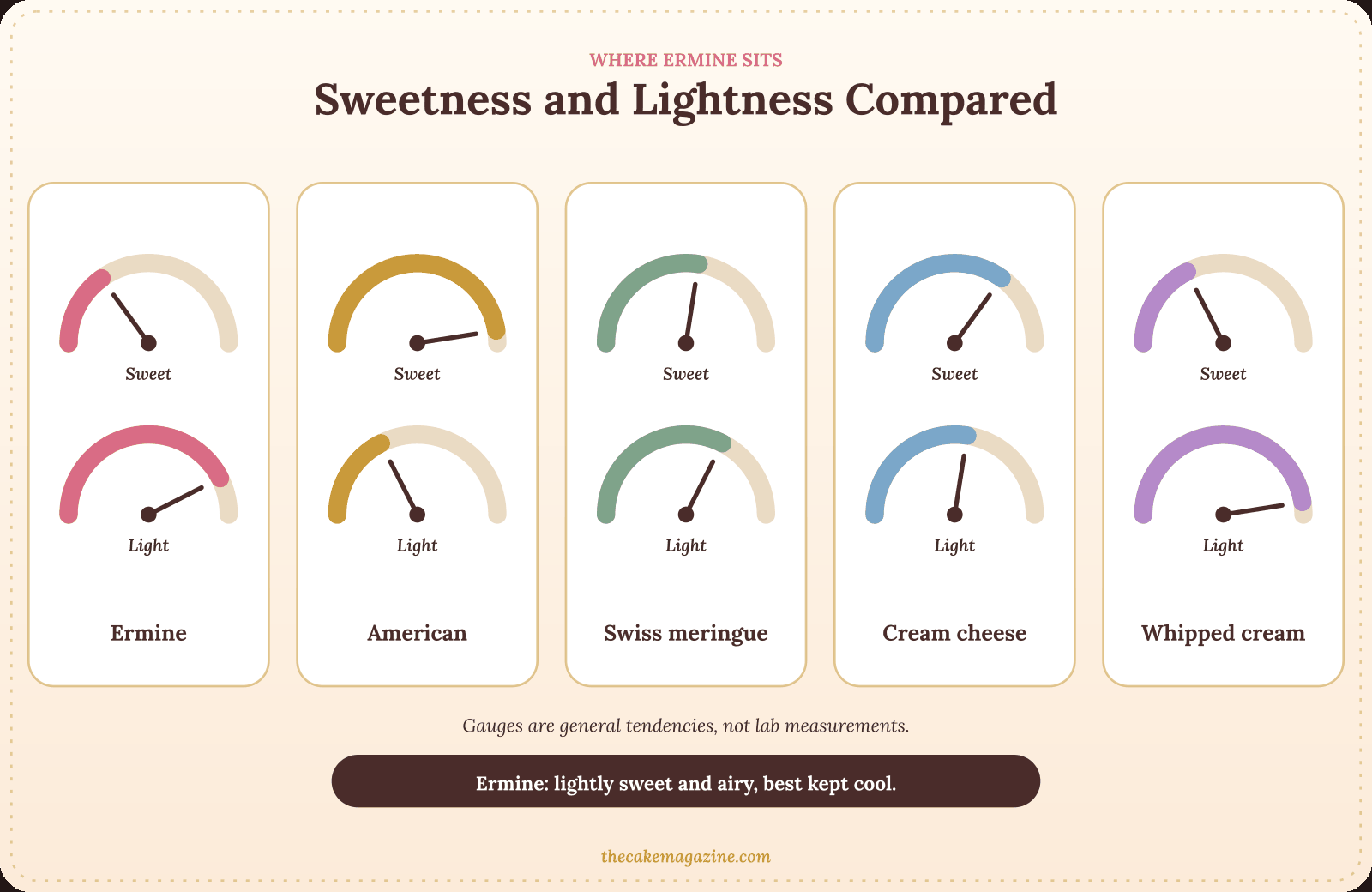
Ermine vs American buttercream
American buttercream is butter beaten with powdered sugar, much sweeter and sturdier, with a slight crust. Ermine is silkier and lighter, with no grit. See our American buttercream recipe for the other side of the comparison.
Ermine vs Swiss meringue buttercream
Swiss meringue buttercream is smoother and more stable, with a glossy finish, but it needs egg whites and a thermometer-heavy process. Ermine is simpler and egg-free. Read the Swiss meringue buttercream guide if you want that polish.
Ermine vs Italian meringue buttercream
Italian meringue buttercream uses hot sugar syrup, and it is very stable and silky. It takes more skill. Our Italian meringue buttercream guide explains the syrup step.
Ermine vs cream cheese frosting
Cream cheese frosting is tangy and soft and has to stay refrigerated. Ermine is milder and more neutral. Compare them in our cream cheese frosting guide.
Ermine vs whipped cream frosting
Stabilized whipped cream is lighter still, but it is more fragile and needs cold storage. See stabilized whipped cream frosting for methods.
Ermine vs ganache
Ganache is dense, chocolatey and firm when cool. Ermine is airy. They pair well, with a ganache drip over an ermine-frosted chocolate cake. Our chocolate ganache guide gives ratios.
If you want the whole family side by side, our guide to the types of buttercream compares American, Swiss, Italian, French, German and ermine frostings in one place, which is a good next read if you are still choosing.
Scaling and planning your ermine frosting recipe
The formula in the recipe card is a double batch, but real baking days rarely match a recipe. Here is how to scale the ermine frosting recipe up or down, and how to fit it into a day so nothing waits on anything else.
Batch sizes at a glance
- Half batch (30 g flour, 150 g sugar, 227 g milk, 170 g butter): about 2 1/2 cups, enough for 12 cupcakes with a modest swirl or a thin coat on a single 9-inch layer.
- Full card batch (60 g flour, 300 g sugar, 454 g milk, 340 g butter): about 5 cups, a two-layer 8-inch cake or a 9 by 13-inch sheet cake.
- One and a half batches: a tall three-layer cake, or a two-layer cake with a heavily piped border.
The half-batch weights are the same ratios the King Arthur page uses for its single batch, which is a helpful cross-check. Keep every ingredient scaled by the same factor. If you change the flour alone, the paste changes thickness, and the whole frosting shifts with it.
Why bigger batches behave differently
A larger pot takes longer to heat and a larger volume of paste takes much longer to cool. A double batch can sit for an hour or more if you leave it in a deep bowl. Spread it in a shallow dish or set the bowl over ice to bring the time down. Smaller batches cool in minutes and can overshoot into cold, so check them often.
A relaxed timeline for a layer cake
- The day before: bake and cool the cake layers, wrap them well and cook the paste. Refrigerate the paste with plastic pressed on top.
- Two hours before frosting: take the paste out of the fridge and set the butter on the counter, cut into pieces.
- One hour before: check both. They should feel cool and pliable, around 65 to 70°F.
- Forty minutes before: whip the frosting, taste it and adjust the vanilla and salt.
- Frosting time: crumb coat, chill 20 minutes, finish. Keep the leftover frosting covered.
Doing the work in stages like this takes the pressure off the whipping. It also gives you a margin when something goes slightly wrong, since you can pause the frosting without anything spoiling.
Tuning the texture and sweetness of an ermine frosting recipe
The base formula is one point on a range. Once you understand which ingredient controls which quality, you can tilt the frosting toward whatever your cake needs.
For a firmer frosting
Use a little more flour in the paste, around 5 to 8 grams extra in the card batch, and let the finished frosting rest in the fridge for ten minutes before using. A thicker paste carries butter better. Do not go far, though. Too much flour makes a stodgy, pasty mouthfeel that coats the tongue.
For a softer, silkier frosting
Reduce the butter slightly or add a spoonful of milk at the end. The ermine frosting recipe becomes more spoonable and less structured, which suits cupcakes and simple rustic cakes. It will also soften faster at room temperature, so save it for cool rooms.
For a sweeter frosting
Raise the sugar in the paste to about 340 g, and cook it the same way. The extra sugar dissolves in the milk and adds sweetness without any grit. This keeps the smooth texture that makes cooked flour frosting special, which stirring in powdered sugar would not.
For a less sweet frosting
Drop the sugar to about 250 g and add a slightly larger pinch of salt. The result is almost like sweetened whipped butter, a good match for a very sweet cake, a fruit filling or a salted caramel layer.
What the whipping time does
The longer you whip, the more air goes in and the lighter the frosting turns. A short whip gives a denser, more spreadable frosting. A long whip gives something airier that is harder to smooth and shows air bubbles on the cake. For a clean finish, run the mixer on its lowest speed for a minute at the end to knock out large bubbles. Our cake mixing methods guide explains how speed and air work together in batters, and the same principles apply to frostings.
A quick pre-flight checklist before you start
Before you make this ermine frosting recipe, run through this short list. It catches nearly every problem before it starts.
Ingredients
Flour, sugar and milk weighed. Butter cut into pieces and softening to about 65 to 68°F. Vanilla and salt within reach.
Equipment
Saucepan, flat whisk, shallow dish, plastic wrap, a clean mixer bowl and beater, and an instant-read thermometer.
Timing
An hour for cooling the paste, plus 10 to 15 minutes for whipping. Cake layers already cooled and ready to frost.
Space
Room in the fridge for the cake, and a cool spot for the bowl. In summer, clear a shelf for a ten-minute chill.
If an ermine frosting recipe is your first cooked frosting
An ermine frosting recipe is a friendly first cooked frosting, though the full process of leveling, filling, coating and finishing a cake has its own learning curve. Our cake decorating for beginners guide walks through tools, frosting and a first project, and it pairs well with this recipe.
If you want a second opinion on texture
King Arthur Baking publishes a broad cake guide that covers cakes and finishing techniques, and it is worth bookmarking alongside this article. Comparing what two sources say about the same step is a useful habit in any kitchen, especially for something as temperature-sensitive as frosting.
How to read the frosting by sight and touch
A thermometer gives you numbers, but experienced bakers also read the frosting. These cues help you judge an ermine frosting recipe even when you cannot measure.
- Paste, cooked enough: thick, glossy, holds a ribbon from the whisk, and tastes sweet and milky with no raw flour note.
- Paste, cool enough: no warmth against your wrist and no steam. A spoonful dropped on a cold plate holds its shape.
- Butter, ready: dents under a finger without feeling greasy. A smear on the counter is a cream-colored streak, not a pool.
- Mixing, on track: the bowl looks creamy and slightly glossy, then turns matte and fluffy as air goes in.
- Finished frosting: pale ivory, smooth, and it holds a soft peak on the spatula without drooping.
Learn what these cues look like on a good day, then trust them on a bad one. When a kitchen runs hot or cold, the numbers on a thermometer and the feel of the bowl will tell you the same story.
What to do with leftover ermine frosting recipe batches
An ermine frosting recipe rarely makes exactly the right amount, so it helps to have a few plans for the extra. Chilled leftovers are firm, so let them warm and re-whip first, as described in the storage section.
- Sandwich cookies. Pipe or spread a spoonful between two soft cookies, such as oatmeal or ginger. The mild frosting is a natural filling.
- Cake pops and cake balls. Crumbled cake mixed with a little frosting binds well. Use only enough to hold the crumbs together, then chill before shaping.
- A cupcake topping for tomorrow. Frost plain cupcakes the next day. Bring the frosting to cool room temperature and whip it back to a fluffy texture first.
- A spread for quick breads. A thin layer on banana bread, pumpkin bread or warm biscuits works the way a sweet butter would.
- Between wafer cookies or graham crackers. A plain, no-bake treat for kids or a late snack.
Is the second day any different?
After a night in the fridge, the frosting has firmed up, and the flavor of the butter and vanilla may taste a little rounder. Many bakers feel that cooked-flour frostings taste better after a rest. The texture needs a re-whip to regain its lightness. If it looks greasy once it warms, chill it briefly and whip again, which is the same temperature logic you applied on day one.
Take notes on your own kitchen
Write down the brand of butter, the cooling time of the paste, the whipping time and the room temperature. After two or three batches, you will have a personal version of this ermine frosting recipe with times and cues that fit your own stove, mixer and weather, and it will be better than any generic instruction. That habit is worth more than any single trick, and it is how most good bakers learn their frostings.
Is an ermine frosting recipe right for you?
An ermine frosting recipe is a good fit if you like a light, creamy, lightly sweet frosting, you want to avoid raw eggs and you are willing to watch temperature. It is a weaker fit if you need a frosting that stays firm in the heat, holds fine piped detail for hours or has a long shelf life on the counter. In those cases, a meringue buttercream or a sturdy American buttercream is the safer choice, and the buttercream comparison can help you decide.
Storage and food safety for ermine frosting
Because this frosting contains cooked milk and a lot of butter, with less sugar to preserve it, it deserves more care than a stiff, sugary buttercream. These are general food-safety habits, not a guarantee, and the official sources linked below are the place to confirm details.
Keep the ermine frosting recipe cooling time short
Cool the paste promptly, cover it and do not leave it sitting out for hours. The USDA Food Safety and Inspection Service explains the temperature danger zone and the two-hour rule for perishable foods on its food safety pages. As a habit, if the paste or the finished frosting has been in a warm room for a long time, discard it. Do not rely on smell.
Short term: the counter
A frosted cake that is not filled with anything perishable can usually sit in a cool room for a short while, covered, for serving the same day. In warm weather, do not stretch that window. When in doubt, refrigerate the cake and serve it at cool room temperature.
In the refrigerator
Store leftover frosting in an airtight container, with plastic pressed onto the surface, in the refrigerator. We suggest using it within about three days. Frosted cakes should also go in the fridge in a covered container if they will be kept longer than a day, especially in warm weather. Let the cake sit out for 30 to 60 minutes before serving so the butter softens and the flavor opens.
Freezing
You can freeze extra frosting in a sealed container for a couple of months, thaw it in the fridge overnight, bring it to cool room temperature and re-whip until smooth. Freezing can slightly change the texture, so test a small amount first before you commit a wedding cake to it.
Reviving chilled frosting
Cold frosting is stiff and may look split. Let it warm on the counter until it feels pliable, then beat on low and increase the speed. Add nothing at first. Most of the time, it returns to a smooth, light texture with only a few minutes of whipping.
Food safety note. This is general information, not medical advice. If you sell cakes, your state or local health authority sets the rules for perishable fillings and frostings. Check with them before you offer this frosting for sale. Anyone who is pregnant, immunocompromised or caring for young children should follow official guidance for dairy and perishable foods.
Common mistakes to avoid with an ermine frosting recipe
- Adding butter to warm paste. It melts the butter and you get soup. Cool the paste fully.
- Using butter straight from the fridge. Cold butter will not blend into the paste, and the frosting looks curdled.
- Undercooking the paste. Without full bubbling, the flour tastes raw and the frosting is thin.
- Skipping plastic wrap on the paste. A skin forms and leaves chewy lumps.
- Measuring by cups. Flour and butter vary widely by cup. Weigh them.
- Adding the butter all at once. Small additions blend more smoothly.
- Giving up too early. The frosting often looks broken for a minute or two before it comes together.
- Whipping in a hot kitchen without a break. Chill the bowl if the frosting turns glossy.
- Leaving it out too long. This frosting contains cooked milk, so be careful with time and temperature.
- Expecting it to behave like American buttercream. It is softer and less sweet, and it works best in moderate temperatures.
Ermine frosting recipe FAQ
What is an ermine frosting recipe?
It is a recipe for a cooked-flour frosting. You cook flour, sugar and milk into a thick paste, cool it, and beat it into softened butter and vanilla. The result is light, silky and only mildly sweet, with a texture close to whipped cream.
Is ermine frosting the same as boiled milk frosting?
Yes, for practical purposes. Ermine icing, boiled milk frosting, cooked flour frosting and flour buttercream all describe the same method: a cooked flour-and-milk paste whipped into butter. Small differences in ratios exist between versions.
Why is my ermine frosting recipe grainy or lumpy?
Lumps usually come from flour that was not whisked smoothly into the milk, or from skin that formed on the paste as it cooled. Whisk the dry ingredients first, add milk slowly, cover the paste with plastic wrap, and strain it if needed.
Why did my ermine frosting recipe curdle?
Curdling is almost always a cold problem: the paste, the butter or the bowl was too cool. Warm the outside of the bowl gently, then whip again on medium-high. It typically smooths out within a few minutes.
Why is my ermine frosting soupy?
The paste was probably still warm, the butter too soft, or the kitchen too hot. Chill the bowl for 15 to 20 minutes and whip again. Repeat once if needed, and stop as soon as the frosting thickens.
Does an ermine frosting recipe taste like flour?
It should not. If it does, the paste was undercooked. Cook it until it bubbles and keep whisking for a minute more. Properly cooked paste tastes milky and sweet, and the finished frosting tastes of butter and vanilla.
Is an ermine frosting recipe safe if it contains flour?
The flour is cooked to a boil, which is what makes the paste safe to use. The FDA notes that flour is a raw food and that cooking kills bacteria. Do not taste the paste before it has fully boiled, and handle the finished frosting like any perishable dairy product.
Can I make an ermine frosting recipe ahead?
Yes. You can cook and refrigerate the paste a day ahead, then bring it to cool room temperature before whipping in the butter. You can also make the finished frosting a few days ahead, refrigerate it, then re-whip it after it warms up.
Can you pipe with ermine frosting?
You can, with realistic expectations. Soft swirls, rosettes and simple borders work well when the frosting is cool. Sharp, intricate detail and tall designs are harder, since it is softer than American buttercream. Keep the bowl and the cake cool.
How sweet is an ermine frosting recipe compared to buttercream?
Noticeably less sweet. It uses a modest amount of sugar dissolved in the paste rather than several cups of powdered sugar, so the dairy flavor leads. If you want more sweetness, increase the sugar a little in the paste next time.
Does an ermine frosting recipe need to be refrigerated?
Because it contains cooked milk, leftovers and long-held cakes should be refrigerated, using an airtight container. Short serving periods at cool room temperature are common practice, but avoid leaving it out for hours, especially in warm rooms. Check your local food-safety guidance.
What is the best cake to pair with an ermine frosting recipe?
Red velvet is the traditional match, and chocolate, spice, carrot and vanilla cakes all work well. Rich, deeply flavored cakes balance the light, mild frosting nicely.
Can I double or halve the recipe?
Yes. Keep the ratios the same, and weigh everything. A smaller batch cooks faster, so watch it closely. A larger batch takes longer to cool, so use a wide shallow dish or an ice bath to avoid waiting hours.
Final thoughts
A good ermine frosting recipe is humble. It uses a few pantry ingredients and one saucepan, and it rewards you with a frosting that tastes like butter and vanilla and feels like silk on the knife. The method is simple, but it depends on patience: cook the paste until it truly bubbles, cool it all the way down, bring the butter to the same cool temperature and let the mixer finish the job.
Make it once as written, so you learn how your stove and mixer behave. Then change one thing at a time. Add cocoa, swap in brown sugar, fold in a bit of jam. Keep notes on what the paste looked like and how long you whipped, because next time you will remember the cues instead of the times. If you try this ermine frosting recipe, tell us how it went and what you frosted, and we will keep refining the guide.
Editorial note: reviewed and updated November 2026 and written for home bakers in the United States, using American measurements and ingredients. The formula here is a starting point built from commonly published ratios. It has not been tested in our own kitchen, so adjust for your oven, stove, mixer and room temperature. Food-safety references link to FDA and USDA pages, and this is general information, not professional or medical advice.