Open three baking books and you will find three different explanations of meringue, each one confident and none of them quite agreeing on the details. The good news is that the main types of meringue are easy to sort out once you see what separates them: how the sugar gets into the egg whites, and how much heat is involved. This guide to types of meringue takes a cake baker’s point of view, so you can pick the right one for frosting, fillings, toppings and decorations.
There are three classic types of meringue. French meringue whips raw whites with sugar and needs baking, so it suits crisp shells, layers and folding into batter. Swiss meringue warms whites and sugar together until the sugar dissolves, then whips them, which gives a dense, glossy meringue that is the base of Swiss meringue buttercream. Italian meringue pours hot sugar syrup into whipping whites and is the most stable, which makes it the choice for piped decoration, baked Alaska and the steadiest buttercream.
- The three types of meringue, explained
- Why meringue works: the science in plain words
- French meringue: the quick, cold method
- Swiss meringue: warmed and silky
- Italian meringue: hot syrup and maximum stability
- Comparing the types of meringue head to head
- Ingredients and equipment that matter
- Reading the peak stages
- Food safety and raw egg whites
- Starting formulas for baked meringue layers and shells
- Using meringue in cakes: frostings, toppings and layers
- Troubleshooting meringue problems
- Humidity, storage and make-ahead timing
- How to choose among the types of meringue
- FAQ
The three types of meringue, explained
Meringue is egg whites beaten with sugar until the mixture holds air. That is the entire definition, and it is also the reason the topic gets confusing, because “egg whites plus sugar” can be put together in several ways. The three classic types of meringue differ only in how the sugar meets the whites and whether heat is involved. Everything else, from texture to shelf life to what you can build with it, follows from those two choices.
Pastry kitchens have used these three methods for generations, and a cake baker uses all of them without always noticing. The fluffy white topping on a lemon cake, the silky frosting on a wedding tier, the crisp disc between layers of cream and the sharp little kisses on a cupcake can each come from a different meringue. Knowing the types of meringue means you can swap one for another on purpose instead of by accident.

French meringue, the simplest of the types of meringue
French meringue is the simplest of the types of meringue. You whip raw whites until they hold soft peaks, then add granulated sugar gradually while the mixer keeps going, until the mixture is stiff and glossy. Nothing is heated. Because the whites stay raw, French meringue is baked before anyone eats it, or folded into a batter that will be baked. It is light and airy, and it is also the least stable of the three.
Swiss meringue, the middle of the types of meringue
Swiss meringue starts with whites and sugar stirred together in a heatproof bowl set over barely simmering water. You warm the mixture, stirring or whisking, until the sugar has fully dissolved and the whites feel hot to the touch. Then you whip it off the heat until it is stiff and cool. The result is denser and glossier than French meringue, with a marshmallow quality, and it can be baked, torched or turned into buttercream.
Italian meringue, the sturdiest of the types of meringue
Italian meringue calls for a pot of sugar and water cooked to about 240°F, which is then poured in a thin stream into whites that are already whipping. The hot syrup dissolves instantly, strengthens the foam and warms the whites. When you keep whipping until the bowl feels cool, you get a very stable meringue that holds sharp piping and barely weeps. Bakers often find it the most intimidating of the types of meringue, mostly because of the hot sugar.
French is cold and needs baking. Swiss is warmed and silky. Italian is hot syrup and sturdy. If you remember only that, you can already choose sensibly among the types of meringue for most cakes.
Why meringue works: the science in plain words
Egg whites are about 90 percent water and 10 percent protein, and those proteins are coiled up tightly in the liquid. When you whip them, the whisk drags air into the whites, and the proteins unfold at the surface of each bubble and link together. That network is what makes foam hold its shape. Understanding this makes every one of the types of meringue easier to control, because each method is really a way of protecting that network.
Sugar is the protector. It dissolves into the water around the bubbles and makes the liquid thicker and more syrupy, so the thin walls of each bubble drain more slowly and are less likely to pop. This is why meringue made with plenty of sugar is glossy and sturdy, and why whites beaten with almost none collapse so easily. Sugar also slows the unfolding of proteins, so you get a finer, steadier foam instead of a coarse, dry one.
What a drop of fat does to the types of meringue
Fat is the enemy of whipped whites. Even a speck of yolk, a smear of butter or a greasy film on a bowl gets between the unfolded proteins and stops them bonding. The foam looks fine at first, then refuses to climb past soft peaks or deflates in minutes. That is why every guide to the types of meringue tells you to use a spotless metal or glass bowl and to separate eggs carefully, and why it is worth repeating here.
The part acid and heat play
A little acid, usually cream of tartar, lemon juice or white vinegar, helps proteins link more loosely and evenly, so the foam is more forgiving. It also makes the whites less likely to be overbeaten into a dry, grainy mass. A common starting point is about one quarter teaspoon of cream of tartar for every four egg whites. Heat has a different job: warming the whites with sugar, as in Swiss meringue, dissolves the sugar fully and changes how the proteins whip.
Why dissolved sugar is the real goal
Gritty sugar causes most meringue disappointments. Undissolved crystals draw moisture out of the foam as it sits, and that moisture shows up as beads of syrup on a baked shell or a weeping puddle under a pie topping. All three of the main types of meringue are different routes to the same destination: fully dissolved sugar inside a stable network of tiny bubbles. Our guide to cake baking science explains how sugar, eggs and heat behave in the wider batter, and the same principles apply here.
French meringue: the quick, cold method
French meringue is where most home bakers meet meringue for the first time, and it deserves its popularity. It needs no thermometer, no double boiler and no pot of hot sugar. You need a clean bowl, a mixer and some patience. Among the types of meringue, it is also the one most used inside a cake batter itself, as in angel food cake, chiffon cake and many sponge cakes where whipped whites give lift.
How to make French meringue, the first of the types of meringue
Start with egg whites at room temperature, which whip to a larger volume than cold ones. Add a pinch of salt and the cream of tartar to the bowl, then beat on medium speed until the whites turn foamy and white. Raise the speed slightly. When the whites hold soft peaks, begin adding sugar, about a tablespoon at a time, waiting about 15 seconds between additions so each one dissolves into the foam.
- Wipe the bowl and whisk with a paper towel dampened with lemon juice or vinegar, then dry them.
- Whip whites, salt and cream of tartar to foamy, then to soft peaks.
- Add sugar gradually, one spoonful at a time, with the mixer on medium-high.
- Whip until the meringue is stiff, glossy and smooth when you rub a bit between your fingers.
- Add vanilla or other flavorings at the very end, and use the meringue right away.
The pinch test at the end is worth learning. Rub a little meringue between two fingertips. If you feel grit, the sugar has not dissolved, and a minute or two more whipping usually fixes it. If it feels smooth, you are ready to pipe or fold.
The usual French meringue ratios
For crisp baked meringue, the most common starting ratio is one part egg white to two parts sugar by weight, for example 100 grams of whites to 200 grams of sugar. That is about three large whites. Many bakers use superfine sugar because it dissolves faster. For a softer topping meant to stay marshmallowy in the middle, you will see ratios closer to one part white to one and a half parts sugar, though the meringue will also be a little less stable.
What French meringue is best for
French meringue is the meringue of crisp textures. Pipe it into small kisses and bake low and slow until dry. Spread it into discs for layering with whipped cream and fruit. Fold it into almond or hazelnut mixtures to make the nut meringue layers used in dacquoise-style cakes. It is also the foam that lightens many sponge batters. Its biggest strength is speed, and its biggest weakness is that it should not be left sitting around, because the foam begins to drain within the hour.
French meringue is made from raw whites and never gets hot enough on its own to be considered cooked. Bake it fully, or use pasteurized egg whites if a recipe will not be cooked. The food safety section below covers this in more detail.
Swiss meringue: warmed and silky
Swiss meringue sits in the middle of the types of meringue for effort and for stability. It needs a pot of simmering water and a bowl that fits on top, plus a thermometer if you want to be precise. In return you get a meringue that is smoother, denser and glossier than French, with sugar that has already dissolved before you start whipping. That is why bakers who struggle with grainy meringue often find Swiss meringue the easiest fix.
How to make Swiss meringue step by step
Combine egg whites and sugar in a clean, dry, heatproof bowl, usually the bowl of your stand mixer. Set it over a saucepan holding about an inch or two of barely simmering water, making sure the bottom of the bowl does not touch the water. Whisk constantly but gently, scraping the sides, until the sugar has dissolved and the mixture is hot to the touch. For safety and for the smoothest texture, many bakers heat it to 160°F on a thermometer.
- Set a saucepan with an inch or two of water on medium heat and bring it to a bare simmer.
- Whisk whites and sugar in a heatproof bowl over the water until smooth and 160°F, with no grit between your fingers.
- Move the bowl to the mixer and whip on medium-high speed.
- Continue until the meringue is stiff, glossy, and the bowl has cooled to near room temperature.
- Use it right away for toppings, or continue to buttercream.
The cooling step matters. Warm meringue will melt any butter you add, and it also looks stiffer than it really is. Be patient and keep whipping until the side of the bowl feels cool.
Why bakers like this type of meringue for cakes
Swiss meringue is a favorite for cakes because it behaves predictably. The sugar is dissolved, the whites are warmed, and the finished foam is dense enough to pipe cleanly but still soft enough to eat as a topping. It can be torched, baked at a low temperature, or beaten with butter into a satin-smooth buttercream. Our deep dive on Swiss meringue buttercream covers the butter stage, temperature fixes and emulsion troubleshooting in detail.
A caution about the water bath
Steam can burn, and the bowl gets hot. Use a dry towel or oven mitt when you lift it. Keep the water just below a simmer, because a rolling boil can overheat the bottom of the bowl and scramble the whites into little cooked flecks. If that happens, strain the mixture or start over. Watch for water getting into the bowl as well, since even a splash can slow whipping.
Italian meringue: hot syrup and maximum stability
Italian meringue is the sturdiest of the types of meringue, and it has a reputation for being tricky that is a little overblown. The real requirements are a candy or probe thermometer, a mixer that can run while you pour, and a steady hand. Once you have done it twice, the rhythm becomes familiar. The payoff is a meringue that holds its shape for days, pipes sharply and makes the most reliable meringue-based buttercream.
How to make Italian meringue step by step
Combine sugar and water in a small, heavy saucepan. A common ratio is about one part water to four parts sugar by weight, enough to wet the sugar so it dissolves without scorching. Stir once to moisten, then stop stirring and cook over medium-high heat. Meanwhile, begin whipping the whites with a pinch of cream of tartar to soft peaks. Time it so the syrup reaches about 240°F as the whites reach soft peaks.
- Cook sugar and water to 240°F without stirring. Brush down any crystals from the pot sides with a wet pastry brush.
- Whip whites to soft peaks with the mixer on medium speed.
- With the mixer running, pour the syrup in a thin, steady stream down the side of the bowl, not onto the whisk.
- Raise the speed and whip until the meringue is stiff, glossy and the bowl has cooled to lukewarm or room temperature.
- Use immediately, or continue to buttercream by beating in soft butter.
If you pour too fast, the syrup can scramble the whites or splash on the bowl wall and harden into candy. Pour slowly and be patient. If a few hard bits form, simply leave them behind instead of scraping them in.
Italian ratios and temperature for these types of meringue
A usual starting formula is about 100 grams of whites to 200 grams of sugar, with the sugar dissolved in roughly 50 grams of water. The syrup is generally cooked to somewhere between 235°F and 245°F, with 240°F being the common target. A lower temperature gives a softer, less stable meringue. A higher temperature gives a firmer, slightly chewier one, and makes the pour more dangerous. Test your thermometer in boiling water first, since it should read 212°F at sea level.
Why Italian meringue holds up so well
The hot syrup does three things at once. It dissolves into the whites instantly, so there is no grit to worry about. It warms and partially sets the egg proteins, which firms up the foam. And it adds so much concentrated sugar that the foam resists draining. The upshot is a meringue you can pipe, rest and even refrigerate without much loss of volume. You can read more about using it to make frosting in our guide to Italian meringue buttercream.
Syrup at 240°F is far hotter than boiling water and sticks to skin. Use a pot with a pour spout, wear long sleeves, keep children and pets away from the stove, and never lean over the bowl while pouring.
Comparing the types of meringue head to head
Seeing the types of meringue next to each other helps more than any single description. The cards below summarize the differences that matter when you are standing in your kitchen and deciding which one to make.
French meringue
Method: whip raw whites, add sugar gradually.
Texture: light, airy, a little fragile.
Stability: lowest. Use within minutes.
Eat raw? No. Bake it or fold into baked batter.
Best for: crisp shells, nut meringue layers, foam cakes.
Swiss meringue
Method: warm whites and sugar over water, then whip.
Texture: dense, glossy, marshmallow-like.
Stability: good. Holds for hours.
Eat raw? Safer when heated to 160°F.
Best for: buttercream, toppings, pavlova, torched peaks.
Italian meringue
Method: pour 240°F syrup into whipping whites.
Texture: airy yet firm, smooth, fine-grained.
Stability: highest. Holds for days.
Eat raw? Heat helps, but see the safety notes.
Best for: baked Alaska, sharp piping, steadiest buttercream.
Effort, equipment and forgiveness across the types of meringue
French meringue needs a bowl and a mixer, and it forgives almost nothing about the bowl being clean. Swiss meringue needs a pot, a bowl and ideally a thermometer, and it forgives sugar mistakes because the sugar dissolves before whipping. Italian meringue needs a thermometer, a pot and a mixer, and it forgives humidity better than the others. Which of the types of meringue is easiest depends on whether your biggest worry is equipment, timing or weather.
A quick note on taste
Flavor differs more than you might expect. French meringue tastes clean and sweet, a little like air. Swiss meringue is slightly toasty, because the sugar and whites cook together, and it tastes close to marshmallow fluff. Italian meringue is the smoothest and most neutral. If you plan to serve a meringue by itself, say on a lemon cake, Swiss or Italian will usually please more people than French.
When you cannot swap one of the types of meringue for another
Substitutions work until they do not. You can swap Swiss for Italian in a buttercream with small adjustments. You cannot swap French for either one in a recipe that will not be baked, because the whites are raw. And you cannot use Italian meringue where a recipe depends on a very light, almost foamy texture, such as a soufflé. Match the method to the job first, then adjust sugar and flavor.
Ingredients and equipment that matter
Meringue has only a few ingredients, so every one of them counts. A small difference in your egg whites, sugar or bowl can change how any of the types of meringue behave. Getting these basics right will fix more problems than any clever technique.
Egg whites for any of the types of meringue
A large egg white weighs about 30 grams, though sizes vary, so weighing is more reliable than counting. Fresh whites hold their shape better in baked meringue, while older whites, aged a day or two in the refrigerator, often whip higher because they have thinned out slightly. Room temperature whites whip faster than cold ones. If you are separating eggs, do it while they are cold, since the yolks hold together better, then let the whites sit out for a short while.
Cartons of liquid egg whites are convenient and are pasteurized, which is useful when safety matters. They sometimes whip a little more slowly or to a slightly lower volume, and some brands work better than others. Dried egg white or meringue powder is another option and is common in royal icing and some buttercreams. Always follow the package directions for the ratio, since it differs from fresh whites.
Sugar
Granulated sugar works, but superfine sugar, sometimes sold as caster sugar, dissolves faster and is kinder to French meringue. You can make your own by pulsing granulated sugar in a food processor for a few seconds. Powdered sugar contains cornstarch and behaves differently, so keep it out of meringue unless a recipe calls for it. Brown sugar and honey add moisture and flavor and make a softer, chewier meringue.
Acids and stabilizers
Cream of tartar is the traditional stabilizer: about one quarter teaspoon for every four whites. Lemon juice and white vinegar work too, at about half a teaspoon for four whites. Cornstarch, used in pavlova at roughly one teaspoon for four whites, helps keep the center marshmallowy and the outside crisp. Salt, a tiny pinch, improves flavor but is optional. More is not better with any of these.
Bowls, whisks and thermometers
Use stainless steel, glass or ceramic bowls. Plastic holds onto oils even when it looks clean, which is a classic reason foams fail. A stand mixer with a whisk attachment is the easiest way to make any of the types of meringue, and a hand mixer works well too for smaller batches. If you are choosing equipment, our guides to stand mixers and hand mixers explain what to look for. A digital probe thermometer is the other tool worth having.
Wash the bowl and whisk with hot, soapy water, rinse well and dry. Then wipe both with a paper towel moistened with lemon juice or white vinegar and let them air dry. This removes invisible grease and costs you almost nothing.
Aquafaba and other substitutes
Aquafaba, the liquid from canned chickpeas, can be whipped into a meringue-like foam for bakers who avoid eggs. A common starting point is about three tablespoons to replace one egg white, though brands differ. It takes longer to whip, it is less stable and it is not a perfect substitute, but it behaves recognizably like French meringue and can often be used in a similar way. Test small batches first and expect somewhat different results from egg white meringue.
Reading the peak stages
Whipping time is a poor guide because mixers, bowls and whites all vary. The better guide is what the foam looks like when you lift the whisk. Every one of the types of meringue passes through the same stages on the way, and knowing them tells you when to add sugar, when to stop and when you have gone too far.

The five stages shared by all types of meringue
- Foamy: small bubbles, still see-through and liquid. This is the point to add cream of tartar or other acid.
- Soft peaks: a peak forms but flops over completely. Begin adding sugar here for French meringue.
- Medium peaks: the tip curls like a hook. This is a useful stage for folding whites into cake batter.
- Stiff peaks: the peak stands straight up, with a glossy surface. Use this for shells, buttercream and piping.
- Overbeaten: dry, grainy, clumpy, sometimes with liquid in the bottom. The network has tightened too much and wrung out its water.
The upside-down bowl test
Tipping the bowl upside down over your head is a classic show-off move, but it works, and it is a good test for stiff peaks in French and Italian meringue. A better habit for most kitchens is to lift the whisk and watch the peak, or hold the bowl over the counter and see whether the meringue stays put. If it slides, keep whipping. Do not try this with Swiss meringue until it has cooled, since warm foam looks stiffer than it is.
Can you rescue overbeaten whites?
Sometimes. If whites are only slightly grainy, add one more fresh egg white and whip briefly to bring the foam back together. If they are dry and curdled, they are usually best used in a batter where they will be folded in anyway, or discarded. Prevention is easier. Stop when the meringue is stiff and glossy, and remember that adding sugar early makes overbeating much less likely.
Why the sugar goes in late
Sugar added before the whites reach soft peaks slows whipping and reduces volume, because the syrup weighs the bubbles down. Sugar added all at once after stiff peaks is hard to dissolve and leaves grit. The compromise, starting at soft peaks and adding gradually, gives the best volume and the smoothest finish. That timing is built into the French method, and Swiss and Italian meringue simply dissolve the sugar by heat so timing matters less.
Food safety and raw egg whites
Meringue is delicious, and it is also an egg product, so a few safety habits belong in every kitchen that makes it. The risk is Salmonella, which can occasionally be present in or on eggs. The U.S. Department of Agriculture’s Food Safety and Inspection Service publishes consumer guidance at fsis.usda.gov/food-safety, and it is the right place to check current recommendations. What follows is general information, not medical advice.
The key point for anyone comparing the types of meringue is that they treat the eggs differently. French meringue uses raw whites and is safe to eat only after baking or when made with pasteurized whites. Swiss meringue heats the whites, often to 160°F, which is the temperature USDA consumer guidance generally gives for cooked egg dishes. Italian meringue relies on the hot syrup, which warms the whites substantially, though the final temperature depends on your pour and your whites.

Who should be extra careful with raw types of meringue
Federal food safety guidance singles out young children, pregnant people, older adults and anyone with a weakened immune system as being more vulnerable to foodborne illness. If any of them will eat your cake, choose pasteurized egg whites or pasteurized meringue powder for any frosting or topping that is not fully baked, and heat Swiss meringue to 160°F with a thermometer rather than guessing. Ask your clinician if you have specific concerns.
What about torching?
A kitchen torch browns the surface of meringue in seconds, which looks wonderful, but it does not reliably heat the interior of a thick swirl. Treat toasting as decoration, not as a food safety step. If the meringue underneath was made from raw whites, as in French meringue, the torch will not make it safe. Use Swiss or Italian meringue, or a pasteurized product, as the base for any topping you plan to torch and serve to guests.
Safe handling habits
- Buy eggs from a refrigerated case, keep them cold and discard cracked or dirty ones.
- Wash hands, bowls and tools after handling raw eggs, and keep raw egg away from ready-to-eat food.
- Do not leave meringue-based frosting or toppings out for long periods in warm rooms, especially if they contain butter or sit over a cream filling.
- Refrigerate finished cakes with meringue-based fillings, and read our guide to cake filling stability for what can safely sit out and what cannot.
- When serving to vulnerable guests, use pasteurized whites, and when in doubt, bake it.
If you sell cakes, rules about raw or lightly cooked egg ingredients differ by state and by local health department. We do not cite specific limits here. Contact your state or county food regulator to find out what applies where you bake.
Starting formulas for baked meringue layers and shells
Baked meringue is the easiest way to practice the types of meringue and a lovely cake component in its own right. The formulas below are starting points built from conservative, widely used ratios, not recipes this site has oven-tested. Ovens, pans, humidity and egg size all change results, so treat the times as a guide and trust what you see. Try a small batch before you bake for an event.
Starting formula: crisp meringue kisses or layers
- Egg whites, at room temperature100 g (about 3 large whites)
- Superfine sugar200 g (1 cup, a little over)
- Cream of tartarabout ¼ teaspoon
- Fine salta small pinch
- Vanilla extract (optional)½ teaspoon
- Heat the oven to 200°F to 225°F. Line two baking sheets with parchment, not wax paper.
- Whip the whites with salt and cream of tartar to soft peaks, then add sugar a spoonful at a time.
- Whip until stiff and glossy and no grit remains when rubbed between your fingers. Fold in vanilla.
- Pipe kisses, or spread two 8-inch discs about three quarters of an inch thick.
- Bake until the meringue is dry on the outside and lifts easily from the parchment. Small kisses may take about an hour and a half, thicker discs longer.
- Turn off the oven, leave the door closed and let the meringue cool inside for an hour or until the oven is cool.
If you would rather make it the Swiss way, warm the whites and sugar over simmering water to 160°F first, then whip until cool and bake the same way. The result is a slightly chewier, smoother meringue with a very small chance of beading. Either approach is a good place to learn how the types of meringue behave in the oven.
Variation: a pavlova-style base
For a softer center, use the same weights and add one teaspoon of cornstarch and half a teaspoon of white vinegar to the whites. Spread into a round about seven inches wide with a slight hollow in the middle. Bake at a lower temperature, around 200°F to 225°F, for an hour and a half to two hours, then cool in the oven. The outside should feel dry and crisp, with a marshmallowy middle.
Variation: a nut meringue layer
Fold about 80 grams of finely ground almonds or hazelnuts and 30 grams of extra sugar into the finished French meringue, gently, in two additions. Spread into discs and bake as above, adding a few minutes. Nut meringue gives crunch and flavor to dacquoise-style cakes, and it also holds up better against creamy fillings. Fat from the nuts will slightly soften the foam, so fold with a light hand and stop as soon as the mixture is even.
How to tell when baked types of meringue are done
Look for a surface that is dry and firm, not tacky, and that lifts cleanly off the parchment. The color should be white to very pale cream. Browning means the oven was too hot. Tap a kiss and listen for a hollow sound. Cool completely before judging, since meringue crisps as it cools, and a shell that feels slightly soft in the oven may be perfect an hour later.
Using meringue in cakes: frostings, toppings and layers
This is where the types of meringue earn their place in a cake baker’s kitchen. Each one slots into a different part of the cake, from the batter to the frosting to the decorations on top. Choosing well saves you from fixing the wrong thing later.
Meringue buttercreams
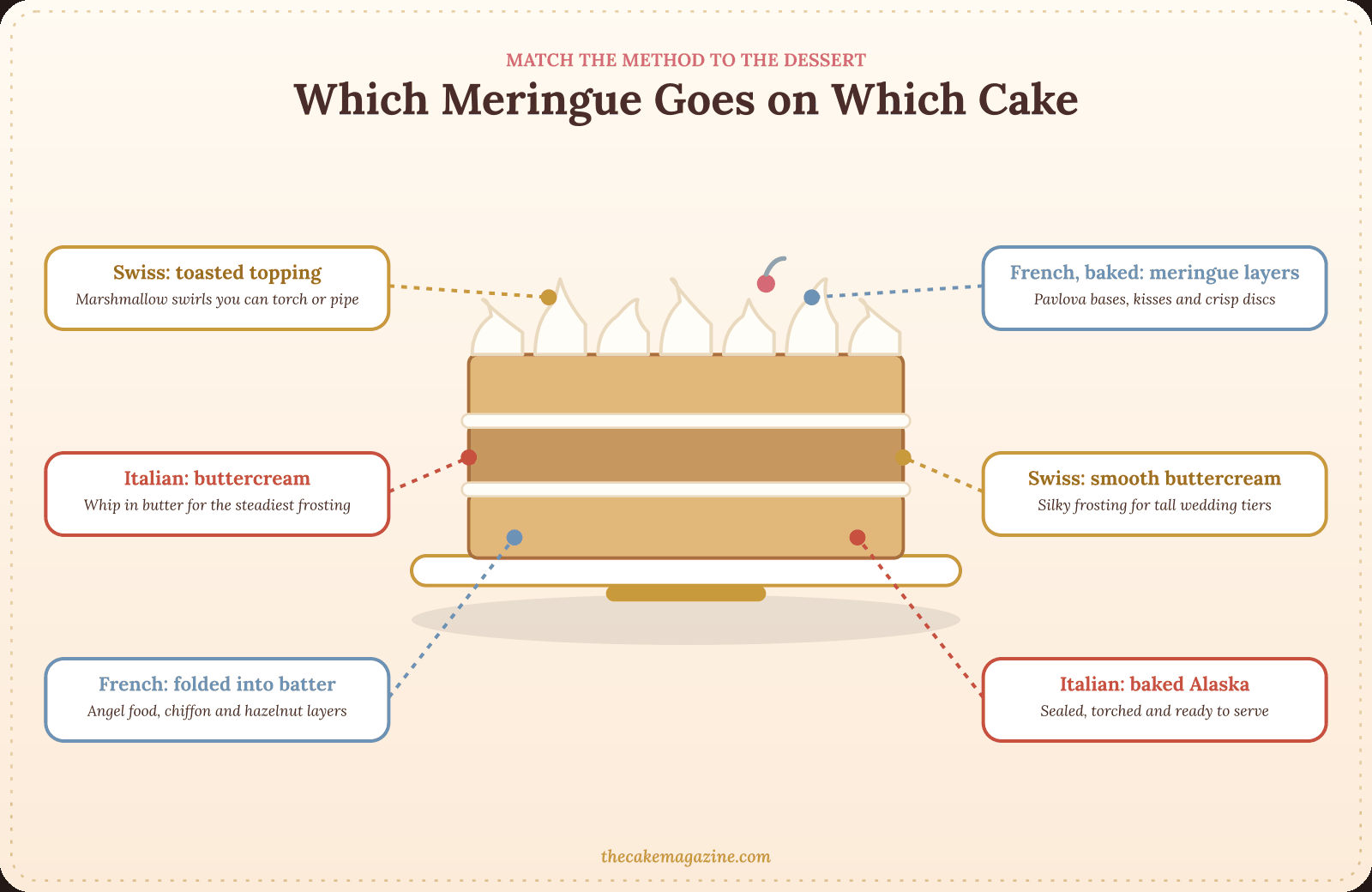
Both Swiss and Italian meringue can be beaten with soft butter to make buttercream that is smooth, less sweet and more stable than American buttercream. Swiss is the easier of the two and is popular for smooth-sided cakes. Italian is the more heat-tolerant and tends to be the choice for tall, decorated cakes. Our buttercream guide comparing every type shows how both sit among the other styles, and American buttercream is the sweeter, simpler cousin if you need a quicker option.
Meringue toppings and frostings from the types of meringue
A swoopy meringue topping is a classic finish for lemon, coconut and chocolate cakes. Swiss meringue is a reliable choice, because it holds its swirls and toasts evenly. A cooked, fluffy frosting sometimes called seven-minute frosting is essentially a Swiss-style meringue whipped over hot water and spread right away. These toppings are best served the day they are made, since they gradually soften and may weep if the cake is refrigerated.
Meringue layers and crunch
Crisp meringue discs pair beautifully with whipped cream, fruit and curd. They soften as they absorb moisture, so assemble within a few hours of serving. If you need to hold an assembled dessert longer, a thin brush of melted white chocolate on the meringue can slow moisture. Our guides to stabilized whipped cream and lemon curd for cakes cover two classic fillings for meringue layers.
Foam cakes and sponge batters
When a cake recipe tells you to beat egg whites to medium or stiff peaks and fold them in, it is using French meringue as a leavener. Angel food, chiffon and many sponges rely on it. The trick is gentle folding: add about a quarter of the whites to lighten the batter first, then fold in the rest in two additions. You can see how this fits among the other approaches in our guide to cake mixing methods.
Baked Alaska and torched designs
Baked Alaska layers ice cream and cake under an insulating blanket of meringue that is baked or torched until golden. Italian meringue is the usual choice because it is the most stable and the least likely to weep over cold ice cream. Cover every bit of the cake and ice cream, down to the plate, so the meringue seals. Work fast, serve soon and keep the dessert in the freezer until the last minute.
Piped meringue decorations
Meringue kisses, shells, stars and drops make beautiful, light toppers for cakes and cupcakes. Pipe them with a star or round tip using the same sharp-edged techniques you would use for buttercream, which our cake piping guide explains. Bake them low and slow, store them airtight, and add them to the cake close to serving so they stay crisp.
Which of the types of meringue goes with which flavor?
Every one of the types of meringue is sweet and neutral, so it benefits from sour, bitter or rich partners. Lemon, passion fruit, raspberry and orange cut through the sugar. Dark chocolate and coffee give contrast. Toasted nuts echo the browned edges. For help matching flavors across a whole cake, see our cake flavor pairing guide.
Troubleshooting meringue problems
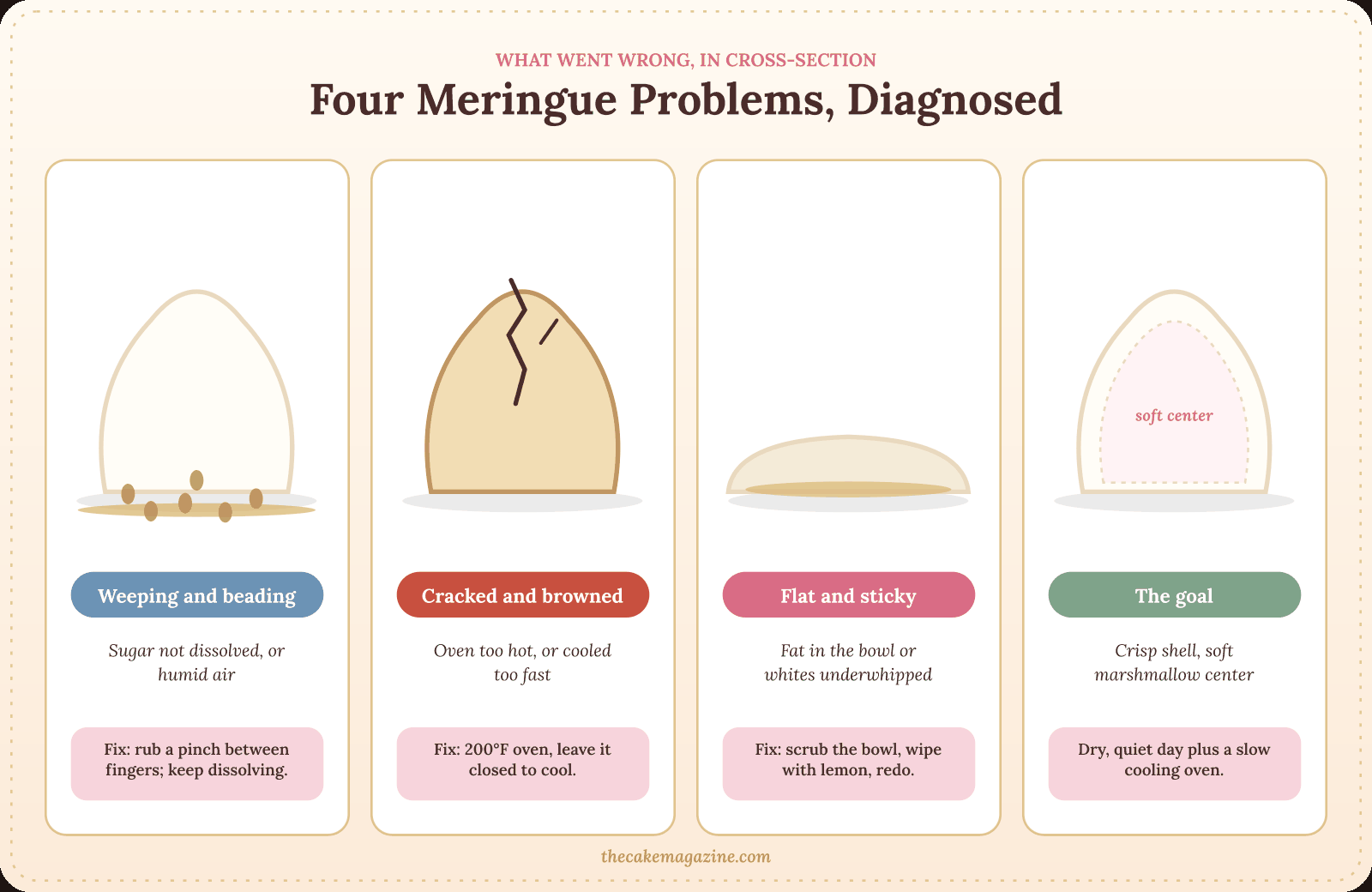
Meringue problems look dramatic, but most of them trace back to a short list of causes. Whichever of the types of meringue you made, start by asking three questions. Was anything greasy? Was the sugar fully dissolved? Was the weather humid? The cross-sections below show what the most common failures look like, and the fixes that follow match them to causes. For a broader look at diagnosing baking problems, our cake troubleshooting guide uses the same detective approach.
The whites will not whip
What it looks like: the foam stays soupy or reaches soft peaks and then refuses to go further, even after several minutes.
Likely causes: a trace of yolk, a greasy bowl or whisk, a plastic bowl, or sugar added too early.
Fix it: start over with a freshly cleaned bowl and fresh whites. Use a spare white to rescue the batch only if you caught the problem early. Wipe the bowl with lemon juice or vinegar before every batch.
Weeping syrup and beads on the surface
What it looks like: golden droplets on baked meringue, or a layer of liquid under a topping.
Likely causes: undissolved sugar, a humid room, overbaking, or a topping spread onto a filling that was still hot.
Fix it: whip longer and rub a pinch between your fingers to check for grit. Use superfine sugar, or switch to the Swiss method so the sugar dissolves before whipping. Bake on a dry day and cool the filling first.
Cracks, browning and a collapsed middle
What it looks like: deep fissures on the surface, tan color, or a high shell that sinks when it comes out of the oven.
Likely causes: an oven that is too hot, a door opened early or a sudden change in temperature after baking.
Fix it: use an oven thermometer, bake at 200°F to 225°F and let the meringue cool in the closed oven. Small hairline cracks on a pavlova are normal and can be hidden with whipped cream and fruit.
Sticky or chewy meringue that will not dry out
What it looks like: a surface that feels tacky, or a shell that bends instead of snapping.
Likely causes: too short a bake, humid air, or meringue left uncovered after baking.
Fix it: return it to a low oven for another 20 to 30 minutes, then cool it in the oven. Store in an airtight container with a small piece of parchment between layers.
Swiss meringue that stays soft or looks scrambled
What it looks like: either it never reaches stiff peaks, or there are cooked flecks in the foam.
Likely causes: heat too high, water touching the bowl, or not enough whipping time. Warm meringue also looks looser than it will after cooling.
Fix it: keep the water just below a simmer, whisk constantly and keep whipping until the bowl is cool. Strain out any cooked bits before whipping.
Italian meringue that deflates or splatters
What it looks like: hard strands of sugar on the bowl wall, or foam that sinks after the syrup goes in.
Likely causes: syrup poured too fast, onto the whisk, or whites whipped too stiff before pouring. Syrup that was undercooked also gives a looser foam.
Fix it: pour in a thin stream between the whisk and the bowl wall. Aim for soft peaks before the syrup goes in, and check your thermometer in boiling water.
Meringue buttercream that curdles or looks soupy
What it looks like: a grainy, split texture, or a loose, melting mixture.
Likely causes: the meringue was still warm, the butter was too cold or too warm, or the room is hot.
Fix it: keep beating, because many buttercreams come back together. If it is soupy, chill the bowl for 10 to 15 minutes and beat again. If it is curdled, warm the outside of the bowl gently with a warm towel, then beat. We walk through every fix in our Swiss meringue buttercream guide.
A diagnostic order that saves time
- Check cleanliness: bowl, whisk, yolk traces.
- Check sugar: dissolved, measured by weight, superfine if possible.
- Check temperature: oven thermometer, syrup thermometer, butter temperature.
- Check weather: humidity, a steamy kitchen, an air-conditioned room.
- Check timing: whipped long enough, baked long enough, cooled slowly.
Humidity, storage and make-ahead timing
Sugar attracts water, and meringue is mostly sugar, so humidity is its natural enemy. On a damp or rainy day, baked meringue may refuse to dry, and a finished shell left out can turn soft and sticky within hours. Many bakers pick dry days for baked meringue when they can, or run an air conditioner or dehumidifier. If you cannot control the weather, the types of meringue made with hot syrup or heated whites tend to be more forgiving than French.
Storing baked types of meringue
Fully cooled baked meringue keeps best in an airtight container at room temperature, away from steam and sunlight. Pack kisses in a single layer or separate layers with parchment. Do not store meringue in the refrigerator, where moisture will soften it. Many bakers make crisp meringue a day or two ahead for this reason, and a few days is generally fine if the container is truly airtight. If a shell softens, a short time in a low oven can dry it again.
Storing meringue toppings and buttercream
Soft toppings are at their best the day they are made. Swiss and Italian meringue buttercream can be refrigerated or frozen in airtight containers, then brought to room temperature and rewhipped. As a general guide, many bakers refrigerate it for a few days or freeze it for a couple of months. Because the butter and egg whites are perishable, keep it cold when it is not in use and read the guidance at USDA FSIS on keeping perishable foods safe.
Timing an event with different types of meringue
Plan backwards. Bake meringue shells and layers one or two days ahead and keep them dry. Make buttercream the day before and refrigerate it. Assemble cream-filled pavlovas and layered meringue desserts a few hours before serving. Pipe soft meringue toppings and toast them as late as possible. This timeline lets each of the types of meringue show up at its best.
Freezing and reviving
Baked meringue freezes poorly because it takes up moisture as it thaws. Raw egg whites freeze well, though, and many bakers keep leftover whites in labeled containers, measured by weight. Thaw them overnight in the refrigerator and use them within a few days of thawing. Frozen and thawed whites sometimes whip faster than fresh ones, which can be useful.
How to choose among the types of meringue
When you stand in front of your mixer, the choice usually comes down to a short list of questions. Ask them in order, and the right method is nearly always obvious. The choice is less about difficulty than about what the meringue has to do and how long it has to do it.
Start with the job
- Folded into a cake batter or baked into crisp pieces: French meringue.
- Buttercream for smooth sides: Swiss meringue, or Italian if you want the sturdiest.
- A fluffy topping that will be toasted: Swiss meringue.
- Piped decoration that must hold sharp edges: Italian meringue, or baked French or Swiss.
- Baked Alaska or ice cream desserts: Italian meringue.
Then consider your equipment
No thermometer and no double boiler? French meringue baked low and slow is the simplest route. A heatproof bowl and a saucepan? Swiss meringue is within reach. A candy thermometer and a mixer that can run hands-free? Italian meringue is open to you. Every one of the types of meringue can be made with a hand mixer, though a stand mixer makes the long whipping of Swiss and Italian meringue far easier.
Then consider your day
Hot, humid weather favors the cooked meringues. A kitchen with children and pets favors the ones that skip boiling sugar. A tight schedule favors French. A big wedding order, where reliability matters most, favors Italian or Swiss. Pick what your day can support, and write down how it turned out.
Begin with baked French meringue kisses to learn peak stages. Move to Swiss meringue to learn how heat dissolves sugar. Finish with Italian meringue once you are comfortable with a thermometer. Each step builds on the last, and by the end you will understand all three types of meringue by feel.
Mix and match the types of meringue when it helps
Professionals blend approaches all the time. A pastry cook might use French meringue to lighten a mousse, Swiss meringue as a topping and Italian meringue as a buttercream base within the same dessert. If you are curious about how all the frostings compare, our overview of the types of buttercream sets meringue styles beside American, German and ermine styles.
Ten mistakes that cause most meringue failures
- Using a plastic or greasy bowl. Use metal, glass or ceramic and wipe with acid.
- Getting yolk in the whites. Separate eggs one at a time into a small bowl first.
- Dumping in the sugar. Add it gradually after soft peaks for French meringue.
- Skipping the grit test. Rub a pinch between your fingers before baking or using.
- Baking too hot. Meringue should dry, not brown.
- Opening the oven door early. A sudden temperature change cracks the shell.
- Whipping warm Swiss meringue into butter. Wait until the bowl is cool.
- Pouring syrup onto the whisk. Aim for the bowl wall in a thin stream.
- Ignoring humidity. Dry days are better for baked meringue.
- Storing it in the refrigerator. Baked meringue goes soft in the cold.
Frequently asked questions about types of meringue
What are the main types of meringue?
The three classic types of meringue are French, Swiss and Italian. French whips raw whites with sugar and is baked afterward. Swiss warms whites and sugar over simmering water and then whips them. Italian pours hot sugar syrup into whipping whites. A few other styles, such as meringue made with powdered sugar or with dried egg whites, are variations on these.
Which of the types of meringue is the most stable?
Italian meringue is the most stable, because hot syrup dissolves the sugar instantly and partly sets the egg proteins. It holds its shape for days and survives humidity better than the others. Swiss meringue is the next most stable, and French meringue is the least, so it should be baked or used soon after whipping.
Which type of meringue is easiest for beginners?
French meringue is easiest in terms of equipment, since it needs only a clean bowl and a mixer. Swiss meringue is often easier to get right, because the sugar dissolves before whipping, which removes the most common cause of grit and weeping. Many beginners do best learning on baked French kisses, then moving to Swiss.
Are all types of meringue safe to eat if not baked?
It depends on the type of meringue. French meringue uses raw whites and should be baked or made with pasteurized whites. Swiss meringue heated to 160°F is generally considered a safer choice. Italian meringue is warmed by hot syrup, though the final temperature varies. Vulnerable people should be served pasteurized or fully baked versions, and USDA FSIS has current guidance.
Can I use pasteurized carton egg whites for meringue?
Yes, and they are a convenient safe option. They sometimes whip a little more slowly or to slightly lower volume than fresh whites, and results vary by brand. Warm them to room temperature, use a very clean bowl, and add cream of tartar. Check the package, since some brands recommend using meringue powder or a specific ratio.
Why won’t my egg whites whip into peaks?
Fat is the usual culprit. A trace of yolk, grease on the bowl or whisk or a plastic bowl will keep whites from whipping properly. Sugar added too early and whites that are very cold can also slow things. Start over with a clean metal or glass bowl, wipe it with lemon juice or vinegar and separate the eggs carefully.
Why is my meringue weeping or leaking syrup?
Weeping is usually undissolved sugar or humidity. Whip until a pinch rubbed between your fingers feels smooth, use superfine sugar, or switch to Swiss meringue so the sugar dissolves with heat first. Bake on a dry day and cool any filling before putting meringue on it, since a hot filling can drive moisture up into the foam.
What is the difference between Swiss and Italian meringue?
Swiss meringue dissolves the sugar by warming whites and sugar together over simmering water, then whips them cool. Italian meringue dissolves the sugar in a hot syrup cooked to about 240°F and pours it into whipping whites. Italian is slightly more stable and glossy, while Swiss needs less equipment and no pouring of hot sugar.
Can I make any types of meringue ahead of time?
Yes, with the right type. Baked meringue keeps for a day or two in an airtight container at room temperature. Swiss and Italian meringue buttercream can be refrigerated and rewhipped. Soft meringue toppings are best the day they are made, and French meringue should be used within minutes of whipping, before it begins to drain.
Do I need cream of tartar for the types of meringue?
No, but it helps. About one quarter teaspoon per four whites makes the foam steadier and the meringue less likely to be overbeaten. Lemon juice or white vinegar can replace it, at about half a teaspoon for four whites. A very clean bowl matters more than the acid, and meringue can be made without either.
How do I fix meringue that is too soft or runny?
If the whites are underwhipped, keep going until the peaks stand up. If sugar is gritty, whip longer or warm the mixture. If a Swiss or Italian meringue is still warm, keep whipping until the bowl cools. If fat got in, start over. Humidity can also keep meringue soft, so a dry day or a longer bake helps.
Which types of meringue work for buttercream?
Swiss and Italian meringue are the two used for buttercream, because both are cooked or heated and both hold butter well. Swiss is simpler and popular for smooth finishes. Italian is the most heat-tolerant. French meringue is not used for buttercream, since the raw whites are not heated and the foam is less stable.
Can I make meringue without eggs?
Yes, with aquafaba, the liquid from canned chickpeas. About three tablespoons replaces one egg white in many recipes, and it can be whipped with sugar and cream of tartar into a foam. It is less stable than egg white meringue and may need a longer bake, so test small batches before using it in an important cake.
Final thoughts
The types of meringue can look like three unrelated techniques, but they share one idea: get the sugar dissolved and the proteins stretched into a stable foam. French does it with patience and a clean bowl. Swiss does it with gentle heat. Italian does it with a pot of hot syrup. Once you see them as three routes to the same place, the choice stops feeling intimidating and starts feeling like a decision about timing, equipment and the cake in front of you.
If you are new to all of this, begin with baked French meringue kisses and learn the peak stages by sight. Then try a small Swiss batch and feel how the sugar vanishes with warmth. When you are ready, make Italian meringue and enjoy the sturdiest foam of the three. Keep notes on weather, bowl, sugar and timing. In a few batches you will know your own kitchen’s habits better than any book can tell you.
Tell us how your meringue turned out, which of the types of meringue you reach for most often, and what went wrong that we should add to the troubleshooting section. Real baking questions are what make a guide like this better over time.
Editorial note: reviewed and updated November 2026 for home bakers in the United States. The ratios, temperatures and times in this guide are conservative starting points drawn from widely used baking practice, and this site has not oven-tested them, so test a small batch before an event and adjust for your oven, altitude and humidity. This is general food safety information, not medical advice. For current egg safety guidance, see the USDA Food Safety and Inspection Service, and for general cake technique see the King Arthur Baking cake guide.