Cream cheese frosting is the tangy, creamy topping people reach for when plain sweetness feels like too much. It belongs on carrot cake, red velvet and spiced layers, and it makes a lovely cloud on a cinnamon roll. It is also one of the fussiest frostings around: it runs soft, it weeps in a warm kitchen, and it resists sharp edges. This guide explains why cream cheese frosting behaves that way, so you can sweeten, chill, store and decorate with it on purpose.
Cream cheese frosting is a soft emulsion of butter, cream cheese and powdered sugar, and the water in the cream cheese is both its charm and its weakness. Keep the ingredients cool, mix briefly, add enough sugar for the job and chill the finished batch before using it. Treat it as a perishable dairy product: refrigerate the frosted cake, and do not leave it out longer than two hours, or one hour in a hot room. It swirls beautifully, but it is no match for razor-sharp edges or tall piped flowers.
- What cream cheese frosting really is
- How cream cheese frosting is built: fat, water and sugar
- The ingredients that matter most
- Two starting formulas to adapt
- Mixing without making soup
- Balancing sweetness and tang
- Temperature control for cream cheese frosting
- Refrigeration and food safety
- Decorating limits and how to work within them
- Flavors and cake pairings
- Troubleshooting cream cheese frosting
- Make-ahead, storage and transport
- FAQ
- Final thoughts
What cream cheese frosting really is
Most people picture cream cheese frosting as “buttercream with a tang,” and that is a decent shortcut. The classic American version beats softened butter and cream cheese together, then adds powdered sugar, vanilla and a pinch of salt. No eggs are cooked, no syrup is boiled, and no special equipment is needed. It takes about ten minutes. The simplicity is why it became the default partner for carrot cake, and it is also why so many home versions go wrong.
The key difference from ordinary buttercream is moisture. Butter is mostly fat. Cream cheese is mostly water held in a network of milk protein, with fat suspended through it. When you replace part of the butter with cream cheese, you swap firm fat for a soft, wet ingredient. That makes the frosting tastier, lighter and tangier. It also makes it softer, more temperature sensitive and more perishable than the plain buttercream you might already know from our guide to American buttercream.
Once you understand that trade, the rest follows. Every tip in this guide, from using cold cream cheese to stopping the mixer early, is really about managing water. Keep the water inside the emulsion and you get a smooth, spreadable, tangy frosting. Let it escape and you get a puddle.
Where cream cheese frosting fits in the frosting family
Cream cheese frosting sits near the soft end of the spectrum. Cooked meringue buttercreams, like the ones in our buttercream guide, hold sharp edges and tolerate a warm room better. Whipped cream is lighter but needs its own help to stay put, as the guide to stabilized whipped cream frosting explains. Ganache firms up as it cools. It lands in the middle: richer than whipped cream, softer than buttercream, and happiest when it is cold.
That placement tells you what to ask of it. It is superb for a naked or semi-naked layer cake, for sheet cakes, cupcakes, sandwich cookies, cinnamon rolls and cake fillings. It is a so-so choice for smooth, sharp-edged tiers and a poor choice for outdoor summer weddings. Knowing which jobs suit it will save you more frustration than any single technique.
Why bakers love it anyway
The appeal is flavor. The lactic tang of cream cheese cuts through the sugar and lets spices, toasted nuts, fruit and brown butter come forward. A carrot cake without it feels unfinished. A red velvet cake without it loses its signature contrast. Our red velvet cake recipe and the carrot cake recipe both lean on that tang, and a well-made batch is a big part of why those cakes taste the way they do.
Think of frosting as a dairy dessert that happens to be spreadable. That mindset keeps you honest about temperature, storage and serving time, and it stops you from judging it by the standards of a stiff, shelf-stable buttercream.
Cream cheese frosting compared with other common choices
American buttercream
Sweeter, firmer and more tolerant of warmth, because it is mostly butter and sugar. It forms a light crust and smooths better, but lacks the tang.
Meringue buttercreams
Silky, less sweet and the best for sharp edges and piping detail. They take more time and a thermometer, and they use eggs cooked with sugar.
Stabilized whipped cream
Light and barely sweet, but it needs reliable refrigeration and does not stand up to long displays.
Cream cheese frosting
Tangy and creamy with a relaxed, rustic look. Quick to make, but soft, perishable and limited in the decorating it can handle.
How cream cheese frosting is built: fat, water and sugar
Look at a spoonful of cream cheese frosting and you see something smooth and uniform. Under a microscope it would be a crowded neighborhood. Fat globules from the butter and cream cheese float in a watery base. Strands of milk protein weave through the water. Sugar crystals dissolve into whatever water they find. Everything stays smooth only while the fat is firm enough to hold its position.

The role of fat
Fat provides the structure you can see. Butter is solid when cold and soft near room temperature, and that is why frosting firms in the fridge and slumps on a warm counter. Cream cheese carries fat too, but less of it. In the United States, the FDA’s standard for cream cheese requires at least 33 percent milkfat and no more than 55 percent moisture, according to the federal regulation on cream cheese. That moisture ceiling is high enough to matter. More than half of the block can be water.
Because the block is up to 55 percent water, every ounce you add to a frosting brings a lot of liquid with it. The more cream cheese you use compared with butter, the softer your frosting becomes. That is the single most useful ratio in this article, and we will return to it in the formulas.
The role of water and protein
Water makes the frosting creamy, but it also makes it unstable. Left to itself, water wants to drift out of the mixture, especially when the fat softens and loosens its grip. That drift is what you see as a shiny, weeping surface or a puddle at the base of a cupcake. The milk proteins in cream cheese give a little body and slow the leak, but they are not strong enough to hold a peak the way egg white foam does.
Overbeating makes this worse. Beating pushes air into the mixture and warms it with friction. Warm fat softens, the emulsion loosens, and the water separates from the fat. This is why recipe writers repeat the same advice: mix on low, mix briefly, and stop.
The role of sugar
Powdered sugar does two jobs. It sweetens, and it thickens. Fine sugar dissolves into free water and turns it into syrup, which is thicker than plain water. Most powdered sugar also contains a small amount of cornstarch, which absorbs moisture and adds body. So when the frosting looks too thin, adding sugar will stiffen it, but only at the cost of sweetness and tang.
That trade-off is why we treat sweetness and stiffness as a single dial rather than two separate decisions. A frosting that holds a swirl has been pushed toward sugar. One that tastes tangy and light has been left soft. You pick the point on the dial that your cake needs.
Cold butter holds the shape, cream cheese supplies flavor and water, and powdered sugar soaks up that water so the frosting can stand without running.
The ingredients that matter most
A short ingredient list means every item carries weight. Four choices decide whether your frosting is lovely or limp: the type of cream cheese, the butter, the sugar and the supporting flavors.
Block cream cheese, not spread
Use full-fat cream cheese sold in a foil-wrapped block. Tubs of spreadable cream cheese are made for bagels, and many are whipped or thinned to spread cold. Labels vary by brand, so read yours, but in general they carry more moisture or air than a block and behave like a soft, runny version of the same thing. Low-fat and fat-free blocks have even more water. For frosting, full-fat block cream cheese is the reliable choice.
Brand matters less than people think, but consistency matters a lot. If one brand gives you a good frosting, buy that brand again. Different manufacturers, and even different batches, can vary in moisture and tang. If you get a wet, soft batch, you may need to trim the sugar target up or the cream cheese down slightly, which is a good reason to keep notes.
Butter: unsalted, cool and firm enough
Unsalted butter lets you control the seasoning. The texture of the butter at the start sets the stage for everything else. Aim for butter that is soft enough to dent with a fingertip but still cool, around 65°F. If your butter is greasy, shiny or starting to melt, your frosting will start out loose and only get looser. Our guide to cake baking science explains why fat temperature matters so much in batters, and the same logic applies here.
Resist the temptation to soften butter in the microwave. Even a few seconds of uneven heating melts the outer layer while the center stays hard, and melted butter will not re-solidify into the same structure. Cut cold butter into cubes and let it sit on the counter for 30 to 45 minutes instead.
Powdered sugar: sift it and weigh it
Powdered sugar, also called confectioners’ sugar, clumps in the bag. Those tiny lumps do not always dissolve in a soft, wet frosting, and they show up later as gritty bits. Sift it, or press it through a sieve with the back of a spoon. Weigh it if you can. A cup of powdered sugar can swing by 20 grams or more depending on how it was scooped, and in a frosting this sensitive, that is enough to change the texture.
Flavor helpers: vanilla, salt and acid
Vanilla and a pinch of salt turn a flat, sweet mix into something that tastes like a bakery. A little lemon juice can brighten a frosting that tastes heavy, but it adds liquid, so add only a teaspoon or two and compensate with a spoonful of sugar if needed. Our guide to cake flavor pairing has ideas for matching these helpers to different cakes.
- Two 8-ounce blocks of full-fat cream cheese, still foil-wrapped
- Unsalted butter, cool and sliceable
- A bag of powdered sugar, sifted before use
- Pure vanilla extract and fine salt
- Optional: lemon, cinnamon, maple or brown butter for variations
Two starting formulas to adapt
Nobody at this magazine has oven-tested or bench-tested these formulas, so please read them as starting points built on conventional ratios, not as guaranteed results. Cream cheese brands, butter, humidity and your own kitchen temperature all move the numbers. Make a small batch first, taste it, check the texture against the job you have in mind, and write down what you change.
Both formulas below are weighed in grams, with cup estimates for convenience. If you only own cups, spoon the sugar into the cup and level it rather than scooping. The first formula is soft and tangy. The second has more butter and sugar, so it stands up better to swirls and cupcake piping.
Formula A: soft and tangy
226 g (8 oz) cream cheese, 113 g (1 stick, ½ cup) unsalted butter, 210 g (about 1¾ cups) powdered sugar, 5 ml (1 teaspoon) vanilla and a pinch of fine salt. Makes roughly 2½ cups. Best for filling layers, spreading on sheet cakes, topping carrot cake and finishing cinnamon rolls you will serve soon.
Formula B: firmer for swirls
170 g (6 oz) cream cheese, 226 g (2 sticks, 1 cup) unsalted butter, 420 g (about 3½ cups) powdered sugar, 5 ml (1 teaspoon) vanilla and a pinch of fine salt. Makes roughly 3½ cups. Best for cupcake swirls, simple rosettes and a thicker coat on a cake you will keep chilled until serving.
How much cream cheese frosting do you need?
As a rough guide, Formula A is enough to fill and lightly frost the top and sides of a two-layer 8-inch cake in a rustic, semi-naked style. For a fuller coat and some piping, make one and a half times the recipe. A dozen cupcakes with generous swirls usually takes about the same as Formula B. Our guide on how much frosting you need breaks down amounts by cake size, shape and style so you do not run short halfway through.
Adjusting a formula to your kitchen
If your frosting tastes right but looks too soft, chill it for 20 minutes before changing anything. If it is still soft after chilling, add powdered sugar a tablespoon at a time and mix briefly. If it tastes too sweet but is stiff enough, you have the opposite problem: replace a little of the sugar with extra cream cheese, chill, and test again. Make one change at a time so you can tell what helped.
Scaling a formula up or down
Both formulas scale in a straight line, which makes life easy. Double Formula A for a tall three-layer cake or a large sheet cake, and halve it for a handful of cupcakes. The catch is the mixing bowl. A big batch warms up faster from friction and from the time it takes to scrape and portion, so chill larger amounts a bit longer. Weighing every ingredient makes scaling painless, which is one more reason to keep a kitchen scale handy.
A note on cinnamon rolls and other bakes
Warm cinnamon rolls are a different situation. Frosting a hot roll melts the topping into a glaze, which some people love. For a thicker, spoonable topping, let the rolls cool until they are just warm, and use the soft Formula A. Cooled, the frosting sets into a creamy layer. Either way, cream cheese on a baked good that sits out is subject to the same time limits you would apply to a cake.
Mixing without making soup
The mixing method for cream cheese frosting is short and a little counterintuitive. You want the butter smooth, the cream cheese just combined and the sugar mixed in without a long beating session. Most failures happen when someone treats it like American buttercream and whips it for five minutes to make it fluffy. It does not need to be whipped. It needs to be combined.

The sequence that works
Start with the butter. Beat the cool, soft butter on medium for one to two minutes until it is smooth and creamy. It should be pale but not fluffy or greasy. Scrape the bowl once. This step gives the frosting a stable, fat-based backbone before the wet ingredient joins it.
Add the cream cheese. Cut the cold cream cheese into cubes and drop them in, then mix on low speed until no streaks remain, about a minute. Using cream cheese that is cool, not warm, is the best protection against runny frosting. If small flecks of cream cheese remain, do not keep beating. Stop, scrape and give it ten more seconds.
Add the sugar. Sift the powdered sugar in, about a third at a time. Mix on the lowest speed until it is absorbed, then increase just enough to smooth it out. Stop as soon as the frosting looks uniform. Add vanilla and salt in the last few seconds, or fold them in by hand with a spatula.
Rest and chill. Cover the bowl and refrigerate for 20 to 30 minutes. The butter firms, the sugar finishes dissolving and the frosting gains body. Stir it gently with a spatula before using. If it seems loose at that point, chill it another ten minutes rather than adding sugar.
Which mixer should you use?
Any mixer will do the job, and many bakers prefer a stand mixer for its steady low speed and enclosed bowl. A hand mixer works well for a single batch, and a bowl with a sturdy spatula is a perfectly good option for tiny amounts. The important variable is not the machine but your restraint. If you are choosing equipment, our comparisons of stand mixers for cake baking and hand mixers for cake and frosting cover speed control and bowl size in more detail.
Cold cream cheese or room temperature?
Recipes disagree on this, and the confusion is understandable. Room-temperature cream cheese blends into butter quickly and gives a very smooth mix, but it is also soft and wet, so the margin for error shrinks. Cold cream cheese keeps the frosting firmer, but it can leave small lumps if you add it to soft butter and stop too early. A cool middle path usually works best: take the block out of the fridge 15 to 20 minutes before mixing and cut it into cubes so it softens evenly.
If you only remember one rule, remember this one: the butter should be a little softer than the cream cheese, and neither should be warm. Our guide to cake mixing methods makes the same point about batters. Temperature first, technique second.
Hand-mixing and small batches
For a small amount of frosting, a bowl, a flexible spatula and a little patience are enough. Press the butter smooth, work in the cream cheese in pieces, then fold in the sifted sugar. You will not whip air into the frosting this way, which is actually helpful. It produces a dense, creamy result that spreads well and holds up in a warm kitchen for a few extra minutes.
- You can no longer see streaks of white cream cheese or yellow butter.
- The surface looks creamy and matte, not shiny or wet.
- The bowl feels cool, not warm, when you touch the outside.
Balancing sweetness and tang
One reason cream cheese frosting is popular is that it tastes less sugary than plain buttercream. That only stays true if you resist adding too much sugar to fix texture. Sweetness is part of the formula, not an afterthought. Every tablespoon of powdered sugar changes both the flavor and the firmness, so it helps to know what you are buying with each addition.
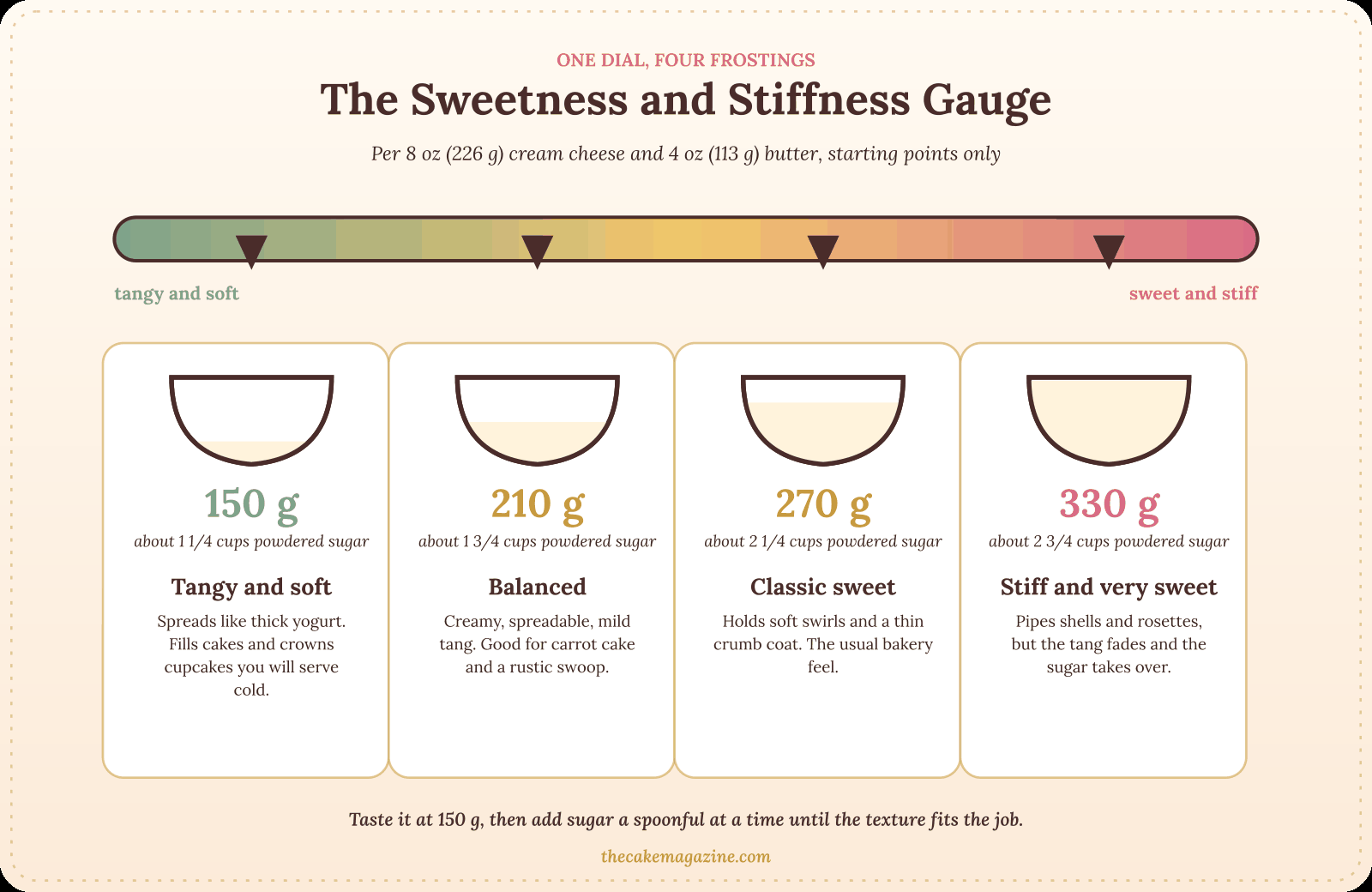
Reading the sweetness gauge
The gauge above shows four ways to build a frosting from 226 grams of cream cheese and 113 grams of butter. At 150 grams of powdered sugar, the mix is tangy and soft, almost like a sweetened spread. At 210 grams, it is balanced and creamy. At 270 grams, it reaches the classic bakery sweetness. At 330 grams, it is stiff and very sweet, and the tang recedes. These are starting points, not laws. Your cake, your taste and your cream cheese will move them.
How to lower the sweetness without losing structure
If you want less sugar but still need stiffness, use cold. Chill the finished frosting thoroughly, since cold butter does the work that sugar would otherwise do. A higher share of butter relative to cream cheese also helps, because butter is firm and holds less water. Finally, pair the frosting with a cake that is itself fairly sweet, so the overall dessert reads as balanced, not flat.
A simpler trick is to use less frosting. A thin, even layer on a spiced cake tastes better than a thick blanket that overwhelms it. Fillings and toppings you add, like chopped toasted nuts or a spoonful of jam, also let you stretch a modest amount of sweetness across the whole slice.
How to make it tangier
A tangier cream cheese frosting calls for more cream cheese or a touch of acid. A teaspoon of lemon juice, or a spoonful of sour cream stirred in at the end, can brighten a frosting that tastes too heavy. Remember that each of those additions brings water, so offset it with a tablespoon of sugar and chill the result. A pinch more salt also sharpens the flavor without adding tang.
Taste it cold
Taste the frosting at the temperature you will serve it, not warm from the bowl. Cold dulls sweetness and softens tang, which means a frosting that tastes perfect while mixing can seem muted on a chilled cake. A frosting that tastes balanced at room temperature may need a pinch of salt or a few drops of vanilla to stand out once it comes out of the fridge.
Temperature control for cream cheese frosting
If structure is the science of this frosting, temperature is the practice. A frosting that is two or three degrees too warm behaves like a different recipe, and the same frosting chilled for fifteen minutes can be a joy to use. Learning to read and manage temperature is the biggest skill upgrade available to anyone who works with this frosting.

The temperature zones
Straight from the fridge, cream cheese frosting is firm, cold and hard to spread. It is also at its most stable. Around 60°F to 65°F it becomes workable for piping, and between about 65°F and 68°F the butter and cream cheese are at their friendliest for mixing and blending. Past 70°F, the frosting softens, spreads easily and begins to lose its swirl definition. At 78°F and above, water starts to separate and the frosting slumps.
Those figures are guideposts drawn from general baking practice, not lab measurements, and your formula will shift them a few degrees either way. The thermometer graphic is meant to give you a feel for the range. A cheap instant-read thermometer takes the guesswork out, and it is a useful tool for batters and custards as well.
Managing a warm kitchen
Warm kitchens, hot hands and bright lights all work against it. Frost in the coolest part of the day. Keep the bowl of frosting in the fridge between layers and bring out only as much as you need. Chill the cake itself, since a cold cake keeps the frosting from softening as you spread it. If the frosting turns shiny and soft, stop and refrigerate for 15 to 20 minutes rather than pushing through.
Your hands matter more than you would expect. A piping bag held in a warm fist can soften the frosting in a few minutes. Use a thick bag, hold it by the top, and swap to a fresh bag of chilled frosting when the first one starts feeling soft.
Why cold cake plus cold frosting works
A chilled cake gives frosting a firm surface to grip and prevents crumbs from tearing up the layer. Bake the cake a day ahead, wrap the layers well and chill them, or freeze them briefly before frosting. Cold layers are also easier to level and torte, which our guide on how to torte a cake covers in detail. Frosting a cold cake with cold, well-mixed frosting is the closest thing to a foolproof method.
- Mix with cool ingredients, aiming for a bowl that never feels warm.
- Chill the finished frosting for 20 to 30 minutes.
- Frost chilled cake layers, returning the cake to the fridge between coats.
- Serve after the cake has sat out only briefly, within safe time limits.
Refrigeration and food safety
This is the part of frosting that gets skipped in too many recipes. Cream cheese is a dairy product, and a frosting that is part cream cheese should be treated like any perishable dairy dessert. That means refrigeration, sensible time limits and clean handling. It is general food-safety guidance, not a quirk of one recipe, and it matters especially when you are serving guests, children, older adults or anyone with a weakened immune system.
The two-hour rule
The U.S. Department of Agriculture’s Food Safety and Inspection Service describes the “danger zone” as 40°F to 140°F, the range where bacteria multiply fastest. It advises that perishable food should not stay in that range for more than two hours, or for more than one hour when the temperature is above 90°F. You can read the details on the USDA food safety pages. A cake covered in cream cheese frosting is a perishable item, so the same clock applies from the moment it leaves the fridge.
In practice, that means you plan the serving timeline. Take the cake out of the fridge, let it sit while you sing and cut slices, and return leftovers to the fridge promptly. If your party runs long and the cake has been out for hours, the safest choice is to discard it instead of hoping for the best.
Is it safe to leave a frosted cake on the counter overnight?
For cream cheese frosting, the safe answer is no. A frosted cake that has sat out overnight has been in the danger zone far longer than two hours. Some bakers do leave certain buttercream-frosted cakes out for a short time, but that depends on the recipe, and this frosting contains more moisture and dairy than most of them. When in doubt, refrigerate. Our guide to cake filling stability sorts common fillings and frostings into what can sit out and what must stay cold.
How long does it keep?
Many home bakers keep a frosted cake in the fridge for a few days, and a covered bowl of leftover frosting for about the same. Treat that as a rule of thumb, not a guarantee. The real limit depends on how fresh your ingredients were, how clean your tools were, how cold your fridge runs and what else is in the cake. Look for off smells, a sour taste, visible mold or a watery, curdled texture, and throw out anything doubtful.
Use clean utensils every time you scoop frosting from a container. Dipping a used spoon back into the bowl adds bacteria and speeds spoilage. If you need to frost over several sessions, portion what you need into a separate bowl and keep the main batch sealed and cold.
Safe handling checklist
- Buy cream cheese that is sealed and within its date, and keep it in the fridge until you need it.
- Wash your hands, bowl, beaters and spatulas before you start.
- Do not soften cream cheese on the counter for hours. Twenty to thirty minutes is plenty.
- Refrigerate frosted cakes, cupcakes and leftover frosting promptly.
- Track how long a cake has been out, and stick to the two-hour limit, or one hour above 90°F.
- Follow your local rules if you sell cakes, and ask your state agency about cottage food limits before you take orders.
This section is general information, not legal or medical advice. If you plan to sell cakes with cream cheese frosting, check your state or local health department about whether perishable frostings are allowed under cottage food rules, because those rules vary and can change. Our guide to starting a cake business explains how to find the right office.
Does baking or freezing make it safe?
Freezing pauses bacterial growth but does not sterilize food. Frozen frosting is perfectly usable if it was handled safely beforehand, but it is not a cure for frosting that sat out too long. Baking helps with cream cheese fillings that go into the oven, like cheesecake bars, but a raw frosting never gets that treatment. When in doubt, follow the guidance in King Arthur’s cake guide and the USDA pages mentioned above.
Decorating limits and how to work within them
Here is where expectations collide with physics. Bakers see gorgeous photographs of frosting rosettes and sharp-edged cakes and assume the frosting can do everything buttercream can. It can do a lot, but not all of it. Knowing the limits lets you choose the right job for the frosting, and the right frosting for the job.

What cream cheese frosting does well
It excels at filling, crumb-coating and rustic finishes. Spread it with an offset spatula, drag a spoon through it for swoops, or leave the sides of the cake bare for a naked look. It handles simple swirls on cupcakes and loose rosettes if you pipe with a large open tip and keep it cold. A thin crumb coat, as described in our crumb coat guide, followed by a chilled final coat gives you a neat, homey cake that looks as good as it tastes.
Where it struggles
Sharp edges and smooth sides are the biggest problem. It is soft and sticky, and it does not form a skin the way American buttercream does, so scraping it with a bench scraper tends to drag and smear. Fine piping, such as tight borders, lettering and tall flower petals, can sag or lose definition as the heat of your hands softens it. Humid weather makes all of this worse.
If your cake design needs crisp lines, you have a few options. Use a firmer cream cheese formula and chill between steps. Hide the structure under another frosting and use cream cheese only as filling or as a thin finishing layer. Or switch to a frosting built for the job, like Swiss meringue buttercream, which smooths well and holds detail. Our tutorial on smooth buttercream sides and sharp edges shows the techniques that work with sturdier frostings.
Making the most of piping
If you want to pipe with cream cheese frosting, plan the design around its strengths. Choose Formula B, chill it until it feels firm like soft clay, and use a large open star or round tip. Simple swirls and big rosettes read well, while delicate details do not. Pipe in a cool room, hold the bag with the tips of your fingers and refrigerate the cake as soon as you finish. Our cake piping guide covers bags, tips and pressure so your results look even.
Cream cheese frosting on cupcakes, sheet cakes and tiered cakes
Cupcakes are the most forgiving use, since they are small, eaten quickly and easy to refrigerate. Sheet cakes also work well because you only need a smooth, even spread. Tiered and stacked cakes are the riskiest. The weight of upper tiers presses on the lower layers, soft frosting bulges, and the cake travels poorly. For wedding and celebration cakes, most bakers use it only inside the cake, if at all, and use a sturdier frosting outside.
If the design needs to look sharp for hours at room temperature, cream cheese frosting is the wrong outer coat. If it needs to taste wonderful and look relaxed, it is a great one.
Flavors and cake pairings
Cream cheese frosting is a blank canvas with a built-in tang, so it takes flavor well. Add one idea at a time and keep the added liquid small, since water is the thing this frosting handles worst. Extracts, zests, spices, cooled browned butter and powders are better choices than juices and syrups.
Flavor ideas that behave
Brown butter
Brown the butter, chill it until it is solid again and soft-cream it before mixing. You get a nutty depth that suits pumpkin, pecan and apple cakes. Never add warm brown butter to the bowl, or it will melt everything.
Citrus zest
Lemon, orange or lime zest adds bright flavor without much liquid. Rub the zest into the sugar first so the oils spread evenly. A teaspoon of juice is usually the most you can add before the texture loosens.
Warm spice
Cinnamon, ginger and nutmeg are natural partners. Add a quarter to half a teaspoon to a batch, taste after chilling and build slowly. Spices bloom as the frosting rests overnight.
Maple and honey
Real maple syrup is lovely but wet. Use a tablespoon at most, reduce it on the stove and cool it first, or reach for maple extract and a pinch of brown sugar instead.
Freeze-dried fruit
Ground freeze-dried strawberries or raspberries give intense flavor and color without adding water, and they thicken the frosting slightly. Sift them in with the powdered sugar.
Espresso and cocoa
Instant espresso powder, dissolved in a few drops of vanilla, adds a roasted note. Sifted cocoa turns the frosting into a tangy chocolate version. Add more sugar to balance cocoa’s dryness.
If you want to color the frosting, gel color is better than liquid because it adds almost no water. This frosting starts off ivory, so pinks and blues need a little extra gel and often look softer than they do in buttercream. Our guide to coloring buttercream has tips on pastels and deep shades that carry over to this frosting.
Cakes that love cream cheese frosting
The classics earn their reputation. Carrot cake, red velvet, hummingbird, pumpkin, banana, spice cake and apple cake all have flavors that sit comfortably alongside a tangy topping. Chocolate cake works too, especially when the frosting is a little less sweet. A dense, moist cake with a lot of its own flavor balances the cream cheese tang well.
Be more careful with delicate sponge cakes, which can be crushed by a heavy, cold frosting, and with very sweet cakes, where the frosting should step back instead of piling on more sugar. Our cake flavor pairing guide goes through matching cakes, fillings and frostings in more depth, and our chocolate cake recipe is a good base if you want to try a tangy chocolate combination.
Using cream cheese frosting as a filling
Inside a cake, the frosting has an easier job. It sits between layers, supported by the cake, and does not need to hold a shape on its own. Pipe a dam of firmer frosting around the edge of each layer if you are adding a softer filling like jam or fruit, then spread the frosting inside it. Chill the assembled cake before the final coat so the layers settle.
Troubleshooting cream cheese frosting
Almost every cream cheese frosting problem is a variation on one of three themes: too warm, too wet or overmixed. Here are the most common symptoms, what they usually mean and how to fix them. For broader baking problems beyond frosting, our cake troubleshooting guide covers sunken centers, dry crumb and more.
The frosting is runny and will not hold a shape
What it looks like: it slides off the spatula, pools on the cake or collapses when piped.
Likely causes: warm butter, warm cream cheese, overbeating, a cream cheese with high moisture or too little sugar.
How to fix it: chill the bowl for 20 to 30 minutes and stir gently. If it is still soft, beat in powdered sugar a tablespoon at a time on low. For a lasting fix, remake the batch with cooler ingredients and a higher ratio of butter to cream cheese.
The frosting is grainy or gritty
What it looks like: tiny hard specks you can feel on your tongue.
Likely causes: unsifted powdered sugar, sugar added to a very wet mix or sugar that did not have time to dissolve.
How to fix it: rest the frosting in the fridge for an hour, then stir. Sugar often dissolves with time. For next time, sift the sugar and add it gradually to a smooth base.
There are lumps of cream cheese
What it looks like: white flecks or small chunks that do not blend into the butter.
Likely causes: cream cheese that was too cold or added to butter that was too soft.
How to fix it: mix on low for another 15 seconds. If lumps persist, press the frosting through a fine sieve or warm the bowl slightly by holding it against your palms for a minute, then mix again.
The frosting looks curdled or split
What it looks like: a slightly cottage-cheese look, with fat and liquid beginning to separate.
Likely causes: temperature shock, such as cold cream cheese beaten into very soft butter, or too much beating.
How to fix it: bring the bowl to a cool, even temperature, either by chilling a warm batch or letting a cold batch sit for ten minutes. Then mix on low until it smooths out. A tablespoon of powdered sugar can help it recombine.
Water weeps out after frosting the cake
What it looks like: shiny beads or a thin pool of liquid on the surface or around the base of the cake.
Likely causes: a warm room, a frosting that was too wet from the start or a cake served after sitting out too long.
How to fix it: blot the liquid gently with a paper towel and refrigerate the cake. Next time, use a firmer formula, frost a cold cake and serve it soon after taking it out of the fridge.
The frosting is too sweet
What it looks like: the first bite is fine and the second is cloying.
Likely causes: too much sugar for stiffness, or a sweet cake underneath.
How to fix it: beat in a spoonful of extra cream cheese, a pinch of salt and a little lemon zest, then chill. Next time, start at the lower end of the sweetness gauge and rely on chilling for firmness.
The frosting is too tangy or sour
What it looks like: a sharp, almost sour edge that overpowers the cake.
Likely causes: a naturally tangy brand of cream cheese, too much cream cheese for the formula or old cream cheese.
How to fix it: add a little more butter and a spoonful of sugar. If it tastes truly sour or off rather than just tangy, discard it. Old cream cheese is not worth the risk.
The frosting turns yellow or gray
What it looks like: the color is warmer than the ivory you expected, or turns dull after sitting.
Likely causes: butter color, a long beating session or interaction with some colorings and spices.
How to fix it: a tiny dab of violet gel color can neutralize yellow, but go slowly. Cover the surface to keep it from drying and darkening in the fridge.
Ten habits that prevent most problems
- Use full-fat block cream cheese, not tub spread.
- Keep the butter cool and the cream cheese cold, but not rock hard.
- Sift the powdered sugar, and weigh it when you can.
- Mix on low speed and stop as soon as the frosting is uniform.
- Chill the finished frosting 20 to 30 minutes before using it.
- Frost a cold cake, in thin coats, with chilling between coats.
- Keep liquid flavors to a teaspoon or two, and reach for zests and powders.
- Refrigerate frosted cakes and respect the two-hour limit.
- Use clean tools every time you scoop from the bowl.
- Write down the brand, weights and results so you can repeat what worked.
Make-ahead, storage and transport
One of the best qualities of frosting is that it handles a day or two of advance prep well. The flavor settles and the texture firms up in the fridge. With a bit of planning, you can spread the work across days and frost the cake at your leisure.
A realistic bake-day timeline
Cream cheese frosting rewards a calm schedule. Two days ahead, bake and cool the cake layers, wrap them tightly and chill them. The day before, mix the frosting, chill it and, if you like, fill and crumb-coat the cake. On the day itself, apply the final coat in the coolest hour you have, return the cake to the fridge and take it out shortly before serving. Spreading the work out keeps your hands cool and your frosting calm.
Leave yourself a buffer for the unexpected. A phone call, a late guest or a warm afternoon can add thirty minutes you did not plan for. When everything is already chilled, that extra time costs you nothing. When you are racing the clock with a soft frosting and a warm cake, it costs you the whole project.
Making cream cheese frosting ahead
Mix the frosting, transfer it to an airtight container and press plastic wrap against the surface so it does not form a skin or absorb fridge odors. Refrigerate it. When you are ready to use it, take it out for 15 to 30 minutes, then stir with a spatula until it is spreadable. Resist the urge to rewhip it with a mixer, which can warm and loosen it. If it has become very stiff, a short stir is usually enough.
Freezing cream cheese frosting
You can freeze cream cheese frosting in an airtight container for a few weeks. Thaw it overnight in the fridge, then stir gently. It may look slightly separated after thawing, but a slow stir, and sometimes a spoonful of powdered sugar, usually brings it back together. Frozen and thawed frosting works best for spreading and fillings rather than fine piping.
Storing a frosted cake
Refrigerate a frosted cake in a covered container or cake box. To keep the frosting from picking up fridge smells, give the cake a loose cover once the frosting has firmed. Before serving, let the cake sit out briefly so the crumb softens, but keep the serving window within the food-safety limits discussed earlier. Cold cake dulls flavor, and a short rest brings it back without taking the cake into the danger zone for long.
Transporting a cake with cream cheese frosting
Chill the cake thoroughly, transport it in a sturdy box on a flat surface in a cool car with the air conditioning running, and avoid leaving it in a hot vehicle. A cold, well-chilled cake is much more likely to arrive intact. For longer trips or outdoor events, bring a cooler with ice packs. Our guide to transporting a wedding cake offers a step-by-step approach that applies to any chilled, delicate cake.
Choosing something else when the limits matter
Sometimes the best advice is to use a different frosting. For hot weather, sharp-edged designs or tall tiers, a meringue buttercream will serve you better, and our guide to Swiss meringue buttercream explains how to make one. For a lighter, less sweet option that still feels creamy, try the cooked-flour method in our ermine frosting recipe. You can also keep it as a filling and wrap the outside in something sturdier.
Frequently asked questions about cream cheese frosting
Why is my cream cheese frosting so runny?
Runny cream cheese frosting usually comes from warm ingredients, overmixing or too much moisture from the cream cheese. Chill the bowl for 20 to 30 minutes, stir gently, and add powdered sugar a tablespoon at a time if it is still loose. Next time, use cooler butter, full-fat block cream cheese and shorter mixing.
Can I use tub cream cheese for frosting?
It is better to use full-fat block cream cheese. Spreadable tub cream cheese is often softer and wetter, so the frosting turns loose and may never firm up. Check the label and choose a foil-wrapped block when you want a stable result.
Does cream cheese frosting need to be refrigerated?
Yes. Cream cheese frosting contains dairy and should be treated as a perishable food. Refrigerate frosted cakes and leftover frosting, and keep serving time within the USDA guideline of two hours, or one hour when the room is above 90°F.
How long can a cake with cream cheese frosting sit out?
Plan on no more than two hours at normal room temperature, and no more than one hour above 90°F, based on USDA food-safety guidance for perishable foods. Return the cake to the fridge as soon as serving is done, and discard it if it has been out longer.
Can you pipe with cream cheese frosting?
Yes, within limits. Use a firmer formula, chill it until it feels like soft clay, and choose a large open tip for swirls and simple rosettes. Fine details and tall shapes tend to sag, so use buttercream for those designs.
How do I make cream cheese frosting thicker without making it too sweet?
Chill it first, because cold butter provides structure without adding sugar. Then increase the butter slightly relative to the cream cheese. If it still needs help, add powdered sugar a spoonful at a time, accepting a bit more sweetness in exchange for stiffness.
Why is my cream cheese frosting grainy?
Grainy frosting usually means the powdered sugar was not sifted or had no time to dissolve. Rest the frosting in the fridge for an hour and stir. In future batches, sift the sugar and add it gradually to a smooth base of butter and cream cheese.
Can I freeze cream cheese frosting?
You can freeze it in an airtight container for a few weeks. Thaw it overnight in the fridge and stir gently. It may look a little separated at first but usually recovers, and it works better for spreading than for detailed piping.
Should the cream cheese be cold or at room temperature?
Cool is the best answer. Take the block out about 15 to 20 minutes before mixing and cut it into cubes. That softens it enough to blend smoothly but keeps it firm enough to protect the structure of the frosting.
How much powdered sugar goes in cream cheese frosting?
It depends on the job. Per 226 grams of cream cheese and 113 grams of butter, 150 to 210 grams gives a soft, tangy result, while 270 to 330 grams gives a sweeter, stiffer one. Treat these as starting points and adjust to taste and texture.
Can I use cream cheese frosting under fondant?
It is not a reliable choice. Soft, moist frosting does not give fondant a firm, smooth base, and the moisture can cause sweating and sagging. A firmer buttercream or ganache is the usual foundation for fondant work.
What goes well with cream cheese frosting besides carrot cake?
Red velvet, pumpkin, banana, spice cake, apple cake, hummingbird cake and cinnamon rolls all pair well with the tang. It also works with chocolate cake when you keep the frosting a bit less sweet, and with lemon or berry cakes when you add zest.
Final thoughts
Cream cheese frosting rewards a gentle hand. It does not need heat, special equipment or hours of beating. It needs cool ingredients, careful sugar, a short mix and a chilly rest. Do those four things and you will have a frosting that is creamy, tangy and a pleasure to eat, whether it is going on a carrot cake, a batch of cupcakes or a pan of cinnamon rolls.
It also asks you to be honest about its limits. It is a soft, perishable, water-rich frosting, so it belongs in the fridge, on cakes you can serve within a sensible window, and in designs that celebrate its relaxed looks. When a project needs sharp lines, heat tolerance or a long day on a dessert table, use a sturdier frosting and save the cream cheese for the filling.
Start with Formula A or B, taste, adjust and write down what you changed. After a few batches, you will know how your brand of cream cheese behaves, how much sugar your cakes can take and how long your kitchen gives you before the frosting begins to slump. That knowledge is what turns a good cream cheese frosting into your cream cheese frosting.
Editorial note: reviewed and updated November 2026. This guide is general baking and food-safety information for home bakers in the United States, using American measurements. The two formulas have not been tested in our kitchen, so treat them as starting points and adjust for your ingredients, oven and climate. Food-safety timing follows USDA FSIS guidance for perishable foods and is not medical or legal advice. If you sell baked goods, check your state or local health department for rules on perishable frostings.