A good cake order form does one quiet job: it makes sure you never quote, bake or take money for a cake before you know what the customer actually needs. Most bakery headaches, from the wrong size to a missed allergy to a surprise “I thought that was included,” start with a missing detail at the very beginning. This guide shows what to put on a cake order form, why each question earns its place, and how to turn the answers into a clear quote and a deposit you can stand behind.
A custom cake order form should collect the customer’s contact details, the event date and time, pickup or delivery plans, the number of guests, flavors and fillings, design details with reference photos, allergies and dietary needs, and the budget range. Collect those before you quote anything, send a written quote that repeats what you understood, and treat the order as confirmed only when the customer accepts the terms and pays the deposit. Keep the cake order form short enough to finish in ten minutes.
- Why every custom cake needs a cake order form
- Inquiry first, order second: how a cake order form fits the process
- Contact details, event date and time on your cake order form
- Servings, size and budget
- Flavors, fillings and menu choices
- Design details: how much to ask for
- Allergies and dietary needs on a cake order form
- Pickup, delivery and setup questions
- From cake order form to quote and deposit
- Policies to place beside your cake order form
- How to build a cake order form that people finish
- A sample cake order form you can adapt
- Common cake order form mistakes
- Turning cake order form answers into a smoother week
- FAQ
Why every custom cake needs a cake order form
Picture the usual way a custom cake order begins. A message arrives that says, “Hi! Can you do a birthday cake for next Saturday? How much?” There is no number of guests, no flavor, no word about allergies, and the date might already be booked. You could answer with a price, but you would be guessing, and a guess at the start of an order tends to turn into an argument at the end of it.
The form replaces that guessing with a short, predictable set of questions. It does not have to be fancy. It can live in a free form tool, a booking page, a shared document or a printed sheet on the counter. What matters is that every customer answers the same questions in the same order, and that you see the answers before you commit to a price or a date.
What a cake order form protects
Think of a form as protection for three different things. The first is your time. A form filters out requests for dates you are already booked, designs outside your style and budgets that were never going to work, so you answer fewer messages and spend more time baking.
The second is your accuracy. When the guest count, flavor and design are written down by the customer, you are working from their words instead of your memory of a phone call. The third is the customer’s peace of mind. People ordering a cake for a wedding shower or a child’s party are nervous. A clear form tells them you are organized, which is half of what they are buying.
- Fewer back-and-forth messages. One complete submission replaces a dozen “one more question” texts.
- A written record. If a detail is disputed later, you can point to what the customer submitted and what you quoted.
- Better quotes. Price depends on size, flavor, design and delivery. You cannot price what you have not been told.
- Safer baking. A required allergy question is a safety habit, not only a business habit.
If you are still deciding how orders fit into the larger picture of your bakery, our guide to how to start a home cake business shows where the form sits between your menu, your prices and your calendar.
A form is not a contract, and that is fine
It helps to be clear about what a cake order form is and is not. The form collects information. It is the customer describing what they want. A written quote tells them what you will deliver and for how much, and a contract or terms page spells out payment, changes and cancellations. These pieces work together, but the form on its own does not promise anything.
Some bakers combine all three into one long document, and that can work for a simple order. For custom and wedding cakes, keeping them separate is usually easier to read and easier to fix. If you want to go deeper on the legal-style pieces, see our cake contract guide and, for weddings, the wedding cake contract checklist. We are not lawyers, so have anything binding reviewed locally.
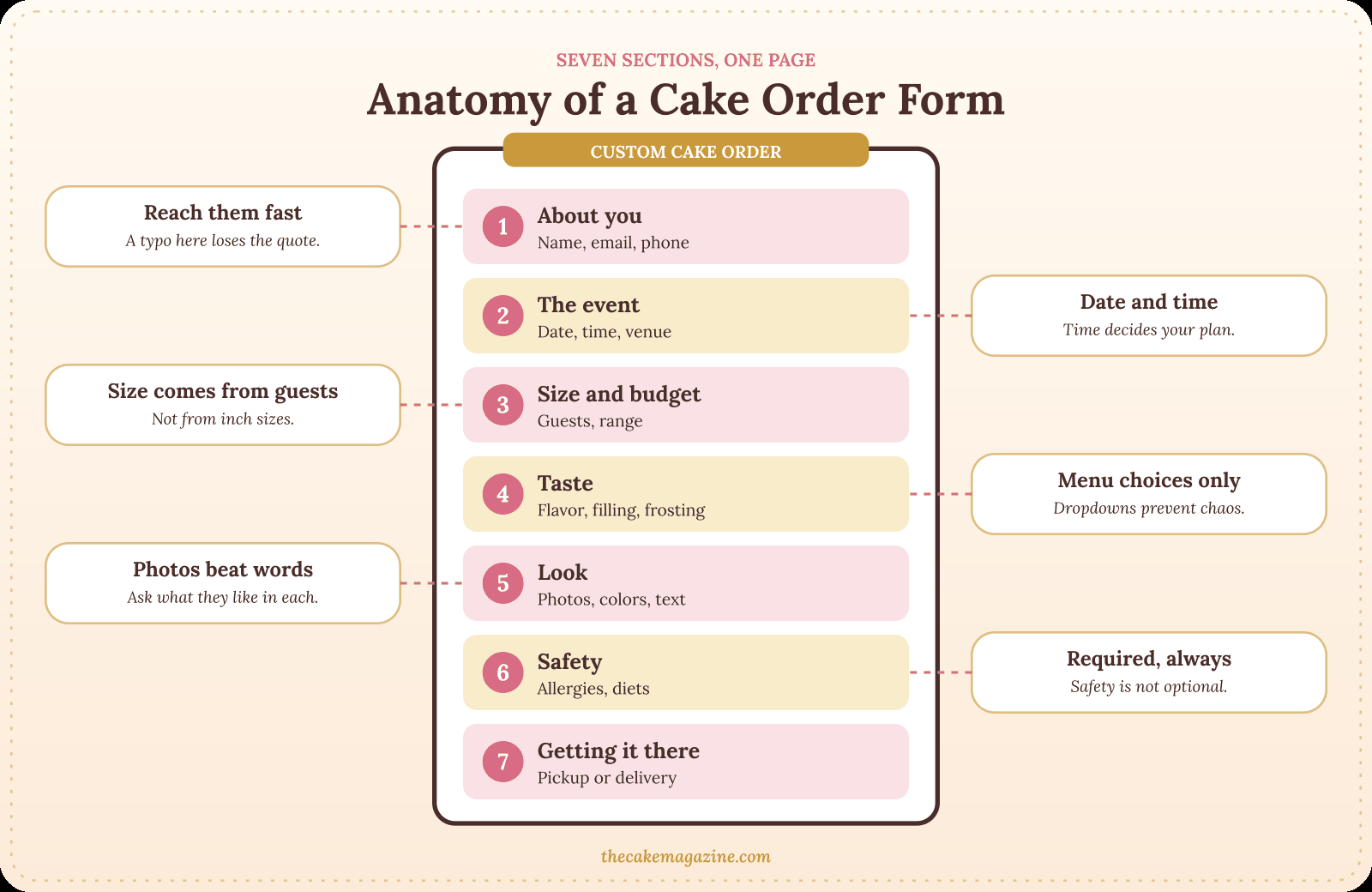
The illustration above shows the sections of a well-built cake order form as one sheet. Notice that the sections follow the order in which a customer naturally thinks: who they are, when they need the cake, how big it should be, what it should taste and look like, what keeps people safe, and how they will get it. Following that same flow makes a form feel like a conversation instead of an interrogation.
A note on scope. This article gives general business and food-safety information for U.S. bakers. Rules about home baking, labeling, sales tax, contracts and deposits vary by state and city, and we do not list specific laws here. Check with your state or local agency, and with a qualified professional, before you rely on any wording in your own forms.
Inquiry first, order second: how a cake order form fits the process
One of the most useful changes a baker can make is to stop treating every first message as an order. There are really two steps. The first is an inquiry, where the customer asks whether you are free and roughly what the cake might cost. The second is the order, where they commit to details and a deposit. A cake order form can serve either step, but it works best when you know which one you are asking for.
The two-step approach
In the two-step approach, you give people a short inquiry form first. It asks for just enough to answer the question “can you do this, and about what will it cost?” Name, email, event date, guest count, a sentence about the design and the budget. This takes two minutes and keeps people from abandoning a long form before they have even learned whether you are available.
If the date and the idea are a fit, you reply with a rough range or an invitation to complete the full cake order form. That longer form asks for flavors, fillings, exact design notes, allergies and delivery details. Because the customer has already decided they are serious, they are willing to spend the extra ten minutes. The two-step approach also protects your inbox from half-filled, abandoned requests.
When one form is enough
Plenty of bakeries get by with a single form, and that is fine, especially for a limited menu. If you sell six flavors in three sizes with a short list of finishes, one cake order form can capture everything in a few minutes. The more customization you offer, the more a separate inquiry step helps.
- Menu cakes (set flavors and sizes): one short cake order form with a deposit built in often works.
- Custom birthday and celebration cakes: inquiry first, then a fuller form once you have confirmed availability.
- Wedding and multi-tier cakes: inquiry, a consultation or tasting, then the full form and a written agreement. Our cake consultation guide covers the questions worth asking in that conversation.
- Cupcake and cookie add-ons: a line item or checkbox on the main form, with minimum quantities stated.
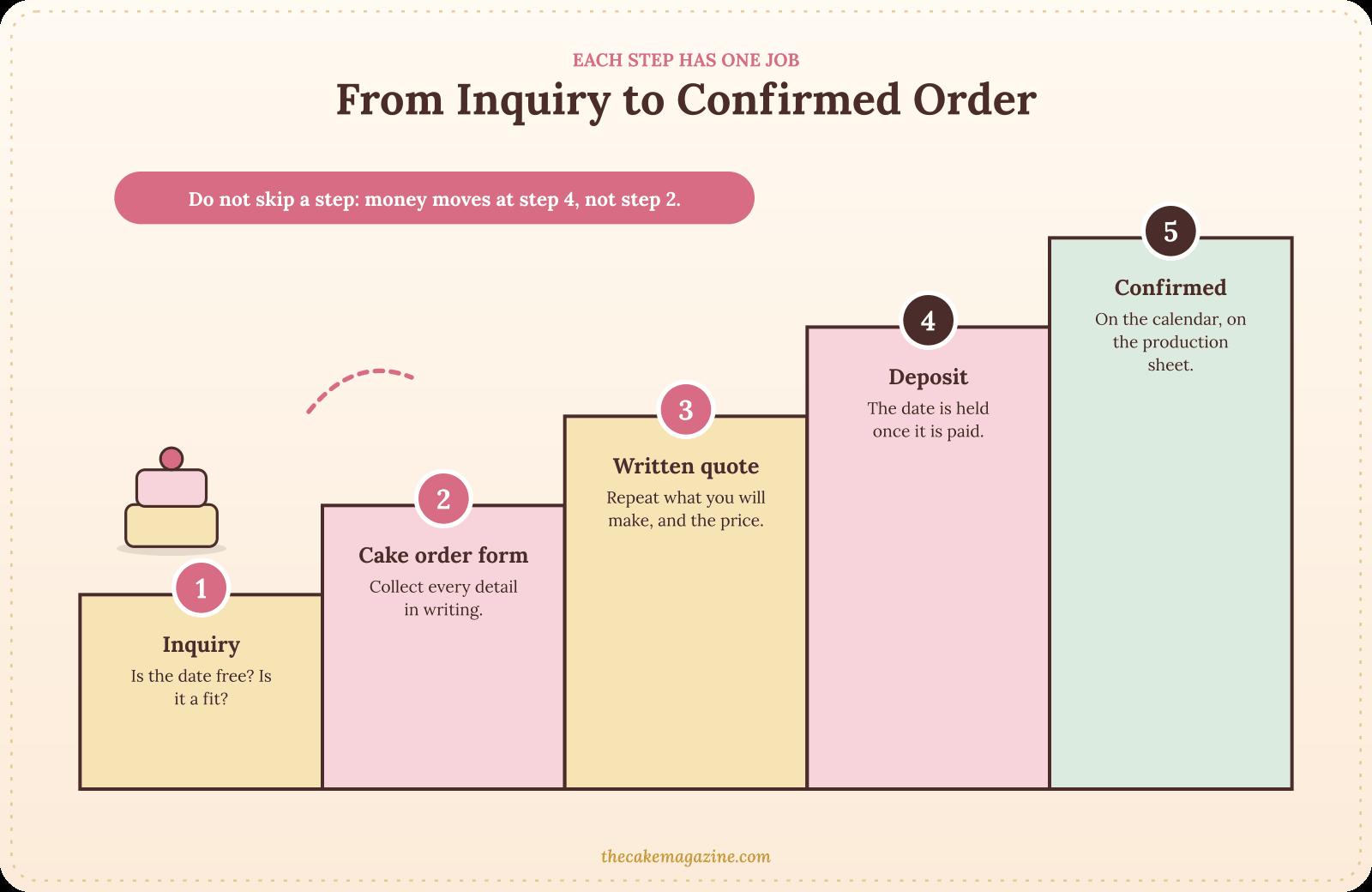
The staircase above shows how a request climbs from first message to confirmed order. Each step has one purpose, and the customer cannot skip a step without you noticing. Inquiry checks fit. The cake order form gathers details. The quote states what you will make and the price. The deposit holds the date. Only then does the cake belong on your calendar.
Decide what the form answers, and what it does not
The form should not try to replace a conversation about complicated ideas. If a customer wants a sculpted character cake, a gravity-defying structure or a tier count that does not match their guest list, the form’s job is to flag that so you can talk. Add a final field that reads something like “Anything else we should know?” and a clear note that complex designs may need a short call before a quote.
Equally, your form should not bury people in questions they cannot answer yet. A customer planning a shower may not know the final guest count. Let them enter a range or an estimate, and say when you will need the final number. A cake order form that demands exact answers too early produces random answers, and random answers are worse than honest ones.
Finally, decide how quickly you will reply and say so on the form. “We answer every request within two business days” is a promise you can keep and one that calms anxious customers. If you are booked for the date, say that right away on the form itself, or add a date check at the top so people learn it before they fill in anything else.
Contact details, event date and time on your cake order form
The top of any cake order form should be boring, and that is a compliment. Name, email, phone number and the best way to reach the customer. People rush through this part, so make it quick and make it unambiguous. A single typo in an email address can cost you a deposit payment, a quote or a delivery update, so it pays to build in a little care here.
The contact fields that matter
- Full name of the person ordering. If someone is ordering as a gift, ask for the name on the order and, separately, the name of the person receiving the cake.
- Email address. Quotes, invoices and confirmations will go here. A confirmation field, or a form tool that checks the format, prevents most typos.
- Mobile number. Useful on delivery day, when you need to reach someone fast.
- Preferred contact method. Some people never check email and some hate phone calls. A simple choice saves you from chasing.
- How they found you. Optional, but it tells you which marketing is actually working.
Resist the urge to ask for a home address, a birthday or anything else you do not need. Every extra field lowers completion, and collecting personal details you do not use is a small liability. Ask for a delivery address only when the customer chooses delivery.
The event date, time and the date that really matters
Ask for the event date, but also ask what time the cake needs to be ready or in place. A cake for a noon birthday lunch and a cake for a seven o’clock dinner are two very different production plans. For weddings and larger events, add the time the cake needs to be set up, since that is the true deadline for delivery.
It also helps to ask whether the date is flexible. Some customers are happy with a Friday pickup for a Saturday party. Others have a fixed date. Knowing this up front gives you room to say yes to more people without overbooking a single weekend, which links directly to how you plan capacity. Our guide to a cake order calendar goes into limits per day and per week.
Show your availability on the form. A small line near the date field such as “We are fully booked for the first two weekends of June” saves both sides from a pointless submission. If your cake order form lives on a website, you can also state your minimum lead time right beside the date picker.
Lead time and rush orders
Every bakery needs a lead time, which is how far ahead a customer must order. Choose a number that fits your real capacity, put it on the form and on your website, and then treat it as a rule instead of a suggestion. Custom cakes with sculpting or hand-painted details need more notice than a simple two-layer cake. Weddings usually need much more.
Rush orders are a policy decision, not an emergency. You can decline them, or you can accept them with a clear rush fee and only if your calendar allows. Whichever you choose, say it plainly on the form, and avoid making exceptions on an ad hoc basis. The first exception becomes the expectation.
Servings, size and budget
This is where a cake order form earns most of its keep, because size drives price, baking time, packaging and delivery. The most common mistake is asking customers to choose a pan size. Most people have no idea what a six-inch or eight-inch cake looks like, or how many slices it provides. Ask for what they know, which is the number of guests and the type of event.
Ask for guest count, then translate
Instead of “What size cake do you want?”, ask “How many people will be eating cake?” and “Is this the main dessert, or one of several?” Then you pick the size from your own serving chart. A cake that is the only dessert at a party needs more slices than one sharing a table with cupcakes, cookies and ice cream.
Be clear on what a serving means. Party slices are typically smaller than a generous slice at home, and wedding slices are often smaller still. If your form or quote mentions servings, state the slice size you use so nobody is surprised at the party. For a deeper look at portion math, see our wedding cake serving guide, which explains tier sizes and portions in detail.
- Number of guests: a number or range, plus an option for “not sure yet” with a date they will confirm by.
- Cake as main or one of several desserts: a simple dropdown.
- Adults, children or mixed: small slices for kids can change the size you recommend.
- Leftovers wanted? Some families want to keep the top tier or send slices home.
Add a budget field and say why
Many bakers feel awkward asking about budget, but it is one of the kindest questions on a form. A customer with a modest budget does not want to receive a quote that makes them feel foolish, and you do not want to spend an hour designing something they cannot afford. A budget range lets you suggest a cake that fits, and it lets you decline politely when it does not.
Frame the question gently. “Do you have a budget range in mind? This helps us suggest the best design for you” reads as help instead of pressure. A set of ranges in a dropdown works better than a blank box, and a “not sure yet” choice keeps people from guessing wildly. Do not promise a price from the form. The quote comes later, once you have all the details.
If you are not confident about your own numbers yet, work on them before you publish a form with ranges. Our guides on how to price cakes and on the cake cost calculator show how ingredients, labor and overhead add up to a price you can defend.
Flavors, fillings and menu choices
This section of the form is where good menu design pays off. If you offer a short list of flavors and fillings that you have made many times, ordering is easy and your results are consistent. If every customer can request anything, you are inventing a new recipe for every order, and you will rarely have time to test it.
Let the menu do the work
List your flavors and fillings as choices, and let people pick from them rather than typing a wish. Dropdowns or checkboxes prevent the “can you do something like a tiramisu but also lemon?” message that takes twenty minutes to untangle. If you have a seasonal rotation, show only what you are offering for that month, and update the form when the season changes.
A good structure is one choice for the cake, one for the filling and one for the frosting, with notes on any combinations that do not work. Some fillings need refrigeration, and some pair poorly with certain decoration styles. If a filling limits how long the cake can sit out at an event, say so beside the choice. More on building the menu itself is in our guide to cake business menu strategy.
- Cake flavor: a dropdown limited to your current menu, with a “something else” option that triggers a conversation.
- Filling: a dropdown, with a note when a filling needs to be kept cold.
- Frosting or covering: buttercream, ganache, fondant or naked, whatever you actually make.
- Tiers with different flavors: a clear field for each tier, plus a minimum size per flavor if you set one.
Custom flavors without chaos
Some customers will want a flavor you do not offer. You can allow that, with some guardrails. Say that custom flavors may carry an extra charge, need more lead time and may require a small test batch. Also say that you reserve the right to decline a combination you cannot do well. A confident baker is allowed to say “I do not make that, but here is something close.”
Be careful with ingredient requests that carry safety or religious weight, such as alcohol, raw egg frostings or flavors based on nuts. Put those under the allergy and dietary section rather than the flavor section, so they get the attention they deserve. We cover that in detail below.
Menu cake order
Customer picks size, flavor, filling and finish from a short list. Deposit and date are handled in one step.
Custom celebration order
Customer submits a brief and photos. You confirm availability, write a quote and ask for the deposit.
Wedding or large event
Inquiry, tasting or consultation, then a detailed cake order form, written agreement and scheduled payments.
Keeping these three order types separate makes your forms shorter and your quotes faster. Each customer sees only the questions that apply to them, and you avoid cluttering a simple birthday request with wedding-level questions.
Design details: how much to ask for
Design is where a cake order form can go wrong in two opposite ways. Ask too little, and you get a vague idea that turns into a mismatch on delivery day. Ask too much, and customers give up halfway through a form that feels like a school exam. The goal is to collect the minimum you need to price and plan the design, then talk through the rest.
Reference photos are worth a hundred words
Add a way to upload or link inspiration photos. Customers are far better at pointing to a cake they like than describing it, and a single picture can settle questions about color, scale and style in seconds. Ask them to mark what they like about each image, such as the colors, the piping or the topper, since people often love one detail and not the rest.
Add a clear note that your cakes are made by hand in your own style, and that you do not copy another baker’s work exactly. That keeps the conversation honest, and it respects the work of other decorators. A baker can recreate a general look, such as a floral palette, a vintage piped border or a minimalist finish, without duplicating a specific cake.
Questions that shape the design
- Occasion and theme: birthday, shower, anniversary, graduation, wedding, corporate event.
- Colors: a short list, plus the colors of the venue or party if they matter.
- Text on the cake: exact spelling, and who proofreads it. A typo on a cake is a common and entirely avoidable heartbreak.
- Toppers and decorations: do they supply them, or do you? Say whether toppers are edible, and who is responsible for non-edible items.
- Style: buttercream, fondant, drip, naked, painted, floral. Offer the styles you do well.
- Fresh flowers or non-edible decor: whether the customer or a florist will provide them, and who places them.
Fresh flowers deserve a careful note on the form. Flowers on a cake should be food-safe or kept from touching the cake, and some plants are not safe near food at all. The form should ask whether flowers are planned, and your policy should say that you decide how they are placed. When in doubt, a baker can recommend a florist who knows what is safe.
Use a complexity scale
One of the most practical tools for design questions is a simple complexity scale that you share with customers. Not every cake takes the same time, and your pricing should reflect that. A customer who sees that a “simple” cake and a “sculpted” cake sit at opposite ends of a scale understands why the second one costs more.
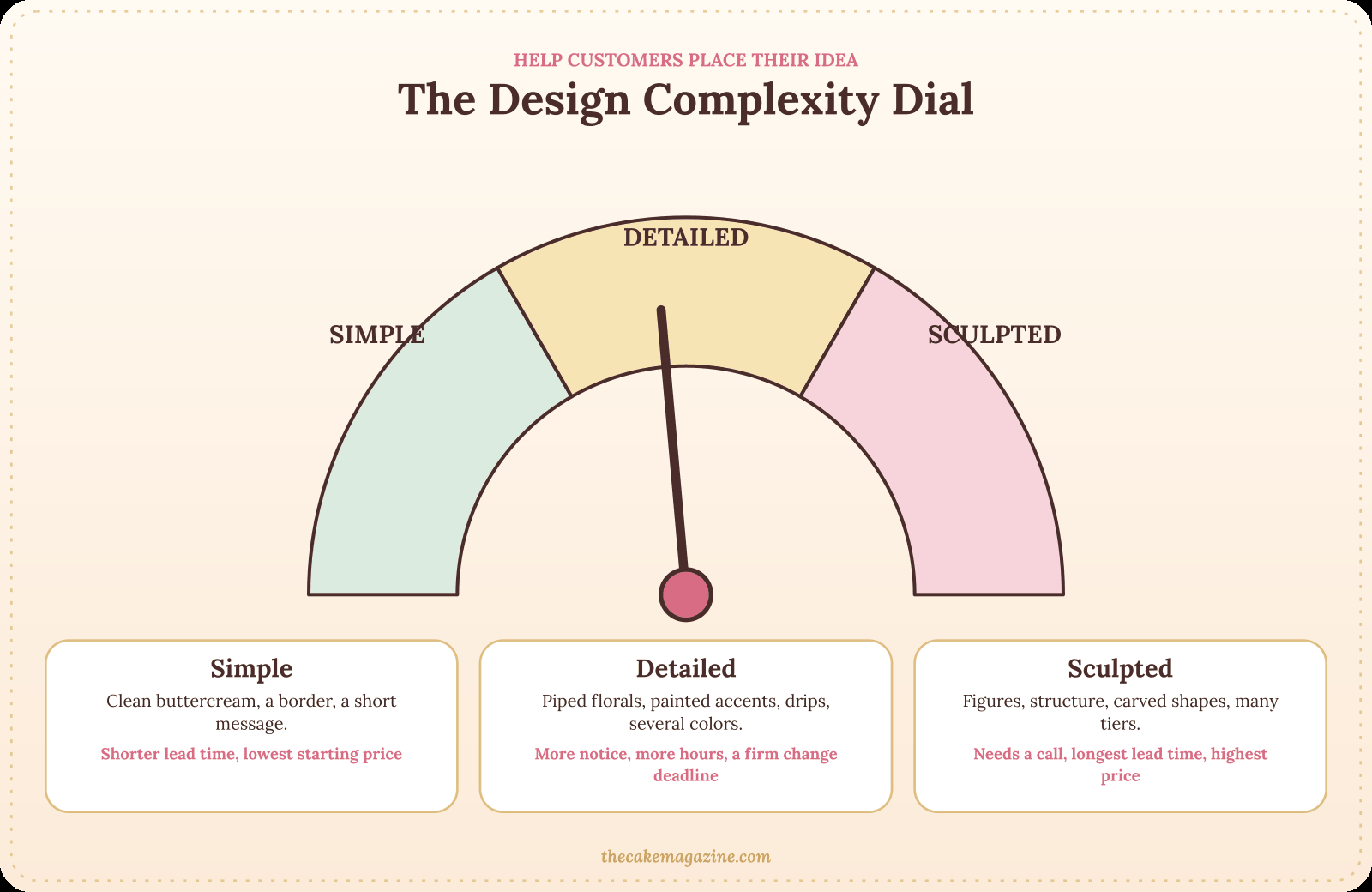
The dial above sorts designs into three zones, from simple to sculpted. Use something like it on your own cake order form or your pricing page, and then tie each zone to a starting price, a lead time and a design-change policy. Customers can place themselves on the dial, and you can confirm or adjust. It turns a subjective argument about “just a little detail” into a shared reference.
Describe the limits on the form. A sentence such as “Final designs are confirmed in your written quote, and major changes after the deposit may affect the price” sets expectations early. Put the details in your policies, and let the form simply point to them.
Allergies and dietary needs on a cake order form
If one question on your form is not optional, it is this one. Food allergies can be serious, and cakes contain some of the most common allergens: wheat, milk and eggs in almost every recipe, plus nuts, soy and sesame in many fillings and toppings. The form should always ask about allergies and dietary needs in a visible, required field, even when the answer is “none.”
Know the major allergens
The U.S. Food and Drug Administration lists nine major food allergens: milk, eggs, fish, crustacean shellfish, tree nuts, peanuts, wheat, soybeans and sesame. Sesame became the ninth when the labeling requirement took effect in 2023, as described on the FDA’s page about the FASTER Act and sesame. Learn that list well enough that you can scan any recipe or ingredient label against it without hesitation.
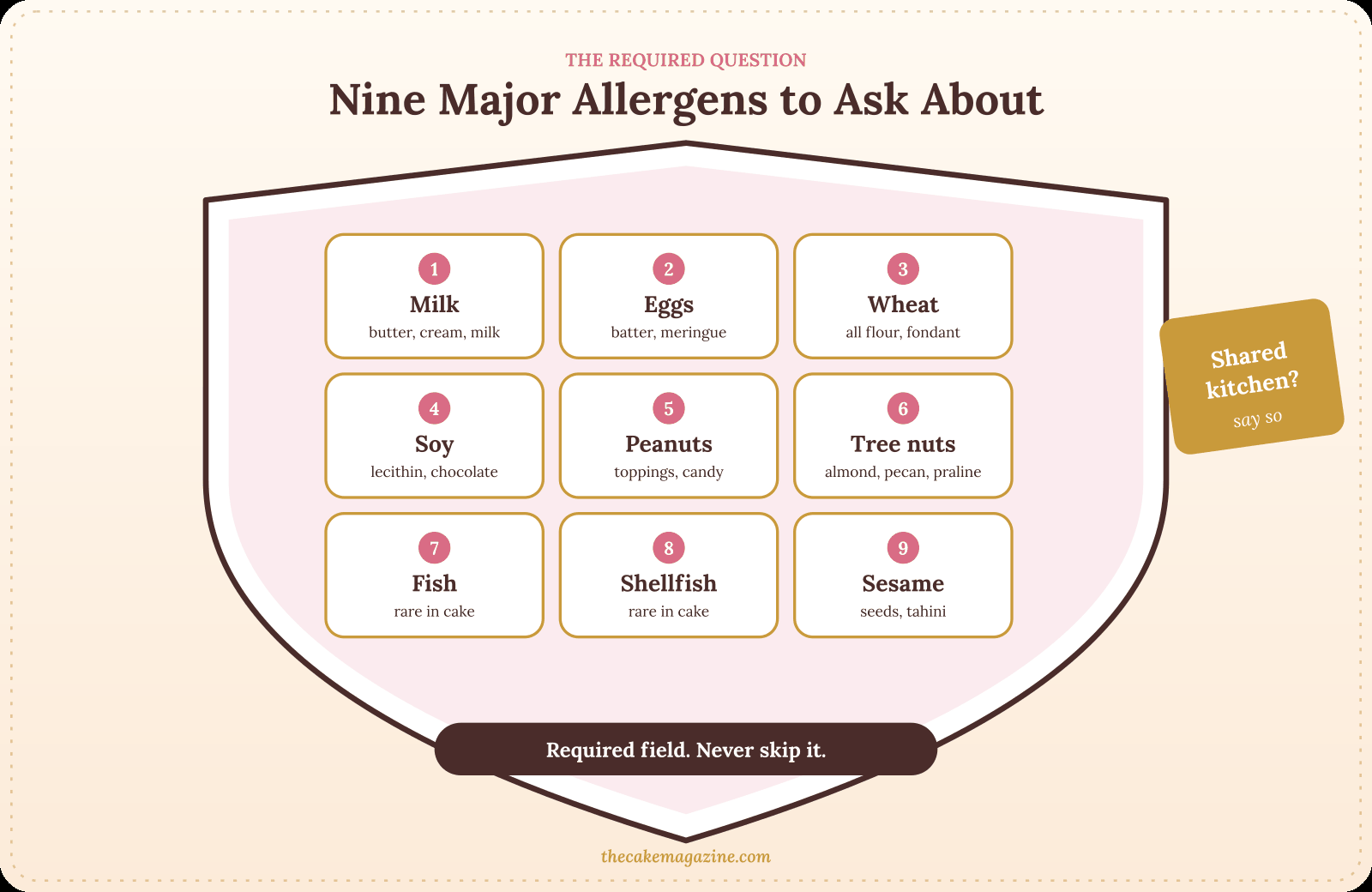
The shield above lays out the nine major allergens and shows where each tends to hide in a cake kitchen. Use it as a mental checklist when you review an order, and as a reminder that a “plain” cake can still contain several of them. The point is not to scare customers. It is to make sure you never guess about something that can harm someone.
The wording that works
A strong allergy question is direct and specific. Instead of “Any allergies?”, try “Does anyone eating this cake have a food allergy or dietary restriction? If yes, please list it.” Add a second line for severity, because a mild preference and a life-threatening allergy need different responses. Make the field required, so it cannot be skipped by accident.
- Allergies: a required text field with a “none” option, and a place to describe the allergy.
- Severity: a short choice such as “preference,” “intolerance” or “serious allergy.”
- Dietary needs: vegetarian, vegan, gluten-free, dairy-free, halal, kosher or other, as far as you can honestly accommodate.
- Who will eat the cake: a note about children or guests with special needs.
Be honest about your kitchen
Most home and small bakeries handle flour, nuts, dairy and eggs in the same space. That means cross-contact is possible even in a recipe that does not list an allergen. Say so plainly on the form or the policies page. A sentence such as “Our kitchen handles wheat, milk, eggs, tree nuts, peanuts and soy, so we cannot guarantee any cake is free of these” is honest and protective for everyone.
If you decide to decline orders that need strict allergen control, say that as well. It is a legitimate business decision, and customers with serious allergies would rather hear “no” than receive a cake that might not be safe. For a full treatment of labels, cross-contact and what to tell customers, read our guide on cake allergen management.
Make allergen safety a routine. Put the allergy question on the cake order form, copy the answer onto your production sheet, and check it again when you pack the cake. When safety lives in a routine instead of your memory, a busy week cannot make you skip it. Check your state and local rules on labeling, since requirements for home bakers vary.
Keep health claims out of your form
Avoid wording such as “allergy-free,” “safe for celiacs” or “sugar-free” unless you can fully support it and your local rules allow the claim. These phrases can create expectations you cannot meet. Describe what the cake contains and how it was made, and let the customer decide. If a customer’s health situation is complicated, a short conversation or a respectful refusal is better than a promise on a form.
Pickup, delivery and setup questions
A cake that is perfect in your kitchen can fail in the last mile. Heat, bumpy roads, tilted car seats and unfamiliar venues cause more damage than any baking mistake. The pickup and delivery section of your form is where you gather the information needed to prevent that.
Pickup is the easy default
For many home bakers, pickup is the best option. The customer assumes responsibility once the cake is in their car, and you avoid the time and risk of driving. State your pickup window, location instructions and what happens if someone is late. For a home-based business, give the exact address only after the order is confirmed, and use a clear pickup process that respects your household.
Include a short note about transport. “Please keep the cake on a flat surface in the coolest part of the car, never on the seat and never in a hot trunk” is a sentence that can save a cake. Many bakers add it to the confirmation email so customers see it twice.
If you deliver, ask the right things
- Full delivery address: including apartment numbers, venue name and any access instructions.
- Delivery time window: and who will be there to receive the cake.
- On-site contact: a name and a phone number for the day, which may not be the person who ordered.
- Setup details: stairs, elevators, outdoor tables, display stands, shade and refrigeration at the venue.
- Weather and season: outdoor summer events call for different frosting and display choices.
Set a delivery fee based on distance and time, and show it as a separate line on the quote. For help planning routes, vehicle setup and the handoff itself, our guide to the cake delivery workflow covers the full process. A cake order form only needs the facts. The system around it handles the rest.
Temperature and time on the table
Cakes with dairy, eggs or perishable fillings need attention to temperature. The USDA’s food safety guidance explains that bacteria grow fastest in the “danger zone” between 40°F and 140°F, and that perishable food should not sit out more than two hours, or one hour when it is above 90°F. You can read the details on the USDA Food Safety and Inspection Service site. Use that guidance to decide what you serve, how you pack it and what you tell customers about serving time.
On the form, ask how long the cake will be out at the event and whether there is a fridge at the venue. Then your quote can recommend a design and filling that suit the situation. A cake sitting in direct sun for four hours needs a different plan than a cake cut within thirty minutes of arrival.
From cake order form to quote and deposit
A submitted cake order form is not an order yet. It is a set of facts, and your job is to turn those facts into a clear quote. Before you write a number, check that you have what you need. A short internal checklist keeps you from quoting with holes in the information, which is how underpriced cakes happen.

The checklist above shows eight things to confirm before a quote leaves your hands: a free date, a final guest range, a size you can recommend, flavors from your menu, a design you can actually make, allergy answers you understand, a pickup or delivery plan, and a budget that makes sense. If any item is missing, reply with a specific question instead of a guess. One polite follow-up is better than one expensive assumption.
What a good quote repeats back
A quote should read like a mirror. It repeats what the customer asked for in plain words, so they can catch a misunderstanding before you start baking. Include the date and time, the size and approximate servings, flavors and fillings, a short description of the design, any allergy notes, the delivery or pickup plan, the total price and the deposit amount.
- Itemized price: cake, decoration, extras, delivery and any taxes that apply where you live. Ask your state or local tax office what applies to your sales.
- What is not included: stands, boxes returned, flowers, cutting and serving, if applicable.
- How long the quote is valid: a week is common, because your calendar can fill.
- How to accept: reply, sign, or pay the deposit through a specific link.
Customers often compare quotes. A written, itemized quote shows your value and explains why your price is what it is, which is more persuasive than a lower number. For help turning ingredients and hours into a figure, see our cake pricing guide.
The deposit holds the date
A date is not held until money changes hands. That sentence belongs in your quote, on your website and, in a gentler form, on your form. A deposit shows that the customer is serious, covers the time you set aside and lets you buy supplies for a confirmed order. Without one, a cake date can disappear a day before the event, and you cannot resell it.
How much to ask for is a business decision. Many bakers choose a fixed percentage of the total for standard orders and a larger one, or a nonrefundable booking fee, for weddings and big custom cakes. We are not giving a number here, because the right amount depends on your costs and your local rules. Our dedicated guide on cake deposits and cancellation policies walks through the options and how to word them fairly.
Use a payment method that leaves a record. Online invoices and payment links create a timestamped trail with the amount, date and customer name. That makes bookkeeping easier and settles any disagreement about what was paid and when.
Confirm in writing, every time
Once the deposit arrives, send a confirmation that restates the key details. Include the date, time, final design notes, the allergy information and the policies the customer agreed to. Ask them to reply if anything looks wrong. This single email is the document you will lean on if there is a question later, so write it with care.
Then add the order to your calendar and your production plan, with a deadline for final changes. If you are building a workflow for many orders at once, our guide to a cake production schedule shows how to plan baking, filling and decorating over several days.
Policies to place beside your cake order form
The form collects information, and policies explain how you work. The best arrangement is to keep policies on a separate page or in the quote, and link to them from the form with a checkbox that says the customer has read them. Short policies get read. Long ones do not, so aim for plain language and a clear structure.
The policies most bakers need
- Payment and deposit: when the deposit is due, when the balance is due and which payment methods you accept.
- Cancellations and refunds: what happens if the customer cancels, and how timing changes the outcome.
- Changes to the order: a deadline for final changes, and how late changes affect price.
- Design and substitution: that your work is handmade and may vary slightly from photos, and that you may substitute decorations of similar quality if a supply item is unavailable.
- Pickup and delivery: responsibilities after the cake leaves your hands, and what happens if a pickup is missed.
- Allergens and kitchen: the shared-kitchen statement discussed above.
- Returns and complaints: that cakes are perishable and not returnable, plus how to contact you promptly if there is a problem.
Write policies in a friendly but firm voice. “We hold your date once your deposit is paid” sounds warmer than “Dates are not guaranteed until payment is received,” and it says the same thing. Customers who feel respected are more likely to follow the rules.
When to use a full contract
For wedding cakes, large events and orders over a certain value, a signed agreement is worth the effort. It lists the scope of work, the schedule of payments, the delivery terms and what happens if either side cancels. The cake order form feeds that agreement, because the details the customer provided become the scope of work. Contracts have legal effect, so use a template reviewed by a professional familiar with your state.
Our cake contract guide explains what to include and how the pieces fit together, and the wedding cake contract checklist adds the tasting, venue and day-of details that couples care about. Neither article is legal advice, but both can help you walk into a lawyer’s office with good questions.
Do not copy someone else’s terms word for word. Another baker’s policies reflect their state, their business and their risk. Use examples for ideas, then adapt the language to your own situation and have it checked where it matters, especially anything about refunds, liability or contracts.
How to build a cake order form that people finish
A cake order form can be built in a free online form tool, a website plugin, a booking platform, a shared document or a printed page. The best tool is the one you will actually use and check every day. Fancy features matter less than reliability, mobile-friendliness and a notification that tells you the moment someone submits a request.
Choosing a format
- Online form tools: quick to set up, easy to share by link, and many can send you an email or text for each submission.
- Website forms: look more professional and live on your own domain, which helps with credibility and search visibility.
- Bakery or invoicing software: can combine the form, quotes, invoices and calendars, but may cost more and take longer to learn.
- Paper or PDF forms: useful for in-person orders at a market or shop, as long as you transfer them to a digital record.
Do not choose a tool because it has the most features. Choose it because it makes the customer’s path short and your record-keeping easy. Check whether your tool stores data securely and lets you export it, so you are not locked in if you switch later.
Layout that keeps people moving
Most customers will open your cake order form on a phone, often while doing something else. That means short sections, large tap targets, clear labels and as few typed answers as possible. Use dropdowns and checkboxes for anything you can predict, and reserve free-text boxes for design notes and special requests.
Group related questions under headings, and put the easy ones first. Starting with name and date builds momentum, and saving the longer design notes for later means people are already invested. Show a progress bar on longer forms, and mark required fields clearly. Test the form on your own phone, then ask a friend who has never seen it to fill it in while you watch.
Keep it short, and keep it kind
A useful rule is to ask whether you will actually use each answer. If you will not quote from it, plan with it or deliver with it, delete the question. The form with twelve well-chosen fields will out-perform one with thirty, because completion rates drop with every extra box.
Tone matters too. A short welcome line, a friendly “tell us about your celebration” heading and a thank-you message after submission turn a form into the start of a relationship. Add an auto-reply that says when the customer can expect to hear from you and what happens next. People who know what to expect stop sending reminder messages.
Last, think about privacy. You are collecting names, phone numbers and sometimes health-related allergy details. Collect only what you need, store it securely and do not share it. A short privacy note at the bottom of the form, written in plain language, builds trust.
A sample cake order form you can adapt
Here is a starting layout for a custom cake order form, written so you can copy it into whatever tool you use. It is a template to adapt, not a rule. Cut what you do not need, rename things in your own voice and add anything your menu requires. Fields marked required are the ones that, in our view, keep a quote from going wrong.
1. About you
Full name (required), email (required), mobile number (required), preferred contact method, and how you heard about us.
2. About the event
Event type (required), event date (required), time the cake is needed (required), whether the date is flexible, and the venue name if it is not your home.
3. Size and budget
Number of guests or a range (required), whether cake is the main dessert, adults or children, and a budget range with a “not sure yet” choice.
4. Taste
Cake flavor, filling and frosting from your current menu (required), plus a separate choice for each tier if the cake has more than one.
5. Look
Colors, theme, exact text on the cake, photo upload or links, who supplies toppers, and a design complexity choice.
6. Safety
Allergies and dietary needs (required, “none” allowed), how serious they are, and a checkbox acknowledging your shared-kitchen statement.
The three remaining sections are the ones people forget. Pickup or delivery comes next, with an address and time window if delivery is chosen. After that comes a catch-all field for anything else you should know, and last, a required checkbox that says the customer has read your policies and understands that the order is confirmed only when the deposit is paid.
Confirmation text you can reuse
After someone submits the cake order form, they should see a message right away. Something like the following works well, and you can change the wording to fit your voice and the way you handle replies.
- On screen: “Thank you! We have your request. We reply within two business days with availability and next steps. Your date is not held until a deposit is received.”
- By email: a copy of what they submitted, a link to your policies and the expected reply time.
- To you: an instant notification with the event date at the top of the subject line, so you can spot urgent requests quickly.
That small piece of automation turns a plain cake order form into a reliable intake system. It cuts the “did you get my request?” messages in half and gives you a consistent record of when each request arrived.
Adapting the form for different cakes
A single template rarely fits every kind of order. You can build a base cake order form and then add or remove sections depending on the type of cake. Keep the base short, then branch.
- Wedding cakes: add tasting preferences, ceremony and reception timing, venue coordinator contact, serving style and whether the top tier is saved. Pair it with the details in our wedding cake guide.
- Children’s parties: add the child’s age and name, character or theme, and a reminder about candles and decorations.
- Corporate orders: add the company name, a billing contact, logo files and whether an invoice is needed.
- Cupcakes and small cakes: add quantities, minimum order sizes and packaging options. Mini formats are covered in our guide to mini cakes.
- Market or shop pre-orders: use a one-screen form with flavor, size and pickup time, and skip the design questions.
Test with a real, difficult order. Take a past order that went wrong or was confusing, and fill out your new cake order form as if you were that customer. If the form would have prevented the problem, it is ready. If not, add the missing question.
Common cake order form mistakes
Most problems with order forms are not dramatic. They are small gaps that stay hidden until a busy week exposes them. Here are the mistakes we see described most often by home and small-shop bakers, and how to fix each one.
Asking for pan size instead of guest count
What it looks like: customers guess “eight-inch” and receive a cake too small for the party, or choose a huge one they do not need.
Fix it: ask for the number of guests and the dessert plan, then recommend a size and explain your slice size in the quote.
Making the allergy question optional or hidden
What it looks like: the field is buried in a long notes box, and no one notices the mention of a nut allergy until the day before delivery.
Fix it: make it a required, separate field, repeat the answer in the quote and add it to your production sheet.
Treating the form as the whole agreement
What it looks like: a customer claims a change was agreed, and there is nothing in writing except the original form.
Fix it: confirm in a written quote or confirmation email, state a deadline for changes and keep every version.
Quoting before you check the date
What it looks like: you reply with a price, the customer says yes and then you remember a wedding order that weekend.
Fix it: check your calendar first, say “available” in the first line of every reply and hold the date only once the deposit is paid.
Too many questions
What it looks like: requests stop arriving, or customers fill the form halfway and message you instead.
Fix it: remove any question you do not use, split the process into inquiry and order, and watch where people abandon the form.
Never reviewing the form
What it looks like: the menu has changed, prices have gone up and the form still lists last year’s flavors and policies.
Fix it: set a reminder to review the form every season, and after any order that caused confusion.
Signs your form needs work
Pay attention to the messages you keep sending. If you ask the same follow-up question to most customers, it belongs on the form. If many customers choose “other” in a dropdown, add that choice to the menu or explain why you do not offer it. If requests regularly arrive for dates you cannot do, move your availability note higher on the page.
Over time, your form becomes a record of everything your business has learned. Each awkward moment becomes one better question, and each smooth order shows that the process is working. That is a practical way to improve without needing a big redesign.
Turning cake order form answers into a smoother week
A cake order form does more than start a quote. The answers can feed your shopping list, your calendar and your production plan, which is where a lot of small bakeries quietly lose hours. When every order arrives in the same structure, you can copy it straight onto a production sheet instead of rereading a long email thread.
One order, one sheet
Create a simple production sheet that mirrors your form: date and time, size, flavors, design notes, allergies, delivery plan and balance due. Print it or keep it on a tablet, and tick items off as you bake, fill, decorate and pack. The allergy line should sit at the top, in a spot you cannot miss. If you bake several cakes in the same week, the sheets also show at a glance who needs what and when.
The same data helps with shopping. Add up the flavors and sizes across the week and you know how much flour, butter, chocolate and cream to buy. Over a few months, patterns appear. You might learn that lemon outsells everything in spring or that most orders come in for the same two Saturdays each month. Our guide to production scheduling shows one way to organize that rhythm.
Notice what customers really ask for
Read the free-text fields from time to time. If three customers a month ask for a vegan option, that is a menu idea. If many send the same reference photo style, your portfolio might be missing it. If people keep asking for a size you do not offer, that may be a gap to fill. The form is quiet market research that costs nothing but attention.
- Track inquiry to order: how many requests become paid orders, and where the others drop off.
- Track time per order: note how long each cake really took, then compare it to what you charged.
- Track change requests: frequent late changes point to a form or a quote that is not clear enough.
- Track declined requests: if you keep saying no to the same thing, either adjust your form to filter it or consider offering it.
These small numbers keep you from running on instinct alone. They also feed into bigger questions about profit and pricing, which our guide on how to price cakes can help you answer. The form tells you what customers want. The numbers tell you whether you can afford to make it.
Keep records and protect them
Save submitted forms, quotes, confirmations and payment records for each order in one place, labeled by date and customer. If a question comes up months later, you will be glad to find a complete trail. How long to keep records, and what you must keep for tax purposes, depends on your location and situation, so ask a local accountant or your state’s small business office.
If you handle allergy details, store them with care and use them only for the order. Delete or archive old forms on a schedule you decide in advance. A tidy filing habit is part of running a business that customers can trust.
Cake order form FAQ
What should a cake order form include?
A cake order form should include the customer’s name and contact details, event date and time, pickup or delivery plans, guest count, flavors and fillings, design details with reference photos, allergies and dietary needs, and a budget range. Add a link to your policies and a checkbox confirming the customer has read them. Keep it short enough to finish in about ten minutes.
How do I create a cake order form for free?
Many free online form tools let you build a form with dropdowns, file uploads and email notifications. A shared document or a spreadsheet with a form attached also works. Choose a tool that works well on phones, sends you an alert for every submission and lets you export your data. Test it with a friend before you share it publicly.
Should I put prices on my cake order form?
You can show starting prices or price ranges so customers know what to expect, but avoid giving a final price from the form. The real price depends on size, design, flavor and delivery, and it belongs in your written quote. Starting prices filter out mismatched budgets without locking you into a number before you know the details.
What is the difference between a cake order form and a cake contract?
The form gathers information about what the customer wants. A contract is a signed agreement that sets out the scope, payment, changes and cancellation terms. The form usually feeds the contract. For simple orders, a quote with clear terms may be enough, while weddings and large events deserve a fuller agreement. See our cake contract guide.
How far ahead should customers submit a cake order form?
Set a lead time based on your real capacity and state it on the form. Simple menu cakes may need about a week, custom designs more, and wedding cakes often several months. The exact number is your call. What matters is that it is stated clearly, applied the same way to everyone and backed by a rush-order policy.
Do I need a deposit before I accept an order?
Most bakers do take one, because a deposit holds the date, covers the time you set aside and shows the customer is committed. Say clearly on the quote how much it is, when the balance is due and what happens if plans change. Our guide to cake deposits and cancellation policies covers wording options.
How should I ask about allergies on a cake order form?
Use a required, separate field that asks whether anyone eating the cake has a food allergy or dietary restriction, with a “none” option and space to describe it. Add a short severity choice, repeat the answer in your quote and be honest about cross-contact in your kitchen. Our allergen management guide goes further.
Is a cake order form legally required?
A cake order form is not usually a legal requirement on its own, but your state or city may have rules about labeling, allergen information, record keeping or taxes that affect what you collect and keep. Check with your state agriculture or health department and your local business office, and ask a professional for advice about contracts and deposits.
How long should a cake order form be?
Short enough that a customer can finish it in about ten minutes on a phone. Many bakers find that a short inquiry form followed by a longer order form works better than one giant form. If you never use an answer to quote, plan or deliver, delete the question.
Can customers upload reference photos to a cake order form?
Yes, and you should let them. Photos communicate color, scale and style faster than words. Ask them to note what they like about each photo, and state that your cakes are handmade in your own style and will not be exact copies of another baker’s work. Many form tools support file uploads or links.
What do I do if a customer changes the order after paying the deposit?
Point to your change policy and your deadline for final changes. Small changes, such as a different color, may be easy. Larger ones, such as more tiers or a new design, may change the price and need your approval. Confirm every change in writing, update the quote and keep a copy with the original cake order form.
How do I keep my cake order form from scaring customers away?
Keep it friendly, short and mobile-friendly, and explain why you ask the harder questions. A sentence such as “This helps us give you an accurate quote” makes budget and allergy questions feel helpful. Put your availability note at the top, use dropdowns where you can, and send a warm automatic reply after submission.
Where can I learn the baking side of what I am quoting?
The King Arthur Baking cake guide is a good general reference for techniques and troubleshooting. On our site, the cake baking science guide explains why recipes behave as they do, which helps you describe and price your cakes with confidence.
Final thoughts
The form is a small tool with a large effect. It tells customers you are organized, it gives you the facts you need to quote fairly, and it puts allergies, dates and delivery details in front of you before they can become emergencies. You do not need software that costs a lot or a form that looks like a tax return. You need a short list of questions that you actually use.
Start with the basics: contact, date, guest count, flavors, design, allergies and delivery. Add a quote that repeats the details and a deposit that holds the date. Keep policies in plain words, review the form each season and let every awkward order teach you one better question. That is how a simple cake order form grows into a dependable system.
If you build or improve your own cake order form after reading this, we would love to hear which question saved you the most trouble. Share it with other bakers, and keep exploring the business guides above to build the pieces that surround it.
Editorial note: reviewed and updated in November 2026. This article offers general information for U.S. home and small-shop bakers and is not legal, tax, insurance or professional food safety advice. Rules on cottage food, labeling, allergens, taxes, contracts and deposits vary by state and locality and change over time, so confirm current requirements with your state and local agencies and with qualified professionals. Sample wording is a starting point to adapt, not a legal template.