Every few months someone declares that a certain cake is “everywhere,” and every few months it turns out that the cake is mostly everywhere on one corner of the internet. So let us be careful. This guide to cake trends 2026 tries to separate what bakers, pastry chefs and market researchers have actually reported from what merely goes viral for a week.
It covers five real shifts: smaller formats, more contrasting textures, tangier flavors, old-fashioned piping that has come back on purpose, and cakes whose shape does most of the talking. For each one you will get the evidence, the reasoning behind it, and a practical way to try it in your own kitchen without buying a single gadget you do not need.
As of November 2026, the cake trends 2026 that have the strongest backing are mini formats (smaller portions of better cake), texture mashups (crunchy, chewy and creamy in one bite), tangy flavors led by lemon and passionfruit, vintage piping such as shells, swags and bows, and statement cakes with unusual shapes or very large sizes. The first three come mostly from global consumer research. The last two come mostly from wedding professionals.
All five are easy to adapt at home if you start with one idea, keep the sweetness in check and treat the trend as a seasoning rather than the whole recipe.
- What cake trends 2026 actually are
- How we read the evidence
- Global signals versus US demand
- The cake trends 2026 compass
- Trend one: mini formats and perfect portions
- Dot cakes and the viral spillover
- How to bake mini cakes at home
- Trend two: texture mashups
- How to build a texture cake
- Trend three: tangy flavors
- Pairing tang with something soft
- Trend four: vintage piping
- Trend five: statement cakes
- The wedding baker’s view
- Cake trends 2026 at a glance
- Trying the cake trends 2026 at home
- Ordering a trend cake from a baker
- Food safety for trend cakes
- What may fade and what will last
- Update log and review schedule
- Frequently asked questions
- Final thoughts
What cake trends 2026 actually are
A trend is not a single viral cake. It is a direction that shows up in several places at once: in what people say they want when a researcher asks, in what they search for when nobody is asking, and in what professionals are being hired to make. When all three line up, you can reasonably call it a trend. When only one does, you are looking at a fad, or a niche, or a good marketing week.
That distinction matters for any cake trends 2026 conversation because the cake world is unusually good at producing striking photographs. A dramatic tower, a glittering mirror glaze, a cake shaped like a handbag: all of these travel well on a phone screen. But photogenic is not the same as popular, and popular is not the same as something you should bake on a Saturday afternoon with a hungry family waiting. A good guide to cake trends 2026 should help you decide which ideas are worth borrowing and which are better admired from a distance.
So here is how we approach the cake trends 2026. We start with the evidence. We keep the dates visible, because a trend report from last October tells you about last October. We say plainly where a number comes from, and we leave out numbers we cannot trace. Then we translate each idea into kitchen language: what changes in the batter, the filling, the frosting, the pan or the plan for the day. That last step is the part most trend articles skip, and it is the part that makes a trend usable.
A promise about tone. Nothing here is a rule. If your family wants a plain vanilla cake with chocolate frosting on every birthday, that is a wonderful tradition and no trend report should talk you out of it. Think of the cake trends 2026 as a pantry of ideas you can dip into when you feel like it.
Why these five?
We picked five cake trends 2026 because they appear in more than one credible place and because each one changes something a baker can actually do. Mini formats and tangy flavors both appear in global consumer research published by Taste Tomorrow, the trend program run by the bakery ingredient company Puratos. Texture mashups appear in the same research. Vintage piping and statement shapes come out of The Knot’s reporting on what wedding cake makers are being asked for. Together these cake trends 2026 cover the whole cake: size, crumb and filling, flavor, decoration and silhouette.
We also left a few things out of our cake trends 2026 list on purpose. Some short-lived novelties from social media are mentioned in their own section, because they tell us something about how trends spread, but we do not treat them as part of the core five. We also skip any claim we could not find in a source we are willing to name.
How we read the evidence
Reading trend research takes a little skepticism, and the cake trends 2026 reports are no exception. Here are the questions we ask of every source, and the answers for the ones we rely on in this article.
Who ran the research, and why?
Taste Tomorrow is the trend research program of Puratos, a company that sells ingredients to bakeries and pastry shops. That does not make the findings wrong, but it does mean the audience is the baking industry, and the framing leans toward what a bakery could sell. Its patisserie trends report for 2026 was published on 28 October 2025 and draws on a global consumer survey, digital analysis of online conversation and cultural research.
A second Taste Tomorrow piece, a trend radar of viral treats, was published on 18 June 2026 and tracks online buzz rather than survey answers.
The Knot is a wedding planning platform. Its wedding cake trends article, last updated on 13 October 2025, relies on quotes from professional bakers about what their clients are requesting. That is a smaller and more anecdotal base than a global survey, but it is also closer to the actual work of building a cake, which is useful for the decoration and shape trends.
King Arthur Baking is a long-established American flour company whose baking guides are widely used by home bakers. We lean on its cake guide for the practical technique that sits underneath every trend. The United States Department of Agriculture’s Food Safety and Inspection Service, usually shortened to FSIS, supplies the basic food safety rules we mention near the end.
What kind of number is it?
There are at least three kinds of numbers in trend research, and they mean different things. A survey percentage says how many of the people asked gave a certain answer. A search or conversation growth figure says how much online activity has risen from a starting point, which can look dramatic when the starting point was tiny. And a baker’s anecdote says that one professional, or a handful of them, noticed something. We try to label each one so you know what you are getting.
A good example is the way the research describes the rise of dot cakes, which we cover below. The growth in online mentions is enormous in percentage terms, but a percentage over a short window tells you about momentum, not about how many cakes were actually sold. We report it as momentum and nothing more.
What is the date on it?
Everything in this guide is dated “as of November 2026.” Trend research ages quickly, and some of what we cite was written months before this review. Where a source is from late 2025 we say so. If you are reading this in the spring of 2027, treat these cake trends 2026 as a snapshot of the previous year and check the update log near the end of the article for newer notes.
Global signals versus US demand
This is the part most trend articles blur, and it is worth slowing down for. Much of the research behind the cake trends 2026 is global, which is worth remembering whenever a headline says everyone wants something. It surveys consumers in many countries and tracks conversation across languages. That is valuable, but a global signal is not automatically an American one.
Take the mini format trend. The Taste Tomorrow survey found that a clear majority of consumers worldwide prefer smaller portions without losing flavor, and the figure was somewhat higher in some regions than others. The North American number was in the mid-sixties, so the preference is real in the United States, but it is not the strongest region. The research also points to South Korea as the origin of the one-bite cake style, a format that has to travel and adapt before it shows up in an American bakery case.
Or take wedding cakes. The Knot is an American publication writing for American couples, and its trend list reflects American venues, American portion expectations and American baker practices. Elements like tall cakes at intimate weddings, or sheet-style cakes at receptions, fit American hospitality habits. They may or may not be the pattern in other countries.
The practical lesson is simple. When you read that a flavor or format is rising, ask where. A trend that is strong in Asia-Pacific or in the Middle East may reach your neighborhood bakery eventually, but it may not be on the menu this year. A trend that shows up in North American survey data, American baker interviews and American search behavior is a safer bet for what your local customers, guests or family will actually enjoy.
A quick way to check a trend for your area. Look at your local bakery’s seasonal menu, your own grocery store’s bakery case and the cakes shown by two or three bakers near you. If a trend appears in none of them, it is probably early. If it appears in all three, it has arrived.
The cake trends 2026 compass
Before we dig into each trend, here is the whole picture in one glance. The compass below places the five trends in three rings: mainstream now, growing, and watch list. The placement is our own editorial reading of the sources, not a measured score, and we have said so on the graphic itself. Use it as a map for the rest of the cake trends 2026 story, because each section that follows zooms in on one dot.

In the compass, mini formats sit nearest the center because the survey evidence is the strongest and the format is already visible in bakeries and on delivery apps. Tangy flavors and texture mashups come next, since both are backed by survey data and by growth in online conversation. Vintage piping and statement cakes sit further out, not because they are weak, but because the evidence is more anecdotal and comes largely from the wedding trade. That makes them more specific to certain customers and occasions.
Trend one: mini formats and perfect portions
If you only take one idea from the cake trends 2026 reports, take this one: people are not giving up dessert, they are shrinking it. Taste Tomorrow’s patisserie report sums up the attitude with a phrase that has stuck, describing the idea as Downsizing dessert instead of skipping it
. The point is that a smaller serving does not have to be a lesser one. It can be richer, more carefully made and more satisfying precisely because there is less of it.
Those figures come from the Taste Tomorrow patisserie research published on 28 October 2025. The survey result says that roughly six in ten consumers worldwide prefer a smaller portion as long as the flavor does not suffer, with higher shares in the Middle East and Africa and in South America, and a North American figure just above the global average. The search growth number reflects online behavior, which is a separate kind of evidence. It tells us that people are looking for small desserts near them, not that bakeries are selling that many.
What counts as a mini cake?
The term covers a surprisingly wide range, so it helps to line the formats up by size. At the smallest end is the one-bite cake, sometimes called a micro cake, which the research connects to South Korea. These are built like a miniature layer cake, with sponge, cream and a sliver of fruit or a drip, but they are sized for a single mouthful. They photograph beautifully, they are easier to share, and the research notes they are viewed as a more affordable and more health-conscious choice.
Next come mini tartlets, which the same research tracked as a growing subject of online conversation in the second quarter of 2025. A tartlet is not a cake in the strictest sense, but it belongs to the same family of small, composed desserts and it shows how the whole pastry case is shrinking.
After that we reach the cup cake format, where a generous portion is served in a cup, and then the bento-style cake, a small round cake of about four inches that is made for two or three people. Beyond that you are in ordinary layer cake territory: six inches for a small gathering, eight inches for a proper party.

Why smaller formats are catching on
There is no single reason for this part of the cake trends 2026 story, and the research does not claim there is. A few threads run through it. Prices are one: a smaller cake costs less to make and to buy, and people watching their grocery bills may prefer to spend on a single beautiful item than a large average one. Waste is another. A family of three does not always finish a twelve-slice cake, and leftover cake gets stale.
Health and balance play a role, as people try to enjoy sweet things without overdoing them. And photography matters too, because a small, tidy cake in good light is exactly what a phone camera loves.
There is also something quietly practical about a mini format for celebrations, and it is one reason the cake trends 2026 favor small cakes for parties. A table of individual cakes means no cutting, no plates to pass and no awkward gap in the middle of the party while someone searches for a knife. For a baker, it changes the math too: individual portions can be made ahead, frozen, finished the morning of the event and served without any last-minute assembly.
Mini does not mean easy
It is tempting to think a smaller cake is a smaller job, but the cake trends 2026 do not make baking any easier. Often it is the opposite. A miniature version of a classic has the same number of components, and each one has to be scaled down and executed neatly. A thin layer of cream that would disappear in a full-size cake becomes the star of a one-bite version. Edges must be sharper because there is nowhere to hide.
Our guide to mini and one-bite cakes goes deeper into portioning, pricing and why small-format celebration cakes are growing, and it is worth reading before you commit to a table of forty tiny cakes.
Dot cakes and the viral spillover
Not every one of the cake trends 2026 comes out of a market research survey. Some arrive from a single bakery with a very long line outside it. The most striking example in 2026 is the dot cake, and it is useful to look at it carefully because it shows how a format trend can start.
Taste Tomorrow’s trend radar, published on 18 June 2026, describes the dot cake as a cake served in a cup, with a thick layer of frosting on top, finished with nonpareil sprinkles. The radar traces it to a bakery called The Dot Cakes in Roslyn, New York, where customers reportedly queue for hours. Online mentions grew by a staggering 6,207%
over the previous three months, according to the radar. Outside the United States, the report lists the United Kingdom, Canada, India, Japan and Australia among the top markets for the conversation.
There is a lot to learn from that single description. First, the cake is a mini format in everything but name: a portion in a cup, designed to be eaten with a spoon. Second, it is built around frosting and sprinkles, which means its appeal is playful and nostalgic rather than elegant. Third, it was easy for home bakers to imitate. The radar notes that home versions use baking mixes and store-bought frosting, and that spinoffs have appeared, from drinks to savory versions topped with caviar.
That last point is a classic sign of one of the cake trends 2026 moving from product to idea. Once people start reinterpreting a dessert in unrelated forms, it is no longer just one bakery’s item. It is a pattern. We cover the format in depth in our explainer on dot cakes and why they went viral, including how to make a cup cake with sturdy frosting at home.
What a viral cake can and cannot tell you
For anyone tracking cake trends 2026, a viral treat is a good signal for what people are curious about, and a poor signal for what they will be eating a year from now. The same trend radar also describes a no-bake Japanese yogurt cheesecake and a Korean cookie inspired by Dubai chocolate, each with large increases in online conversation over a short period. These make for fun reading, and each one tells you something about the moment: people like desserts with a clear story, a few ingredients and a visual hook.
But a spike is a spike. Social media interest can crest and fall within a season, and a bakery that builds its whole menu around a viral item can find itself holding a lot of unsold product. If you are baking at home, this is a point in your favor. You can try a viral cake for the fun of it, then move on, without any commercial risk.
The viral test. Before you plan a party around a trending cake, ask three questions. Will it still be good to eat tomorrow? Can I make it with ingredients from my regular grocery store? And would I want to eat it if nobody photographed it? If you answer yes to all three, go ahead.
How to bake mini cakes at home
You do not need special molds to try the mini side of the cake trends 2026. You do need a plan, because small cakes punish improvisation. Here is a method that works with a basic sponge, a firm filling and a stable frosting.
Start with a sheet pan or a loaf pan
The easiest route to a mini layer cake is to bake a thin sheet of sponge, cool it, and cut rounds or squares with a cookie cutter or a knife. A quarter sheet pan gives you a good amount of cake for cutting. Because the sponge is thin, it bakes quickly, so check it a few minutes earlier than a full-size layer would need. Our guide to the best vanilla cake recipe gives a reliable crumb that handles being cut and stacked, and the best chocolate cake recipe is just as sturdy.
If you prefer a single piece of cake per person, a standard muffin tin works too. Fill the cups about two-thirds full, bake until a skewer comes out with a few moist crumbs, and cool completely. Remember that King Arthur Baking’s cake guide advises against frosting a warm cake, and that is doubly true when the cake is tiny and the frosting will slide off.
Choose frostings that hold their shape
A mini cake has very little structure to support a soft frosting, so reach for something stable. American buttercream is quick and forgiving, and our American buttercream recipe explains how to adjust sweetness and texture. Swiss meringue buttercream is silkier and less sweet, with a bit more skill required, and the Swiss meringue buttercream guide walks you through the temperatures. If you are not sure which one to choose, the buttercream comparison lays them side by side.
Work cold, work small
Small cakes are happiest when chilled. Cut the sponge, fill it, then chill the stack for twenty to thirty minutes before the outer coat. Use a small offset spatula or the back of a spoon. For the cleanest look, scrape the sides with a bench scraper before you add any decoration. The principles in our guide to smooth buttercream sides and sharp edges apply at any scale, you just have to work with a lighter hand.
Decide how many you really need
A common mistake is to overestimate. One mini cake per guest is a generous plan. If you are also serving other desserts, a half portion per person is usually plenty. Ask yourself whether you want guests to have a choice of flavors, because two or three varieties with a dozen of each is easier to manage than six varieties with four of each.
A simple mini cake plan
- Day before: bake the sponge sheet, cool it fully and wrap it tightly. Make the frosting and keep it covered.
- Morning of: cut the rounds, fill and stack them, chill, then give them a thin crumb coat.
- Two hours before: apply the final coat, add a small decoration, and keep the cakes cool until serving.
If your mini cakes contain fresh cream, custard or other perishable fillings, keep them refrigerated and follow the food safety notes near the end of this guide. For bakers who are starting a business around small cakes, our overview of how to start a home cake business covers pricing and legal basics that apply to small formats as much as large ones.
Trend two: texture mashups
The second of the cake trends 2026 is less about how a cake looks and more about how it feels in the mouth. Taste Tomorrow’s patisserie research describes it as indulgence through crunchiness, chewiness and creaminess all at once. A single forkful should have something crisp, something soft and something silky, and the contrast is what makes it memorable.
These are global figures from the same October 2025 report. The first two are survey answers: seventy-one percent of consumers worldwide described texturally interesting treats as joyful, and eighty-six percent said a creamy filling adds richness and indulgence. The second two are online behavior numbers, showing rising searches and conversation. Together they point in one direction. Layers, fillings and contrast are not just nice details, they are what many people are actually looking for.
Why texture is having a moment
Part of the story behind these cake trends 2026 is simply that a plain, uniform cake can feel one-note, and consumers who have eaten a lot of soft sponge are hungry for variety. Part of it is the shift toward smaller portions we covered above. When you have fewer bites, each bite has to carry more interest, and contrast is an efficient way to add interest without adding sugar. A crisp shard on top of a soft cake costs very little and changes the whole experience.
It also helps these cake trends 2026 along that texture is one of the few things a photograph can hint at but cannot fully deliver. A cross-section shot of a cake with a crunchy base, a mousse layer and a chewy caramel is far more tempting than a photograph of a plain slice, and it invites people to try it for themselves.
A real-world example
The research points to a vanilla entremet at Pleincoeur, a pastry shop in Paris created by pastry chef Maxime Frederic. It combines a soft mousse and cream with a crisp biscuit and a silky milk jam, and it uses three types of vanilla. The example is instructive because it shows how a single flavor, vanilla, can become more interesting through texture alone. There is no exotic ingredient; the difference lies in how the layers behave when you bite through them.
How to build a texture cake
You do not need a pastry degree to bring this part of the cake trends 2026 into your kitchen. You need a clear idea of the three or four textures you want and a way to keep them from turning into mush. Use the diagram below as a blueprint.

The four building blocks
Crunch
Toasted nuts, crushed cookies, praline, brittle, a thin crisp biscuit base or toasted coconut. Keep crunchy elements dry and add them as late as possible, because moisture from cream will soften them within hours.
Softness
This is your sponge. A tender butter cake, an oil cake or a chiffon all work. If you want a reliable base, see our guide to cake baking science for how fat, flour and eggs shape the crumb.
Creaminess
Mousse, whipped ganache, pastry cream, mascarpone filling or a simple stabilized whipped cream. Creamy layers carry flavor and give the cake a cool, silky feel.
Chew
Caramel, fruit jam, milk jam, dulce de leche or a thin layer of marzipan. Chewy elements add resistance, which makes the cake feel more substantial.
Rules that keep it from going wrong
Limit yourself to three textures. More than that and the cake feels busy, and the layers get thick and unstable. Soft, creamy and crunchy is a classic trio, with chewy as an optional fourth.
Mind the moisture. The enemy of crunch is water. A layer of melted chocolate or white chocolate brushed over a crisp base creates a thin barrier. Keep wet fillings and crisp components separated until close to serving if you can.
Keep the layers thin. A thick slab of any one texture dominates the others. A good rule is that the crunch should be about as thick as a cookie, the chew about as thick as a thin layer of jam, and the cream thick enough to feel generous but not enough to slide out when you cut.
Chill before slicing. Texture cakes cut more cleanly when they are cold. Use a long knife dipped in hot water and wiped dry between cuts.
Plan the order. If you are building a multi-component cake, make the crisp element first, since it can be done days ahead and stored airtight. Make the chewy element next, then the sponge, then the creamy filling, and assemble last.
Everyday versions that need no special equipment
You can add texture to an ordinary layer cake in about ten minutes. Press toasted chopped nuts into the lower edge of a frosted cake. Spread a thin line of jam between the layers in addition to buttercream. Scatter crushed freeze-dried berries over the top. Fold crushed cookies into a whipped filling. Each of these small moves adds contrast without turning the cake into a project.
And if you are baking a cake that has a naturally tender crumb, such as our red velvet cake, a crunchy topping of toasted pecans or white chocolate shards is a pleasing counterpoint. The more tender the crumb, the more a crisp finish stands out.
If you plan to sell texture cakes
Texture cakes have a shelf life problem. Crisp elements soften in a day or two, so a baker who sells texture cakes needs a plan for assembly timing and customer instructions. If you are building a menu, our guide to starting a home cake business explains how to organize orders and workflow so that fresh components are finished close to pick-up.
Trend three: tangy flavors
The third of the cake trends 2026 is the one you can taste fastest. Taste Tomorrow reports that tangy flavors ranked among the top patisserie trends in every global region after a sharp rise in 2025. Lemon zest and fruity sour notes lead the way. For a category that has spent decades getting sweeter, this is a notable change of direction.
Why acid is in
The research points to several drivers. People associate tangy flavors with freshness and, rightly or wrongly, with health. A bright acidic note is visually appealing too, since lemons, passionfruit and berries look wonderful on a cake. There is also a shift away from very sweet profiles, and the researchers suggest the popularity of sourdough bread has taught people to enjoy mildly acidic, fermented notes in baked goods.
From a baker’s point of view, acid does something useful: it cuts through richness. A buttercream cake with a thick layer of frosting can feel heavy after a few bites, but add a lemon curd layer or a passionfruit filling and the whole cake feels lighter and more balanced. Acid wakes up the palate, so the next bite tastes as good as the first.
The fruits and flavors named in the research
The report names citrus, berries and tropical fruits as leading sources of tang, with specific mentions of mango, raspberry, yuzu and passionfruit. It also highlights three emerging flavors that are worth knowing:
- Tamarind: a sweet and sour tropical pod. Online conversation about it grew by 35% in the second quarter of 2025, according to the report.
- Fiori di Sicilia: a Sicilian blend of orange, vanilla and floral notes that is gaining ground in Asia-Pacific.
- Makrut lime: an aromatic citrus used in pavlova, sorbet and cheesecake. Interest in Europe rose 44% over the past year in the research.
Note that these cake trends 2026 flavors are regional signals. Tamarind, Fiori di Sicilia and makrut lime are not household staples in most American kitchens, and the research does not claim they are. They tell us where the flavor conversation is heading, not what is selling at your neighborhood bakery. Lemon, raspberry, passionfruit and mango are the ones you can find easily right now.
The Knot’s reporting on wedding cakes is consistent with this. Its list of flavor ideas includes lemon-raspberry, vanilla cake with raspberry filling, berry chantilly and a tangy passionfruit option, along with an Earl Grey cake with a pronounced bergamot note. Wedding bakers are not chasing exotic ingredients so much as giving familiar flavors a brighter twist, which fits the wider cake trends 2026 picture.
Tangy is not the same as sour. The goal is brightness, not a face-scrunching pucker. A little acid goes a long way. Taste your filling on a spoon of plain sponge or a plain cracker and adjust, because acid tastes sharper on its own than it does in a finished slice.
Pairing tang with something soft
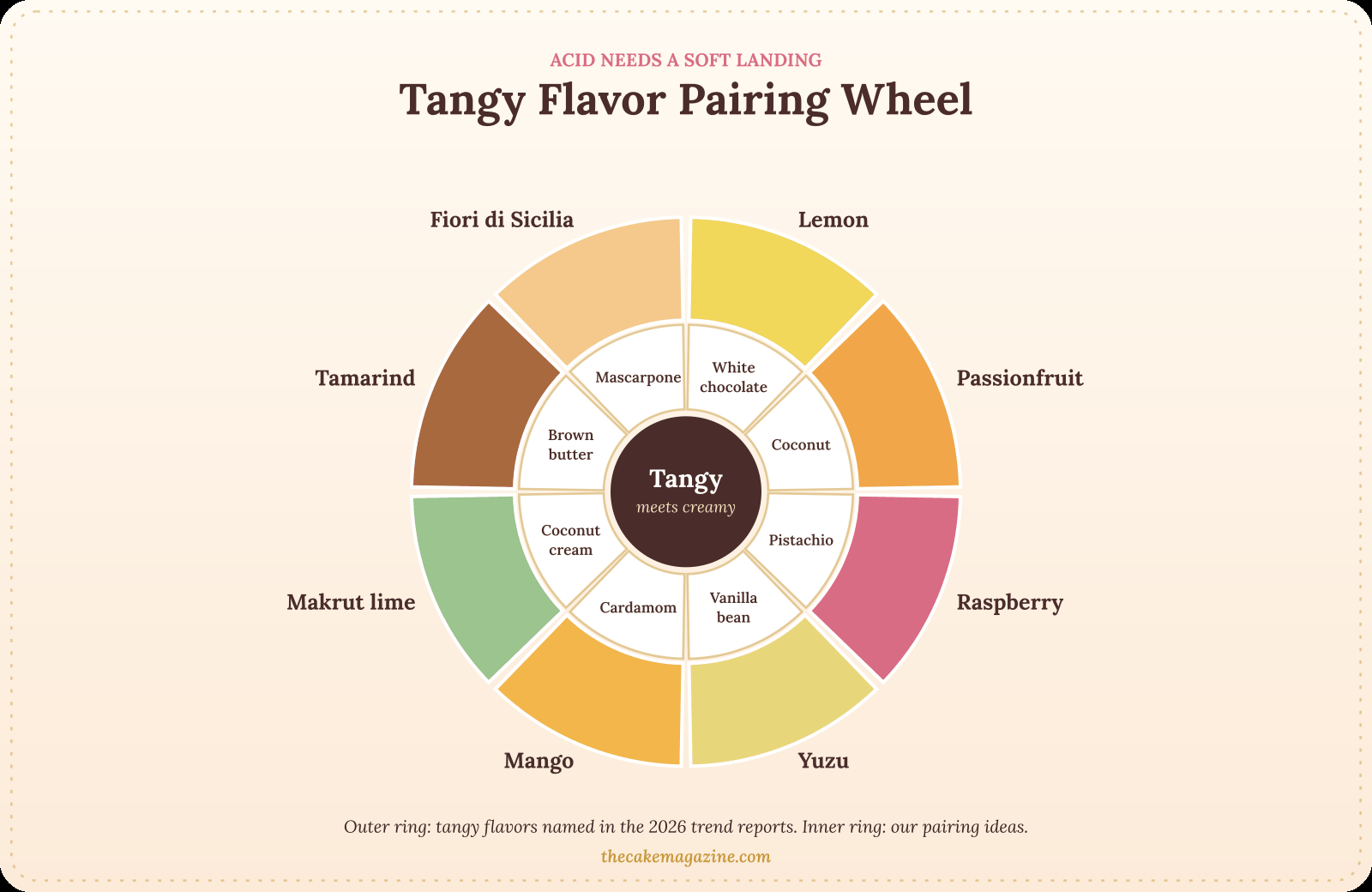
A tangy flavor needs a soft landing. Sharp lemon against a dry crumb can be harsh, and passionfruit with no creamy partner can overwhelm. The pairing wheel below offers eight tangy flavors from the research, each matched with a creamy or mellow partner. The pairings, like the rest of our cake trends 2026 advice, are our suggestions based on common pastry practice, not claims from the sources.
How to add tang to a cake you already make
You have four main ways to bring acid into a cake, and each one changes the result differently.
In the batter. Buttermilk, yogurt, sour cream and lemon zest all add a gentle tang while keeping the crumb tender. This is the lowest-risk option, since it uses ingredients that already belong in a cake. Be careful with liquid lemon juice in the batter, because acid reacts with leaveners and can change the rise and crumb.
In the filling. Lemon curd, passionfruit curd, a quick berry compote or a mango puree can all sit between layers. Because fillings are separate from the cake structure, you can change the flavor without changing how the sponge bakes. Use a ring of buttercream around the edge of each layer, called a dam, to keep a soft filling from squeezing out.
In the frosting. Cream cheese frosting is naturally tangy, and you can add citrus zest or a reduced fruit puree to buttercream. Swiss meringue buttercream handles fruit flavor well if the puree is reduced to a thick consistency. If you are new to it, our Swiss meringue buttercream guide explains why temperature matters.
On the outside. Fresh berries, candied citrus slices or a glaze made with lemon juice and powdered sugar bring tang as a finishing touch. The Knot also notes a trend toward fresh and candied fruit decoration, including sugared pears, grapes and citrus.
Quick pairing ideas
Lemon and white chocolate
A lemon sponge with a white chocolate ganache filling. The sweetness of the white chocolate softens the acid.
Passionfruit and coconut
A coconut cake with a thin passionfruit curd layer. Tropical, bright and easy to balance.
Raspberry and pistachio
Vanilla cake with raspberry filling and a pistachio cream. The Knot mentions a similar pairing in wedding cake flavors.
Earl Grey and lemon
Earl Grey infused milk in the batter, with a lemon glaze. The bergamot in the tea echoes citrus.
What to watch for
Acidic fillings can curdle dairy, so combine them carefully. Curds and fruit purees should be cooled before you add them to cream. Acid also softens meringue and can make whipped cream weep, so assemble tangy cakes closer to serving time. And if you are baking from a recipe that includes baking soda, remember that soda needs acid to work, which is why buttermilk and yogurt make such good partners in a tangy cake. Our cake troubleshooting guide explains what to do if a cake sinks, turns dense or tastes flat.
Trend four: vintage piping
If mini formats and tangy flavors are the modern face of the cake trends 2026, vintage piping is the nostalgic one. Bakers quoted in The Knot’s wedding cake trends article describe a return to decoration that looks like it belongs in a grandmother’s cake book: shells, ropes, swags, bows, pleats and lace-like ruffles. Among the cake trends 2026, it is a deliberate revival. The look says that someone took the time to make it by hand.
What bakers are reporting
The article, last updated on 13 October 2025, collects a long list of old-fashioned details that wedding bakers are being asked for. It mentions 1980s-style cake toppers, buttercream swags, bows and ruffled tulle. It describes floating tiers, vintage columns, swans, pillars and cake boards lined with lace or tulle. It names pleats and shiplap-style piping, made with buttercream, ladyfingers or meringue, along with stucco-finish buttercream and fabric-inspired drapes.
It highlights Lambeth-style cakes, often in dusty blue with white piping and cherries, and classical motifs including Roman columns, scallop shells and swans. It also notes candles reminiscent of childhood birthday cakes, with the author suggesting 1990s nostalgia might follow.
These cake trends 2026 details are anecdotes from professional bakers, not survey results, so we treat them as signals from the trade rather than proof of mass demand. But they are consistent with one another, and they describe a recognizable aesthetic: ornate, tactile and a bit theatrical.
Why old-fashioned piping feels fresh
In the cake trends 2026 context, for a generation of decorators, the dominant look was a smooth, minimal cake with a few flowers. After years of clean lines, hand-piped detail reads as an act of craft. It is also, in an era of printed edible images and fondant shortcuts, a way for a baker to show skill. A well-piped shell border is hard to fake.
There is also an emotional pull. Many people grew up with cakes decorated this way, in family kitchens or neighborhood bakeries, and a piped bow or a Lambeth swag evokes that memory. It feels warm rather than slick. Pair it with a pastel palette or a dusty blue and the effect is charming without being kitsch.
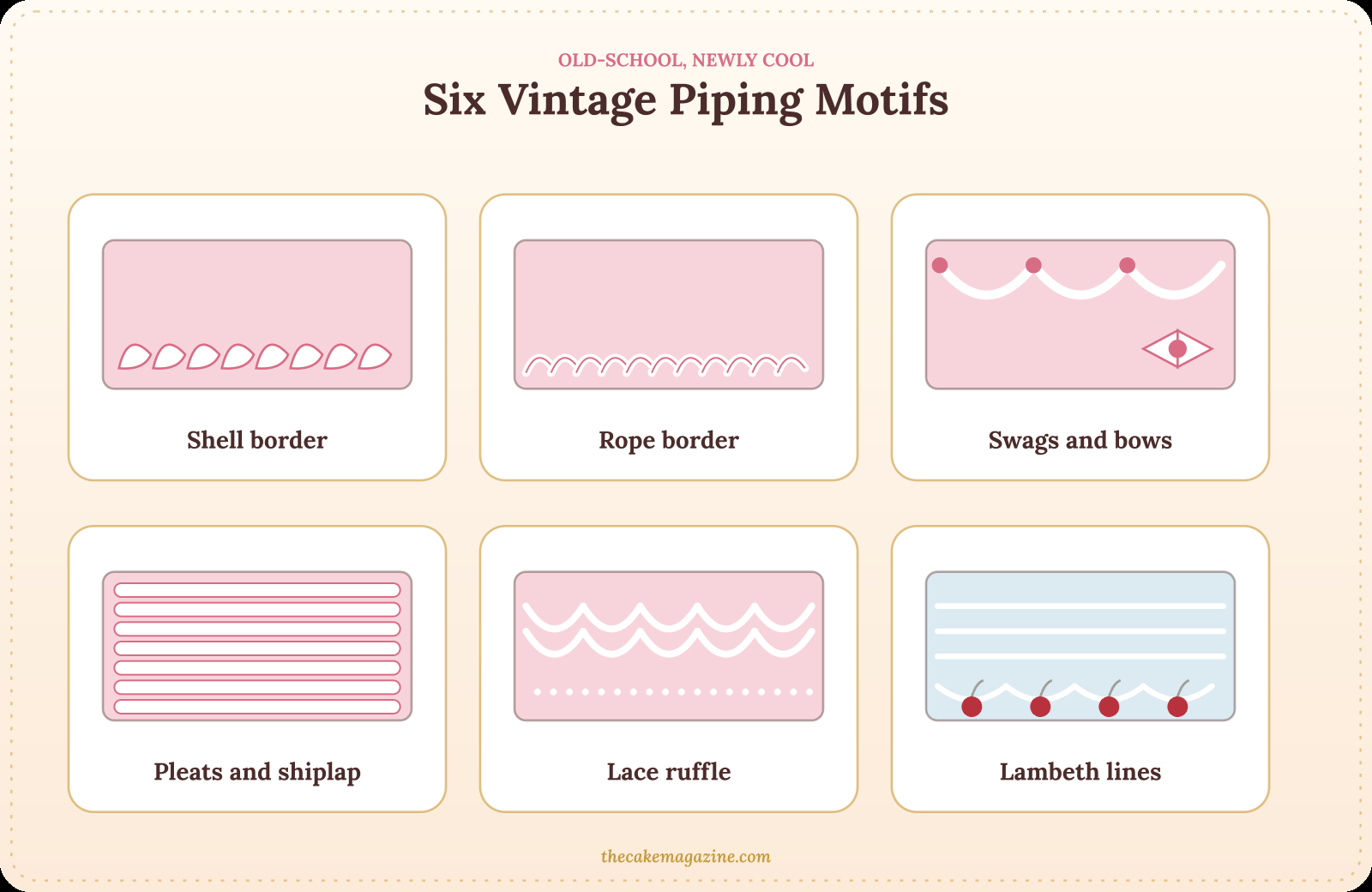
Six motifs to know
Shell border
A row of small curved shells piped around the base or top edge of a cake. It is the most forgiving vintage border to learn and it looks neat even when it is a little uneven.
Rope border
A twisted, rope-like line that sits along an edge. It takes steady rhythm and is easiest in a medium-stiff frosting.
Swags and bows
Draped garlands of frosting that hang from points on the side of a cake, with bows at the joins. The Knot mentions buttercream swags and bows as a returning detail.
Pleats and shiplap
Horizontal or vertical lines that create a fabric or paneled effect. The Knot notes these can be made with buttercream, ladyfingers or meringue.
Lace and ruffles
Fine, repeating scallops and dots that mimic lace or tulle. These show up with lace-lined boards and ruffled details in the trade reporting.
Lambeth lines
A heavily piped style of overlapping lines and swags, often finished with a cherry. The Knot describes a dusty blue and white version with cherries.
How to start piping at home
You do not need a full decorating kit. A piping bag, a coupler or a reusable bag, a medium open star tip and a small round tip will cover the shell, rope and dot patterns in the diagram. The harder part is the frosting.
Use the right consistency. Piping frosting needs to hold a ridge. If it is too soft the shells melt into blobs, and if it is too stiff the bag is hard to squeeze and the lines tear. American buttercream is the easiest to adjust: add a spoonful of milk to loosen it or a little powdered sugar to stiffen it. Swiss and Italian meringue buttercreams pipe beautifully and hold detail but need to be at the right temperature. Our buttercream guide compares them.
Practice on parchment. Pipe a row of shells onto a sheet of parchment paper first. Scrape it up and put it back in the bag to reuse. Ten minutes of practice does more than an hour of reading.
Chill the cake first. A cold, firm frosted cake holds a piped border better than a warm, soft one. If the frosting begins to soften while you work, return the cake to the fridge for ten minutes.
Keep pressure and speed consistent. Most piping problems are pressure problems. Squeeze from the top of the bag with your dominant hand and let the other hand guide. For shells, press, hold briefly, relax and pull, then start the next shell overlapping the tail of the last.
Start with a flat surface. The cleaner the base coat, the easier the piping looks. If your sides are uneven, review our guide to smooth buttercream sides and sharp edges before you start.
For more detail on bags, tips, pressure, borders, shells, rosettes and writing, see our full cake piping guide. And if you are a complete beginner to decorating, our cake decorating for beginners guide covers the tools, frosting and smoothing that come first.
Vintage does not mean perfect. Part of the charm of old-fashioned piping is that it looks handmade. A slightly uneven shell is part of the look. Do not throw out the cake because the swags are not identical. A relaxed, imperfect border usually looks better than a stiff, over-corrected one.
A word on color
Color is half the vintage look. The Knot mentions dusty blue with white piping as a signature Lambeth palette, along with pearlescent and metallic finishes in gold, silver and bronze and shimmery bright shades like chartreuse and mauve. For home bakers, a soft pastel base with white piping is the most reliable combination, because white frosting is the easiest to pipe cleanly and pastels forgive small imperfections. If you color your own frosting, add gel color a little at a time and let it sit, because color deepens as it rests.
Trend five: statement cakes
The fifth of the cake trends 2026 is about silhouette and scale. Where mini formats go small, statement cakes go in the other direction: long, wide, tall, asymmetric or surrounded by an entire scene. The common thread is that the cake itself becomes the centerpiece of the room.
The Knot’s reporting is the main source for this one, and it comes from bakers rather than surveys. It lists oval cakes, which the author expects to grow, often as single tiers that resemble cameo pendants or lockets. It describes sheet cakes in many forms, including stacked, squarish designs, and long rectangular cakes that span most of a dinner table. It mentions wide, flat single-tier cakes sometimes called the Italian wedding cake trend, and asymmetrical forms such as squares stacked at angles.

Bigger is back
Bakers in the article also report a move toward large-format cakes, with added tiers on long cakes and large rounds, some very tall designs, and big cakes appearing even at small, intimate weddings. One baker was reportedly asked for a cake six feet tall. That is an extreme case, but it makes the point that scale is part of the statement.
There is an interesting tension here with the mini side of the cake trends 2026. In some ways the two are opposites, and in other ways they are the same impulse. Both reject the middle: the average cake that serves twelve and looks like every other cake. A very small, very good cake and a very large, very dramatic one both say that the cake is chosen on purpose.
Across the cake trends 2026, people are polarizing toward the ends of the size range, and the ordinary round cake of moderate size is simply less of a statement.
Cakescapes and vignettes
The article also describes cake vignettes and what it calls cakescapes: a main cake surrounded by coordinating smaller cakes, flowers, ribbons, candles and linens, arranged like a still life. There is a growing interest in interactive moments too, such as candle lighting or a cake parade when the cake is brought out. This is less about the cake and more about the display, but it affects what a baker is asked to produce.
How home bakers can borrow a statement shape
You do not need a tall tier or custom pans to bring a statement to a cake. A few practical ideas:
- Bake in a sheet pan and decorate the whole surface. A rectangular cake with a border and a row of fruit looks bold without any structural complexity. Our cake pan buying guide covers sheet pans and other shapes.
- Go wide, not tall. A single wide tier, baked in a large round pan and frosted simply, is an easy way to create presence. Make the cake shallow rather than tall, so it is easy to slice.
- Stack squares at an angle. Two or three square cakes of decreasing size can be rotated slightly as you stack them. Use dowels or straws for support in the lower tiers and a cake board between layers.
- Build a small scene. Put your cake on a stand, add a few candles, fresh flowers that are safe to place near food and a linen napkin. A cakescape needs more styling than baking.
Large and tall cakes in the cake trends 2026 mix require more structure, and the physics are unforgiving. A heavy cake needs supports and a sturdy board. If you plan something ambitious, practice at a smaller size first and check that your mixer and pans can handle the volume. Our guides to stand mixers for cake baking and hand mixers explain how bowl size and power affect batch capacity.
The wedding baker’s view
Wedding cakes are where many of the cake trends 2026 meet each other, so it is worth stepping back to see how a couple might combine them. The Knot’s article adds several flavor and decoration ideas that are worth noting.
Flavors couples are asking for
Bakers describe classics with a twist, such as lemon-raspberry, tiramisu and chocolate, along with berry chantilly and shortcake-style fruit, cream and airy layers. There is interest in less sweet cakes and in Swiss buttercream rather than heavy American buttercream. Floral and herbal flavors, including lavender, rose, elderflower and pandan, appear on the list, and so do vegetable-inspired flavors such as zucchini, sweet corn custard and tomato leaf buttercream. These last ones are unusual, and the article presents them as an edge of the trend rather than the center.
Decoration beyond piping
Fresh and candied fruit, sugar-crystallized pears, grapes and citrus, powdered-sugar berries, sugar flowers and painted florals all appear in the article. It also mentions vegetables as decoration, such as cabbage, artichokes and garlic scapes. For a home baker, fruit and fresh flowers are the easiest to borrow. For a couple hiring a baker, they are a good way to add a seasonal and personal touch.
Planning a wedding around the cake trends 2026
If you are planning a wedding, a statement cake changes your math. A long rectangular cake or an extra-tall design may serve more guests, or it may be mostly decorative with a backup sheet cake in the kitchen. Our guide to wedding cake serving sizes explains tier sizes, portions and backup cake planning, and the wedding cake cost guide explains why intricate piping, tall tiers and fresh flowers raise the price. For a bigger-picture overview, start with our wedding cake guide.
The Knot also advises asking bakers how they would execute a design, since elaborate, high-touch designs are returning and not every baker has the same skill with them. That is sensible advice for any special-order cake: ask for photos of similar work and ask how the design is supported and transported.
Cake trends 2026 at a glance
Long guides are wonderful until you need one fact in a hurry. Here is the whole of the cake trends 2026 picture condensed into a handful of reminders you can read on your phone in the grocery store, along with the sources each one rests on.
The five cake trends 2026 in one breath
- Mini formats: smaller, richer portions, from one-bite cakes to bento-style rounds. Source: Taste Tomorrow patisserie research (October 2025) and its June 2026 trend radar.
- Texture mashups: crunchy, chewy and creamy elements in one bite. Source: Taste Tomorrow patisserie research.
- Tangy flavors: lemon, passionfruit, raspberry and other bright fruit, with a soft partner. Source: Taste Tomorrow, plus flavor ideas in The Knot.
- Vintage piping: shells, ropes, swags, bows, pleats and Lambeth lines. Source: bakers quoted in The Knot.
- Statement cakes: ovals, long table cakes, wide single tiers, angled squares and very tall designs. Source: bakers quoted in The Knot.
Which cake trends 2026 suit which baker?
A beginner will have the easiest time with mini formats and tangy flavors, since both can be done with a basic sponge, a spoonful of curd and a steady hand. An intermediate baker who already makes layer cakes will enjoy texture mashups, which reward planning and clean assembly. Someone who loves detail work will gravitate to vintage piping, and anyone who enjoys structural challenges will find the statement shapes worth a try, provided they practice at a smaller size first.
Three mistakes to avoid with any trend
Copying the photo instead of the idea. A cake on a screen is lit, styled and often retouched. Take the idea from the cake trends 2026, such as a tangy filling or a shell border, and adapt it to your oven and your skill level.
Over-sweetening a tangy cake. It is natural to add sugar to a sharp filling, but the point of tang is balance. Taste the filling with the cake and the frosting together, not on its own.
Forgetting the schedule. Many of the cake trends 2026 involve components made in advance and assembled late. Write the schedule down, because texture, cream and fresh fruit all have a window in which they taste their best.
If you are building a menu or a portfolio
Bakers who sell cakes face a different question: how many of the cake trends 2026 belong on a menu? Our advice is to choose one or two that suit your style and your equipment, and to build them into products you can make consistently. A bakery known for excellent small lemon cakes with a shell border is more memorable than one that offers every viral item for a month.
Consistency matters with cake trends 2026 because it protects your margins, since you can price a product you have made many times far more accurately than a novelty you tried once.
Trying the cake trends 2026 at home
Reading about trends is pleasant. Baking them is better. The risk is trying everything at once and ending up with a cake that is small, crunchy, tangy, vintage and enormous, which is to say, confused. A better approach is to choose one trend as the lead and let the others play supporting roles. Here is a weekend plan for the cake trends 2026 and a few combinations that work.
Pick a lead trend
Ask yourself what the occasion really needs from the cake trends 2026. A casual get-together with six people calls for mini formats, because nobody has to cut anything and leftovers are not a problem. A holiday dessert table benefits from texture, since a crunchy topping is easy to add to a make-ahead cake. A summer birthday is a natural home for tangy flavors. A milestone party, a wedding or an anniversary is the time for vintage piping or a statement shape.
Small gathering
Lead with mini formats. Bake a thin sheet of sponge, cut rounds and make six or eight little layer cakes with a tangy filling.
Make-ahead dessert
Lead with texture. Add toasted nuts, a thin jam layer and a crisp topping to a cake you already trust.
Summer birthday
Lead with tang. Lemon sponge, passionfruit curd and a light buttercream, finished with fresh fruit.
Milestone celebration
Lead with vintage piping or a statement shape. Choose one dramatic element and keep everything else simple.
Three combinations that work
The tiny tangy cake. Mini formats plus tangy flavors is probably the easiest crossover. A small lemon sponge round, a thin layer of lemon curd, a whisper of vanilla buttercream and a single raspberry on top. Because the cake is small, the acid does not overwhelm, and because it is bright, the buttercream does not feel heavy.
The crunchy vintage cake. Vintage piping plus texture. A classic frosted layer cake with a shell border at the base and a ring of toasted chopped nuts pressed into the lower edge. It looks traditional and eats with a little surprise.
The statement sheet cake. A large rectangular cake in a sheet pan, frosted smoothly in a pastel color, with a rope border and a row of fresh berries across the center. It is bold without being technical, and it serves a crowd.
A weekend plan
- Thursday evening: decide on the lead trend and write a short shopping list. Check your oven temperature with a thermometer, because small cakes bake fast and a few degrees matter.
- Friday: bake the sponge, make any curd or compote, and prepare crunchy elements. Cool everything fully, wrap the cake and store the components separately.
- Saturday morning: make the frosting, fill and stack, crumb coat and chill.
- Saturday afternoon: final coat, piping or decoration, and add any fresh elements as late as possible.
- Serve: bring the cake to the right temperature, slice with a hot knife and enjoy.
King Arthur Baking’s cake guide stresses a few habits that apply to every one of these combinations: grease the pan, line it with parchment and grease again; use light-colored pans for a more tender crust; weigh your ingredients for accuracy; and wait until a cake is thoroughly cool before frosting. None of these are trendy, but all of them make the trendy parts work.
Mixing method matters more than you think
One detail worth knowing before you adapt a favorite recipe is the mixing method, because a trend that adds fruit, acid or fillings can stress a delicate batter. A creamed butter cake tolerates buttermilk and extra zest well. A reverse-creamed cake has a very fine crumb that holds up under tender fillings. An oil cake stays moist for days and is a good candidate for texture work, since the moist crumb contrasts well with a crisp topping.
Our guide to cake mixing methods explains how creaming, reverse creaming, foaming and one-bowl methods differ, which helps you choose the right base for the trend you want to try.
Ordering a trend cake from a baker
Not everyone wants to bake. If you plan to order, the cake trends 2026 can help you ask better questions. Whether you are speaking to a neighborhood bakery or a custom cake artist, here is what to ask.
Questions to ask
- Have you made this before? A trend format may be new to a baker, and early attempts can be uneven. Ask to see photos of past work in a similar style.
- How will it be supported and transported? This matters most for tall, long or multi-component cakes. Ask whether the cake will be delivered and set up, or whether you will pick it up.
- What is the serving count? A mini cake order is counted in pieces, while a statement cake may serve more or fewer guests than it appears to. Make sure you and the baker are counting the same thing.
- How will the texture hold? If the cake has crisp elements, ask when they are added and how long the cake will keep its crunch.
- What is the price breakdown? Intricate piping, extra tiers and unusual shapes affect labor and materials, and understanding why helps you decide where to spend.
- What are the storage and serving instructions? A good baker will tell you when to take the cake out of the fridge and how long it can sit out.
Be realistic about timing
Trend cakes can be in high demand, and a baker who becomes known for a viral format may have a long waiting list. If you want a specific look for a date, book early. Ask when the baker needs final details, and avoid changing the design late, since a change in a design with hand piping can mean redoing hours of work.
If you are curious about the business side, perhaps because you are thinking about turning your hobby into an income, our home cake business guide explains pricing, legal basics and workflow, including how to decide whether to follow a trend or build your own signature style.
Food safety for trend cakes
Trend cakes often involve fillings and finishes that are more perishable than a plain frosted layer cake: fresh cream, custard, mousse, cream cheese frosting, curd and fresh fruit. That is worth a short word on safety.
The USDA Food Safety and Inspection Service publishes basic guidance on food handling, and its core message is easy to remember: clean, separate, cook and chill. Its site also advises washing your hands after handling raw eggs, which matters if you make meringue-based frostings, custards or curds from raw eggs. Our Swiss meringue buttercream guide covers heating egg whites safely.
FSIS guidance on temperature is straightforward. Perishable foods should not sit in the so-called danger zone, between 40 and 140 degrees Fahrenheit, for more than two hours, or for more than one hour when the surrounding temperature is above 90 degrees. You can read the agency’s broader advice at the FSIS food safety page. For cakes, this means a few practical habits:
- Refrigerate any cake with fresh cream, custard, mousse, cream cheese or curd between layers, and take it out shortly before serving.
- Keep mini cakes on a tray in the fridge until serving time, since small cakes warm up faster than large ones.
- At an outdoor party, serve perishable cakes in shifts rather than leaving the whole tray out.
- Use clean tools for each stage, particularly after handling raw eggs, and wash your hands often.
- Label cakes that contain nuts, dairy, eggs or other common allergens, since new flavors and crunchy toppings often involve tree nuts.
Shelf-stable buttercream cakes are more forgiving, but they still do best in a cool, covered place. When in doubt about a filling, choose the safer storage route.
What may fade and what will last
Predicting trends is a risky business, and we want to be honest about the limits of any cake trends 2026 forecast. Here is our cautious view of which of the cake trends 2026 are likely to stay and which may burn out.
Likely to last
Smaller portions. The preference for smaller servings is backed by survey data across regions, and it fits a long-running shift toward value and moderation. Specific shapes within the cake trends 2026, like cup cakes with thick frosting, may change, but the underlying wish for a smaller, better portion is likely to persist.
Tang and brightness. Taste Tomorrow describes tangy flavors as rising in every region. Lemon and berries are classics and will not vanish. Individual exotic flavors may come and go, but the broader shift away from very sweet profiles looks durable.
Textural contrast. People have always liked a bit of crunch with their cream. The trend is the renewed emphasis, not a new idea, and it is easy to adopt in small ways.
Could cool off
Viral novelty cakes. A dessert whose appeal is mostly a long line and a dramatic video can fade as fast as it rose. We think dot cakes will leave behind a lasting habit of thick frosting and sprinkles in a cup, but the brand-name frenzy is more likely to calm down.
Extreme sizes. A six-foot cake is a one-off. Very tall and very long cakes will remain a feature of some weddings, but they require space, budget and skilled labor that limit how far they spread.
Very specific nostalgia. A look tied to a particular decade tends to have a life of a few years. The Knot’s author speculates that 1990s childhood-style candles may be next, which shows how quickly nostalgia cycles move. Vintage piping itself, as a technique, is likely to endure, since shells, swags and bows have been in cake decorating for a century.
Update log and review schedule
Trend pages go stale, so we treat this cake trends 2026 guide as a living article. We plan to review it quarterly and to say clearly what changed. Here is the log so far.
November 2026 (first publication). Reviewed sources: Taste Tomorrow patisserie trends for 2026 (published 28 October 2025), Taste Tomorrow trend radar of viral treats (published 18 June 2026), The Knot’s 2026 wedding cake trends (last updated 13 October 2025), King Arthur Baking’s cake guide and USDA FSIS food safety basics. Next scheduled review: February 2027. We will add newer research, retire anything that has stalled and note where US demand diverges from global signals.
If you spot something out of date, or if a bakery near you is making a trend we missed, let us know. A trend report is only as good as the people who read it and tell us what they are seeing.
Frequently asked questions
What are the biggest cake trends 2026 bakers should know?
The best-supported ones are mini formats and smaller portions, texture mashups with crunchy, chewy and creamy layers, tangy flavors such as lemon and passionfruit, vintage piping like shells, swags and bows, and statement cakes with unusual shapes or large sizes. The first three come from global consumer research, and the last two come mostly from wedding bakers.
Are the cake trends 2026 the same in the United States as everywhere else?
Not exactly. Much of the research is global, so a trend can be strong in Asia-Pacific or the Middle East and only emerging in the United States. The preference for smaller portions is visible in North American survey results, but the mini one-bite cake style is tied to South Korea. Always check what bakers near you are actually selling.
What is a dot cake and is it one of the cake trends 2026?
A dot cake is a cake served in a cup with a thick layer of frosting and nonpareil sprinkles. It went viral in 2026 after lines formed at a New York bakery, according to Taste Tomorrow’s trend radar. We see it as a viral example of the mini-format trend rather than a separate trend of its own.
Why are tangy flavors popular in cake trends 2026?
Research from Taste Tomorrow points to perceived freshness and health benefits, visual appeal, a move away from very sweet flavors and the influence of sourdough’s mildly acidic taste. For bakers, acid also cuts through rich buttercream and makes each bite taste as good as the first.
How do I add texture to a cake without making it complicated?
Add one crisp element and one chewy element to a cake you already trust. Press toasted nuts into the sides, spread a thin layer of jam between layers or top the cake with crushed cookies or brittle just before serving. Keep crunchy elements dry and add them late so they do not soften.
Is vintage cake piping hard to learn?
Shell and dot borders are among the easiest decorations to learn. You need a piping bag, a medium open star tip, a consistent frosting and some practice on parchment paper. Rope borders and swags take more rhythm. See our piping guide for step-by-step help.
Do mini cakes cost less than regular cakes?
It depends on who makes them. A single mini cake costs less than a full cake, but a table of forty small cakes involves a lot of labor, so the total can be similar to a large cake. Research notes that consumers view one-bite cakes as more affordable, but a baker’s price reflects time as well as ingredients.
What wedding cake shapes are part of the cake trends 2026?
The Knot’s reporting from bakers lists oval cakes, long rectangular cakes, wide single-tier cakes, sheet-style cakes, asymmetrical stacked squares and very tall designs. It also mentions cakescapes, where a main cake is surrounded by smaller cakes, flowers, candles and linens.
How can I try cake trends 2026 on a small budget?
Choose one trend and use ingredients you already own. Add lemon zest and a simple curd for tang, press toasted nuts into the sides for texture, bake a thin sheet cake and cut it into minis, or pipe a shell border with basic buttercream. None of these require special equipment.
Should perishable trend cakes be refrigerated?
Yes, if they contain fresh cream, custard, mousse, cream cheese frosting, curd or cut fruit. The USDA recommends keeping perishable foods out of the 40 to 140 degree Fahrenheit danger zone for no more than two hours, or one hour in hot weather above 90 degrees.
How often will this cake trends 2026 guide be updated?
We review it every three months and record changes in the update log. The first version was reviewed in November 2026, and the next review is planned for February 2027.
Where do these cake trends 2026 come from?
They come from Taste Tomorrow’s patisserie research and trend radar, The Knot’s wedding cake reporting, and baking technique guidance from King Arthur Baking. We also use USDA FSIS food safety basics for storage advice. Each section names its source and date.
Final thoughts
The cake trends 2026 are less a revolution than a set of gentle corrections. Cakes are getting smaller where they were too big, brighter where they were too sweet, more interesting where they were too uniform, and more handmade where they were too slick. The two outliers, vintage piping and statement shapes, pull in a more theatrical direction, but they too are about making a cake feel chosen rather than default.
If you take one thing from this guide, let it be that you do not have to follow all of it. Pick the single idea that fits your next occasion. Bake a small lemon cake with a crunchy topping. Pipe a shell border on a pastel layer cake. Order an oval cake for an anniversary. Each of those is a perfectly good way to take part in the cake trends 2026, and each one will taste better if you have enjoyed making the decision.
Remember the dates, too. This cake trends 2026 guide is a snapshot from November 2026, built on research published between October 2025 and June 2026. By next year some of these ideas will have settled in, a few will have faded and something new will have appeared online with a very long line outside it. We will be keeping an eye on all of it and updating this guide as the picture changes. If you try one of these trends, tell us how it went, what size you baked and what you would change.
Editorial note: this guide is written for home bakers in the United States, using American measurements and ingredients. Trend information is drawn from the sources named in the text and reflects their publication dates; it is not a forecast or a guarantee of what will be popular. Baking results vary by oven, altitude and ingredients. Where we link to products or tools in the future, we will disclose affiliate relationships near the links.