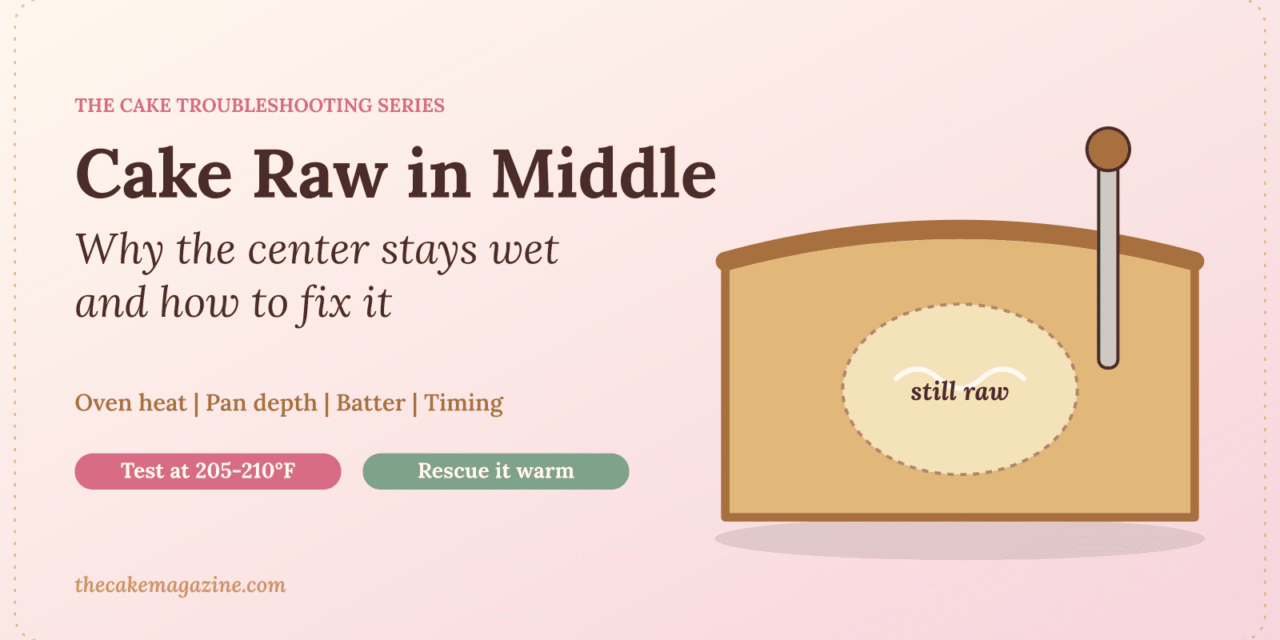
You pull the pan out, the top is golden, the edges are pulling away nicely, and the whole kitchen smells like a bakery. Then the knife goes in, and a wet, shiny stripe of batter oozes up the blade. A cake raw in middle is one of the most frustrating results in home baking, because it looks finished from every angle except the one that counts.
The good news is that it has a short list of causes, each one easy to spot once you know what to look for. This guide shows you how to confirm it, rescue it and prevent it.
A cake raw in middle almost always means the outside of the cake set long before the heat reached the center. The usual culprits are an oven that runs hotter than its dial, a pan that is too deep or too dark for the batter, a batter that is too wet or heavy, or a bake pulled out on looks alone.
Check the center with a thermometer (about 205°F to 210°F for most cakes), lower the oven by 25°F, and bake longer. If the cake is already out, you can usually return it to the oven.
- Why a cake raw in middle happens
- Is it really a cake raw in middle? How to check properly
- Cause one: a hot oven leaves a cake raw in middle
- Cause two: pan depth that gives a cake raw in middle
- Cause three: pan material, color and cake strips
- Cause four: a wet batter makes a cake raw in middle
- Cause five: mixing, leavening and a collapsed structure
- Cause six: rack position, door opening and timing
- How to fix a cake raw in middle right now
- Food safety: when a cake raw in middle is not worth saving
- When a cake raw in middle is just hot: cooling and slicing
- Three example scenarios and how to read them
- High altitude, humidity and other kitchen variables
- Bundts, sheet cakes, cupcakes and tall tiers
- How to prevent a cake raw in middle next time
- FAQ
Why a cake raw in middle happens
Think of a cake batter as a pan of liquid that has to turn into a solid sponge. Heat arrives from the outside: from the hot oven air, from the metal pan walls and from the pan bottom. The edges of the batter touch that hot metal, so they set first.
The center sits farthest from every heat source, and batter conducts heat slowly because it is full of water, fat and trapped air. A cake raw in middle is simply a cake whose outside finished its job before the inside got the memo.
Every cake has a timing gap between the edge and the center. In a good bake, the gap is small. The edges set, the center catches up, and the whole cake finishes within a few minutes of each other. In a problem bake, the gap is huge. A hot oven or a deep pan stretches that gap until the crust is brown and dry while the middle is still pudding. Almost every fix for a cake raw in middle is a way of shrinking that gap.
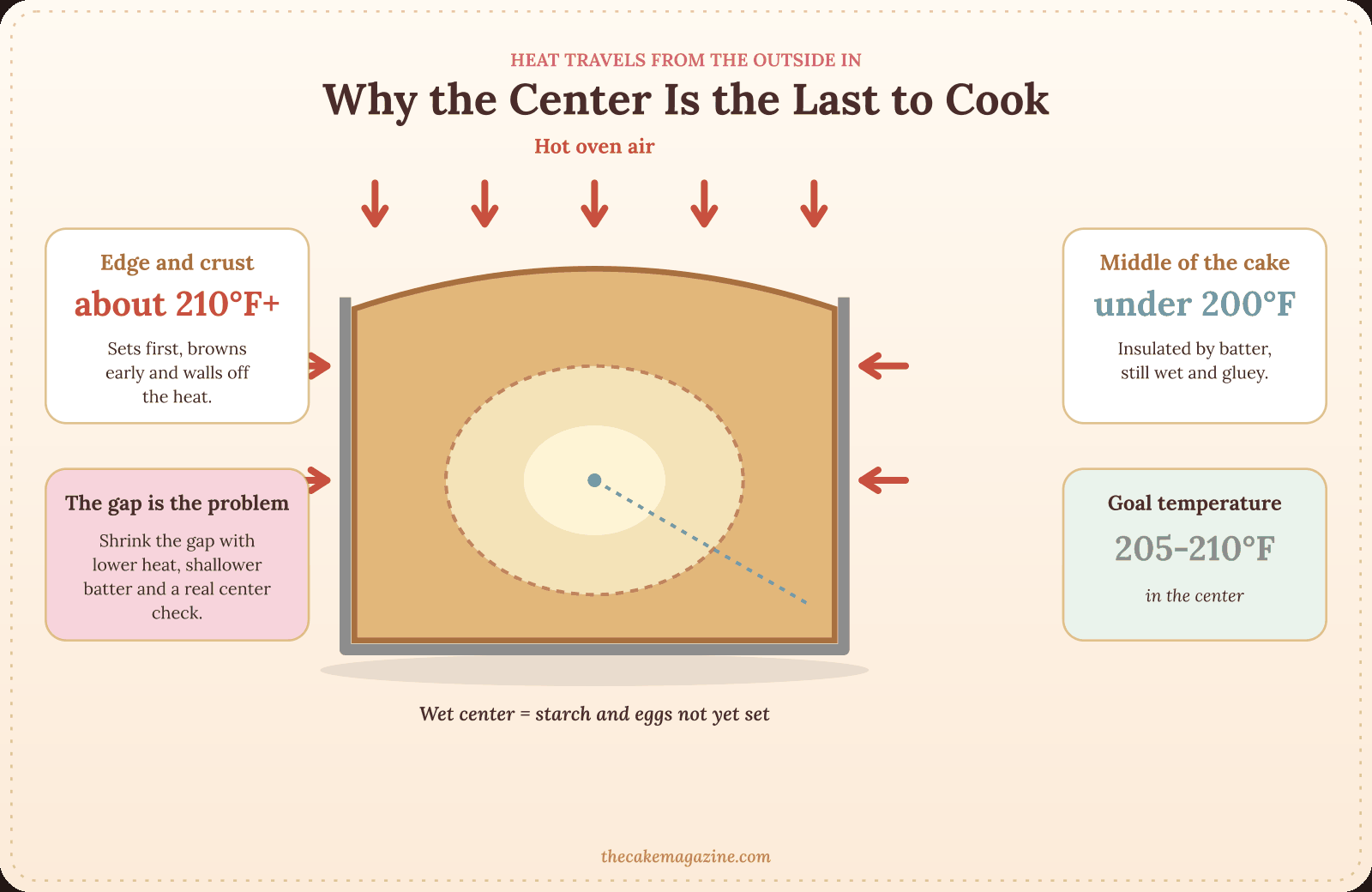
What actually has to happen in the center
For a butter or oil cake to be safe and tender, three things need to happen in the middle. The starch in the flour must absorb water and swell, which is called gelatinization. The proteins in the eggs and flour must set into a net that holds the bubbles in place.
And the batter must get hot enough for both to finish, which for most cakes means an internal temperature somewhere around 200°F to 210°F. King Arthur Baking puts typical cake doneness in about that range, with many classic butter and chocolate cakes finishing near 210°F.
If the center never reaches that range, the starch stays partly raw, the proteins stay loose and the crumb has a damp, gluey texture. That is the stripe you see on the knife. It is also why simply leaving the cake on the counter does not help.
A cake raw in middle does not “finish” as it cools. It cools into a dense, doughy slab. If you want the broader picture of how flour, eggs, fat and sugar build that structure, our guide to cake baking science walks through each ingredient in detail.
Cake raw in middle versus sunken center versus gummy layer
These three problems get mixed up all the time, and the difference matters because the fixes differ. A cake raw in middle has a wet, batter-like center that may or may not be sunken. A sunken cake has a dip in the top, but the crumb underneath can be fully cooked. A gummy layer is a dense, damp band, usually near the bottom, in a cake that is otherwise done.
They are cousins, though, and one often leads to another. A cake raw in middle nearly always sinks as it cools, because the unset structure cannot hold itself up. If your cake has a crater, our guide to why a cake sinks in the middle covers the shape problem. If the wet band sits at the bottom, see why a cake has a gummy layer. This page focuses on the middle of the cake and the baking decisions that leave it undone.
Browning is not doneness. Color comes from the surface, where sugar and protein meet dry heat. Doneness lives in the center, where only temperature and set crumb tell the truth. Every fix in this guide follows from that: slow the surface down, speed the center up, and check the center directly.
Is it really a cake raw in middle? How to check properly
Before you change anything, make sure you are looking at a real cake raw in middle. Some cakes look wet in the center for other reasons. A very moist cake, a cake with a lot of fruit, or a cake still steaming hot can seem underdone when it is fine.
Cutting into a hot cake also smears the crumb and makes it look gummy. So the first job is a proper check, done in a way that does not wreck the cake if it turns out to be fine.
The skewer test for a cake raw in middle
Push a thin skewer, a cake tester or a paring knife straight down into the center, all the way to the bottom of the pan. Pull it out slowly. Clean or with a few dry crumbs clinging to it means the crumb has set. Wet batter, a shiny film or sticky, gluey streaks mean it needs more time. King Arthur notes that a paring knife shows underbaked crumb more clearly than a toothpick, because it has more surface area to grab it.
A word of caution: a tester can look nearly clean even when the cake is not finished, especially if it only slides through a narrow channel. That is why the skewer should be one of two checks, not the only one. Test in the very center and again about an inch off-center. If the two disagree, trust the wetter one.
The thermometer test for a cake raw in middle
An instant-read thermometer gives you a number instead of an opinion. Slide the probe into the center of the cake, avoiding the bottom of the pan, which reads hotter than the crumb. Most butter, oil and chocolate cakes are done when the center reads about 205°F to 210°F. Very light foam cakes may finish a little lower, and dense, moist cakes like carrot or banana can need the top of the range. If you are well under 200°F, you have a cake raw in middle.
The thermometer is especially helpful when you cannot see inside, such as in a tall tiered cake or a bundt. Our dedicated guide on how to tell when a cake is done without overbaking it compares every doneness cue in detail, and it pairs nicely with this one.
The touch and look test
Press the top of the cake gently with two fingertips in the center. A set cake springs back. A cake raw in middle leaves a dent that slowly fills, or feels loose and jiggly under the crust. Look at the edges, too. In a greased pan, a finished cake pulls away from the sides by roughly an eighth to a quarter inch. And watch the surface of a chocolate cake, which shifts from glossy to matte as it sets.
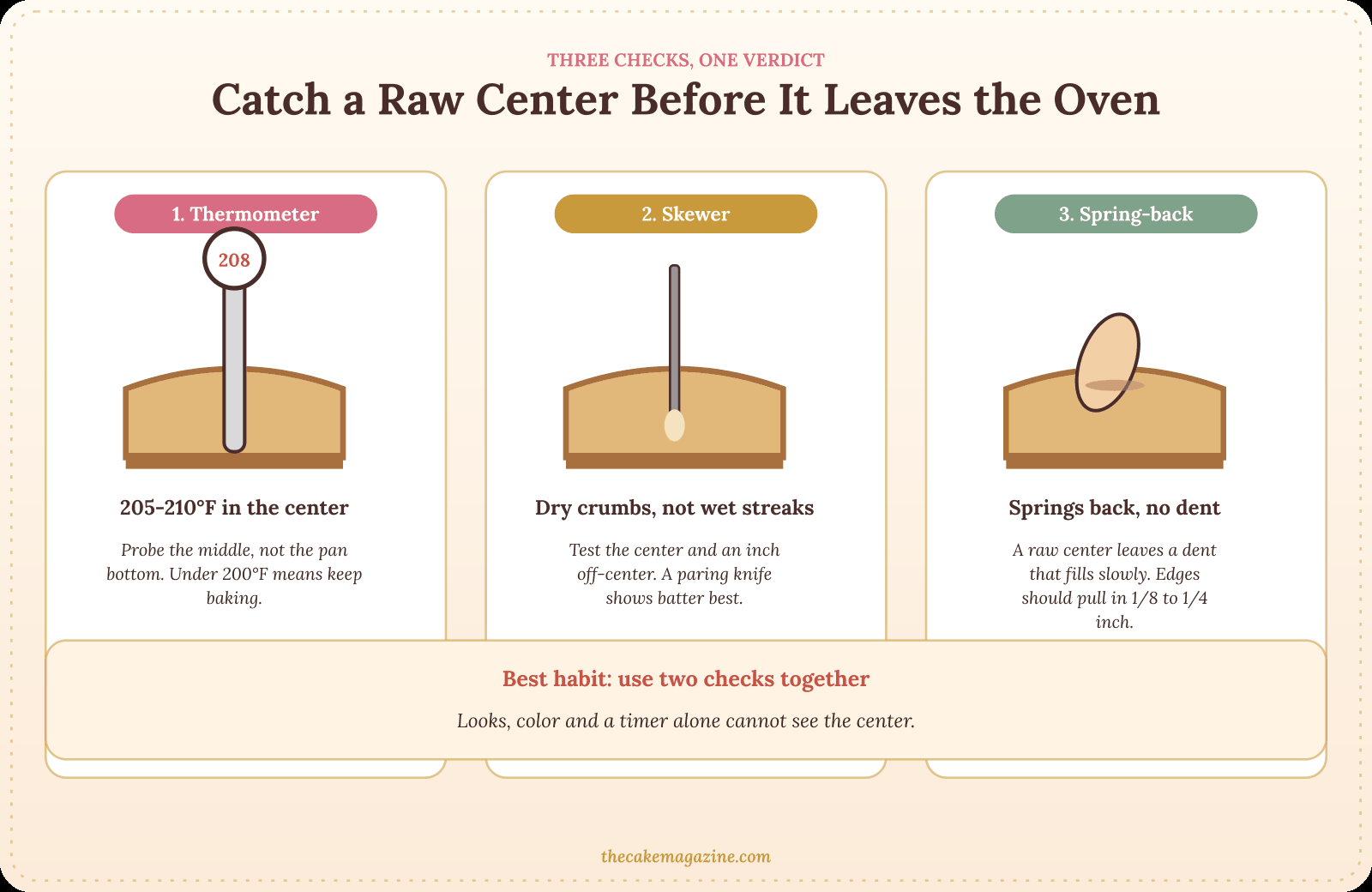
Fast diagnosis: where is the wet spot?
Wet only in the very center: heat did not reach the core. Think oven too hot, pan too deep or too large a batch of batter.
Wet as a band along the bottom: a heavy batter, undermixed fat or a cold pan. See the gummy layer guide linked above.
Wet in the center with a sunken top: pulled too early, or the door was opened too soon in the bake.
Wet and sticky all through: wrong oven temperature, too much liquid, or a recipe with measuring errors.
Cause one: a hot oven leaves a cake raw in middle
This is the single most common reason for a cake raw in middle, and it hides in plain sight. Many home ovens do not hold the temperature on the dial. They swing above and below it as the heating element cycles, and some run 25°F or more off from start to finish. King Arthur recommends preheating well and using an independent oven thermometer, because built-in oven displays are often unreliable.
When an oven runs hot, the outside of the cake sets and browns quickly. The crust turns into a barrier that slows heat moving inward, and by the time the center is warm, the top and edges are dark, dry and sometimes cracked. You pull the cake because it looks done, or because the timer rang, and the middle is a puddle. A hot oven turns a bake that should take 30 minutes into a race the center cannot win.
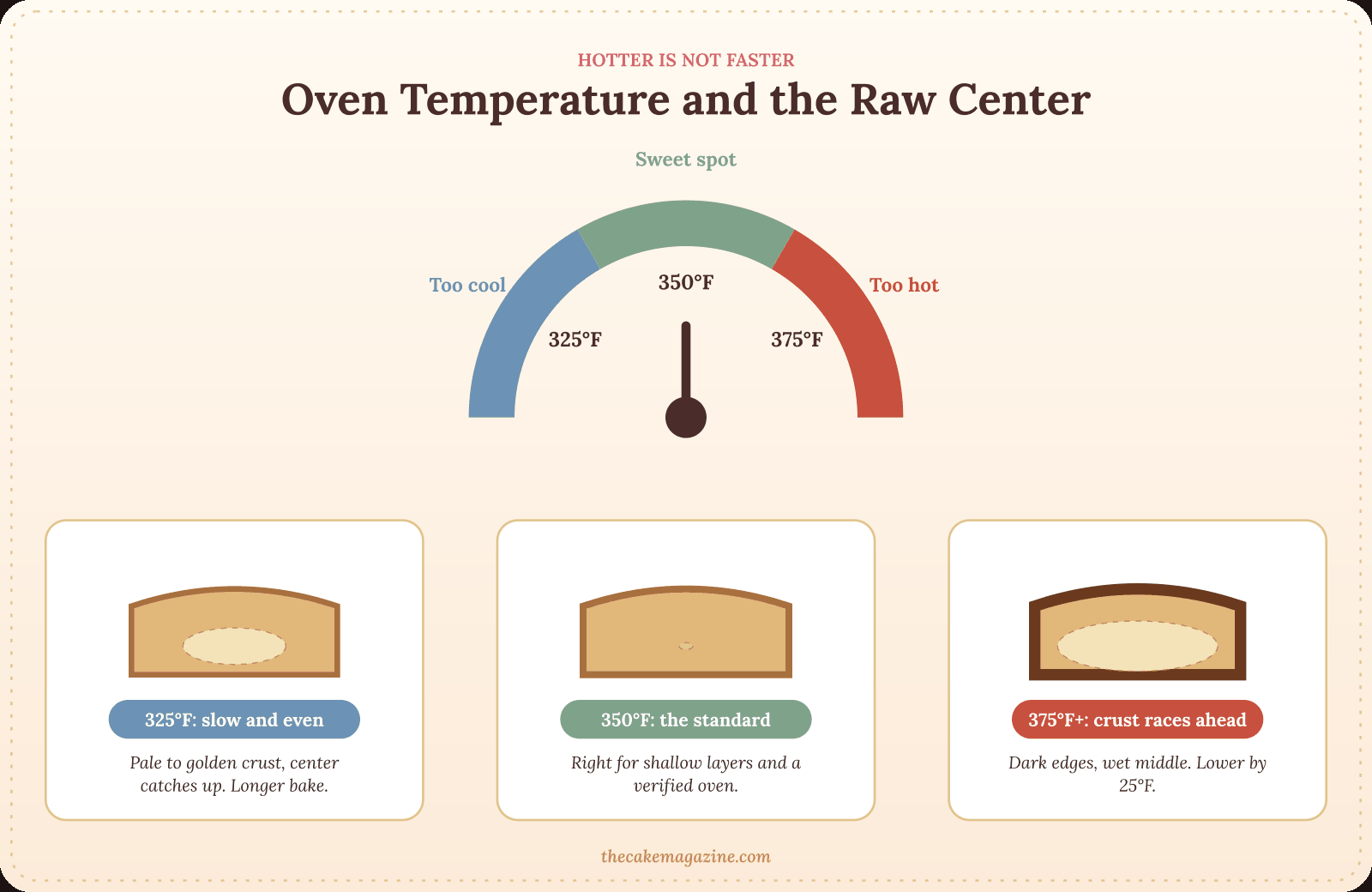
How to catch a hot oven
Hang or stand an inexpensive oven thermometer on the center rack and preheat for a full 20 to 30 minutes, longer than the beep. Read the thermometer without opening the door more than you must, and read it again halfway through. Write down the real number. If the oven says 350°F and the thermometer says 375°F, you have found your problem, and probably several others, because it is likely sabotaging more than this one cake.
Our oven thermometer guide explains how to check calibration and map hot spots, and our cake baking temperature guide covers when 325°F beats 350°F. As a rule of thumb, if your thermometer shows more than about 15°F to 25°F off, set the dial to compensate, or call the manufacturer about recalibrating it.
When lowering the temperature helps
Lower heat gives the center time to catch up before the crust is finished. If your cakes keep turning out with brown edges and a soft middle, try dropping the oven by 25°F and extending the bake time by roughly 10 to 20 percent, then check with a thermometer instead of the clock. Deep or large cakes benefit the most. A tall layer baked at 325°F often comes out flatter on top, more even in color and fully set in the center.
Lower is not always better. Too cool an oven can leave a pale, dense cake that never rises well, because the leavening gases escape before the structure sets. Adjust in small steps, and change one thing at a time, so you know which change worked.
A fan pushes hot air across the pan, so the edges of a cake set even sooner in a convection oven. If you use convection, many bakers drop the temperature by about 25°F and check early. Fan settings that blast a cake can also dome it and produce a crust that outpaces the center, so a gentle or reduced-fan mode is often kinder to a raw-prone cake.
Cause two: pan depth that gives a cake raw in middle
Heat has to travel from the pan walls to the middle of the batter, and the farther it has to go, the longer it takes. A deep pan is a longer journey. If you pour a recipe meant for two 9-inch pans into two 8-inch pans, the same amount of batter now sits much deeper, and the center needs a lot more time.
This is a classic recipe for a cake raw in middle, and it is the reason so many “it worked in my friend’s kitchen” cakes fail in yours.
Pan diameter and batter depth work together. A wide, shallow layer of batter bakes through quickly, because no point in it is far from a hot surface. A narrow, tall column bakes slowly and unevenly, because the middle is insulated by the batter around it. A 6-inch pan filled to the brim can take far longer than a 9-inch pan with a thin layer, even at the same temperature.
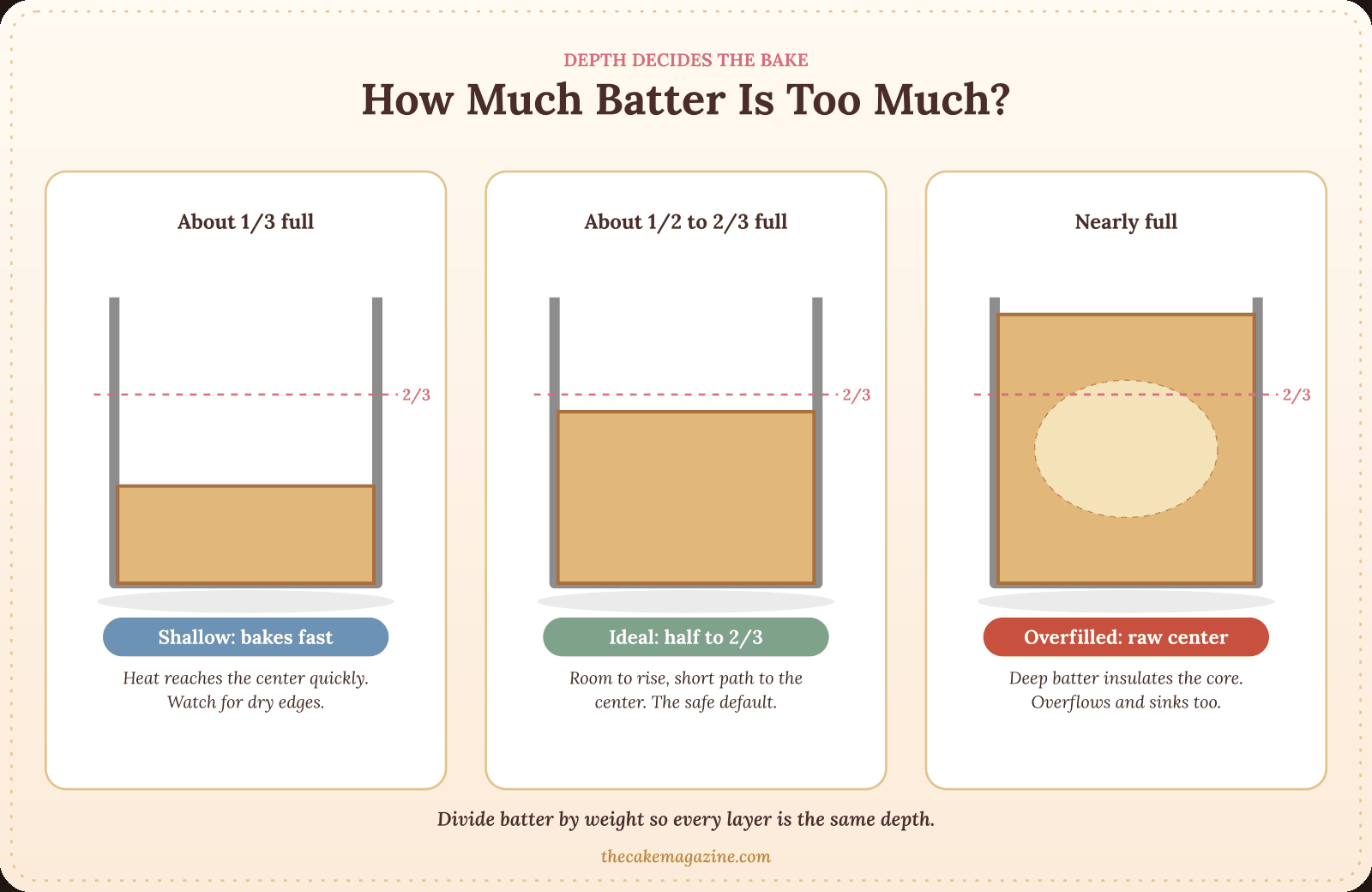
The fill-line rule
As a safe starting point, fill a cake pan only about halfway to two-thirds full. That leaves room to rise and keeps the batter shallow enough to cook through. A standard 2-inch deep pan then carries roughly one to one and a half inches of batter. If your batter climbs higher than that, split it into more pans, or accept a longer, lower bake. Weighing the batter and dividing it by weight keeps the layers even too.
If you have changed pan sizes, do the math before you bake rather than after. Our guide to cake pan conversion shows how to match batter volume to a new pan, and our cake pan size guide lists the capacity of the common rounds, squares and specialty shapes. Recipes written for larger pans also tend to include a baking time that does not scale cleanly when you swap pans.
Slow the bake so a deep cake is not raw in middle
When you do need to bake a deep batter, give it a gentler, longer bake. Drop the oven to 325°F, expect a bake time that is 10 to 25 minutes longer than a shallower cake, and check for doneness with a thermometer. Baking the batter in a pan with a heat core, such as a flower nail or baking core in the center of a wide cake, can also bring heat to the middle faster, as we explain in the tall-tier section further down.
Quick pan checklist
Use the pan the recipe names. Size, shape and depth all matter, not just the diameter.
Measure the pan. Many pans stamped “9 inch” measure slightly differently, and depth ranges from 1.5 to 3 inches.
Do not overfill. Stay at two-thirds or less so the cake can rise and cook through.
Divide by weight. Equal layers bake at equal speeds, so they finish together.
Cause three: pan material, color and cake strips
The pan you bake in changes how fast heat gets into the batter. Light, shiny aluminum reflects some heat and bakes gently and evenly. Dark, matte or nonstick pans absorb more heat, which browns the sides and bottom faster. That faster outside heat is exactly what pushes a cake toward a raw center, because the crust forms before the middle can catch up.
Glass and ceramic go the other way: they heat slowly but hold heat for a long time, so the edges keep cooking even after the pan leaves the oven.
Thick or insulated pans, such as air-bake pans with a hollow layer, slow the heat from the bottom. Silicone pans are floppy and poor conductors, so a cake baked in one often needs more time and a sturdy baking sheet underneath. None of these pans is bad. They just behave differently, and a recipe tested in light aluminum may need adjusting when you use something else. Our cake pan buying guide compares the materials in more depth.
Adjusting for dark and glass pans
A common adjustment for dark metal pans is to lower the oven by about 25°F and watch the edges. For glass or ceramic, many bakers also reduce the temperature by roughly 25°F, since glass holds heat strongly and can over-brown the outside while the middle lags. These are starting points, not laws. If the edges are getting dark early, tent the pan loosely with foil and keep baking until the center is done.
Cake strips and edge shields
Cake strips are damp fabric bands that wrap around the outside of a pan. They keep the pan walls cooler, so the edges set more slowly and the whole cake rises more level. Because the edges no longer race ahead of the center, strips are a handy tool for a cake that tends to be raw in the middle, especially in deep or wide layers. Expect a longer bake, often by 5 to 15 minutes.
Not everyone owns strips, and you can improvise with strips of foil or a folded, dampened kitchen towel pinned around the pan, but keep the cloth away from the oven element and never let it dry out or touch a flame. Our guide on why a cake domes goes deeper into how strips affect the shape of the top.
Light aluminum
Even, moderate browning. The reference pan for most recipes and the safest default.
Dark or nonstick
Browns the outside faster. Lower the oven by about 25°F and watch the edges.
Glass or ceramic
Slow to heat and slow to cool. Often needs a lower temperature and a longer rest.
Silicone
Poor conductor. Bake on a sheet pan and expect a longer time and a paler crust.
Cause four: a wet batter makes a cake raw in middle
Sometimes the oven and the pan are fine, and the batter itself is the problem. A cake with more liquid than its flour and eggs can handle takes much longer to set. The extra water has to heat up, turn to steam and escape before the structure firms up, and that process happens slowest in the center.
A wet batter is also weak. It rises, then collapses before it sets, leaving a dense, damp core. Many cases of a cake raw in middle come down to a recipe that went off its formula.
Common culprits are measuring by volume instead of weight, packing the flour so the batter is heavy, adding extra fruit puree, sour cream or buttermilk, swapping a thicker ingredient for a thinner one, or folding in a lot of wet add-ins. Measurements that look close on paper can add up.
A 10 percent error in liquid, or 10 percent too little flour, is enough to change the bake. Our guide on how to measure flour for cake shows why a scoop and a spoon-and-level cup can differ by 30 grams or more.
Heavy mix-ins and moist add-ins
Carrot cake, banana cake, pumpkin cake and cakes loaded with fruit, nuts or chocolate are especially prone to a damp center. They contain a lot of water-rich ingredients, and the add-ins weigh the batter down, which slows heat. These cakes often need a lower temperature, a longer bake and a center reading at the high end of the doneness range, around 210°F.
Fresh fruit releases juice as it heats, which can pool in the center. Toss berries and chopped fruit in a spoonful of the dry mix before folding them in, drain canned or thawed fruit well, and avoid piling add-ins so thickly that the batter cannot hold them. A cake with a lot of mix-ins is safer in a shallower pan or as cupcakes.
Ingredient swaps that go wrong
Swapping a few ingredients can quietly change the batter’s water content. Replacing oil with applesauce, butter with yogurt, or sugar with honey changes how much liquid the batter holds and how it sets. Reduced-sugar versions can be fragile too, because sugar helps the crumb hold moisture and sets the cake gradually. If you want to adjust a recipe, change one ingredient at a time, and keep a note of how the cake behaves. Our scaling guide covers adjusting a recipe by weight.
Compare your batter to a trusted version of the same cake. If yours looks much thinner, pours like pancake batter when it should plop like thick yogurt, or you have added lots of wet ingredients, expect a longer bake and a risk of a raw center. Weighing every ingredient removes the biggest guesswork.
Cause five: mixing, leavening and a collapsed structure
Mixing and leavening shape the crumb, and a poorly built crumb can leave a cake raw in middle even when the temperature is right. An overmixed batter develops extra gluten, which makes a tight, rubbery structure that is slow to heat through. An undermixed batter has uneven pockets of fat and flour, and the dense pockets stay wet. Overbeaten batters also trap too much air, which rises fast, then collapses, packing the middle into a damp, dense layer.
Leavening plays a similar role. Too much baking powder or soda makes the cake rise quickly, then fall as the bubbles grow too large and burst. The fallen center is compressed, heavy and slow to cook. Too little leavening, or leavening that is old, gives a dense cake that holds water and takes longer to set. Test baking powder in hot water every few months, and measure leaveners with level spoons or, better, a scale.
Ingredient temperature matters too
Cold eggs, cold milk and cold butter do not blend smoothly, and a lumpy, split batter bakes unevenly. Cold batter also takes longer to heat, so the center lags even more. Most layer cake recipes call for room-temperature ingredients for this reason. Our guide to room-temperature ingredients for cake explains which ones matter most.
Meanwhile, if you chill a filled pan or let the batter sit for a long time before baking, the leavening may start to spend itself, so get the pan in the oven soon after mixing.
Mixing method plays a part as well. One-bowl, creaming and reverse-creaming batters all behave differently, and each has its own way of going wrong. Our overview of cake mixing methods breaks down what each method does to the crumb, and it will help you spot whether your technique is contributing to the raw center.
Cause six: rack position, door opening and timing
Where the pan sits in the oven changes what reaches the batter. On the top rack, the cake is close to the heating element or the hottest air, so the top browns fast while the middle lags. On the bottom rack, the pan bottom gets blasted, and you can end up with a dark base and a damp center. The center rack, with an inch or two of space around each pan, gives the gentlest and most even heat for most cakes.
Crowding makes things worse. Several pans crammed on one rack block the airflow, so some heat unevenly, and pans touching the oven wall cook faster on that side. Leave about an inch of space around every pan, and if you must use two racks, rotate and swap the pans partway through, after the structure has set. Our guide on why a cake bakes unevenly explains hot spots and rack position in depth.
Opening the oven door too early
Every peek lets heat out and cool air in. During the first half of the bake, the batter is still liquid and fragile, and a rush of cool air can stall the rise or make it collapse. That leaves a dense, undercooked center. Keep the door closed for at least the first 25 to 30 minutes of a standard layer cake, use the oven light, and wait until the structure has set before you rotate pans or poke the cake.
Trusting the timer instead of the cake
A recipe’s bake time is an estimate from one kitchen, one oven and one pan. Your cake may need more or less. Set the timer for a few minutes before the earliest time in the range, then test, and test again every five minutes. A cake that has gone from “almost” to “done” in the wrong oven can easily be out five minutes too soon. When in doubt, bake a little longer, tent the top with foil if it is browning, and check the center directly.
Rack and timing checklist
Center rack: use it for most cakes, with an inch of space all around.
Door closed: hold off for the first 25 to 30 minutes.
Foil tent: if the top is browning too fast, lay a loose sheet of foil on top and keep baking.
Test twice: center and off-center, with a thermometer if you have one.
How to fix a cake raw in middle right now
You have a pan on the counter and guests arriving, so here is the practical part. What you can do depends on one thing: has the cake cooled and been cut, or is it still whole? A cake raw in middle that has not been cut is usually salvageable. A cake that has been sliced and fully cooled is harder, but not hopeless. Work through the decision path below, and use your thermometer to confirm each step.
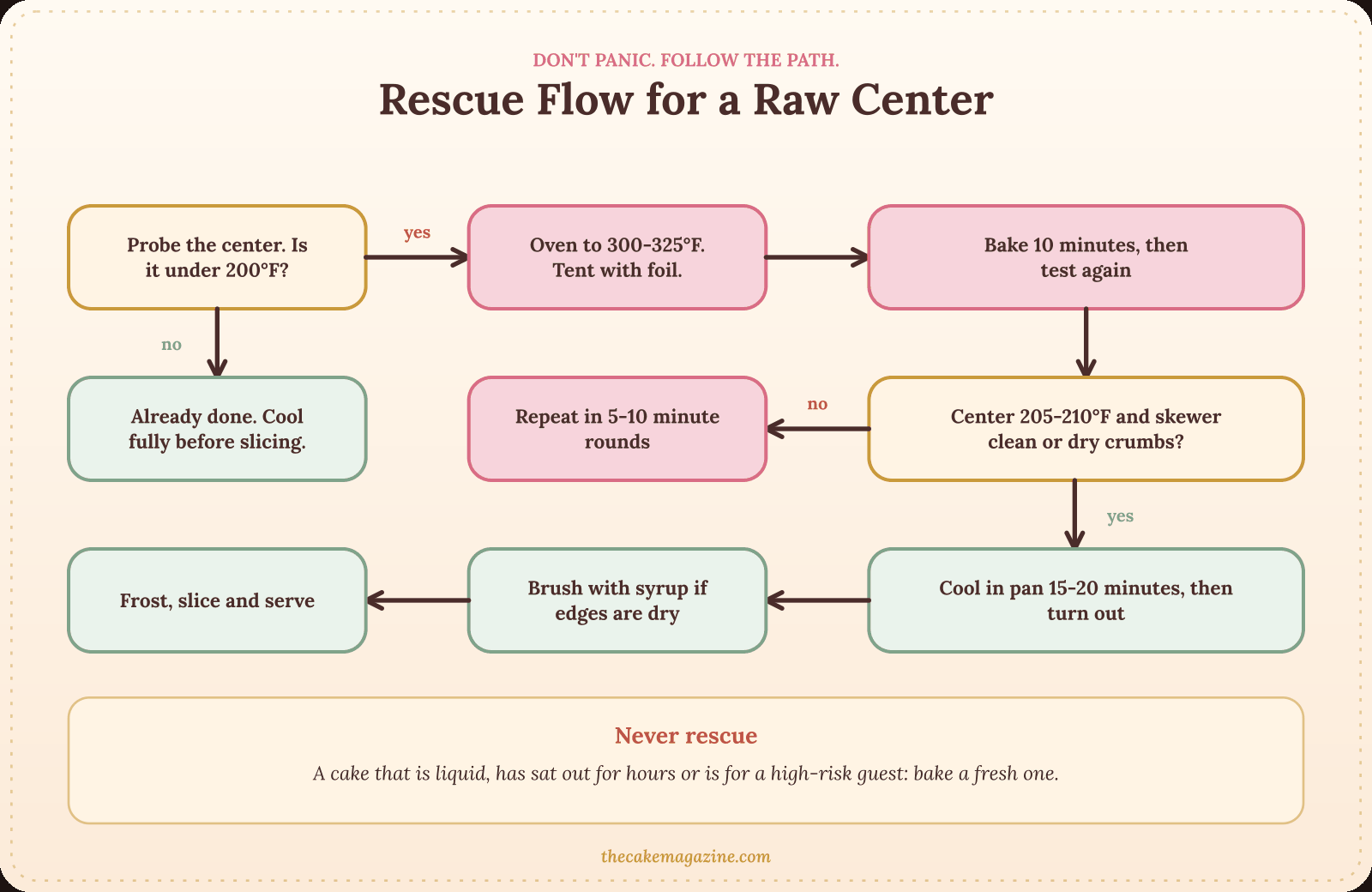
If your cake raw in middle is still in the pan and warm
Put it straight back in the oven. Lower the temperature to 300°F to 325°F, so the top does not burn, and tent the cake loosely with foil. Bake for 10 to 15 minutes, then test the center again with a skewer or thermometer. Repeat in 5 to 10 minute rounds until the center reaches roughly 205°F to 210°F and the skewer comes out with a few dry crumbs. Most cakes recover well if you act while they are still warm.
If you have cut a small test hole, do not worry about it. A skewer hole is easy to hide with frosting. If you have cut a wedge to look inside, return the cake to the oven anyway, and shield the cut edge with a small piece of foil so it does not dry out. A cake raw in middle will keep cooking from the cut face, but the exposed crumb may be a little firmer than the rest.
If your cake raw in middle has already cooled
A fully cooled cake can go back into the oven, though it will take longer to heat and the outer crust will be extra dry. Set the oven to 300°F, wrap the cake loosely in foil to hold in moisture, and bake for 15 to 25 minutes, checking the center. The outside may become drier than ideal, so plan to brush the layers with simple syrup and cover with frosting. Our guide to simple syrup for cake explains how to add moisture back without making the crumb soggy.
If the raw band is only in a small area, you may be able to slice it away. Level the cake, use a serrated knife to cut out the damp center, and use the firm ring in another way, such as cake cubes for trifle, cake pops or a cake base for a parfait. Keep in mind that this is a salvage job, not a restoration, so only use portions that are fully cooked and set all the way through.
If the middle is only slightly damp
Sometimes the center is just a touch dense and moist, not truly raw. In that case a longer rest might be all it needs. Let the cake cool completely in the pan, then chill or wrap it. Many butter cakes firm up and taste better after a night in the fridge or on the counter, because the crumb relaxes and the moisture redistributes. If the texture is still doughy and gluey after cooling, the starch never finished cooking, and it needs another trip to the oven.
The rescue checklist
Step 1: check the center with a thermometer. Under about 200°F means it is not done.
Step 2: drop the oven to 300°F to 325°F and tent the cake with foil.
Step 3: bake in 10 minute rounds, testing each time, until the center is about 205°F to 210°F.
Step 4: cool in the pan for 15 to 20 minutes, then turn out and cool completely.
Step 5: brush with syrup if the edges feel dry, then frost as planned.
What not to do
Do not crank the oven to blast the center. High heat just burns the surface more. Do not microwave the cake as a shortcut, since it heats unevenly and can leave dry, rubbery patches beside raw ones. And do not serve a cake that is still gluey in the center because it “tastes fine.” Look at the next section before you decide.
Food safety: when a cake raw in middle is not worth saving
A cake raw in middle is not just a texture problem. Cake batter contains raw flour and raw eggs, and both can carry germs that only heat destroys. The U.S. Department of Agriculture’s Food Safety and Inspection Service explains safe handling of eggs and other foods on its food safety pages, and the guidance is consistent: cook eggs until they are firm, and do not eat raw batter.
The Centers for Disease Control and Prevention lists raw cookie dough and raw batter among the riskier foods for pregnant people, especially when they contain raw flour or raw eggs. The CDC also notes that egg dishes without meat should reach 160°F. A cake that is truly raw in the center has not been through that kind of heat. Baked to its normal 205°F to 210°F, a cake is well past those numbers, which is why finishing the bake matters.
Who should be extra careful
Young children, older adults, pregnant people and anyone with a weakened immune system are more likely to get seriously ill from foodborne germs. If you are baking for any of these guests, do not serve a slice with a raw or gluey center, even if it looks mostly baked. When a cake is only slightly underdone and you return it to the oven until it reaches the proper range, it is fine. When in doubt, toss it and bake again.
If the center is liquid, glossy and clearly uncooked, and the cake has already cooled and sat out for hours, bake a new one instead of reviving it. Batter that has sat at room temperature for a long time is a risk of its own. This page offers general guidance, not medical advice. For specific concerns, check the USDA and CDC pages or ask your healthcare provider.
Tasting raw batter
Tasting a spoonful of raw cake batter is a baker’s habit, but it carries a real, if small, risk. Raw flour is not a ready-to-eat food, and raw eggs can carry Salmonella. If you must taste, lick the spatula only from batters made without eggs, or bake a small test cupcake. A baked taste test also tells you more about the flavor of the finished cake than a raw spoonful does.
Bundts, sheet cakes, cupcakes and tall tiers
Different cake shapes fail in different ways, so the fixes shift slightly. The rule underneath stays the same: keep the distance from the heat to the center as short as you can, and bake slowly enough for the middle to keep up.
Bundt and tube cakes
A bundt pan has a central tube that carries heat into the middle, so these cakes usually bake through well. The risks are overfilling, thick batter and dark, heavy pans. A raw spot in a bundt is often in the ridges near the bottom, or around the base of the tube. Fill the pan only about two-thirds full, tap out air pockets, and test in several places before you pull it. Our bundt cake guide covers pan prep and release.
Sheet cakes and 9×13 pans
A sheet cake is shallow, so it tends to bake through more quickly, but it also has more surface and more corners. The edges and corners can overbake while the center is still soft. Check the center in two or three spots, and use a lower, steadier temperature for thick batters. See our sheet cake guide for pan sizes and bake times.
Cupcakes and mini cakes
Small cakes cook fast and rarely turn out as a cake raw in middle, unless the oven is far too cool or the liners are overfilled. If your cupcakes dip in the middle, the batter was likely too wet or the oven too cool. Fill liners about two-thirds full. If you plan to turn batter into small cakes, our mini cakes guide shows how to scale the time.
Tall and wide layers, and heating cores
The risk of a cake raw in middle rises with the width and height of the cake. A 12-inch or 14-inch layer, or a very tall one, takes a long time to heat all the way to the middle. Many bakers lower the oven to 300°F or 325°F for these, wrap the pan in strips, and bake for an hour or more.
A heating core or flower nail, a metal rod or cone placed in the center of the pan, carries heat inward and shortens the bake. Use it carefully, and follow the manufacturer’s directions.
Keep in mind that a large pan holds a lot of heat. Even after you take it out, the center keeps cooking for a while. Large cakes also cool slowly, so give them extra time before you turn them out, or the soft center can tear. It also helps to bake large cakes as two thinner layers instead of one tall one.
Bundt
Fill two-thirds full. Test near the base and ridges. Lower heat helps thick batters.
Sheet cake
Check the center and corners. Expect a shorter bake, and do not overfill.
Cupcakes
Two-thirds full liners. Check the oven temperature before blaming the batter.
Tall or wide layers
Go lower and slower. Consider strips or a heating core, and split into thinner layers.
How to prevent a cake raw in middle next time
Prevention is about putting a few small habits in place before the cake goes into the oven. None of them is hard, and together they fix most problems before they start. If you only adopt two, make them a real oven thermometer and a kitchen scale. Everything else supports those two.
Your pre-bake checklist
- Oven preheated for 20 to 30 minutes, with a thermometer on the center rack showing the true temperature.
- Ingredients weighed in grams, at the temperature the recipe calls for.
- Pan the size and depth the recipe names, filled about half to two-thirds full.
- Pan material noted, and the oven lowered by about 25°F for dark, glass or ceramic pans.
- Cake strips on deep or wide pans, and layers divided by weight so they bake evenly.
- Foil ready to tent the top, and a thermometer or skewer ready for testing.
- Door closed for the first 25 to 30 minutes.
Keep a simple bake log
A short log turns a mysterious failure into a clear lesson. After each bake, write the recipe, the pan, the true oven temperature, the bake time and the center temperature when you pulled it. Add a photo of the cut cake. After three or four bakes, patterns appear: your oven runs hot by 20 degrees, or your 8-inch pans need 10 extra minutes. That knowledge is worth more than any rule on a page.
Common mistakes that lead to a cake raw in middle
Ten habits to drop
1. Trusting the oven dial. Use a thermometer.
2. Pulling the cake because the top is brown. Check the center instead.
3. Using a smaller pan than the recipe calls for. Deeper batter bakes slower.
4. Overfilling the pan. Stay under two-thirds.
5. Opening the door early. Wait 25 to 30 minutes.
6. Cranking the heat to save time. Slow and steady wins.
7. Skipping the scale. Cups vary; grams do not.
8. Adding wet ingredients without adjusting. Watch the water content.
9. Relying on the toothpick alone. Pair it with a thermometer.
10. Cutting into a hot cake. Cool it so the crumb can set.
When a cake raw in middle is just hot: cooling and slicing
Not every damp-looking center is underbaked. A cake straight out of the oven is still setting. The crumb is soft, the starches are still firming, and the steam inside has not yet escaped. Slice into it while it is hot and the knife drags and smears the crumb, leaving a gummy look that is really just an unfinished cooling process. Many bakers panic at this point, throw the cake back in the oven and overbake a perfectly good cake.
The fix is patience. Let a layer cake rest in its pan for about 10 to 20 minutes, turn it out, and let it cool fully before you judge it. Chilling a cake briefly makes it even easier to cut cleanly. If you tested with a thermometer and the center read 205°F to 210°F, trust the number. If the cake is fully cooled and the center is still wet and gluey, that is a real raw center, and the earlier rescue steps apply.
Steam and residual heat
Thick cakes hold heat for a long time. The center of a tall cake can stay hot for 30 minutes or more after it leaves the oven, and it keeps cooking gently during that time. Bakers call this carryover. It can finish a cake that is only a hair underdone, but it cannot rescue one that is truly raw. That is why you should never pull a cake early on the theory that it will finish on the rack.
Cutting with a clean knife
A warm knife dipped in hot water and wiped dry slides through crumb more cleanly than a cold, dry one. Use a long serrated knife with a gentle sawing motion, and wipe the blade between cuts. If the cake is a bit moist, a clean cut will also tell you more honestly whether the middle is set, because you will not mistake smeared crumb for batter.
Three example scenarios and how to read them
The scenarios below are illustrations, not case studies. They show how the causes in this guide combine in everyday kitchens, so you can compare them to your own bake and decide what to change first.
Scenario one: the dark pan and the hot oven
A baker uses two dark nonstick 8-inch pans for a recipe written for 9-inch pans, sets the oven to 350°F and pulls the cakes at 30 minutes because the tops are brown. The centers are wet. Three things stacked up: the dark pans absorb extra heat, the smaller pans make the batter deeper, and the oven may be running hot.
The fix is to use the right pan size, lower the oven to 325°F, and judge by center temperature. Each change alone would have helped, and together they solve the problem.
Scenario two: the fruity loaf
A banana cake with extra mashed banana, a handful of walnuts and some yogurt swapped for part of the oil bakes in a deep loaf pan. The crust is dark, but a ribbon of dense, damp crumb runs through the middle. Here the batter held far more water than the formula intended, and the loaf shape is deep and narrow, so the center is far from the heat.
The fix is to measure the banana by weight, shorten the loaf’s depth by splitting the batter into two pans, and bake lower and longer.
Scenario three: the pretty cake with no thermometer
A baker follows a recipe exactly, in the correct pan, but opens the oven door three times in the first 20 minutes to check on it. The cake rises, dips and finishes with a firm edge and a wet middle. Nothing about the recipe was wrong. The repeated cool-air blasts disrupted the rise and delayed the set. The fix is simply to keep the door closed, use the oven light, and test the center with a thermometer once the bake is nearly done.
In each one, the problem was a combination of small factors rather than one dramatic mistake. That is typical for a cake raw in middle. When you troubleshoot, change the most likely cause first, bake again and compare. Our full cake troubleshooting guide shows how to work through symptoms methodically.
High altitude, humidity and other kitchen variables
Altitude, humidity and even the season can nudge you toward a cake raw in middle. At high elevation, water boils at a lower temperature and leavening gases expand faster, so cakes rise quickly and then can collapse before the structure sets. Recipes often need less leavening and sugar, a little more liquid and a slightly hotter oven. Our guide to high-altitude cake baking lays out the adjustments in detail.
Humidity changes how flour behaves. Flour stored in a humid kitchen holds extra water, so the batter ends up wetter than the recipe expects, and it may take longer to set. Keep flour in an airtight container, and weigh it instead of scooping it. A cold kitchen, cold eggs or a chilled pan can slow the bake as well, so let ingredients come to room temperature and preheat the oven fully.
Oven quirks worth knowing
Gas ovens often have strong bottom heat and moist air, which can brown the cake bottom early. Electric ovens cycle on and off, so temperatures swing up and down. Older ovens can have worn gaskets that leak heat, and a crowded oven can shift temperature when pans go in. A countertop toaster oven heats from very close range and often browns tops before centers set. Whichever you have, learn it with a thermometer and a log, and adjust accordingly.
If you bake often and keep hitting problems, a second look at your equipment may be worthwhile. Our cake pan buying guide and oven thermometer guide are good places to start, and a cake raw in middle often disappears the day you finally learn what your oven is really doing.
Frequently asked questions about a cake raw in middle
Why is my cake raw in middle but cooked on the outside?
The outside touches hot metal and hot air, so it sets first, while the center is insulated by the batter around it. A hot oven, a deep or dark pan, a wet batter or an early pull widen that gap. Lower the oven by 25°F, bake longer and check the center with a thermometer instead of judging by color.
Can I put a cake raw in middle back in the oven?
Yes, in most cases. Return it at 300°F to 325°F, tent it with foil and bake in 10 minute rounds until the center reads about 205°F to 210°F. A cake raw in middle that is still warm recovers best, while a cooled cake will end up a little drier on the outside and may need syrup.
How long should I bake to avoid a cake raw in middle?
There is no single time, because pan size, depth, oven and batter all change it. A standard 8-inch or 9-inch layer often takes about 25 to 40 minutes at 350°F, while deeper or wider cakes take longer at lower heat. Use the time as a guide, and let the center temperature and a skewer decide.
What temperature should the middle of a cake reach?
For most butter, oil and chocolate cakes, about 205°F to 210°F in the center. King Arthur Baking gives a general range of roughly 200°F to 210°F, and notes many classic cakes finish near 210°F. Under about 200°F, expect a damp, gluey crumb, and keep baking.
Is it safe to eat a cake raw in middle?
It is best not to. Cake batter contains raw flour and raw eggs, and heat is what makes them safe. The CDC lists raw batter as a riskier food, especially for pregnant people, so return an underbaked cake to the oven or skip the raw slice. Children, older adults and people with weak immune systems should be extra cautious.
Why does my cake raw in middle sink after I take it out?
An unset center cannot hold up its own weight. As the cake cools, the steam and air inside contract, and the soft middle collapses into a dip with a gummy, dense layer under it. The cure is the same: bake it long enough for the structure to set, and avoid opening the oven door early. See our sinking cake guide for more.
Does a darker pan leave a cake raw in middle?
It can contribute. Dark and nonstick pans absorb more heat, so the outside browns and sets faster than the middle. Many bakers drop the oven by about 25°F when using dark pans, and tent the top with foil if the edges darken early. Light aluminum pans are usually the most forgiving choice for cakes.
Do cake strips help with a cake raw in middle?
They help with deep or wide layers. Damp strips keep the pan walls cooler, so the edges set more slowly and the middle has time to catch up. The result is a flatter, more even cake that is less likely to be raw in the center. Expect to add roughly 5 to 15 minutes to the bake.
Can too much baking powder make the middle raw?
Yes, indirectly. Too much leavening makes the cake rise fast and then collapse, packing the center into a dense, heavy layer that is slow to cook. Too little leavening can also leave a dense, damp crumb. Measure with level spoons or a scale, and test your baking powder in hot water every few months.
Why is a carrot or banana cake raw in middle more often than a vanilla one?
They carry lots of moisture from fruit and vegetables, plus heavy add-ins like nuts, which slow heat and weigh down the batter. They often need a lower oven, a longer bake and a center reading near 210°F. Splitting the batter into shallower pans or making cupcakes also helps them cook through.
Should I lower the oven temperature for a cake raw in middle?
Often, yes. Dropping the temperature by 25°F and extending the bake time lets the center catch up before the crust finishes. First confirm your real oven temperature with a thermometer, because the dial can be off. If the oven runs hot, you may only need to correct that.
Can I fix a cake raw in middle by cutting out the center?
Sometimes, but it is a salvage move. Level the cake and cut away the damp center with a serrated knife, then use only the firm, fully cooked portion in trifles, cake pops or parfaits. Do not use any crumb that is still gluey or wet. For a special occasion, baking a fresh cake is usually the safer, tastier choice.
How can I stop a cake raw in middle from happening again?
Use an oven thermometer, weigh your ingredients, match the pan to the recipe and fill it only half to two-thirds full. Keep the door closed early in the bake, use the center rack, and check the center with a thermometer before you pull the cake. A short bake log helps you spot patterns in your own oven.
Final thoughts
A cake raw in middle feels like a betrayal, since everything looked right until the knife went in. But it is one of the most fixable problems in baking, because the causes are physical and easy to test. Heat has to get to the center before the outside is finished. Your oven, your pan, your batter and your timing all decide whether it does, and each can be adjusted without changing the flavor of the cake.
Start with the two tools that solve most of it: an oven thermometer and a kitchen scale. Then match your pan to the recipe, fill it modestly, bake a little lower and slower when the batter is deep or heavy, and check the center directly. When you do end up with a cake raw in middle, put it back in the oven while it is still warm and try again with one change. You will learn something every time, and your cakes will get better for it.
Editorial note: reviewed and updated November 2026. This guide offers general baking and food-safety information for home bakers in the United States, using American measurements. Temperatures, bake times and pan adjustments are starting points that vary by oven, pan, altitude and ingredients, and they have not been oven-tested by this site. Food-safety guidance is general and not medical advice. For more, see the King Arthur Baking cake guide, the CDC food safety guidance for pregnant people and the USDA food safety pages.