Ask ten couples about the best wedding cake flavors and you will get ten different answers, plus a lot of worry about guests. Will the vanilla seem boring? Will the passion fruit scare Uncle Ray? Is it rude to pick chocolate when half the family wants lemon? This guide takes the pressure off. It explains how to choose the best wedding cake flavors for your own day, with classic pairings that rarely miss, modern twists that feel personal and practical ways to keep a mixed guest list happy.
The best wedding cake flavors are the ones you both love, most guests will happily eat and your venue can keep stable. Vanilla, chocolate, lemon, strawberry, almond, red velvet and carrot cake remain the safest choices, paired with fillings like raspberry, salted caramel, lemon curd or cream cheese. Add one modern twist, ideally in a single tier, and always taste before you decide.
- How to choose the best wedding cake flavors
- Cake, filling and frosting: three choices, not one
- Classic pairings among the best wedding cake flavors
- Modern twists that still feel like wedding cake
- Guest-friendly choices for a mixed crowd
- Allergies and dietary needs
- Planning flavors tier by tier
- Season, heat and venue
- Which fillings hold up best
- How to taste your way to the best wedding cake flavors
- Budget, size and what flavor does to the price
- Sample flavor plans for different couples
- Groom’s cakes, cupcakes and extras
- A quick checklist for choosing the best wedding cake flavors
- Common mistakes to avoid
- FAQ
How to choose the best wedding cake flavors
Before you scroll through photos of lavender honey and miso caramel, it helps to ask a quieter question. What do you actually want to eat on your wedding day? The best wedding cake flavors are not a universal list. They are the overlap between what the two of you love, what your guests are likely to enjoy and what a baker can deliver reliably in your venue and season. Start with that overlap and the decision gets much easier.
A wedding cake has a strange job. It has to look beautiful in photographs, feed a crowd of people with very different tastes and still taste like something worth the money. Most guests get a slice about the size of a deck of cards, often after a full dinner and a few hours of dancing. That means the best wedding cake flavors are pleasant, balanced and easy. It does not have to be dramatic to be memorable.
Five questions to ask before you pick the best wedding cake flavors
Sit down together and answer these in plain words. Disagreements here are useful, because they show you where to compromise before the baker is involved.
- What is your favorite dessert, honestly? Not the one that photographs well. The one you order at a restaurant without reading the menu.
- Who is on the guest list? Kids, grandparents, coworkers and food-loving friends all want slightly different things.
- What is the season and the venue? A July garden and a January ballroom call for different fillings.
- When is the cake served? After a heavy dinner, a lighter, fruitier cake often lands better than another rich one.
- How many tiers do you want? More tiers means more room for more than one flavor, which can solve a lot of arguments.
Once you have those answers, you can build a short list of two or three candidates. A short list matters more than people expect. Bakers often offer a dozen cake flavors and as many fillings, and the number of possible combinations is dizzying. Narrowing it down before the tasting makes the appointment far more useful.
Choose for the room, not the internet. A flavor that is everywhere on social media is not automatically one of the best wedding cake flavors for your guests. Trends fade, but your photos and your memories will not. When you are torn, pick the combination you would be happy to eat on your first anniversary.
If you are still working on the bigger picture, our wedding cake guide covers design, servings, budget, delivery and cutting in one place. Flavor is one decision among several, and it works best when you make it alongside the others rather than in isolation.
Cake, filling and frosting: three choices, not one
People talk about flavor as if it were a single thing, but every slice has at least three parts working together. There is the cake itself, the filling between the layers and the frosting on the outside. Choosing the best wedding cake flavors really means choosing a combination, and a combination only works when the parts support one another.
The cake layer in the best wedding cake flavors
The cake sets the tone. Vanilla and white cakes are mild and let the filling speak. Chocolate is deeper and more assertive. Lemon is bright. Almond adds a warm, slightly floral note. Red velvet and carrot lean on tang and spice. Each has a different texture, too. A butter-based vanilla is tender and a little dense, which makes it excellent for carving and stacking. A lighter sponge feels airier but can be more delicate to stack.
If you like baking, the principles behind these layers are explained in our guides to vanilla cake and chocolate cake. You will not be baking your own wedding cake, but understanding why a crumb is moist or sturdy helps you ask your baker better questions.
The filling that makes the best wedding cake flavors sing
Fillings carry most of the personality of the best wedding cake flavors. A thin layer of raspberry preserves between vanilla cake and buttercream is one of the most loved combinations in the wedding world for a reason: the tartness cuts through sweetness and keeps each bite lively. Lemon curd, salted caramel, ganache, fresh berries with cream and cream cheese are other common choices. Each one behaves differently in heat and in storage, which we cover in the stability section below.
The frosting and finish
The outside of the cake is usually buttercream, fondant or a mix of both. Fondant is a sugar paste that gives a smooth, sculpted surface, and many people peel it off. Buttercream carries flavor and is generally more welcome on the plate. A very sweet frosting can overpower a delicate cake, so if you love subtle flavors, ask about meringue-style buttercreams. Our guide to the different types of buttercream explains how they compare, and the Swiss meringue buttercream article shows why it is such a favorite for weddings.
Classic pairings among the best wedding cake flavors
Classic does not mean boring. These pairings have lasted because they balance sweetness, acidity, richness and texture. If you are unsure where to begin, begin here. The pairing wheel below shows six cakes and the fillings that most often partner with them.
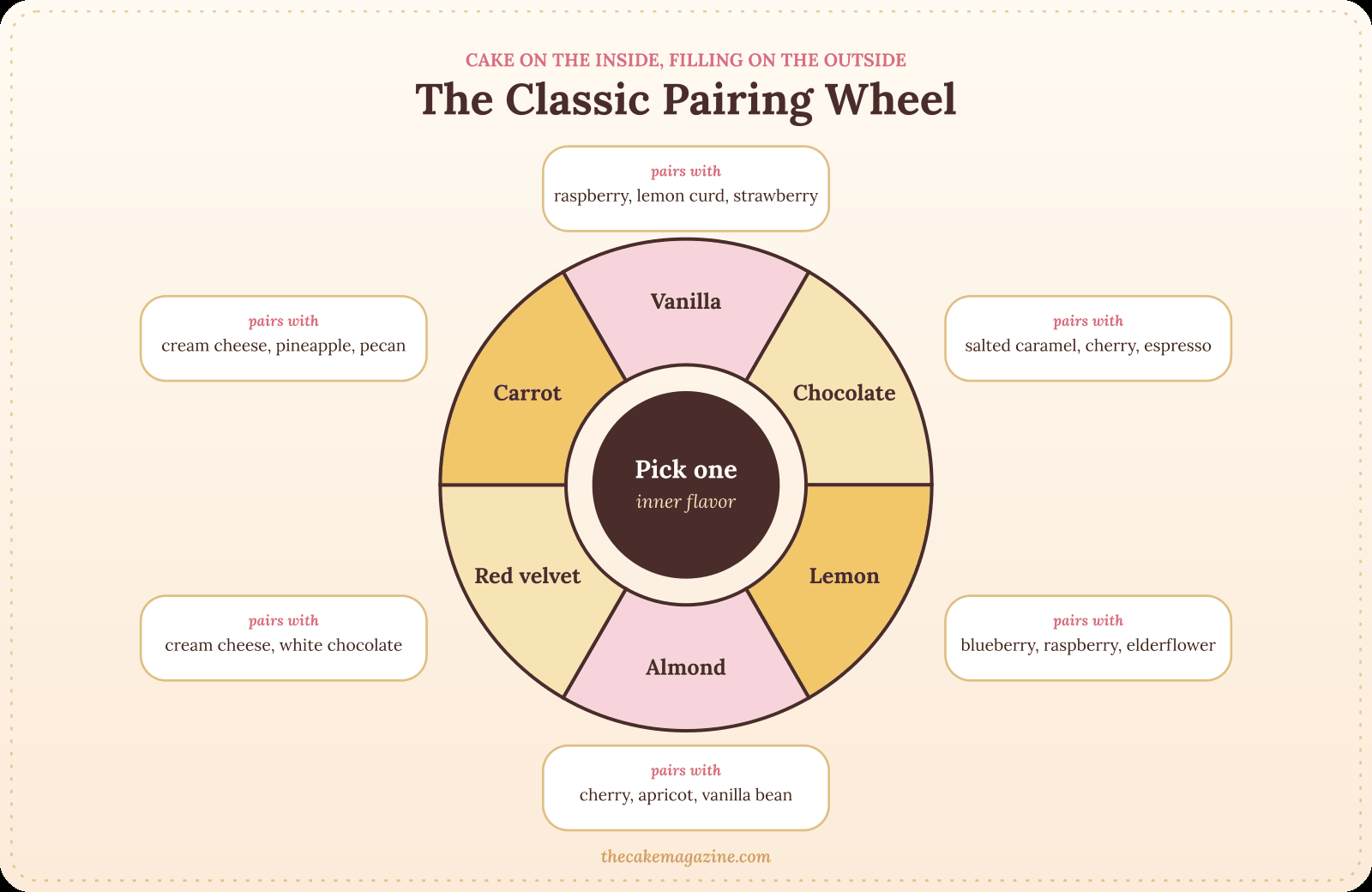
Use the wheel as a menu of the best wedding cake flavors rather than a rulebook. Pick a cake on the inner ring, then glance outward for ideas. Most bakers will happily mix across the wheel if you ask, such as lemon cake with raspberry filling or almond cake with apricot.
Vanilla bean with raspberry
The wedding standard for good reason. Tender vanilla cake, a thin ribbon of raspberry preserves and silky buttercream. Mild enough for children, interesting enough for grown-ups, and it photographs beautifully when cut because of the pink stripe.
Chocolate with salted caramel
Deep cocoa cake with a thin layer of salted caramel and chocolate or vanilla buttercream. The salt keeps it from tasting cloying. This is the usual answer to the question of what to do for the chocolate lovers in your family.
Lemon with blueberry or raspberry
A bright, fresh combination that suits spring and summer and sits lightly after a big dinner. Lemon curd is tart and glossy, and berries add color. Ask your baker how they keep the filling from making the layers slide.
Almond with cherry or apricot
Almond cake tastes warm and a little nutty, with a fruit filling that keeps it from feeling heavy. It is a quiet, elegant choice, but remember it contains tree nuts, so it needs careful labeling.
Red velvet with cream cheese
Cocoa-tinged and tangy, with a cream cheese frosting. Our red velvet cake guide explains the chemistry. Cream cheese frosting is soft, so it is better for cool venues or as a filling under a sturdier exterior.
Carrot with cream cheese and pecans
A spiced, moist cake that feels cozy and autumnal. It has a loyal fan base and works well for fall and winter weddings. Like red velvet, it leans on cream cheese, so ask about stability. See our carrot cake recipe for what makes it so moist.
For a first-time couple choosing a single flavor for a whole cake, vanilla with a fruit filling is hard to beat. It pleases almost everyone, and it accommodates the most decorating styles. If both of you adore chocolate, though, there is no rule against a chocolate wedding cake. The best wedding cake flavors are the ones you will be excited to cut into.
Why simple pairings keep winning among the best wedding cake flavors
Simple pairings dominate the best wedding cake flavors because wedding slices are small and eaten in a hurry. A guest will take three or four bites, usually while talking. In that short window, clear flavors read better than complicated ones. A cake with eight ingredients in the filling might be delicious at a restaurant, where each bite has your full attention, but at a reception it can taste muddled.
That is one reason professional bakers tend to recommend limiting each tier to one cake, one filling and one frosting. If you want complexity, put it in a single element, such as a lemon curd with a hint of thyme, and keep the rest straightforward.
Modern twists that still feel like wedding cake
If the classics feel too safe, there is a lot of room to play. The trick is to change one thing at a time. A familiar base with one surprising note feels thoughtful. A cake where everything is surprising can feel like a science fair. Some of the best wedding cake flavors for couples who want something personal are simply the classics with a small, well-chosen upgrade.
Twists on vanilla: modern takes on the best wedding cake flavors
- Brown butter and vanilla. Browning the butter adds a toasty, nutty depth, and most guests simply describe it as extra buttery.
- Honey and lavender. Floral, soft and pretty. Use a light hand, because too much lavender tastes like soap.
- Earl grey or chai. Tea steeped in the milk or syrup gives a gentle aroma that suits an afternoon wedding.
- Coconut and lime. A tropical favorite for summer and beach weddings, bright and a little creamy.
- Champagne. Often more of an idea than a taste. Ask what the baker actually uses, because the sparkle rarely survives baking.
Twists on chocolate
- Chocolate with espresso. Coffee deepens cocoa without tasting like coffee. A good fit for evening receptions.
- Chocolate with raspberry. A classic that reads as modern when the berry is tart and the chocolate is dark.
- Chocolate with hazelnut. Rich and a little nostalgic. Mind the nut allergy, as always.
- Mexican chocolate. A touch of cinnamon and a gentle warmth from chili for guests who like a quiet kick.
Twists with fruit and flowers
- Strawberry and cream. Real berry flavor is harder than it sounds. Our strawberry cake recipe shows how bakers get fruit flavor without a wet crumb.
- Passion fruit and mango. Vivid and tart. Wonderful in a small tier, and worth tasting first.
- Lemon with elderflower. A fragrant and very elegant combination, and a long-time favorite in the United Kingdom.
- Rose and pistachio. Beautiful with a pale green and pink palette, but a polarizing flavor, so use it as an accent.
- Olive oil and citrus. A moist, slightly savory cake that suits Mediterranean themes.
Twists that nod to the couple
Some of the most memorable choices have a story attached. A cake flavored like the cocktail you had on your first date, the pie your grandmother made or the dessert from the restaurant where you got engaged will always be more meaningful than whatever was popular this year. Guests tend to love hearing the story, and it gives you something to say when someone asks why there is an unusual flavor on the menu.
Just make sure the personal flavor works as cake. Key lime pie, for instance, translates well. Tiramisu translates well too, with espresso-soaked layers and mascarpone filling, though it needs refrigeration. A flavor like cereal milk might be fun at a casual party but feel odd at a formal dinner. Your baker is the best judge of what will bake and hold well.
One adventurous tier is plenty. If you want the best wedding cake flavors for a crowd and a personal twist, give the bold flavor to a smaller tier, often the top. Guests who want the safe option still have a large tier to choose from, and you get your story on the cake.
Guest-friendly choices among the best wedding cake flavors
Every guest list is a patchwork. There will be kids who want chocolate, grandparents who prefer something plain, a cousin who avoids sugar and a friend who is vegan. You cannot please everyone completely, but you can make smart choices that please most people most of the time. The dial below is a simple way to picture it.
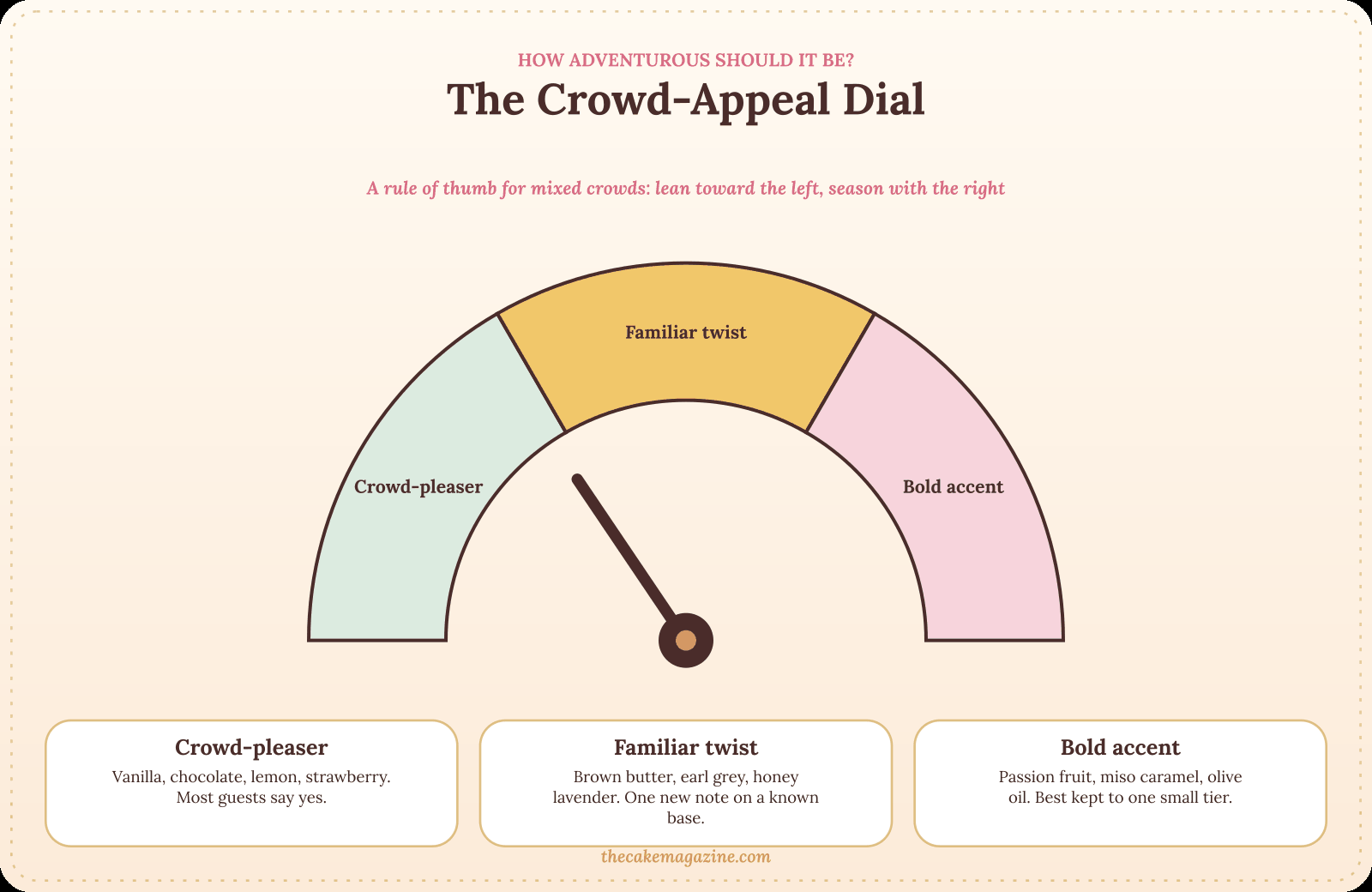
Think of your cake flavors on a dial with three zones. On the left are crowd-pleasers like vanilla, chocolate, lemon and strawberry. In the middle are familiar twists, which are those same flavors with one new note. On the right are bold accents. For most mixed receptions, the best wedding cake flavors sit mostly on the left, with a pinch from the middle. A bold flavor is a bonus, not the foundation.
The easiest ways to serve the best wedding cake flavors to a mixed crowd
There are practical strategies that work better than hunting for one perfect flavor, and they apply to nearly all of the best wedding cake flavors.
- Use different flavors in different tiers. A three-tier cake with vanilla, chocolate and lemon covers most preferences without needing three cakes.
- Add a plain, sturdy option. Many guests are happiest with a slice of vanilla with a simple fruit filling.
- Offer a sheet cake in the kitchen. A small display cake with a larger sheet cake behind the scenes lets you serve more flavors for less. Our comparison of wedding sheet cake versus tiered cake explains the trade-offs.
- Consider a dessert table. If you want variety, a wedding cake versus a dessert table may suit you, with the cutting cake as the centerpiece.
- Keep sweetness moderate. After dinner, a cake that is bright and not too sweet often gets more second helpings.
What kids and older guests tend to like in the best wedding cake flavors
Children generally lean toward chocolate, vanilla and anything with sprinkles or sweet frosting. Older guests often prefer simpler flavors, lemon, almond or classic yellow cake, and a smaller, less sweet slice. None of this is a rule, just a tendency you can use. If your guest list skews young or old, bias the biggest tier toward them.
Regional and cultural traditions matter too. Many families have a cake they have always had at weddings, from a rum-soaked fruitcake to a tres leches. If an older relative would be moved to see it, think about including a small version. Our article on anniversary cakes also covers recreating wedding flavors years later, which is a good reason to choose something you will want to taste again.
Allergies and dietary needs
Food allergies are the one area where the best wedding cake flavors have to give way to safety. The U.S. Food and Drug Administration lists nine major food allergens: milk, eggs, fish, crustacean shellfish, tree nuts, peanuts, wheat, soybeans and sesame. Cake commonly contains milk, eggs, wheat and often soy or tree nuts, so a typical wedding cake is not safe for people avoiding those foods.
What to ask your baker
- Does the bakery handle nuts, dairy, eggs, wheat or soy in the same space? Cross-contact is a real risk even if a cake has no nuts in the recipe.
- Can they make a separate cake for a guest with a serious allergy, and in what conditions?
- Can the ingredient list be provided in writing, so the caterer and the guest can review it?
- How will the allergy-safe cake be boxed, labeled and kept apart from the main cake?
For a guest with a severe allergy, the safest approach is usually a separate, individually labeled dessert from a kitchen that can speak confidently about cross-contact, ordered in advance. Do not rely on guesses or on a menu description alone. If a baker is not comfortable making an allergy-safe cake, that is useful information, and you should believe them.
Gluten-free, dairy-free and vegan versions of the best wedding cake flavors
Many bakers now offer gluten-free, dairy-free or vegan versions of the best wedding cake flavors, as either as a full tier or as a small separate cake.
These cakes can be delicious, but they bake and behave differently. Some are denser, some are more crumbly and some are very sweet. Taste them at your tasting rather than assuming they will match the regular flavors. Ask whether the cake is made in a dedicated space or in a shared kitchen, because a gluten-free cake baked next to wheat flour is not safe for someone with celiac disease.
If only a few guests need a special diet, a small separate cake or a set of labeled cupcakes is often easier and safer than making the whole cake free-from. Tell your caterer, so servers know which plate is which and do not mix them up while cutting.
General information only. This guide is not medical advice. If a guest has a serious allergy, talk to them directly, ask your baker for written ingredient information and follow guidance from a qualified professional. When in doubt, choose a safe alternative over a risky cake.
Planning the best wedding cake flavors tier by tier
A multi-tier cake is the easiest way to offer variety without ordering extra cakes. Each tier is its own cake with its own layers and filling, so there is no technical reason the tiers must match. The challenge is making the combination feel intentional. A good tier plan has a clear logic, whether that is bright to rich, light to dark or simply your favorites in order of size.
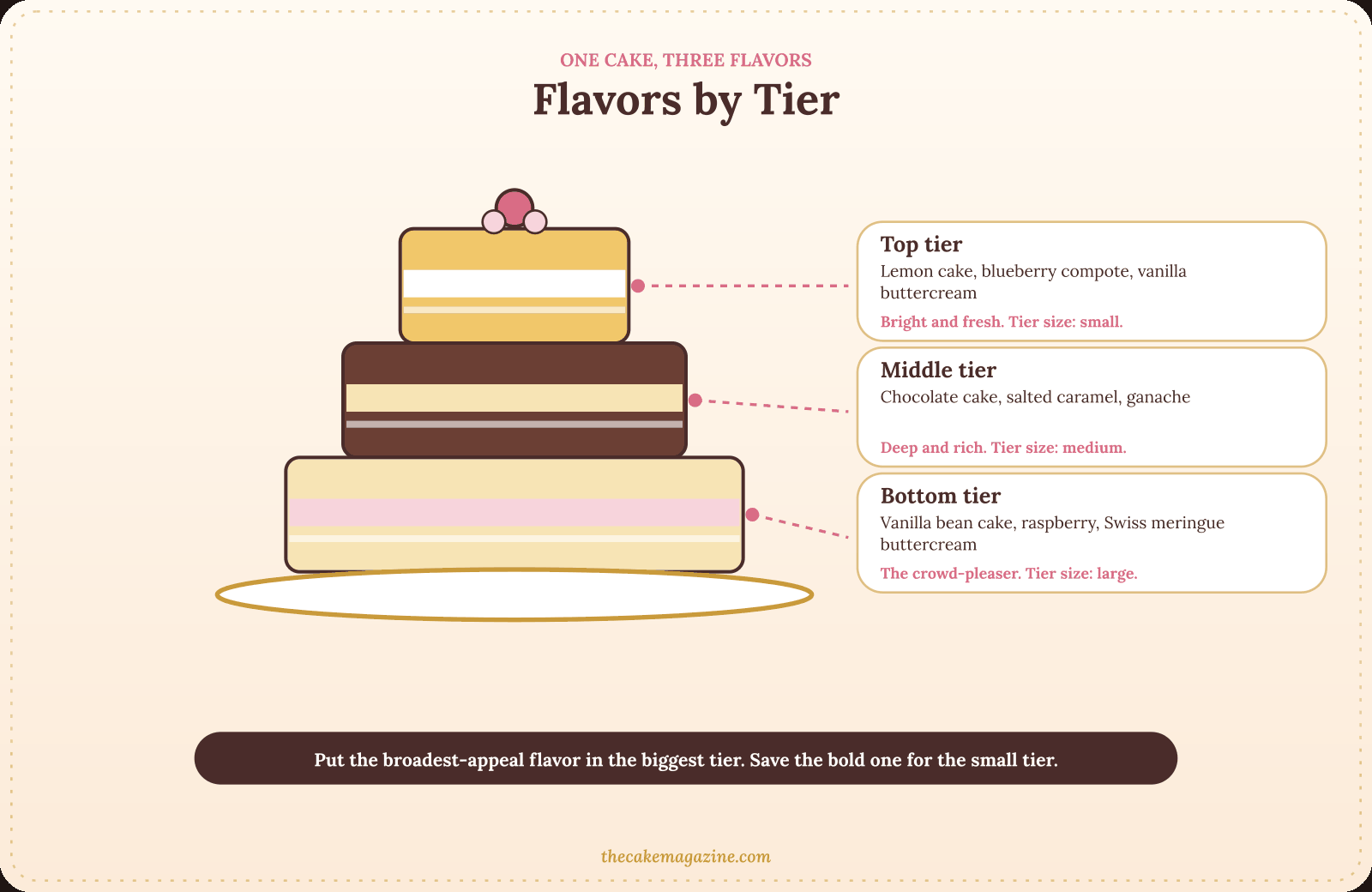
The illustration shows a simple version. The big bottom tier carries the crowd-pleaser, because it will serve the most people. The middle tier holds the rich option for chocolate fans, and the small top tier gets the brightest, most adventurous flavor. That top tier is often saved or sampled first, so it is the right place for a flavor you feel personal about.
Rules that keep the best wedding cake flavors harmonious across tiers
- Match intensity, not just flavor. A very strong tier next to a very mild one can make the mild one disappear on the plate.
- Keep one frosting. Using the same buttercream on the outside keeps the cake looking unified and simplifies the baker’s work.
- Put the biggest flavor where the biggest crowd is. Serving counts differ by tier, so check the numbers in our wedding cake serving guide.
- Limit yourselves to two or three flavors. Four or five different tiers can feel scattered, and each extra flavor adds complexity for the bakery.
- Think about the cut. Servers often cut and plate all tiers together, so flavors that taste fine next to each other on one plate are a plus.
Some couples choose a simple structure: one flavor for the main cake and a second flavor for the top tier, which becomes the anniversary tier. If that is your plan, read our guide on saving the top tier of a wedding cake first. It explains why many bakers suggest a fresh anniversary cake instead of freezing a year-old tier, and flavor is part of that conversation.
When a single flavor beats a mix of the best wedding cake flavors
You do not have to mix flavors. A single, beautifully made flavor, especially a small cake for an intimate wedding, can feel more refined than a mix. If you are serving fewer than fifty guests, or the cake is mostly a photo-and-cutting moment while a dessert table does the heavy lifting, one great flavor is enough. The best wedding cake flavors for small weddings are often the simplest ones executed well.
Dummy tiers and flavor
If you are using foam tiers for height and a smaller real cake for serving, you only need to pick flavors for the real portion. That can free the budget for a more interesting filling or a second flavor. Our explainer on dummy wedding cakes covers how they work and what they cost, and it is a useful read if you are weighing real tiers against decorative ones.
Season, heat and venue shape the best wedding cake flavors
The calendar and the venue quietly shape which flavors will actually succeed. A rich chocolate cake with a cream cheese frosting might taste wonderful in December, but it is a gamble on an outdoor July afternoon. When people ask for the best wedding cake flavors, a sensible answer is always, “It depends on where and when.”
Spring and summer
Warm-weather weddings favor bright, fruity and floral flavors. Lemon, strawberry, raspberry, coconut and passion fruit feel right and sit lightly. Fresh fruit and flowers on the outside are lovely, but make sure any fruit toppings are not left in the heat for hours. The bigger issue is temperature. Buttercream softens quickly, and fillings with fresh cream or custard are riskier outdoors.
Fall and winter wedding cake flavors
Cooler months welcome deeper, warmer picks among the best wedding cake flavors: chocolate, spice cake, carrot, apple, pumpkin, caramel, coffee and gingerbread. Indoor venues are usually cooler and more controlled, so cream cheese frosting and ganache are easier to manage. This is also the time of year when richer flavors feel most welcome, especially for evening receptions.
Outdoor, tent and barn venues
Heat is the enemy of any cake. According to the U.S. Department of Agriculture’s Food Safety and Inspection Service, the “danger zone” for perishable food is 40°F to 140°F, where bacteria can multiply quickly. Perishable food should not sit in that zone for more than two hours, and the limit drops to one hour when the temperature is above 90°F. You can read more at the USDA food safety pages.
What does that mean for cake? Many cakes made with butter, shortening or sugar-heavy frostings are fairly shelf-stable for a few hours, but fillings with fresh dairy, custard, whipped cream or fresh fruit are more perishable. Ask your baker which fillings in your design need refrigeration and for how long. For hot outdoor events, choose stable fillings, keep the cake in the shade or indoors until the last moment and cut it on schedule rather than letting it sit on display all day.
Do not guess about perishable fillings. If your cake contains custard, pastry cream, mousse or fresh whipped cream, ask the baker for storage and display guidance in writing. Rules for commercial bakeries are set by your state and local health agency, so ask them or your baker for specifics. For a setup plan, see our wedding cake setup checklist.
Transport matters too
A cake that must travel an hour in a hot van needs sturdier fillings than one baked down the street. Heavy fruit fillings can make tiers slide, and soft frostings can dent. Delivery planning is covered in our guide to transporting a wedding cake, but the short version is to tell your baker your venue and travel time when you discuss flavors, not afterward.
Which fillings hold up best under the best wedding cake flavors
Fillings deserve their own discussion because they are where taste and engineering collide. A filling has to taste great, stay inside the cake and survive the journey and the party. Some are naturally better at that than others, which is why a baker may steer you away from a favorite filling for an outdoor summer wedding.
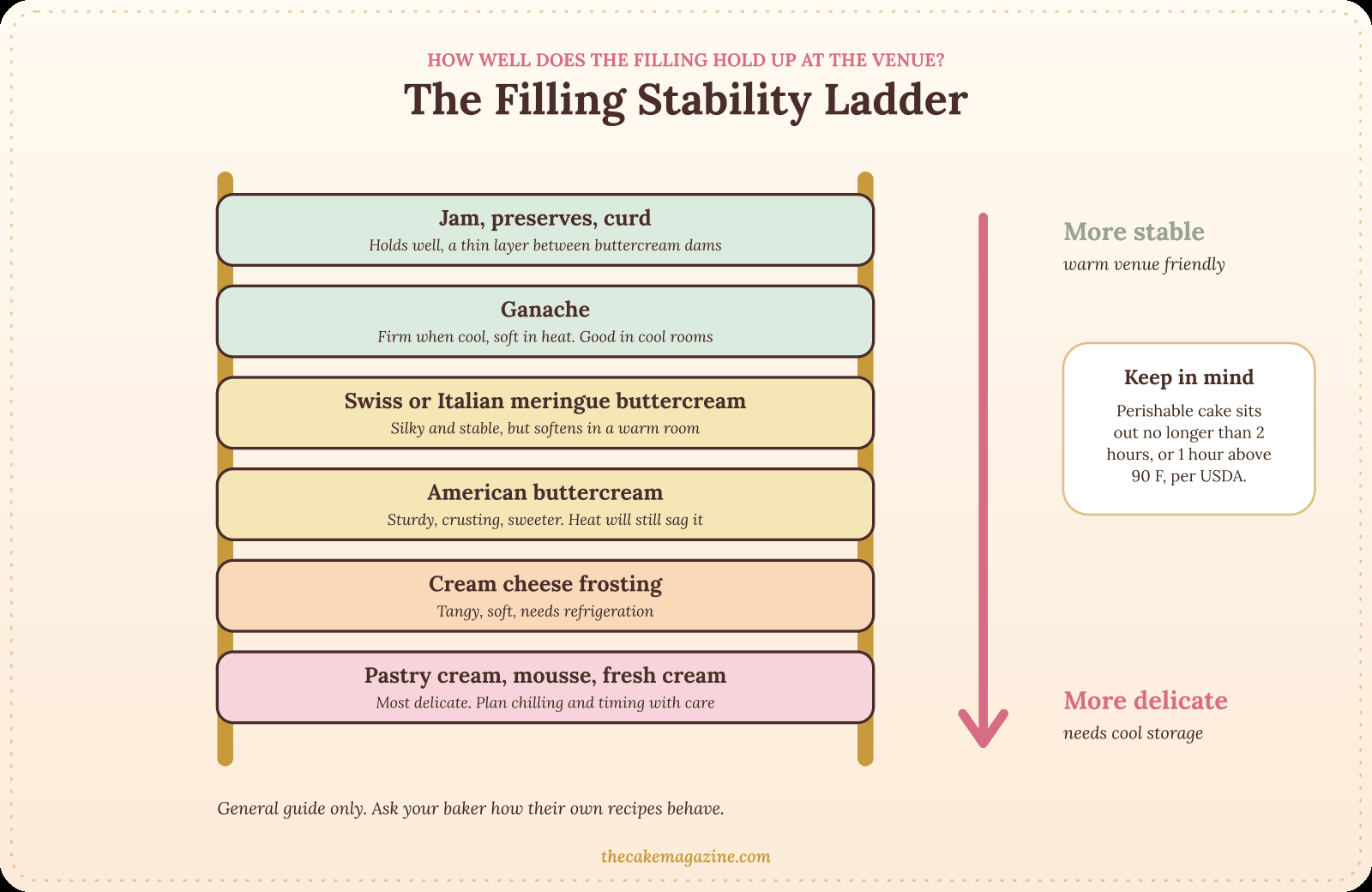
The ladder shows a general guide, from the most stable fillings at the top to the most delicate at the bottom. Individual recipes vary, and a skilled baker can make almost any filling work with the right structure. Treat it as a conversation starter rather than a ranking.
Jam, preserves and curds
Fruit preserves and curds are popular because they are bright, concentrated and relatively stable in thin layers. Bakers usually pipe a ring of buttercream, called a dam, around the edge of each layer so the filling stays in place. A thin layer of raspberry or lemon curd inside a dam is one of the most reliable ways to add flavor to the best wedding cake flavors without risking a collapse.
Ganache and chocolate fillings
Ganache, a mixture of chocolate and cream, firms up when cool and softens when warm. In a cool room it is sturdy and delicious. In a hot room it may go glossy and soft. Our chocolate ganache guide explains ratios and how they change texture, which helps you understand why a baker may use a firmer version inside a wedding cake.
Buttercream fillings
Buttercream is the most common filling and frosting. American buttercream, made from butter and powdered sugar, is sturdy and sweet. American buttercream forms a light crust and holds piping well. Meringue-based buttercreams, including Swiss and Italian meringue buttercream, are silkier and less sweet, though they soften more in warm rooms. Many couples find them more refined, and some find them richer than expected, so taste before deciding.
Cream cheese frosting
Cream cheese frosting is tangy and beloved, but it is softer than most buttercreams and needs to be kept cool. Our guide to cream cheese frosting covers its structure and limits. Many bakers use it as a filling between carrot or red velvet layers and finish the outside with a sturdier buttercream, so you get the flavor without the stability risk.
Fresh fruit, custard and cream
Fresh strawberries and cream, pastry cream and mousse taste lovely and light, but they are the most delicate fillings. They need refrigeration and careful timing, and they can make layers weep or slide if used generously. If you adore them, discuss a plan: a cool venue, a short display window and a baker with experience. Otherwise, consider a stable filling and serve fresh fruit alongside the slice.
How to taste your way to the best wedding cake flavors
You can read lists of the best wedding cake flavors all day, but your own tongue is the final judge. A tasting turns abstract ideas into actual bites, and it is also where you find out whether a baker is right for you. Our dedicated wedding cake tasting guide covers what to ask and how to compare bakers. Here is the flavor side of it.
Before the appointment: shortlist the best wedding cake flavors
Do a little homework so you arrive with a shortlist of the best wedding cake flavors instead of a blank page. Look at the bakery’s flavor list online, choose three to five combinations that appeal and send them ahead if the baker allows. Many bakeries offer a set tasting box with a few standard flavors, and some let you request specific pairings. Ask in advance how many people can come, how long it takes and whether it is free, paid or credited toward your order.
- Do not arrive starving or stuffed. A normal appetite keeps your palate honest.
- Skip strong coffee, mint or spicy food beforehand, because they dull your sense of taste.
- Bring a notes app or a printed scorecard, and a bottle of water.
- Bring the one or two people whose opinions you truly need, not the whole family.
During the tasting
Work through the samples in a sensible order, from light to rich, so a chocolate sample does not flatten the lemon that follows. Take a sip of water between bites. Make a quick note right after each taste, while you can still remember it. The scorecard below shows four things worth judging in every sample: the crumb, the filling, the frosting and the aftertaste.
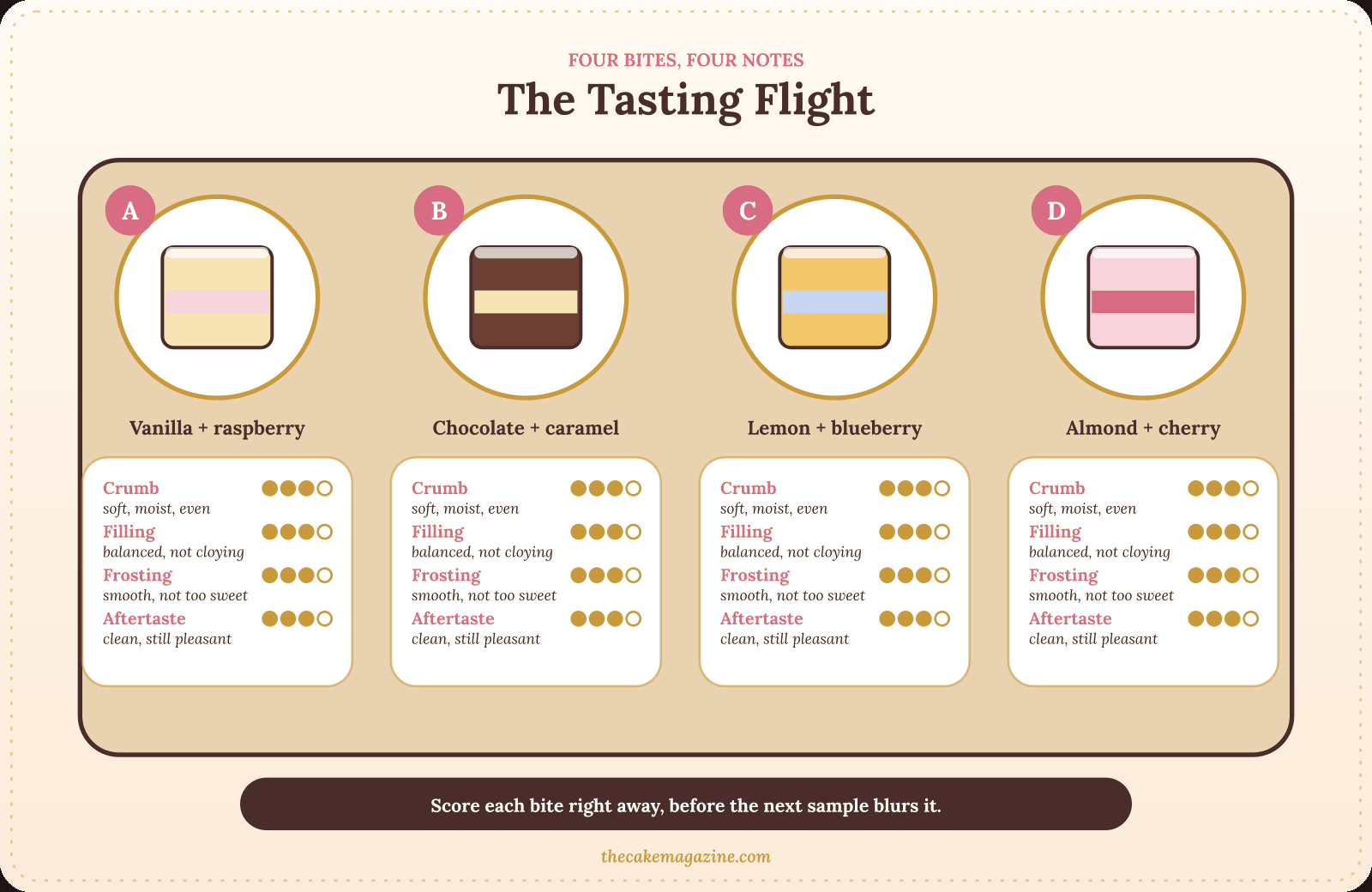
Crumb
Is the cake moist, soft and even, or dry and crumbly? A wedding cake is often made a day or two ahead, so ask how the cake tastes the next day, not just fresh from the oven.
Filling
Is it balanced and fresh-tasting, or sticky and too sweet? A great filling should add a clear note without overwhelming the cake.
Frosting
Is it smooth and pleasant on the tongue, or gritty, greasy or heavy? A frosting you love is more important than one that looks perfect.
Aftertaste
Does the flavor finish cleanly? Some artificial or very sweet flavors linger unpleasantly, and you will notice it in the second or third bite.
Questions worth asking about flavor
- Which flavors do couples order most, and which ones do you steer people away from in summer?
- Can I mix flavors across tiers, and does it change the price?
- Which fillings need refrigeration, and for how long can they be on display?
- Do you bake from scratch, and can you list the main ingredients and allergens?
- Can you make a small tasting version of my exact combination before the final order?
- How far ahead do you bake, and how do you keep the cake fresh?
Be honest at the tasting. Bakers want you to love your cake, and they cannot adjust what they do not hear. If the sweetness is too much, say so. If you want the lemon brighter, ask. Small tweaks, such as less sugar in the frosting or an extra layer of filling, are usually easy for a skilled baker. When you are ready to plan the schedule, our guide on when to order a wedding cake shows how tasting fits in the timeline.
No tasting nearby? If you are ordering from a distance or a baker does not offer tastings, ask for a small sample box, a mini cake or a photo-and-description tasting. Choose recipes that are among the most popular in the shop, because those are the ones the baker has made hundreds of times.
Budget and the best wedding cake flavors: what changes the price
Flavor can influence the price, though usually less than design and size do. A simple vanilla cake with buttercream is generally the baseline. More expensive ingredients, such as imported chocolate, nuts, real vanilla bean, fresh berries or specialty liqueurs, can raise the cost. Fillings that require extra steps, like a house-made curd or a multi-layer filling, take more labor. Ask your baker how each choice affects the quote.
We do not list specific prices here, because they vary widely between regions and bakeries and change over time. Our wedding cake cost guide explains the factors that drive pricing so you can ask smart questions and compare quotes fairly.
Where flavor choices usually cost more
- Specialty or premium ingredients. Pistachio, hazelnut, imported chocolate, passion fruit and some liqueurs often cost more than basic flavors.
- Multiple flavors. Each extra flavor means separate batches of cake, filling and sometimes frosting, which adds labor.
- Custom or experimental flavors. Developing a recipe for your signature idea can take time, and some bakers charge for it.
- Allergy-safe or dietary cakes. These often require special ingredients and a separate workspace.
- Fresh fruit and delicate fillings. They can require extra handling, cold storage and a tighter delivery window.
Where you can save without losing flavor
- Stick with the bakery’s signature flavors. A shop’s regular menu is where the recipes are most reliable and cost the least to produce.
- Use a smaller display cake and a kitchen sheet cake. This lets you serve guests a different, simple flavor without paying for decorated tiers.
- Keep the filling simple. One well-chosen filling usually tastes better than three, and costs less.
- Put the splurge in one place. A single special tier or element can feel luxurious without raising the whole cake’s cost.
Some couples are surprised to learn that the most expensive-sounding flavors are not always the most loved. A well-made vanilla cake with raspberry filling, baked by someone who cares, often beats a complicated flavor made without much attention. Paying for quality and technique usually matters more than paying for exotic ingredients.
Reading a bakery flavor menu
Flavor menus can be confusing. One bakery lists “Tuxedo,” another lists “Celebration,” and a third simply says “Seasonal.” Ask for the actual components of each name: what is the cake, what is the filling and what is the frosting? A description such as “vanilla cake, raspberry preserves, vanilla buttercream” tells you far more than a pretty title.
Pay attention to what the menu leaves out. If every flavor on the list is sweet and rich, ask whether a lighter option exists. If everything is fruit-based, ask about chocolate. A bakery that can talk about balance, texture and how a combination travels is usually a safer pick than one that only talks about trends. And if a baker proudly explains why they do not offer a certain flavor, that is a good sign, because it usually means they care about quality.
Finally, look at the order of the menu. Many bakers place their most reliable recipes first. If you are unsure, begin there, taste a couple of those and then decide whether you want to venture further down the list.
Sample flavor plans for different couples
Sometimes it helps to see how all of this comes together. These are example plans, not rules, and each one uses a different logic. Use them as a springboard to build your own shortlist of the best wedding cake flavors.
The classic garden wedding menu
A spring wedding for about one hundred guests, outdoors in the afternoon. A three-tier cake with vanilla bean cake and raspberry filling on the bottom, lemon cake with blueberry compote in the middle and a small top tier of vanilla with strawberry. Swiss meringue buttercream for a soft, elegant finish, kept in the shade until cutting. Light, pretty, and friendly to almost everyone.
The cozy fall celebration
An evening wedding in October, indoors, for around eighty guests. A bottom tier of spiced carrot cake with cream cheese filling, a middle tier of chocolate with salted caramel and a top tier of apple cider cake. A sturdier buttercream exterior so the cream cheese filling stays protected. Warm, comforting and just a little nostalgic.
The modern minimalist
A small city wedding with forty guests and a single-tier cake. One flavor done very well: olive oil and orange cake with a thin layer of mascarpone cream, finished with a simple frosting and fresh flowers. Because the guest count is small, there is room for a more distinctive flavor, and a dessert tasting box on each table adds variety. Check the plan against our serving guide before you finalize.
The big mixed-crowd reception
A large summer wedding with a wide range of ages. A decorated cake serves as the centerpiece, with a bottom tier of classic vanilla and raspberry, a middle tier of chocolate and a top tier saved for the couple. A sheet cake in lemon and a second in chocolate waits in the kitchen to serve the rest of the crowd. Everyone gets something familiar, and the budget stays under control.
The couple who cannot agree
One of you wants chocolate and the other wants lemon. Congratulations, you have your first marriage compromise. Give each person a tier, put the larger tier on the bottom for whichever flavor you think more guests will choose, and let the third tier be a shared favorite. It is also a fun story to tell later.
If you are weighing more than one celebration, such as an engagement party or a shower, our guides to bridal shower cake ideas and other celebration cakes show how to reuse a favorite flavor in smaller form. It is a nice way to get a preview of your wedding flavors with fewer stakes.
Groom’s cakes, cupcakes and extras beyond the best wedding cake flavors
The main cake does not have to carry every flavor wish. A smaller secondary dessert can solve disagreements and add personality. A groom’s cake, an old Southern tradition now used more broadly, is a separate cake in a flavor or shape that reflects one partner’s tastes. Chocolate, peanut butter, bourbon pecan and cheesecake are common. It does not need to be fancy, and it can be a single-layer cake or a handful of mini cakes.
Cupcakes and mini desserts
Cupcakes, cake pops and mini cakes are an easy way to offer more flavors. A small tray of four or five flavors on a dessert table lets guests choose, and the top-tier cutting cake still gets its photo moment. If you like the idea, our look at mini and one-bite cakes explains why small formats are popular and how they serve a crowd.
The trade-off is labor and storage. Individual desserts take time to bake, fill and decorate, and the price per serving may be higher than a slice from a large cake. They also need space, and a plan for keeping them fresh. Weigh the convenience against the cost before you commit.
Labeling the best wedding cake flavors on the day
A small printed card or a chalkboard near the cake telling guests what is inside is a kind gesture. It helps people with allergies or strong preferences, and it prevents the awkward question of what flavor is in the middle tier. List the cake, filling and frosting for each tier, and note any major allergens. Ask your baker for the wording, because they will know the exact ingredients.
A quick checklist for choosing the best wedding cake flavors
Use this list when you feel overwhelmed. It condenses the guide into steps you can tick off over a few weeks.
- Write down the flavors you both truly love, then circle the overlap.
- Think about your guest list, season, venue and time of day.
- Choose a crowd-pleaser as your anchor flavor, then decide on one optional twist.
- Pick cake, filling and frosting as a set, not as separate decisions.
- Ask which fillings are stable in your venue and what needs refrigeration.
- Check for allergies and dietary needs, and plan a safe alternative.
- Book a tasting for two or three shortlisted combinations and take notes.
- Confirm the final flavors, ingredients and storage plan in writing.
- Print a small flavor card for the cake table.
Decide early, confirm late. Pick a flavor direction when you book your baker, but leave room to confirm details closer to the date. Bakers are usually happy to adjust a filling or swap a tier flavor until a cutoff point, and your tastes may shift once the rest of the wedding plan comes together.
Common mistakes to avoid
Most regrets about the best wedding cake flavors come from a short list of avoidable problems. Here are the ones bakers hear about most, with a simple fix for each.
Choosing only for the photos
What happens: a couple picks a dramatic flavor because it looks stunning online, then realizes on the day that half the guests do not like it.
Fix it: taste first, and ask whether the combination you love is also something most of your guests would reach for. Photograph the outside, but plan the inside for the people eating it.
Making every tier a different bold flavor
What happens: three strong flavors compete on the same plate, and nothing tastes clear.
Fix it: pair one bold tier with one or two mild tiers, and keep frosting consistent. Review the dial to find your balance between familiar and adventurous.
Ignoring the venue temperature
What happens: a delicate filling softens in the heat and the tiers slump or weep before the cake is cut.
Fix it: tell your baker the venue, time of day and setup, and choose fillings that suit the conditions. Keep the cake indoors or in shade until needed.
Skipping the allergy conversation
What happens: a guest with a nut or dairy allergy cannot eat anything on the dessert table, or worse, eats something unsafe.
Fix it: include a line about dietary needs on your invitation or RSVP card, then pass the information to the baker and caterer. Provide a labeled, safe alternative.
Picking a flavor that is too sweet
What happens: after dinner, guests leave half a slice because it is cloying, and you wasted part of the budget.
Fix it: ask for a balanced recipe with tart fruit, citrus or salt to cut the sugar, and mention it at the tasting. Meringue-style buttercreams are often less sweet than powdered-sugar versions.
Deciding without a tasting
What happens: a flavor that sounded perfect turns out dry, bland or artificial.
Fix it: always taste the actual recipe, or at least a closely related one, from the baker who will make your cake. A written description is not a substitute.
Forgetting the people who need something different
What happens: vegan, gluten-free or allergic guests watch everyone else eat cake.
Fix it: plan a small alternative that the baker can safely prepare, and make sure the servers know which slice goes to whom.
Frequently asked questions about the best wedding cake flavors
What are the best wedding cake flavors for a crowd?
The best wedding cake flavors for a mixed crowd are vanilla, chocolate, lemon, strawberry and almond, usually paired with a fruit filling or a light buttercream. They are familiar, easy to eat after a big dinner and rarely cause arguments. If you want something different, add one twist in a smaller tier.
What is the most popular wedding cake flavor?
Vanilla and white cakes are widely regarded as the most common choice, often with raspberry, strawberry or lemon filling. Chocolate is a close companion, and red velvet and carrot appear often too. Popularity varies by region and season, so ask local bakers what couples in your area order most.
Can I have different flavors in each tier?
Yes, and many couples do. Each tier is baked separately, so mixing flavors is simple. Choose two or three flavors that complement each other, keep the outer frosting consistent and place the most popular flavor in the largest tier. Ask your baker whether extra flavors affect the quote.
How many of the best wedding cake flavors should one cake have?
For most weddings, one to three of the best wedding cake flavors is plenty. A single flavor feels elegant and keeps things simple, while two or three give guests a choice. More than that can feel scattered and adds labor for the bakery. If you want more variety, a dessert table or sheet cake in the kitchen is easier.
Which of the best wedding cake flavors work for summer weddings?
Light, bright flavors like lemon, strawberry, raspberry, coconut, passion fruit and vanilla with fruit fillings suit summer. They feel fresh in the heat. More important than the flavor is the filling and frosting stability, so ask your baker which combinations hold up outdoors and keep the cake out of direct sun.
What are the best wedding cake flavors for fall and winter?
Chocolate, spice cake, carrot, apple, pumpkin, caramel, coffee and gingerbread feel cozy and seasonal. Cooler indoor venues also make cream cheese frosting and ganache easier to manage. For a lighter option after a hearty dinner, a citrus or cranberry filling can add contrast without feeling summery.
Is it okay to skip the best wedding cake flavors and pick one only the couple likes?
Of course, it is your wedding. A practical compromise is to give your favorite its own tier, often the top, and use a crowd-pleasing flavor for the larger tiers. That way guests have a familiar choice, and you still get the flavor you love. It also gives you something to save or share later.
How do I handle guests with food allergies?
Ask guests about allergies on the RSVP, share the details with your baker and caterer and request written ingredient information. For serious allergies, a separate labeled dessert from a kitchen that can manage cross-contact is usually safer than modifying the main cake. This is general information, not medical advice.
Do gluten-free or vegan wedding cakes taste different?
They often have a slightly different texture, and quality varies by recipe and baker. Many are excellent, but taste them at your tasting rather than assuming they will match the regular flavors. Also ask whether the cake is prepared in a dedicated space, which matters for celiac disease and severe allergies.
Which fillings are safest for a hot venue?
Jam, preserves and curds in thin layers, along with sturdy buttercream, are generally more stable than fresh cream, custard or mousse. USDA guidance says perishable food should not be left out more than two hours, or one hour above 90°F. Ask your baker what is perishable in your design.
Should I choose the cake flavor before or after the design?
Ideally together, because flavor and design affect each other. Heavy fruit fillings, soft cream cheese frosting and tall tiers all have structural limits. Read our wedding cake design guide and discuss flavors and design with your baker in the same conversation so the result is both delicious and stable.
How far ahead should I decide on the best wedding cake flavors?
Many couples settle on a flavor direction when they book the baker and confirm details at a tasting a few months before the wedding. Popular bakers book early, so start the process well ahead. Our timeline for ordering a wedding cake shows when each decision usually happens.
Do wedding cake flavors really affect the price?
Sometimes. Premium ingredients, multiple flavors, custom recipes and allergy-safe cakes can raise the cost, while a bakery’s standard flavors are usually the most economical. Design and size generally matter more. Ask your baker for a written quote that shows how each flavor choice changes the total.
Final thoughts
The best wedding cake flavors are not a secret. They are a thoughtful mix of what you love, what your guests will enjoy and what your baker can deliver beautifully on the day. Start with a crowd-pleasing base, add one personal twist, choose fillings that suit your venue and taste everything before you decide. Those steps matter more than any trend list.
If you take only one idea from this guide, let it be this: choose flavors you would be happy to eat again on your first anniversary. A cake that tastes like something you truly enjoy will always feel right, whatever the photos look like. Make the decision together, give it a little time and let the tasting do the work.
Planning a cake right now and stuck on a pairing? Tell us the season, the guest count and the flavors you keep going back and forth on, and we will keep expanding this guide with the questions couples actually ask.
Editorial note: reviewed and updated November 2026. This guide offers general information for couples and is not medical, allergy, legal or food safety advice. Allergy, storage and display rules vary by bakery and by state and local health agency, so confirm specifics with your baker and local officials. Flavor combinations and ideas are suggestions drawn from common baking practice, not tested recipes, and prices and results vary by baker and region. For more baking background, see the King Arthur Baking cake guide.