Nobody tells you, when you get engaged, that the cake has a calendar of its own. Somewhere between choosing a venue and arguing about the playlist, you will wonder when to order wedding cake, and the honest answer is earlier than most people expect, but in a series of small steps rather than one big decision. This guide lays out the whole path: the first inquiry, the consultation, the tasting, the design, the final guest count and the delivery. Every step has a sensible window.
For most weddings, the best moment for when to order wedding cake is as soon as you have a date and a venue, with many couples contacting bakers roughly 9 to 12 months ahead and booking at least 6 months out. Tastings usually come a few months before the wedding, the design is locked about 2 to 3 months out, the final guest count goes to the baker 3 to 4 weeks before, and delivery is arranged for the wedding day itself. Every baker sets their own calendar, so ask early.
- Why when to order wedding cake matters
- The timeline at a glance
- Stage one: the first inquiry
- Stage two: the consultation
- Stage three: booking and the contract
- Stage four: the tasting
- Stage five: locking the design
- Stage six: the final guest count
- Stage seven: delivery and setup
- When to order wedding cake on short notice
- Season, weekday and baker size
- Smaller weddings, sheet cakes and other variations
- Common timing mistakes to avoid
- A worksheet for when to order wedding cake
- FAQ
Why when to order wedding cake matters more than you think
A wedding cake is not something a bakery pulls off a shelf. It is a made-to-order piece of work that has to be scheduled, designed, shopped for, baked, assembled and driven to a venue, often by one small team that is also building other cakes that same weekend. A baker who takes on a wedding is reserving a slice of their calendar, and that calendar has a fixed number of Saturdays in it. That is the whole reason when to order wedding cake matters.
Think about what a baker has to hold for you. They set aside a delivery slot, a block of baking and assembly time, and often a tasting appointment months before the date. Sugar flowers, hand-painted details or fresh-flower coordination can add extra days of work. When a baker says they are booked, they usually mean those hours are spoken for, not that they are being fussy.
Knowing when to order wedding cake also protects your options. Early on, you get your first choice of baker, a wider range of designs and a relaxed pace for decisions. Later, you may still find a wonderful cake, but the choices narrow: fewer bakers with openings, fewer design styles that fit the remaining prep time, and less room to change your mind about a flavor.
What misjudging when to order wedding cake can cost you
Waiting is not a disaster, and plenty of couples have a lovely cake after a late start. But it helps to be clear about the trade-offs, so you can choose them on purpose.
- Fewer bakers available. A popular baker may already be full for your date, and you will have to widen your search.
- Less design time. Intricate work such as sugar flowers or hand painting needs lead time, so a later order may mean a simpler design.
- Rushed tasting. If you taste in a hurry, you might choose a flavor on the spot rather than comparing a few and sleeping on it.
- Pressure on the budget. Rush fees are common with small bakeries, and a quick decision rarely leaves time to compare quotes.
What ordering too early can cost you
There is also a gentle downside to jumping the gun. If you book a baker before you have a date, a venue or a rough guest count, you may end up changing the design or servings later. That is fine with many bakers, but it can mean extra conversations and, depending on the contract, extra fees. The sweet spot is booking once the big facts are settled, and finalizing the details as they firm up.
If you want the bigger picture of what goes into a wedding cake before you plan the schedule, our complete wedding cake guide covers design, flavors, servings, budget, delivery and cutting in one place. This article zooms in on the calendar.

The timeline at a glance: when to order wedding cake, step by step
Here is a sample countdown for when to order wedding cake. Treat it as a pattern, not a rulebook. Bakers publish their own booking windows, and a small home baker, a large bakery and a hotel pastry team will each work a little differently. Where a baker’s instructions differ from this list, follow the baker.
9 to 12 months out: inquire
You have a date and a venue. Send inquiries to two or three bakers, ask whether your date is open, and learn how each one handles consultations and deposits. No decisions yet, just availability and a first look at style.
6 to 9 months out: consult and book
Hold a consultation, talk budget and servings, and sign a contract with a deposit to reserve your date. This is the point where the date becomes yours.
3 to 6 months out: taste
Many bakers schedule tastings in this window, once they know which flavors and fillings you are leaning toward. Compare a few options and decide without rushing.
2 to 3 months out: lock the design
Confirm tiers, flavors, finish and decor, and share photos of your florals, stationery and venue. The baker can start planning supplies and prep time.
3 to 4 weeks out: final count
Send the final guest count and any dietary notes. The baker confirms servings, tier sizes and any backup cake, and sends a final invoice if one is due.
1 to 2 weeks out: delivery plan
Confirm delivery time, venue contact, table location, power and cooling, and who will receive the cake. Pay any remaining balance on the baker’s schedule.
If your wedding is under six months away, do not panic about when to order wedding cake. Skip ahead to the section on ordering on short notice, which compresses these steps without cutting the ones that matter.
How to pin when to order wedding cake to your other planning
The cake timeline, including when to order wedding cake, works best when it is pinned to the rest of your wedding calendar. Your venue booking comes first, because the baker needs the date and delivery address. Your guest list drives the cake size. Your florals and color palette shape the design. Your caterer can tell you whether they will cut and plate the cake, and what the venue’s rules are for outside desserts.
A simple trick is to add three dates to your calendar the day you book your baker: the tasting window, the design deadline and the final-count deadline. Put reminders two weeks before each one. Those three dates are the ones couples most often miss, and missing them is where most cake stress begins.
Stage one: the first inquiry, 9 to 12 months out
The first inquiry is the lowest-pressure step in the whole process, and it is the one that answers the question of when to order wedding cake for your specific date. You are not committing to anything. You are asking a few bakers whether they are free and what their process looks like.
Most bakers have an inquiry form or an email address. A good first message is short and specific. It should help the baker decide quickly whether they can take you on, and it should make it easy for them to reply with real numbers rather than a generic brochure.
Your wedding date, venue name and city, an estimated guest count, a rough sense of style (a photo or two helps), and whether you want a full cake, a small cake plus sheet cake, or a dessert table. Ask about their booking window, consultation process and deposit policy.
How many bakers to contact when you decide when to order wedding cake
Two to four is a comfortable number for most couples. Fewer, and you have nothing to compare. More, and you will spend weeks in consultations that blur together. Pick bakers whose portfolios resemble what you imagine, and whose delivery area includes your venue. Our guide to wedding cake tastings includes questions that help you compare bakers fairly once you reach that stage.
Look closely at portfolios, not just the best five photos. Scroll back through a baker’s feed or gallery and look at ordinary weddings, not only the showpiece cakes. Do the tiers look clean? Are the colors consistent with what the baker said they could do? Does the work match your taste a year from now, not just this week?
Questions that save time later
- Is my date still open, and how far ahead do you usually book?
- Do you charge for tastings, and how are they scheduled?
- What is a typical price range per serving for the style I am describing?
- Do you deliver and set up, and what is the delivery area?
- What is your deposit and cancellation policy?
- When do you need my final guest count and design details?
That last question is gold. A baker who answers it plainly, with real dates, is usually one whose process is organized. If you want a head start on numbers, our wedding cake cost guide explains what drives the price, so a quote will not come as a surprise.
If your date is a peak weekend
For peak dates, the answer to when to order wedding cake shifts earlier. Popular dates, such as Saturdays in the busiest wedding months, fill first. If your date falls on one of those weekends, start inquiries on the early side of the window and be ready to move quickly after a consultation. A small number of bakers will ask you to book on the day of your tasting to hold the date. That is a perfectly reasonable request when a date is in demand.
Stage two: the consultation, 6 to 9 months out
A consultation is a conversation, sometimes in person, sometimes on a video call, where you and the baker talk through what you want and what it will take to make it. For many couples, this is the real answer to when to order wedding cake: the consultation is where the order begins, even if the contract comes a few days later.
Plan the consultation, the first real step in when to order wedding cake, for a time when both partners can attend, or at least when the person making the design decisions can. Bakers are happy to hear from both of you, and it avoids the awkward moment when one partner vetoes the plan afterward. Come with a rough budget in mind, because the baker will be shaping suggestions around it.
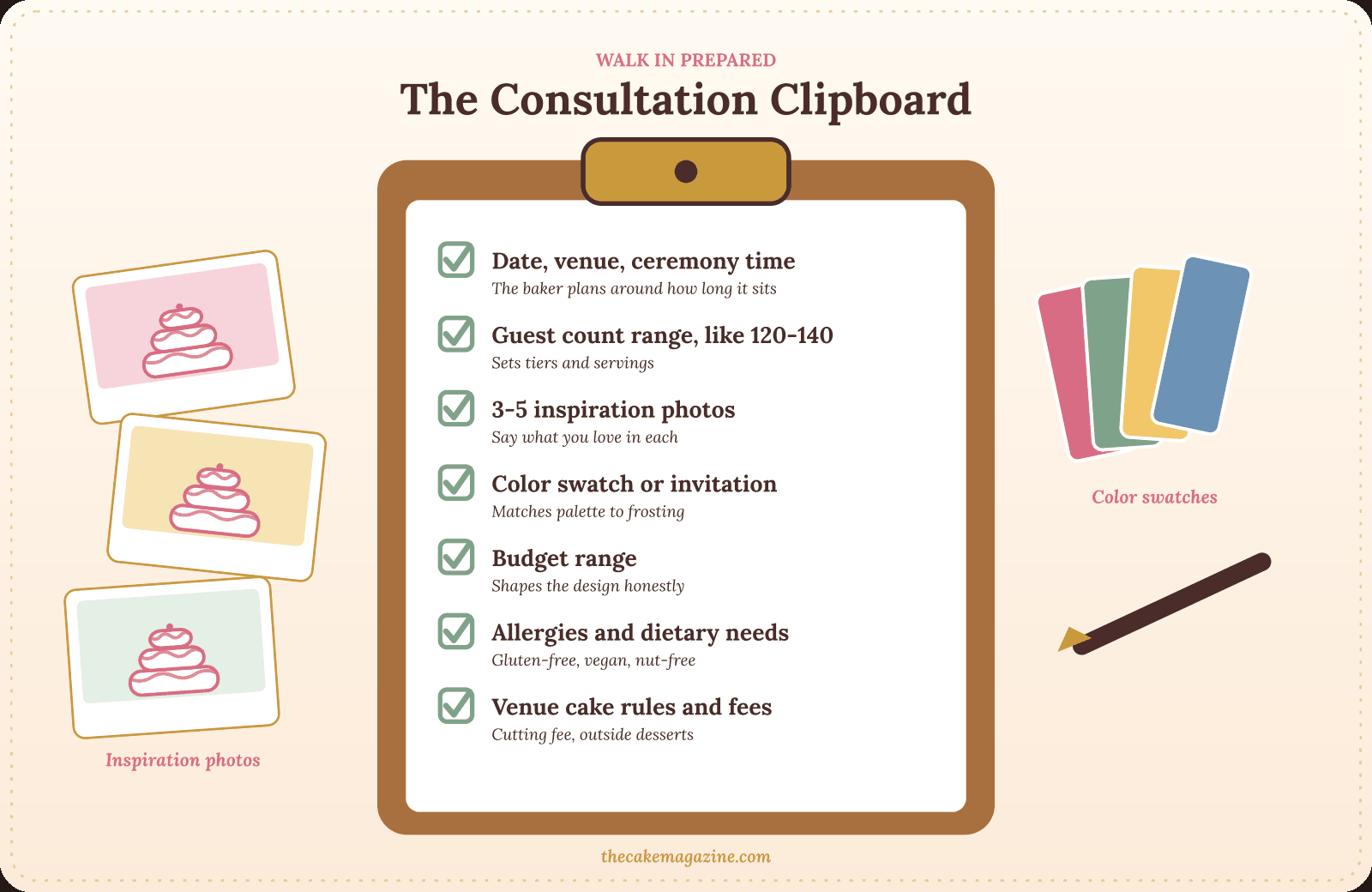
What to bring when you plan when to order wedding cake
You do not need a finished vision. A few well-chosen items will make the conversation far more useful than a hundred saved photos.
- Your date, venue and ceremony time. The baker needs to know how long the cake will sit before it is served.
- An estimated guest count. A range is fine, such as 120 to 140.
- Three to five inspiration photos. Pick the ones you love most and be ready to say what you like about each: the shape, the texture, the color, the flowers.
- Your color palette and a sample of the bridesmaid or table colors. A fabric swatch or invitation works well.
- Your budget range. A baker cannot design to a number they have not heard.
- Dietary needs. Mention allergies, gluten-free or vegan guests, and any religious or cultural restrictions.
- Your venue’s rules. If the venue or caterer has a cake-cutting fee or a policy about outside desserts, share it now.
Questions to ask the baker about when to order wedding cake
Most bakers walk through their process unprompted, but it helps to have your own list. Ask what is included in the price, whether delivery and setup are separate, and who will be at the venue. Ask how the cake will be supported inside: structure matters more than people realize with tall or heavy tiers. Ask what happens if something goes wrong, and whether the baker carries a repair kit to the venue.
Also ask what is not included. Stands, cake toppers, fresh flowers, cake knives, boxes for leftovers and extra servings often fall outside the base price. Hearing that early helps you compare quotes honestly. For a clear idea of how those pieces add up, our breakdown of wedding cake pricing is a good companion.
How long a consultation takes
Most last somewhere between thirty minutes and an hour, though it varies. Some bakers combine the consultation and the tasting, and some do them separately. Ask which format they use, because it affects how many appointments you will need to schedule and whether you should come hungry.
Stage three: booking and the contract
The contract is the moment your order becomes official. It is also where the details of timing get written down, so read it carefully. A good wedding cake contract is not complicated, but it should be specific.
Booking is the heart of when to order wedding cake. Most bakers reserve a date with a deposit and ask for the balance by a set date before the wedding. The size of the deposit and the timing of the balance vary from baker to baker, so there is no universal number to quote here. Whatever the terms are, make sure you know the amounts, the due dates and what is refundable if plans change.
The wedding date and delivery time, the venue address and contact, the cake description (tiers, flavors, fillings, finish), the total price and what it covers, deposit and balance due dates, the deadline for the final guest count, the cancellation and change policy, and what happens if the baker cannot fulfill the order.
Deadlines hiding inside the contract
Many contracts include three deadlines that matter for your timeline: a date by which the design must be finalized, a date by which the final guest count is due, and a date by which the balance is paid. Copy each one onto your calendar. These are the dates that tell you precisely when to order wedding cake changes, because after them, changes may cost extra or may not be possible.
If a baker does not list those deadlines in writing, ask for them. A short email that says “just to confirm, the design is due by this date and the final count by that date” is perfectly polite and protects both of you.
Home bakers and licensing
If you are considering a home-based baker, know that rules for home food businesses vary by state and sometimes by county. We will not guess at the rules here. It is reasonable to ask any baker whether they operate under their local licensing or cottage food requirements, and to check your state or local health department’s website if you want to understand what applies where you live. The USDA’s food safety resources are also a useful general starting point for safe handling.
Changing your mind after you decide when to order wedding cake
Small changes, such as swapping a filling or adjusting a color shade, are usually easy early on and harder as the date approaches. Big changes, such as moving from three tiers to five, may change the price and the prep time. Ask in advance how changes are handled, and whether there is a date after which they are no longer possible.
Stage four: the tasting, 3 to 6 months out
When to order wedding cake and when to taste it are two different dates. A tasting is a small sampling of cake flavors and fillings, and it is the fun part. It is also where flavor decisions stop being guesses. Because tastings take baker time and ingredients, many bakers schedule them a few months before the wedding rather than at the first meeting, and some charge a fee that may or may not be credited toward your order.
That makes the tasting window a useful part of the answer to when to order wedding cake. Book the baker first, then taste once your choices are narrowed. A baker who tastes with you too early may have to repeat the process if your guest count, venue or style changes.
How to make a tasting useful
Eat something light beforehand so your palate is neutral. Bring water, and ask whether you can come with a short list of flavors you are curious about, rather than trying everything on the menu. If the baker offers pairings of cake, filling and frosting, taste them together, because that is how your guests will experience them.
Take notes right away, even a single line per sample. After the third or fourth bite, flavors blur together, and a note like “lemon with raspberry, bright, loved it” is surprisingly helpful two weeks later. Take photos of each sample too, so you can match the visual and flavor together.
For a deeper look at what to try and how to compare, see our wedding cake tasting guide, and for ideas on pairings that suit a crowd, our piece on the best wedding cake flavors is a good starting point.
Flavors by guest, not by couple
The cake is for everyone at the wedding, so keep your guest list in mind. Classic vanilla, chocolate and lemon tend to please wide crowds, while bolder flavors can be fun in a single tier or a groom’s cake. If you have guests with allergies or dietary needs, ask the baker how they handle cross-contact and labeling, and whether a separate small cake is wise.
If you cannot attend a tasting
Some bakers offer tasting boxes by mail or pickup. If you are planning a destination wedding or live far from your baker, ask about this option. It will not replace the conversation, but it lets you try the real flavors. A video call to talk through the notes afterward keeps the process personal.
Stage five: locking the design, 2 to 3 months out
By now you have a baker, a date and a flavor. The next job is to turn all of that into a specific design. This is the stage where “something romantic with flowers” becomes a sketch, a color match, a tier plan and a finish.
When to order wedding cake changes slightly with design: most bakers ask for the design to be confirmed a couple of months ahead so they can order supplies, schedule sugar work and plan their prep days. If your design needs custom items, such as handmade sugar flowers or a specially colored fondant, the lead time matters even more. This is why design decisions sit on the timeline where they do, and it is a core part of when to order wedding cake without regret.
What goes into a final design
- Tier count and size. Driven by the guest count and how you plan to serve the cake.
- Shape and structure. Round, square, hexagon or a mix, with heights that suit your table and venue.
- Finish. Smooth buttercream, textured, fondant, naked or semi-naked, painted or piped.
- Decor. Fresh flowers, sugar flowers, greenery, ribbon, a topper or none at all.
- Color. Matched to your palette, with a swatch if possible.
- Stand and display. Who supplies the cake stand, and how it will sit on the table.
Our wedding cake design guide walks through style, venue, flowers, color and scale in detail, which helps if you are still choosing between a clean modern finish and a romantic floral look.
Coordinating with your florist
If your cake will carry fresh flowers, the baker and florist need to talk, or at least you need to pass messages between them. Ask the florist which blooms are safe to place on a cake and how they will be prepared, and ask the baker who will add them: the florist, the baker or you. Settle that in writing so nobody is guessing on the wedding morning.
Sending a final design confirmation
Once the design is set, ask the baker for a written summary or a sketch. Check that it lists tiers, flavors, fillings, finish, colors, decor and delivery time. A confirmation like that is a safeguard for both sides, and it is easy to refer to if questions come up in the last few weeks.

Stage six: the final guest count, 3 to 4 weeks out
Alongside when to order wedding cake, the final guest count is the number that decides how much cake gets baked. It is also the number that changes most between the first inquiry and the last RSVP. That is why bakers ask for it late, and why this stage belongs on your calendar in bold.
Your final count normally comes from your RSVPs, not from your invite list. Give the baker the number of guests you expect to attend, plus a note about any extras you want to account for, such as vendors, a wedding party meal or a few late additions. If you are unsure, tell the baker you are between two numbers and ask how they would handle it.
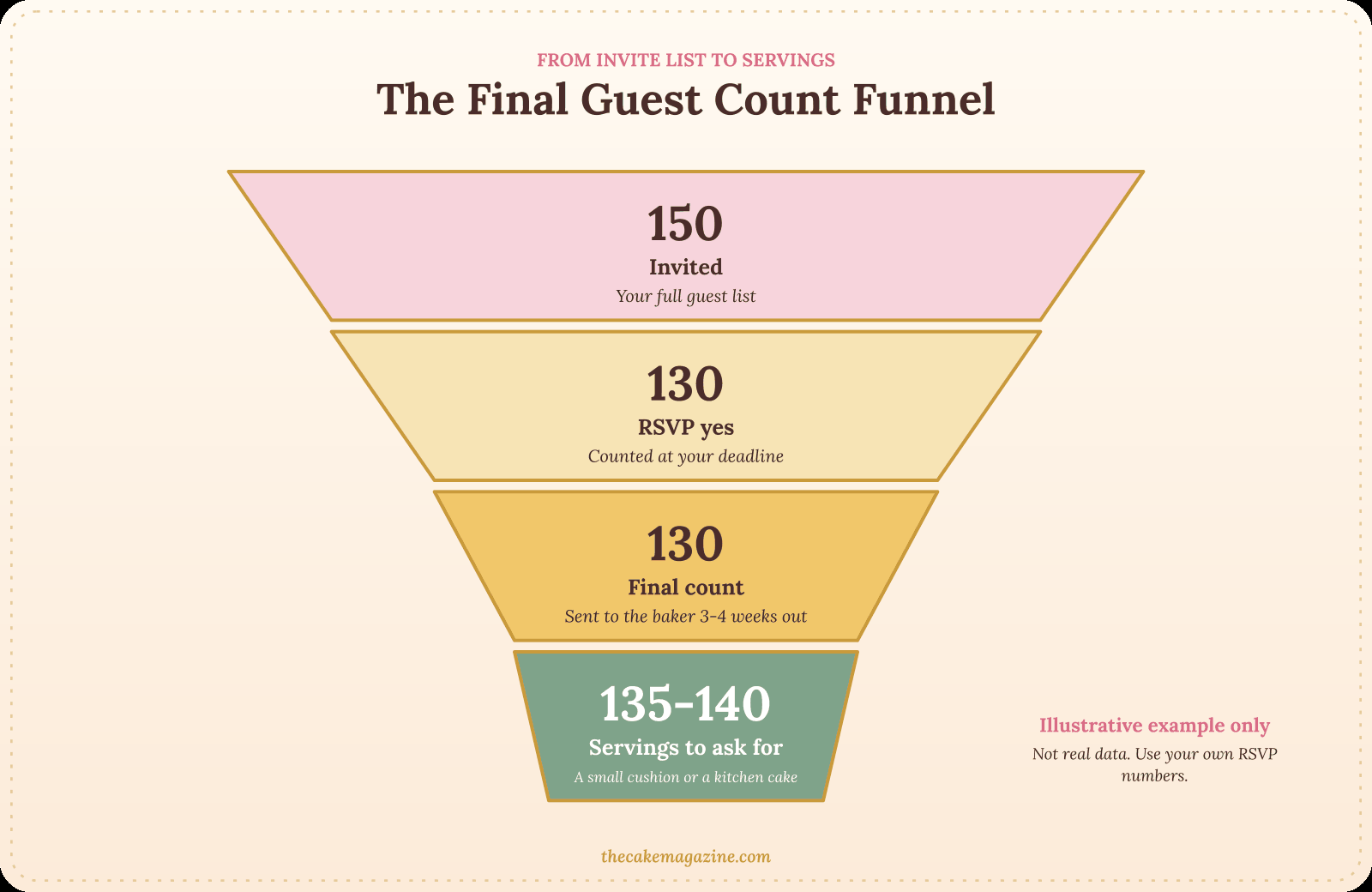
From invited to served: a worked example
Here is how the numbers might move for an imaginary wedding. These figures are illustrative, not data. Suppose you invite 150 people, and 130 say yes by the RSVP deadline. A few guests will not eat cake, and some will want a very small slice, but you usually plan for the number who will be there, not the number who will eat.
If the baker plans standard wedding-style slices and you have 130 guests, you would ask for a cake that serves at least 130, and possibly a little extra if you want to send slices home or save a tier. Our wedding cake serving guide explains tier sizes, portions and backup cakes, so you can check any quote against your actual guest count.
Ask your baker how many servings the design provides in standard wedding slices, and compare that with your final count. If the numbers are close, ask whether a small backup cake, such as a sheet cake served from the kitchen, is a good idea. It is usually less costly than adding a whole tier.
Kitchen cakes and backup cakes
Many couples order a smaller display cake and a plain sheet cake kept in the kitchen, so the display tiers look beautiful while the kitchen cake handles most of the serving. It is a sensible, budget-friendly approach, and it changes how you think about timing: the display cake needs the long lead time, while a simple kitchen cake is far more flexible. We compare the two approaches in our guide to sheet cake versus tiered cake.
What to do if your count changes after you decide when to order wedding cake
Tell the baker as soon as you know. Small changes of a handful of guests usually do not matter. Bigger changes may require a different tier size, and the baker will tell you whether that is still possible. The earlier you share news, the more options you have, which is another reason a clear deadline in the contract helps.
Dietary needs belong in the final count
When you send your final number, also send the final list of dietary requests. The baker needs to know how many guests need gluten-free or dairy-free options, whether a nut-free tier is required, and whether any ingredient needs to be avoided entirely. A late allergy note is much harder to handle than an early one, so share it as soon as you hear about it.
Stage seven: delivery and setup, the last two weeks
A great cake still has to get to the table in one piece. In the last couple of weeks, the work shifts from design to logistics: who delivers, when, where it goes and how it stays cool and upright. This stage is part of when to order wedding cake too, because delivery slots are scheduled long before the wedding week and are not infinitely flexible.
Ask your baker for a delivery window, since delivery is the last piece of when to order wedding cake, and share it with your venue coordinator and caterer. Many venues want to know when outside vendors will arrive, where they should park, and which door to use. A shared message among baker, venue and planner prevents the classic problem of a baker standing at a locked door with a cake in their arms.
The delivery checklist
- Delivery time and window. Confirm it in writing, and make sure it fits before the reception starts.
- Venue contact. A name and phone number for the person receiving the cake.
- Table placement. A sturdy, level table in a spot away from direct sun, heaters and heavy foot traffic.
- Cooling. Ask whether a refrigerator or walk-in will be available for fillings that need to stay cold.
- Setup time. Allow the baker time to assemble, stack tiers and add final details.
- Cutting plan. Decide who will cut and plate the cake, and whether the venue charges a cutting fee.
- Cake stand and tools. Know who supplies the stand, the knife and the serving pieces.
Our guides to transporting a wedding cake and the wedding cake setup checklist go into the practical side, including vehicle setup, table height, lighting and what to do if a tier needs a quick repair.
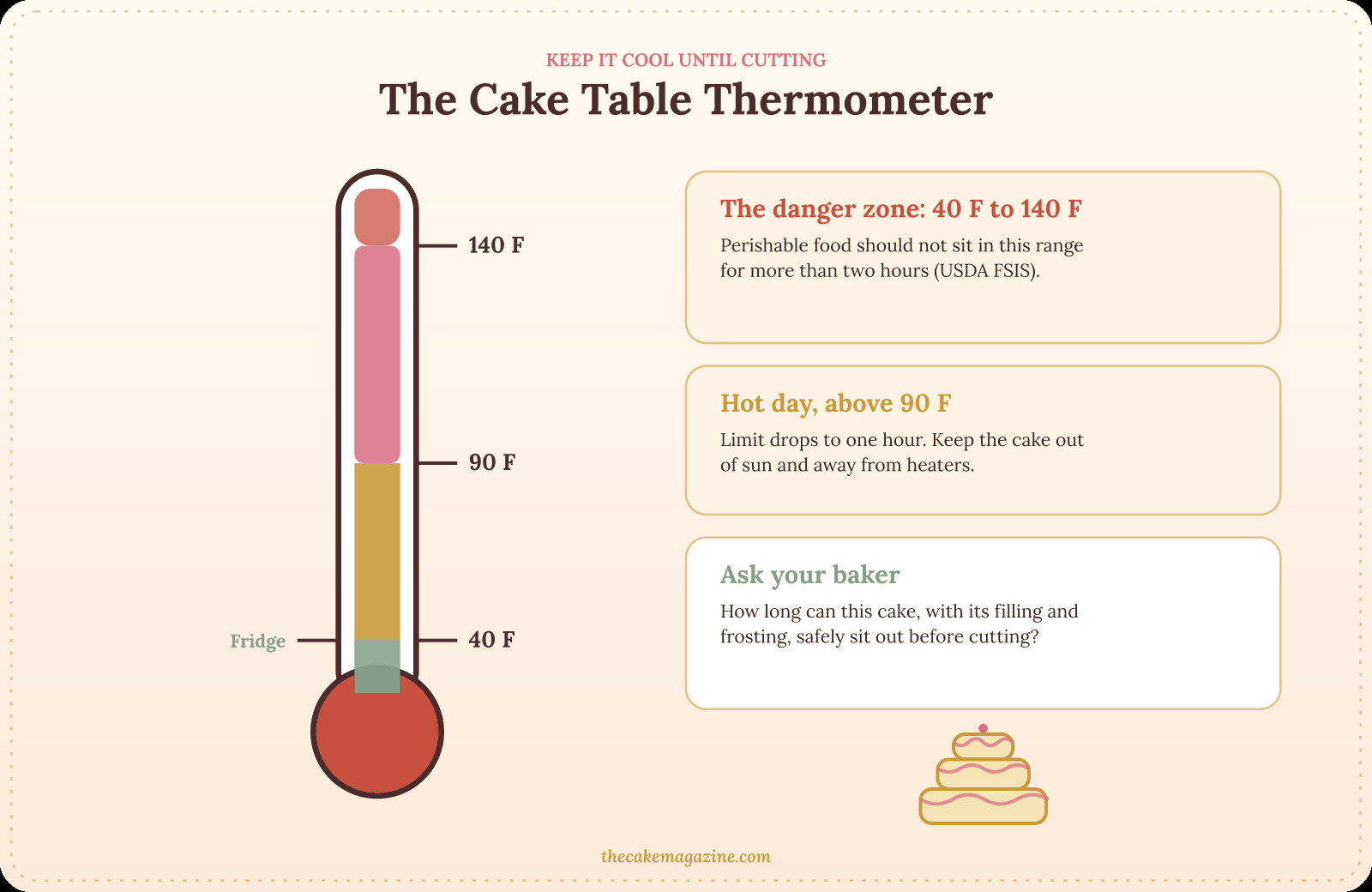
Keeping the cake safe on a warm day
Cakes with perishable fillings or frostings, such as cream cheese, whipped cream or custard, need to stay cool until the reception. The USDA’s food safety guidance describes the “danger zone” as 40°F to 140°F, and says perishable food should not sit in that range for more than two hours, or more than one hour when the temperature is above 90°F. You can read the guidance in this USDA FSIS release.
Cakes finished with sturdier frostings and fillings behave differently from cakes with cream-based ones, so ask your baker how long yours can safely sit out. Then pass that answer to your coordinator, so the cake is not parked next to a sunny window or a heating lamp while everyone is taking photographs.
What happens after the cake is cut
A lot of couples save the top tier for an anniversary, and that is a charming tradition that deserves its own plan. Ask your baker how to wrap and freeze it, and ask your caterer to box it, so it does not disappear into a banquet fridge. Our guide to saving the top tier of a wedding cake covers freezing, wrapping and safety.
If your venue or caterer will cut the cake, mention it to them in advance. A tidy cutting plan keeps the dessert course on schedule, and our guide to cutting a wedding cake shows how tiered portions are usually sliced.
When to order wedding cake on short notice
Life does not always cooperate with a perfect schedule. You might have a short engagement, a change of venue or a baker who had to cancel. If you are researching when to order wedding cake with only a few months left, take a breath. A beautiful cake is still very possible, and the main change is that you need to move faster and keep the design simpler.
When to order wedding cake on short notice comes down to speed. The first step is to start calling or emailing bakers immediately, and to say right away that your date is close. Ask whether they take short-notice orders, and what design options fit the time. Some bakers keep a few open dates or have a menu of simpler designs they can do with less lead time. Others will refer you to a colleague.
A compressed timeline for when to order wedding cake with a few months left
Week one
Contact several bakers at once. Share your date, venue, guest count and style, and ask who has an opening. Be ready to book within days.
Week two
Combine the consultation and tasting if the baker offers it. Choose flavors and a simple design in a single visit, and sign the contract.
Weeks three and four
Confirm the design in writing, coordinate with your florist and share the venue details. Ask the baker for their final-count and balance deadlines.
Final weeks
Send the final count as soon as RSVPs allow, confirm delivery and check on cooling and the cutting plan.
Designs that suit a shorter lead time
Simpler finishes tend to fit tight schedules better than elaborate ones. Smooth or textured buttercream, a naked or semi-naked cake, and fresh flowers placed at the venue are usually quicker than detailed sugar work or intricate hand painting. Ask the baker which designs they can do in your time frame, and choose from that list instead of insisting on a favorite photo.
Other short-notice options
If a custom baker is not available, there are other routes. You could order a smaller display cake and add a sheet cake, choose a dessert table, or pick a bakery that sells decorated celebration cakes in standard sizes. Our comparison of a wedding cake and a dessert table and our explanation of dummy wedding cakes can help you weigh those routes against each other.
Whatever you decide about when to order wedding cake, ask about food safety and ingredient labeling, and ask to see the cake’s description in writing. A short lead time should not mean skipping the details that keep guests safe and happy.
Season, weekday and baker size: what moves your timeline
The sample countdown above assumes a typical situation. Real calendars bend around three things: the season of your wedding, the day of the week and the size of your baker’s operation. Understanding them helps you adjust your own plan for when to order wedding cake instead of copying a generic schedule.
Busy months and quiet months
Season is a big part of when to order wedding cake.
In many parts of the country, late spring, summer and early fall are the most popular wedding seasons, and bakers in those regions tend to fill their calendars earlier. Winter and early spring weddings, and weddings in places with a different peak season, often have a bit more breathing room. We cannot give you a precise rule for your area, because it depends on where you live. The reliable way to know is to ask a few local bakers how far ahead they usually book for your month.
Holiday weekends deserve a special mention. A wedding on a long weekend, near a major holiday or alongside a big local event may compete with other celebrations for a baker’s time. If your date falls near one, contact bakers on the early end of your window.
Saturday versus other days
Saturday is the classic wedding day, and it affects when to order wedding cake more than any other detail, so it is the day bakers are most likely to be booked. A Friday evening, a Sunday afternoon or a weekday wedding may have more availability, and some bakers are happy to be flexible for those dates. If your guest list can handle a non-Saturday, it can ease the search, though it does not remove the need to plan ahead.
Small bakers, large bakeries and hotels
A solo home baker may take only a few weddings each weekend, which means limited dates but often a very personal process. A larger bakery may have more capacity and a clearer system for consultations, though its calendar still fills. A hotel or catering team may include the cake in a package, with its own deadlines, so ask your venue what it offers before you go shopping elsewhere.
Whichever kind of baker you choose, remember that capacity, not quality, is what sets the booking window. A baker who books a year out is not necessarily better than one who books three months out. They may simply have a different way of managing their calendar.
Two imaginary couples, two answers to when to order wedding cake
Here are two made-up examples to show how the same steps can land differently. Neither is a real case, and the dates are only illustrations.
The first couple gets engaged in January and picks a Saturday in October. They inquire with three bakers in February, hold two consultations in March, book in April and taste in June. They lock the design in July, send the final count in early September and arrange delivery for the wedding morning. It is a relaxed pace with time to spare.
The second couple decides to marry in four months. They email five bakers on the same day, find two with openings and book one after a combined consultation and tasting in the first week. They keep the design simple, confirm it a month later and send their final count as soon as RSVPs allow. It is a faster path, but it works because they decided quickly and made clear choices.
Smaller weddings, sheet cakes and other variations
Not every wedding has a three-tier cake and a hundred and fifty guests. The same timeline logic holds for smaller celebrations, but the details change. Here is how to adjust when you plan when to order wedding cake for a different kind of day.
Elopements, micro-weddings and when to order wedding cake
For a small ceremony, when to order wedding cake is usually less urgent. A small ceremony with a handful of guests may only need a tiny cake, sometimes called a mini or two-tier cake. Small cakes are easier to schedule, so the lead time may be shorter, but popular bakers can still fill up. Our article on mini cakes shows how small formats work and why they are popular for intimate celebrations.
Cake plus dessert table
If you want a small display cake and a spread of other desserts, order the cake first, because it has the most design time, then plan the rest around it. Ask the baker whether they can supply other desserts, or whether you need to coordinate with a separate vendor. Make sure each vendor knows the delivery time and table setup, so everything arrives in an order that makes sense.
A cake with a surprise or personal touch
Sometimes the cake carries a personal element, such as a family recipe, a replica of a grandmother’s flavor or a design that reflects a hobby. Share that early. A custom flavor may need extra recipe testing on the baker’s side, and a custom design may need extra prep time. Giving this information at the consultation is a kindness to the baker and gives them room to deliver it well.
Wedding anniversaries and later celebrations
Couples who plan an anniversary party or a vow renewal can use the same timeline in miniature. For general party cakes, our cake serving calculator for parties helps estimate how much cake you need, and its tips on timing carry over nicely.
Common timing mistakes to avoid
Most cake stress comes from a handful of repeat mistakes. Knowing them in advance is the easiest way to avoid them, and it makes your decision about when to order wedding cake much easier.
Mistake: Waiting for a final guest count before booking
Why it hurts: The guest count may not be final for months, and bakers’ dates fill in the meantime.
What to do instead: Book with an estimated range and finalize the count later, as the contract allows.
Mistake: Tasting before you have narrowed the style
Why it hurts: A broad tasting can bring too many options and a lot of repeat work.
What to do instead: Settle on a baker and a few flavor ideas, then taste in the baker’s recommended window.
Mistake: Missing the design deadline
Why it hurts: Supplies, sugar work and prep days are scheduled around the design.
What to do instead: Copy the deadline onto your calendar the day you sign, with a reminder two weeks ahead.
Mistake: Sending a guess for the final count
Why it hurts: A big gap between the guess and the real number can leave you short or paying for extra cake.
What to do instead: Use your RSVP count, tell the baker about any uncertainty and ask about a backup cake.
Mistake: Forgetting to tell the venue
Why it hurts: A venue that does not expect the baker may have no table, no refrigeration and no one to open the door.
What to do instead: Share the baker’s name, delivery window and setup needs with the venue contact a week or two ahead.
Mistake: Assuming the cake is included in a package
Why it hurts: Some venues include a cake, some include a cutting service and some include neither.
What to do instead: Ask what your venue or caterer includes before you contact outside bakers.
Mistake: Not asking about food safety on a hot day
Why it hurts: Perishable fillings and frostings need to stay cool.
What to do instead: Ask the baker how long the cake can sit out, and plan the placement and cutting time accordingly.
A quick self-check on when to order wedding cake
If you have read this far and want a final test of your planning, ask yourself these questions. Do you know your baker’s deadlines for design, final count and balance? Does your venue know the delivery time? Do you have a plan for cutting and serving? Do you know where the top tier will go afterward? If any answer is no, that is your next task, and it is a small one.
A pocket calendar for when to order wedding cake
- Date and venue confirmed: send first inquiries.
- Baker chosen: sign the contract and note every deadline.
- Tasting window opens: schedule it, bring a short list of flavors.
- Design deadline: send photos, palette and florals; ask for a written confirmation.
- RSVP deadline passes: send the final count and dietary needs.
- Two weeks out: confirm delivery with baker and venue, and pay the balance on time.
- Wedding day: have one person who knows where the cake is, who is cutting it and where the top tier goes.
Print that list, or paste it into your phone, and tick each line as you go. A short, clear checklist beats a perfect plan that lives only in your head.
How much of this a planner can handle
If you have a wedding planner or venue coordinator, ask them when to order wedding cake in your area; they often know local lead times. they can often take over the logistics side: confirming deliveries, checking the table setup and talking to the baker. You still make the design and flavor decisions, but you do not have to be the one chasing deadlines. Tell them early which dates matter and ask them to share the schedule with the baker and caterer.
Even with a planner, keep your own copy of the contract and the confirmation. If a question comes up, the person who signed the order should be able to answer it in a minute.
A worksheet to decide when to order wedding cake for your date
If you like to see the plan on one page, work through this short exercise. It turns the general advice into dates that belong to you, and it takes about fifteen minutes with a calendar and a cup of coffee. Think of it as a personal answer to when to order wedding cake, built from your own wedding date backward.
Step one: count back from the wedding
Write your wedding date at the bottom of a page. Above it, mark the date two weeks earlier for delivery confirmation, and the date three to four weeks earlier for the final guest count. Two to three months before that, mark the design deadline. A few months earlier still, mark the tasting window, and about six to nine months before the wedding, mark the booking target.
You now have a rough ladder of dates. Compare it with today’s date. If every rung is still in the future, you are right on schedule. If the top rungs have already passed, you are in the short-notice situation, and the compressed plan earlier in this guide is your map.
Step two: replace the guesses with your baker’s dates
Once you have a baker, swap each estimate for the real deadline in your contract. The estimates are only there to guide you before you have those dates. This swap is what makes when to order wedding cake a plan rather than a worry, because every date on your page now has a name next to it.
Step three: add the people who need to know
Next to each date, note who needs to hear about it. The venue needs the delivery time. The caterer needs the cutting plan. The florist needs the design if flowers will be on the cake. Your planner, if you have one, needs the whole schedule. A short message to each of them on the right date is far easier than a frantic round of calls in the last week.
Step four: add a buffer
Give yourself a cushion of a week or two on each of your own deadlines. If the baker needs your final count by the first of the month, aim to send it by the twentieth of the month before. A buffer turns small hiccups, like a late RSVP or a busy week at work, into minor annoyances rather than missed deadlines.
If you only take one thing from this worksheet, make it the buffer. The couples who keep their cake planning calm are rarely the ones with the most elaborate plans. They are the ones who knew when to order wedding cake, wrote the dates down and left themselves a little room.
FAQ: when to order wedding cake
When to order wedding cake if my wedding is a year away?
A year out is a comfortable time to start inquiring about when to order wedding cake, but you do not need to rush into a contract. Contact two or three bakers, confirm availability for your date and learn their booking windows. Many couples sign around six to nine months ahead, and bakers who fill early will tell you so. Book when you have a date, a venue and a rough guest count.
Is it too late to order a wedding cake three months before the wedding?
No, but your choices will be narrower. Start contacting bakers right away, mention your date in the first message and ask about short-notice openings. A simpler design is usually easier to fit into a tight schedule, and some bakers keep a few dates open for exactly this situation. Move quickly, and be ready to book after one consultation.
How far ahead should I schedule a tasting once I know when to order wedding cake?
Many bakers hold tastings a few months before the wedding, often after you have booked, so the samples match your likely choices. Ask your baker what they recommend, since policies differ. If you are on a tight schedule, ask whether the tasting can be combined with the consultation so you can decide in one visit.
When should I send the final guest count, after deciding when to order wedding cake?
Most bakers ask for the final count a few weeks before the wedding, commonly three to four weeks, though your contract will give the exact date. Use your RSVP numbers, tell the baker about any uncertainty and mention dietary needs at the same time. If your count changes later, let the baker know right away.
Do I have to pay a deposit when I order a wedding cake?
When to order wedding cake and when to pay go together: most bakers ask for a deposit to reserve your date, and some ask for a larger payment up front. The amount and timing vary, and there is no standard figure we can quote. Read the contract for the deposit, the balance due date and what is refundable. Ask questions before you sign, not after.
Can I change my wedding cake design after I order it?
Often, yes, especially early on. Small adjustments to color, decor or flavor are usually easy before the design deadline. Larger changes, such as adding tiers, can change the price and the prep time and may not be possible close to the date. Ask your baker about their change policy before you sign.
When to order wedding cake for a destination wedding?
Start earlier than you would for a local wedding when deciding when to order wedding cake, because you also need to arrange tastings, delivery and setup at a distance. Ask your baker about tasting boxes and video consultations. If the venue is far away, check whether the baker delivers there or whether a local baker is a better fit, and confirm refrigeration and setup access at the venue.
Does the venue need to know about my cake order?
Yes. Tell your venue or coordinator the baker’s name, delivery window and setup needs. Ask about cake-cutting fees, outside-dessert policies, table placement and refrigeration. A short email a week or two before the wedding, copied to the baker, prevents most day-of confusion and gets everyone working from the same schedule.
How early should I order a cake if I want sugar flowers or hand painting?
As early as you reasonably can. Detailed handwork takes extra days, and a baker may only schedule so much of it each week. Mention the design at your first inquiry, ask how much lead time it needs and confirm the design well before the deadline so there is room to plan.
What if I order a cake and my guest count drops a lot?
Talk to the baker as soon as you know. They may be able to change the tier sizes if the design deadline has not passed, or they may suggest keeping the design and freezing extra servings. Policies differ, so check your contract. Telling the baker early gives you more choices than waiting until the last week.
How do I know the cake will stay safe on a hot day?
Ask your baker how long the cake can sit out given its fillings and frosting. USDA guidance says perishable food should not stay in the 40 to 140 degree Fahrenheit range for more than two hours, or one hour above 90 degrees. Place the cake away from sun and heat, and keep refrigeration available if the baker recommends it.
Should I order a dessert table instead of a cake?
That is a personal choice, and it affects timing. A dessert table may need several items from one or more vendors, so the planning window is similar. Some couples order a small display cake for the photos and a spread of desserts for serving. Either way, book early and ask each vendor about deadlines.
What is the simplest rule for when to order wedding cake?
Inquire as soon as you have a date and venue, book around six months out or earlier, taste a few months before, lock the design about two or three months out, and send your final count a few weeks before. Every baker sets their own deadlines, so write down theirs the day you sign the contract.
Final thoughts
The best answer to when to order wedding cake is not one date but a rhythm. Inquire early, book once your big facts are settled, taste with a clear head, lock the design with time to spare, send your real guest count and plan the delivery with everyone who will touch the cake. Each step is small, and together they take the pressure off.
If you are already behind on when to order wedding cake, you are not out of luck. A shorter timeline calls for faster decisions and a simpler design, not a worse cake. Get in touch with bakers today, be clear about your date and budget, and keep the deadlines in a place you will see them.
When in doubt about when to order wedding cake for your own date, ask your baker for their calendar and put it in writing. That one habit, more than any rule of thumb, keeps the cake a happy part of the day. For more on what goes into the cake itself, start with our wedding cake guide and our standards for the basics at King Arthur Baking’s cake guides.
Editorial note: reviewed and updated November 2026. This guide offers general planning information for couples in the United States and is not legal, financial or food-safety advice. Bakers set their own booking windows, deposits and policies, so the timelines here are typical patterns, not rules. For food safety questions, consult your local health department and the USDA’s food safety resources. Where we link to products or services in the future, we will disclose any affiliate relationships near the links.