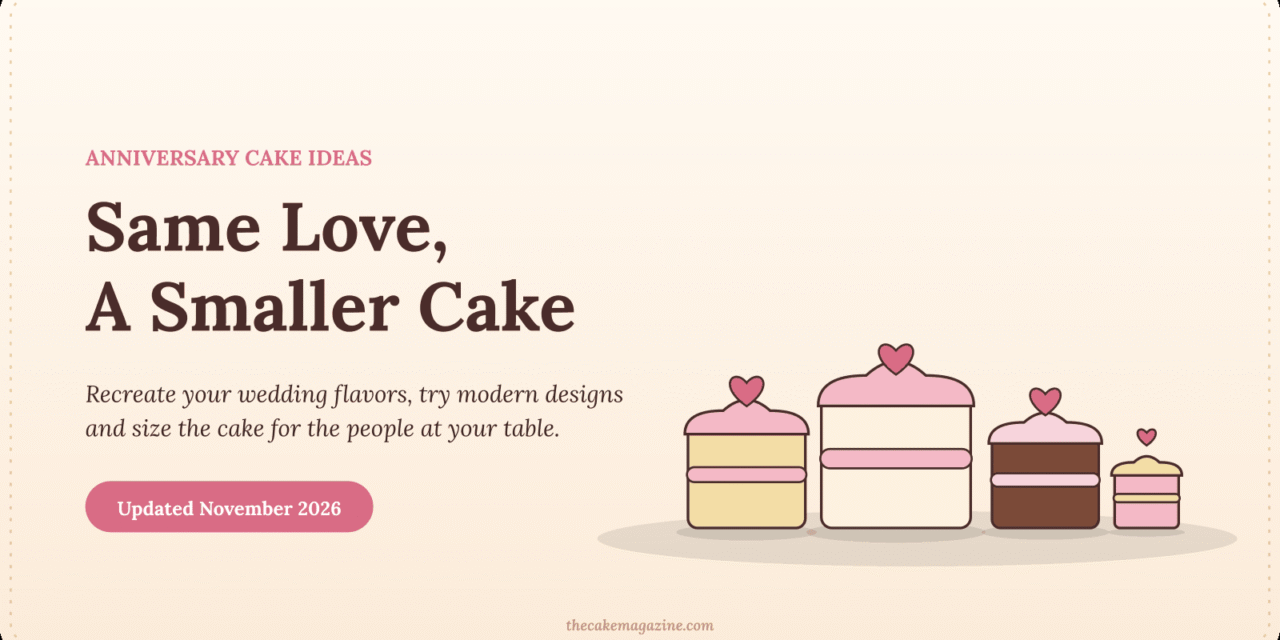
Most couples remember what their wedding cake tasted like, and many remember it was gone before the second slice. That is why anniversary cake ideas are so appealing: the guest list is tiny, and you finally get to eat the cake slowly. This guide collects practical anniversary cake ideas for home bakers and couples ordering from a bakery. We cover recreating your wedding flavors, modern designs that suit a small celebration, and how to size a smaller cake so nothing is wasted.
The best anniversary cake ideas start with a memory, not a trend: bake or order the flavor you had at your wedding, then shrink it to a 4-inch to 6-inch cake that fits the number of people at the table. Add one modern design choice, such as smooth sides with fresh flowers or a small piped number. Skip the year-old frozen top tier unless sentiment matters more than taste; a fresh cake in the same flavor will be better to eat.
- What makes good anniversary cake ideas
- Anniversary cake ideas by milestone year
- Recreating your wedding cake flavors
- The top-tier tradition, and what to do instead
- Flavor pairings worth trying
- Modern anniversary cake ideas and designs
- Small anniversary cake ideas: sizes and servings
- Baking your anniversary cake ideas at home
- Decorating anniversary cake ideas by skill level
- Fillings, frostings and finishing touches
- Budget-friendly anniversary cake ideas
- Anniversary cake ideas for people who skip cake
- Ordering from a bakery
- Serving, surprises and timing
- Common mistakes with anniversary cake ideas
- FAQ
What makes good anniversary cake ideas
An anniversary cake has a different job from a birthday cake or a wedding cake. A birthday cake is mostly about the person and the candles. A wedding cake feeds a crowd and has to survive a long day. An anniversary cake usually feeds two to ten people, and it is mostly about one thing: remembering. That changes how you choose almost everything, from flavor to size to how much decoration is worth the effort.
Before you scroll through photos, it helps to answer four questions. They sound simple, but they settle most of the decisions for you, and they keep the cake from turning into a stressful project on a day meant to be enjoyable.
The four questions that shape every cake
- Who is eating it? Two people, a dinner for six, or a family party of fifteen? The number of plates drives the size more than anything else.
- What do you want it to remind you of? Your wedding flavor, the place you met, a favorite dessert from your first dinner, or just a classic celebration cake.
- Who is doing the work? If one of you is baking it as a surprise, the design should match your skill and your free hours, not a photo from a professional.
- Where will it be eaten? A cake carried to a restaurant or a park has to be sturdier and simpler than one that never leaves your kitchen.
Once you have those four answers, the rest of these anniversary cake ideas becomes a menu. Pick one idea from each section and you have a plan. Our broader wedding cake guide covers the original cake in far more depth, and a lot of it is useful here too, especially the flavor and structure advice.
Why smaller anniversary cake ideas usually win
Many of the most satisfying anniversary cake ideas are small ones. A tiny cake looks intentional rather than leftover. It is cheaper to make or buy. It is also easier to finish while it is still fresh, which matters because cake dries out and the best slice is always the first one. A 6-inch cake with two layers is often plenty for a dinner party, and a 4-inch cake is a lovely choice for two.
If the smaller formats interest you, our guide to mini and one-bite cakes explains the sizes and techniques in more detail, and the 2026 cake trends roundup shows where this shift toward small celebration cakes is heading.
A quick rule of thumb. Plan on one slice per person after a meal, and add one or two extra slices so nobody feels they are taking the last bite. That small cushion is far less wasteful than a cake that is too large to finish.
Anniversary cake ideas by milestone year
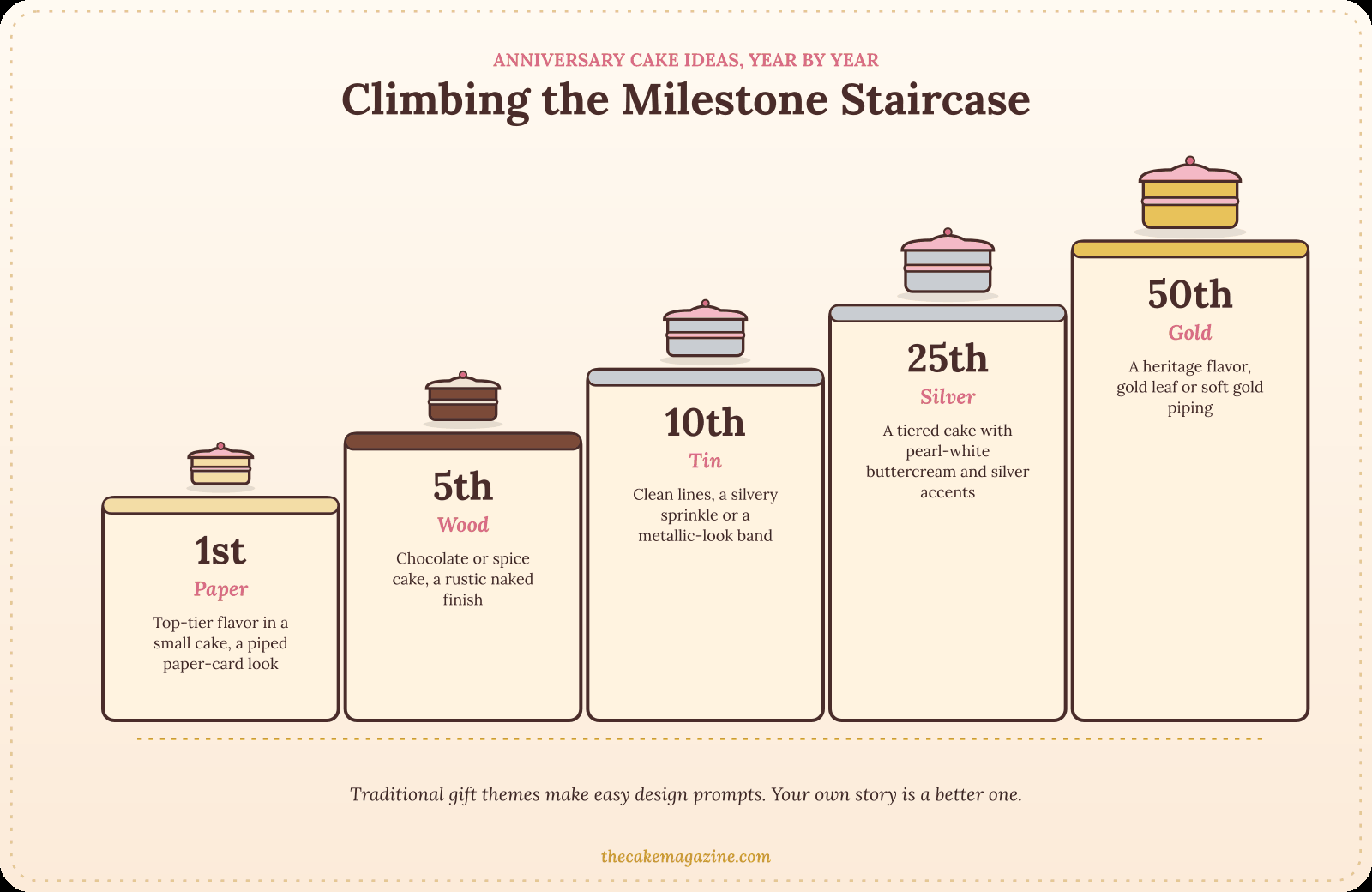
Traditional anniversary gift lists assign a material to each year: paper for the first, wood for the fifth, tin or aluminum for the tenth, silver for the twenty-fifth and gold for the fiftieth. Different lists vary a little, and nobody is checking, but the themes make handy design prompts. They give you a color, a texture and a mood to work from when a blank cake board feels intimidating.
First anniversary cake ideas: paper
The first anniversary is the one with the strongest cake tradition, because it is when couples most often think about their wedding top tier. A paper theme works nicely on a small cake: a cream or white finish with a piped “1” on top, or a cake topped with a little folded paper heart you made yourself. Use the flavor you remember from the wedding, and keep it small. A 4-inch or 6-inch cake lets you recreate the original without eating it for a week.
Fifth anniversary: wood
Wood suggests warmth and earthiness, which suits chocolate, spice or carrot cake. A “naked” or semi-naked finish, where the sides show a thin layer of frosting and the cake peeks through, looks natural without much work. Top it with a few chocolate shavings, toasted nuts or a sprig of rosemary. If you want a dependable base, our chocolate cake recipe is sturdy enough to carry a ganache or a cream cheese frosting.
Tenth anniversary: tin or aluminum
The tenth is a natural moment for clean lines. Think smooth white or pale gray buttercream, a thin band of metallic-look sprinkles or a sparkle of edible silver dust, and one confident piped number. Simple finishes read as modern. If your sides are not perfectly smooth yet, our guide to cake decorating for beginners walks through the basics of getting a tidy surface.
Twenty-fifth anniversary cake ideas: silver
A silver anniversary often means a real gathering with family and friends. This is the year when a small tiered cake makes sense: a 6-inch tier on top of an 8-inch tier serves roughly sixteen to twenty slices after a meal. Pearl-white buttercream, a few sugar pearls and a pale gray ribbon around the base look elegant without needing professional skills. If you are ordering, ask the baker about a small two-tier cake rather than a full-size stacked display.
Fiftieth anniversary cake ideas: gold
Fifty years deserves a cake that tells the story. Many families pick the original wedding flavor, then add a gold accent: a few pieces of edible gold leaf, a gold-painted number, or soft gold piping. If you are working with a bakery, bring a photo of the original wedding cake if one exists. Bakers love recreating vintage designs, and old photos often show details, like piped bows and string work, that are back in style.
Anniversary cake ideas for other years
You do not need a round number. Plenty of couples celebrate the third or the fifteenth, or the anniversary of a first date. For those years, ignore the gift list and let your own story guide the anniversary cake ideas you pick. Bake the dessert you ordered on that first dinner, add the color of a dress or a bouquet, or reproduce a favorite spice or fruit from a trip you took together. Personal details tend to be more memorable than metallic accents.
Recreating your wedding cake flavors for anniversary cake ideas
Recreating wedding flavors is probably the most meaningful of all anniversary cake ideas, and it is also the easiest to get wrong. Wedding cakes are built for a particular job. They are tall, stacked and often fondant-covered. A flavor that worked in that format may need adjusting to taste right in a small, soft, freshly frosted cake. The good news is that most wedding flavors are classics, and classics are easy to rebuild.
Start by finding the original recipe
If you ordered from a bakery, look back through your contract, tasting notes or emails. Most couples chose from a short list of flavor combinations, such as “vanilla cake with raspberry filling and vanilla buttercream” or “chocolate cake with salted caramel.” Those descriptions are enough to rebuild the cake. If you cannot find them, call the bakery. Bakers often keep records and are usually happy to remind you what you chose, even if they will not share the exact recipe.
If the cake came from a family member or a friend, ask them for the recipe card or a description of the frosting and filling. A single note, like “almond extract in the batter” or “cream cheese filling,” can make the difference between a cake that feels familiar and one that does not.
Break the cake into three parts
When you recreate a flavor, treat the cake as three separate decisions: the sponge, the filling and the frosting. A “white almond wedding cake” is a white sponge with almond flavor. “Lemon raspberry” is a lemon sponge, a raspberry filling and a vanilla or lemon buttercream. Once you see the three pieces, you can mix and match them, and you can swap in a simpler version of any layer if you are short on time.

What changes when you shrink the cake
A smaller cake has less structure to support, so you can relax some choices. You do not need a dense, firm sponge, because there is no stack of tiers pressing down. You can use softer fillings, such as whipped ganache, fresh fruit or lemon curd, because the cake will not travel far. And you can lighten the frosting, since a thin coat is easier to eat than a thick shell meant for fondant.
At the same time, a shorter cake shows its flavor faster. With only two thin layers, the ratio of filling to sponge matters more. Keep fillings to about a quarter-inch thick so the cake does not slide, and make sure the frosting tastes good on its own, because there is nothing hiding it. Our guide to wedding cake flavors lists classic pairings and modern variations that translate well to smaller formats.
Bring back the cake from a tasting
If you went to a tasting, you may remember the little sample boxes with five or six flavor combinations. Those are a great source of anniversary cake ideas. Pick the runner-up, the flavor you almost chose, and bake that one this year. It gives you something new while staying in the same family, and it is a fun conversation starter about what might have been.
The top-tier tradition, and what to do instead
Saving the top tier of the wedding cake to eat on the first anniversary is one of the best-known wedding customs in the United States. It is a sweet idea. It is also a slightly awkward one, because cake that has sat wrapped in a freezer for twelve months rarely tastes the way you remember it. Plenty of couples carry on the tradition happily, and plenty of others quietly skip it. Both choices are fine.
Our detailed guide to saving the top tier of a wedding cake covers freezing, wrapping and safety in depth. Here is the short version, along with some alternatives that keep the spirit of the tradition without the freezer burn.
If you do keep the top tier
Freezing preserves cake safely for a long time, but quality slips over the months. Frosting can pick up freezer odors, the crumb can dry out, and decorations can weep when they thaw. If you are going ahead, set it up for the best chance of success. Chill the cake until the frosting is firm, wrap it tightly in several layers of plastic wrap, add a layer of foil, and put it in a sturdy box. Keep it flat and away from strong-smelling foods.
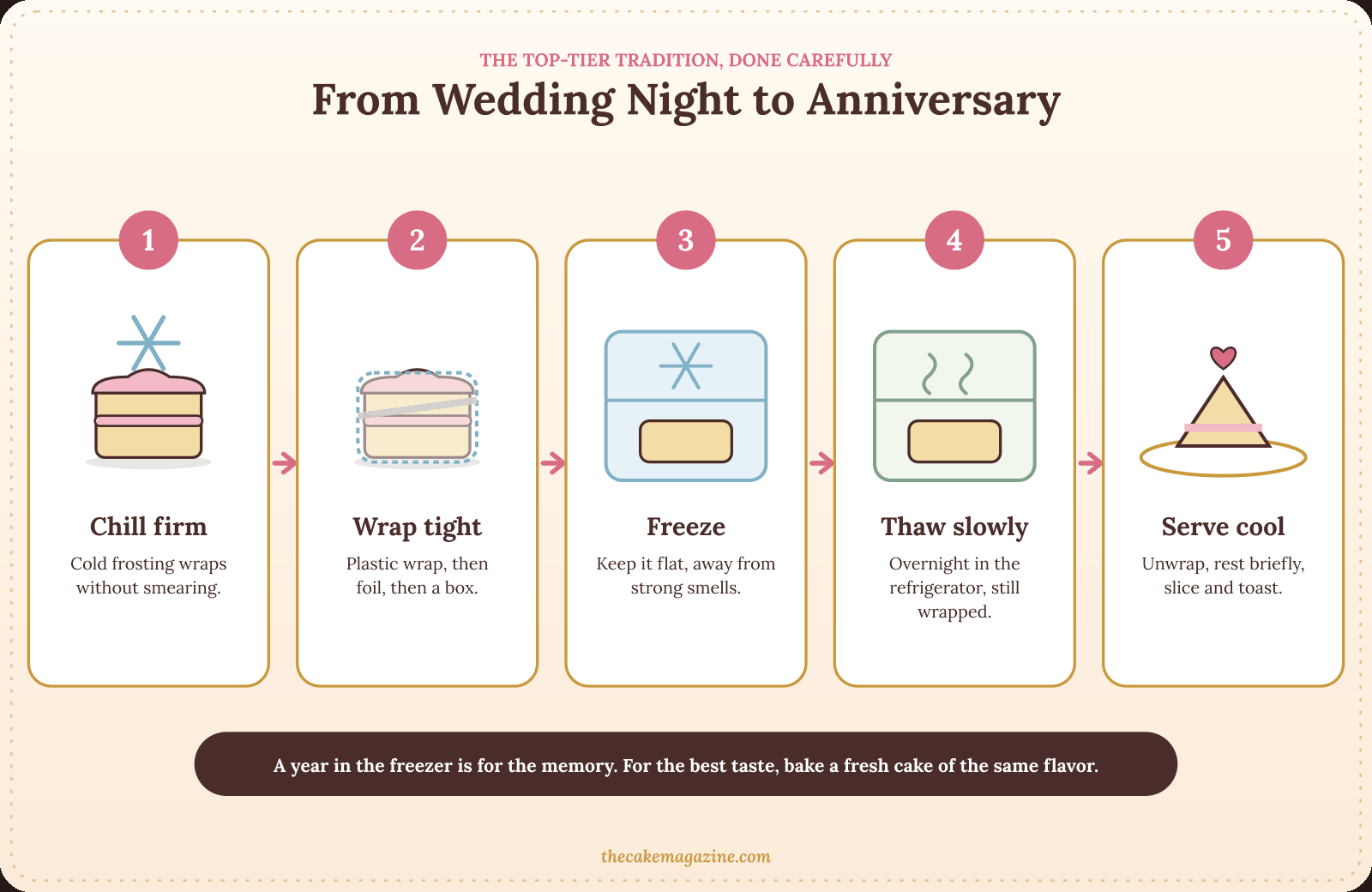
When the day arrives, thaw it slowly, still wrapped, in the refrigerator. Unwrap it only after it has come to a cool room temperature so condensation does not wet the frosting. Slice it, taste it, and be honest about what you think. For general freezing and food-handling guidance, the USDA Food Safety and Inspection Service is a reliable place to start, and it is worth a look before you commit a cake to a freezer for a year.
A kind word about cream fillings. Tiers filled with fresh fruit, custard or whipped cream do not keep well for a year. If your wedding cake had those, a preserved top tier is more a keepsake than a dessert. Taste a small piece at the one-year mark, then decide whether to eat the rest or let it go.
Anniversary cake ideas that keep the tradition alive
- Bake a fresh twin. Make a small cake in the same flavor and frost it in the same style. You get the nostalgia and a fresh, moist crumb.
- Freeze one slice, not a whole tier. A single wrapped slice takes up little space and thaws faster. Better still, freeze a few unfrosted layers or a cup of the original buttercream flavor notes, then rebuild a small cake later.
- Keep the topper, not the cake. A cake topper, a ribbon from the cake table or the knife you used to cut the first slice can sit in a box and bring the memory back without any food safety worry.
- Order a small anniversary cake from the same bakery. Many bakeries offer a first-anniversary cake in the original flavor. It is worth asking at your wedding or a few weeks before the date.
Flavor pairings worth trying
Once you step outside the wedding cake, the flavor options widen. An anniversary can be an excuse to try something you would not serve to a hundred guests. These anniversary cake ideas work well in small cakes because they feel special without depending on technique.
Classic flavors with a gentle twist
Start with something familiar and change one layer. Vanilla cake with raspberry jam and vanilla buttercream becomes vanilla cake with lemon curd and a raspberry swirl in the buttercream. Chocolate cake with chocolate frosting turns into chocolate cake with espresso buttercream and a thin ganache between the layers. Red velvet gets a brown butter cream cheese frosting. The structure of the cake does not change, so the risk is low, but the taste feels new.
If you want a trusted starting point, our vanilla cake recipe and the chocolate cake recipe are both built for layers and take flavored fillings well.
Anniversary cake ideas tied to a place or a moment
Some of the most memorable anniversary cake ideas come from a story rather than a menu. A couple who got engaged on a trip to Italy might choose an almond cake with amaretto cream and cherries. Someone who met at a coffee shop could build a tiramisu-inspired cake with coffee-soaked layers and mascarpone filling. A couple married in a vineyard might choose a white cake with a grape or lemon filling. The story gives the cake a reason to exist, and it gives your guests something to ask about.
Seasonal anniversary cake ideas
If your anniversary lands in a particular season, let the weather help you. Spring and summer lean toward lemon, strawberry, rhubarb, peach and fresh berries. Autumn suits apple, pear, maple, pumpkin spice and brown butter. Winter is the time for chocolate, peppermint, orange, cranberry and warm spices. Seasonal fruit also tastes better and often costs less, which matters when the cake is small and the fillings are the star.
A few combinations to try
- Lemon sponge, blueberry compote, vanilla bean buttercream
- Chocolate cake, raspberry preserves, dark chocolate ganache
- Almond cake, cherry filling, whipped vanilla frosting
- Carrot cake, pineapple, brown butter cream cheese frosting
- Vanilla cake, salted caramel, toasted pecan crunch
- Brown sugar cake, roasted pear, mascarpone cream
Check any filling for stability before you commit. Fresh fruit and loose compotes can soak into the layers, so thicken them slightly or pipe a ring of buttercream around the edge to hold them in place.
Modern anniversary cake ideas and designs
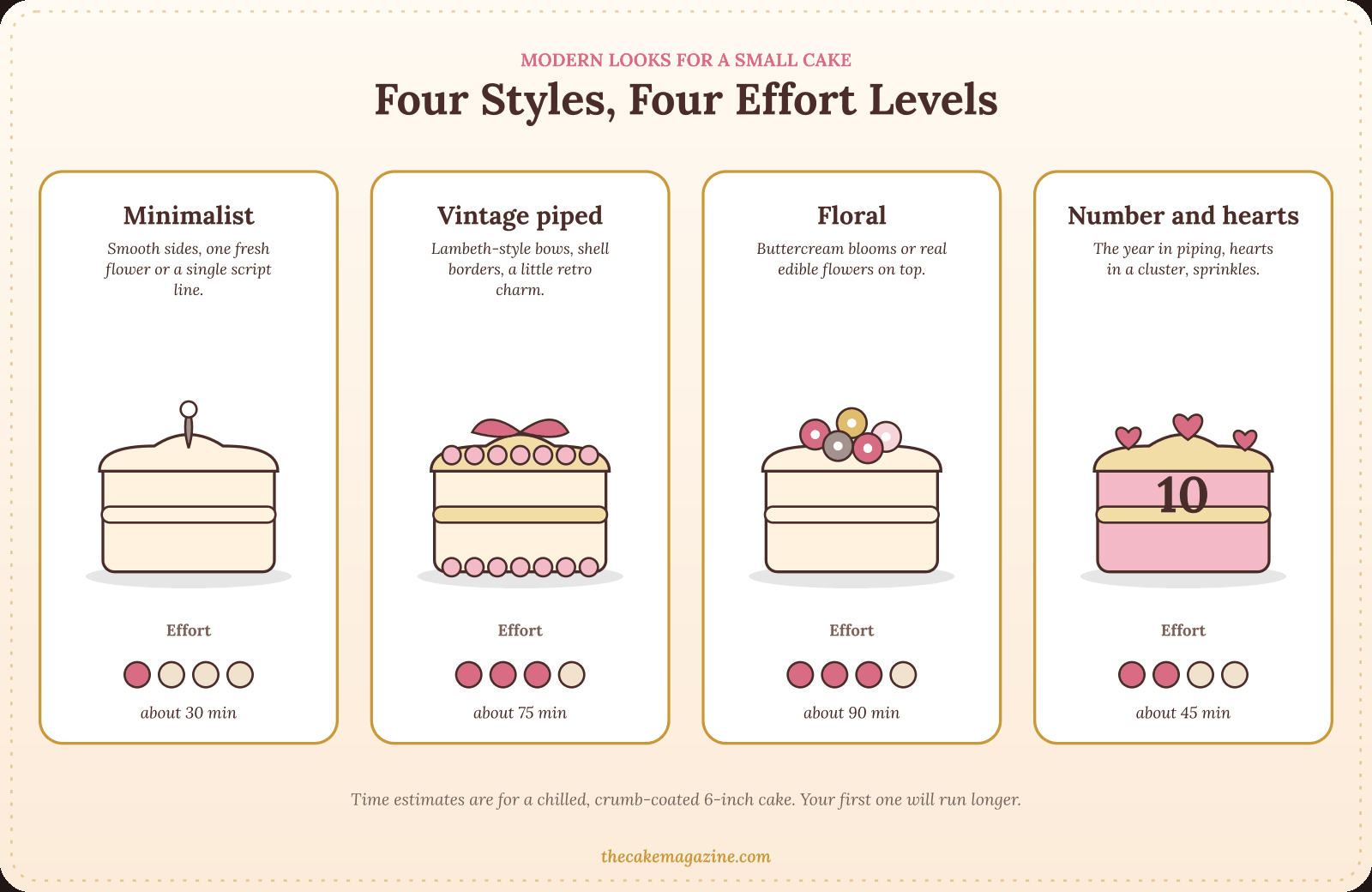
Anniversary cake design has moved away from the tall, ornate look of earlier decades. Today, many people prefer cakes that feel personal, tactile and a little imperfect. Trend sources describe a lean toward smaller cakes, retro piping and expressive texture, and our own roundup of 2026 cake trends covers those shifts in more detail. For anniversary cake ideas, a handful of looks tend to work especially well.
Minimalist and smooth
One smooth cake, one or two pieces of decoration, plenty of empty space. A single fresh flower, a few berries, or a short line of script on the top is enough. This style is calm and elegant, and it hides little, so the crumb coat and the final coat need to be neat. A bench scraper and a cold cake help a great deal, as our guide to cake decorating for beginners explains.
Vintage piping
Piped bows, shell borders and written messages in a retro style have become popular for celebration cakes, and they suit an anniversary especially well because they feel like a gift. They can be forgiving: a little wobble reads as handmade charm. Use a stiff but smooth buttercream, chill the cake before piping and practice on parchment first. A small round tip and a star tip are enough for most designs.
Floral
Flowers on a cake echo the bouquet and the venue of a wedding. You can use real blooms, but only ones sold as edible or that you have confirmed are safe, and keep them from touching the frosting directly by wrapping the stems in floral tape. Or pipe simple buttercream flowers in the colors you chose for your wedding. A small cluster of piped blooms on the top of a 6-inch cake looks lovely and takes less time than you might expect.
Numbers, hearts and text
A piped number or a handful of hearts says “anniversary” at a glance. Hearts can be piped, cut from sugar paste or made from sprinkles. For text, practice the message on parchment first and keep it short. A date, a pair of initials or a simple phrase tends to look better than a long sentence.
Dot cakes and mini cakes
A small cake covered in tiny dots or sprinkles has been an online favorite. Our explainer on dot cakes shows how the look works. For a playful twist, a pair of matching 4-inch cakes, one for each person, is a playful alternative to a single cake. Each one can carry a different flavor or message, and nobody has to share.
Texture over color
Many modern designs rely on texture, such as swoops, ridges, a palette-knife finish or a heavy dusting of crumbs. Texture is easier than perfect smoothness because there is nothing to correct. It also photographs well, and it hides small flaws in a way a flat finish cannot.
Small anniversary cake ideas: sizes and servings
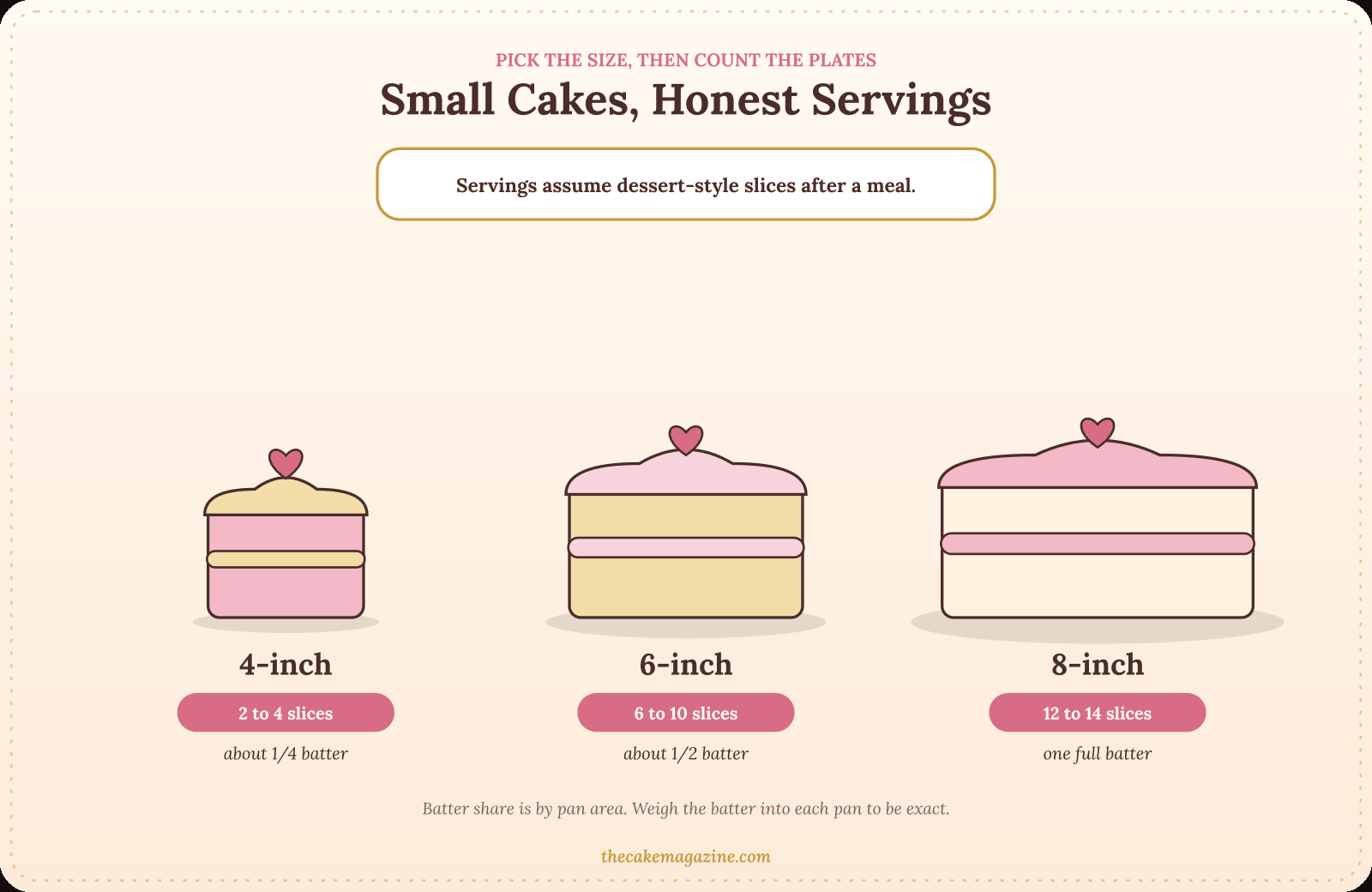
Choosing the right size is the most useful thing you can do when you pick from any list of anniversary cake ideas. A cake that is too big wastes ingredients and money, while one that is too small leaves guests wishing there were seconds. The numbers below are typical dessert-sized slices after a meal. Your guests, your slicing style and how generous you are will change the count, so treat them as a guide.
Cake sizes at a glance
4-inch cake
Two to four slices. Good for two people, or a pair of 4-inch cakes at a dinner for four. Needs about a quarter of a standard 8-inch batter.
6-inch cake
Six to ten slices. The sweet spot for a family dinner or a small gathering. Needs about half of a standard 8-inch batter.
8-inch cake
Twelve to fourteen slices. Best for a party of ten to fifteen. One full 8-inch batter makes two layers.
6-inch plus 8-inch tiers
About eighteen to twenty-four slices, depending on how you cut. A good choice for a milestone party. Plan the stacking and dowels carefully.
For a full breakdown of tiers and portions, see our wedding cake serving guide, which explains how bakers count slices. If you are feeding a larger crowd and want a quick estimate, the party cake serving calculator guide walks through how much cake different events need.
How the batter scales
You can estimate the batter for a different pan by comparing areas. An 8-inch round pan covers about 50 square inches, a 6-inch pan about 28 and a 4-inch pan about 12.5. That means a 6-inch pan needs a little over half of an 8-inch batter, and a 4-inch pan needs about a quarter. For layers of the same height, those ratios are a good starting point. Weigh the batter into each pan so the layers match.
Leave room for the cake to rise rather than filling the pan more than about two-thirds.
Smaller cakes also bake faster. A 6-inch layer often needs several minutes less than an 8-inch layer, and a 4-inch layer less still. Start checking early, use a skewer or a thermometer rather than the clock, and note the time that works in your oven for next year. These are starting points rather than promises, and our vanilla cake recipe includes more notes on doneness cues.
One cake or two small ones
Two 4-inch cakes can be a clever alternative to a single 6-inch cake. Each person gets a cake, flavors can differ, and the decorating is faster because each cake is small. The tradeoff is more pans, more assembly and more cleanup. If you only have one set of small pans, bake in batches, or use a muffin tin or a small springform pan as a stand-in.
Using leftovers well
Small cakes do not generate much leftover, but you may still have a few slices. Cake keeps best at a cool room temperature if the frosting is stable, loosely covered, for a day or so. Fillings made with fresh cream, custard or fruit belong in the refrigerator. When in doubt about holding times for perishable fillings, check the guidance from the USDA Food Safety and Inspection Service, and let cold cake sit out for a bit before eating so the flavors open up.
Baking your anniversary cake ideas at home
Making the cake yourself is a gift in its own right, and it is the cheapest way to get exactly the flavor you want. It also takes planning. The key is to break the work into stages across a few days, so you are never trying to bake, fill, frost and decorate on the same afternoon.
A simple three-day timeline
- Two or three days before: Plan the flavor, buy ingredients, make any fillings that keep well, such as jam, curd or ganache, and clean your pans.
- The day before: Bake the layers, cool them completely, wrap them and chill or freeze. Make the frosting, or the base of it.
- The day of: Level, fill and crumb coat the cake, chill it, then frost and decorate. Leave an hour for chilling and a little more for surprises.
Cold cake is easier to handle than warm cake, so baking a day ahead is not just a convenience. Wrapped layers often taste a little moister the next day, and they frost more cleanly with fewer crumbs.
Choose a reliable base for your anniversary cake ideas
Anniversary cake ideas work best with batters you already trust. Our vanilla cake, chocolate cake and red velvet cake pages cover the core flavors that show up most often at weddings. If you pick a new recipe, bake a test cake a couple of weeks ahead. A practice run teaches you your oven, your pans and how the cake handles frosting, and it gives you a snack. For reference, the King Arthur Baking cake guide is a dependable resource for general technique and troubleshooting.
About recipes on this site. We do not claim to have tested every formula in our kitchen. Treat any amounts, temperatures and bake times as starting points, adjust for your oven and pan, and judge doneness by the cake itself.
Equipment you really need
- Two or three small round pans (4-inch, 6-inch or both), straight-sided and about 2 to 3 inches deep
- Parchment rounds to line the bottom of each pan
- A kitchen scale, for equal layers and accurate batter
- A serrated knife or leveler, a turntable and an offset spatula
- A bench scraper for smooth sides
- A cake board slightly larger than the cake, and a box that fits
You do not need specialty pans or tools to make a good small cake. If you do not own small pans, you can bake a half-batch in an 8-inch pan, cut the cooled layers into rounds with a plate or a cake ring, and stack the rounds. The edges you trim off make excellent snacks or cake truffle filling.
Filling and stacking
Level each layer so it sits flat. Pipe a dam of buttercream around the edge of the bottom layer, spread filling inside it, and set the next layer on top, cut side down for a flat top. Press lightly so the layers settle. Chill the stack for about twenty minutes, then apply a thin crumb coat to seal in stray crumbs, chill again and finish with the final coat. This is where patience pays off, and our guide to cake decorating for beginners shows each step in detail.
Decorating anniversary cake ideas by skill level
The loveliest of all anniversary cake ideas is the one you can finish without tears. Choose a design based on the time you have and the skills you already own, not on the most impressive photo you saw. The three levels below build on each other, and each one produces a cake that looks deliberate. These looks scale from a quiet evening at home to a larger gathering.
Easy anniversary cake ideas for new decorators
Keep the sides rustic and let the top carry the design. Spread a generous coat of frosting, then drag a spatula or the back of a spoon around the cake for a soft swoop. Add fresh berries, a few edible flowers or a scatter of sprinkles. A store-bought topper in the shape of a number is perfectly acceptable. The finish is forgiving, and nobody will notice that the sides are not razor-sharp.
- Use a thin crumb coat and a cold cake. This is what makes beginner frosting look neat.
- Choose a soft color palette. Pale pink, ivory and sage hide small mistakes better than a dark or bright color.
- Keep decorations to one focal point, like a cluster of berries or a single piped heart.
If you have some practice
Smooth the sides with a bench scraper and try a small amount of piping. A shell border at the base, a few buttercream dots or a short message in a soft color looks polished and takes less than an hour. Our guide to cake decorating for beginners explains how to hold the bag, how much pressure to use and how to fix mistakes. Practice the pattern on parchment first, then repeat it on the cake.
A quick trick is to freeze a drawn template. Trace a heart or number on parchment, pipe over it, freeze the piped shape, then peel it off and place it on the cake. If it breaks, you simply make another one before it touches the cake.
If you are confident
Try a two-tone buttercream finish, a hand-piped lace border or a small stacked cake with a tidy ribbon of fondant at the base. A tall, slim 6-inch cake with sharp edges and a thin line of metallic paint looks quite sophisticated. If you want to try a retro look, pipe a row of small bows and a delicate border on a chilled cake and let it set in the refrigerator.
Even experienced decorators plan extra time for surprises. Humidity softens buttercream, warm hands melt piped details, and a dropped cake board can ruin an afternoon. Build in a margin, and keep an extra batch of frosting in the refrigerator in case something needs repair.
Writing a message that looks good
Handwriting on a cake is harder than it looks. Chill the cake so the frosting is firm. Use a thin piping tip or a small bag with a tiny cut, and write slowly, holding the tip slightly above the surface. If you are nervous, lightly press a toothpick into the frosting to mark the line first, or use alphabet cutters on fondant or chocolate. Short messages like “Happy 10th” or “Forever” read better than a long sentence.
If the writing goes wrong, wipe it off with a clean spatula and try again.
Fillings, frostings and finishing touches
On a small cake, the filling and frosting make up a significant share of every bite. That is good news, because they are easy to customize and they are where the flavor memory really lives. Choose them first, and then match the sponge.
Choosing a frosting
American buttercream is sweet, sturdy and easy for beginners; our overview of the types of buttercream compares it with Swiss meringue, Italian meringue, French and ermine styles. Swiss meringue buttercream is silkier and less sweet, and it is popular for wedding cakes. Cream cheese frosting pairs well with carrot, red velvet and spice cakes, but it is softer and needs the refrigerator. Ganache is rich and glossy and works beautifully on chocolate cakes, but it needs time to set.
If your wedding cake used a particular buttercream, recreating that texture is a big part of the memory. Many bakeries use Swiss meringue buttercream for weddings because it is smooth and holds up well. If that is what you remember, it may be worth learning the method, or choosing a less sweet frosting that comes close.
Fillings that stay put
- Jam and preserves: Easy and stable. Spread a thin layer inside a buttercream dam.
- Lemon or passion fruit curd: Bright and tart. Keep it thin so the layers do not slip.
- Ganache or whipped ganache: Rich and sliceable. Cool it before using.
- Fresh fruit: Lovely but wet. Pat berries dry and add them just before serving if possible.
- Mousse and pastry cream: Delicate and delicious, but they need refrigeration and a firm dam.
Fillings that contain eggs, dairy or cream need to be kept cold. The USDA Food Safety and Inspection Service publishes guidance on safe handling and temperatures, and it is worth reading if you plan to make custard or cream-based fillings and keep the cake for more than a few hours.
Personal finishing touches
Small details turn a nice cake into a gift, and these ideas need almost no skill. Here are a few to try:
- Tuck in a few flowers from your wedding bouquet palette, using only safe, edible varieties or wrapping stems well.
- Pipe a heart on the board in melted chocolate.
- Use a candle shaped like the anniversary number, or a single candle for each year if you have a small number of years to count.
- Add a tiny handwritten card with the date you were married, the flavor and where it came from.
- Serve it on the plates or the cake stand you used at your wedding.
Allergies and dietary needs
If anyone at the table has an allergy or follows a gluten-free, dairy-free or egg-free diet, plan for it from the start. Substituting in an existing recipe can change texture and structure significantly, so use a recipe designed for that diet rather than improvising. Label the cake clearly, and be careful with shared bowls, spatulas and surfaces if cross-contact matters. When a guest has a serious allergy, check with them or their family about what is safe.
Budget-friendly anniversary cake ideas
A meaningful cake does not need a large budget. The most economical anniversary cake ideas are small, simple and built from ingredients you already know how to use. Money tends to disappear into three places: extra layers, fancy decoration and specialty ingredients. Trim those and you still have a lovely cake.
- Bake one thin layer and split it. A single 6-inch layer cut in half gives you a tiny two-layer cake with half the batter.
- Use seasonal fruit. Berries in June or apples in October cost less and taste better than out-of-season fruit.
- Make one good filling instead of three. A jar of jam, a quick lemon curd or a simple ganache goes a long way.
- Decorate with texture. A palette-knife swoop costs nothing, and a handful of sprinkles or a few chocolate shavings covers the top.
- Borrow instead of buying. A cake stand from a friend or your own plates are better than a new set of props.
If you are buying, a bakery case cake or a small cake from the grocery store bakery can be personalized with a few fresh berries and your own candles. It is a quiet way to keep the tradition and keep the spending sensible. Whatever you choose, tell people what the cake is for and enjoy it slowly.
Anniversary cake ideas for people who skip cake
Some couples simply do not love layer cake, and that is fine. The spirit of anniversary cake ideas is a shared sweet moment, and a few alternatives deliver it just as well. Choose a format that suits the two of you rather than the one in the photos.
- Cheesecake. A small 6-inch cheesecake is dense, rich and a classic celebration dessert. It needs time to chill, so plan ahead.
- Cupcakes. A half-dozen cupcakes in the wedding flavor are easy to serve and need no cutting. Our mini cake guide shows several small formats.
- A cookie cake or brownie stack. Chewy, shareable and forgiving. Add a piped message and a few candles.
- A tart or pie. A fruit tart or a pie from your wedding season suits a relaxed dinner.
- A dessert flight. Several tiny portions, such as a mini cake, a truffle and a spoonful of mousse, let you taste your way through memories.
Whatever you choose, keep one thread from your wedding: a flavor, a color or a candle. That small link is what turns a plain dessert into one of your own anniversary cake ideas.
Ordering anniversary cake ideas from a bakery
Not every one of these anniversary cake ideas needs a home oven, and a bakery order can be a good gift to yourself. Bakers are often delighted by small anniversary orders because they are personal and quick. The key is to order early and be specific.
What to ask and what to tell them
- Is a 4-inch or 6-inch cake available, or is there a minimum size?
- Can they match the flavor of your wedding cake or the bakery that made it?
- What is the lead time, and when can you pick up or arrange delivery?
- Do they handle allergens, and how do they label them?
- How should the cake be stored, and for how long?
- Do they offer a tasting or a sample slice for a custom flavor?
Tell them the number of guests, the date and time, the flavor, any color preferences and a photo for inspiration. If you are unsure about the design, ask for the baker’s recommendation. A good baker will steer you toward something that will look good and taste good at the size you need.
What affects the price
Prices vary widely by region and bakery, so we will not quote numbers. The main drivers are size, number of layers, the complexity of the decoration, the cost of ingredients such as fresh fruit or imported chocolate, and the time the baker spends. A simple smooth cake with a minimal design costs less than a heavily piped or sculpted one. For a deeper look at what goes into cake pricing, ask the baker which of these choices is driving the quote.
Many bakeries also offer ready-made small cakes in a case in a case, which can be the most economical choice if you have flexibility on flavor and design. If you want a custom message, ask whether they can personalize one of those.
Picking up and transporting
Cake travels best cold and flat. Place the box on a flat surface in the car, such as the floor of the back seat or the trunk, not on a seat where it can tilt. Drive gently, avoid a hot car and do not leave the cake sitting in the sun. If the cake has a perishable filling, keep it in the refrigerator until the party. Even a short ride can ruin a delicate design, so give yourself a few extra minutes.
Serving, surprises and timing
A good cake can be undone by serving it at the wrong temperature or the wrong moment. A little attention to timing makes the difference between a cake that tastes the way you planned and one that is stiff, soggy or melted.
Take the chill off
Cake straight from the refrigerator tastes muted, because cold butter firms up and dulls flavor. Take a refrigerated cake out about 30 to 60 minutes before serving, depending on how warm the room is. Cakes with cream cheese or whipped cream frosting should stay cold a little longer, and cakes filled with custard or fresh cream should not sit out for long at all.
Slicing small cakes cleanly
Use a long, thin knife dipped in hot water and wiped dry between cuts. For a 6-inch cake, cut in half through the center, then cut each half into thin wedges, or slice straight across for rectangular pieces. Keep the slices modest. A rich cake with generous filling is satisfying in small portions, and it stretches further.
Candles and photos
Anniversary candles are mostly for the picture, so keep them simple. One tall candle, a number candle or a few small ones look better than a crowd of candles on a small surface. Light them just before the photo and blow them out quickly so wax does not drip on the frosting. If you want a photograph of the whole cake, take it before slicing, in soft daylight if you can.
Surprise cakes
If you are planning a surprise, think about where the cake will hide and how long it will be there. A refrigerator in a shared home is not very private, so consider a friend’s kitchen or a cooler. A cake with simple finishes also travels more safely, and a shorter timeline helps keep the secret.
A countdown checklist
- Two weeks out: Pick the flavor, the size and the design. Order from a bakery, or plan a test bake.
- One week out: Buy ingredients, packaging and a cake board. Make a plan for where it will be stored.
- Two to three days out: Make fillings and bake layers if you are freezing them.
- The day before: Make frosting, assemble the cake and give it a crumb coat. Chill overnight.
- The day of: Finish the frosting, add decorations and set out the cake before serving.
Common mistakes with anniversary cake ideas
Nearly every home baker runs into a few of the same problems on a celebration cake. None of them are disasters, and most can be fixed with a few small adjustments. When you are trying a celebration cake for the first time, expect one small hiccup and plan a little time to deal with it. For a deeper dive into causes, our vanilla cake recipe notes on doneness and structure are a good companion.
The cake is too large for the number of guests
What it looks like: half a cake left on the counter two days later, drying out.
Fix it next time: pick a size based on plates, not on how impressive a big cake looks. Check the size chart above and err toward smaller.
Crumbs showing through the frosting
What it looks like: brown flecks in a pale buttercream, especially at the edges.
Fix it next time: use a thin crumb coat, chill it until firm, then add the final coat. Cold cake sheds far fewer crumbs than warm cake.
Layers sliding or bulging
What it looks like: filling pushing out at the sides, or a top layer leaning.
Fix it next time: pipe a firm buttercream dam around each layer, keep fillings thin, and chill the stack before the final coat.
A dry cake
What it looks like: a firm, crumbly slice that needs a drink of milk.
Fix it next time: check for doneness early, brush the layers with a light simple syrup, and wrap them while still slightly warm if you are baking ahead. Our vanilla cake recipe has details on bake times and moisture.
Buttercream melting or weeping
What it looks like: glossy, soft frosting that slides down the sides on a warm day.
Fix it next time: chill the cake for twenty minutes, keep the room cool and use a sturdier frosting. If you must work in warm weather, work in short stretches and return the cake to the refrigerator between steps.
Rushing the decoration
What it looks like: smudged piping, uneven writing and a cake that looks tired.
Fix it next time: do a practice run on parchment and choose a simpler design if time is tight. A clean, simple cake always looks better than an overworked one.
Frequently asked questions about anniversary cake ideas
What are the best anniversary cake ideas for a small celebration?
For two to six people, a 4-inch or 6-inch two-layer cake in a flavor you love is hard to beat. Pick your wedding flavor, a favorite dessert from early in your relationship or a seasonal fruit, then add one simple finish such as fresh flowers, berries or a piped number. Small, personal and freshly made is the formula that works almost every time.
How do I recreate my wedding flavors using anniversary cake ideas?
Find the original description in your contract, tasting notes or emails, then break it into sponge, filling and frosting. Rebuild each layer separately using trusted recipes, and shrink the size to fit your guest list. If you cannot find the details, call the bakery or ask a relative who tasted it. You will not match it exactly, but you will get close.
Is it safe to eat the top tier of a wedding cake after a year?
Properly wrapped cake that stayed frozen the whole time is generally safe, but quality drops over the months, and cakes with fresh fruit, cream or custard fillings are a poorer bet. Thaw it slowly in the refrigerator and taste a small piece first. For food safety questions, check the USDA Food Safety and Inspection Service website, and bake a fresh cake if you are unsure.
Which anniversary cake ideas suit a dinner for four?
Of all the small anniversary cake ideas here, a 6-inch two-layer cake gives six to ten dessert slices, which covers four people with seconds. If you want a cake that looks impressive but not enormous, that size is a safe choice. For two people, a 4-inch cake is usually plenty, and for six to eight guests, an 8-inch cake works well.
Which anniversary cake ideas suit a first anniversary?
Your wedding flavor is the classic choice, since it is the cake you remember. If you want something different, vanilla with a fruit filling, chocolate with raspberry or lemon with berries are popular, dependable options. The first anniversary is also a good time to try the runner-up flavor from your tasting.
How can I try modern anniversary cake ideas without advanced skills?
Use a soft, rustic finish with a palette-knife swoop, then add one focal point, such as a handful of berries, a few edible flowers or a store-bought number topper. Smooth finishes need more skill, but texture is forgiving. A cold cake, a thin crumb coat and a calm color palette will make almost any beginner cake look intentional.
How far ahead can I prepare anniversary cake ideas like these?
Bake and wrap the layers one to two days ahead and chill them, or freeze them for longer. Assemble and frost the cake the day before or the morning of the celebration. Cakes with fresh cream, custard or fruit fillings should be finished as close to serving time as possible and kept refrigerated.
Do anniversary cake ideas change by year?
They can, but you do not have to follow tradition. Gift themes such as paper, wood, tin, silver and gold are handy design prompts, and a milestone like the twenty-fifth or fiftieth may call for a larger or more elaborate cake. For other years, a personal story or a favorite flavor is just as meaningful.
Should I order anniversary cake ideas from a bakery or bake them myself?
Baking gives you total control over flavor and costs less, but it takes planning and time. A bakery saves effort and often delivers a more polished look. If you are short on time or want a complicated design, order. If you enjoy baking and want something personal, bake. Many couples do a bit of both with a bought cake and a homemade filling.
How do I keep a small cake fresh until the party?
Chill the finished cake until the frosting is firm, then cover it loosely or keep it in a box. Cakes with butter-based frosting and no perishable filling can wait a few hours at cool room temperature, while anything with cream, custard or cream cheese should stay refrigerated. Take it out about an hour before serving so it softens.
Can I make a gluten-free or dairy-free anniversary cake?
Yes, but use a recipe designed for that diet rather than swapping ingredients in a standard recipe, since flour, fat and eggs all affect structure. Check labels on sprinkles, chocolate and extracts, and keep equipment clean if cross-contact matters. For serious allergies, confirm the details with the person or their family before serving.
Which anniversary cake ideas work for a very large family party?
For a bigger crowd, an 8-inch cake serves twelve to fourteen dessert slices, and a 6-inch top tier on an 8-inch base serves about twenty or so. For thirty or more guests, a quarter-sheet or half-sheet cake is more practical and often less expensive. Check our serving guide to match the count to the room.
Final thoughts
The best anniversary cake ideas are the ones that make you feel something when you take the first bite. That might be the flavor from your wedding, the color of a bouquet or the dessert you shared on a first date. It does not have to be big, and it does not have to be perfect. A small cake, a thoughtful flavor and a calm afternoon will do more for the day than any elaborate design.
Start with the memory, choose a size that fits the table, and pick one design idea that suits your skills. If you are baking, plan across a few days and keep a practice run in mind. If you are ordering, ask early and be specific. And if you decide to skip the year-old top tier, a fresh cake in the same flavor will carry the same love and taste far better.
Sources and further reading
- King Arthur Baking, cake guide.
- U.S. Department of Agriculture, Food Safety and Inspection Service, food safety.
Editorial note: this guide was reviewed and updated in November 2026 and is written for home bakers in the United States, using American measurements. It offers general information and ideas, not tested recipes; amounts, bake times and storage times are starting points that vary by oven, pan and ingredients. Food-safety and allergy details are general, so check official guidance and the people you are feeding. Traditional anniversary gift themes vary by list.