A good spice cake recipe should smell like the first cold morning of fall before it ever leaves the oven. It should taste warm rather than dusty, stay moist for days, and hold a frosting without crumbling under the knife. Too many versions fall short, with a pinch of cinnamon in a vanilla batter, or a brick of cloves that numbs your tongue. This guide gives you a reliable two-layer spice cake recipe and, just as importantly, the reasoning behind it, so you can adjust it with confidence.
The most dependable spice cake recipe for layers is an oil-based cake built on brown sugar, a spoonful of molasses and buttermilk, with cinnamon, ginger, nutmeg and a little clove whisked in with the flour. Weigh everything, mix until the batter just comes together, and bake two 8-inch layers at 350°F until a skewer shows a few moist crumbs. Cool completely, then frost. The rest of this guide explains each choice.
Why this spice cake recipe works
Anyone searching for a spice cake recipe usually wants a short list of things that sound easy and are surprisingly hard to pull off together. They want warmth without bitterness. They want a crumb that is soft and damp, closer to a good carrot cake than a muffin. And they want layers sturdy enough to stack. A handful of deliberate choices in this formula answer each wish, and knowing them lets you troubleshoot later.
This spice cake recipe uses oil, so the crumb stays soft
Butter tastes wonderful, but it turns firm in a cold kitchen or a refrigerator, and a butter cake can feel tight and dry when it is chilled. Oil stays liquid at every temperature, so the crumb stays plush whether the cake is warm, cool or straight from the fridge. Spice cakes carry so much flavor from the spices and the brown sugar that you give up very little by leaving butter out of the batter. You can bring that dairy richness back through the frosting, where it counts.
If you prefer a butter-based, creamed cake, our best vanilla cake recipe is a good model for that style, and the same spices can be folded into it with a few adjustments covered later.
Brown sugar and molasses make the spice cake recipe taste deeper
Plain white sugar sweetens. Brown sugar does more, because it carries a little molasses along with it, which adds moisture, a caramel note and a faint acidity. This spice cake recipe uses mostly brown sugar and adds a spoonful of extra molasses. That combination gives the cake its warm color and a flavor that sits comfortably alongside ginger and cinnamon. The whole idea is gingerbread’s darker cousin, softened into something suited to frosting.
Buttermilk keeps a spice cake recipe tender
Buttermilk adds moisture and a gentle tang, and it gives baking soda an acid to react with. The result is an even rise and a tender, slightly springy crumb. Brown sugar and molasses are mildly acidic too, so the cake leans on a small amount of baking soda for lift and a little baking powder for insurance. If you want to know why these leaveners behave as they do, our guide to cake baking science explains the chemistry in plain terms.
The spice cake recipe blooms its spices in the batter
Ground spices hold most of their flavor in aromatic oils, and those oils dissolve into fat far more readily than into water. By whisking the spices into the wet mixture that contains oil, the flavor spreads evenly through the crumb rather than clumping in dry pockets. It also means you avoid the unpleasant feeling of biting into a pocket of raw cinnamon. We show the method in the infographic further down.
A one-bowl, whisk-only spice cake recipe is hard to ruin
There is no creaming and no whipping. You whisk the dry ingredients in one bowl, the wet ones in another and then bring them together with a spatula. That means fewer chances to overmix, fewer dishes and a very forgiving first layer cake. If you want to understand how other methods compare, our overview of cake mixing methods lays them side by side.
A note on expectations. This site has not oven-tested the formula below. It is built from conservative, widely used baking ratios and offered as a starting point to adapt. Ovens, pans, brands of spice and even the humidity in your kitchen change the result. Bake it once as written, take notes and adjust from there.
The spices in a spice cake recipe, explained
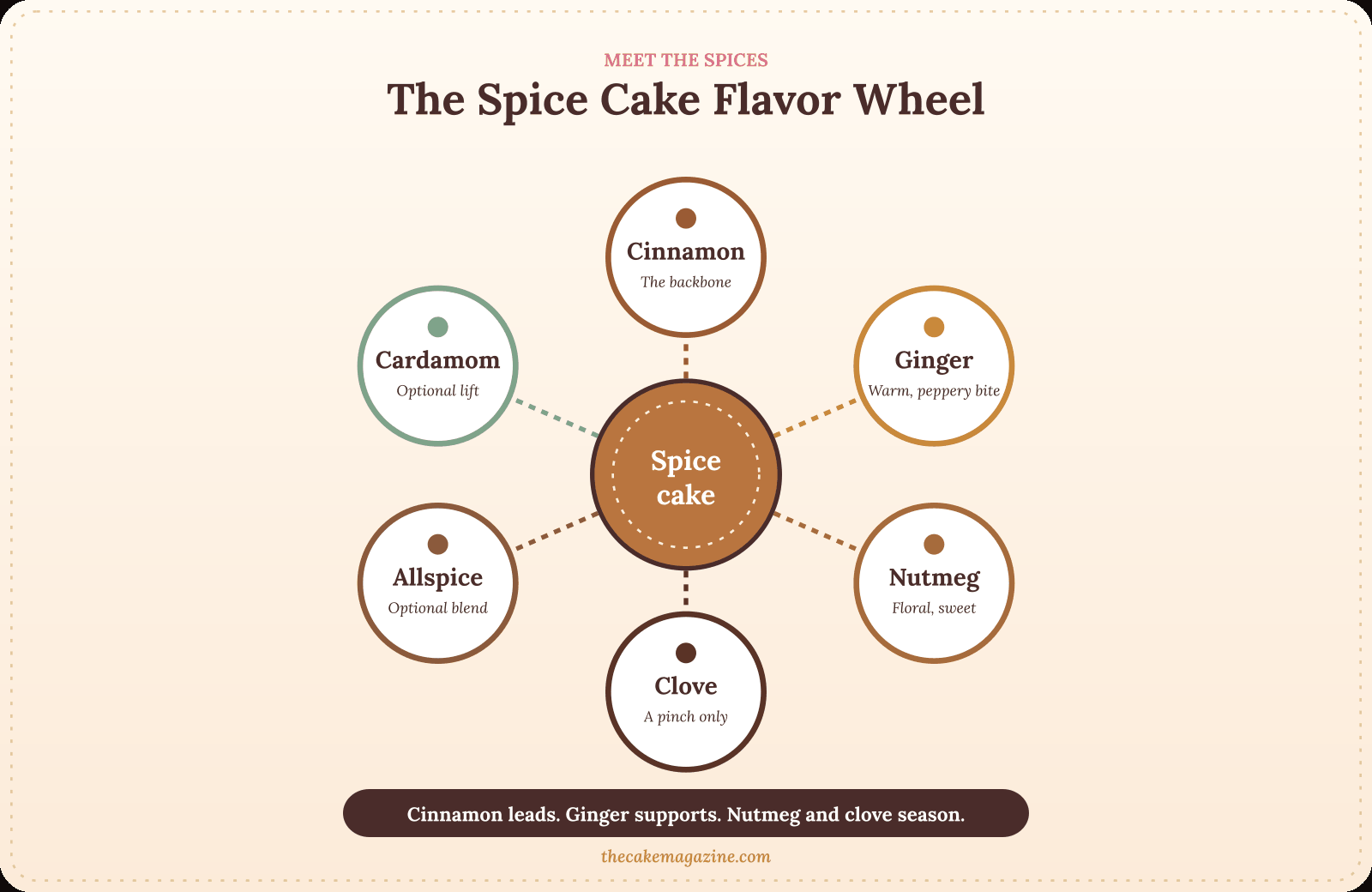
Before you start measuring, it helps to meet the cast. Each spice plays a different role, and the balance between them is what makes a spice cake recipe taste like a recipe rather than a candle. The infographic below gives you the quick view, and the sections after it fill in the details.
Cinnamon: the backbone of any spice cake recipe
Cinnamon is the main voice, and it makes up the largest share of the spice blend. The cinnamon most Americans buy in the grocery store is cassia, which is bold, sweet and a little peppery. Ceylon cinnamon, sometimes sold as true cinnamon, is lighter, more floral and more delicate. Either works. If you use Ceylon, you may want slightly more, since its flavor is gentler.
Fresh matters here. Ground cinnamon that has sat in the cupboard for three years smells faintly of nothing much. Open the jar and sniff. If the aroma is weak, the cake will be too.
Ginger: warmth with a little bite
Ground ginger adds a peppery, almost tingling warmth that keeps the cake from tasting merely sweet. It is the spice that gives gingerbread its character, and in a spice cake recipe it works as a supporting act. Too little and the cake tastes flat. Too much and it turns hot and sharp, particularly after a day or two when the spices deepen.
Nutmeg: floral and slightly sweet
Nutmeg is potent, which is why the amount in a spice cake recipe is small. It adds a perfumed, woody sweetness that rounds out cinnamon. Freshly grated nutmeg from a whole nut tastes noticeably brighter than the pre-ground version, and a small rasp grater makes it easy. If you only have pre-ground, use it, but replace the jar once a year.
Cloves: a little goes a long way
Ground cloves are intense, with a medicinal, numbing edge when overdone. In this spice cake recipe you use only a pinch, about a quarter teaspoon. At that level you cannot pick out cloves by name, but the cake tastes rounder and more complete without them. If your cloves are old and dull, bump the amount up slightly. If they are very fresh and strong, stick to the pinch.
Allspice and cardamom: optional extras
Allspice tastes like a blend of cinnamon, nutmeg and clove, and it can stand in for some of each. Cardamom adds a citrusy, almost floral lift that works beautifully with brown sugar and a cream cheese frosting. Both are optional. Start with the core four and add one extra at a time so you can learn what each does.
The simple rule. Cinnamon leads, ginger supports, nutmeg and clove are seasoning. If you can name cloves when you taste the cake, you used too much.
How much spice is the right amount?
Recipes vary widely, but most home-style spice cakes use somewhere between a tablespoon and a tablespoon and a half of total ground spice for every 300 grams of flour. That sounds like a lot, and it is, because the cake also contains a considerable amount of sugar and fat that mute flavor. Below that range, the cake tastes like a mildly cinnamon-scented yellow cake.
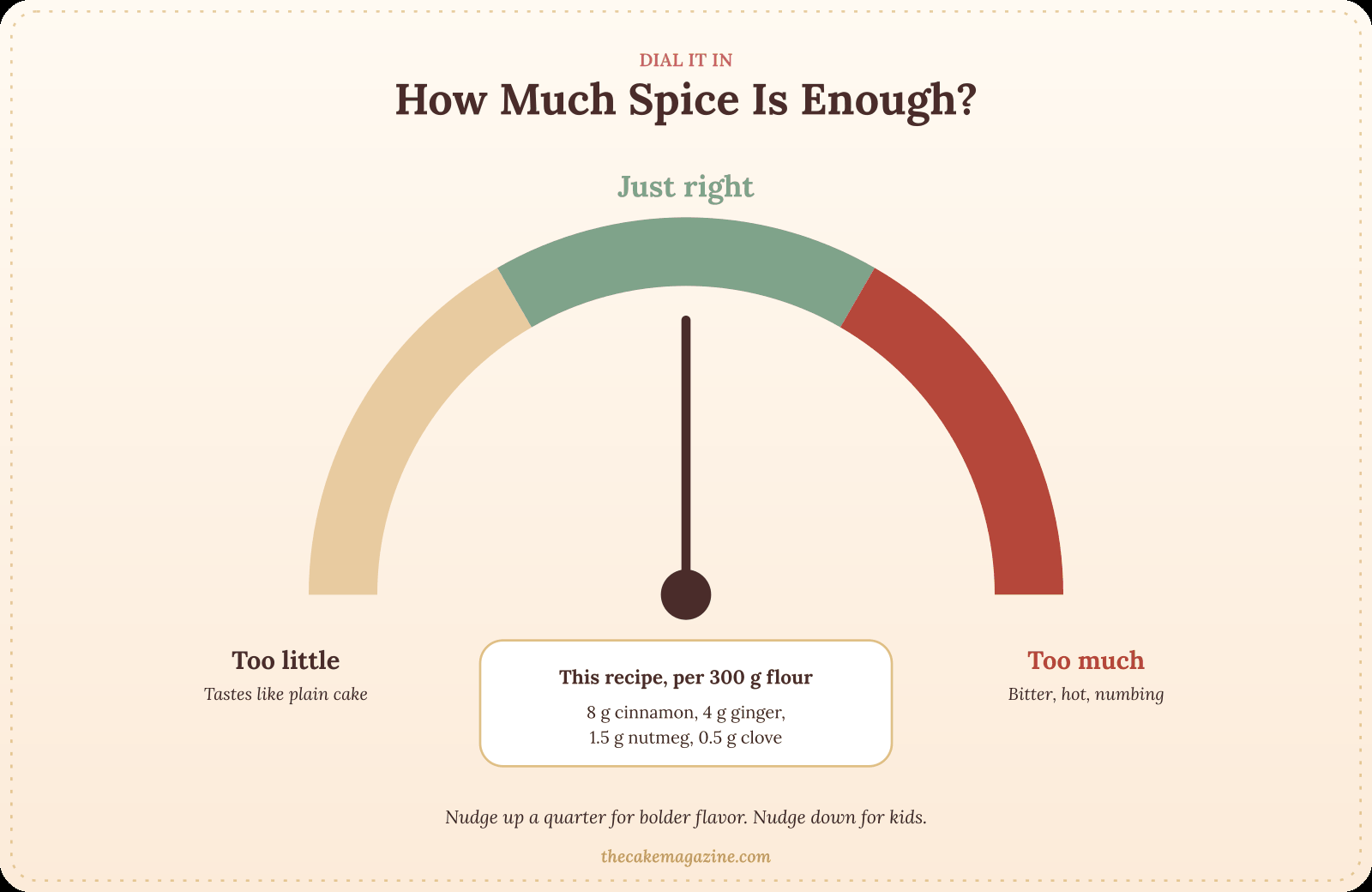
The formula in this guide stays near the middle of the range, which suits most households. If your family loves bold flavor, nudge the amounts up by a quarter as a first experiment. If you are baking for kids or for someone sensitive to pungent flavors, nudge down instead.
Whole spices, ground spices and blends
You can buy a premade pumpkin pie spice or apple pie spice blend, and in a pinch it works in a spice cake recipe. The ratios in those blends differ by brand, though, and some are heavy on ginger or clove. Mixing your own gives you control. A small jar of your own blend also keeps well, so make a batch for the next three or four cakes.
Ground spices lose their punch over time, since the aromatic oils evaporate. Store them in tight jars away from the stove and light, and plan to replace them about once a year. If you want a sense of how spice shows up in other fall bakes, our pumpkin cake recipe and carrot cake recipe both lean on similar blends.
A simple house spice blend for a spice cake recipe
If you bake this cake more than once, mixing a small jar of your own blend saves time and keeps the flavor consistent. Here is a ratio to start from, by weight: 8 parts cinnamon, 4 parts ginger, 1.5 parts nutmeg and 0.5 part cloves. That matches the amounts in the recipe card exactly, so one batch of blend equals one cake.
Multiply the parts by whatever number suits your jar. Four times the amounts, for example, gives you 32 grams of cinnamon, 16 of ginger, 6 of nutmeg and 2 of cloves, enough for four cakes. Whisk them together, store the blend in a small airtight jar and write the date on the lid. Keep it away from the stove, where heat and steam shorten the life of the oils.
Smell test and taste test before you bake
Two quick checks save a cake. First, rub a pinch of each spice between your fingers and smell it. A strong, clear aroma means it is fresh. A faint, dusty one means it is tired. Second, stir a little of your blend into a spoonful of buttermilk and brown sugar and taste it. You are not judging sweetness. You are checking whether the balance feels warm and round or sharp and clovey.
This small habit is also a good way to learn your own preference. Some people love a ginger-forward cake that tingles on the tongue. Others prefer mostly cinnamon with a hint of everything else. There is no wrong answer, only the one that your household will finish first.
Toasting spices for a stronger flavor
Warming ground spices briefly in a dry pan, or in the oil you plan to use, can intensify their aroma. Heat them over low heat for 30 to 60 seconds until fragrant, stirring constantly, then cool before using. Burnt spices taste bitter, so pull the pan the moment the aroma blooms. This extra step is optional. The base cake already tastes warm without it, but it is a nice experiment when you want a deeper result.
Brown sugar, molasses and moisture in a spice cake recipe
Sugar is not just sweetness in a cake. It attracts and holds water, slows the setting of the structure and keeps the crumb tender. In a spice cake recipe the type of sugar also shapes the flavor, so this is the choice that most changes the final cake after the spices themselves.
Light brown, dark brown or white sugar?
Light brown sugar contains a modest amount of molasses and gives a gentle caramel note. Dark brown sugar contains more, which means a deeper flavor, a darker crumb and a little more moisture. Granulated white sugar contributes sweetness and helps the cake bake up lighter and more tender at the edges. This formula uses mostly light brown sugar with a small portion of white, and you can swap dark brown in for a more pronounced, gingerbread-like cake.
Pack brown sugar into a measuring cup if you must use cups, but better yet, weigh it. Packing varies wildly from one cook to the next, and weight removes the guesswork.
What does extra molasses do?
A spoonful of unsulphured molasses adds a mild bitterness that balances the sweetness, and it deepens the color. It is also slightly acidic, so it reacts with baking soda. Too much, though, and the cake turns heavy, dark and a little bitter. Two tablespoons for a two-layer cake is a safe amount. If you are out of molasses, the recipe still works. You will lose a little depth, not the whole cake.
Measuring molasses without the mess. Place your mixing bowl on the scale, tare it and pour molasses straight in by weight. Better still, weigh it into the oil you are measuring. Oil coats the container, and the molasses slides out without sticking.
Why the crumb stays moist
Moisture in this spice cake recipe comes from several places at once: the oil, which coats the flour and stays liquid, the buttermilk, the eggs, and the brown sugar and molasses, which hold on to water. Bakers call sugar hygroscopic, which just means it draws in and keeps moisture. That is why a brown sugar cake can taste fresher on day two than a plain white sugar one.
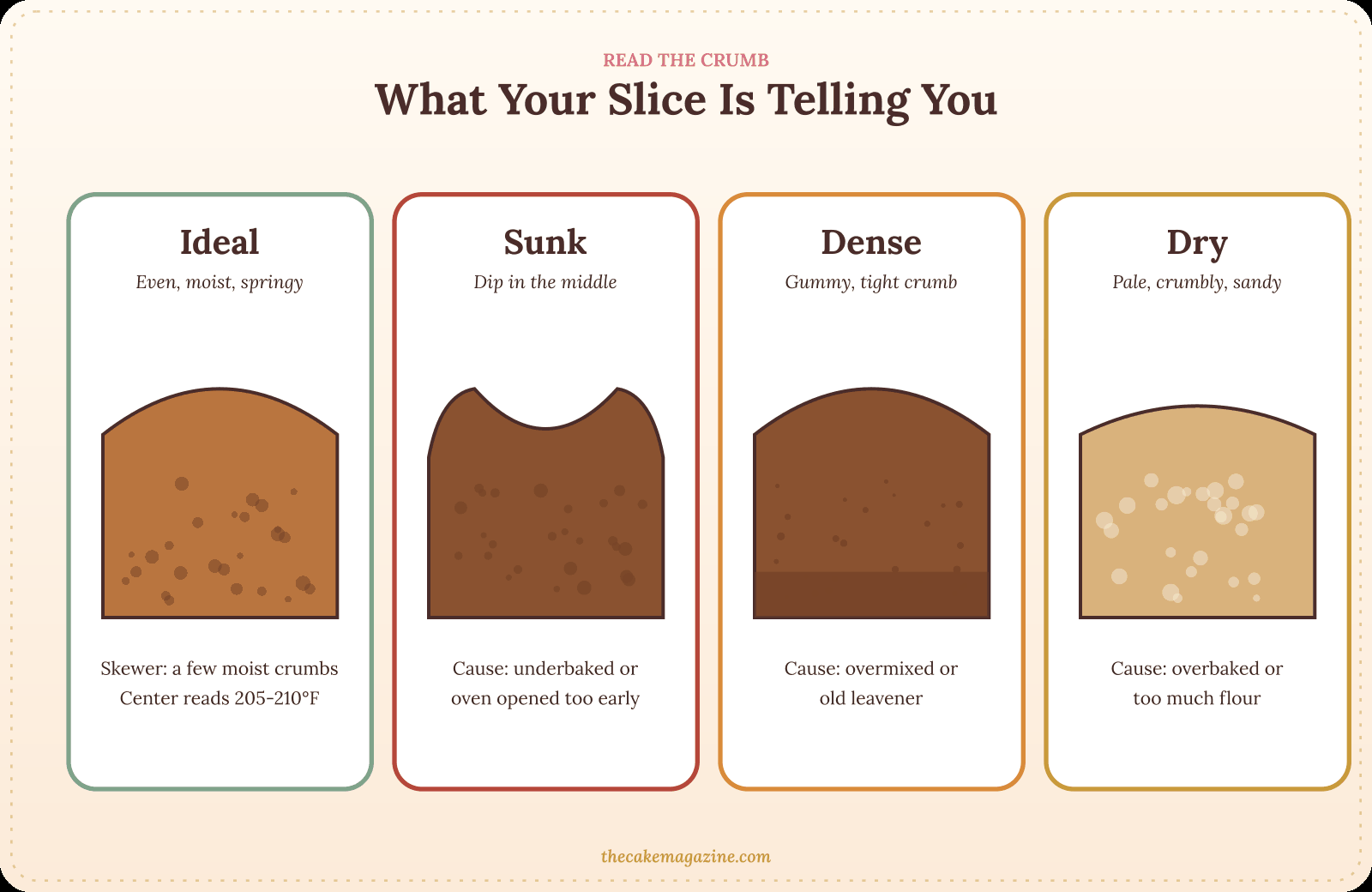
The cross-section above shows what each outcome looks like when you slice a layer, from the ideal crumb to the common problems. We return to each one in the troubleshooting section, and our broader cake troubleshooting guide covers the causes in greater depth.
Equipment and pans for a spice cake recipe
You do not need specialist gear to make a good spice cake recipe, but a few tools improve consistency.
- A digital kitchen scale. The single best upgrade. Spices and leaveners are tiny amounts, so a scale that reads to a gram or better helps.
- Two 8-inch round pans, 2 inches deep. Light aluminum bakes evenly. Dark pans brown faster, so start checking sooner. Our cake pan buying guide explains the differences.
- Parchment paper. Brown sugar batters can stick, so line the bottoms.
- A large whisk, a spatula and two bowls. No mixer is needed for the cake itself.
- Measuring spoons. If you do not have a scale precise enough for spices, level the spoons carefully.
- An oven thermometer. Many home ovens run 10 to 25 degrees off.
- A wire rack. For cooling, so steam escapes from underneath.
- A fine-mesh sieve. Spices clump, and sifting prevents bitter pockets.
Preparing the pans
Grease the sides and bottoms with softened butter or baking spray, press a parchment circle into the base and grease that too. Dust with a little flour and tap out the excess. Because a spice cake is dark, a flour film is not very visible, and you can skip the cocoa trick used for chocolate cakes.
Baking strips, the damp fabric bands that wrap the outside of a pan, help layers bake level and flat. They are optional but useful if your cakes tend to dome in the center.
The spice cake recipe card
Brown Sugar Spice Layer Cake
A one-bowl, oil-based, two-layer 8-inch spice cake with cinnamon, ginger, nutmeg and clove, built on brown sugar, molasses and buttermilk. This is a starting formula to adapt, based on conservative baking ratios and not yet oven-tested by this site. Test your own bake times.
Ingredients
- All-purpose flour300 g (about 2½ cups, spooned and leveled)
- Baking powder6 g (1½ teaspoons)
- Baking soda3 g (½ teaspoon)
- Fine salt4 g (¾ teaspoon)
- Ground cinnamon8 g (1 tablespoon)
- Ground ginger4 g (2 teaspoons)
- Ground nutmeg1.5 g (½ teaspoon)
- Ground cloves0.5 g (¼ teaspoon)
- Light brown sugar, packed300 g (about 1½ cups)
- Granulated sugar100 g (½ cup)
- Large eggs, cool room temperature150 g (3 eggs)
- Neutral oil (canola, vegetable or sunflower)150 g (¾ cup)
- Buttermilk, cool room temperature300 g (1¼ cups)
- Unsulphured molasses40 g (2 tablespoons)
- Pure vanilla extract8 g (2 teaspoons)
Instructions
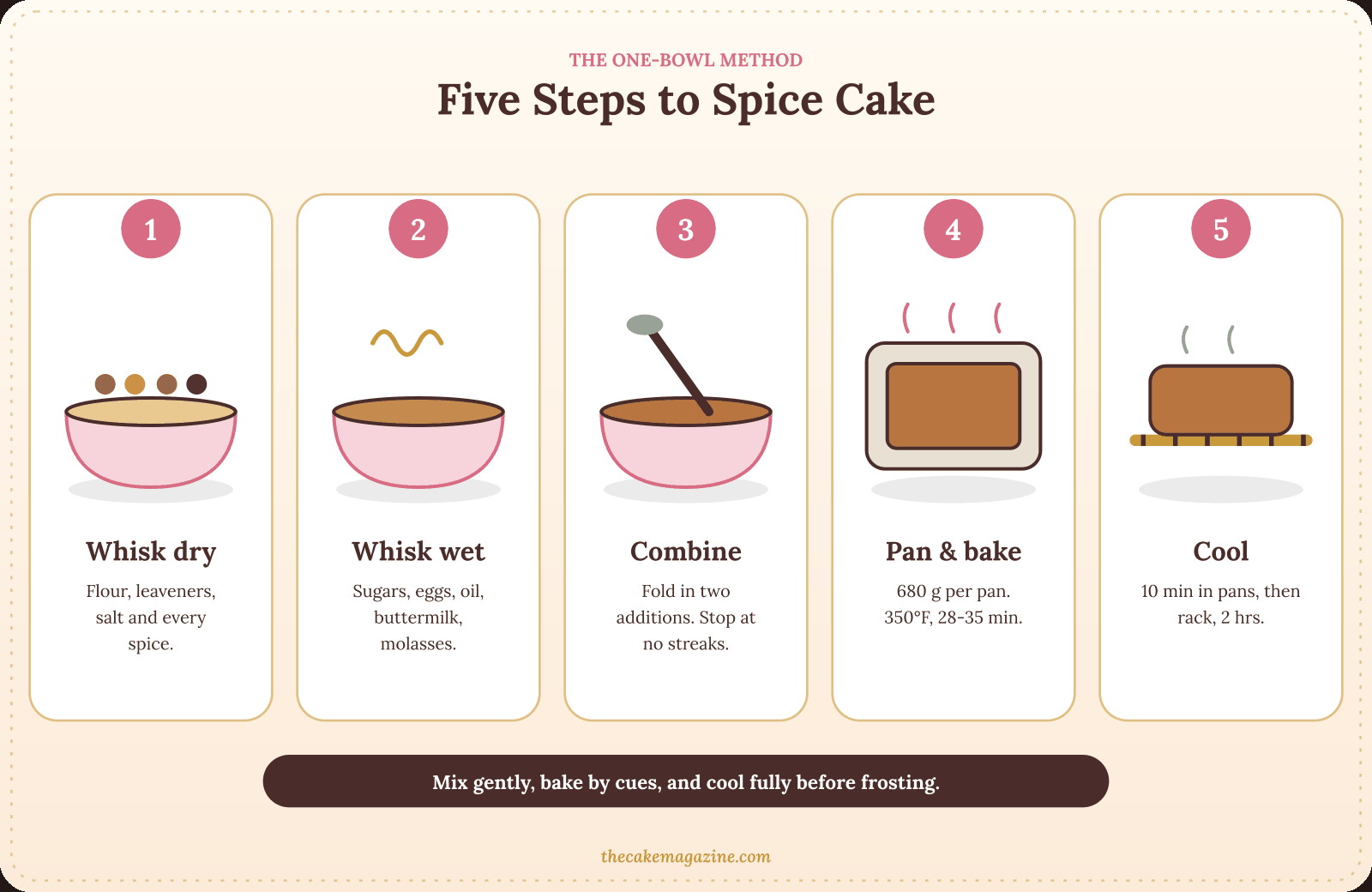
- Prep. Set a rack in the center of the oven and heat to 350°F (175°C). Grease two 8-inch by 2-inch round pans, line the bottoms with parchment, grease the parchment and dust with flour.
- Whisk the dry ingredients. In a medium bowl, whisk the flour, baking powder, baking soda, salt and all the spices for 30 seconds. Sift if the spices look lumpy.
- Whisk the wet ingredients. In a large bowl, whisk the brown sugar, granulated sugar and eggs until smooth. Whisk in the oil, buttermilk, molasses and vanilla. Press out any brown sugar lumps with the whisk.
- Combine. Add the dry mixture to the wet in two additions, folding with a spatula or whisking gently until no dry streaks remain. Stop as soon as the batter is smooth.
- Pan the batter. Divide by weight (about 680 g per pan). Tap each pan firmly on the counter two or three times to release air.
- Bake. Bake 28 to 35 minutes. Begin checking at 26 minutes. The cakes are done when the tops spring back lightly, the edges just pull from the pan and a skewer shows a few moist crumbs (about 205°F to 210°F inside).
- Cool. Cool in the pans on a rack for 10 minutes. Run a thin knife around the edge, turn out the layers, peel off the parchment and cool completely, at least 1 to 2 hours, before frosting.
Notes
- Storage: Wrap cooled layers tightly and keep at cool room temperature for 1 day, or freeze for up to 2 months.
- No buttermilk? Stir 1 tablespoon of lemon juice or white vinegar into 1 cup of whole milk and rest for 5 minutes, then measure 300 g.
- Adapt it: Pans, ovens and spice brands vary. Treat the times and amounts as a starting point, take notes and change one thing at a time.
- Frosting: Pair it with cream cheese frosting, a silky Swiss meringue buttercream or a classic American buttercream.
Step-by-step: how to make a spice cake recipe
The recipe card gives you the order of operations. This section gives you the reasons, which is what saves you the day something behaves differently than expected. If you are new to layer cakes, read it once before you begin.
Step 1: Set up your spice cake recipe
Take the buttermilk and eggs out about 30 minutes before you plan to bake, and heat the oven fully before the pans go in. A preheat light can switch on before the oven walls and rack are truly hot, so give it another ten minutes. Prepare the pans before you mix, not while the batter waits. Weigh each ingredient into its own cup or bowl first. Cooks call this mise en place, and it prevents the classic mistake of forgetting the baking soda.
Step 2: Whisk the dry ingredients
Whisk the flour, leaveners, salt and spices for about 30 seconds. This spreads the spices and the tiny amount of baking soda evenly. Uneven leavener leads to a metallic taste in one bite and a dense patch in the next. If the cinnamon or ginger looks clumped, push it through a sieve. Ground spices absorb moisture from the air and form small knots that will not dissolve in the batter.
Step 3: Whisk the wet ingredients and sugars
In a large bowl, whisk the brown sugar, white sugar and eggs until smooth, then add the oil, buttermilk, molasses and vanilla. Brown sugar can arrive in stubborn lumps, so crush them against the bowl with the whisk or rub them out with your fingers before adding liquid. A smooth, glossy mixture means the oil is emulsified and will spread through the cake evenly.
Step 4: Combine without overmixing
Add the dry mixture in two additions and mix just until you cannot see dry flour. Stop there. Vigorous stirring develops gluten, and gluten makes cakes tough and tunneled. The batter will be on the thinner side, similar to a pourable pancake batter, and that is correct. Scrape the bottom and sides once so no pocket of flour hides, then stop.
Step 5: Pan the batter
Divide the batter by weight so your layers match. Place each pan on the scale, tare it and pour until you reach about 680 grams. Tap each pan firmly on the counter a couple of times to release large air bubbles. Level the surface with a spatula if needed. A pitcher with a spout, or a ladle, makes the job tidier.
Step 6: Bake the spice cake recipe
Bake on the center rack, with the pans at least an inch apart and away from the walls. Keep the oven door shut for the first 25 minutes. Opening it early lets heat escape just as the cake is setting, and that is a common cause of a sunken center. Begin checking around 26 minutes, since pans and ovens vary.
How to tell a spice cake is done
Use more than one cue. The edges should just begin to pull from the pan. The top should spring back when pressed lightly. A skewer inserted in the center should come out with a few moist crumbs, not wet batter and not perfectly clean. If you own an instant-read thermometer, the center of a finished layer typically reads about 205°F to 210°F. A dry, clean skewer is a sign of overbaking in a cake meant to be moist.
Cooling the layers
Let the cakes rest in the pans on a rack for 10 minutes. This lets the structure firm up enough to release cleanly. Run a thin knife around the edges, flip each layer onto the rack and peel away the parchment. Cool completely before frosting. A warm layer melts frosting into a greasy slick and tears under a spatula. Two hours on the counter is usually enough, and an hour in the fridge speeds things up when you are short on time.
Frosting and filling ideas for a spice cake recipe
A spice cake recipe is a flexible canvas, and the frosting you choose changes the whole personality of the cake. Warm spices love something creamy, tangy or caramelized. They tolerate very sweet frostings less well, since the cake is already sweet. Here are the pairings that work most reliably, along with what to watch for in each.
Cream cheese frosting
The classic partner. Its tang cuts the sweetness and echoes the buttermilk in the crumb. Because it softens quickly, keep a frosted cake in the refrigerator and let slices come to cool room temperature before serving. If you enjoy this pairing, see how it works with the carrot cake recipe.
Brown butter buttercream
Melt butter until the milk solids turn nutty and golden, chill it until solid, then beat it into a buttercream. The toasty flavor sits beautifully beside molasses and ginger. Our American buttercream recipe explains the texture and sweetness adjustments you can use as a base.
Swiss meringue buttercream
Silky, less sweet and very stable. A good choice if you want clean decorating edges or a cake that sits out for a while. The Swiss meringue buttercream guide covers temperature and emulsion troubleshooting.
Maple or caramel glaze
For a simple, rustic cake, pour a warm glaze of powdered sugar, maple syrup and a little cream over a single layer or a bundt. No stacking required.
Whipped mascarpone
Light, barely sweet and cloud-like. It makes a lovely filling between layers, and a spoonful of apple butter swirled through it adds depth. Serve the cake chilled.
Apple or pear compote filling
Cook diced fruit with a little sugar and lemon juice until jammy, cool it completely and spread a thin layer between cake layers. Dam the edge with frosting so it does not leak.
How to fill and stack a spice cake
Level the tops with a serrated knife if they dome. Place the first layer on a plate or board, cut side up. Pipe a ring of frosting around the edge to form a dam, add your filling inside it and top with the second layer, bottom side up so the flat base becomes the smooth top. Chill the stacked cake 20 minutes before applying a crumb coat.
If you are new to the decorating side, our cake decorating for beginners guide walks you through the basics, and the guide to smooth buttercream sides and sharp edges helps with the finish.
Choosing a frosting for the occasion
A bold, deeply spiced cake with a thick cream cheese frosting suits Thanksgiving, a harvest party or a casual birthday. A lighter, more restrained cake with a brown butter or Swiss meringue buttercream looks refined enough for a small wedding shower. Because this spice cake recipe stays moist for days, it is also a practical choice when you must bake ahead of a celebration.
Food safety with cream cheese and dairy fillings. Cakes finished with cream cheese frosting, whipped cream or mascarpone should be refrigerated and not left out for long stretches. For official guidance on perishable foods, see the USDA Food Safety and Inspection Service. This is general information, not a substitute for official advice.
Pan sizes and yield for a spice cake recipe
The formula makes about 1,360 grams of batter, which fills two 8-inch round pans. You can bake it in other shapes, but the times change. Treat everything below as a starting point, and begin testing early. Fill pans only about half to two-thirds full so the batter has room to rise.
Two 8-inch rounds (the standard)
About 680 g per pan. Bake 28 to 35 minutes. A frosted cake serves 12 to 14 slices.
Two 9-inch rounds
Same weight per pan, so the layers are thinner and bake faster. Start checking around 24 minutes and expect roughly 24 to 30.
9 by 13-inch pan
One thicker layer, handy for a sheet cake or a simple potluck bake. Expect roughly 33 to 40 minutes. Frost the top directly.
Three 6-inch rounds
A tall, narrow cake that serves 10 to 12. Divide by weight, and expect around 26 to 32 minutes.
Cupcakes
Fill liners about two-thirds full. The formula makes around 18 to 22 standard cupcakes, baked roughly 18 to 22 minutes.
Bundt pan
Use a 10 to 12-cup pan, grease it thoroughly and expect around 45 to 55 minutes. Check the inside with a skewer at the thickest part.
These ranges are rough guides drawn from typical behavior of similar oil-based cakes, not results from our own kitchen. Check early, trust your oven thermometer and your skewer, and write down what worked.
Scaling the spice cake recipe up or down
To make a 6-inch two-layer cake, multiply every ingredient by about 0.55, and weigh the eggs by cracking and beating one, then measuring out the portion you need. To make a larger three-layer 8-inch cake, multiply by 1.5. Scale the spices by weight, not by feel, since small errors become noticeable at the extremes. For anything bigger, such as a tiered cake, see our wedding cake guide and its servings chart for planning.
Make ahead and storage for a spice cake recipe
This is one of the best cakes to make ahead, because the spices and brown sugar mellow and meld over a day. Many bakers feel a spice cake tastes better on day two than on day one. That is a matter of taste, so try it yourself.
Storing unfrosted layers
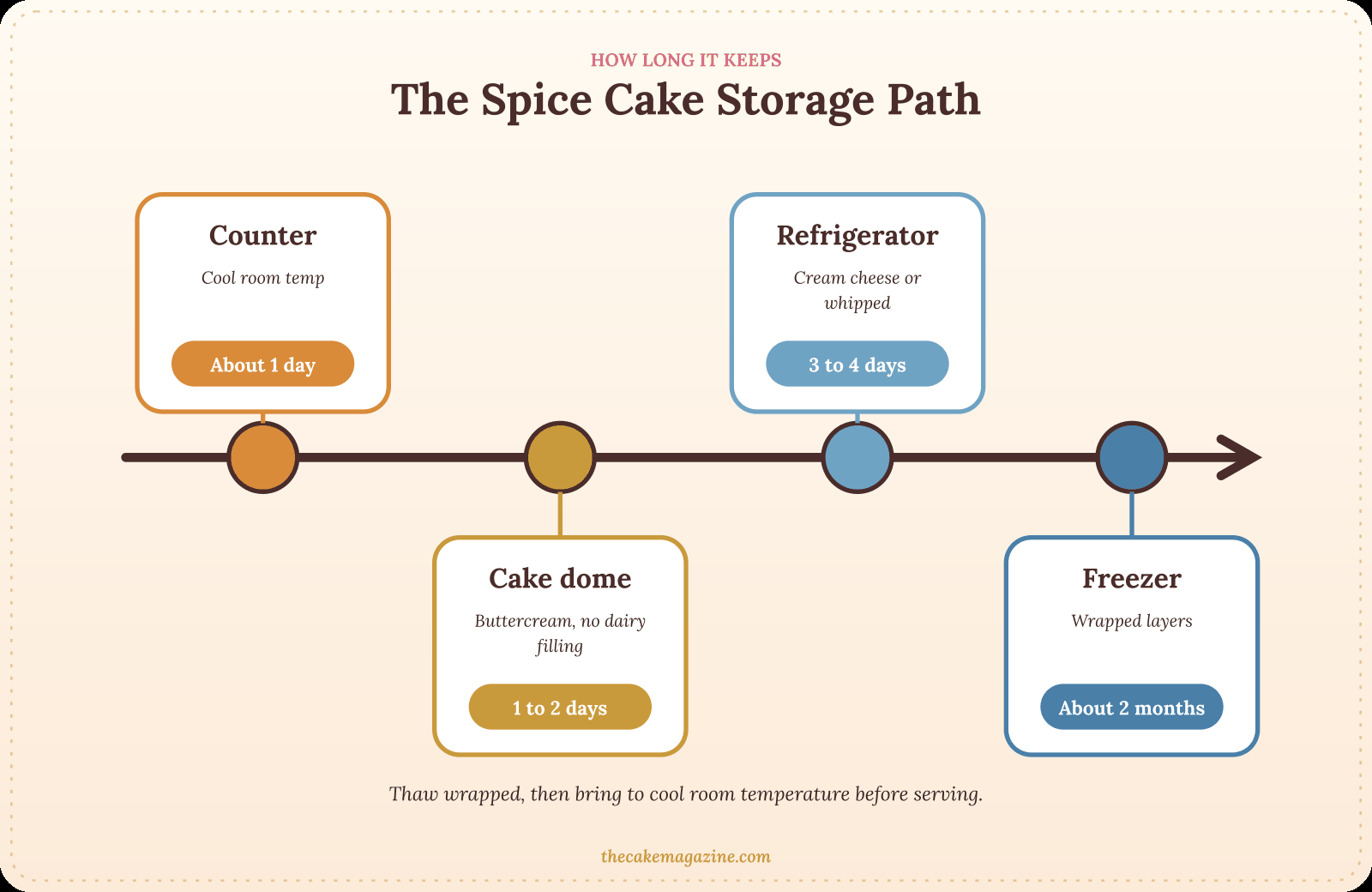
Cool the layers completely, then wrap each one tightly in plastic wrap. At cool room temperature they hold for about a day. For longer storage, freeze them wrapped in plastic and then foil for up to about two months. Thaw wrapped, on the counter, for a few hours so condensation collects on the wrapping and not on the cake.
Storing a frosted cake
A cake with a buttercream finish and no perishable filling does well at cool room temperature for a day or two under a cake dome or in a covered container. A cake with cream cheese frosting, whipped cream or mascarpone should go in the refrigerator, covered, and be eaten within about three to four days. For official storage and handling advice, consult the USDA food safety pages and follow current guidance.
Bring a refrigerated cake to cool room temperature for 30 to 60 minutes before serving. Cold butter and cream cheese taste muted, and the crumb feels firmer straight from the fridge.
Freezing a frosted spice cake
Chill the finished cake until the frosting is firm, then freeze it uncovered for an hour. Wrap it snugly in plastic, then foil, and keep it in a box if you can. Thaw in the refrigerator overnight, still wrapped, and unwrap once it has lost its chill. A thin crust of ice crystals on the frosting is a sign it went in the freezer too warm or wrapped too loosely.
A sensible make-ahead plan
- Two days ahead: bake and wrap the layers, and make the frosting. Refrigerate the frosting in a sealed container.
- One day ahead: bring the frosting to cool room temperature, rewhip it briefly, fill and frost the cake and refrigerate if needed.
- Serving day: let the cake sit out for 30 to 60 minutes, then slice with a long knife wiped clean between cuts.
Serving and slicing a spice cake
Use a long, sharp knife and wipe it clean with a damp towel between cuts. Warm the blade under hot water and dry it for the cleanest edges on a cream cheese frosting. Serve slices at cool room temperature so the spices come forward and the crumb relaxes. A spoonful of unsweetened whipped cream, a few toasted pecans or a drizzle of caramel can turn a plain slice into a dessert.
Gifting and transporting a spice cake
A sheet-style or loaf-shaped version travels better than a tall layer cake. Chill the finished cake until the frosting is firm, place it on a sturdy board in a box and keep it level on a flat car floor, not a seat. Drive carefully and keep the box out of the sun. If the cake has a dairy frosting, plan for refrigeration at both ends of the trip.
Using up leftovers
Spice cake scraps and trimmed edges are lovely crumbled over vanilla ice cream, layered into a trifle with whipped cream and apple compote, or pressed into truffles with a little frosting. Dried-out slices can be toasted lightly in a pan with butter, which brings back the aroma. Little ideas like these keep you from wasting a good cake.
Troubleshooting your spice cake recipe
Even a forgiving spice cake recipe can go sideways. The good news is that cakes usually tell you what went wrong, if you know how to read the crumb. Match your problem below, then try the fix on your next bake. For wider diagnostics, our cake troubleshooting guide goes deeper.
The spice cake sank in the middle
Likely causes: underbaking, opening the oven door too early, too much baking soda or baking powder, an oven that runs cooler than the dial says, or too much liquid from an over-measured buttermilk.
How to check: a wet, gummy band at the bottom of the slice suggests underbaking. A coarse, tunneled crumb suggests too much leavening.
Fix it next time: weigh the leaveners, keep the door closed for the first 25 minutes, verify the oven with a thermometer and bake until the center reads at least 205°F. Our guide on why a cake sinks in the middle covers the causes in depth.
The spice cake is dry
Likely causes: overbaking, too much flour from scooping, a hot oven or too little fat or liquid.
Fix it next time: weigh the flour, pull the layers at the first sign of doneness and trust the skewer. A clean, bone-dry skewer usually means you waited too long. For a cake that is already dry, brush the layers with a simple syrup of equal parts sugar and water, cooled, or a splash of apple cider. Read more in why a cake is dry.
The cake is dense or heavy
Likely causes: overmixing after the flour went in, old baking powder or soda, too much molasses or too many spices, which weigh the batter down.
Fix it next time: mix gently until just combined, test your leaveners by stirring a pinch into hot water or vinegar to see whether they fizz, and measure molasses by weight.
The cake tastes bitter, harsh or medicinal
Likely causes: too much clove, too much baking soda, too much molasses or unmixed pockets of spice.
Fix it next time: cut the clove by half, level your spoons or weigh the soda and whisk the dry mixture thoroughly. If the cake is already baked, a cream cheese frosting helps soften the harshness.
The flavor is weak or flat
Likely causes: stale spices, too little salt or a very mild brand of cinnamon.
Fix it next time: smell each jar before you bake and replace any that smell faint. Weigh the salt. Bump the cinnamon up by a quarter for your next bake and see how it tastes.
The top cracked or domed
Likely causes: an oven that is too hot, which sets the edges before the middle can rise, or a pan placed too close to the heat source.
Fix it next time: lower the temperature by 25 degrees and bake a few minutes longer, or use baking strips. Level any dome with a serrated knife before stacking.
The cake stuck to the pan
Likely causes: skipped parchment, thin greasing or releasing the cake too early or too late.
Fix it next time: line the pan bottoms, grease the parchment and release after about 10 minutes of resting. If a layer breaks, patch it with frosting. Nobody will see it once it is stacked and covered.
The edges are dark or crusty
Likely causes: a dark metal pan, a hot oven or a long bake. Brown sugar caramelizes faster than white sugar, so edges darken sooner than you might expect.
Fix it next time: use light-colored pans, drop the oven temperature by 15 to 25 degrees, and trim the edges with a serrated knife if needed.
Variations on the spice cake recipe
Once you understand the base spice cake recipe, you can bend it in a dozen directions. Change one thing at a time so you can tell what helped, and keep notes. These variations are suggestions to experiment with, not tested results.
Apple spice cake
Fold about 200 grams of finely diced, peeled apple into the batter at the end. Pat the pieces dry first, so they do not add extra water. Because fruit adds moisture, bake a few minutes longer and check carefully. Our apple cake recipe goes deeper on choosing apples and managing the extra water.
Pumpkin spice variation
Replace part of the buttermilk with pumpkin puree, thick and blotted, and keep total liquid close to the original. This moves the cake toward the territory of our pumpkin cake recipe, which handles the moisture balance in more detail.
Banana spice cake
Mash ripe bananas and swap them in for some of the buttermilk and oil. The result is moist and sweet, and the spices pair nicely with banana. Look at the banana cake recipe for more on ripeness and frosting pairings.
Carrot and walnut version
Fold in 150 grams of finely grated carrot and 80 grams of chopped toasted walnuts. This edges toward carrot cake, and the cream cheese frosting makes it feel like the real thing. See our carrot cake recipe for the full approach.
Chai spice cake
Swap the nutmeg and clove for a chai-style blend: extra cardamom, a touch of black pepper and a little ground fennel or star anise if you like. Steep a strong black tea bag in the warmed buttermilk for flavor, then cool it before adding. Go easy on the pepper, since it builds as the cake sits.
Gingerbread-style layer cake
Use dark brown sugar, increase the molasses to 60 grams and raise the ginger to 6 grams. Reduce the white sugar slightly to keep the sweetness in check. The cake will be darker, stickier and more intense, a holiday cake in everything but name.
Spice cake with butter instead of oil
Replace the oil with the same weight of melted and cooled butter. You get a richer, buttery flavor and a slightly firmer crumb. It is a good swap when serving the cake the same day, but it will feel less soft once chilled.
Gluten-free and dairy-free notes
A gluten-free all-purpose blend designed for cakes can replace the flour one for one by weight, though the batter often needs a rest of ten minutes before baking. For dairy-free, swap the buttermilk with plant milk soured with a tablespoon of lemon juice. Results vary, so test a small batch first.
Making the cake less sweet
Cutting sugar cuts moisture and tenderness, so do not reduce it much. A better route is to keep the cake as written and choose a tangy, lightly sweetened frosting. Cream cheese frosting with extra lemon juice or a barely sweet whipped mascarpone works well.
Turning it into a sheet cake or snack cake
Pour the batter into a greased 9 by 13-inch pan and bake until a skewer shows moist crumbs. Dust with powdered sugar or spread with a thin glaze. It travels well, slices cleanly and needs no stacking, which makes it a useful potluck cake.
Ten spice cake recipe mistakes to avoid
- Using old spices. If the jar has no scent, the cake will have no flavor. Replace ground spices yearly.
- Scooping flour from the bag. This packs in extra flour and makes a dry, dense cake. Weigh it or spoon and level.
- Too much clove. It is easy to overdo and hard to correct. Measure it exactly.
- Skipping the salt. Salt sharpens every other flavor in the cake.
- Packing brown sugar unevenly. Weigh it and break up the lumps.
- Overmixing. Stir only until the flour disappears.
- Opening the oven too early. Wait until the cake has set before peeking.
- Trusting the timer alone. Use your eyes, the skewer and a thermometer.
- Frosting warm layers. Let them cool completely first.
- Making changes all at once. Adjust one variable per bake so you learn what each change does.
Ingredient swaps that usually work
Baking is chemistry, so swaps deserve a little caution. Still, a few substitutions are low risk and handy when the pantry is thin. Change only one at a time, and expect small differences in color, flavor and crumb.
- Dark brown sugar for light. Deeper flavor and a touch more moisture. Reduce the extra molasses slightly if the cake tastes too dark.
- Sour cream or plain yogurt for buttermilk. Thin it with a little milk until it pours like buttermilk, then weigh the same amount.
- Light olive oil or melted coconut oil for neutral oil. Light olive oil tastes mild. Coconut oil firms up when cold, so the cake feels a bit tighter from the fridge.
- Maple syrup for molasses. The cake will taste lighter and less gingerbread-like, though still pleasant.
- Applesauce for part of the oil. You can replace up to about a third of the oil, but the crumb becomes denser and a little gummier.
Swapping the flour is riskier. Cake flour gives a softer, finer crumb but can make an oil cake feel delicate, while whole wheat flour makes it heavier and thirstier. If you try either, replace only a portion and take notes.
Baking at high altitude or in humid weather
Altitude changes how batters rise, since lower air pressure lets gas expand faster and liquids evaporate sooner. Cakes at elevation may need slightly less leavener, a little more flour or liquid and a hotter oven. The details depend on how high you live, so consult a trusted source such as your local university extension service. Humidity matters too. On very damp days, flour and spices can absorb moisture, so measure by weight and keep spice jars sealed.
A baker’s notebook for this cake
The fastest way to improve any recipe is a simple record. After each bake, jot down the date, the pans, the brand of brown sugar and spices, the oven temperature on your thermometer and the exact minute the skewer looked right. Add one line about the taste and texture the next day. A few entries will show patterns you could never guess, such as an oven hot spot or a favorite level of ginger.
Note, too, who ate the cake and what they said. A spice cake is usually baked for someone, and the best adjustment is the one that makes those people ask for another slice. Treat the formula as a conversation between you, your oven and your household, and let each bake sharpen the next one.
Frequently asked questions about the spice cake recipe
What makes a spice cake recipe moist?
Oil, buttermilk, brown sugar and molasses all hold on to moisture. Weighing the flour so you do not add too much, mixing gently and pulling the layers when a skewer shows a few moist crumbs matter just as much as the ingredients.
Which spices go in a spice cake recipe?
Cinnamon, ginger, nutmeg and a small amount of clove are the classic four. Allspice and cardamom are common optional additions. Cinnamon should lead, and clove should stay in the background.
Can I use pumpkin pie spice in a spice cake recipe?
Yes, as a shortcut. Use about the same total weight as the individual spices in the recipe card, which is roughly 14 grams, and taste the blend first. Brands differ in how much ginger and clove they contain, so the cake may come out stronger or milder.
Can I make a spice cake recipe without buttermilk?
You can. Stir a tablespoon of lemon juice or white vinegar into a cup of milk and let it rest five minutes, or thin plain yogurt with a little milk. Measure the result by weight so the batter keeps the right consistency.
Can I use butter instead of oil in this spice cake recipe?
Yes. Replace the oil with the same weight of melted, cooled butter. The flavor is richer, though the cake feels slightly firmer, especially when chilled. Oil gives the softest crumb across temperatures.
How do I keep a spice cake recipe from tasting bitter?
Measure clove precisely, weigh the baking soda, whisk the dry mix well and keep molasses to about two tablespoons. Old, rancid spices can also taste harsh, so replace them about once a year.
Can I bake a spice cake recipe in a 9 by 13-inch pan?
Yes. Expect a bake time of roughly 33 to 40 minutes, which varies by oven. Check with a skewer from about 30 minutes, and frost directly in the pan or serve with a dusting of powdered sugar.
How far ahead can I make a spice cake recipe?
Wrapped layers keep for a day at cool room temperature and freeze for up to about two months. A frosted cake with cream cheese frosting should be refrigerated and eaten within about three to four days.
What frosting goes best with a spice cake recipe?
Cream cheese frosting is the classic. Brown butter buttercream, Swiss meringue buttercream and whipped mascarpone are all excellent. Choose something tangy or only lightly sweet to balance the sugar in the cake.
Is a spice cake recipe the same as gingerbread?
They are close cousins. Gingerbread leans on molasses and ginger, producing a darker, denser, stickier cake. A spice cake recipe uses a wider mix of spices and usually less molasses, so it is lighter and better suited to layers and frosting.
Why did my spice cake recipe sink in the middle?
The usual causes are underbaking, opening the oven too soon, too much leavener or an oven running cooler than expected. Check the oven with a thermometer, weigh the baking soda and powder and bake until the center reads about 205°F.
Can I freeze the batter for a spice cake recipe?
It is not recommended, because baking powder and baking soda start working once they meet the wet ingredients and lose strength. Bake the layers and freeze those instead, wrapped tightly.
Can I halve a spice cake recipe?
Yes. Halve every ingredient by weight, including the eggs, by beating one and measuring the portion. Bake in a single 8-inch pan or a loaf pan, and begin checking a few minutes earlier than the full recipe suggests.
Final thoughts on the spice cake recipe
A great spice cake recipe is not about a secret spice. It is a few good habits: fresh spices in the right proportion, brown sugar and molasses for depth, buttermilk and oil for a soft crumb, a light hand with the mixing and a skewer you trust more than a timer. Get those right and a plain-looking cake becomes the one people ask for every autumn.
Bake it once as written so you learn how it behaves in your oven. Then change one thing at a time: a pinch more ginger, dark brown sugar, a brown butter frosting. Keep notes. For more reading on technique, the King Arthur Baking cake guide is a respected companion.
Editorial note: reviewed and updated November 2026. This guide is written for home bakers in the United States, using American measurements and ingredients. The spice cake recipe is a starting formula built from conservative, commonly used baking ratios and has not been oven-tested by The Cake Magazine, so bake times, pan sizes and spice strength may need adjusting in your kitchen. Food safety links are general information, not professional advice.