A fruit decorated cake can be the prettiest thing on the table or the soggiest, and the difference is rarely the fruit itself. It comes down to what sits under it, how dry it was when it landed, and how long it has been there. A cake topped with glossy berries, sugar-frosted grapes or a fan of candied orange looks like a celebration before anyone has taken a bite.
This guide covers every way to dress a cake with fruit, from simple fresh toppings to candied and sugared pieces and sculpted fruit shapes, plus the prep, timing and storage that keep it all looking good.
A fruit decorated cake works when you control water. Choose fruit that holds its shape, wash it and dry it thoroughly, and set it on a firm frosting with a thin barrier layer such as chocolate or buttercream. Make candied and sugared pieces a day or two ahead so they dry fully, and add fresh fruit in the last hour or two before serving. Keep the cake cold, and treat any cut fruit like the perishable food it is.
- What a fruit decorated cake really is
- Why the fruit decorated cake is having a moment
- Four styles of fruit decorated cake
- Choosing fruit for a fruit decorated cake
- Washing, drying and prepping fruit
- Building a fruit decorated cake that can carry the load
- Making a fresh fruit decorated cake
- Candied fruit and citrus slices
- Sugared fruit for a frosted sparkle
- Sculptural fruit designs
- Layouts for a fruit decorated cake: color and balance
- Timing, storage and food safety for a fruit decorated cake
- Choosing a fruit decorated cake for the occasion
- Troubleshooting a fruit decorated cake
- Pairings and seasonal ideas
- FAQ
What a fruit decorated cake really is
The phrase covers more ground than it first seems to.
At one end sits the humble berry cake: a frosted layer cake with a handful of strawberries on top. At the other end are showpieces, such as a cake covered in sugar-frosted pears and grapes, or a dessert sculpted and glazed to look exactly like an orange. What ties them together is that the fruit is part of the design, not just an ingredient. You are using color, shine and shape to do the decorating that piping or fondant might do elsewhere.
That makes a fruit decorated cake different from a fruit-filled cake. Fillings live inside the layers and are protected by cake and frosting. Decorative fruit sits on the outside, exposed to air, light and your refrigerator. It has to look good and stay stable at the same time. That one fact explains almost every tip in this guide.
The three jobs fruit does on a cake
Fruit earns its spot in three ways. First, it brings color that frosting struggles to match: the deep red of a cherry, the glow of a sliced blood orange, the dusty purple of a fig. Second, it adds contrast in flavor and texture. A rich buttercream wants something tart, juicy or sharp next to it. Third, it signals the flavor inside. A few raspberries on top tell guests what to expect before the first forkful.
When you plan a fruit decorated cake, ask which job matters most. If color is the point, you can use candied or sugared fruit that will last for days. If flavor contrast matters, fresh fruit is better, and you accept a shorter window. If signaling is the goal, a small, tidy cluster does more than a heap.
What this fruit decorated cake guide covers
We start with the trend itself and the four main styles, then move to the practical side: choosing fruit, washing and drying it, building a cake that can carry it, and placing it well. After that come detailed sections on candied, sugared and sculptural fruit, followed by layouts, timing, storage and troubleshooting. If you are new to decorating in general, our guide to cake decorating for beginners covers frosting, smoothing and tools that this article assumes you have.
A note on testing. The cake and candy timings here are starting points built from widely used baking and candy-making ratios. We have not oven-tested them in our own kitchen. Fruit varies by ripeness and season, so trial a small batch before an important event and adjust.
Why the fruit decorated cake is having a moment
A fruit decorated cake is hardly a new idea, but it has picked up fresh attention. The Knot’s wedding cake trends guide, last updated on October 13, 2025, has a section on fruit adornments. It describes pears, grapes and citrus arrangements given a crystalline coat of sugar, and berry-covered cakes dusted with powdered sugar. The same guide quotes a cake designer saying fruit is having a “huge moment”, listing scattered, candied, embedded and fanned fruit as examples.
Our overview of 2026 cake trends places this within a bigger picture of tangy flavors, vintage piping and statement cakes. Fruit fits all of them. It adds the bright note that tangy-flavor fans want, and it suits both modern minimalist cakes and the nostalgic, over-the-top styles that keep coming back.
Fruit-shaped cakes and the social media effect
A second strand of the trend is the fruit-shaped dessert. An Axios Detroit report from June 2025 describes large pastries sculpted to look like the fruit or nut they are flavored with, filled with mousse, compote and sponge. It names a Los Angeles bakery selling a giant orange with a stem and leaves, and a Detroit bakery offering mango, raspberry and hazelnut versions. It credits viral videos with spreading the look and notes that French pastry chef Cédric Grolet has made fruit-imitating desserts for years.
So the “sculptural” end of the fruit decorated cake is partly a social-media story. Realistic shapes are fun to film and easy to share. As with any viral look, the durable part is the idea, and the specifics will change. We cover how to approach the sculpted style as a home baker in its own section below.
What this trend does and does not tell us
It helps to be honest about the evidence. The sources above are a wedding-industry guide and a local news piece. They show that fruit decoration is visible in wedding and pastry circles, and that fruit-shaped desserts got attention. They do not give a national sales figure, and we are not aware of a reliable one for decorative fruit on cakes specifically. Treat the trend as a strong design direction, not a measured market share.
The practical conclusion is simple. If you bake for yourself, for family or for clients, a fruit decorated cake is a safe, current choice that also happens to be one of the more affordable ways to make a cake look special. Fruit costs less than sugar flowers and takes less time than fondant work.
Four styles of fruit decorated cake
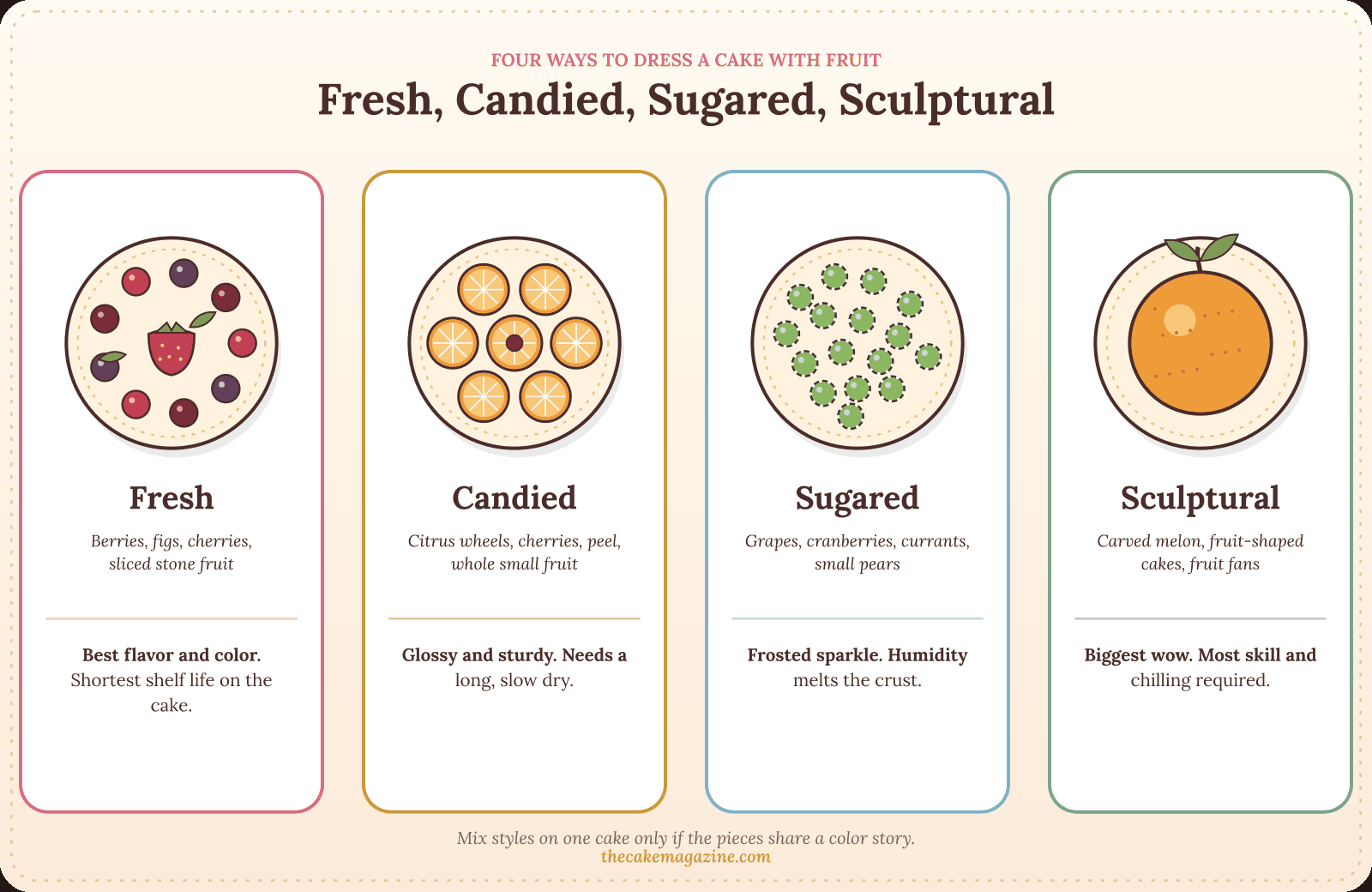
Almost every fruit decorated cake falls into one of four styles, or a mix of them. Knowing which one you are making tells you what to prepare, how far ahead, and what can go wrong.
Fresh fruit
Berries, cherries, figs, sliced peaches or plums, and citrus segments, placed raw. This gives the best flavor and the brightest color. It also has the shortest life on the cake, because cut and even whole fruit slowly weeps moisture and softens.
Candied fruit
Fruit simmered in sugar syrup and dried until glossy and sturdy. Thin citrus wheels are the classic. Candied pieces hold their shape for days if dried well, which makes them the make-ahead choice for a fruit decorated cake.
Sugared fruit
Whole or halved fruit coated in a thin layer of syrup or egg white and rolled in fine sugar. It dries into a frosted, sparkling crust. Grapes, cranberries, small pears and currants suit it, and it looks wonderful on winter and wedding cakes.
Sculptural fruit
Fruit carved, fanned or stacked, or a cake shaped to look like a piece of fruit. The effect is dramatic. It also takes the most planning, the most chilling and the most patience.
You can combine styles, but give the cake one clear voice. A top with fresh berries, sugared grapes and candied orange wheels can look joyful if the colors relate, and chaotic if they do not. We come back to color and balance in the layouts section.
Which style suits which cake
Match the fruit style to the cake’s job. A birthday cake served the same afternoon is a natural home for fresh fruit. A wedding cake that has to sit through photos and a long reception does better with candied or sugared fruit that will not weep. A small bakery box that travels across town suits a few sturdy pieces pressed into the frosting. A centerpiece for a dinner party is the right place to attempt a sculpted design.
Our guide to naked and semi-naked cakes is worth a read here. Those cakes show their crumb and often carry fresh fruit and flowers, and they have their own moisture and timing rules that overlap with this topic.
Choosing fruit for a fruit decorated cake
Not every fruit is a good cake decoration, and the best choices for a fruit decorated cake are not always the prettiest in the shop. Some hold their shape, color and structure for hours. Others bleed, brown, collapse or release so much juice that the frosting beneath turns to soup. Picking well is half the battle for any fruit decorated cake.
Fruit that holds up well
Firm berries are the workhorses. Strawberries (whole or halved), blueberries and blackberries keep their form and color. Raspberries look lovely but are delicate and can leak, so place them last and handle them as little as possible. Cherries are sturdy and photograph beautifully, with their stems left on for a classic look. Grapes, kumquats, small plums, figs and cranberries all do well, especially when sugared or candied.
Citrus is the most versatile of all. Thin wheels of orange, blood orange or lemon, supreme segments, curls of zest and little twists make a cake look polished. Fresh citrus slices can weep, so candied wheels are the safer route when the cake has to sit.
Reliable choices
Strawberries, blueberries, blackberries, cherries, grapes, figs, kumquats, cranberries, candied citrus, pomegranate seeds (dried well) and halved small plums.
Use with care
Raspberries, sliced peaches, nectarines, mango, melon and pineapple. They look great but release juice or soften quickly. Add late, pat dry, and keep the cake cold.
Poor choices
Sliced bananas, apples and pears that have not been treated (they brown), very ripe or mushy fruit, and anything that has been frozen and thawed, which turns watery.
Fruit with enzymes that fight cream and gelatin
A few fruits contain enzymes that break down protein. Fresh pineapple, kiwi, papaya and fresh figs can break down gelatin and make dairy-based toppings turn bitter or thin when they sit together. If your cake has stabilized whipped cream, a gelatin-set mousse or a custard layer, either skip these fruits or use canned or briefly cooked versions, where heat has deactivated the enzymes. For help with cream that holds its shape under fruit, see our guide to stabilized whipped cream frosting.
Buy for the day, not the dream
Ripeness matters more than variety. A perfectly ripe strawberry is lovely to eat and tends to be fragile. A strawberry that is a little firm will sit on a cake better. For decoration, look for fruit that is fully colored, dry, unblemished and just firm to the touch. Buy a third more than you think you need, because you will discard the odd bruised piece and you will want choices when you arrange.
Seasonality helps your results and your budget. Berries in summer, cherries in early summer, figs and grapes in late summer and fall, pears and cranberries in autumn and winter, and citrus in winter all look and taste best in their own seasons. Out of season, candied and sugared pieces from fruit that is easy to find year-round, such as citrus and grapes, are a dependable fallback.
Washing, drying and prepping fruit
Fruit prep is not glamorous, but it decides whether your fruit decorated cake looks crisp or tired. Two things matter: safety and dryness. Fortunately the same steps serve both.
Wash it the safe way
The U.S. Food and Drug Administration advises rinsing produce under running water before you prepare or eat it, and drying it with a clean cloth or paper towel afterward. It says not to use soap, detergent or commercial produce wash, because produce is porous and can absorb them. It also notes that washing can reduce bacteria but will not eliminate them. You can read the full advice in the FDA’s guide to selecting and serving produce safely.
Firm fruit with a rind, such as melons, should be scrubbed with a clean produce brush and washed before cutting, so surface dirt is not dragged through the flesh by the knife. The same guidance says to keep perishable and pre-cut produce in a refrigerator at 40°F or below. Packages labeled pre-washed or ready-to-eat do not need another wash.
Then dry it, completely
Rinsed fruit holds a film of water that will leave rings on frosting and make colors run. After washing, spread the fruit on a clean towel and let it air-dry for a while, then pat it gently. For berries, a layer of paper towel in a shallow tray works well. Hulled strawberries and halved fruit should be set cut side down on paper towels for a few minutes so the surface juice soaks out.
- Wash fruit before you hull, pit or cut it, not after.
- Use a clean towel for each batch so you are not moving moisture around.
- For fruit that will touch frosting, dry it a second time right before placing it.
- Keep washed fruit in the refrigerator on a dry paper towel until the final decorating window.
Cut cleanly and keep the pieces tidy
A sharp knife makes smoother cuts that bleed less. Use a small serrated knife for tomatoes and soft fruit and a paring knife for citrus and strawberries. Cut with a single downward stroke instead of sawing. Halved strawberries show off their pretty interior and sit flat on frosting, which also makes them easier to arrange in rows or rings.
If you plan to glaze fruit for shine, a thin brush of warmed, strained apricot jam or a clear glaze seals the surface and slows drying and weeping. Brush it on lightly. A heavy coating turns sticky and picks up lint, crumbs and fingerprints.
Building a fruit decorated cake that can carry the load
A fruit decorated cake stands or falls on what is underneath. Fruit adds weight and moisture, so the cake and frosting have to be prepared for both. Plan the base before you plan the fruit.
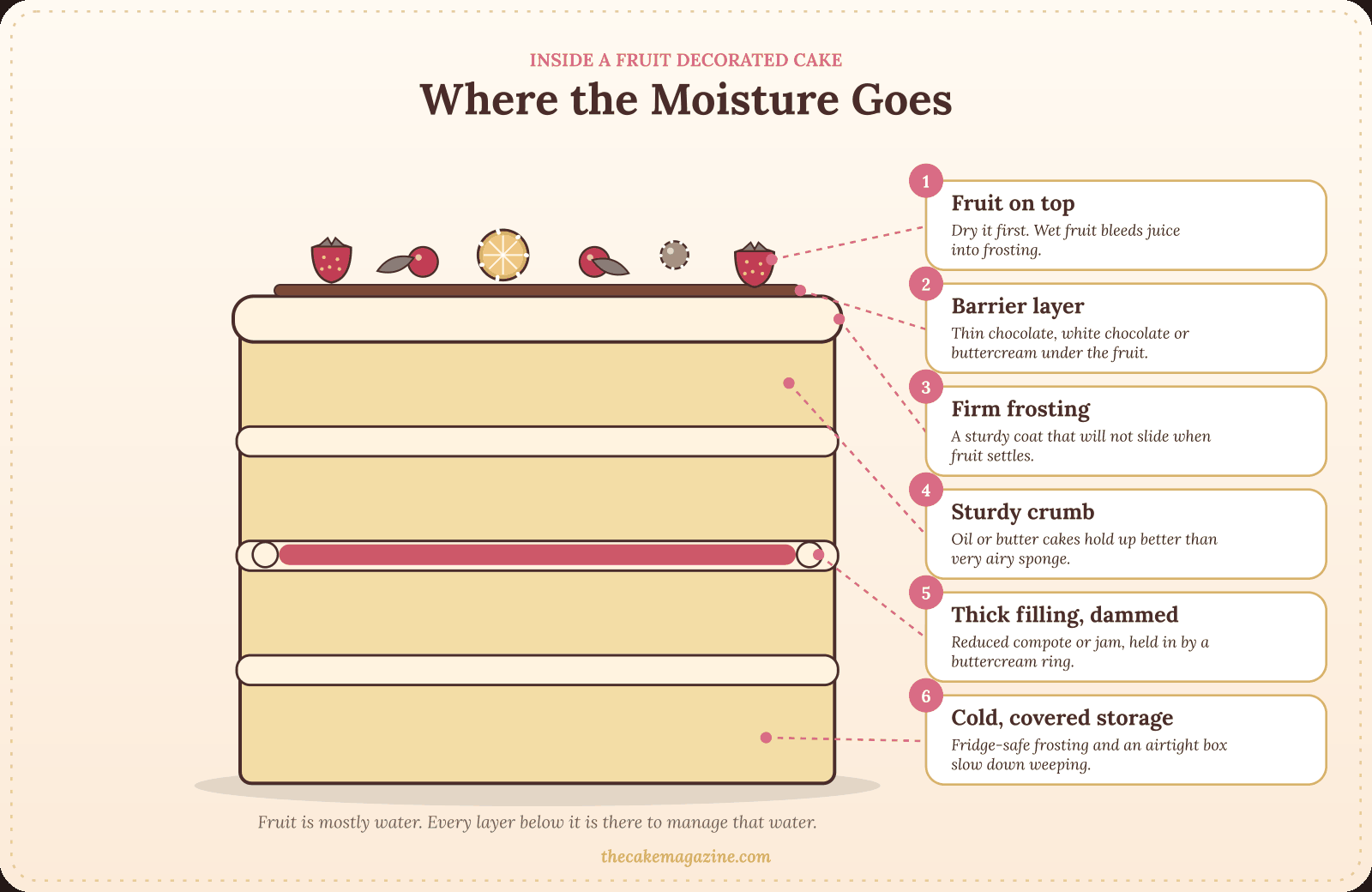
Pick a sturdy crumb for your fruit decorated cake
Very delicate, airy sponges can compress under heavy fruit and soak up juice fast. Butter and oil cakes with a moderately tight crumb carry fruit better. Our strawberry cake guide explains how to get real berry flavor without a wet or gummy crumb, which is the same balancing act you face when fruit goes on top. If you want to understand why some crumbs hold up better than others, the science is covered in our King Arthur Baking cake guide and in our own explainers on cake structure.
Cool the cake completely and chill the layers before you build. A cold, firm cake is easier to frost, shows less crumb and gives you a steadier surface for fruit. If you are building a tall cake, add dowels or supports where needed, because fruit will add weight to the top tier.
Choose a frosting that stays put
Frosting is the glue and the cushion. For a fruit decorated cake it needs to be firm enough to hold the fruit and not slide in a warm room. Swiss meringue buttercream is smooth, stable and holds fruit nicely when it is well made; see our guide to Swiss meringue buttercream for temperatures and fixes.
American buttercream is sweeter and crusts, which helps hold fruit but can taste heavy next to tart berries. Cream cheese frosting is soft and needs refrigeration. Whipped cream tastes lovely with fruit but needs stabilizing and a cold room.
Whatever you use, make the top coat smooth and level, with a slightly firm set. Chill the frosted cake until the surface is firm to the touch before you add fruit. Fruit pressed into soft frosting sinks, slides and leaves a trail. If your sides still need work, our guide to smooth buttercream sides and sharp edges shows how to get a clean finish that makes fruit look even better.
Use a barrier layer under fresh fruit
A barrier is a thin, water-resistant layer between wet fruit and the frosting. A band of melted dark or white chocolate brushed on the top, a thin layer of firm buttercream, a ring of ganache, or a pile of cake crumbs sealed with frosting all help. Chocolate is the most effective, because fat repels water. Spread it in a thin, even layer and let it set before placing fruit.
Do not use a barrier for fruit that is only touching the edge or sitting on a firm buttercream shelf, since this is extra work you do not need. Use one where fruit will sit in direct contact with soft frosting for more than an hour or two.
Mind the fillings inside the cake
Fruit on the outside is only half the story. If you also fill the layers with fruit, keep the filling thick and contained. A thick buttercream dam, a ring of frosting piped around the edge of each layer, holds a spoonful of jam or reduced compote in place and keeps it from squeezing out the sides. Our guides on fresh fruit cake fillings and fruit compote for cake filling go through moisture control, thickening and stability layer by layer.
Tip. If the filling and the decoration are the same fruit, make the filling cooked and the decoration fresh or candied. A cooked filling is more stable, and the decoration gives you the bright flavor and color.
Making a fresh fruit decorated cake
Fresh fruit is the quickest route to a fruit decorated cake and the least forgiving one. The window between looking perfect and looking tired is short. Plan your timing around that.
Step-by-step: a simple berry crown
- Chill the frosted cake until the top is firm. If the top will touch fruit for a while, brush a thin layer of melted chocolate over the area and let it set.
- Wash and dry the fruit, then keep it cold on a dry towel.
- Halve a few strawberries and leave others whole. Keep a mix of sizes.
- Place the largest pieces first, spacing them unevenly around the edge of the cake. Press each piece in lightly so it does not roll.
- Fill in with smaller berries, then add a few leaves or sprigs of mint for contrast.
- Step back, look at the cake from the side as well as above, and remove one or two pieces if it feels crowded.
- Return the cake to the refrigerator until it is time to serve.
The side view matters. Most cakes are seen at an angle, and fruit that looks balanced from above can look lopsided from the table. Check the silhouette against a plain wall before you call it done.
Keep the fruit from sliding
Round fruit rolls, especially on a smooth top. A few tricks help. Press blueberries and cherries into a small dab of frosting, like glue. Pipe a ring or small mounds of buttercream to nest the fruit in. Use a slightly tacky surface, such as a thin layer of room-temperature buttercream, as the landing place. If you are building height, a small cluster of frosting between fruit pieces keeps them stable.
For cakes that will travel, avoid tall unsupported stacks. Keep fruit low and anchored, and hold back a small container of extra pieces to add on site. Our guide to transporting a wedding cake covers chilling, boxing and vehicle setup, and the same ideas apply to any fruit decorated cake that has to go somewhere.
Add shine and a finishing touch carefully
A dusting of powdered sugar looks lovely on berries and hides small imperfections, but it dissolves into spots when the fruit is wet. Apply it right before serving with a fine sieve, holding it high so the sugar falls evenly. A light brush of warmed apricot glaze gives a fresh-from-the-pastry-shop shine and slows drying for a few hours.
Leaves, herbs and flowers add dimension, and they follow separate safety rules. Only use leaves and blooms you know are food-safe and have not been sprayed with chemicals. Our guide to edible flowers on cakes explains sourcing, preparation and placement. Tell guests which decorations are inedible, and remove anything that is not meant to be eaten before serving.
Common fresh-fruit mistakes
- Placing damp fruit. Water rings and bleeding colors show up within the hour.
- Decorating too early. Fruit placed the night before often looks dull and sunken by lunch.
- Heaping the top. A mountain of fruit looks generous but slides. Aim for a clear shape with some bare frosting around it.
- Using soft frosting. Chill first so the top holds the pieces.
- Forgetting pits and stems. Tell guests when cherries or other whole fruit still have pits.
Candied fruit and citrus slices
Candied fruit is the baker’s answer to the problem of weeping. When fruit is simmered in sugar syrup and then dried, much of its water is replaced by sugar. The result is glossy, translucent and far more stable than raw fruit. A candied orange wheel can sit on a cake for a day or two without collapsing, which is why it features in so many winter and wedding designs, and why it earns a place on any make-ahead design.
How candied citrus works
Sugar draws water out of the fruit and slowly moves in. Thin slices let that exchange happen evenly, and a gentle simmer keeps the slices intact. The slices turn glassy and the peel softens. Once dried on a rack, the surface becomes slightly tacky or crisp rather than wet. Because the interior is saturated with sugar, microbes find it harder to grow, which is why candied fruit has traditionally been a preserved food.
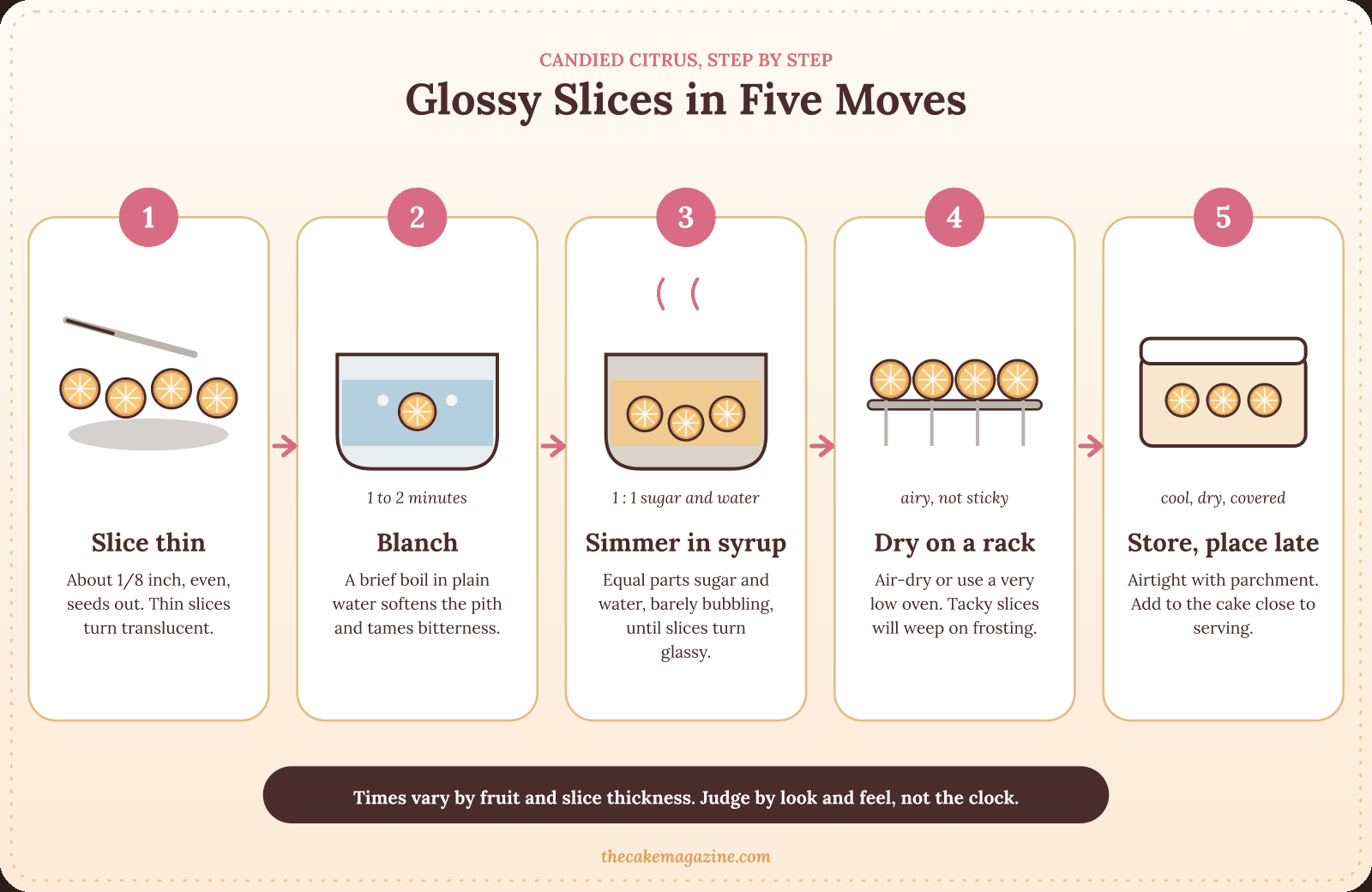
A starting method for candied orange wheels
This is a general method rather than a tested recipe. Treat the times as ranges and judge by look and feel.
- Slice. Wash and dry two or three firm oranges, and slice them crosswise into rounds about 1/8 inch thick. A sharp knife or a mandoline gives even slices. Pick out any seeds.
- Blanch. Simmer the slices in plain water for a minute or two, then drain. This softens the pith and takes some bitterness out.
- Make a syrup. In a wide pan, combine equal weights of granulated sugar and water, for example 300 g (about 1 1/2 cups) of each. Warm gently until the sugar dissolves.
- Simmer. Lay the slices in a single layer in the syrup. Keep the heat low so the syrup barely bubbles. Simmer until the white pith turns translucent and the slices look glassy, which often takes somewhere between 45 and 75 minutes, turning the slices occasionally.
- Dry. Lift the slices onto a wire rack set over a tray. Air-dry them for several hours or overnight, or dry them in a very low oven around 200°F (95°C) until they feel dry on the surface. They will firm up as they cool.
- Store. Layer the dry slices between sheets of parchment in an airtight container.
Save the leftover syrup. It is lightly orange-scented and works for brushing on cake layers, sweetening iced tea or stirring into cocktails. Keep it in a clean jar in the refrigerator.
Other candied candidates
Lemon and lime wheels work the same way, though thinner slices and a slightly longer blanch help with sharper pith. Blood oranges give a dramatic ruby color. Kumquats can be candied whole or halved. Cranberries, cherries and thin ribbons of peel can be candied too. Peel strips work well as a garnish for curled and swirled decoration and take less time than wheels.
Color tip. Candied citrus gets darker and more amber the longer it cooks and dries. For a bright, fresh look, simmer gently and avoid high heat. For a deep, rustic look, dry a little longer in the low oven.
Using candied fruit on the cake
Place candied pieces on a firm, set frosting. If a slice still feels tacky, let it dry longer before use. For cakes with cream frosting or fridge storage, put candied fruit on late, since humidity from the refrigerator can soften the surface. If the slices have gone slightly soft, a short rest at room temperature or a few minutes in a very low oven may refresh them, though this is something to try ahead of time, not at the last minute.
A candied slice can be partly dipped in melted chocolate for a sharp, professional look. Dry the slice thoroughly first, dip half, and set it on parchment. This also adds a protective layer that slows moisture from reaching the frosting.
Sugared fruit for a frosted sparkle
Sugared fruit is the look the wedding press keeps describing: grapes, pears and citrus wearing a crystalline coat that glitters under the lights. It is easier than it looks, and it is ready to serve once the coating dries in a few hours. It is also less durable than candied fruit, so it suits cakes that will be served soon and kept cool and dry.
Two ways to coat fruit
The first method uses simple syrup. Make a syrup of equal parts sugar and water, cool it, brush or dip the fruit, and roll it in superfine sugar. The second method uses egg white. Brush a thin film of egg white on the fruit and sprinkle sugar over it. Egg white gives a more delicate, frosted crust, but raw egg white is a food-safety consideration. If you use it, choose pasteurized egg whites or reconstituted meringue powder, and tell guests the fruit contains egg.
A starting method for sugared grapes
- Wash grapes in small clusters and dry them thoroughly. Any water on the skin will dissolve the sugar.
- Brush each cluster lightly with pasteurized egg white, meringue-powder wash or cooled simple syrup. You want a thin film, not drips.
- Sprinkle or roll in superfine sugar until the coat looks even and fully frosted.
- Set on a wire rack and let dry for a few hours, or until the coating feels set and dry to the touch.
- Store in a single layer in a cool, dry place until needed.
Cranberries work well with the syrup method. Warm them briefly in syrup, drain, and roll in sugar once they have cooled slightly. They have a tart interior that balances the sweet crust, and they look like tiny frosted jewels on a winter cake.
The enemy of sugared fruit is humidity
A sugar crust attracts water from the air and the fruit. On a rainy day, or in a refrigerator, the sparkle can dull and the sugar can melt into sticky spots. Sugar the fruit in a dry room, dry it fully, and place it on the cake as late as you can. If a cake with sugared fruit must go in the fridge, expect some loss of sparkle and plan to refresh it with a fresh dusting of sugar before serving.
Best for
Winter cakes, wedding cakes, small cakes and any design that wants frosty sparkle and a tidy look.
Watch out for
Humid rooms, wet frosting, and fruit left on the cake overnight in the fridge. Each can dull or melt the crust.
Pairs well with
Vanilla and white cakes, lemon and citrus, cranberry and spice, and dark chocolate for strong contrast.
Dusting with powdered sugar instead
If sugared fruit feels like too much work, a soft dusting of powdered sugar gives a similar look in seconds. Dust right before serving, because the sugar dissolves into damp berries. For a more polished effect, look for a dusting sugar sold as moisture-resistant, which holds up a little longer on damp surfaces.
Fruit you can safely leave off the cake
Sometimes the wisest decoration is the fruit you serve beside the cake. A bowl of macerated berries, a small jar of lemon curd or a plate of candied slices lets guests add their own, and it removes the risk of weeping altogether. This works especially well for cakes with whipped cream or a long timeline, and for events where you will not be there to finish the cake.
Keep a small decorated area on the cake itself, such as a crescent of sugared fruit or a few candied slices, so the cake still looks finished before guests help themselves. The side dish adds generosity and the topping adds the photograph. Many bakers use this idea for large gatherings because it also makes serving faster, since nobody has to scrape berries off a slice.
You can also set fruit on the cake board or plate instead of the frosting. Three or four whole strawberries beside the cake, a few leaves and a candied wheel on the board give a styled look without touching the surface. The cake stays clean and easy to cut, and the fruit can be replaced if it tires before the party ends.
Sculptural fruit designs
The sculptural end of the fruit decorated cake covers two quite different projects. One is fruit that is carved or arranged into a shape. The other is a cake that is shaped to look like fruit. Both reward preparation.
Carved and fanned fruit
A fan is among the simplest sculptural effects. Take a strawberry, make several thin parallel cuts from near the tip toward the stem without cutting all the way through, and press gently to fan the slices. Do the same with a small pear, a fig or a firm plum. Fans lie flat on frosting and make a ruffle effect. Chill sliced fruit until firm for cleaner cuts.
Other options include citrus twists, orange peel roses made by rolling a long strip of peel into a spiral, and small cutout shapes from firm fruit or melon using tiny cutters. Brush cut surfaces lightly with a clear glaze to slow drying. Keep sculpted fruit cold, since cut surfaces and thin pieces dry out and turn dull quickly.
Fruit stacked and embedded
Another look is to embed fruit into the frosting like jewels, so each piece sits partly sunk into the surface. This holds fruit securely, travels well and looks intentional. Pipe small mounds of buttercream and press a berry into each, or spread a thick, even layer of frosting and press halved fruit into it. Because the fruit sits in the frosting, use fruit that is dry and place it with a clean touch.
Stacked fruit, such as a pile of berries at the top of a cake, needs support. Use a small ring of frosting as a dam, or a layer of firm filling or ganache, so the pile has an edge to lean against. Keep it small and neat for any cake that travels.
Cakes shaped like fruit
Fruit-shaped cakes are a challenging project: a sphere of cake and filling coated and finished to look like an orange, a peach or a strawberry. Typical builds use a mold or domed pans, a filling such as mousse or compote, and a glaze or sprayed coating for color and texture. The Axios Detroit report notes these desserts are filled with mousse, compote and sponge, which gives a sense of the layers involved.
For a first attempt at home, keep it simple. Bake two domes in a round, shallow bowl or half-sphere pan. Fill with a firm filling such as a thick jam or stabilized cream. Chill until very firm, then coat in a chocolate or fondant shell and color it with food-safe dust or paint.
Details vary by method, and we have not tested a specific sphere formula, so expect a practice run. Our fresh fruit filling guide helps you choose a filling that will not leak through a thin shell.
Start small. A fruit-shaped cake is a good use for a mini format. Our guide to 2026 cake trends covers small formats alongside other directions, and a single small sphere is far easier to chill, glaze and box than a large one.
When a sculptural fruit decorated cake makes sense
Sculptural designs make sense when the cake is the centerpiece, you have time to chill between steps, and the venue is cool. They make less sense for a cake that will sit outdoors or travel a long way. When in doubt, use a simpler fruit decorated cake and put the effort into one standout feature, such as a single fanned piece or a crown of candied citrus.
Layouts for a fruit decorated cake: color and balance
Good fruit placement on a fruit decorated cake looks effortless and is usually planned. A few layout ideas cover most cakes, and each has its own strengths.

Five layouts that work
- Crescent. A curved sweep along one edge. It is easy to balance and leaves the rest of the cake clean for piping or a message.
- Crown. A full ring around the edge with the center left open. It is tidy and traditional, and it suits round cakes.
- Cascade. Fruit starts on top and spills down one side. It adds drama and height, so anchor the fruit well.
- Scatter. Loose groups placed unevenly with leaves or petals in between. It looks relaxed and modern.
- Embedded. Fruit pressed into the frosting like jewels. It is secure and travels well.
Odd numbers and uneven heights
Groups of three or five look more natural than pairs. Mix sizes: a few large pieces, several medium ones and a scattering of small ones. Vary the height by tucking some fruit lower and letting others sit higher. Leave negative space. Bare frosting gives the eye a place to rest and makes the fruit look more deliberate.
Color story
Choose a limited palette and repeat it. Red, deep purple and a hint of orange look rich together. Citrus on its own, yellow, orange and green, looks fresh and sunny. A blush palette of pale pink, cream and a few deep berries looks soft and romantic. If you add a color that appears nowhere else on the cake, such as a bright green grape on a pink cake, make sure it is a deliberate accent.
Think about the frosting color too. White and ivory make fruit pop. Pastel frostings need fruit in a similar tone to avoid clashing. Dark chocolate frosting makes sugared and pale fruit glow. Our guide on tangy cake flavors pairs color and taste ideas for lemon, passion fruit, raspberry and more.
Work with the cake, not against it
Cake shape and size decide how much fruit you need. A small 6-inch cake can feel crowded with more than a modest handful. A tall cake often looks best with fruit concentrated at the top and a few pieces trailing down. A sheet cake can take rows or a pattern across the surface. Step back, take a quick phone photo, and look at it small. If it still reads clearly in a thumbnail, the design is working.
Timing, storage and food safety for a fruit decorated cake
This is the section that turns a pretty cake into a dependable one. Timing and temperature decide how a fruit decorated cake looks at the party and whether it is safe to eat.

A simple schedule
- Two days before: make candied citrus and let it dry on a rack, then store it airtight.
- One day before: sugar grapes or cranberries and dry them in a cool, low-humidity room. Bake and chill cake layers, and make frosting.
- Morning of: wash, dry, hull and halve fresh fruit. Frost the cake and chill it until the top is firm.
- Last hour or two: blot fruit once more and place it. Add leaves, glaze or powdered sugar last.
- At serving: keep the cake cold until it is time to cut and serve.
This schedule is a rule of thumb. Heat, humidity and the type of fruit change it. In a warm, humid kitchen, shorten the gap between placing fruit and serving. In a cool, dry room, you have more freedom.
Refrigeration and time limits
A cake with fresh cream, custard, cream cheese frosting or cut fruit is perishable and belongs in the refrigerator. The FDA says to keep perishable produce, including cut produce, at 40°F or below. The U.S. Department of Agriculture’s Food Safety and Inspection Service advises that perishable food should not sit out more than two hours, or one hour when it is above 90°F. Their food safety pages have the full guidance.
Bring the cake out close to serving time so the frosting softens and the flavors open up, but not so early that it sits through a long party. For a buffet or outdoor event, serve in stages: keep the cake cold and bring it out in portions.
Our guide to cake food safety goes deeper on eggs, dairy, fillings, refrigeration and display, and is especially useful if you sell cakes.
Dry and sugary fruit versus fresh fruit
Candied and well-sugared fruit is lower in free water, so it is less perishable than fresh cut fruit, but it still sits on a cake that may contain perishable frosting. The safety rule follows the cake, not the decoration. If the cake needs refrigeration, the decorated cake needs refrigeration.
Allergens and labels
Fruit allergies exist, and some people react to specific fruits such as kiwi, mango or stone fruit. Sugared fruit may contain egg.
Candied and glazed fruit may have been made on equipment shared with other allergens, and chocolate barriers can contain milk or tree nuts. If you serve guests or sell cakes, list the fruit and any egg, dairy, nut or other major allergens, and tell people which decorations to avoid. For general guidance on handling food safely, follow the FDA and USDA pages above, and check your local rules if you sell baked goods.
Storing a finished fruit decorated cake
Store the cake in a tall cake box or carrier in the refrigerator, away from strong-smelling foods. Do not wrap fresh fruit tightly in plastic, which traps moisture and lets the fruit sweat. If you have to cover the cake, tent it loosely. Leftovers are best eaten within a day or two, and the fruit will look less fresh each hour. Travel adds its own rules, which we cover just below in the troubleshooting section.
Choosing a fruit decorated cake for the occasion
The same fruit decorated cake does not suit every event. Think about how long the cake will sit, how warm the room will be and how many people will see it before it is cut. Those three facts narrow the choice quickly.
Birthdays and family dinners
Casual events are the easiest place to use fresh fruit. The cake is usually served within an hour or two, kept in the refrigerator beforehand and cut by someone who is happy to explain what is on top. A crescent or scatter of berries is plenty. Kids tend to love simple whole fruit, so leave the pits in the kitchen and keep the pieces large and easy to spot.
Weddings and showers
Receptions mean photographs, long timelines and sometimes warm rooms. A fruit decorated cake for a wedding leans on candied and sugared fruit, embedded pieces and a little fresh fruit added on site. Ask the venue about refrigeration, and ask the couple about fruit allergies and any dietary needs. Our wedding cake transport guide covers the practical side of getting a decorated cake to a venue in one piece.
Holidays and gatherings
Holiday cakes are where candied citrus, cranberries and pomegranate shine. They give color without needing out-of-season berries, and they tolerate a busy kitchen schedule because you can make most pieces days ahead. If you are baking for several gatherings, make one big batch of candied slices and sugared fruit and store them dry between parchment.
Selling a fruit decorated cake
If you sell cakes, fruit adds cost and risk. Fresh fruit prices swing with the season, and a cake that wilts on the way to a customer is a problem you will hear about. Price the fruit by what you actually use, include time for washing, drying and placing, and consider giving customers a note about when to take the cake out of the refrigerator. Labeling matters too, since fruit and any egg, dairy or nut ingredients affect allergen information.
Troubleshooting a fruit decorated cake
Most problems with a fruit decorated cake fall into a handful of patterns. Here is how to spot them and what to change next time.
Fruit is leaking juice onto the frosting
What it looks like: pink, purple or orange streaks, a wet halo around each piece, or frosting that looks thin under the fruit.
Likely causes: damp fruit, fruit placed too early, very ripe fruit, or no barrier layer.
Fix it next time: dry fruit twice, add a thin chocolate or firm buttercream barrier, place fruit later, and keep the cake cold. Sugared or candied fruit leaks far less.
Berries slide off the top
What it looks like: pieces roll, tilt or drift toward the edge, especially during transport.
Fix it next time: chill the frosting until it is firm, then nest each berry in a small dab of fresh frosting. Use halved fruit with a flat cut side, and avoid tall unsupported piles.
Sugared fruit looks wet or sticky
What it looks like: the frosted crust has dissolved into shiny patches, or the sugar looks clumpy.
Likely causes: fruit was not fully dry before coating, the room was humid, or the fruit sat in the refrigerator.
Fix it next time: dry the fruit completely, coat in a thin layer, dry in a cool, dry room and place late. Refresh with a light dusting of sugar before serving.
Candied citrus is chewy, bitter or tacky
What it looks like: slices that stay sticky for days, taste harsh, or bend instead of holding a gentle curve.
Fix it next time: slice thinner and more evenly, blanch briefly to tame the pith, simmer more gently and dry longer. If the slices are only tacky, give them more time on the rack or in a very low oven.
The cream or mousse turned thin or bitter
What it looks like: a runny layer beneath fresh pineapple, kiwi or papaya, or a sharp aftertaste.
Fix it next time: use canned or cooked versions of those fruits where they touch cream or gelatin, or choose a different fruit.
Fruit looks dull or sunken by serving time
What it looks like: wrinkled skin, flat color or a collapsed look.
Fix it next time: decorate later, brush with a thin glaze, keep the cake covered loosely and cold, and choose firmer fruit.
Pairings and seasonal ideas
Fruit is both decoration and flavor, so choose it with the cake in mind. Contrast usually works better than matching. A rich or sweet cake loves something sharp, and a plain cake can take something deep and jammy. Our flavor pairing guide goes into this in more depth.
Vanilla or white cake
Mixed berries, sugared grapes or candied lemon. The mild base lets the fruit be the star, and almost any color works.
Chocolate cake
Cherries, raspberries, orange wheels or sugared cranberries. Dark frosting makes bright fruit glow.
Lemon or citrus cake
Candied lemon, blueberries, raspberries or a few edible leaves. Keep the palette light and fresh.
Spice or carrot cake
Candied orange, sugared pears or cranberries, and fanned figs. Warm colors suit warm flavors.
By season
Spring suits strawberries, rhubarb ribbons and pale citrus with soft pastels, which fits the ideas in our Easter cake ideas. Summer is the time for berries, cherries, peaches and figs, and our summer cake ideas add notes on heat-smart designs. In fall, pears, grapes and figs bring deep color. Winter calls for citrus, cranberries and pomegranate, and the guide to Christmas cake ideas shows how to use them on holiday designs.
Scaling fruit to your fruit decorated cake
As a rough guide, a small 6-inch cake looks best with a modest cluster, a standard 8-inch cake with a crescent or crown, and a taller or wider cake with a fuller arrangement. These are design starting points, not rules. If you are unsure, start with less. You can always add a few more pieces, and removing fruit from soft frosting leaves marks.
Making a fruit decorated cake for a crowd
For a large event, split the work. Prepare candied and sugared pieces early, keep fresh fruit washed and cold in labeled containers, and decorate on site if you can. If a cake must be finished at home, box the cake and carry the fruit separately for a final touch. Keep the cake in the coolest spot available and decorate as close to serving as the schedule allows.
Common fruit decorated cake mistakes
- Decorating the night before with fresh fruit and expecting it to look the same at noon.
- Skipping the dry step because the fruit “looks dry.”
- Using soft frosting that has not been chilled.
- Choosing fruit by color alone and ignoring how it behaves.
- Placing every piece in a perfect row, which can look stiff.
- Forgetting to tell guests about pits, stems, seeds and inedible leaves.
- Leaving a perishable cake out for hours at a warm event.
FAQ
What is a fruit decorated cake?
A fruit decorated cake is a cake that uses fruit as its main decoration, whether fresh, candied, sugared or carved into shapes. The fruit supplies color, flavor contrast and visual interest, and it is placed on the outside of the cake instead of hidden inside the layers.
How far ahead can I decorate a fruit decorated cake?
Candied citrus can be made two days ahead, and sugared fruit about a day ahead in a dry room. Fresh fruit looks best when placed in the last hour or two before serving. Keep the cake in the refrigerator until then, and adjust for your climate.
How do I keep a fruit decorated cake from getting soggy?
Dry the fruit well, then set it on a firm frosting with a thin barrier of melted chocolate or buttercream. Place it late and keep the cake cold. Pat each piece once more right before it goes on the cake.
Which fruits are best for a fruit decorated cake?
Strawberries, blueberries, blackberries, cherries, grapes, figs and citrus are dependable. Raspberries and sliced stone fruit look lovely but are delicate. Avoid fruit that browns quickly, such as sliced bananas or apples, unless it is treated or candied.
Do I need to wash fruit for a fruit decorated cake?
Yes. The FDA advises rinsing produce under running water and drying it with a clean towel, without soap or produce wash. Washing reduces bacteria but does not eliminate it, so keep cut fruit cold. Dry it thoroughly afterward so it does not weep on the frosting.
How long do candied orange slices keep?
Well-dried slices stored airtight with parchment in a cool, dry place can keep for days, and often longer, but time depends on how dry they are. If they feel sticky or look wet, use them quickly or dry them further. Make a small batch first to learn your own timing.
Is it safe to use raw egg white to sugar fruit?
Raw egg white carries a food-safety risk for some people. Use pasteurized egg whites, a meringue-powder wash or simple syrup instead, and tell guests the fruit contains egg if you use it. Check the USDA food safety pages for current guidance on eggs.
Can a fruit decorated cake be left out at room temperature?
Not for long if it has cream, custard, cream cheese frosting or cut fruit. USDA guidance says perishable food should not be out more than two hours, or one hour above 90°F. Keep the cake cold and bring it out close to serving time.
What frosting works best for a fruit decorated cake?
A firm, stable frosting such as Swiss meringue or American buttercream chilled until set holds fruit best. Whipped cream and cream cheese frosting work too, but they need to stay cold and are more perishable. A thin chocolate barrier helps under any frosting.
Can I freeze a fruit decorated cake?
You can freeze unfrosted cake layers, but freezing fresh fruit makes it watery when it thaws. Freeze the cake, thaw it, then decorate with fresh, candied or sugared fruit. Do not freeze a finished cake with fresh fruit on it.
How do I transport a fruit decorated cake?
Chill the cake first, use a snug box and a non-slip base, keep the box level and carry extra fruit separately for a last-minute finish. Embedded and sugared fruit travel better than tall piles of fresh berries, and a cool car helps.
Is the fruit decorated cake trend going to last?
Nobody can say for sure, but fruit has long been part of cake decoration and trend sources such as The Knot highlight it in 2026. The specific looks, such as sugared pears or fruit-shaped cakes, may change, while the practice of decorating with fruit is likely to stay.
Final thoughts
A fruit decorated cake does not need special equipment or advanced skill. It needs a sturdy cake, a firm cold frosting, dry fruit and a sense of timing. Choose the style that fits the occasion, build the cake underneath with care, make the slow parts early and the fresh parts late, and leave some bare frosting so the fruit has room to shine.
If you are new to this, start with a small crown of berries on a chilled cake and a thin chocolate barrier. Then try one candied slice or a handful of sugared grapes on your next cake. Each attempt will teach you how your fruit, your kitchen and your frosting behave. Tell us what worked for you, and we will keep refining this guide.
Sources and further reading
- The Knot, wedding cake trends, updated October 13, 2025.
- Axios Detroit, fruit-shaped desserts trending in Metro Detroit, June 2025.
- U.S. Food and Drug Administration, selecting and serving produce safely.
- U.S. Department of Agriculture, Food Safety and Inspection Service, food safety.
- King Arthur Baking, cake guide.
Editorial note: this guide was reviewed and updated in November 2026 for home bakers in the United States. Trend information comes from the sources named above and is current as of that date. The candying and sugaring methods are general starting points that have not been oven-tested by our team, and times vary with fruit, pan and climate, so test a small batch first. Food-safety notes are general information, not medical advice. If you sell baked goods, check your state and local food rules.