Easter cake ideas tend to start the same way: someone says “we should have a cake,” and then nobody agrees on what kind. One person wants carrot cake with cream cheese frosting, another wants something lemony and light, and the kids want a bunny. This guide sorts through the options so you can choose with confidence. We cover flavors, pastel colors, floral and spring designs, sizes and servings, make-ahead timing, food safety and the problems that show up on the day, all written for home bakers.
The best easter cake ideas pair a spring flavor with a simple, soft-colored design. Carrot cake with cream cheese frosting is the classic. Lemon or orange cake feels fresh after a rich meal. Pastel buttercream, a few piped or fresh flowers, a nest of candy eggs or a bunny-ear topper turns any of them into an Easter cake. Choose a design that fits your skill, bake in advance, and keep cream cheese frosting refrigerated.
- What makes easter cake ideas work
- Carrot cake: the classic of easter cake ideas
- Lemon, orange and other citrus easter cake ideas
- More flavors: coconut, strawberry, vanilla and chocolate
- Pastel colors without the guesswork
- Floral easter cake ideas
- Spring design easter cake ideas: nests, bunnies, eggs and more
- Easter cake ideas by skill level
- Mini cakes, cupcakes and other small easter cake ideas
- Sizes and servings for your Easter table
- Make-ahead plan and food safety
- Troubleshooting and common mistakes
- FAQ
- Final thoughts
What makes easter cake ideas work
Easter is a spring holiday, and the cakes people remember tend to feel like spring. That usually means three things: a flavor that is bright or comforting, a color palette that is soft, and a shape or detail that nods to the season without shouting. A cake does not need a rabbit on it to be an Easter cake. A plain lemon layer cake with pale yellow buttercream and a few fresh flowers does the job.
Easter dinner is also usually a big meal, often with ham or lamb, sides and plenty of other desserts competing for space. That changes what makes a good dessert. A cake that is light enough to eat after a large lunch, easy to slice for a crowd and sturdy enough to sit out for a while will beat a fragile showpiece most years. We keep returning to that practical test throughout these easter cake ideas.
The three decisions behind easter cake ideas
Almost every one of the easter cake ideas in this guide comes down to three choices. First is the flavor: carrot, citrus, coconut, strawberry, vanilla or something chocolate for the people who always ask for it. Second is the finish: smooth pastel frosting, a rustic swoop, a naked cake with fruit, or a fully piped design. Third is the size: one tall cake, a sheet cake for a big family, or a tray of minis for a mixed crowd.
Make those three choices in that order, flavor first. Flavor drives the frosting choice, the frosting drives how the cake can be decorated, and the guest count drives size. If you start with a Pinterest photo of a ruffled floral cake and work backward, you can end up with a design that does not suit the flavor you wanted or the time you have.
When is Easter, and why does it matter for baking?
Easter moves around the calendar, which affects the weather, the produce in the store and how much time you have between other spring events. Western Christian churches celebrate it on the first Sunday after the first full moon on or after March 21, according to The Old Farmer’s Almanac. By that rule Easter fell on April 5 in 2026, falls on March 28 in 2027 and lands on April 16 in 2028.
An early Easter, like March 28, 2027, often means cool weather and less local fruit, so citrus, carrots and jarred or frozen berries do more of the work. A late Easter in mid-April may bring strawberries, rhubarb and fresh flowers. It can also bring a warm day for an outdoor egg hunt, which matters if your cake has cream cheese frosting. We cover that in the food safety section.
Trend note, as of November 2026. Our guide to 2026 cake trends tracks the bigger picture: small formats, tangy flavors and vintage piping are all showing up in spring baking. Easter cake ideas are a good place to try any of them without committing to a full-size cake.

How to use these easter cake ideas
You do not need to read the whole thing. If you already know the flavor, jump to the carrot, citrus or other flavor sections, which collect the easter cake ideas by taste. If your main worry is how it will look, the color, floral and design sections are for you. If you are baking for a large group, go straight to sizes, make-ahead timing and food safety. Every one of these easter cake ideas can be scaled up or down, and none requires special equipment beyond what a home kitchen usually has.
Where we mention a recipe, we link to the full recipe on this site rather than repeating it here. That keeps this guide focused on ideas and decisions, and it means you can check the details for each cake in one place before you bake. Because this site has not oven-tested every variation mentioned here, treat any adjustment as something to try on a small batch first.
Carrot cake: the classic of easter cake ideas
If one cake says Easter in the United States, it is probably carrot cake. It is moist, lightly spiced, easy to make ahead and sturdy enough to carry to someone else’s house. The cream cheese frosting is pale, which makes it a natural base for pastel decoration. Of all easter cake ideas, carrot cake is the one most likely to be requested by name, so it is a safe place to begin if you are unsure.
What gives carrot cake its texture
Most carrot cakes are made with oil rather than creamed butter. Oil stays liquid at room temperature, which keeps the crumb soft even after a night in the refrigerator, when a butter cake can turn firm. Grated carrot adds moisture and a little sweetness, and most recipes include warm spices such as cinnamon, with nutmeg or ginger sometimes added. Chopped walnuts or pecans and sometimes raisins or pineapple give it body.
The carrots matter more than people expect. Finely grated carrots disappear into the crumb and add moisture evenly. Coarsely grated carrots leave visible strands and a slightly chewier bite. Both are fine, but pick one deliberately. Grating by hand on the small holes of a box grater is slower than a food processor, yet it gives the most consistent shreds. Weigh them rather than counting carrots, since size varies a lot.
Carrot cake looks that suit easter cake ideas
The simplest Easter carrot cake is a two-layer round with a thick swoop of cream cheese frosting and a ring of chopped nuts around the base. For something more on theme, the classic is the “carrot patch”: a small cluster of orange fondant or marzipan carrots with green tops set into crushed cookie “dirt” or a sprinkle of toasted chopped nuts. Another popular option is a naked or semi-naked cake, where the sides show through a thin scrape of frosting.
Pastel piping also works well on carrot cake. A row of small shells in pale pink or pale yellow around the top edge, with a few sugar flowers in the center, looks cheerful without hiding the cake. If you like the idea of coloring frosting, see our guide on how to color buttercream, which explains gel colors and how to keep pastels from turning muddy. The same principles apply to cream cheese frosting.
Carrot patch
Ring of fondant or marzipan carrots with green tops on a swoop of cream cheese frosting.
Naked carrot layer cake
Thin frosting scrape so the spiced crumb and flecks of carrot show through the sides.
Pastel shell border
Small piped shells in soft pink, yellow or mint around the top rim, finished with chopped nuts.
Sheet-cake carrot
Single layer in a 9 by 13-inch pan, frosted in a quilt of pale swirls for a bigger crowd.
Nuts, raisins, pineapple and other add-ins
Add-ins are where carrot cakes differ most from one family to the next. Walnuts and pecans are the usual choices, and toasting them for a few minutes in a dry skillet or a moderate oven wakes up their flavor and keeps them crisp inside the soft crumb. Raisins can be plumped in warm water or orange juice and drained well. Crushed pineapple adds moisture, but it must be drained thoroughly or the cake turns gummy.
If someone at the table avoids nuts, bake the cake without them and offer chopped nuts on the side or only on part of the frosting. Keep any nut-free portion physically separate, and label it honestly. Coconut is another common addition. A small handful folded into the batter gives a chewy texture, and a toasted sprinkle on top makes the cake look finished without any piping at all.
Cream cheese frosting: the part that needs attention
Cream cheese frosting is softer than American buttercream. It tastes lovely, but it does not hold sharp edges or heavy piping as well, and it needs the refrigerator once the cake is assembled because it contains dairy. If you want the full explanation of structure, sweetness and how much it can hold, read our cream cheese frosting guide. Here are the quick rules for easter cake ideas that use it.
- Use cold block-style cream cheese rather than spreadable tub cheese, which has more moisture.
- Beat the butter and powdered sugar first, then add cream cheese last and mix only until combined. Overbeating thins it.
- If it feels loose, chill the bowl for 20 to 30 minutes before using it, rather than adding more sugar.
- For piped details, consider a stiffer buttercream for the decoration and use cream cheese frosting only between layers and on the sides.
That last tip is a common bakery workaround. A carrot cake filled and coated with cream cheese frosting and decorated with a firmer buttercream border gets the best of both. If you sell or give away the cake, label it so people know it contains dairy, eggs, wheat and tree nuts.
Our full carrot cake recipe for your easter cake ideas
We have a dedicated walk-through of the cake itself: the oil-versus-butter question, how much carrot to use, the nut and raisin options, and layer and sheet-pan sizes. Find it in our carrot cake recipe guide. It is the best companion to this section if you want to bake the cake rather than just plan it. For a deeper look at why oil cakes stay soft, our cake baking science guide explains how fat and moisture work together.
Lemon, orange and other citrus easter cake ideas
Citrus is the other great flavor family among easter cake ideas, and it solves a problem carrot cake cannot. After ham, potatoes and rolls, a bright lemon cake feels like a palate cleanser. These easter cake ideas pair well with pale yellow, white and soft green, and they travel well with simple decoration. Lemon is the most familiar, but oranges, limes and even grapefruit have a place.
Lemon cake and lemon curd
A good lemon cake gets its flavor from zest, not only juice. The zest carries the lemon oils, which taste more floral and less sour than juice does. Rubbing the zest into the sugar with your fingertips before mixing releases those oils and spreads them through the batter. Juice then adds acidity and some moisture, but too much can affect structure, so follow a tested ratio. Our lemon cake recipe goes through the options.
Lemon curd between the layers turns a plain lemon cake into something special. It is tart, silky and bright yellow, which suits a spring palette on its own. Curd is looser than frosting, so pipe a ring of buttercream around the edge of each layer as a dam to keep it from squeezing out. We explain how to cook, cool and store curd in our lemon curd for cakes guide.
Pairing tip. Lemon is sharp, so match it with a gentle frosting. Vanilla buttercream, whipped cream cheese frosting or a light Swiss meringue buttercream all let the lemon stand out without turning the cake sour.
Orange, lime and other citrus options
Orange cake tastes sunnier and softer than lemon, which makes it a good match for people who find lemon too sharp. Orange zest and a little orange blossom water is a combination often used in spring baking, but go lightly with blossom water since it can taste soapy if overdone. We cover balance, zest and extract in the orange cake recipe guide.
Lime and grapefruit are less common at Easter, but a lime cake with coconut can look wonderful in pale green, and a pink grapefruit glaze on a simple loaf is a pretty, lower-effort idea. For broader ideas on tart flavors, see our guide to tangy cake flavors, which looks at lemon, yuzu, passion fruit and raspberry and why this family of flavors is rising right now.
Citrus decorating ideas
Citrus cakes are easy to decorate because the fruit gives you a theme. A ring of thin lemon slices, candied zest curls or a scattering of edible flowers on pale buttercream looks fresh without much work. A glaze made from powdered sugar and lemon juice, drizzled over a bundt or loaf, is one of the easiest Easter desserts there is, and it slices cleanly for a crowd.
- Lemon bundt with glaze: minimal decoration, big presence, serves many.
- Lemon layer cake with curd and buttercream: classic, pretty, better for a smaller group.
- Orange cake with cream cheese frosting: a cream-colored cake that suits a pastel palette.
- Citrus sheet cake: a simple glaze and a few candied peel curls on each square.
More flavors: coconut, strawberry, vanilla and chocolate
Not everyone at the table loves carrots or lemon, and a good host plans for that. These easter cake ideas widen the menu. The following flavors round out a spring menu and give you alternatives when the guest list is mixed. Most of them also work as a second, smaller cake beside a carrot or lemon centerpiece, which is a smart approach for a big family gathering.
Coconut: the nest-friendly choice for easter cake ideas
Coconut cake is almost made for Easter. The white, fluffy coating can be left plain or tinted to look like grass, and it is the traditional base for the “bird’s nest” look: toasted coconut shaped into a nest with candy eggs inside. Coconut milk or cream in the batter gives flavor, and toasted flakes add chew and aroma. See our coconut cake recipe for filling ideas and how to keep the layers tender.
A tip for the nest look: toast sweetened or unsweetened flaked coconut on a sheet pan until it is just golden, stirring often, since it can go from perfect to burned quickly. Cool it fully before pressing it into the frosting. For green grass, shake plain coconut in a jar with a drop of gel color until it is evenly tinted, then let it dry a few minutes on parchment.
Strawberry and other spring fruit
Strawberry cake with whipped cream or strawberry buttercream is a lovely choice for a later Easter, when berries are in season in many parts of the country. Fresh berries are juicy, so use them carefully. Macerated or cooked strawberries make a better filling than raw ones, and a reduced strawberry sauce or jam gives a firmer layer. Fresh berries on top should go on right before serving, not the night before.
Whipped cream frosting looks gorgeous with strawberries and feels light. It also needs refrigeration and is softer than buttercream, so it is better for a cake that will go straight from fridge to table. Our guide to stabilized whipped cream frosting explains how gelatin or other stabilizers help it hold, and how long a cake with it can safely sit out.
Vanilla and funfetti: the safe bets
Vanilla cake is the canvas of the cake world, and it takes pastel color beautifully. A white or ivory sponge looks clean next to pink, mint and lavender frosting, and nobody ever complains about it. Start with our best vanilla cake recipe if you want a dependable base. Funfetti, a vanilla cake with sprinkles in the batter, suits the playful side of Easter, especially when you choose pastel sprinkles.
One warning on sprinkles: some types bleed color into the batter, turning it gray or muddy. Nonpareils, the tiny round ones, are the worst offenders. Jimmies, the rod-shaped ones, generally hold better. If you want sprinkles inside, check the results on a small batch before committing to a large cake, and fold them in at the very end with a few gentle strokes.
Chocolate for the people who always ask
Chocolate is not traditionally springlike, but a chocolate cake at Easter is never wasted. It pairs well with pastel decoration, since white and pastel frosting look striking against dark crumb, and it satisfies chocolate lovers and anyone with leftover candy in the house. A chocolate cake with vanilla buttercream and a nest of chocolate eggs is a natural Easter combination. Start with our best chocolate cake recipe.
If you want something between chocolate and spring, consider chocolate and raspberry, chocolate and orange, or chocolate with coconut. Each has a spring feel and an obvious Easter-basket link. A small chocolate cake next to a larger lemon or carrot cake gives guests a choice without doubling your workload.
Mixed crowd
One carrot or lemon cake plus a small chocolate or vanilla cake.
Kids’ table
Funfetti with pastel sprinkles and a bunny-ear topper.
After a heavy meal
Lemon or orange with a light, tangy frosting.
Late Easter with berries
Strawberry and whipped cream, assembled the day of.
Pastel colors for easter cake ideas, without the guesswork
Pastels are the visual signature of easter cake ideas. Pink, yellow, mint, lavender and baby blue turn up on eggs, ribbons and cakes alike. They are also surprisingly easy to get wrong. Too much color turns a soft pastel into a bright one, and mixing two colors can produce a grayish tone instead of the one you wanted. These easter cake ideas work best when the color is gentle and the palette is limited.

How to mix a clean pastel
The method is simple: start with white frosting and add color in tiny amounts. Dip a toothpick into gel color, swirl it into the frosting, mix thoroughly and judge the result before adding more. Gel colors are strong, so a small dab usually does more than a big drop of liquid food coloring, which can thin the frosting. Our food coloring for cakes guide compares gel, liquid, powder and oil-based options.
Always color more frosting than you think you need. Matching a pastel shade the second time is hard, and running out halfway through a cake is a common problem. Buttercream also deepens as it sits, so a color that looks right when you mix it may be a little stronger a few hours later. Aim for slightly lighter than your target, and let it rest before you decide.
Pick a palette, not a rainbow
A cake with two or three pastel colors looks designed. A cake with six looks busy. Good combinations include pink with cream and sage green, butter yellow with white and soft blue, lavender with pale pink and a touch of green, and mint with cream and a pop of coral. Natural white or ivory frosting works as a neutral in any of them, so the cake does not feel overloaded.
- Garden palette: blush, sage, cream. Works with florals and carrot cake.
- Sunny palette: butter yellow, white, pale blue. Matches lemon and orange.
- Candy palette: pink, mint, lavender. Matches funfetti and bunny designs.
- Modern palette: cream, sage, a single coral accent. Suits naked cakes and minimalist styles.
Natural coloring options
Some bakers prefer to color with natural ingredients. Freeze-dried strawberry or raspberry powder gives a soft pink and a fruit flavor. Matcha powder gives a gentle green. A tiny amount of turmeric can give a pale yellow, though it can taste earthy if used too heavily. Natural colors are usually less intense and may shift as they sit, so test them, and be prepared for a more muted look than gel color gives.
Pastel frosting and Easter weather
Heat and light both affect pastel frosting. A cake with pale, saturated color left in strong sunlight can fade or streak, and buttercream in a warm room can soften and smear. If you plan an outdoor Easter gathering, keep the cake indoors or in the shade until it is time to serve. Our American buttercream guide explains how sweetness and stability change in warm conditions.
Floral easter cake ideas
Flowers and Easter go together, and floral cakes are some of the most photographed easter cake ideas every spring. Floral easter cake ideas also suit Mother’s Day. Floral decoration also scales neatly. You can do a single piped bloom on a small cake or a full crown of flowers on a tall one, and you can use buttercream, fresh blooms, sugar flowers or a mix. Here is how the main approaches compare in effort and risk.
Buttercream flowers
Piped buttercream flowers such as daisies, simple roses and little ruffled blooms are the traditional bakery choice. They use the same frosting as the cake, so the flavor stays consistent. They take practice, though, and they need a stiffer buttercream than a smooth finish does. If you are new to it, our buttercream flowers guide walks through roses, peonies, daisies and leaves, along with how to fix common piping problems.
A good beginner shortcut is the flower cluster: three or four simple blooms and a few leaves in one area of the cake, with the rest left smooth or lightly textured. It looks intentional, saves time and forgives small mistakes, since no one is checking whether every petal matches. Chilling the cake briefly makes it easier to place the blooms cleanly.
Palette knife florals and watercolor effects
Palette knife painting is a looser technique where you press and drag buttercream across the cake to build petals and texture. The result looks like an impressionist painting rather than a precise bouquet. It is forgiving, quick and very suited to Easter. Our palette knife cake decorating guide covers the tools, the motions and how to build up flowers in layers.
Watercolor buttercream blends two or three tones into one soft, blushing surface without hard lines. It works particularly well in pastel palettes. It also takes a gentle hand, since overworking the frosting can turn the colors muddy. Our guide to watercolor buttercream cakes explains how to blend without overworking the finish.
Fresh and edible flowers
Fresh flowers are the fastest way to a dramatic look, but they need care. Not every flower is safe to eat, and flowers from a florist or garden center are often treated with chemicals not meant for food. Use only flowers you know are edible and untreated, and keep stems out of the cake itself. Our edible flowers on cakes guide covers safety, sourcing, preparation and placement.
Food-safe placement. Even edible flowers should not touch the cake directly if you are unsure of their source. Wrap stems in floral tape or tuck them into a small piece of parchment or a food-safe flower holder, and set them in just before serving.
Easy floral easter cake ideas to try first
- Crescent of blooms: a curved arrangement of fresh or piped flowers along one side of the cake top.
- Flower crown: a ring of small blooms just inside the top edge, leaving the center plain for a message.
- Cascade: flowers and leaves running from the top edge partway down the side of a tall cake.
- Pressed flower look: dried edible flowers or thin sugar sheets pressed onto smooth frosting for a flat, botanical finish.
Spring design easter cake ideas: nests, bunnies, eggs and more
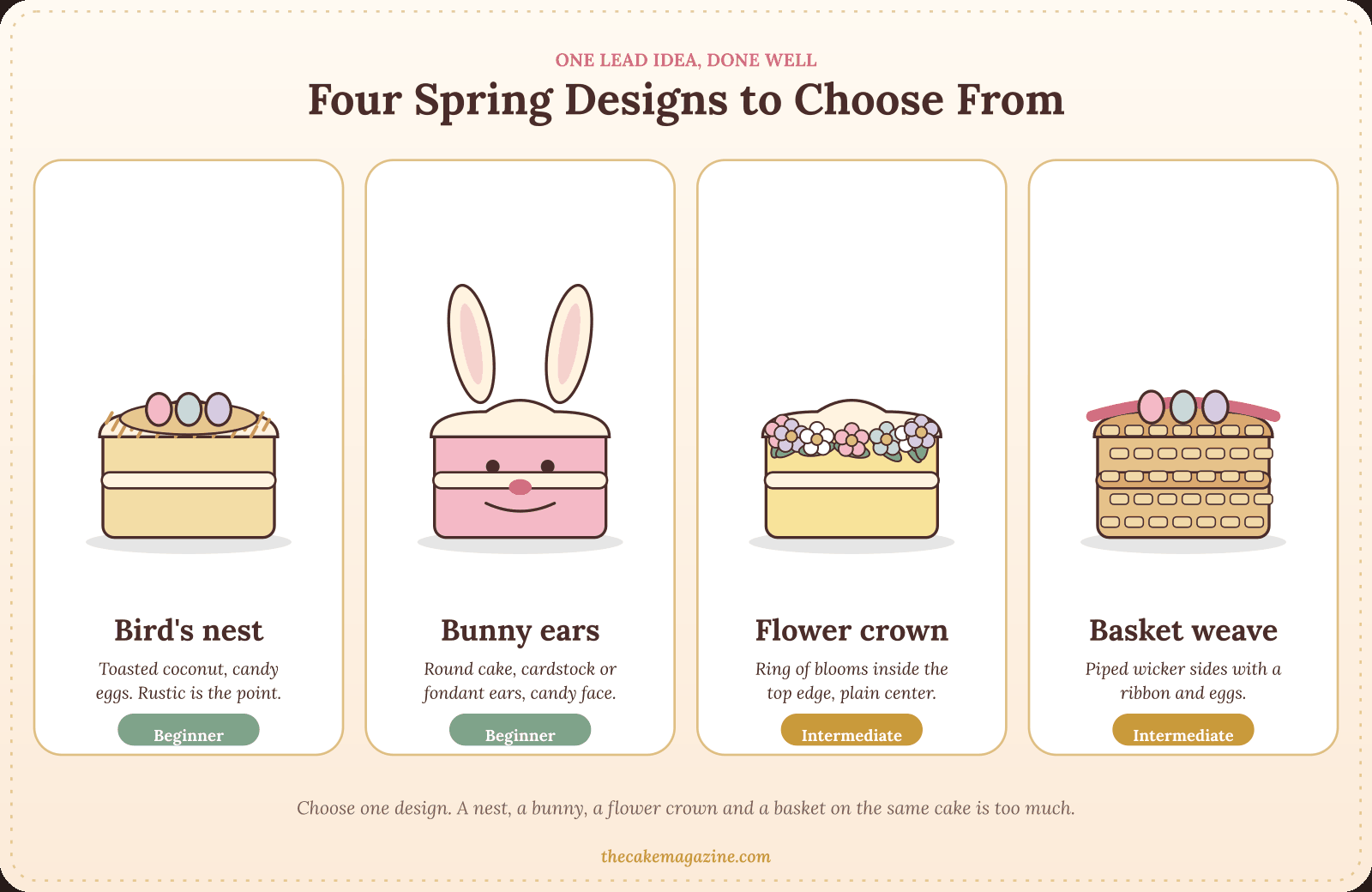
Beyond flowers, Easter has its own set of recognizable symbols. Using one of them gives your cake an immediate holiday identity, and these easter cake ideas all start there. The trick is to use one idea well rather than combining several. A cake with a nest, a bunny, a basket weave and a field of flowers can end up looking like a craft table. Pick a lead design and let the rest be quiet.
The bird’s nest cake: an easy pick among easter cake ideas
A nest cake is one of the best easter cake ideas for beginners. Frost a round cake smoothly or roughly, press toasted coconut, chocolate shreds or crushed cookie crumbs around the sides and top, and set a few candy eggs in the center. You can also use shredded wheat or pretzel sticks and melted chocolate to make small nests for cupcakes. The look is rustic by nature, so imperfections help rather than hurt.
Choose your eggs with some thought. Small chocolate or candy-coated eggs look neat, but very hard candy can be tough to bite. If small children will eat the cake, remove whole candies from the portions you serve, or choose soft, chewy ones. Always warn guests about decorations that are not meant to be eaten, such as plastic eggs or wired flowers.
Bunny cakes and bunny ears
The classic bunny cake uses two round cakes: one for the head and one cut in half and arranged as ears and a bow tie. It is charming, kid-friendly and needs only frosting, coconut and candy. Because it uses cut pieces, it requires a firm cake that cuts cleanly, so chill the layers first. A pound cake or sturdy vanilla works better than a very tender sponge.
If that sounds like a lot, a simpler path is a single round cake with two cardstock or fondant ears at the back, plus a face made of candies. Bunny ear toppers made of cardboard wrapped in food-safe paper or covered in fondant add the same charm without any carving. Choose a topper material that will not leak onto the frosting. Our cake topper guide compares paper, acrylic and sugar options.
Decorated egg cakes
An egg-shaped cake can be made by carving, or by baking in an oval pan and shaping the top. For an easier route, use a regular round cake and paint or pipe a pastel egg pattern: zigzags, dots and stripes in bands of two or three colors. A cake decorated with a single oversized “egg” made of smooth pastel fondant or buttercream is a clean modern twist. Smooth frosting is the key, and our smooth buttercream sides guide shows how.
Gingham, basket weave and other textures
Texture is a good alternative to a figurative design. A basket weave in buttercream looks like a wicker Easter basket and uses a flat basket-weave tip and patience. Gingham, a checked pattern in two pastel tones, can be piped or painted onto the cake side. Ruffles, ribbed combing and vertical pipes also add a spring feel. These are less literal, and a lovely choice if you want an Easter cake that still looks good in May.
Finishing touches that make a plain cake look festive
Sometimes the smartest decoration is the smallest. A strip of pastel ribbon tied around the base of a cake board, a sprig of rosemary or mint beside the flowers, or a handful of speckled candy eggs on a plain frosted top can carry a whole design. Keep non-edible items such as ribbon clear of the frosting, and remove them before slicing. These touches cost little and take only a few minutes.
Cake boards, stands and plates matter as well. A simple white pedestal stand lifts a cake and makes even a plain swoop of frosting look intentional. A vintage plate with a floral rim can set the whole mood. If you are carrying the cake somewhere, build the cake on a sturdy board and set that board on the nicer plate once you arrive.
Lamb, chick and other animals
A lamb cake, traditionally baked in a two-part mold and covered in coconut, is a long-standing Easter favorite in some families. Chicks, ducklings and lambs can also be made from marshmallows, fondant or buttercream details. Because the mold-baked lamb has delicate legs and ears, grease and flour the mold thoroughly and cool the cake fully before unmolding. Always follow the instructions that come with a specific mold.
Easter cake ideas by skill level
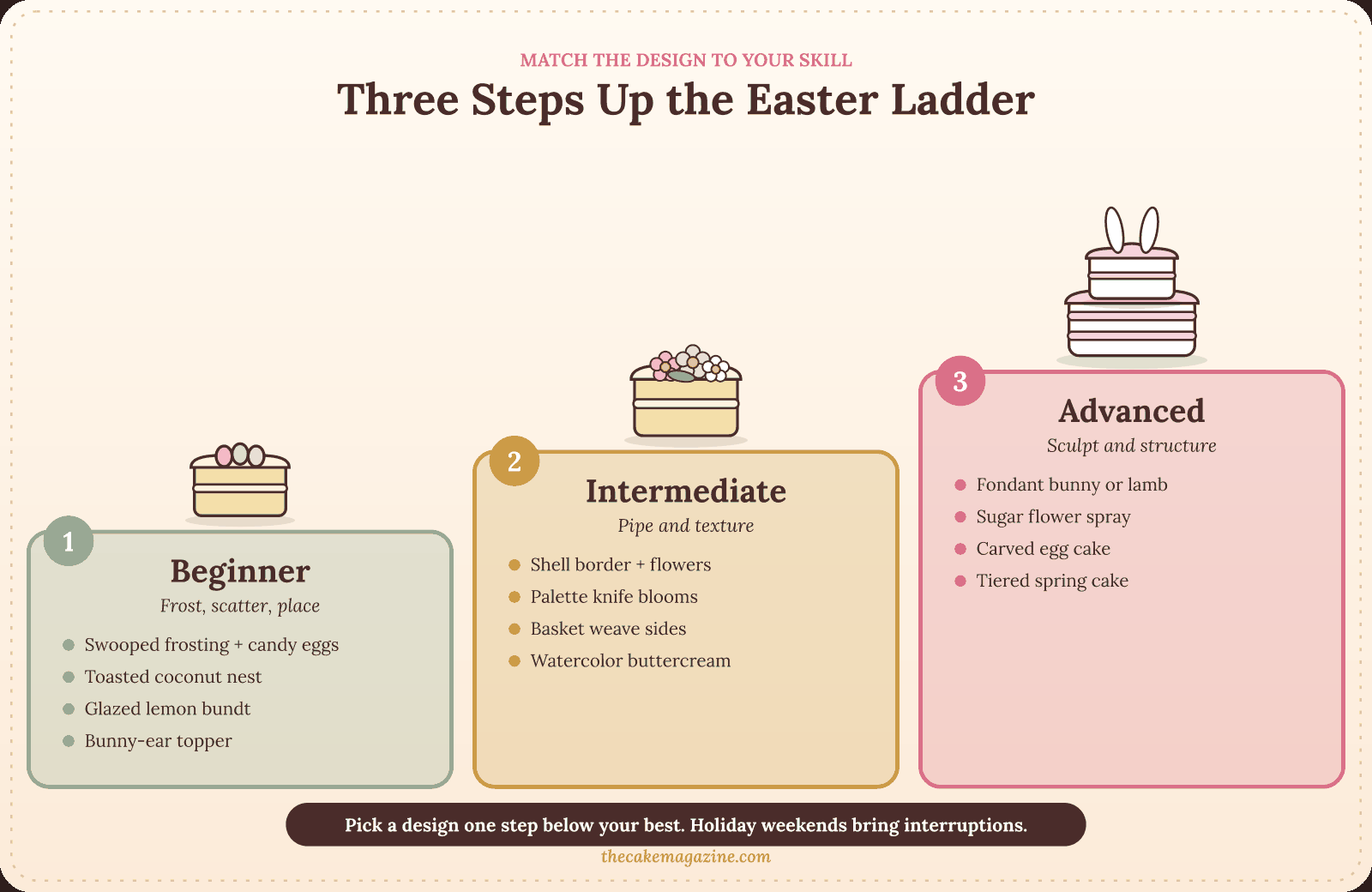
The best design is the one you can actually finish. Skill, time and equipment matter more than ambition on a holiday weekend. Below we group easter cake ideas into three levels so you can match a design to your experience. If you want a deeper grounding, our guide to cake decorating for beginners covers the tools and techniques behind most of them.
Beginner: frost, scatter, place
Beginner easter cake ideas rely on frosting and toppings you place by hand. A smooth or swooped cake with candy eggs, a sprinkle border, a few fresh flowers or a bunny-ear topper looks festive. A bundt with glaze and a few pastel decorations is another low-stress choice. A box of cupcakes with candy nests is easy to share. You need a spatula, a few bowls and a little patience.
Intermediate: piping and texture
Once you can frost a cake smoothly, you can add piped borders, shells, basket weave and simple buttercream flowers. A watercolor or palette knife finish builds on the same skill with more freedom. Intermediate designs usually need a crumb coat, a chilling step and a few piping tips, and they take longer, so give yourself a day. Our piping guide explains tips, bags and consistency.
Advanced: sculpted and structural
Advanced easter cake ideas include carved or tiered cakes, fondant bunnies, sugar flowers, hand-painted eggs and mold-baked lambs. They require structure, stable frosting and time, and they are easy to rush into a disaster. If you are tempted, practice the new technique on a small cake or a dummy a week ahead, and keep a simpler backup plan. Our fondant cake guide covers covering and smoothing.
A good rule. Pick a design one step below your best. Holiday baking comes with interruptions, guests and a crowded oven, and a design that is slightly easier than you are capable of usually looks better than one that stretches you.
Mini cakes, cupcakes and other small easter cake ideas
Not every Easter table needs a full cake. Small formats are easier to serve, easier to carry and easier to adapt to different tastes. They also give you a way to offer two or three flavors without baking three cakes. Individual desserts are a growing part of what bakers are making, and many easter cake ideas work well scaled down.
Cupcakes and nest cupcakes
Cupcakes are the classic Easter crowd-pleaser. Frost them with pastel swirls and top with a candy egg, sprinkles or a small fondant carrot. For nest cupcakes, pipe or spoon a ring of frosting, press toasted coconut or chocolate shreds around it and set two or three small eggs in the center. They look more elaborate than they are and travel well in a snug box.
Because cupcakes bake in liners, any of the flavors above can become a cupcake: carrot with cream cheese frosting, lemon with lemon buttercream, vanilla with strawberry cream. Check them a few minutes earlier than the cake bake time, since small cakes finish faster. Cupcake times are a good example of why we do not give fixed minutes in this guide: pans, ovens and batter depth vary.
Mini and bento easter cake ideas
Mini cakes and bento cakes, usually around 3 to 4 inches, are a natural fit for spring gifting. A bento cake with a piped message, a few flowers and a bunny ear detail makes a charming gift box for a neighbor or teacher. Our bento cake guide covers sizes, boxes, piping, portions and pricing, and the same principles apply to Easter versions.
Mini cakes also solve the “too many flavors” problem. A tray with a few mini carrot cakes, a few lemon and a few chocolate lets guests pick. If you plan to make several sizes for the same event, scale your batter carefully, bake each size separately and treat every new pan as something to test on a small batch.
Cake pops, cake jars and dessert cups
Cake pops dipped in pastel candy coating and decorated as eggs or chicks suit children’s tables. Cake jars, with layers of cake, cream and fruit in a small glass, are a make-ahead option that needs no slicing. Dessert cups of lemon mousse or carrot cake trifle are easy for a buffet. These formats take less decoration skill, though they often need more refrigerator space, so plan accordingly.
- Egg cake pops: shape the cake mixture into ovals, dip, then add stripes or dots.
- Carrot cake trifle: cubes of cake, cream cheese cream and chopped nuts in a clear bowl.
- Lemon curd cups: crumbled cake, curd and whipped cream in a small glass.
- Strawberry shortcake jars: sponge, berries and whipped cream, assembled the same day.
Sizes and servings for your Easter table: easter cake ideas by headcount
The number of people at your table determines the size of the cake, and Easter guest lists can change at the last minute. A cake that is too small leaves people hungry, and one that is too large leaves you with leftovers. Easter also tends to be a day with many desserts, so each guest often takes a smaller slice than at a birthday party.
Rough serving estimates
Servings depend on how thickly you cut and how many other desserts are on the table. As a loose guide, a two-layer 6-inch cake serves about 8 to 10 people with party-size slices. A two-layer 8-inch cake serves about 12 to 16, and a two-layer 9-inch cake somewhat more. A 9 by 13-inch sheet cake serves about 20 to 24 in generous squares and more if you cut smaller pieces.
These are estimates, not rules. Slice thickness, cake height and the rest of the menu all change them. For a family meal with several desserts, plan on a small slice per person. For a gathering where the cake is the main dessert, cut larger slices or add a second cake. Our guide to wedding cake servings explains the standard cutting method that stretches a cake the furthest.
Match the shape to the gathering
- Small family (4 to 8): one 6-inch layer cake, a bundt or a few mini cakes.
- Medium gathering (10 to 16): one 8-inch layer cake, or a lemon bundt with a small carrot cake.
- Large family (20+): a sheet cake, two layer cakes or a cake plus cupcakes.
- Buffet or potluck: cupcakes, minis or a sheet cake cut into squares.
Pans and baking notes
If you adapt a favorite recipe to a different pan, the batter depth changes the bake time. Deeper batter bakes slower and may dome; shallower batter bakes faster and can dry out. Fill pans about halfway to two-thirds full, check early and use a skewer or toothpick for doneness. Our pan buying guide explains how pan size, material and color influence results.
When you scale a recipe up, bake times usually grow and ovens can have hot spots. Rotate the pan partway through if your oven is uneven. Cakes that bake unevenly can dome or crack, and our guide on why a cake bakes unevenly covers the likely causes and fixes.
Make-ahead plan and food safety for easter cake ideas
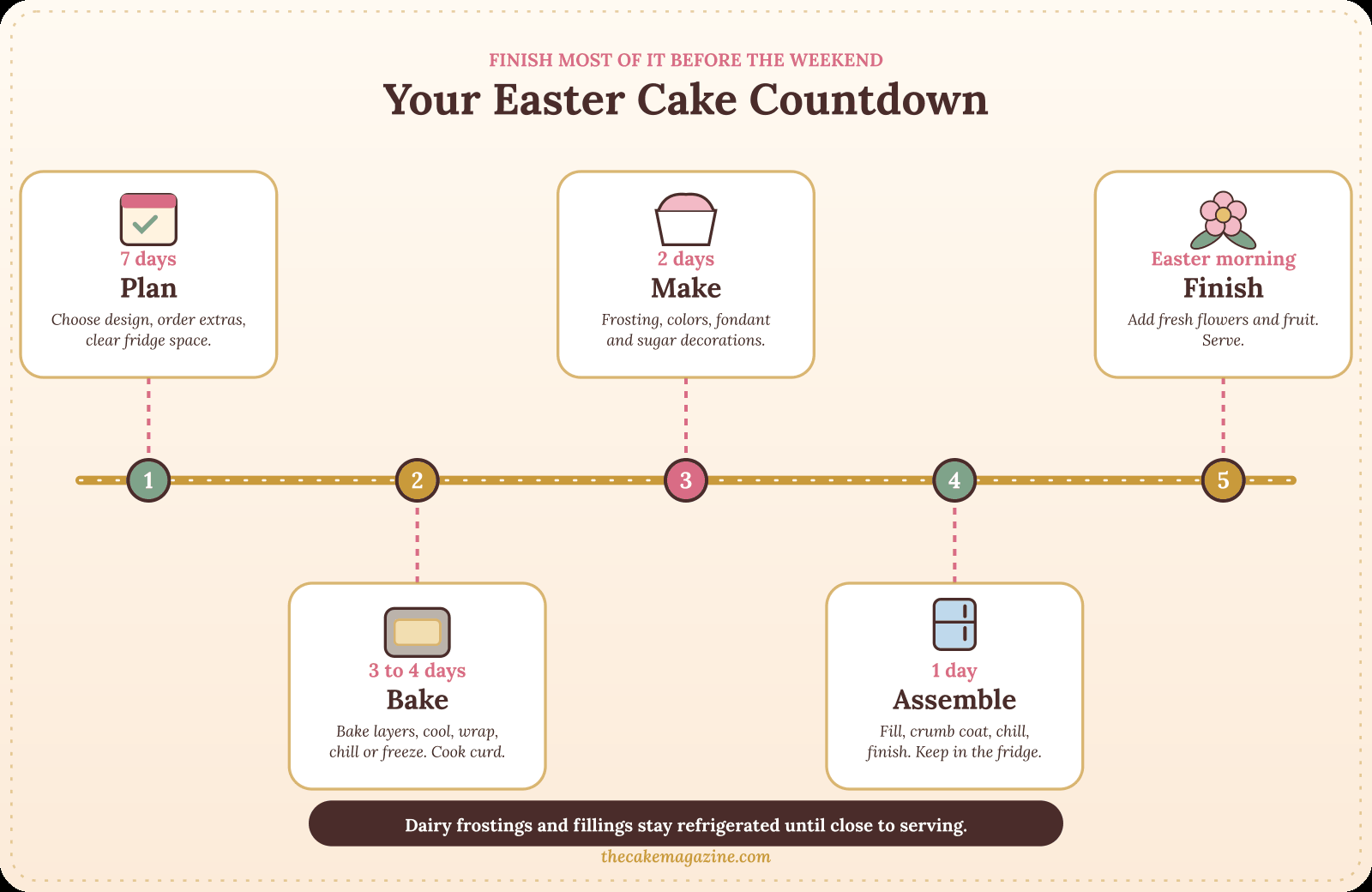
The easiest of all easter cake ideas is the one you mostly finished before the weekend. Most of the baking, filling and chilling can be done earlier, so on the day you only need to decorate and transport. A good plan also makes food safety much easier, since the cake spends less time out of the refrigerator. A simple countdown keeps everything in order.
A countdown for the week before Easter
- One week out: choose the design, order any special decorations or flowers, and clear refrigerator and freezer space.
- Three to four days out: bake the cake layers, cool them fully, wrap them well and freeze or refrigerate. Make curd or fillings.
- Two days out: make frosting, color it and store it covered. Prepare any fondant or sugar decorations.
- The day before: assemble, crumb coat, chill and finish the cake. Refrigerate in a closed box or cake carrier.
- Easter morning: add fresh flowers, fruit and any delicate decorations, then let the cake sit out briefly before serving.
Cake layers that are wrapped well and chilled or frozen often cut more cleanly and carry less crumb. Because we have not oven-tested every variation here, test your own storage times and adjust them to your recipes and kitchen. If you have never frozen layers before, try it once ahead of Easter so you know how your cake behaves.
Food safety for easter cake ideas on the Easter table
Easter brings extra food safety questions: cream cheese frosting, whipped cream, custard and curd fillings, and eggs of every kind. The U.S. Department of Agriculture’s Food Safety and Inspection Service lists four basics on its food safety page: clean, separate, cook and chill. For cakes, the “chill” step matters most. Dairy-based frostings and fillings should be refrigerated until close to serving.
USDA guidance generally says perishable food should not sit out more than two hours, or one hour when it is above 90°F, which is easy to reach at an outdoor party. Treat that as the upper limit, not a target. Serve the cake, then return the rest to the refrigerator. Confirm details on the USDA site, and see our cake food safety guide for fillings and storage.
About Easter eggs. Real eggs that have been dyed and hidden can be a food safety concern if they sit out for long or are decorated with non-food-safe dye. Do not decorate a cake with dyed hard-boiled eggs that have been handled outdoors. Use candy eggs or fondant instead, and check USDA guidance for real eggs.
Allergens and labeling
Carrot cake often contains nuts, many Easter candies contain nuts or milk, and cream cheese frosting contains dairy. If you are serving guests with food allergies or giving cake as a gift, tell them what is in it. If you sell cakes, check your state’s cottage food or labeling rules instead of relying on general advice, and see our cake food safety guide. This guide offers general information, not legal advice.
Transporting the cake to Easter lunch
Many Easter cakes travel in the back seat, in a car with a ham, a bag of rolls and an excited child. Chill the cake well first, since cold frosting is firm and less likely to smear. Use a snug box or carrier on a flat, non-slip surface, never on a tilted seat or in a hot trunk. Our cake carrier buying guide and cake box guide cover sizes and features.
Pack your tools, too: a small offset spatula, a few extra flowers or candies, wipes and a bag of leftover frosting. If something shifts on the way, a few minutes of touch-up at the destination solves it. Add fresh flowers, loose candy and anything delicate after you arrive. Carry the cake in with both hands, flat, and avoid carrying it up a step while looking at your phone.
Troubleshooting and common mistakes
Holiday baking has its own failure modes: a crowded schedule, a warm kitchen, a cake that must be ready at a fixed time. Most problems have simple causes and can be prevented with a little planning. Here are the issues we see most often with easter cake ideas, and what to do about each. For general cake problems, our cake troubleshooting guide goes deeper.
Pastel frosting looks too bright or too gray
Likely cause: too much color added at once, or two colors mixed without checking the result. Fix: start with white frosting and add gel color on a toothpick. If it is too bright, stir in more plain frosting. If it looks gray, start a fresh small batch and add a tiny touch of the complementary tone.
Cream cheese frosting is runny
Likely cause: overbeating, warm ingredients or tub-style cheese. Fix: chill the frosting in the bowl for 20 to 30 minutes and stir gently. Next time, use cold block-style cream cheese and add it last. If you need to pipe details, use a stiffer buttercream for the decoration.
Cake layers slide or the filling oozes
Likely cause: a loose filling such as curd or fruit, warm layers or no dam. Fix: pipe a firm ring of buttercream around the edge of each layer, chill the assembled cake before the final coat, and keep fillings thinner. A cold, level cake holds together far better.
Coconut nest looks messy or dry
Likely cause: toasting unevenly or pressing coconut onto frosting that has already crusted. Fix: toast in a thin layer, stir often, cool completely and press onto fresh frosting. A slightly rustic nest is correct, so do not chase perfection.
Fresh flowers or berries wilt or bleed
Likely cause: placing them too early or using wet blooms. Fix: add them just before serving, pat berries dry and place a small barrier of parchment or a sugar sheet beneath flowers where they touch the frosting.
Mistakes worth avoiding
- Combining too many themes. One lead idea, such as a nest or a flower crown, reads better than four.
- Leaving everything for Easter morning. Do the bake, filling and chill earlier.
- Skipping the refrigerator. Dairy frostings and fillings need chilling, even if the cake looks fine.
- Using decorations that are not edible. Plastic grass, wire stems and some foil-wrapped candies should be removed before serving.
- Trying a new technique on the day. Practice once ahead of time on a cupcake or a small cake.
- Forgetting to label allergens. Nuts, dairy, eggs and wheat appear in many Easter cakes.
Next-day cake care
Leftover cake is part of the Easter tradition. Store it covered in the refrigerator if it has cream cheese frosting, whipped cream or a custard filling, and bring slices to room temperature for a few minutes before eating, since cold cake can taste muted. Discard anything that has been out too long, and use a clean knife for each cut. Our King Arthur cake guide is a good outside reference for general cake technique.
FAQ: easter cake ideas
What are the best easter cake ideas for beginners?
Start with a flavor you can already bake, such as carrot, lemon or vanilla, and use a simple design: a swoop of frosting with candy eggs, a sprinkle border, a bird’s nest of toasted coconut or a few fresh flowers. These easter cake ideas need no special skill and look festive.
What is the most traditional Easter cake in the United States?
Carrot cake with cream cheese frosting is probably the most recognized Easter cake in the United States, along with coconut cake and lemon cake. Some families also bake a lamb-shaped cake or a pound cake. Traditions vary by region and family, so there is no single official answer.
Which flavors work best for easter cake ideas?
Spring flavors such as carrot, lemon, orange, coconut, strawberry and vanilla are common. Lemon and orange feel light after a rich meal, while carrot and coconut feel familiar and festive. Chocolate also works and keeps chocolate lovers happy.
How do I make pastel frosting for an Easter cake?
Start with white frosting and add a tiny amount of gel color with a toothpick, mixing thoroughly before adding more. Gel is more concentrated than liquid food coloring, so you need less, and the frosting stays thick. Color more than you think you need, since matching a shade later is difficult.
How far ahead can I make easter cake ideas like layer cakes?
Layers can usually be baked a few days ahead and kept wrapped in the refrigerator or freezer, and the cake can be assembled the day before. Add fresh flowers, fruit and delicate decoration on the day. Test your own storage times, since results vary with the recipe and the kitchen.
Does cream cheese frosting need to be refrigerated?
Yes. Because it contains dairy, cream cheese frosting should be refrigerated, and a cake with it should not sit out for long. USDA guidance generally says perishable food should not be left out more than two hours, or one hour above 90°F. Take it out shortly before serving.
Can I use real flowers on an Easter cake?
Only if they are edible, untreated and from a source you trust. Many florist and garden-center flowers are treated with chemicals not meant for food. Keep stems out of the cake, and add the flowers just before serving. Our edible flowers guide covers safety and placement.
How do I make a bird’s nest cake for easter cake ideas?
Frost a cake, then press toasted coconut, chocolate shreds or cookie crumbs around the top and sides to form a rustic nest. Place candy eggs in the center. The look is meant to be a little messy, so it is a forgiving design for beginners.
What size cake do I need for Easter dinner?
A two-layer 8-inch cake serves roughly 12 to 16 people, and a 9 by 13-inch sheet cake serves around 20 to 24. Because Easter menus often include several desserts, slices tend to be smaller than at a birthday party. Cupcakes or minis are good for mixed crowds.
What are some easy Easter cake decorations that are not frosting?
Candy eggs, pastel sprinkles, toasted coconut, chopped nuts, fresh berries, candied citrus peel, fondant or marzipan carrots, bunny-ear toppers and edible flowers all work. Each adds a spring feel without advanced piping. Use food-safe materials only, and remove non-edible items before serving.
Is it safe to decorate a cake with Easter eggs?
Candy and chocolate eggs are the safest choice. Real hard-boiled eggs should be refrigerated and not left out for long, and dye should be food-safe. For decoration, most bakers use candy or fondant eggs. Check USDA guidance for details about cooked eggs and Easter egg handling.
Will these easter cake ideas work for Mother’s Day or a spring party?
Yes. Pastel palettes, flowers, citrus and carrot cake all suit other spring events. For Mother’s Day, see our guide to Mother’s Day cake ideas, and for a more modern approach, see our overview of 2026 cake trends. Skip the bunnies and nests, and the designs read as general spring.
Final thoughts
The best easter cake ideas are rarely the most complicated ones. They are the cakes that taste like spring, look soft and happy on the table, and arrive without a last-minute crisis. Pick a flavor your family loves, choose one lead design that suits your skill, and do as much as you can before the holiday weekend. A carrot cake with a swoop of frosting and a few flowers will outshine an overambitious sculpture most years.
If you want to go further with easter cake ideas, try one new technique on a small cake a week before Easter, such as pastel piping, a palette knife flower or a coconut nest. Then you will know what to expect on the day. And if the plan changes, a lemon loaf with glaze and a handful of candy eggs is still a perfectly good Easter dessert. Keep it simple, keep the dairy cold and enjoy the table. Whichever of these easter cake ideas you choose, plan it early.
Sources and further reading
- The Old Farmer’s Almanac, when is Easter Sunday: Easter dates.
- U.S. Department of Agriculture, Food Safety and Inspection Service, food safety.
- King Arthur Baking, cake guide.
Editorial note: this guide was reviewed and updated in November 2026 and is written for home bakers in the United States, using American measurements and ingredients. Easter dates come from the source named above. We have not oven-tested the variations described here, and serving estimates, times and storage guidance are starting points that vary by recipe, pan, oven and kitchen. If you sell baked goods, check your state and local food rules. This is general information, not legal or medical advice.