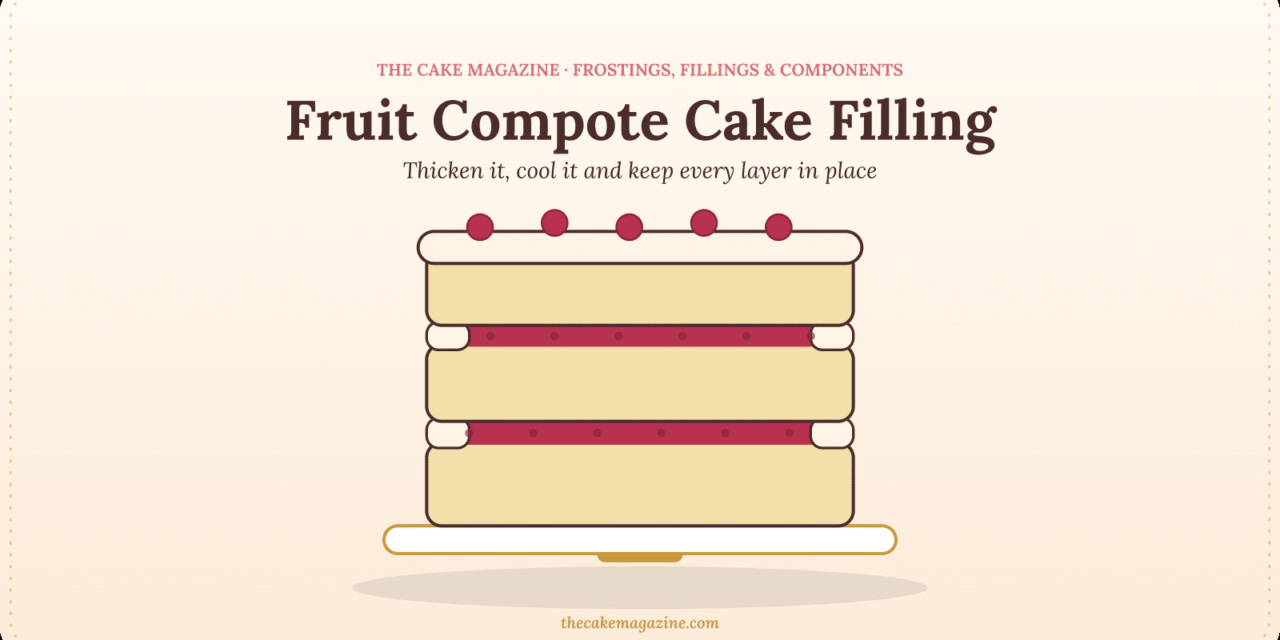
Every baker has a story about a fruit layer that betrayed them. The cake looked gorgeous at the cutting table, and then the filling oozed out the side, the top layer slid a quarter inch to the left, and the crumb underneath turned to wet bread. A well-made fruit compote cake filling prevents almost all of that. It gives you bright fruit flavor without the heavy sweetness of jam or the water problem of raw fruit. This guide covers thickening, cooling and building layers that stay put.
A stable fruit compote cake filling is fruit, sugar and acid cooked briefly, then thickened with a starch such as cornstarch until it holds a clean trail on a spoon. The part most people skip is cooling. Chill it fully, ideally overnight, until it is spreadable but stiff, pipe a firm buttercream dam around each layer, and keep the fruit layer thin, about a quarter inch. Thick, cold, contained filling is what keeps a cake straight.
- What fruit compote cake filling actually is
- Compote, jam, fresh fruit and curd compared
- Choosing fruit for fruit compote cake filling
- The ratio: fruit, sugar, acid and thickener
- Thickeners: cornstarch, Clear Jel, pectin, gelatin and reduction
- A starting formula for strawberry compote filling
- Cooking it and testing the thickness
- Cooling fruit compote cake filling the right way
- Assembling stable layers: dams, thickness and chilling
- Storage and food safety
- Troubleshooting a loose, gummy or leaking filling
- Fruit-by-fruit notes and pairings
- Flavor variations that still hold up
- Scaling the filling for different cakes
- Ten mistakes to avoid
- Tall, tiered and warm-weather cakes
- FAQ
What fruit compote cake filling actually is
A compote is fruit gently cooked in a little sugar and liquid until it softens and releases its juices. Served as is, it is a spoonable dessert topping, loose and syrupy, with fruit pieces swimming in it. That version is lovely over pancakes and far too wet for a cake. A fruit compote cake filling takes the same idea and tightens it: less liquid, a thickener, and a cooling step that turns it from sauce into something closer to a soft, spreadable paste.
The appeal for cake bakers is balance. Fruit is the one filling that cuts through rich buttercream, and cooked fruit is more predictable than raw fruit. Heat breaks down cell walls, so the fruit releases its water on your stove, where you can deal with it, instead of inside your cake an hour after assembly. You also get to control sweetness, which matters when the frosting is already sugary.
The four jobs your filling has to do
Before we talk technique, it helps to name what a good filling must accomplish. Each of these shows up again later when something goes wrong, and each one maps to a choice you make in the pot.
- Taste like fruit. Bright, slightly tart and not candy-sweet.
- Hold its shape. It should sit where you put it and not run when the cake is cut.
- Stay out of the crumb. Free water is what makes cake layers soggy, so the filling needs to keep its liquid bound up.
- Support weight. Three or four layers sit on top of it. A soft, slippery filling is how a tall cake leans.
Everything in this guide about fruit compote cake filling serves those four jobs. If a technique does not help one of them, we skip it.

Where this fits in the bigger filling picture
Fillings are one half of the filling-and-frosting system, and the other half is the buttercream that surrounds them. If you want the full lineup of options, our buttercream guide comparing the main types explains which frosting suits which situation, and it is a good companion to this page because the frosting you choose for the dam changes how much a fruit layer can safely weigh.
Compote, jam, fresh fruit and curd compared
Bakers use the word filling loosely, so it is worth being clear about what makes a fruit compote cake filling different from its neighbors. They overlap, and plenty of excellent cakes use more than one, but each behaves differently once it is between two layers.
Compote
Fruit cooked briefly, usually with less sugar than jam, then thickened with starch. Keeps visible fruit pieces and fresh flavor. Needs refrigeration and a proper cooling step.
Jam or preserves
Cooked longer with a lot of sugar, often pectin, so it sets firm. Very stable and sweet, with a cooked, jammy flavor. Our jam cake filling guide covers when preserves work and when they slide.
Fresh fruit
Uncooked, juicy and bright. Looks beautiful but weeps liquid into the crumb as it sits. See fresh fruit cake fillings for moisture-control tricks.
Curd
Egg-thickened and buttery, usually citrus. Rich and tangy, and set by egg proteins rather than starch. See our lemon curd for cakes guide.
Compote sits in a useful middle spot. It tastes fresher than jam, behaves better than raw fruit and is less rich than curd. The tradeoff is that it takes a little more attention than opening a jar, because you are the one deciding how thick it ends up.
When a fruit compote cake filling is the right choice
Reach for compote when you want visible fruit and real fruit flavor, when your cake is delicate and could not carry the sugar-set firmness of jam, or when you want to make the filling ahead and chill it. It pairs especially well with vanilla and white cakes, buttermilk cakes and lightly spiced cakes. It is a poor match for a cake that will sit out at a warm outdoor party for hours, because any fruit filling is perishable. We return to that in the safety section.
When to choose something else
If the cake needs to survive a long delivery, a hot day or a display table, a jam-based or curd-based filling is usually the more forgiving choice, and a firm, fully cold fruit layer inside a chilled cake is the fallback. If you are planning a tall tiered cake, read our cake filling stability guide before deciding, because the structure under the fruit matters as much as the fruit.
Choosing fruit for fruit compote cake filling
You can make a fruit compote cake filling from almost any fruit, but fruits differ a lot in water content, natural pectin, acidity and fiber. Those four traits decide how much thickener you need and how the finished filling feels in the mouth. Matching the technique to the fruit saves a lot of reruns.
Water content sets the thickener budget
Strawberries, peaches and watermelon-type fruits are mostly water, and they release most of it as soon as sugar touches them. Blueberries and cranberries hold less free liquid and are bound up by their skins until heat splits them. The wetter the fruit, the more starch it needs, or the longer you must cook it to reduce the liquid.
Natural pectin helps, but not equally
Pectin is the plant fiber that gels when it is heated with sugar and acid. Apples, cranberries, currants and citrus peel are rich in it. Strawberries, cherries and peaches are lower. High-pectin fruit may need less added thickener, and it can set up surprisingly firm once chilled, so test it before assuming you need the full amount.
Fresh or frozen
Frozen fruit works well for compote and is often the smarter choice out of season. Freezing breaks cell walls, so frozen fruit releases juice quickly and cooks down faster. The tradeoff is more liquid than you would see from the same weight of fresh fruit. Do not thaw and drain it away, because that juice carries flavor. Cook everything together, and plan on a little extra starch or a minute or two more simmering.
A cup of chopped strawberries and a cup of blueberries weigh very different amounts, and frozen fruit packs differently from fresh. Weighing fruit in grams makes your ratios repeatable, which is the whole point of a formula you plan to reuse.
The ratio: fruit, sugar, acid and thickener
Most reliable fruit compote cake filling formulas follow the same skeleton. Once you see it, you can adapt any fruit without hunting for a new recipe each time. The skeleton is fruit as the base, sugar for sweetness and body, acid for brightness and color, and a thickener for structure. Salt is a quiet fifth ingredient that sharpens flavor, and a pinch is plenty.
As a starting point, treat the weight of fruit as 100 percent and work from there. These numbers are starting points, not laws. Your fruit, your pan and your stove will all nudge them.
Sugar: about 15 to 30 percent of the fruit weight
Sweet, ripe fruit needs the low end. Tart fruit such as rhubarb or cranberry needs the high end. Remember the cake and the frosting are sweet too, so err toward less.
Acid: about 3 to 6 percent of the fruit weight
Lemon juice is the default. It brightens flavor, protects color and lifts flat fruit. Very tart fruit may need none.
Starch thickener: about 2 to 4 percent of the total mixture
Total means fruit plus sugar plus acid plus any water. Lower for dry, fibrous fruit, higher for juicy fruit and for fillings that must hold a tall cake.
Salt: a small pinch
Roughly one gram for a batch of this size. It will not taste salty. It makes the fruit taste more like itself.
Why the fruit compote cake filling needs less sugar than jam
In jam, sugar is a preservative and a structural partner for pectin, so the recipe uses a lot of it, often as much sugar as fruit by weight. A fruit compote cake filling is not shelf-stable and does not rely on a sugar gel, so you can cut the sugar considerably. That is a flavor win. It is also a safety reminder: lower sugar means you must treat the finished filling as a perishable item and keep it cold.
Why acid matters more than it seems
Acid does three things. It makes fruit taste lively instead of flat. It keeps red and purple pigments from fading to brown. And it affects thickeners, which is where it gets interesting, because acid weakens starch gels. A very tart mixture thickened with plain cornstarch can end up looser than expected. The fix is simple: add most of the lemon juice near the end, or add a touch more starch to compensate.
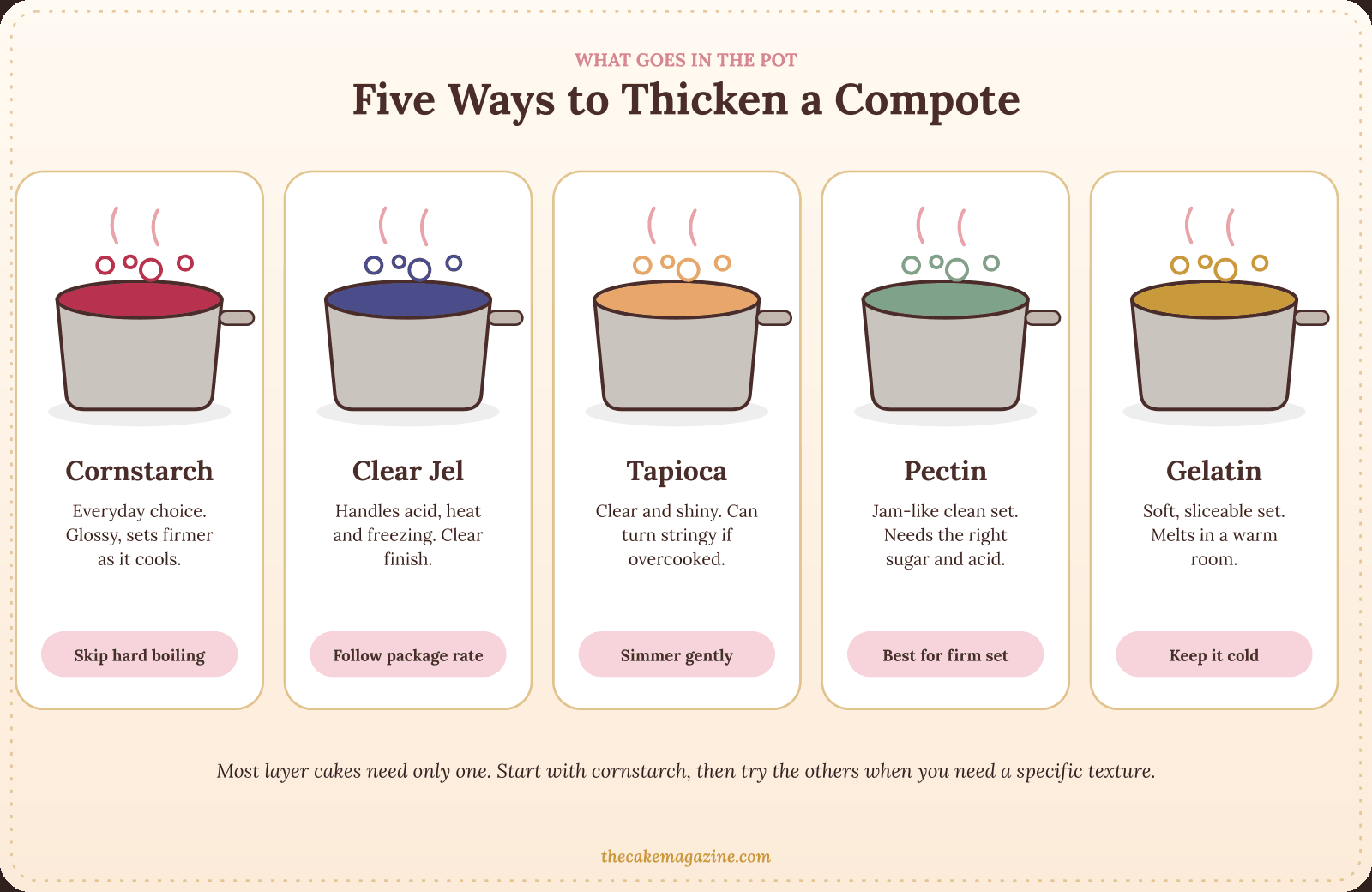
Thickeners for fruit compote cake filling: cornstarch, Clear Jel, pectin, gelatin and reduction
The thickener is what separates a fruit compote cake filling you can stack on from a sauce you can only spoon. There are several good options, and each leaves a different texture, so it helps to know how each one behaves in the pot and later in the fridge.
Cornstarch: the everyday workhorse
Cornstarch is cheap, available everywhere and strong. It is dispersed in cold liquid first, a mixture called a slurry, then stirred into the hot fruit. Starch granules swell and thicken the liquid once it reaches a simmer, and cooking about a minute past that point removes any raw, chalky taste. Cornstarch gives a slightly opaque, glossy finish and sets firmer as it cools.
Its weaknesses are worth knowing. Long, hard boiling can break the gel and thin the filling again. Strong acid weakens it. And it can weep a little liquid after freezing and thawing. For most bakers filling a cake they will serve within a few days, none of that matters, which is why it is our default.
Clear Jel and other modified starches
Clear Jel is a modified cornstarch designed for pie fillings and canning. It tolerates acid and heat, and it holds up to freezing better than regular cornstarch, and it finishes clearer. Bakers who make fruit fillings in volume, or who freeze them, like it for exactly that stability. It is sold by baking suppliers and some grocery stores. Follow the usage rate on the package, because the strength differs from plain cornstarch.
Tapioca and potato starch
Tapioca starch gives a clear, glossy gel and handles acid reasonably well, but can turn slightly stringy if overcooked. Potato starch thickens at a lower temperature and loses power if boiled hard. Either can substitute for cornstarch in a pinch, often at a similar or slightly higher weight, but test a spoonful before you commit the whole batch.
Pectin
Added pectin makes a gel that is stable and clean-cutting, which is why it is the thickener behind most jams. Traditional pectin needs a lot of sugar and the right acidity to gel. Specialized low-sugar pectins exist for fillings with less sweetener. Pectin is a good choice when you want a firm, jam-like set with visible fruit, and a poor one when you want a soft, spoonable filling.
Gelatin
Gelatin sets a filling into a soft, sliceable, almost mousse-like consistency, and it works well in cold, chilled cakes. It melts at warm temperatures, so a gelatin-set fruit layer will soften in a warm room. Fresh pineapple, kiwi, papaya and fresh figs contain enzymes that break down gelatin, but cooking the fruit first neutralizes them, which makes a cooked compote a safe vehicle. If you want a creamy gelatin-based layer, our cake mousse fillings guide goes deeper on it.
Reduction: thickening fruit compote cake filling with time
You can also thicken simply by simmering until water evaporates. Reduction concentrates flavor and sugar and needs no extra ingredients. The downside is that long cooking dulls the bright, fresh note that made you want compote in the first place, and a wet fruit like strawberry can take a long time. In practice, many good fillings use a short reduction plus a little starch.
If you are new to this, start with cornstarch. It is forgiving, you probably own it, and the results are predictable. Move to Clear Jel if you freeze fillings or make them in batches, and to pectin or gelatin only when you want a particular texture.
How much thickener a layer cake needs in its fruit compote cake filling
A fruit compote cake filling for a single-layer dessert can be soft. A filling that carries three or four layers needs to be considerably firmer. If you are not sure, aim thicker than feels natural. A fruit filling that seems almost too stiff when cold usually spreads and eats just right at room temperature, while a loose one only gets looser as the cake warms.
A starting formula for strawberry fruit compote cake filling
Here is a formula to adapt, built on conservative, common ratios. We have not oven-tested or bench-tested it, so treat it as a sensible starting point and expect to adjust. Fruit varies, stoves vary, and your target thickness depends on how tall your cake is. Taste, test a spoonful on a cold plate, and write down what you change.
Strawberry compote filling (starting formula)
Enough for two thin filling layers in an 8-inch, three-layer cake, with a little left for tasting. Scale up or down by weight.
Ingredients
- Strawberries, hulled and chopped small (fresh or frozen)450 g (about 3 cups)
- Granulated sugar100 g (about ½ cup)
- Fresh lemon juice25 g (about 2 tablespoons)
- Cornstarch16 g (about 2 tablespoons)
- Cold water30 g (2 tablespoons)
- Fine salt1 g (a small pinch)
- Pure vanilla extract, optional5 g (1 teaspoon)
Instructions
- Combine the strawberries, sugar and salt in a medium saucepan. Let them sit about 10 minutes so juices begin to release.
- Cook over medium heat, stirring, until the fruit softens and the juices bubble, about 6 to 8 minutes. Mash some of the fruit with a spoon if you want a smoother texture.
- Stir the cornstarch into the cold water until no lumps remain.
- Pour the slurry into the simmering fruit, stirring constantly. Bring back to a steady bubble and cook 1 to 2 minutes until glossy and clearly thickened.
- Remove from the heat. Stir in the lemon juice and vanilla.
- Spread in a shallow container, press plastic wrap onto the surface and cool, then refrigerate at least 4 hours or overnight before using.
Because the formula is built on ratios, you can swap the fruit and keep the skeleton. Blueberries, cherries and peaches all fit, with small changes noted in the fruit-by-fruit section below. Our guide to cake flavor pairings helps you decide which cake, fruit and frosting belong together.
A second example: scaling the skeleton to blueberries
To see how the skeleton adapts, run the numbers for blueberries. Blueberries hold less free juice than strawberries, so they need a little less starch, and their skins do not break down on their own, so you crush part of the fruit as it cooks. Treat these amounts as a starting point and check them on a cold plate.
- Blueberries, fresh or frozen: 450 g (about 3 cups)
- Granulated sugar: 90 g (a scant half cup)
- Lemon juice: 20 g (about 1 ½ tablespoons), plus a little zest
- Cornstarch: 12 to 14 g (about 1 ½ tablespoons), mixed with 25 g cold water
- Fine salt: 1 g
Cook the berries and sugar until about half have burst, add the slurry, bubble for a minute or two and finish with the lemon. The method is identical to the strawberry version. Only the numbers shift, which is the real lesson: once you understand the ratio, a new fruit is a small adjustment, not a new recipe.
Taste it cold before you decide it is done
Cold dulls sweetness and sharpens tartness, so a filling that tastes perfect hot can seem sour once chilled. Spoon a little onto a cold plate and taste it after a minute in the freezer. Adjust with a pinch of sugar or a few drops of lemon, then judge again. Doing this before assembly day saves you from discovering a flat or harsh filling after the cake is already built.
Cooking it and testing the thickness
Cooking a fruit compote cake filling is not difficult, but it rewards attention. The goal is not just a thick mixture. It is a mixture that will be the right thickness after it has cooled, which is a different target from how it looks in the hot pan. Learning to read the pot is the single most useful skill in this guide.
Use the right pan and the right heat for fruit compote cake filling
A wide, heavy-bottomed saucepan works best. Wide means water evaporates quickly, and heavy means the sugary fruit is less likely to scorch on the bottom. Cook at medium heat, stirring regularly, and scrape the corners. Fruit sugars can catch and burn fast, and a burned note will ruin the whole filling no matter how well you thicken it.
Watch for the visual cues
Once the starch goes in, you are watching for three things. The bubbles should become slow and thick instead of quick and watery. The mixture should turn glossy and look less cloudy. And when you drag a spoon across the bottom of the pan, it should leave a trail that closes slowly, not instantly.
The cold plate test for fruit compote cake filling
Put a small plate in the freezer when you start cooking. When you think the filling is close, spoon a teaspoon of it onto the cold plate and return it to the freezer for a minute. Then push it with your finger. The result shows you roughly what the chilled filling will do.
- It runs and the edges flood outward: too thin. Cook another minute or two, or add a little more slurry.
- It holds a soft, slightly wobbly mound and a finger-trail stays open: this is the target for most layer cakes.
- It is stiff, pasty or rubbery: too thick. Loosen with a spoonful of water or juice and stir gently.
Do not overcook the starch
Once the filling is thick, stop. Boiling a starch-thickened mixture hard for several more minutes can thin it as the starch network breaks down, and it also dulls the fruit flavor. If you need extra thickness, add a small amount of fresh slurry instead of simmering longer.
Season at the end
Lemon juice, vanilla, a splash of liqueur and fresh herbs all taste brightest when added after the heat is off. Taste the fruit compote cake filling now and adjust. A little more lemon can fix flatness, and a little more sugar can fix harshness. Remember that cold dulls sweetness slightly, so do not overcorrect while it is warm.
Cooling fruit compote cake filling the right way
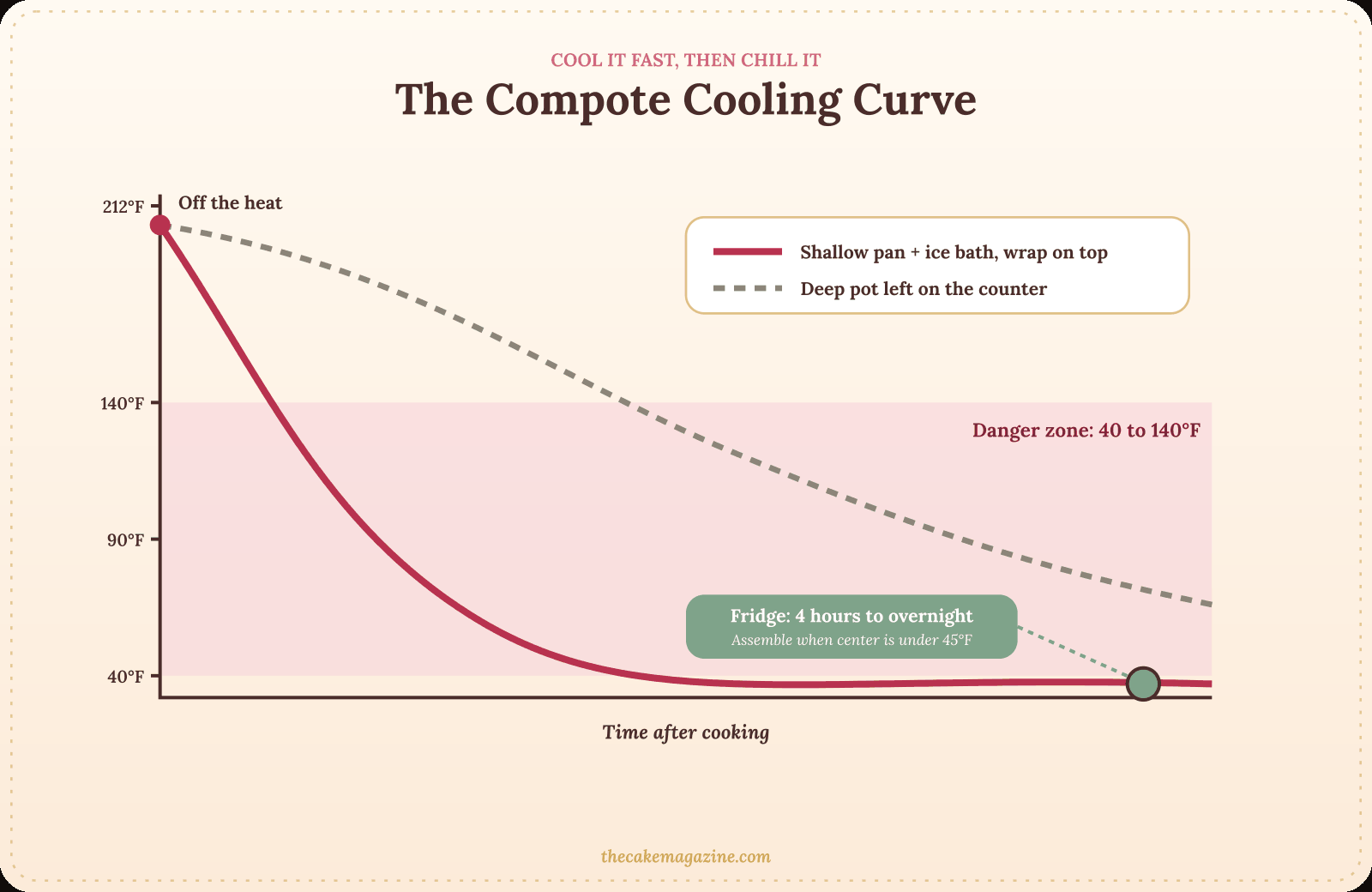
This is the step that decides whether the cake behaves. A hot or even warm fruit filling spreads into buttercream, softens the frosting and drives moisture into the crumb. A fully chilled one is a controlled, firm layer. Plan on cooling time as part of the bake, not an afterthought.
Why starch sets as fruit compote cake filling cools
Starch-thickened mixtures keep gaining body as they cool, because the swollen granules form a firmer network at lower temperatures. That is why a filling that looks slightly loose in the pan is often perfect after a night in the fridge, and why a filling that already looks very thick when hot can turn into a stiff paste. Aim for a hot filling that is a touch looser than your final target.
A cooling plan that works
- Spread it out. Pour the filling into a shallow dish or a rimmed sheet pan. A thin layer cools many times faster than a deep pot.
- Cover the surface. Press plastic wrap directly onto the filling so it does not form a skin.
- Cool briefly at room temperature. Do not leave perishable food out for long. The USDA warns that food should not sit in the “danger zone” of 40 to 140°F for more than two hours, or one hour when it is above 90°F, according to its Food Safety and Inspection Service guidance.
- Move it to the fridge. Chill until cold all the way through. Four hours is a minimum for a small batch, and overnight is better.
- Stir before using. Starch gels can set so firmly that a quick stir restores a smooth, spreadable texture.
Speeding things up with an ice bath
If you are short on time, set the shallow container inside a larger bowl of ice water and stir occasionally. This can bring a small batch down in 20 to 30 minutes. Finish in the fridge, because the center of the filling will still be warmer than the edges, and uneven temperature leads to uneven texture.
Check that it is truly cold
Surface feel is misleading. The edges cool first and the center holds heat for a long time. Poke an instant-read thermometer into the middle of the filling and confirm it is under about 45°F before you start assembling. If it is not, it is not ready, and a rushed assembly will cost you more time than waiting would.
Make the fruit compote cake filling the day before you assemble. Bake the layers the same day, cool them fully, and let the filling chill overnight. On assembly day, everything is cold, firm and cooperative.
Assembling stable layers of fruit compote cake filling: dams, thickness and chilling
A great filling can still fail if the cake structure around it is weak. Stability is a team effort between the filling, the dam, the layer thickness and the temperature of the whole cake. Think of the filling as a soft core that needs a firm wall.

Build a buttercream dam around fruit compote cake filling
A dam is a ring of sturdy frosting piped around the edge of each layer, forming a wall that holds the filling in. Use a stiff frosting, not a loose one. American buttercream and a firm Swiss meringue buttercream both work well. If you need a refresher on frosting types, our American buttercream recipe and Swiss meringue buttercream guide cover stiffness and temperature.
- Pipe the ring about half an inch wide and a bit taller than the filling will be.
- Keep it close to the edge, but not so close it shows through the finished frosting.
- Press the ring gently so there are no gaps for filling to escape through.
- Chill the dammed layer for 15 minutes before adding filling if your kitchen is warm.
Keep the fruit compote cake filling layer thin
Fruit filling is delicious, which tempts people to pile it on. Resist. A quarter inch is plenty for most cakes, and three-eighths of an inch is a sensible ceiling. For an 8-inch layer, that is roughly 150 to 180 grams of filling inside the dam. More than that adds weight and slip risk without adding much flavor.
Add a barrier if your crumb is delicate
A thin brush of simple syrup is a common technique for keeping cake moist, but fruit fillings already add moisture, so go light. If your cake is very tender, a thin layer of buttercream or a smear of melted white chocolate on the cake surface can act as a moisture barrier between crumb and fruit. For more on moisture, see our simple syrup for cake guide.
Level and torte evenly
A filling pushes into low spots, so uneven layers lead to a leaning cake. Level each layer before you stack. If you are splitting thicker cakes into thinner layers, our how to torte a cake guide explains how to cut evenly and keep the pieces matched.
Chill between stages
Once the cake is stacked, chill it for 30 to 60 minutes before applying the crumb coat. That time lets the filling firm up inside its dam and the layers settle together. After the crumb coat, chill again so the outside is firm before final frosting. Our crumb coat guide shows how thin that first coat can be, and how to get smooth buttercream sides covers the finishing coat.
Spot the early warning signs of a bulge
If you see the sides of the cake beginning to push out like a belt that is too tight, stop and chill the whole cake right away. A bulge nearly always means the dam is too thin, the filling is too soft or too thick a layer is sitting inside. It is far easier to fix at the crumb coat stage than after the final frosting.
Storage and food safety
A fruit compote cake filling is a perishable food. Cooking it and adding sugar does not make it shelf-stable the way a properly canned jam is. That does not mean it is risky when handled well, it simply means you treat it like other moist, ready-to-eat foods: cool it promptly, keep it cold and do not leave it out for long. This section is general information, not a substitute for official guidance.
The two-hour rule in plain language
The USDA describes the temperature range of 40°F to 140°F as the “danger zone,” where bacteria multiply quickly. Perishable food should not stay in that range for more than two hours, or one hour if the room is hotter than 90°F. You can read the full guidance on the USDA Food Safety and Inspection Service site. For cake bakers, that means the time a filled cake spends on a counter counts, including decorating time and serving time.
How long does fruit compote cake filling keep?
Stored in a clean, covered container in the fridge, a cooked fruit filling generally keeps for several days, and many bakers use it within about a week. Use clean utensils every time, never double-dip a spoon you have tasted from and discard it if it smells fermented, looks fizzy or shows mold. When in doubt, throw it out. If you are baking for others, especially for people with weakened immune systems, be more conservative.
Freezing fruit compote cake filling
Fruit compote can be frozen in a sealed container or in small portions, which is handy for batch cooking. Starch-thickened fillings may release a bit of liquid after thawing, so thaw in the fridge, stir well and, if needed, warm briefly and add a small slurry before cooling again. Fillings thickened with Clear Jel tend to freeze better.
Storing the finished cake
Because the filling is moist and the cake may also contain dairy-based frosting, keep a cake with a fruit compote cake filling refrigerated if it will not be eaten within the same afternoon. Bring slices to cool room temperature before serving for better flavor and texture. Our guide to what can sit out and what needs refrigeration lays out the decisions in more detail.
Rules for perishable cakes, including fruit-filled ones, vary by state and county, and some home-baking exemptions limit fillings that need refrigeration. This guide does not give legal advice. Check with your state or local health department before you sell.
Troubleshooting a loose, gummy or leaking fruit compote cake filling
Even careful bakers run into problems. The good news is that fruit compote cake filling problems follow patterns, and each pattern has a short list of likely causes. Use the cards below like a field guide. If you are chasing a problem that seems to be in the cake itself instead of the filling, our cake troubleshooting guide covers sinking, dryness and density.
The filling is runny
What it looks like: it spreads thin, runs from the dam and soaks into the cake.
Likely causes: too little thickener, undercooked starch, a very acidic mixture or frozen fruit with extra juice.
Fix it: return it to the pan, bring to a simmer and whisk in a small fresh slurry, about 3 to 5 grams of cornstarch in a spoonful of cold water. Cook one to two minutes, then cool again.
The filling is gummy or gluey
What it looks like: a stiff, rubbery, glue-like texture that does not taste fresh.
Likely causes: too much starch, or a mixture that was allowed to set solid before use.
Fix it: stir in a spoonful of juice or water, or warm gently with a splash of liquid and stir smooth. Next time, reduce the starch by about 10 percent.
The filling tastes starchy or chalky
What it looks like: a dull, pasty flavor under the fruit.
Likely cause: the starch was not cooked long enough after it began to bubble.
Fix it: reheat to a steady bubble and cook one to two minutes. Add a bit of lemon at the end to brighten it.
The filling bleeds into the frosting
What it looks like: pink or purple streaks seeping into white buttercream.
Likely causes: a thin dam, a warm filling or a filling with free juice on top.
Fix it: chill the layers, thicken the filling, pipe a taller dam and wipe stray filling off the dam before stacking.
The cake layers are soggy
What it looks like: wet, dense crumb beneath the filling after a few hours.
Likely causes: a filling that was not cold, too much filling or too much simple syrup.
Fix it: use a thicker, fully chilled filling in a thinner layer and skip or lighten the syrup.
The cake bulges or leans
What it looks like: the sides push out at the filled seams, or the top layer slides off-center.
Likely causes: a soft filling, a weak or uneven dam, a thick filling layer or uneven cake layers.
Fix it: chill immediately. If it is early, use a bench scraper to gently push the sides back, then rebuild the dam on future cakes.
The filling is grainy or has tough bits
What it looks like: seeds, skins or fibers that feel gritty or stringy in the bite.
Likely causes: seedy berries, tough skins or stringy fruit such as rhubarb or pineapple core.
Fix it: blend and strain, or chop smaller. For raspberries, strain out part of the seeds after cooking.
The filling weeps liquid after storage
What it looks like: a pool of juice around the filling after a day or two, or after thawing.
Likely causes: cornstarch network breaking down, freezing, or too little thickener.
Fix it: stir the filling, drain off any pooled juice, or reheat and re-thicken. Use Clear Jel if you often freeze it.
A quick diagnosis habit
When a filling misbehaves, ask three questions in order. Was it thick enough in the pan? Was it fully cold at assembly? Was the dam strong and the layer thin? Nine times out of ten, the answer to at least one of those is no, and fixing it solves the problem.
Fruit-by-fruit notes and pairings
The skeleton formula works for nearly any fruit, but each one has quirks. These notes give you starting adjustments for a fruit compote cake filling, not rigid rules. Use them to decide how much to cook, whether to strain and what flavors to pair, and always do the cold plate test before you assemble.

Strawberry
Watery and delicate, so it needs a full starch dose and a short cook to protect flavor and color. Lemon is essential. Pairs with vanilla, white, almond and chocolate cakes.
Blueberry
Holds less free liquid and has a tougher skin. Crush about half the berries as they cook so juices release. Lemon zest and a pinch of cinnamon work well. Pairs with lemon, vanilla and buttermilk cakes.
Raspberry
Tart, aromatic and seedy. Strain part of the seeds if you want a smooth bite. It gets a touch more sugar, and it is a classic partner for chocolate and almond cakes.
Cherry
Pit them first. Tart cherries need more sugar and keep their shape well. A drop of almond extract amplifies the flavor. Pairs with chocolate, vanilla and almond cakes.
Peach and nectarine
Peel, chop small and use ripe fruit. They soften quickly and can turn mushy, so cook briefly. Ginger, brown sugar or a little bourbon is a warm match. Pairs with vanilla, brown butter and spice cakes.
Apple and pear
Rich in pectin, so they need little added thickener. Cook until tender and dice small so the pieces do not tear the cake. Cinnamon, nutmeg and brown sugar fit. Pairs with spice, carrot and brown butter cakes.
Rhubarb
Very tart and fibrous. Cut small and use more sugar. It breaks down into a soft, jammy texture on its own. Strawberry-rhubarb is a classic pairing for vanilla and almond cakes.
Mango, pineapple and tropical fruit
Fibrous and juicy. Cook pineapple through, because raw pineapple enzymes can wreck dairy and gelatin. Lime and coconut pair beautifully. Pairs with coconut, vanilla and lime cakes.
Cranberry
Very tart and very high in pectin, so it sets firm on its own. It needs plenty of sugar. Orange zest is a natural partner. Pairs with spice, orange and white chocolate cakes.
Mixing fruits for better balance
Blending fruits can fix a weakness in one of them. A bit of apple adds natural pectin to a wet fruit. A handful of raspberries sharpens sweet strawberries. A spoonful of orange juice brings fragrance to cranberries. Keep the base fruit as the main character, around two thirds or more, so the cake still tastes like what its name promises.
Dealing with fruit that is not at its best
Out-of-season fruit is often pale and bland. Cooking helps, because heat concentrates flavor. Add a little extra lemon, a pinch of salt and a splash of vanilla to wake it up. Frozen fruit frozen at peak ripeness is frequently better than fresh fruit shipped long distances, so there is no shame in the freezer aisle.
Flavor variations that still hold up
Once your base fruit compote cake filling is dependable, small additions can make it feel custom. Keep any additions small and dry, so they do not upset the water balance you worked to control.
- Citrus zest: a teaspoon of lemon, orange or lime zest added after cooking adds fragrance without extra liquid.
- Warm spices: a pinch of cinnamon, cardamom or ginger suits apples, peaches and cherries.
- Vanilla bean or extract: rounds out sharp fruit and softens acidity.
- Liqueur: a tablespoon of kirsch, amaretto or orange liqueur stirred in at the end. It adds liquid, so reduce another liquid slightly.
- Fresh herbs: basil with strawberries or thyme with peaches, infused while cooking and removed before cooling.
- Brown sugar: swap a portion of the white sugar for a caramel-like depth that suits stone fruit and apples.
Combining compote with other fillings
A fruit layer often tastes best next to something creamy. A thin layer of fruit compote cake filling on top of a layer of vanilla buttercream, whipped cream or pastry cream gives you contrast in each bite. If you want a custard partner, our pastry cream for cakes guide covers cooking, cooling and safe storage, and the same cooling discipline applies there.
Scaling fruit compote cake filling for different cakes
How much filling you need depends on the cake size and how many filled layers it has. Because filling is a thin layer inside a dam, the volume is smaller than most people expect. Over-making is cheap, but under-making on assembly day is stressful, so round up slightly.
6-inch cake, three layers (two fillings)
Roughly 180 to 220 grams total at a quarter inch inside a dam. Half the strawberry formula is plenty.
8-inch cake, three layers (two fillings)
Roughly 300 to 360 grams total. One batch of the strawberry formula covers it with a little left over.
9-inch cake, three layers (two fillings)
Roughly 380 to 450 grams total. Use one full batch, and consider scaling up by a quarter if you like a generous layer.
Cupcakes
About 10 to 15 grams per cupcake for a core fill. Keep it thick, since cupcakes have no dam to hold it in.
These are estimates to plan with, not guarantees. Pan depth, layer height and how generously you pipe your dam all change the number. If you are unsure, make a slightly larger batch, because leftover compote is useful on toast, yogurt or ice cream.
A simple make-ahead schedule
- Two days before: make the fruit compote cake filling and chill it. Bake and freeze the cake layers if you like.
- One day before: level, torte and assemble the cake. Crumb coat and chill.
- Assembly day: apply the final coat, decorate and keep the cake refrigerated until a few hours before serving.
Ten mistakes to avoid
Most failures with fruit compote cake filling come from a short list of habits. If you fix these, you will fix most of your problems.
- Using the filling while it is still warm.
- Skipping the cold plate test and trusting the look of the pot.
- Piling on filling more than three-eighths of an inch thick.
- Piping a thin or soft dam, or leaving gaps in it.
- Draining frozen fruit and throwing away the flavorful juice instead of cooking it down.
- Boiling the starch for too long, which thins it again.
- Adding all the lemon juice early to a cornstarch mixture and then wondering why it is loose.
- Leaving a filled cake out on the counter past the two-hour mark.
- Skipping the chill between stacking, crumb coating and final frosting.
- Making a filling that tastes great warm but is cloyingly sweet once chilled. Taste cold before you decide.
If you would like a broader view on how fillings, frostings and structure fit together, our guide to cake baking science explains why ingredients behave the way they do, which makes it easier to improvise with confidence.
Fruit compote cake filling in tall, tiered and warm-weather cakes
A single two-layer birthday cake forgives a lot. A tall celebration cake, a tiered cake or a summer garden party does not. When weight and temperature go up, a fruit compote cake filling needs a more careful plan, and sometimes a different filling altogether. Here is how to think it through.
Weight is the hidden problem in tall cakes
Each layer pushes down on whatever sits beneath it. A soft fruit layer under four cake layers and a tier above is a squishy foundation, and it compresses unevenly. The fix is a mix of firmer filling, thinner layers and more structure. In very tall cakes, keep the fruit layer toward the top half and use sturdier fillings such as ganache or firm buttercream lower down.
If you are building tiers, support the cake with dowels or boards appropriate to the design, and never let a fruit layer carry the weight of a tier by itself. Our wedding cake guide walks through tier structure, servings and delivery, which is the context where filling stability matters most.
Heat is the second problem
Buttercream softens as it warms, and a soft dam is a failed dam. If the room is warm, a filling that was perfectly firm in the fridge can begin pushing at the frosting within an hour. Keep the cake cold until close to serving, transport it in an air-conditioned vehicle and avoid direct sun. Heat also shortens the safe time window, which is why the one-hour rule for hot days matters.
Cool, indoor party
A standard fruit compote cake filling with a firm dam is fine. Serve within a few hours of leaving the fridge and keep leftovers cold.
Warm room or long event
Thicken the filling more, shorten the time the cake is out and consider serving it in a chilled room or from a cooler fridge-to-table plan.
Outdoor summer event
Use a fruit filling only if you can keep the cake cold. Otherwise choose a more stable filling and serve fruit on the side.
Shipping or long delivery
Fruit fillings are risky here. Choose a firmer, more stable filling and refer to your local rules and our stability guide.
Choosing a frosting for the outside
The frosting that surrounds your fruit compote cake filling also affects stability. Swiss and Italian meringue buttercream tolerate moderate warmth better than a very soft American buttercream, while cream cheese frosting and whipped cream are softer and need constant refrigeration. Our cream cheese frosting guide explains how far that frosting can go before it gives up.
A plan for cutting and serving
Serve a cake with fruit filling cold enough that the layers are firm, then let slices sit a few minutes for flavor. Use a long, thin knife dipped in hot water and wiped dry between cuts, and wipe the blade after every slice. Fruit smears across the cut face when the knife is dirty, and clean slices make a fruit layer look as good as it tastes.
How to judge success
You can tell whether your filling worked by cutting the cake and looking at the cross-section. The layers should be straight. The filling should sit inside its dam with a clean edge. The crumb above and below should look moist but not wet, with no dark, soggy band. Photograph the cut face and write down the formula, fruit weight and chill time, so the good version is repeatable.
Over a few bakes this notebook becomes your own reference. You will learn how your preferred filling behaves with your particular oven, stove and kitchen, which is worth more than any generic rule.
Fruit compote cake filling FAQ
What is fruit compote cake filling?
It is fruit cooked briefly with sugar and acid, then thickened, usually with cornstarch, until it holds its shape between cake layers. It is looser and fresher-tasting than jam, but firmer than the syrupy compote you would spoon over pancakes.
How thick should fruit compote cake filling be?
Thick enough to hold a soft mound on a spoon and keep a finger trail open, even when cold. After a night in the fridge it should be spreadable but stiff. If it runs when you tilt a plate, it is too thin for a stacked cake.
Can I use frozen fruit for fruit compote cake filling?
Yes, and many bakers prefer it out of season. Cook the fruit with its juices instead of draining them, and expect to need a little more thickener or a minute or two more simmering, since frozen fruit releases extra liquid.
How much cornstarch do I need for fruit compote cake filling?
A reasonable starting point is about 2 to 4 percent of the total mixture by weight. The strawberry formula in this guide uses 16 grams of cornstarch for roughly 600 grams of ingredients. Juicier fruit needs more and fibrous fruit needs less, so test on a cold plate.
How long should I cool fruit compote cake filling before using it?
Chill it until it is cold all the way through, at least four hours for a small batch and ideally overnight. A warm filling softens buttercream and soaks the crumb. A thermometer reading under about 45°F in the center confirms it is ready.
Does a cake with fruit compote filling need to be refrigerated?
Generally yes. Cooked fruit fillings are perishable, and perishable food should not sit between 40°F and 140°F for more than two hours, or one hour above 90°F, per USDA guidance. Refrigerate the cake and let slices warm slightly before serving.
How long does homemade fruit compote last in the fridge?
Stored cold in a clean, covered container, it generally keeps for several days, and many bakers use it within about a week. Use clean spoons, and discard it if it smells off, looks fizzy or shows mold. When unsure, throw it out.
Can I freeze fruit compote cake filling?
Yes. Freeze in a sealed container or small portions and thaw in the fridge. Cornstarch fillings may weep a little after thawing, so stir well or briefly reheat with a pinch more slurry. Clear Jel generally freezes better than plain cornstarch.
Why is my fruit compote cake filling runny even after cooking?
The common causes are too little thickener, starch that never reached a steady bubble, a very acidic mix or extra juice from frozen fruit. Return it to a simmer, add a small slurry, cook one to two minutes and cool it completely before judging the thickness.
How do I keep fruit filling from making my cake soggy?
Keep the filling thick and fully cold, use a thin layer of about a quarter inch, pipe a firm buttercream dam and go easy on simple syrup. A thin buttercream or white chocolate barrier on the crumb can also help with delicate cakes.
What is the difference between compote and jam as a cake filling?
Jam is cooked longer with much more sugar, often with pectin, so it is firm and shelf-stable when properly processed. Compote has less sugar, a fresher flavor and a softer set, and it needs refrigeration. Our jam and fresh fruit guides cover those alternatives.
Can I use canned pie filling instead of making fruit compote cake filling?
You can, but check it first. Many canned fillings are loose and sweet, so drain off extra liquid, chop large pieces and thicken it if needed. Homemade gives you control over sweetness, thickness and fruit pieces, which is why it is worth the extra half hour.
What buttercream works best with a fruit compote filling?
A sturdy buttercream, such as American or Swiss meringue, holds a dam well. Cream cheese frosting and whipped cream are softer, so they need more care and cold storage. Chill the dam before adding the fruit to help it stay firm.
Final thoughts
A good fruit compote cake filling is not complicated, but it is particular. Cook the fruit briefly, thicken it a little more than feels necessary, cool it completely and then build a firm dam around a thin layer. Those four habits turn a risky filling into a dependable one, and they work with almost any fruit you can find at the market or in the freezer aisle.
Start with the strawberry formula as written, test it on a cold plate and take notes on what you change. Once you see how a spoonful behaves cold, you will know what to do with blueberries, cherries or peaches. For broader background on layers and structure, the King Arthur Baking cake guide is a helpful reference to keep nearby.
If you try a recipe from this guide, tell us what fruit you used, how thick it ended up and what you would change. Your notes help us keep improving these guides.
Editorial note: reviewed and updated November 2026. The formula in this guide is a starting point built from common baking ratios and has not been oven-tested by The Cake Magazine, so bake and cooking times, thickness and yields will vary with your fruit, pans, stove and oven. Food-safety comments are general information, so follow official guidance from your local health department and the USDA when serving or selling perishable cakes.