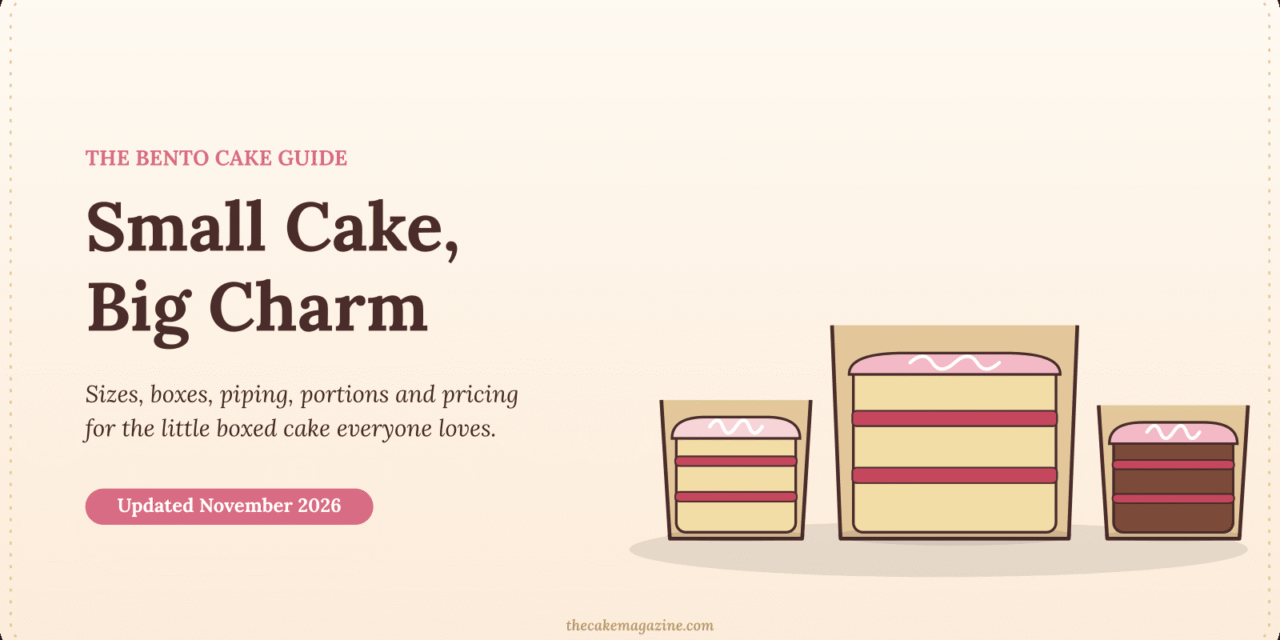
A bento cake is a small round cake, usually about four inches across, built like a real layer cake and sold or gifted in its own little box. It feels personal in a way a big cake rarely does: one cake, one person, one message piped on top. If you want to make one at home, or sell a few without wasting a pound of buttercream, this guide covers the sizes, pans, piping, boxes, portions and pricing that make a bento cake work.
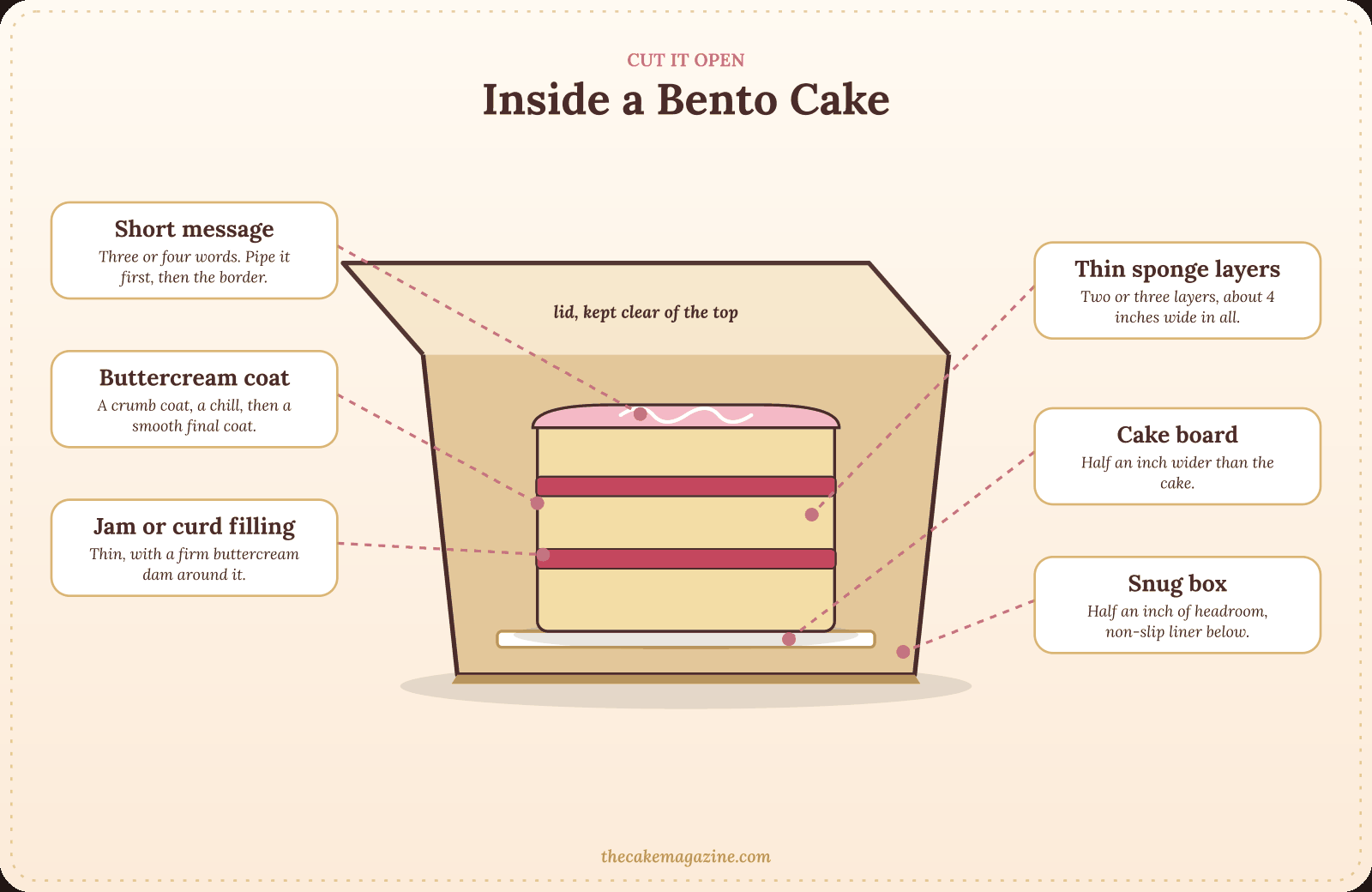
A bento cake is a small, boxed cake, most often 4 inches wide with two or three thin layers, covered in buttercream and finished with a short piped message. One serves one hungry person or two people sharing. You can bake the layers in 4-inch pans or cut rounds from a sheet cake, then chill, fill, crumb coat and pipe. Pack each bento cake in a snug box on a board, keep it cold, and price it for labor and packaging, not just ingredients.
- What is a bento cake?
- Where the format came from
- Bento cake sizes and what they serve
- Pans, cutters and gear
- Choosing a cake base
- Scaling batter for small pans
- Baking and cooling small layers
- How to assemble and frost a small cake
- Piping on a bento cake
- Bento cake design ideas
- Flavor and filling combinations
- Boxes and packaging for a bento cake
- Portions and serving
- A two-day workflow for a batch of small cakes
- Birthdays, gifts and small celebrations
- Presenting and photographing a boxed cake
- How to price a bento cake
- Food safety, storage and allergens
- Troubleshooting small cakes
- Will the format last?
- FAQ
What is a bento cake?
Ask five bakers and you may get five definitions, so let us pin it down. A bento cake is a small cake sized for one or two people, typically around four inches across, with a couple of thin layers of sponge and a filling between them. It wears a smooth coat of buttercream, a simple piped border and, very often, a short message or a tiny drawing. It is sold or given in a small box, which is where the name comes from.
That last detail matters more than it sounds. The box is part of the product. A bento cake is meant to be handed over like a lunchbox: lift the lid, find the cake inside, read the little message. Many bakers add a cake knife or a fork in the same box, and a few tuck in a sticker or a card. The format is closer to a gift than to a slice of dessert.
What makes it different from a cupcake or a mini cake
A bento cake is built the way a larger cake is built. There are separate layers, a filling, a crumb coat and a final coat. A cupcake is one baked piece with a swirl on top. A bento cake also differs from a one-bite cake, which is a tiny layered cake eaten in a couple of bites. Our broader guide to mini and one-bite cakes compares all of these small formats side by side.
What sets the small cake apart is the combination of size, packaging and message. You can have a four-inch cake that is not a bento cake if it is sold on a stand without a box. You can also have a boxed cake in a slightly different shape, such as a small heart, as long as it keeps the same personal, boxed spirit.
A quick definition to keep. If it is small, layered, frosted by hand, topped with a short message and handed over in its own box, most people will call it a bento cake. Everything else is detail, and this guide covers the detail.
Why bakers like the format
For home bakers, a little cake is a low-risk way to practice. You use a small amount of batter and buttercream, you can finish one in an afternoon, and a mistake costs very little. Piping a border on a four-inch top is a lot less intimidating than piping one around a ten-inch cake.
For people who sell cakes, the appeal is different. A small box is an easy yes for a customer who does not need a full cake, and it fits birthdays, thank-yous, apologies, anniversaries and plain old Tuesdays. It is also a good way to use leftover sponge and buttercream, as long as you handle them safely. We return to that in the sections on food safety and pricing.
Where the format came from
The bento cake is usually traced to South Korea, where small, cute cakes with short handwritten-style messages became a social media favorite. A January 2026 feature in The Star describes the format as a South Korean trend that has spread well beyond Asia, notes that the name comes from Japanese bento lunch boxes, and says the cakes are typically presented in small boxes with a short message for the recipient.
You will also see them called lunchbox cakes, which is the same idea described in English. The name did not come from a single bakery or a single date that we could verify, so we will not pretend to know one. What we can say is that the look is small, bright, playful and personal, and that social video helped it travel.
What the Korean mini cake coverage adds
A February 2025 report in The Korea Herald looked at the wider shift toward very small cakes in Korea. It described cakes the size of a single bite, a walnut, a dinner roll or an apple, and it said shoppers liked them because they suit small groups, avoid leftovers, photograph well and cost less than a large cake. It also reported that some customers thought certain small cakes were overpriced for their size.
That last point is useful for anyone who sells. A small cake is not automatically cheap to make. A bakery owner quoted in the same report agreed that some prices looked high compared with ingredient costs, while noting that small cakes can take more skill. We come back to that tension in the pricing section.
How it fits into the bigger trend picture
The small cake is one part of a larger movement toward smaller, more personal cakes. If you want the full picture of where it sits among other directions, such as texture, tangy flavors and vintage piping, read our overview of 2026 cake trends. The short version is that small formats have been rising for a few years, and the bento cake is the version most people can picture right away.
As of November 2026, we treat the bento cake as a durable format with short-lived styling. The box, the size and the message look like they are here to stay. The particular colors, characters and decorations will change with the season, as they always do.
Bento cake sizes and what they serve
The classic bento cake is about four inches across, but the range is wider than most articles admit. The same Star feature describes the cakes as roughly palm-sized and suggests home bakers use a small tin about 8 to 12 centimeters across, which is roughly 3 to 4.7 inches. In practice, American home bakers work with 3-, 4-, 5- and 6-inch rounds.
Height matters as much as width. Most bakers aim for two or three thin layers that add up to about 2.5 to 3 inches tall once filled and frosted. A taller little cake looks lovely but is harder to box, and the lid may touch the top and smudge the message.

A size-by-size guide
3 inches
The smallest size most people would still call a bento cake. It suits a polite portion for one person, or a few bites each for two. Good for a gift add-on or a cake box of several flavors.
4 inches
The standard. A generous single serving or a shared dessert for two. It fits common small cake boxes and gives enough room for a short message and a border.
5 inches
A middle size for two to four people with small slices. Good when you want more room for decoration, though it nudges toward a small celebration cake.
6 inches
A small party cake rather than a small cake. It still fits a box, but most people will think of it as a regular small layer cake.
Serving math you can trust
Servings are a judgment call, because people cut cake differently. What you can calculate exactly is the top surface. A 4-inch round has an area of about 12.6 square inches, while an 8-inch round has about 50.3. The 8-inch cake has four times the surface, so at the same height it holds roughly four times the cake.
That means one 8-inch cake equals about four 4-inch bento cakes in volume. If you are planning a party and wondering how many boxed cakes to make for a crowd, our wedding cake serving guide explains how portion sizes work on larger cakes, and the same logic applies when you scale down.
One person or two? A boxed cake can be a dessert for one very happy person or a share-plate for two. If you sell them, say which you mean in the listing. Customers who expect a tiny snack and receive a generous cake, or the reverse, are the ones who leave reviews.
Pans, cutters and gear
You do not need special equipment to make a bento cake, but a few small tools make the work calmer. The most important item is not a pan at all. It is a kitchen scale. When you are working with 150 grams of batter per layer, a few grams either way changes the height visibly.
Pans and cutters
There are two ways to get small layers. The first is to bake in small round pans, 3 or 4 inches across and at least 2 inches deep. Mini springform pans and mini cake pans both work, and you can use a ring on a lined tray if you do not own the pan. The second is to bake a sheet cake and cut rounds from it with a 3- or 4-inch cutter.
Pans give you a domed top that you need to level, a thin crust you may want to trim and exact repeatability. Cutting from a sheet gives you flat, even layers and less waste if you plan the grid. A 9 by 13-inch quarter-sheet pan fits about six 4-inch rounds in a 2 by 3 grid with a little room to spare, and a half sheet fits about twelve.
A basic kit that covers most designs
- Digital scale for batter, filling and frosting by weight.
- Serrated knife for leveling layers and trimming edges.
- Small offset spatula and a bench scraper for smoothing the sides.
- Cake boards or cardboard rounds cut about half an inch wider than the cake.
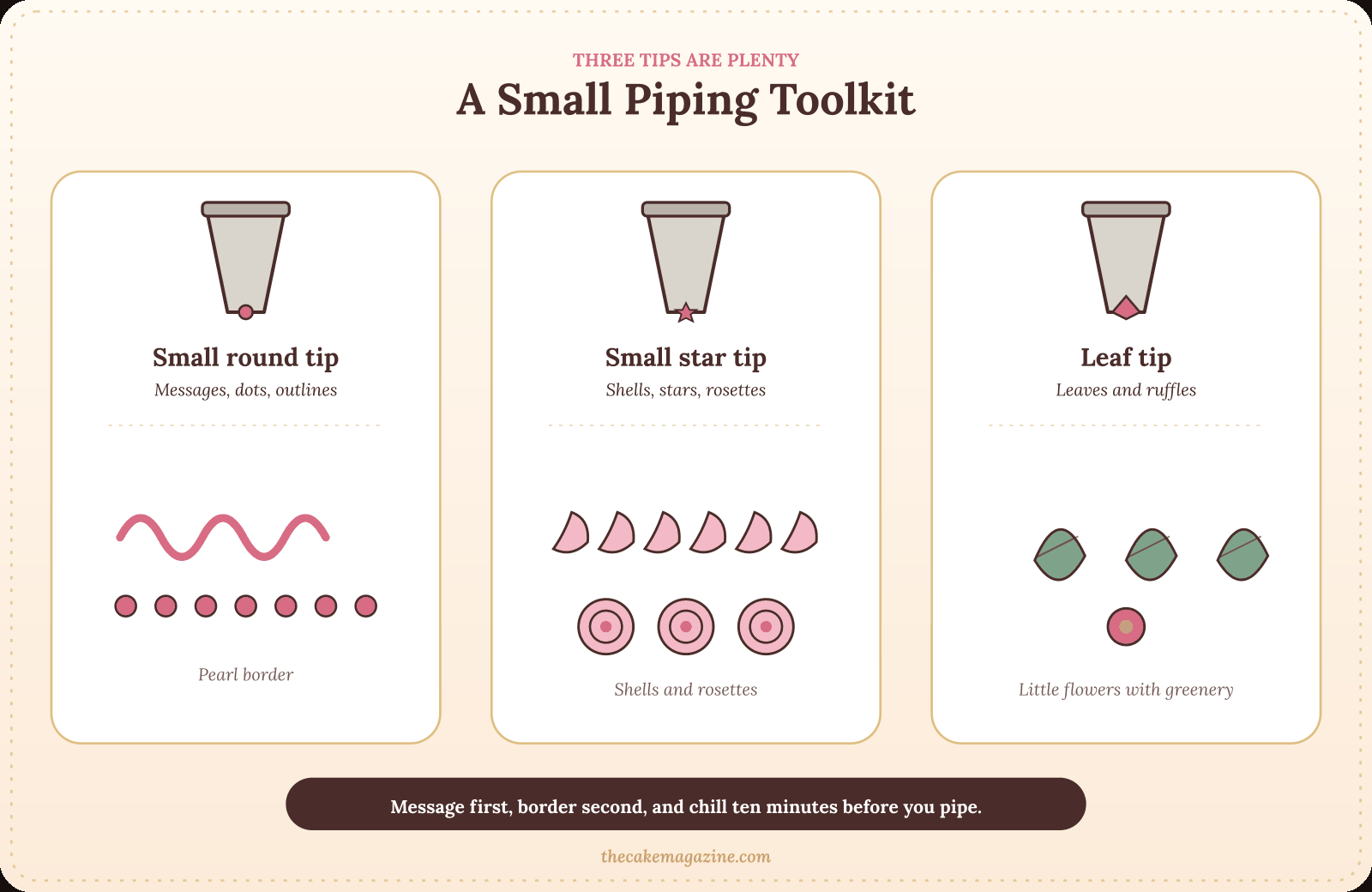
- Piping bags and a few tips: a small round tip, a small open star and a leaf tip cover most looks.
- Parchment for lining pans and for catching drips.
- Small cake boxes sized to fit, with a non-slip liner.
If you want to practice smooth sides before you tackle a tiny cake, our guide to smooth buttercream sides shows the full method on a larger cake, and the same moves work at a smaller scale.
Choosing a cake base
A small cake has less cake to hide behind. Every layer is thin, so a dry crumb shows up in the first bite, and a fragile crumb tears when you cut or stack it. The best base for a little cake is a moist, fairly sturdy sponge that stays tender after a night in the refrigerator.
Oil-based cakes are a strong choice because oil stays liquid when cold, so the crumb does not stiffen the way a butter-only cake can. Butter cakes taste richer but firm up in the fridge, which is fine if you bring them to room temperature before serving. Very airy sponges, such as chiffon, can be too delicate to cut into neat rounds without crushing.
Two starting points from our recipe guides
If you want a dependable base, start with a formula you already trust. Our best vanilla cake recipe and our best chocolate cake recipe are both built to stack and frost well. Neither has been scaled specifically for 4-inch pans, so treat the scaled amounts below as a starting point and test them in your own oven.
A sheet-pan cake that you cut into rounds can be even more forgiving. Because the whole sheet bakes at an even thin depth, the layers come out uniform, and you can freeze the slab before cutting. If a cake is crumbly or hard to cut, chilling it for 30 minutes often fixes the problem before you reach for a different recipe.
Skip the recipe that needs to be eaten warm. Soft pudding cakes, molten centers and very wet fruit cakes are lovely, but they do not hold a box, a fridge or a three-hour trip across town. Choose a base that is still good on day two.
Scaling batter for small pans
You can scale any layer cake down by comparing pan areas. A 4-inch round has about one quarter of the surface of an 8-inch round. If the original recipe puts a certain weight of batter into an 8-inch pan at a particular depth, a 4-inch pan filled to the same depth takes about a quarter of that weight.
Our chocolate cake formula uses about 690 grams of batter per 8-inch pan, so a 4-inch pan at the same depth would take roughly 170 grams. Our vanilla cake uses about 620 grams per 8-inch pan, which gives roughly 155 grams per 4-inch pan. These are calculations, not tested results, so weigh your first batch and adjust.
The pan-area shortcut
3-inch pan
About 14 percent of the area of an 8-inch pan. Roughly one seventh of the batter at the same depth.
4-inch pan
About 25 percent of the area. A quarter of the batter at the same depth.
5-inch pan
About 39 percent of the area. A little under two fifths of the batter.
6-inch pan
About 56 percent of the area. A little over half of the batter.
These percentages come from the area of a circle, so they hold for any recipe. What changes between recipes is the starting weight, so always begin with the weight your formula puts in an 8-inch pan, not with a volume in cups.
Fill small pans by weight, not by eye
With only 150-odd grams in each pan, a spoonful more or less changes the height by several millimeters. Put the pan on the scale, tare it, and portion the batter. Fill each pan about half to two-thirds full so the cake has room to rise without spilling over.
If you are baking in a mini pan with a removable bottom, set it on a tray first. Small pans leak at the seam more often than you would think, and a cup of batter on the oven floor is a bad start to the afternoon.
Baking and cooling small layers
Small layers bake faster than large ones because the heat has a shorter distance to travel. A cake that needs 30 to 35 minutes as an 8-inch layer may be ready in 20 to 28 minutes as a 4-inch layer, depending on depth, pan material and oven. Check early, and treat every time in this guide as a starting point.
The signs of doneness are the same as for any cake. The top springs back gently when pressed, the edges begin to pull away from the pan and a skewer in the center comes out with a few moist crumbs rather than wet batter. If you own an instant-read thermometer, 205°F to 210°F in the center is a useful target for many oil-based cakes.
Oven habits that help
- Bake one tray at a time in the center of the oven. Several small pans on two racks bake unevenly.
- Space the pans an inch or two apart so air can move around them.
- Rotate the tray halfway through if your oven has hot spots.
- Use an oven thermometer. A 25°F error matters far more on a 20-minute bake.
- Do not open the door in the first 15 minutes.
Cooling and storing the layers
Let the layers rest in their pans for about ten minutes, then turn them out onto a rack and cool them completely. A warm layer melts buttercream and tears when you try to cut or level it. Once cool, wrap each layer in plastic and chill it for at least 30 minutes, or freeze it for an hour.
A chilled layer is firmer, sheds fewer crumbs and is easier to trim to an exact height. Many bakers bake the layers a day ahead, wrap them and assemble the next morning. For general guidance on cake structure and technique, the King Arthur Baking cake guide is a good companion to this article.
How to assemble and frost a small cake
Assembly is where a bento cake either looks crisp or looks tired. The recipe is simple, but small cakes leave no room for sloppiness. A cold cake, a firm buttercream and a steady hand matter more than any fancy tool.
Level, trim and stack
Start by leveling each layer with a serrated knife so the tops are flat. If the sides have a dark crust you do not want to see, trim a thin ring off the edge. Stack two or three layers with a thin filling between them. Two layers around 1 inch thick each often look neater than three thin ones, but both work.
Pipe a ring of firm buttercream around the edge of each layer before adding a soft filling such as jam or curd. This dam keeps the filling from squeezing out when you press the layers together. Press down gently, then check the cake from the side to be sure it is straight.
The crumb coat and the chill
Spread a thin layer of buttercream over the top and sides to trap loose crumbs. It can look messy. That is fine. Put the cake in the refrigerator for 15 to 20 minutes, or the freezer for about 10, until the coat is firm to the touch.
Then add the final coat. Scrape the sides with a bench scraper, smooth the top with a clean offset spatula and take a moment to level the top edge. A small cake lives or dies on its edges, because the eye lands on them first. If a firm, crusting buttercream suits your climate, our guide to American buttercream explains how to make one that holds a shape.
How much frosting you need
A reasonable starting estimate is about 100 to 150 grams of buttercream per 4-inch cake, which covers the filling, a crumb coat, the final coat and a bit for piping. That figure is a rough planning number, not a tested one. Weigh what you actually use on your first three cakes, then write the average on your recipe card.
Buttercream that is too soft slides off the sides, and buttercream that is too stiff tears the crumb coat. If it feels like cold peanut butter, beat in a teaspoon of milk. If it looks glossy and loose, chill the bowl for ten minutes and whip it again.
Piping on a bento cake
Piping gives a bento cake its character. The message, the border and a few small dots or flowers are what people photograph. The good news is that you only need a small amount of skill because the surface is small. A neat, simple design beats a crowded one every time.
Tips and what they make
A small round tip, around the size of a pea, handles messages, dots and thin lines. A small open star or closed star tip makes shells, rosettes and a classic border. A leaf tip adds greenery to flowers. If you want a deeper dive into tips and techniques, our cake piping guide covers pressure, angles and practice exercises in detail.
- Small round tip: messages, outlines, dots, pearls and tiny hearts.
- Small star tip: shells, stars, rosettes and tight borders.
- Leaf tip: leaves, ruffles and simple petal shapes.
- Snipped bag, no tip: a quick, wobbly line that looks handmade and charming.
Writing a short message
Short is the rule. Three to four words, such as “Happy Birthday” or “You did it,” fit on a 4-inch top at a comfortable size. Longer messages shrink the letters and the cake starts to look crowded. Practice the message on parchment or a plate before you pipe it on the cake.
Use a slightly softer buttercream for writing, thinned with a few drops of milk, and keep the bag at a steady angle. Pipe the message first, then the border, so a wobbly word does not collide with a finished edge. If you make a mistake, chill the cake for five minutes and lift the error away with a small, clean spatula or the tip of a toothpick.
Borders that suit a small top
A shell border, a ring of tiny dots or a band of small stars all work. Keep the border narrow, because a wide one steals space from the message. For a retro look with bold piped lines and cherries, take a look at vintage Lambeth cakes, which pairs especially well with a small cake and a short piped phrase.
Chill before you pipe. A firm, cold surface keeps piped lines crisp and lets you correct a slip without wrecking the coat. Ten minutes in the refrigerator between the final coat and the piping is often all it takes.
Bento cake design ideas
The charm of a boxed cake comes from restraint. One color family, one message and one small decoration are usually enough. Because the surface is only about a dozen square inches, every element you add competes with the others, so choose a focus and let the rest stay quiet.
Designs that work on a small top
The simple message
A white or pastel coat, a short line of piped text and a tiny border. Fast, clean and almost impossible to overdo.
The retro cake
Bold piped lines, a ring of shells and a few cherries or sprinkles. A good place to try a vintage look without committing to a whole tiered cake.
The flower top
A small cluster of piped flowers in two shades, with a leaf tip for greenery. Keep the cluster off-center for a relaxed look.
The doodle cake
A thin, hand-piped drawing, such as a smiling face, a tiny heart or a simple animal. The imperfect line is the appeal.
The sprinkle band
A narrow ring of sprinkles around the base, with a plain top and a single piped word. Colorful and nearly foolproof.
The seasonal mini
A small design tied to a holiday: pastel dots in spring, warm colors in autumn, a tiny wreath in December.
If you like the stand-out sprinkle look, our guide to dot cakes covers a related small cake that is covered in frosting and sprinkles rather than piped detail. The two formats share fans and customers, and the skills carry over.
Color and contrast
Choose a background color and one or two accents. A soft base with a darker piped message is easy to read. White on white looks elegant in person but vanishes in photos. If you use gel color, add it a little at a time, because buttercream darkens as it rests.
Test the color on a spoonful of frosting and let it sit for 15 minutes before judging. Deep reds and blacks take more gel than you might expect, and they can taste bitter if you overdo it. A chocolate or cocoa base is an easier way to get a dark color than a heavy dose of black gel.
Keeping the design food-safe and edible
Everything on a bento cake should be edible or removable. Skip glitter that is labeled for decoration only, plastic picks that could fall out and small hard candies that a child could choke on. If you add a topper or a candle, tell the customer plainly that it is not edible.
Flavor and filling combinations
A little cake is a small amount of cake, so each flavor should be clear and balanced. Because the layers are thin, a strong filling can overwhelm the sponge. Keep the filling to a thin layer, about the thickness of a pencil, and let the cake and frosting do the talking.
Combinations that work well
- Vanilla, raspberry jam and vanilla buttercream. Bright, familiar and forgiving.
- Chocolate, salted caramel and chocolate buttercream. A rich, classic pairing that suits a small portion.
- Lemon cake, lemon curd and a light vanilla buttercream. Fresh and a good match for a spring box.
- Strawberry jam and cream-style buttercream. Keep it chilled if you use real dairy filling.
- Coffee cake, mocha buttercream and a dusting of cocoa. A grown-up option for a gift.
- Funfetti sponge with sprinkles and vanilla frosting. The default birthday choice for a reason.
For a different angle on bright, tangy flavors, take a look at our guide to tangy cake flavors, which covers lemon, yuzu, passion fruit and raspberry in more depth.
Fillings that need extra care
Fresh fruit, whipped cream, cream cheese frosting, custard and pastry cream are all perishable and need to stay cold. They also make a small cake softer, which can cause slipping in a box. If you are selling or giving the cake to someone who will not refrigerate it right away, a stable jam or a firm buttercream is safer.
Always label the flavors, and keep a list of ingredients for each one. If a customer asks about allergens, you should be able to answer without guessing. We cover this in the section on food safety.
Boxes and packaging for a bento cake
The box is not an afterthought. It protects the cake, frames the gift and decides whether the message arrives intact. A good bento cake box is sturdy, food-safe, snug and tall enough that the lid does not touch the top of the frosting.

Choosing a box size
Measure the finished cake, including the board, and add about half an inch on each side. A cake that rattles in the box slides, and a cake that is squeezed gets smudged. For a 4-inch cake on a 4.5-inch board, a box about 5 inches square leaves a little room without letting it move.
Height matters as much as width. Measure from the bottom of the board to the highest point of the decoration, then choose a box at least half an inch taller. A tall window box looks lovely but is easy to tip, so many bakers prefer a shorter, solid box with a flat lid.
Making the cake sit still
- Put a small square of non-slip liner, or a dot of buttercream, under the cake board.
- Set the board in the center of the box and press gently.
- Chill the boxed cake, uncovered, until the frosting is firm.
- Close the lid only when the frosting is cold, so it does not stick.
- Seal the lid with a sticker or band and add the label.
Keep it flat. A boxed cake should travel on a level surface, such as the floor of a car or a flat shelf, not on a seat. Do not stack boxes on top of each other, and do not leave a cake in a hot vehicle.
Labels and extras
A small label on the box lid or side should show the flavor, the date it was made, storage instructions and the major allergens. If you sell cakes, check your state and local rules for any additional labeling requirements, because they vary. A plastic fork or a cake knife in the box is a nice touch and helps the customer eat the cake on the spot.
Portions and serving
The easiest way to serve a small cake is to hand over a fork and let the person eat it from the box. That is how the format was designed. If two people are sharing, a small knife cuts it into halves or into four wedges, which makes a bento cake a surprisingly flexible dessert.
Cut the cake with a thin, sharp knife dipped in hot water and wiped dry between cuts. Hot water softens the buttercream just enough to slice cleanly, and the dry wipe prevents streaks. For a cold cake, let it sit at room temperature for about 20 to 30 minutes before eating so the crumb softens and the flavors open up.
Ways to serve small cakes at a party
One boxed cake per guest is a charming way to serve a small group, and it removes the pressure of cutting and plating. A table of four to eight boxed cakes, each in a different flavor, also doubles as a decoration. Guests can pick their favorite and take the leftovers home in the box.
For a bigger event, a bento cake can sit beside a larger cutting cake for photos. Our overview of mini and one-bite cakes shows how small cakes fit into weddings and parties, and what to watch for when you plan quantities.
Planning quantities
If you are making little cakes for an event, count one per guest for a dessert-only occasion and one per two guests if there is also a main cake. Add a couple of extras for the host and for accidents. Weigh your first cake, then multiply, so you know how much batter and buttercream to prepare for the whole batch.
A two-day workflow for a batch of small cakes
The biggest time saver in small-cake baking is spreading the work across two days. Baking and cooling on one day, then assembling and decorating on the next, keeps your hands steady and your frosting cold. It also makes the cakes easier to cut, because chilled sponge is firmer than warm sponge.
The plan below assumes a batch of six cakes. The times are rough and will depend on your pace and your kitchen, so treat them as a template to adjust after your first run.
Day one: bake, cool and wrap
- Weigh and prep. Line the pans or the sheet, weigh the ingredients and read the recipe all the way through.
- Mix and pan. Make the batter, portion it by weight and tap out air bubbles.
- Bake. Check early. Rotate the tray if your oven runs uneven.
- Cool. Ten minutes in the pans, then on a rack until fully cool.
- Wrap and chill. Wrap each layer or slab in plastic and refrigerate overnight, or freeze if you will wait longer.
- Make the buttercream. Store it in an airtight container, and re-whip it before use.
Day two: assemble, coat, pipe and pack
- Cut and level. Cut rounds if you baked a sheet, then trim the layers to the same height.
- Fill and stack. Pipe a dam, add the filling and press the layers together.
- Crumb coat and chill. About 15 to 20 minutes in the refrigerator.
- Final coat. Scrape the sides, smooth the top and chill again for a few minutes.
- Pipe. Messages first, then borders, then any small decorations.
- Box, label and chill. Set each cake in its box, label it and keep it cold until pickup or delivery.
Write down your times. Note how long each step takes for six cakes. That record is gold when you price your work or plan an order, because guessing is how people underprice themselves.
Using leftovers wisely
Trimmings from a sheet cake can become cake crumbs for a layered dessert or a snack for the baker. If you plan to reuse them for cake pops or trifles, keep them clean and refrigerated, and use them within a couple of days. Do not sell leftover buttercream that has sat out, and do not rework frosting that has touched raw or used utensils.
Birthdays, gifts and small celebrations
The charm of a bento cake is that it fits moments that do not call for a full cake. A birthday for one, an anniversary dinner at home, a thank-you for a neighbor, a get-well gift or a quiet celebration for a graduate are all good fits. It is also popular for people who live alone, or who want a treat without a week of leftovers.
The message is the heart of the gift. A short, specific line, such as a name, a joke only the recipient will understand or a date, lands better than a generic greeting. If you are selling, offer a few simple message options and a space for a custom one, so you can control the length and the lettering.
Seasonal and holiday ideas
- Valentine’s Day: red and pink buttercream, a tiny heart border and a short sweet note.
- Spring and Easter: pastel dots, piped flowers and a lemon or strawberry flavor.
- Summer: berries, citrus and a firmer frosting that stands up to warm weather.
- Fall: spice, caramel and warm brown and orange tones.
- Winter holidays: peppermint, chocolate and a small piped wreath or snowflake.
A set of three or four small cakes in different flavors makes a nice gift box. Put each cake in its own box so nothing slides, then tie them together with a ribbon or a larger outer box. Keep the combined weight light enough to carry comfortably.
Allergy-friendly and special-diet requests
Customers will ask for gluten-free, dairy-free, egg-free or nut-free cakes. Be honest about what you can and cannot control in your kitchen. A recipe may be free of an ingredient, but cross-contact on shared tools and surfaces can still happen. If you cannot guarantee safety for a severe allergy, say so plainly and suggest a bakery that specializes.
Presenting and photographing a boxed cake
Because a bento cake lives so much on social media, how it looks in a photo matters. Fortunately, a small cake in a box is easy to photograph. You do not need a studio, only a clean surface, soft daylight and a simple background.
Simple photo tips
- Use window light. Soft, indirect daylight from a window flatters buttercream and avoids harsh shadows.
- Keep the background plain. A cutting board, a linen napkin or a plain wall is plenty.
- Shoot from above and from the side. The top shows the message, and the side shows the layers.
- Show the box. The lid, the label and the box are part of the story.
- Photograph before delivery. A cold, freshly decorated cake looks best.
If you cut one open for a photo, use a hot, dry knife and wipe between cuts. A clean cross-section shows the layers and filling, and it tells customers exactly what they are getting. Always get permission before you post a photo that includes someone else’s name or message.
Describing your cake honestly
When you write a listing or a caption, describe the size, the flavor, the number of servings and the storage instructions. Avoid claims you cannot support, such as “healthy” or “low sugar,” unless you have measured it. A clear description is better marketing than a vague one, and it prevents disappointment on pickup day.
How to price a bento cake
Pricing is the part many home bakers find uncomfortable, and a boxed cake makes it harder because the item looks small and cheap. The cost to make it is not as small as it looks. Labor, packaging, time to decorate and the cost of a delivery run do not shrink along with the cake.
The wider lesson from the Korean coverage is that customers notice value. Some shoppers there felt certain mini cakes were overpriced for their size, while a bakery owner noted that small cakes can demand more skill. Neither side is wrong. If you sell a bento cake, price it so you can explain what is in it, and make sure it tastes as good as it looks.
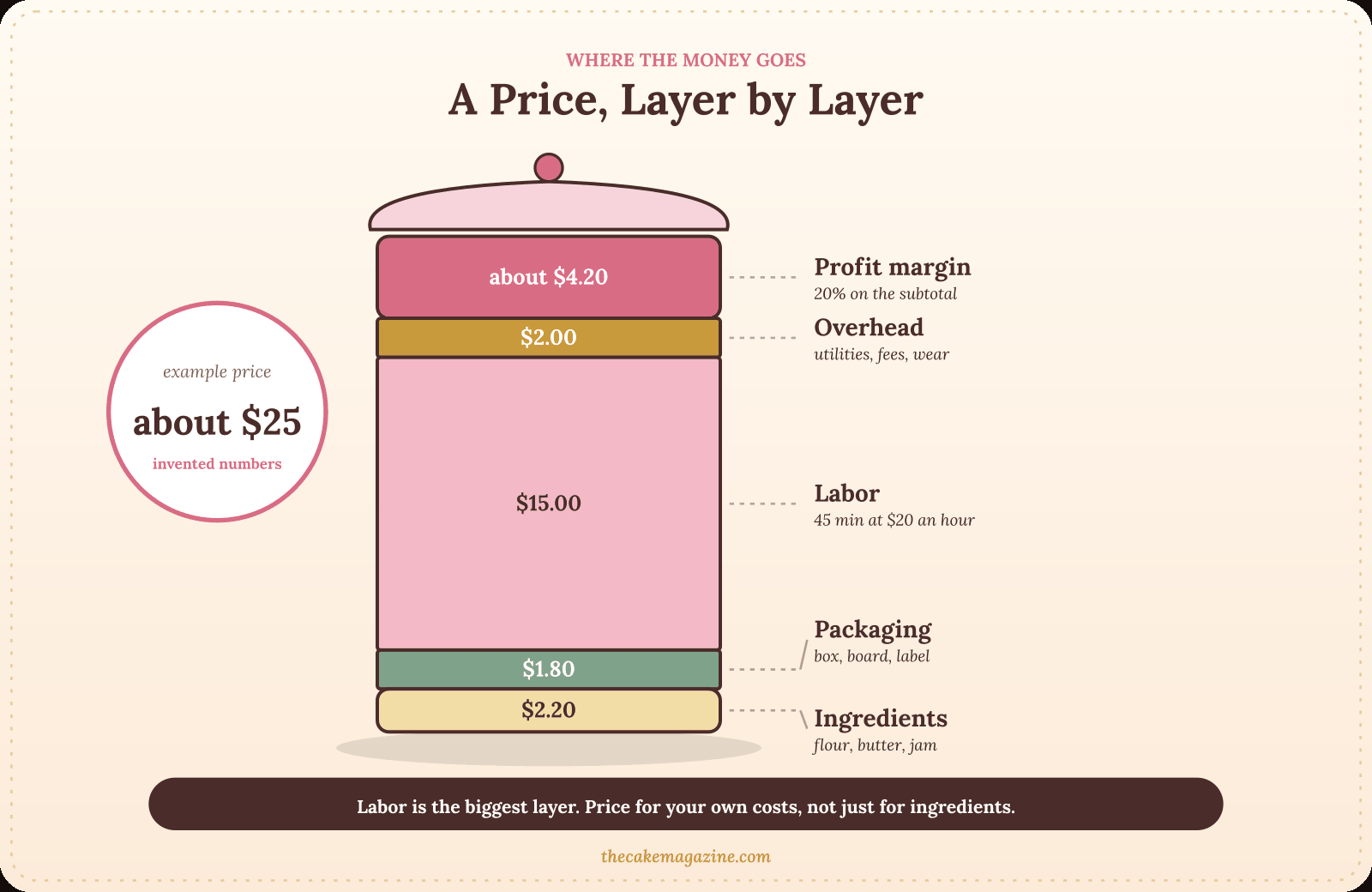
The five layers of a price
- Ingredients. Flour, sugar, butter, eggs, filling and decoration, measured by weight.
- Packaging. The box, board, liner, label and any extras such as a fork or a sticker.
- Labor. Baking, cooling, assembling, piping, cleaning and packing, at a fair hourly rate.
- Overhead. A share of utilities, equipment wear, insurance, fees and your time spent on orders and messages.
- Profit. A margin that lets the business grow, not just break even.
A worked example with made-up numbers
These numbers are invented for illustration and are not market prices. Suppose the ingredients for one cake cost $2.20, the box, board and label cost $1.80, and the cake takes 45 minutes of hands-on work across the day. At a labor rate of $20 an hour, that is $15 of labor. Together, that is $19.00 before overhead and profit.
Add $2.00 for overhead and a 20 percent margin on the subtotal, and the price lands near $25. Change the labor rate, the box or the batch size and the answer changes. The point is not the number, it is the method. Our guides on how to price cakes and the cake cost calculator walk through the same steps in more detail and let you plug in your own costs.
Batching saves time, not value. Baking a dozen little cakes in one session lowers the labor per cake, because setup and cleanup are shared. That is a reason to sell boxes of several, or to take pre-orders, rather than a reason to undercharge.
Selling safely and legally
Rules for selling homemade baked goods vary by state, county and city, and they change. Some places allow cottage food sales with limits on what you can sell and where, and some require licenses, labels or inspections. This article is general information, not legal advice. Contact your state department of agriculture or health department to learn what applies to you before you take your first order.
Food safety, storage and allergens
A small cake is as subject to food safety rules as a large one. In fact, a box with a perishable filling, carried around for an afternoon, is a classic way for things to go wrong. The U.S. Department of Agriculture’s Food Safety and Inspection Service has a page of basic food safety guidance on keeping food clean, separate and chilled.
The USDA’s general advice for perishable foods is not to leave them out for more than two hours, or one hour when the temperature is above 90°F. Treat any bento cake with a dairy-based, egg-based or fruit filling as perishable, and keep it cold until the moment it is handed over.
What needs the fridge and what does not
- Refrigerate: cream cheese frosting, whipped cream, custard, pastry cream, fresh fruit fillings and any cake with a dairy-based filling.
- Cool room temperature is usually fine: well-made buttercream cakes and jam-filled sponges, for a short time. Many bakers still chill them for shape and neatness.
- Freezing: unfrosted layers freeze well. Frosted small cakes can be frozen, wrapped carefully, but allow time to thaw in the refrigerator so the box does not get damp.
Storing a finished cake
A boxed bento cake can sit in the refrigerator for a few days, depending on the filling. Bring it out about 20 to 30 minutes before eating. Keep it away from strong-smelling foods, because buttercream absorbs odors easily, and keep the lid closed to prevent the surface from drying.
If you are not sure how long a particular filling is safe, err on the side of caution and give a shorter window. When you sell cakes, tell customers how to store them and when to eat them.
Allergens and ingredient lists
Eggs, milk, wheat, soy, tree nuts, peanuts, sesame, fish and shellfish are the major food allergens identified under U.S. food labeling law. A boxed cake almost always contains several of them. Keep a written list of ingredients for each recipe, wash tools between batches and do not promise that a cake is free of an allergen unless you can control cross-contact.
If you sell, ask your state or local agency what allergen labeling you need on a baked good. Rules differ for home-based and licensed kitchens. When in doubt, a plain label with the ingredient list and a line such as “made in a kitchen that also handles nuts” is better than silence.
Troubleshooting small cakes
Small cakes have a few predictable problems. Most come down to temperature, weight and patience. Here are the ones we hear about most, with the likely cause and the fix.
The layers slide or lean
What it looks like: the top layer drifts sideways, or the cake leans after boxing.
Likely cause: a soft filling, an uneven layer or a cake that was not chilled.
Fix it next time: pipe a firm buttercream dam, level each layer, keep the filling thin and chill the cake after the crumb coat.
The cake is dry
What it looks like: a crumbly texture and a dull flavor, especially on day two.
Likely cause: overbaking a thin layer, too much flour, or no moisture in the base.
Fix it next time: start checking early, weigh your flour, use an oil-based formula and brush the layers with a light simple syrup before filling.
Crumbs in the frosting
What it looks like: brown flecks that show through the final coat.
Likely cause: a warm or soft cake, or skipping the crumb coat.
Fix it next time: chill the layers, apply a thin crumb coat and chill again before the final coat.
The buttercream is melting or weeping
What it looks like: a glossy, soft surface, or beads of moisture in the box.
Likely cause: a warm kitchen, an over-soft frosting or condensation from moving a cold cake into a warm room.
Fix it next time: work in a cool space, keep frosting at a spreadable but firm texture and let a cold cake warm up in a loosely covered box.
The message is wobbly or smudged
What it looks like: uneven letters, letters that collide or a lid that touches the writing.
Likely cause: too long a message, frosting that is too soft or a box that is too short.
Fix it next time: shorten the message, practice on parchment, chill before piping and choose a box with at least half an inch of headroom.
Common mistakes to avoid
- Baking small layers for the same time as large ones.
- Filling pans by eye instead of by weight.
- Skipping the chill between steps.
- Choosing a delicate sponge that cannot be cut or stacked.
- Using a box that is too big, too short or too flimsy.
- Pricing only for ingredients.
- Promising allergen safety without a way to control it.
Will the format last?
Nobody can say for certain how long any dessert trend will hold, and we will not pretend to. What we can see is that the reasons people like a bento cake are ordinary ones: it is the right size for one or two people, it is easy to give, it does not leave leftovers and it looks charming in a photo.
Those reasons are more durable than any single color palette or character. As of November 2026, we expect the format to stay in some form while the decoration changes. For the broader view of which directions are rising, see our 2026 cake trends overview, and for how viral cake formats rise and fade, our guide on how cake trends go viral is a useful companion.
How to test demand before you commit
If you plan to sell, start with a small test. Offer two flavors for a weekend, take pre-orders so you do not waste cake and ask each customer what they liked. Keep notes on how long each cake took, what it cost and what it sold for. Those numbers will tell you more than any trend article.
Bento cake FAQ
What is a bento cake?
A bento cake is a small, layered cake, usually about four inches across, that is frosted by hand, topped with a short piped message and sold or given in its own box. It serves one person or two people sharing, and the name comes from the Japanese bento lunch box.
How big is a bento cake?
Most are about 4 inches wide and 2.5 to 3 inches tall, though some bakers make them 3, 5 or 6 inches across. A bento cake is meant to fit in a small box and be eaten by one or two people, so the size stays modest.
How many people does a bento cake serve?
A 4-inch small cake serves one generous eater or two people sharing. A 3-inch cake is a polite single serving, and a 5- or 6-inch cake can stretch to three or four small slices. Always say how many people a listing is meant for.
What size pan do I need for a bento cake?
A 4-inch round pan at least 2 inches deep is the standard choice. You can also bake a sheet cake and cut 4-inch rounds, which gives even, flat layers. Fill small pans by weight, about a quarter of the batter you would use in an 8-inch pan at the same depth.
How long do you bake small cake layers?
Small layers usually need less time than large ones, often 20 to 28 minutes at 350°F, but ovens and pans vary. Start checking early, look for a springy top and a few moist crumbs on a skewer, and treat any time you read, including this one, as a starting point.
What frosting works best for a bento cake?
A firm, smooth buttercream is the easiest to pipe and holds a message well. American buttercream and Swiss meringue buttercream both work. Cream cheese frosting and whipped cream are softer and need the refrigerator, so they suit cakes that will be eaten soon.
How do I write on a bento cake?
Use a small round tip or a snipped bag and a slightly softer buttercream. Keep the message to three or four words, practice on parchment first and chill the cake for ten minutes before piping. Pipe the message first and the border after.
How do I pack a bento cake so it does not slide?
Chill the cake until the frosting is firm, put it on a board slightly wider than the cake and use a snug box with a non-slip liner underneath. Keep the box flat, do not stack boxes and keep the lid clear of the decoration with half an inch of headroom.
How long does a bento cake keep?
It depends on the filling. A buttercream cake with a stable jam keeps well for a few days in the refrigerator, while one with fresh fruit, cream or custard should be eaten sooner. Follow USDA guidance on perishable foods and give customers clear storage instructions.
How much should I charge for a bento cake?
Price it for ingredients, packaging, labor, overhead and profit, not just the cost of flour and sugar. Your number depends on your costs and your market, so work it out with a calculator or a worksheet. Our pricing guide explains the steps and shows a made-up example.
Can I sell bento cakes from home?
Maybe, but the rules depend on where you live. Many states have cottage food laws with limits on products, sales channels and labeling, and some require registration. Check with your state department of agriculture or health department before you sell, because this guide is general information only.
Is the bento cake a passing trend?
Nobody can say for sure, but the reasons behind the bento cake, such as portion size, price, less waste and an easy gift, are ordinary and lasting. The decoration styles will change, while the idea of a small, boxed, personal cake looks likely to stay in some form.
Final thoughts on the bento cake
A bento cake is small, but it asks you to get the basics right: a sturdy and moist base, cold layers, a neat coat, a short and steady message and a box that fits. Get those right and the result looks like care. Get them wrong and a small cake shows every flaw at close range.
If you are new to the format, bake a quarter-sheet cake, cut six rounds and make three finished cakes. Weigh everything, time each step and write down what you would change. After two or three batches you will know your oven, your frosting and your pace, and the next bento cake will come together quickly.
Sources and further reading
- The Star (Malaysia), “Cute, playful and sweet: South Korea’s mini bento cakes are getting more popular”, 13 January 2026.
- The Korea Herald, “How small can a cake get?”, 24 February 2025.
- U.S. Department of Agriculture, Food Safety and Inspection Service, food safety.
- King Arthur Baking, cake guide.
Editorial note: reviewed and updated November 2026. This guide is written for home bakers in the United States and uses American measurements. We have not oven-tested the scaled batter weights or bake times here; they are calculations and starting points, so test them in your own oven and pans. Trend statements are attributed to the sources named above. If you sell baked goods, check your state and local food rules, which vary and change. The pricing example uses invented numbers for illustration.