Every host eventually stands in the bakery line wondering if a ten-inch cake is enough for thirty guests. A good cake serving calculator turns that guess into a short, honest piece of arithmetic. It tells you how many slices a cake gives you, how many slices your guests will actually eat, and how much cushion to add so nobody gets a sliver or a bare plate. This guide covers the math, slice sizes, event assumptions and worked examples for any party.
A cake serving calculator divides the cake’s size by the size of one slice, then compares that number with how many slices your guests will really eat. For a standard party slice (1.5 by 2 inches, cut from a cake about 4 inches tall), a round cake serves roughly its top area divided by 3: about 16 slices from an 8-inch round and 26 from a 10-inch.
Plan one slice per guest when cake is the only dessert, fewer when other sweets are on the table, and add about 10 percent as a cushion.
- What a cake serving calculator actually does
- Slice sizes: party, wedding and generous
- The math behind every cake serving calculator
- Five steps to use a cake serving calculator
- How much cake you need for different events
- When cake is not the only dessert
- Sheet cakes and the cake serving calculator
- Tiered cakes and cutting-cake combinations
- Cupcakes, minis and other formats
- Five worked examples of the cake serving calculator
- Using an online cake serving calculator wisely
- Build your own cake serving calculator
- Ordering from a baker or baking it yourself
- Cutting for the count, and keeping cake safe
- Common mistakes with a cake serving calculator
- FAQ
- Final thoughts
What a cake serving calculator actually does
Strip away the buttons and sliders and every cake serving calculator does two jobs. First, it converts a cake into a number of slices. Second, it converts a guest list into a number of slices needed. If the first number is bigger than the second, you are fine. If it is smaller, somebody leaves without cake, or you are cutting thinner pieces than you promised.
That sounds trivial, but the two halves are where most planning mistakes hide. The slice count depends on a slice size nobody states out loud, and the guest count depends on assumptions about who eats cake, who skips it and who comes back for seconds. The online tools you find all make these choices for you, quietly. Some assume a wedding-size sliver, others a hearty party slice. Some assume everyone eats, others assume most do.
This guide makes those choices visible. Once you can see them, you can use any free cake serving calculator, a baker’s chart or a pencil and the back of an envelope, and get the same answer. You will also know when to override the tool, which is the part no calculator can do for you.
What a cake serving calculator cannot know
A calculator does not know that your uncle will have two pieces, that half the children will only eat the frosting, or that the party runs through dinner and nobody is hungry for dessert until nine. It does not know whether the cake is dense chocolate ganache, which most people cut small, or a light vanilla sponge that disappears quickly.
It cannot tell whether the cake will be cut in the kitchen and plated, or cut at the table by a nervous cousin with a butter knife.
So think of the output as a well-informed starting point. You supply the judgment. In the sections below we show where that judgment usually shifts the answer up or down, and by how much.
A note on the numbers. Every serving count here is our own arithmetic from standard pan sizes and commonly used slice dimensions. The per-event assumptions are planning rules of thumb, not survey data. Your baker’s pans, cake height and cutting style may differ a little, so confirm the final count with whoever makes the cake.
Why bother with a cake serving calculator at all
Cake is one of the few party items that is hard to fix at the last minute. You can send someone for more ice, more drinks or another bag of chips. A second cake means another order, another bake and another bill. Ordering too little is awkward. Ordering far too much is wasteful and expensive, especially with a custom design where cost climbs with size. Ten minutes of planning protects you from both.
If you are planning a wedding rather than a party, our guide to the wedding cake guide covering design, servings, budget and delivery goes deeper. Everything here still applies, but weddings use smaller slices and a few extra rules, so the numbers differ.
Slice sizes: party, wedding and generous
Before any calculator can give you a serving count, it has to decide what a serving is. The industry has settled on a few common slice sizes, and the difference between them is bigger than it looks. Choosing a slice is the single most important input, because it can swing the answer by a third or more.
The three slice sizes we use
A wedding slice measures about 1 inch by 2 inches on the top surface and stands the full height of a tier, roughly 4 inches. It is a modest piece, designed for a dessert that follows a full meal and is shared with dozens of other things going on. A party slice measures about 1.5 by 2 inches.
This is what most people picture when they cut a birthday cake, and it is the default for everyday celebrations. A generous slice measures about 2 by 2 inches. It is a proper dessert portion, the kind you would serve at a small dinner when cake is the main event.
Multiply the footprint by the height and you get a rough volume: about 8 cubic inches for a wedding slice, 12 for a party slice and 16 for a generous one. That volume idea matters later, when we get to sheet cakes that are shorter than a layer cake.

Which slice should your cake serving calculator use
For most parties, plan on the party slice. It is big enough that nobody feels shortchanged and small enough that the numbers work out sensibly. Use the wedding slice when cake follows a large meal, when you are serving a very rich cake, or when you want to stretch a cake for a big crowd and your guests will not mind. Use the generous slice for small, cake-focused gatherings, such as a milestone birthday with ten people where the cake is the whole point.
If you are comparing quotes from bakers, ask which slice they used to calculate the servings on their price list. A baker who says an eight-inch cake serves 24 is quoting wedding slices. One who says it serves 12 to 16 is using something closer to the party slice. Neither is wrong, but you cannot compare the prices until the slice is the same.
The math behind every cake serving calculator
You do not need a website to work this out. The formulas are short, and once you have seen them they are easy to carry around. Here is how a cake serving calculator arrives at its answer for each common shape.
Round cakes in a cake serving calculator
A round cake’s top is a circle. Its area is 3.1416 times the radius squared, where the radius is half the diameter. Divide that area by the footprint of one slice and round down. Rounding down accounts for the curved edge, which always leaves wedge-shaped scraps that are too small to serve.
Round cake formula. Servings = 3.1416 × (diameter ÷ 2)² ÷ slice footprint, rounded down. Footprints: 2 square inches for a wedding slice, 3 for a party slice, 4 for a generous slice. Assumes a cake about 4 inches tall.
Try an 8-inch round. The radius is 4, squared is 16, and 3.1416 times 16 is about 50.3 square inches. Divided by 3 for a party slice, that is 16.8, which we round down to 16. A 10-inch round has about 78.5 square inches, giving 26 party slices. A 12-inch round has about 113 square inches, giving 37. These match the figures in our companion guide to wedding cake servings and tier sizes, which also covers the wedding-slice counts.
Square and rectangular cakes
Squares and rectangles are even simpler. Multiply the two sides to get the area, then divide by the slice footprint. A 10-inch square has 100 square inches, which gives 33 party slices. Because there are no curved edges, rectangles also waste less cake, so a square cake of the same nominal size serves roughly a quarter more people than a round one. That is why any cake serving calculator shows a higher count for a square than for a circle.
Reference counts for common round cakes
Here are the numbers a cake serving calculator would give you for the usual round sizes, assuming a cake about 4 inches tall, rounded down.
You may see slightly different numbers elsewhere, such as 12 slices for a six-inch round. Different bakeries round differently, cut different slice dimensions and build to different heights. The gap is normal. What matters is that you and your baker agree on the same assumptions.
Height changes the answer
Everything above assumes a cake about 4 inches tall, which is typical for two or three layers with filling. A single-layer cake is closer to 2 inches tall, so each slice holds half the cake and people naturally cut bigger pieces. A very tall cake, 5 or 6 inches, can be cut into two shorter slices per wedge by some bakers.
If your cake is not 4 inches, use the volume approach: divide the cake’s volume by the volume of one slice, which we do for sheet cakes below.
Five steps to use a cake serving calculator
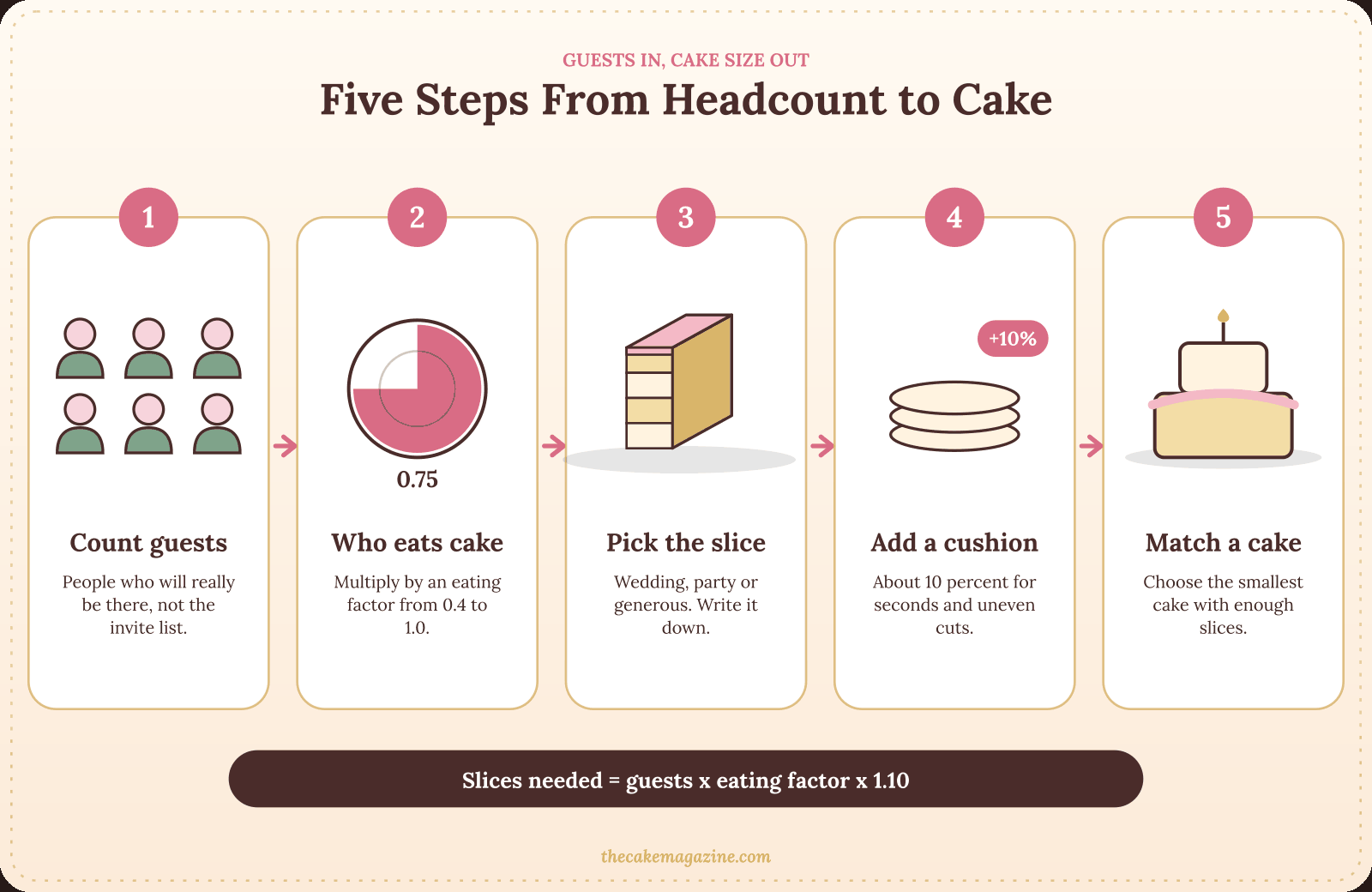
Whether you are typing numbers into a website or doing it on paper, the process is the same five steps. Do them in order and you will land on a cake size without second-guessing. The order matters, because each step feeds the next.
Step 1: Count the people who will be there
Start with the number of guests you expect to attend, not the number you invited. If you sent invitations and have RSVPs, use the confirmed yes answers plus a few for maybes. If it is an open house or an office party where people drift in and out, estimate attendance from past events. Be honest here. Rounding the guest count up by ten out of politeness is how a cake ends up half eaten.
Step 2: Decide who actually eats cake
Not every guest takes a slice. Some are on a diet, some are allergic, some are saving room for something else and some simply do not like cake. Others take one and return for another. Multiply your guest count by an eating factor, which is the share of guests who will take a piece.
For a birthday where cake is the centerpiece, use close to 1.0. For a big buffet with several desserts, drop it to 0.6 or 0.7. We give starting values for common events in the next section.
Step 3: Pick the slice
Choose the slice size that fits the occasion, as described earlier. If you are not sure, use the party slice. Write the choice down, because if a baker or a store is making the cake, you will want the same number in the order confirmation.
Step 4: Add a cushion
Add about 10 percent to the number of slices you need. It covers second helpings, uneven cutting, the piece that falls apart and the guest you forgot. For a very large event, 5 percent may be enough. For a small event of ten or twelve, you may want a little more, because one extra slice is a bigger fraction of a small total.
Step 5: Match the cake serving calculator result to a cake
Now compare your needed slice count with the reference numbers and pick the smallest cake or combination that meets it. If you land between sizes, go up. A cake that is slightly too big costs a few dollars and gives you leftovers. A cake that is slightly too small costs you the goodwill of the last people in line.
The cake serving calculator in one line. Slices needed = guests × eating factor × 1.10. Then pick a cake whose party-slice count is equal or higher. Everything else about the cake serving calculator is about choosing sensible numbers for those three inputs.
How much cake you need for different events
Your cake serving calculator is only as good as the eating factor you feed it. Different events produce different appetites, and the same cake feels very different at a baby shower than at a retirement dinner. The values below are our own planning assumptions, built from common sense and standard party experience rather than from any survey. Treat them as starting points and adjust for your crowd.

Birthday parties for adults
At an adult birthday, cake is usually the one planned dessert and the moment everyone gathers around. Most guests take a slice, and some take a second. An eating factor of about 0.9 to 1.0 works well. If the party is a sit-down dinner, the slices can be smaller, so the party slice is plenty. For a small group of eight to twelve, consider the generous slice, because the cake is the main event. Our birthday cake guide covers sizes, flavors and designs for every age.
Children’s birthday parties
Kids are the easy part: nearly all of them want cake, so count each child at 1.0. Parents are the less predictable group. Some stay and have a slice, others drop off and leave. A factor of about 0.7 for adults is a sensible start. Children also tend to take smaller pieces than adults and leave a fair amount on the plate, so a party slice is plenty, and a smaller 1 by 2 inch cut stretches the cake further.
See our guide to kids birthday cakes for design and flavor ideas.
Baby showers and bridal showers
Showers usually come with several sweet things: cake, cookies, maybe a punch or a brunch spread. Guests nibble around. An eating factor of 0.7 to 0.8 is realistic. If the cake is the only dessert, bump it to 0.9. Many shower cakes are cut into smaller pieces, so a party slice is generous. For more on designs and sizes, our baby shower cake guide is a good next stop.
Graduation open houses
An open house is tricky because people come and go over several hours. Not everyone is there at once, and the total number of guests who walk through the door is often smaller than the invite list suggests. Use your best estimate of actual attendance, apply an eating factor of about 0.7 to 0.8, and cut party slices. Cake is typically not the only food, so do not plan on every visitor having a piece.
Anniversaries, retirements and milestone dinners
These are close to adult birthdays: cake is the headline, and most guests expect a slice. Use 0.9. The crowd tends to include older relatives who take smaller pieces, which can make a party slice slightly generous, so your cushion works in your favor.
Office and corporate events
At the office, attendance is the big variable. People are in meetings, out sick or on calls. Plan on 70 to 80 percent of headcount being present and take a slice, and cut smaller pieces. Many offices cut sheet cakes into squares, which stretch further. Our corporate event cake guide goes into sizing, branding and handling dietary needs in more depth.
Holiday gatherings
At Thanksgiving, Christmas or a big family dinner, cake competes with pies, cookies and other desserts. Use a factor of 0.6 to 0.7 and choose smaller slices. If cake is a family tradition and the star, treat it like a birthday and use 0.9.
Weddings
Weddings are their own category. Slices are smaller, dessert often follows a multi-course meal, and many couples also provide a dessert table or a second kitchen cake. Plan on the wedding slice and an eating factor near 0.85 to 0.95. The wedding servings guide has the complete tier-by-tier breakdown.
Quick starting factors
Adult birthday 0.9 to 1.0. Kids: children 1.0, adults 0.7. Showers 0.7 to 0.8. Graduation 0.7 to 0.8. Milestone dinner 0.9. Office 0.7 to 0.8 of headcount. Holidays 0.6 to 0.7. Weddings 0.85 to 0.95.
When to nudge up
Cake is the only dessert, the party runs in the evening, the crowd is young, the cake is light and fruity, or you are serving a late-night “cake moment” after dancing or drinks.
When to nudge down
A big buffet, multiple desserts, a very rich cake, a morning or lunch event, a crowd with many dietary restrictions, or guests arriving after the cake is cut.
Time of day and the shape of the party
Two parties with the same guest count can eat very different amounts of cake. A mid-afternoon party with coffee and no other food tends to burn through dessert, because guests are hungry and cake is the only substantial thing on offer. A lunch party where everyone just ate a big meal does not. A late-night gathering often sees a second wave of cake eaters after dancing.
Cake timing matters too. If the cake is cut early, everyone is still hungry and most will take a slice. If it is cut after a long evening, some guests have already left and others are full. When in doubt, cut the cake earlier than you think you should, and tell the room when it is happening.
When cake is not the only dessert
The more sweets on the table, the less cake each guest takes. That is obvious, but it is also the most common reason people over-order. A cake serving calculator that ignores the rest of the menu will overshoot, so it is worth stating the adjustment out loud.
A simple way to adjust your cake serving calculator
Think of the dessert as a pie chart. If cake is the only dessert, it is the whole pie, and your eating factor is about 0.9 to 1.0. If there is one other dessert, such as cookies or a tray of brownies, cake loses roughly a quarter of the pie, and the factor drops to about 0.7. If you have a full dessert table with five or six options, cake might be a third or less, and the factor can fall to 0.5 or even 0.4.
These are planning assumptions, not measured rates. A dessert table with a striking centerpiece cake will draw a lot of attention, and some guests will try everything. Others will go straight to the chocolate. If your guest list leans toward people who love dessert, stay on the higher end.
Cake only
Factor about 0.9 to 1.0. Plan on nearly every guest taking a slice, and a few taking two.
Cake plus one other sweet
Factor about 0.7. Guests often sample both, so slices may be cut a little smaller.
Full dessert table
Factor about 0.4 to 0.6. The cake is a centerpiece and a photo moment as much as a dessert.
If you are weighing a single large cake against a spread, our guide to a wedding cake versus a dessert table explains the tradeoffs, and most of its logic carries over to other parties. For a dessert table, cutting each treat into smaller portions helps guests try more things without feeling stuffed.
Guests who cannot eat the cake
Not everyone can eat cake with wheat, eggs, dairy or nuts. If you know you have guests with allergies or restrictions, plan a small separate item for them rather than counting them in the main cake. Subtract them from the headcount you feed into the cake serving calculator, and buy or bake a separate dessert, with the right labels and a clean serving utensil. Cross-contact is easy to cause in a shared cutting setup, so keep the special dessert wrapped and cut it first.
Adjusting for the crowd
Beyond the menu, the people themselves matter. Teenage athletes will eat more than a group of retired friends. A crowd of young children will take smaller pieces and waste more. A crowd that has been drinking and dancing will eat late-night cake with enthusiasm. None of this is scientific, but a host who knows the guests can usually feel which way to nudge the factor, and a small nudge, 0.1 up or down, is all that is needed.
Sheet cakes and the cake serving calculator
Sheet cakes are the workhorse of large parties. They are easy to cut, easy to serve and easy to scale, and grocery stores and bakeries sell them in standard sizes. But a sheet cake behaves differently in a cake serving calculator, because most are one or two layers tall instead of three or four. That changes the numbers.
Why sheet cakes need a different formula
A single-layer sheet cake is about 2 inches tall once frosted. If you cut it into party slices of 1.5 by 2 inches, each piece would be only half as tall as a layer-cake slice, and it would look tiny on a plate. People cut sheet cakes into bigger footprints to compensate.
The cleanest way to count is by volume: a party slice has a volume of about 12 cubic inches, so a 2-inch-tall cake needs a footprint of about 6 square inches per slice, such as 2 by 3 inches.
Using that rule, here is what a cake serving calculator gives for common sheet cakes. Bakery pan sizes vary, so check your baker’s actual dimensions.

Grocery stores and bakeries name their sheet sizes differently, and the dimensions drift: a half sheet at one shop may be 11 by 15 and at another 12 by 18. The King Arthur Baking cake guide notes that one batch of batter can fill a 9 by 13-inch sheet cake, two 9-inch rounds or two dozen cupcakes, which is a useful sense of scale. Always ask for the dimensions and the height, not only the name.
Two-layer sheet cakes
A two-layer sheet cake is about 4 inches tall, so it behaves like a layer cake and the standard footprint math returns. A 9 by 13 two-layer sheet has 117 square inches, which gives about 39 party slices. That is more than double the single-layer count, and it explains why a two-layer sheet cake at a bakery can cost noticeably more than a single-layer one. For help comparing the options, see our piece on sheet cake versus tiered cake.
Sheet cake cutting grids
One advantage of a sheet cake is that cutting it is mostly arithmetic. A 9 by 13 cut into a 3 by 6 grid gives 18 even rectangles. Cut each in half and you have 36 smaller pieces. For an office party or a crowded open house, the smaller grid stretches a quarter sheet a long way.
For a family gathering where people want a real slice, use the bigger one. Decide the grid before you walk up to the cake, and mark it lightly with a knife so the first cuts set the pattern.
Tiered cakes and cutting-cake combinations
Many parties use more than one cake. A small decorated cake sits on the table for the candles, the photos and the speech, and a plainer sheet cake waits in the kitchen to be cut and served. This is a long-standing trick, and a cake serving calculator makes it easy to plan.
How tiers add up
When two or more round cakes are stacked into tiers, the total is the sum of each tier’s servings. A 6-inch tier on top of a 10-inch tier gives 9 plus 26, or 35 party slices. An 8-inch on a 12-inch gives 16 plus 37, or 53.
A common three-tier stack of 6, 8 and 10 inches gives 9 plus 16 plus 26, or 51. The top tier is often saved for later, which means you should subtract it from the party count and plan on the lower tiers only.
Some bakeries stack tiers with dowels or supports, which take up a little room, and some decorative stands hide extra cake. Ask your baker to confirm the servings for the actual structure, not just the diameters.
The kitchen cake approach
A kitchen cake is a plain cake cut and served from the back, so the display cake stays intact for photos. It is a smart way to cut costs, because the part of the cake that guests actually eat can be simple, and the decoration goes only where people look. A common plan is a small decorated round that serves 8 to 12 plus a sheet cake that serves the rest. Our guide to choosing cake pans helps if you are baking the kitchen cake yourself.
A hybrid example. For 50 guests with an eating factor of 0.9 and a 10 percent cushion, you need about 50 slices. An 8-inch decorated round (16 slices) plus a half-sheet kitchen cake cut in 2 by 3 pieces (36 slices) gives 52. The decorated cake handles the ceremony, and the sheet handles the line.
Square versus round for a crowd
If you are choosing between a round and a square cake for a larger party, square usually wins on servings per dollar, because there is no wasted edge, and it is easier to cut into even pieces. Round wins on classic looks. The count difference is real: a 10-inch square serves about 33 party slices against about 26 for a 10-inch round, which is roughly a quarter more cake for a similar footprint on the table.
Cupcakes, minis and other formats
Not every party needs a cut cake. Cupcakes, mini cakes, cake pops and individual desserts are popular because they skip the cutting, hand out evenly and look pretty on a stand. The calculation changes with them, but only slightly.
Cupcakes and the cake serving calculator
Cupcakes are the easiest to count: one cupcake is one serving. The usual plan is one per guest who will eat dessert, with the same eating factor and cushion we have used so far. The difference is that guests often take two small cupcakes instead of one slice, so if cupcakes are the only dessert, it is wise to plan about 1.3 per eating guest.
A standard batter recipe makes about two dozen. That figure matches the King Arthur Baking guide to cake, which says one batter can make 24 cupcakes.
Mini cupcakes are about a third of the size, so plan on two or three per person if they are the main dessert, and one or two if they are part of a spread. Because they are so small, guests grab them freely, and they disappear faster than their size suggests.
Mini cakes and bento cakes
Individual cakes, such as three- or four-inch rounds, are one serving each, or sometimes two when guests share. They are great for small gatherings and for tables where each guest gets one at their place. They also take more hand work per serving than one big cake, which is why they usually cost more. Our guide to the mini cake trend and small-format celebration cakes covers sizes, pricing and how to serve them.
Combining formats with a cake serving calculator
A popular plan is a small cutting cake for the photo and candles plus cupcakes for everyone else. Plan the cupcakes to cover the guests who do not get cake, and count the cutting cake as a bonus for people who want seconds. This hybrid also makes it easy to offer more than one flavor without ordering several full cakes.
Cupcakes
One per eating guest, about 1.3 each if they are the only dessert. Standard batter yields roughly two dozen.
Mini cupcakes
Two or three per guest as a main dessert, one or two as part of a spread.
Individual mini cakes
One per guest at a table setting, or one for two people when sharing.
Cake pops and bites
Two or three per guest as part of a dessert table, more if nothing else is sweet.
Five worked examples of the cake serving calculator
Numbers make the method concrete. Here are five realistic parties, worked through with a cake serving calculator, step by step. In each, we use the formula slices needed = guests × eating factor × 1.10, then match the answer to the reference counts from earlier. These are illustrations of the method, not recommendations for your particular party.
Example 1: A 30-guest adult birthday dinner, step by step
Thirty people sit down to dinner, and cake is the only dessert. Use an eating factor of 0.9: 30 × 0.9 = 27 slices. Add 10 percent: 27 × 1.1 is about 30. A 10-inch round gives only 26 party slices, which is short. A 12-inch round gives 37, which leaves a comfortable cushion. A two-tier 6-inch and 10-inch stack gives 35, which also works and looks more festive. Either is a good answer.
Example 2: A children’s party with 20 kids and 12 adults
Kids at 1.0 give 20 slices. Adults at 0.7 give about 8. The total is 28, and with the cushion it comes to about 31. A single-layer half sheet (12 by 18) cut into 2 by 3 pieces gives 36, which covers it. If you would rather have a tall round cake, a 12-inch round with 37 party slices does the job, and you can cut the children’s slices smaller to stretch it.
Example 3: A baby shower for 40 with cookies and fruit
There are other sweets, so use a factor of 0.7: 40 × 0.7 = 28 slices. With the cushion, that is about 31. A 6-inch plus 10-inch two-tier gives 35 party slices. If the top tier is meant to be saved for the parents, the 10-inch alone gives 26, which would be short, so either choose an 8-inch plus 10-inch (42) or plan to cut the slices a bit smaller.
Example 4: A graduation open house with 60 invited
Say you expect about three quarters of the invitees to come at some point, which is 45 guests. Use a factor of 0.75, since there are other foods: 45 × 0.75 is about 34. With the cushion, about 37. A 12-inch round gives 37 party slices exactly, and adding a 6-inch tier brings it to 46, which is safe. If you want a simpler plan, a half sheet cake with 36 pieces plus a small decorated cake for the table works well.
Example 5: An office party for 40 employees
Plan on 75 percent of headcount being present and eating: 40 × 0.75 = 30. With the cushion, about 33. A single-layer half sheet gives 36 pieces cut 2 by 3, which fits. If you want smaller squares, a quarter sheet cut into 36 small pieces (1.5 by 2 inches) also works, though each piece is petite. For more office-specific ideas, see the corporate event cake guide.
What the examples show. The answer is rarely an exact match. You choose the nearest size above your number, then adjust slice sizes to fit. If your result lands just below a size, go up. If it lands just above, check whether cutting slightly smaller would let you drop down a size.
Using an online cake serving calculator wisely
Search for a cake serving calculator and you will find dozens: bakery websites, baking-supply stores, party-planning blogs and spreadsheet templates. Most are fine. The trouble is that they hide their assumptions, so two honest tools can give you two different answers for the same cake, and you will not know why.
Questions to ask any cake serving calculator
Before you trust a result, find out four things. What slice size does it use? Many default to the wedding slice, which makes every cake look like it feeds more people. What cake height does it assume? A tool built for tall tiers will overcount a shallow sheet cake.
Does it round down or up? And does it add any cushion for seconds, or is the answer the bare minimum? A good cake serving calculator states these on the page. If it does not, treat the answer as a rough guide.
Check the answer against the pencil math
A quick sanity check takes thirty seconds. For a round cake, multiply the diameter by itself, multiply by 0.785 to get the area, then divide by 3 for party slices. For an 8-inch round that is 8 × 8 = 64, times 0.785 is about 50, divided by 3 is about 16.
If a cake serving calculator tells you that an 8-inch round serves 30, it is using a very small slice, or counting two stacked layers as two separate cakes. Neither is wrong, but you should know which one you are looking at.
When the tool and the baker disagree
Sometimes your cake serving calculator says one thing and the bakery says another. Trust the baker for the cake you are actually buying, because they know their own pans and heights. But do ask them to explain the gap. Often the answer is simply a different slice size, and you can decide which one fits your party. A baker who explains this clearly is usually a good sign.
Build your own cake serving calculator
You do not need an app. A small table on paper or a few cells in a spreadsheet will do everything a website does, and you can adjust it for your own party. It is also a nice way to keep a record so that next year’s planning takes five minutes instead of an hour.
The inputs
Set up five inputs: expected guests, eating factor, slice footprint, cushion percentage and cake height. Then add a column for each cake you are considering, with its shape and dimensions. For a round cake, the formula is the diameter squared times 0.785, divided by the slice footprint, rounded down. For a rectangle, multiply the sides instead. If the height is not 4 inches, scale the answer by the height divided by 4.
A short paper example
Say you have 24 guests, a factor of 0.8 and a cushion of 10 percent. That is 24 × 0.8 × 1.1, or about 21 slices. You are weighing a 9-inch round, which gives about 21 party slices on paper, and a 10-inch round, which gives 26. Your homemade cake serving calculator says the 9-inch is exactly enough and the 10-inch leaves five extra slices. If seconds are likely, pick the 10-inch. If not, the 9-inch is fine.
Keep notes for next time
After the party, write down how many slices were left or how many people went without. A short note, such as “26 slices, 4 left, cut party size,” turns your cake serving calculator into a personal one. After two or three events you will know whether your crowd eats more or less than the standard factors, and you can adjust the numbers with real experience instead of guesses.
Ordering from a baker or baking it yourself
Once you have a number, the next question is how to get the cake. Both routes use the same serving math, but the details differ. If you order, the conversation with the baker is where assumptions get fixed. If you bake, you need to convert a slice count into pans and batter.
What to tell a baker
Give the baker the date, the guest count, the event type and whether other desserts will be served. Then ask what slice size their serving estimate uses, how tall the cake will be and whether the number includes the top tier or any display-only layers. Ask whether they would adjust the size for your crowd. A good baker will tell you honestly when a smaller cake will do, and when to go bigger.
Ask for the quote in writing, including the servings, the pan sizes and the delivery details. Prices vary a lot by region, design and baker, so we do not quote specific figures here. If you are curious how bakers think about cost, our guide on how to price cakes explains the factors behind a quote.
Baking it yourself
To bake your own, work backward from the cake size. First, pick the pans. A standard recipe for two 9-inch layers fills roughly the same volume as one 9 by 13 pan, according to King Arthur’s pan notes, so you can use that as an anchor.
Then scale by pan area: a pan with twice the area needs about twice the batter if the depth stays the same. Fill pans no more than about two-thirds full, and expect to need extra batter if you want three layers instead of two.
Baking times and amounts depend on your oven, pans and recipe, so treat any scaling as a starting point and test before the party. If you are making a vanilla cake, our reference to the King Arthur cake guide is a good cross-check on pan sizes and batter volume. When you need help choosing pans, see our pan buying guide.
Allow time for cooling and chilling
A larger cake takes longer to cool, fill and decorate, and it needs more space in the refrigerator. Plan the cake a day ahead where you can, and leave time for the frosting to set before cutting. A cake cut while still warm or soft will crumble, which wastes slices and spoils the look of the plate.
Cutting for the count, and keeping cake safe
A cake serving calculator gives you a promise: this cake will make this many slices. Keeping that promise depends on how the cake is cut. Consistent cutting is what turns 26 slices on paper into 26 slices on plates. And once the cake is out, you also have a short window to serve it safely.
Cutting a round cake
The classic method for a round cake is to cut a ring first. Mark a circle about 2 inches in from the outer edge, then slice that outer ring into pieces about 1.5 inches wide. When the ring is gone, repeat with the inner circle, cutting it into similar pieces or, for the very center, into wedges.
Use a long, thin, sharp knife, wipe it clean between cuts, and dip it in hot water for neater edges. Our walkthrough on how to cut a wedding cake shows the same technique in more detail, and it works for any tiered or round cake.
Cutting a sheet cake
Sheet cakes are easier. Cut the cake lengthwise into strips, then cut each strip across into pieces of equal width. Count your pieces before you start. If the grid does not give you the number you need, adjust the width of the last row or column rather than shrinking every slice. A ruler laid along the edge and a light score with the knife make it easy to keep lines straight.
Who cuts matters
If one person cuts, slices tend to stay consistent. If everyone cuts their own, the first few people take big pieces and the last few are left with scraps. For a large party, assign a cutter, or plate slices in the kitchen and bring them out. At a small gathering, the host can cut a slice for each person and ask who wants seconds.
The two-hour rule after the cake serving calculator
Cake is not usually thought of as a risky food, but some cakes are. Anything with whipped cream, pastry cream, custard, cream cheese frosting or fresh fruit filling is perishable and needs to stay cold. The USDA Food Safety and Inspection Service describes the danger zone as 40 to 140 degrees Fahrenheit and advises that perishable food should not sit in that range for more than two hours, or one hour when the air temperature is above 90 degrees.
You can read more at the USDA food safety site and in its summer danger zone advice.

Many common cakes, such as those with American buttercream or a firm ganache, are more forgiving, but the safest habit is the same: keep cake cool, bring it out close to serving time and put leftovers away promptly. If your cake has perishable filling and the party is outside on a hot day, serve it in small batches from a cooler.
Leftovers
With a 10 percent cushion, you will often have a few slices left. Wrap them well, refrigerate any cake with perishable filling and use them within a few days. For plain, sturdy cakes, individual slices freeze well when wrapped tightly. If you saved a top tier, see our guide to freezing a wedding cake top tier for the method. Do not leave leftover cake sitting out overnight, and when you are not sure, throw it out.
General information only. The food safety notes here are general guidance from public sources, not medical advice. If you serve cake to people with allergies, pregnancy, weakened immune systems or other health concerns, check ingredient labels and follow the advice of a qualified professional. If you sell cakes, your state or local health agency sets the rules you must follow.
Common mistakes with a cake serving calculator
After walking through the math, it helps to name the mistakes that trip people up. Most come down to a hidden assumption.
Comparing prices without comparing slices
One baker’s “serves 24” is another’s “serves 14.” Ask which slice size sits behind each quote before you compare. A lower price per serving can simply mean smaller slices.
Counting invited guests instead of attendees
People decline, run late or never answer. Use confirmed attendance, and plan around a realistic figure rather than the invitation list.
Forgetting the cake is also a decoration
A small cake on a big table looks lonely. If the cake is a centerpiece, a slightly larger display cake may be worth it even if the slices are not all eaten. A kitchen cake can cover the actual serving.
Using layer-cake numbers for a sheet cake
A one-layer sheet is half as tall as a layer cake. If you apply footprint math designed for a tall cake, you will either overestimate servings or end up cutting oddly thin pieces.
Skipping the cushion
No cushion means the last person gets a sliver and the host sees empty plates. About 10 percent costs very little and prevents most shortfalls.
Cutting the first slices too big
Early cutters tend to be generous and the cake runs out before the line ends. Decide the slice size beforehand and cut a few sample pieces to show the size.
Ignoring dietary needs
If one or two guests cannot eat the cake, a small separate dessert with clear labels is kinder and safer than leaving them with nothing.
Trusting one cake serving calculator blindly
Online calculators differ because they assume different slices and heights. If two tools give two answers, check what each one assumes, then use the one that matches your party.
A quick cake serving calculator checklist before you order
- Confirm the expected attendance, not the invite count.
- Choose an eating factor that fits the event and the other food.
- Pick the slice size and write it down.
- Add about 10 percent.
- Match to a cake and confirm height, pan sizes and servings in writing.
- Plan who cuts, and decide the grid or ring pattern.
- Arrange cold storage for any perishable filling.
- Plan a small allergy-friendly alternative if needed.
FAQ: cake serving calculator questions
What is a cake serving calculator?
A cake serving calculator is a tool, or a short piece of arithmetic, that converts a cake’s size into a number of slices and compares it with the number of slices your guests will eat. It divides the cake’s top area or volume by the size of one slice, then helps you pick a cake that covers your guest list with a small cushion.
How do I use a cake serving calculator for a party?
Count the guests who will attend, multiply by the share who will take a slice, add about 10 percent, and choose the smallest cake whose party-slice count meets that number. For example, 30 guests at a factor of 0.9 plus a cushion means about 30 slices, which points to a 12-inch round or a two-tier cake.
How many people does a 10-inch round cake serve in a cake serving calculator?
In a cake serving calculator, a 10-inch round cake about 4 inches tall serves roughly 26 party slices (1.5 by 2 inches) or about 39 wedding slices (1 by 2 inches). If you cut generous 2 by 2 inch pieces, it serves about 19. The exact count depends on the cake’s height and how neatly it is cut.
How much cake do I need per person, according to a cake serving calculator?
Plan on one slice for each guest who will eat cake, which is what most cake serving calculator tools assume. When cake is the only dessert, that is close to every guest. When there are other sweets, plan on about 0.5 to 0.7 slices per guest. Add roughly 10 percent for seconds and uneven cutting, and round up to the next cake size.
How many does a quarter sheet cake serve?
A 9 by 13-inch single-layer quarter sheet serves about 18 pieces cut 2 by 3 inches, or about 36 small pieces cut 1.5 by 2 inches. A two-layer version about 4 inches tall serves around 39 party slices. Bakery dimensions differ, so confirm the pan size and height.
Why do different cake serving calculators give different answers?
They assume different slice sizes, heights and eating habits. One may use a wedding slice of 1 by 2 inches while another uses a 1.5 by 2 inch party slice, which changes the count by about a third. Check the assumptions each tool uses and pick the one that matches your event.
What is the difference between a party slice and a wedding slice?
A wedding slice is about 1 by 2 inches on top, usually 4 inches tall, and is meant as a small dessert after a meal. A party slice is about 1.5 by 2 inches and is closer to the piece most people cut at a birthday. The party slice is about 50 percent larger by volume.
How much cake should I order for a children’s birthday party?
Count each child as one slice and each adult as about 0.7, then add about 10 percent. Twenty children and twelve adults come to roughly 31 slices, which a half sheet cake or a 12-inch round can cover. Children often take smaller pieces, so you can cut slices smaller to stretch the cake.
Should I add extra for guests who take seconds?
Yes, but a small amount. A 10 percent cushion usually covers seconds, uneven cutting and unexpected guests. If cake is the only dessert and the crowd loves sweets, consider 15 percent. If there are many other desserts, 5 percent may be enough.
Do sheet cakes serve more people than round cakes?
Per square inch of top, a sheet cake serves about as many slices as a round cake of the same area, and it wastes less at the edges. But single-layer sheets are about half as tall as layer cakes, so pieces are cut bigger. A two-layer sheet serves about the same as the area math suggests.
How many cupcakes equal one cake in a cake serving calculator?
A rough match is one cupcake per party slice. A cake that serves 24 party slices is comparable to two dozen cupcakes, and a typical batter makes about 24 cupcakes. If cupcakes are the only dessert, plan about 1.3 per eating guest because many people take two small ones.
How long can cake sit out at a party?
For cakes with perishable fillings such as whipped cream, custard or cream cheese, the USDA advises no more than two hours in the 40 to 140 degree Fahrenheit range, and one hour when the air is above 90 degrees. Sturdier cakes with firm frostings are more forgiving, but it is still best to keep cake cool until serving.
Can I use a cake serving calculator for a wedding cake?
Yes, a cake serving calculator works for weddings too, but use the wedding slice of 1 by 2 inches and check with your baker, who may use different heights or counting methods. Our wedding servings guide breaks down the numbers tier by tier, including how to plan for a saved top tier or a backup kitchen cake.
Final thoughts
The best cake serving calculator is the one you understand. When you know that a party slice is 1.5 by 2 inches, that an 8-inch round gives about 16 of them and that a one-layer sheet cake needs a different formula, you can judge any online tool or bakery chart in seconds. You can also spot the moment when a number looks wrong, which is when most over- and under-ordering gets caught.
To use a cake serving calculator well, start with the guest count you really expect, pick an eating factor that fits the event, choose a slice, add about 10 percent and round up to the next cake. Then talk to your baker or check your pans, write the assumptions down and decide who will cut. That small amount of cake serving calculator planning is what keeps the last person in line smiling at a full plate.
If you are planning a larger celebration, our corporate event cake guide and dessert table comparison are good next reads. And if you are making the cake yourself, our pan buying guide will help you pick sizes that match your serving count.
Editorial note: reviewed and updated November 2026. Serving counts are our own arithmetic from standard pan sizes and commonly used slice dimensions; event eating factors are planning assumptions, not survey results. Bakery pan sizes, cake heights and slice sizes vary, so confirm final servings with your baker. Food safety guidance is general information from the USDA Food Safety and Inspection Service, not medical advice. If you sell cakes, check your state and local food rules.