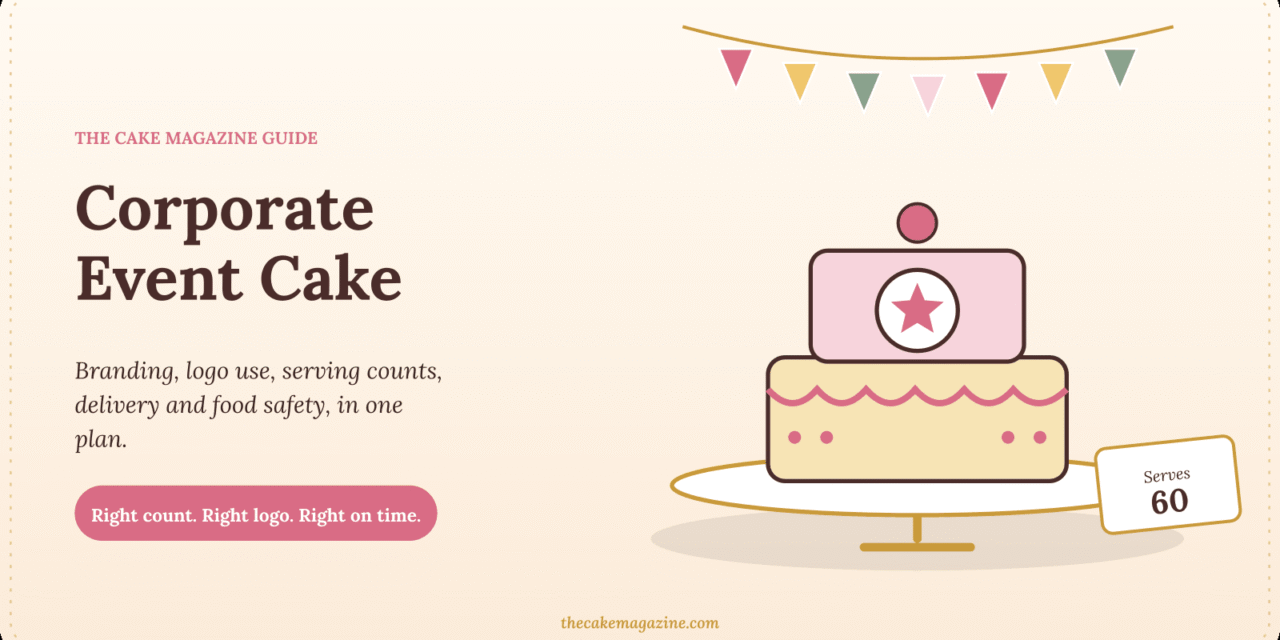
A corporate event cake looks simple from the outside. Someone in the office says “let’s get a cake for the launch,” a logo gets pasted into an email, and a sheet cake shows up at 2 p.m. In practice, a corporate event cake sits at the crossroads of branding, headcount math, tight delivery windows and food safety, and a small mistake in any of those shows up in front of the whole company. This guide walks through each piece in plain language so you can order, or bake, one with confidence.
A good corporate event cake starts with three facts: the real number of people who will eat, the exact logo files and brand colors the company approves, and the delivery address with a named contact. Order two to three weeks ahead for branded work, plan about one party-size slice per guest when cake is the only dessert, and keep anything perishable cold and out of the danger zone for no more than two hours. Get the details in writing.
- What a corporate event cake really is
- Common occasions for a corporate event cake
- Ordering timeline for a corporate event cake
- Serving counts for a corporate event cake
- Choosing a format: sheet, tiered, cupcakes or minis
- Branding a corporate event cake
- Five ways to put a logo on a cake
- Logo permission and trademark basics
- Flavors, dietary needs and allergens
- Delivery and setup for a corporate event cake
- Food safety for a corporate event cake
- Budget, quotes and invoices
- Common mistakes to avoid
- Printable planning checklist
- FAQ
What a corporate event cake really is
A corporate event cake is any cake ordered for a business occasion rather than a family one. That covers a sheet cake for an office anniversary, a three-tier showpiece at a product launch, a tray of mini cakes at a client reception and a stack of individually boxed slices for a remote team’s shipped celebration. The common thread is that the cake is doing a job for an organization, and usually carrying its name.
That changes the order in subtle ways. A birthday cake is judged by one family on taste and sweetness. A corporate event cake is judged by dozens or hundreds of people, some of whom are clients or executives, and it often shows up in photos on social media within the hour. The person ordering it is rarely the person who will eat most of it, which is why the details tend to go missing.
How a corporate event cake differs from a wedding or birthday cake
If you have planned a wedding, you already know a lot of what matters here. Our wedding cake guide covers design, servings, budget and cutting in depth, and many of those ideas carry over. The differences are mostly about people and paperwork.
- More decision makers. A marketing lead may approve the logo, an assistant may book the delivery and a finance team may need an invoice with a purchase order number.
- Stricter brand rules. Colors, logo spacing and wording often come from a brand guide, and the cake has to respect them.
- Less flexibility on timing. The cake has to be at the venue before the toast or the meeting, not “sometime in the afternoon.”
- Mixed audiences. Guests include people with allergies, dietary rules and no particular fondness for sugar, so the flavor choices need to be broad.
- Less cutting ceremony, more grab-and-go. Slices are often served on paper plates at a standing event, which affects the cake’s shape and structure.
Who is this guide for?
Two groups tend to read about the corporate event cake: the people buying one and the bakers filling the order. We wrote the sections so both can follow along. Buyers will find checklists for what to tell the bakery. Bakers will find reminders about what to ask, what to put in writing and how to keep a cake safe between the kitchen and the conference room.
If you are a home baker considering your first company order, read this next to our guide on how to start a cake business, since local rules about selling from home still apply.
Common occasions for a corporate event cake
Almost every workplace milestone invites a cake, but the best design depends on the occasion. A cake for a quiet Friday staff birthday round has very different needs than one for a keynote dinner. Thinking about the setting first keeps you from over-ordering, or under-designing, the corporate event cake.
Company anniversaries
These are often the most branded cakes of the year. A founding date, an “X years” number and a simplified logo work well. Expect everyone on site to take a slice, so plan on the high end of your serving count.
Product launches
The cake is part of the photo. Colors, a clean logo and a sturdy shape matter more than flavor variety. A tall single cake on a stand reads well from across a room.
Milestones and wins
Hitting a sales target, finishing a big project or celebrating a team award usually calls for a simple sheet cake with a short message. Speed and fair portions matter more than polish.
Retirements and send-offs
These are personal but still happen at work. See our ideas for retirement cakes for themes, humor and professional designs that suit an office crowd.
Client receptions
Think mini cakes, petit fours and a single hero display piece. Individual desserts avoid cutting, and mini and one-bite cakes suit a standing reception well.
Holiday parties
Seasonal flavors and a gentle nod to the company, such as a small logo tag rather than a giant one, tend to feel warmer than a heavily branded cake.
Match the corporate event cake to the room
A buffet table in a conference room with fluorescent lighting wants a different cake from a hotel ballroom with a pin spot on the dessert table. Ask where the cake will be displayed, how long it will sit out and whether guests will serve themselves. Those three answers shape almost every other choice in this guide, from icing type to box size.
A simple rule helps: the longer a cake sits in a warm room, the plainer and sturdier it should be. Fresh cream fillings, delicate sugar flowers and glossy glazes are lovely at a plated dinner. They are risky on an office counter at 3 p.m. in July.

Ordering timeline for a corporate event cake
Lead time is the single most common reason a corporate event cake goes wrong. Businesses tend to decide late, and logo cakes cannot be rushed the way a plain sheet cake can. A bakery has to review artwork, source or print edible images, plan the bake day and leave time for decorating and boxing. Here is a realistic way to think about it, with the caveat that every bakery sets its own policies.
Three to four weeks out
Send the baker the date, time, venue, headcount estimate, budget range and the occasion. Share the logo files and any brand guide at the same time. Ask what the bakery needs to hold the date and how its deposit works. Popular dates, like the week before a major holiday, fill up first, and a corporate event cake competes with weddings and other business orders for the same weekend slots.
Two weeks out
Approve the design sketch or mockup in writing. Confirm flavors, any dietary requests, the final wording and the colors. If a logo is being printed on an edible sheet, this is the point where the baker will need your final, approved files. Ask who at the company signs off on the artwork, and make sure that person actually sees it.
One week out
Lock the headcount, the delivery address, the contact name and phone number on site, the delivery window and where the cake will be set up. Confirm payment details. If your finance department needs a purchase order or invoice before payment, request it now, not on the day of the event.
Two to three days out
Send a final message: the headcount, any last-minute allergy notes and the on-site contact. Ask the baker to confirm in return. Make sure someone at the venue knows a cake is coming and has a place for it, ideally a cool room or a refrigerator if the cake is perishable.
Event day
Have someone meet the delivery, inspect the cake and sign the receiving slip. Check that the logo and the spelling look right before the driver leaves. If something is wrong, you want to flag it while the baker is still standing there, not an hour later when the guests have arrived.

Rush orders are possible, but plan for simpler. If you only have a few days, ask for a plain sheet cake in the company colors with piped lettering instead of a printed logo. Many bakeries can deliver that on short notice, and it looks tidy when the design is restrained.
Serving counts for a corporate event cake
Getting the serving count right is the part everyone worries about, and it is where a little arithmetic prevents a lot of embarrassment. Run out and the last people in line see an empty tray. Over-order dramatically and you waste money. The goal is to plan for the people who will actually eat, with a modest cushion, and to be honest about how the cake will be served.
Start with who will really eat
Headcount and cake-eating count are not the same number. Some people skip dessert, some are away from their desks, and some are allergic. As a rule of thumb, when cake is the only dessert and the event is celebratory, plan for most attendees to take a slice. When there are other sweets, a full meal or a long event, fewer will. These are planning habits, not statistics, so adjust for your own crowd.
- Cake is the only dessert at a celebration: plan for nearly everyone, then add a small cushion.
- Cake sits beside cookies, fruit or a full dessert table: plan for roughly two-thirds to three-quarters of attendees.
- Drop-in event with people coming and going: estimate by the peak number present at one time, then add a cushion for late arrivals.
- After a large catered meal: plan on smaller slices, since people are already full.
Slice size matters more than cake size
A standard party slice is bigger than the tidy wedding slice you may have seen at a reception. Our wedding cake serving guide explains the small, 1 by 2 inch portions used for tiered cakes and why they differ from what most people expect at a party.
In an office, people tend to cut generous squares. If you want a cake to stretch, tell the person cutting it the slice size, or ask the bakery to pre-cut and mark the cake.
Typical sheet cake ranges
Bakeries size sheet cakes slightly differently, so treat these numbers as planning ranges and ask your baker for their own chart. The low end is a generous party slice. The high end is a modest slice for a crowd that is also eating other food.
Quarter sheet (about 9 by 13 inches)
Roughly 12 to 20 slices. Good for a team of 10 to 15 when cake is the main treat.
Half sheet (about 12 by 18 inches)
Roughly 30 to 48 slices. The classic office event size, and the one most bakeries stock pans for.
Full sheet (about 18 by 24 inches)
Roughly 60 to 96 slices. Needs a large table, a large box and a vehicle that can carry it flat.
Two-tier round (6 and 8 inch)
Roughly 20 to 30 party slices, depending on height and how it is cut. Often paired with a back-up sheet.
Use a hero corporate event cake with a back-up
One very common strategy for a corporate event cake is to have a showpiece cake for the photo and the speech, then a plain sheet cake in the kitchen for the actual serving. The hero cake gets the logo and the design work. The sheet cake, with the same flavors, does the heavy lifting.
This saves money and avoids awkward cutting of a delicate, expensive cake. For a deeper dive into this approach, see our guide to the wedding sheet cake versus a tiered cake, where the logic is the same.
If you are working out headcounts for any type of party, our cake serving calculator guide walks through the math for different events and portion sizes.
Do not count on a number you have not confirmed. “About 100 people” in an email can mean 70 on the day or 140. Ask who is invited, who has replied and whether guests are bringing plus-ones. Then add a small cushion rather than a large one.
Choosing a format: sheet, tiered, cupcakes or minis
The shape of the cake decides how it will be served, how it will travel and how easily the logo reads. There is no single right answer for a corporate event cake. There is only the best fit for your room, your crowd and your budget, so it helps to compare the common formats honestly.
Sheet cakes
Sheet cakes are the workhorse of company events. They give you a large, flat surface for a logo, they cut into even squares without ceremony and they are the easiest shape to box and carry. The trade-off is that they look casual. A good decorator can lift one with a clean border, crisp lettering and a restrained color palette, but a sheet cake rarely makes a dramatic centerpiece on its own.
Tiered and stacked cakes
A tiered cake brings height and a sense of occasion, which suits anniversaries, launches and galas. It also needs internal supports, a stable base and a level table. Transport is harder, and cutting a tiered cake for a crowd takes a plan. If you want to know how professionals portion them, our guide to cutting a tiered cake for venues and caterers explains the method.
Cupcakes and mini cakes
Individual desserts remove the cutting problem and let each guest pick up a treat in one hand. A logo can be repeated on a topper or a swirl of frosting. They are also easier to keep portion-controlled, which matters when headcounts are firm. The cost per serving is often higher than a sheet cake because of the extra handling, and a tray of small cakes dries out faster if left uncovered.
We cover the trend in more detail in our piece on mini and one-bite celebration cakes.
Individually boxed slices
For hybrid or remote teams, individually boxed slices or mini cakes can be shipped or hand-delivered to each location. This is a growing option, and it solves the “no one is in the same room” problem. It also adds packaging and labeling work, so the order needs more lead time and a clear delivery list with addresses and any dietary notes for each recipient.
A quick way to choose. Standing reception with photos: a hero cake plus minis. Office kitchen or conference room: a half sheet. Seated dinner with a speech: a small tiered cake with a plain back-up in the kitchen. Distributed team: boxed individual cakes.
Flat, tall or textured: what reads from across the room?
Think about the sight line. A flat sheet cake lies below eye level on a table, so the logo is only legible to people standing near it. A tall cake on a stand puts the design at chest height and gets noticed. Textured finishes, such as a ridged buttercream or a gold-brushed edge, photograph well but can compete with a logo, so keep the busiest decoration away from the brand mark.
Branding a corporate event cake
This is the part that makes a corporate event cake different from any other. The cake is carrying an identity, and people at the company will notice if the blue is the wrong blue or the logo looks stretched. A little preparation up front makes the result look intentional rather than approximate.
Gather the brand assets before ordering a corporate event cake
Before you talk to a baker, collect what the company already uses. You do not need a full style guide, but you do need the basics.
- Logo files. Ask for a vector file (SVG, EPS or PDF) and a high-resolution PNG with a transparent background. A screenshot from a website is rarely sharp enough to print.
- Brand colors. Ask for the hex codes or Pantone references, then understand that icing and edible ink will only approximate them.
- Safe versions of the logo. A one-color or simplified version often works better on a cake than the full-color original with gradients and fine type.
- Wording. Send the exact text, including capitalization and punctuation, rather than retyping it in the order form.
- Do-nots. Many brand guides forbid stretching, recoloring or placing a logo on a busy background. Ask what is not allowed.
Be honest about what food coloring can do for a corporate event cake
Food coloring is not printer ink. Deep reds, navy, true black and some neon shades are hard to achieve in buttercream without very heavy pigment, which can affect taste and texture. Pastels and mid-tones are much easier. If the company’s brand color is a dark teal or a vivid red, talk to the baker early about whether to use an edible print, a fondant cutout or a smaller accent of that color instead of covering the whole cake.
It also helps to ask for a color swatch or a photo of a similar finished cake. Screens vary, and a color that looks right on a monitor can shift under warm venue lighting. Our cake decorating for beginners guide explains how icing color behaves if you want a bit more background on why this happens.
Keep the corporate event cake design simple on purpose
The most effective branded cakes are usually restrained. One strong element, such as a logo on the top and a clean band of the brand color around the base, tends to look more polished than a cake loaded with icons, slogans and extra decoration. White space does a lot of work. If the logo has fine detail, simplify it, because small type often turns to mush in icing.
- Limit the cake to two or three brand colors plus white or neutral.
- Choose one place for the logo and keep other decoration away from it.
- Skip tiny taglines, since they rarely survive being piped or printed at cake scale.
- Match the occasion text, like “10 Years” or “Welcome Aboard,” to the cake’s tone, not to the company’s marketing voice.
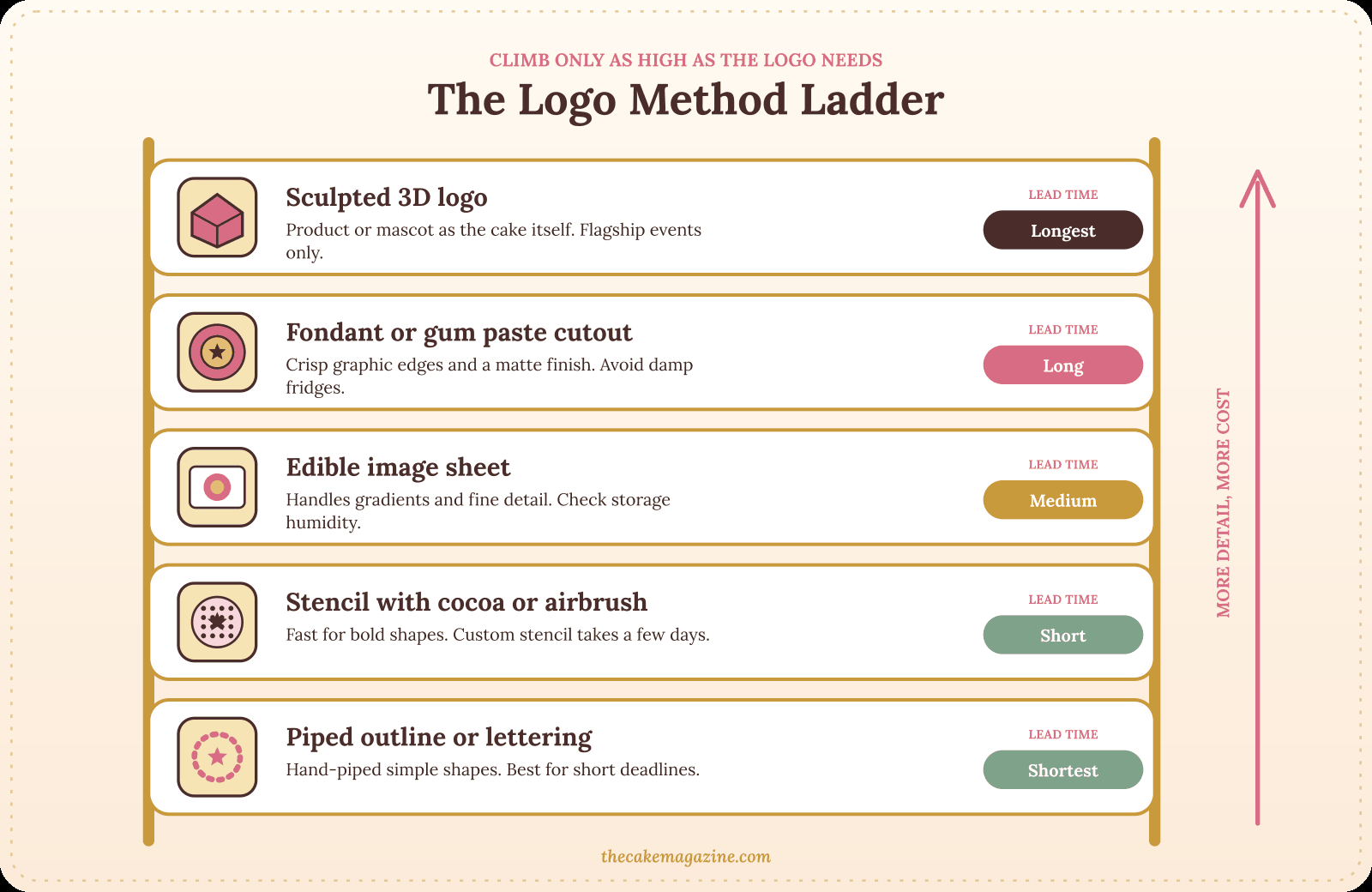
Five ways to put a logo on a corporate event cake
Bakers use several techniques to carry a logo onto a cake, and each has its own look, cost and risk. Knowing the menu lets you ask for what fits the logo’s complexity and the delivery conditions. The ladder in the figure above shows them from simplest to most detailed.
1. Piped outline or lettering
A decorator pipes the logo’s shape or name by hand in buttercream or royal icing. It looks homemade in the best sense, and it handles simple shapes and block letters well. It is a good choice for short deadlines and for logos made of clean lines. It is a poor choice for a logo with thin script, gradients or lots of small elements.
2. Stencil with cocoa, sprinkles or airbrush
A food-safe stencil lets a baker dust or spray the logo’s shape onto a cake’s surface. The result is crisp for bold shapes and softer for details. It is fast once the stencil exists, but a custom stencil may need a few days to cut. Humid rooms can smudge a stenciled finish, so ask how it will hold up where the cake is going.
3. Edible image sheet
An edible image is a thin sheet printed with food-safe ink, then applied to a cake. This is the closest thing to a photographic logo and it handles gradients and fine detail better than any hand method. Colors may print slightly lighter or different on frosting, and the sheet can bleed if the cake is very moist or kept in a damp refrigerator. Ask the bakery how it stores and applies prints.
4. Fondant or gum paste cutout
Fondant can be cut, layered and painted into a clean, graphic version of a logo. It gives a sharp edge and a matte finish that reads well in photos. It is time-consuming for complicated marks and needs to be made in advance. Fondant does not like extreme humidity or refrigeration, so confirm how the cake will be stored before choosing it.
5. Sculpted or three-dimensional logo
Some companies want their product, mascot or a three-dimensional logo as the cake itself. It is dramatic, expensive and slow, and it needs the most lead time and the most careful transport. It can be worth it for a flagship event. For most offices, a flat logo on a well-made cake gets a similar reaction at a fraction of the cost.
Ask for a proof. Whatever method is used, ask the baker to send a mockup or a photo of the printed sheet or cutout before it goes on the cake. A two-minute check by someone at the company can catch a wrong color, a flipped logo or a misspelled name.
What to ask a baker about logo work
- Which method do you recommend for this logo, and why?
- What file format and size do you need from us?
- Will I see a proof before the logo is applied?
- How will the finish hold up if the cake is refrigerated or sits in a warm room?
- Can the logo be removed for cutting, and is any part of it not meant to be eaten?
That last question is easy to forget. Some toppers, plaques and decorations are not edible, and guests should be told. A simple cake-side sign, or the baker removing the non-edible piece before slicing, avoids a lot of confusion.
Logo permission and trademark basics for a corporate event cake
Most of the time, a corporate event cake carries the logo of the company that ordered it, supplied by someone inside that company. That is the simple case. Things get more complicated when a baker is asked to reproduce a logo for someone who does not own it, such as a client’s brand, a sports team or a famous character. This section is general information, not legal advice.
What a trademark is
According to the U.S. Patent and Trademark Office, a trademark is a word, phrase, symbol or design, or a combination of them, that identifies a business’s goods or services and sets them apart from others. A logo can function as a trademark. You can read the agency’s overview on the USPTO trademark basics page.
Practical habits that keep everyone comfortable
You do not need to become a lawyer to run a sensible process. A few habits go a long way for both buyers and bakers.
- Use logos supplied by the client. If a company wants its own logo on its own cake, ask them to send the file and confirm in writing that the cake is for their event.
- Do not copy a third-party brand without permission. If a company wants a partner’s or client’s logo, ask for the partner’s approval or a supplied file, and have the company confirm it is authorized.
- Avoid famous logos and characters on commercial orders. Entertainment and sports brands are well known for protecting their marks. When in doubt, ask a qualified attorney.
- Keep a record. Save the email that includes the approved artwork and the permission, in case there is a question later.
- Do not post a client’s logo cake as portfolio work without asking. It is both courteous and sensible.
When to ask for professional advice
If the cake involves a licensed property, a co-branded promotion or any situation where you are unsure who owns the artwork, ask a qualified attorney who handles intellectual property. A short conversation costs less than a dispute. For everyday company logo cakes, supplied by the company itself, this is rarely an issue, but it is still wise to write down who approved what.
Flavors, dietary needs and allergens for a corporate event cake
A wedding has a couple with strong opinions about flavor. A company has a crowd with no shared opinions at all. That is why a corporate event cake should lean toward flavors most people enjoy and be clear about what is inside it. Safe, crowd-pleasing choices are not boring when they are baked well.
Flavors that please a mixed crowd at a corporate event cake
Vanilla and chocolate remain the most dependable pair, and a half-and-half sheet cake lets you offer both. Lemon, strawberry and vanilla with a tart berry filling are reliable bright options. Rich, heavy flavors such as coffee, strong spice or dense ganache suit a smaller, adult reception more than a large staff party. If you want a bit more inspiration, our guide to wedding cake flavors lists classic pairings that work just as well in an office.
If you are baking the cake yourself, start from a trusted base. Our best vanilla cake recipe and best chocolate cake recipe are written in grams and make solid sheet or layer cakes. Treat them as starting formulas to adapt to your own pan sizes and oven, and test any scaled-up batch before the event.
The nine major allergens
The U.S. Food and Drug Administration lists nine major food allergens: milk, eggs, fish, crustacean shellfish, tree nuts, peanuts, wheat, soybeans and sesame. Sesame became the ninth, and labeling for it has been required since January 1, 2023, according to the FDA’s page on food allergies. A typical cake contains at least three of them, usually milk, eggs and wheat, and may contain tree nuts or soy through fillings, toppings or chocolate.
That means a corporate event cake with a crowd of strangers has some real risk, and the right response is clear information, not guesswork. Ask the baker for a written ingredient and allergen list, and keep it with the cake at the event. If your company has a policy about allergen labeling for catered food, share it with the baker in advance.
Dietary requests and what is realistic
People ask for gluten-free, dairy-free, egg-free, vegan and nut-free cakes, and they are not all the same kind of request. A preference is different from a medical need. Tell the baker which it is, because a bakery that handles wheat flour in a shared kitchen cannot promise a cake is safe for someone with celiac disease, even if the recipe itself has no gluten. Ask directly about how they prevent cross-contact and be prepared to hear that they cannot.
- Ask early. Specialty cakes need their own ingredients and separate baking, so they take more lead time.
- Consider a separate small cake. A small dedicated cake, boxed and labeled, is safer and easier than modifying the main cake.
- Label everything. A card at the table with the cake name and its main allergens helps guests decide.
- Keep serving tools separate. A knife used on a regular cake should not then cut the allergy-friendly one.
Never promise what you cannot verify. If you are the baker, say plainly what your kitchen can and cannot do about cross-contact. If you are the buyer, do not tell your guests a cake is allergy-safe unless the baker has told you so in writing.
Fillings and frostings that suit an office
Cakes meant to sit on a table for a couple of hours should use fillings and icings that hold up. That generally means buttercream, ganache or fruit preserves rather than fresh whipped cream, custard or cream cheese-based mixtures, which need to stay cold. If you are curious about how different buttercreams behave in warm rooms, our guide to the types of buttercream compares them in detail.
A cake does not have to be bland to be safe, but the filling should be chosen with the clock in mind.
Delivery and setup for a corporate event cake
A beautiful corporate event cake can be undone in the last ten miles. Heat, bumps, tight corridors and missing elevators are all common, and they are all avoidable with questions asked early. Delivery is also the point where responsibility passes from the baker to the venue, so it deserves a clear plan.
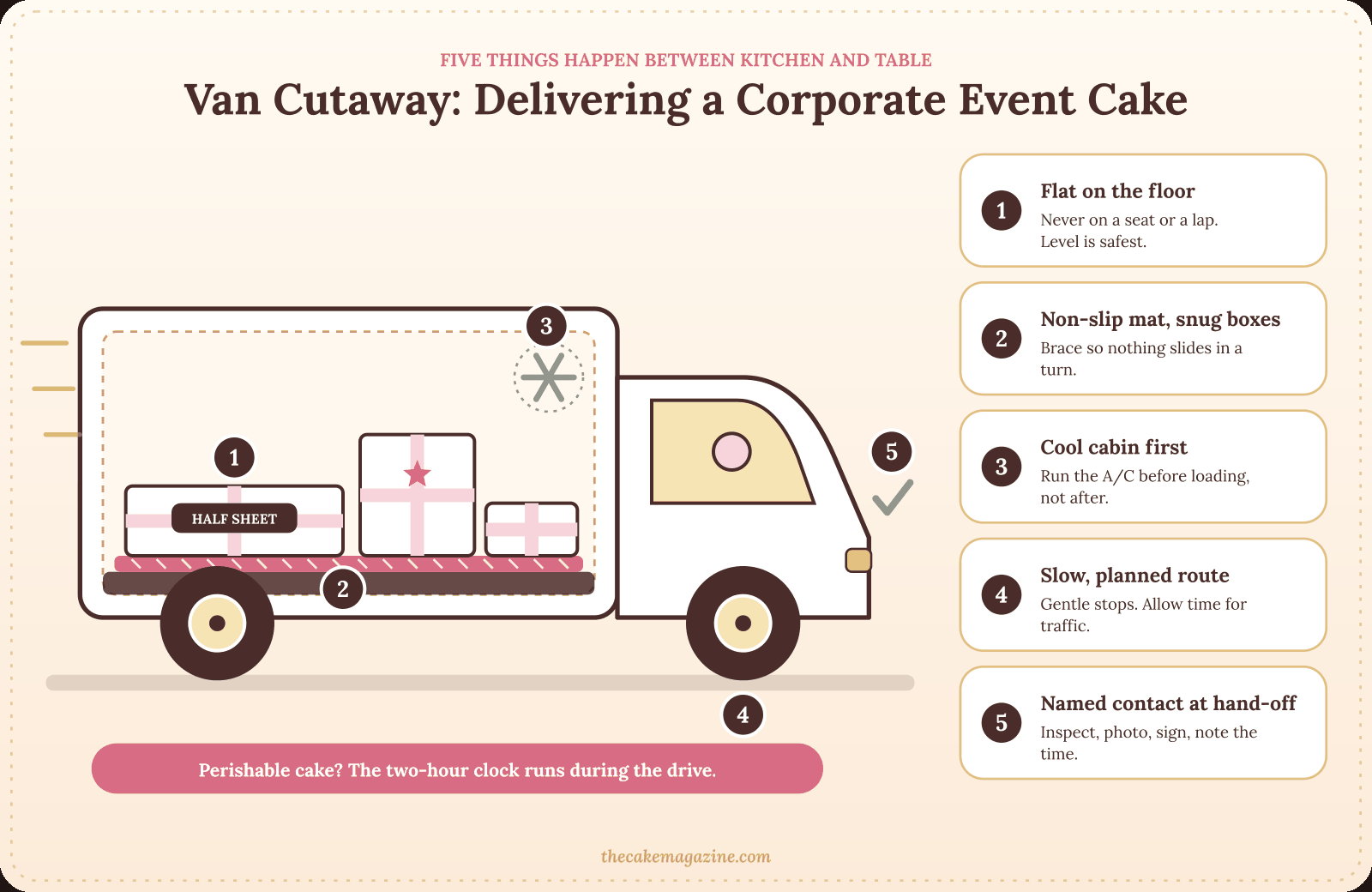
Pickup or delivery
Pickup puts the transport risk on you but costs less and gives you control. Delivery shifts the risk to the baker and usually adds a fee, which is often worth paying for tall, tiered or heavily decorated cakes. If you pick up a cake yourself, bring a helper, a flat surface for the vehicle’s floor, a non-slip mat and a plan for what to do if you hit traffic.
Our guide on how to transport a wedding cake walks through chilling, boxing and vehicle setup, and the advice applies directly to office cakes.
What to tell the baker about the venue
The more the baker knows, the better the cake will travel and look on arrival. Provide these details in writing at least a week out.
- The full address, floor and any building access rules, such as a loading dock or visitor sign-in.
- Whether there is a service elevator, and its dimensions if the cake is large.
- The name and mobile number of a contact who will be on site and can actually answer the phone.
- The delivery window, and the time the cake needs to be on display, which are not always the same.
- Whether there is a refrigerator or a cool room, and how long the cake will sit out.
- Whether the venue is outdoors, in direct sun or near a heater, a kitchen or a window.
Set the stage before the corporate event cake arrives
Prepare the table in advance. Choose a sturdy, level surface that is large enough for the cake board with space around it. Cover it with a clean cloth if the venue has one. Keep it out of direct sunlight and away from vents, windows and heaters. Put plates, forks, napkins and a cake knife nearby, so the cake does not sit unattended while someone hunts for utensils.
For a longer checklist of table, lighting and temperature details, see our cake setup checklist for venues, written for weddings but just as useful for a company reception.
Inspect the corporate event cake on arrival
Have the person receiving the cake look it over while the driver is still there. Check the spelling, the logo placement, the number of tiers or sheets and any damage in transit. If something is wrong, take a photo and tell the baker immediately. Small repairs, like a patched corner or a touch-up of icing, are often possible on site if the baker carries a repair kit, which careful decorators usually do.
Who cuts and serves?
Decide in advance who will cut the cake. A catering team may do it, a company volunteer may do it, or the baker may offer pre-cutting for a fee. If nobody is in charge, the cake often ends up sliced unevenly and runs out early. Hand the cutter a simple instruction card with the slice size, such as “cut about 2 by 3 inch pieces,” and the cake will stretch as planned.
Food safety for a corporate event cake
Food safety sounds like a boring subject until someone gets sick after a company party. The rules are not complicated, but they are strict about time and temperature, and they matter most for cakes with perishable fillings. The core ideas come from the U.S. Department of Agriculture’s Food Safety and Inspection Service, whose food safety pages are a good place to start.
The danger zone and the two-hour rule
USDA explains that bacteria grow fastest between 40°F and 140°F, a range known as the danger zone, and that their numbers can double in as little as 20 minutes. Perishable food should not be left out of refrigeration for more than two hours. When the temperature is above 90°F, that limit drops to one hour. You can read the details on the agency’s page about how temperatures affect food.
Not every cake is equally perishable, and a plain butter cake with a high-sugar buttercream is generally more forgiving than one filled with cream or custard. Still, the safest approach for a corporate event cake is to treat the two-hour limit as the working rule for anything with dairy, eggs or fresh fruit, and to ask your baker which components of your cake are perishable.

Keep the clock honest on a corporate event cake
The clock starts when the cake leaves refrigeration, not when it reaches the table. Count the car ride, the time spent waiting for an elevator and the setup before the toast. If the cake must sit out for a long event, plan to cut it early, serve it promptly and return any unserved perishable portions to a refrigerator, or discard them if they have been out too long.
- Ask the baker which parts of the cake need refrigeration and how long it can sit out.
- Write down the time the cake is placed on the table.
- Keep perishable cakes in a cool room until shortly before service.
- Use a clean, dedicated knife and serving utensil.
- Do not let leftovers sit on the table all afternoon as an office snack.
Cleanliness at the baking end
If you are the baker, handling matters as much as temperature. Wash your hands, use clean tools and keep raw ingredients away from finished cake. Label the box with the cake’s name, the allergens and the date it was made. For a broader view of kitchen rules for home bakers, read our guide to starting a cake business, and always check your state and local agencies for what they require when you sell food, because rules vary by location.
Rules differ by place. Venues, hotels and some companies have their own food policies, and some require food from a licensed or inspected kitchen. Ask the venue and your local health department what applies. We do not list specific legal requirements here, because they change and vary.
A corporate event cake for outdoor and summer events
Heat and sun are the biggest enemies of an event cake. Buttercream softens, fondant sweats and logos slide. If the event is outdoors, choose a sturdy icing, keep the cake in the shade, bring it out late and consider a smaller display cake with the main cake kept cold inside. Plan for a shorter time on the table, since the one-hour limit applies when it is hot out.
Budget, quotes and invoices for a corporate event cake
We are not going to quote prices here, because they differ widely by region, bakery and design. What we can do is show what drives the cost so a quote makes sense when it arrives. If you are a baker setting your own rates, our guide on how to price cakes covers ingredients, labor, overhead and profit, and the wedding cake cost article explains the same factors from the buyer’s side.
What moves the price
- Servings. More cake means more ingredients and more labor, though not in a perfectly straight line.
- Logo method. A printed edible image is usually simpler than a hand-cut, painted fondant logo, and a sculpted mark costs the most.
- Complexity and size. Tiers, supports and structural work add time.
- Dietary accommodations. Specialty cakes need separate ingredients and extra care.
- Delivery and setup. Distance, stairs, venue rules and wait time all add cost.
- Rush fees. Short notice often means extra charges, since other work has to move.
Questions that make corporate event cake quotes comparable
Two quotes can look different because they cover different things. Ask each bakery the same questions so you can compare fairly. Does the price include delivery and setup? Is the logo print or cutout included? Are plates, forks and a cake knife included or extra? What does the bakery charge if the headcount changes? What is the cancellation policy and how much of the deposit is refundable?
Deposits, invoices and company paperwork
Businesses often need things a private customer does not: an itemized invoice, a purchase order number, a tax or business name on the paperwork and a payment term. Tell the bakery early what your finance team needs, so the invoice is right the first time. A baker should provide a written agreement that lists the date, the time, the design, the flavors, the price, the deposit and the policies for changes and cancellations.
Put approvals in one email thread. When a design changes, summarize the final version in a single message and ask the company contact to reply “approved.” That one sentence saves many arguments about what was agreed.
Ways to keep a corporate event cake on budget without looking cheap
You can get a polished result without paying for sculpted work. Use a hero-and-sheet plan, choose a simpler logo method, limit the colors, skip add-ons that no one will eat and order a size based on real counts. A well-proportioned sheet cake with clean lettering and a bold border often looks better than an ambitious design that was squeezed into a budget.
Common mistakes to avoid
Most problems with a corporate event cake repeat from one order to the next. Here are the ones that cause the most grief, with the quick fix for each.
Ordering too late
What it looks like: a request three days out for a printed logo cake on a busy week.
Why it happens: the occasion gets decided in a meeting and the cake is assumed to be easy.
Fix it next time: start the order two to three weeks ahead and send artwork at the first message. If you are late, choose a simpler design.
Using a low-quality logo file
What it looks like: a blurry, pixelated or stretched logo on the finished cake.
Why it happens: someone sent a screenshot or a small image from a website.
Fix it next time: ask the marketing team for a vector file or a high-resolution PNG, and approve a proof.
Guessing the headcount
What it looks like: the cake runs out, or half of it comes back to the office.
Why it happens: “about 80 people” turns into 55 or 110.
Fix it next time: confirm RSVPs, apply the right slice size and add a modest cushion or a back-up sheet.
Ignoring allergens
What it looks like: a guest asks what is in the cake and no one knows.
Why it happens: the bakery was never asked for an ingredient list and nobody labeled the cake.
Fix it next time: request a written allergen list, display it, and offer a separate, clearly labeled option when needed.
Letting the cake sit out too long
What it looks like: melting icing, sweating fondant, sagging decoration or a food safety worry.
Why it happens: the cake arrives early, sits in a warm room and the event starts late.
Fix it next time: schedule delivery close to service, keep it cool and track the time out of refrigeration.
No one meets the delivery
What it looks like: a driver waiting at a locked door with a cake in a hot van.
Why it happens: the contact person was in a meeting or the phone number was a desk line.
Fix it next time: name a mobile contact, share building access details and agree on a backup person.
Three worked examples
The scenarios below are illustrations, not case studies. They show how the pieces fit together so you can adapt them to your own event.
The 60-person office anniversary corporate event cake
An office is marking ten years in business with an afternoon gathering. Cake is the main treat, so the planner expects nearly everyone to take a slice and adds a small cushion. A half sheet comfortably covers the low end of the range, but with 60 people and generous slices, they choose a half sheet plus a quarter sheet in the kitchen.
The logo is a simplified one-color version on an edible print, with a band of the brand color around the base. Delivery is set for an hour before the toast, and the cake waits in the office kitchen refrigerator until then.
The 150-guest product launch
A launch event includes a catered buffet and a dessert station. Because other sweets are available, the team plans for roughly two-thirds of guests to try the cake. They choose a two-tier hero cake with a fondant logo for photos and a pair of half sheets in matching flavors for the serving line.
A cutter from the catering team portions the sheets while the hero cake is cut ceremonially for the speech. The planner asks for the allergen list and displays it on a small card at the table.
The remote team celebration
A distributed team of 24 people across several cities wants a shared moment. The company orders individually boxed mini cakes with a small logo tag, shipped or hand-delivered through local partners with a delivery list and dietary notes. Everything is labeled and instructions say to refrigerate on arrival. The planner schedules a video call where everyone eats at the same time and keeps the food safety instructions short and clear.
Printable planning checklist for a corporate event cake
Copy this list into an email or a shared document and fill it in with your baker. Every item here has appeared in a section above, and none of them takes long if you ask early.
The event: date, start time, cake service time, venue, address, floor, and on-site contact with a mobile number.
The count: confirmed headcount, estimated cake-eaters, slice size, and a plan for a back-up cake.
The design: approved logo files, brand colors, exact wording, one-color option, proof approved by a named person.
The cake: format, flavors, filling, frosting, allergens, dietary requests and a written ingredient list.
The money: quote, deposit, invoice details, purchase order, cancellation and change policy.
The logistics: pickup or delivery, delivery window, access notes, refrigerator availability, table setup and who cuts.
The safety: perishable parts identified, time out of refrigeration tracked, utensils clean, leftovers handled promptly.
Corporate event cake FAQ
How far ahead should I order a corporate event cake?
For a branded cake, plan on two to three weeks, and earlier during busy seasons such as the weeks before major holidays. Plain sheet cakes can sometimes be done in a few days, but logo work, printed images and tiered designs need more time. Ask your bakery for its policy and send your logo files with the first message.
How many servings do I need for a corporate event cake?
Start with the number of people who will really eat cake, not the full guest list. If cake is the only dessert, plan for nearly everyone. If other sweets are served, plan for roughly two-thirds to three-quarters. Then add a modest cushion. Slice size matters as much as headcount, so tell the person cutting the cake what size to cut.
Can a bakery put our company logo on a cake?
Yes, in most cases, using an edible print, a piped design, a stencil or a fondant cutout. Send a vector file or a high-resolution image and ask for a proof. The baker should confirm which method suits your logo and how it will hold up at your venue, since moisture and heat can affect the finish.
Do we need permission to put a logo on a corporate event cake?
If it is your own company’s logo, supplied by your team, that is usually straightforward. If it belongs to a client, partner or another brand, get their approval in writing before the baker reproduces it. This is general information, not legal advice, so ask a qualified attorney if you are unsure about a licensed or protected mark.
What is the best cake size for a company party of 50?
A half sheet cake is a common choice for around 30 to 48 party slices, so for 50 people a half sheet plus a quarter sheet gives you a comfortable cushion, especially if cake is the only dessert. If other food is served, a single half sheet may be enough. Confirm the pan size and slice count with your baker.
Is a sheet cake or a tiered cake better for a corporate event cake?
A sheet cake is easier to serve, cheaper per slice and simpler to transport. A tiered cake makes a stronger centerpiece but needs supports, a level table and more care to cut. Many companies combine both, with a decorated hero cake for photos and a plain sheet cake in the kitchen for serving.
How long can a corporate event cake sit out safely?
USDA guidance says perishable food should not be left out of refrigeration for more than two hours, or one hour when it is above 90°F. Cakes with dairy, cream, custard or fresh fruit are the most sensitive. Ask the baker what applies to your cake, and keep it cool until shortly before serving.
How do I handle allergies at a corporate event cake?
Ask the baker for a written ingredient and allergen list and display it with the cake. The FDA names nine major allergens: milk, eggs, fish, crustacean shellfish, tree nuts, peanuts, wheat, soybeans and sesame. For serious allergies, consider a separate, clearly labeled cake and ask the bakery honestly about cross-contact before you rely on it.
Should the bakery deliver, or should we pick up the cake?
Delivery is usually safer for tall, tiered or heavily decorated cakes, because the baker handles the transport and setup. Pickup costs less but puts the risk on you, and needs a helper, a flat vehicle floor and a plan for traffic. For a big event, delivery fees are generally worth paying.
What file format is best for a logo on a cake?
A vector file such as SVG, EPS or PDF is best, since it can be sized without losing sharpness. A high-resolution PNG with a transparent background also works. Avoid screenshots and small web images. A simplified or one-color version of the logo often looks cleaner on a cake than the full-color original.
Can a home baker make a corporate event cake?
Maybe. It depends on local rules about selling food from a home kitchen, which vary by state and locality, and on what the company or venue requires. Some businesses only accept food from licensed kitchens. Check with your state and local agencies, and read our guide on how to start a cake business for the basics.
What should I put in writing with the baker?
Put the date, time, address, contact person, serving count, design, logo approval, flavors, allergens, price, deposit and the change and cancellation policy in writing. Summarize the final approved design in one message and ask for a reply confirming it. A clear written record helps everyone and prevents most disagreements.
Final thoughts on the corporate event cake
A great corporate event cake is rarely the most elaborate one. It is the one that arrives on time, carries the right logo in the right color, feeds the actual crowd and stays safe to eat from the first slice to the last. None of that takes special talent. It takes a few honest questions asked early, a written record and a baker who is told the truth about the room.
If you remember only a handful of things, make them these: send clean logo files and approve a proof, confirm the real headcount and slice size, plan the delivery around a named contact, and watch the clock on anything perishable. Then let the cake do what it came to do, which is to make a workday feel like an occasion.
Planning a company cake right now? Tell us what you are celebrating and what has been hardest to figure out, and we will keep improving this guide and the ones around it.
Editorial note: reviewed and updated November 2026. This guide offers general information only and is not legal, trademark, medical or professional food safety advice. Serving ranges, timelines and slice sizes are planning guides, not guarantees, and bakeries differ. Food safety figures come from USDA and FDA pages we read while writing, and local health rules vary, so check with your state and local agencies and your venue.