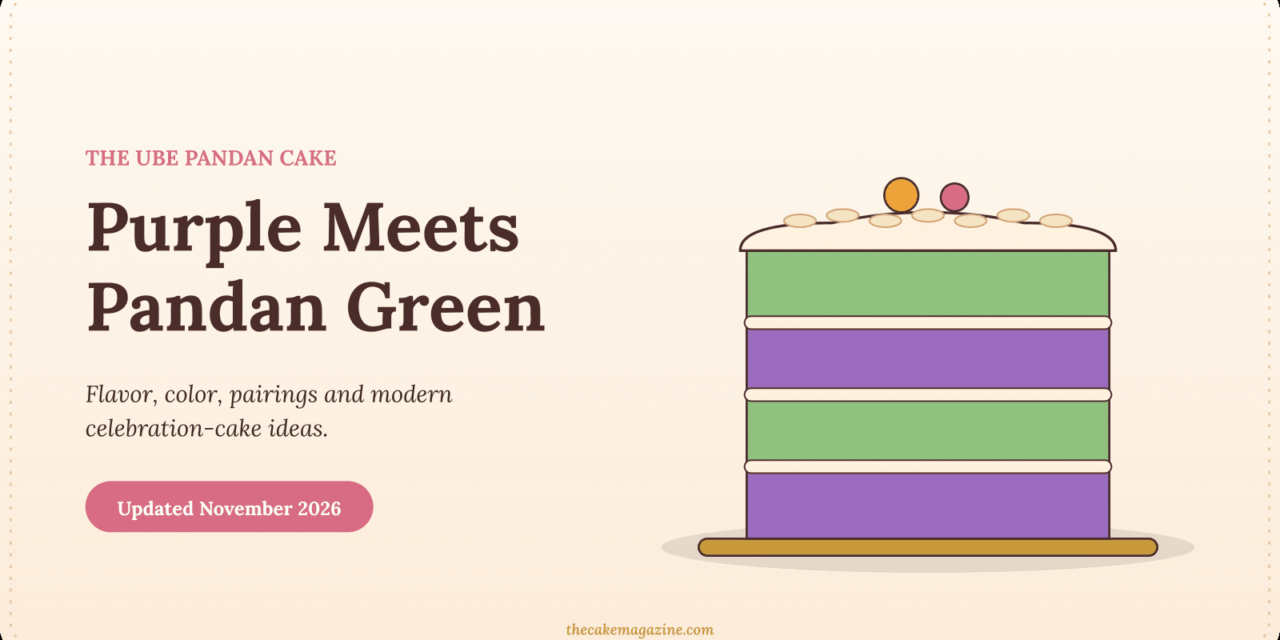
The first time most people see an ube pandan cake, they stop and stare. One layer is a deep lavender-purple, the next is a soft jade green, and the whole thing smells faintly of coconut and warm vanilla. It looks like a dessert from another planet, yet the flavors are gentle and familiar once you taste them. This guide explains what is inside the cake, why the two flavors work together, how to keep both colors bright, and how to turn the idea into modern celebration cakes for birthdays, showers, weddings and holidays.
An ube pandan cake combines two Southeast Asian flavors: ube, a purple yam with a mild, nutty, vanilla-like sweetness, and pandan, a fragrant tropical leaf with a grassy, coconut-like aroma. They are usually baked as separate colored layers, or swirled together, and joined with coconut cream, whipped cream or a light buttercream. The main challenges are color and moisture. Use real ube and real pandan for flavor, add color gently, keep batters on the acidic side of neutral, and chill the cake before you stack it.
- What an ube pandan cake really is
- Ube: flavor, color and origin
- Pandan: the fragrant green leaf
- Why the ube pandan cake is trending in 2026
- Why ube and pandan belong together
- Ingredient forms: what to buy and what to expect
- Keeping the colors true
- A starting formula for an ube pandan cake
- Sponge, chiffon or butter cake?
- Fillings and frostings
- Variations
- Modern celebration-cake ideas for an ube pandan cake
- Drinks, toppings and pairings
- Storing and serving safely
- Planning day by day
- Costs and pricing
- Troubleshooting an ube pandan cake
- Common mistakes with ube pandan cake
- Frequently asked questions about ube pandan cake
What an ube pandan cake really is
There is no single official ube pandan cake. The name describes a family of cakes that use ube, pandan or both. Some are tall chiffon cakes in two colors. Some are butter cakes with ube halaya folded into the batter. Others are simple pandan sponges with a ribbon of purple jam between the layers. What they share is a flavor pairing and, nearly always, a striking color contrast.
Both ingredients in an ube pandan cake come out of Southeast Asian kitchens, and especially from the Philippines, where purple yam desserts and pandan-and-coconut sweets are part of everyday and festive eating. A baker outside that tradition can still make a lovely ube pandan cake. It helps to understand the source ingredients first, because the whole cake depends on how they behave.
Three common ways to build one
The two-layer or multi-layer stack is the most common in celebration baking. One batter is tinted and flavored with ube, the other with pandan, and the layers alternate. The cross-section is the showpiece, so the frosting is often kept pale to let it show through.
The marbled or swirled cake divides one base batter into two bowls, flavors each, then drags a skewer through both. The result is a softer, more rustic pattern, and it is more forgiving if your layers do not come out perfectly flat.
The single-flavor cake with a contrast element bakes one pandan sponge, say, and adds ube through the filling, a glaze or a topping. It suits bakers who want the look without managing two batters. Any of these can be called an ube pandan cake, and all three are covered below.
What the cake tastes like
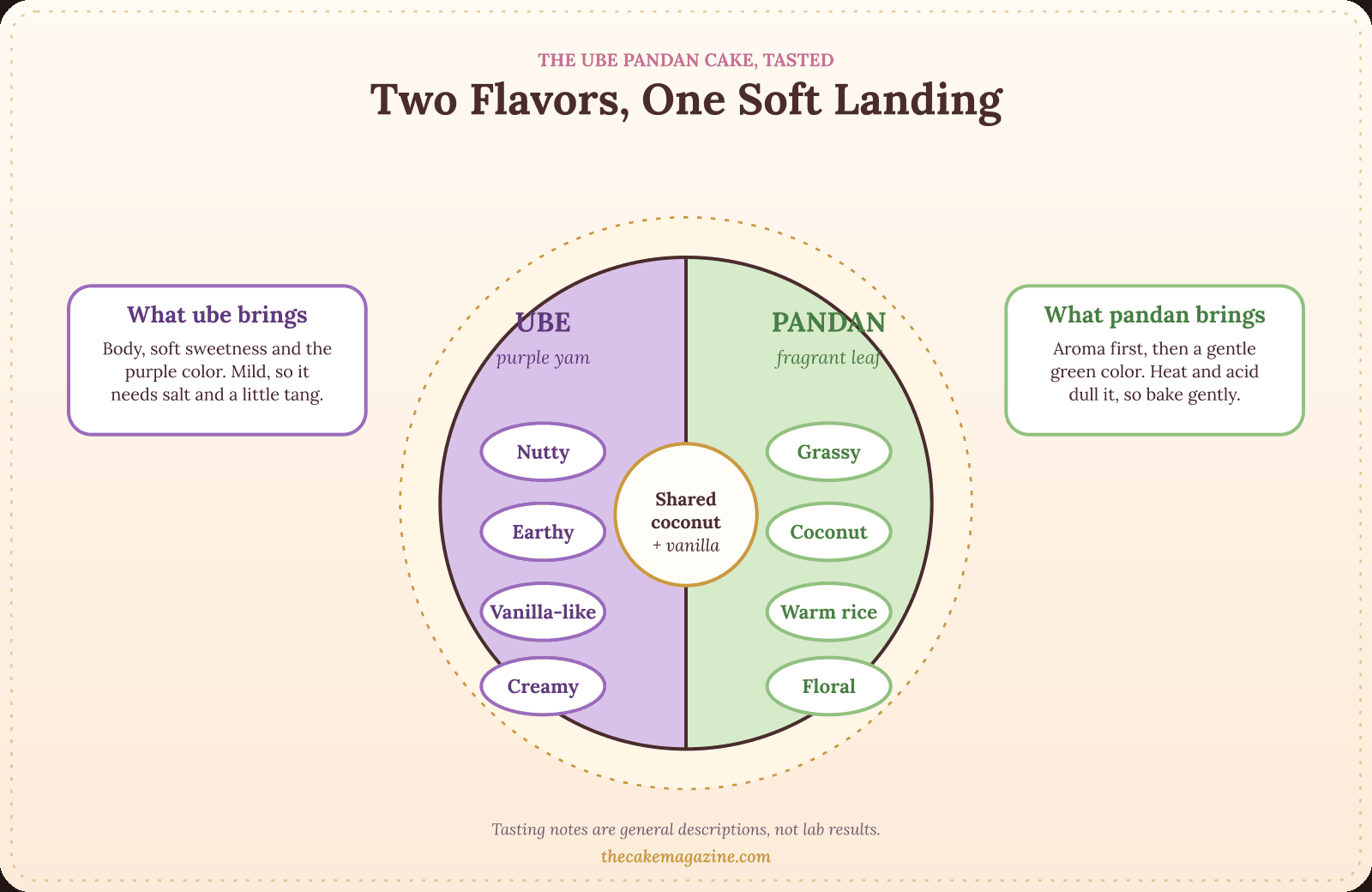
People who have never tried either flavor often ask for a comparison, and the honest answer is that there is no perfect one. Ube is mild, a little earthy and slightly nutty, and many people describe a vanilla-like sweetness in the finished dessert. Pandan is more aromatic: green, warm and a bit like a mix of vanilla, fresh hay and coconut. Together they taste soft and rounded rather than loud, which is why a pinch of salt and a little tang often help.
A quick honesty note. This site has not oven-tested the formula in this article. The ratios are conservative, familiar baking ratios, and we say where you should adjust. Treat every amount and time here as a starting point, and keep a notebook of what your oven and your brand of ube do.
Ube: flavor, color and origin
Ube, pronounced roughly OO-beh, is the Filipino name for the purple yam known to botanists as Dioscorea alata. According to the Wikipedia entry on the plant, it is native to the tropics of Asia and Oceania, and the Philippines is considered its center of origin. The word comes from Tagalog. In English you will also see it called purple yam, greater yam or water yam.
The tubers are usually vivid violet to bright lavender inside, although some varieties are cream or white. The purple comes from anthocyanins, the same family of pigments that color blueberries and red cabbage. That detail is the key to everything that follows about baking, because anthocyanins change shade as acidity changes.
Ube is not taro and not an orange sweet potato
Ube gets mixed up with other roots. Taro is a different plant, usually pale with a lavender fleck, and it is starchier and less sweet. Purple sweet potatoes look similar, and the Wikipedia article notes that they are often substituted for ube. Ube tends to be moister and carries more pigment. If you cannot find ube, purple sweet potato can stand in, though the flavor and color will not match exactly.
It also helps to remember that a bright purple cake does not always mean ube. Some bakeries use purple food coloring or a flavored extract to get the look. If real flavor matters to you, read the ingredient list on whatever you buy.
How ube is sold
Fresh ube appears at Asian grocers and is less common in ordinary supermarkets. Frozen grated ube is easier to find. Ube halaya, a sweetened, mashed and cooked purple yam spread, is sold in jars and tubs. Ube powder, ube extract and ube paste or flavoring are also common. Each behaves differently in a batter, and the section on ingredient forms below walks through what to expect from each.
Pandan: the fragrant green leaf
Pandan is the long, flat, blade-like leaf of Pandanus amaryllifolius, a tropical plant used throughout Southeast Asia and parts of South Asia. Cooks tie it into knots and simmer it in coconut rice, wrap it around chicken, steep it into custards and blend it into cakes. The Wikipedia entry on the plant notes that its signature scent comes from the compound 2-acetyl-1-pyrroline, the same aroma compound that gives jasmine rice and fresh white bread their toasty smell.
That is a nice thing to know the first time you smell it. If pandan seems familiar but you cannot place it, think of rice cooking. The scent is warm and slightly sweet more than it is vegetal.
Fresh, frozen, extract and paste
Fresh pandan leaves are sold in some Asian markets, and frozen leaves are common where the plant does not grow. Bottled pandan extract is the convenient choice, but the same source warns that extracts often contain green food coloring. That is not a flaw, only something to know when you are judging how much natural color your cake really has.
For the best aroma, many bakers blend fresh or thawed leaves with water or coconut milk, strain the liquid through a fine sieve and use that. It is more work, and it gives a flavor that extract rarely matches. An easy middle path is to use blended leaf juice for scent and add a little extract only if the color needs help.
Why pandan color shifts in the oven
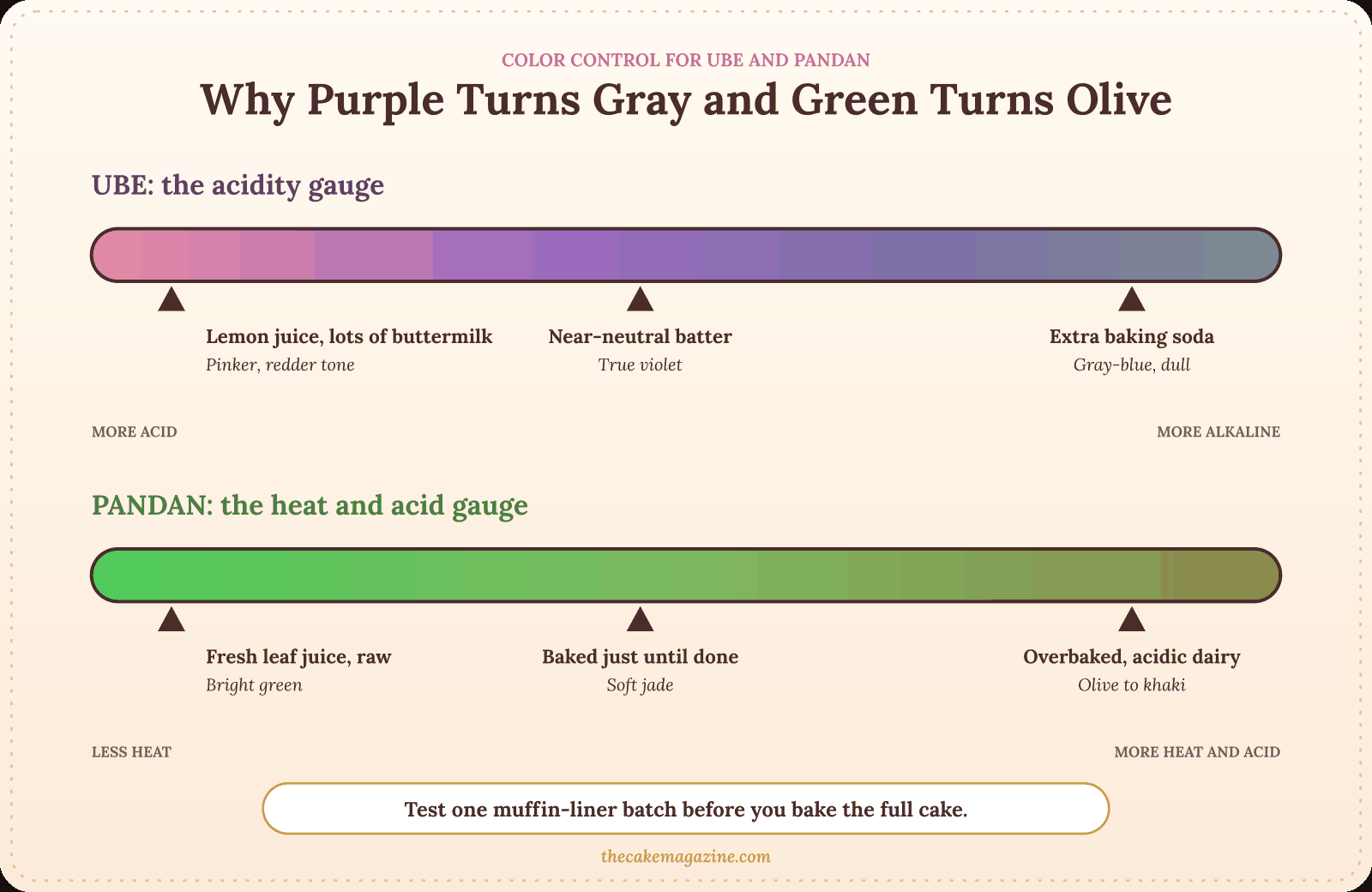
The green in pandan juice is chlorophyll, and chlorophyll is delicate. Heat and acid both tend to push it from bright green toward olive. A pandan layer that looked emerald in the bowl can bake into something closer to khaki, particularly if it is overbaked or if the batter contains a lot of acidic dairy. Many bakers expect this and add a small amount of green coloring, or let the aroma matter more than the shade.
Why the ube pandan cake is trending in 2026
Ube has moved from specialty bakeries to mainstream menus quickly, and pandan is following behind it. As of November 2026, the evidence we could verify points to real growth, though not to a precise number for cakes alone. We separate what the sources say from what is repeated online, because a tidy statistic is easy to inflate.
What the sources say
The convenience-store trade association NACS reported in April 2026 on research from the firm Datassential. It found ube on about 1.3 percent of U.S. restaurant menus, with the firm projecting 2.4 percent by 2029. It also reported consumer awareness of ube at 27 percent, up from 15 percent in 2021, and 13 percent of people who had tried it. Those figures belong to Datassential as reported by NACS.
The trade site BakeryAndSnacks, in an article from April 2026, described ube as a possible successor to matcha. It cited Google Trends for a rise in global search interest from the end of February 2026, and Transparency Market Research for a forecast growth rate of 6.9 percent a year from 2025 to 2035. It also reported a Mintel analyst saying that Filipino farmers were struggling to keep up with demand.
What this does and does not tell you. These numbers describe ube as a flavor across menus and packaged foods, not cake sales. Pandan has fewer published figures than ube. Read the trend as growing curiosity and rising menu presence, not as proof that every bakery should add it.
Why the ube pandan cake suits the moment
Three things help explain the interest. The color photographs beautifully, and a purple and green cross-section is exactly what people share. The flavors are gentle, so a cake in this style does not require a taste for strong spices or bitterness. And ube and pandan carry cultural meaning for the communities that grew up with them, so many bakers want to make them well, not just use them as props.
If you follow wider forecasts, our overview of 2026 cake trends places this flavor pair alongside mini formats, texture play and tangy flavors. It is a good example of a trend that is durable because it rests on a real tradition, not only a color.
Is the ube pandan cake a durable trend or short-lived hype?
Our reading is cautious. Bright colors tend to cycle, and the early surge in search interest could cool. Still, a flavor with roots in an established dessert tradition and a growing mainstream presence tends to hold on longer than a one-season novelty. If you sell cakes, test it as a seasonal or limited flavor before committing to a full menu. If you bake at home, you do not need a forecast to justify a cake you will enjoy.
Why ube and pandan belong together
It is easy to assume the pairing is only about the color wheel. Purple and green are close to opposites, so they stand out next to each other. But there is more going on in the mouth than on the plate.
Coconut is the bridge
In Southeast Asian sweets, pandan and coconut appear together constantly, and ube is often cooked with coconut milk or paired with coconut in desserts. In a cake, coconut milk or coconut cream gives both layers a shared base. It softens the earthiness of ube and rounds out the grassy edge of pandan. A recipe with ube in one layer and pandan in the next will taste more unified if both batters use the same coconut element.
Mild, sweet and aromatic
Ube is the soft, nutty part. Pandan is the perfume. One carries body and the other carries scent, so a forkful with both feels fuller than either alone. A little salt keeps that sweetness from turning flat, and a spoonful of something tart on the side, such as fresh mango or passion fruit, makes the whole slice feel brighter.
For a closer look at the way tart flavors lift rich cakes, see our guide to tangy cake flavors. The same logic applies here.
Texture helps the pairing
Pandan is traditionally baked into airy chiffon cakes. Ube, on the other hand, is often found in denser, creamier forms, such as halaya or ube cheesecake. Putting a light, springy pandan sponge next to a moist ube layer gives a contrast in every bite. It also means each batter should be chosen for its job rather than forced into the same recipe.
Ingredient forms: what to buy and what to expect
The same flavor name can mean very different products. Knowing what you are holding saves you from a purple that fades or a flavor that disappears. We have not tested specific brands and we do not recommend any, so the notes below describe categories only.
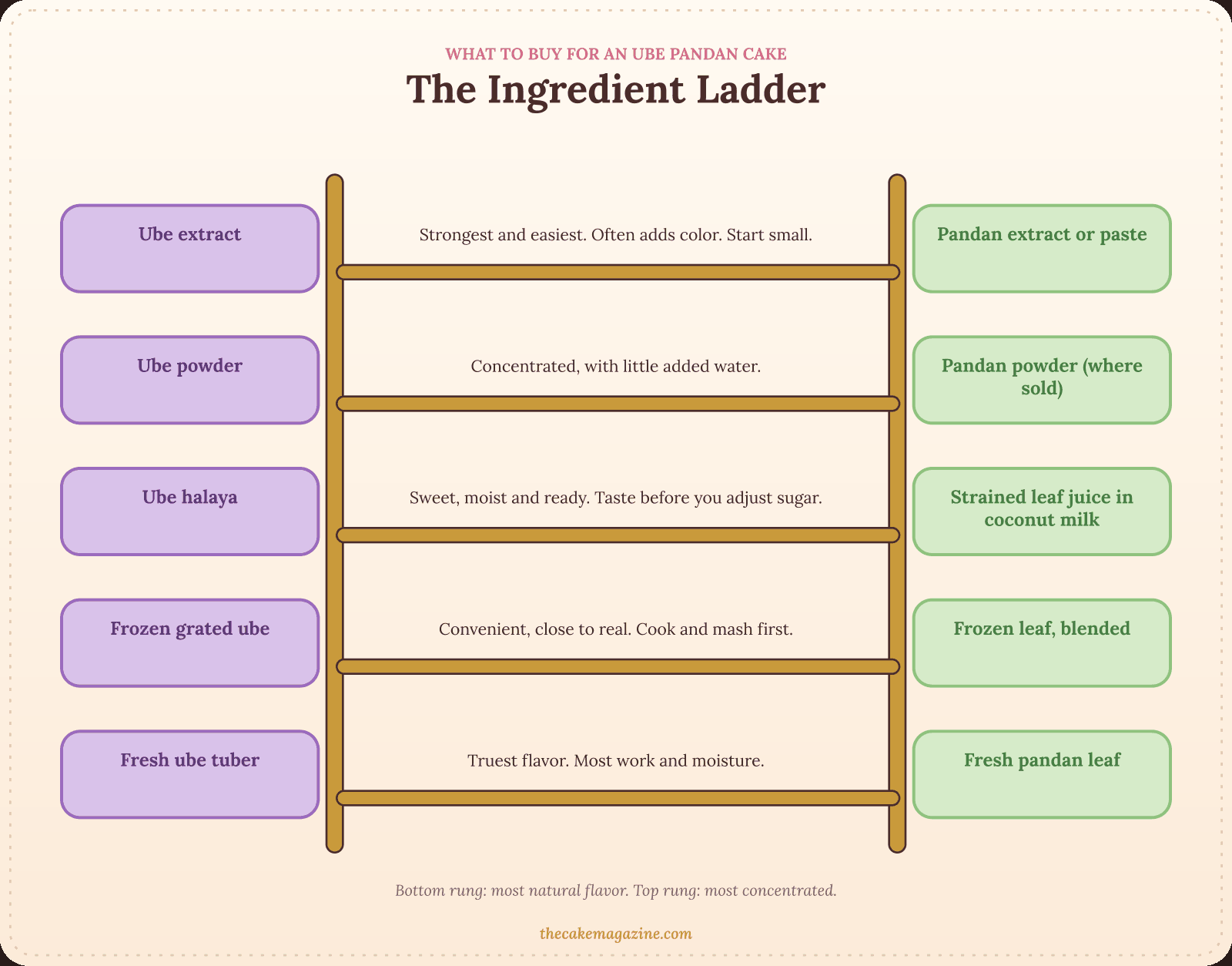
Ube forms, from most to least natural flavor
Fresh or frozen grated ube
The closest thing to the real tuber. You cook it, mash it and often sweeten it yourself. It brings true flavor and natural color but also a lot of moisture, so the cake formula has to account for it. Frozen grated ube is a convenient place to start.
Ube halaya (jam)
Cooked, sweetened and mashed purple yam, often with milk or coconut milk. It is thick and ready to use as a filling, a swirl or a batter addition. Sweetness varies by maker, so taste before you adjust the sugar in your cake.
Ube powder
Dried and ground ube. It is concentrated, shelf-stable and lets you add flavor without adding much water. It can taste a little flat on its own, so bakers often combine it with halaya or extract.
Ube extract or flavoring
A small amount carries a lot of flavor, and many products have added color. Because extracts differ widely, read the label and start with less than you think you need. Treat extract as a booster, not as the only source.
Pandan forms
Fresh or frozen leaves give the best aroma. Blend them with a measured amount of water or coconut milk, then strain well. Bottled extract is quick and consistent, and it usually contains added color, as noted earlier. Pandan paste, where sold, is typically thicker and can be stronger than extract. Because strengths vary, add pandan in stages and smell as you go.
A note on labels and allergens
Coconut milk and coconut cream appear in many versions of this cake, along with eggs, dairy and wheat. If you are baking for others, ask about allergies and label accordingly. If you sell cakes, your state or local rules decide what labels you need, so check with your state agency instead of relying on a blog.
Keeping the colors true in an ube pandan cake
This is the part that separates a beautiful ube pandan cake from a muddy one. Both colors are natural pigments, and both are sensitive. Learning a few rules will save a lot of disappointment.
Why ube turns gray, blue or pink
Anthocyanins shift with acidity. In more acidic conditions they lean redder and pinker. In more alkaline conditions they drift toward blue, green or gray. Baking soda is alkaline, so a batter with a lot of it can push ube toward a dull gray-blue. Heavy lemon juice or lots of buttermilk can tilt it pink. This behavior is a general property of anthocyanin pigments, and it is why bakers often keep ube batters close to neutral.
Test small first. Mix a spoonful of ube batter with a tiny pinch of baking soda, and another with a drop of lemon juice, and bake each in a muffin liner. You will see the pH shift in about twenty minutes, and it costs almost nothing.
Protecting pandan green
Chlorophyll fades with heat and acid. Bake pandan layers only until done, since extra minutes dull the color. Use the lower end of your oven range. Avoid adding much sour cream or lemon to the pandan batter, and let the coconut milk and leaf juice do the flavoring. If the color still comes out olive, a small drop of green coloring corrects it.
Natural color versus added color
It is perfectly reasonable to add a little gel color to boost either layer, and many professional bakers do. Just be honest with yourself about what is natural. If a customer expects an all-natural cake, tell them what you used. A drop of purple or green gel can rescue the look without changing the taste, but a large amount can add a bitter edge.
Light and time matter too
Natural pigments tend to fade in bright light and over days. Keep finished cakes out of direct sun, and photograph and serve them soon after cutting. A cake that looks brilliant at 2 p.m. under a window can look pale by the evening.
A starting formula for an ube pandan cake
The formula below builds on the same conservative butter-cake ratios as our best vanilla cake recipe, divided into one ube batter and one pandan batter. It makes two 6-inch layers of each color, or enough for a four-layer cake. It is a starting formula to adapt, not a tested recipe. Ovens, pans and ube products vary, so bake test layers before you commit to a celebration cake.
Shared base, per flavor
Each batter uses the same base, then diverges in flavor and liquid. Weigh everything. Ube halaya and coconut milk are heavy and sticky, and volume measures can drift by a whole third.
Base for one batter
- Cake flour150 g (about 1 ¼ cups, spooned and leveled)
- Granulated sugar140 g (about ⅔ cup)
- Baking powder5 g (1 ¼ teaspoons)
- Fine salt2 g (½ teaspoon)
- Unsalted butter, cool room temperature85 g (6 tablespoons)
- Large egg50 g (1 egg)
- Egg yolk18 g (1 yolk)
- Pure vanilla extract4 g (1 teaspoon)
Ube batter additions
Ube layer
- Ube halaya120 g (about ½ cup)
- Full-fat coconut milk, shaken70 g (about ⅓ cup)
- Ube extract (optional)start with 2 g (½ teaspoon), taste the batter
- Purple gel color (optional)one tiny dot at a time
Because the halaya brings its own sugar and moisture, this formula has slightly less sugar than a plain vanilla version would at the same flour weight, and less liquid. If your halaya is very sweet or very loose, hold back some coconut milk and look for a thick, spoonable batter.
Pandan batter additions
Pandan layer
- Pandan leaf, thawed or freshabout 60 g, cut small
- Full-fat coconut milk120 g total, for blending with the leaves
- Pandan extract (optional)start with 2 g, add only if needed
- Green gel color (optional)one tiny dot at a time
To prepare the pandan liquid, blend the leaves with the coconut milk until nearly smooth, then press the mixture through a fine sieve. Weigh the strained liquid and top it up with coconut milk to 120 g. Discard the pulp. This liquid keeps for a day in the refrigerator, but the aroma is brightest when fresh.
Method, step by step
- Heat the oven to 335 to 350°F (170 to 175°C) and prepare four 6-inch pans with parchment and pan release.
- In a stand mixer or large bowl, combine the dry ingredients for one batter and add the butter in pieces. Mix on low until the mixture looks like damp sand.
- Whisk the egg, yolk, vanilla and flavored liquid, then pour in about two-thirds, mix on medium for 40 to 60 seconds, scrape and add the rest.
- For the ube batter, fold in the halaya at the end until the color is even.
- Divide each batter between two pans by weight and tap out large bubbles.
- Bake until a skewer shows a few moist crumbs, usually somewhere in the 25 to 32 minute range. Pandan layers can come out of the oven a minute earlier to protect color.
- Cool 10 minutes in the pan, turn out and cool completely before wrapping and chilling.
This is the reverse-creaming method, covered in our guide to cake mixing methods, and it gives a tender, even crumb. Chilled layers are far easier to level and stack, especially with sticky ube batter.
How to adapt the formula
If you prefer an 8-inch pan, multiply everything by about 1.7 and expect a longer bake. For a single-flavor cake, double one batter. If you want a stronger ube flavor, add halaya in 20 g steps while lowering the coconut milk by half that weight, so the batter stays the same consistency. For stronger pandan, raise the leaf weight before the extract. For general guidance on pans and conversions, see the pan buying guide.
Keep notes. Write down the weight of halaya, the brand, the oven temperature, the bake time and how the color looked. After two or three batches you will have a formula that is truly yours.
Sponge, chiffon or butter cake?
The right structure for an ube pandan cake depends on the occasion, the climate and how much you want to stack, carve or transport. Each of the three main options handles ube and pandan differently.
Chiffon: the classic pandan cake
Chiffon cakes use oil, whipped egg whites and a small amount of flour, so they are tall, airy and soft. Pandan chiffon is a well-loved format in Southeast Asian bakeries, and it suits the leaf’s delicate scent. The drawback is structure. A chiffon is delicate and does not stack well beneath heavy frosting or fondant. It is better served tall and plain, or with whipped cream and fruit.
Butter cake: the sturdy choice
A butter cake, like the formula above, has a firmer, finer crumb and can carry buttercream, ganache and tiers. It is the best base for decorated celebration cakes. It can be a little denser than chiffon, so coconut milk and a modest amount of fat help keep it moist. Our cake baking science guide explains how fat, sugar and eggs set the crumb, which is useful when you start adjusting.
Sponge and chiffon hybrids
Some bakers whip whole eggs, fold in flour and add oil or melted butter to build a springy sponge that is sturdier than chiffon and lighter than butter cake. It works for roll cakes, which are another beautiful way to show purple and green together. Rolling needs a thin, flexible sheet cake, so adjust the bake time for the pan.
Which structure to choose for your ube pandan cake
Choose chiffon when
You want a light, tall cake served simply, for a family gathering or a tea. Keep the frosting light and plan to serve it soon after assembling.
Choose butter cake when
You need to stack, frost smoothly, transport or serve a crowd. It is the dependable choice for birthdays and showers.
Choose a roll cake when
You want a spiral of color without stacking. A thin, flexible sponge rolled around cream shows both colors in every slice.
Fillings and frostings for an ube pandan cake
Because both flavors are subtle, the frosting should not bury them. A very sweet American-style frosting can flatten the delicate coconut and pandan aroma. Lighter, creamier options usually work better.
Whipped cream and coconut cream
Lightly sweetened whipped cream, or stabilized coconut whipped cream, is a natural match. It is soft, cool and gentle. The trade-off is stability: whipped cream needs to stay cold, and it does not hold sharp edges or warm rooms. It suits cakes that will be refrigerated and served soon.
Cream cheese frosting
A little tang lifts the sweet ube and balances the creamy filling. Cream cheese frosting also holds a clean edge when chilled, though it is soft in warmth. Use it with a modest hand, because too much tang can fight pandan.
Swiss meringue buttercream
For a silky, less sweet frosting that smooths well and pipes cleanly, our Swiss meringue buttercream guide is the place to start. It lets the colors show and holds up better than whipped cream at a party. If you are choosing among options, our overview of buttercream types compares them side by side.
Ube halaya and coconut as fillings
Halaya makes an excellent filling, but it is thick and sticky. Loosen it slightly with coconut milk or a spoonful of cream and spread it in a thin layer so the cake does not slide. A thin line of toasted coconut or a spoonful of sweetened coconut strands adds texture without extra moisture.
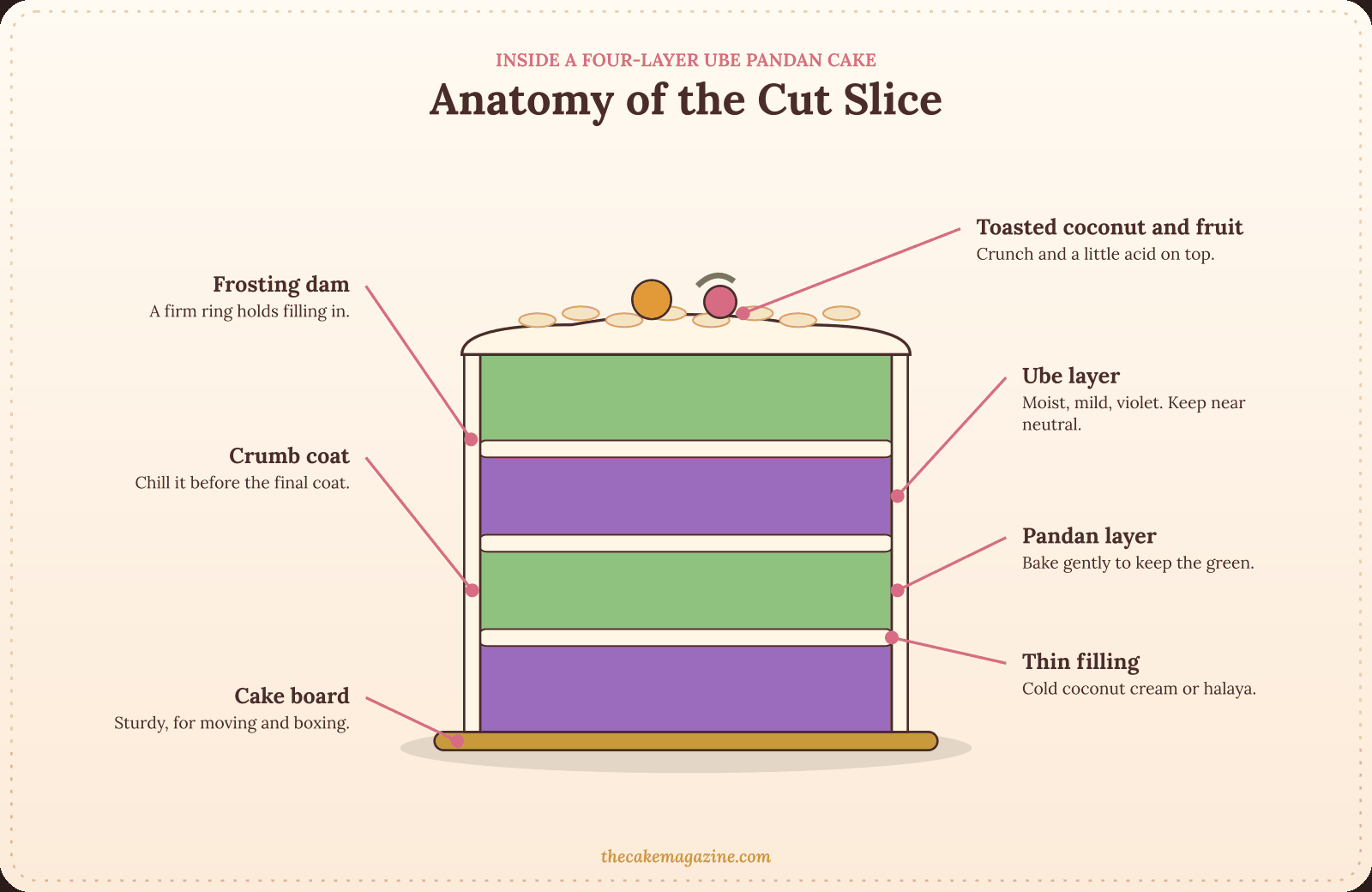
A simple assembly plan
- Chill the layers for at least an hour, wrapped, before leveling.
- Pipe a dam of frosting around the edge of each layer to hold the filling.
- Alternate colors, with pandan at the bottom and top for contrast, or ube at the top for the strongest color.
- Crumb coat, chill for 20 to 30 minutes and finish with a thin outer coat.
- For clean sides, see our guide to smooth buttercream sides.
Variations on the ube pandan cake
Once you understand how the two flavors behave, you can move them into other formats without a full new recipe. These variations keep the same flavor logic and change the shape, the structure or the serving style of the ube pandan cake.
Cupcakes and muffin-tin cakes
The butter cake formula above bakes well in a standard muffin pan, and it is an easy way to test the colors before committing to a tall cake. Fill liners about two-thirds full and expect a shorter bake than a layer cake. Top with a small swirl of cream cheese frosting and toasted coconut. A mixed box of purple and green cupcakes is also a friendly way to introduce guests to the ube pandan cake flavors.
Roll cake
A thin sheet of pandan sponge rolled around ube whipped cream, or the reverse, shows both colors in a spiral. Bake the sheet briefly, roll it while still warm in a clean towel to set the shape, cool, then unroll and fill. Use a stabilized whipped cream, since a loose filling will squeeze out. Slice with a warm knife for neat spirals.
Icebox or no-bake style
Many Filipino desserts layer cake or biscuits with cream and chill them until soft. A version of this cake can follow that idea: thin sponge layers, sweetened cream flavored with halaya or pandan, and a few hours in the refrigerator. It is forgiving, makes serving easy for a hot day, and the soft texture suits both flavors.
Cheesecake and cream-cheese layers
Ube cheesecake is a well-known dessert, and a thin layer of ube cream cheese filling between pandan sponge layers brings that idea into a cake. Keep the filling cold and thick, and avoid adding more than a modest amount of halaya per cup of filling, or it will loosen. Taste after each addition.
Ice cream cake
Soft-serve ube and pandan ice creams are common in dessert shops, and a layered ice cream cake is a natural extension. Line a pan with thin pandan sponge, add softened ube ice cream, freeze, then repeat. Serve straight from the freezer with a warm knife. Keep it frozen until the moment of serving, and do not leave it out long.
A lighter, less sweet version
If your guests prefer a less sweet dessert, cut the sugar in the frosting first. The cake itself relies on sugar for tenderness and moisture, so reduce it only a little. Fresh fruit, a pinch of salt and a squeeze of lime on the fruit will make the cake taste lively even when the sweetness is modest.
One change at a time. When you adapt a formula, change only one thing per bake: the format, the flavor strength or the frosting. If three things change and the result is wrong, you will not know which one caused it.
Modern celebration-cake ideas for an ube pandan cake
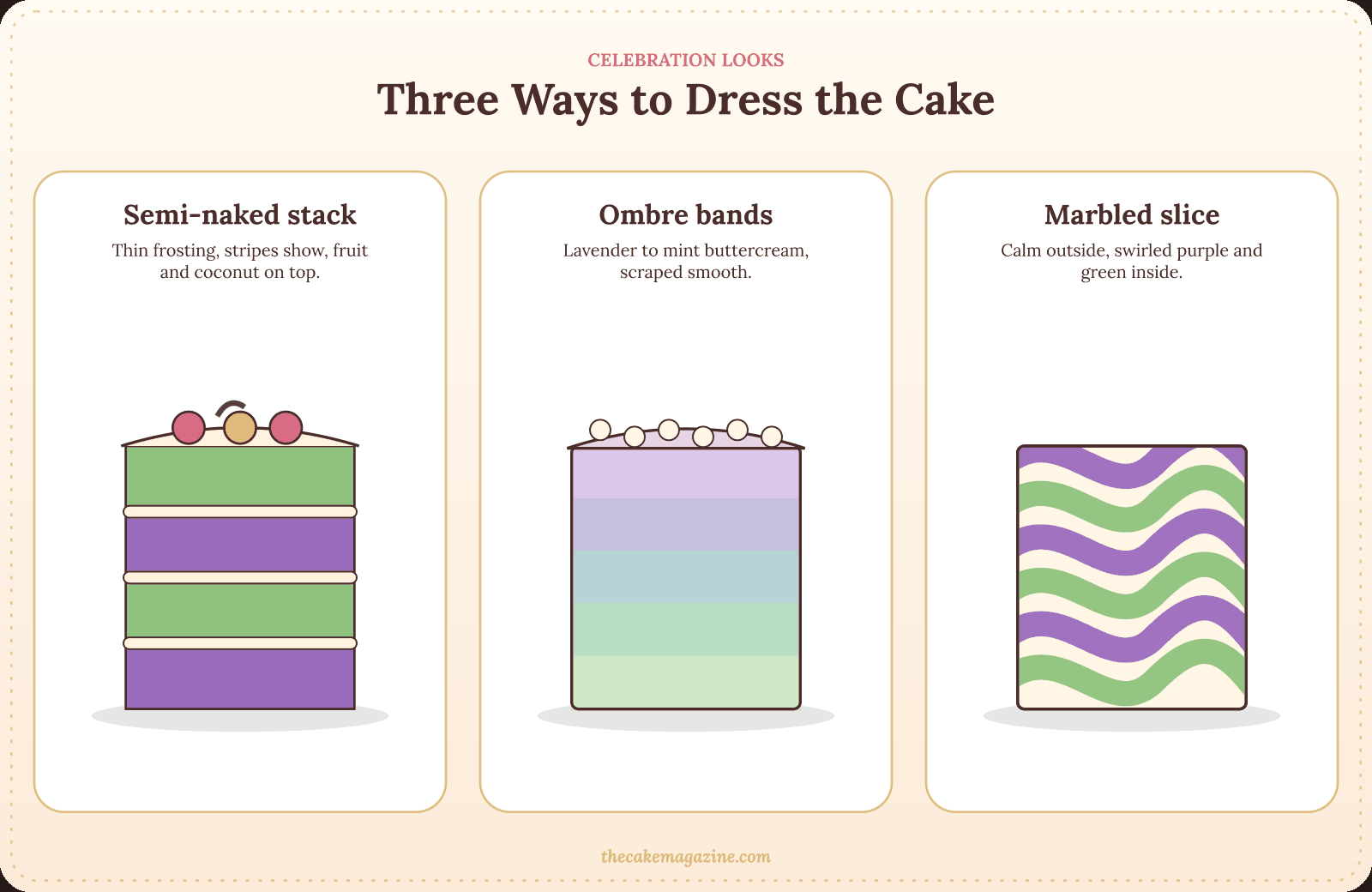
The color pair practically designs itself, but a few thoughtful choices keep the cake from looking like a craft project. These ideas range from beginner-friendly to ambitious, and each works for a different kind of celebration.
The naked or semi-naked stack
A thin skim of cream cheese frosting or whipped cream lets the purple and green stripes show on the sides. It is the simplest way to show off the cake and a good first design. Use a bench scraper to scrape the sides almost clean, then dress the top with fruit, coconut flakes and a few flowers. Fresh mango, passion fruit and toasted coconut feel right at home here.
The ombre or watercolor finish
Tint your buttercream in a few shades from pale lavender to a light green and apply them in soft bands, blending with a scraper. This looks lovely at baby showers, bridal showers and spring birthdays. It does require a steady hand, so practice on a cold cake round or even a flowerpot first. Our smooth sides guide will help with the base coat.
Marbled and swirled interiors
If you want a surprise inside, swirl ube and pandan batters in the pan and frost the outside in a calm neutral. Cutting reveals the pattern. This suits birthdays where the reveal is half the fun. Keep the swirl gentle, with only three or four passes of a skewer, or the colors will muddy into a brownish gray.
Mini and bento versions
Small cakes suit this flavor pair well, because the cross-section shows in a few bites and each guest gets their own. A 4-inch ube pandan cake works as a personal birthday cake, and a tray of one-bite squares works for a party. For more on small formats, see our guide to the mini cake trend and the dedicated bento cake guide.
Dot cakes and playful decoration
A palette of lavender and mint is perfect for the polka-dot look. Pipe small rounds in alternating colors, or press on freeze-dried berries and shredded coconut. Our dot cake guide covers the technique and the proportions that look balanced.
Fruit and flower finishes for an ube pandan cake
Fresh fruit is a favorite for this combination: sliced mango, lychee, strawberries, passion fruit pulp or kiwi. If you are weighing fruit decoration, our guide to the fruit-decorated cake trend explains how to keep fruit looking fresh and prevent weeping onto the frosting. Edible flowers should be labeled as edible and sourced for food use.
Celebrations that suit the flavor
Birthdays
A semi-naked stack with fruit, or a marbled cake with a calm exterior. Add a candle and a short message in white chocolate or piped frosting.
Showers and spring parties
Soft ombre sides, a pastel palette and a few edible flowers. The colors already feel springlike.
Weddings and anniversaries
A single tier of ube pandan cake can sit among classic flavors as a guest-favorite option. For planning, see our wedding cake guide, and note that stacked tiers need sturdier cakes than chiffon.
Holidays and cultural gatherings
Many families already serve ube or pandan desserts at holidays. If you are making one for someone else’s tradition, ask what matters to them. Their version may be a favorite, and your job is to honor it.
Drinks, toppings and pairings for ube pandan cake
An ube pandan cake is gentle, so what you serve beside it matters. These pairings come from general flavor logic, not from tests, so treat them as ideas to try.
Toppings that work
- Toasted coconut: adds crunch and ties both flavors together.
- Fresh mango or passion fruit: acidity and brightness against rich cream.
- Macapuno or young coconut strips: a classic Filipino pairing, chewy and sweet. Use sparingly.
- Toasted sesame or black sesame: a nutty, savory edge that suits ube.
- Latik or coconut curds: traditional toasted coconut milk solids, if you have a source or a recipe.
- White chocolate shards: tidy and elegant, with a flavor that stays out of the way.
Drinks
Hot jasmine or green tea is a calm companion for the cake, because tea cuts the richness. Coffee also works, especially a milky latte. For a cold option, serve iced coconut water or sparkling water with lime. Avoid anything sharply bitter, which can drown out the delicate flavors.
Flavors to be careful with
Strong chocolate, heavy spice and intensely tart lemon can overwhelm both ube and pandan. If you want a third flavor, choose something gentle: coconut, vanilla, mango, white chocolate or a little lime zest. Remember that acid also shifts the colors, as covered in the section on keeping the colors true.
Storing and serving an ube pandan cake safely
An ube pandan cake with a creamy filling needs the same care as any dairy-filled dessert. Cream cheese, whipped cream and coconut cream can all spoil if left out too long, and a warm room will wilt delicate frosting quickly.
Refrigerator and counter
Keep a finished cake covered in the refrigerator if it contains whipped cream, cream cheese, custard or fresh fruit. Let it sit out for a short while before serving so the crumb softens and the flavors open. The U.S. Department of Agriculture’s Food Safety and Inspection Service advises against leaving perishable food out for more than about two hours, and for less time in hot weather. That is a good rule for parties too.
Freezing
Unfrosted layers can be wrapped well and frozen for a few weeks, which is convenient for ube batter that you want to cut from a cold slab. Thaw them in their wrapping so condensation does not soak the surface. Fully frosted cakes with fresh fruit or whipped cream do not freeze as gracefully.
Transporting
Chill the cake until firm, use a sturdy board and a snug box, and keep the car cool. Avoid sun on the box and keep the cake level on the floor of the car, not on a seat. If you are delivering for pay, our cake pricing guide explains how to include delivery and risk in the price.
If you sell your ube pandan cake
Selling baked goods from home is regulated differently from state to state, and rules can change. We do not list specific rules here. Contact your state or local agency, and read the general information from the USDA Food Safety and Inspection Service linked above. Also check how your area treats products containing dairy or coconut and what must appear on labels. This is general information, not legal advice.
Planning a celebration ube pandan cake, day by day
A two-flavor cake has more moving parts than a single-flavor one, so a simple schedule keeps the work calm. This timeline assumes a four-layer butter cake for a weekend party. Shift it to suit your kitchen.
Several days ahead
Order or find your ube halaya and pandan leaves, since specialty products can be hard to find at short notice. Decide on the frosting and write down the weight of everything you plan to use. If this is your first attempt, bake one small test layer of each batter now. It will tell you what color the batter turns in your oven and whether you need a drop of gel.
Two days ahead
Bake the layers, cool them completely, wrap them in plastic and chill or freeze them. Cold, firm layers level cleanly and carry sticky ube filling without tearing. This is also a good moment to make toasted coconut or other toppings, which keep well in a sealed container.
The day before the ube pandan cake is served
Make the frosting, assemble the cake, crumb coat it and chill. Apply the final coat and decorate, then refrigerate in a box. If you are using fresh fruit or flowers, hold them back and add them on the day.
The day of
Take the cake out about 30 to 60 minutes before serving, depending on the room temperature, so the crumb softens. Add fresh toppings, slice with a long knife warmed in hot water and wiped dry between cuts. The colors are most vivid on a clean cut, so wipe the blade each time.
How much cake do you need
A four-layer, 6-inch cake serves roughly 10 to 14 slim party slices, depending on how generously you cut. For larger gatherings, use the sizing logic in our wedding cake serving guide, which explains how portions scale between pan sizes. Because ube and pandan are rich and mild, small slices often satisfy, and a platter of fruit alongside helps.
Make it your own. Many Filipino families have a preferred way to serve ube or pandan desserts. If you are cooking for a guest who grew up with these flavors, ask about their favorite version. It is the best flavor research you can do, and it shows respect for the tradition.
Testing the idea before you commit
If you plan to sell or serve this cake to a crowd, treat the first bake as a test. Make a half batch of each flavor, bake in a small pan, taste the cake the same day and again the next day, and note how the color holds in the refrigerator. Ask a few friends to compare it against your usual flavors. Then you have real information, and you are not relying on a trend report.
Keeping an eye on the trend
Menu data and search interest move over months. If you plan seasonal menus, check industry sources each quarter and watch what customers actually ask for. Our guide to how cake trends start explains how to tell a lasting shift from a brief spike. As of November 2026, the sources named above show growing interest in ube, and we will update this guide when the data changes.
Costs and pricing for an ube pandan cake
Specialty ingredients change the math. Ube halaya, good coconut milk and fresh or frozen pandan usually cost more per cake than flour, sugar and vanilla, and the supply of ube has reportedly been tight, according to the BakeryAndSnacks article above. We do not quote prices here because they vary by region, brand and season. Instead, here is how to think about the numbers.
Weigh and record every ingredient
Write down the grams of halaya, coconut milk and leaves in each batch, then price them from your receipts. A cake that uses 240 g of halaya costs very differently from one that uses a flavored extract. The cost calculator in our cake cost calculator guide gives a structure for adding up ingredients, packaging and time.
Charge for the extra work
Two batters, two colors and careful assembly take more hands-on time than a single-flavor cake. Straining pandan, chilling layers and cleaning up sticky halaya all take minutes that add up. Include them in your labor, as described in our guide on how to price cakes.
Offer it as a limited flavor
A seasonal or limited ube pandan cake lets you test demand without stocking ingredients you might not use. Announce the dates, take pre-orders and make only what is ordered. If the cake sells out, you will know the flavor has an audience, and you can repeat it with confidence.
Troubleshooting an ube pandan cake
Most problems fall into a few patterns: color, moisture and structure. For wider issues, such as sinking centers or dry crumb, our cake troubleshooting guide is the full reference. The fixes below are specific to an ube pandan cake.
The ube layer baked gray or blue
Likely cause: too much baking soda or an alkaline ingredient shifting the anthocyanins. Fix: use baking powder as the main leavener, reduce soda, and test a small batch. A tiny dot of purple gel can restore the look.
The ube layer turned pink or reddish
Likely cause: a very acidic ingredient such as lemon juice or a lot of buttermilk. Fix: reduce the acid and balance with a little more coconut milk. Acid can also be used on purpose for a pinker tone.
The pandan layer looks olive or brown
Likely cause: overbaking, long heat or acidic dairy. Fix: shorten the bake, lower the oven slightly and add a small drop of green gel. Keep the leaf liquid fresh.
The cake is gummy or heavy
Likely cause: too much halaya or ube moisture, or underbaking. Fix: weigh the halaya, reduce liquid by half the halaya weight, and bake until the skewer has a few moist crumbs, not wet batter.
The flavor is faint
Likely cause: too little real ube or pandan, or a frosting that is too sweet. Fix: raise the halaya in small steps, strengthen the leaf juice and cut some sugar from the frosting. A pinch of salt also brings flavor forward.
The colors bled into each other
Likely cause: warm layers or a soft filling. Fix: chill layers before stacking, use a firm dam of frosting and avoid wet fillings.
The layers slide
Likely cause: loose halaya or too much filling. Fix: thicken halaya by cooking it briefly, spread a thin layer and chill between assembly steps.
Common mistakes with ube pandan cake
- Relying on color alone. Purple dye with no real ube gives the look without the flavor. Use real ingredients, then tint if needed.
- Adding too much extract. Extracts differ in strength, and too much can taste perfumed or bitter. Start small.
- Skipping the sieve. Unstrained pandan leaves leave fibers in the batter.
- Stacking warm layers. Sticky ube cake tears when it is warm.
- Using a sour frosting by default. A little tang is good, a lot clashes with the colors.
- Not tasting your halaya. Sweetness varies, and your cake sugar should respond.
- Forgetting the story. These flavors come from living traditions. A short note on a menu or card credits them properly.
Frequently asked questions about ube pandan cake
What is an ube pandan cake?
An ube pandan cake is a cake that combines ube, a purple yam with a mild, nutty sweetness, and pandan, a fragrant tropical leaf with a coconut-like aroma. It is often baked as purple and green layers, or swirled together, and finished with coconut cream, whipped cream or a light buttercream.
What does an ube pandan cake taste like?
Ube is gently sweet, earthy and a little nutty, with a vanilla-like note, and pandan smells like a mix of vanilla, fresh grass and coconut. Together they taste soft and rounded rather than bold, which is why a pinch of salt and a little tang make it taste brighter.
Is ube the same as taro or purple sweet potato?
No. Ube is the purple yam Dioscorea alata. Taro is a different plant, starchier and less sweet, and purple sweet potato is another root that looks similar and is sometimes used as a substitute. The flavor and color of a substitute will not match ube exactly.
Can I make an ube pandan cake without ube extract?
Yes. Ube halaya, ube powder or cooked, mashed ube can supply flavor and some natural color. Extract is a booster that many bakers use for extra aroma or color, but it is not required, and it varies widely by brand, so read the label and start with a small amount.
Where can I find pandan leaves or ube?
Asian grocery stores are the most reliable source for fresh or frozen pandan leaves, frozen grated ube and ube halaya. Some larger supermarkets and online shops carry extracts, powders and jarred halaya. Product quality and ingredients vary, so check labels for added color and sugar.
Why did my ube cake turn gray or blue?
Ube gets its color from anthocyanins, and they shift with pH. Too much baking soda or other alkaline ingredients can push the color toward gray, blue or green. Use baking powder as the main leavener, keep the batter near neutral and test a small bake before you make the full ube pandan cake.
Why does my pandan cake look brown instead of green?
Chlorophyll fades with heat and acid. A long bake, a hot oven or a lot of acidic dairy can turn pandan olive or brown. Bake only until done, keep the batter gently flavored with coconut milk, and add a drop of green gel color if you want a brighter green.
Can I use pandan extract instead of fresh leaves?
You can. Extract is convenient and consistent, but some contain added green coloring and the aroma is often less rich than leaf juice. Many bakers blend a little fresh or frozen leaf for scent and add extract only if the color or flavor needs help.
What frosting goes best with an ube pandan cake?
Lightly sweetened whipped cream, coconut cream, cream cheese frosting and Swiss meringue buttercream all pair well. Because ube and pandan are mild, avoid very sweet frostings that cover the flavor. Whipped cream needs refrigeration, while Swiss meringue buttercream holds shape better at a party.
How long does an ube pandan cake keep?
A cake with whipped cream, cream cheese or fresh fruit should be refrigerated and eaten within a few days, and the colors will gradually soften. Unfrosted layers can be wrapped and frozen for a few weeks. Follow USDA guidance on leaving perishable food out for no more than about two hours.
Is the ube pandan cake trend going to last?
No one can say for sure. Industry reports from 2026 show growing ube menu presence and consumer awareness, but those numbers are about ube generally, not cakes. A flavor with deep cultural roots tends to last longer than a color-only fad, though interest may rise and fall.
Can I use ube pandan cake flavors for a wedding cake?
Yes, especially for a single tier or a groom’s cake. Choose a sturdy butter cake rather than a delicate chiffon if the cake will be stacked, keep fillings cool and thick, and test the full recipe before the event. Ask the couple what the flavors mean to them.
Can I make an ube pandan cake ahead of time?
Yes. Bake and wrap the layers one or two days ahead and chill or freeze them, then assemble the day before. Keep the cake refrigerated, add fresh fruit and flowers on the day, and let it sit out briefly before serving so the crumb softens and the flavor comes through.
Final thoughts on the ube pandan cake
An ube pandan cake works because it is more than a color trick. Ube brings a soft, nutty sweetness and pandan brings an aromatic, coconut-like perfume, and together they taste calm and complete. The colors are the invitation, and the flavor is the reason people ask for a second slice.
The practical lessons for any ube pandan cake are simple. Use real ube and real pandan for flavor, add gel color only to help. Keep batters close to neutral so purple stays purple, bake pandan gently so green stays green, and chill everything before stacking. Choose a frosting that lets the flavors speak. Taste, weigh and take notes, because your oven and your ube product will teach you more than any single recipe.
If you try an ube pandan cake, we would like to hear how it went: which form of ube you used, how the colors held and what you served alongside. We will keep refining this guide as the trend and the baking evolve.
Sources and further reading
- NACS, “Where Will Ube Show Up Next?”, April 2026, reporting Datassential research.
- BakeryAndSnacks, “The next matcha? Ube surges in popularity”, 23 April 2026.
- Wikipedia, Dioscorea alata and Pandanus amaryllifolius, for botanical and culinary background.
- U.S. Department of Agriculture, Food Safety and Inspection Service, food safety.
- King Arthur Baking, cake guide.
Editorial note: reviewed and updated November 2026. This guide is written for home bakers in the United States, using American measurements. Trend figures belong to the organizations that published them. The formula in this article has not been oven-tested by this site; it is a starting point built from conservative baking ratios, and times and amounts will vary by oven, pan and ingredient brand. If you sell baked goods, check your state and local food rules. Where we link to products in the future, we will disclose affiliate relationships near the links.