Every few months a cake you have never seen is suddenly in every bakery window and video feed, as if the whole baking world agreed on it overnight. It never did. Learning how cake trends start is one of the most useful things a baker can do, because it shows which new looks deserve a Saturday of practice and which will be forgotten by spring. This guide follows a trend from the first odd experiment to the supermarket case and shows how to judge what lasts.
How cake trends start is usually a small, ordinary story: one baker tries a shape, flavor or finish, someone films it, and creators remake it in their own kitchens. If bakeries, brands and search traffic then pick it up, the idea reaches the mainstream. Trends also come from professional trend reports and from nostalgia, when an old style is rediscovered by a new generation. The ones that last usually solve a real need, such as smaller portions, or are easy to repeat. The rest are looks, and looks burn out.
- What counts as a cake trend, and what does not
- How cake trends start: five common sparks
- The life of a cake trend, from spark to afterlife
- How social media carries a cake trend
- Bakery innovation and professional trend reports
- Nostalgia and the revival loop
- Case studies: vintage piping, mini cakes and flavor shifts
- Reading the signals: search, social and sales
- What lasts and what fades
- Trying a trend in your own kitchen
- Common mistakes when following cake trends
- Trend update log, November 2026
- FAQ
- Final thoughts
What counts as a cake trend, and what does not
Before looking at how cake trends start, it helps to agree on what we are talking about. The word gets stretched to cover almost anything that appears twice in a feed. A single beautiful cake is not a trend. A color that three bakers happened to use in the same month is not a trend either. A trend needs a shared idea that many different people pick up, repeat and adapt over a period of time.
That definition matters for a practical reason. If you treat every pretty cake as a trend, you will chase everything and master nothing. If you can tell the difference between a one-off, a fad and a lasting shift, you can decide how much of your time and money each one deserves.
Four layers of cake trends
It is easier to think about how cake trends start and move in layers, because each layer travels at a different speed.
Looks
Colors, textures and decorations: a certain pink, a certain piping style, a certain sprinkle. Looks change fastest and are the easiest to copy.
Flavors
Citrus, tangy fruit, toasted sugar, a new spice. Flavors move more slowly because people have to taste them, like them and ask for them again.
Formats
Cake sizes and shapes: tiny cakes, heart shapes, long rectangles. Formats change how a cake is baked, boxed, priced and served.
Occasions
How and why people buy cake at all: smaller gatherings, themed parties, desserts that suit a feed. These shifts are the slowest and the most lasting.
Most of what goes viral lives in the first layer. The deepest changes happen in the last two. When you are deciding how seriously to take something new, the first question is which layer it belongs to.
Trend, fad, classic and signature style
Four other words come up constantly, and they are not interchangeable. A fad is a short, sharp burst of attention that fades quickly. A trend lasts long enough to change what bakers offer. A classic is a style that has outlived several trends and still sells. A signature style is something one baker or bakery is known for, regardless of what is fashionable.
One trend can become a classic, and some classics were trends once. A signature style can even start a trend if enough people copy it. When you study how cake trends start, keeping the words straight stops you from calling a six-week fad a lasting shift, which is one of the most common mistakes we cover later in this guide.
A note on evidence. No one can fully measure how cake trends start. In this guide we separate what named sources report, such as trade reports and news articles, from our own editorial reasoning. When something is our interpretation, we say so. Figures stay attached to the organization that published them.
How cake trends start: five common sparks
When people ask how cake trends start, they usually picture a single viral video. That is one path, and an increasingly important one, but it is not the only one. Looking at the baking world, we can sort how cake trends start into five groups of sparks. A single trend often has more than one of them behind it.
1. A baker solves a practical problem
Many lasting changes begin as someone’s workaround. A baker who keeps getting orders from people who live alone starts making tiny cakes. A home baker without a big oven works with sheet pans. A cake seller who delivers by car invents a sturdier finish that survives a bumpy road. Nobody planned a trend. They solved something, and other people with the same problem noticed.
These practical sparks tend to last, because the problem does not go away when the video gets old. It is one reason the shift toward smaller portions has stayed in the conversation in trade reports for several years. You can read more about that shift in our guide to why small-format celebration cakes are growing.
2. A creator makes something that is easy to watch
Some cakes are made to be filmed. A smooth mirror finish, a dramatic cut, a pour, a pull-apart reveal: these are moments that work in six seconds with the sound off. Creators learn quickly what holds attention, and a cake that photographs well has a head start in how cake trends start online. The cake does not have to be the best tasting. It has to be the best to watch.
That is not a criticism. Visual appeal has always sold cake, from the Victorian sugar showpiece to the glass bakery case. Social platforms simply made the audience larger and the feedback faster.
3. A professional brand or trade body names the idea
Ingredient companies, trend forecasters and trade magazines study what people want and publish lists. When a report names a direction, such as smaller portions, tangy flavors or mixed textures, bakeries that read it may start offering products in that direction. Those products then become visible to customers, which makes the direction look like a trend, even when it was predicted first. This is a quieter version of how cake trends start, and we look at the pipeline in a later section.
4. Nostalgia pulls an old style forward
Old cake styles return again and again. Heavy piping, retro colors and old-fashioned shapes have all been rediscovered by people who never saw them the first time. Nostalgia does not mean copying the past exactly. People remix it, and the new version feels fresh even though the bones are old. The revival of ornate, vintage-look piping is one of the best-documented examples of this spark.
5. A shop, chain or celebrity gives the idea reach
Sometimes a trend that was already small and local gets a huge boost when a large retailer or a well-known person adopts it. A grocery-store bakery selling a once-niche cake, or a public figure’s event featuring a particular design, can move an idea from thousands of people to millions. The idea was not born there, but the reach changes everything.
Practical need
Usually slow and durable. Example direction: smaller cakes for smaller households.
Creator appeal
Fast and fragile. Example direction: finishes built for video.
Professional signal
Medium speed. Example direction: trade-report predictions turned into products.
Nostalgia
Cyclical. Example direction: vintage-look piping and retro color.
Retail reach
A booster, not a source. Example direction: a big chain adopting an existing look.
If you only remember one thing from this section, remember that the most durable sparks are the practical ones, and the least durable are the ones that depend on a single platform’s attention. That pattern comes up again when we look at what lasts, because how cake trends start often predicts how long they stay.
The life of a cake trend, from spark to afterlife
Almost every trend follows a similar shape, even though how cake trends start differs from case to case. Researchers have described this shape for decades. The sociologist Everett Rogers, in his book Diffusion of Innovations, first published in 1962, described how new ideas spread through a population in groups: innovators, early adopters, the early majority, the late majority and laggards. Adoption over time tends to form an S-shaped curve, and the point where enough people have adopted an idea for it to sustain itself is often called critical mass.
Rogers was studying the spread of innovations in general, not cake. But the pattern is useful for bakers because it explains why a cake style can feel rare, then exciting, then everywhere, then tired, in a predictable order. Here is how that arc looks when we apply it to cake, from how cake trends start to how they end. This is our editorial adaptation of a general theory, not a measured dataset.

Stage 1: the spark
A handful of bakers, often skilled ones working at the edge of their craft, try something unusual. At this point, how cake trends start looks like nothing at all. Few people notice. Customers rarely ask for it by name, because they do not know it exists. If you are a baker who likes experimenting, this is the stage where you will feel ahead of the crowd, and where the risk is highest, because most sparks go nowhere.
Stage 2: the spread
Creators and ambitious home bakers start remaking the idea. They add their own colors and shortcuts, and they share the results. Tutorials appear. The look gets a name, because people need a word to search for. In many trends, the naming moment is the real beginning of the mainstream, since a named idea can be requested, searched and tagged.
Stage 3: the peak
Bakeries, chains and supermarkets offer the cake. Customers ask for it without any explanation. At this stage, it is easy to confuse popularity with staying power. A cake that everyone is making is at its most visible, and often close to its most crowded.
Stage 4: fatigue
Everyone has seen it, and a few bakers are quietly looking for the next thing. Prices for the look may drop as supply grows. This is the stage where many small bakers who jumped in late feel the squeeze: the equipment is bought, the sample cakes are made, and the attention has moved on.
Stage 5: the afterlife
The trend either fades or settles in. Fading means it disappears from menus and feeds. Settling in means it becomes a normal option, a classic that bakers offer when someone asks. Some styles do both in turn: they fade, rest for years and return. That return is the revival loop we cover in the nostalgia section.
Where are you on the curve? If your cousin, your neighbor and your grocery store have all mentioned the same cake within a month, you are probably at stage three or four. Starting a big project at stage four rarely pays off. Starting a small test at stage two often does.
How social media carries a cake trend
Social platforms did not invent cake trends, but they changed the speed and the shape of how cake trends start. A cake idea that once took years to travel between towns can now cross a continent in a weekend. The mechanics are worth understanding, because they explain both the opportunity and the danger in how cake trends start online.
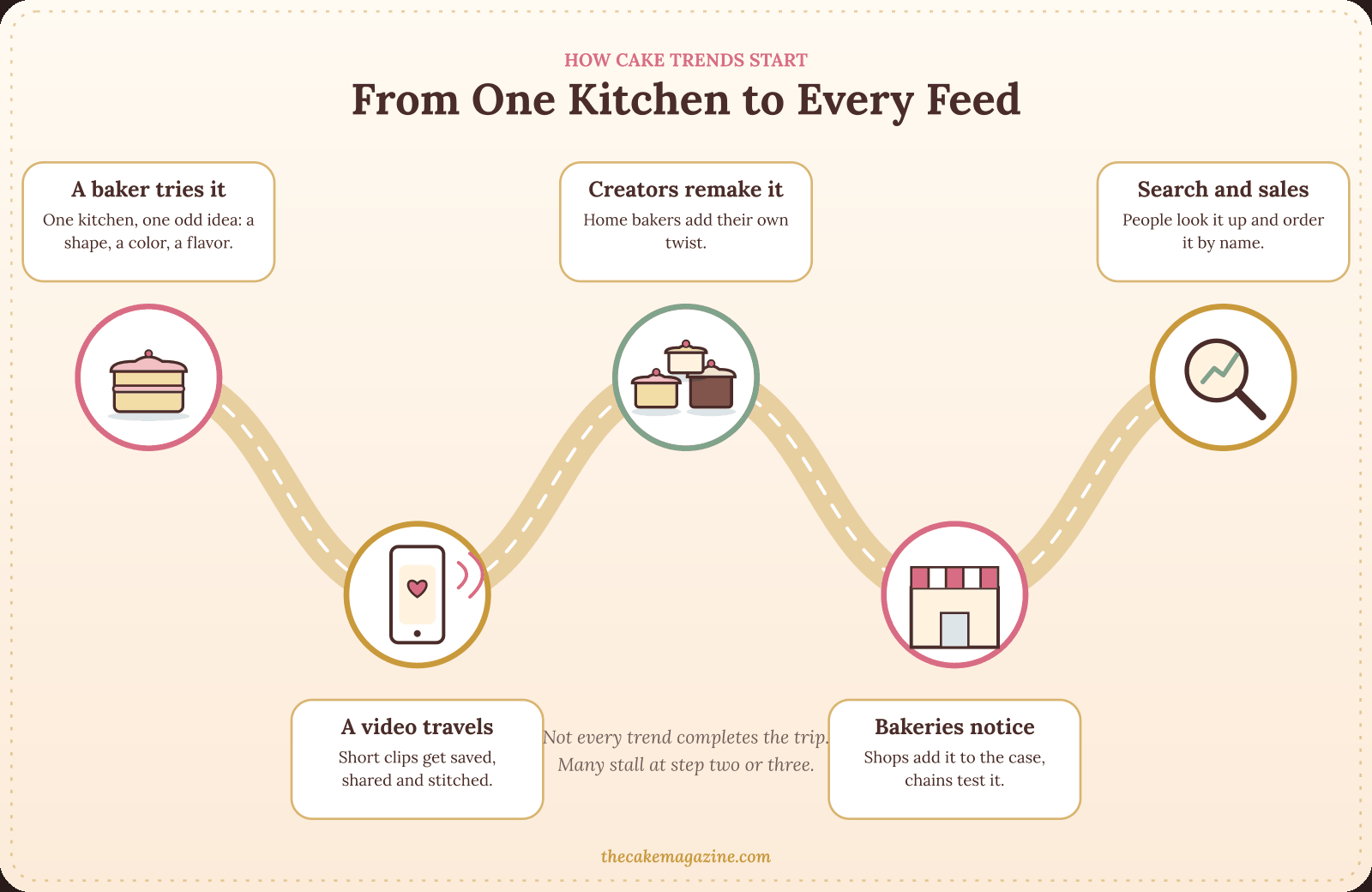
The relay: how cake trends start online
Think of a trend as a relay race. A baker makes something. A short video of it gets saved and shared. Other creators remake it, often adding a twist, which gives the original idea a second life. Bakeries and brands notice the pattern and offer a version. Finally, people start searching for it and ordering it by name. Each handoff can fail, and many trends stop at the second or third handoff.
The recipient of each handoff matters. A video that is seen by a thousand home bakers can lead to a thousand remakes. A video seen by ten million people who never bake leads to attention but not necessarily to anything on a bakery counter.
Why some cakes travel and others do not
Cakes that travel well online tend to share a few traits, and they explain a lot about how cake trends start on video. They are readable at a glance, so a single frame explains the idea. They are easy to describe in two or three words. They invite participation, because a viewer can imagine making a version. And they usually contain a small surprise, such as an unexpected shape, an unusual size or a reveal when the cake is cut.
Look at two real examples from news coverage.
The Korea Herald reported in February 2025 that a Korean-language Instagram search for “one-bite cake” returned over 22,000 posts, and that a viral “One Bite Challenge” had people trying to eat a whole mini cake in one go. A tiny cake is readable at a glance, easy to name and made for a camera.
Food Network reported in February 2025 that Walmart decorators were posting TikTok videos of themselves making Lambeth-style heart cakes, and commenters praised their work. Both are cases where an idea moved from a niche to a very broad audience through short video.
What social media cannot tell you about how cake trends start
Views are not orders. A video can be watched millions of times and still not change what anyone buys. Likes, shares and comments measure attention, which is not the same as demand, and demand is not the same as willingness to pay. When you look at a viral cake, ask three questions. Who is watching? What would they actually do with the idea? And what does it cost to make the cake that people are watching?
The creators who make viral cakes also make a very particular kind of cake: one built for the camera. A cake that wins on video may be fragile, hard to transport or too sweet to eat in quantity. A cake that works for a customer is more forgiving. Both can be good. They are just different jobs.
Platform feeds
Reward novelty and visual surprise. Great for discovery, but they push everyone toward the same looks.
Saved and shared posts
A better sign of interest than a quick like, because people save what they intend to make or order.
Comments and questions
When viewers ask where to buy or how to make something, the idea has crossed from watching to wanting.
Bakery innovation and professional trend reports
Not every trend begins on a phone. A lot of the ideas that reach cake counters come from professional channels: ingredient companies, trade publications, culinary schools and bakery chains. These groups study customers and try to predict what will sell, and their predictions can shape what shops make next year. Seeing how this pipeline works makes how cake trends start look less mysterious.
What trend reports actually are
A trend report is a forecast with evidence behind it. The better ones explain where the evidence comes from. Puratos, a bakery ingredient company, publishes a yearly program called Taste Tomorrow. According to the company, the method combines a worldwide consumer survey, AI-driven digital analysis and human cultural intelligence. For 2026, its patisserie summary, published in October 2025, names three directions: perfect portion, tangy twist and texture mashup.
The same summary reports that 63 percent of surveyed consumers prefer smaller portions without losing flavor, and that 71 percent find texturally interesting treats joyful. Those are Puratos figures from its own survey, and the company sells ingredients that serve those directions. That does not make the numbers wrong, but it is a good reason to treat them as one informed view rather than the final word.
How a report becomes a product
Here is the pipeline in plain steps. A forecaster publishes a direction. Product developers at bakeries, grocery chains and ingredient suppliers read it. A few of them build a test product. If it sells, others copy it. By the time a customer sees the finished cake in a case, the idea has been moving for a year or more. The customer experiences it as a sudden trend. The industry experienced it as a planned launch.
Reports are one window onto how cake trends start inside the industry. This is also why you will sometimes see the same flavor appear in several brands at once. They read the same signals. It is not a coincidence, and it is not magic.
What professional trends mean for home bakers
If you bake at home or sell from a small kitchen, trade reports are useful in a different way. They are early signals of where the wider market is heading, so they can help you choose what to practice. If a report says tangy flavors are rising, you can try lemon or raspberry in a few cakes and see whether your own customers respond. Our guides to tangy cake flavors and texture mashup cakes are good places to start.
What you should not do is assume that a report predicts your town. A forecast describes broad patterns, and your neighborhood may be different. A baker in a small community who knows what her customers order every month has information no global report can match.
Other forecasters, and a note on accuracy claims
Other groups publish forecasts too. Pinterest releases a yearly “Pinterest Predicts” report, and its December 2025 edition says it identifies fast-rising patterns using year-over-year growth in activity on its platform. The page also claims 88 percent accuracy over six years, without explaining how accuracy is measured. We mention this as an example of why we always ask how a claim was measured. The food section of that 2026 report that we reviewed focused on cabbage dishes and gummy-style desserts, and it did not name a cake-specific trend.
Our general rule for how cake trends start in forecasts is simple. A forecast is a useful starting point. It becomes more trustworthy when it explains its sources, when several independent groups point the same way and when real sales or real baker behavior confirms it.
Nostalgia and the revival loop
Some of the most interesting answers to how cake trends start are not new at all. Old styles come back, and they come back more often than most people expect. A heavily piped cake that looked dated to one generation looks charming to the next. A color palette that someone’s grandmother used becomes a deliberate choice for a new birthday party. This is the revival loop, and it explains a surprising share of what looks like novelty.

The five beats of the loop
The loop has five beats. A style is fashionable, and it feels fresh and a little special. It becomes everywhere, offered by every bakery until it feels ordinary. Then it dates: bakers move on, and the style reads as old-fashioned. It is forgotten, and few people make it or ask for it. Finally, a new generation rediscovers it, and the cycle begins again with a new twist.
The loop is a second answer to how cake trends start: sometimes they simply restart. It does not have a fixed length. Some styles come back within a decade, others take far longer. What stays consistent is the emotional engine. People like feeling connected to something familiar, and they also like the thrill of making it their own.
Why nostalgia is not just copying
A writer on the Historical Foodways newsletter, discussing the vintage cake trend, argues that younger bakers are drawing on the past to remix it, not to return to it. Today’s vintage-look cakes, the author notes, often use buttercream where older versions used royal icing, and they mix elements from several eras, which keeps them from feeling like a copy of a grandmother’s wedding cake. That is our paraphrase of one writer’s view, but it matches what we see across baking coverage.
For a baker, the lesson is useful. When an old style returns, the version that sells is rarely a faithful reproduction. It is a reinterpretation: the old structure with new colors, a new sense of humor or a more forgiving ingredient. If you are tempted to revive a style, ask what you would keep, what you would change and what a customer today would recognize.
Why some styles revive, and what that says about how cake trends start
Not every old cake returns. The ones that do share a few qualities. They are visually distinctive, so people recognize them in a thumbnail. They are teachable, with techniques that can be learned from a tutorial. They are forgiving, meaning a home baker can get a pleasing result without years of practice. And they carry a feeling, such as playfulness, comfort or romance, that people want right now.
Our deeper guides to vintage Lambeth cakes and to rococo and classical cake decorating follow these revivals technique by technique.
Case studies: vintage piping, mini cakes and flavor shifts
Theory is easier to trust when you can see it work on real examples of how cake trends start. Below are three trends that sources have documented, each starting in a different way. We keep to what the sources report and mark where the evidence runs out.
Case study 1: how vintage piping went from dated to viral
Lambeth-style cakes are covered in ornate, heavily piped decoration.
The Takeout reported in December 2024 that the style is named after Joseph Lambeth, whose book on cake decoration became a standard reference, and that it fell out of favor during decades of minimalist cake trends. The article ties the revival to nostalgia and to social media’s appetite for detailed, visual content, noting that baking videos on TikTok are where many people saw the style resurface. It does not name a single creator who started it, and that is typical: revivals rarely have one origin.
Sources disagree on some historical details. One article places the style’s origins in the late Victorian era, while the newsletter we cited describes the Lambeth method becoming popular in the 1930s. Both can be partly right, since decorating traditions evolve, but it is a reminder that stories about how cake trends start are often tidier than the facts.
The mainstream moment came next. Food Network reported in February 2025 that Walmart was selling made-to-order Lambeth-style heart-shaped cakes for about $25, in a 10-inch size meant to serve 24, and that independent bakers often charged $100 to $150 for similar specialty cakes. Prices and offerings like that change, so treat them as a snapshot of early 2025, not as current pricing.
What this case shows. The path ran from a niche style, through short video and nostalgia, to a large retailer. By the time the style reached a big chain, it had already passed the spark and spread stages. Notice also that the retailer’s version was likely simpler than the handmade original, which is common at the peak: the idea survives, but the craft is flattened.
If you decorate cakes yourself, the technique side of this trend is within reach. Our cake decorating for beginners guide covers the tools and piping basics you need, and the heart-shaped cake guide covers pans, carving and serving sizes for the shape that became so closely tied to the style.
Case study 2: one-bite cakes and the small-format shift
Small cakes show a different pattern, one driven as much by practical need as by looks. The Korea Herald reported in February 2025 that cakes in Korea were shrinking toward walnut-size “micro” versions, often decorated to look like full cakes. Buyers quoted in the article gave reasons that are easy to relate to: giving each child at a party their own cake, avoiding leftovers, needing less sugar and finding full-size cakes expensive. Shops promoted their tiny cakes on Instagram, and one product, a micro burger cake, went viral.
The same article reported that a Korean retailer, Emart, sold 30,000 mini strawberry roll cakes, including pre-orders, between November 30 and December 25, which the article said was about 30 percent more than cheaper cakes sold in the same period a year earlier. It also recorded criticism: some people felt tiny cakes cost too much compared with a regular slice, and a bakery owner said some were overpriced relative to ingredient costs.
Why does this case matter for understanding how cake trends start? Because it combined several sparks. There was a practical need (portion, waste, price), a creator-friendly look (a tiny cake that photographs well), and retail reach (a large retailer building a product around it). When several sparks line up, a trend is more likely to last. We did not find reliable numbers for the United States, and in our mini and one-bite cakes guide we say so plainly. The related bento cake guide goes into sizes, boxes and pricing.
Case study 3: flavor shifts and the professional side of how cake trends start
Not every trend is visual. Puratos’s Taste Tomorrow summary describes a rise in sour and acidic flavors, especially citrus, berries and tropical fruit, and names emerging flavors such as tamarind, Fiori di Sicilia and makrut lime. It also describes desserts that mix crunchy, chewy, creamy and crisp textures. These came out of a survey and analysis program, not a viral video.
The paths are very different. A visual trend can spread in a weekend, but a flavor trend needs people to taste something, like it and buy it again. That slower path is part of why flavor shifts often last longer than a color or a decoration. It also means that if you want a trend that lasts, tasting well matters more than looking dramatic.
Reading the signals: search, social and sales
Knowing how cake trends start is helpful. Knowing whether a particular idea is growing, peaking or fading is more helpful still. Three kinds of signals are available to almost any baker, and each has strengths and blind spots.
Search signals
Search tools show what people look for. Google Trends, for example, displays a sample of Google searches. It divides each data point by the total searches in that place and time, then scales the results from 0 to 100, so the numbers show relative interest, not raw search counts. Google’s own help page notes that a spike does not mean a topic is popular or winning, and that Trends is not a scientific poll. Low-volume terms can show up as zero.
Used carefully, it is still a handy tool. Compare your idea with a familiar term, such as a common cake flavor, to see its scale. Look at a five-year view, not just the last month, because it shows how cake trends start as a slow climb, a sudden spike or a yearly return. Then check related searches to see which words people actually use, because the name of a trend is often different from what you expect.
Social signals
Social platforms are also where you can watch how cake trends start in real time, if you know where to look.
On social platforms, the useful signals are quieter than view counts. Look at saves and shares, because people save what they plan to make. Look at comments that ask questions, such as where to buy or what tip to use. Look at how many different creators are making their own versions, not copies of one video. And look at how the idea is described by people outside the baking world, since that tells you whether it has crossed over.
Sales and order signals
If you sell cakes, you own the most reliable signal there is: your orders, which often show how cake trends start in your own town before any report does. Keep a simple note of what customers ask for, even if you cannot make it yet. Three requests for the same idea in a month is stronger evidence than a thousand views. If you do not sell cakes yet, ask friends and family what they would order for their next birthday. Their answers will not be a statistical sample, but they are real.
Strong signs
Repeated customer requests, many creators remaking an idea, questions about where to buy it and steady search interest over months.
Weak signs
One viral video, a single celebrity mention, a spike that lasts days or a trend that only baking accounts discuss.
Mixed signs
A forecast with no sales evidence, or sales in one region only. Worth a small test, not a big bet.
Taken together, the three kinds of signals tell a fuller story of how cake trends start and stall than any one alone. A trend with strong search interest, active remaking and real orders is a very different case from one with just a big video. If you want to see how these signals fit into the wider picture for the year, our 2026 cake trends guide pulls the main directions together.
What lasts and what fades after how cake trends start
This is the question every baker, shop owner and cake lover eventually asks: will it last? Nobody can answer with certainty, and anyone who sounds sure is guessing. Knowing how cake trends start helps, but it does not tell you how they end. But we can look at the patterns from earlier sections and build a practical way of judging. The goal is not prediction. It is deciding how much effort an idea deserves.

Seven questions that separate hype from habit
When you meet a new cake idea, run it through these questions. None of them is a perfect test, but together they turn how cake trends start into something you can act on.
- Does it solve a real problem? Smaller portions, less waste, easier transport and lower prices are real. A particular shade of pink is not.
- Is it easy to repeat? Ideas that a home baker can make with ordinary tools spread wider and last longer than ones needing rare equipment.
- Does it taste good on day two? A cake that only works for a photo will not earn repeat orders.
- Does it have more than one spark? A trend with a practical need, a creator-friendly look and retail interest is more stable than one with a single driver.
- Does it have a past? Styles that have already returned once, like ornate piping, have shown they can come back again.
- Can you adapt it? Ideas that bend to different flavors, sizes and budgets survive. Rigid ones get boring fast.
- Is it tied to a single product or platform? If it depends on one ingredient, one app or one celebrity, it is exposed to that thing’s fate.
Score an idea by counting the yeses. Five or more suggests it is worth building a skill around. Two or fewer suggests treating it as a one-time special at most. This is our own rule of thumb, not a scientific measure, and it works best as a conversation starter with yourself.
How cake trends start matters: why practical ones outlast decorative ones
Look back at the case studies. The small-cake shift rests on reasons that are ordinary and durable: smaller households, portion preferences, price sensitivity and less waste. Those pressures do not vanish when a video gets old. A decoration style, on the other hand, depends on taste, and taste moves. That does not mean decorative trends are worthless. It means they should be treated differently: as a seasonal offer, a skill to practice or a chance to stand out, but not as the foundation of a business.
The Puratos 2026 summary points the same way. Its “perfect portion” direction is about eating less without giving up pleasure, which is a practical motive. Its “tangy twist” and “texture mashup” directions are about flavor and experience, which tend to move more slowly than appearance.
What a fading trend looks like
Fading usually shows up in small ways before it shows up in numbers. Creators begin to joke about the style. Brands start using it in advertising, which tends to happen near the peak. Bakers who first embraced it move to something new. Customers say they have seen it before. None of this means a trend is dead, and revivals show that fading is not final, but it does mean the best moment to invest has probably passed.
Do not confuse a trend with a reason to buy. A new tool, mold or ingredient that is marketed on the back of a trend deserves extra skepticism. Ask whether you would still use it if the trend ended next month. If the answer is no, it is a purchase for the trend, not for your baking.
Trying a trend in your own kitchen
The best way to learn how cake trends start, spread and fade is to try one yourself, on a small scale. A test costs a few ingredients and an afternoon, and it teaches you far more about how cake trends start than a week of scrolling. Here is a method that keeps the risk low.
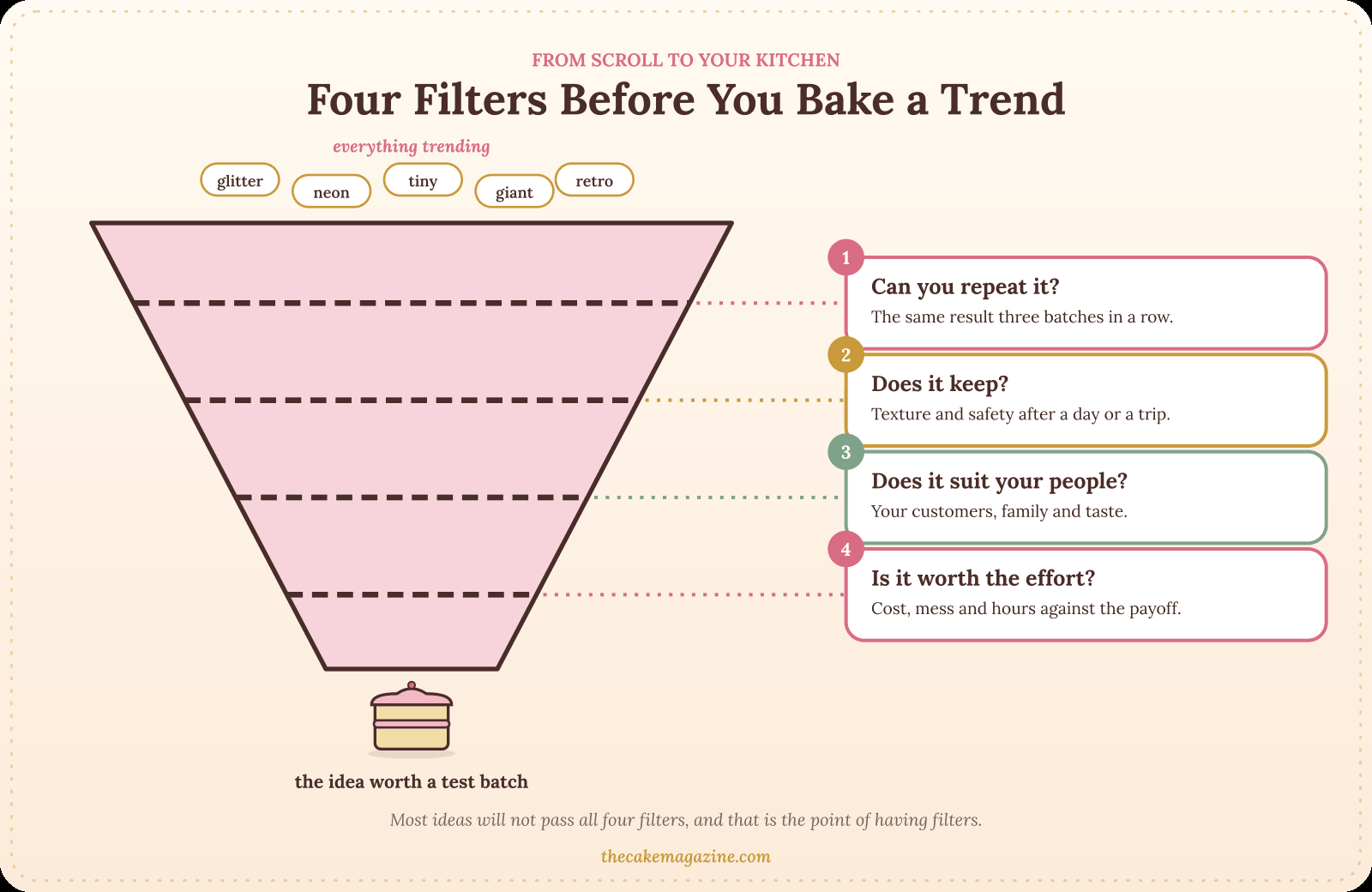
Step 1: run the four filters
Before you buy anything, put the idea through four filters. Can you repeat it, meaning get the same result three batches in a row? Does it keep, meaning does the texture and safety hold up after a day or a car ride? Does it suit your people, meaning the customers, family or guests you actually bake for? And is it worth the effort, once you count the cost, the mess and the hours?
Whatever the origin of an idea, how cake trends start matters less than whether it survives your kitchen. Most ideas will not pass all four filters, and that is the point. The filters protect your time. Something that fails the first one may simply need more practice. Something that fails the third may be a great idea for someone else’s kitchen.
Step 2: bake a small test
Choose a cake you already make well, such as our vanilla cake or chocolate cake, and apply the trend to it in small form. Do not change the cake and the style at the same time. If you are testing a piping style, use a buttercream you already know. If you are testing a tangy flavor, keep your normal decoration. Changing one thing at a time tells you what actually worked.
Keep notes as you go: what you tried, how long it took, what went wrong and what you would change. A short log is worth more than a good memory.
Step 3: get honest feedback
Share the test cake with a few people and ask specific questions. Would you order this? Would you pay more for it than for a plain cake? What did you like best? What would you change? People are kind, so ask for the least flattering answer you can get. If you sell cakes, offer the idea to a few customers as a limited item and track what they choose.
Keep food safety in the plan. If your trend involves whipped cream, custard, cream cheese or other perishable fillings, treat the test like any other cake. The USDA Food Safety and Inspection Service advises discarding perishable food left out for more than two hours, or one hour in temperatures above 90°F. Read the USDA food safety information before you serve or sell a new design.
Step 4: decide how far to go
After the test, you have three honest options. Drop it, if it was harder, messier or less loved than expected. Keep it as an occasional special, if people enjoyed it but it does not fit every week. Or build it into your regular offer, if it worked, repeated well and customers asked for more. There is no shame in the first option. Knowing what to leave alone is a skill.
Adapting a trend without copying it
Once an idea passes your tests, the next step is to make it yours. Copying a viral cake exactly rarely works, because the original already belongs to someone else and the audience has already seen it. Adaptation gives you a version that fits your customers and your skills.
Change the flavor
Keep the look, swap the filling. A trendy shape with a flavor your neighbors already love is a safe bet.
Change the scale
A trend that works as a large cake may work better as a small one, or the reverse. Scale is one of the easiest ways to make an idea fit.
Change the palette
Take the structure and pick colors from your own taste or your customer’s party. Color is where personality shows.
Change the occasion
A style made for one holiday can find a second life at another. A romantic look can become a birthday look with a different message.
If you sell cakes, adapting also means adapting the price. A trend that takes twice as long deserves a higher price, and our guide on how to price cakes shows how to account for time, ingredients and overhead. If you are thinking about building a business around what is popular, read how to start a cake business first, because a menu built entirely on trends is a fragile menu.
Common mistakes when following cake trends
Chasing trends is fun, and it is also easy to do badly. Most mistakes come from forgetting how cake trends start: with a few people experimenting, not a crowd. These are the mistakes we see most often, with a plain fix for each.
Mistake: buying everything at the peak
Why it happens: a trend looks unstoppable when everyone is talking about it.
What goes wrong: by the time you have bought the tools and practiced, attention has started to move on.
Better approach: start with what you already own. Use a trend to stretch current skills, and buy new equipment only after the idea has proved itself in your kitchen.
Mistake: treating views as demand
Why it happens: a video with millions of views feels like proof.
What goes wrong: viewers may never buy a cake, and the audience may live far from you.
Better approach: look for requests from real customers and for saves and questions, not just view counts. A few direct requests beat a big number.
Mistake: copying the look but not the craft
Why it happens: short videos hide the hours of practice behind a clean result.
What goes wrong: the first attempt looks rough, and it is easy to give up or to sell something you are not proud of.
Better approach: practice on a cake board or a cheap test cake before taking a real order. Give yourself several attempts.
Mistake: ignoring how the cake tastes and keeps
Why it happens: trends are visual, and photos do not show dryness.
What goes wrong: a stunning cake that is stale or too sweet earns no repeat orders.
Better approach: taste every test cake on day two, and check how it holds up in a box. The King Arthur cake guide is a solid reference for the baking fundamentals underneath any trend.
Mistake: following trends your customers do not want
Why it happens: it is easy to assume your audience matches the internet.
What goes wrong: you spend time on something nobody orders.
Better approach: ask. A two-question survey to past customers is cheap and revealing.
Mistake: dropping your own style
Why it happens: fear of missing out is strong.
What goes wrong: your cakes begin to look like everyone else’s, and there is no reason to choose yours.
Better approach: keep a signature element in every cake, such as a flavor, a color or a finishing touch, and let trends visit your style instead of replacing it.
If you only fix one of these, fix the first. Patience is the cheapest advantage a baker has when studying how cake trends start. Letting an idea mature for a few weeks before you commit costs almost nothing, and it filters out most of the hype.
Trend update log, November 2026
Trends move, so a guide about how cake trends start should show its age honestly. This log records what we checked and when. We plan to review the article every quarter, and sooner if the sources behind a case study change in a meaningful way.
November 2026: first edition
We re-read the sources named below, including the Puratos Taste Tomorrow patisserie summary (October 2025), the Pinterest Predicts 2026 report (December 2025), the Korea Herald article on one-bite cakes (February 2025) and the Takeout and Food Network coverage of Lambeth-style cakes (December 2024 and February 2025).
What we could not verify
We found no reliable national figures for how many American bakeries now sell vintage-style or mini cakes, so we make no such claim. Prices quoted from news articles are early-2025 snapshots and may have changed.
Next planned review
February 2027. We will check whether the directions in the 2026 reports still appear in newer forecasts, and we will note any case study that has clearly faded or settled.
If you spot a claim that looks out of date, or you know of a source we should read, tell us. A guide to how cake trends start improves when the people who bake and sell cakes add what they see in their own towns.
Frequently asked questions about how cake trends start
How do cake trends start?
How cake trends start is usually small: a baker tries a new shape, flavor or finish, someone films it and creators remake it. Others begin with a practical need, like smaller portions, with a trade forecast, or with nostalgia for an older style. Bakeries, brands and search interest then carry the idea to a wider audience. Often several of these sparks happen together, which makes a trend stronger.
Why do cake trends go viral so quickly?
Cakes are very visual, and that explains much of how cake trends start online. Short videos reward anything that is readable at a glance, easy to name and a little surprising. A tiny cake, a dramatic cut or a heavily piped design all suit that format. Platforms also make it easy to save, share and remake an idea, so a single clip can reach home bakers and shops in the same weekend.
Does social media explain how cake trends start?
Many do, but not all. Social platforms are now a major route for how cake trends start and spread, as news coverage of vintage piping and one-bite cakes shows. Others come from trade forecasts, ingredient companies, bakeries solving practical problems or large retailers. Social media often works as an amplifier of ideas that began somewhere else.
How long does a cake trend usually last?
There is no standard length. Some looks fade within weeks, some last a season or a year, and some settle in as regular options. Practical shifts, like smaller portions, tend to outlast purely visual ones. Because nobody can predict exact lifespans, it is better to test an idea on a small scale than to bet on how long it will last.
Why do old styles keep coming back when we talk about how cake trends start?
People enjoy familiar styles and also like making them their own. A style that fell out of fashion can feel fresh to a new generation, especially if it is easy to learn from tutorials and fun to customize. Revivals are usually remixes, with new colors, new icing or a new sense of humor, not exact copies of the original.
How can I tell if a cake trend will last once I know how cake trends start?
Look for a real need behind it, such as smaller portions, an idea that is easy to repeat, good flavor on day two and more than one source of momentum. Check whether customers ask for it, not just whether videos get views. A trend that has already returned once, like piped vintage-look cakes, has shown it can survive a quiet period.
What tools show how cake trends start and move?
Google Trends shows relative search interest, though Google notes it is a sample and not a scientific poll. Social platforms show saves, shares and the questions people ask. Trade reports from ingredient companies and magazines give broader context. Your own order notes and customer requests are the most reliable signal if you sell cakes.
Should I follow every cake trend as a home baker?
No. Choose ideas that fit your skills, your customers and your budget, and treat the rest as inspiration. Trying a trend on one practice cake is a good way to learn a new technique without much risk. Keeping your own signature style helps your cakes stay recognizable when the trend moves on.
Are trend reports reliable for understanding how cake trends start?
They can be useful, but they are one view. A company that sells ingredients may have an interest in the directions it highlights. Better reports explain their methods, such as survey size and data sources. Treat any forecast as a starting point, and compare it with several sources and with what your own customers say.
What is the difference between a trend and a fad?
A fad is a short burst of attention that fades quickly. A trend lasts long enough to change what bakers offer and what customers expect. The line is only clear in hindsight, which is why we suggest testing ideas in small batches and watching for repeat requests before building a menu around any single look.
Can a cake business survive on trends alone?
It is risky. Trends rise and fall, and a menu built only on them has to be rebuilt constantly. A steadier approach is to keep a core of reliable cakes that you make well, add trending items as limited offers, and track what sells. Our guide on starting a cake business covers how to build that foundation.
How do I use trends without copying other bakers?
Change at least one major element: flavor, scale, palette or occasion. Credit the inspiration when it is clearly someone else’s original idea, and avoid reproducing a particular baker’s signature design exactly. Taking a general style, like heavy piping or small cakes, is normal. Copying one person’s exact cake is not.
Where does a new baker start when learning how cake trends start?
Start with the basics: a reliable cake, a buttercream you can handle and a clean crumb coat. Then pick one trend and test it on a single cake. Our guide to cake decorating for beginners covers the tools and techniques most trends rely on, so the skills you build apply to whatever comes next.
Final thoughts
Knowing how cake trends start will not let you predict the next big cake. It will do something more useful: it will make you calmer. When a new look floods your feed, you will recognize the pattern. You will ask who started it, what need it serves, whether it is easy to repeat and whether your customers would care. Most of the time the answer will be “enjoy it and move on,” and once in a while it will be “this one is worth learning.”
The bakers who stay steady are rarely the ones chasing every wave. They tend to have a strong core, curious hands and a habit of testing small. Trends then become a source of ideas instead of a source of stress. A heavily piped heart cake, a tiny bento box or a tangy citrus filling can all find a place in your repertoire without replacing what you do well.
Pick one idea from this guide, run it through the four filters and bake a single test cake this month. Write down what you learn. That small habit will teach you more about how cake trends start, spread and settle than any report, and it will leave you with a skill you can use long after the buzz has moved on.
Sources on how cake trends start
- Puratos Taste Tomorrow, hottest patisserie trends, published 28 October 2025.
- The Korea Herald, “How small can a cake get?”, 24 February 2025.
- The Takeout, why Lambeth-style cakes are making a comeback, 4 December 2024.
- Food Network, Lambeth Victorian cakes at Walmart, 20 February 2025.
- Historical Foodways, the vintage cake trend and nostalgia.
- Pinterest Newsroom, Pinterest Predicts 2026, 9 December 2025.
- Google Trends Help, how Trends data is adjusted.
- Wikipedia, diffusion of innovations, on Everett Rogers’s 1962 book.
- U.S. Department of Agriculture, Food Safety and Inspection Service, food safety.
- King Arthur Baking, cake guide.
Editorial note: this guide was reviewed and updated in November 2026 for home bakers in the United States. Trend evidence comes from the sources named above, and figures belong to the organizations that published them. Our stage model and seven-question checklist are editorial rules of thumb, not scientific measures. This article contains no recipes. If you sell baked goods, check your state and local food rules. Where we link to products or tools in the future, we will disclose affiliate relationships near the links.