Every baker has a story about the cake that went sideways, and almost none of those stories are about the sponge. They are about the client who changed the design three days out, the deposit that was “coming Friday,” the venue that was not where the address said it was, or the guest who turned out to have a nut allergy nobody mentioned. Most of them could have been avoided with a simple cake contract.
A clear cake contract will not stop every surprise, but it gives both sides a shared, written answer to the question “what happens if?” before anyone is upset. This guide walks through what a cake contract should say, why each clause exists and how to word it in a warm, human way.
A cake contract is a short written agreement that records what you will make, what it will cost, when and how it will arrive, and what happens if plans change. A solid one names the parties and event date, describes the cake in plain detail, sets a design-change deadline, spells out the deposit and balance, explains cancellation and rescheduling, covers delivery and setup, and states each side’s responsibilities. Have a local attorney review your template once, because rules vary by state.
- Why a cake contract matters, even for small orders
- What a good cake contract covers
- Scope of work: describing the cake clearly
- Design changes and the lock date
- Payment terms in a cake contract
- Cancellation and rescheduling in your cake contract
- Delivery, pickup and setup terms
- Liability, allergens and what you can promise
- Other clauses worth a few lines
- Matching your cake contract to the order
- How to write your cake contract in six steps
- Cake contract mistakes to avoid
- A one-page cake contract checklist
- FAQ
Why a cake contract matters, even for small orders
Many bakers avoid paperwork because it feels cold. You are making a birthday cake, not buying a house, and the customer is often a friend, a neighbor or a friend of a friend. A written agreement can feel like you are signaling distrust. In practice it works the other way around. A cake contract is a kindness to everyone involved, because it replaces guesses with answers.
Think about how most cake disputes start. Nobody is acting in bad faith. The client remembers saying “buttercream flowers” and you remember “a few simple flowers.” The client assumed delivery was included and you assumed pickup. They thought the deposit was refundable and you thought it was not. Each person is sincere, and each person is a little bit wrong. Writing it down is the cheapest way to catch the mismatch while it is still a conversation instead of an argument.
What a contract does for you
- Protects your time. A baker’s real product is a reserved day. The agreement records that you turned away other work to hold it.
- Protects your cash. Ingredients, boards, boxes and sugar flowers are bought before the event. Clear payment terms mean you are not financing a stranger’s party.
- Sets honest expectations. A sketch, a reference photo and a written description are an interpretation of a design, not a photocopy of one. The agreement says so kindly.
- Makes hard conversations easier. It is much simpler to say “our agreement says changes close two weeks out” than to invent a rule while you are stressed.
- Shows professionalism. Clients tend to trust a baker who has a process, and a process is exactly what a contract is.
What a contract does for your client
It is easy to forget that the customer benefits too. A client planning a wedding or a milestone birthday is juggling a dozen vendors. A clear agreement tells them the cake is booked, what they will receive, when to pay, who is bringing it and what happens if the venue changes. That reassurance is part of the service you sell, and it is a good reason to present your cake contract as a welcome document rather than a legal hurdle.
A note on tone. The best agreements read like a helpful baker wrote them, not like a law firm. Plain sentences, short sections and friendly headings get read and signed. Dense legalese gets skimmed, and an unread agreement does very little for either of you.
When a handshake is not enough
Even a tiny, informal order benefits from a written summary, and a text message or confirmation email can count as one. As the order gets bigger, the paperwork should grow with it. Tiered cakes, weddings, corporate orders, anything with delivery, anything with a large deposit and anything for an event that cannot be rescheduled deserve a proper signed cake contract. A simple dozen cupcakes for pickup might need only a confirmation message with the price, the date and the pickup time.
If you are still setting up your bakery, our guide on how to start a home cake business shows where an agreement fits among your other systems, and the custom cake order form guide explains which details to collect before you ever write one.
What a good cake contract covers
You do not need a twenty-page document. Most bakers do well with one to three pages that cover the same core areas every time. Once you know the areas, you can write the document in an afternoon and reuse it for every order, changing only the details that belong to the client.
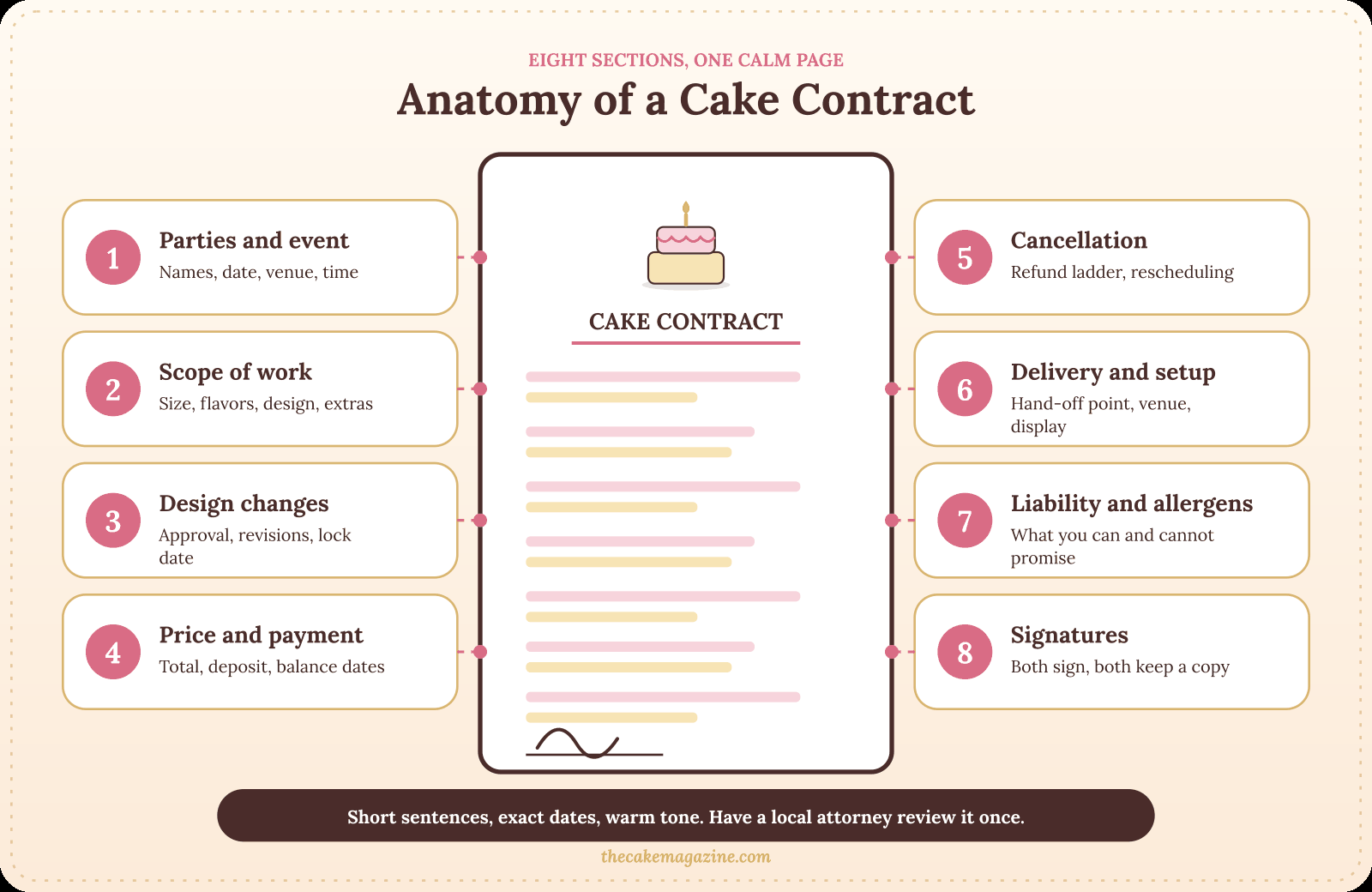
The infographic above lays out the eight sections that a dependable cake contract usually contains. Here they are in the order a client would meet them.
- The parties and the event. Your business name and the client’s name, phone, email, the event date, the venue and the delivery or pickup time.
- Scope of work. What exactly you will make: size, servings, flavors, fillings, frosting, design, decorations and anything included or excluded.
- Design changes. How the design is approved, how many revisions are included and the date after which the design is locked.
- Price and payment. Total, deposit, balance due date, accepted payment methods, taxes if they apply and any late fee.
- Cancellation and rescheduling. What is refundable, what is not and how date changes are handled.
- Delivery, pickup and setup. Who moves the cake, where, when, what happens at the venue and what the client needs to prepare.
- Liability and allergens. What the client is told, what you can and cannot guarantee and what happens after hand-off.
- Signatures and date. Both parties sign, with the date, and each keeps a copy.
Everything else, such as photo rights, tasting terms or weather, is a short optional clause that you add when the order calls for it. We cover those in the section on other clauses below.
One agreement or several documents?
Some bakers combine everything into a single cake contract. Others use a quote, an order form and a separate terms page. Either approach works, as long as the final package is clear, is accepted by the client in writing and does not contradict itself. If your quote says one thing and your terms say another, a reasonable person will rely on the version that favors them. Keep the pieces consistent and make sure the signature page refers to all of them.
A tidy way to do this is to let the order form feed the agreement. The form collects facts, and the cake contract turns those facts into promises. If you already use a form, copy its answers straight into the agreement so nobody has to retype or reinterpret them.
Plain language beats legal language
Compare these two sentences. “The Client shall indemnify the Vendor against any and all claims arising from the consumption of the Product” sounds official, but few customers will understand it, and a small bakery that copies it from the internet may not understand it either. “Please tell us about any allergies before you order, because we cannot guess, and we will tell you which ingredients are in your cake” says something true, is easy to follow and is much friendlier.
That said, plain language still has to be precise about the things that matter: dates, amounts, quantities, deadlines and responsibilities. Warm tone, exact facts. If a clause involves real legal consequences, such as limiting your liability, have an attorney review the wording once rather than guessing.
Scope of work: describing the cake clearly
The scope section answers the most basic question in any cake contract: what is the client buying? It sounds obvious, but a vague scope is behind more cake arguments than any other clause. “A three-tier floral wedding cake” can mean forty different things at forty different price points. Your job is to narrow it down to one.
Details that belong in the scope
- Size and servings. Tier diameters, heights and the number of servings you are planning for. Be clear on what a serving means. Our wedding cake servings guide explains why a party slice and a dessert slice differ.
- Flavors and fillings. Name each tier’s cake flavor, filling and frosting, such as “Tier 1: vanilla cake, raspberry filling, vanilla buttercream.”
- Frosting and finish. Smooth buttercream, textured, naked, fondant or a mix. Name the colors, and note that colors can look slightly different on screen and in person.
- Decorations. Piped flowers, sugar flowers, fresh flowers, toppers, ribbons, edible prints. State who supplies what.
- Inclusions. Cake stand, board, cake knife, boxes, cake topper, candles. If it is included, say so. If it is a rental, say that too.
- Exclusions. Plates, forks, cutting service, server staff, extra parties or a backup cake. Listing what is not included prevents polite misunderstandings later.
Reference images and how to word them
Clients love to send photos, and that is a good thing, as long as everyone understands what the photo means. A reference image is inspiration. It is almost never a guarantee that the finished cake will be identical, because hands, tools, ingredients and even the humidity differ from baker to baker. A single sentence in your agreement handles this beautifully:
Example wording. “Photos you share are used as inspiration. Your cake will be made in our style and will be similar to, but not an exact copy of, any reference image. We will confirm the final design with you in writing.”
If you refuse to copy another decorator’s work, which is a reasonable and ethical choice, say that politely in the same section. It protects both your reputation and the client’s expectations.
Allergy and dietary requests in scope
If a client asks for gluten-free, dairy-free, nut-free or vegan, treat it as a specific line in the scope, not a casual comment. Record exactly what was requested and what you can and cannot promise. A home kitchen that also handles wheat, nuts and dairy cannot honestly promise a medical-grade allergen-free environment. We cover the safe wording in the liability and allergens section, and the cake allergen management guide goes deeper into labels and cross-contact.
A scope example you can adapt
Here is how the scope of a modest celebration order might read. The wording is a sample to adapt, not legal advice.
- Cake: one 8-inch, two-layer round cake, about 14 party slices.
- Flavor: chocolate cake, salted caramel filling, chocolate buttercream.
- Design: smooth finish in dusty rose, piped buttercream flowers in cream and sage, a gold-lettered cake topper reading “Happy 40th, Maya.”
- Included: sturdy cake box, cake board. Not included: plates, forks, cutting or serving.
- Pickup: Saturday at 2:00 p.m. at our home kitchen.
Notice how much clearer that is than “chocolate birthday cake with flowers.” A reader can picture it, you can price it and a third person could even bake it from the description. That clarity is the entire point of the scope section.
Design changes and the lock date
Design changes are the quiet budget-killer of custom cakes. A tweak to the flower color sounds tiny. But if the buttercream is already tinted, the sugar flowers are already dried or the topper is already ordered, “tiny” can mean hours of rework and a pile of wasted materials. The cake contract does not forbid changes, and a cake contract that welcomes them early feels generous. It gives them a schedule and a price tag so they stay manageable.

Set a design lock date
The most useful single sentence in this whole section is the lock date. Pick a point, usually a number of weeks before the event, after which the design is final. Before that date, reasonable changes are welcome. After it, you work from the approved design, and any further change depends on what is still possible and may cost extra.
The right date depends on your workload and the kind of cake. A simple birthday cake might lock a week out. A wedding cake with sugar flowers, custom toppers or special-order supplies may need three or four weeks. Think about the longest lead time in your process, such as drying time, shipping or shopping, and set the lock date just ahead of it.
Example wording. “Your design is finalized two weeks before your event. Up to that date, we are happy to make reasonable changes at no charge. After that date, changes depend on what we have already prepared and may carry a fee.”
Decide what counts as a change
Not every adjustment needs the same response. It helps to sort changes into three simple groups so you can respond consistently and fairly.
- Minor tweaks. Shifting a ribbon color, adjusting lettering wording or changing a flower placement. Usually free before the lock date.
- Moderate changes. Swapping a flavor, adding a tier, changing the finish from buttercream to fondant. These change cost and time, so re-quote them.
- Major redesigns. A completely different theme or style. Treat it as a new order and a new quote, and check your calendar before saying yes.
Writing these categories into your agreement saves you from negotiating from scratch every time. You can also explain it simply: “Small changes are free until the lock date, anything that changes the cost gets a new quote.”
How many revisions are included
Revisions are another place to draw a line kindly. Many bakers include one or two rounds of sketches or written design updates in the base price, then charge a modest hourly or flat fee for extra rounds. The number is up to you. What matters is that it is written down and that you apply it evenly. A client who sees the rule in the cake contract on day one is far less likely to feel nickel-and-dimed on day thirty.
Approvals should be in writing
A verbal “that looks great” on the phone is easy to forget. Ask the client to approve the final design by reply email, text message or a signature on a one-page design summary. Then store that approval with the agreement. If a question comes up later, you can point to the exact approved version instead of competing memories.
- Send the design summary as a message the client can reply to with “approved.”
- Include the date and time of the approval in your order file.
- Keep the reference photos the client sent alongside it.
- Note any special requests such as “no gold leaf” or “keep the sides rustic.”
When changes arrive after the lock date
Sometimes life happens. A bride changes her colors, a company updates its logo or the party moves from outdoors to indoors. Your cake contract should leave you room to help without being forced to. A good pattern is “we will try to accommodate late changes where our schedule and supplies allow, and any extra cost will be quoted before we proceed.” That keeps the door open, protects your time and lets you say yes when you can.
If you use a written production plan, such as the three-day workflow in our cake production schedule guide, you will know exactly which changes are still easy and which are already baked into the schedule.
Payment terms in a cake contract
Money is where a casual cake contract most often falls apart, so it deserves precise language. The payment section answers four questions: how much, when, how and what if it is late. Keep every answer specific and put the dates on the page, because “a few weeks before” means something different to everyone.
The deposit: what it is for
A deposit does two jobs. It reserves your date, which prevents you from selling the same Saturday twice, and it covers the costs you take on before the event, such as ingredients, boards, boxes and early labor. Thinking about it that way helps you choose a fair amount. Add up the work and money you would lose if the order disappeared and the date could not be resold, and set the deposit so it covers a reasonable share of that.
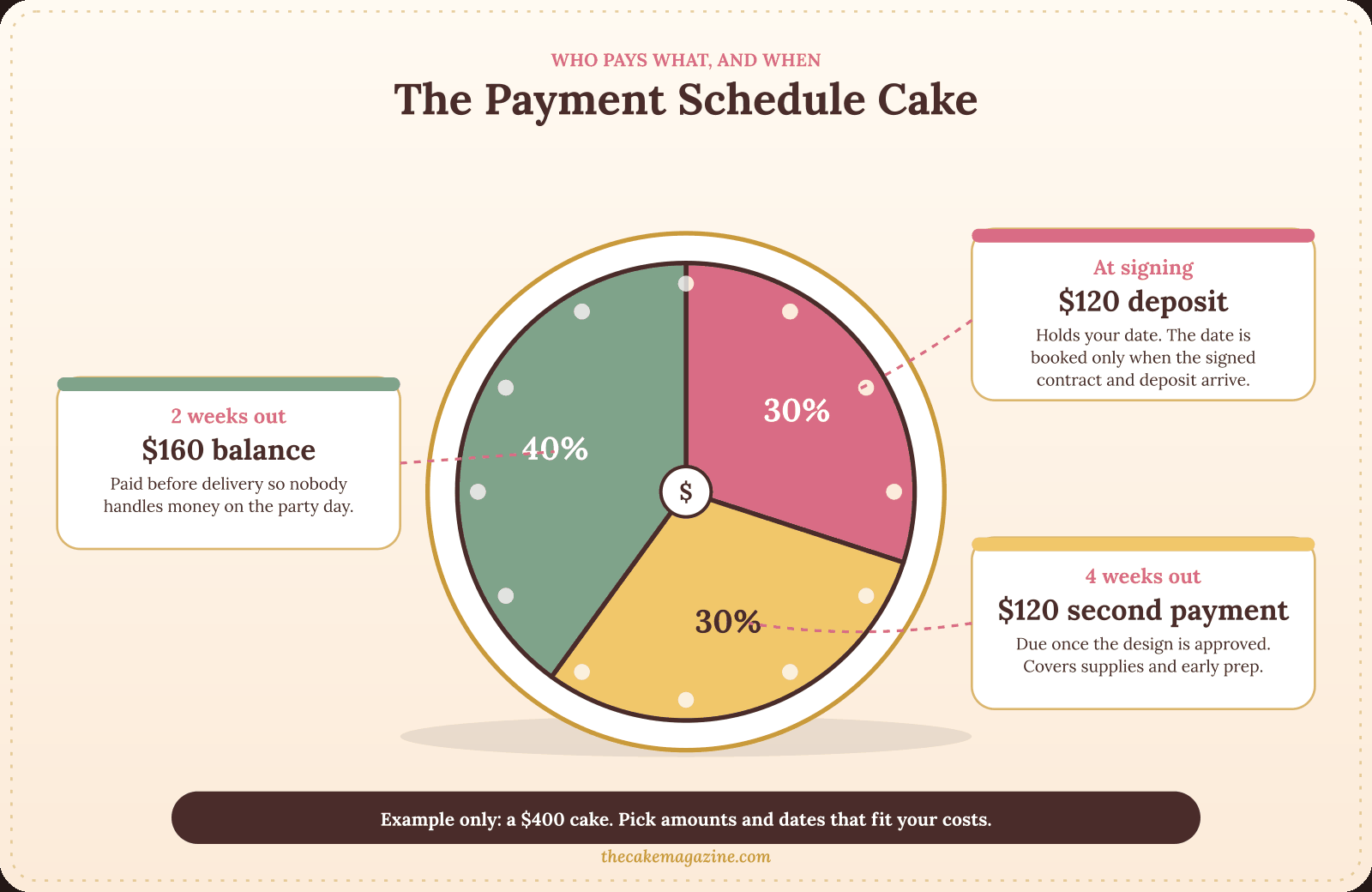
Bakers use many different structures, and there is no single correct number. Some take a flat reservation fee. Others take a percentage of the total. For larger or more complex orders a staged schedule, such as a deposit at booking, a second payment partway through and the balance before delivery, spreads the commitment. Whatever you choose, state it as a plain amount or percentage with a due date. Our deeper guide to cake deposits and cancellation policies walks through how to pick numbers that feel fair.
A sample payment schedule
Here is an illustration with made-up numbers, just to show the shape. Suppose a custom cake is quoted at $400.
- At signing: $120 deposit, which holds the date. Cake booked only when the signed agreement and deposit arrive.
- Four weeks before the event: a second payment of $120 once the design is approved.
- Two weeks before the event: the $160 balance is due, before ingredients and decorations are finalized.
The amounts and timing are yours to choose. For smaller cakes, two payments are plenty. For large orders, three or four give both sides comfort, because nobody has to hand over or wait for a huge sum at one moment.
Balance due before the event
Collecting the balance before the day of the event is one of the kindest habits a baker can build. It removes an awkward money conversation from a busy celebration, and it keeps you from driving a finished cake across town only to learn the check is in someone else’s purse. Many bakers set the balance due one to two weeks ahead and state that the cake will not be released until the balance is paid. If you accept payment at pickup, say so plainly and list the methods you take.
Payment methods and records
List the payment methods you accept, such as card, bank transfer, a payment app or check, along with any processing fee you pass on. Give a receipt for every payment, and keep a simple record that matches your bookkeeping. If you collect sales tax in your area, note whether quotes include it. Rules on tax vary, so check with your state and a tax professional, and see the IRS guidance linked in our home cake business guide for the basics.
- Say whether the total includes tax, delivery and any rental items.
- Name the day each payment is due, not just “two weeks before.”
- State the acceptable methods and any fees.
- Decide whether returned or failed payments carry a fee and say so.
- Give every client a copy of the signed agreement and a receipt for each payment.
Late payments
Plan for a missed payment before it happens. A short clause might say that if a payment is not received by the due date, you will send a reminder, and if it remains unpaid after a stated grace period, you may treat the order as cancelled and release the date. This is not about punishing anyone.
It is about being able to fill your calendar again with someone who is ready to book. Whether you add a late fee is your choice, and any fee should be modest and clearly stated up front.
Price changes and add-ons
Your total depends on the scope. If the scope changes, the price may change too. Add a line saying that additions, such as extra servings, extra tiers or a rush request, are quoted separately and added to the balance only after the client agrees in writing. That single sentence prevents the surprise on the final invoice that turns a happy client into a skeptical one. If you are not sure how to calculate those add-ons, our guide on how to price cakes covers labor, overhead and complexity.
Cancellation and rescheduling in your cake contract
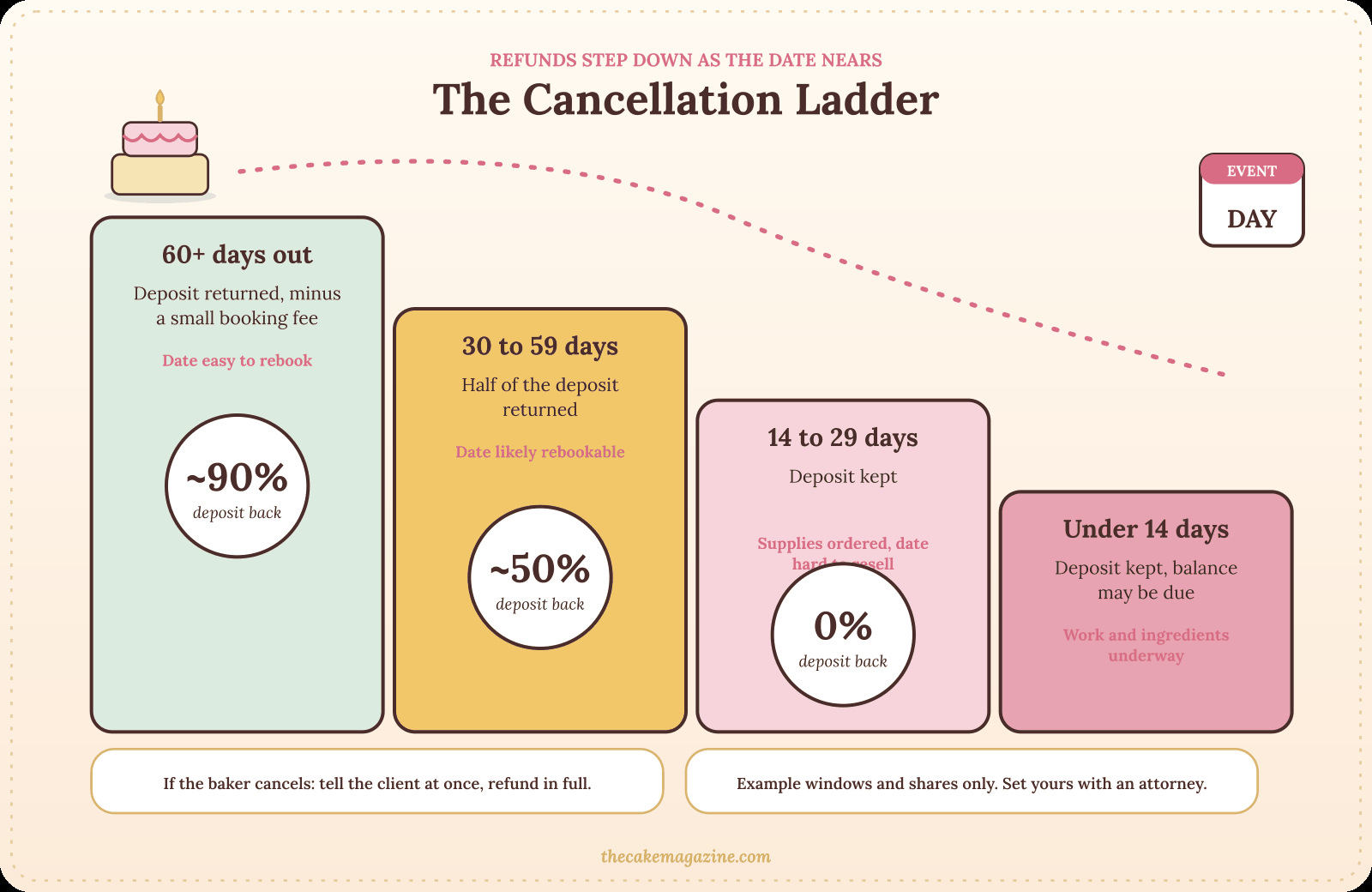
Nobody likes writing the cancellation clause, yet it is the one clients most often ask about and the one bakers most often wish they had written clearly. The fair approach is simple. The earlier a client cancels, the more of their money you can return, because the earlier you can rebook the date and the less you have already spent.
A sliding scale feels fair
Rather than a flat “no refunds,” many bakers use a ladder that steps down as the event approaches. The infographic shows the idea. Far from the event, most or all of the deposit might be returnable, minus a small booking fee. Closer in, the deposit is kept because the date is hard to resell. In the final days, when ingredients are purchased and work is underway, nothing is returned, and a portion of the balance may still be owed.
A ladder works because it matches the real cost to you. It also feels more reasonable to a client than a single hard rule, and a client who feels the rule is reasonable is less likely to dispute it. The exact windows and percentages are for you to set, ideally with your attorney’s input, because rules about deposits and refunds can differ by state.
Example wording. “Your deposit holds your date and covers our early planning and purchasing. If you cancel more than 30 days before your event, we will return the deposit minus a $25 booking fee. Inside 30 days, the deposit is not refundable.”
What to say about rescheduling
Rescheduling is different from cancelling, and it is worth treating it that way. If a client moves the date and you have an opening, many bakers happily transfer the deposit once. If you do not have an opening, or if the change is very late, the situation is closer to a cancellation. Your agreement can say that one reschedule is allowed with a set amount of notice, subject to availability, and that later changes are treated as cancellations.
Be careful with your calendar here. A moved date might collide with another order, and the answer is not always yes. Tools like the approach in our cake order calendar guide help you check capacity before you promise a new day.
If you have to cancel
A fair agreement is not one-sided. Illness, a car accident, a power outage or an oven that quits can all interrupt your plans, and clients deserve to know what you will do.
A common and decent promise is to notify the client right away, to try to arrange a substitute baker or an alternative where possible and to refund payments in full if you cannot deliver. Stating this builds trust, and it also reminds you to keep a backup plan, such as a baker friend you can call in a pinch.
Events that are out of anyone’s control
Severe weather, road closures, venue shutdowns or public emergencies can make an event impossible. Many agreements include a short clause for these, often called force majeure, which simply explains how the parties handle an event neither could control. Because the legal effect of that clause varies, this is one to have an attorney review. In plain terms, you might say you will work with the client to reschedule or refund what has not already been spent, and describe how you will treat money already used on non-recoverable materials.
Refund requests after the event
Decide in advance how you will handle complaints about a delivered cake. Because cake is perishable, you cannot take it back and resell it, so a “no returns” stance is normal for food. Even so, a decent agreement invites the client to contact you within a short window, such as 24 hours, with photos if something was wrong, and says you will review each concern in good faith. This protects the client’s peace of mind, and it protects you from a surprise complaint weeks later with no evidence.
Keep the cake contract cancellation rule consistent
Whatever ladder you choose, apply it the same way every time. Making exceptions out of kindness is understandable, but it can make the next client feel entitled to one too. If you want to bend the rule, treat it as a clearly labeled courtesy, and note it in the order file. That way the cake contract remains the standard and your generosity remains a gift.
Delivery, pickup and setup terms
A beautiful cake can be ruined in the last twenty minutes of its journey. Heat, bumps, a wrong address or an unprepared table can undo days of work, so the delivery section of your cake contract is more than a formality. It describes who is responsible for the cake at every step, and it tells the client what they need to do to make the hand-off go smoothly.

Pickup or delivery, and the line between them
Decide which options you offer and state each clearly. For pickup, include the address, the time window and a note that the client takes responsibility for the cake once it is in their care. For delivery, include the address, the delivery window, the fee and the name of the person who will receive the cake. The most important idea in the whole section is the hand-off point, the moment responsibility passes from you to the client or the venue. The infographic above marks that moment with a signature.
- Pickup: the client is responsible once the boxed cake leaves your hands. Share short transport tips, such as placing the box flat on a level floor and not on a car seat.
- Delivery: you are responsible until you set the cake down at the agreed spot and the client or venue contact confirms it.
- After hand-off: storage, display, heat and handling are in the client’s hands, unless you stay to set up.
For a full look at planning routes, loading the vehicle and documenting the hand-off, the cake delivery workflow guide goes step by step.
Delivery details to put in writing
- The full venue address, the room or area and a contact person with a phone number.
- A delivery window, such as “between 1:30 and 2:00 p.m.,” and a note that traffic or weather may shift it slightly.
- Access details, such as loading dock rules, elevators, stairs, parking and any venue fees or badges.
- A table requirement, such as a sturdy, level surface of a minimum size that is away from sun, vents and heat.
- Who will meet you, who signs for the cake and what happens if nobody is there.
- The delivery fee and whether it rises with distance, tiers or a rush request.
Temperature and display conditions
Cake and its fillings do not all tolerate heat equally. Cream cheese frosting, whipped cream, custard fillings and fresh fruit need more care than a firm American buttercream or a plain sponge. The food safety side of this is real, and the U.S. Department of Agriculture’s Food Safety and Inspection Service publishes general guidance on keeping perishable foods out of unsafe temperatures. Your agreement can reflect that by describing how long the cake should sit out and where.
For instance, you might say that cakes with perishable fillings should be refrigerated until about an hour before serving and should not be displayed outdoors in direct sun or for more than a few hours. Our cake food safety guide covers time and temperature limits in more depth, and local rules for your area may be stricter.
Setup, staging and assembly
If you set up the cake at the venue, say what that includes: assembling stacked tiers, placing fresh flowers, adding the topper and arranging the cutting knife. If you do not offer setup, say that the cake will be delivered fully assembled and placed on the cake table, and that the client or venue takes it from there. Tell clients what they should have ready, such as a clean table, a cloth and a cake stand, so you are not improvising on arrival.
For tall or multi-tier cakes, ask about stairs, lifts and doorways in advance. Cakes that cannot physically be moved into the room are a surprisingly common problem. A quick venue question during booking, noted on the order form, is far cheaper than a panicked phone call on the day.
Returns of stands, boxes and rentals
If you lend cake stands, domes, risers or other equipment, a line in your cake contract makes the rules clear. List the items, any rental fee or refundable deposit, the return date and what happens if something is damaged or lost. Keep it friendly.
“Please return the stand within a week of your event. Your stand deposit is returned once it arrives safely” is simple and gets stands back. Packaging itself, such as boxes and boards, is typically the client’s to keep or discard, as discussed in our guide to cake packaging for businesses.
Delay, no-shows and wrong addresses
Say what happens if the client is not available at the delivery time, or if the address was wrong. A reasonable approach is to wait a short, stated time, attempt to call the contact person and then, if the cake cannot be handed off, make a decision about a second delivery or a pickup, possibly with an extra fee. Cakes do not wait well, so a clear plan saves a bad moment and protects the cake’s safety.
Liability, allergens and what you can promise
This is the section where a cake contract becomes most legal, and it is also the one where it is most important to be honest and careful. The goal of this part of a cake contract is not to dodge responsibility. It is to describe accurately what you do, what you cannot control and what the client needs to tell you. It is a good place to invest in a one-time consultation with an attorney in your state.
Important. Liability clauses can be limited or overridden by state law, and a contract cannot excuse unsafe food handling. Nothing here is legal advice. Ask a qualified local attorney to review your wording, and ask an insurance professional about coverage.
Allergens: ask, record, communicate
Food allergies are serious, and they belong in your agreement. According to the U.S. Food and Drug Administration’s food allergies page, there are nine major food allergens: milk, eggs, fish, crustacean shellfish, tree nuts, peanuts, wheat, soybeans and sesame. A typical cake kitchen handles several of them every day, which means cross-contact is a real possibility even when a recipe avoids a given ingredient.
A practical allergen clause usually does three things.
- Asks the client to disclose any allergies or dietary needs of the person eating the cake, in writing, before the order is confirmed.
- Describes your kitchen honestly, for example that you handle wheat, eggs, dairy and tree nuts, and that you cannot guarantee a cake is free of traces.
- Offers ingredient information on request, and promises to label the cake or provide an ingredient list at hand-off.
Example wording. “Our kitchen handles wheat, milk, eggs, soy and tree nuts. We cannot guarantee that any cake is free from traces of these ingredients. Please tell us about any allergy before you order, and we will share an ingredient list on request.”
If you decide to decline allergy-critical orders, that is a legitimate business decision, and saying so in your agreement protects everyone. Our allergen management guide explains labeling and cross-contact practices, and keep in mind that “may contain” statements are no substitute for careful handling.
What you are responsible for
You are responsible for making the cake as described, with safe ingredients and clean practices, and for delivering it as agreed. State this plainly. A client reading it should feel you stand behind your work. Then describe the limits: you are not responsible for damage that happens after hand-off, such as a cake left in a hot car, a table that collapses or guests who mishandle a tall tier.
What the client is responsible for
- Giving accurate information on guest count, allergies, venue and timing.
- Providing a safe, level, shaded surface and accessible delivery location.
- Storing and serving the cake as instructed after hand-off.
- Reading and approving the final design summary.
- Telling you promptly if anything about the cake does not match the agreement.
Limiting liability: one to review with a lawyer
Many bakers add a sentence that caps their financial responsibility at the price paid for the cake. That kind of limit can be reasonable, but whether it is enforceable depends on where you live and what happens. It generally cannot protect against everything, particularly if someone is hurt. This is the clause to have reviewed. Do not copy language from another business without understanding it, because a clause that sounds protective may do nothing for you.
Insurance is a separate layer
An agreement allocates responsibility between you and the client. It does not replace insurance, which helps if something goes wrong and a claim is made. Product liability, general liability and delivery-related coverage can all be relevant to a cake business. Our cake business insurance guide explains the main types so you know what to ask a licensed agent. Also check local requirements for your kitchen, since selling from home may require permits; the cottage food laws guide and the licenses and permits checklist point you in the right direction.
Other clauses worth a few lines
Beyond the big six, a few optional cake contract clauses are worth including when the order calls for them. Each can be a single sentence or two, and each can save you from a conversation you would rather not have.
Tastings and consultations
If you offer tastings, say whether they are free, whether they are credited toward the order and how many people may attend. If a consultation takes meaningful time, you might ask for a fee that is applied to the final price if the client books. A short line keeps tastings from becoming a free afternoon of samples with no commitment. Our cake consultation guide explains how to run one well.
Photos and social media
Your finished cakes are your portfolio, so ask permission to photograph and share them. One line works: “We may photograph your cake and share the photos on our website and social media. Please tell us if you prefer that we do not.” If the client’s event includes other vendors, such as a photographer, clarify that credit is appreciated when the images are shared. Clients usually say yes, and asking up front avoids awkwardness.
Substitutions
Sometimes a specialty ingredient is out of stock, a particular flower is unavailable or a color is discontinued. Add a sentence saying you may substitute an item of similar quality and look when needed, and that you will tell the client about any significant change. That protects you from last-minute scrambling and tells the client you will always keep the spirit of the design.
Natural variation in handmade cakes
Handmade cakes vary slightly from one to the next, and decorations such as sugar flowers, hand-piped details and natural colorings are never perfectly identical. A single line acknowledging this sets reasonable expectations and keeps a client from judging the cake against a flawless photograph. This pairs well with the reference-image wording earlier in the scope section.
Dispute resolution and governing law
Some agreements say how disagreements will be handled, for example by talking first, then trying mediation and only then going to court, and which state’s law applies. For small orders this can be a line or two. Because wording and enforceability vary, ask your attorney what suits your state. Many bakers simply start with “let’s talk, and we will make it right if we can.”
Signatures, copies and electronic acceptance
Both parties should sign and date the agreement, and both should keep a copy. Many bakers send agreements electronically and accept typed or digitally drawn signatures, which is convenient for out-of-town clients. Whether and how electronic signatures hold up depends on where you live, so ask your attorney, and keep records such as the signed file, the email it came in and the payment receipt together in one order folder.
Matching your cake contract to the order
You do not need a heavy cake contract for a dozen cupcakes, and you should not treat them like a five-tier wedding. Many bakers keep a short version and a full version of their cake contract and choose between them depending on the order. That keeps small sales smooth and big ones well protected.
A light version for simple orders
For birthday cakes, standard flavors and local pickup, a one-page agreement or a confirmation message is often enough. It lists the client, date, pickup time, description, price, deposit, balance due date, a short cancellation line and an allergy note. Clients can approve it with a reply, and you keep the message in your order file.
A fuller version for custom and large orders
For sculpted cakes, multi-tier designs, corporate orders and anything delivered, use the full document with every section covered earlier. The extra detail is worth it, because these cakes use more time and money, and a mistake costs more.
Wedding cakes deserve their own checklist
Wedding cakes involve venues, planners, tastings, multiple payments, long lead times and emotional stakes. They also tend to include rentals, setup and a larger range of things that can change. If you take wedding orders, build a dedicated template, and see our wedding cake contract checklist for items such as tasting terms, servings and venue details. The wedding cake guide and the article on wedding cake costs help you describe and price what you are promising.
Repeat clients and standing orders
If you bake weekly for a café or monthly for a regular customer, a single agreement can cover the pattern: the menu, the delivery days, the payment terms, the notice needed to change quantities and how either party ends the arrangement. Ongoing relationships need clear notice periods more than anything else, because they involve changes in volume that can leave you holding supplies.
How to write your cake contract in six steps
Writing a cake contract template is a one-time project, and once it exists, each new order takes a few minutes. Here is a calm way to build yours, from a blank page to a document you can send with confidence. Block out an afternoon, put on some music and treat it like any other recipe development session.
Step 1: Gather your real policies
Before writing a word, list how you actually run orders today: lead time, deposit, balance date, delivery area, rush fees and cancellation habits. Your cake contract should describe your real business, not an imagined one. Look back at your last ten orders to see where friction showed up.
Step 2: Draft in plain language
Use the eight sections from the infographic as headings. Write each in short sentences with exact dates, amounts and names. Read it aloud. If it sounds like a form letter from a bank, rewrite it the way you would explain it to a friend across the counter.
Step 3: Build in the details that change
Leave clear blanks for the parts that differ with each order: client, date, venue, description, price and payment dates. Pull these from your custom cake order form so the facts match what the client already told you.
Step 4: Get your cake contract reviewed
Take the draft to a local attorney who works with small businesses, and ask them to check your cancellation, liability and governing-law language. A one-time review can cost less than a single dispute, and it makes the rest of your template safer to reuse.
Step 5: Test it on a friend
Ask a friendly customer to read it and tell you what is unclear. If they stumble over a clause, so will a stranger. Fix the confusing parts and shorten anything that feels heavy. A shorter, clearer document gets signed faster.
Step 6: Make it part of your workflow
Decide when the agreement goes out, such as right after the quote is accepted, and that no date is held until the signed copy and the deposit arrive. Store each signed copy with the order. Review the template once or twice a year as your business changes.
Where the cake contract sits in the order flow
The cleanest sequence is inquiry, consultation, quote, agreement, deposit and then production. The agreement should come after the client has seen and accepted the quote, but before any money changes hands and before you block off the date. That order keeps everything tidy: the quote becomes the price, the agreement becomes the promise and the deposit becomes the confirmation.
If you also use a written production plan, attach key dates from the agreement to it, such as the lock date, the balance due date and the delivery window, so they show up on your calendar and not only in a PDF. The three-day workflow in our cake production schedule guide makes a good companion.
A sample outline you can adapt
The skeleton below shows how a short cake contract might look. It is a structure, not finished legal language, so fill it with your own details and have it reviewed.
- 1. Who and when: baker, client, event date, venue, delivery or pickup time.
- 2. The cake: size, servings, flavors, fillings, design summary, inclusions and exclusions.
- 3. Design: approval method, included revisions, lock date and late-change policy.
- 4. Payment: total, deposit, due dates, balance, methods and late-payment steps.
- 5. Changes to the plan: cancellation ladder, one reschedule and what happens if the baker must cancel.
- 6. Hand-off: delivery or pickup details, setup, display conditions and equipment returns.
- 7. Responsibility: allergen disclosure, kitchen statement, limits after hand-off and any liability wording your attorney approves.
- 8. Signatures: both parties, with date and a copy for each.
How to present it without sounding cold
The way you send the agreement matters almost as much as what it says. A short, warm note, such as “Here is our agreement so we are both on the same page, and I am happy to explain anything,” turns the document into a conversation starter. Offer to walk through it by phone for larger orders. Clients who feel invited rather than processed are more likely to sign quickly and to enjoy the experience, which is good for your reviews as well as your records.
Cake contract mistakes to avoid
Most problems with a cake contract are not dramatic. They are small gaps that grow under stress. These are the ones that come up again and again, along with simple ways around each.
Copying a template without reading it
What happens: you borrow wording from another business, and it mentions services you do not offer, rules that do not apply in your state or promises you cannot keep.
Fix: use templates as inspiration only. Rewrite each clause to match your process, then have it reviewed.
Vague descriptions of the cake
What happens: “elegant floral cake” is read three ways by three people, and the final cake disappoints someone.
Fix: list sizes, flavors, colors, decorations and inclusions. Add an approved design summary and keep the client’s reference photos with it.
Holding a date without a deposit
What happens: you promise Saturday to someone who then goes quiet, and you turn down two paying clients in the meantime.
Fix: state that a date is held only after the signed agreement and deposit arrive. Be kind, but be consistent.
Burying the cancellation terms
What happens: the client signs without noticing the refund ladder, then feels surprised when it applies.
Fix: give cancellation its own clear heading, mention it in your quote email and, for big orders, point it out in conversation.
Ignoring allergens
What happens: a guest has an undisclosed allergy, or a client assumes a “nut-free” cake comes from a nut-free kitchen.
Fix: ask every client about allergies, describe your kitchen honestly and decline orders you cannot make safely. Read the full steps in our allergen management guide.
Forgetting to say when responsibility ends
What happens: a cake sits in a hot room for hours and a client blames you for the melted frosting.
Fix: define the hand-off moment and include short display and storage instructions. Add them to your cake label or card too.
Never reviewing the document
What happens: your business changes, but the template still describes last year’s prices, services and policies.
Fix: set a reminder to review the cake contract at least once a year and after any dispute, then update it with what you learned.
When something still goes wrong despite a cake contract
Even with a strong agreement, a cake can still arrive damaged, a client can still be upset or a payment can still go missing. Respond with calm and kindness first. Gather the facts, look at the agreement together and offer a fair fix where you can. A thoughtful resolution often costs less than a fight, and a client who feels heard may still recommend you. If a dispute is serious or involves injury, contact your insurance provider and an attorney promptly rather than trying to handle it alone.
A one-page cake contract checklist
Use this before you send any agreement. If you can tick every box, your cake contract is in good shape for most orders.
- Names, phone numbers, emails, event date, venue and time are correct.
- The cake description covers size, servings, flavors, fillings, finish, colors and decorations.
- Inclusions, exclusions and any rental items are listed.
- The reference-photo sentence is included.
- The design lock date and the revision policy are stated.
- The total, deposit, balance due date and payment methods are written with exact dates.
- The cancellation ladder and the rescheduling rule are clear, plus what happens if you cancel.
- Delivery or pickup details, setup, display conditions and the hand-off moment are described.
- Allergy questions are answered and the kitchen statement is included.
- Photo permission, substitution and natural variation lines are in place.
- Both parties have signed and dated, and each has a copy.
- A lawyer has reviewed your template within the last year or two.
If you want a reliable starting point for the rest of your baking business, the King Arthur Baking cake guide is a helpful reference for the baking side while you build the business side.
Frequently asked questions
Do I really need a cake contract for every order?
You do not need a long document for every cupcake box, but you should have something in writing for every order. For small orders a confirmation message with the date, price, description and pickup time works well. For custom, delivered, wedding and large orders, a signed cake contract is the safer choice.
What should a cake contract include at minimum?
At minimum it should name both parties, the event date and the venue or pickup details, describe the cake, state the total price, deposit and balance date, explain cancellation and rescheduling, say how delivery or pickup works, mention allergens and be signed by both sides. Add other clauses as your orders require.
How much deposit should I ask for in a cake contract?
There is no single right amount. Base it on the non-recoverable costs and the lost opportunity if the date cannot be resold, then state it plainly as a flat fee or percentage with a due date. Our cake deposits and cancellation policies guide explains how to choose a fair figure for your business.
Can a cake contract be a text message or email?
Often a written exchange can record an agreement, but how strong it is depends on the details and where you live. A signed document with clear terms is generally easier to rely on. Ask a local attorney how electronic agreements and signatures are treated in your state before depending on them for large orders.
What if the client wants a design change after the lock date?
Your agreement should say you will try to help where your schedule and supplies allow, and that late changes may cost extra. Quote the change in writing before you proceed. If you cannot make it work, offer the approved design instead, and explain kindly why the lock date exists.
Should the deposit be refundable?
That is your choice, and a sliding scale is a popular, fair approach: more is returnable far from the event and less as the date approaches. Whatever you pick, state it clearly in the cake contract and check with an attorney, since rules on deposits and refunds can vary by state.
Who is responsible once the cake is delivered?
Your agreement should name the hand-off moment. Usually the baker is responsible until the cake is set down at the agreed location and received, and the client or venue is responsible afterward for storage, temperature, display and serving. Include short care instructions so clients know how to keep the cake safe.
How do I handle allergies in a cake contract?
Ask for allergy information in writing before confirming the order, describe the allergens your kitchen handles and avoid promising an allergen-free cake unless you truly can. The FDA lists nine major food allergens, and cross-contact is a real risk in shared kitchens. Our allergen guide has more detail.
Can I limit my liability in a cake contract?
You can include wording that limits responsibility, such as capping it at the price paid, but whether a court would enforce it depends on your state and the situation. It generally cannot excuse unsafe practices or serious harm. Have a local attorney review any liability clause and talk with an insurance agent about coverage.
Does a wedding cake contract look different?
They usually benefit from a fuller version, because weddings involve venues, long lead times, tastings, several payments, setup and more moving parts. See our wedding cake contract checklist for the extra items to include, and keep your standard terms consistent across both versions.
What happens if I have to cancel on a client?
Put your plan in the agreement. A common and fair approach is to notify the client immediately, try to find a substitute baker where possible and refund what the client has paid if you cannot deliver. A backup baker you trust can turn a crisis into a minor change of plans.
How often should I update my cake contract?
Review it at least once a year, and again after any dispute, price change, new service or change in local rules. Small updates keep it accurate, and a periodic attorney check keeps your cancellation and liability language up to date for your state.
Where can I learn more about running the business side?
Start with our guide to starting a home cake business, then read about pricing, food safety and insurance. Together they cover the pieces that a good cake contract depends on, from costing a cake properly to keeping it safe on the way to the party.
Final thoughts
A good cake contract is not about distrust. It is a short, friendly record of a promise: this cake, on this day, for this price, delivered in this way, with a fair plan if life changes. When both sides can see that promise in writing, the cake gets better, because you spend your energy on the baking instead of on clearing up misunderstandings.
You do not have to write the perfect document today. Start your first cake contract with the basics, the cake description, the payment dates and the cancellation ladder, and add the other clauses as your orders teach you what you need. Then have a local professional check the parts that carry legal weight. Over time, your cake contract becomes a quiet part of your craft, one more thing that helps clients feel looked after.
Editorial note: reviewed and updated November 2026. This guide offers general information for U.S. home and small-bakery cake makers and is not legal, tax, insurance or food safety advice. Contract, refund, licensing and electronic-signature rules vary by state and locality, so confirm current requirements with a qualified attorney and your state and local agencies. Sample wording and dollar amounts are illustrations only and have not been reviewed by an attorney.