Most custom cake orders still begin with a phone in someone’s hand and a search that sounds like “wedding cake near me” or “birthday cake bakery in my town.” A local seo cake business strategy is simply the work of making sure your bakery is one of the few names that appear when that moment arrives. It is less mysterious than it sounds. It rests on a well-filled Google Business Profile, a clear service area, honest reviews, a website that says where you bake, and patience.
A local seo cake business plan has five parts. Claim and verify a Google Business Profile with accurate details. Pick specific categories and set a realistic service area. Collect reviews from real customers and answer every one. Build a website that names your town, your cakes and your ordering steps. Keep the same name, address and phone number everywhere. Google says nobody can pay for a better local ranking, so steady, accurate work is the whole game.
- What local seo cake business work really means
- How Google decides which bakeries to show in a local seo cake business search
- Claiming and verifying your Google Business Profile
- Name, categories, hours and description
- Service areas for a home baker
- Photos, products and posts that earn clicks
- Reviews: how to earn them, ask for them and answer them
- Your website: the local seo cake business pages that matter
- Winning wedding cake searches
- Citations, directories and local links
- Tracking what is working
- Common local seo cake business mistakes bakers make
- A 90-day local seo cake business plan
- FAQ
What local SEO for a cake business really means
Search engines treat some searches as questions about a place, and that is where a local seo cake business competes. When someone types “custom cakes” and Google senses that they are standing in Columbus or Tacoma or a small town in Vermont, it shows a map and a short list of nearby businesses before the usual web results. Local SEO is the craft behind every local seo cake business listing: earning a spot in that short list, and in the ordinary results beneath it.
For a cake maker the stakes are practical. A custom cake is not something people ship across the country, and most buyers want a baker within a reasonable drive. That makes a local seo cake business effort one of the most direct marketing jobs you can do. You are not trying to be famous. You are trying to be easy to find for the people who live within reach of your kitchen and are ready to book.
It also helps to say what local seo cake business work is not. It is not a trick for climbing past established bakeries overnight, and it is not a replacement for good cakes. It cannot rescue a business that answers messages three days late. What a local seo cake business effort does is remove friction, so that when a good baker and a ready customer are within ten miles of each other, they actually meet.
Local search versus ordinary search
Ordinary search cares mainly about the content of a page. Local search adds the physical world: where the searcher is, where your business is, and how trustworthy your business looks to people nearby. That is why two bakers with similar websites can show up very differently on the map. One has a complete, verified profile with fresh photos and forty honest reviews. The other has an unclaimed listing with a wrong phone number.
Because the physical world is part of every local seo cake business search, you also have a few things you cannot control, like how far the searcher happens to be from you. The goal is to control everything else, so that the factors you can influence work in your favor.
What a baker gets out of it
- Better-fit inquiries from a local seo cake business. People who find you through a local search are usually inside your delivery range and already want a custom cake, not a price shootout.
- Less dependence on one platform. If a social account is restricted or the algorithm shifts, your profile and website keep working.
- A steady trickle in slow months. Good local listings keep bringing in inquiries while you are elbow-deep in fondant.
- Proof in public. Reviews, photos and answers to common questions do some of your selling for you, while you sleep.
A note on scope. This is general marketing information from a baking magazine, not legal or professional advice. Rules about selling food from home, about advertising and about business names depend on where you live. If you are still sorting out whether you may sell cakes at all, start with our guide to starting a home cake business and your state’s own agency before you invest in marketing.
How Google decides which bakeries to show
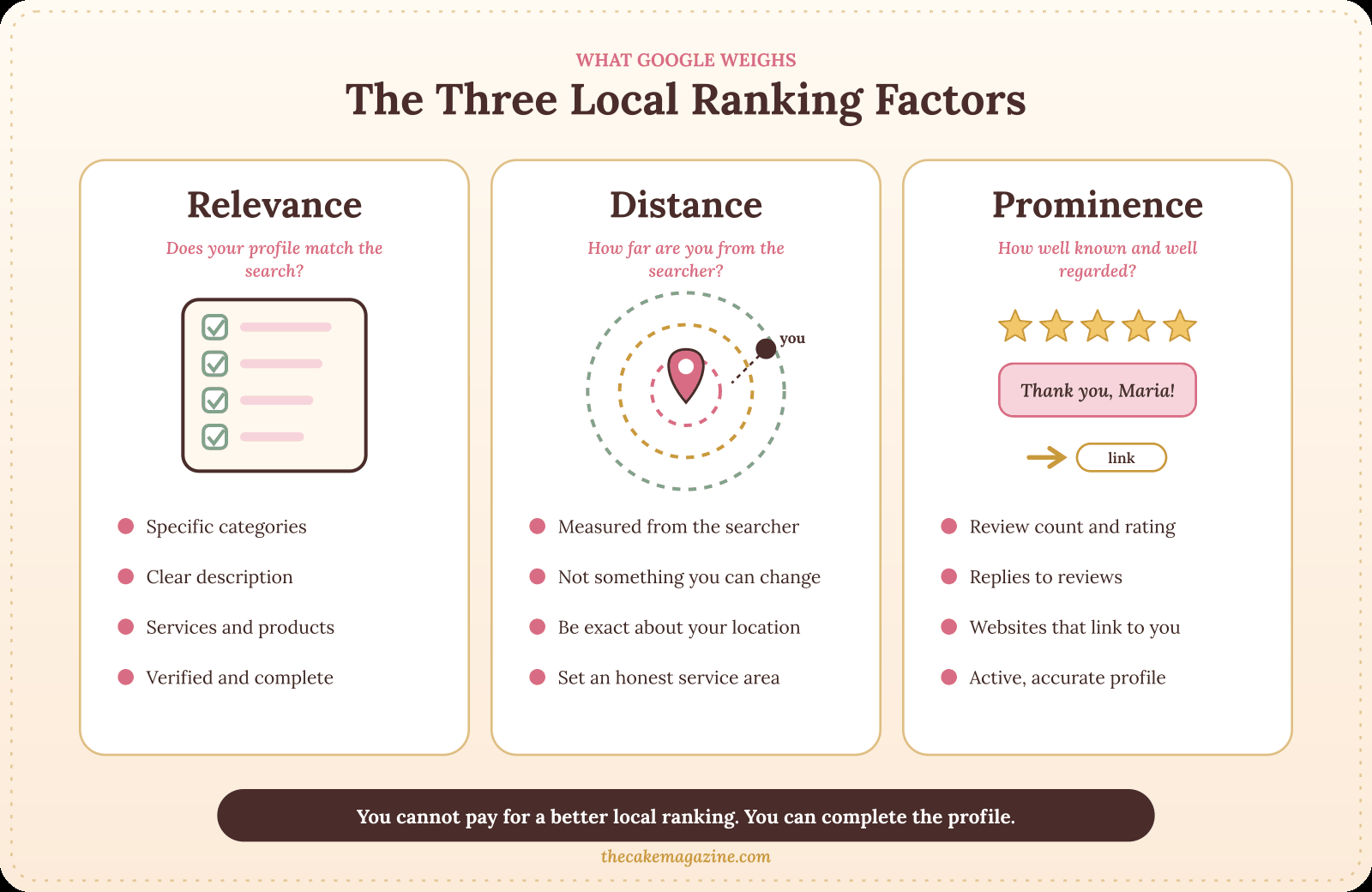
Google explains local ranking in its own help pages, and the explanation is refreshingly short. Local results are based mainly on three things: relevance, distance and prominence. Every tactic in a local seo cake business plan feeds one of those three, so it is worth understanding each before you touch a single setting.
Relevance: does your profile match the search?
Relevance is how well your listing matches what the person typed. A complete profile helps Google understand what you do. If your listing says “Bakery” and nothing else, Google has to guess whether you make wedding cakes, cupcakes or sourdough. If it lists specific categories, services, products and a clear description, the match is much easier. Google’s help page notes that complete, detailed information improves relevance.
Distance: how far are you from the searcher?
Distance is exactly what it sounds like. If the searcher shares a location, Google measures from there. If not, it uses whatever location it already has for them. You cannot change this factor, and trying to fake it with a rented mailbox or a fake address is a fast route to a suspended profile. The honest response is to be accurate about where you are and which areas you serve.
Prominence: how well known and well regarded are you?
Prominence is the reputation factor, and it is the slow-burning heart of any local seo cake business. Google lists things like how many websites link to your business and how many reviews you have. Review count and star rating both play into it, and replying to reviews is mentioned as a way to show you value feedback. This is the factor that takes the longest to build, and it is the one where baking skill and good service pay off the most.
You can read Google’s own wording in its help page on improving your local ranking. One line is worth remembering: there is no way to request or pay for a better local ranking. Anyone who sells you a guarantee is selling something Google says does not exist.
What this means for a home baker
If you bake from home you may never have a storefront, a street sign or walk-in traffic. That used to be a handicap for any local seo cake business online. It matters less than people assume, because prominence is built from things you can create: reviews, photos, links and a clear website. You are competing on completeness and reputation, not on rent.
Think of the three factors behind a local seo cake business as a dial board. Distance is fixed. Relevance you can set to near-perfect in an afternoon. Prominence rises slowly with every good cake. The sections below follow that order, starting with the fastest wins.
Claiming and verifying your Google Business Profile for a local seo cake business
The Google Business Profile, often shortened to GBP, is the free listing that appears on the map and beside your name when someone searches for it. For any local seo cake business, it is the single most valuable asset you can control, which is why it comes before the website, social media or directories.
Before you create anything, search for yourself
Open Google or Maps and search for your bakery’s name plus your town. You may find a listing already exists, created by a customer, a former owner or an automatic import. If it does, claim it rather than creating a second one. Google’s guidelines list creating more than one profile for the same business among the things that can lead to suspension, so duplicates are a problem, not a shortcut.
Check that you are eligible
Google’s guidelines say businesses with a customer-facing location, or that travel to customers, can have a profile. A business with no storefront that travels to customers can have a single service-area profile. Home-based service businesses should hide their address. Virtual offices are not eligible, and P.O. boxes and remote mailboxes are not acceptable addresses.
Where this gets personal for bakers is the question of whether your arrangement counts. A baker who sells from home and delivers cakes to customers is typically close to a service-area business. A baker who invites customers into a bakery with posted hours is a storefront. A baker who meets customers at a coffee shop is neither. Read the guidelines page yourself, because Google updates it, and choose the setup that honestly describes how you work.
Your local cottage food or licensing rules matter here too. If your state says certain sales must happen in particular ways, such as limits on delivery or on where customers may pick up, your profile should not advertise something your local rules do not allow. Our guide to cottage food laws for cake businesses explains what to check before you promote anything.
Verification: proving you are real
Verification tells Google you are authorized to represent the business, and Google says it makes you more likely to appear in results. The method offered depends on your business and location. It may be a postcard, a phone call, a text, an email or a short video. Follow the steps Google presents to you. Do not pay a stranger to “verify” you.
- Use the account you will keep. Create the profile under a business email you control long-term, not a friend’s login.
- Add a backup manager. Add a second trusted owner or manager so one lost password does not lock you out.
- Keep your proof ready. If a video is requested, have your equipment, packaging, signage or kitchen area ready to show in a way that stays private and safe.
- Be patient. If your first attempt fails, read the message, fix the mismatch and try again rather than creating another listing.
Protect your home address. If you bake at home and customers never visit, choose the service-area option and hide your address. Share the pickup address privately only after an order is confirmed. Your safety and your neighbors’ patience are worth more than a pin on a map.
Name, categories, hours and description
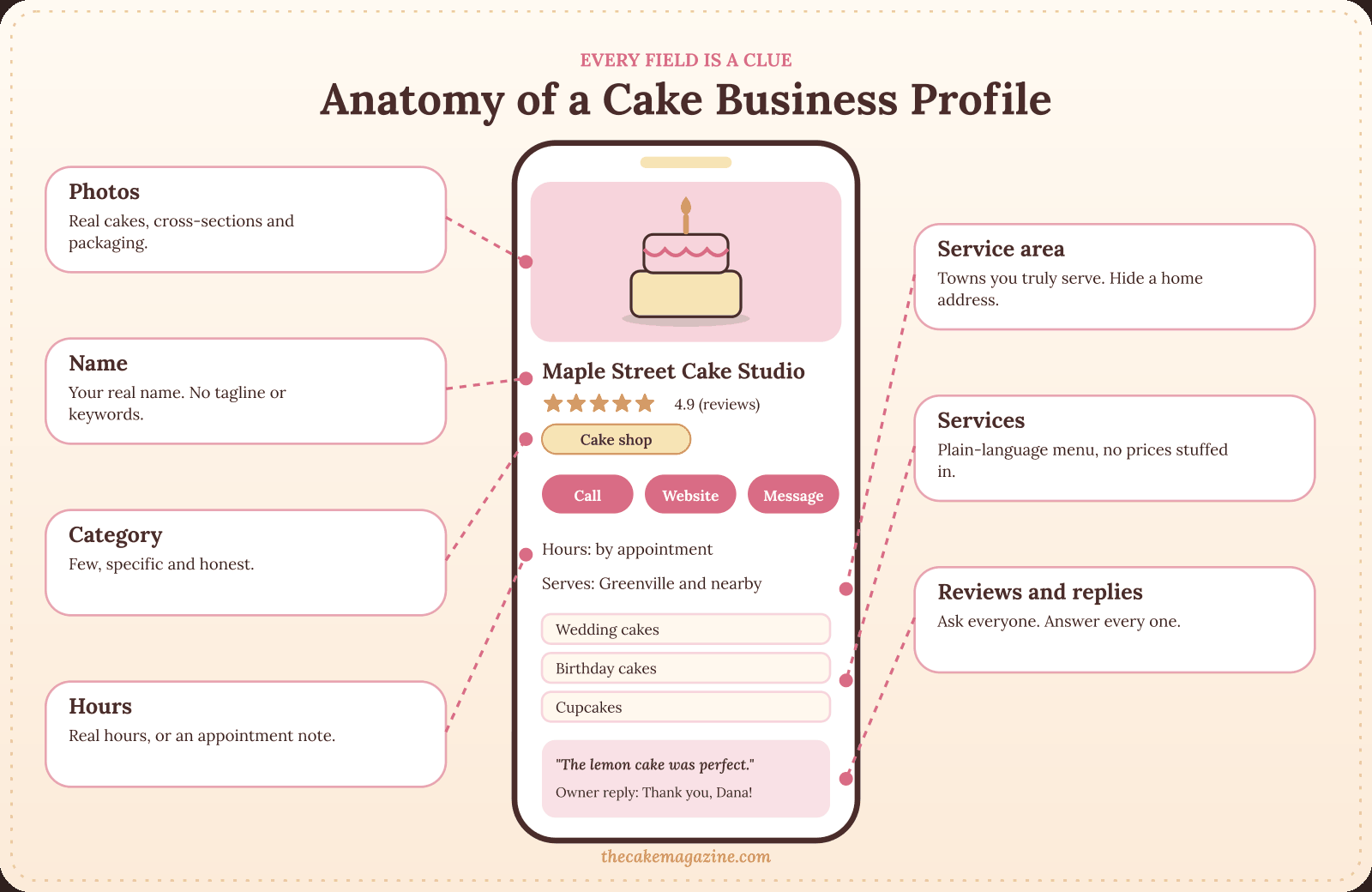
Four small fields do most of the relevance work in a local seo cake business profile. They are also the four where bakers most often get creative in ways that cause trouble.
Your business name
Google’s rule is plain: use the real-world name that appears on your signage, website and stationery. Do not add taglines, hours, phone numbers, URLs or details about products or locations. It might be tempting to rename your listing “Sweet Rose Cakes | Wedding Cakes Austin | Custom Birthday Cakes,” but that stuffing is exactly the kind of thing the guidelines list as a reason for suspension.
The better move is to choose a business name you are happy to use everywhere and then let the other fields do the work. If your name already contains a keyword, like “Maple Street Cake Studio,” fine. If it does not, you lose nothing, because categories, services and reviews tell Google what you sell.
Categories: choose few and choose precisely
Categories are the strongest relevance signal you control. Google’s advice is to pick the fewest categories that describe what you are and to make them as specific as possible. For many bakers a primary category such as a cake shop or bakery, and perhaps one or two closely related secondary ones, is enough. Do not add categories for things you do not actually do, such as catering, if you are not catering.
The categories available change over time, so browse the list inside your profile rather than relying on a list in a blog post. Search the dashboard for words like “cake,” “wedding,” “bakery” and “dessert” and choose what honestly fits. If you are unsure, look at three bakeries near you that you respect and notice what they selected, then choose for your own business, not theirs.
Hours that match real life
Hours are an odd fit for a custom baker. You may be baking at two in the morning and unavailable for pickup on Wednesdays. Google lets you list regular customer-facing hours, set seasonal or holiday hours, and mark a business temporarily closed in an off-season. It also notes that some business types, including appointment-only or varied-schedule businesses, should not list hours.
If you take orders by inquiry and hand off cakes by appointment, say so in your description and on your website instead of inventing opening hours that mislead people. If you do hold pickup windows, list them accurately, and update them before holidays. A customer who drives to a closed door writes the kind of review you cannot erase.
A description that sounds like a person
The description is where you tell your story in a few sentences. Google’s guidelines say to leave out promotions, prices, links and gibberish. Write what you bake, who it is for, what area you serve, and how someone gets started. Read it aloud. If it sounds like a list of search terms strung together, rewrite it.
Here is a pattern that works for many bakers, which you should adapt to your own voice: say what you make, say where you make it, say how people order, and mention one distinctive detail. For instance, a baker might write that she makes custom celebration and wedding cakes in a home kitchen, delivers within a stated area, takes inquiries through the website form, and bakes from scratch with real butter. That is clear, honest and specific without a single stuffed keyword.
Service areas for a home baker
A service area tells Google, and customers, which places you will travel to. For many bakers who deliver, it is the heart of local seo cake business planning, because it decides who sees you and who does not. It also forces an honest conversation about how far a cake can safely and profitably travel.
What Google says about service areas
Per Google’s guidelines, service-area businesses get one profile tied to a central location, with a defined service area. The guidelines add that service areas should generally stay within about two hours’ drive of the base, though larger areas may be allowed for some businesses. A cake is not a plumber, and two hours with a tiered wedding cake in the back is a stretch most bakers would never choose.
Use that outer limit as a ceiling, not a target, when you plan a local seo cake business. A smaller, believable area beats a sprawling one that makes your profile look like it is reaching for searches it cannot serve.
Draw your rings by drive time, not by pride
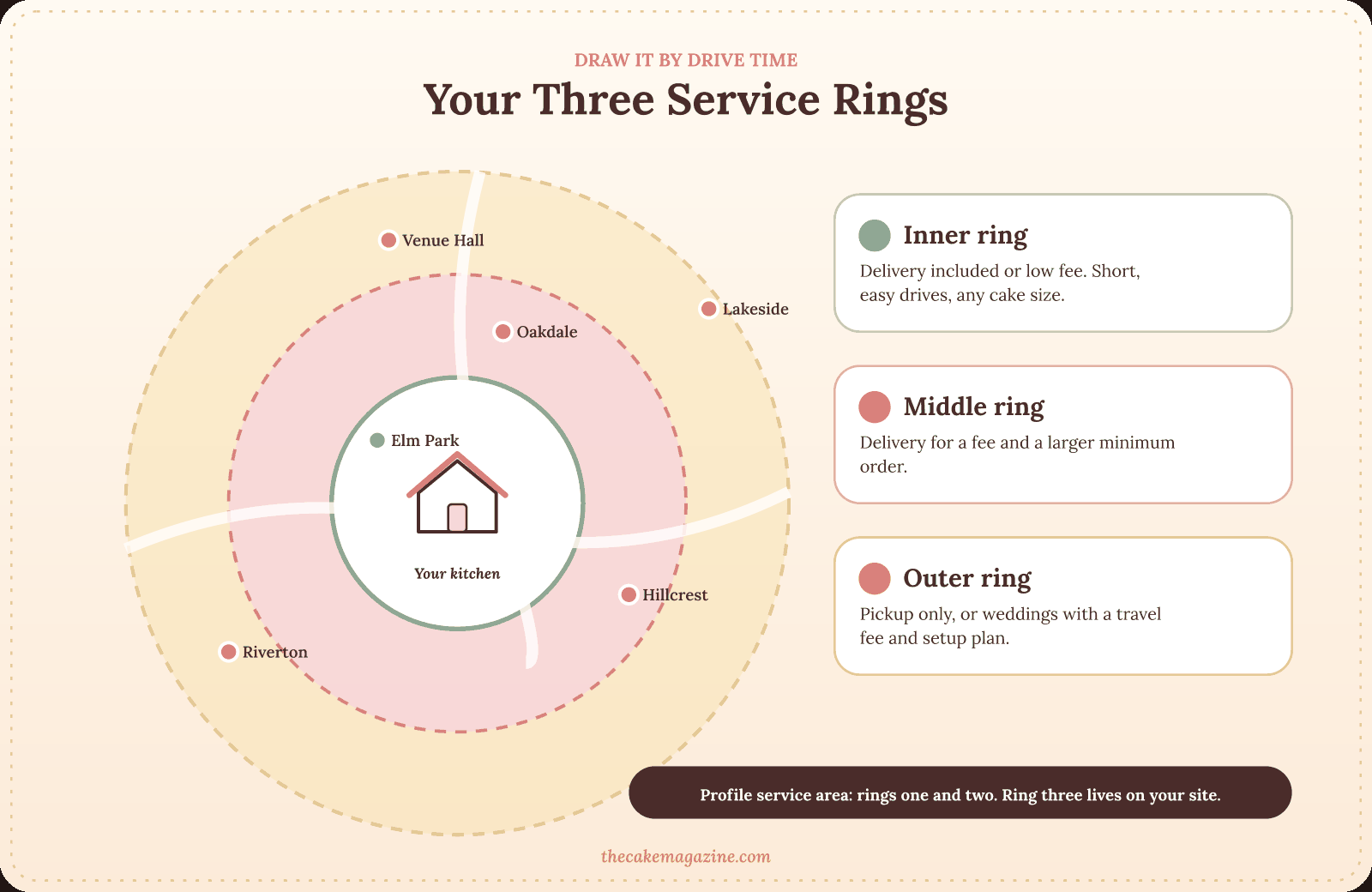
Think in three rings. The inner ring is the area where you will deliver any cake, even a tall one, without a second thought. The middle ring is where you will deliver for a fee and for orders large enough to justify the trip. The outer ring is pickup only, or by special arrangement for weddings. Your profile service area usually matches the first two rings; the third lives on your website.
- Inner ring: short drives, flat roads, no hurry. Free or low delivery fee.
- Middle ring: longer drives, a clear delivery charge, a larger minimum order.
- Outer ring: pickup only, or wedding bookings with a travel fee and a setup plan.
Our cake delivery workflow guide covers the practical side: vehicle setup, temperature, timing and handoff. Decide your rings with that reality in mind. A cake that arrives wilted because you promised a ring you could not serve produces the worst review a baker can receive.
Naming places in your profile and on your site
In the profile you add cities, counties or postal codes. Choose the places you truly serve and keep the list modest. On your website you have more room to be useful. A page that says “We deliver custom cakes to these towns, with a delivery fee that starts at a stated amount” gives a customer a reason to trust you and gives search engines clear text to read.
Avoid creating a separate near-identical page for every suburb, each with the same paragraph and the town name swapped. Search engines see through it, and so do customers. One honest service-area page, plus real pages for towns where you have something specific to say, is much stronger. A real reason might be a wedding venue you often work with there, or a farmers market stall you run.
When you do have a pickup location
If you rent a commercial kitchen with a counter, or run a small shop where customers come in, you can show that address and list customer-facing hours. In that case, Google’s guidance says to keep permanent signage at the address and to use a precise, real street address. A co-working or shared kitchen qualifies only when it meets conditions like clear signage and staff on site during posted hours.
If you use a shared commissary but customers never visit, you probably still want the service-area setup. Match the profile of your local seo cake business to how customers actually interact with you, not to where your equipment lives.
Photos, products and posts that earn clicks
Google shows photos prominently in local results, and cake is about as visual as a product gets. A profile with sharp, honest, recent images does a lot of persuading before the customer has read a word. The trick is to show your actual work consistently, in a way that lets a stranger picture their own event.
The photos worth uploading first for a local seo cake business
A local seo cake business does not need a hundred images on day one. You need a handful of strong ones that cover the questions customers silently ask. Do you make cakes I would be proud to serve? Do you do my style? Are you a real person? Is the cake clean, neat and well packed?
- A logo and a cover image that matches your brand colors and looks good when cropped.
- Five to ten finished cakes on a clean background, with the full cake visible and a closer shot of the details.
- A cross-section of a cut slice, because crumb and filling sell the flavor.
- A wedding or tiered cake at a venue, if you have permission to share it.
- Packaging and delivery shots, such as a boxed cake in your vehicle, which quietly signal professionalism.
- A photo of you at work, hands in the frame if you prefer, so the business feels like a person.
Lighting and consistency do most of the work. Our cake photography guide walks through light, backgrounds, angles and color so your portfolio looks like one bakery rather than a scrapbook. Good photos serve your website, your social media and your profile all at once, which makes the effort cheap per use.
Alt text and file names on your own site
On your website, image file names and alt text help search engines and screen readers understand each picture. Name files in plain words, like “lemon-raspberry-wedding-cake-austin.jpg,” and write alt text that describes what is in the photo the way you would explain it to someone who cannot see it. Skip stuffing every alt with the same phrase, which helps nobody.
Products and services in the profile
Your profile can list services and products, which is a good place to explain your menu in a few plain words. You might list wedding cakes, custom birthday cakes, cupcakes by the dozen and dessert tables, each with a short description and a starting-from note if you have one. Check the current rules inside the dashboard, because Google limits what can appear in some fields and has said that prices and links do not belong in the business description.
Be careful about anything that could suggest a food-safety promise you cannot keep. Phrases such as “allergen-free” or “gluten-free” can be risky for a home kitchen with shared equipment. Say what you actually do, like “we can bake without nuts but work in a kitchen that handles nuts,” and send detailed questions to your order form.
Posts and updates
Profile posts and updates let you share a seasonal flavor, a fresh opening in your calendar, or a holiday cutoff date. They take a minute and signal that the business is active. Keep them factual and free of anything that looks like an ad for a deal you cannot honor. A short note like “Thanksgiving pie-cake orders close on November 12” is useful, specific and unlikely to break any rule.
If you have a rhythm on social media, you can reuse the same photo and a sentence or two. Our guide to social media for cake businesses covers content ideas, and the same cakes can quietly feed your profile. Do not duplicate effort in your local seo cake business. Post once, in a form that suits each place.
Reviews: how to earn them, ask for them and answer them
Reviews are the loudest part of prominence in any local seo cake business, and the part bakers worry about most. The good news is that bakers have a natural advantage. A cake is an emotional purchase, and happy customers are often eager to say so, if you make it easy and ask at the right moment.
The best moment to ask
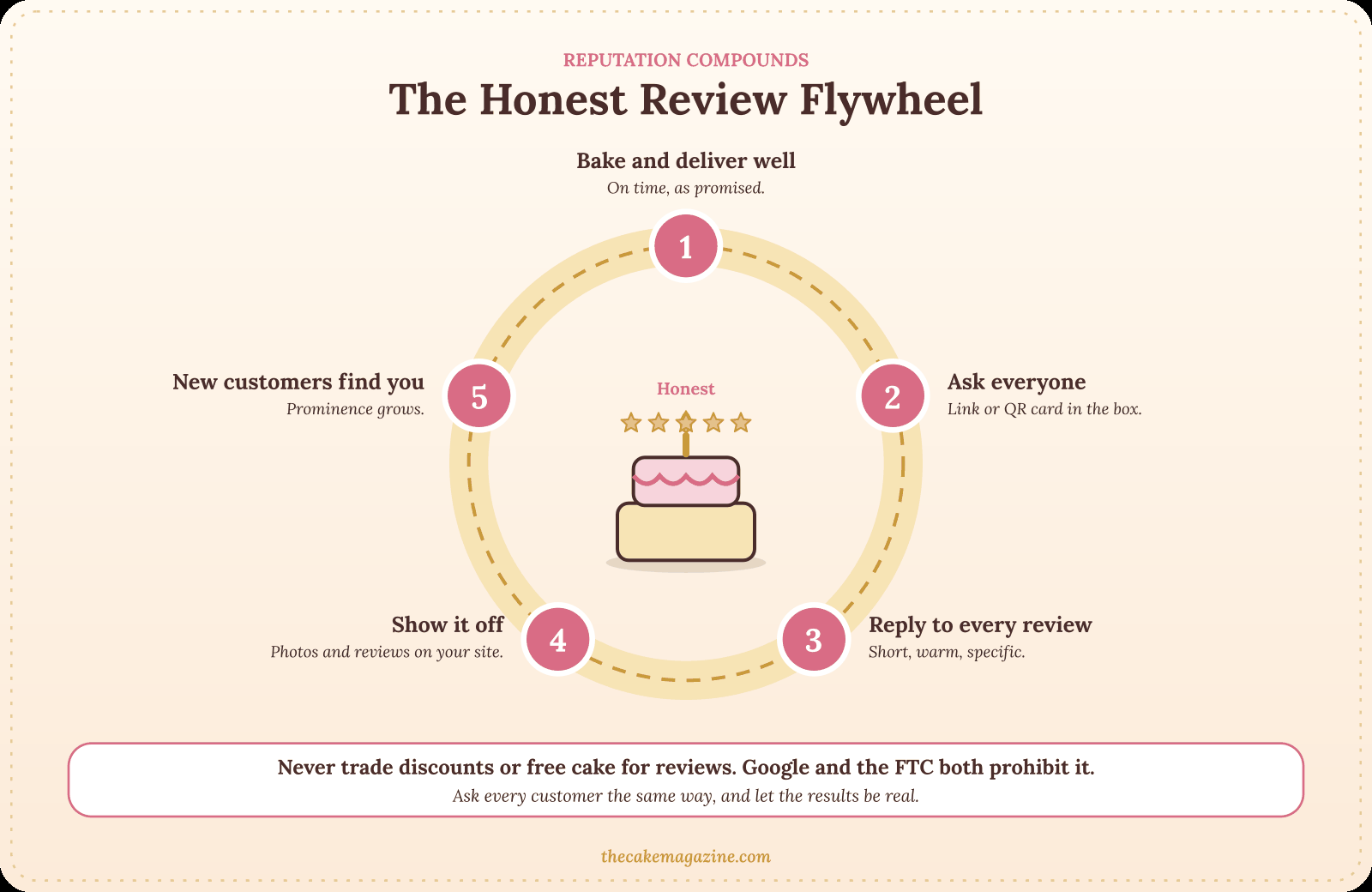
The best moment is when the joy is still fresh and the cake has done its job: right after pickup or delivery, or the day after the event once people have eaten it. A short, warm message works better than a long request. Thank them, say what the review helps you do, and include the link. Google’s help page says you can ask customers by sharing a link or QR code, and that customers need a Google Account to post.
In a local seo cake business, many bakers tuck a small card with a QR code into the cake box or the pickup bag. It costs pennies and does the asking for you. Keep the wording friendly and free of pressure. “If you loved it, a quick review helps other families find us” is enough.
What you must never do
This is where the rules matter most. Google prohibits offering free or discounted goods or services in exchange for a review, for changing a review, or for removing a negative one, and treats that as fake and misleading content. Do not trade cupcakes for stars; a local seo cake business grows best on honest reviews.
The U.S. Federal Trade Commission’s rule on consumer reviews and testimonials, which took effect on October 21, 2024, adds legal weight. According to the FTC’s guidance, businesses may not write or buy fake reviews, may not pay for or reward reviews conditioned on a particular sentiment, and may not suppress reviews through intimidation or unfounded legal threats. You can read the agency’s plain-language questions and answers on the rule.
- Do not write your own reviews or ask friends and family who did not buy to write them.
- Do not offer discounts in return for reviews, or for deleting a bad one.
- Do not screen who you ask. Asking only the customers you think will be positive can skew your picture, so ask everyone, the same way.
- Do not threaten reviewers. If you believe a review breaks the platform’s rules, flag it instead.
This is general information, not legal advice. If you are unsure whether a particular promotion or request counts as a prohibited incentive, read the sources linked above and ask a qualified professional before you run it.
How to answer reviews
Replying shows future customers how you behave when things go well and when they do not. Google’s guidance is to keep replies polite, professional and brief, to avoid generic thank-yous and to use replies to share helpful details instead of promoting deals. Reply to every review, even a short one, and try to sound like yourself.
A good reply to a happy review names something specific. “Thank you, Maria. We loved making the lemon cake for your mother’s birthday.” It tells readers you remember your customers. Keep private details out, such as an order amount or a person’s allergy.
How to answer the hard ones
For a negative review, Google suggests acknowledging mistakes where appropriate, explaining what you can and cannot do, apologizing sincerely, addressing the reviewer by name and responding promptly. If the situation is complicated, invite the person to continue by phone or email. Do not argue in public, do not reveal private order details, and do not make personal attacks.
Read the review twice before you write. Sometimes there is a legitimate lesson, such as a pickup window that was unclear, and you can say what you changed. Other times the review is about something you cannot control, and a calm, short, factual reply serves readers better than a defense. Remember that you are writing for the next ten customers, not the one who is upset.
Fixing the process behind a bad review
In a local seo cake business, patterns matter more than any single review. If three customers mention late deliveries, no reply will fix that. A clearer timeline will. Clear policies prevent most disputes before they begin, which is why deposit and cancellation policies and a thorough custom cake order form are quietly some of your best review-protection tools.
Your website: the local seo cake business pages that matter
In a local seo cake business, your profile gets people to the door. Your website is the room they walk into. For a local seo cake business, the website has two jobs: prove to people that you are the right baker, and prove to search engines where you are, what you make and how to order. You can do both with a surprisingly small site.
The pages worth having
- Home page. One clear sentence about what you bake and where, a few of your best photos and a single obvious button to start an inquiry.
- Cakes or menu page. Flavors, sizes, starting prices if you share them, and how far ahead people should book.
- Wedding cakes page. Its own page, because wedding searches have their own language, and couples want different reassurance.
- Service area and delivery page. Your rings, your fees, and what is pickup only.
- About page. A real person, a real kitchen, a real story. No invented credentials.
- Order or inquiry page. A form that collects what you need to quote, such as date, servings, design ideas, allergies and location.
- Reviews or testimonials. Only real ones, which you have permission to share.
- FAQ. Answers to the questions you get in every inquiry.
This is the same rule that applies to everything in a local seo cake business: be specific. A page titled “Custom Wedding Cakes in Greenville” that has two paragraphs of real information beats a page of vague poetry about love and flour.
Put your name, address and phone number in plain text
Place your business name, service area and phone number in the footer of every page as ordinary text, not just inside an image. If you hide your address, show your service area instead. Make sure the details match your Google Business Profile exactly, because consistent information across places is one of the quiet ways search engines build confidence.
Write titles and headings like a human
Each page should have a title that says what the page is and where you are, written for a person first. “Custom Birthday Cakes in Roswell, Georgia” is clear. “Cakes cakes custom cakes best cake bakery Roswell cakes” is not. Do the same with headings. Put the words a customer would use where they naturally fit, and stop there.
The same applies to the body text. Mention your town and the places you serve when it is natural, such as in a sentence about delivery. Skip the habit of repeating the phrase in every paragraph. Search engines are good at reading, and so are your customers.
Make the site fast and easy on a phone
Most people will read your site on a phone, often with one hand and a toddler in the other. Large images should be compressed so pages load quickly. Buttons should be big enough to tap. The inquiry form should be short enough to finish on a phone in two minutes. Test your site yourself on a phone, over mobile data, and fix whatever annoys you.
Structured data in plain language
Structured data is a block of code that tells search engines facts about your business, such as its name, type, phone number and service area, in a format machines read easily. Many website tools and plugins add this for you. If yours does, check the details are accurate. If you edit code yourself, use Google’s own documentation for local business markup and test the result. Structured data does not guarantee special treatment, but it removes guesswork.
One honest warning: never mark up reviews you wrote or reviews you copied in a misleading way. Your markup should reflect what is genuinely on the page, and the FTC rule above makes fake reviews a real risk, not just an SEO one.
Make the next step obvious
A visitor who loves your cakes should know exactly what to do next. Put an inquiry button near the top of each page, repeat it at the bottom, and tell people what happens after they submit: how long you take to reply, what you need to quote and when a date is secured. Our guide to the cake consultation explains the questions that make quotes accurate, and many of them belong on your form.
Pricing is the question every visitor has. You do not have to publish a rate card, but giving a starting range or a “cakes usually begin at” statement filters out mismatched inquiries and spares you the awkward back-and-forth. If you are not sure how to set that range, our guide on how to price cakes works through ingredients, labor, overhead and profit.
Winning wedding cake searches
Weddings are where a local seo cake business can have an outsized payoff. A wedding order is large, planned well ahead and made by people who are researching carefully. It is also where competition is thickest, because venues, planners and florists all point couples toward the bakers they know.
How couples really search
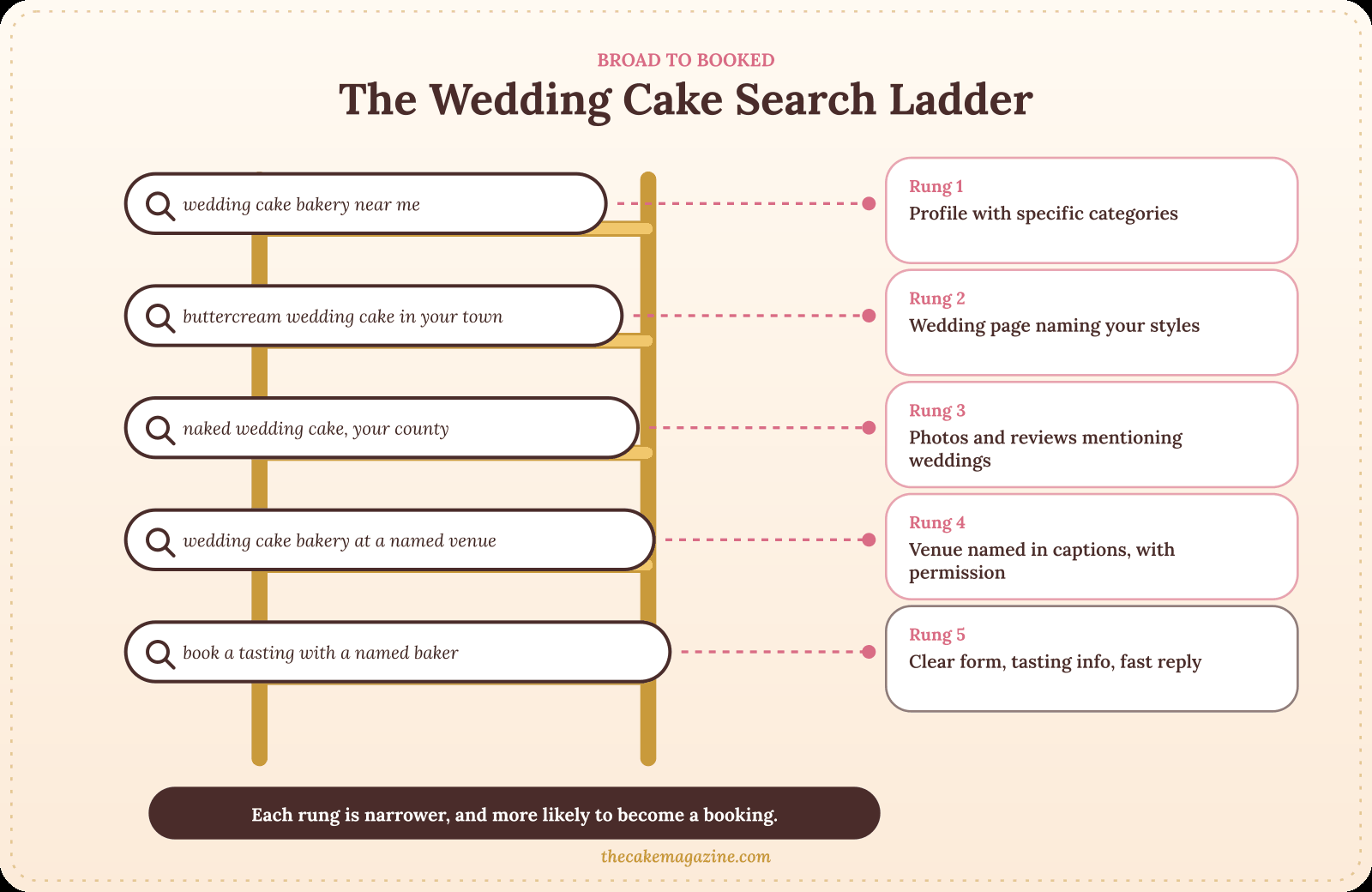
Wedding searches tend to start broad and narrow quickly. A couple may begin with something like “wedding cake bakery near me,” then add a style such as “naked cake” or “buttercream,” then a place, then a venue name. Someone planning a particular venue may search for the venue plus the word “cake” to see who has worked there. Think of it as a ladder: each rung is more specific and more likely to turn into a booking.
In wedding searches, a local seo cake business does not need to chase every rung. You need to be clearly findable on the ones that match what you really offer. If you make elegant buttercream wedding cakes within an hour of the venue, your content should say that in the same words a couple might use.
Build a wedding page that does the work
For a local seo cake business, a strong wedding page answers the questions couples have before they ever write to you. Include what styles you make, how far ahead to book, how a tasting works, how servings are planned, how delivery and setup happen, and how a deposit holds the date. Add photos of finished weddings with the venue named, when you have permission.
Link outward to your own supporting material, and to our resources for couples when helpful. A couple trying to understand what is reasonable may like our wedding cake guide and our explanation of what wedding cakes cost. When your page makes that kind of research easier, you look like the baker who will be easy to work with.
Be the baker the venue remembers: local seo cake business relationships
Venues and planners are the quiet engine of wedding bookings. They want bakers who deliver on time, set up cleanly and follow venue rules. If you have worked at a venue, say so. Put the venue’s name in a photo caption or a short “Venues we have delivered to” list, only for places where you actually delivered.
Reach out politely. A short note to a venue coordinator, with a few photos and a line about your service area, costs nothing. Do not ask for a favor in the first message. Offer something useful, such as an easy-to-forward summary of how you handle setup, and let the relationship grow.
Offer tastings in a way that fits your business
Tastings are part of the wedding sales process for many bakers. They are also a time commitment, so decide how you will run them. Some bakers offer a boxed sampler for pickup, some host sessions by appointment, some charge a fee that is credited toward the order. Whatever you choose, explain it on your page so couples are not surprised. Our article on wedding cake tasting shows couples what to try and ask, which is a helpful way to see the process from their side.
Timing: when couples look for you
Couples usually begin their search long before the wedding, and the ideal time varies by season, region and baker. Our guide on when to order a wedding cake explains typical timelines from the couple’s point of view. Use that knowledge to plan your own content calendar: post your availability, seasonal wedding photos and booking cutoffs ahead of busy periods, not during them.
Reviews that mention weddings
A review that says “our wedding cake was beautiful and arrived on time” is worth more to a prospective couple than a general five-star rating. You cannot script what people write, and you must not coach them toward particular wording. What you can do is ask at a good moment, after the wedding when the memories are warm, and make the link easy to find. Some couples also leave reviews on wedding platforms, and you can reply there in the same professional tone.
Citations, directories and local links
A citation, in local search language, is a mention of your business name, address or service area and phone number on another website. Directories, chamber of commerce pages, wedding vendor lists and local news sites all create them. They matter for a local seo cake business because they confirm your details from outside sources and, when they include a link, feed the prominence factor Google describes.
Consistency beats quantity in a local seo cake business
You do not need your name on two hundred directories. You need accurate listings in a handful of places that real people use, with identical details. Decide on one version of your business name, one phone number and one website address, and use it everywhere. If you move or change your number, update the main places first, then the smaller ones.
- Your own accounts first: Google Business Profile, Apple Business Connect if it is available to you, and Bing Places.
- Local organizations: your chamber of commerce, a farmers market vendor list or a local makers’ guild.
- Wedding and event directories: reputable regional ones where couples actually look.
- Suppliers and partners: a venue, florist or rental company that links to you from a vendor page.
Check each platform’s current terms before you sign up, and be wary of paid listings that promise rankings. Free profiles that you control are usually plenty to start with.
Links from real local relationships for your local seo cake business
The best links come from relationships you already have. A florist who has delivered flowers beside your cakes may happily list you on her vendor page. A venue may feature preferred bakers. A local magazine may run a roundup of birthday party ideas. A school fundraiser may thank donors on its site. None of these require trickery. They require being useful, generous and easy to work with.
Be cautious with bought links, link swaps arranged in bulk and anything described as a “private network.” Google’s help page says prominence depends partly on how many websites link to a business, but it does not suggest that quantity at any cost is the goal. A few links from genuine local sites beat hundreds from nowhere.
Add something worth linking to
People link to useful things. A short, honest guide to ordering a cake in your area, a seasonal flavor calendar, or a “how many servings do I need” explainer can earn mentions that a plain menu never will. If you want to lean on our resources instead of writing your own, our cake serving calculator guide and wedding cake serving guide are written for exactly those questions.
Tracking what is working
Local seo cake business results move slowly, and without a little measurement it is easy to either panic or fool yourself. You do not need expensive software. A notebook, your profile’s built-in insights and the free analytics tools most website platforms offer will carry you a long way.
Numbers worth a monthly look for your local seo cake business
- Profile views and actions. Google’s dashboard shows how people found you and what they did, such as calls, website clicks or direction requests, where available.
- Inquiries and their source. Add a “How did you hear about us?” question to your order form and tally the answers each month.
- Review count and average rating. Note the date each new review arrives so you can see the pace.
- Website visits to key pages. Look at the wedding page, the service-area page and the form page.
- Booked orders from local search. The number that actually pays you.
Resist the urge to check rankings every morning. Results shift between searchers and locations, because distance changes who sees what. Run a few searches from your phone once a month, note what you see, and treat it as a rough thermometer, not a scoreboard.
A simple monthly rhythm for your local seo cake business
Once a month, spend an hour on your local seo cake business. Add three new photos. Reply to any unanswered reviews. Update holiday hours and your booking availability. Read your inquiry form answers and look for a pattern, such as a town you did not expect or a question you keep answering by hand. Then fix one small thing on the website. That single hour, repeated, beats a frantic weekend twice a year.
Tie it into your business calendar. Our guide to a cake order calendar shows how to plan capacity so marketing does not bring in more orders than you can bake. If your profile is working better than you can handle, adjust by raising prices or tightening your service area, not by letting quality slip.
Know when something is wrong
Sudden changes deserve a look. If your phone number suddenly shows as something else, if a second listing appears, or if your profile is suspended, act promptly. Check Google’s guidelines to see what might have triggered the problem, correct it and follow the appeal steps in your dashboard. Do not create a replacement listing, which usually makes things worse.
Common local SEO mistakes bakers make
After the basics, most of the trouble a local seo cake business runs into comes from a short list of avoidable habits. Here are the ones to watch for, along with the better move.
Stuffing the business name
Adding “wedding cakes Dallas custom cakes” to your listing name feels clever and breaks Google’s naming guidance. Use your real name and let categories and services carry the keywords.
Using a fake address
A rented mailbox, a friend’s storefront or a virtual office is not an acceptable address under the guidelines. Be honest about where you work and hide a home address.
Ignoring reviews
Unanswered reviews tell readers you are not paying attention. A short, warm reply costs two minutes and does a surprising amount of selling.
Buying or trading for reviews
Discounts for reviews and fake testimonials are prohibited by Google and the FTC rule. Ask everyone, offer nothing in exchange, and let the results be real.
A service area that is far too big
Claiming ninety minutes in every direction makes you look like you cannot be trusted. Choose the area you can serve safely and profitably.
Copy-paste town pages
Fifty pages with only the town name changed add noise, not value. Write one good service page and a few real local ones.
Mismatched details across the web hurt a local seo cake business
A phone number on Facebook that differs from the one on your profile, an old website address on a directory, a business name spelled two ways: each one is a small crack in trust. Make a one-page “business facts” note with your exact name, phone, website and service area, and copy from it every time.
Promising what your rules do not allow
If your local cottage food or licensing rules limit where or how you may sell, your profile and website should not promise otherwise. Check your state agency before you advertise shipping, delivery of certain fillings or sales at events, and keep your marketing inside your legal lines.
Treating your local seo cake business as a one-time project
The most common local seo cake business mistake is setting up a profile once and walking away for a year. Hours go stale, photos age and reviews stop arriving. A light, steady habit beats a heroic burst. Block the monthly hour on your calendar like a customer appointment.
Forgetting the cake itself
Even a strong local seo cake business setup can put you in front of a customer, but it cannot bake the cake. Consistent flavor, reliable timing and honest communication create the reviews that feed the whole system. If you want a reminder of how the whole business fits together, our guide on starting a home cake business connects the legal, pricing, ordering and workflow pieces that your marketing depends on.
A 90-day local seo cake business plan
Here is a gentle local seo cake business plan you can adapt. It assumes you already bake for customers and want to be easier to find. Each month has one theme so you are never doing everything at once.
Month one: lay the local seo cake business foundation
- Search for your business name and check for duplicate or unclaimed listings.
- Claim and verify your Google Business Profile, with a backup manager.
- Choose a primary category and a small number of accurate secondary ones.
- Decide whether you are a service-area or storefront business, and set your address display accordingly.
- Write your business facts note: name, phone, website, service area.
- Upload a logo, a cover image and eight to ten strong cake photos.
- Write a plain, honest description.
Month two: build trust
- Create or refine your reviews routine: a QR card in every box and a thank-you message after each order.
- Reply to every existing review.
- Publish your service-area page with your rings and delivery fees.
- Write or rewrite your wedding page.
- Add a “How did you hear about us?” question to your order form.
- List yourself in two or three local directories with identical details.
Month three: grow and measure
- Reach out to two venues, a florist and a planner with a short, friendly note.
- Publish one genuinely useful page, such as a serving guide or an ordering timeline.
- Post a profile update for the coming season.
- Review your numbers: profile actions, inquiries, review pace.
- Fix the biggest weak spot you can see, and write down what you will do next quarter.
Expect slow, not instant. With any local seo cake business effort, nobody can promise how quickly reviews, links and rankings will build in your area. Judge the plan by the work you finished each month and by the quality of the inquiries, and adjust from there.
A quick checklist for your local seo cake business
- Profile claimed, verified and accurate
- Real business name, no stuffing
- Specific categories chosen
- Service area set honestly
- Hours or appointment note that match reality
- Fresh photos uploaded
- Reviews requested from everyone, answered by you
- Website with menu, wedding, service area, about and inquiry pages
- Same name, phone and website everywhere
- A monthly one-hour routine on the calendar
For more on how to turn those inquiries into profitable, well-planned orders, see our walkthrough of the King Arthur cake guides for technique, and keep the food safety basics from the USDA Food Safety and Inspection Service close at hand, because a customer who finds you online will also trust you with their guests’ health.
Frequently asked questions
What is local seo cake business marketing in plain terms?
It is the set of steps that help nearby customers find your bakery when they search for cakes in their area: an accurate Google Business Profile, a believable service area, honest reviews, a clear website and consistent details across the web. It focuses on being findable and trustworthy in your own region, not on ranking nationwide.
Can a home baker have a Google Business Profile?
Often yes. Google’s guidelines say businesses that travel to customers can have a service-area profile, and that home-based service businesses should hide their address. Read the current eligibility rules yourself, make sure your local cottage food or licensing rules allow how you sell, and choose the setup that honestly matches how customers reach you.
Should I show my home address on my profile?
If customers do not visit you, usually not. Choose the service-area option, hide the address and share pickup details privately after an order is confirmed. If you run a real storefront with posted hours, Google expects a precise, real address and permanent signage at that location.
How many reviews do I need to rank well?
There is no magic number. Google says review count and ratings feed the prominence factor, but how that plays out depends on your competition. Aim for a steady pace of honest reviews from real customers, and compare yourself with the bakeries near you instead of a number you read somewhere.
Can I offer a discount in exchange for a Google review?
No. Google prohibits offering free or discounted goods or services in exchange for a review, a changed review or a removed review. The FTC’s rule on reviews and testimonials also bars rewarding reviews that depend on a particular sentiment. Ask politely, offer nothing in return and thank people either way.
What should I do about an unfair negative review?
Reply calmly and briefly, without private details or personal attacks, and say what you can and cannot do. If the review appears to break Google’s content policies, flag it through the reporting process. Do not threaten the reviewer or offer money to remove it, since that can create bigger problems than the review.
How big should my service area be?
As large as you can serve safely and profitably, and no larger. Google’s guidance says service areas should generally stay within about two hours’ drive of your base, but most bakers will choose far less. Think about cake safety, drive time, fuel, fees and how many orders you can deliver in one day.
Do I need a website if I have a Google Business Profile?
You can start with the profile alone, but a small website helps a great deal. It gives you room for a wedding page, a service-area page, an inquiry form and answers to common questions, and it lets search engines confirm your details. A simple five-page site is enough for most bakers.
How do I show up for wedding cake searches?
Give weddings their own page that names your styles, booking timeline, tasting process, delivery and service area. Earn reviews that mention weddings, show real venues you have worked with where you have permission, and build friendly relationships with venues, florists and planners. Be patient, because wedding searches reward proven reputations.
Should I create separate pages for every nearby town?
Only when you have something real to say about each place. Near-identical pages with a swapped town name add little value and can look spammy. One strong service-area page, plus a few genuine local pages, such as a venue you work with often, serves customers and search engines better.
How long does it take for local SEO to work?
It varies by area, competition and how much you already have in place. Profile fixes can matter quickly, while reviews and links build over months. Nobody can promise a timeline or a ranking, and Google says there is no way to pay for a better local ranking, so measure progress by inquiries and finished tasks.
Is a local seo cake business strategy worth it for a small baker?
For most, yes, because it costs mostly time and the benefits compound. A complete profile, a handful of reviews and a clear website bring in nearby, well-matched inquiries. If you are already booked solid, use it to raise prices or be choosier, not to take on more than you can bake well.
Do I need to hire an SEO company?
Not to begin. Everything in this local seo cake business guide can be done by a patient owner with an hour a month. If you do hire help, ask what exactly they will do, avoid anyone who guarantees rankings or sells reviews, and make sure you keep ownership of your profile and website accounts.
Final thoughts
A good local seo cake business plan is mostly ordinary care, done consistently. Tell Google the truth about who you are and where you work. Fill out every field that a customer might wonder about. Photograph your cakes well. Ask happy customers for reviews, and answer every review like a neighbor would. Keep your website clear and your details the same everywhere.
None of it is flashy, and none of it can be rushed or bought. That is good news for honest bakers. The same habits that make a bakery pleasant to buy from, such as clear communication, fair policies and reliable cakes, are the ones that build the reputation local search rewards. Pick one task from the 90-day plan this week and finish it.
If you are working on this now, tell us what is hardest in your area, whether that is hiding your address, getting your first reviews or standing out for weddings. We will keep this guide and its companions updated as local search changes.
Editorial note: reviewed and updated November 2026. This guide offers general marketing information for U.S. cake businesses and is not legal, tax or professional advice. Google’s guidelines, features and the FTC’s rules can change, so confirm details on the official pages cited here before you act. Nothing in this guide promises a particular search ranking or result.