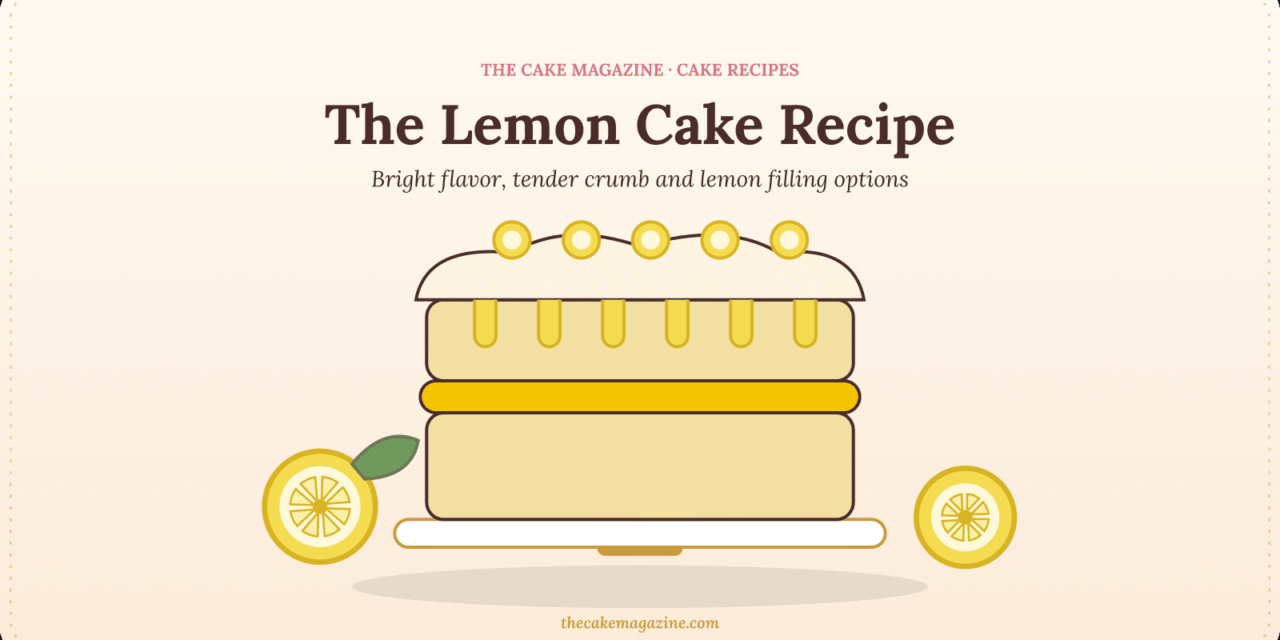
A good lemon cake should taste like lemon the way a warm kitchen smells like a bakery: immediately, and without any perfume. Too many versions taste like sweet vanilla cake with a hint of cleaning product, or they pucker so hard the crumb turns gummy. This lemon cake recipe aims for the middle path. It is a soft, buttery two-layer cake built on a conservative, well-known ratio, flavored three ways (zest, juice and a lemon syrup soak), and ready for a curd filling if you want one.
Along the way you will learn why each choice matters, so you can adapt it to your own oven and your own lemons.
The most dependable lemon cake recipe for layers uses the reverse creaming method: rub lemon zest into sugar, blend it with flour and cool butter until sandy, then add eggs, sour cream and buttermilk. A little lemon juice goes in the batter, and the real punch comes from a lemon syrup brushed onto the warm layers. Weigh everything, bake at 350°F until the center reads about 205°F to 210°F, and fill with lemon curd if you like. Treat the numbers below as a starting formula to test in your own oven.
- Why this lemon cake recipe works
- Where real lemon flavor comes from
- The ingredients, explained
- Equipment and pans
- The lemon cake recipe card
- Step-by-step method
- How to tell it is done
- Lemon syrup and glaze
- Lemon filling options
- Stacking and frosting
- Pan sizes and yield
- Make ahead and storage
- Troubleshooting
- Variations
- Ten mistakes to avoid
- FAQ
Why this lemon cake recipe works
People who go looking for a lemon cake recipe usually want the same few things. They want a flavor that is bright and clearly lemon, not sugary with a whisper of citrus. They want a crumb that is tender and moist enough to stay that way for a couple of days. And they want a layer sturdy enough to carry a filling and frosting without crumbling.
Lemon makes all three goals harder than they sound, because the ingredient that gives you flavor is acid, and acid interferes with structure. A handful of deliberate choices in this recipe deal with that tension.
This lemon cake recipe uses reverse creaming for a fine, tender crumb
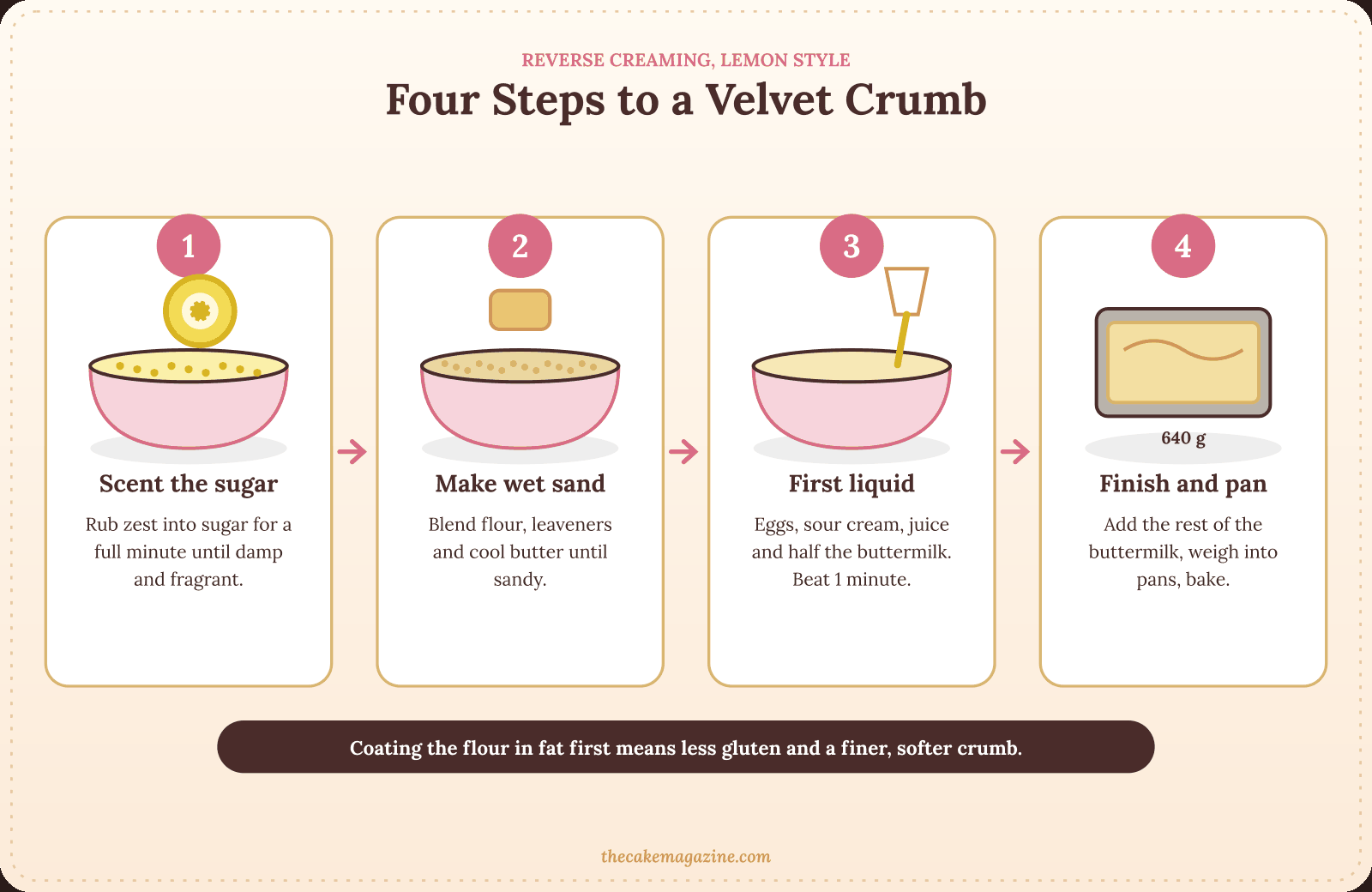
In the classic creaming method you beat butter and sugar until fluffy, then add eggs and alternate flour and liquid. Reverse creaming flips the order. You blend the dry ingredients and cool butter first, so the flour particles get coated in fat before any liquid arrives. Coated flour develops less gluten, and less gluten means a softer, finer, more velvety crumb. It is also a very forgiving method, because the batter is hard to overmix.
We cover the method in more depth in our guide to cake mixing methods, and the same logic runs through our best vanilla cake recipe.
Zest does the heavy lifting in a lemon cake recipe
Here is the part most recipes underplay. The yellow outer skin of a lemon holds the fragrant oils that you smell when you scratch a peel. Juice is mostly sour, and sour is a taste, but the aroma that makes people say “lemon” comes largely from the zest. In this recipe the zest is rubbed into the sugar with your fingers until the sugar turns damp and fragrant, which pulls the oils out of the peel and spreads them through every crystal. It is a small step with a large payoff.
A lemon cake recipe needs a little juice in the batter, plenty in the syrup
It is tempting to pour lots of juice into the batter, and many bakers do, then wonder why the cake bakes up dense or pale. Too much acid weakens the proteins that hold a cake up and fights with the leaveners. So the batter gets a modest amount of juice, balanced with buttermilk and a touch of baking soda, and most of the juice flavor arrives later, in a syrup that soaks into the baked layers. That way you get bright tartness without damaging the structure.
Weighing keeps the lemon cake recipe repeatable
Flour is the ingredient that most often ruins a cake, because a cup of it can weigh anywhere from 120 to 160 grams depending on how you scoop. Every ingredient in the recipe card is given in grams, with cup equivalents for convenience. A digital scale costs very little and removes the biggest source of variation. If you are curious about how flour, fat, sugar, eggs and liquid pull against each other, our guide to cake baking science goes through it step by step.
A note on how we present this. The Cake Magazine has not oven-tested this formula. It is built from conservative, widely used butter cake ratios and cross-checked against the general guidance in the King Arthur Baking cake guide. Treat it as a starting formula: bake one test cake, take notes on your oven and pans, and adjust times and amounts from there.
Where real lemon flavor comes from
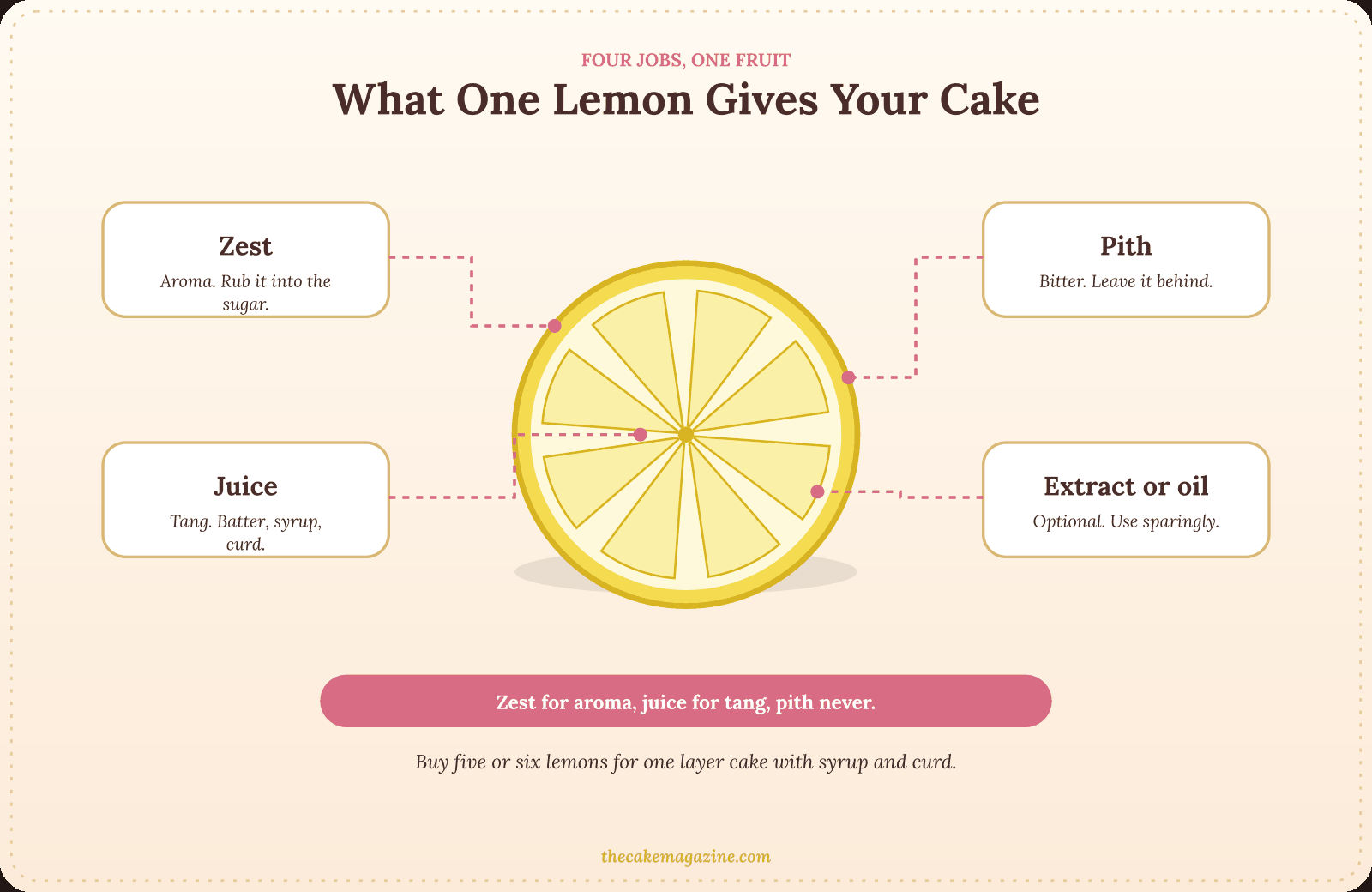
Before you buy anything, it helps to know what a lemon actually offers a baker. A single fruit gives you four different things, and each one does a different job in a lemon cake recipe. Treat them as separate ingredients and the cake starts to make sense.
Zest: aroma and fragrance
Zest is the colored part of the peel, and only that part. Use a rasp-style grater or a vegetable peeler followed by a sharp knife, and stop when you reach the white. The aromatic oils sit in tiny pockets in the yellow layer. Fresh zest tastes floral, a little herbal and unmistakably lemony. Dried zest and bottled extract can help in a pinch, but fresh is the one that people notice. As a rough guide, a medium lemon gives about a tablespoon of zest, which is why the recipe starts with three or four fruits.
Juice: acidity and brightness
Juice brings the sour taste that wakes up the palate and cuts through butter and sugar. A medium lemon yields roughly two to three tablespoons, though this swings with the size and ripeness of the fruit, and thick-skinned lemons can be stingy. Juice is also where most of the trouble starts in a lemon cake, because acid changes how proteins, starch and leavening behave. That is why we weigh it rather than eyeballing it.
Pith: the bitter part to leave behind
The white layer beneath the zest is bitter, and a few stray strips of it can leave an unpleasant edge in the finished cake. If you zest carefully there is nothing to worry about. If you cut peel off with a knife, scrape away the white before chopping the yellow.
Oil and extract: optional reinforcements
Some bakers add a half teaspoon of pure lemon extract, or a few drops of food-grade lemon oil, to stretch the aroma. These are optional. If you use them, buy pure products, measure carefully and add them in small amounts, because they are concentrated and can turn harsh or medicinal. Our version works well without them.
How much lemon is too much in a lemon cake recipe?
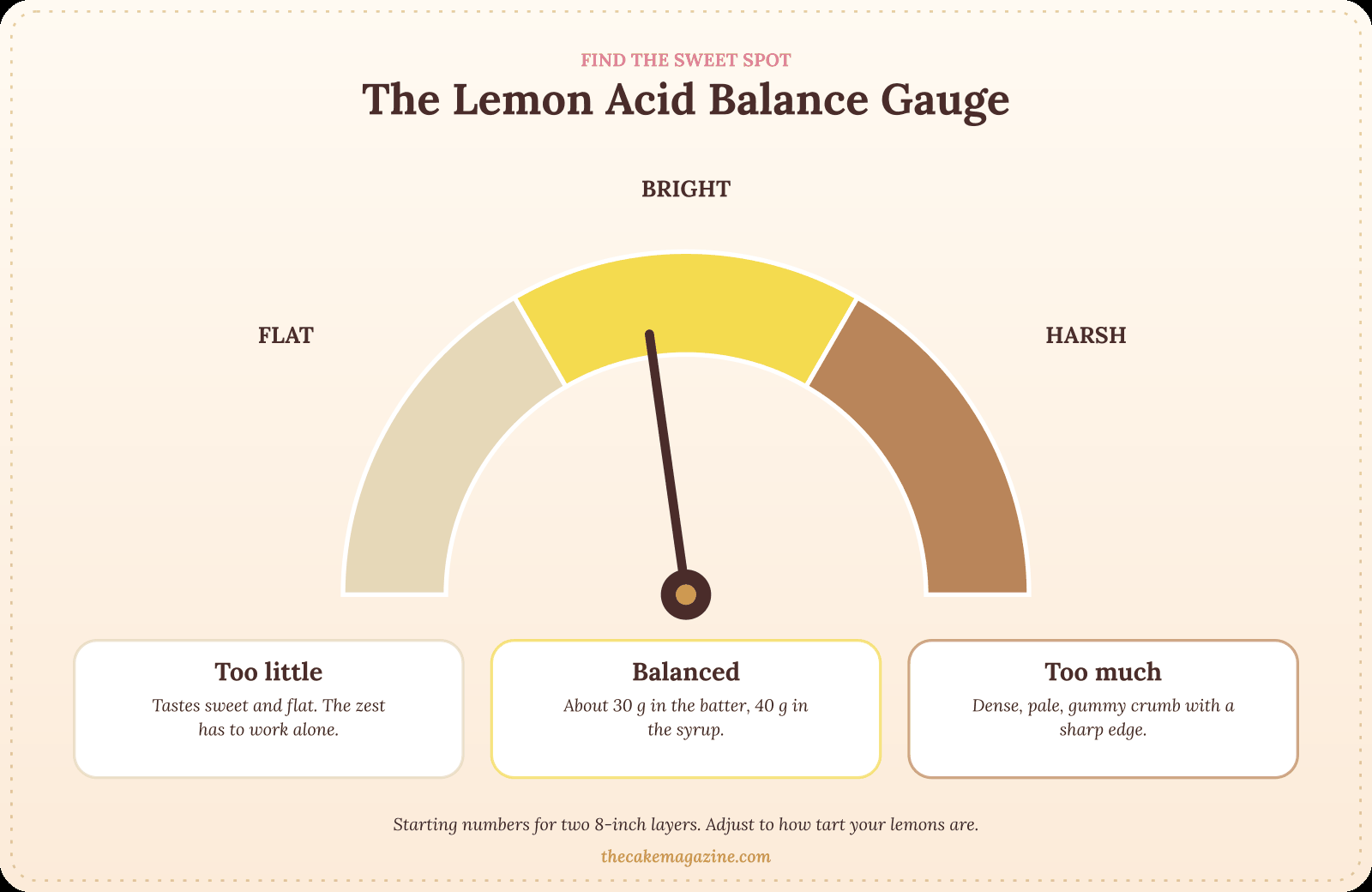
The gauge above shows the trade-off. Too little juice and the cake tastes flat. Somewhere in the middle, tartness is balanced by sugar and fat. Push past that, and the crumb turns dense, pale and sometimes gummy, and the flavor tips from bright into harsh. In this formula, about 30 grams of juice goes in the batter and another 40 grams goes into the syrup, with zest supplying the aroma. Those numbers are a starting point, not a law. If your lemons are very tart, you can trim the syrup a little.
The ingredients, explained
Every item in this lemon cake recipe has a reason to be there. Knowing the reason makes substitutions safer and mistakes easier to diagnose.
Cake flour or all-purpose flour
Cake flour has less protein than all-purpose, so it builds a more delicate crumb. It is the best choice here if you can find it. If you only have all-purpose flour, you can approximate cake flour by replacing two tablespoons (about 16 grams) of every cup with cornstarch and sifting the mixture a couple of times. Expect a slightly sturdier crumb from all-purpose flour, which is not a bad thing if the cake will be stacked tall.
Unsalted butter, cool
In reverse creaming, the butter should be cool but pliable, around 65°F, the temperature at which a finger leaves a dent without sliding through. Soft, greasy butter coats the flour unevenly and can leave you with a heavy cake. Cut it into cubes so it blends quickly. Using unsalted butter lets you control the salt.
Granulated sugar
Sugar sweetens, of course, but it also tenderizes the crumb, holds moisture and helps the cake brown. In a lemon cake recipe it has a second job: it is the carrier for the zest oils. Do not cut the sugar sharply to make the cake less sweet. The structure suffers, and the lemon will taste sharper rather than better.
Eggs
Eggs give structure, richness and a little lift. Use large eggs at cool room temperature, weighed rather than counted when you can. Ours total 150 grams out of the shell, which is three large eggs. If you want a richer, more custardy crumb, you can swap one whole egg for two yolks and a little extra buttermilk, but keep it simple the first time.
Sour cream and buttermilk
These two bring moisture, fat and acidity. Sour cream makes a plush, tender cake that stays soft for days. Buttermilk thins the batter just enough for easy pouring and supplies the acid that baking soda needs to work properly. Full-fat dairy gives the best texture. If you are out of buttermilk, mix a tablespoon of lemon juice into a cup of whole milk and let it sit for five minutes, though true buttermilk gives a smoother result.
Baking powder, baking soda and salt
Baking powder does most of the lifting. A small amount of baking soda reacts with the acid from the buttermilk, sour cream and lemon juice, which helps the cake brown and neutralizes some of the sharpness. Salt is not optional: it keeps the sweetness from going flat and makes the lemon taste more like itself. Weigh these tiny amounts, since a quarter teaspoon too much of either leavener can leave a soapy taste.
Vanilla
Vanilla is a supporting actor here. A small spoonful rounds off the lemon and softens its edges. Skip imitation vanilla and use the pure extract, because the cleaner flavor lets the citrus come through.
Shopping shortcut. Buy five or six lemons for one cake. You will want the zest from three or four of them, plus juice for the batter, the syrup and any curd. Zest first, juice second: it is far easier to grate a whole lemon than a juiced half.
Equipment and pans for a lemon cake recipe
You do not need much, but a few items make this lemon cake recipe easier and more consistent. None of them need to be expensive.
- A digital kitchen scale. Accurate to the gram. This is the one item worth buying if you do not own it.
- Two 8-inch by 2-inch round pans. Light-colored metal bakes more evenly than dark pans. Our cake pan buying guide compares the common materials.
- A stand mixer or a hand mixer. Reverse creaming works well with either. The paddle attachment is the right one for a stand mixer. If you are shopping, see our guides to stand mixers and hand mixers.
- A fine rasp grater. A microplane-style tool gives you zest without pith.
- An instant-read thermometer. The most reliable way to tell when a cake is done, and handy for the curd as well.
- Parchment paper. Cut rounds to fit the bottoms so the layers release cleanly.
- A pastry brush. For the syrup soak.
- An oven thermometer. Many home ovens run 15 to 25 degrees off. A cheap thermometer tells you the truth.
Prepare the pans properly
Grease the pans with soft butter or baking spray, line the bottoms with parchment, grease the parchment, then dust the sides with a little flour and tap out the extra. Lemon cakes, with their sugar and acid, can stick more stubbornly than you would expect, and a stuck layer is a heartbreaking way to start a cake.
The lemon cake recipe card
Here is the full formula in one place. Remember, this lemon cake recipe is a starting formula: this site has not oven-tested it, so check your cakes a few minutes early the first time and write down what you see.
Soft Lemon Layer Cake with Lemon Syrup
A reverse-creamed, two-layer 8-inch lemon cake with zest rubbed into sugar, a tender buttery crumb and a bright lemon syrup soak. A starting formula to adapt, not an oven-tested recipe.
Cake ingredients
- Granulated sugar300 g (1 ½ cups)
- Lemon zest, finely grated12 g (from 3 to 4 lemons)
- Cake flour (or see note for all-purpose)300 g (about 2 ½ cups, spooned and leveled)
- Baking powder9 g (2 ¼ teaspoons)
- Baking soda1.5 g (¼ teaspoon)
- Fine salt4 g (¾ teaspoon)
- Unsalted butter, cool but pliable, cubed170 g (12 tablespoons)
- Large eggs, cool room temperature150 g (3 eggs)
- Full-fat sour cream, room temperature120 g (about ½ cup)
- Buttermilk, room temperature180 g (about ¾ cup)
- Fresh lemon juice, strained30 g (2 tablespoons)
- Pure vanilla extract5 g (1 teaspoon)
Lemon syrup
- Granulated sugar50 g (¼ cup)
- Water50 g (3 ½ tablespoons)
- Fresh lemon juice, strained40 g (about 3 tablespoons)
Instructions
- Prep. Set a rack in the center of the oven and heat to 350°F (175°C). Grease two 8-inch by 2-inch round pans, line the bottoms with parchment, grease the parchment and dust the sides with flour.
- Scent the sugar. In the bowl of a stand mixer, rub the zest into the sugar with your fingertips for about a minute, until the sugar looks damp and smells strongly of lemon.
- Add the dry ingredients. Add the flour, baking powder, baking soda and salt. Mix on low with the paddle for 30 seconds.
- Blend in the butter. Add the cubed butter, one handful at a time, and mix on low until the mixture looks like damp, coarse sand with no big butter lumps, about 2 minutes.
- Mix the wet ingredients. In a pitcher, whisk the eggs, sour cream, half of the buttermilk (90 g), the lemon juice and the vanilla until smooth. It may look slightly curdled from the lemon juice. That is fine.
- First addition. With the mixer on low, pour in the egg mixture in a steady stream. Raise the speed to medium and beat for 45 to 60 seconds, until the batter is thick and fluffy. Scrape the bowl.
- Second addition. With the mixer on low, add the remaining 90 g of buttermilk in two or three pours. Mix just until smooth, about 20 seconds. Finish by hand with a spatula, scraping the bottom of the bowl.
- Pan the batter. Divide the batter by weight (about 640 g per pan) and smooth the tops. Tap each pan firmly on the counter two or three times.
- Bake. Bake 28 to 34 minutes. Check at 26 minutes. The cakes are ready when the tops spring back lightly, the edges barely pull away from the pan and a skewer shows a few moist crumbs (about 205°F to 210°F in the center).
- Make the syrup. While the cakes bake, simmer the sugar and water in a small saucepan until the sugar dissolves. Remove from the heat and stir in the lemon juice. Cool slightly.
- Soak. Cool the cakes in the pans for 10 minutes, then turn them out onto a rack. Brush the tops of the warm layers with the syrup, about half on each layer, letting it soak in.
- Cool completely. Cool for at least 1 to 2 hours before filling or frosting.
Notes
- All-purpose flour option: use 300 g all-purpose flour with 2 tablespoons (16 g) removed per cup and replaced with cornstarch. Sift together twice.
- No sour cream? Use plain whole-milk yogurt in the same amount.
- Storage: Wrap cooled, unfilled layers tightly and keep at room temperature for up to 1 day, or freeze for up to 2 months.
- Other pans: See the pan size section. Treat all times as starting points and check early.
- Fillings and frostings: Pair it with the lemon curd below, a Swiss meringue buttercream, a classic American buttercream or a cream cheese frosting.
- Untested: This formula has not been oven-tested by The Cake Magazine. Bake times and amounts vary by oven and pan.
Step-by-step: how to make this lemon cake recipe
The recipe card gives you the sequence. This section gives you the reasoning, which is the thing that saves you on the day something looks a little different from what you expected. If you are new to layer cakes, read it once before you start.
Step 1: Set up your lemon cake recipe before you mix
Take the eggs, sour cream and buttermilk out about 30 minutes ahead so they lose their chill. Cut the butter into cubes while it is still cool, since warm butter turns smeary. Heat the oven fully before the pans go in. A preheat signal can come on before the walls and rack are truly hot, so give it ten more minutes if you can. Prepare the pans before you start mixing, not while the batter waits.
Zest all the lemons first, then juice them. Measure the juice through a small strainer to catch seeds and pulp. Put each ingredient in its own bowl or cup before the mixer goes on, because reverse creaming moves fast once the butter is in.
Step 2: Rub the zest into the sugar
This is the most pleasant step in the recipe and the most important for flavor. Put the sugar in the mixer bowl, add the zest and rub the two together with your fingertips for a full minute. The sugar crystals act like tiny scrubbers, breaking open the oil pockets in the zest. You will see the sugar turn pale yellow and feel it clump slightly, and your kitchen will smell like a lemon grove. Do not skip it, and do not shorten it.
Step 3: Blend the dry ingredients and butter
Add the flour, baking powder, baking soda and salt and mix on low for 30 seconds so the leaveners are evenly spread. Then add the butter in handfuls. Mix on low until the mixture looks like wet sand. If you press a pinch between your fingers it should hold together briefly and then crumble. This stage coats the flour with fat, which is the secret to the fine crumb.
Step 4: Add the first round of liquid to the lemon cake recipe
Whisk together the eggs, sour cream, half the buttermilk, the juice and the vanilla. The lemon juice may make the mixture look a little grainy, because the acid is thickening the dairy. Do not worry. Pour it into the mixer in a steady stream on low speed, then raise the speed to medium for about a minute. This is the only time you will beat the batter hard, and it builds the structure and air that carry the cake. The batter should look thick, pale and fluffy.
Step 5: Finish with the remaining buttermilk
Add the rest of the buttermilk slowly, with the mixer on low. The batter thins into a pourable, satiny consistency. Stop as soon as it is smooth. Take the bowl off the mixer and scrape the bottom with a flexible spatula, since pockets of unmixed flour love to hide there.
The batter looks a little curdled. That is normal when lemon juice meets dairy and eggs. The acid tightens the milk proteins for a moment. By the time you finish adding the buttermilk it should look smooth and satiny. If it still looks greasy and separated, the butter was probably too warm or the liquids too cold.
Step 6: Portion and bake
Weigh the batter into the pans. A kitchen scale makes it easy to divide the batter evenly, so both layers bake in the same time and finish at the same height. Smooth the tops, tap the pans on the counter to release large air bubbles and slide them into the center of the oven. Resist opening the door in the first 20 minutes, because a sudden drop in temperature is one of the fastest ways to make a layer sink.
Step 7: Soak, cool and level
Let the layers rest in the pans for ten minutes, then loosen the edges with a thin knife and turn them out onto a rack. Peel off the parchment and brush the warm tops with syrup. Warm cake takes up syrup readily, and the sugar in the syrup helps seal in moisture as it cools. Let the layers cool completely before you fill them. If the tops have domed, trim them flat with a serrated knife.
How to tell your lemon cake recipe is done
Lemon cakes are pale, and a pale cake hides its doneness. You cannot rely on color the way you can with chocolate. Use several cues together, and trust the thermometer most of all.
- The edges pull away. A hairline gap between the cake and the pan wall means the structure has set.
- The top springs back. Press the center lightly with a fingertip. A done cake rebounds and leaves no dent.
- The skewer has a few moist crumbs. Wet batter means more time. A completely dry skewer at the earliest time can mean you are already a touch past done.
- The center reads about 205°F to 210°F. Slide an instant-read thermometer into the middle. This is the most objective test for a butter cake.
- The color is a light golden tan. The top should look set and dry, with a pale gold edge, not a dark brown one.
Start checking about four minutes before the earliest time in the recipe. A cake that is pulled a minute early is easy to fix with more time in the next bake, while a cake that is baked a few minutes too long cannot be rescued. If your cakes seem dry, our guide on why cakes turn dry walks through the usual suspects.
Why a lemon cake recipe browns differently
Acid slows browning a little and, in a pale batter like this, the crust stays lighter than in a chocolate or brown-sugar cake. The small amount of baking soda in this formula helps it take on color. If your layers still look too blond, check your oven temperature before you assume anything else. Do not raise the heat to chase color, since a hotter oven sets the edges before the center and brings domes and cracks.
Lemon syrup and glaze
The syrup is where a lemon cake recipe earns its reputation. It carries the tart juice that you would otherwise have to force into the batter, and it keeps the layers moist for days. It is also optional if you prefer a drier, more classic crumb, but we recommend trying it at least once.
How to use lemon syrup in this lemon cake recipe
Make the syrup while the cakes bake: dissolve the sugar in the water over medium heat, take it off the heat and stir in the juice. Brush it over the layers while they are still warm. Go slowly. Apply a thin coat, wait a minute for it to absorb and then apply a little more. You are aiming for a surface that looks glossy and damp, not a layer that is squishy or sticky. About three tablespoons per layer is a good place to start.
If you plan to freeze the layers, brush them with syrup after thawing instead, and let them sit for ten minutes before filling. That keeps the crumb from getting waterlogged in the freezer.
A simple lemon glaze for a single-layer lemon cake recipe
If you would rather bake the batter in a loaf or bundt pan, a glaze is a quick finish. Whisk 200 grams of powdered sugar with 30 to 40 grams of lemon juice and a pinch of salt until it flows slowly off a spoon. Start with the smaller amount of juice and add more a few drops at a time. Pour it over a cake that has cooled completely, otherwise it will turn translucent and run off. A teaspoon of finely grated zest in the glaze adds both flavor and flecks of color.
Syrup flavors worth trying
- Lemon and thyme. Simmer two sprigs of fresh thyme in the syrup, then strain them out.
- Lemon and vanilla. Add a scraped vanilla bean pod to the sugar and water for a softer, rounder flavor.
- Lemon and limoncello. Replace a spoonful of the juice with limoncello if the cake is for adults.
- Lemon and elderflower. A splash of elderflower cordial replaces a bit of the sugar and water for a floral note.
Lemon filling options
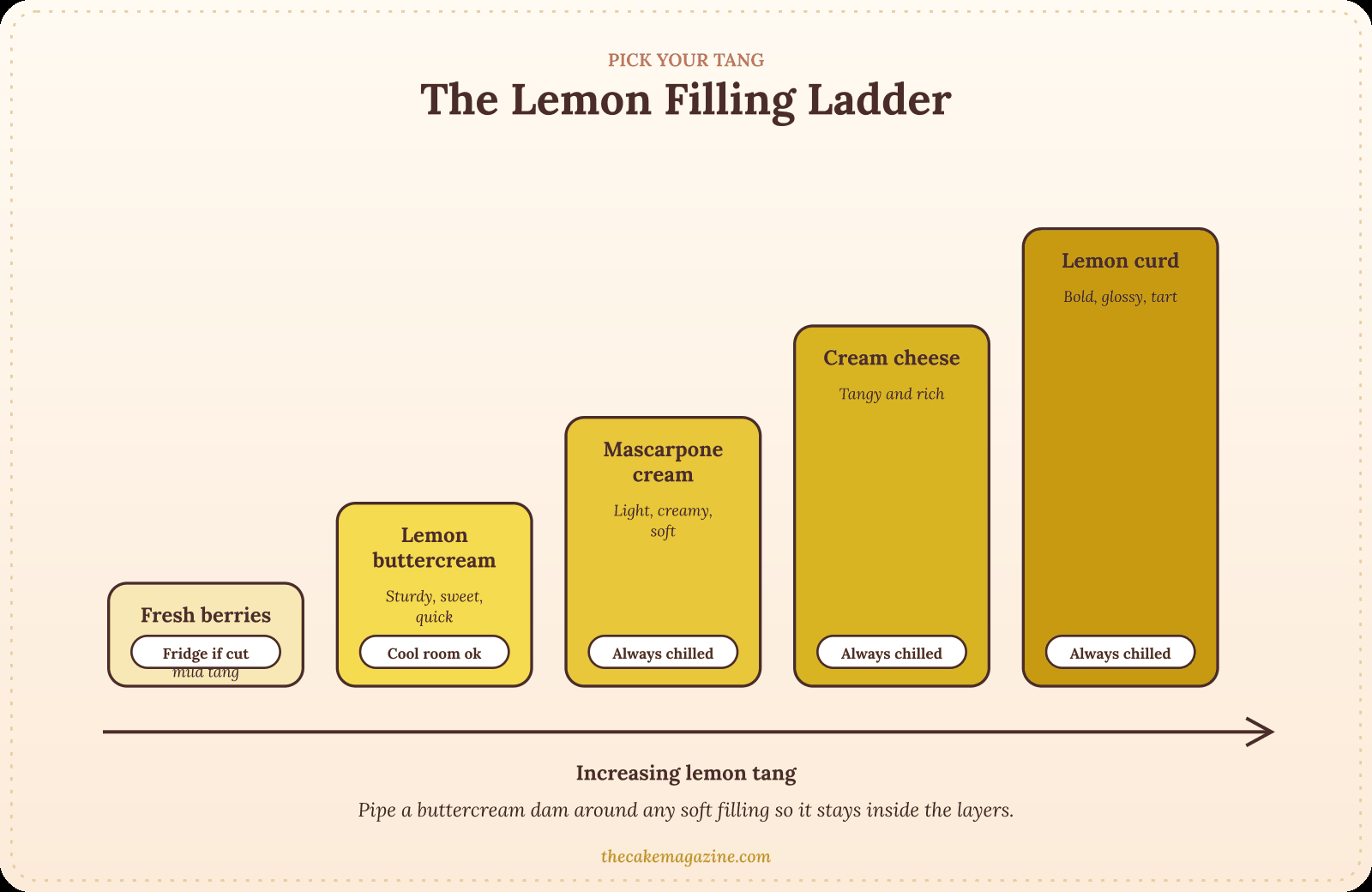
A plain lemon cake is lovely. A lemon cake with a good filling is something people remember. The filling you choose changes both the flavor and the practical side of the cake, such as how long it can sit out and how tall you can stack it. Here are the options we reach for most.
Lemon curd, the classic lemon cake recipe filling
Lemon curd is a cooked mixture of juice, sugar, eggs and butter that sets into a glossy, spreadable custard. It tastes like a more intense version of the cake, which is exactly the point. It is also tart enough to balance sweet buttercream. Below is a starting formula that yields about 400 grams, more than you need for one cake, so you will have some to spoon over slices.
Lemon curd (starting formula)
You will need 75 g egg yolks (about 4), 50 g whole egg (1 large), 150 g granulated sugar, 120 g fresh lemon juice, 1 tablespoon finely grated zest, 85 g cold unsalted butter cut into cubes, and 1 g fine salt.
Method
Whisk the yolks, egg, sugar, juice, zest and salt in a heavy saucepan. Cook over medium-low heat, whisking constantly, until it thickens and reaches about 170°F, roughly 8 to 10 minutes. Strain, whisk in the butter and press plastic wrap onto the surface.
Chill and use
Refrigerate until fully cold and set, at least 4 hours. Whisk it smooth before using. It keeps in the fridge for about a week. Do not hold it at room temperature for long.
Why the curd temperature matters
Egg yolks thicken a curd as they heat, and the mixture goes from thin to coating the back of a spoon quite suddenly. Overshoot and you get scrambled bits. Cook it too little and it stays runny. A thermometer takes away the guesswork. The USDA, in its egg guidance on shell eggs from farm to table, advises cooking egg-containing dishes to a safe minimum internal temperature of 160°F. A curd that reaches 170°F clears that mark, and it is also the point where it thickens well. Straining afterward catches any tiny cooked bits.
Other fillings that pair well
Lemon mascarpone cream
Whip 240 g cold heavy cream with 115 g mascarpone, 50 g powdered sugar and 60 g lemon curd until it holds stiff peaks. Light, creamy and not too sweet. Keep the finished cake refrigerated. For more on holding whipped fillings, see our guide to stabilized whipped cream frosting.
Lemon buttercream
Beat 225 g soft butter until pale, add 450 g powdered sugar, a pinch of salt, 1 tablespoon zest and 30 g lemon juice. Beat until fluffy. Quick and sturdy, and it doubles as a dam for curd.
Cream cheese filling
Tangy cream cheese and lemon are old friends. Our guide to cream cheese frosting explains how to keep it from going soft and how long it can sit out.
Fresh berries
Raspberries, blueberries or sliced strawberries between layers bring color and a second kind of tartness. Pat them dry and fold in a spoonful of buttercream so the juices do not seep.
Ermine frosting
This cooked-flour frosting is light and silky, and a little lemon curd folded in is lovely. Read our ermine frosting recipe for the technique.
Stacking and frosting a lemon cake
A tender lemon cake with a soft filling needs a little engineering to stay upright. The stack below gives each layer a job, and it is the same approach whether you are making a casual weeknight cake or a celebration centerpiece.
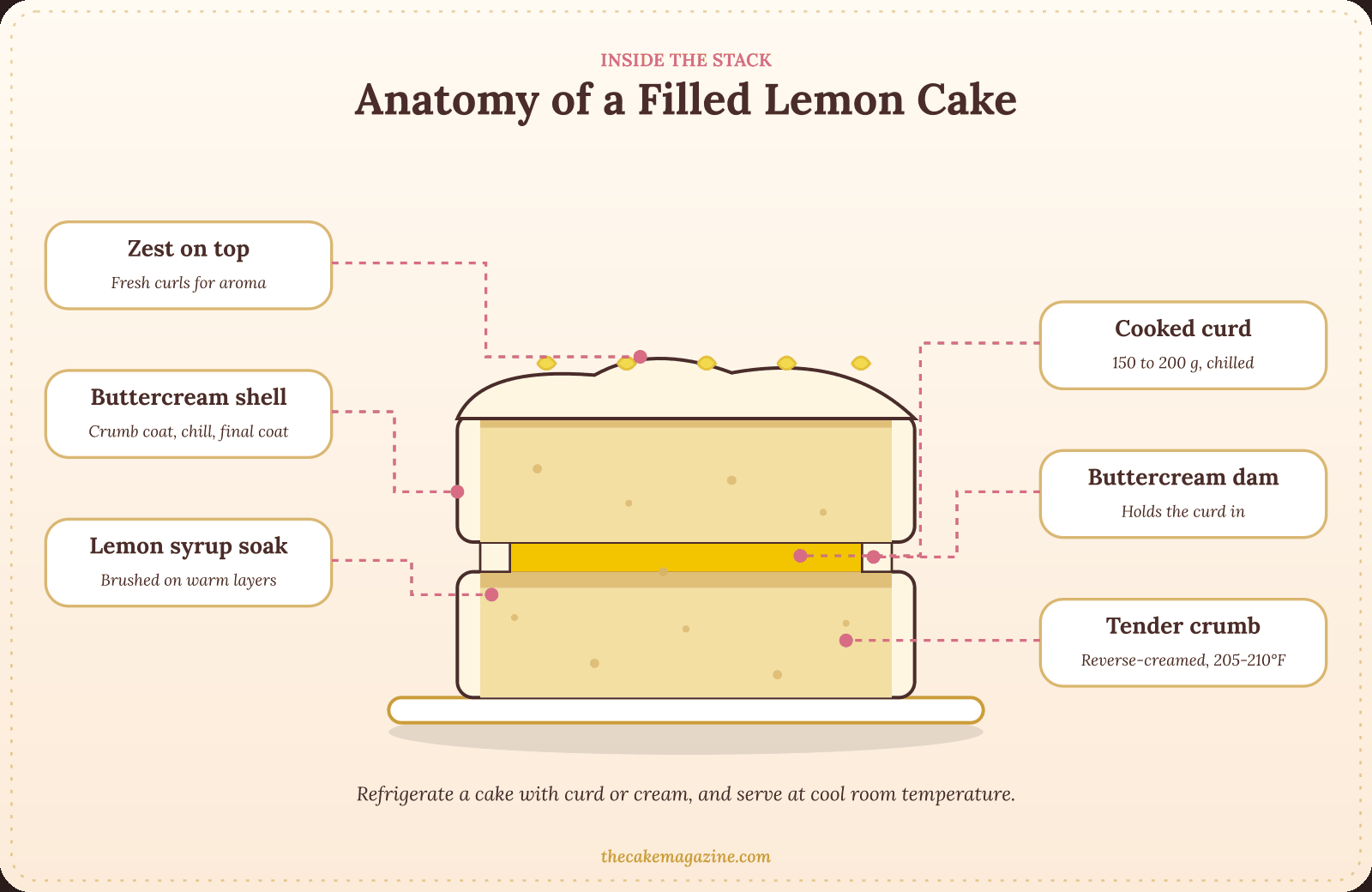
Level and chill the layers
Once the layers are completely cool, trim any dome with a serrated knife. Wrap them and chill for 30 minutes or so if you have time. Cold layers are firmer and release fewer crumbs, which makes frosting much cleaner. This is a good habit for any soft cake, not just a lemon cake recipe.
Build a dam for the curd
Place the first layer on a cake board or plate. Pipe a ring of sturdy buttercream around the outer edge, about as wide as your finger. This dam holds the curd in place. Spoon in 150 to 200 grams of cold curd and spread it level inside the ring. Too much curd makes layers slide, so resist the urge to be generous. Set the second layer on top, bottom side up, for the flattest surface.
Crumb coat, chill, finish
Spread a thin layer of buttercream over the whole cake to trap crumbs, and refrigerate it for 20 to 30 minutes until firm. Then apply the final coat. For clean sides and sharp edges, follow our guide to smooth buttercream sides, and if you are brand new to frosting, our cake decorating for beginners guide is a gentle place to start. A lemon cake looks lovely with a naked or semi-naked finish too, where a thin coat lets the golden crumb show through.
Decorating ideas that fit the flavor
- Candied lemon slices. Thin slices simmered in sugar syrup until translucent, then dried on a rack.
- Fresh zest curls. A strip of zest, trimmed with a channel knife, scattered on the top.
- Edible flowers. Pansies or violas on a white frosting look like spring. Use only flowers grown for eating.
- A drip of curd. A thin ring of cold curd around the top edge, held in place by a buttercream border.
- Dollops and swirls. A simple spiral of buttercream with a spoon looks relaxed and bakery-like.
Pan sizes and yield
The formula makes about 1,280 grams of batter, which is enough for two 8-inch layers. If you want a different shape, divide by weight and fill each pan only about halfway, never higher than two-thirds. Every time below is a starting point. Different pans, ovens and batter depths change the result, so check early and use the thermometer.
Two 8-inch rounds (the standard)
About 640 g of batter per pan. Bake 28 to 34 minutes. A frosted cake about 4 inches tall serves 12 to 14 slices.
Two 9-inch rounds
Same weight per pan, so the layers are thinner. Start checking at 24 minutes and expect roughly 24 to 30. A wide, low cake with room for generous filling.
Three 6-inch rounds
About 420 g per pan. Expect 26 to 32 minutes. A tall, narrow cake that serves 10 to 12. Bake any extra batter as cupcakes.
One 9 by 13-inch pan
Pour in all of the batter. Bake roughly 30 to 38 minutes. Ideal for a sheet cake topped with glaze or buttercream and fresh berries.
Cupcakes
Fill liners about two-thirds full, roughly 50 g each, for around two dozen. Bake at 350°F for about 18 to 22 minutes. Dip the tops in glaze or pipe on lemon buttercream.
Two 9 by 5-inch loaf pans
Divide the batter in half. Bake about 45 to 55 minutes. A loaf takes longer because the batter is deeper, so shield the top with foil if it browns too fast.
If you plan a taller or larger cake, such as a tiered celebration cake, a single recipe will not stretch. Scale up by weight and bake in more pans rather than overfilling. Our wedding cake guide and its companion pieces cover how tiers are planned.
Make ahead and storage for a lemon cake recipe
Lemon cake is a good make-ahead cake, since the flavor often settles and deepens overnight. How you store it depends on what is in it. A plain cake and a cake with a curd filling and a buttercream shell are very different from a food safety point of view, so it helps to think about each component.
Unfilled lemon cake recipe layers
Once the layers have cooled completely, wrap each one tightly in plastic wrap and keep it at cool room temperature for up to a day. For longer storage, double-wrap and freeze for up to two months. Thaw the layers in their wrapping on the counter so condensation forms on the wrap, not on the cake.
Lemon curd
Curd contains eggs, butter and very little to slow spoilage other than acid and sugar. Keep it in a covered container in the refrigerator and plan to use it within about a week. Chill the curd completely before you spread it between layers, which also makes it firmer and easier to handle.
Filled and frosted cakes
Here is where common sense and food safety meet. A cake filled with egg-based curd, cream cheese or whipped cream is a perishable dessert. The USDA’s food safety guidance repeatedly stresses that cooked egg dishes should be cooled quickly and refrigerated, and that perishable foods should not sit out longer than two hours. Our recommendation is simple: refrigerate a cake with curd, cream cheese or whipped cream, and bring it out about 30 to 60 minutes before serving.
A buttercream-only cake with no fillings that need refrigeration can often sit in a cool room for a day, but a warm kitchen shortens that. When in doubt, chill it. Cold cake is firmer to slice, and a short rest on the counter restores the soft crumb.
A simple timeline for a party cake
- Three days ahead: make the curd and refrigerate it.
- Two days ahead: bake the layers, soak them with syrup if you like, cool, wrap and freeze or refrigerate.
- One day ahead: make the buttercream, fill and crumb-coat the cake and refrigerate.
- Serving day: apply the final coat, decorate and keep chilled until 30 to 60 minutes before slicing.
Troubleshooting your lemon cake recipe
Even a careful baker meets surprises. Here are the problems people run into most with a lemon cake recipe, with a likely cause and a fix for each. For problems that are not specific to lemon, our cake troubleshooting guide goes deeper.
The cake tastes bland or only faintly lemony
Likely causes: too little zest, old zest, zest that was not rubbed into the sugar, or a syrup that was skipped. Juice alone fades quickly during baking.
How to test: smell the sugar after you rub in the zest. It should smell strongly of lemon. If it does not, add more zest.
Fix it next time: use fresh zest from large, fragrant lemons, increase it by a third, and brush with syrup. A half teaspoon of pure lemon extract can help.
The cake tastes bitter or soapy
Likely causes: white pith in the zest, too much baking soda or baking powder, or lemon extract that was added heavily.
How to test: taste a pinch of the zest. If it is bitter, there is pith in it. Re-check your leavener weights.
Fix it next time: zest lightly with a rasp, weigh the leaveners on a scale that reads to the gram or tenth of a gram, and use extract sparingly.
The layers are dense or gummy
Likely causes: too much lemon juice in the batter, overmixing after the liquid goes in, butter that was too warm, or underbaking.
How to test: check the center with a thermometer. It should read at least 205°F. Press a cooled layer. A gummy layer looks like a dense, shiny band near the bottom.
Fix it next time: keep the juice at the recipe amount, stop mixing as soon as the batter is smooth and bake until the thermometer agrees. Our guides on dense cake and cakes that sink in the middle explain the mechanics.
The cake is dry
Likely causes: too much flour from scooping, an oven that runs hot, overbaking or a pan that is too large for the batter.
How to test: if the skewer comes out bone dry at the earliest time in the recipe, you may be past done.
Fix it next time: weigh the flour, check the oven with a thermometer and pull the cake at 205°F to 210°F. The syrup soak is also very good insurance. See also our guide to dry cake causes.
The batter curdled or looks separated
Likely causes: cold eggs or buttermilk hitting soft butter, lemon juice acidifying the dairy or liquid added too fast.
How to test: a lightly curdled look that smooths out is normal. A greasy, broken batter that stays that way is a temperature problem.
Fix it next time: bring the liquids to cool room temperature, keep the butter cool but not soft and pour the egg mixture in steadily on low speed.
The cake sank or has a dense layer on the bottom
Likely causes: underbaking, opening the oven door early, too much leavening, or too much acid in the batter.
How to test: a cooled cake that is wet in the center was underbaked.
Fix it next time: verify the oven temperature, weigh the leaveners and avoid opening the door in the first 20 minutes.
The curd is runny, grainy or tastes metallic
Likely causes: undercooking (runny), overheating (grainy bits of cooked egg) or cooking in an uncoated aluminum or unlined copper pan, which can react with the acid and give a metallic taste.
How to test: a good curd coats the back of a spoon and holds a line when you drag a finger through it. It also thickens further as it chills.
Fix it next time: use a heavy stainless steel or nonreactive saucepan, cook over medium-low heat, whisk constantly and strain at the end.
The filling is leaking or the layers are sliding
Likely causes: too much curd, a weak dam, layers that were still warm or a stack that sat out too long.
How to test: if the cake bulges at the seam, the filling is pushing out.
Fix it next time: pipe a sturdy dam, use a thinner layer of curd, chill between steps and consider a few dowels or a cake board if the cake is tall.
Variations on the lemon cake recipe
Once the base cake works in your kitchen, small changes give you a whole family of lemon desserts. Make one change at a time so you can tell what caused what.
Lemon blueberry
Fold about 150 g of blueberries tossed in a spoonful of the flour into the finished batter. The flour coating helps keep the berries from sinking. Add a few minutes to the bake time.
Lemon raspberry
Spread raspberry jam or fresh crushed raspberries between layers with the curd. The pink-and-yellow cross-section is lovely. Our strawberry cake recipe has more thoughts on keeping berry flavor without a wet crumb.
Lemon poppy seed
Whisk 15 g of poppy seeds into the dry ingredients. They add a faint crunch and a nutty note. Skip them if you plan a very smooth cake for a wedding or event.
Lemon coconut
Fold in a handful of toasted unsweetened coconut, and frost with a creamy buttercream. See our coconut cake recipe for fillings that suit it.
Lemon and vanilla bean
Replace the vanilla extract with the seeds of half a vanilla bean. Lovely with a simple vanilla buttercream. Pair it with our vanilla cake for a two-flavor dessert table.
Orange or lime swap
Swap the zest and juice for orange, lime or grapefruit. Orange is milder and needs more zest, while lime is sharper and needs a little less. Adjust the syrup sugar to taste.
Turning the lemon cake recipe into cupcakes or a loaf
Our pan section lists baking times for cupcakes, loaves and sheet pans. A lemon loaf with a glaze is a very simple way to try this formula before you commit to a layer cake.
Using the lemon cake recipe for a celebration
If you are planning a larger cake for a party, a wedding or a shower, bake one test cake first and note how it behaves. Because lemon curd and buttercream together are soft, a tall tiered cake needs firmer fillings or extra support. Our wedding cake guide explains structure and planning in detail.
Ten mistakes to avoid with a lemon cake recipe
- Measuring flour by the cup. A heavy hand adds a third more flour than you think. Weigh it.
- Using bottled juice for flavor. It often tastes flat and a little cooked. Use fresh.
- Zesting into the pith. You will get bitterness. Stop at the white.
- Skipping the zest rub. You lose most of the aroma.
- Adding more juice to the batter. It weakens the structure. Add it to the syrup instead.
- Warm butter in reverse creaming. It smears instead of coating flour.
- Overmixing after the last addition. The crumb turns tough.
- Opening the oven early. A sudden drop in heat can sink the center.
- Filling a warm cake. Curd and buttercream melt and slide.
- Leaving a curd-filled cake out all day. Refrigerate it, as the USDA guidance suggests for perishable foods.
Lemon cake recipe FAQ
What makes a lemon cake recipe taste more lemony?
Use plenty of fresh zest, rub it into the sugar before mixing and add a lemon syrup soak after baking. Zest provides the aroma, and juice provides the tang. Pouring extra juice into the batter tends to hurt the crumb, so keep most of it for the syrup and filling.
Can I use bottled lemon juice in a lemon cake recipe?
You can, and the cake will still bake, but the flavor is flatter and sometimes slightly bitter or cooked. Fresh juice is better, and you need fresh lemons for zest anyway. If you must use bottled juice, keep the amounts the same and lean harder on the zest.
Why did my lemon cake recipe come out dense?
The usual causes are too much juice in the batter, overmixing after the liquid goes in, butter that was too warm or underbaking. Weigh the flour, keep the juice at the recipe amount and check the center with a thermometer for about 205°F to 210°F.
Do I need cake flour for a lemon cake recipe?
No. Cake flour gives the softest crumb, but all-purpose flour works if you replace two tablespoons per cup with cornstarch and sift well. Without that swap the cake will be a little sturdier, which can actually help if you are stacking a tall cake.
Can I make this lemon cake recipe ahead of time?
Yes. Wrap cooled layers tightly and keep them at room temperature for up to a day, or freeze them for up to two months. Make the curd up to a few days ahead and keep it refrigerated. Assemble and frost the cake the day before or the day of serving.
Does the lemon cake recipe filling need to be refrigerated?
Yes. Curd contains eggs and butter, so it should be kept cold and used within about a week. A cake filled with curd should be refrigerated as well. The USDA recommends cooling cooked egg dishes quickly and not leaving perishable foods out longer than two hours.
Can I bake this lemon cake recipe in a different pan?
Yes. It works in 6-inch and 9-inch rounds, a 9 by 13-inch pan, loaf pans, a bundt pan and as cupcakes. Fill pans no more than two-thirds full, expect different bake times, and check early with a thermometer. The pan section above has starting points.
What frosting goes best with a lemon cake recipe?
Swiss meringue buttercream is silky and not too sweet, American buttercream is quick and sturdy, and cream cheese frosting adds tang. Whipped mascarpone is light. For something simple, a lemon glaze over a loaf or bundt cake is hard to beat.
Why does my lemon cake recipe batter look curdled?
Lemon juice and buttermilk are acidic, and acid can make dairy proteins clump for a moment. A slightly curdled look that smooths out as you finish mixing is normal. A batter that stays greasy and broken usually means the ingredients were at the wrong temperatures.
How long does a lemon cake recipe last?
An unfilled, lightly frosted cake keeps for about two days in a covered container at cool room temperature. A cake with curd, cream cheese or whipped cream should be refrigerated and eaten within a few days. Bring slices to cool room temperature before serving for the softest crumb.
Can I make a lemon cake recipe without sour cream?
Yes. Plain whole-milk yogurt makes a good one-to-one substitute. Full-fat Greek yogurt thinned with a splash of milk also works. Avoid low-fat versions, which can leave the cake drier and less tender.
Is this lemon cake recipe tested?
No. The Cake Magazine has not oven-tested this formula. It is built from common, conservative butter cake ratios, so treat the amounts and bake times as a starting point. Bake a test cake, weigh and record what you do, and adjust for your oven and pans.
How do I keep lemon curd from tasting metallic?
Cook it in a nonreactive pan such as heavy stainless steel, and stir with a silicone spatula or whisk. Uncoated aluminum and unlined copper can react with the acid and give the curd a metallic edge. Strain it after cooking for the smoothest result.
Final thoughts on the lemon cake recipe
A great lemon cake recipe is mostly about respect for the fruit. Zest gives aroma, juice gives tang, and each belongs where it can do the most good: the zest in the sugar, a modest amount of juice in the batter and the rest in a syrup and a curd. Add a tender reverse-creamed crumb and a filling with some backbone, and you have a cake that tastes bright, not sharp.
Bake it once as written so you know how it behaves in your oven, and keep notes on time, temperature and pan. Then start tweaking: a bit more zest, a different filling, a blueberry fold-in. After a few rounds you will have a lemon cake recipe that is truly yours, and you will understand it well enough to rescue it when something goes sideways.
If you try our lemon cake recipe, tell us how it went. Share your pan size, your oven and what you filled it with, and we will keep refining this guide.
Editorial note: reviewed and updated November 2026. This guide is written for home bakers in the United States, using American measurements and ingredients. The recipe formulas on this page have not been oven-tested by The Cake Magazine; they are conservative starting formulas, and results vary by oven, altitude and ingredients. Food safety information is general, so please consult the USDA Food Safety and Inspection Service for current guidance. Where we link to products or tools in the future, we will disclose affiliate relationships near the links.